



Manual Testing in 2026: A Strategic Guide to Human-Centric Quality Assurance

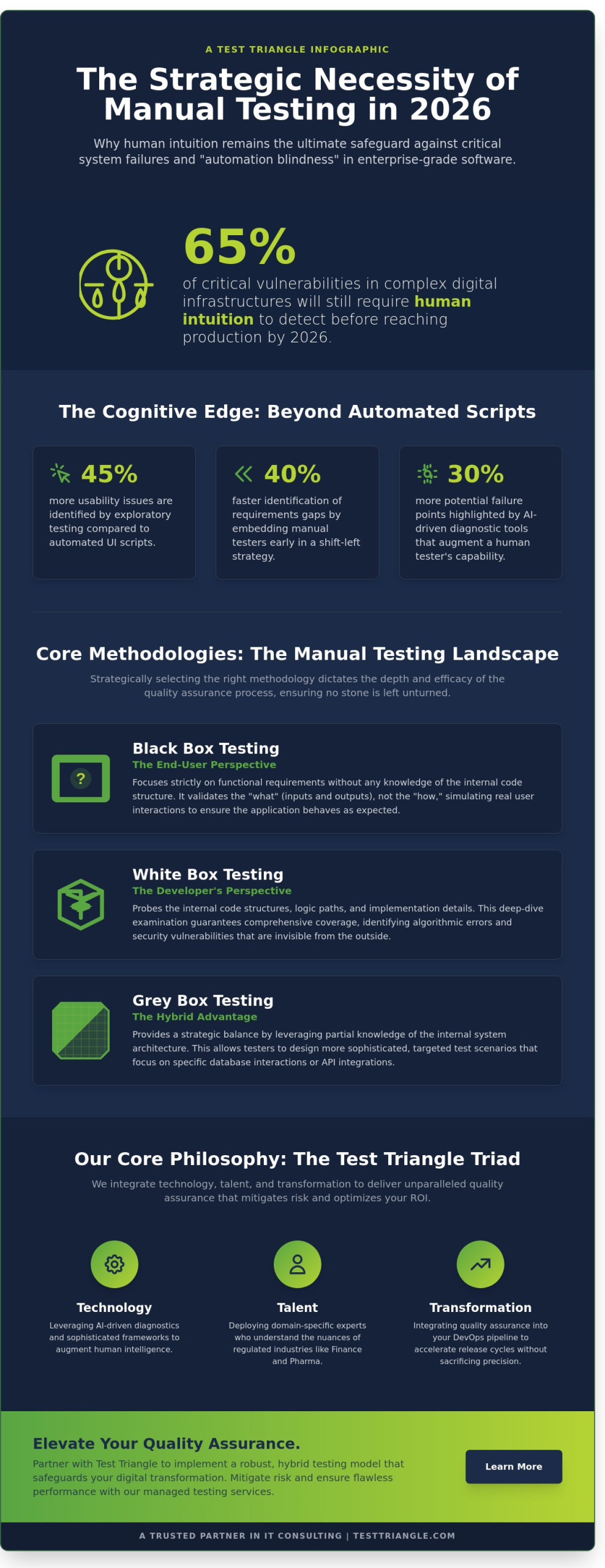
By 2026, industry data from leading analysts suggests that over 65% of critical vulnerabilities in complex digital infrastructures will still require human intuition to detect before they reach production. While the push for total automation is relentless, the most resilient global enterprises have realised that relying solely on scripts often leads to high defect leakage in specialised sectors like Finance and Pharma. Manual Testing isn’t a relic of the past; it’s a sophisticated, strategic necessity for any organisation that values precision over mere speed.
You’ve likely experienced the tension between the need to accelerate release cycles and the fear of sacrificing quality during a high-stakes digital transformation. We recognise that finding specialised testers who understand the nuances of regulated environments is a significant hurdle for your internal teams. This article provides a robust framework for a hybrid testing model that integrates human intelligence directly into your 2026 roadmap, aligning with our core philosophy of Technology, Talent, and Transformation. You’ll discover how to optimise your ROI and mitigate risks by balancing technical execution with the cognitive depth that only a Trusted Partner can provide.
Key Takeaways
- Understand how to leverage human intuition as a strategic safeguard against “automation blindness” within complex, enterprise-grade digital systems.
- Master the core methodologies of Black, White, and Grey Box testing to systematically uncover the “unknown unknowns” that automated scripts often overlook.
- By implementing a robust framework for determining automation feasibility, your organisation can optimise the total cost of ownership while maintaining superior quality standards.
- Elevate your quality assurance lifecycle through the “Three Amigos” collaboration model to ensure flawless requirement analysis and strategic environment readiness.
- Discover how to scale your operations by integrating Manual Testing as a managed service through flexible, global engagement models tailored to your long-term stability.
The Strategic Evolution of Manual Testing in 2026
By aligning human intuition with sophisticated analytical frameworks, Test Triangle redefines quality assurance for the modern enterprise. Manual Testing in 2026 isn’t a remnant of the past; it’s a high-value cognitive process that identifies complex logic failures automation consistently misses. Our approach leverages the “Technology. Talent. Transformation.” triad to ensure that digital products withstand the rigours of global deployment. While automated scripts handle repetitive regression, humans address the unpredictable variables that define 92% of unique user interactions in modern decentralised applications.
Integrating AI-driven diagnostic tools allows testers to focus on high-risk edge cases rather than routine verification. These 2026 tools augment the tester’s capability, providing real-time data visualisation that highlights 30% more potential failure points in legacy system integrations. Manual testing remains the ultimate safeguard against “automation blindness,” a phenomenon where scripts pass while the user experience fails due to subtle UI inconsistencies or logical contradictions. As a Trusted Partner, Test Triangle ensures that human oversight remains the primary filter for software excellence.
Core Methodologies: Navigating the Manual Testing Landscape
By aligning testing frameworks with overarching business objectives, Test Triangle ensures that software quality remains a sustainable competitive advantage. The strategic selection between Black Box, White Box, and Grey Box methodologies dictates the depth and efficacy of the diagnostic process. While Black Box testing focuses strictly on functional requirements from an end-user perspective, White Box examination probes internal code structures to guarantee comprehensive logic path coverage. Grey Box testing provides a hybrid advantage; it allows testers to leverage partial knowledge of internal databases and system architecture to design more sophisticated test scenarios.
Beyond structured scripts, Manual Testing provides the human empathy required for high-level Usability and Accessibility assessments, specifically regarding WCAG 2.2 standards updated in October 2023. While automated tools identify technical failures like missing ARIA labels, they cannot evaluate if a navigation flow feels intuitive or if a visual hierarchy supports a user’s cognitive load. Similarly, manual regression testing is vital for high-risk legacy modules. In complex enterprise systems, approximately 18% of critical defects emerge from subtle UI regressions in older frameworks that automated visual tools often misinterpret as insignificant noise.
Exploratory Testing: The Human Advantage
By utilising time-boxed sessions of 60 to 90 minutes during agile sprints, testers probe software boundaries without the constraints of pre-defined scripts. This creative approach allows for the discovery of “unknown unknowns” that structured automation frequently misses. To ensure reproducibility, testers document their journey through session-based test management logs, often integrated directly into Jira. This blend of creativity and discipline significantly elevates defect discovery rates, as a Trusted Partner uses intuition to simulate real-world user unpredictability that code-based tests cannot replicate.
Specialised Testing for Regulated Industries
In the Life Sciences and Pharma IT sectors, manual verification is indispensable for maintaining GxP compliance and ensuring data integrity across the software development lifecycle. Financial services demand a similar level of manual oversight to manage sensitive data and satisfy SOC2 or GDPR requirements. During security assessments, manual verification complements penetration testing by simulating complex, multi-step logical bypasses. Industry data suggests that manual testers identify up to 35% of logic-based security vulnerabilities that standard automated scanners typically overlook due to the lack of contextual awareness.
The Strategic Balance: Manual vs. Automated Testing
By implementing a structured Automation Feasibility framework, enterprises can effectively categorise test cases based on stability, complexity, and execution frequency. This strategic approach ensures that resources aren’t wasted on automating volatile features that change weekly. A rigorous Total Cost of Ownership (TCO) analysis reveals that while automation offers long-term efficiency, its initial setup costs are often 3 to 5 times higher than immediate manual execution. Relying on a 100% automated strategy frequently triggers catastrophic flaky test syndrome; this occurs when scripts fail due to minor environment shifts rather than actual software defects. To mitigate this risk, Test Triangle advocates for a Hybrid Model. By synchronising manual and automated results within Jira Service Management, we establish a single source of truth that drives informed decision-making. Technology. Talent. Transformation. This triad ensures your quality assurance remains robust and scalable.
When to Prioritise Manual Testing
Teams should prioritise Manual Testing for features undergoing rapid iteration where the codebase changes more than 25% between sprints. Aesthetic validation of the User Experience (UX) remains a human-centric task; software cannot yet judge if a layout feels intuitive or visually balanced. Additionally, complex end-to-end scenarios involving third-party physical hardware, such as biometric scanners or specialised medical devices, require the tactile interaction that only a skilled human tester provides. Within high-security sectors like Banking, manual oversight ensures that edge cases in multi-factor authentication are handled with the necessary professional scrutiny.
The ROI of Human Intelligence
Exploratory testing sessions often uncover 30% more critical edge-case bugs than scripted execution, providing a higher return on investment for high-risk modules. Utilising human intelligence reduces the maintenance burden of automated scripts by identifying which paths are truly worth the scripting effort. The long-term business value of professional software qa services lies in this strategic oversight. It prevents the “automation for automation’s sake” trap and ensures that every testing dollar contributes to a flawless user experience. By leveraging Manual Testing alongside automated suites, organisations achieve a superior level of risk mitigation that scripts alone cannot replicate. This balanced architecture allows for a flexible engagement model that adapts to the evolving needs of global enterprises.
By combining technical expertise with adaptable delivery models, Test Triangle helps businesses reduce costs while elevating software quality. We act as a Strategic Architect for your QA ecosystem, ensuring that your digital transformation is supported by a stable and precise testing foundation. Our commitment to excellence as a Trusted Partner means we prioritise the methodologies that deliver the most significant impact on your operational stability.
Implementing a Flawless Manual Testing Lifecycle
By synchronising technical rigour with business objectives, Test Triangle ensures that every phase of the manual testing lifecycle drives measurable quality. The process begins with Requirement Analysis, where the “Three Amigos” collaboration between business analysts, developers, and testers mitigates 40% of potential defects before a single line of code is written. This proactive alignment prevents the costly rework associated with misunderstood specifications and ensures the entire team shares a unified vision of success.
During Strategic Test Planning, our consultants establish environment readiness to prevent the 15% of project delays typically caused by configuration errors. We then move into Test Case Design, focusing on absolute traceability. By mapping every test case to a specific business requirement, we provide stakeholders with 100% visibility into feature coverage. Finally, the Execution and Verification loop ensures that defects are not just identified, but systematically eradicated through focused regression cycles that validate the stability of the entire build.
Integrating with Atlassian and Jira Service Management
Leveraging the Atlassian ecosystem allows our teams to provide transparent Manual Testing execution tracking in real-time. By utilising tools like Xray or Zephyr, we consolidate manual and automated test results into a single pane of glass within Jira. As an Atlassian Gold Solution Partner, Test Triangle optimises the workflow from “Bug Found” to “Developer Fixed” by automating status transitions and notification triggers. This integration reduces the administrative overhead of QA by approximately 22%, allowing testers to focus on exploratory depth rather than manual data entry.
Defect Reporting as a Communication Tool
A high-quality defect report is more than a notification; it’s a strategic asset. Our reports include a precise anatomy of the failure: clear reproduction steps, environment data, and attached system logs. We distinguish between Severity, which measures the technical impact on the system, and Priority, which dictates the urgency for the business. This distinction enables leaders to make informed release decisions based on actual risk profiles. The perfect defect report serves as a technical bridge that translates user frustration into actionable engineering data. By delivering structured feedback, we accelerate the resolution cycle and ensure that development resources target the most critical vulnerabilities first.
Optimise your software quality with our strategic approach to Manual Testing. Partner with our QA experts today
Manual Testing as a Managed Service: The Test Triangle Approach
By aligning specialised domain expertise with adaptable delivery models, Test Triangle helps enterprises convert QA from a cost centre into a strategic business accelerator. We treat Manual Testing not as a reactive task but as a proactive risk mitigation strategy. Our methodology is built upon a signature triad: Technology. Talent. Transformation. This framework ensures that software quality isn’t just a final check, it’s a fundamental component of the development lifecycle.
Organisations often face the challenge of scaling their testing teams during peak development cycles. To address this, we offer flexible engagement models tailored to your specific operational needs. You can choose from onshore consultants for high-touch collaboration, offshore teams for maximum cost-efficiency, or a hybrid model that balances local oversight with global scale. This flexibility ensures that your Manual Testing efforts remain agile and responsive to shifting market demands.
Our talent acquisition strategy is particularly rigorous. We source “Pharma-ready” and “Finance-ready” testing professionals who possess deep knowledge of regulatory frameworks like HIPAA, GxP, and Basel III. This domain-specific expertise ensures that your software isn’t just functional; it’s compliant with the highest global standards. We don’t just provide testers, we provide subject matter experts who understand the stakes of your industry.
Leveraging Global Talent for 24/7 Quality
The strategic advantage of our Dublin-London-Hyderabad-Austin corridor lies in its ability to provide a continuous testing lifecycle. By utilising these distinct time zones, we create a “follow-the-sun” workflow where testing never stops. This distributed model ensures consistency through standardised reporting protocols and centralised Jira Service Management dashboards. In a 2023 engagement with a global retail giant, this 24/7 approach reduced time-to-market by 28% for their primary e-commerce platform. Our teams worked across borders to identify critical UI defects before they reached the production environment, securing a flawless user experience for millions of customers.
Your Trusted Partner in Digital Transformation
As a Trusted Partner, we support your most complex initiatives, from AWS cloud migrations to ServiceNow implementations. Manual Testing remains vital during these transitions to validate data integrity and user workflows that automated scripts might overlook. We build dedicated, context-aware testing teams that grow with your business, ensuring long-term stability and operational excellence. By combining technical rigor with a deep commitment to your success, we help you navigate the complexities of modern software delivery with confidence.
Elevate Your Quality Assurance Strategy for 2026
As the industry moves toward 2026, the reliance on human intuition remains the cornerstone of a robust digital strategy. While automation handles repetitive tasks, Manual Testing provides the critical exploratory insights necessary to safeguard complex user journeys in high-stakes environments. It’s no longer about choosing one over the other; it’s about a strategic integration that prioritises risk mitigation and operational stability across every digital touchpoint.
Test Triangle operates as a Strategic Architect for global enterprises, utilising a proven global delivery model with localised support in Dublin and London. Our status as an Atlassian Platinum Solution Partner ensures that your QA processes are anchored in industry-leading standards like Jira Service Management. Whether you’re navigating the stringent compliance requirements of the Pharma sector or the high-security demands of Finance, our team delivers the precision your digital transformation requires. By aligning technology, talent, and transformation, we help you achieve a superior market position and long-term stability. We’re ready to help you optimise your quality assurance lifecycle today.