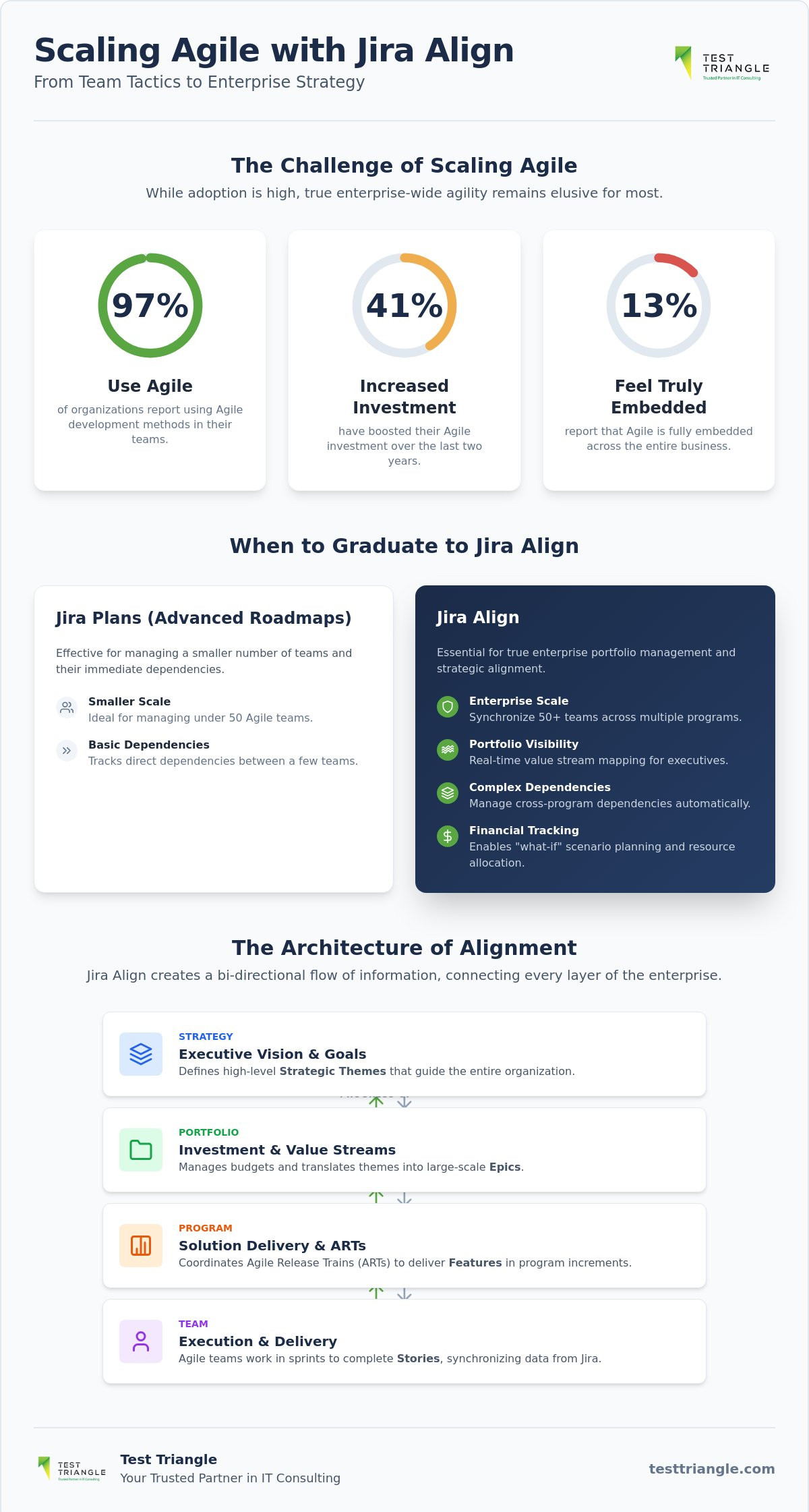
While 97% of organizations report using Agile development, a staggering 41% have increased their investment over the last two years only to find that a mere 13% feel Agile is truly embedded across their business. This disconnect often stems from a lack of visibility into cross-team dependencies and strategic goals that fail to reflect in daily development work. If you’re struggling to understand how to scale agile with jira align across hundreds of manual Jira boards, you’re not alone in seeking a more disciplined approach to digital transformation.

We understand that your primary objective is to move beyond simple output tracking and toward genuine outcome alignment. This 2026 strategic guide promises to help you master the complexities of enterprise-scale agility by connecting team-level execution to executive strategy using the latest Jira Align v.11.25 capabilities and preparing for the v.11.27.0 feature set. You’ll learn how to replace manual reporting with real-time visibility into portfolio health and automated dependency management. We’ll explore the implementation of framework-agnostic strategies that ensure your investments directly drive delivery, providing the stability, precision, and growth your global enterprise requires for long-term success.

Key Takeaways

  • Master the multi-layered architecture of Jira Align to effectively bridge the visibility gap between high-level executive strategy and granular team execution.
  • Evaluate the flexibility of various scaling frameworks, including SAFe and LeSS, to determine the optimal configuration for your unique organizational requirements.
  • Execute a structured implementation roadmap that prioritizes data hygiene and executive alignment to ensure a successful transition when learning how to scale agile with jira align.
  • Leverage predictive AI-driven insights to identify delivery risks and resource bottlenecks before they impact your portfolio’s strategic health.
  • Transform fragmented team data into a bi-directional flow of information that empowers leadership with real-time visibility into the relationship between investment and delivery.

What is Jira Align and Why Does Enterprise Agility Require It?

By establishing a bi-directional flow of information, Jira Align functions as the enterprise-scale bridge that connects high-level executive strategy with granular team-level execution. While Jira Software excels at managing the tactical workflows of individual teams, it often leaves a visibility gap when organizations attempt to synchronize multiple Agile Release Trains (ARTs) across a global footprint. For organizations with 500 or more developers, the challenge isn’t just about managing tasks; it’s about ensuring that every line of code contributes to a defined business outcome. Jira Align provides the necessary infrastructure to align, accelerate, and achieve these objectives through real-time data synchronization across the entire enterprise.

Understanding how to scale agile with jira align requires a fundamental shift in perspective, moving from tracking team outputs to measuring strategic outcomes. As organizations adopt the Scaled Agile Framework (SAFe) or other enterprise models, the complexity of managing cross-team dependencies often becomes a bottleneck. Jira Align resolves this by aggregating data from hundreds of Jira boards into a single, coherent portfolio view, providing the institutional maturity required to manage digital transformation at scale. For those moving toward this level of maturity, engaging with Atlassian implementation experts ensures that the technical configuration mirrors the organizational strategy.

The Disconnect Between Strategy and Execution

In many large-scale environments, development often becomes a “black box” to C-suite stakeholders, where strategic goals are set at the top but lose clarity as they cascade down to the teams. This misalignment results in wasted resources on low-value features that don’t move the needle on key business metrics. By implementing Jira Align, companies transition from project-centric models to product-centric delivery. This shift allows leadership to see exactly how investment translates into progress, ensuring that daily development work remains anchored in the company’s long-term vision and operational stability.

Jira Align vs. Jira Plans (Advanced Roadmaps)

Deciding when to graduate from Jira Plans to Jira Align is a critical strategic milestone. While Jira Plans is effective for managing a small number of teams and their immediate dependencies, it lacks the depth required for true portfolio management and financial tracking. The tipping point for Jira Align investment typically occurs when:

  • Organizations need to synchronize 50 or more agile teams across multiple programs.
  • Executive leadership requires real-time visibility into value stream mapping and strategic snapshots.
  • Financial tracking and “what-if” scenario planning become necessary for resource allocation.
  • The complexity of cross-program dependencies exceeds what manual reporting can reliably manage.

Jira Align v.11.25 provides the sophisticated toolset needed to manage these complexities, offering a level of precision that standard roadmapping tools simply cannot match.

The Architecture of Alignment: How Jira Align Functions

Jira Align operates on a hierarchical architecture specifically engineered to synchronize the disparate layers of a global enterprise. Unlike standard project management tools that focus on linear task completion, this platform establishes a bi-directional flow of information between technical execution and business value. Understanding how to scale agile with jira align requires a deep dive into its four primary levels of scale: Strategy, Portfolio, Program, and Team. By connecting these layers, the platform ensures that every story point delivered at the team level contributes directly to a Strategic Theme defined at the executive level. This structural integrity is what allows organizations to move beyond simply “doing” agile to truly Achieving Agility across the entire business ecosystem.

The core of this functionality lies in the “Room” concept, which provides tailored environments for different stakeholders to collaborate. These Rooms act as command centers, aggregating data from Jira Software and transforming it into actionable insights. For instance, while developers work within their familiar Jira boards, their progress is automatically rolled up into Program and Portfolio views. This data hierarchy ensures that Epics, Features, and Stories remain tethered to the overarching mission, eliminating the manual data entry that often plagues large-scale transformations. If your organization is struggling to map these complex relationships, you may benefit from a professional consultation on enterprise architecture design to ensure your data hygiene supports your scaling goals.

The Strategy and Portfolio Rooms

The Strategy Room is where executive leadership defines the long-term goals and Strategic Themes that drive the enterprise. Here, the focus shifts from individual projects to funding value streams, allowing for more flexible resource allocation based on real-time performance. By tracking Investment Themes, portfolio managers can ensure that budgets remain aligned with business priorities. This level of oversight provides the peace of mind that comes from knowing capital is being deployed toward the highest-value initiatives, rather than being lost in low-impact development cycles.

The Program and Team Layers

At the Program and Team layers, the architecture focuses on execution and dependency management. The Program Board serves as a vital visualization tool, highlighting cross-team dependencies that could jeopardize delivery timelines. Meanwhile, the Team Room provides developers with a clear view of how their specific stories contribute to the broader Program increment. This visibility empowers teams by providing context, while the automated roll-up of story points provides leadership with an accurate, real-time reflection of program-level progress. This seamless integration ensures that how to scale agile with jira align becomes a matter of operational rhythm rather than constant manual intervention.

Selecting Your Framework: SAFe, LeSS, or Hybrid?

Choosing the right framework is a pivotal decision that defines the trajectory of an enterprise’s agility journey and its ultimate operational stability. While many organizations gravitate toward the Scaled Agile Framework (SAFe) due to its comprehensive structure, Jira Align provides the necessary flexibility to support diverse methodologies including LeSS, Scrum@Scale, and the Spotify model. This framework-agnostic capability allows enterprises to customize the platform to fit their unique organizational DNA, ensuring that the software adapts to the business rather than forcing the business to adapt to the software. By establishing this adaptable foundation, leadership can maintain institutional maturity while allowing teams the autonomy they need to excel.

In many global infrastructures, it’s common to find hybrid environments where different departments employ varying agile methodologies simultaneously to meet their specific delivery needs. Understanding how to scale agile with jira align in these complex scenarios involves mapping disparate terminologies into a unified, coherent interface. By translating team-level data into a standardized language of Features and Strategic Themes, the platform provides a cohesive view of progress across the entire enterprise, regardless of the underlying framework used by individual teams. This alignment ensures that technical managers and executive leadership remain synchronized, fostering a spirit of partnership and shared success across the organization.

Optimizing the Scaled Agile Framework (SAFe)

For organizations committed to SAFe, Jira Align acts as a powerful accelerator by automating the labor-intensive aspects of PI Planning and reducing the manual effort associated with big-room synchronization. The digital Program Board provides a real-time visualization of the Agile Release Train (ART), allowing release train engineers to identify and resolve blockers instantly before they jeopardize the current Program Increment (PI). Jira Align proactively manages cross-team dependencies by providing automated conflict alerts and visual health indicators to prevent delivery delays and maintain release predictability.

Beyond Frameworks: Value Stream Management

True organizational progress requires moving beyond mere framework compliance to focus on the efficient flow of value from concept to cash. Jira Align empowers leadership to identify systemic bottlenecks within complex value streams, providing the data necessary to optimize resource allocation and improve time-to-market. By mapping these enterprise value streams, organizations can ensure that every development effort is directly contributing to revenue generation or strategic growth. To achieve this level of operational excellence, many enterprises leverage Digital Transformation Services to refine their processes and ensure their technology stack fully supports their value delivery goals.

Implementation Roadmap: Steps to Scale Agile Successfully

Scaling agile at the enterprise level requires a methodical, multi-phased approach that prioritizes organizational readiness over technical configuration. When considering how to scale agile with jira align, the most successful implementations follow a structured roadmap that begins with executive alignment and value stream identification. This initial phase ensures that leadership agrees on the definition of value before any data is synchronized. Following this, organizations must move through a rigorous process of data hygiene, pilot programs, and eventual portfolio-wide expansion to ensure long-term stability and precision. Moving too quickly without these foundations often leads to fragmented visibility and wasted resources.

The roadmap typically unfolds across five distinct phases designed to build institutional maturity and operational stability:

  • Phase 1: Executive Alignment: Defining the strategic themes and value streams that will anchor the transformation. This phase focuses on connecting business outcomes to technical delivery.
  • Phase 2: Data Hygiene: Standardizing Jira Software configurations to ensure a “single source of truth.” This involves cleaning up legacy boards and field configurations that could distort portfolio reporting.
  • Phase 3: The Pilot Program: Selecting a single Program or Agile Release Train (ART) for initial rollout. This allows the organization to test and refine its configuration in a controlled environment.
  • Phase 4: Scaling Out: Expanding the implementation across the full enterprise portfolio once successful patterns and governance models are established.
  • Phase 5: Continuous Optimization: Refining executive dashboards to track ROI. As of the v.11.25 release in mid-2026, these dashboards offer more granular insights into the relationship between investment and delivery.

Preparing Your Data for Jira Align

The “Garbage In, Garbage Out” risk is the single most common cause of implementation failure in large organizations. Before synchronizing any data, technical managers must standardize issue types, statuses, and field configurations across all team-level boards. Mapping Jira Software projects to the Align Program layer effectively requires a disciplined approach to metadata to ensure that story points roll up accurately. You can discover how DevOps Consulting supports this level of data integrity by establishing automated guardrails for your development lifecycle.

Training and Cultural Adoption

Successful scaling is as much about people as it is about platforms. To overcome “tool fatigue” in large-scale enterprise environments, organizations should establish a Center of Excellence (CoE) to provide long-term governance and support. This body serves as the steady hand that ensures the platform evolves alongside the business, maintaining the institutional maturity required for global operations. You can explore Atlassian Consulting for tailored training programs that help your teams embrace these new ways of working. If you’re ready to begin your journey, request a strategic roadmap assessment to ensure your implementation is built on a foundation of expert knowledge.
How to Scale Agile with Jira Align: The 2026 Enterprise Strategic Guide

Future-Proofing Your Scale: Jira Align in 2026 and Beyond

As we move deeper into 2026, the metrics of success for enterprise agility are undergoing a fundamental transformation, shifting the focus from simple team velocity to the tangible measurement of Business Value Delivered. Mastering how to scale agile with jira align now involves leveraging advanced machine learning algorithms that predict delivery risks and resource bottlenecks before they impact the bottom line. This evolution ensures that the “Strategy Collection” within the Atlassian ecosystem is no longer just a repository of goals but a dynamic engine for organizational progress. By integrating Jira Align with broader strategic tools, enterprises can achieve a level of precision that was previously unattainable, allowing technical execution to stay perfectly in sync with high-level corporate objectives.

The integration of AI-driven portfolio insights marks a departure from reactive reporting toward a more disciplined, proactive management style. In the current landscape, the ability to anticipate resource constraints across multiple value streams provides the peace of mind that comes from systemic risk reduction. For global enterprises operating in highly regulated industries, this predictive capability is essential for maintaining operational stability and ensuring that large-scale technological evolution remains on track. Understanding how to scale agile with jira align in this context means moving beyond basic synchronization to embrace a platform that actively suggests optimizations for your investment themes.

The Human + AI Enterprise

Augmenting PMO decision-making with AI-generated “what-if” scenarios allows leadership to explore various resource allocation models without disrupting current delivery cycles. This synergy between automated insights and human leadership ensures that strategic intuition is backed by data-driven certainty, empowering technical managers to make informed adjustments in real time. In 2026, AI in portfolio management serves as a predictive rather than reactive force, identifying potential slippage weeks before it manifests in development boards. This transition allows organizations to maintain a steady hand in a fast-changing technological landscape, emphasizing progress through a combination of human expertise and technical precision.

Partnering for Long-Term Success

Navigating the complexities of a mature Atlassian ecosystem requires more than just technical configuration; it demands a strategic visionary who remains deeply practical. While “out-of-the-box” implementations often fail to account for unique organizational DNA, a custom approach ensures that the platform supports your specific digital transformation goals. Test Triangle acts as a reliable long-term collaborator, providing the institutional maturity and human expertise needed to turn technical tools into scalable growth engines. To ensure your organization is positioned for success in an increasingly complex environment, Contact Test Triangle for a Strategic Jira Align Roadmap and secure the expert guidance required for your agile journey.

Mastering Enterprise Agility: Your Strategic Path Forward

Achieving a seamless connection between executive vision and team execution requires more than just a software implementation; it demands a disciplined commitment to data hygiene and architectural alignment. By leveraging the multi-layered structure of Jira Align, organizations can move beyond simple task tracking to visualize the genuine business value delivered across every value stream. Whether you’re adopting SAFe or a hybrid model, the platform provides the flexibility needed to maintain institutional maturity while utilizing AI-driven insights to predict delivery risks. Learning how to scale agile with jira align is the definitive step toward a future where strategy and delivery are perfectly synchronized.

As an Authorized Atlassian Gold Solution Partner with specialized expertise in highly regulated industries like Finance and Pharma, Test Triangle acts as a reliable long-term collaborator for your digital transformation. Our global delivery model offers the remote and offshore flexibility necessary to support your complex digital infrastructure with precision and stability. Scale Your Enterprise Agility with Test Triangle's Atlassian Experts today and empower your organization with the tools and expertise required for sustainable, scalable growth.

Frequently Asked Questions

What is the minimum team size recommended for Jira Align?

Jira Align is specifically engineered for large-scale environments, typically recommended for organizations managing 50 or more agile teams or at least 500 developers. While smaller organizations might find value in its reporting, the platform’s architecture is optimized for the complexity of multiple Agile Release Trains (ARTs) and high-level portfolio management. Investing in this tool is most effective when your primary challenge is synchronizing work across hundreds of people rather than just a few squads.

How long does a typical Jira Align implementation take?

A standard enterprise implementation of Jira Align generally spans three to six months, moving from initial configuration to full cultural adoption. This timeline is heavily influenced by your organization’s existing agile maturity and the complexity of your value streams. Starting with a focused pilot program allows you to establish successful patterns before expanding to the broader portfolio, ensuring a more stable and predictable rollout across the global enterprise.

Can Jira Align integrate with tools other than Jira Software?

While Jira Align is naturally optimized for the Atlassian ecosystem, it supports integration with other work management platforms such as Azure DevOps. This flexibility allows global organizations to maintain a single source of truth at the portfolio level even if different departments utilize various team-level tools. Establishing these bi-directional links ensures that strategic themes remain visible across the entire infrastructure, regardless of the specific software used for daily execution.

What is the difference between Jira Align and Advanced Roadmaps?

The primary difference lies in scale and strategic depth, as Jira Plans (Advanced Roadmaps) focuses on team-level delivery while Jira Align bridges the gap to executive strategy. Advanced Roadmaps is ideal for coordinating up to 20 teams, but it lacks the financial tracking and portfolio-level insights required for true enterprise agility. Jira Align provides the institutional maturity needed to manage value streams and strategic snapshots that smaller roadmapping tools cannot support.

Does Jira Align support the Scaled Agile Framework (SAFe) natively?

Jira Align provides native, comprehensive support for the Scaled Agile Framework (SAFe) and is often considered the industry standard for this methodology. The interface directly maps SAFe terminology such as ARTs, PIs, and Strategic Themes to ensure a seamless transition for practitioners. However, its framework-agnostic design means it remains versatile enough to support LeSS, Scrum@Scale, or custom hybrid models effectively while maintaining operational stability.

What are the common pitfalls when scaling agile with Jira Align?

The most significant pitfall is neglecting data hygiene, which leads to a “Garbage In, Garbage Out” scenario that undermines executive reporting. Many organizations also fail by treating the platform as a team-level task manager rather than a strategic alignment tool. Successfully learning how to scale agile with jira align requires strong executive buy-in and a clear focus on organizational change management to overcome tool fatigue and ensure long-term adoption.

How does Jira Align help with dependency management?

Jira Align facilitates automated dependency management by visualizing cross-team links on the digital Program Board to identify potential delivery risks instantly. This real-time visibility allows technical managers to resolve blockers before they impact the Program Increment (PI) schedule or strategic objectives. By replacing manual spreadsheets with automated conflict alerts, the platform provides the precision needed to maintain a steady flow of value across complex, global development environments.

Paul Guy

Article by

Paul Guy

Paul serves as the Marketing Director at Test Triangle, where he leads a global team in driving growth through strategic B2B marketing and brand communications. With a strong emphasis on measurable outcomes and sustainable performance, he plays a pivotal role in aligning marketing functions to enhance customer engagement and accelerate business impact. Under his leadership, marketing initiatives have consistently delivered significant returns on investment, elevated brand visibility, and strengthened the company's presence across key markets.

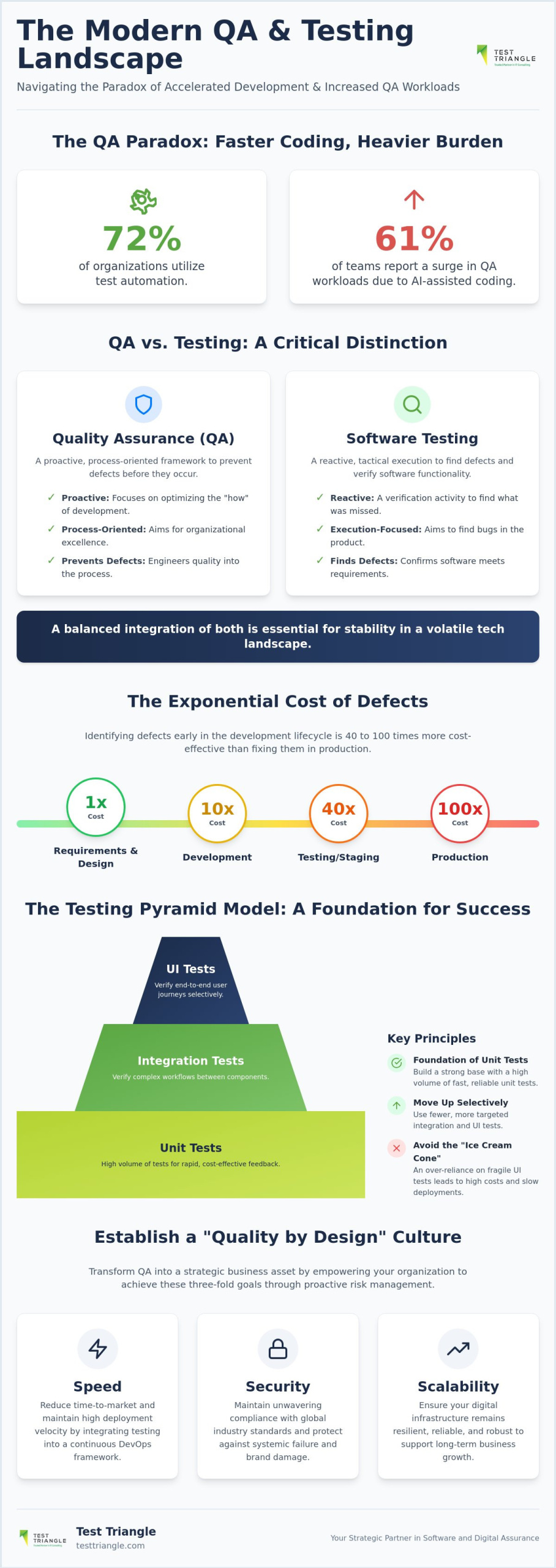

With 72% of organizations now utilizing test automation, you might expect the burden on development teams to be lifting, yet 61% of teams report a dramatic surge in QA workloads due to the rise of AI-assisted coding. This paradox often leaves global enterprises trapped between the need for rapid deployment and the risk of high defect rates in production. When you’re operating within highly regulated industries, the challenge of finding specialized talent to manage Testing and QA Software testing only compounds these operational bottlenecks. You likely feel that your current testing framework is a hurdle to clear rather than a foundation to build upon.

We’re here to change that perspective by showing you how to transform quality assurance into a strategic business asset that drives speed, security, and scalability. As a reliable long-term collaborator, we provide a comprehensive roadmap for integrating manual, automation, and performance testing into a unified DevOps strategy. By aligning technical execution with long-term business outcomes, you’ll discover how to reduce time-to-market, improve user experience, and maintain unwavering compliance with global industry standards. We will examine the specific methodologies, tools, and staffing models required to ensure your digital infrastructure remains resilient, reliable, and robust.

Key Takeaways

  • Understand the critical distinction between process-oriented quality assurance and execution-focused software testing to optimize resource allocation and mitigate the exponential costs of late-stage defect remediation.
  • Learn to deploy the Testing Pyramid model, which prioritizes unit and integration tests over UI-heavy suites to maintain high deployment velocity and operational efficiency.
  • Discover how to integrate Testing and QA Software testing into a continuous DevOps framework, ensuring that quality becomes an intrinsic component of your digital transformation journey.
  • Identify the strategic synergy between manual exploratory testing and automated performance checks to deliver a seamless user experience across complex, multi-platform environments.
  • Establish a “Quality by Design” culture that empowers your organization to achieve the three-fold goals of speed, security, and scalability through proactive risk management.

Demystifying Testing and QA: A Strategic Business Imperative for 2026

By 2026, the velocity of software delivery has reached a point where traditional, siloed validation methods are no longer sufficient to protect enterprise value. With over 53% of all code now being AI-generated or assisted, the sheer volume of output has created a paradox: development is faster, yet the risk of systemic failure is higher. This evolution has elevated Testing and QA Software testing from a tactical checkbox to a strategic pillar of digital resilience. For global organizations, quality is no longer just about finding bugs; it’s about engineering trust into every layer of the digital infrastructure.

The financial implications of this shift are stark. Industry data consistently demonstrates that identifying a defect during the initial requirement or design phase is 40 to 100 times more cost-effective than remediating the same issue once it reaches production. When a defect escapes into the wild, the costs aren’t merely financial; they include technical debt, operational downtime, and the erosion of customer loyalty. By integrating a comprehensive overview of software testing into the earliest stages of the development lifecycle, businesses can achieve a state of precision, predictability, and progress.

The ROI of a Mature QA Strategy

A sophisticated approach to quality assurance serves as a powerful engine for value creation. By reducing technical debt, organizations free up their engineering talent to focus on innovation rather than fire-fighting. In a high-stakes marketplace, a single high-profile failure can lead to significant churn and permanent brand damage. We position our software and digital assurance testing services to align directly with your corporate strategic roadmaps, ensuring that every testing milestone supports a broader business objective. This alignment transforms QA from a cost center into a catalyst for digital transformation services, empowering you to scale with confidence.

QA vs. Testing: Understanding the Methodology

While often used interchangeably, Quality Assurance and Software Testing represent two distinct but complementary disciplines. QA is a proactive, process-oriented framework designed to prevent defects before they occur. It focuses on organizational excellence and the “how” of development. Conversely, testing is a reactive, tactical execution of verification activities aimed at confirming that the software meets specific requirements. Your organization doesn’t need to choose between them; it needs a balanced integration of both. A robust framework for Testing and QA Software testing ensures that while the process is optimized for prevention, the execution remains rigorous enough to catch the unexpected. This dual-layered defense is what allows global enterprises to maintain stability in a volatile technological landscape.

The Core Pillars of Software Testing: From Unit to System Integration

Establishing a resilient digital infrastructure requires a disciplined adherence to the Testing Pyramid model. This framework dictates that the foundation of your strategy should consist of a high volume of unit tests, which provide rapid and cost-effective feedback during the earliest stages of development. As we move up the pyramid, integration and UI tests are applied more selectively to verify complex workflows and end-to-end user journeys. By maintaining this structural balance, enterprises can avoid the “ice cream cone” anti-pattern, where an over-reliance on fragile UI tests leads to high maintenance costs and slow deployment cycles. This hierarchy is essential for successful Testing and QA Software testing, ensuring that your quality framework remains both scalable and sustainable.

Beyond the structural pyramid, a mature strategy must address both functional and non-functional requirements. While functional testing confirms that the application executes its intended business logic, non-functional testing evaluates critical attributes such as performance, usability, and security. Given that the security testing market is growing at a 24.7% CAGR toward a projected $43.9 billion by 2029, vulnerability assessments have become a non-negotiable pillar of modern assurance. Understanding the strategic business implications of QA allows executive leadership to see these non-functional pillars as essential risk-mitigation tools that protect the organization’s reputation and financial stability.

Regression testing serves as the vital heartbeat of continuous delivery pipelines. It ensures that new code enhancements don’t inadvertently disrupt existing functionality, a risk that’s significantly amplified in the age of AI-assisted development. By automating regression suites, organizations can maintain a clean, production-ready codebase even as release cycles accelerate. If you’re seeking to modernize your validation frameworks, you might consult with our strategic partners to align your technical execution with enterprise-grade standards.

System Integration Testing (SIT) and User Acceptance (UAT)

SIT functions as the critical bridge where individual modules are validated as a cohesive system, ensuring that data flows seamlessly across internal and external interfaces. In complex enterprise environments, managing these dependencies requires a meticulous approach to environment stability and data integrity. Once the system is technically sound, UAT provides the final validation from the end-user perspective, confirming that the solution delivers the intended business value. You can learn about SIT in testing through our specialized assurance frameworks designed for regulated industries.

Integrating QA with Atlassian and ServiceNow Ecosystems

Operational efficiency is maximized when Testing and QA Software testing activities are deeply embedded within the platforms your teams already use. By leveraging Jira for transparent defect tracking, teams gain real-time visibility into the quality lifecycle, while ServiceNow implementation allows for the automation of ITSM workflows. This integration ensures that testing results are directly connected to service management and incident response. You should explore Atlassian implementation strategies to see how these tools foster collaboration between development and operations.

Execution is the ultimate proving ground for any quality strategy. While the previous sections established the structural pillars of quality, the actual delivery of Testing and QA Software testing involves navigating a spectrum that balances human intuition with algorithmic precision. Manual testing remains the indispensable human element for exploratory sessions and comprehensive UX assessments, allowing seasoned experts to uncover edge cases that scripted logic might overlook. This human-centric approach is vital for validating the nuances of user behavior and visual fidelity. For those seeking to understand the academic and practical foundations of these disciplines, reviewing a Software Testing and Quality Assurance syllabus provides a clear window into the rigorous standards required for professional validation.

Conversely, automation testing drives the speed and precision necessary for high-volume, repetitive tasks, enabling teams to maintain velocity without sacrificing accuracy. This is particularly critical when dealing with performance testing, which ensures that your digital infrastructure remains resilient under peak load and high-concurrency scenarios. By simulating real-world traffic, we identify architectural bottlenecks before they impact the end-user. This technical rigor is complemented by compatibility testing, which guarantees consistent experiences across an increasingly fragmented device ecosystem, ensuring that your application performs flawlessly regardless of the user’s hardware or operating system. We focus on delivering three core outcomes: stability, security, and scalability.

When to Automate and When to Stay Manual

A mature quality framework requires a strategic selection process to identify high-ROI automation candidates, such as stable regression suites and data-driven tests. Over-automation can lead to fragile test environments and high maintenance costs, which is why we advocate for a balanced approach that preserves the human perspective for complex usability challenges. You can explore our Manual Testing in 2026: A Strategic Guide to learn more about where human insight provides the greatest business value.

Performance and Load Testing for Enterprise Scalability

Enterprise-scale applications must be engineered to withstand seasonal spikes and global product launches without degradation. Our performance testing methodology involves rigorous stress testing to determine the absolute breaking point of your architecture, providing the data necessary for proactive capacity planning. For organizations looking to automate these complex checks within a CI/CD pipeline, our Software Test Automation Services for Scalable Quality offer a roadmap for sustainable growth and operational stability.

Establishing a Quality Culture: Implementation Strategies for Global Enterprises

Shifting the organizational mindset from “testing as a phase” to “quality as a culture” is the hallmark of a mature digital enterprise. This transition requires a fundamental commitment to “Shifting Left,” a strategy where validation activities are integrated into the earliest stages of the software development lifecycle. By addressing potential failures during the requirements and design phases, organizations move away from a reactive “detect and fix” cycle toward a proactive “prevent and protect” philosophy. This cultural realignment ensures that every stakeholder, from product owners to architects, views Testing and QA Software testing as a shared responsibility rather than a final hurdle before release.

Building a cross-functional DevOps culture focused on “Quality by Design” allows for the seamless integration of automated checks within continuous delivery pipelines. This isn’t merely about technical tools; it’s about fostering collaboration between development, operations, and assurance teams to eliminate silos. When quality is baked into the architecture, the result is a resilient infrastructure that supports rapid deployment without compromising security or performance. For global organizations, this structural discipline is what transforms a functional necessity into a strategic business asset that empowers long-term growth.

Specialized QA for Regulated Industries

In sectors like pharmaceuticals and life sciences, the stakes of software failure extend beyond financial loss to include regulatory and safety risks. Navigating GxP compliance requires a rigorous approach to validated software testing, ensuring that every digital tool meets the exacting standards of global health authorities. Similarly, securing financial platforms demands a specialized focus on penetration testing and data integrity. We provide the technical rigor and institutional maturity needed to manage these complexities. You can explore the industries we support with specialized QA to see how we tailor our frameworks to meet specific regulatory mandates.

QA Outsourcing and Staffing Models

Structuring a high-performing quality department often involves balancing internal expertise with flexible external resources. Many enterprises find that a Managed Service Provider (MSP) model offers the most sustainable path to long-term stability, providing consistent oversight and technical evolution that individual staffing often lacks. Whether you’re considering offshore teams for cost-efficiency or permanent placement for core IP retention, the choice of model must align with your strategic roadmap. Our QA Outsourcing: A Strategic Comparison provides a detailed framework for evaluating these options. If you’re ready to optimize your department’s structure, you should connect with our strategic advisory team to discuss a customized staffing or managed service solution.

Strategic Software Testing & QA: A Complete Guide

Test Triangle: Your Strategic Partner in Software and Digital Assurance

Achieving excellence in Testing and QA Software testing requires more than just technical proficiency; it demands a reliable long-term collaborator who understands the intersection of methodology, execution, and business value. We position ourselves as a high-level corporate partner for global organizations, providing comprehensive software and digital assurance testing that goes beyond basic bug detection. Our approach integrates strategic technology roadmapping with digital transformation services, ensuring that your quality framework evolves in lockstep with your broader organizational goals. By aligning our technical execution with your strategic vision, we empower your enterprise to navigate complex technological shifts with confidence and clarity.

Operational stability is further reinforced through our expert Atlassian and ServiceNow implementation services, which optimize your quality workflows and harmonize communication across departments. We recognize that every organization has unique resource requirements, which is why we offer highly adaptable IT staffing services. Whether your project requires specialized contract experts, remote/offshore development teams, or permanent placements to build internal IP, our flexible delivery models provide the technical rigor and scalability necessary for sustained success. We provide three core pillars for your digital journey: Precision, Progress, and Peace of mind.

Why Leading Enterprises Trust Test Triangle

With over a decade of institutional maturity and a global operational footprint across Europe, North America, and Asia, we bring a seasoned perspective to every engagement. Our deep expertise in DevOps consulting and AWS cloud migration allows us to manage complex digital infrastructures with unmatched discipline. By focusing on risk reduction and operational stability, we ensure that your technology stack remains a driver of growth rather than a source of liability. This commitment to excellence is why global leaders in finance, healthcare, and retail view us as an essential extension of their engineering departments.

Accelerate Your Quality Journey

We deliver customized IT service management services that are meticulously tailored to the specific demands of your industry. For those operating in highly regulated environments, our specialized talent provides the nuanced expertise required for pharmaceutical recruitment and life science resourcing projects. We don’t just provide services; we engineer the foundations of your future success. If you’re ready to transform your approach to quality assurance, you should Partner with Test Triangle for Strategic QA and discover the empowerment that comes from large-scale technological evolution.

Engineering Resilience for the Digital Future

The transition from a reactive validation model to a proactive, strategic business asset is the defining characteristic of a digitally resilient enterprise. By integrating the core pillars of the testing pyramid and fostering a cross-functional DevOps culture, organizations can significantly reduce technical debt while accelerating deployment velocity. This journey requires more than just technical tools; it demands a disciplined approach to Testing and QA Software testing that aligns technical execution with long-term corporate objectives. Whether you’re navigating the complexities of GxP compliance or scaling a global cloud infrastructure, the right framework provides the stability necessary for innovation.

As an Atlassian Gold Solution Partner with global delivery centers across Europe, North America, and Asia, we provide the institutional maturity and specialized expertise required for high-stakes digital environments. We’re committed to acting as your reliable long-term collaborator, offering the precision, protection, and progress your organization deserves. It’s time to transform your quality assurance from a functional necessity into a powerful engine for growth. We look forward to supporting your next phase of technological evolution.

Optimize your software quality with Test Triangle's strategic QA services

Frequently Asked Questions

What is the difference between QA and software testing in an enterprise context?

Quality Assurance (QA) focuses on the organizational processes designed to prevent defects before they occur, while software testing is the tactical execution of verifying that the code meets specific requirements. In an enterprise context, a mature strategy for Testing and QA Software testing integrates both to ensure systemic reliability and operational stability. This dual approach allows leadership to manage risk proactively rather than reacting to failures after deployment.

How much should a company invest in software testing and QA services?

Investment levels vary based on the complexity of the digital infrastructure and the regulatory requirements of the industry, though many global enterprises allocate a significant portion of their development budget to assurance activities. While specific costs depend on the service model, the focus should remain on the “cost of quality,” where early investment mitigates the 40 to 100 times higher expense of fixing production defects. A strategic partner helps balance these costs against the potential risk of brand damage.

Can you outsource software testing without losing control of project quality?

Outsourcing remains highly effective when managed through a strategic partnership model that emphasizes transparency, accountability, and shared goals. By utilizing a Managed Service Provider (MSP), organizations maintain oversight through integrated defect tracking and regular performance audits while benefiting from specialized technical expertise. This approach ensures that quality standards remain consistent across global delivery centers, allowing internal teams to focus on core innovation without sacrificing technical rigor.

What are the benefits of integrating QA with DevOps consulting?

Integrating quality assurance with DevOps consulting fosters a “Quality by Design” culture that accelerates release cycles through continuous testing and automated feedback loops. This synergy eliminates operational silos, enabling teams to identify vulnerabilities earlier in the software development lifecycle. The result is a resilient delivery pipeline that supports rapid deployment while maintaining high standards of stability, security, and scalability, which are essential for large-scale digital transformation.

Why is manual testing still necessary in an automation-first world?

Manual testing provides the indispensable human perspective required for exploratory sessions and complex user experience assessments that automated scripts cannot replicate. It allows seasoned experts to evaluate visual fidelity, intuitive navigation, and subtle edge cases that exist outside of predefined logical parameters. In a balanced Testing and QA Software testing framework, human insight acts as a critical safeguard, ensuring that the technology remains centered on the end-user’s needs.

How does Atlassian consulting improve the software testing lifecycle?

Atlassian consulting enhances the testing lifecycle by implementing industry-leading tools like Jira and Confluence to provide end-to-end traceability and transparent defect management. These platforms allow for the seamless synchronization of development and assurance tasks, ensuring that every stakeholder has real-time visibility into the project’s quality status. This structural discipline reduces communication gaps and streamlines the path from initial requirement to final deployment, fostering institutional maturity.

What is validated software testing for the pharmaceutical industry?

Validated software testing is a specialized assurance process designed to meet GxP compliance and other stringent regulatory mandates within the pharmaceutical and life science sectors. It involves rigorous documentation, comprehensive audit trails, and evidence-based verification to ensure that every digital tool performs consistently and safely. This level of technical rigor is essential for protecting patient safety and maintaining the legal integrity of the organization’s data in highly regulated global markets.

What is the typical ROI of implementing test automation services?

The return on investment for test automation is realized through significantly reduced regression cycles, improved bug detection rates, and the ability to execute high-volume tests with absolute precision. While initial implementation requires a strategic commitment, the long-term benefits include lower maintenance costs and a faster time-to-market for new features. Organizations that successfully deploy these services report a dramatic increase in operational efficiency, allowing their engineering talent to focus on high-value strategic initiatives.

Paul Guy

Article by

Paul Guy

Paul serves as the Marketing Director at Test Triangle, where he leads a global team in driving growth through strategic B2B marketing and brand communications. With a strong emphasis on measurable outcomes and sustainable performance, he plays a pivotal role in aligning marketing functions to enhance customer engagement and accelerate business impact. Under his leadership, marketing initiatives have consistently delivered significant returns on investment, elevated brand visibility, and strengthened the company's presence across key markets.

The era of treating service management as a back-office function has ended, replaced by a mandate for organizational agility that leaves no room for fragmented workflows or legacy inertia. Choosing a strategic Atlassian ITSM partner Ireland is no longer a simple procurement task but a critical business decision that determines your ability to scale amidst the 2026 regulatory shifts and the phased wind-down of Data Center licenses. You’ve likely experienced the frustration of over-customized systems that stifle innovation or the anxiety that comes with high-stakes cloud migrations that feel more like risks than opportunities.

With 43% of ITSM professionals now identifying advanced capabilities as their top priority, the need for a reliable long-term collaborator has never been more urgent. This guide provides a comprehensive framework to identify a partner who offers more than just technical support, focusing instead on stability, precision, and growth. You’ll learn how to evaluate expertise in Jira Service Management and the NIS2 Directive to ensure your infrastructure becomes a high-velocity engine. We’ll explore the essential markers of a visionary expert who can reduce your operational risk while delivering the seamless integration your enterprise requires for sustainable digital evolution.

Key Takeaways

  • Understand the fundamental shift from traditional ticketing to high-velocity service delivery, focusing on how Irish enterprises are prioritizing organizational agility to stay competitive in 2026.
  • Identify the essential criteria for selecting a certified Atlassian ITSM partner Ireland, emphasizing why Platinum Solution Partner status is non-negotiable for managing complex, enterprise-scale digital transformations.
  • Navigate the 2026 cloud migration imperative with a strategic roadmap designed to mitigate operational risk while transitioning from legacy Data Center environments to a scalable cloud infrastructure.
  • Learn how to bridge the gap between development and operations by transforming Jira Service Management into a unified Enterprise Service Management framework that supports seamless cross-team collaboration.
  • Discover the strategic advantage of a long-term collaborator who integrates human expertise with technical rigor to ensure compliance and security in highly regulated sectors like finance and pharma.

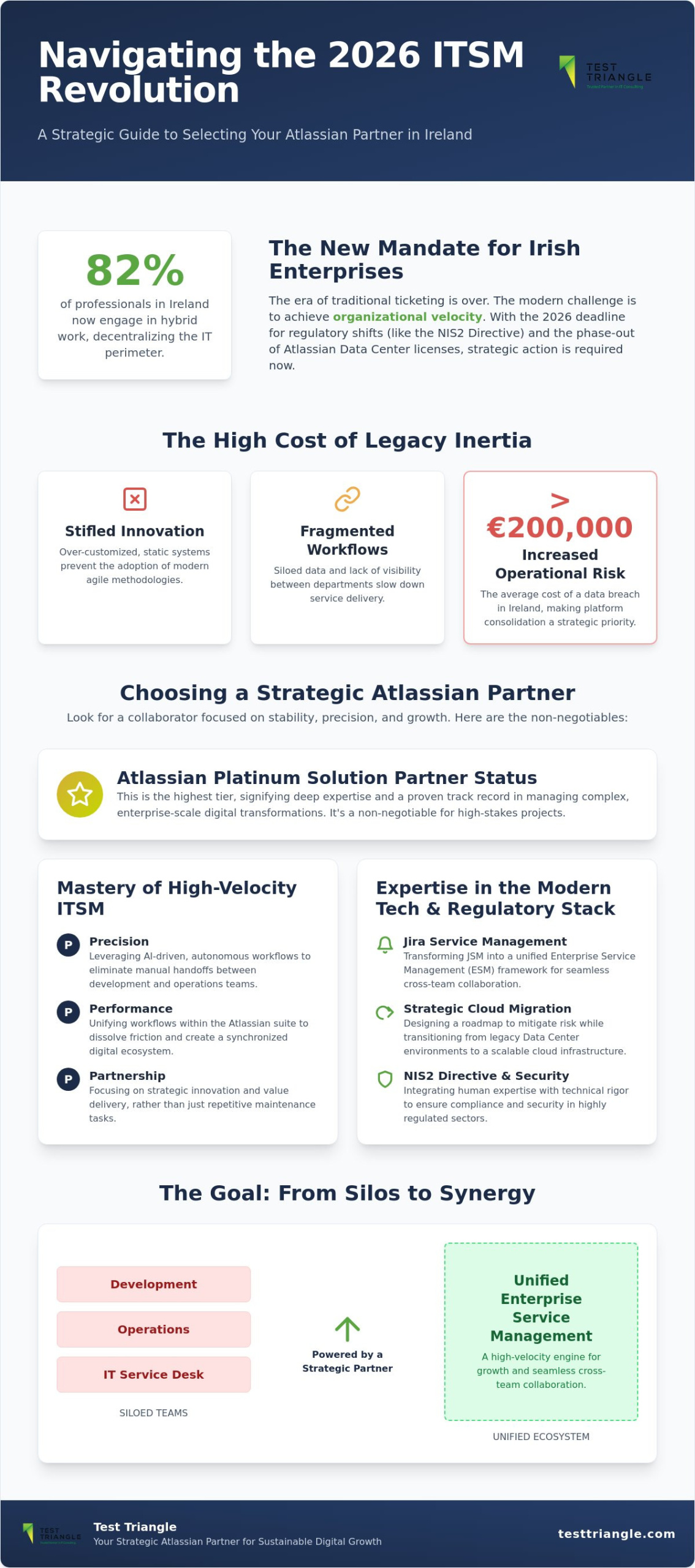
The Irish enterprise market is undergoing a seismic shift as 82% of professionals now engage in hybrid work, a reality that has decentralized the IT perimeter and rendered traditional ticketing systems obsolete. For an organization seeking a strategic Atlassian ITSM partner Ireland, the challenge lies in moving beyond basic ticket resolution toward a model of organizational velocity. Modern IT Service Management (ITSM) must now account for the NIS2 Directive’s stringent cybersecurity requirements while supporting a workforce that expects consumer-grade service speed. This evolution demands a strategic visionary who can align technical frameworks with business outcomes, ensuring that stability and scale remain at the forefront of every implementation.

The Move Toward High-Velocity Service Delivery

Velocity in the 2026 landscape transcends simple speed; it represents the rate at which an organization delivers value through its digital ecosystem. By unifying workflows within the Atlassian suite, businesses can effectively dissolve the friction that historically existed between development and operations teams, creating a synchronized environment where information flows without interruption. High-velocity ITSM in 2026 is defined by the autonomous orchestration of service requests through unified AI-driven workflows that eliminate manual handoffs between development and operations. This approach prioritizes Precision, Performance, and Partnership, allowing technical managers to focus on innovation rather than repetitive maintenance tasks while maintaining a steady hand on operational stability.

Navigating the 2026 Digital Transformation Agenda

Many Irish organizations currently struggle with over-customized legacy systems that hinder their digital transformation services and prevent the adoption of modern agile methodologies. These static configurations often lack the visibility required to manage cross-departmental workflows, leading to silos that slow down service delivery and increase operational risk. As a dedicated Atlassian ITSM partner Ireland, the focus must be on leveraging AI and automation to streamline service desk operations, providing executive leadership with the real-time data needed for informed decision-making. Visibility is no longer a luxury; it’s a mandatory requirement for maintaining resilience in a landscape where the average cost of a data breach in Ireland now exceeds €200,000, making platform consolidation a strategic priority for 2026 and beyond.

Beyond Basic Configuration: The Strategic Value of an Atlassian ITSM Partner

Internal teams often possess deep institutional knowledge but frequently lack the specialized, cross-platform experience required to optimize complex digital ecosystems. Selecting a premier Atlassian ITSM partner Ireland allows organizations to transcend basic technical setup, moving instead toward a model of strategic alignment that maximizes return on investment. While an internal rollout might solve immediate ticketing needs, a partner-led approach ensures that ITSM best practices are woven into the very fabric of the enterprise, providing a predictable infrastructure that reduces long-term operational risk. This partnership focuses on Strategy, Security, and Scalability, ensuring your tools evolve alongside your business objectives.

Strategic collaborators also provide essential oversight in Atlassian Licences management, identifying specific opportunities for cost optimization that internal procurement departments might overlook. By aligning license tiers with actual usage and 2026 growth projections, a partner ensures you aren’t overpaying for redundant features while maintaining the flexibility needed for large-scale technological evolution. In an era where the average cost of a data breach in Ireland exceeds €200,000, having a partner who prioritizes ISO 27001:2022 compliance and NIS2 readiness is a fundamental requirement for maintaining institutional maturity.

Unified Workflows: Connecting Development and Operations

High-velocity service delivery requires a seamless bridge between Jira Software and Jira Service Management. A strategic Atlassian ITSM partner Ireland orchestrates this integration, ensuring that developers and operations professionals share a single source of truth. This transparency reduces the mean time to resolution (MTTR) and fosters a culture of accountability, particularly in hybrid-work environments where decentralized teams must remain perfectly aligned. By implementing DevOps-driven IT Service Management Services, organizations can automate the flow of information from bug reports to feature requests, eliminating manual handoffs and the human error associated with fragmented legacy systems.

Expanding ITSM into Enterprise Service Management (ESM)

The core principles of structured service delivery are no longer confined to the IT department. Leading Irish enterprises are now expanding these frameworks into HR, Finance, and Legal to create a unified Enterprise Service Management (ESM) ecosystem. A partner facilitates this transition by managing both the cultural shift and the technical configuration required to standardize service delivery across all business units. This approach ensures that every department benefits from the same level of automation and visibility, transforming Jira Service Management into a comprehensive business engine. To explore how these strategic frameworks can be tailored to your specific organizational goals, it’s often beneficial to consult with a certified expert who understands the local regulatory landscape.

Strategic Selection: Criteria for Choosing an Atlassian ITSM Partner Ireland

Identifying the right Atlassian ITSM partner Ireland involves moving beyond a checklist of technical features toward a rigorous evaluation of strategic capability. In 2026, the complexity of digital ecosystems demands a collaborator who understands the nuances of the Irish regulatory landscape, particularly the NIS2 Directive, while maintaining a globally-minded perspective on service delivery. This choice is foundational to establishing a reliable long-term collaborator capable of achieving organizational progress through the disciplined combination of human expertise and advanced technical tools. Technical managers and executive leadership alike must prioritize a partner who demonstrates institutional maturity and a composed, solution-oriented approach to large-scale technological evolution.

Why Platinum Solution Partner Status Matters

Platinum status represents the pinnacle of the Atlassian partnership ecosystem, signaling a level of commitment and technical rigor that is essential for enterprise-scale projects. This designation is not easily earned; it requires a high volume of certified professionals and a track record of successfully managing complex, multi-layered implementations. While Gold partners provide reliable support for small to mid-sized organizations, Platinum partners possess the specialized expertise to architect high-velocity service delivery engines for global enterprises. This status ensures your organization benefits from direct access to Atlassian’s product development teams, providing a strategic advantage when planning long-term infrastructure roadmaps. Choosing a Platinum partner guarantees that your complex digital infrastructures are managed with the highest standards of expertise and reliability.

Assessing Strategy, Stability, and Scalability

A partner’s value is best measured by their ability to operate within highly regulated sectors such as Finance and Life Sciences, where precision is a mandatory requirement. Credentials like ISO 27001:2022 compliance offer tangible proof of a partner’s commitment to the highest standards of security and quality. When interviewing a potential Atlassian ITSM partner Ireland, look for a proven track record of reducing operational risk through certified expertise in Atlassian implementation and post-go-live support. It’s vital to assess their capacity to provide local, on-the-ground support in Ireland while leveraging a global perspective on emerging ITSM trends. A visionary partner should provide a steady hand in a fast-changing landscape, offering the Strategy, Stability, and Scalability needed to transform your service delivery into a competitive advantage. This disciplined approach ensures that your ITSM framework remains adaptable, resilient, and perfectly aligned with your long-term digital growth objectives, providing the peace of mind that only comes from true institutional maturity.

The Implementation Roadmap: Navigating Cloud Migration and Integration

As the wind-down of Atlassian Data Center products begins on March 30, 2026, shifting to a cloud-first infrastructure has become an immediate strategic priority. Managing this evolution requires an Atlassian ITSM partner Ireland capable of orchestrating complex migrations while maintaining the rigorous standards of ISO 27001:2022. For global enterprises, the migration process isn’t merely a technical transfer of data; it’s a comprehensive modernization project that demands Planning, Performance, and Peace-of-mind. A disciplined roadmap ensures that data integrity is preserved while integrating with existing ecosystems like AWS or executing a ServiceNow Implementation to create a unified service environment.

Internal management of these transitions often leads to high failure rates, especially when dealing with over-customized legacy systems. A strategic collaborator mitigates this risk by providing a steady hand from initial assessment to post-migration stabilization. Prioritizing security is essential, as Irish organizations must remain resilient against a threat landscape where over 60% of SMEs have already experienced cyberattacks. This structured approach allows leadership to focus on progress while technical execution stays in expert hands, ensuring that the migration supports long-term agility rather than creating new technical debt.

Navigating the Cloud Migration Journey

A successful Migration Program follows five essential stages: Assess, Plan, Prep, Test, and Migrate. Each phase is designed to identify potential bottlenecks and ensure zero data loss during the transition to Atlassian Cloud. An Atlassian ITSM partner Ireland utilizes specialized tools to handle the migration of complex configurations and third-party app data, which are common pitfalls in enterprise-scale transitions. This testing phase is a mandatory requirement to minimize business downtime and ensure the new high-velocity service ecosystem is fully optimized for 2026 standards. It’s about moving beyond simple data transfer to achieve true platform modernization.

Post-Implementation Optimization and Support

The journey doesn’t end at go-live; sustainable growth requires continuous improvement and system health monitoring. Engaging with Managed Outsourcing Services provides the ongoing expertise needed to refine Jira Service Management environments and adopt emerging AI governance standards. Organizations often require specialized IT Staffing Services to bridge the talent gap during the adoption of new ITSM frameworks. This long-term collaboration ensures that your infrastructure remains scalable and adaptable to future technological shifts. To begin architecting your organization’s transition to a high-velocity cloud environment, contact our strategic consulting team today for a comprehensive migration assessment.

Atlassian ITSM Partner Ireland: The 2026 Strategic Selection Guide

Test Triangle: Your Strategic Atlassian Partner for Sustainable Digital Growth

As global enterprises navigate the complexities of 2026, the requirement for a disciplined Atlassian ITSM partner Ireland has never been more critical. Test Triangle embodies the core principles of Precision, Performance, and Partnership, serving as a steady hand for organizations undergoing large-scale technological evolution. Our status as an Atlassian Platinum Solution Partner ensures that every engagement is backed by institutional maturity and a deep understanding of the Jira Service Management ecosystem. By maintaining ISO 27001:2022 compliance, we provide the peace of mind that comes from knowing your digital infrastructure is managed with the highest standards of security and technical rigor.

Our approach is rooted in the belief that organizational progress is achieved through the intentional combination of human expertise and advanced technical tools. We don’t just act as a service provider; we position ourselves as a reliable long-term collaborator invested in your operational stability. Whether you’re managing the 2026 cloud migration imperative or consolidating fragmented workflows, our team delivers the strategic vision needed to bridge the gap between technical execution and business outcomes.

A Comprehensive Portfolio of IT Excellence

Digital growth is rarely achieved through isolated software implementations. It requires a holistic strategy that integrates Digital Transformation Services with practical technical execution. Test Triangle bridges this gap by offering a versatile service portfolio that ranges from high-level Atlassian Consulting to long-term Managed Outsourcing Services. As an official partner for Freshworks and AWS in Ireland, we possess the cross-platform expertise needed to manage complex, multi-cloud environments while ensuring seamless interoperability. Our capability extends to custom application development, allowing us to extend the standard functionality of the Atlassian suite to meet the unique operational demands of your business. This adaptable approach ensures that technical managers and executive leadership can achieve a scalable service ecosystem without sacrificing stability or performance.

Your Partner for the Future of Work

The transition to high-velocity service delivery is a journey that demands a visionary Atlassian ITSM partner Ireland. Our Atlassian Implementation services are designed to drive operational excellence by aligning your ITSM frameworks with the realities of decentralized, hybrid-work models. We have a proven track record in supporting highly regulated industries, including finance and pharma, where compliance and data integrity are mandatory requirements. Additionally, our strategic roadmapping for the Public Sector and Government ensures that institutional progress is achieved through technical precision. Test Triangle architects the foundations for sustainable digital growth, ensuring your organization remains resilient in a fast-changing landscape. By choosing a partner that values precision and scalable growth, you empower your enterprise to transform its digital infrastructure into a true competitive advantage.

Architecting Your High-Velocity Future

The transition toward high-velocity service delivery is no longer an optional upgrade but a fundamental requirement for maintaining digital resilience in 2026. By choosing a premier Atlassian ITSM partner Ireland, your organization gains the strategic oversight needed to navigate complex cloud migrations and the rigorous demands of the NIS2 Directive. We’ve explored how moving beyond basic configuration toward unified workflows empowers teams to bridge the gap between development and operations, ensuring that your infrastructure evolves into a scalable business engine that supports sustainable growth.

As an Atlassian Platinum Solution Partner with ISO 27001:2022 certification, Test Triangle provides the institutional maturity and technical precision required to secure your digital future. Our global presence, combined with deep national expertise in Ireland, makes us a reliable long-term collaborator for enterprises in highly regulated sectors like finance and pharma. It’s time to transform your service ecosystem into a high-velocity delivery engine through our core values of Precision, Performance, and Partnership. Partner with Test Triangle for strategic Atlassian ITSM excellence and take the first step toward a more agile, secure, and integrated operational landscape. Your journey toward organizational progress starts with the right strategic alignment.

Frequently Asked Questions

What are the benefits of hiring an Atlassian ITSM partner in Ireland vs. doing it in-house?

Hiring an Atlassian ITSM partner Ireland provides access to a depth of specialized expertise that is difficult to cultivate and maintain internally. While in-house teams understand institutional nuances, a partner brings cross-industry experience and direct access to Atlassian’s product roadmap. This collaboration ensures your infrastructure is optimized for high-velocity service delivery while allowing your internal staff to focus on core business innovation rather than complex configuration maintenance.

How does Jira Service Management compare to ServiceNow for Irish enterprises in 2026?

Jira Service Management is frequently favored by Irish enterprises in 2026 for its superior integration with DevOps workflows and its lower total cost of ownership compared to ServiceNow. JSM provides a more unified experience for teams already utilizing the Atlassian suite for development, leading to increased organizational velocity. This agility allows organizations to respond to service requests without the overhead associated with more rigid legacy platforms.

What should we look for in an Atlassian Platinum Solution Partner?

A Platinum Solution Partner must demonstrate a proven track record of managing enterprise-scale digital transformations while maintaining a high volume of certified technical professionals. Beyond technical skills, look for a partner who offers a strategic vision for your long-term growth and stability. Their ability to align your ITSM framework with business outcomes and provide direct escalations to Atlassian support is a mandatory requirement for complex projects.

Can an Atlassian partner help with ISO 27001 compliance during migration?

A qualified partner ensures that your cloud migration aligns with ISO 27001:2022 standards by implementing rigorous security controls and structured governance. They manage the technical transfer of data while maintaining the integrity and confidentiality required for compliance in regulated sectors. This disciplined approach reduces operational risk and provides the peace of mind that your new cloud environment meets the highest global benchmarks for information security.

How much does an Atlassian ITSM implementation typically cost in Ireland?

Implementation costs vary based on the scale of your organization, the complexity of your current legacy systems, and the specific level of customization required. Rather than focusing solely on initial fees, enterprises should evaluate the long-term ROI derived from license optimization and reduced operational friction. A strategic partner helps identify cost-saving opportunities through efficient Atlassian Licences management and the elimination of redundant tool sprawl.

What is the timeline for a full Atlassian Cloud migration for a large organization?

The timeline for a full Atlassian Cloud migration typically ranges from three to nine months for large organizations, depending on the volume of data and the complexity of existing configurations. Meticulous planning and assessment phases are essential to ensure zero data loss and minimal business downtime. A structured Migration Program involves multiple testing cycles to verify that the new environment is fully optimized before the final transition.

How do Atlassian partners handle integrations with tools like AWS or Freshworks?

Partners leverage native connectors, robust APIs, and specialized middleware to orchestrate seamless integrations between the Atlassian suite and platforms like AWS or Freshworks. This creates a unified service ecosystem where data flows effortlessly across your entire technology stack. By utilizing their status as official partners for these industry-leading platforms, they ensure that your integrations are resilient, secure, and capable of supporting high-velocity organizational workflows.

Is Jira Service Management suitable for non-IT departments like HR or Finance?

Jira Service Management is an ideal foundation for non-IT departments like HR, Finance, and Legal to adopt Enterprise Service Management (ESM) principles. The platform’s flexibility allows these departments to standardize service delivery and improve visibility into cross-functional workflows using the same automation and reporting tools as IT. This expansion creates a consistent service experience across the entire organization, driving efficiency and empowering every team to operate with greater agility.

Paul Guy

Article by

Paul Guy

Paul serves as the Marketing Director at Test Triangle, where he leads a global team in driving growth through strategic B2B marketing and brand communications. With a strong emphasis on measurable outcomes and sustainable performance, he plays a pivotal role in aligning marketing functions to enhance customer engagement and accelerate business impact. Under his leadership, marketing initiatives have consistently delivered significant returns on investment, elevated brand visibility, and strengthened the company's presence across key markets.


What is Enterprise Service Management (ESM)?

Enterprise Service Management Explained: Enterprise Service Management (ESM) extends IT Service Management (ITSM) principles beyond IT to departments such as HR, Finance, Facilities, Legal and Procurement. Using a single service platform, organisations can automate requests, improve collaboration and deliver better employee experiences.

Why Organisations Choose ESM

Instead of every department using different systems and manual processes, ESM provides one central platform to:

  • Automate service requests
  • Improve employee experience
  • Standardise processes
  • Increase visibility and reporting
  • Reduce costs
  • Speed up service delivery

Departments That Benefit

  • Human Resources
  • Finance
  • Facilities
  • Legal
  • Procurement
  • Marketing
  • Operations
  • Information Technology

How ESM Works

Employees submit requests through a self-service portal. The request is automatically routed to the correct team, approved if required, tracked through to completion and measured using dashboards and reports.


Test Triangle - What is Enterprise Service Management

Benefits of Enterprise Service Management

  • Faster response times
  • Better customer and employee satisfaction
  • Reduced manual work
  • Improved compliance
  • AI-powered automation
  • Self-service portals
  • Central knowledge base
  • Better reporting and analytics

ESM Platforms We Support

Test Triangle helps organisations implement Enterprise Service Management using: Atlassian Jira Service Management, ServiceNow, Freshservice, Alemba

We provide: Consulting, Implementation, Migration, Integration, AI automation, Managed Support, Training


Why Choose Test Triangle?

Test Triangle helps organisations across Ireland and the UK modernise service delivery with Enterprise Service Management solutions that improve efficiency, automate workflows and enhance the employee experience. Our consultants work across Atlassian, ServiceNow, Freshservice and Alemba to deliver scalable, secure and future-ready service management solutions.


Frequently Asked Questions

What is Enterprise Service Management?
Enterprise Service Management extends IT Service Management across the entire organisation.

What is the difference between ITSM and ESM?
ITSM focuses on IT services. ESM applies the same practices to all business departments.

Which departments use ESM?
HR, Finance, Legal, Facilities, Procurement, Marketing, Operations and IT.

Which ESM platform is best?
Popular platforms include Jira Service Management, ServiceNow, Freshservice and Alemba.

How long does an ESM implementation take?
Most projects take between 6 and 16 weeks depending on the organisation.

Can AI be used in ESM?
Yes. AI can categorise requests, suggest knowledge articles, automate workflows and power virtual agents.

Ready to transform service delivery across your organisation?

Talk to Test Triangle about implementing Enterprise Service Management with Atlassian, ServiceNow, Freshservice or Alemba.

Contact Us | Schedule a Consultation


With the IT Service Management market reaching a valuation of USD 14.85 billion in 2026, operational efficiency has become the primary differentiator for the modern global enterprise. Many leadership teams still struggle with the inherent friction caused by disconnected platforms, where manual ticket duplication and a lack of cross-departmental visibility stall organizational progress. Successfully integrating jira with servicenow for itsm is no longer a mere technical preference; it’s a strategic imperative for those aiming to align high-velocity development with the rigorous stability of ITIL standards.

You likely recognize that data silos between Dev and Ops don’t just slow down work, they create significant risks to your service reliability and customer satisfaction. We’re here to help you architect a seamless bridge between these two powerhouses to eliminate silos and accelerate operational velocity. This guide explores the methodologies required to achieve real-time bidirectional synchronization and improved Mean Time to Resolution (MTTR). We’ll also examine how automated reporting across both platforms provides the high-level visibility needed to manage a complex, scalable digital infrastructure with absolute confidence and precision.

Key Takeaways

  • Understand the architectural foundations for integrating jira with servicenow for itsm to align high-velocity engineering teams with the governance requirements of enterprise service management.
  • Evaluate the strategic trade-offs between ServiceNow IntegrationHub Spokes and custom API builds to select a deployment model that prioritizes long-term maintenance and scalability.
  • Establish a unified source of truth by implementing rigorous data mapping and workflow orchestration that eliminates fragmented data and manual entry errors.
  • Secure your enterprise ecosystem by adopting advanced synchronization protocols that ensure data privacy and compliance during complex cross-platform migrations.
  • Recognize how a disciplined, dual-platform consultancy can bridge the gap between strategic roadmapping and technical execution to accelerate your digital transformation journey.

The Strategic Case for Integrating Jira with ServiceNow

By architecting a unified workflow between engineering and service operations, global enterprises can transcend the limitations of disconnected ecosystems and foster a culture of systemic improvement. The strategic case for integrating jira with servicenow for itsm rests upon the elimination of “Siloed Operations,” a state where fragmented data and delayed incident resolution become the standard rather than the exception. When development teams reside in Jira and service desks operate within ServiceNow, the lack of a synchronized bridge forces manual ticket duplication, which inevitably introduces human error and technical debt. Modern enterprises require a reliable, automated flow that ensures the engineering backlog and the service catalog function as a single, cohesive unit.

The return on investment for such an integration is primarily realized through the increased accuracy of the Configuration Management Database (CMDB) and the reduction of administrative overhead. By automating the exchange of data, organizations can ensure that every change request or incident reported in ServiceNow is reflected accurately within the development lifecycle. This alignment is critical for those seeking to bridge the gap between high-velocity Agile development and the structured governance of IT Service Management (ITSM) frameworks. As your organization moves through its digital transformation, establishing this connection allows for a disciplined approach to growth that balances speed with operational stability.

Breaking Down the Developer-Agent Barrier

Providing service desk agents with real-time visibility into bug fixes and feature releases empowers them to provide accurate updates to stakeholders without leaving their primary environment. Simultaneously, developers gain access to context-rich incident reports, ensuring they’ve the necessary data to address root causes efficiently. ITSM integration is the linchpin of modern enterprise operational efficiency. By leveraging IT Service Management services that prioritize this connectivity, companies can ensure that technical context isn’t lost during the handoff between departments.

Key Business Benefits in 2026

As we look toward the operational demands of 2026, the benefits of integrating jira with servicenow for itsm extend beyond simple data transfer. Organizations can expect to see a significant acceleration in Mean Time to Resolution (MTTR) as automated ticket routing directs issues to the correct engineering squads immediately. Compliance and auditability are also enhanced, as the integration maintains a single, synchronized audit trail that satisfies regulatory requirements without manual intervention. Finally, reducing tool-switching fatigue improves the overall employee experience, allowing your specialists to focus on high-value tasks rather than navigating disparate software interfaces. This holistic approach ensures that your digital infrastructure remains resilient, scalable, and fully aligned with your long-term business objectives.

Technical Architectures: Choosing the Right Integration Path

Selecting the appropriate technical architecture for integrating jira with servicenow for itsm requires a balance between speed to value and long-term maintainability. This decision shouldn’t be viewed as a one-time setup but rather as a strategic ITSM implementation that evolves alongside your enterprise needs. Organizations must evaluate three primary paths: native integration hubs, custom REST API builds, or specialized third-party connectors. Each method presents distinct trade-offs regarding data volume, security protocols, and the internal capacity required for ongoing management. A steady hand is needed to navigate these options to ensure the resulting bridge is both resilient and scalable.

ServiceNow IntegrationHub Spokes represent the most streamlined approach, offering pre-built actions that significantly reduce development time. These spokes simplify the connection to Jira by providing a low-code environment for workflow orchestration. While they excel in ease of use, enterprises must account for potential licensing costs and the limitations of standardized logic. When assessing the stability of Jira Service Management connectors for enterprise-scale traffic, it’s vital to ensure they can handle high-frequency synchronization without degrading platform performance. Reliability is a cornerstone of our architectural recommendations.

Native IntegrationHub vs. Custom REST APIs

Choosing between native tools and custom builds often comes down to the complexity of your business logic. Native Spokes offer a supported, reliable framework that minimizes the risk of breakage during platform updates. Conversely, custom REST API integrations provide the flexibility to handle unique, non-standard requirements that pre-built tools might miss. While custom code avoids additional licensing fees, it often accumulates technical debt that can become a burden during major version upgrades. For organizations prioritizing security, the choice of authentication is non-negotiable. Modern standards require OAuth 2.0 to ensure robust, token-based security, moving away from the vulnerabilities associated with Basic Auth.

Third-Party Integration Platforms (iPaaS)

For complex, multi-tool ecosystems, leveraging an Integration Platform as a Service (iPaaS) like Workato or MuleSoft can be advantageous. These platforms act as a resilient buffer, managing high-frequency data transfers and providing sophisticated error-handling mechanisms that native connections might lack. This architecture is particularly effective when integrating jira with servicenow for itsm across diverse global business units. If your team requires expert guidance to determine the most stable path forward, our Atlassian Implementation services provide the deep architectural insights necessary for a successful deployment. You can also connect with our consultants to evaluate which architecture best fits your current digital infrastructure.

Data Mapping and Workflow Orchestration Best Practices

Success in integrating jira with servicenow for itsm depends less on the physical connection between servers and more on the logical orchestration of data between platforms. Establishing a definitive “Source of Truth” is the foundational step in this process; organizations must decide which platform owns specific data points to prevent circular updates and data corruption. For instance, while ServiceNow typically owns the overall incident status and business priority, Jira serves as the primary record for technical sub-tasks and engineering-specific metadata. By clearly defining these ownership boundaries, enterprises can maintain a clean, reliable data environment that supports both ITIL governance and Agile velocity.

Deciding between bidirectional and unidirectional synchronization is a strategic choice influenced by your specific operational requirements. While a unidirectional push from ServiceNow to Jira is often sufficient for simple task escalations, a comprehensive Jira and ServiceNow integration usually requires bidirectional flow to keep both service agents and developers informed in real-time. This synchronization must also extend to unstructured data, such as attachments and comments. Handling these elements requires sophisticated mapping to overcome technical hurdles like varying file size limits and formatting differences, ensuring that the full context of an issue is available to all stakeholders regardless of their preferred interface.

Essential Field Mapping Framework

A robust mapping framework ensures that ServiceNow Incidents translate accurately into Jira Issues by aligning critical fields such as Priority, Severity, and Description. Synchronizing user identities is equally vital, as it ensures the original reporter in ServiceNow is recognized within the Jira environment, which maintains accountability and streamlines communication. Field mapping must account for data validation rules on both platforms to prevent sync failures that could disrupt your ServiceNow Implementation and overall service delivery. When these fields are correctly aligned, the resulting visibility provides a stable foundation for cross-departmental collaboration and reporting.

Managing Workflow Logic

Effective orchestration involves automating the creation of Jira issues directly from ServiceNow triggers, such as the selection of a specific service category or the assignment to a specialized engineering group. Closing the loop is the final stage of this automation; when a developer marks a Jira issue as “Done,” the corresponding ServiceNow incident should automatically transition to a resolved state. To maintain system integrity, conflict resolution protocols must be established to handle scenarios where data is updated on both sides simultaneously. By implementing these automated loops through expert IT Service Management Services, organizations can eliminate the lag time between engineering fixes and service desk resolutions, directly improving the end-user experience.

Mitigating Risks: Maintenance, Security, and Scalability

The endurance of an enterprise-grade bridge depends on its ability to withstand the continuous evolution of its host platforms. When integrating jira with servicenow for itsm, organizations often encounter “Integration Fragility,” where a version update on one side disrupts the logic on the other. For instance, with ServiceNow’s scheduled “Australia” release in the second quarter of 2026 and Atlassian’s ongoing Cloud-first transitions, maintaining a rigid connection is no longer viable. A dedicated staging environment is essential for vetting these updates, allowing your technical teams to simulate data flows and identify potential breaks before they impact production environments. This proactive approach ensures that your service delivery remains uninterrupted despite the rapid pace of software updates.

Security remains a paramount concern, particularly regarding the synchronization of Personally Identifiable Information (PII). Enterprises must ensure that sensitive data isn’t inappropriately mirrored across platforms, which could lead to compliance violations under international data protection frameworks. Performance monitoring is equally critical to prevent “integration loops,” where a change in one system triggers an endless cycle of updates that degrades platform performance and consumes unnecessary API calls. By establishing rigorous monitoring protocols, you can detect anomalous behaviors early, ensuring your digital infrastructure remains stable and responsive. Reliability is built through constant vigilance and technical rigor.

Governance and Long-term Maintenance

Long-term stability requires a disciplined approach to documentation and oversight. Developing an integration registry allows your architects to document every data flow, dependency, and transformation logic in a central repository. This registry is vital for managing API versioning and deprecation, ensuring that your bridge doesn’t become obsolete as Atlassian or ServiceNow update their endpoints. Establishing a clear protocol for these changes prevents the accumulation of technical debt and simplifies the onboarding of new team members. Implementing these IT Service Management solutions provides the governance framework necessary to manage complex dependencies and maintain operational continuity.

Security Best Practices for 2026

As we look toward the security landscape of 2026, the Principle of Least Privilege (PoLP) must be applied to all integration service accounts to minimize the potential blast radius of a credential compromise. Service accounts should only possess the specific permissions required to read or write the necessary fields, rather than having broad administrative access. Data in transit between ServiceNow and Atlassian Cloud should adhere to the highest encryption standards, safeguarding your corporate intelligence from interception. Regular security auditing of integration logs is necessary to detect unauthorized access or anomalous data transfers that might signal a security event. If you’re concerned about the resilience or compliance of your current setup, contact our security specialists to conduct a comprehensive risk assessment of your integration architecture.

Integrating Jira with ServiceNow for ITSM: A Strategic Enterprise Guide for 2026

Partnering for Success: The Test Triangle Advantage

Achieving a seamless bridge between engineering velocity and service stability requires more than just technical configuration; it demands a partner who understands the intricate nuances of both ecosystems. While many organizations attempt a DIY approach, the complexity of integrating jira with servicenow for itsm often leads to technical debt and operational friction. Test Triangle provides the dual-platform expertise necessary to orchestrate these systems with precision, partnership, and performance. Our methodology guides you from initial strategic roadmapping through to rigorous technical execution, ensuring your digital infrastructure remains resilient as it scales.

The initial setup of an integration is merely the beginning of the journey. To prevent the “integration maintenance fatigue” that often plagues large-scale deployments, we offer Managed Outsourcing Services designed to maintain the long-term health of your cross-platform workflows. This proactive management ensures that your synchronization logic remains intact during platform updates and that your data remains secure. Our commitment to excellence has delivered tangible business outcomes, including a case where we enabled a global enterprise to reduce their Mean Time to Resolution (MTTR) by 40% through a unified and automated ITSM architecture.

Comprehensive Consulting and Implementation

Our Atlassian and ServiceNow consultants don’t work in isolation. They collaborate closely to build resilient architectures that satisfy the specific requirements of both development and operations teams. This cross-functional expertise is particularly valuable for clients in highly regulated industries, such as pharmaceuticals and finance, where data integrity and auditability are non-negotiable. By leveraging our ServiceNow Consulting Services, your organization gains access to tailored implementation support that aligns your technical tools with your broader business objectives, ensuring a stable foundation for digital transformation.

Future-Proofing Your ITSM Ecosystem

As your DevOps maturity grows, your integration must evolve to support more sophisticated workflows and automation logic. We focus on continuous optimization, helping you refine your data mapping and workflow orchestration to meet changing market demands. Beyond technical implementation, we provide the agility to scale your internal capacity through flexible staffing and recruitment models, giving you access to global talent when you need it most. We’re a reliable collaborator invested in your long-term success and operational stability. Contact Test Triangle today to start your ITSM integration journey and transform your service delivery model for 2026 and beyond.

Architecting a Unified Enterprise Ecosystem

Establishing a seamless bridge between your development and service management teams represents a fundamental shift from simple tool connectivity toward total operational alignment. By prioritizing stable technical architectures and rigorous data mapping, your organization can effectively eliminate silos while maintaining the highest standards of security and compliance. Successfully integrating jira with servicenow for itsm provides the visibility and speed required to navigate the complex digital landscape of 2026 with absolute confidence. This strategic integration ensures that your engineering velocity is always balanced by the structural integrity of your service management framework.

As an authorized Atlassian and ServiceNow Partner with a global presence and Dublin-based strategic leadership, Test Triangle provides the specialized expertise necessary to manage these complex digital infrastructures. We’re specialists in pharmaceutical and financial IT compliance, ensuring that your most sensitive data remains secure and your workflows meet every regulatory benchmark. Our team is committed to acting as your reliable long-term collaborator, guiding you through the technical execution and strategic optimization of your cross-platform environment.

Optimise your ITSM workflows with Test Triangle’s integration experts and take the next step in your digital transformation journey. We’re here to help you build a more connected and efficient future.

Frequently Asked Questions

Is it possible to integrate Jira and ServiceNow without using third-party plugins?

Yes, you can establish a direct connection between these platforms by utilizing native REST APIs or the ServiceNow IntegrationHub. This approach provides maximum control over your unique business logic but requires significant internal development expertise to manage long-term API maintenance and security protocols. Choosing this path when integrating jira with servicenow for itsm ensures stability, precision, and growth while maintaining total architectural control over your digital infrastructure.

What are the main differences between Jira Service Management and ServiceNow for ITSM?

ServiceNow is typically positioned as a comprehensive Enterprise Service Management platform for global organizations, while Jira Service Management offers a high-velocity, developer-centric approach. While both platforms support ITIL frameworks, ServiceNow provides deeper capabilities for complex CMDB management and cross-departmental orchestration. Organizations often choose ServiceNow for its institutional maturity and its ability to act as a steady hand across diverse, highly regulated industries.

How does bidirectional synchronisation work between Jira issues and ServiceNow incidents?

Bidirectional synchronization functions through a series of webhooks and API calls that trigger real-time updates across both ecosystems. When a service agent updates a ServiceNow incident, the integration hub pushes those changes to the corresponding Jira issue to ensure engineering and operations teams remain perfectly aligned. This methodical flow allows both departments to maintain a single, synchronized audit trail without the risks associated with manual ticket duplication.

What are the most common challenges when mapping fields between these two platforms?

The most frequent hurdles involve aligning disparate state transitions and ensuring that data validation rules don’t cause synchronization failures. Discrepancies in mandatory fields or attachment size limits can disrupt the flow of information, which requires a disciplined approach to technical mapping and workflow orchestration. Successfully navigating these challenges provides the peace of mind derived from risk reduction and the empowerment found in large-scale technological evolution.

Can I integrate Jira Cloud with an on-premise ServiceNow instance?

Yes, you can bridge Jira Cloud with an on-premise ServiceNow instance by utilizing a ServiceNow Management, Instrumentation, and Discovery (MID) Server. This architecture allows for secure, outbound communication from your internal network to the Atlassian Cloud environment without exposing your infrastructure to unnecessary external risks. It’s a practical solution for global enterprises that must balance modern cloud development with the security requirements of on-premise legacy systems.

How do I ensure that integration doesn’t negatively impact ServiceNow performance?

To safeguard platform performance, you should implement asynchronous processing and rigorous monitoring to detect and prevent integration loops. Throttling API calls during peak hours ensures that integrating jira with servicenow for itsm doesn’t consume excessive system resources or impact the end-user experience. Maintaining this operational efficiency requires a solution-oriented approach that prioritizes the long-term success and stability of your entire digital infrastructure.

What is the best way to handle user synchronisation between Atlassian and ServiceNow?

Utilizing a centralized Identity Provider is the most effective method for managing user synchronization across your enterprise software ecosystem. By mapping users through a single source of truth, such as Azure AD or Okta, you ensure consistent identity management and simplify the permissioning process for both platforms. This strategy reduces administrative overhead and enhances your security posture by ensuring that only authorized personnel have access to sensitive technical data.

How much maintenance does a custom-built Jira-ServiceNow integration typically require?

Custom integrations require a high level of ongoing maintenance to address API versioning, security patches, and platform deprecations. Organizations often find that the total cost of ownership for custom code exceeds that of pre-built tools when factoring in the human expertise needed for continuous optimization. Partnering with a reliable collaborator for managed services can mitigate these risks, providing the stability, precision, and security needed to navigate complex technical landscapes.

Paul Guy

Article by

Paul Guy

Paul serves as the Marketing Director at Test Triangle, where he leads a global team in driving growth through strategic B2B marketing and brand communications. With a strong emphasis on measurable outcomes and sustainable performance, he plays a pivotal role in aligning marketing functions to enhance customer engagement and accelerate business impact. Under his leadership, marketing initiatives have consistently delivered significant returns on investment, elevated brand visibility, and strengthened the company's presence across key markets.
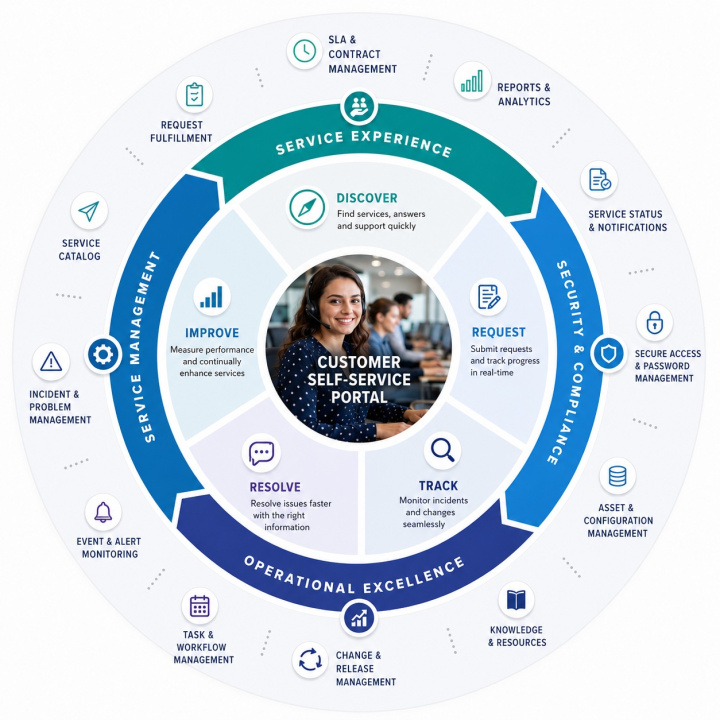

By March 30, 2026, the option to purchase new Atlassian Data Center licenses will officially vanish, marking a definitive shift in how global enterprises must architect their digital ecosystems. You likely recognize the mounting pressure of this transition, particularly as a 15% price increase for Data Center products takes effect while the window for favorable renewal terms narrows toward the January 12, 2026, hard stop. Managing Atlassian Licences across multiple products often leads to technical debt and financial waste, leaving many leadership teams feeling they’re overpaying for underutilized seats without a clear path forward.

This guide empowers you to regain control over your software spend by providing a clear roadmap for license consolidation and strategic growth. You’ll learn how to evaluate the ROI of Premium versus Enterprise tiers, navigate the critical journey from Data Center to Cloud, and leverage expert partnerships to secure better payment terms. We’ll examine the specific steps required to achieve precision, predictability, and performance in your licensing strategy, ensuring your infrastructure remains a catalyst for innovation rather than a budgetary burden.

Key Takeaways

  • Prepare for the March 30, 2026, end-of-sale milestone for Data Center products to maintain operational continuity and avoid unnecessary cost escalations.
  • Evaluate the functional distinctions between Cloud tiers to ensure your selected plan matches your enterprise’s specific security, compliance, and scale requirements.
  • Streamline your procurement of Atlassian Licences through a strategic partnership that provides consolidated billing and expert-led renewal management.
  • Execute a comprehensive licensing audit to eliminate waste from inactive users and duplicate subscriptions, maximizing your overall software return on investment.
  • Adopt a structured methodology to assess, implement, and optimize your digital tools, transforming your software ecosystem into a reliable driver of global growth.

The year 2026 represents a pivotal juncture for enterprise software architecture. As organizations move toward greater operational maturity, Atlassian Licences have evolved from simple software permissions into the essential gateway for enterprise agility and global collaboration. This shift is driven by a fundamental change in how teams interact with their tools. By anchoring your technology stack in a unified licensing framework, you create a stable foundation for Atlassian implementation that scales alongside your business objectives.

Understanding Atlassian’s corporate history reveals a consistent trajectory toward platform unification. This evolution culminates on March 30, 2026, a critical milestone where new Data Center license sales will cease entirely. For global enterprises, this isn’t merely a procurement deadline; it’s a strategic mandate to modernize. Waiting until the final hour risks operational disruption and creates unnecessary friction in your digital transformation journey. A strategic partner acts as a steady hand during this process, helping you navigate the complexities of Atlassian Licences while ensuring your global software spend remains optimized for maximum ROI.

The 2026 Cloud Mandate

The migration from self-managed infrastructure to high-performance Cloud environments is now a prerequisite for staying competitive. For industries like Life Sciences and Finance, where regulatory oversight is stringent, Atlassian Cloud offers advanced security protocols and automated compliance features that were previously difficult to maintain on-premise. Atlassian Cloud Licensing is a flexible, subscription-based model for modern DevOps. This model allows for rapid scaling and provides immediate access to the latest AI-driven features, ensuring your teams aren’t held back by legacy hardware limitations.

Data Center Transition: Deadlines and Decisions

Organizations still reliant on Data Center infrastructure must act with precision. The roadmap for 2026 requires a clear-eyed assessment of current user tiers and future growth projections. Delaying this transition introduces significant risks, including potential compliance gaps as support for older versions eventually sunsets. To ensure a seamless transition, your approach should focus on Strategy, Security, and Scalability. By mapping out these three pillars early, you avoid the pitfalls of a rushed migration and ensure your infrastructure remains robust during the shift to Cloud.

Decoding Cloud Tiers: Standard, Premium, and Enterprise

Selecting the appropriate tier for Atlassian Licences requires more than a simple comparison of feature lists; it demands a deep alignment with your organization’s operational maturity and long-term roadmap. While the Standard tier provides the essential building blocks for collaboration, the leap to Premium or Enterprise is often necessitated by the need for advanced orchestration and centralized governance. As Atlassian’s commercial strategy continues to prioritize Cloud innovation, enterprises must weigh the 5-10% price increases effective late 2025 against the functional gains in security and automation. Understanding these nuances is critical for technical leaders who must justify software spend while ensuring their teams remain unencumbered by tool limitations.

Standard vs. Premium: When to Upgrade

When does the upgrade become non-negotiable? The primary tipping point usually occurs when cross-team visibility becomes a bottleneck, making the Advanced Roadmaps feature in Jira Software Premium indispensable for complex project tracking. Beyond project management, the Premium tier offers a 99.9% uptime SLA and unlimited storage, providing the reliability required for mission-critical workflows. Managers should evaluate their current environment using this quick checklist:

  • Are teams struggling with manual status reporting across multiple projects?
  • Do you require a sandbox environment to test configurations before deployment?
  • Is your data growth approaching the limits of a Standard subscription?
  • Does your team require 24/7 “Premium” support for high-priority incidents?

If you answered yes to more than two, the Standard tier has likely been outgrown.

The Enterprise Advantage: Global Scale and Security

For global organizations managing thousands of users across disparate business units, the Enterprise tier serves as the ultimate catalyst for scale. It introduces multi-site management, allowing administrators to partition data and configurations while maintaining a unified billing and security posture. This tier is also the primary home for advanced AI capabilities like Rovo, which accelerates knowledge discovery across the entire ecosystem. We view this level of investment as a cornerstone of digital transformation services, offering a value proposition built on Peace, Performance, and Partnership.

Central to this scale is Atlassian Guard, which provides the centralized security and user provisioning necessary to mitigate risk in highly regulated environments. Since Guard Standard saw a 5% price adjustment in late 2025, optimizing its deployment within an Enterprise license often yields better consolidated value than managing fragmented security tools across various instances. It’s a strategic move that simplifies compliance while empowering your global workforce. If you’re uncertain which tier aligns with your 2026 growth targets, consulting with a strategic partner can clarify the financial and technical implications of your choice.

The Strategic Advantage of Partner-Led Licensing Procurement

While many procurement departments assume that purchasing directly from a vendor’s portal is the most efficient path, global enterprises often find that this approach lacks the nuance required for complex, multi-region deployments. Direct purchasing frequently forces organizations into rigid payment structures and anonymous support queues that don’t account for the unique operational hurdles of highly regulated sectors. By contrast, securing Atlassian Licences through an authorized partner transforms a routine transaction into a strategic asset. This collaborative model provides the Strategy, Support, and Stability required to ensure your software ecosystem remains resilient amidst shifting market demands. Partners don’t just process orders; they provide a layer of local expertise that bridges the gap between global product roadmaps and specific regional requirements.

Consolidated Billing and Financial Optimization

Managing a fragmented software portfolio across multiple vendors often results in administrative friction and hidden costs. Partner-led procurement alleviates this burden by offering consolidated billing, which simplifies the accounts payable process for diverse IT environments. Because partners often reinvest reselling commissions into value-added services, clients benefit from a more comprehensive support structure without increasing their direct software spend. This financial efficiency is particularly valuable when integrated with managed outsourcing services, as it allows for local currency invoicing and flexible payment terms that align with corporate fiscal cycles. Such adaptability ensures that your technology investments remain predictable, providing a clear methodology for scaling your digital infrastructure without the risk of currency fluctuations or unforeseen budgetary gaps.

Expert Guidance: Beyond the Transaction

The true value of a partner lies in their ability to move beyond the “anonymous portal” experience, acting instead as a dedicated strategic visionary for your technical infrastructure. While Atlassian provides excellent documentation for Decoding Cloud Tiers, a partner applies that information to your specific business context to prevent over-provisioning. This expertise is vital for aligning the procurement of Atlassian Licences with broader Atlassian implementation services, ensuring that every seat purchased is mapped to a functional requirement. For enterprises in Life Sciences and Finance, this seasoned guidance provides a steady hand in navigating compliance and security benchmarks that standard support channels might overlook. By choosing a reliable long-term collaborator, you gain access to a depth of institutional knowledge that secures your operational stability and empowers your teams to focus on core innovation rather than administrative maintenance.

Maximizing ROI: Auditing and Optimizing License Spend

Maintaining the health of your technical ecosystem requires more than just functional updates; it demands rigorous fiscal oversight to prevent budgetary drift. Many enterprises unknowingly leak capital through unoptimized Atlassian Licences, where seat counts often reflect historical peaks or forgotten project teams rather than current active requirements. Establishing a disciplined approach to “License Hygiene” isn’t just a cost-saving exercise; it’s a strategic necessity that ensures your infrastructure remains lean, responsive, and fully aligned with your actual operational reality. By connecting a clear audit methodology to specific decommissioning actions, you transform your software spend from a fixed overhead into a dynamic, ROI-driven asset.

User Management and Seat Optimization

Stale accounts represent one of the most common sources of financial waste in large-scale software deployments. A methodical audit begins by identifying users who haven’t authenticated within the last 90 days, allowing administrators to deactivate those accounts and potentially drop to a more cost-effective user tier. This is particularly critical as organizations prepare for the 15% price increase for Data Center products effective February 17, 2026. Consolidating user tiers across Jira and Confluence further streamlines your billing, ensuring you aren’t paying for high-tier access for personnel who only require basic functionality. License Optimization is a continuous process of aligning seat count with active engagement.

App and Marketplace Audit

The Atlassian Marketplace offers immense functional extensibility, yet it frequently accounts for a significant portion of the total cost of ownership. Because many apps operate on a per-user licensing model, a single underutilized plugin can inflate your annual bill by thousands of dollars. Managers should implement a rigorous evaluation framework that weighs app utility against its recurring cost, often discovering that native Cloud features now fulfill requirements once met by third-party tools. Aligning these audits with your broader IT service management solutions ensures that your entire technical stack is optimized for performance and security. If you’re ready to eliminate waste and reclaim your IT budget, schedule a comprehensive license audit with our experts today.

Atlassian Licences in 2026: The Strategic Enterprise Guide to Optimization and Scale

Scaling with Confidence: Test Triangle’s Managed Licensing Solutions

By positioning our firm as a reliable long-term collaborator, we provide the institutional maturity required to manage complex digital infrastructures with absolute precision. Our methodology follows a rigorous “Assess, Implement, and Optimize” framework, ensuring that every decision regarding your Atlassian Licences is rooted in data-driven insights and strategic foresight. We integrate seasoned human expertise with industry-leading technical tools to bridge the gap between high-level business objectives and technical execution, allowing your organization to achieve scalable growth without compromising operational stability. This commitment to organizational progress ensures that your technology stack remains a catalyst for innovation rather than a source of technical debt.

Our approach is designed to provide the peace of mind that comes from risk reduction and systemic improvement. We recognize that managing a global software spend requires more than just administrative oversight; it requires a strategic visionary who can anticipate market shifts and vendor roadmap changes. Whether you’re navigating the 2026 Data Center milestones or optimizing a massive Cloud Enterprise footprint, our team acts as a steady hand. We ensure your licensing strategy is the foundation for broader digital transformation, aligning your procurement cycles with your actual operational capacity and long-term technical goals.

A Tailored Approach to Enterprise Needs

We adapt our service delivery to match your specific corporate milestones, recognizing that the journey to a modernized Cloud environment is unique for every enterprise. There’s a profound sense of empowerment found in large-scale technological evolution when it’s guided by experts who understand the nuances of highly regulated industries. To understand how we align our resources with your long-term goals, we encourage you to consult our strategic partner guide for deeper insights into our collaborative model.

Getting Started: The Path to Optimization

The journey toward a leaner ecosystem begins with an initial discovery phase to evaluate your current health. This comprehensive check identifies immediate opportunities for cost reduction while mapping out a future-proof architecture for your Atlassian Licences that supports your 2026 growth targets. We facilitate a seamless transition from a general need for improvement to a specific, high-performance technical solution that addresses your unique pain points. We remain dedicated to your success through our core values of Precision, Partnership, and Progress.

Securing Your Enterprise Future in the Atlassian Ecosystem

Navigating the complexities of the 2026 transition requires a proactive stance on technical architecture and procurement strategy. Audit your usage. Select the cloud tier that aligns with your organizational maturity. These actions transform your infrastructure into a lean engine for global growth. The upcoming milestones for Data Center products serve as a vital catalyst to modernize your environment, ensuring your teams have access to high-performance tools while maintaining strict compliance in highly regulated sectors.

As an authorized Atlassian Solution Partner with specialized expertise in Life Sciences and Financial compliance, Test Triangle provides the steady hand necessary to optimize your Atlassian Licences. Our global delivery model and 24/7 support availability ensure that your digital evolution is managed with the highest standards of quality and security. We’re committed to being your reliable long-term collaborator, helping you achieve Stability, Security, and Success in every phase of your software lifecycle.

Optimize your Atlassian Licensing with Test Triangle today and take the first step toward a more predictable and scalable technical future. We look forward to helping you turn these systemic changes into a definitive competitive advantage.

Frequently Asked Questions

How do I buy Atlassian licenses in 2026?

Enterprises can procure Atlassian Licences directly through the vendor’s portal or by collaborating with an authorized solution partner. While direct purchasing is available, partnering with a strategic visionary allows you to align procurement with a comprehensive digital roadmap. This collaborative approach ensures that your license acquisition supports long-term operational stability and provides access to favorable payment terms that aren’t typically available through anonymous self-service portals.

What is the difference between Jira Standard and Premium licenses?

Jira Premium extends the core functionality of the Standard tier by introducing Advanced Roadmaps for cross-project visibility and a 99.9% uptime SLA for mission-critical reliability. Organizations requiring unlimited storage and 24/7 support will find the Premium tier provides the necessary empowerment for large-scale technological evolution. It’s designed for teams that have outgrown basic task management and require sophisticated orchestration across multiple global workstreams.

Can I still purchase Atlassian Data Center licenses after March 2026?

No new Data Center licenses will be available for purchase after the March 30, 2026, end-of-sale deadline. Existing customers maintain the ability to renew their current subscriptions or expand user tiers until March 30, 2028. However, all Data Center products will reach their final end-of-life on March 28, 2029, making it essential to plan your migration to Cloud well before these hard stops occur.

How can I optimize my Atlassian license costs to avoid overpaying?

Optimizing your software spend requires a disciplined methodology that includes deactivating inactive users and auditing the utility of high-cost Marketplace apps. By implementing regular “License Hygiene” checks, you ensure your seat count reflects active engagement rather than historical peaks. This practice prevents the financial waste associated with underutilized assets and allows you to consolidate user tiers across Jira and Confluence for maximum efficiency.

What are the benefits of buying Atlassian licenses through an authorized partner?

Authorized partners provide consolidated billing and local currency invoicing, which simplifies administrative overhead for global procurement teams. Beyond the transaction, a partner acts as a steady hand by offering strategic implementation advice and seasoned expertise in highly regulated industries. This partnership ensures that your Atlassian Licences are managed with precision, providing a layer of support that bridges the gap between technical execution and business outcomes.

Is Atlassian Guard required for all Cloud Enterprise subscriptions?

Atlassian Guard is bundled within the Cloud Enterprise tier to provide the centralized security and user provisioning necessary for managing global scale. While it isn’t a separate requirement for Enterprise users, it serves as the foundational security layer that enables single sign-on (SSO) and automated lifecycle management. This integration simplifies compliance for technical managers while empowering the workforce with secure, seamless access to essential tools.

How much do Atlassian licenses cost for large enterprise teams?

Final costs for enterprise deployments are determined by the specific user tier and the selected Cloud or Data Center plan. Effective late 2025 and early 2026, list prices for Cloud products increased by 5% to 10%, while Data Center products saw a 15% adjustment. Enterprises should consult with a partner to receive a tailored quote that reflects their specific user count and functional requirements.

Can I switch from monthly to annual Atlassian billing for better rates?

Transitioning from monthly to annual billing is a highly effective strategy for securing better rates and ensuring budgetary predictability. Annual subscriptions lock in current pricing for a twelve-month period and typically offer a lower total cost of ownership compared to the cumulative expense of twelve monthly payments. This shift allows financial leadership to plan with confidence while reducing the administrative burden of monthly invoice processing.

Paul Guy

Article by

Paul Guy

Paul serves as the Marketing Director at Test Triangle, where he leads a global team in driving growth through strategic B2B marketing and brand communications. With a strong emphasis on measurable outcomes and sustainable performance, he plays a pivotal role in aligning marketing functions to enhance customer engagement and accelerate business impact. Under his leadership, marketing initiatives have consistently delivered significant returns on investment, elevated brand visibility, and strengthened the company's presence across key markets.


In 2026, Jira administration is no longer about simple task management; it is a discipline of strategic governance where plugins serve as architectural force multipliers. You likely understand the friction caused by plugin bloat slowing down instance performance or the difficulty of managing complex global workflows across diverse teams. Identifying the Top Jira Admin Plugins is essential for any lead looking to move beyond manual maintenance toward a model of precision, performance, and peace of mind. As a dedicated Atlassian Partner, we recognize that your digital infrastructure requires a steady hand and a sophisticated toolkit to remain competitive.

This article provides the roadmap you need to discover the essential Jira administration plugins required to maintain system integrity, automate complex workflows, and drive operational efficiency in a modern enterprise environment. We’ll review verified 2026 updates for tools like ScriptRunner and Structure, while exploring how AI-driven agents are redefining system health and project visibility. By the end of this guide, you’ll have a clear strategy for consolidating your environment and achieving a stable, high-performing Jira instance that delivers tangible business value.

Key Takeaways

  • Understand how the modern Jira administrator has evolved into a strategic system architect focused on driving long-term scalability rather than mere ticket management.
  • Identify the Top Jira Admin Plugins that utilize advanced automation and scripting to act as force multipliers for complex enterprise workflows.
  • Enhance organizational security and system health by implementing governance tools that provide deep impact analysis and enterprise-grade access control.
  • Bridge the gap between technical execution and business outcomes through reporting plugins that deliver clear, executive-level visibility into project portfolios.
  • Apply a disciplined four-step framework to audit and consolidate your environment, ensuring maximum operational efficiency and a high-performing Atlassian ecosystem.

The Strategic Evolution of Jira Administration in 2026

The era of the Jira administrator as a reactive ticket-handler has concluded. In 2026, the role has transitioned into that of a strategic system architect. This evolution requires a shift from operational maintenance to high-level governance, where the administrator acts as a reliable long-term collaborator within the enterprise. As Jira (software) has expanded from its roots in bug tracking to become the central nervous system of global agility, managing these environments demands a sophisticated understanding of Stability, Scalability, and Security. Today’s administrators aren’t just configuring workflows; they’re designing digital ecosystems that must accommodate both human teams and AI-driven agents like Atlassian Rovo.

Modern enterprises now prioritize a governance-first mindset. This approach ensures that every addition to the tech stack serves a specific architectural purpose. Rather than simply reacting to user requests for new features, strategic admins utilize the Top Jira Admin Plugins to build resilient frameworks that prevent performance degradation. Through our Atlassian Implementation services, we’ve observed that the most successful organizations are those that move beyond “keeping the lights on” to focus on cloud-native performance optimization and systemic growth.

N-Level Cascade Select for Jira & Jira Service Management

One of the newest additions to the Atlassian Marketplace is N-Level Cascade Select for Jira & Jira Service Management from Test Triangle.

Unlike Jira’s native Cascade Select field, which is limited to just two levels, this app enables administrators to create unlimited hierarchical selection fields.

It is particularly valuable for organisations using Jira Service Management where request forms need structured data such as:

  • Region → Country → Office → Building
  • Department → Team → Role
  • Product → Category → Model → Variant
  • Business Unit → Service → Application → Component

The app improves data quality, simplifies administration, and creates a much better experience for end users across Jira Software and Jira Service Management. It also requires no scripting or coding to configure.

Learn more: https://marketplace.atlassian.com/apps/813282014/n-level-cascade-select-for-jira-and-jsm

N-Level Cascade Select from Test Triangle Jira

Why Native Jira Isn’t Enough for Global Enterprises

While Jira provides a robust foundation, global organizations often hit a “scale ceiling” when relying solely on native functionality. Native tools frequently struggle with complex, cross-project automation that requires logic beyond standard trigger-action sequences. Furthermore, executive stakeholders often find a gap in advanced data visualization, as native reporting lacks the depth required for high-level portfolio management. Maintaining consistency across thousands of users and hundreds of projects becomes a manual burden without specialized tools to enforce global permission schemes and configuration standards.

Defining the Force Multiplier: What Makes a ‘Top’ Plugin?

In a disciplined 2026 environment, a “top” plugin is defined by its ability to act as a force multiplier without compromising system health. We evaluate tools based on three critical pillars: security compliance, performance impact, and vendor reliability. It’s essential to prioritize apps from Marketplace Partners with Platinum or Gold status, as these designations signal a commitment to enterprise-grade support. Beyond simple licensing fees, administrators must consider the Total Cost of Ownership (TCO). A plugin that requires excessive manual configuration or slows down page load times ultimately costs the business more than its initial price tag suggests. By selecting tools that offer seamless integration and automated governance, you empower your organization to scale with precision and confidence.

Automation and Scripting: The Admin’s Force Multipliers

Automation serves as the engine for the strategic architect role we established earlier. To achieve true operational efficiency, administrators must move beyond native triggers and embrace tools that orchestrate complex, cross-departmental processes. The Top Jira Admin Plugins in this category allow you to replace manual, error-prone tasks with precise, repeatable logic. This shift doesn’t just save time; it reduces institutional risk by ensuring that every transition and calculation follows a strictly governed path. While TechRepublic’s Jira Review highlights the platform’s robust native capabilities, these specialized extensions are what enable a global instance to scale without friction.

ScriptRunner: Beyond Basic Automation

ScriptRunner for Jira remains the undisputed leader for those who require total control over their environment. With the June 2026 release of version 26.0.0, the tool has integrated task-specific AI agents that assist in generating and debugging scripts, effectively lowering the barrier to entry for complex customization. This pro-code approach allows for the automation of intricate calculations and the creation of custom JQL functions that native Jira cannot replicate. ScriptRunner acts as the indispensable bridge between standard Jira functionality and the bespoke requirements of a complex enterprise environment. Beyond simple workflows, it provides the power for bulk data cleanup and systemic instance maintenance, ensuring your database remains lean and performant.

Workflow Optimization Tools

For teams that prefer a low-code approach, the JSU Automation Suite and Jira Workflow Toolbox offer powerful alternatives that don’t require deep programming expertise. These tools specialize in solving “impossible” transition logic problems, such as synchronizing field values across linked issues or enforcing strict conditional approvals. By implementing these solutions, organizations can reduce manual input errors and deploy logic that scales seamlessly across multiple business units. We’ve seen automated approval loops significantly reduce time-to-market for our clients by removing the bottlenecks of human intervention. Choosing between pro-code and low-code isn’t a binary decision; most successful enterprises utilize a hybrid model to maintain agility. If you’re unsure which path best fits your current infrastructure, discussing your automation roadmap with an expert can help clarify your strategy. Our Atlassian Implementation specialists focus on identifying the right balance to ensure your system remains agile, secure, and easy to maintain over the long term.

Governance, Security, and System Health Plugins

Governance represents the bedrock of a high-performing Jira instance. Without a disciplined approach to system health, even the most advanced automation rules will eventually falter under the weight of configuration drift. Strategic administrators prioritize tools that provide visibility into the methodology and execution of their system’s architecture. By utilizing the Top Jira Admin Plugins dedicated to governance, you ensure that every modification is intentional and every user access point is secure. This focus on systemic integrity provides the peace of mind necessary for large-scale technological evolution.

Power Admin: The Safety Net for System Changes

Power Admin for Jira functions as a critical safety net for those managing complex, global environments. It allows you to perform comprehensive impact analysis before committing to significant system changes. You can identify unused custom fields and deprecated workflows with confidence, visualizing dependencies to prevent the unintentional breaking of linked projects during updates. Regular instance hygiene using these utilities maintains system speed and reduces the technical debt that often plagues long-lived Jira deployments. This proactive approach to maintenance ensures that your infrastructure remains lean, performant, and ready for future growth.

Enterprise Security and Access Management

Security remains a non-negotiable priority for global enterprises, especially those operating within highly regulated sectors like pharmaceuticals or finance. SAML Single Sign On (SSO) by Resolution provides the robust framework needed to manage enterprise-grade security at scale. It facilitates seamless integration with industry-leading identity providers such as Azure AD and Okta, allowing for precise user provisioning and de-provisioning. Implementing these controls through our Atlassian Implementation Services ensures that your access management strategy aligns with global security benchmarks while empowering your workforce with friction-free authentication.

Beyond high-level security, tools like Extender for Jira address the small but critical gaps in the standard UI and UX, providing administrators with a more versatile toolkit for daily operations. In regulated environments, the role of audit logs and configuration tracking is vital. These features provide a transparent record of system changes, which is essential for maintaining compliance and institutional maturity. A well-governed instance is a stable instance; it allows your organization to progress through the combination of human expertise and technical precision without the fear of systemic failure.

Reporting and Portfolio Management: The Executive View

Operational efficiency within Jira is only half of the equation; the other half is the ability to translate that efficiency into clear, executive-level insights. For leadership, the value of the Atlassian ecosystem lies in its capacity to provide a transparent lens into the strategic progress of the organization. By deploying the Top Jira Admin Plugins for reporting and portfolio management, you bridge the gap between technical execution and business outcomes. These tools transform raw ticket data into sophisticated business intelligence, allowing stakeholders to make informed decisions based on real-time capacity and performance metrics. This level of visibility ensures that your digital infrastructure remains a driver of organizational growth rather than a black box of technical activity.

Advanced Analytics with eazyBI

While native Jira dashboards offer basic oversight, eazyBI Reports and Charts provides the deep analytical capabilities required for true institutional maturity. This tool allows for the creation of custom MDX measures to track non-standard KPIs that are specific to your unique business logic. By integrating external data sources, you can build a holistic view that correlates development progress with financial or operational data from other enterprise platforms. eazyBI stands as the premier tool for multi-dimensional data analysis in the Atlassian ecosystem, empowering you to identify trends and bottlenecks that would otherwise remain hidden. This capability allows administrators to provide leadership with the actionable intelligence needed to refine strategy and maximize ROI.

Portfolio Visibility and Resource Management

Managing complexity at scale requires a structured approach to issue hierarchy and resource allocation. Structure for Jira enables the visualization of thousands of issues across multiple departments, providing a clear map of cross-project relationships and dependencies. When organizations scale to SAFe or other Agile at Scale frameworks, BigPicture becomes an essential component for resource leveling and capacity planning. These tools allow project managers to ensure that workloads are balanced and that high-priority initiatives are appropriately staffed. This strategic alignment is a cornerstone of our Digital Transformation Services, as it enables a seamless flow of value from the portfolio level down to individual teams.

Implementing these high-level reporting solutions requires a disciplined approach to data integrity and system architecture. Without a steady hand guiding the implementation, the resulting reports may fail to reflect the true health of your projects. If your current reporting framework lacks the clarity and concision required for executive decision-making, contact our consulting team to design a bespoke analytics strategy. We specialize in helping enterprises harness the full power of their data to drive long-term success and operational stability.

Best Jira Admin Plugins to Boost Efficiency

Optimizing Your Plugin Stack for Maximum ROI

Achieving a high-performing environment requires more than just the installation of the Top Jira Admin Plugins; it demands a disciplined approach to lifecycle management. While each individual extension offers specific value, the cumulative effect of an unmanaged stack often results in “App Bloat,” which degrades system latency and complicates your security posture. A strategic administrator must act as a guardian of system health, ensuring that every tool remains a contributor to operational efficiency rather than a liability to performance. By treating your Jira instance as a living digital infrastructure, you protect the long-term stability and security of your organizational data. This methodology transforms your platform from a simple tool into a resilient asset that supports Precision, Performance, and Progress.

The Plugin Audit Framework

To maintain a lean and effective ecosystem, we recommend a structured four-step audit framework. First, perform a usage analysis to identify “ghost” apps that consume resources without providing active value to your teams. Second, conduct a rigorous security and compliance review, particularly in light of Atlassian’s “Enterprise-Ready” Trust Program launching in October 2026. Third, execute performance benchmarking to measure the specific impact of each plugin on page load times and indexing speed. Finally, focus on consolidation by replacing multiple niche applications with a single, versatile tool like ScriptRunner or Structure. This systematic consolidation reduces technical debt and simplifies the administrative burden of version updates and license management.

Strategic Partnership for Long-Term Stability

Navigating the complexities of a modern Atlassian environment often requires expertise that goes beyond internal capacity. Engaging with a reliable long-term collaborator provides the peace of mind derived from expert roadmapping, especially during high-stakes transitions like Atlassian Cloud migrations. Our Managed Outsourcing Services deliver proactive instance monitoring and performance testing, ensuring that new deployments don’t compromise system integrity. This collaborative approach is far more cost-effective than a trial-and-error strategy, as it leverages institutional maturity to prevent costly downtime. By aligning your technical tools with a professional service methodology, you empower your organization to achieve scalable growth and sustained operational excellence.

Ultimately, the value of your Jira instance is defined by its reliability and the clarity of the insights it provides. Regular audits and strategic consolidation ensure that your plugin stack remains an architectural force multiplier. When you combine the right tools with the right expertise, you create a stable foundation for the future of your enterprise. We remain committed to supporting your journey toward a fully optimized, high-performing digital workspace.

Architecting a Resilient Future for Your Jira Instance

The transition toward a governance-first Jira environment requires a deliberate shift from reactive maintenance to strategic system architecture. By implementing the Top Jira Admin Plugins discussed, your organization can effectively bridge the gap between technical execution and executive-level visibility. Achieving long-term stability depends on your ability to automate complex workflows while maintaining a lean, high-performing instance through regular auditing and consolidation. As a reliable long-term collaborator, we understand that managing complex digital infrastructures requires both human expertise and technical precision to ensure Stability, Scalability, and Security.

Test Triangle brings the institutional maturity of an Authorized Atlassian Partner to every engagement, offering specialized expertise in complex DevOps and ITSM environments across global industries. Our approach focuses on the peace of mind derived from risk reduction and the empowerment found in large-scale technological evolution. You can optimize your Atlassian ecosystem with Test Triangle’s strategic consulting to ensure your infrastructure remains secure, scalable, and performant. We look forward to helping you build a resilient digital ecosystem that drives operational excellence for years to come.

Frequently Asked Questions

What are the most essential plugins for a new Jira Administrator?

ScriptRunner for Jira and Power Admin are the foundational tools for any new administrator seeking to establish systemic control. These Top Jira Admin Plugins provide the necessary bridge between basic issue tracking and advanced enterprise governance. By prioritizing tools that offer deep automation and impact analysis, you ensure that your initial configurations remain scalable and secure as your organizational needs evolve.

How do I choose between free and paid Jira plugins in 2026?

Choosing between free and paid plugins in 2026 requires a rigorous evaluation of the Total Cost of Ownership and vendor reliability. While free apps may seem attractive for niche tasks, premium plugins from Platinum Marketplace Partners often provide the security updates and enterprise support essential for global stability. You should prioritize tools that offer a clear roadmap and official endorsements to minimize the risk of technical debt.

Can Jira plugins significantly slow down my instance performance?

Excessive or poorly coded plugins can significantly degrade instance performance by increasing page load latency and indexing times. This “App Bloat” often stems from a lack of disciplined auditing and consolidation. We recommend regular performance benchmarking to identify which extensions are impacting your system’s health, allowing you to maintain a lean, high-performing environment that supports human and AI interaction.

Which Jira plugins are best for managing large-scale Agile teams?

Structure for Jira and BigPicture are the industry benchmarks for managing large-scale Agile teams within frameworks like SAFe. These tools allow you to visualize complex hierarchies and cross-project relationships that native Jira cannot represent. By implementing these solutions, you provide leadership with the portfolio-level visibility required to manage global resources and capacity with precision and confidence.

How do I ensure a Jira plugin is secure and compliant with GDPR/HIPAA?

To ensure a plugin meets GDPR or HIPAA standards, you must verify the vendor’s participation in the Atlassian “Enterprise-Ready” Trust Program. Review the Data Residency options and the specific privacy policies provided on the Atlassian Marketplace. For highly regulated industries like pharmaceuticals, conducting a manual audit of the plugin’s data handling practices is a necessary step for maintaining institutional security.

What is the best way to manage plugin updates without breaking my workflows?

The most reliable way to manage updates is to validate them in a dedicated staging environment before deploying to production. Utilizing tools like Power Admin allows you to perform an impact analysis to see how an update might affect existing workflows or custom fields. This methodical approach ensures that systemic improvements don’t result in unintended downtime or broken logic for your end users.

Are there plugins that can help with Jira Cloud migration?

The Jira Cloud Migration Assistant is the primary tool for transitioning data, but specialized vendor plugins often provide additional support for moving complex configurations. Many Top Jira Admin Plugins have dedicated migration paths to ensure that your scripts and hierarchies remain intact. Consulting with an expert partner can help you navigate these technical hurdles to ensure a seamless and secure cloud transition.

How can I calculate the ROI of a premium Jira plugin like ScriptRunner?

Calculating ROI involves comparing the annual cost of manual administrative labor against the license fee and time saved through automation. For a tool like ScriptRunner, you should also factor in the value of risk reduction and the empowerment found in systemic optimization. When a single script replaces hundreds of hours of manual data entry, the return on investment becomes a clear driver of organizational progress.

Paul Guy

Article by

Paul Guy

Paul serves as the Marketing Director at Test Triangle, where he leads a global team in driving growth through strategic B2B marketing and brand communications. With a strong emphasis on measurable outcomes and sustainable performance, he plays a pivotal role in aligning marketing functions to enhance customer engagement and accelerate business impact. Under his leadership, marketing initiatives have consistently delivered significant returns on investment, elevated brand visibility, and strengthened the company’s presence across key markets.


What if the very tools designed to accelerate your service delivery are actually the silent architects of your system’s latency? As you seek the Best Jira Apps for Service Management for your 2026 strategy, you’ll likely find that app bloat and integration complexity often undermine the very efficiency they’re intended to create. With 70% of customers now using social media for support according to J.D. Power, the pressure to integrate diverse data streams without sacrificing system speed has never been higher. We believe managing a complex digital infrastructure demands a disciplined, versatile, and strategic approach to tool selection.

This article provides a roadmap to help you assess the “Runs on Atlassian” ecosystem, ensuring your software choices prioritize precision, performance, and partnership. We’ll examine how AI-powered insights and native integrations can reduce manual effort while elevating your customer satisfaction scores. From Tempo’s AI-driven time tracking to the seamless data residency of Forge-based applications, you’ll discover how to build a streamlined, high-performance architecture that empowers your teams and secures your long-term operational stability.

Key Takeaways

  • Understand why the 2026 landscape demands a transition from simple plugins to cloud-native strategic accelerators that align with Atlassian’s Forge architecture for enhanced security.
  • Learn to achieve operational excellence by deploying advanced automation tools like ScriptRunner and JSU to reduce manual ticket handling and drive systemic efficiency.
  • Discover the Best Jira Apps for Service Management to elevate the user journey through bespoke portal designs and seamless external data integration.
  • Implement a rigorous governance framework using a 4-point checklist to ensure every app in your stack meets high standards for security, speed, and scalability.
  • Recognize the strategic advantage of professional JSM architecture over DIY setups to guarantee a reliable, long-term foundation for your digital transformation.

The Strategic Role of Marketplace Apps in Jira Service Management

Standard Jira Service Management provides a robust foundation for ticketing, but for global enterprises, native features often represent only the starting point of a mature service strategy. The ecosystem acts as a force multiplier, transforming a centralized system into a sophisticated engine for service orchestration. By 2026, the marketplace has moved decisively toward a Cloud-first architecture, exemplified by the “Runs on Atlassian” program. This initiative ensures that the Best Jira Apps for Service Management are built on Forge, providing the security, data residency, and architectural alignment necessary for highly regulated industries. Strategic growth now rests on three pillars: automation of repetitive cycles, visibility into complex data sets, and a seamless user experience.

While out-of-the-box JSM covers essential functions, it often lacks the granular customization required for industry-specific workflows or complex third-party data integrations. Relying solely on native functionality can lead to high manual effort in repetitive ticket handling, which ultimately stalls organizational progress. To achieve true operational excellence, technical leaders must look toward specialized extensions that bridge these functional gaps. These tools aren’t mere plugins; they’re strategic accelerators that allow a business to maintain a lean core while deploying highly targeted capabilities where they matter most.

Why Enterprise Maturity Requires Ecosystem Integration

Moving beyond basic ticketing toward complex service orchestration is a hallmark of institutional maturity. As organizations scale, the need to connect IT with diverse business units becomes paramount, requiring tools that can translate technical tasks into business outcomes. Implementing advanced IT Service Management solutions often involves integrating apps that facilitate cross-departmental collaboration and automated asset management. This integration ensures that IT Service Management (ITSM) frameworks are not just theoretical models but practical, executable processes that drive long-term success and operational stability.

Defining the Value Proposition: Speed, Scale, and Stability

Marketplace value is evidenced by the over 28,000 installations of performance tools like Tempo, which signals a critical enterprise shift toward data-driven operational control and resource precision. Selecting the Best Jira Apps for Service Management requires a balance between native functionality and targeted third-party enhancements to ensure the stack remains high-performing without becoming bloated. By automating the suggestion of time entries and incident categorization, these apps play a vital role in reducing Mean Time to Resolution (MTTR). This disciplined approach to tool selection provides the peace of mind that comes from risk reduction and the empowerment found in large-scale technological evolution.

Driving Operational Excellence: Best Jira Apps for Automation and Workflow

Operational excellence in 2026 is no longer defined by the mere presence of a service desk but by the elimination of manual toil through strategic automation. While native Jira Service Management (JSM) capabilities provide a starting point, global enterprises often require more sophisticated logic to manage the strategic role of ITSM within their digital ecosystems. Selecting the Best Jira Apps for Service Management involves identifying tools that act as force multipliers, converting complex business requirements into repeatable, error-free processes. This transition from manual ticket handling to automated precision is essential for maintaining high customer satisfaction scores while scaling infrastructure.

Advanced Scripting and Logic Execution

ScriptRunner for Jira remains the industry standard for organizations demanding absolute control over their environment. Its 2026 Cloud-native features allow administrators to execute Groovy scripts that handle multi-level approval chains across disparate departments, ensuring that no request stalls due to human oversight. For even more complex logic, Power Scripts offers a robust alternative, providing a Sil-based language that simplifies the execution of intricate conditions and post-functions. These tools are foundational for DevOps Consulting initiatives, where the goal is to synchronize service desk activity with rapid development cycles. Programmatic ticket transitions and automated incident categorization reduce human error, allowing your technical teams to focus on high-value systemic improvements rather than routine maintenance.

Workflow Enhancers for Non-Technical Administrators

The 2026 Atlassian landscape has seen a significant rise in no-code automation, empowering non-technical administrators to manage complex workflows without deep coding expertise. JSU Automation Suite for Jira and Jira Miscellaneous Workflow Extensions (JMWE) provide a versatile middle ground for enterprise teams. JSU excels in simple, impactful enhancements like linked issue synchronization and copy-value post-functions, while JMWE offers deeper conditional logic via a point-and-click interface. Choosing between them depends on your specific use case: JSU is often preferred for rapid deployment across standard service desks, whereas JMWE supports more granular data manipulation. Both apps ensure that your JSM stack remains agile, allowing for the quick implementation of business-specific rules that drive down Mean Time to Resolution (MTTR).

Building a high-performance service ecosystem requires a disciplined blend of technical rigor and strategic vision. If you’re looking to refine your automation strategy, you can consult with our experts to identify the Best Jira Apps for Service Management tailored to your unique operational requirements. By integrating these advanced workflow enhancers, you secure the peace of mind that comes from a stable, scalable, and highly efficient service infrastructure.

Elevating the User Journey: Best Apps for Portal Design and Asset Management

User experience is the bridge between technical capability and business adoption. While native Jira Service Management (JSM) portals offer functional entry points, they often lack the sophisticated branding and intuitive navigation required by global organizations. To truly elevate the user journey, technical leaders must deploy the Best Jira Apps for Service Management as part of their broader IT Service Management solutions. This shift from a “ticketing interface” to a “branded experience” ensures that employees and customers find solutions quickly, which reduces the burden on support agents and improves overall sentiment across the enterprise.

Transforming the Helpdesk into a Branded Experience

Refined for Jira stands as the premier choice for organizations seeking to move beyond the constraints of standard portal layouts. By providing a customizable site-building interface, it allows administrators to structure multi-portal environments that reflect the specific branding and language of diverse global business units. This approach improves user adoption by presenting an intuitive UI that mirrors modern web experiences rather than a complex database. Integrating knowledge bases directly into the request journey ensures that users are guided toward self-service options before a ticket is even created. As discussed in recent insights regarding AI in Service Management, the focus has shifted toward human practicalities, where the interface must facilitate, not hinder, the resolution process.

Asset Management and External Data Integration

Operational excellence requires a holistic view of the digital landscape, which is often fragmented across various data silos. Elements Connect bridges this gap by allowing JSM to fetch and display external data from SQL databases, LDAP directories, or REST APIs directly within Jira fields. This capability ensures that agents have immediate access to real-time information without switching platforms. Complementing this is the 2026 evolution of Assets (formerly Insight), which provides a robust Configuration Management Database (CMDB) for hardware lifecycle and inventory control. An integrated CMDB serves as a single source of truth that reduces operational risk by providing immediate visibility into the impact of changes across the entire digital infrastructure.

Combining these tools allows for a seamless flow of information from the initial user request to the final asset update. Organizations that prioritize these integrations see a marked improvement in data accuracy and a reduction in manual data entry. By investing in these strategic extensions, you ensure your JSM environment remains a high-performance asset that scales with your enterprise’s growth. Choosing the Best Jira Apps for Service Management is not just about adding features; it’s about building a steady hand in a fast-changing technological landscape.

The Governance Framework: Evaluating Apps for Security and Scalability

Establishing a robust governance framework is the cornerstone of a high-performance JSM environment. While previous sections focused on automation and UX, the Best Jira Apps for Service Management must also be scrutinized through the lens of security, stability, and scalability. Many enterprises hesitate to move to the cloud due to concerns over data residency and third-party access; however, a disciplined evaluation process can mitigate these risks. By prioritizing apps that have achieved “Cloud Fortified” status, organizations ensure they’re partnering with vendors who adhere to rigorous security standards and reliable support protocols. This strategic approach provides the peace of mind derived from risk reduction and the empowerment found in large-scale technological evolution.

Security and Compliance in the Atlassian Marketplace

Security and compliance in the Atlassian Marketplace have evolved significantly with the introduction of the “Runs on Atlassian” program. This designation confirms that apps are built on the Forge infrastructure, ensuring better data residency and alignment with Atlassian’s core architecture. Before any installation, technical leaders should perform a comprehensive audit using the Atlassian Trust Center to verify GDPR compliance and vulnerability management practices. This rigorous vetting process is essential for maintaining the institutional maturity required in highly regulated industries. It’s a method that connects methodology to specific actions and subsequent results, ensuring your digital infrastructure remains resilient against emerging threats and regulatory shifts.

Performance Optimization and Maintenance

Performance optimization and maintenance are critical to preventing the system latency often caused by app-heavy instances. Identifying “heavy” apps that impact page load times requires continuous monitoring and a strategy for managing updates in a production environment. Consolidating functionality into fewer, more versatile tools helps reduce “App Bloat,” which can otherwise degrade the user journey discussed earlier. When selecting the Best Jira Apps for Service Management, we recommend a 4-point checklist for every new addition to your stack:

  • Security: Does the app meet enterprise-grade compliance and data residency requirements?
  • Support: Is the vendor a reliable collaborator with a proven track record of timely updates and official endorsements?
  • Speed: Does the app maintain low latency and high precision even under extreme ticket volumes?
  • Scalability: Can the tool handle the growth of a global enterprise without requiring significant re-configuration or manual intervention?

A steady hand is required to balance technical rigor with business outcomes. If you’re concerned about the security or performance of your current stack, contact our Atlassian consultants for a strategic audit of your JSM architecture. We’re deeply invested in your long-term success and operational stability, providing the expertise needed to manage complex digital infrastructures with confidence.

Best Jira Apps for Service Management: Top 2026 Picks

Implementing a Seamless Service Ecosystem with Test Triangle

The transition from a collection of fragmented tools to a unified service engine requires more than just a list of the Best Jira Apps for Service Management; it demands a strategic visionary who understands the intersection of technical rigor and business outcomes. While DIY setups often lead to the app bloat and system latency discussed in our governance framework, a professional Atlassian Implementation ensures your infrastructure is built for long-term stability. At Test Triangle, we position ourselves as a reliable collaborator, guiding global enterprises through the complexities of digital transformation with a steady hand. Our approach moves beyond simple installation, focusing instead on creating a high-performance JSM stack that empowers your teams and secures your operational excellence.

Our methodology is rooted in a disciplined three-stage progression: Analyze, Architect, Automate. By first conducting a technical audit of your existing workflows, we identify the specific gaps where automation can yield the highest ROI. We then architect a customized environment that integrates industry-leading platforms directly into your service descriptions, ensuring that every tool in your ecosystem serves a strategic purpose. This structured flow leads from a general need for improvement to a specific technical solution, mirroring the operational efficiency we promise to our clients.

Strategic Consulting for Global Enterprises

Leveraging our Atlassian Consulting Services Dublin allows organizations to access local expertise with a truly global mindset. We specialize in developing custom app extensions tailored to the highly regulated requirements of the pharmaceutical and finance industries, where data residency and security are paramount. This isn’t a one-time service but a long-term partnership focused on continuous platform optimization. As your business evolves, our consultants remain deeply invested in your success, adapting your JSM architecture to meet new challenges and technological shifts.

Managed Outsourcing and Ecosystem Support

Maintaining a complex JSM environment requires constant vigilance to ensure 24/7 stability for critical service management tools. Our Managed Outsourcing Services provide the institutional maturity needed to handle routine maintenance, app updates, and performance tuning without interrupting your core business operations. This solution-oriented style gives technical managers and executive leadership the peace of mind that their digital infrastructure is managed with expert precision. By consolidating support and maintenance under a single strategic partner, you reduce the risk of system failures and ensure a predictable, high-quality user journey.

Don’t let the complexity of the Atlassian Marketplace stall your organizational progress. A strategic audit is the first step toward a streamlined, high-performance service desk that drives real business value. Schedule your Atlassian ecosystem audit with Test Triangle today and discover how a disciplined approach to the Best Jira Apps for Service Management can transform your operational landscape.

Securing Your Strategic Service Evolution

The journey toward service maturity in 2026 requires a disciplined transition from basic ticketing to a high-performance ecosystem. By selecting the Best Jira Apps for Service Management through a rigorous governance framework, you ensure that your digital infrastructure remains resilient, scalable, and secure. We’ve explored how advanced automation, intuitive portal design, and integrated asset management serve as the foundation for operational excellence. However, the true value lies in the seamless execution of these tools within a professionally architected environment that prioritizes precision, performance, and peace of mind.

As an Atlassian Gold Solution Partner with a global presence across Europe, North America, and Asia, Test Triangle acts as a reliable long-term collaborator for enterprises navigating this complex landscape. Our strategic partnerships with industry leaders like AWS and ServiceNow allow us to deliver sophisticated, cross-platform solutions that drive systemic improvement. We’re ready to help you move beyond the risks of app bloat toward a lean, high-output service strategy. Optimize your JSM ecosystem with Test Triangle's Atlassian Consulting and empower your organization to achieve sustainable, scalable growth.

Frequently Asked Questions

What are the most essential Jira apps for a new Service Management setup?

Essential tools for a high-performance setup include ScriptRunner for advanced logic, Refined for bespoke portal design, and Assets for comprehensive CMDB functionality. These strategic accelerators transform a standard ticketing system into a sophisticated engine for service orchestration. By deploying the Best Jira Apps for Service Management early, you ensure your digital infrastructure remains resilient, scalable, and prepared for global growth.

How do I ensure a Jira Marketplace app is secure for enterprise use?

Enterprise security is verified by prioritizing apps with “Cloud Fortified” status and those built on the Forge infrastructure. This disciplined approach involves utilizing the Atlassian Trust Center to perform a technical audit of data residency and GDPR compliance before any installation occurs. Such rigor provides the peace of mind derived from risk reduction and ensures your stack meets recognized global benchmarks.

Can I use ScriptRunner for Jira Service Management automation?

ScriptRunner is highly effective for JSM automation, allowing technical teams to execute complex multi-level approval chains and programmatic ticket transitions. It acts as a force multiplier that reduces manual effort while maintaining high standards of quality and precision in ticket handling. By leveraging Groovy scripts, administrators can implement intricate business rules that native automation can’t support, driving systemic improvement across the organization.

What is the difference between Refined and the native Jira portal?

Refined provides a customizable, branded UI that improves user adoption through intuitive navigation, whereas the native Jira portal offers a standard, functional database interface. This transition from a simple helpdesk to a branded experience is vital for global organizations seeking to elevate the user journey. It allows for multi-portal environments that reflect specific branding and language requirements for diverse business units.

Do Jira apps impact the performance of my Cloud instance?

Certain “heavy” apps can impact page load times, which is why we recommend choosing Forge-based applications that run natively within Jira’s cloud infrastructure. Consolidating functionality and avoiding app bloat is essential for maintaining the operational efficiency and system speed required by large enterprises. Monitoring performance metrics ensures that your Best Jira Apps for Service Management don’t inadvertently introduce system latency.

How much do Jira apps typically cost for large teams?

Pricing for enterprise-grade apps typically follows a per-user model that scales down as team size increases. For instance, as of September 2025, Tempo Timesheets costs $5.21 per user per month for a 100-user cloud instance. This predictable, volume-based licensing allows executive leadership to anchor their technical execution costs in recognized industry benchmarks while planning for long-term operational stability.

What happens to my data if I uninstall a Jira app?

Data retention policies vary by vendor, but most Marketplace apps retain your configuration and data for a specific grace period, often 60 days, after uninstallation. We advise conducting a thorough review of the vendor’s data privacy policy to ensure long-term compliance and security. This technical audit is a cornerstone of a mature governance framework, protecting your institutional data during platform transitions.

Can I build my own custom Jira app for Service Management?

Global enterprises can indeed build custom apps using the Atlassian Forge platform to address unique pharmaceutical or financial requirements. This approach allows for the creation of secure, natively integrated tools that align perfectly with your specific business outcomes and technical needs. Custom development ensures organizational progress through a combination of human expertise and technical precision, tailored to your unique service ecosystem.

Paul Guy

Article by

Paul Guy

Paul serves as the Marketing Director at Test Triangle, where he leads a global team in driving growth through strategic B2B marketing and brand communications. With a strong emphasis on measurable outcomes and sustainable performance, he plays a pivotal role in aligning marketing functions to enhance customer engagement and accelerate business impact. Under his leadership, marketing initiatives have consistently delivered significant returns on investment, elevated brand visibility, and strengthened the company's presence across key markets.
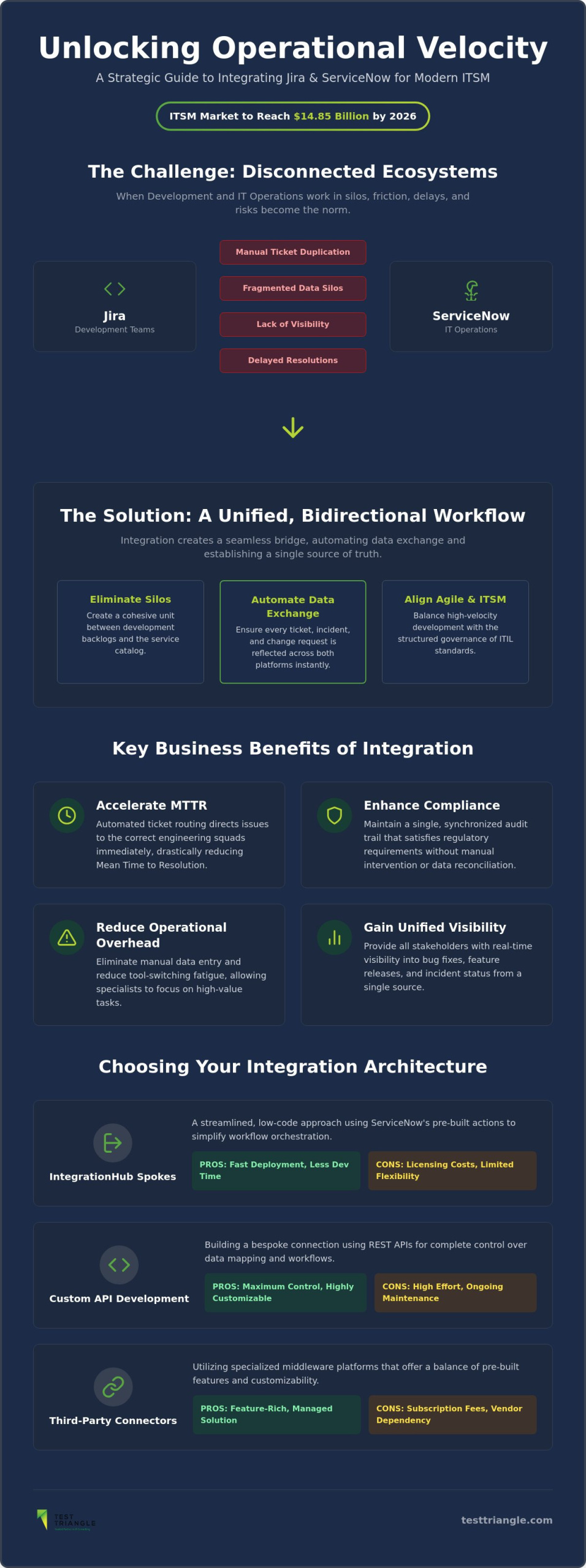

Could your organization’s pursuit of granular data be the primary catalyst for system instability? With Jira Cloud now enforcing a strict 700-field-per-space limit, the era of unchecked custom field proliferation has officially transitioned from a minor inconvenience to a critical strategic risk. You’ve likely experienced the frustration of custom field bloat, where every new department request results in a fresh layer of technical debt that slows down your instance and complicates cross-functional reporting. It’s a high-maintenance cycle that drains agent productivity while obscuring the very insights you’re trying to capture.

We understand that maintaining a clean, scalable environment requires a disciplined approach to data governance. By mastering Jira Forms Best Practices, you’ll learn to transition from static, field-heavy configurations to high-performance dynamic forms that drive data integrity and ITSM efficiency. This article provides a comprehensive roadmap for standardizing intake across global departments, allowing you to reduce administrative overhead and empower your teams through superior data quality, operational precision, and sustainable growth. We’ll explore how to leverage native form capabilities to orchestrate a streamlined request process that restores your instance to a state of scalable excellence.

Key Takeaways

  • Discover how to mitigate system performance issues and reduce administrative overhead by replacing excessive custom fields with dynamic, high-performance form elements.
  • Implement Jira Forms Best Practices to architect user-centric request portals that enhance data accuracy and completion rates through intuitive design logic.
  • Establish a robust governance framework that balances centralized oversight with departmental flexibility to maintain a standardized intake process across global enterprise instances.
  • Learn to enforce mandatory data points and secure audit trails to meet the rigorous regulatory compliance requirements of the pharmaceutical and financial sectors.
  • Understand how professional Atlassian consulting services can accelerate your digital transformation by avoiding common implementation pitfalls and ensuring long-term operational stability.

The Strategic Shift: From Custom Field Bloat to Dynamic Jira Forms

For decades, the architectural backbone of Jira (software) relied heavily on custom fields to capture every nuance of a request. However, as global enterprises scaled, this reliance evolved into a significant bottleneck, manifesting as “custom field bloat” that degrades instance performance and complicates administrative oversight. Transitioning to a form-based architecture represents a fundamental pivot from static, rigid issue screens to a fluid, dynamic intake model. By adopting Jira Forms Best Practices, organizations can decouple data collection from the underlying database schema, ensuring that the system remains responsive while providing the precision required for complex workflows. This shift fosters a more productive partnership between IT teams and business units, as it allows for rapid iteration of intake requirements without the risk of contaminating the global field list. Ultimately, this modern approach delivers three core pillars of enterprise success: Performance, Precision, and Partnership.

Reducing Technical Debt with Form-Based Architecture

Maintaining an environment with over 1,000 custom fields carries a hidden, compounding cost that many organizations fail to quantify until system performance begins to stutter. Administrators often spend dozens of hours each month merely reconciling field configurations, managing complex screen schemes, and troubleshooting indexing delays that frustrate end-users. Forms alleviate this burden by allowing teams to collect information that exists only within the context of a specific request, rather than occupying a permanent slot in the Jira database. When you leverage Atlassian implementation strategies centered on forms, you’re effectively future-proofing your instance against the 700-field-per-space limit currently enforced in Jira Cloud. To begin this transition, we recommend a comprehensive audit of existing fields to identify those that are project-specific or rarely used in high-level reporting. Converting these into form elements immediately reduces the metadata load, creating a leaner, more agile environment.

When to Use Forms vs. Custom Fields

Determining the appropriate container for your data is essential for long-term scalability and user satisfaction. Custom fields should be reserved for data points that require cross-project reporting, trigger complex automation rules, or serve as critical filters in JQL searches. Conversely, specific request details, such as a shipping address for a hardware request or a software version for a bug report, are prime candidates for forms. By following Jira Forms Best Practices, you can adopt a “Hybrid Approach” that maximizes searchability while maintaining a clean, professional UI. This strategy ensures that your most vital business metrics remain searchable and reportable, while team-specific needs are handled through flexible, dynamic forms. This distinction prevents the “one-size-fits-all” screen fatigue that often leads to inconsistent data entry and high maintenance effort for IT managers. By strategically segregating data, you empower your agents with high-quality information without overwhelming them with irrelevant fields.

Architecting Enterprise-Grade Form Design and Logic

Designing an enterprise-grade intake portal requires a shift from reactive field creation to a proactive, design-first methodology. By prioritizing the user journey, organizations can significantly increase completion rates and ensure data accuracy from the point of entry. One of the most critical Jira Forms Best Practices involves the implementation of sophisticated conditional logic to mitigate “form fatigue.” When users are presented only with the fields relevant to their specific request, the cognitive load is reduced, leading to higher-quality submissions and fewer abandoned tickets. For organizations managing intricate global workflows, leveraging Atlassian Implementation Services ensures that these complex logic builds are executed with technical rigor and long-term stability in mind. This strategic approach transforms the intake process from a simple data dump into a streamlined conversation between the requester and the service provider.

Mastering Conditional Logic and Dynamic Sections

Effective form architecture relies on clear Jira form design principles that utilize “if/then” branching to create a tailored experience. For instance, selecting “Hardware Request” should dynamically trigger sections for equipment specifications and delivery addresses, while hiding unrelated software licensing queries. It’s vital to use descriptive section headers and concise tooltips to guide the user through these transitions. However, administrators must remain vigilant against “logic loops,” which are contradictory conditions that prevent a user from progressing or successfully submitting the form. A disciplined approach to logic testing during the design phase prevents these operational friction points and ensures a seamless experience for the end-user.

Effective Data Mapping and Field Linking

To maintain reporting capabilities without sacrificing system speed, you must master the art of field mapping. Jira Forms Best Practices dictate that critical data points, such as those required for SLAs, automation triggers, or executive dashboards, should be linked directly to Jira system fields. This ensures the data remains searchable through JQL, allowing for robust performance tracking and automated routing. For supplementary information that doesn’t require global reporting, data can remain unmapped, stored securely within the form structure or rendered into an attached PDF. This selective mapping strategy preserves the integrity of your global schema while capturing the granular detail necessary for agent resolution. If your current configuration is becoming unmanageable, it may be time to speak with our strategic consultants to refine your intake architecture and restore operational clarity.

Governance and Standardization Across Global Instances

Operating at a global scale requires more than just technical tools; it demands a rigorous framework of systemic discipline to ensure that organizational growth does not lead to operational chaos. Establishing a comprehensive “Form Governance Policy” is a strategic imperative for enterprises seeking to maintain architectural integrity across multiple business units. By adhering to Jira Forms Best Practices, leadership teams can define clear boundaries for form creation, ensuring that the transition away from custom fields does not simply result in a new era of “Form Bloat.” This governance model must find a delicate balance between centralized oversight, which ensures global standards, and decentralized management, which provides individual departments with the agility they need to respond to local requirements. When properly executed, this framework acts as a steady hand, guiding the organization toward a state of scalable excellence and operational fluidity.

Standardization begins with the implementation of strict naming conventions for both forms and their linked fields. Utilizing a structured format, such as [Department]_[Process]_[Version], allows administrators to identify the purpose and owner of any given form at a glance, significantly reducing the time spent on system audits. Furthermore, establishing a formal review process for new form requests ensures that every addition to the system is necessary, well-designed, and compliant with global data standards. This proactive approach to digital transformation services prevents the accumulation of technical debt and ensures that the Jira environment remains a lean, high-performance asset for the entire enterprise.

Creating a Form Template Library

To accelerate deployment and maintain consistency, organizations should develop a centralized template library categorized by department, such as HR, Finance, IT, and Legal. This library serves as a repository of proven configurations, allowing teams to launch new intake processes with confidence and speed. Version control is a critical component of this library; it enables administrators to update form logic and fields without compromising the integrity of historical data. Sharing these Jira Forms Best Practices through an internal Atlassian Center of Excellence fosters a culture of continuous improvement, where successful strategies from one department can be easily adopted by others to drive collective efficiency.

Permission Schemes and Security for Forms

Securing your data collection processes requires a sophisticated approach to permission schemes that controls who can create, edit, and submit forms at the project level. In the context of IT service management solutions, managing the distinction between internal and external form access is paramount to protecting sensitive information while maintaining a frictionless user experience. Administrators must implement regular auditing of form changes to ensure that security protocols are followed and that no unauthorized modifications have occurred. This level of oversight provides the peace of mind that comes from knowing your digital infrastructure is both open to collaboration and resilient against risk.

Industry-Specific Compliance and Data Integrity

In highly regulated sectors such as pharmaceuticals and finance, the stakes for data collection extend far beyond simple operational efficiency; they represent a critical layer of regulatory risk management. Adhering to Jira Forms Best Practices in these environments ensures that every piece of captured data is traceable, secure, and compliant with global standards. By utilizing forms to enforce mandatory data points, organizations can create an immutable audit trail that satisfies the rigorous demands of external regulators. For those operating in compliance-heavy landscapes, our IT services for the public sector provide the specialized expertise needed to navigate these complex digital requirements with confidence. This strategic approach to data integrity transforms the intake process into a robust defense mechanism against non-compliance and systemic error.

Ensuring data privacy through field-level security and granular form access is paramount when handling sensitive information. Unlike standard issue screens that may expose data to all project users, forms allow for a more controlled environment where only authorized personnel can view or edit specific data points. This level of precision is essential for maintaining GDPR and HIPAA standards within a shared Jira instance. By segregating data at the point of entry, organizations can empower their teams to collaborate effectively while maintaining the strict confidentiality required by global privacy laws. It’s a disciplined methodology that reinforces the brand’s commitment to security and operational excellence.

Jira Forms in GxP and Validated Environments

Within Life Sciences, forms play a pivotal role in supporting 21 CFR Part 11 compliance by providing structured data entry points for change control and incident reporting. While Atlassian provides a compliant platform, achieving full regulatory alignment requires precise configuration and the strategic use of manual testing to validate form workflows against specific business requirements. This validation process ensures that electronic records remain accurate and that the system behaves predictably under audit scrutiny. By integrating these structured intake methods, companies can move away from fragmented documentation toward a centralized, validated source of truth that supports long-term operational stability and human safety.

Data Validation and Error Handling

To maintain the highest standards of data integrity, administrators should employ advanced validation techniques, such as regex (regular expressions), to prevent the entry of “dirty data.” This technical rigor ensures that sensitive information, like financial account numbers or clinical trial IDs, follows a standardized format before submission. Jira Forms Best Practices also involve setting mandatory fields that capture essential compliance data without introducing unnecessary friction for the end-user. Automating notifications when critical data is missing further strengthens the governance model, allowing for immediate corrective action. If you’re ready to fortify your compliance framework, consult with our regulatory experts today to ensure your Jira instance meets the most demanding global benchmarks.

Jira Forms Best Practices: Optimize Your Data Collection

Maximizing ITSM Efficiency with Professional Atlassian Consulting

Navigating the complexities of enterprise-scale Atlassian environments requires more than just technical configuration; it necessitates a strategic partnership that aligns tool capabilities with high-level business objectives. Expert consulting plays a pivotal role in this alignment, particularly when organizations are migrating from legacy custom field structures to modern, form-based architectures. By integrating Jira Forms Best Practices into the broader organizational workflow, professional services help teams avoid common implementation pitfalls such as redundant logic, poor data mapping, or inconsistent naming conventions. This proactive guidance accelerates return on investment by ensuring the system is architected for scalability from day one. Test Triangle’s unique approach to Atlassian Consulting focuses on delivering long-term stability through a combination of human expertise and technical precision, positioning us as a reliable collaborator in your journey toward operational excellence.

To begin this evolution, the first logical step is a comprehensive audit of your current Jira instance to identify candidates for form optimization. This process involves analyzing field usage statistics, identifying project-specific data points, and mapping out the user journey for your most frequent request types. Professional consultants provide the objective lens necessary to distinguish between essential system fields and legacy bloat that should be transitioned to dynamic forms. This audit sets the foundation for a scalable, high-performance environment that supports both current operations and future expansion, ensuring your digital infrastructure remains a lean and agile asset.

Strategic Roadmapping for Atlassian Optimization

Strategic roadmapping allows organizations to move from reactive support models to proactive system evolution. By integrating Jira Forms into a wider Digital Transformation strategy, leadership can ensure that every data intake point serves a specific, high-value purpose within the global enterprise. For organizations with limited internal bandwidth, leveraging Managed Outsourcing Services provides the continuous maintenance and optimization required to keep the instance lean. This comprehensive oversight ensures that your governance policies remain effective as your business requirements evolve, providing the peace of mind that comes from expert-led infrastructure management.

Training and Change Management for Teams

Successful adoption depends on empowering internal teams to build and manage their own forms within a strictly governed framework. Conducting rigorous user acceptance testing (UAT) for every new deployment is essential to ensure that form logic remains intuitive and error-free for the end-user. Finally, closing the loop through form analytics allows administrators to identify friction points and drive continuous improvement across all service desks. By mastering Jira Forms Best Practices through expert-led training, your teams gain the versatility needed to manage complex request types with confidence, ensuring that your digital tools act as a catalyst for growth rather than a source of technical debt.

Future-Proofing Your Enterprise Data Strategy

The transition from rigid, field-heavy configurations to a dynamic, form-centric architecture is no longer just a recommendation; it’s a strategic necessity for maintaining system performance and data integrity. By implementing Jira Forms Best Practices, your organization can effectively eliminate technical debt, enforce rigorous compliance standards, and empower teams through intuitive, logic-driven intake processes. This evolution ensures that your digital infrastructure remains a lean, agile asset capable of supporting global operations without the friction of administrative overhead or inconsistent data quality.

As an Atlassian Platinum Solution Partner with deep expertise in GxP and highly regulated industries, Test Triangle is uniquely positioned to guide your digital transformation. Our global delivery model provides the technical rigor and reliability required to manage complex digital landscapes with precision. Whether you’re navigating a large-scale migration or refining your governance policies, we remain your dedicated long-term collaborator for operational stability and growth. We look forward to helping you achieve a more scalable and efficient future.

Optimize your Jira environment with Test Triangle’s Atlassian Consulting Services to restore clarity and efficiency to your enterprise workflows today.

Frequently Asked Questions

What is the difference between Jira Forms and Custom Fields?

Jira Forms function as dynamic UI components that capture information without requiring permanent database schema changes, whereas custom fields exist as global entities that impact the entire instance. By utilizing forms, organizations can adhere to Jira Forms Best Practices by collecting project-specific details that don’t need to be indexed globally. This approach prevents system bloat and ensures that your technical infrastructure remains lean, responsive, and easy to manage.

Can I use Jira Forms in Jira Software and Jira Work Management?

Yes, Jira Forms are a native feature accessible across Jira Software, Jira Work Management, and Jira Service Management in the Cloud. This cross-platform availability empowers organizations to standardize their intake processes regardless of the specific project type. It ensures a consistent user experience while providing the technical rigor and versatility needed to manage complex enterprise workflows across diverse global departments and teams.

How do I map Jira Form fields to existing issue fields?

You map fields by selecting the “Link to a Jira field” option within the form builder’s configuration settings for each specific element. This connection ensures that form data is synchronized with system or custom fields, making the information searchable via JQL and accessible for automation. Following Jira Forms Best Practices involves mapping only critical data points to preserve system performance and maintain a clean database architecture.

Are Jira Forms available in the Jira Cloud mobile app?

Jira Forms are fully supported within the Jira Cloud mobile app for both iOS and Android devices. Users can view, edit, and submit forms directly from their smartphones or tablets, ensuring operational continuity for field-based or remote teams. This mobile accessibility supports a more versatile and globally-minded workforce by allowing for real-time data collection and request management in any professional environment.

Can I hide specific forms from certain customer groups in JSM?

You can control form visibility by associating specific forms with different Request Types within Jira Service Management. By configuring your portal settings, you can ensure that only relevant forms are presented to specific customer groups or organizations based on their needs. This granular control reduces “form fatigue” and ensures that sensitive intake processes remain secure, targeted, and aligned with your organizational governance policies.

How do Jira Forms impact system performance compared to Issue Screens?

Jira Forms offer a significantly lower performance impact than traditional issue screens because they don’t contribute to the custom field proliferation that often slows down reindexing. By housing granular data within the form layer rather than the database schema, you reduce the computational load required to render complex request types. This methodology supports a high-performance, scalable growth model that’s essential for large-scale enterprise environments.

What happens to the data if I delete a form from a Jira issue?

Deleting a form from an issue results in the permanent loss of any data stored exclusively within that form’s structure. However, any data that was linked and mapped to Jira fields will remain intact within the issue’s record. To ensure data integrity, administrators should verify that all critical information is properly mapped to system fields before removing any form attachments from an active issue.

Can I automate issue transitions based on Jira Form submissions?

You can use Jira Automation to trigger issue transitions or updates immediately upon form submission or completion. By leveraging the “Form submitted” trigger, you can orchestrate complex, multi-stage workflows that respond to new data with high precision and speed. This capability is vital for maximizing ITSM efficiency and ensuring that your request management processes are both highly automated and professionally structured.

Paul Guy

Article by

Paul Guy

Paul serves as the Marketing Director at Test Triangle, where he leads a global team in driving growth through strategic B2B marketing and brand communications. With a strong emphasis on measurable outcomes and sustainable performance, he plays a pivotal role in aligning marketing functions to enhance customer engagement and accelerate business impact. Under his leadership, marketing initiatives have consistently delivered significant returns on investment, elevated brand visibility, and strengthened the company's presence across key markets.


Beyond Jira’s Two-Level Limit: Why Every Growing Organisation Needs Multi-Level Cascading Field

As organisations become larger and more complex, so do the processes they manage inside Jira.

What starts as a simple project management platform often evolves into the operational backbone of the business, supporting IT Service Management (ITSM), HR, procurement, facilities, software development, compliance, asset management, customer support and much more.

Yet many organisations eventually encounter the same limitation.

Jira’s native Cascade Select field only supports two levels.

For modern enterprises managing complex services and hierarchical data, that simply isn’t enough. Atlassian itself documents that the native cascading select field is limited to parent and child selections, meaning organisations needing deeper hierarchies must rely on third-party solutions.

That’s why Test Triangle developed N-Level Cascade Select for Jira & Jira Service Management, a powerful Atlassian Marketplace app that removes this restriction and allows organisations to create cascading drop downs with virtually unlimited levels. The app is built on Atlassian Forge and is designed for Jira Cloud environments.

N-Level Cascade Select from Test Triangle

That is exactly why Test Triangle developed
N-Level Cascade Select for Jira and Jira Service Management.


Why the Native Jira Cascade Field Falls Short

Jira excels at workflow management, but today’s organisations rarely work with simple two-level classifications.

Consider a few everyday business examples.

IT Service Management

Service Category

→ Application

→ Module

→ Component

→ Environment

→ Priority

→ SLA

Global Organisations

Continent

→ Country

→ Region

→ City

→ Office

→ Department

→ Team

Product Management

Product Family

→ Product

→ Version

→ Module

→ Feature

→ Enhancement

Human Resources

Business Unit

→ Department

→ Team

→ Role

→ Employment Type

→ Location

Each represents a natural business hierarchy.

Trying to squeeze these into only two levels creates unnecessary complexity and often results in poor-quality data.


The Hidden Cost of Poor Data Capture

Many organisations compensate for Jira’s limitation by introducing workarounds.

These often include:

  • Hundreds of values inside a single dropdown
  • Multiple disconnected custom fields
  • Manual validation
  • Complex Jira Automation rules
  • Marketplace apps designed for unrelated purposes
  • Custom scripting and maintenance

Initially these approaches appear manageable.

Over time they become expensive.

Users select incorrect values.

Reports become unreliable.

Automation breaks.

Administrators spend more time maintaining workflows than improving them.

Most importantly, decision-makers lose confidence in the quality of their Jira data.


Introducing N-Level Cascade Select

N-Level Cascade Select extends Jira by allowing organisations to build structured cascading selections with unlimited depth.

Instead of stopping at two levels, organisations can create:

  • 3 levels
  • 5 levels
  • 10 levels
  • 20 levels
  • Any hierarchy required by the business

Each user selection intelligently filters the next available options, creating a guided experience that is faster, simpler and significantly more accurate.


Real Business Examples

IT Service Desk

Instead of asking users to search through hundreds of systems, the request naturally guides them.

Infrastructure

→ Servers

→ Windows

→ Production

→ Database Server

→ SQL Cluster

Support teams immediately know exactly what the issue relates to.


HR Request Portal

People Operations

→ Recruitment

→ Permanent Employee

→ Technical

→ Software Engineer

→ Dublin

Every request arrives fully classified before an agent even opens the ticket.


Facilities Management

Building

→ Floor

→ Room

→ Equipment

→ Asset Type

→ Maintenance Category

Instead of chasing users for additional information, maintenance teams receive complete and accurate requests.


Product Support

Hardware

→ Laptop

→ Manufacturer

→ Model

→ Operating System

→ Version

Perfect for organisations supporting thousands of products across multiple regions.


Designed for Jira Service Management

One of the biggest advantages of N-Level Cascade Select is its seamless integration with Jira Service Management.

The app works directly inside customer request forms, allowing organisations to capture highly structured information before tickets are created. This reduces back-and-forth communication, improves ticket routing and helps service teams resolve issues faster.

For organisations processing hundreds or thousands of requests each day, this can dramatically improve operational efficiency.


Built for Enterprise Administration

Large organisations often maintain thousands of categories.

Manually creating them isn’t practical.

N-Level Cascade Select includes:

  • Visual hierarchy builder
  • JSON Builder
  • JSON Import
  • JSON Export
  • Real-time preview
  • Workflow transition support

Administrators can build or update extensive classification structures in minutes instead of hours. Recent releases have also expanded storage capacity and added workflow conditions and inline editing capabilities.


Built on Atlassian Forge

Security is critical.

N-Level Cascade Select is developed using Atlassian Forge, meaning it operates within Atlassian’s cloud platform architecture and keeps app data within the Jira environment rather than sending it to external infrastructure.

For organisations with strict governance and compliance requirements, this provides greater confidence in how data is managed.


Better Data Creates Better Decisions

The quality of dashboards, automation, reporting and AI depends entirely on the quality of the underlying data.

Structured information enables organisations to:

  • Improve reporting accuracy
  • Automate workflows with confidence
  • Reduce user error
  • Standardise classifications globally
  • Simplify administration
  • Improve customer experience
  • Increase service desk productivity

Instead of cleaning data afterwards, organisations capture it correctly from the beginning.


More Than an App

N-Level Cascade Select is part of Test Triangle’s wider Atlassian practice.

As an Atlassian Gold Solution Partner, Test Triangle provides:

  • Atlassian Consulting
  • Jira Software implementation
  • Jira Service Management implementation
  • Cloud migration
  • Managed Services
  • Platform optimisation
  • Licensing and renewals
  • Enterprise support

The app was developed from real customer challenges encountered during enterprise Jira implementations, making it a practical solution to a common operational problem.


Who Can Benefit?

N-Level Cascade Select is ideal for organisations using Jira across:

  • IT Service Management
  • Software Development
  • Human Resources
  • Finance
  • Procurement
  • Healthcare
  • Pharmaceutical
  • Government
  • Education
  • Manufacturing
  • Asset Management
  • Facilities Management
  • Customer Support

If your organisation captures structured business information inside Jira, deeper cascading fields can significantly improve usability and data quality.


Transform the Way You Capture Data in Jira

Jira is one of the world’s most powerful collaboration and workflow platforms. But as organisations grow, the need for richer, more structured data becomes essential.
N-Level Cascade Select removes one of Jira’s most common limitations by allowing organisations to build intuitive, unlimited-depth cascading fields that mirror real business structures.
The result is cleaner forms, better user experiences, more reliable reporting and stronger governance across your Jira environment.
Whether you’re managing IT services, enterprise projects, HR processes or customer support, N-Level Cascade Select helps you capture the right information the first time.

Start your free trial today on the Atlassian Marketplace and discover how multi-level cascading fields can transform the way your organisation uses Jira.
If your business relies on complex hierarchical data, N-Level Cascade Select provides a scalable and intuitive solution built specifically for Jira and Jira Service Management.

Explore N-Level Cascade Select for Jira and Jira Service Management
on the Atlassian Marketplace and discover how structured data capture can transform your Jira environment.