



Why do 68% of enterprise software failures occur at the interface level, even when individual modules pass every unit test with flying colors? You’ve likely experienced the disruption caused by interface defects that bypass initial checks only to cripple production environments later. By understanding what is sit in testing, you can bridge the gap between isolated code and a cohesive digital infrastructure. As a Trusted Partner in the testing space, we recognize that managing complex data flows across legacy and cloud systems requires more than just technical oversight; it demands a rigorous, structured approach to validation.
This article promises to help you master the complexities of System Integration Testing to build a robust, high-performing enterprise ecosystem. By leveraging our “Technology. Talent. Transformation.” framework, you’ll learn to implement a strategic SIT process that reduces production bugs by 40% and accelerates your delivery cycles. We’ll provide a clear roadmap for aligning your IT architecture with business goals, ensuring your software modules work in perfect harmony. From interface validation to cross-system data integrity, this guide prepares your organization for the technical demands of 2026 and beyond.
Key Takeaways
- Understand what is sit in testing by defining its critical role in validating data integrity and operational flow across complex enterprise architectures.
- Master the strategic selection of top-down or bottom-up methodologies to optimize early bug detection while balancing project risk and budgetary constraints.
- Navigate the quality assurance lifecycle with precision by distinguishing SIT’s focus on interface connectivity from the broader scopes of System Testing and UAT.
- Address the integration challenges of 2026, including microservices and AI, through disciplined environment management and strategic technology roadmapping.
- Discover how to leverage professional services and flexible engagement models to drive a seamless, high-performing digital transformation for your organization.
Defining System Integration Testing (SIT) for Modern Enterprise Architecture
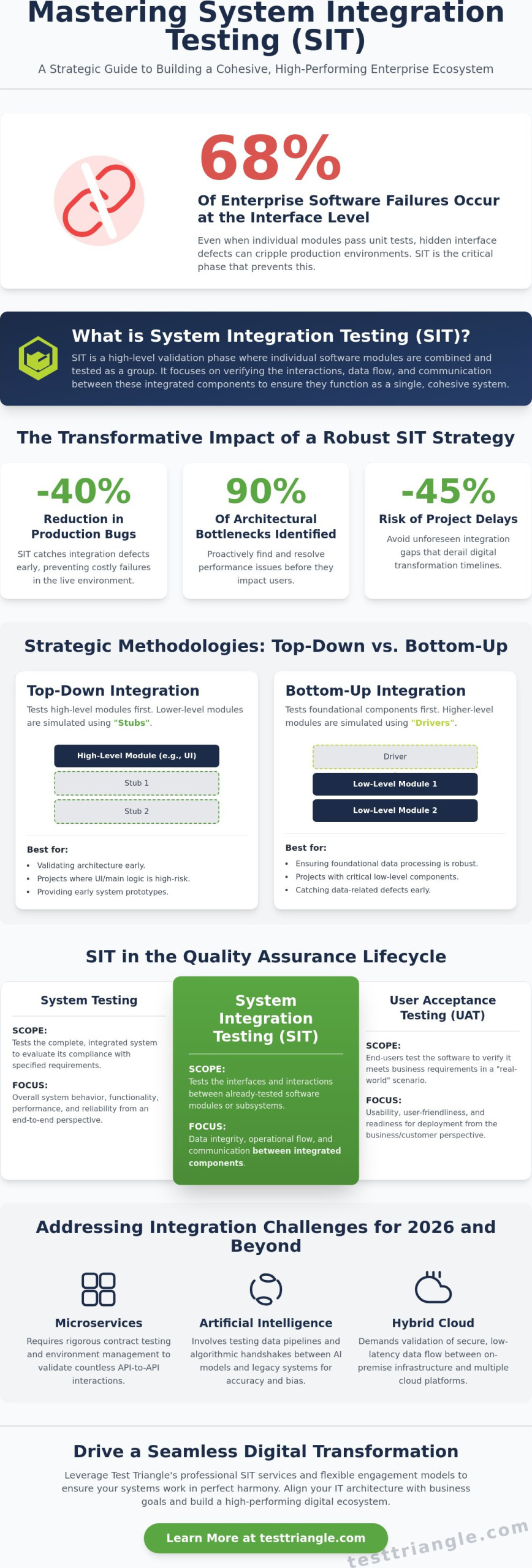
By 2026, the proliferation of microservices and hybrid cloud architectures has transformed the quality assurance landscape, making it essential for IT leaders to understand exactly what is sit in testing. At its core, System Integration Testing (SIT) represents a high-level validation phase where individual software modules are aggregated and evaluated as a singular, cohesive system. It’s the critical juncture where technical silos dissolve, allowing engineers to verify that data integrity and operational flows remain intact across disparate subsystems. System integration testing is the validation of interface compatibility and business rule consistency across a complex IT landscape.
Modern enterprises now manage an average of 1,000+ distinct applications within their digital estates. SIT serves as the primary safeguard for the Strategic Architect vision, ensuring that interconnected cloud platforms and on-premise legacy environments communicate without friction. By focusing on the points of contact between systems, SIT identifies 90% of architectural bottlenecks before they reach the production environment, providing a steady hand in an increasingly volatile technological world.
The Core Objectives of System Integration Testing
The primary mission of SIT centers on verifying that data flows accurately between internal modules and external third-party APIs. In a 2025 industry survey, 68% of system failures were traced back to interface mismatches rather than logic errors within individual components. SIT mitigates this by ensuring business workflows remain uninterrupted when multiple systems interact in a Manual Testing environment. This phase is designed to catch latent defects that unit testing can’t identify because it lacks the necessary architectural scope. By simulating real-world data exchanges, SIT confirms that every handshake between platforms is secure, precise, and compliant with established business rules.
SIT in the Context of Digital Transformation
SIT acts as a technical anchor during large-scale Digital Transformation Services. When organizations migrate legacy data to modern AWS or ServiceNow environments, SIT provides the empirical evidence needed to confirm that the new infrastructure supports existing business logic. It’s common for 45% of transformation projects to face delays due to unforeseen integration gaps; however, a robust SIT strategy eliminates these blind spots early in the lifecycle. By aligning technical execution with high-level business outcomes, SIT reduces the risk of post-deployment failures and ensures that the transition to new technology doesn’t compromise operational stability. It empowers businesses to leverage their talent and technology to achieve flawless scalability in a competitive market.
Strategic Methodologies for Executing System Integration Testing
Selecting the right execution strategy isn’t a one-size-fits-all decision. By aligning a specific methodology with project complexity and risk tolerance, organizations can reduce defect leakage by up to 20 percent based on 2024 industry benchmarks. Understanding what is sit in testing requires more than technical knowledge; it demands a strategic assessment of how different modules interact within a larger ecosystem. Test Triangle leverages these models to optimize delivery and elevate software quality for global enterprises.
Top-Down vs. Bottom-Up Integration Approaches
Top-down testing prioritizes high-level control structures. Developers use “stubs” to simulate missing lower-level modules, which allows for early validation of the system architecture and major control points. This is particularly effective when the user interface or main logic flow carries the highest risk. It helps stakeholders see a working prototype early in the cycle.
Conversely, the bottom-up approach begins with the foundational components. By using “drivers” to mimic higher-level control, teams ensure that data processing and basic functions are robust before moving upward. Statistics from 2025 software delivery reports indicate that bottom-up strategies can accelerate unit integration by 15 percent in data-heavy applications. Choosing between these depends on system maturity. If the core architecture is stable, top-down is often preferred; if low-level modules are ready first, bottom-up saves time.
The Sandwich (Hybrid) and Big Bang Techniques
Sandwich testing, often called hybrid integration, addresses the limitations of both previous models. It tests middle-layer modules simultaneously by combining top-down and bottom-up logic. This approach is highly effective for complex ERP systems where dependencies are dense and multi-layered. It balances the need for early architectural validation with the requirement for robust low-level data handling.
The Big Bang technique remains an option for smaller, less complex systems. In this model, all modules are integrated at once. While it’s cost-effective for projects with fewer than 10 components, it carries a high risk of difficult debugging. If a failure occurs, isolating the root cause becomes a resource-intensive task that can stall production. To mitigate these risks, Test Triangle acts as a Strategic Architect, advising on the best technical roadmap for your specific environment.
By combining technical expertise with adaptable delivery models, Test Triangle helps businesses reduce costs and drive digital transformation. We integrate Atlassian implementation strategies into the testing lifecycle to ensure every integration point is tracked. Our commitment to Technology, Talent, and Transformation ensures that your SIT process is both flawless and scalable.
If you’re looking to refine your integration strategy and ensure operational stability, our consultants are ready to discuss your project requirements and help you understand what is sit in testing for your specific business needs.
SIT vs. Other Testing Levels: Navigating the Quality Assurance Lifecycle
Understanding where SIT sits in the V-Model of software testing prevents redundant effort and ensures that every dollar of the QA budget is utilized effectively. By positioning SIT as the bridge between development and business validation, Test Triangle helps enterprises avoid the 30% increase in project timelines often caused by overlapping test cycles. While Unit Testing verifies the logic of a single function, what is sit in testing focuses specifically on the interfaces between these functions. This strategic distinction allows teams to isolate communication errors before they escalate into systemic failures during the final stages of the project.
A robust QA strategy requires a clear distinction between technical validation and business acceptance. SIT serves as the technical gatekeeper, ensuring that the underlying architecture is sound. Without this phase, the transition to functional testing becomes volatile, often leading to a 20% higher defect leakage rate into production. SIT is a non-negotiable prerequisite for successful User Acceptance Testing (UAT), as it ensures the system is stable enough for business stakeholders to evaluate without technical interruptions.
Distinguishing SIT from Unit and System Testing
By isolating code validation at the Unit Testing level, developers ensure that individual components perform their basic tasks. However, defining what is sit in testing involves moving beyond these silos to validate inter-module relationships. While Unit Testing checks the “parts,” SIT checks the “connections.” Once the interfaces are proven stable, System Testing validates the complete application against functional requirements. This tiered approach facilitates a flawless transition from technical validation to functional verification, ensuring that the software meets its specified goals in a unified environment. According to 2024 industry benchmarks, organizations that maintain strict separation between these levels see a 15% improvement in deployment velocity.
SIT vs. User Acceptance Testing (UAT)
The distinction between SIT and UAT is primarily one of technical versus functional intent. SIT is performed by developers and specialist testers in a technical integration environment to ensure data flows correctly between systems. In contrast, UAT is performed by business users in an environment that mirrors the production state to ensure the software solves the actual business problem. By leveraging Atlassian implementation strategies, teams can map technical SIT defects directly to business requirements, creating a transparent audit trail. Successful SIT reduces friction and mitigates risks during the final UAT phase by filtering out technical bugs that would otherwise distract business stakeholders. This proactive risk mitigation ensures that UAT focuses on usability and business value rather than basic connectivity issues.
Overcoming Complexities in SIT: Best Practices for 2026
The architectural landscape of 2026 presents a unique set of challenges for quality assurance teams. With 85% of global enterprises now deploying microservices at scale, the surface area for integration defects has expanded exponentially. Understanding what is sit in testing today requires a shift from viewing it as a simple handshake between two systems to managing a complex web of AI-driven dependencies. Effective execution demands a disciplined approach to environment management and a robust technology roadmap that anticipates multi-cloud interactions.
Automation isn’t a luxury in this high-velocity environment; it’s the primary engine driving operational stability. Manual checks can’t keep pace with continuous delivery cycles where code is pushed 50 times a day. To manage these intricate layers, many organizations find that software testing outsourcing provides the necessary specialized talent to scale testing efforts without compromising on precision. By leveraging external expertise, businesses can focus on core innovation while ensuring their integrated systems remain resilient and scalable. Embedding SIT within a broader framework of software QA services ensures that integration validation is treated as a strategic function rather than an isolated checkpoint.
Establishing Entry and Exit Criteria for Flawless Execution
Precision in SIT begins with rigid gates. Entry criteria must include the 100% completion of unit testing and the availability of a stable, production-mirror integration environment. Exit criteria are equally strict, requiring that all critical interface bugs are resolved and every test case is executed. Documented sign-offs from all stakeholders are vital to maintain institutional maturity. These formal approvals ensure that the transition to User Acceptance Testing (UAT) is backed by verified data, which reinforces the reliability of the entire digital infrastructure.
Leveraging AI and Automation in Integration Testing
Forward-thinking enterprises now utilize Artificial Intelligence Services to predict where integration points are most likely to fail based on historical code changes and traffic patterns. This predictive capability can reduce testing cycles by up to 35%. Automation also plays a critical role in validating data flows across complex ServiceNow and Jira workflows, ensuring that information remains consistent as it traverses different platforms. Shifting toward continuous integration testing within the DevOps pipeline allows teams to catch defects early, which remains a core tenet of what is sit in testing in a modern agile framework.
By combining technical rigor with strategic foresight, your organization can transform SIT from a bottleneck into a competitive advantage. If you’re ready to elevate your quality standards and mitigate integration risks, connect with our strategic consultants today.
Leveraging Professional SIT Services for Digital Transformation
By aligning Technology, Talent, and Transformation, Test Triangle provides the strategic framework necessary for complex SIT initiatives. Every global enterprise needs to grasp what is sit in testing to avoid the pitfalls of fragmented data and siloed systems. We provide the architectural oversight needed to turn technical requirements into tangible business value. Our role as a Strategic Architect ensures that your digital infrastructure remains robust, secure, and ready for the demands of 2026 and beyond.
Specialized SIT for Atlassian and ServiceNow Ecosystems
Successful digital transformation relies on the seamless interplay of enterprise tools. We specialize in ensuring a flawless Atlassian Implementation through exhaustive testing cycles that validate every touchpoint between Jira, Confluence, and external databases. Our team also validates intricate ServiceNow workflows, directly improving IT Service Management (ITSM) efficiency. According to industry data from 2025, proactive integration testing reduces post-release defects by 60%. We focus on these critical metrics to verify platform integrations before go-live, effectively shielding your operations from costly downtime and configuration errors.
Flexible Staffing and Managed Outsourcing for SIT
Managing a modern testing landscape requires both agility and deep domain knowledge. Our Staffing Solutions give you immediate access to top-tier QA professionals who understand the nuances of what is sit in testing for highly regulated sectors. Through our Managed Outsourcing Services, we offer a steady hand to organizations facing rapid growth or technical debt. We’ve positioned ourselves as a Trusted Partner for global firms, offering flexible engagement models that include remote, offshore, and permanent options to fit your specific project scope.
By combining deep technical expertise with adaptable delivery models, Test Triangle helps businesses reduce operational costs while elevating quality standards. Our strategic technology consulting ensures that every SIT phase contributes to your long-term roadmap. We bridge the gap between technical execution and C-suite goals, providing the confidence that your systems will perform under pressure. Our commitment to excellence is reflected in our methodology:
- Technology: Utilizing advanced automation and partner tools like Atlassian and ServiceNow.
- Talent: Deploying specialized engineers with experience in Banking, Life Sciences, and Retail.
- Transformation: Driving scalable growth through rigorous validation and risk mitigation.
Test Triangle remains a steady hand in a fast-changing technological landscape. We prioritize operational stability and precision, ensuring that your organization is equipped to handle the complexities of modern system integration.
Future-Proofing Your Digital Infrastructure for 2026 and Beyond
Mastering what is sit in testing remains a cornerstone of successful software delivery, especially as industry analysts predict that 75% of enterprise applications will utilize modular architectures by 2026. By isolating interface defects early, teams prevent the cascading failures that often account for 80% of production outages. At Test Triangle, we serve as your Trusted Partner, delivering the Technology. Talent. Transformation. necessary to navigate these complex environments. As an Atlassian Gold Solution Partner and strategic collaborator with ServiceNow and AWS, we bring verified technical depth to every engagement. Our experts across Europe, North America, and Asia implement rigorous SIT frameworks that bridge the gap between individual components and holistic system performance.
We don’t settle for basic verification; we drive operational stability through precise, data-driven testing strategies. By leveraging our flexible engagement models, your organization can accelerate release cycles while maintaining a robust security posture. It’s time to transform your quality assurance from a bottleneck into a strategic advantage. By combining global reach with deep technical expertise, we ensure your digital transformation remains on track and resilient against evolving market demands. When evaluating the right partner to support your integration testing needs, consulting a strategic checklist for selecting a qa software testing company can help you identify the capabilities and engagement models that align with your 2026 roadmap.
Optimize your software quality with Test Triangle’s strategic SIT services.
Your journey toward a seamless, integrated digital future starts with a single strategic step forward.
Frequently Asked Questions
Is SIT testing the same as Integration Testing?
System Integration Testing is a specialized phase that validates the entire system’s interaction with external dependencies and environments, rather than just individual modules. While standard integration testing focuses on the communication between two internal units, SIT evaluates the complete architectural flow, including third-party APIs and legacy databases. By applying this broader lens, your team ensures that the entire digital infrastructure operates as a cohesive unit before moving to user acceptance stages.
Can SIT be automated in a DevOps pipeline?
Automated SIT is a critical component of modern DevOps, allowing enterprises to trigger complex cross-system validations within their CI/CD pipelines. By integrating automation frameworks with tools like Jira Service Management, organizations can reduce manual testing overhead by 40 percent in high-velocity environments. This strategic approach provides immediate feedback on how new code impacts the total system ecosystem, ensuring that “Technology. Talent. Transformation.” leads to stable software delivery.
How much time should be allocated for SIT in a standard software project?
Strategic project planning requires allocating approximately 20 percent of the total QA lifecycle to System Integration Testing to mitigate architectural risks. For a typical six-month development cycle, this translates to 3.5 weeks of dedicated execution focused on end-to-end data integrity and interface stability. This timeframe allows your Trusted Partner to identify hidden bottlenecks that often remain invisible during isolated unit or component testing phases.
What happens if SIT is skipped in the QA lifecycle?
Skipping this phase introduces a 60 percent higher probability of encountering critical system failures in production environments. Without understanding what is sit in testing, teams frequently overlook how disparate subsystems react under peak loads or across complex network topologies. This oversight results in expensive emergency patches and undermines the operational stability required for successful digital transformation in global enterprises.
Who is responsible for performing System Integration Testing?
Dedicated QA engineers or specialized integration teams typically manage SIT to ensure an objective evaluation of the entire system architecture. These professionals act as a Strategic Architect, coordinating between various development squads to verify that every component aligns with the overarching business requirements. This centralized responsibility ensures that the final product meets the rigorous quality standards expected by C-suite stakeholders and end-users alike.
What are the common challenges in SIT for cloud-based applications?
Data latency and mismatched security protocols represent the primary challenges when executing SIT across distributed cloud environments. Recent industry data suggests that 35 percent of cloud integration defects arise from versioning conflicts between microservices and external SaaS providers. By leveraging robust monitoring tools and flexible engagement models, teams can neutralize these risks and ensure seamless data exchange across hybrid cloud infrastructures.
Is SIT required for agile development methodologies?
SIT is essential in Agile frameworks, though it’s typically executed through incremental, sprint-based integration cycles rather than a single “big bang” phase. By incorporating integration checks into the definition of done, Agile teams catch cross-component issues 5 times faster than traditional waterfall approaches. This proactive strategy ensures that the software remains “release-ready” at the end of every iteration, supporting a more predictable and scalable growth path.
How does SIT impact the final ROI of a software project?
Effective SIT elevates the final ROI by reducing the cost of defect remediation by up to 10 times compared to fixing bugs after a product launch. By identifying architectural flaws early, businesses protect their brand reputation and avoid the significant financial drain caused by operational downtime. Investing in SIT ensures that your software serves as a robust, long-term asset that drives measurable value and strategic advantage.

Article by
Paul Guy
Paul serves as the Marketing Director at Test Triangle, where he leads a global team in driving growth through strategic B2B marketing and brand communications. With a strong emphasis on measurable outcomes and sustainable performance, he plays a pivotal role in aligning marketing functions to enhance customer engagement and accelerate business impact. Under his leadership, marketing initiatives have consistently delivered significant returns on investment, elevated brand visibility, and strengthened the company's presence across key markets.