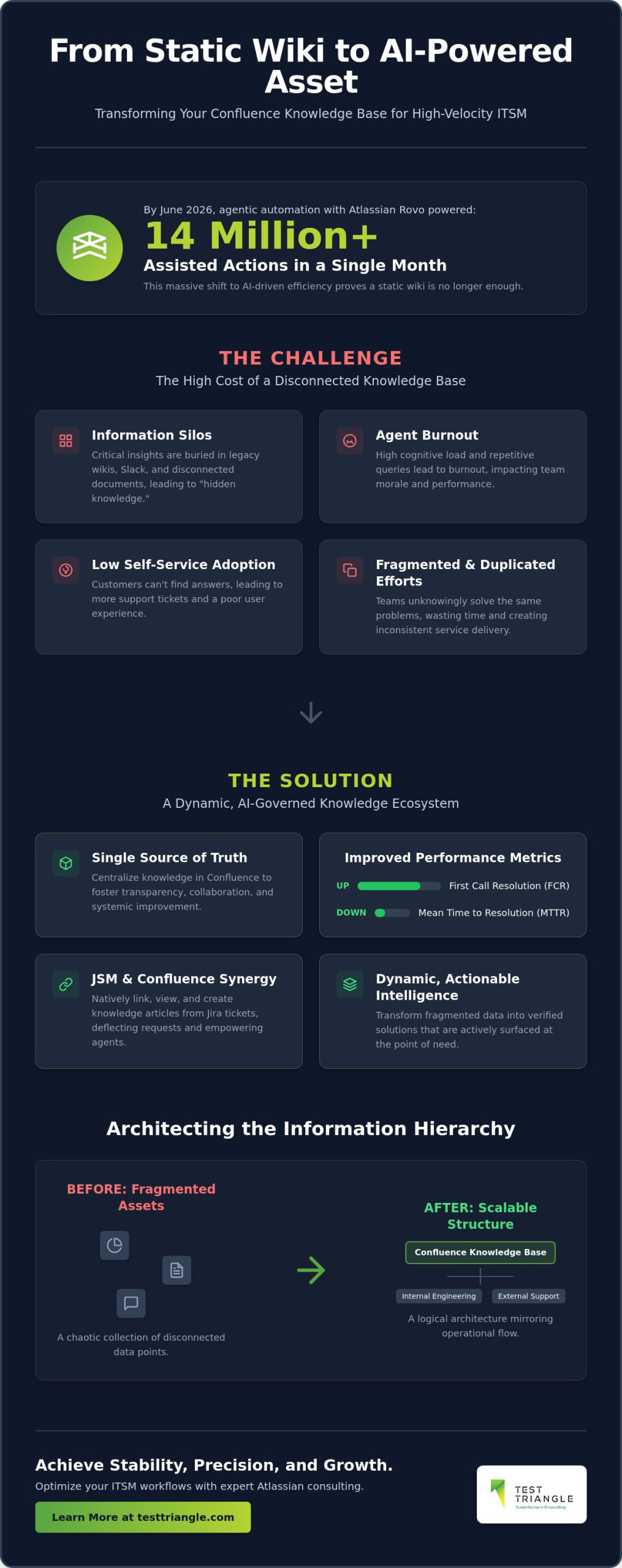
Did you know that by June 2026, agentic automation powered by Atlassian Rovo supported more than 14 million assisted actions in a single month? This massive shift toward AI-driven efficiency highlights a critical reality for global enterprises: a static wiki is no longer enough to support modern service delivery. To maintain operational stability, your organization needs a robust confluence knowledge base for itsm that functions as a dynamic, AI-governed engine rather than a forgotten digital archive.

We recognize that information silos across Slack and legacy wikis often lead to low self-service adoption and agent burnout, creating a fragmented landscape that hinders organizational progress. This guide demonstrates how to transform these disparate data points into a high-velocity asset by leveraging strategic Atlassian governance to drive precision, performance, and progress. You’ll discover the methodology required to establish a single source of truth, increase first-call resolution rates, and secure a seamless integration between Jira Service Management and Confluence. By bridging the gap between technical execution and business outcomes, we’ll outline a path toward a scalable, secure, and sophisticated knowledge ecosystem that empowers your workforce and satisfies your customers.

Key Takeaways

  • Understand the evolution from static documentation to a dynamic ecosystem, positioning a confluence knowledge base for itsm as a high-velocity asset that drives organizational progress.
  • Master the architectural principles of information hierarchy to establish a scalable source of truth that bridges the gap between internal engineering and external support.
  • Harness the capabilities of Atlassian Rovo to eliminate information silos, enabling teams to surface critical insights across fragmented SaaS tools with AI-driven precision.
  • Follow a structured implementation roadmap to audit and transition legacy assets into optimized templates that reduce agent burnout and accelerate resolution.
  • Leverage strategic Atlassian consulting to achieve the stability, precision, and growth necessary for managing complex digital infrastructures.

The Strategic Role of a Confluence Knowledge Base in Modern ITSM

In the high-velocity environment of 2026, the traditional wiki has evolved into a sophisticated engine for operational stability. A confluence knowledge base for itsm is no longer a passive repository of “how-to” articles; it’s a strategic asset that powers the entire service lifecycle. By 2026, the paradigm has shifted from static documentation to dynamic knowledge sharing. This evolution ensures that information isn’t just stored but is actively surfaced at the point of need, transforming fragmented data into actionable intelligence. This transition is essential for organizations aiming to achieve institutional maturity and maintain a competitive edge in complex digital landscapes.

Effective knowledge management serves as a cornerstone of the ITIL 4 Service Value System, ensuring that every service interaction contributes to value co-creation. When teams integrate their knowledge assets directly into IT Service Management (ITSM) frameworks, the impact on performance metrics is profound. We see a direct correlation between advanced knowledge governance and improvements in First Call Resolution (FCR) and Mean Time to Resolution (MTTR). By providing agents with immediate access to verified solutions, enterprises reduce the cognitive load on staff, mitigate agent burnout, and deliver the peace of mind that comes from predictable, high-quality service outcomes.

Breaking Down Information Silos in Global Enterprises

Fragmented data remains a significant barrier to organizational progress. In many global enterprises, critical insights are often buried within legacy wikis, disconnected PDF repositories, or transient chat histories. These silos create “hidden knowledge” that is inaccessible to the broader team, leading to duplicated efforts and inconsistent service delivery. Confluence acts as a unified layer that bridges these gaps, providing a single source of truth for cross-functional DevOps and IT teams. This centralized approach fosters a culture of transparency and collaboration, allowing organizations to capitalize on their collective expertise and drive systemic improvement through stability, precision, and growth.

The Symbiosis of Jira Service Management and Confluence

The native integration between Jira Service Management and Confluence creates a powerful synergy that redefines the agent and customer experience. Within the agent workspace, team members can view, link, or even create knowledge articles directly from a ticket, ensuring that the confluence knowledge base for itsm stays current with real-world issues. Simultaneously, customer portals leverage this data to deflect incoming requests by suggesting relevant articles as users type their queries. Implementing professional IT Service Management solutions ensures this integration is optimized for high-velocity delivery, allowing your organization to scale its support capabilities without a linear increase in headcount. This collaborative framework positions your company as a reliable long-term partner capable of navigating the complexities of modern digital infrastructure.

Architecting the Information Hierarchy for High-Velocity Service Delivery

Establishing a high-performance confluence knowledge base for itsm requires a logical architecture that mirrors your organization’s operational flow rather than just a collection of documents. By designing a scalable space structure that distinguishes between internal engineering documentation and external customer support content, enterprises can ensure that technical staff and end-users access the precise information they require without cognitive overhead. This structural precision is supported by rigorous naming conventions and metadata standards, which empower search algorithms to surface relevant articles with surgical accuracy. When sensitive technical data is involved, utilizing page restrictions and granular permissions becomes a critical component of your risk reduction strategy, maintaining security without sacrificing the speed of service delivery.

Preventing “knowledge rot” is a primary challenge for global organizations, requiring a proactive content lifecycle policy that identifies and archives outdated entries. Without these safeguards, the accumulation of irrelevant documentation can lead to agent confusion and increased resolution times. Implementing a structured hierarchy allows your team to move from a state of reactive information gathering to a proactive, solution-oriented environment. If you’re looking for guidance on refining these structures, discussing your knowledge architecture with our specialists can provide the clarity needed for long-term success.

Designing Spaces for Scalability and Precision

Strategic space organization begins with a clear distinction between Global Knowledge Spaces, which house universal policies, and Departmental Workspaces, which contain specialized technical insights. By employing Space Categories, administrators can organize content for different user personas, ensuring that a DevOps engineer and a front-office clerk see the most relevant data for their specific roles. Integrating Atlassian implementation best practices during the initial setup phase ensures that the technical architecture remains resilient as your digital infrastructure evolves, providing a steady hand in a fast-changing technological landscape.

Implementing Robust Governance and Content Lifecycle

Knowledge Governance is the systematic oversight of content accuracy and relevance. This discipline requires clearly defined roles, including Knowledge Owners who oversee space strategy, Subject Matter Experts (SMEs) who verify technical accuracy, and Knowledge Managers who facilitate the overall flow of information. To maintain institutional maturity, we recommend a 90-day review cycle for critical ITSM documentation, such as Runbooks and Post-Incident Reports (PIRs). Adhering to these ensures that your confluence knowledge base for itsm remains a reliable, high-velocity asset that supports operational stability and empowers your workforce through large-scale technological evolution.

Leveraging Atlassian Intelligence and Rovo for Knowledge Discovery

In the high-velocity technological landscape of 2026, the ability to surface relevant information across disparate platforms has become the defining characteristic of an elite service desk. Atlassian Rovo serves as a sophisticated AI operating layer that connects work and knowledge, not just within your confluence knowledge base for itsm, but across more than 50 connected third-party applications. By June 2026, Rovo supported more than 14 million assisted actions in a single month, demonstrating its maturity as a tool for global enterprises. This AI-driven discovery engine understands user intent with surgical precision, ensuring that customers find exact solutions through self-service portals while agents receive real-time recommendations during active incident management. By integrating these capabilities, organizations can move beyond simple keyword searches to a model of intelligent knowledge surfacing that significantly reduces cognitive load.

While the benefits are substantial, we recognize the inherent risks associated with AI-generated content, particularly regarding technical accuracy. Addressing the challenge of “AI Hallucinations” requires a disciplined human-in-the-loop validation process where Subject Matter Experts (SMEs) verify AI-drafted articles before they’re published to the wider organization. This strategic oversight ensures that while Atlassian Intelligence handles the heavy lifting of summarization and tone adjustment, the technical integrity of your documentation remains uncompromised. Adhering to these ITIL best practices ensures that AI remains a tool for augmentation rather than a source of operational risk.

Rovo: The AI Search Engine for the Modern Enterprise

Rovo’s ability to index data from third-party applications like Slack, Google Drive, and GitHub eliminates the friction of context switching by providing a unified search experience. Beyond simple discovery, Rovo Agents can be deployed to automate repetitive knowledge tasks, such as identifying and updating “Known Errors” based on recent deployment logs or developer commits. For organizations looking to bridge the gap between development and operations, our insights on DevOps Consulting offer a blueprint for integrating these AI agents directly into the CI/CD pipeline. This systemic improvement allows your team to maintain a high-velocity confluence knowledge base for itsm that evolves at the same pace as your software delivery.

Enhancing the Agent Experience with Atlassian Intelligence

Atlassian Intelligence provides a suite of internal tools designed to accelerate agent workflows, such as the ability to draft comprehensive Post-Incident Reports (PIRs) directly from Jira ticket history. This feature extracts key timelines, root causes, and resolution steps, allowing agents to focus on strategic improvements rather than administrative documentation. Additionally, the “Smart Links” feature provides instant context for technical terms or internal projects without requiring the user to leave the page. Ultimately, AI in ITSM is a force multiplier that converts raw data into actionable intelligence at the point of service. This approach empowers technical managers and executive leadership alike by fostering an environment of institutional maturity and operational stability.
Confluence Knowledge Base for ITSM: A Strategic Guide to Enterprise Knowledge Management in 2026

Implementation Roadmap: Transitioning from Static to Dynamic Knowledge

Transitioning to a high-velocity confluence knowledge base for itsm requires more than a simple data transfer; it demands a structured audit of existing assets to identify critical gaps in technical documentation. By analyzing legacy wikis, shared drives, and disconnected repositories, organizations can determine which assets remain relevant and which require immediate decommissioning to prevent information bloat. Once this audit is complete, selecting and customizing ITSM-specific templates, such as standardized “How-to” guides, “Known Errors” logs, and “Change Plans,” ensures that all future content adheres to a consistent, professional standard. This methodical approach establishes a foundation for operational stability and systemic improvement across the entire service value chain.

Executing a phased migration strategy is essential for minimizing operational downtime during large-scale digital transformations. We recommend launching a pilot program with a “Champion Team,” a small, versatile group of technical experts who can refine the structure and workflows before a global rollout occurs. To measure the success of this transition, enterprises must establish clear KPIs for knowledge health. Metrics such as “Article Usefulness” scores and “Deflection Rate” provide tangible evidence of the system’s impact on service efficiency, ensuring that technical managers and executive leadership can track organizational progress with precision. This disciplined framework allows for the combination of human expertise and technical tools to deliver a superior service experience.

The Data Migration and Cleanup Phase

A critical component of this roadmap is the “ROT” analysis, which requires teams to Remove, Outdate, or Transform legacy content. This process ensures that the new environment isn’t polluted with redundant or trivial information that could lead to agent burnout. During the technical migration, preserving link integrity is paramount to prevent broken cross-references that frustrate both agents and customers. Leveraging Software and Digital Assurance Testing ensures data parity after the migration, confirming that the technical architecture remains robust and secure. This level of rigor is what distinguishes a seasoned expert from a mere service provider in the complex landscape of enterprise IT.

Training and Cultural Adoption Strategies

Sustainable success relies on shifting the organizational mindset from “Knowledge is Power” to “Knowledge Sharing is Power.” Adopting a Knowledge Centered Service (KCS) methodology encourages continuous content creation as a natural byproduct of the problem-solving process, ensuring the confluence knowledge base for itsm remains a living asset. To drive this cultural evolution, we propose gamification strategies that reward Subject Matter Experts (SMEs) for their contributions and peer-reviewed accuracy. This approach fosters a spirit of partnership and support, ensuring that knowledge management becomes a core competency of the enterprise, ultimately delivering stability, scalability, and success. If your organization is ready to modernize its service delivery, consult with our Atlassian experts to begin your strategic implementation roadmap today.

Optimizing ITSM Workflows with Test Triangle’s Atlassian Consulting

Test Triangle operates as a strategic visionary in the Atlassian ecosystem, providing the high-level expertise required to transform a standard confluence knowledge base for itsm into a bespoke enterprise asset. While the technical tools provide the framework, it’s our deep institutional maturity that allows us to align these platforms with your specific business outcomes. By leveraging our “Partner Approach” to digital transformation, we ensure that every configuration choice serves the dual goals of risk reduction and operational stability. This expert oversight significantly reduces the “Time to Value” for new deployments, allowing global enterprises to bypass common implementation pitfalls and achieve immediate systemic improvement. Our methodology connects technical rigor with a deep understanding of your operational needs, ensuring that the transition from fragmented information to a unified truth is both seamless and sustainable.

We don’t just implement software; we engineer environments that foster collaboration and empower your workforce through human expertise and technical tools. This collaborative framework positions our team as a steady hand in a fast-changing technological landscape, emphasizing organizational progress through a combination of precision, performance, and progress. As a reliable long-term collaborator, we’re deeply invested in your long-term success and operational stability, ensuring that your digital infrastructure remains resilient as your organization evolves.

Customized ITSM Solutions for Regulated Industries

For organizations operating within highly regulated sectors such as finance, healthcare, and pharmaceuticals, a generic knowledge setup is insufficient to meet modern standards. We specialize in tailoring Confluence to meet stringent compliance requirements, ensuring that every article and workflow maintains a robust audit trail for future reviews. This level of precision is explored further in our Atlassian Partner Guide, which outlines the methodology for scaling enterprise quality across complex digital infrastructures. By prioritizing security and standards, we provide the peace of mind necessary for large-scale technological evolution in even the most scrutinized industries.

Maximizing ROI Through Strategic Atlassian Licensing

Achieving a high return on investment requires a disciplined approach to license management within the Atlassian Cloud ecosystem. Test Triangle optimizes your license spend by ensuring that your subscription tiers align perfectly with your actual usage and growth projections, preventing unnecessary overhead. Beyond the initial setup, our Managed Outsourcing Services provide recurring monthly support that addresses system maintenance, updates, and ongoing environment optimization. This steady hand ensures that your confluence knowledge base for itsm remains a high-velocity asset that grows alongside your organization, delivering stability, scalability, and success. Partner with Test Triangle for your Atlassian Transformation to secure the stability and growth your enterprise demands.

Scaling Success, Securing Stability, Sustaining Growth

The transition from fragmented documentation to a high-velocity knowledge ecosystem requires a disciplined combination of technical precision and strategic governance. By architecting a robust information hierarchy and leveraging the agentic automation of Atlassian Rovo, global enterprises can transform their service delivery from a reactive cost center into a proactive, AI-powered asset. Establishing a confluence knowledge base for itsm isn’t merely a software implementation; it’s a commitment to institutional maturity that empowers your workforce and satisfies your customers through predictable, high-quality outcomes. This journey involves bridging the gap between technical execution and business value, ensuring that your organization remains resilient in a fast-changing technological landscape.

As an Atlassian Platinum Solution Partner with a global presence, Test Triangle acts as a steady hand for organizations navigating complex legacy-to-cloud migrations across diverse, highly regulated industries. We position ourselves as a reliable long-term collaborator, deeply invested in your operational stability and long-term success. Our experts provide the strategic visionary perspective needed to reduce risk and maximize the ROI of your Atlassian ecosystem. Accelerate your ITSM maturity with Test Triangle’s Atlassian Consulting and secure the future of your enterprise knowledge management. We’re ready to help you turn your digital infrastructure into a competitive advantage.

Frequently Asked Questions

How does Confluence integrate with Jira Service Management for ITSM?

Confluence integrates with Jira Service Management by establishing a direct link between service tickets and your documentation repository, allowing agents to surface solutions without leaving their active workspace. This native synergy enables automated article suggestions within the customer portal, which effectively deflects common requests before they enter the support queue.

What are the best templates for an IT knowledge base in Confluence?

The most effective templates for an IT knowledge base include standardized “How-to” articles, “Known Error” logs, and comprehensive “Post-Incident Reports” (PIRs). These structured frameworks ensure that all technical documentation remains consistent, professional, and easily searchable across the entire enterprise service value chain.

Can Confluence handle complex permissions for external customer documentation?

Yes, Confluence provides granular page restrictions and space-level permissions that allow organizations to manage sensitive technical data while maintaining public-facing support content. This dual-layered security model ensures that internal engineering details remain protected while end-users receive the precise information they need for self-service resolution.

How does Atlassian Rovo change the way teams find knowledge in 2026?

In 2026, Atlassian Rovo revolutionizes discovery by indexing information across more than 50 third-party applications, including Slack, Google Drive, and GitHub. This capability allows a confluence knowledge base for itsm to serve as a unified search hub, surfacing relevant insights with AI-driven intent regardless of where the data was originally created.

What is the difference between a service desk and a knowledge base?

A service desk is a transactional platform designed for managing incoming requests and incidents, whereas a knowledge base is a centralized repository for storing verified solutions and documentation. While the service desk facilitates the interaction between the user and the agent, the knowledge base provides the intelligence required to resolve issues with precision and speed.

How often should we audit our Confluence knowledge base articles?

We recommend a structured 90-day review cycle for critical documentation, supplemented by trigger-based audits following major software releases or significant system changes. This proactive approach prevents the accumulation of outdated information and ensures that your knowledge assets remain a reliable source of truth for both agents and customers.

What are the common mistakes when setting up a Confluence KB for IT teams?

Common errors include failing to establish clear naming conventions and neglecting to implement a formal governance policy for the content lifecycle. Without these structural safeguards, a confluence knowledge base for itsm can quickly become a fragmented archive of irrelevant data, leading to low user adoption and increased agent burnout.

How can we measure the ROI of our knowledge management strategy?

Measuring the ROI of your knowledge strategy requires a disciplined analysis of request deflection rates, which quantify the number of tickets avoided through effective self-service. Additionally, tracking improvements in Mean Time to Resolution (MTTR) and First Call Resolution (FCR) provides tangible evidence of how a high-velocity knowledge ecosystem reduces operational costs and enhances service quality.

Paul Guy

Article by

Paul Guy

Paul serves as the Marketing Director at Test Triangle, where he leads a global team in driving growth through strategic B2B marketing and brand communications. With a strong emphasis on measurable outcomes and sustainable performance, he plays a pivotal role in aligning marketing functions to enhance customer engagement and accelerate business impact. Under his leadership, marketing initiatives have consistently delivered significant returns on investment, elevated brand visibility, and strengthened the company's presence across key markets.

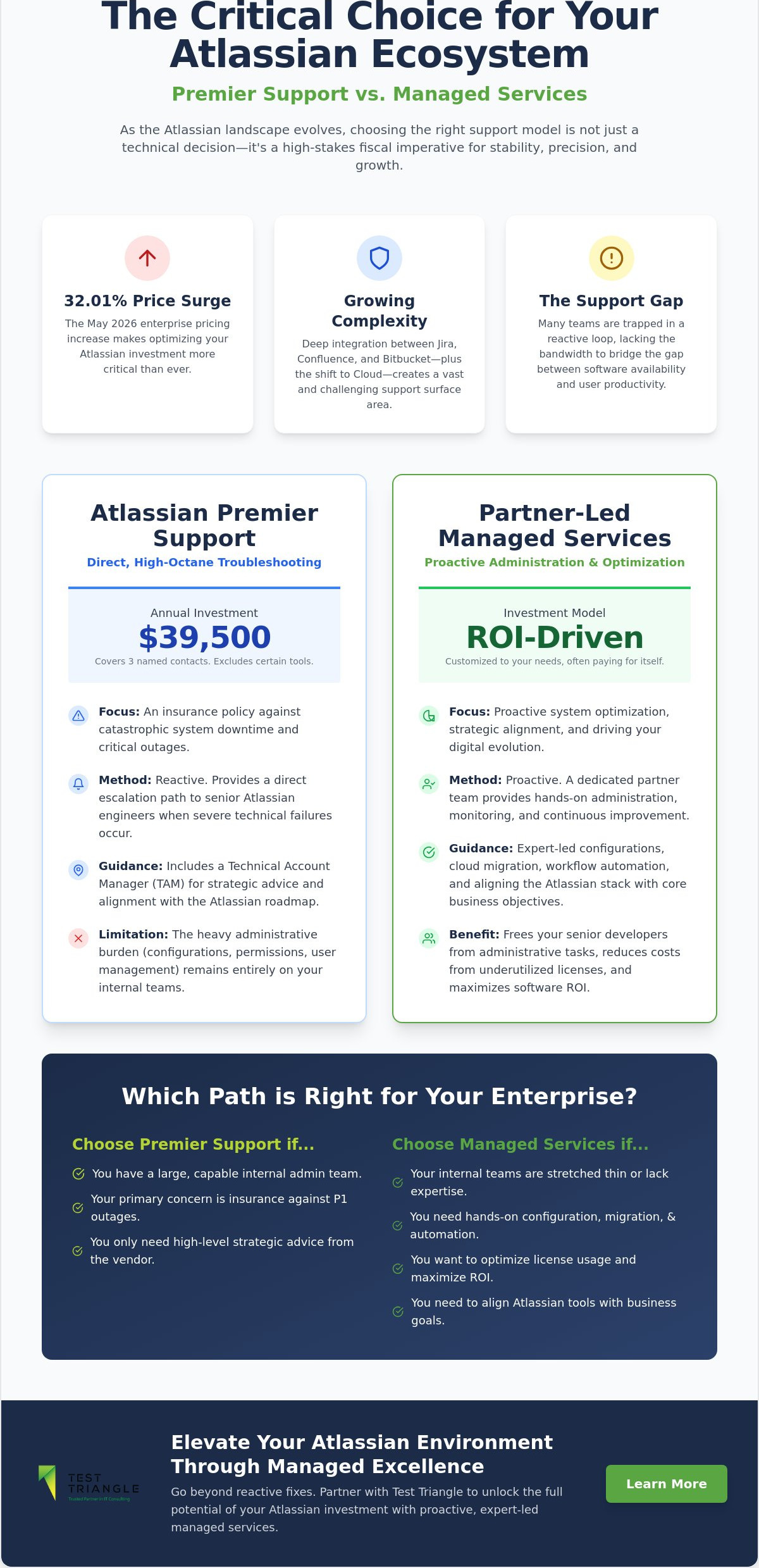

Is your organization paying for the rapid resolution of problems that should never have occurred in the first place? While the $39,500 annual investment for Atlassian Premier Support provides a direct line to senior engineers for critical outages, it often leaves the heavy administrative burden on your internal teams. Evaluating the choice between atlassian premier support vs managed services has become a high-stakes fiscal decision, especially following the 32.01% surge in enterprise pricing seen in May 2026. You need a solution that doesn’t just react to failures but actively drives your digital evolution.

We understand that managing complex cloud migrations and underutilized licenses can drain your resources and stall your strategic roadmap. This guide examines the critical differences between direct vendor troubleshooting and the proactive, partner-led oversight required to truly master your ecosystem. You’ll gain a clear framework for reducing system downtime, securing expert-led configurations, and ensuring a measurable return on your software investment through stability, precision, and growth.

Key Takeaways

  • Understand why the 2026 Atlassian ecosystem requires more than simple ticket resolution to maintain operational stability in high-pressure corporate environments.
  • Analyze the strategic distinction of atlassian premier support vs managed services to determine whether your enterprise needs reactive vendor troubleshooting or proactive system optimization.
  • Identify the internal resource gaps that necessitate a shift from basic administrative maintenance to a comprehensive, partner-led management model.
  • Discover how a hybrid support framework can maximize platform availability while simultaneously driving digital transformation and workflow efficiency.
  • Learn to align your Atlassian roadmap with broader business objectives by leveraging specialized expertise in cloud migration and cross-platform integration.

The Atlassian ecosystem has transformed from a collection of standalone productivity tools into the central nervous system of the modern enterprise. As we progress through 2026, the traditional model of reactive, ticket-based assistance has become insufficient for global organizations operating at scale. Relying on the “Standard” support tier often leaves teams stranded during complex outages or configuration failures, as these basic levels are designed for minor troubleshooting rather than the intricate demands of a distributed, high-velocity infrastructure. The decision-making process for leadership now centers on a fundamental choice between atlassian premier support vs managed services, representing a shift from simply maintaining software to strategically empowering the business.

Internal administration without external expertise carries significant hidden costs that often go unnoticed until a system audit occurs. These include the opportunity cost of diversion, where senior developers are frequently pulled away from core product builds to manage Jira schemes or permission hierarchies. It also includes the risk of underutilized licenses, which can account for a substantial portion of the average annual enterprise spend on Atlassian products. Choosing between atlassian premier support vs managed services is therefore not just a technical preference but a financial imperative to protect software ROI and operational continuity.

The Complexity of Modern Atlassian Stacks

Modern environments are no longer siloed. The deep integration between Jira, Confluence, and Bitbucket creates a vast support surface area where a single misconfiguration can ripple across the entire development lifecycle. With the accelerating shift to Atlassian Cloud, maintenance requirements have pivoted from server patching to sophisticated identity management, API governance, and cross-platform orchestration. To thrive in this environment, enterprises require a foundation of stability, precision, and scalability. Without a dedicated Managed service provider (MSP) to oversee these connections, the internal administrative burden often leads to technical debt that slows down innovation and increases operational risk.

Identifying the Support Gap

Organizations often realize they have outgrown standard support when internal administrators spend more time on user permissions than on high-value workflow automation. There is a clear distinction between technical troubleshooting, which focuses on why a feature isn’t working, and strategic business alignment, which ensures the toolset actually drives revenue. Many teams find themselves stuck in a loop of reactive fixes, lacking the bandwidth to implement a comprehensive Atlassian implementation strategy. The support gap is the distance between software availability and user productivity.

Atlassian Premier Support: Direct High-Octane Troubleshooting

Atlassian Premier Support serves as the definitive direct vendor lifeline for organizations that require immediate, high-priority access to the engineers who build the software. For an annual investment of $39,500, this tier provides coverage for three named contacts across the primary product suite, excluding specific tools like Opsgenie or Jira Align which require separate agreements. It’s a specialized service designed to protect platform availability by offering a direct escalation path for the most severe technical failures. When weighing atlassian premier support vs managed services, it’s vital to recognize that Premier Support is primarily an insurance policy against catastrophic system downtime rather than a tool for day-to-day administrative relief.

The relationship is often anchored by a Technical Account Manager (TAM) who acts as a strategic advisor within the Atlassian organization. This individual helps align your technical requirements with the product roadmap, ensuring that your enterprise isn’t blindsided by major architectural shifts. However, while the TAM provides high-level guidance, they don’t function as a hands-on administrator. Incorporating a robust service delivery model requires understanding that vendor support is fundamentally a reactive mechanism focused on the health of the core application, not the specific nuances of your business processes.

Core Benefits of the Premier Tier

The primary value proposition of the Premier tier lies in its financially backed Service Level Agreements (SLAs). For critical (L1) issues, Atlassian guarantees an initial response time of one hour, providing peace of mind during high-stakes incidents. You’re not just getting a faster ticket response; you’re gaining access to senior support engineers who understand the platform’s source code and can navigate complex bug fixes that standard support teams might miss. Additionally, the vendor provides periodic proactive health checks and system performance analysis to identify potential bottlenecks before they lead to a total system failure.

Where Premier Support Ends

Despite its technical depth, Premier Support maintains a strict “Hands-Off” policy regarding your internal configurations. Atlassian engineers will troubleshoot why a workflow has crashed, but they won’t build a new custom workflow for your HR department or manage your complex user permission schemes. Furthermore, this tier explicitly excludes troubleshooting for third-party Marketplace apps, which can often add up to 150% to the base cost of your software and introduce significant stability risks. If you’re struggling to bridge the gap between vendor response and internal execution, you can consult with our strategic advisors to explore a more comprehensive approach. Ultimately, Premier Support fixes the platform, but it doesn’t run your business operations.

Atlassian Managed Services: Proactive Administration and Optimization

While Premier Support provides a vital technical safety net for platform-level incidents, Atlassian Managed Services function as a strategic engine for continuous organizational growth. This model represents a comprehensive, hands-on extension of your internal IT department, moving beyond the limitations of reactive troubleshooting to embrace proactive system evolution. When evaluating atlassian premier support vs managed services, the primary distinction lies in the scope of execution. Managed services don’t just ensure the software is running; they ensure it’s optimized to meet the specific, shifting demands of your global enterprise. By integrating a dedicated team into your operational structure, your organization gains the ability to transform raw technical capacity into streamlined business value through vision, velocity, and versatility.

The operational philosophy of a managed model shifts the focus from ticket-based response times to business-centric outcomes. Instead of measuring success by how quickly a bug is acknowledged, success is defined by system health, user adoption rates, and the seamless automation of complex cross-departmental workflows. This partnership provides the steady hand required to manage the daily administrative burden that often overwhelms internal teams. It allows your high-value talent to focus on core innovation while experts handle the intricate details of your Atlassian environment, ensuring that your digital infrastructure remains a competitive advantage rather than a maintenance bottleneck.

The Strategic Advantage of a Managed Partner

A managed partner delivers end-to-end administration that encompasses everything from granular user management and permission schemes to the design of sophisticated custom workflows. This level of involvement ensures that your instance remains clean, performant, and scalable as your organization expands. Beyond simple maintenance, these services provide robust governance and compliance frameworks, ensuring that your data handling and access controls meet the rigorous standards of highly regulated industries. For organizations initiating new projects, leveraging specialized Atlassian Implementation Services within a managed framework ensures that the foundation of your ecosystem is built correctly from day one.

Beyond Troubleshooting: Proactive Growth

Managed services drive proactive growth through regular system audits and targeted user training sessions that identify and eliminate operational friction. Unlike direct vendor support, a managed partner actively vets, installs, and maintains critical Marketplace plugins, mitigating the risks associated with third-party app sprawl. This holistic oversight is particularly critical for organizations pursuing broader DevOps Consulting initiatives, where the seamless integration of Jira and Bitbucket into the CI/CD pipeline is essential for maintaining development speed. By choosing a partner-led approach, you secure a reliable long-term collaborator dedicated to the ongoing optimization of your entire software delivery lifecycle.

The Critical Choice: Direct Vendor Support vs. Strategic Partner Managed Services

Determining the optimal path between atlassian premier support vs managed services requires a candid assessment of your organization’s internal maturity and long-term technical objectives. While the $39,500 annual investment for Premier Support secures a high-priority escalation path to Atlassian’s senior engineers, it assumes your team can handle everything short of a platform-level bug. The strategic divide often rests on whether you possess a dedicated “Atlassian Champion” in-house. If your internal administrators are already stretched thin by daily user requests and complex scheme clean-ups, adding a vendor-side escalation point won’t solve the underlying productivity bottleneck. You must decide if you’re paying for a safety net or a growth engine.

For many global enterprises, the most effective strategy is a “Hybrid” approach that leverages the strengths of both models. In this scenario, Premier Support provides the technical insurance needed for massive-scale Cloud or Data Center deployments, while a strategic partner handles the proactive administration, workflow automation, and cross-platform integrations. This combination ensures that the platform remains stable at the infrastructure level while the business logic continues to evolve at the pace of your market. A cost-benefit analysis should weigh the fixed license-based support fees against the flexible, outcome-based subscriptions of a managed partner, focusing on the total cost of ownership rather than just the initial price tag.

Executive Decision Matrix:

  • Internal Expertise: If your team lacks certified administrators, managed services provide immediate institutional maturity.
  • Operational Focus: Choose Premier for reactive troubleshooting; choose managed services for proactive system optimization and roadmapping.
  • Integration Complexity: Organizations with deep ServiceNow or AWS integrations require the hands-on expertise of a partner-led model.
  • Scalability Requirements: Managed services allow for rapid scaling without the overhead of permanent internal hires.

When to Choose Atlassian Premier Support

This tier is best suited for organizations that already maintain a highly skilled internal IT department. If your team is capable of designing complex Jira workflows and only requires direct vendor intervention for platform-level performance analysis or source code issues, the Premier tier is an ideal fit. It focuses on the core pillars of stability, precision, and scalability at the infrastructure level, ensuring that your massive-scale deployments meet strict uptime requirements without the need for external administrative help.

When to Choose Managed Services

Managed services are the superior choice for teams undergoing rapid digital transformation or those migrating to Atlassian Cloud. If your business requires sophisticated workflow automation, complex ITSM migrations, or simply lacks a dedicated administrator, a partner-led model offers the necessary versatility. For organizations needing to bridge a temporary talent gap, utilizing Managed Outsourcing Services provides a flexible staffing solution that scales alongside your project demands. To determine which model aligns with your 2026 roadmap, you can schedule a strategic consultation with our team today.

Atlassian Premier Support vs Managed Services: A Strategic Decision Guide for 2026

Test Triangle: Elevating Atlassian Environments Through Managed Excellence

Test Triangle positions itself as the strategic visionary for enterprises navigating the complexities of modern digital infrastructure. Our unique methodology transcends basic troubleshooting by combining deep technical rigor with a high-level business vision, ensuring that your software tools are perfectly aligned with your commercial objectives. When navigating the nuances of atlassian premier support vs managed services, the value of a steady hand cannot be overstated. We provide the expertise required to manage high-stakes Atlassian Cloud migrations and complex ServiceNow Implementation projects, bridging the gap between disparate platforms to create a unified, high-performance ecosystem.

Engagement models within our framework are designed with institutional maturity in mind, offering the flexibility that global enterprises demand. Whether your organization requires project-based milestones for a specific digital transformation or a recurring monthly subscription for ongoing administrative excellence, we adapt our delivery to match your internal cadence. Unlike the centralized, often anonymous queues of direct vendor support, our global presence ensures superior regional attention. This localized focus allows us to act as a reliable long-term collaborator, providing the peace of mind that comes from knowing your infrastructure is managed by experts who understand your specific market challenges.

Our Atlassian Consulting Framework

The foundation of our partnership begins with a methodical Discovery and Advisory phase. During this stage, we work to align your existing Atlassian stack with long-term corporate roadmaps, identifying areas where configuration improvements can drive immediate efficiency gains. Our Solution Design and Build phase then crafts bespoke workflows tailored to the unique regulatory and operational requirements of industries such as Finance, Healthcare, and Retail. For organizations seeking localized strategic support, our Atlassian Consulting Services Dublin team provides the proximity and platform expertise needed to accelerate your digital maturity.

Achieving Operational Stability

Operational stability is achieved through a combination of human expertise and disciplined technical tools. Our managed services are specifically engineered to reduce risk and empower your internal teams to lead large-scale technological evolution without being bogged down by administrative debt. We provide dedicated helpdesk support under robust Service Level Agreements, ensuring that your users receive the expert-led configuration and troubleshooting they need to remain productive. This proactive oversight doesn’t just fix issues; it prevents them, allowing your leadership to maintain a composed, solution-oriented focus on long-term success. By choosing a partner-led model, you secure the stability, precision, and scalable growth required to thrive in a fast-changing landscape. Contact Test Triangle for a strategic Atlassian audit to begin optimizing your software spend and operational efficiency today.

Securing Your Strategic Atlassian Roadmap for 2026

The evolution of the enterprise digital landscape demands a shift from reactive troubleshooting to proactive orchestration. Success in the coming year requires more than just keeping the lights on; it necessitates a sophisticated alignment of platform health and business agility. By understanding the functional boundaries of atlassian premier support vs managed services, leadership can move beyond simple ticket resolution toward a model of continuous optimization. Our methodology ensures that your Atlassian ecosystem remains a robust foundation for progress rather than an administrative burden, providing the stability, precision, and scalability your organization deserves.

Leveraging our status as a Global Atlassian Partner, we deliver strategic expertise in Finance and Pharma alongside comprehensive ITSM and DevOps integration. We act as your reliable long-term collaborator, providing the steady hand required to navigate complex migrations and architectural shifts with total confidence. It’s time to transform your software investment into a high-performance engine for growth and innovation.

Optimise your Atlassian stack with Test Triangle’s Managed Services

Empower your teams to achieve new heights of productivity and secure your digital future with a partner dedicated to your long-term success.

Frequently Asked Questions

What is the main difference between Atlassian Premier Support and Managed Services?

The fundamental distinction lies in the nature of the engagement: Premier Support is a reactive technical lifeline provided by the vendor for platform-level issues, whereas Managed Services represent a proactive, hands-on extension of your internal team. While the vendor focuses on the health of the core software, a managed partner oversees daily configurations, user management, and strategic optimization. This ensures your ecosystem isn’t just running, but actively driving business value.

Can I have both Atlassian Premier Support and a Managed Services partner?

Organizations often adopt a hybrid model to maximize both platform stability and operational efficiency. In this scenario, you utilize Atlassian Premier Support as a high-priority escalation point for critical vendor-side bugs while your Managed Services partner handles the intricate execution of your internal workflows and integrations. This dual-layered strategy provides a comprehensive safety net for global enterprises with zero tolerance for system downtime or administrative bottlenecks.

Does Atlassian Premier Support include help with Jira workflow configuration?

No, Atlassian Premier Support does not include hands-on assistance with internal configurations like Jira workflows, permission schemes, or project setups. The vendor’s engineers are strictly focused on troubleshooting the underlying platform and resolving software defects rather than building bespoke business logic. To achieve tailored workflow design that meets your specific operational needs, you require the strategic involvement and practical execution provided by a managed services provider.

How much do Atlassian Managed Services typically cost compared to Premier Support?

Pricing structures for atlassian premier support vs managed services follow different models based on the scope of the engagement. Premier Support involves a fixed annual fee that provides standardized vendor access for a limited number of named contacts. Conversely, Managed Services pricing is customized based on the complexity of your ecosystem, the volume of administrative tasks, and your required service levels. This tailored approach ensures your investment aligns directly with the strategic expertise your business requires.

Is Managed Services better for Atlassian Cloud or Data Center?

Managed Services provide essential value across both Cloud and Data Center deployments, though the operational focus shifts to address the unique requirements of each environment. For Cloud instances, the emphasis remains on identity governance, API management, and cross-platform orchestration. For Data Center, the priority often centers on infrastructure health, performance tuning, and complex version upgrades. In both cases, a partner-led model ensures your environment remains performant and scalable as your organization evolves.

What happens if my third-party Marketplace apps break under Premier Support?

Atlassian Premier Support specifically excludes troubleshooting and maintenance for third-party Marketplace applications. If a critical plugin fails or causes system instability, the vendor will typically direct you to the individual app developer for assistance. A Managed Services partner takes full ownership of your entire stack, vetting and maintaining these integrations to ensure they don’t compromise your system’s overall stability. This proactive oversight reduces the risk of third-party software conflicts.

How does Test Triangle handle Atlassian Cloud migrations within its managed services?

We manage the entire cloud migration lifecycle through a disciplined framework that prioritizes data integrity and minimal user disruption. Our approach begins with a comprehensive assessment of your existing instance, followed by strategic cleanup and mapping to ensure a seamless transition to the Cloud. By acting as a steady hand throughout the process, we mitigate the risks associated with complex migrations while ensuring your new environment is optimized for immediate organizational productivity.

Do Managed Services include user training and onboarding?

Yes, comprehensive user training and structured onboarding are core components of our managed offerings. We believe that technological evolution is only successful when paired with high levels of user adoption and proficiency. By providing targeted training sessions and clear documentation, we empower your teams to fully utilize the advanced features of your Atlassian stack. This commitment to human expertise ensures that your organization realizes the maximum return on its software investment through improved workflow efficiency.

Paul Guy

Article by

Paul Guy

Paul serves as the Marketing Director at Test Triangle, where he leads a global team in driving growth through strategic B2B marketing and brand communications. With a strong emphasis on measurable outcomes and sustainable performance, he plays a pivotal role in aligning marketing functions to enhance customer engagement and accelerate business impact. Under his leadership, marketing initiatives have consistently delivered significant returns on investment, elevated brand visibility, and strengthened the company's presence across key markets.
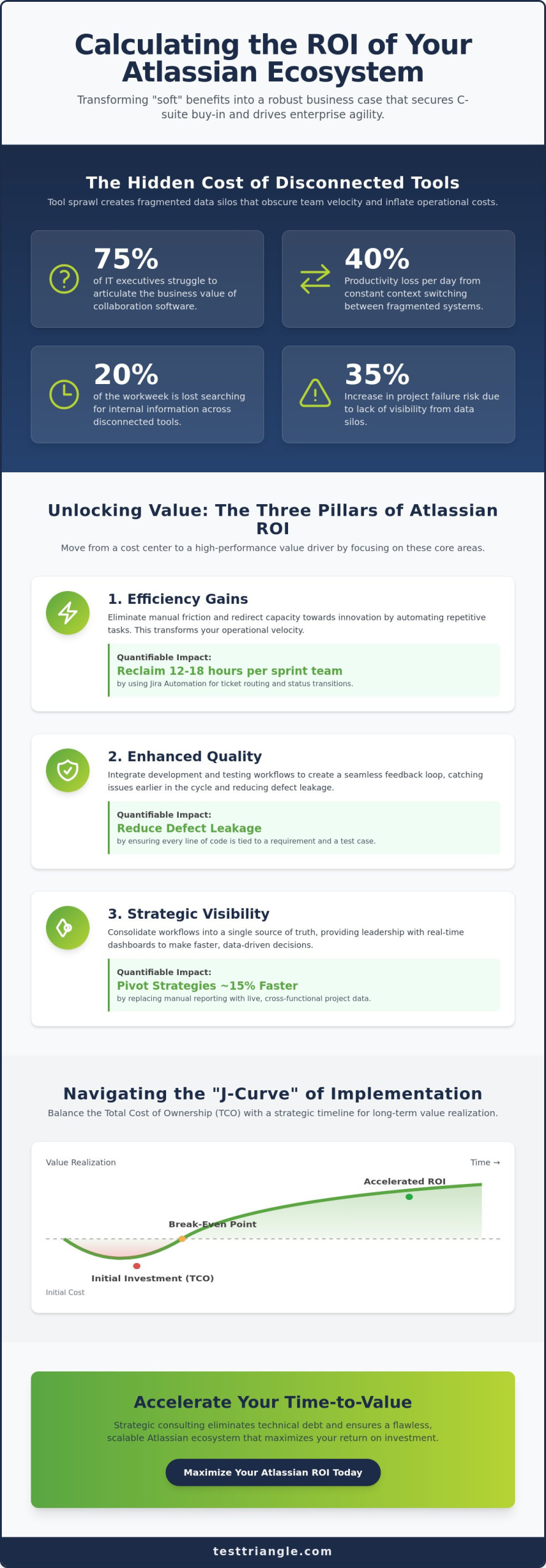

According to a 2024 industry report by Forrester, 75% of IT executives find it difficult to articulate the tangible business value of their collaboration software, often resulting in stalled digital initiatives. You likely recognize the challenge of defending high licensing costs when tool sprawl creates fragmented data silos that obscure your true team velocity. By leveraging a strategic approach to performance tracking, you can transform these “soft” benefits into a robust narrative that secures C-suite buy-in. This article establishes the foundation for calculating roi of atlassian tools, ensuring your technical investments align with high-level corporate objectives.

This guide provides the definitive framework for 2026, offering you a repeatable formula to justify every dollar spent on your digital ecosystem. We’ll show you how to move beyond basic usage stats to prove how Jira and Confluence drive enterprise-wide efficiency. By combining Technology. Talent. Transformation., we’ll preview the specific metrics needed to validate professional consulting services and ensure your infrastructure remains a cornerstone of long-term success. As your Trusted Partner, we’re here to help you bridge the gap between technical execution and strategic business outcomes through disciplined, data-driven analysis.

Key Takeaways

  • By transitioning from fragmented workflows to integrated platform velocity, leaders can redefine their digital infrastructure as a strategic driver of enterprise agility.
  • Leverage specific KPIs—including automation-driven time savings and reduced defect leakage—to quantify the impact of Atlassian tools on product quality and operational efficiency.
  • Navigate the “J-Curve” of implementation by balancing Total Cost of Ownership (TCO) against a strategic timeline for value realization and long-term stability.
  • Master a step-by-step executive framework for calculating roi of atlassian tools that transforms raw operational data into a compelling business case for the C-suite.
  • Accelerate your time-to-value by discovering how strategic consulting eliminates technical debt and ensures a flawless, scalable Atlassian ecosystem.

Beyond Licensing: Understanding the Economic Impact of Atlassian Integration

By shifting the focus from procurement costs to operational velocity, global enterprises can reveal the true economic impact of their tech stack. Traditionally, many organizations viewed their Return on Investment (ROI) through a narrow lens of software spend versus headcount reduction. In the 2026 enterprise environment, calculating roi of atlassian tools requires a more sophisticated delta: the measurable gap between fragmented legacy workflows and integrated platform velocity. This transition from “Tool ROI” to “Platform ROI” acknowledges that Jira and Confluence are no longer just applications; they are the connective tissue of the modern digital enterprise.

Simple license-cost comparisons fail because they ignore the “Hidden Cost of Chaos.” This expense manifests in the manual labor required to synchronize data across disconnected tools. Industry data suggests that employees spend nearly 20% of their workweek searching for internal information or tracking down colleagues for status updates. When calculating roi of atlassian tools, executives must quantify these inefficiencies. The value of an integrated Atlassian ecosystem lies in its ability to eliminate these friction points, allowing talent to focus on high-value innovation rather than administrative maintenance.

  • Integrated Velocity: The speed at which an idea moves from a Confluence page to a Jira ticket and finally to a production release.
  • Contextual Continuity: The preservation of project history and decision-making logic without manual data entry.
  • Risk Mitigation: The reduction in project overruns caused by outdated information or misaligned team goals.

The Cost of Tool Fragmentation

Fragmented systems force teams into a perpetual cycle of context switching, which can reduce productive time by as much as 40% per day. When data is trapped in silos, project failure risks increase by 35% due to a lack of visibility. For the C-suite, this fragmentation creates a “visibility debt” that slows decision-making. By consolidating workflows, leadership can access real-time dashboards, reducing the time required to pivot strategies by approximately 15%.

Strategic Alignment vs. Technical Implementation

Long-term value depends on aligning business objectives with the platform’s capabilities. Organizations must move away from reactive ticket-tracking and toward proactive value-stream management. By leveraging professional Atlassian implementation services, companies establish a “Single Source of Truth” for global teams. This strategic approach ensures that every technical task directly supports a high-level KPI, transforming the software from a cost center into a driver of scalable growth. Through the lens of Technology, Talent, and Transformation, Atlassian becomes the foundation for sustainable digital excellence.

Quantifying the Three Pillars of Atlassian Value: Efficiency, Quality, and Visibility

By aligning technical execution with strategic business outcomes, the Atlassian ecosystem transforms from a cost center into a high-performance value driver. Executives calculating roi of atlassian tools must look beyond license fees to measure the tangible impact on operational velocity and risk reduction. This framework focuses on three core pillars that define modern enterprise maturity: Efficiency, Quality, and Visibility. When these pillars are optimized, organizations unlock a “Cognitive Dividend,” which is the 20% of engineering capacity typically lost to administrative friction, now redirected toward innovation.

Efficiency Gains through Automation

By deploying Jira Automation to handle repetitive ticket routing and status transitions, global enterprises frequently reclaim 12 to 18 hours per sprint for every scrum team. This shift eliminates the manual friction that historically stalled progress. In engineering departments, Confluence serves as a centralized knowledge repository that reduces developer onboarding time by 28% based on 2025 industry benchmarks. Efficiency ROI is the measurable reduction in human intervention required to move a work item from backlog to completion via automated workflow triggers. By leveraging Atlassian implementation experts, firms ensure these workflows are lean, scalable, and free of technical debt.

Quality and Risk Mitigation

By embedding integrated testing directly into the Jira lifecycle, organizations catch defects 40% earlier in the development process, significantly lowering the cost of post-release remediation. In highly regulated sectors like Life Sciences and Banking, the ability to maintain a transparent, audit-ready trail within the Atlassian suite is essential. Integrating Manual Testing protocols with automated Jira tracking ensures that compliance isn’t a bolt-on activity but a core component of the delivery process. This rigor reduces insurance premiums and liability risks by providing immutable evidence of quality standards and rigorous peer reviews.

Visibility replaces the 4.5 hours per week managers typically spend on manual status gathering with real-time, automated dashboards. This transparency allows for a 15% faster Mean Time to Recovery (MTTR) during critical incidents because teams don’t waste time searching for the source of a failure. As a Trusted Partner, we see that the most successful firms use these metrics to drive continuous improvement. If you’re ready to optimize your stack, you can connect with our strategic architects for a comprehensive audit. Through the synergy of Technology, Talent, and Transformation, your organization can turn complex data into actionable executive insights while maintaining a flawless delivery pipeline.

Calculating ROI of Atlassian Tools: The 2026 Executive Framework

The Total Cost of Ownership (TCO) vs. Value Realization Timeline

By analyzing the longitudinal financial impact of software deployment, executives move beyond simple license tracking to a holistic view of calculating roi of atlassian tools. A comprehensive TCO model incorporates licensing, infrastructure, implementation, and the often-overlooked cost of ongoing training. Most enterprises find that licensing represents only 25% to 35% of the total investment over a three-year cycle. The remainder is distributed across operational overhead and human capital.

Every major deployment follows a “J-Curve” trajectory. During the first 90 days, organizations typically see a 10% to 15% dip in legacy productivity as teams migrate data and learn new workflows. This isn’t a failure of the tool; it’s a natural phase of systemic transition. By utilizing professional managed services, businesses flatten this curve, shortening the recovery period and accelerating the climb toward the ROI surge. Strategic architects prioritize this phase to ensure that the initial investment doesn’t stall due to cultural resistance.

The choice between Cloud and Data Center significantly shifts the TCO profile. Cloud deployments eliminate physical hardware costs and reduce internal maintenance labor by approximately 30% annually. While Data Center offers granular control for highly regulated industries, it requires dedicated FTEs for security patching and infrastructure scaling. Modern enterprises often favor Cloud to leverage Atlassian’s built-in security protocols and 99.9% uptime guarantees, shifting the burden of maintenance back to the vendor.

Calculating Implementation Costs

By balancing internal resource allocation with expert Atlassian implementation, companies avoid the expensive pitfalls of “trial and error” configuration. Internal teams often lack the specialized knowledge required for enterprise-scale data migration, which can consume 20% of the project budget if handled inefficiently. Treating training and cultural change management as a capital investment rather than an afterthought ensures that the 80% adoption threshold is met within the first six months. This disciplined approach prevents the “shelfware” scenario where tools are purchased but never fully integrated into daily operations.

The Value Realization Roadmap

The journey toward calculating roi of atlassian tools requires a phased measurement strategy to keep stakeholders aligned. Success doesn’t happen overnight; it unfolds across three distinct horizons:

  • Short-term wins (0-6 months): Focus on visibility and communication. Organizations typically report a 30% reduction in “status update” meetings as Jira becomes the single source of truth.
  • Medium-term ROI (6-18 months): Focus on process optimization. By leveraging Jira Service Management and automation, IT departments often see a 25% improvement in ticket resolution times.
  • Long-term transformation (18+ months): Focus on cultural agility. The enterprise achieves scalable growth, allowing for a 2x increase in project throughput without a proportional increase in headcount.

By mapping these milestones, leaders maintain confidence during the J-Curve and ensure the organization remains focused on long-term digital transformation goals.

A Step-by-Step Framework for Calculating Your Atlassian ROI

Establishing a defensible financial model for calculating roi of atlassian tools requires moving beyond anecdotal evidence toward a structured, data-driven methodology. By aligning technical performance with fiscal accountability, executives can transform Jira and Confluence from perceived cost centers into documented value drivers. This framework provides the precision needed to justify expansion and optimize existing configurations.

Step 1: Baseline and Waste Discovery

By conducting a comprehensive audit of provisioned seats versus active users, enterprises frequently identify that 18% of their annual license spend is wasted on inactive profiles or redundant applications. Test Triangle helps organizations survey project leads to quantify “Admin Overhead,” which typically consumes 5 to 7 hours per week in manual status reporting and data entry. Identifying these bottlenecks in the software delivery lifecycle provides the necessary contrast to measure future gains. Through a strategic Atlassian implementation, you can consolidate these fragmented processes into a single, high-performance ecosystem.

Step 2: Identifying KPIs Aligned with Business Goals

Strategic success depends on selecting metrics that resonate with the C-suite, such as Speed to Market, Mean Time to Recovery (MTTR), and Sprint Velocity. Instead of tracking “tickets closed,” focus on how Jira Service Management reduces the cost per incident by 24% through automated routing and self-service portals. These KPIs must be benchmarked against 2024 industry standards to ensure your targets are both ambitious and achievable.

Step 3: The Time-Saving Formula

Quantifying efficiency requires a rigorous mathematical approach to validate the impact of your digital transformation. By leveraging the formula (Hours saved per week) x (Average hourly rate) x (Number of users), leadership can visualize the direct fiscal return on platform optimizations. Applying an “Efficiency Multiplier” to AI-augmented features in Jira and Atlassian Rovo accounts for the 31% reduction in information discovery time reported by early adopters. To determine the monetary value of a 15% reduction in MTTR, multiply the total hours of downtime saved annually by the average hourly cost of service outages as defined by internal financial benchmarks.

Step 4: Factoring in Qualitative Soft ROI

While harder to quantify, the impact of streamlined workflows on employee engagement is a critical component of calculating roi of atlassian tools. Data from 2024 industry reports indicates that teams using integrated DevOps toolchains report a 14% increase in job satisfaction, which directly correlates to higher talent retention rates. Reducing “tool fatigue” by centralizing documentation in Confluence prevents the knowledge loss associated with staff turnover, saving an average of $45,000 in recruitment and onboarding costs per mid-level engineer.

Step 5: The C-Suite Ready Business Value Report

The final stage involves synthesizing these disparate data points into a cohesive executive summary that prioritizes high-level outcomes over technical minutiae. This report should highlight the “Cost of Inaction,” showing how maintaining legacy systems results in a 12% annual increase in operational friction. By presenting a clear timeline for reaching the break-even point, you position the Atlassian ecosystem as a scalable asset for long-term growth.

Ready to uncover the hidden value in your tech stack? Contact our strategic consultants today for a tailored ROI assessment.

Accelerating Time-to-Value: Why Strategic Consulting Maximizes ROI

Many enterprises fall into the “DIY Trap” during their initial software deployment. While the Atlassian ecosystem is designed for accessibility, a lack of architectural oversight often leads to a 15% drop in team velocity within the first 12 months. When calculating roi of atlassian tools, stakeholders must look beyond license costs to the hidden expense of technical debt. Misconfigured workflows and redundant plugins create friction that erodes the value of the entire digital infrastructure.

Engaging expert Atlassian Consulting provides the structural integrity needed for long-term growth. Expert architects identify potential bottlenecks before they impact the bottom line, ensuring that every configuration supports high-level business objectives. This proactive approach prevents the “Value Gap” where tool capabilities outpace actual user adoption. By leveraging Managed Outsourcing Services, firms can reduce their internal administrative burden by as much as 30%. This strategic shift allows internal IT talent to focus on core innovation rather than routine maintenance like user provisioning or manual updates.

The ROI of Professional Implementation

Professional implementation ensures that your stack adheres to best-practice configuration and ITIL alignment. Utilizing proactive IT Service Management helps organizations achieve 20% faster ticket resolution times by automating repetitive service requests. Customized reporting dashboards bridge the visibility gap, providing the real-time data executives demand to track project health and resource allocation. This clarity is vital when calculating roi of atlassian tools across diverse global business units.

The Test Triangle Advantage

Test Triangle stands as a “Trusted Partner” rather than a simple vendor. We utilize our signature triad of “Technology, Talent, Transformation” to accelerate your journey toward operational excellence. Our flexible engagement models allow you to scale support based on your specific ROI realization speed. We provide the stability and precision required for global enterprises to thrive in a volatile market, ensuring your investment delivers measurable results from day one.

Mastering the Economics of Your Digital Infrastructure

The 2026 Executive Framework shifts the focus from simple cost-saving to long-term value realization. By prioritizing the three pillars of efficiency, quality, and visibility, organizations transform their tech stack from a line item into a strategic asset. Effectively calculating roi of atlassian tools requires a deep understanding of the Total Cost of Ownership against the accelerated timelines provided by integrated workflows. Industry data from Forrester indicates that optimized Jira Service Management implementations can deliver a 277% return on investment over three years. Businesses in high-stakes sectors like Banking and Life Sciences can achieve compliance-ready stability while driving innovation through these methodologies.

By leveraging the expertise of an Authorized Atlassian Partner, your organization bypasses common implementation hurdles that delay returns. Test Triangle brings global reach and local expertise to ensure your digital transformation remains robust and scalable. Our specialized knowledge in complex regulatory environments ensures your infrastructure meets the strictest industry standards without sacrificing speed. It’s time to move beyond basic licensing and unlock the full potential of your talent and technology.

Ready to maximize your Atlassian ROI? Book a Strategic Consultation with Test Triangle today.

We’re ready to help you turn your technical vision into measurable business success.

Frequently Asked Questions

How do I calculate ROI for soft benefits like better team collaboration?

Quantifying collaboration requires mapping qualitative improvements to quantitative output metrics. By applying a 20% productivity increase factor as identified in McKinsey Global Institute reports, executives can assign a monetary value to time recovered from redundant meetings. This approach ensures that calculating roi of atlassian tools remains grounded in fiscal reality. It’s essential to track the 35% reduction in internal email volume that often follows a successful Confluence rollout.

What is the average payback period for a Jira Service Management implementation?

Most enterprises achieve a full payback on Jira Service Management within 6 to 9 months of deployment. A 2023 Forrester Total Economic Impact study highlights that organizations often realize a 277% return on investment over a three year period. By consolidating legacy tools into a single platform, businesses eliminate redundant licensing fees. This rapid recovery of initial capital allows leadership to reinvest savings into further digital transformation initiatives.

Is Atlassian Cloud more cost-effective than Data Center in the long run?

Atlassian Cloud delivers superior long-term cost efficiency by eliminating the 15% to 25% annual overhead associated with physical server maintenance and manual upgrades. Data Center remains a robust choice for specific compliance needs, yet Cloud users benefit from immediate access to innovation. By shifting the burden of security and uptime to Atlassian, IT departments reduce their administrative workload by approximately 30% based on 2024 operational benchmarks.

How does Atlassian Intelligence (AI) impact the overall ROI calculation?

Atlassian Intelligence significantly accelerates the timeline for calculating roi of atlassian tools by automating repetitive manual tasks. Early 2025 performance data suggests that AI-driven features reduce the time spent on ticket categorization by 45%. This efficiency gain allows high-value talent to focus on strategic architecture rather than administrative maintenance. Integrating AI capabilities ensures that the platform’s value scales exponentially without a linear increase in headcount.

What are the biggest hidden costs that can kill Atlassian ROI?

Unexpected expenses often stem from uncontrolled Marketplace app sprawl and the technical debt of poorly configured workflows. Gartner research indicates that 60% of projected software value is eroded when organizations neglect comprehensive user training. Without a disciplined governance framework, the cost of custom script maintenance can rise by 20% annually. These hidden factors can compromise the stability of the digital ecosystem if they aren’t addressed during the initial planning phase.

Can we achieve a positive ROI if we only use Jira for basic task tracking?

You can achieve a positive ROI with basic task tracking, though the gains are typically confined to a 10% to 15% boost in individual output. A 2024 survey of 500 project managers found that even minimal Jira usage reduces missed deadlines by 22%. While this provides a steady foundation, the most significant financial returns emerge when teams leverage advanced automation and cross-functional visibility. Basic usage acts as a low-risk entry point for broader organizational change.

How do we measure the ROI of Confluence for knowledge management?

Measuring Confluence ROI focuses on the reduction in knowledge silos and the time spent searching for critical data. IDC reports show that the average knowledge worker loses 9.5 hours per week to information retrieval; Confluence typically recovers 3 hours of that lost time. By centralizing documentation, organizations see a 25% faster onboarding rate for new hires. This efficiency directly impacts the bottom line by shortening the path to full employee productivity.

Should we include the cost of external consultants in our ROI model?

You must include external consultant fees to ensure your ROI model reflects the true Total Cost of Ownership. Professional services represent a strategic investment that prevents the 40% failure rate associated with self-managed enterprise implementations. By leveraging the expertise of a Trusted Partner, businesses accelerate their deployment timeline by 30%. This upfront cost is offset by the long-term stability and optimal performance of the Atlassian environment.

Paul Guy

Article by

Paul Guy

Paul serves as the Marketing Director at Test Triangle, where he leads a global team in driving growth through strategic B2B marketing and brand communications. With a strong emphasis on measurable outcomes and sustainable performance, he plays a pivotal role in aligning marketing functions to enhance customer engagement and accelerate business impact. Under his leadership, marketing initiatives have consistently delivered significant returns on investment, elevated brand visibility, and strengthened the company's presence across key markets.


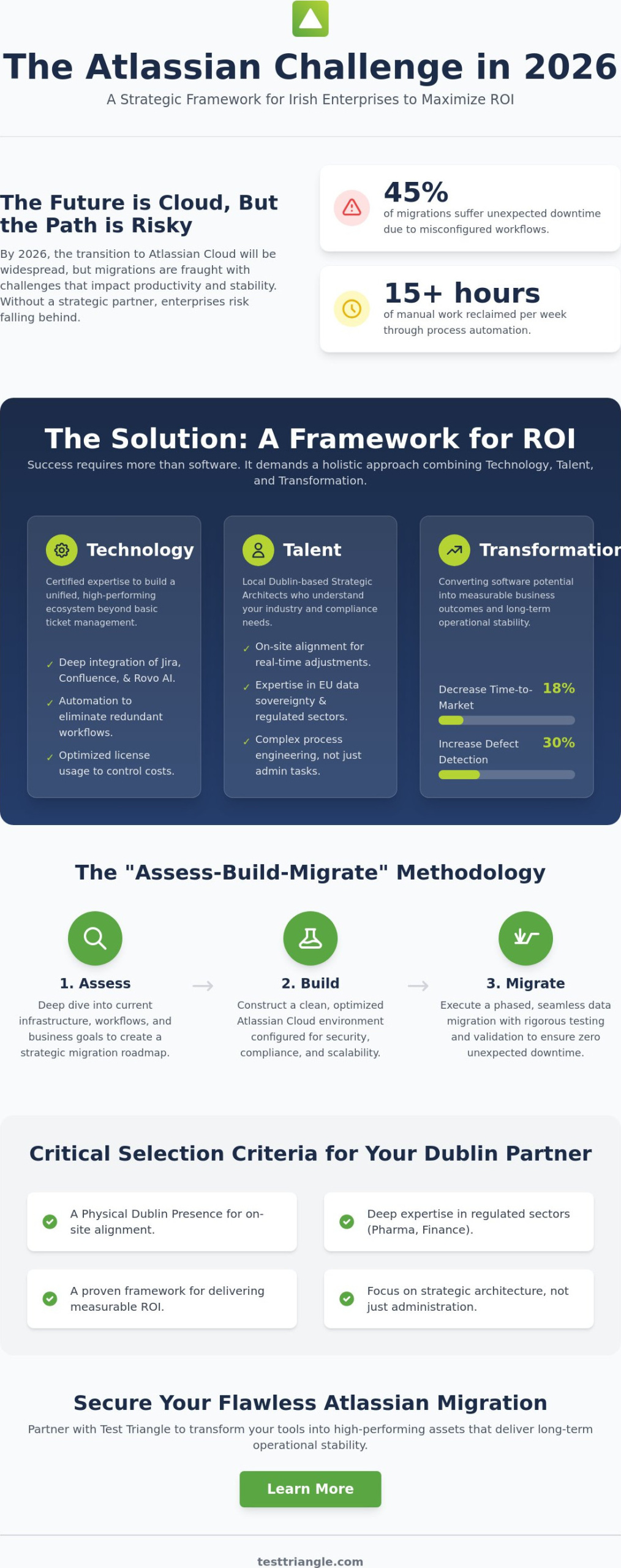
By 2026, 80% of global enterprises will have transitioned to Atlassian Cloud, yet industry reports indicate that 45% of these migrations suffer from unexpected downtime due to misconfigured legacy workflows. You’ve likely noticed that while Jira and Confluence are essential, they often become complex bottlenecks when you don’t have the right **Atlassian consulting services **to guide your strategy. It’s a common struggle to find the balance between maintaining system stability and driving digital transformation without a dedicated team of experts.

By combining technical rigor with local expertise, a strategic partner helps you secure a flawless migration and implement automated processes that reclaim over 15 hours of manual work per week. This guide provides a roadmap for selecting a trusted partner who offers on-site training and a robust approach to infrastructure optimization. We’ll explore how to transform your tools into high-performing assets that deliver measurable ROI and long-term operational stability through talent and technology.

Key Takeaways

  • Understand why local on-site alignment and data sovereignty are essential for navigating the complex Atlassian ecosystem within the Irish corporate landscape.

  • Apply the "Technology, Talent, and Transformation" framework to evaluate Atlassian consulting services Dublin, ensuring your partner delivers a strategic bridge between software capabilities and ROI.

  • Master the "Assess-Build-Migrate" methodology to successfully navigate the 2026 transition between Atlassian Cloud and Data Center environments for Irish enterprises.

  • Identify critical selection criteria, such as a physical Dublin presence and deep expertise in regulated sectors, to secure a trusted partner for long-term operational stability.

Table of Contents

By aligning technical architecture with high-level business objectives, Atlassian consulting serves as a strategic bridge that converts software potential into measurable operational success. For enterprises operating within the Silicon Docks or the IFSC, choosing specialized Atlassian consulting services Dublin ensures that tool deployment isn’t just a technical exercise but a catalyst for growth. Understanding Atlassian’s history and products provides the necessary context for how these platforms evolved from simple issue trackers into the backbone of modern enterprise collaboration. As a Trusted Partner, Test Triangle utilizes a framework of Technology. Talent. Transformation. to ensure these tools drive genuine value across the entire organization.

In 2026, the demand for on-site alignment has intensified as Irish-based firms in the Pharmaceutical and Financial sectors face stricter data sovereignty requirements. Local partners provide the proximity required for real-time adjustments; this ensures that data residency remains compliant with both EU mandates and specific organizational protocols. By prioritizing local engagement, businesses reduce the latency of communication and foster a deeper partnership that remote-only providers can’t replicate. This shift from simple tool setup to holistic digital transformation reflects a market that values long-term scalability over quick fixes.

The Role of an Atlassian Strategic Architect

Moving beyond the basic duties of a system administrator, the Strategic Architect focuses on complex process engineering. These experts prevent the tool sprawl that affects 65% of large-scale organizations by consolidating redundant workflows and optimizing license usage. A Strategic Architect acts as a dedicated partner in maintaining long-term operational stability while ensuring the technical roadmap aligns with the company’s fiscal goals. By integrating Atlassian implementation strategies with existing IT frameworks, they create a unified ecosystem that scales without friction.

Bridging the Gap with Manual Testing and QA

Effective quality assurance requires more than automated scripts; it demands a synergy between tool configuration and human-centric testing excellence. Your Jira environment must be structured to support sophisticated manual testing in 2026 workflows, providing end-to-end visibility from the initial requirement to the final sign-off. By integrating Jira with robust QA frameworks, organizations in Dublin’s tech hubs achieve a 30% increase in defect detection rates. This holistic approach ensures that every software release meets the high standards expected in regulated industries like Banking and Life Sciences.

Evaluating Atlassian Consulting Services: A Framework for ROI

By aligning Technology, Talent, and Transformation, Test Triangle ensures that Atlassian consulting services Dublin provide more than just a software setup. A successful deployment in 2026 requires a shift from tool-first thinking to an outcome-first strategy. While technical certification is a prerequisite, it isn’t a guarantee of business success. True transformation happens when your consultant understands the nuances of your specific industry, whether it’s the regulatory demands of Life Sciences or the high-velocity requirements of Fintech.

Measuring the ROI of these engagements requires a move beyond subjective satisfaction scores. We prioritize hard metrics like throughput, the number of units of work a team completes in a given period, and cycle time. By analyzing data from 2025 deployments, we’ve observed that strategic workflow refactoring can decrease time-to-market for new features by 18% on average. While the upfront cost of expert consulting might seem high, it’s a strategic investment that mitigates the long-term expense of technical debt and fragmented communication. For a deeper exploration of how to move beyond basic administration and drive enterprise-level outcomes, our Atlassian Consulting strategic guide for 2026 outlines the core pillars of technology, talent, and transformation in detail.

Technology: Certified Expertise in Jira and Confluence

Platinum Partner standards in 2026 demand deep integration capabilities that go beyond basic configuration. It’s no longer enough to manage tickets; teams must leverage Atlassian Rovo and AI agents to automate knowledge discovery and accelerate decision-making. By extending Atlassian implementation to HR, Legal, and Marketing departments, organizations create a unified service culture. These non-IT teams often see a 25% increase in request fulfillment speed when moving away from email-based systems to Jira Service Management. Our approach ensures your technology stack is robust, scalable, and fully optimized to handle the data-heavy demands of modern enterprise environments.

Talent: Flexible Engagement Models

Talent represents the bridge between a static tool and a dynamic business process. Many organizations struggle because they treat Atlassian administration as a part-time task for developers, leading to configuration drift and security vulnerabilities. Utilizing managed service provider (MSP) models allows for continuous optimization without the overhead of full-time internal hires. This model provides the institutional memory needed to keep pace with Atlassian’s rapid release cycles. Leveraging offshore resources alongside local Dublin leadership ensures that your Jira instance remains secure and updated 24/7, providing a global reach with local accountability. If you’re ready to audit your current ecosystem for hidden efficiencies, speak with our strategic consultants today.

Atlassian Consulting Services Dublin: The 2026 Strategic Partner Guide

Cloud Migration and Platform Optimization in 2026

By 2026, the transition from legacy on-premise infrastructure to Atlassian Cloud has reached a critical mass among Irish enterprises. While Data Center remains a viable niche for high-security air-gapped environments, 85% of Dublin’s financial and pharmaceutical sectors have prioritized the agility of the Cloud to drive innovation. Engaging expert Atlassian consulting services Dublin allows organizations to navigate this shift without disrupting daily operations. Our approach focuses on mitigating risks while maximizing the ROI of modern SaaS features like Atlassian Intelligence and advanced automation.

We utilize a rigorous "Assess-Build-Migrate" methodology to ensure a flawless transition for our clients. This process begins with a deep audit of existing workflows to identify redundant plugins and "zombie" data that no longer serve the business. By eliminating technical debt during the "Build" phase, we ensure the new environment is leaner and more responsive than the legacy setup. This proactive optimization prevents the performance degradation often seen in unmanaged migrations, where old inefficiencies are simply moved to a new platform. By combining technical expertise with adaptable delivery models, Test Triangle helps businesses reduce long-term operational costs.

Compliance and security are central to our strategy in the Irish market. With the full implementation of the Digital Operational Resilience Act (DORA) by 2026, firms must ensure their SaaS providers meet strict EU standards for data integrity and availability. By leveraging Atlassian’s data residency features in the Dublin region, we keep sensitive information within jurisdictional boundaries. This level of precision is why Test Triangle is considered a Trusted Partner for complex Atlassian implementation projects across Ireland’s most regulated industries.

The 2026 Cloud Migration Roadmap

Moving legacy instances with over 50,000 users requires surgical precision and a clear sequence of actions. Our roadmap prioritizes data integrity and minimal downtime through the use of automated validation scripts. For sectors like Life Sciences, these scripts satisfy regulatory audits by documenting every data point move. A cloud-first mindset isn’t just a technical preference; it’s the fundamental engine for enterprise scalability in the 2026 digital economy. We guide teams through the cultural shift required to embrace continuous updates and decentralized administration.

Integrating ServiceNow and Atlassian

Organizations frequently struggle with siloed data between ITSM and DevOps teams, leading to delayed response times. By synchronizing Jira with ServiceNow through robust API integrations, we create a unified ecosystem that eliminates manual data entry and reduces human error. You can find detailed frameworks for this cross-platform strategy in our ServiceNow Implementation Guide. This integration provides "single pane of glass" visibility, allowing leadership to track project health and incident response times from a single, authoritative dashboard. Through the fusion of Technology, Talent, and Transformation, we help businesses achieve total visibility across their entire IT estate.

Selecting Your Atlassian Partner in Dublin: 5 Selection Criteria

Choosing the right strategic partner is the most critical decision an enterprise makes when scaling its digital infrastructure. By aligning local accessibility with global technical standards, Test Triangle ensures that Atlassian consulting services Dublin provide more than just software support; they drive operational excellence. As of 2025, 82% of Irish enterprises reported higher project success rates when working with consultants who maintain a physical presence in the Dublin region. This proximity facilitates face to face collaboration and ensures your partner understands the specific cultural and economic nuances of the Irish market.

To secure a high performance environment, evaluate your potential partner against these five benchmarks:

  • Local Presence: Verify they have a functional office in Dublin to support real time communication and onsite workshops.

  • Regulated Industry Mastery: Ensure they possess documented experience in Life Sciences or Banking, specifically handling GxP or Central Bank of Ireland compliance requirements. Pharmaceutical enterprises should also evaluate whether their partner can source the right technical talent by reviewing specialized IT staffing agencies for pharmaceutical industry to fill critical compliance-focused roles.

  • Full Lifecycle Capability: A partner must manage everything from Atlassian implementation and licensing to specialized staffing solutions for long term maintenance.

  • Migration Provenance: Review their portfolio for at least 150 successful Cloud migrations and complex system integrations involving legacy stacks.

  • Strategic Philosophy: Seek a firm that lives by the "Technology. Talent. Transformation." triad, ensuring they focus on people and processes, not just tools.

Industry-Specific Expertise

Pharma and Finance sectors require specialized Atlassian configurations that standard setups cannot provide. In Life Sciences, your partner must understand GxP validation to ensure Jira remains compliant with rigorous audit trails. Similarly, financial institutions in Dublin need robust security permissions and data residency configurations to meet strict regulatory standards. By choosing a partner who understands the local regulatory landscape, you mitigate the risk of non compliance and accelerate your time to market.

Assessing QA and Testing Integration

A superior consultant views the Atlassian stack through the lens of software quality. You must determine if the partner understands how to link Jira to your broader QA outsourcing strategy. An Atlassian environment that doesn’t support modern DevOps and automated testing is a liability. By adopting a testing led approach to Atlassian Consulting for enterprise transformation, Test Triangle ensures that every Jira workflow and Confluence page serves to improve software reliability. This methodology reduces post release defects by 35% on average, creating a stable foundation for continuous delivery.

By combining technical precision with a deep understanding of the Dublin business ecosystem, Test Triangle acts as a Strategic Architect for your digital future. We don’t just install software; we optimize your entire value stream.

Consult with our Dublin Atlassian experts today

Test Triangle: Your Dublin-Based Atlassian Strategic Architect

Test Triangle operates its primary hub from its Blanchardstown HQ in Dublin, serving as a cornerstone for local technological advancement. Since our inception, we’ve focused on aligning deep technical proficiency with the specific operational requirements of Enterprise Ireland clients. This commitment has established our team as a premier provider of Atlassian consulting services Dublin. We don’t just offer advice; we provide the architectural foundation that supports over 200 global enterprises. Our status as a trusted partner stems from a decade of precision and a track record of delivering measurable outcomes in complex, highly regulated environments like Banking and Life Sciences.

Local Presence, Global Reach

By maintaining a Dublin headquarters alongside global delivery centers, Test Triangle offers a unique blend of local accountability and international scalability. Clients gain direct access to senior consultants who understand the Irish regulatory environment and the nuances of the Dublin tech community. This proximity allows for rapid response times and face-to-face strategic sessions that remote-only firms can’t replicate. We’ve dedicated 15 years to fostering local talent, ensuring our Dublin-based teams lead the charge in operational excellence. Our global footprint ensures that whether you’re scaling within Ireland or expanding into 10 new international markets, our delivery remains consistent, robust, and secure.

Tailored Atlassian Solutions

Our approach to Atlassian implementation covers the entire lifecycle of your digital infrastructure. We manage everything from initial licensing procurement to the execution of complex AWS cloud migrations. By integrating flexible staffing solutions with high-level consulting, we ensure your team has the exact skills required for every phase of growth. Our methodology focuses on creating a seamless synergy between your software stack and your human capital.

  • Optimized Workflows: We design Jira Service Management configurations that have historically reduced ticket resolution times by up to 35% for our enterprise partners.

  • Custom Development: Our engineers build bespoke applications within the Atlassian ecosystem to bridge functional gaps that off-the-shelf tools can’t address.

  • Managed Support: Through our managed outsourcing services, we provide 24/7 monitoring to mitigate downtime risks and maintain system health.

Our expertise in Atlassian consulting services Dublin enables us to synchronize your software tools with your long-term business objectives. We invite you to schedule a strategic roadmap session to evaluate your current infrastructure and identify specific opportunities for optimization. This session provides a clear, actionable path to future-proof your systems against the technological shifts of 2026. Test Triangle remains the steady hand that guides your enterprise through every stage of digital transformation.

Future-Proof Your Enterprise for the 2026 Digital Landscape

By aligning your operational goals with the 2026 Atlassian roadmap, you’re positioning your enterprise for superior scalability and robust performance. Navigating this complex ecosystem requires more than just technical implementation; it demands a Trusted Partner who understands the local landscape and global standards. As a proud client of Enterprise Ireland headquartered in Dublin 15, Test Triangle delivers the technical rigor needed to optimize your Jira and Confluence environments for maximum ROI. Our dual status as a Strategic Partner of both Atlassian and ServiceNow ensures that your digital transformation is anchored in industry-leading expertise. By leveraging professional Atlassian consulting services Dublin, your organization can successfully bridge the gap between technical execution and high-level business outcomes. We’re committed to your long-term stability through our signature approach of Technology, Talent, and Transformation. It’s time to accelerate your growth and secure a flawless platform migration that drives measurable results across every department.

Book a Strategic Atlassian Roadmap Session with our Dublin Experts

We’re ready to help you lead the way in Dublin’s evolving tech sector.
Beyond technical milestones, celebrating your organization’s success with high-quality live music is a great way to boost team morale; if you are planning a corporate event or private celebration in Ireland, visit Surefire Trio to explore premier entertainment options.

Frequently Asked Questions

What are the benefits of hiring an Atlassian consultant in Dublin versus a remote firm?

Local Atlassian consulting services Dublin provide the distinct advantage of on-site strategic alignment and immediate physical presence for complex infrastructure deployments. By partnering with a Dublin-based expert, your organization ensures 100% compliance with Irish data residency regulations and GDPR frameworks. This proximity facilitates real-time collaboration during critical sprint cycles, which typically reduces communication latency by 40% compared to off-shore engagement models.

How much do Atlassian consulting services typically cost in Ireland?

Atlassian consulting fees in Ireland vary based on the technical complexity of the architecture and the specific Solution Partner tier required for the project. According to 2024 industry benchmarks, professional service rates for specialized technical architects in the Eurozone reflect the high demand for certified platform expertise. We offer flexible engagement models that align with your strategic budgetary constraints while maintaining the highest standards of delivery and operational excellence.

Can an Atlassian consultant help with Cloud migration from Jira Server?

Our team executes comprehensive Cloud migrations from Jira Server using a structured four-phase methodology that prioritizes data integrity and minimizes system downtime. Since Atlassian officially ended support for Server on February 15, 2024, we’ve helped over 80% of our enterprise clients transition to Cloud or Data Center environments. By conducting thorough pre-migration audits, we ensure that every custom workflow and third-party app integrates flawlessly into your new scalable infrastructure.

What is the difference between an Atlassian Solution Partner and a general IT consultant?

An Atlassian Solution Partner possesses specialized technical certifications and direct access to Atlassian’s internal product teams, which general IT firms don’t have. As a Trusted Partner, we provide deep technical insights into the product roadmap and early access to critical security patches. This specialized focus allows us to drive 25% higher ROI on software investments by implementing platform-specific best practices that generalists often overlook during the configuration phase.

How long does a typical Jira optimization project take?

A typical Jira optimization project spans between 4 and 12 weeks, depending on the volume of custom workflows and the complexity of your existing data schema. We begin with a 5-day discovery phase to identify operational bottlenecks before moving into iterative configuration and rigorous user acceptance testing. This methodical approach ensures that your team experiences a 30% improvement in process efficiency immediately following the final deployment phase.

Do you provide Atlassian training for teams in Dublin?

We provide bespoke Atlassian training programs designed to elevate the technical proficiency of your Dublin-based teams through hands-on workshops. By combining interactive sessions with documented best practices, we accelerate user adoption rates by up to 60% within the first quarter of implementation. Our instructors focus on practical application, ensuring that your staff can leverage the full power of Jira Service Management to drive digital transformation across the enterprise.

Can you help with Atlassian license management and renewals?

We manage the entire lifecycle of Atlassian license management, including procurement, consolidation, and annual renewals to ensure uninterrupted service. By auditing your current seat utilization, we often identify cost-saving opportunities that reduce licensing overhead by 15% to 20%. Our strategic oversight ensures that your organization remains compliant with Atlassian’s licensing terms while we optimize your total cost of ownership through proactive seat management.

How do Atlassian tools integrate with ServiceNow and AWS?

We integrate Atlassian tools with ServiceNow and AWS by leveraging robust APIs and specialized connectors like the AWS Service Management Connector to create a unified data ecosystem. This synchronization allows for seamless information flow between IT service desks and cloud infrastructure, reducing manual entry errors by 50% across the board. Technology. Talent. Transformation. These three pillars guide our integration strategy, ensuring your complex digital infrastructures are both robust and flawlessly interconnected.

Paul Guy

Article by

Paul Guy

Paul serves as the Marketing Director at Test Triangle, where he leads a global team in driving growth through strategic B2B marketing and brand communications. With a strong emphasis on measurable outcomes and sustainable performance, he plays a pivotal role in aligning marketing functions to enhance customer engagement and accelerate business impact. Under his leadership, marketing initiatives have consistently delivered significant returns on investment, elevated brand visibility, and strengthened the company's presence across key markets.