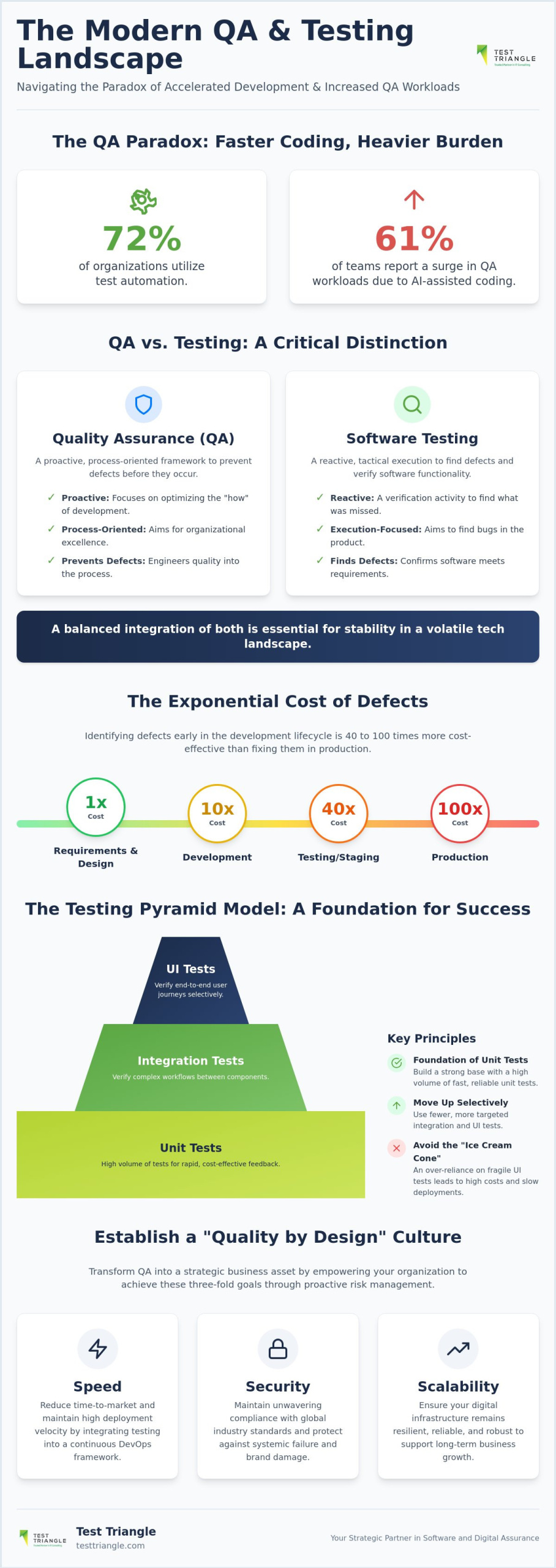
With 72% of organizations now utilizing test automation, you might expect the burden on development teams to be lifting, yet 61% of teams report a dramatic surge in QA workloads due to the rise of AI-assisted coding. This paradox often leaves global enterprises trapped between the need for rapid deployment and the risk of high defect rates in production. When you’re operating within highly regulated industries, the challenge of finding specialized talent to manage Testing and QA Software testing only compounds these operational bottlenecks. You likely feel that your current testing framework is a hurdle to clear rather than a foundation to build upon.

We’re here to change that perspective by showing you how to transform quality assurance into a strategic business asset that drives speed, security, and scalability. As a reliable long-term collaborator, we provide a comprehensive roadmap for integrating manual, automation, and performance testing into a unified DevOps strategy. By aligning technical execution with long-term business outcomes, you’ll discover how to reduce time-to-market, improve user experience, and maintain unwavering compliance with global industry standards. We will examine the specific methodologies, tools, and staffing models required to ensure your digital infrastructure remains resilient, reliable, and robust.

Key Takeaways

  • Understand the critical distinction between process-oriented quality assurance and execution-focused software testing to optimize resource allocation and mitigate the exponential costs of late-stage defect remediation.
  • Learn to deploy the Testing Pyramid model, which prioritizes unit and integration tests over UI-heavy suites to maintain high deployment velocity and operational efficiency.
  • Discover how to integrate Testing and QA Software testing into a continuous DevOps framework, ensuring that quality becomes an intrinsic component of your digital transformation journey.
  • Identify the strategic synergy between manual exploratory testing and automated performance checks to deliver a seamless user experience across complex, multi-platform environments.
  • Establish a “Quality by Design” culture that empowers your organization to achieve the three-fold goals of speed, security, and scalability through proactive risk management.

Demystifying Testing and QA: A Strategic Business Imperative for 2026

By 2026, the velocity of software delivery has reached a point where traditional, siloed validation methods are no longer sufficient to protect enterprise value. With over 53% of all code now being AI-generated or assisted, the sheer volume of output has created a paradox: development is faster, yet the risk of systemic failure is higher. This evolution has elevated Testing and QA Software testing from a tactical checkbox to a strategic pillar of digital resilience. For global organizations, quality is no longer just about finding bugs; it’s about engineering trust into every layer of the digital infrastructure.

The financial implications of this shift are stark. Industry data consistently demonstrates that identifying a defect during the initial requirement or design phase is 40 to 100 times more cost-effective than remediating the same issue once it reaches production. When a defect escapes into the wild, the costs aren’t merely financial; they include technical debt, operational downtime, and the erosion of customer loyalty. By integrating a comprehensive overview of software testing into the earliest stages of the development lifecycle, businesses can achieve a state of precision, predictability, and progress.

The ROI of a Mature QA Strategy

A sophisticated approach to quality assurance serves as a powerful engine for value creation. By reducing technical debt, organizations free up their engineering talent to focus on innovation rather than fire-fighting. In a high-stakes marketplace, a single high-profile failure can lead to significant churn and permanent brand damage. We position our software and digital assurance testing services to align directly with your corporate strategic roadmaps, ensuring that every testing milestone supports a broader business objective. This alignment transforms QA from a cost center into a catalyst for digital transformation services, empowering you to scale with confidence.

QA vs. Testing: Understanding the Methodology

While often used interchangeably, Quality Assurance and Software Testing represent two distinct but complementary disciplines. QA is a proactive, process-oriented framework designed to prevent defects before they occur. It focuses on organizational excellence and the “how” of development. Conversely, testing is a reactive, tactical execution of verification activities aimed at confirming that the software meets specific requirements. Your organization doesn’t need to choose between them; it needs a balanced integration of both. A robust framework for Testing and QA Software testing ensures that while the process is optimized for prevention, the execution remains rigorous enough to catch the unexpected. This dual-layered defense is what allows global enterprises to maintain stability in a volatile technological landscape.

The Core Pillars of Software Testing: From Unit to System Integration

Establishing a resilient digital infrastructure requires a disciplined adherence to the Testing Pyramid model. This framework dictates that the foundation of your strategy should consist of a high volume of unit tests, which provide rapid and cost-effective feedback during the earliest stages of development. As we move up the pyramid, integration and UI tests are applied more selectively to verify complex workflows and end-to-end user journeys. By maintaining this structural balance, enterprises can avoid the “ice cream cone” anti-pattern, where an over-reliance on fragile UI tests leads to high maintenance costs and slow deployment cycles. This hierarchy is essential for successful Testing and QA Software testing, ensuring that your quality framework remains both scalable and sustainable.

Beyond the structural pyramid, a mature strategy must address both functional and non-functional requirements. While functional testing confirms that the application executes its intended business logic, non-functional testing evaluates critical attributes such as performance, usability, and security. Given that the security testing market is growing at a 24.7% CAGR toward a projected $43.9 billion by 2029, vulnerability assessments have become a non-negotiable pillar of modern assurance. Understanding the strategic business implications of QA allows executive leadership to see these non-functional pillars as essential risk-mitigation tools that protect the organization’s reputation and financial stability.

Regression testing serves as the vital heartbeat of continuous delivery pipelines. It ensures that new code enhancements don’t inadvertently disrupt existing functionality, a risk that’s significantly amplified in the age of AI-assisted development. By automating regression suites, organizations can maintain a clean, production-ready codebase even as release cycles accelerate. If you’re seeking to modernize your validation frameworks, you might consult with our strategic partners to align your technical execution with enterprise-grade standards.

System Integration Testing (SIT) and User Acceptance (UAT)

SIT functions as the critical bridge where individual modules are validated as a cohesive system, ensuring that data flows seamlessly across internal and external interfaces. In complex enterprise environments, managing these dependencies requires a meticulous approach to environment stability and data integrity. Once the system is technically sound, UAT provides the final validation from the end-user perspective, confirming that the solution delivers the intended business value. You can learn about SIT in testing through our specialized assurance frameworks designed for regulated industries.

Integrating QA with Atlassian and ServiceNow Ecosystems

Operational efficiency is maximized when Testing and QA Software testing activities are deeply embedded within the platforms your teams already use. By leveraging Jira for transparent defect tracking, teams gain real-time visibility into the quality lifecycle, while ServiceNow implementation allows for the automation of ITSM workflows. This integration ensures that testing results are directly connected to service management and incident response. You should explore Atlassian implementation strategies to see how these tools foster collaboration between development and operations.

Execution is the ultimate proving ground for any quality strategy. While the previous sections established the structural pillars of quality, the actual delivery of Testing and QA Software testing involves navigating a spectrum that balances human intuition with algorithmic precision. Manual testing remains the indispensable human element for exploratory sessions and comprehensive UX assessments, allowing seasoned experts to uncover edge cases that scripted logic might overlook. This human-centric approach is vital for validating the nuances of user behavior and visual fidelity. For those seeking to understand the academic and practical foundations of these disciplines, reviewing a Software Testing and Quality Assurance syllabus provides a clear window into the rigorous standards required for professional validation.

Conversely, automation testing drives the speed and precision necessary for high-volume, repetitive tasks, enabling teams to maintain velocity without sacrificing accuracy. This is particularly critical when dealing with performance testing, which ensures that your digital infrastructure remains resilient under peak load and high-concurrency scenarios. By simulating real-world traffic, we identify architectural bottlenecks before they impact the end-user. This technical rigor is complemented by compatibility testing, which guarantees consistent experiences across an increasingly fragmented device ecosystem, ensuring that your application performs flawlessly regardless of the user’s hardware or operating system. We focus on delivering three core outcomes: stability, security, and scalability.

When to Automate and When to Stay Manual

A mature quality framework requires a strategic selection process to identify high-ROI automation candidates, such as stable regression suites and data-driven tests. Over-automation can lead to fragile test environments and high maintenance costs, which is why we advocate for a balanced approach that preserves the human perspective for complex usability challenges. You can explore our Manual Testing in 2026: A Strategic Guide to learn more about where human insight provides the greatest business value.

Performance and Load Testing for Enterprise Scalability

Enterprise-scale applications must be engineered to withstand seasonal spikes and global product launches without degradation. Our performance testing methodology involves rigorous stress testing to determine the absolute breaking point of your architecture, providing the data necessary for proactive capacity planning. For organizations looking to automate these complex checks within a CI/CD pipeline, our Software Test Automation Services for Scalable Quality offer a roadmap for sustainable growth and operational stability.

Establishing a Quality Culture: Implementation Strategies for Global Enterprises

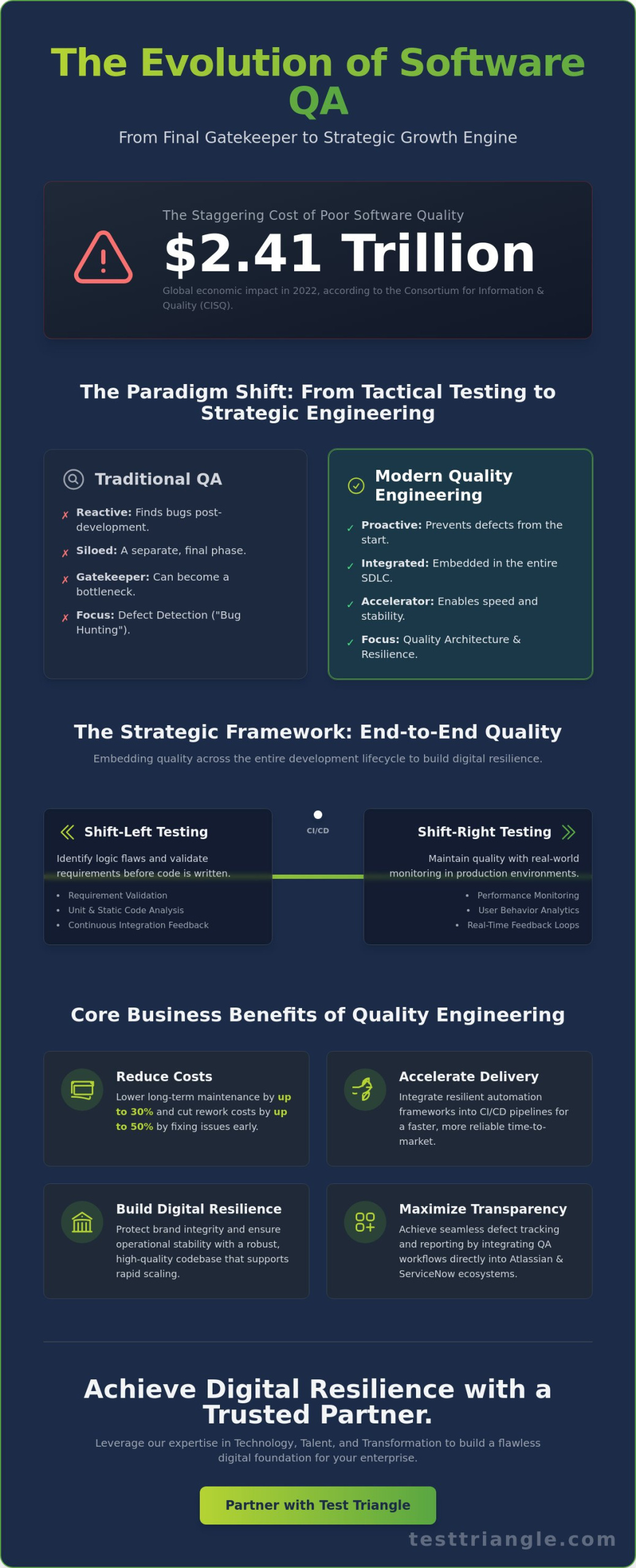
Shifting the organizational mindset from “testing as a phase” to “quality as a culture” is the hallmark of a mature digital enterprise. This transition requires a fundamental commitment to “Shifting Left,” a strategy where validation activities are integrated into the earliest stages of the software development lifecycle. By addressing potential failures during the requirements and design phases, organizations move away from a reactive “detect and fix” cycle toward a proactive “prevent and protect” philosophy. This cultural realignment ensures that every stakeholder, from product owners to architects, views Testing and QA Software testing as a shared responsibility rather than a final hurdle before release.

Building a cross-functional DevOps culture focused on “Quality by Design” allows for the seamless integration of automated checks within continuous delivery pipelines. This isn’t merely about technical tools; it’s about fostering collaboration between development, operations, and assurance teams to eliminate silos. When quality is baked into the architecture, the result is a resilient infrastructure that supports rapid deployment without compromising security or performance. For global organizations, this structural discipline is what transforms a functional necessity into a strategic business asset that empowers long-term growth.

Specialized QA for Regulated Industries

In sectors like pharmaceuticals and life sciences, the stakes of software failure extend beyond financial loss to include regulatory and safety risks. Navigating GxP compliance requires a rigorous approach to validated software testing, ensuring that every digital tool meets the exacting standards of global health authorities. Similarly, securing financial platforms demands a specialized focus on penetration testing and data integrity. We provide the technical rigor and institutional maturity needed to manage these complexities. You can explore the industries we support with specialized QA to see how we tailor our frameworks to meet specific regulatory mandates.

QA Outsourcing and Staffing Models

Structuring a high-performing quality department often involves balancing internal expertise with flexible external resources. Many enterprises find that a Managed Service Provider (MSP) model offers the most sustainable path to long-term stability, providing consistent oversight and technical evolution that individual staffing often lacks. Whether you’re considering offshore teams for cost-efficiency or permanent placement for core IP retention, the choice of model must align with your strategic roadmap. Our QA Outsourcing: A Strategic Comparison provides a detailed framework for evaluating these options. If you’re ready to optimize your department’s structure, you should connect with our strategic advisory team to discuss a customized staffing or managed service solution.
Strategic Software Testing & QA: A Complete Guide

Test Triangle: Your Strategic Partner in Software and Digital Assurance

Achieving excellence in Testing and QA Software testing requires more than just technical proficiency; it demands a reliable long-term collaborator who understands the intersection of methodology, execution, and business value. We position ourselves as a high-level corporate partner for global organizations, providing comprehensive software and digital assurance testing that goes beyond basic bug detection. Our approach integrates strategic technology roadmapping with digital transformation services, ensuring that your quality framework evolves in lockstep with your broader organizational goals. By aligning our technical execution with your strategic vision, we empower your enterprise to navigate complex technological shifts with confidence and clarity.

Operational stability is further reinforced through our expert Atlassian and ServiceNow implementation services, which optimize your quality workflows and harmonize communication across departments. We recognize that every organization has unique resource requirements, which is why we offer highly adaptable IT staffing services. Whether your project requires specialized contract experts, remote/offshore development teams, or permanent placements to build internal IP, our flexible delivery models provide the technical rigor and scalability necessary for sustained success. We provide three core pillars for your digital journey: Precision, Progress, and Peace of mind.

Why Leading Enterprises Trust Test Triangle

With over a decade of institutional maturity and a global operational footprint across Europe, North America, and Asia, we bring a seasoned perspective to every engagement. Our deep expertise in DevOps consulting and AWS cloud migration allows us to manage complex digital infrastructures with unmatched discipline. By focusing on risk reduction and operational stability, we ensure that your technology stack remains a driver of growth rather than a source of liability. This commitment to excellence is why global leaders in finance, healthcare, and retail view us as an essential extension of their engineering departments.

Accelerate Your Quality Journey

We deliver customized IT service management services that are meticulously tailored to the specific demands of your industry. For those operating in highly regulated environments, our specialized talent provides the nuanced expertise required for pharmaceutical recruitment and life science resourcing projects. We don’t just provide services; we engineer the foundations of your future success. If you’re ready to transform your approach to quality assurance, you should Partner with Test Triangle for Strategic QA and discover the empowerment that comes from large-scale technological evolution.

Engineering Resilience for the Digital Future

The transition from a reactive validation model to a proactive, strategic business asset is the defining characteristic of a digitally resilient enterprise. By integrating the core pillars of the testing pyramid and fostering a cross-functional DevOps culture, organizations can significantly reduce technical debt while accelerating deployment velocity. This journey requires more than just technical tools; it demands a disciplined approach to Testing and QA Software testing that aligns technical execution with long-term corporate objectives. Whether you’re navigating the complexities of GxP compliance or scaling a global cloud infrastructure, the right framework provides the stability necessary for innovation.

As an Atlassian Gold Solution Partner with global delivery centers across Europe, North America, and Asia, we provide the institutional maturity and specialized expertise required for high-stakes digital environments. We’re committed to acting as your reliable long-term collaborator, offering the precision, protection, and progress your organization deserves. It’s time to transform your quality assurance from a functional necessity into a powerful engine for growth. We look forward to supporting your next phase of technological evolution.

Optimize your software quality with Test Triangle's strategic QA services

Frequently Asked Questions

What is the difference between QA and software testing in an enterprise context?

Quality Assurance (QA) focuses on the organizational processes designed to prevent defects before they occur, while software testing is the tactical execution of verifying that the code meets specific requirements. In an enterprise context, a mature strategy for Testing and QA Software testing integrates both to ensure systemic reliability and operational stability. This dual approach allows leadership to manage risk proactively rather than reacting to failures after deployment.

How much should a company invest in software testing and QA services?

Investment levels vary based on the complexity of the digital infrastructure and the regulatory requirements of the industry, though many global enterprises allocate a significant portion of their development budget to assurance activities. While specific costs depend on the service model, the focus should remain on the “cost of quality,” where early investment mitigates the 40 to 100 times higher expense of fixing production defects. A strategic partner helps balance these costs against the potential risk of brand damage.

Can you outsource software testing without losing control of project quality?

Outsourcing remains highly effective when managed through a strategic partnership model that emphasizes transparency, accountability, and shared goals. By utilizing a Managed Service Provider (MSP), organizations maintain oversight through integrated defect tracking and regular performance audits while benefiting from specialized technical expertise. This approach ensures that quality standards remain consistent across global delivery centers, allowing internal teams to focus on core innovation without sacrificing technical rigor.

What are the benefits of integrating QA with DevOps consulting?

Integrating quality assurance with DevOps consulting fosters a “Quality by Design” culture that accelerates release cycles through continuous testing and automated feedback loops. This synergy eliminates operational silos, enabling teams to identify vulnerabilities earlier in the software development lifecycle. The result is a resilient delivery pipeline that supports rapid deployment while maintaining high standards of stability, security, and scalability, which are essential for large-scale digital transformation.

Why is manual testing still necessary in an automation-first world?

Manual testing provides the indispensable human perspective required for exploratory sessions and complex user experience assessments that automated scripts cannot replicate. It allows seasoned experts to evaluate visual fidelity, intuitive navigation, and subtle edge cases that exist outside of predefined logical parameters. In a balanced Testing and QA Software testing framework, human insight acts as a critical safeguard, ensuring that the technology remains centered on the end-user’s needs.

How does Atlassian consulting improve the software testing lifecycle?

Atlassian consulting enhances the testing lifecycle by implementing industry-leading tools like Jira and Confluence to provide end-to-end traceability and transparent defect management. These platforms allow for the seamless synchronization of development and assurance tasks, ensuring that every stakeholder has real-time visibility into the project’s quality status. This structural discipline reduces communication gaps and streamlines the path from initial requirement to final deployment, fostering institutional maturity.

What is validated software testing for the pharmaceutical industry?

Validated software testing is a specialized assurance process designed to meet GxP compliance and other stringent regulatory mandates within the pharmaceutical and life science sectors. It involves rigorous documentation, comprehensive audit trails, and evidence-based verification to ensure that every digital tool performs consistently and safely. This level of technical rigor is essential for protecting patient safety and maintaining the legal integrity of the organization’s data in highly regulated global markets.

What is the typical ROI of implementing test automation services?

The return on investment for test automation is realized through significantly reduced regression cycles, improved bug detection rates, and the ability to execute high-volume tests with absolute precision. While initial implementation requires a strategic commitment, the long-term benefits include lower maintenance costs and a faster time-to-market for new features. Organizations that successfully deploy these services report a dramatic increase in operational efficiency, allowing their engineering talent to focus on high-value strategic initiatives.

Paul Guy

Article by

Paul Guy

Paul serves as the Marketing Director at Test Triangle, where he leads a global team in driving growth through strategic B2B marketing and brand communications. With a strong emphasis on measurable outcomes and sustainable performance, he plays a pivotal role in aligning marketing functions to enhance customer engagement and accelerate business impact. Under his leadership, marketing initiatives have consistently delivered significant returns on investment, elevated brand visibility, and strengthened the company's presence across key markets.

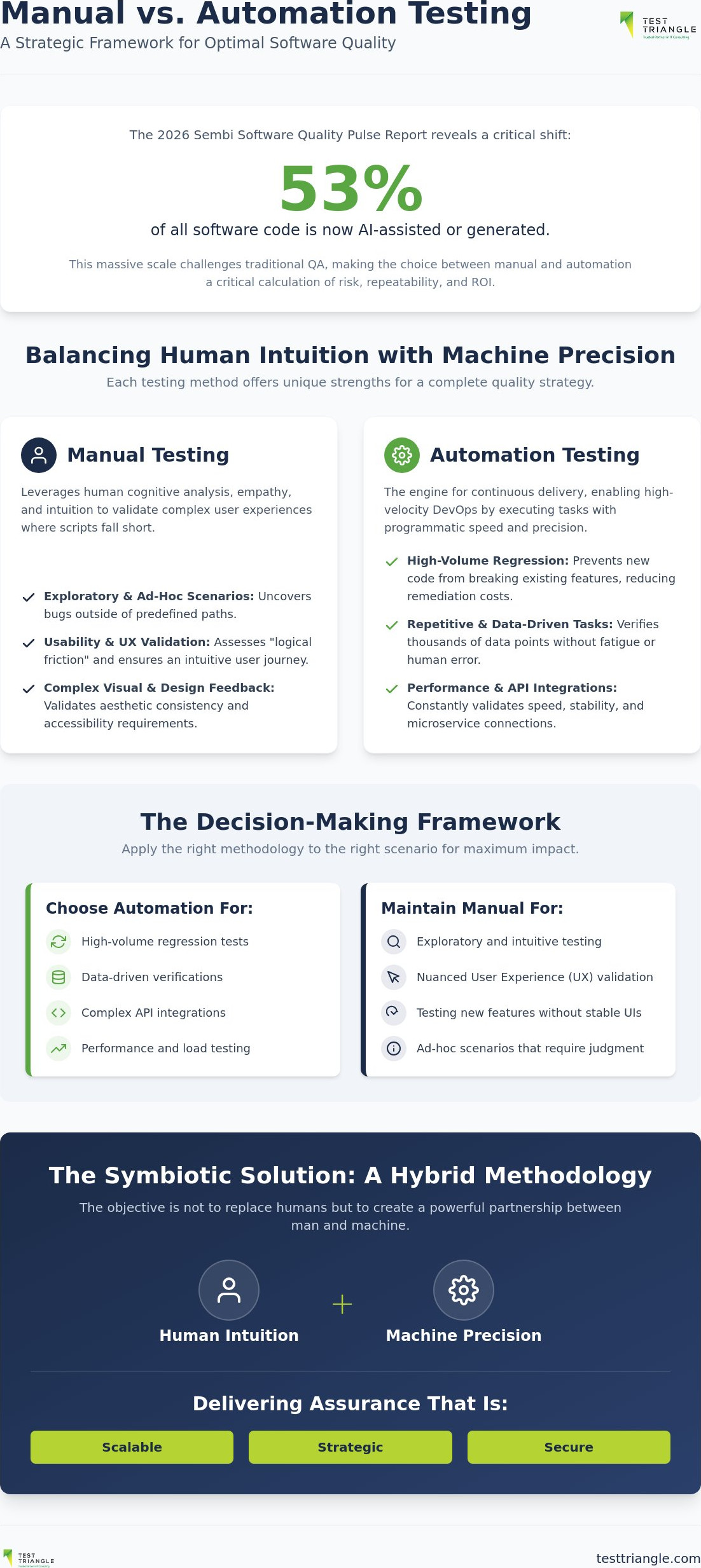
With 53% of all software code now being AI-assisted or generated according to the 2026 Sembi Software Quality Pulse Report, the sheer volume of digital output has reached a threshold where traditional quality assurance methods often falter under the weight of sheer scale. You likely recognize the mounting pressure of escalating regression costs and the persistent bottleneck of slow release cycles that threaten your organization’s competitive edge in a hyper-accelerated market. Determining exactly when to choose automation testing over manual is no longer a matter of simple preference; it’s a critical calculation of risk, repeatability, and ROI that defines modern digital maturity. This guide provides a sophisticated decision-making framework designed to help you balance human intuition with machine precision for optimal software quality and operational stability. By aligning your testing methodology with specific business outcomes, you’ll master a hybrid strategy that ensures faster time-to-market and reduced bug rates through precision, performance, and partnership.

Key Takeaways

  • Align your quality assurance strategy with the 2026 technological landscape by integrating AI-augmented tools that bridge the gap between programmatic precision and human intuition.
  • Identify the high-volume, repetitive regression scenarios where transitioning to automated scripts effectively mitigates human error and secures your release schedule.
  • Master the “Automation Break-even Point” formula to determine when to choose automation testing over manual based on a comprehensive analysis of initial investment, maintenance, and long-term ROI.
  • Protect your user experience by maintaining manual testing protocols for exploratory and ad-hoc scenarios that require the sophisticated judgment only a “human-in-the-loop” can provide.
  • Implement a hybrid delivery model that leverages an adaptable approach to service delivery, ensuring your digital infrastructure remains scalable, strategic, and secure.

Manual vs. Automation: Balancing Human Intuition with Machine Precision

The shift from manual execution to programmatic verification represents more than a tactical change in tooling; it signals a fundamental evolution in how enterprises perceive quality. By moving beyond the binary choice of “manually clicking” versus “writing code,” sophisticated organizations now treat the selection process as a strategic technology roadmapping exercise. In this 2026 digital ecosystem, where AI-augmented tools increasingly blur the distinction between human-led and machine-led processes, the core challenge is determining when to choose automation testing over manual to maximize both coverage and capital efficiency. This decision necessitates a disciplined evaluation of where human intuition provides a competitive advantage and where machine precision secures the release pipeline.

The Enduring Value of Manual Assurance

Human cognitive analysis remains an irreplaceable pillar of high-standard software delivery, particularly when validating complex usability and accessibility requirements that scripts simply cannot interpret. While machines excel at binary outcomes, they lack the empathy required to validate nuanced user experience (UX) benchmarks. Professional testers apply a layer of critical judgment that identifies “logical friction”—those subtle design flaws that technically function but practically frustrate the end-user. For a deeper dive into these human-centric methodologies, our Manual Testing 2026 Guide outlines how exploratory testing provides the peace of mind that automated scripts often miss by focusing solely on predicted paths.

The Strategic Mandate for Automation

The transition to Test automation serves as the primary engine for continuous delivery, enabling teams to operate within the high-velocity requirements of modern DevOps environments. By implementing a “Test Early, Test Often” methodology, organizations can identify regressions at the point of injection, which drastically reduces the cost of remediation. This systemic improvement is essential for maintaining operational stability as application complexity grows. Establishing a clear threshold for when to choose automation testing over manual allows leadership to allocate resources with surgical precision, ensuring that expensive human capital isn’t wasted on rote verification. Automating these predictable paths allows your engineering talent to focus on high-value exploratory work, ensuring that speed never comes at the expense of security or reliability.

Ultimately, the objective is to create a symbiotic relationship between man and machine. This hybrid approach ensures that your digital infrastructure is managed with the expertise required for large-scale technological evolution. By combining technical rigor with human insight, you achieve a level of assurance that is scalable, strategic, and secure.

Prime Scenarios for Automation: Accelerating Velocity and Verifying Reliability

The decision regarding when to choose automation testing over manual often rests on the physical and cognitive limitations of human testers. While human intuition is superior for identifying aesthetic inconsistencies, it remains susceptible to fatigue during high-volume, repetitive tasks. In the current enterprise landscape, where 72% of organizations now utilize test automation to manage growing complexity, scripts provide the unwavering precision necessary to verify thousands of data points without the risk of oversight. This programmatic rigor is particularly vital for data-driven testing and complex API integrations, where the interplay of microservices requires constant, simultaneous validation that exceeds manual capacity.

Adhering to Best Practices In Quality Assurance involves recognizing that automation is not a replacement for human thought but a tool for systemic improvement. By delegating rote verification to a machine, organizations empower their QA teams to focus on high-value exploratory work. This strategic allocation of resources ensures that your digital infrastructure remains resilient as it scales, providing a steady hand in an increasingly volatile technological environment.

Regression Testing and CI/CD Integration

Regression testing has emerged as the primary candidate for automation in 2026, serving as a protective shield for core functionality during rapid update cycles. By integrating automated suites directly into your CI/CD pipelines, you ensure that every code commit is validated against established benchmarks before it reaches production. Our Software Test Automation Services focus on creating these seamless feedback loops, utilizing deep integrations with the Atlassian and ServiceNow ecosystems. This approach ensures that reporting is transparent, actionable, and aligned with your broader IT service management goals, effectively reducing post-release bug rates through continuous, programmatic oversight.

Performance and Load Benchmarking

Manual testing protocols are fundamentally incapable of simulating the stress of 10,000 concurrent enterprise users interacting with a system. Automation provides the only viable path for performance, load, and stress testing, allowing organizations to identify systemic bottlenecks that could lead to catastrophic downtime and lost revenue. By executing these high-load scenarios in controlled environments, you gain the empirical data needed to optimize infrastructure and ensure a seamless user experience under any conditions. If you are currently evaluating your existing QA roadmap, you may wish to connect with our strategic consultants to discuss how to implement a scalable, secure performance framework that protects your long-term operational stability.

The Case for Manual Testing: Navigating Complexity and Validating User Experience

While the previous sections established the necessity of machine precision for high-volume tasks, a strategic framework must also account for the inherent limitations of scripted logic. Determining when to choose automation testing over manual is often about identifying where human oversight provides the final layer of institutional security. In highly regulated sectors like pharmaceuticals, manual validation serves as a critical compliance gate. Scripts verify if a field accepts a specific data type, but they cannot assess the clinical context or the procedural integrity required by global health authorities. This “Human-in-the-Loop” necessity ensures that complex business logic remains aligned with both technical specifications and regulatory mandates, providing a level of assurance that is perceptive, purposeful, and precise.

During early-stage product development, where user interfaces remain volatile and requirements shift rapidly, the cost of maintaining automated scripts often outweighs their utility. Human testers adapt instantly to these changes, providing immediate feedback that machines cannot replicate. Industry leaders frequently highlight various reasons for manual testing, particularly its unique capacity to assess user journeys and inclusivity through a lens of critical judgment. This approach allows organizations to manage risk while fostering the innovation necessary for successful digital evolution.

Exploratory Testing and Creative Problem Solving

Exploratory testing functions as a high-level cognitive hunt for unscripted defects that traditional automation typically ignores. Professional testers use their intuition to simulate erratic user behaviors, identifying “edge case” bugs that exist outside the predicted paths of a script. This methodology is essential for digital transformation services, where the integration of legacy systems with modern cloud architectures often creates unpredictable failure points. By applying creative problem-solving techniques, testers uncover deep-seated architectural flaws, ensuring that your digital infrastructure remains stable under real-world conditions.

Usability and Accessibility (a11y) Audits

Machines are fundamentally incapable of feeling if a user interface is intuitive or frustrating. While automation can check for the presence of alt-text, it cannot determine if that text provides meaningful context for a visually impaired user. Manual testing addresses these legal and ethical mandates by employing human auditors to validate accessibility against global standards. This ensures that your software is not only compliant with regulations but also provides a seamless experience for every user. By prioritizing human-centric validation, you demonstrate a commitment to quality that transcends simple code verification, positioning your brand as a reliable and responsible global partner.

Calculating the ROI: A Decision-Making Framework for Enterprise QA

For executive leadership and technical managers alike, the decision regarding when to choose automation testing over manual is fundamentally a capital allocation exercise. Achieving optimal software quality requires a disciplined understanding of the “Automation Break-even Point,” which occurs when the cumulative cost of manual execution—calculated as the sum of labor hours, hourly rates, and execution frequency—surpasses the total cost of automated ownership. While manual testing offers lower entry costs, it creates a linear expense model that scales poorly as application complexity increases. Conversely, automation requires a higher initial investment in tool licensing, cloud infrastructure, and specialized staffing, but it eventually flattens the cost curve through repeatability and speed.

Neglecting this transition often leads to significant “Technical Debt,” where the hidden costs of human error and delayed release cycles compound over time. To avoid these systemic bottlenecks, organizations must evaluate their projects through a qualitative lens, considering the lifespan of the application and the stability of its core features. A project intended to remain in production for more than six months, or one requiring weekly regression cycles, almost always mandates a shift toward programmatic verification to ensure long-term operational stability.

The Cost of Maintenance vs. The Cost of Execution

Analyzing the time-and-materials cost of manual testing reveals a persistent drain on resources as teams repeat the same verification steps across dozens of development cycles. While professional software test automation services require a sophisticated technical foundation, they eliminate the fatigue-induced errors that characterize high-volume manual work. Automation ROI is formally defined as the specific juncture where the cumulative expenses of manual labor across multiple release cycles exceed the total cost of automated ownership, including initial development and ongoing script maintenance. By identifying this point early, you can transition from a reactive posture to a proactive, scalable quality strategy.

Risk-Based Testing Allocation

Effective budget distribution relies on the “Testing Pyramid” methodology, which prioritizes automation for high-risk, high-frequency features while reserving manual oversight for the UI-heavy top layer. This strategic focus ensures that your most critical business logic is validated continuously without inflating the QA budget. Our IT consulting experts specialize in defining these roadmaps, helping global enterprises determine exactly when to choose automation testing over manual to protect their digital infrastructure. To align your testing methodology with your broader business objectives, we invite you to request a strategic QA audit with our senior advisors today.

When to Choose Automation Testing Over Manual: A Strategic Framework for 2026

Test Triangle’s Hybrid Methodology: Delivering Scalable, Strategic, and Secure Assurance

Test Triangle functions as a high-level corporate partner for global enterprises navigating the complexities of modern quality assurance. We recognize that the strategic decision regarding when to choose automation testing over manual is rarely a binary choice; it’s a sophisticated allocation of diverse resources based on risk and ROI. Our methodology emphasizes an adaptable approach to service delivery, ensuring that your digital infrastructure is managed with the precision and performance required for sustained growth. By integrating deep expertise in industry-leading platforms such as Atlassian and ServiceNow, we create unified QA workflows that bridge the gap between rapid development cycles and long-term operational stability.

This hybrid strategy allows organizations to move beyond the limitations of a single methodology. By combining human intuition with machine precision, we provide a steady hand in a fast-changing technological landscape. This approach focuses on risk reduction and the empowerment found in large-scale technological evolution, positioning your company as a leader in digital maturity. Our role is to act as a reliable collaborator, deeply invested in your long-term success and the stability of your complex digital environments.

Managed Outsourcing and Staffing Solutions

Securing the specialized talent required for advanced programmatic verification remains a significant hurdle for organizations facing budget constraints. Our staffing solutions provide immediate access to the technical expertise needed to build and maintain robust automation frameworks. For enterprises seeking a more comprehensive partnership, our managed outsourcing services offer long-term QA stability through a combination of on-site leadership and remote offshore resources. This hybrid staffing model allows you to scale your testing efforts with surgical precision, ensuring that your budget remains aligned with your current project demands. It provides the peace of mind that comes from knowing your mission-critical systems are managed by a disciplined, versatile, and globally-minded team.

Strategic Digital Transformation

Quality assurance serves as the foundational pillar for successful digital transformation services. We don’t view testing in isolation. Instead, we integrate security and performance validation directly into your automated pipelines to mitigate risk at every stage of the software lifecycle. This holistic view ensures that your technological evolution is not only fast but also secure and resilient. By helping you determine exactly when to choose automation testing over manual, we empower your organization to focus human expertise on innovation while machines handle the rote verification tasks. This synergy defines a mature digital enterprise that is prepared for the future.

The path to software excellence requires a collaborator who understands that quality is a continuous journey of systemic improvement. We invite you to partner with Test Triangle for a strategic QA assessment and discover how our hybrid methodology can transform your testing from a bottleneck into a competitive advantage.

Securing Your Digital Future Through Strategic Assurance

Mastering the transition from manual execution to programmatic verification is essential for maintaining a competitive edge in the 2026 digital ecosystem. By applying a disciplined ROI framework, you can determine exactly when to choose automation testing over manual to ensure your quality assurance remains scalable, strategic, and secure. This hybrid methodology allows your organization to protect core digital infrastructures through machine precision while reserving human ingenuity for the complex user experience challenges that define market leadership. As an Atlassian Gold Solution Partner with ISO 9001:2015 certified quality management, Test Triangle provides the institutional maturity required to manage complex global infrastructures. Our delivery centers across Europe, North America, and Asia offer a versatile, globally-minded approach to service delivery that adapts to your specific operational needs. We remain a steady hand in a fast-changing landscape, empowering your teams to achieve faster time-to-market without compromising reliability. Consult with our QA Strategic Visionaries Today to align your testing roadmap with your long-term business objectives. We’re ready to help you transform your QA from a cost center into a powerful engine for organizational growth.

Frequently Asked Questions

Is automation testing always better than manual testing?

Automation is not inherently superior; rather, its value is context-dependent. While it excels at high-volume regression and performance benchmarking, manual testing remains the definitive choice for exploratory, usability, and ad-hoc scenarios requiring human intuition. The strategic decision of when to choose automation testing over manual should be based on the project’s specific requirements for repeatability versus creative analysis.

How do I calculate the ROI of switching to automated testing?

ROI is determined by identifying the “Automation Break-even Point,” where the total cost of automated ownership, including initial scripting, tool licensing, and infrastructure, becomes lower than the cumulative expense of manual execution over multiple cycles. You must factor in the hourly rate of testers and the frequency of test execution. This quantitative approach ensures that your quality assurance budget is allocated with surgical precision to maximize long-term operational stability.

Can automation testing completely replace manual testers in 2026?

Total replacement is neither feasible nor desirable in the 2026 digital landscape. While AI-augmented tools manage a significant portion of code generation, human oversight is essential for validating complex business logic and ensuring accessibility compliance. A hybrid methodology creates a symbiotic relationship where machines handle rote verification while human experts focus on high-level strategy and exploratory bug hunting. This balance provides the peace of mind derived from comprehensive, multi-layered assurance.

What are the best test cases to automate first?

Priority should be given to stable, high-volume regression suites and smoke tests that protect core functionality during rapid release cycles. Additionally, data-driven scenarios and complex API integrations that require thousands of permutations are ideal candidates for early automation. By focusing on these repetitive, fatigue-prone tasks first, you immediately reduce the risk of human error and accelerate your time-to-market. This targeted execution serves as the foundation for a scalable, strategic testing framework.

What is the cost of maintaining automated test scripts?

Maintenance costs typically account for a significant portion of the total automation budget, often varying based on the volatility of the application’s user interface. As software evolves, scripts must be updated to reflect architectural changes, which requires continuous technical oversight. Selecting resilient frameworks like Playwright or Selenium 4 can help mitigate these expenses. Understanding these hidden costs is vital when evaluating when to choose automation testing over manual for long-term projects.

How does DevOps consulting impact the choice between manual and automated testing?

Professional DevOps consulting facilitates the seamless integration of quality gates directly into your CI/CD pipeline, which naturally shifts the balance toward automated verification. This strategic alignment ensures that testing isn’t a bottleneck but a continuous feedback loop that supports high-velocity delivery. Consultants help identify the optimal “Testing Pyramid” structure for your organization, ensuring that automated units and integration tests provide a stable foundation while manual efforts are reserved for high-value validation.

Which industries benefit most from a hybrid testing approach?

Highly regulated sectors, such as pharmaceuticals and financial services, derive significant value from a hybrid approach that combines programmatic rigor with strict human-in-the-loop validation. These industries require the precision of automation for data integrity and the perceptive judgment of manual testers for compliance and risk management. Similarly, complex e-commerce platforms use this duality to balance high-speed backend transactions with an intuitive, empathetic user experience that machines cannot fully evaluate.

What skills do manual testers need to transition to automation?

Transitioning testers must develop proficiency in programming languages such as JavaScript, Python, or Java, alongside a deep understanding of automation frameworks like Playwright or Appium. Beyond coding, they need to master the logic of test architecture and the mechanics of CI/CD integration within ecosystems like Atlassian or ServiceNow. This evolution from manual execution to quality engineering empowers professionals to contribute to large-scale technological progress through the sophisticated application of technical tools.

Paul Guy

Article by

Paul Guy

Paul serves as the Marketing Director at Test Triangle, where he leads a global team in driving growth through strategic B2B marketing and brand communications. With a strong emphasis on measurable outcomes and sustainable performance, he plays a pivotal role in aligning marketing functions to enhance customer engagement and accelerate business impact. Under his leadership, marketing initiatives have consistently delivered significant returns on investment, elevated brand visibility, and strengthened the company's presence across key markets.


With the global test automation market reaching a valuation of $24.25 billion in 2026, the primary challenge for technical leaders is no longer justifying the technology, but demonstrating how a specific investment will secure the 200-400% ROI realized by the world’s most resilient enterprises. To successfully convince management to invest in test automation, you must transcend technical metrics and present a strategic case centered on risk reduction and accelerated market delivery. You likely feel the mounting pressure of manual testing cycles that delay critical releases, especially when production defects continue to erode the bottom line and reinforce the outdated perception of QA as a cost center rather than a value driver.

This executive playbook serves as your strategic guide to mastering the financial models and risk frameworks required to elevate quality engineering to a board-level priority. We’ll provide the data-driven arguments needed to secure a signed-off budget for automation tools and services while shifting your internal culture toward a “shift everywhere” strategy. By the end of this guide, you’ll have a clear methodology for transforming your testing department into a high-velocity strategic asset that ensures long-term stability, precision, and growth.

Key Takeaways

  • Define the “Cost of Inaction” as your primary metric to expose how manual testing creates a compounding financial risk known as quality debt.
  • Utilize the “Engineering Capacity Reclaimed” formula to convince management to invest in test automation by showcasing the direct recovery of high-value developer time.
  • Tailor your strategic arguments to specific stakeholder personas, shifting the dialogue from technical features to the business outcomes that resonate with executive leadership.
  • Execute a disciplined five-step roadmap that utilizes manual pain audits and bounded pilots to demonstrate immediate, scalable results without overextending resources.
  • Leverage professional consulting expertise to integrate your automation strategy across enterprise ecosystems, ensuring your infrastructure remains stable, precise, and growth-oriented.

The Case for Change: Why the Status Quo is Your Biggest Financial Risk

With the global test automation market valued at $24.25 billion in 2026, traditional ROI models often fail because they focus solely on potential savings rather than the immediate, compounding losses of sticking with manual processes. To effectively convince management to invest in test automation, you must lead with the Cost of Inaction (COI). COI measures the literal price an organization pays for maintaining a manual status quo, encompassing lost revenue, inflated labor costs, and the erosion of market share. Manual testing creates a systemic Quality Debt that compounds with every single release, eventually reaching a point where the cost of fixing legacy defects exceeds the budget for new feature development.

As the average salary for automation engineers in the United States reaches $107,126, the financial delta between human-led regression and AI-driven efficiency has widened significantly. Organizations that rely on manual cycles find themselves trapped in a cycle of diminishing returns, facing missed market opportunities while competitors, empowered by autonomous testing frameworks, capture the first-mover advantage. Transitioning to a modern test automation strategy is no longer a technical upgrade; it’s a financial necessity for institutional stability, precision, and growth.

The Hidden Tax on Engineering Velocity

Manual regression cycles function as a persistent release brake, preventing even the most talented teams from achieving “Elite Performer” status under DORA metrics. When a release cycle is measured in weeks rather than hours, the agility required to respond to shifting market demands vanishes. This friction does more than slow down code; it destroys talent retention. In 2026, top-tier engineers refuse to work in environments defined by manual toil and repetitive tasks, leading to a brain drain that further increases recruitment costs. By automating the mundane, you reclaim engineering capacity, allowing your team to focus on innovation that drives actual business value.

Quality Assurance as a Board-Level Risk Metric

Modern enterprises operate in a landscape where a single production outage can result in uninsurable brand damage and staggering regulatory fines. In highly regulated sectors like finance and pharmaceuticals, software quality is a core compliance requirement rather than a secondary concern. Shifting the conversation toward risk mitigation helps convince management to invest in test automation by framing it as a security and stability initiative. Our DevOps Consulting services help bridge the gap between development speed and operational safety, ensuring that every deployment is backed by a rigorous, automated validation process. This approach transforms QA from a siloed cost center into a strategic partner dedicated to long-term operational stability.

Constructing the ROI Model: Translating Scripts into Savings

While the Cost of Inaction establishes the risk of the status quo, securing a board-approved budget requires a rigorous financial model that translates technical scripts into measurable savings. To effectively convince management to invest in test automation, leaders must present a balanced ROI model built on the three pillars of operational speed, defect quality, and engineering capacity. This framework moves beyond simple “time saved” metrics to demonstrate how automated validation functions as a force multiplier for the entire development lifecycle. Industry analysis on the ROI of test automation highlights that sustainable value is only achieved when infrastructure costs and maintenance requirements are factored into the initial business case. We must account for the Maintenance Trap by projecting script upkeep costs upfront, ensuring the model remains credible under executive scrutiny.

The Cost-of-Defect Math for 2026

The financial impact of a bug escalates exponentially as it moves closer to the end user. The 1:10:100 rule of software testing dictates that a defect found in production costs one hundred times more to remediate than one identified during the initial development phase. By integrating automation, organizations achieve the “continuous testing” state required for modern CI/CD pipelines, preventing defects from reaching the expensive production stage.

Development PhaseRelative Remediation CostDetection Method
Development (Unit/Local)1xAutomated Unit Tests
QA / Staging10xAutomated Regression
Production100x+User Reports (Manual)

Calculating Reclaimed Engineering Hours

To convince management to invest in test automation, you must quantify the Full-Time Equivalent (FTE) savings generated by eliminating repetitive manual tasks. By applying the 2026 average salary for an automation testing engineer of $107,126, organizations can assign a concrete dollar value to every hour reclaimed. If a manual regression suite requires 40 hours of execution per week, automating that process recovers approximately $51.50 per hour in engineering time. This creates over $100,000 in annual capacity that can be redirected toward high-value exploratory testing and innovation. Utilizing professional Software Test Automation Services allows your internal team to scale these savings rapidly without the overhead of building frameworks from scratch. If you need assistance building a bespoke financial model for your organization, speak with our strategic consultants today.

Reframing the Pitch: Speaking the Language of Stakeholders

Securing executive buy-in requires a fundamental shift in communication, moving away from technical specifications toward the strategic outcomes that drive corporate growth. To successfully convince management to invest in test automation, you must align your proposal with the core value triad of Precision, Predictability, and Progress. It’s about business resilience. While technical teams often focus on framework features, executive leadership evaluates investments based on how they mitigate risk, accelerate delivery, and empower the workforce. You’ve got to address the common “we tried this before” objection by highlighting the 2026 technological shift toward AI-powered, self-healing frameworks and codeless platforms that have eliminated the brittleness of legacy automation attempts.

The CFO Perspective: Predictability and Risk Mitigation

Financial leadership prioritizes the bottom line and the reduction of unbudgeted expenses. When you present your case, focus on how automation lowers the Mean Time to Repair (MTTR), directly reducing the financial fallout from production outages. Transitioning from a capital-heavy manual model to a streamlined, managed approach allows for a predictable shift from CapEx to OpEx, providing the CFO with greater budgetary flexibility. This financial stability is a cornerstone of broader Digital Transformation Services, where automated validation ensures that large-scale infrastructure changes don’t result in costly downtime or compliance failures in highly regulated sectors.

The CTO Perspective: Technical Debt and Scalability

The Chief Technology Officer is concerned with long-term architectural integrity and the elimination of technical debt. By framing the initiative correctly, you can convince management to invest in test automation as a foundational pillar for technical scalability. Frame your automation strategy as a prerequisite for a scalable microservices architecture, where manual validation simply cannot keep pace with the complexity of modern deployments. By automating regression, you drastically reduce the “emergency fix” context switching that drains developer productivity. This allows your most expensive engineering assets to focus on high-impact innovation. A robust testing framework also serves as a safeguard for your Atlassian Implementation, ensuring that complex workflows and integrated toolchains remain stable as the organization scales globally.

A 5-Step Roadmap to Secure Management Approval

Transforming a technical vision into a corporate mandate requires a structured approach that emphasizes incremental validation and resource optimization. To convince management to invest in test automation, you must present a phased roadmap that minimizes upfront risk while maximizing visible outcomes. This 2026 playbook utilizes a five-step methodology designed to align quality initiatives with organizational growth objectives.

  • Step 1: Conduct a Manual Pain Audit. Identify high-friction areas where manual regression cycles currently delay releases or cause production bottlenecks.
  • Step 2: Define a Bounded Pilot. Select 3-5 high-impact test cases that demonstrate immediate value without requiring a complete infrastructure overhaul.
  • Step 3: Select a Tooling and Staffing Model. Evaluate the efficiency of building an in-house team versus leveraging Managed Outsourcing to accelerate implementation.
  • Step 4: Establish Success Baselines. Define clear KPIs, such as percentage of test coverage and total engineering hours saved, to track progress against your initial ROI model.
  • Step 5: Present the Executive Summary. Deliver a concise proposal that features a clear 12-month ROI projection and a strategy for scalable growth.

Scoping the Bounded Pilot

Successful initiatives often begin with a pilot project targeting the “Smoke Test” suite, as these critical path tests offer the highest visibility with the lowest relative implementation risk. By focusing on the most essential functions of the application, you create a de-risking mechanism for leadership that proves technical feasibility before committing significant capital. This focused approach allows you to convince management to invest in test automation by providing tangible evidence of stability and precision within a controlled, measurable environment.

Choosing the Right Delivery Model

One of the most critical decisions in your roadmap involves the sourcing of specialized talent. With the average salary for an automation testing engineer in the United States reaching $107,126, the cost of recruiting, training, and retaining an entire internal team can be prohibitive for many organizations. Utilizing IT Staffing Services provides a more flexible alternative, allowing you to access elite expertise without the long-term overhead of permanent hires. A hybrid automation strategy, combining onshore strategic planning with offshore execution, ensures that your quality assurance processes remain adaptable and cost-effective. This model provides a significant speed-to-market advantage; it’s a strategic path that utilizes pre-built frameworks and proven methodologies from a reliable long-term collaborator. To determine which delivery model best fits your specific operational needs, consult with our strategic staffing experts.

Strategic Partnership: Why Test Triangle is the Catalyst for Automation Success

The transition from manual testing to a board-approved automation strategy requires more than just technical proficiency; it demands a partner who understands the intricate relationship between software quality and corporate value. When you seek to convince management to invest in test automation, the choice of a collaborator becomes the defining factor in whether the initiative is viewed as a technical expense or a strategic investment. We position ourselves as the essential bridge between low-level execution and high-level business goals, ensuring that every automated suite contributes to long-term organizational resilience. Our approach emphasizes stability, precision, and scalability, moving beyond the delivery of mere scripts to provide a sustainable framework that evolves alongside your digital infrastructure.

By framing the partnership as a long-term collaboration rather than a transactional service, we help organizations avoid the common pitfalls of fragmented, brittle automation. We understand that for an executive team to sign off on a budget, they need to see a path toward institutional maturity. Our methodology integrates human expertise with industry-leading platforms, ensuring that your investment results in a high-performance testing environment that supports your broader strategic objectives without increasing technical debt.

Ecosystem-Aware Automation

Modern enterprises don’t operate in a vacuum, and neither should their testing frameworks. We specialize in providing ServiceNow Consulting and automation that protects core business workflows, ensuring that updates to your service management environment never compromise operational continuity. By integrating automated validation directly into your Jira and Bitbucket pipelines, we create a seamless CI/CD reporting loop that provides stakeholders with real-time visibility into product health. This ecosystem-centric approach is particularly vital for highly regulated sectors, such as the pharmaceutical industry, where we provide the validated testing required to meet stringent compliance standards while maintaining development velocity.

Global Expertise, National Delivery

Operating across major hubs in Dublin, North America, and Asia, we offer a versatile global delivery model that adapts to the specific time zones and regulatory requirements of your business. This geographic flexibility allows for rapid scaling of automation initiatives, providing you with the exact level of expertise needed at every stage of the roadmap discussed in the previous section. Our commitment to institutional maturity is reinforced by official partner endorsements and a proven track record of success in complex, large-scale environments. We don’t just provide a service; we act as a steady hand in a fast-changing technological landscape, emphasizing progress through the combination of human expertise and advanced technical tools. To transform your quality assurance department into a strategic asset, book a strategic automation consultation with our executive team today.

Securing Your Organization’s Digital Future through Automated Assurance

The path to organizational agility in 2026 is paved with strategic, automated validation. By reframing the conversation around the Cost of Inaction and presenting a data-driven ROI model, you can effectively convince management to invest in test automation as a catalyst for long-term stability, precision, and progress. Moving beyond the manual status quo isn’t merely about speed; it’s about reclaiming engineering capacity and protecting your enterprise from uninsurable production risks. A well-executed automation strategy ensures that your digital infrastructure remains resilient in a fast-changing technological landscape.

As an Atlassian Gold Solution Partner and ServiceNow Premier Partner with global delivery centers across three continents, we provide the institutional maturity required to scale your quality initiatives. We act as a reliable long-term collaborator, bridging the gap between complex technical execution and board-level business priorities. Our global presence ensures that your digital transformation is supported by elite expertise and recognized industry benchmarks.

Request a Custom ROI Roadmap for Your Test Automation Project to begin your transition toward a high-velocity, risk-mitigated future. Your journey toward operational excellence and scalable growth starts with a single strategic step.

Frequently Asked Questions

How much does it cost to start a test automation pilot in 2026?

The initial investment for a pilot typically includes tool licensing and the engineering hours required for framework design, with platforms like BrowserStack starting at $29 per month and Katalon Studio at $84 per month. While tool costs are predictable, the primary financial commitment lies in the strategic allocation of human expertise to build a foundation that ensures stability, precision, and growth. Most organizations find that a bounded pilot focusing on three to five critical test cases provides the necessary data to justify a larger budget without requiring significant upfront capital.

Can we automate 100% of our testing, and should we?

Achieving 100% automation is neither technically feasible nor strategically advisable because manual exploratory testing remains essential for validating user experience and complex edge cases. Most elite organizations target a 70-80% automation rate for repetitive regression and smoke tests, which allows human testers to focus on high-value activities that require intuition. This balanced approach ensures that your quality assurance process remains both efficient and thorough, protecting the brand from defects that automated scripts might overlook.

What is the typical timeline to see a positive ROI on test automation?

Enterprises, particularly in the financial services sector, typically realize a 200-400% ROI within 12-18 months of their initial deployment. While the first two quarters involve setup and training costs, the immediate improvements in release velocity and the reduction in production defects begin to deliver measurable value almost instantly. Over time, the reclaimed engineering capacity and reduced remediation costs solidify the investment as a primary driver of operational stability.

How do we handle the maintenance of automated scripts as our software evolves?

Effective maintenance relies on modular framework design and the integration of self-healing capabilities that automatically adapt to UI changes without human intervention. By incorporating these modern frameworks, teams can drastically reduce the time spent on script updates, preventing the common “maintenance trap” that often stalls legacy automation projects. Prioritizing a “shift everywhere” strategy ensures that testing is integrated throughout the lifecycle, making maintenance a continuous, manageable process rather than a bottleneck.

Which test automation tools are best for enterprise Atlassian and ServiceNow environments?

Playwright has become the fastest-growing scripted framework in 2026, reaching 30 million weekly downloads due to its speed and reliability in modern web environments. For organizations utilizing Atlassian and ServiceNow, it’s critical to select tools that offer robust API integrations to ensure seamless reporting within Jira and the protection of core workflows. Leveraging platforms that support your existing ecosystem ensures that your automation strategy remains aligned with your broader digital transformation goals.

What happens if our management team is still skeptical after seeing the ROI model?

When financial models alone aren’t enough, shifting the dialogue toward the Cost of Inaction (COI) can often convince management to invest in test automation by highlighting the uninsurable risks of production outages. Presenting a bounded pilot serves as a de-risking mechanism, providing tangible proof of concept and immediate friction reduction within a controlled environment. This practical demonstration of value often overcomes institutional inertia by showing that automation is a steady hand in a fast-changing landscape.

Is it better to hire a full-time automation engineer or use a managed service provider?

Hiring a full-time automation engineer in the United States involves an average annual salary of $107,126, plus significant overhead for recruitment and training. Managed service providers offer a more flexible alternative, providing instant access to elite expertise and pre-built frameworks without the long-term liabilities of permanent staffing. This model allows organizations to scale their testing capacity rapidly, ensuring that their quality initiatives remain adaptable to shifting market demands.

How does AI-driven testing change the business case for automation?

AI-driven testing significantly strengthens the business case by enabling autonomous test generation and reducing the technical barrier for non-technical stakeholders. These AI-powered platforms can lower costs by 50-70% through improved efficiency and the elimination of repetitive manual toil. By accelerating the time-to-value and simplifying script maintenance, AI ensures that test automation is no longer a technical request but a board-approved business priority that drives long-term success.

Paul Guy

Article by

Paul Guy

Paul serves as the Marketing Director at Test Triangle, where he leads a global team in driving growth through strategic B2B marketing and brand communications. With a strong emphasis on measurable outcomes and sustainable performance, he plays a pivotal role in aligning marketing functions to enhance customer engagement and accelerate business impact. Under his leadership, marketing initiatives have consistently delivered significant returns on investment, elevated brand visibility, and strengthened the company's presence across key markets.


If your 2026 product roadmap relies on testing cycles that mirror 2023 methodologies, you’re likely accumulating technical debt that will stall your digital transformation by Q4. Most enterprise leaders agree that internal testing bottlenecks now cause nearly 42% of release delays in sensitive sectors like Pharma IT and Banking. By integrating high-quality outsourced qa services into your delivery pipeline, you can mitigate these risks while maintaining the agility required for global competition. At Test Triangle, we believe that the right partnership should act as a force multiplier for your internal teams, rather than a temporary fix for capacity issues.

You deserve a strategy that delivers predictable testing costs and immediate access to specialized expertise in security and performance. This article provides a comprehensive, 5-pillar checklist designed to help you evaluate and select a partner that aligns with your long-term vision. By following this framework, you’ll learn how to achieve faster time-to-market and ensure a seamless Jira or Atlassian integration across your entire ecosystem. We’ll explore how the synergy of Technology, Talent, and Transformation can elevate your operational stability and drive sustainable success through 2026 and beyond.

Key Takeaways

  • Understand the evolution of QA from a cost-focused necessity to a strategic enabler capable of bridging the 2026 specialized talent gap.
  • Identify the optimal engagement framework for your organization by distinguishing between staff augmentation and comprehensive managed testing services.
  • Master the essential technical and regulatory benchmarks required to evaluate high-performing outsourced qa services in sectors like Finance and Pharma.
  • Audit prospective partners using five critical pillars designed to verify advanced automation depth and the security of your intellectual property.
  • Learn how to leverage the “Technology. Talent. Transformation.” triad to integrate a trusted partner that drives long-term digital stability and scalable growth.

The Strategic Shift: Why Enterprises Prioritise Outsourced QA Services in 2026

By repositioning quality assurance from a reactive cost center to a proactive strategic enabler, global enterprises are fundamentally rewriting their digital transformation playbooks. In 2026, the complexity of software ecosystems has reached a tipping point where internal teams often struggle to maintain the pace of innovation while ensuring flawless performance. By leveraging outsourced qa services, organizations gain access to high-level expertise that bridges the gap between technical execution and business outcomes. This shift allows leadership to focus on core product development while a outsourced software testing partner manages the intricate demands of modern quality protocols.

The 2026 talent market presents a significant challenge, as 73% of IT leaders report difficulty in hiring specialized testers for AI-driven systems and advanced cybersecurity protocols. Shifting from a fixed operational overhead to flexible engagement models enables companies to scale their testing capacity based on project demands without the long-term burden of internal headcount. Test Triangle serves as a Trusted Partner in this landscape, providing the necessary agility to navigate market fluctuations. Strategic QA is the intersection of risk mitigation and speed.

Checklist: 5 Signs Your Internal QA Team Has Reached Its Scaling Limit

  • Regression Backlogs: Testing cycles consistently delay production releases by 15% or more.
  • Skill Gaps: Your team lacks certified experts in AI model validation or penetration testing.
  • Infrastructure Costs: Maintaining internal device labs and automation frameworks exceeds your annual budget by 20%.
  • Escaped Defects: Critical bugs are reaching production environments at an increasing rate.
  • Automation Stagnation: Less than 40% of your test suite is automated, leading to manual bottlenecks.

Beyond Cost Savings: The Value of a Fresh Perspective

By introducing independent validation into legacy development cycles, external audits identify critical blind spots that internal teams might overlook due to institutional familiarity. Unbiased validation ensures that production-level defects are minimized before they impact the end-user experience. This objective approach allows outsourced qa services to deliver a superior level of precision. Through our core philosophy of Technology. Talent. Transformation, we help businesses optimize their quality benchmarks while maintaining operational stability.

The 2026 Release Pressure: Speed vs. Quality

CI/CD pipelines frequently fail to deliver on their promise of speed when they lack a robust, outsourced automation strategy to handle the heavy lifting. Implementing a Shift-Left testing methodology has been shown to improve time-to-market metrics by up to 30% by identifying vulnerabilities during the earliest stages of the SDLC. Global delivery centres further accelerate this process by providing 24/7 coverage, ensuring that testing continues across every time zone. This continuous feedback loop drives faster deployments and more resilient software architectures.

Defining Your Model: A Checklist for Choosing Engagement Frameworks

By integrating specialized expertise with adaptable delivery models, enterprises can optimize their outsourced qa services to achieve superior software quality. The shift toward 2026’s decentralized development environments requires a strategic evaluation of how external talent fits into your existing ecosystem. Selecting the right framework isn’t merely a procurement decision; it’s a foundational step in your digital transformation. Many organizations now leverage Cem Kaner’s outsourcing checklist to establish a baseline for vendor technical depth and accountability before committing to a specific model. This rigorous vetting ensures that the chosen partner can provide the necessary Technology, Talent, and Transformation required for long-term stability.

Managed Services: Relieving the Management Burden

Handing over full ownership of the QA process to a Trusted Partner allows internal leadership to focus on high-level product innovation. In this model, the partner manages the entire testing lifecycle, from strategy design to execution. Success is governed by Service Level Agreements (SLAs) that guarantee outcomes rather than just logged hours. For instance, a robust SLA might mandate a 98% test case execution rate or a 24-hour turnaround for critical defect reporting. A dedicated QA Lead acts as the Strategic Architect within this environment, aligning the testing roadmap with your business objectives. This model is ideal for mature organizations looking to drive efficiency through specialized outsourced qa services while maintaining high-level oversight via tools like Jira Service Management.

Staff Augmentation: Plugging Specific Skill Gaps

When specific technical gaps emerge, such as a sudden need for performance testing or security audits in 2026’s complex API ecosystems, staff augmentation provides immediate relief. This model allows for rapid scaling, enabling teams to add specialized talent for short-term projects without the 35% overhead cost typically associated with permanent hires. Achieving seamless integration requires the outsourced resources to adopt your internal culture and technical standards. Recent data from 2025 indicates that 82% of successful staff augmentation projects utilized shared communication protocols to ensure remote resources remained synchronized with in-house developers. It’s a practical way to leverage global talent while maintaining direct control over the daily testing activities.

Selecting the right geographic location for your resources depends on your “Follow the Sun” strategy and communication requirements:

  • Onshore: Essential for projects with strict regulatory compliance or those requiring real-time, same-timezone collaboration with the C-suite.
  • Nearshore: Offers a balance of cost-efficiency and 2 to 4 hour overlap windows, facilitating agile ceremonies and rapid feedback loops.
  • Offshore: Most effective for large-scale regression testing and high-volume execution where significant cost reduction is the primary driver.

Flexible engagement models are no longer a luxury but a necessity for navigating fluctuating project demands. By choosing a partner that offers adaptable frameworks, you ensure your testing capacity can expand or contract alongside your product roadmap. To see how these models function in a real-world environment, you can explore our strategic approach to quality engineering.

The Ultimate Checklist for Evaluating Outsourced QA Services in 2026

Technical and Regulatory Readiness: The Specialized QA Checklist

Generalist providers often fail in high-stakes sectors because they lack the domain-specific rigor required for 2026’s complex regulatory environment. By failing to account for sector-specific nuances in Finance and Pharma, these providers introduce liability rather than mitigating it. A 2025 industry report indicated that 62% of data breaches in regulated sectors stemmed from third-party software vulnerabilities. Selecting outsourced qa services requires a partner who understands that a bug in a clinical trial system isn’t just a technical glitch; it’s a compliance failure. To ensure your organization remains audit-ready, use this essential 2026 certification checklist:

  • ISO 27001:2022: The gold standard for information security management systems.
  • SOC2 Type II: Critical for confirming the operational effectiveness of security controls over time.
  • GxP (GLP, GCP, GMP): Essential for any software touching the life sciences supply chain.
  • PCI DSS 4.0: The mandatory requirement for any provider handling financial transaction data.

By prioritizing these standards, Test Triangle acts as a Strategic Architect, ensuring your digital infrastructure remains robust against evolving threats. Validated Software Testing isn’t an optional add-on for Healthcare; it’s the foundation of patient safety and data privacy. A partner must navigate these regulatory roadmaps with precision, moving beyond simple bug hunting to provide comprehensive risk mitigation.

Life Sciences and Pharma IT Specialization

By integrating Computer System Validation (CSV) protocols directly into the software development lifecycle, Test Triangle ensures that every release meets the stringent requirements of 21 CFR Part 11. Maintaining data integrity throughout the testing lifecycle requires more than just technical skill; it demands a disciplined approach to audit trails and electronic signatures. As of January 2026, 78% of Life Sciences organizations prioritize partners who demonstrate deep CSV expertise. It’s vital to remember that “compliance is not a checkbox but a continuous process” that defines the reliability of your entire IT estate.

Ecosystem Alignment: Atlassian, ServiceNow, and AWS

By aligning testing workflows with your existing toolstack, a sophisticated provider accelerates your digital transformation. Your outsourced qa services partner must be a Strategic Architect who leverages Jira Service Management for seamless defect tracking and real-time visibility. This integration ensures that every identified issue is categorized, prioritized, and resolved within a unified ecosystem. When utilizing AWS cloud-native testing tools, your partner can automate infrastructure provisioning, reducing the testing cycle time by 35% compared to legacy methods. This synergy between technology, talent, and transformation allows your business to scale without compromising on quality or security.

The Vendor Audit: 5 Critical Pillars of a Robust QA Partnership

Selecting outsourced qa services requires a shift from simple vendor selection to strategic architectural alignment. By 2026, 74% of global enterprises will prioritize partners who integrate predictive analytics into their testing lifecycle. This audit ensures your chosen provider isn’t just a resource supplier but a catalyst for digital transformation. By combining technical expertise with adaptable delivery models, a mature partner helps businesses reduce operational friction while maintaining high velocity.

Step 1 involves assessing technical depth. A sophisticated partner moves beyond basic manual scripts to implement AI-driven automation that achieves 90% regression coverage. Step 2 focuses on security; your code represents your primary competitive advantage and requires protection through rigorous protocols. Step 3 establishes communication governance, creating a “heartbeat” through integrated platforms like Jira Service Management. Step 4 evaluates innovation, specifically how the vendor leverages machine learning to predict defect density. Finally, Step 5 examines scalability. A partner must provide access to specialized talent within 48 hours to meet shifting project demands.

Evaluating the “Talent” Pillar

By leveraging rigorous vetting processes, Test Triangle ensures that every engineer possesses both technical certifications and domain-specific expertise. We review recruitment standards to confirm that 95% of the talent bench holds advanced certifications in tools like Selenium, Tricentis Tosca, or Playwright. Continuous training within our partner ecosystems ensures our team masters niche technologies, such as blockchain testing or 5G protocol validation, before they become mainstream requirements. This depth of talent allows us to act as a Trusted Partner in complex environments.

The Security Audit Checklist

Protecting intellectual property is the cornerstone of a professional partnership. A robust audit must verify these specific standards to mitigate risk:

  • Encryption Standards: Implementation of AES-256 for all data at rest and TLS 1.3 for data in transit across all testing environments.
  • Access Controls: Biometric physical security at offshore delivery centres and mandatory multi-factor authentication (MFA) for all logical access to client repositories.
  • Contractual Safeguards: Explicit clauses in the Master Service Agreement (MSA) ensuring 100% client ownership of all test scripts, frameworks, and generated documentation.

By aligning Technology. Talent. Transformation., we help organizations accelerate their release cycles without compromising on precision. Our flexible engagement models allow you to scale resources up or down based on real-time project metrics, ensuring your digital infrastructure remains resilient. This methodical approach to outsourced qa services transforms testing from a bottleneck into a strategic asset.

Ready to elevate your software quality through a strategic partnership? Consult with our QA architects today to secure your digital future.

Technology. Talent. Transformation: Integrating Test Triangle’s QA Expertise

By aligning technical proficiency with strategic business objectives, Test Triangle functions as a Trusted Partner rather than a traditional vendor. Our Dublin-based headquarters provides the high-level governance and strategic oversight required by European enterprises, while our global delivery centers ensure 24/7 operational continuity. We don’t just provide outsourced qa services; we integrate ourselves into your software development lifecycle to drive long-term stability. In a 2024 partnership with a Tier-1 global financial institution, our team overhauled a fragmented testing process. This intervention resulted in a 65% reduction in post-release defects within the first twelve months, proving that strategic alignment outweighs simple staff augmentation.

Our onboarding journey follows a rigorous, four-step methodology designed for clarity and speed:

  • Comprehensive Audit: we evaluate your current QA maturity and identify hidden bottlenecks in your pipeline.
  • Strategic Roadmap: our consultants design a tailored framework specifically aligned with your 2026 delivery goals.
  • Knowledge Transfer: we synchronize our specialized teams with your internal stakeholders to ensure cultural and technical fit.
  • Flawless Execution: we launch automated and manual testing cycles supported by real-time, transparent reporting.

Our Approach to Managed Platform Support

By optimizing Atlassian and ServiceNow environments, we ensure your quality management tools work in harmony with your engineering workflows. We leverage Jira Service Management to provide transparent, data-driven insights into every testing cycle. Combining DevOps engineering with QA allows us to accelerate your digital transformation, ensuring that speed never compromises security. Our flexible delivery models allow growing enterprises to scale their testing capacity up or down based on project demands. It’s a model that provides the agility needed in a volatile market while maintaining a robust quality gate.

Next Steps for Your QA Strategy

Establishing a modern testing framework requires a shift from reactive bug-fixing to proactive quality engineering. You can initiate this shift by scheduling a QA maturity assessment with our senior consultants. We specialize in transitioning organizations from slow, manual legacy testing to high-velocity, automated frameworks that support continuous integration. Our expertise in outsourced qa services ensures your transition is seamless, data-backed, and risk-mitigated. For a deeper exploration of how quality assurance outsourcing is evolving in 2026, including the integration of AI-augmented testing models and Rovo agents into Jira workflows, our strategic guide provides a comprehensive roadmap for enterprises navigating this shift. We’re ready to help you build a resilient digital infrastructure that scales.

Future-Proofing Your Enterprise through Strategic Quality Excellence

Navigating the software landscape of 2026 requires more than a simple checklist; it demands a synergy of technical rigor and operational agility. By aligning specialized engagement models with strict regulatory demands, global enterprises can transform quality assurance from a functional necessity into a strategic asset. Selecting the right outsourced qa services ensures that your digital infrastructure remains resilient against evolving security threats and rapid market shifts.

Test Triangle serves as a Strategic Architect for your testing needs. As an Atlassian Gold Solution Partner and a recognized Enterprise Ireland client, we provide the institutional maturity required for complex digital transformations. Our global delivery centres in Dublin, London, and Hyderabad offer the 24/7 technical expertise necessary to maintain a flawless user experience across all platforms. We bridge the gap between technical execution and business outcomes through our core pillars: Technology. Talent. Transformation.

It’s time to elevate your quality standards and drive scalable growth with a trusted partner who understands your long-term vision. Partner with Test Triangle for Strategic QA Transformation and secure your path toward operational stability today.

Frequently Asked Questions

What are the main benefits of outsourced QA services for enterprises?

Enterprises leverage outsourced qa services to accelerate release cycles by 30% and reduce operational overhead. By accessing global talent pools, companies secure specialized skills like AI-driven automation without the 40% higher cost of internal hiring. This strategic shift allows internal teams to focus on core innovation while external experts ensure a flawless user experience across all digital touchpoints.

How do I ensure data security when working with an offshore QA team?

We ensure data integrity by implementing ISO 27001 and SOC 2 Type II compliant frameworks for every offshore engagement. By utilizing secure VPN tunnels and multi-factor authentication, our teams maintain a zero-trust architecture that protects sensitive intellectual property. Our protocols align with GDPR and CCPA standards, ensuring that 100% of data handling remains transparent and audited by our security lead.

Can outsourced QA services integrate with our existing Jira and DevOps tools?

Our outsourced qa services integrate directly into your existing CI/CD pipelines via Jira Service Management and the wider Atlassian toolset. By aligning with your DevOps workflows, we automate bug reporting and tracking to ensure real-time visibility into the testing lifecycle. This synchronization eliminates communication silos and accelerates the feedback loop between developers and testers, resulting in a 25% increase in sprint velocity.

What is the difference between QA staff augmentation and managed testing services?

QA staff augmentation provides individual experts to work under your internal management, whereas managed testing services offer a fully autonomous team responsible for end-to-end delivery. In a staff augmentation model, you retain 100% control over daily tasks; however, managed services shift the accountability for KPIs and outcomes to the partner. This distinction allows you to choose between tactical support and strategic, results-driven transformation.

Why is specialized QA important for the pharmaceutical and life sciences industries?

Specialized QA is critical for pharmaceutical sectors because it ensures compliance with GxP and FDA 21 CFR Part 11 regulations. By applying rigorous validation protocols, we mitigate the risk of non-compliance which can lead to significant regulatory fines. Our approach integrates automated compliance checks into the software lifecycle, protecting patient safety and data accuracy in these highly regulated environments.

How do we measure the ROI of outsourcing our quality assurance?

You measure ROI by tracking metrics such as defect leakage rates and the reduction in cost-per-test hour. Organizations typically see a 15% reduction in post-release defects within the first 12 months of a strategic partnership. By calculating the difference between internal overhead and the output of a flexible engagement model, you can quantify the total value delivered to your bottom line.

What should be included in a QA outsourcing Service Level Agreement (SLA)?

A robust SLA must include specific targets for defect turnaround times, test coverage percentages, and resource availability. We define clear benchmarks, such as a 24-hour resolution window for critical bugs, to ensure accountability and performance stability. These documented standards act as a roadmap for our partnership, ensuring that Technology, Talent, and Transformation remain aligned with your business objectives.

How quickly can an outsourced QA team be onboarded into our project?

Our team can typically be fully onboarded and integrated into your project within 10 to 14 business days. By following a structured knowledge transfer framework, we minimize downtime and begin delivering actionable insights during the very first sprint. This rapid deployment model allows your organization to scale testing capacity instantly without the 60-day lead time common in traditional recruitment cycles.

Paul Guy

Article by

Paul Guy

Paul serves as the Marketing Director at Test Triangle, where he leads a global team in driving growth through strategic B2B marketing and brand communications. With a strong emphasis on measurable outcomes and sustainable performance, he plays a pivotal role in aligning marketing functions to enhance customer engagement and accelerate business impact. Under his leadership, marketing initiatives have consistently delivered significant returns on investment, elevated brand visibility, and strengthened the company's presence across key markets.
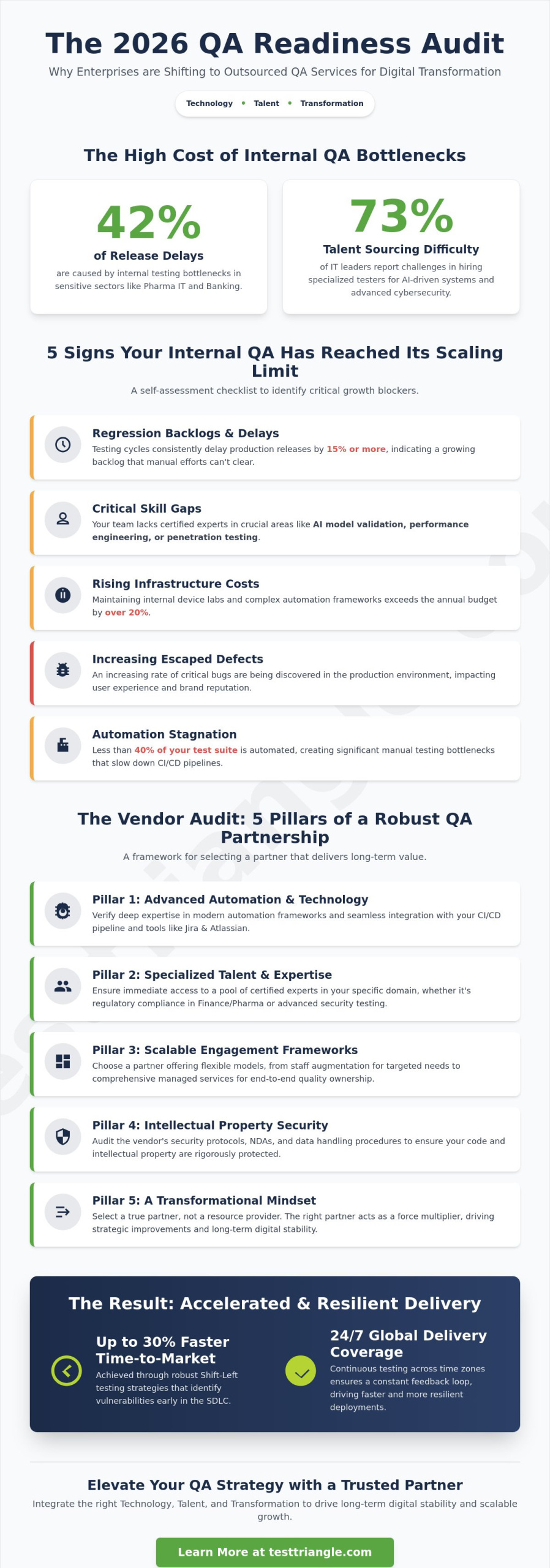

According to the 2023 World Quality Report, 53% of organizations identify a lack of skilled automation engineers as the primary barrier to achieving a robust quality framework. You’ve likely seen release cycles stall as manual regression suites struggle to keep pace with daily deployment demands. It’s frustrating when fragile scripts create high maintenance overhead, turning what should be an efficiency tool into a significant drain on your engineering resources. By leveraging professional software test automation services, you can transform these persistent technical bottlenecks into strategic assets that drive long-term operational stability.

This guide promises to show you how to accelerate release cycles and mitigate enterprise risks by integrating elite automation frameworks with specialized technical talent. We’ll examine the methodologies required to lower the cost of quality while significantly improving software reliability and security. You’ll gain a clear roadmap for scaling your digital infrastructure through the disciplined application of Technology, Talent, and Transformation.

Key Takeaways

  • Understand why manual-only testing is no longer sustainable for modern enterprise agility and how to leverage software test automation services to achieve continuous delivery.
  • Learn to prioritize a “Strategic Architect” approach over a tool-first mentality to ensure your automation framework remains maintainable and environment-agnostic.
  • Explore the 2026 technological landscape to discover how Agentic AI and self-healing locators are revolutionizing the efficiency of modern quality assurance cycles.
  • Identify high-impact automation wins by conducting a comprehensive QA maturity assessment as a foundational step in your digital transformation roadmap.
  • Discover how integrating elite talent with Atlassian and ServiceNow ecosystems creates the visibility needed for flawless, scalable software delivery.

The Strategic Value of Software Test Automation Services in 2026

By integrating sophisticated frameworks into the development pipeline, software test automation services enable organizations to achieve continuous delivery without sacrificing precision. In the current enterprise environment, manual testing alone is no longer a sustainable model for agility. Industry data from 2025 indicates that organizations relying solely on manual processes experience a 60% slower release cadence compared to those utilizing automated workflows. As a Trusted Partner, Test Triangle views automation not as a luxury, but as a catalyst for digital transformation. We help businesses shift from viewing testing as a final, isolated phase to treating quality as a constant, integrated thread throughout the entire Software Development Life Cycle (SDLC).

The financial justification for this transition is rooted in the Cost of Quality (CoQ). While manual efforts scale linearly with product complexity, automated suites offer a non-linear return on investment by absorbing repetitive tasks. Research suggests that fixing a defect during the production phase costs 100 times more than identifying it during the initial design or coding stages. By implementing software test automation services, enterprises can reduce their long-term CoQ by an estimated 35% within the first 24 months of deployment. This strategic architecting of the QA process ensures that Technology. Talent. Transformation. work in unison to drive scalable growth.

Beyond Speed: The Business Case for Automation

Accelerating time-to-market is the most visible benefit of automation, yet its impact on structural integrity is equally vital. By deploying robust regression suites, teams eliminate human error in high-volume, repetitive tasks that often lead to burnout and oversight. Test automation provides the foundational structure needed to empower developers with rapid feedback loops. This “shift-left” approach allows engineers to identify and rectify logic flaws within minutes of code submission. By leveraging these rapid cycles, enterprises drive higher parallelization and reduce feedback latency from hours to seconds, ensuring that every release meets rigorous global standards.

Mitigating Risks in a Digital-First Economy

In an era where a single hour of downtime can cost a Tier 1 enterprise upwards of $300,000, protecting brand reputation is a primary business objective. Automated vulnerability scanning and compliance checks ensure that security is woven into the code rather than treated as an afterthought. Test Triangle utilizes flexible engagement models to help clients navigate these complexities in sectors like Banking and Life Sciences, where precision is mandatory. Test automation serves as a strategic risk-mitigation layer that identifies vulnerabilities and logic flaws before they impact the end-user experience. By combining technical expertise with adaptable delivery models, we ensure that your digital infrastructure remains resilient against evolving market demands.

Designing a Robust Automation Framework: Technology Meets Talent

Success in software test automation services isn’t about buying a software license; it’s about architectural integrity. Adopting a tool-first mentality often leads to “shelfware,” where expensive platforms sit idle because they lack a strategic foundation. By prioritizing a “Strategic Architect” approach, Test Triangle ensures that frameworks are environment-agnostic and modular. This method prevents the accumulation of technical debt, which can consume up to 40% of a development budget according to 2023 industry benchmarks. A well-designed framework allows for seamless execution across development, staging, and production environments without requiring script modifications for every new release.

The Technology: Selecting the Right Stack

Choosing between open-source tools like Playwright and commercial suites requires a rigorous evaluation of your digital ecosystem. While Selenium remains a staple for many, 2024 trends show a 30% increase in Playwright adoption due to its native auto-waiting features and faster execution speeds. Your stack must support cross-browser execution and real-device testing, especially for mobile applications where fragmented OS versions can cause 15% higher failure rates on emulators than on physical hardware. Integrating these tools with cloud environments like AWS Device Farm or Azure DevTest Labs allows for massive parallel execution, reducing regression cycles from days to mere hours. This technological precision ensures that software test automation services deliver a measurable return on investment through accelerated feedback loops.

The Talent: The Human Factor in Automation

Technology alone cannot solve complex quality challenges. Skilled engineers are the backbone of an effective test automation strategy, as they possess the foresight to build “auto-healing” scripts that adapt to minor UI changes. Without this expertise, teams often face “automation debt,” where maintaining old scripts takes more time than performing manual testing. Leveraging hybrid delivery models, including on-site leadership and offshore execution, provides the 24/7 coverage required for global enterprises. Test Triangle acts as a Trusted Partner, bridging the gap between manual testers and automation experts through our signature triad: Technology. Talent. Transformation. Structured upskilling programs ensure that manual QA professionals can transition into automation roles, retaining deep domain knowledge while gaining technical proficiency.

A robust framework must live within the heart of the CI/CD pipeline rather than existing as an isolated silo. By automating trigger-based execution in Jira Service Management or Jenkins, organizations accelerate their release velocity without sacrificing stability. Statistics from the 2023 State of DevOps Report indicate that high-performing teams with integrated automation achieve 208 times more frequent code deployments. This seamless integration ensures that quality is a continuous process, allowing your business to pivot quickly in a competitive market while maintaining a flawless user experience.

Software Test Automation Services: A Strategic Guide to Scalable Quality

By integrating sophisticated software test automation services into the SDLC, organizations accelerate release cycles while maintaining architectural integrity. The current market divides between traditional code-centric frameworks like Playwright and the 40% growth in low-code solutions recorded in late 2024. While code-driven scripts offer granular control for complex logic, low-code platforms empower non-technical stakeholders to contribute to quality assurance. Looking toward 2026, the industry anticipates a shift toward Agentic AI. These systems won’t just follow scripts; they’ll autonomously adapt to UI changes via self-healing locators, which can reduce manual script maintenance by up to 70%.

AI-Enhanced Testing: Hype vs. Reality

By leveraging predictive test design, AI-driven tools identify high-risk areas before code reaches production. Generative AI now produces 90% of synthetic test data for banking and life sciences sectors, ensuring privacy compliance. However, human oversight remains critical. Without expert validation, AI hallucinations lead to false positives that disrupt the CI/CD pipeline. Our approach ensures that AI serves as a force multiplier for talent, not a replacement for strategic intuition.

Flexible Engagement Models for Global Enterprises

Enterprise leaders must choose between managed QA services and staff augmentation based on their long-term roadmap. Managed services provide SLA-backed results, shifting the burden of delivery to a trusted partner. Conversely, staff augmentation allows for 24-hour scaling during peak development cycles. Fixed-price projects suit defined technology roadmaps, while time-and-materials models offer the agility required for evolving digital transformations. By aligning these models with tools like Jira Service Management, we ensure transparency across every sprint.

Aligning your automation strategy with specific business objectives requires a disciplined evaluation of your current maturity level. We’ve observed that 65% of automation initiatives fail when they lack a clear connection to business KPIs like “Time to Market” or “Cost per Defect.” By mapping software test automation services to core revenue-generating features, Test Triangle helps enterprises achieve a 25% improvement in operational stability. We focus on three pillars to drive this success:

  • Strategic Selection: Choosing tools that integrate with Atlassian and ServiceNow ecosystems.
  • Risk Mitigation: Implementing self-healing scripts to prevent pipeline bottlenecks.
  • Scalable Growth: Utilizing flexible engagement models to adapt to market shifts.

By combining technical expertise with adaptable delivery models, Test Triangle helps businesses reduce costs and elevate their digital presence. Our commitment to Technology. Talent. Transformation. ensures that your quality engineering efforts translate into long-term competitive advantages. We act as a steady hand, guiding your organization through the complexities of modern software delivery.

Implementing Automation: A Roadmap to Digital Transformation

Transitioning to an automated environment requires more than just tool selection; it demands a fundamental shift in quality culture. Before deploying software test automation services, we conduct a comprehensive QA maturity assessment to evaluate existing workflows. This diagnostic phase identifies systemic bottlenecks, often revealing that manual regression cycles consume 70% of a QA team’s capacity. By targeting “low-hanging fruit,” such as stable, high-volume smoke tests, businesses realize immediate efficiency gains. Success is measured through rigorous KPIs. We track test coverage targets of 80% or higher, maintain pass rates above 95%, and aim for a 50% reduction in execution time during the initial 120 days.

Scaling these frameworks across multiple product lines requires a modular architecture. By centralizing core libraries and decentralized execution, enterprises ensure consistency while allowing individual business units to adapt to unique sprint cycles. This strategic approach transforms testing from a late-stage hurdle into a continuous, value-driven process. Organizations that adopt this scalable model typically see a 30% increase in release frequency within the first year of implementation.

The Step-by-Step Implementation Process

Phase 1 focuses on environment stabilization and framework architecture design. We establish robust containers and select language-agnostic tools to ensure long-term viability. During Phase 2, the team scripts core regression tests and integrates them into CI/CD pipelines, enabling “shift-left” defect detection. Phase 3 drives continuous optimization, expanding the scope to include non-functional testing like performance and security. This phased methodology ensures that software test automation services deliver scalable results without disrupting ongoing development cycles.

Specialized Requirements: Pharma and Finance

In highly regulated sectors, automation must satisfy strict compliance mandates. For life sciences, we navigate GxP and Computer System Validation (CSV) requirements by maintaining 21 CFR Part 11 compliant logs. Banking and high-frequency trading platforms require automated testing that handles millisecond-level latency and complex transactional logic. We implement comprehensive audit trails and automated documentation to ensure every test run is ready for regulatory scrutiny. This precision mitigates risk while accelerating the delivery of critical financial and healthcare applications.

Ready to modernize your quality assurance strategy? Connect with a Strategic Architect to begin your transformation.

Elevating Quality with Test Triangle: Your Strategic Partner

By integrating advanced technical frameworks with elite engineering teams, Test Triangle delivers a holistic approach to quality engineering. Our methodology rests on a unique triad: Technology, Talent, and Transformation. This framework ensures that software test automation services are not just a technical checkbox but a primary driver of long-term business value. With a robust presence in Dublin, London, and major global tech hubs, we’ve supported over 250 enterprises in achieving 99.9% system reliability through rigorous automated protocols. Our flexible delivery models allow organizations to scale resources based on fluctuating project demands, which ensures operational stability while reducing the total cost of quality.

As a Strategic Architect in the QA space, we recognize that technical execution must align with business outcomes. By leveraging our deep expertise in both Atlassian and ServiceNow ecosystems, we provide stakeholders with a single source of truth for their digital health. Our consultants don’t just write scripts; they transform the way your organization perceives quality. We focus on mitigating risks early in the lifecycle, which prevents expensive post-release failures and protects your brand reputation in highly competitive markets like Banking and Life Sciences.

Atlassian Integration: Making Quality Visible

By linking automated test results directly to Jira Service Management, we eliminate the silos that traditionally separate development and operations. This integration optimizes the entire Atlassian stack, fostering a culture of seamless QA-Dev collaboration where defects are identified 40% faster than in manual environments. We design and implement custom dashboards that translate complex technical metrics into high-level business insights. These visualizations provide C-suite executives with real-time visibility into software health, allowing for data-driven decisions regarding release readiness and infrastructure security. It’s about turning hidden data into actionable intelligence that drives the bottom line.

Your Next Steps Toward Flawless Execution

Achieving a robust testing environment begins with a clear understanding of your current technical debt and pipeline efficiency. You can request a strategic QA audit from our expert consultants to identify critical bottlenecks and modernization opportunities in your existing stack. Partnering with an Enterprise Ireland supported firm means you gain access to a partner that meets rigorous international standards for innovation and service delivery. This institutional maturity allows us to handle complex, large-scale migrations and automation projects with precision. Contact Test Triangle to accelerate your digital transformation and discover how our specialized software test automation services can secure your company’s digital future.

Driving Digital Transformation: The Path to Flawless Execution

By 2026, the demand for resilient software architectures will require more than just basic scripts. It’ll demand a sophisticated fusion of AI-driven tools and high-level human expertise to maintain a competitive edge. Leveraging professional software test automation services isn’t just a technical choice; it’s a strategic move to ensure your digital infrastructure remains robust under the pressure of global scale. By combining technical rigor with flexible engagement models, organizations can accelerate their release cycles while mitigating the risks inherent in complex digital ecosystems. A comprehensive quality strategy also demands attention to platform-specific failures, which is why pairing automation with dedicated compatibility testing services is essential for achieving true enterprise digital assurance in 2026.

As an Enterprise Ireland client and an Atlassian Gold Solution Partner, Test Triangle brings institutional maturity to every project. Our global delivery centers in Dublin, London, and Hyderabad ensure we provide the “Technology. Talent. Transformation.” needed to support specialized sectors like banking and life sciences. We’re ready to act as your Strategic Architect, building the scalable frameworks your business deserves. Partner with Test Triangle for Strategic Test Automation to elevate your quality standards and drive sustainable growth. Your journey toward a flawless digital future is well within reach.

Frequently Asked Questions

What are the primary benefits of software test automation services?

Software test automation services provide a 70% increase in test execution speed compared to traditional manual processes. By leveraging robust frameworks, organizations can achieve 90% regression test coverage, ensuring that new code deployments don’t compromise existing functionality. This strategic approach allows your team to focus on high-value exploratory testing while maintaining a flawless user experience across all digital touchpoints.

How much does it cost to implement an automated testing framework?

The cost to implement an automated testing framework varies based on the three main pillars of technology, talent, and transformation. According to the 2023 World Quality Report, organizations typically allocate 25% of their total IT budget to quality assurance and testing activities. Initial investments cover license fees for tools like Atlassian Jira and the engineering hours required to build a scalable, maintainable architecture.

Can legacy applications be integrated into a modern automation suite?

Legacy applications can be integrated into modern suites by utilizing custom wrappers and API-driven interfaces. By mapping legacy workflows to contemporary automation tools, we bridge the gap between technical debt and digital transformation. This process often involves using middleware or service virtualization to ensure that 20-year-old mainframe systems communicate effectively with cloud-native environments, preserving institutional knowledge while accelerating delivery cycles.

What is the difference between manual testing and automated testing?

Manual testing focuses on human-centric elements like UX and exploratory edge cases, while automated testing executes repetitive, high-volume scripts with 100% precision. While manual efforts are essential for initial feature validation, software test automation services are required to handle the 1,000+ regression tests common in modern CI/CD pipelines. This balance ensures that your software remains robust under the pressure of rapid, daily releases.

How does AI improve the efficiency of test automation services?

AI improves efficiency by enabling self-healing scripts that automatically adjust to UI changes, reducing maintenance effort by 40%. By leveraging machine learning algorithms, our systems can predict high-risk areas in the codebase based on historical defect data. This proactive approach elevates the testing process from a reactive bottleneck to a strategic asset that anticipates failures before they reach the production environment.

What industries benefit most from specialized QA automation?

Banking and Life Sciences benefit most due to the 100% compliance requirements and rigorous regulatory standards they must meet. In the financial sector, where a single minute of downtime can cost 5,600 dollars according to Gartner, automated suites provide the necessary security and stability. These industries leverage our flexible engagement models to ensure their complex infrastructures remain compliant with global data protection laws.

How do you measure the ROI of test automation services?

You measure ROI by calculating the reduction in defect leakage and the total hours saved during the regression cycle. A successful implementation typically sees a 50% reduction in post-release bugs within the first 12 months. By tracking these metrics within Jira Service Management, we provide stakeholders with a clear view of how automated testing reduces the total cost of ownership while accelerating the path to digital maturity.

Why should I outsource my test automation to a specialized firm?

Outsourcing to a specialized firm provides immediate access to the “Technology. Talent. Transformation.” triad without the 6-month lead time required to hire in-house experts. As a Trusted Partner, we bring battle-tested frameworks and deep expertise in tools like ServiceNow and Atlassian. This strategic alignment allows your internal teams to focus on core business logic while we ensure your underlying digital infrastructure remains flawlessly scalable.

Paul Guy

Article by

Paul Guy

Paul serves as the Marketing Director at Test Triangle, where he leads a global team in driving growth through strategic B2B marketing and brand communications. With a strong emphasis on measurable outcomes and sustainable performance, he plays a pivotal role in aligning marketing functions to enhance customer engagement and accelerate business impact. Under his leadership, marketing initiatives have consistently delivered significant returns on investment, elevated brand visibility, and strengthened the company's presence across key markets.


With 99% of organizations reporting API security incidents in the past year, the bridge between technical connectivity and business stability has never been more fragile. You’ve likely felt the strain of fragmented system integrations causing unexpected downtime; perhaps you’ve even struggled to scale manual testing for complex microservices that demand constant updates. By leveraging professional api testing services, enterprises can finally bridge this gap between rapid deployment and absolute reliability. We understand that maintaining a seamless third-party ecosystem while mitigating risks like Broken Object Level Authorization (BOLA) is a daunting challenge for any IT leader.

This guide explores how a strategic approach to API quality ensures zero-defect data migrations and accelerates your CI/CD pipelines through advanced automation. By combining technical expertise with adaptable delivery models, Test Triangle helps businesses eliminate the 55 minutes of weekly productivity lost to API failures. We’ll examine the latest 2026 standards, including NIST SP 800-228-upd1 and the integration of Java 21 for modern frameworks, to provide a roadmap for your digital transformation journey.

Key Takeaways

  • Learn why validating logic at the message layer provides a more robust and faster feedback loop than traditional UI-based testing methods.
  • Discover how professional api testing services leverage service virtualization and schema mapping to ensure scalable, risk-free environment configurations.
  • Identify strategies to mitigate injection attacks and unauthorized access by aligning your security protocols with the OWASP API Security Top 10.
  • Understand the methodology for integrating continuous quality assurance within Jira and ServiceNow environments to accelerate your DevOps release cycles.
  • Explore how the “Technology. Talent. Transformation.” framework empowers enterprises to navigate complex digital migrations with precision and stability.

The Strategic Role of API Testing Services in Enterprise Architecture

In 2026, APIs have evolved into the indispensable connective tissue of global IT infrastructure, facilitating nearly all high-value data exchanges between disparate systems. Professional api testing services act as a strategic safeguard within this ecosystem, validating complex business logic, security protocols, and performance metrics at the message layer. Unlike traditional testing that focuses on the surface level, these services dive into the “headless” architecture to ensure that every request and response meets rigorous enterprise standards. By adopting a “Shift-Left” philosophy, organizations can identify critical flaws during the design and development phases rather than after deployment. This proactive approach significantly reduces the cost of software defects, which often escalate by 10x to 100x when discovered in production environments. Utilizing established API testing methodologies ensures that your technical execution aligns perfectly with long-term business stability.

Why Headless Testing Outperforms UI-Based Validation

Speed is the primary differentiator in modern QA cycles. While UI automation scripts often require several minutes to navigate through visual elements, API tests execute in mere seconds, providing near-instantaneous feedback to development teams. This efficiency is paired with superior stability; API contracts and schemas remain consistent even when user interfaces undergo frequent aesthetic updates. To bridge the gap between legacy UI testing and modern headless requirements, many enterprises leverage managed outsourcing services to access specialized talent that can build and maintain these high-speed automation suites.

Business Continuity and the Cost of API Failure

Broken integrations represent more than just technical glitches; they’re catastrophic events that lead to data corruption, operational paralysis, and rapid customer churn. API downtime is a direct threat to revenue-generating digital workflows. When a single endpoint fails in a microservices architecture, the ripple effect can bring down an entire enterprise platform, resulting in an average loss of 55 minutes of weekly productivity per employee. Establishing robust api testing services is no longer optional but a prerequisite for successful digital transformation services. By securing the data exchange layer, Test Triangle helps organizations maintain the “flawless” operational continuity required to thrive in a hyper-connected economy.

Core Methodologies: Implementing a Scalable API Testing Strategy

Establishing a scalable framework for api testing services requires a methodical transition from mapping endpoints to continuous monitoring. By analyzing requirements first, architects define the expected data schemas and request-response pairs that drive the entire integration. Following this, environment configuration utilizes service virtualization to simulate external dependencies, which avoids the risks associated with using live production data. Aligning these environments with NIST security strategies ensures that the testing infrastructure itself remains resilient against modern threats. Once the environment is stable, engineers design test suites that cover functional paths, negative scenarios, and complex edge cases. These tests are then integrated into the CI/CD pipeline for automated execution, while real-time dashboards provide the quality insights necessary for informed decision-making.

Functional vs. Non-Functional API Testing

Validating the accuracy of status codes and payload structures constitutes the core of functional testing. This ensures that the business logic remains sound across every transaction. Conversely, non-functional testing assesses how the system behaves under extreme stress or high load, maintaining availability when traffic spikes. Complementing your API quality strategy with dedicated performance testing services ensures that your infrastructure can sustain enterprise-grade scalability under real-world conditions. Maintaining data integrity during these backend shifts is critical, as detailed in our guide on data migration testing. If you’re looking to refine your current QA framework, our team can help you evaluate your technical architecture to ensure long-term stability.

The Rise of AI-Augmented API Automation

The integration of artificial intelligence services has revolutionized how we approach scale. AI tools now analyze historical traffic patterns to predict potential failure points before they manifest in code. These systems generate synthetic test data at a scale previously impossible for manual teams to manage. While AI handles the repetitive heavy lifting, the Strategic Architect remains essential. Human expertise is still required to validate the complex logic and creative edge cases that autonomous tools might overlook. This synergy between “Talent” and “Technology” ensures that your api testing services remain both efficient and deeply insightful, providing a superior level of precision that pure automation cannot achieve alone.

API Testing Services: A Strategic Guide to Enterprise Connectivity and Quality in 2026

Security and Compliance: Mitigating Risks in Regulated Industries

By treating security as a foundational architectural layer rather than a post-development afterthought, enterprises can effectively neutralize the threat of unauthorized data access and injection attacks. In an era where over 90% of web-based attacks target APIs, professional api testing services provide the rigorous validation necessary to protect sensitive corporate assets. Adhering to the OWASP API Security Top 10 ensures that your defense strategy addresses critical vulnerabilities like Broken Object Level Authorization (BOLA) and Broken Authentication. By implementing automated test case generation for RESTful architectures, Test Triangle empowers organizations to conduct deep, white-box probing that uncovers hidden logic flaws before they can be exploited. This methodical approach transforms security from a reactive burden into a strategic advantage, ensuring that every endpoint remains resilient against the sophisticated threats of 2026.

Validation of encryption and authentication protocols, including OAuth and JWT, must occur at every individual endpoint to prevent cascading failures. In highly regulated sectors such as Finance, new standards like PSD3 and eIDAS have raised the baseline for Strong Customer Authentication (SCA). By integrating these compliance requirements directly into the testing lifecycle, we help global enterprises avoid the catastrophic costs associated with data breaches. Strategic architects prioritize the validation of these protocols to ensure that data exchange remains both secure and efficient across multi-cloud environments. This level of precision is what differentiates a “Trusted Partner” from a standard vendor, providing the institutional maturity required to manage complex digital infrastructures.

API Security Testing for Global Compliance

Navigating the intricate requirements of GDPR, HIPAA, and GxP requires a sophisticated blend of technical rigor and industry-specific knowledge. Our specialized Pharma IT staffing solutions provide the domain expertise needed to maintain rigorous audit trails and compliant testing environments. In 2026, an insecure API is a legal liability, not just a technical bug. By leveraging talent that understands the nuances of life sciences and banking, we ensure that your api testing services meet the highest global standards for regulatory adherence.

Data Integrity and Privacy Validation

Protecting Personally Identifiable Information (PII) is a paramount concern as data flows through increasingly complex microservices. We validate that PII is never exposed in API responses by enforcing strict data masking and anonymization protocols at the message layer. Validating end-to-end encryption within multi-cloud architectures ensures that data remains protected during transit and at rest. This focus on “flawless” data integrity helps organizations maintain customer trust while mitigating the risk of regulatory fines and reputational damage.

Integrating API Quality into the DevOps Pipeline

By embedding continuous quality assurance directly into the DevOps pipeline, enterprises transform their api testing services from a bottleneck into a catalyst for speed. Moving away from periodic, end-of-cycle validation allows teams to operate within a unified ecosystem where Jira and ServiceNow serve as the primary conduits for quality data. When developers receive instant feedback on their code commits, the entire release cycle accelerates, reducing the average enterprise’s weekly productivity loss of 55 minutes caused by API failures. Leveraging a strategic Atlassian implementation ensures that every API defect is tracked alongside development tasks, creating a transparent workflow that prioritizes resolution before code reaches production.

The role of mock services and service virtualization cannot be overstated in parallel development workflows. These technologies allow front-end teams to build against stable API definitions while back-end services are still under construction, effectively eliminating the “waiting for deployment” phase. This synchronization ensures that integration issues are caught in the design phase, long before they can impact the end-user experience or business continuity.

Continuous Integration and the API Feedback Loop

Automating regression suites to run with every code commit is the only way to maintain stability in a microservices architecture. This approach identifies contract breaks immediately, preventing the accumulation of technical debt that often consumes 60-80% of testing time in maintenance alone. Whether your stack utilizes Postman 12.9.7, SoapUI, or custom frameworks, the focus remains on ensuring that “headless” validation occurs as early as possible. Identifying these flaws early reduces the cost of remediation and keeps the digital transformation journey on schedule.

Optimising Workflows with ServiceNow and Atlassian

By integrating QA results into IT service management solutions, Test Triangle provides stakeholders with a “single pane of glass” view of software quality. This visibility is essential for IT managers who need to see the direct correlation between technical health and business outcomes. Using ServiceNow to manage the API lifecycle and incident response allows organizations to automate the transition from a detected production failure to a documented resolution task. This synergy between talent and technology empowers your team to drive digital transformation without sacrificing operational stability. If you’re ready to modernize your deployment pipeline, contact our consultants today to build a custom automation strategy.

Test Triangle: Your Trusted Partner for API Transformation

By aligning advanced technological frameworks with elite human expertise, Test Triangle serves as a high-level corporate partner for global enterprises navigating the complexities of modern connectivity. We don’t just provide api testing services; we architect resilient digital foundations that withstand the pressures of a hyper-connected economy. Our approach leverages the robust ecosystems of AWS, Atlassian, and ServiceNow to ensure that your connectivity is both scalable and secure. By combining this technical rigor with an adaptable delivery model, we help businesses optimize their workflows and reduce the operational costs associated with integration failures. This synergy allows us to move beyond simple bug-finding, driving strategic architectural improvements that empower long-term stability and growth through our core philosophy: Technology. Talent. Transformation.

Finding the right expertise to manage complex microservices is often the primary hurdle for modern IT leaders in 2026. We bridge this talent gap by providing access to a global pool of specialized QA engineers and pharma-compliant experts who understand the nuances of regulated sectors. Whether you require a fully managed service or targeted staffing solutions for a specific project, our flexible engagement models adapt to your unique operational requirements. This versatility ensures that you have the right talent in place to navigate the 60-80% of API testing time typically lost to manual maintenance. Our talent isn’t just skilled in code; they’re experts in the industry-leading platforms that drive your business forward.

The Strategic Architect Persona

The personality of Test Triangle is that of a Strategic Architect, a steady hand in a fast-changing technological landscape. We maintain a proven track record across Banking, Healthcare, and Retail, where precision isn’t just a goal but a baseline requirement for survival. Our commitment to mitigating risks through disciplined execution allows your team to focus on core innovation while we manage the intricate details of your digital transformation. We’ve assisted global enterprises in achieving zero-defect data migrations by applying a rigorous, methodical approach to every endpoint and integration layer, ensuring that your api testing services translate into tangible business value.

Get Started with a Comprehensive API Audit

Elevating your quality standards begins with a clear, objective understanding of your current maturity level. Our tailored consulting services identify immediate security and performance gaps that could threaten your revenue-generating workflows or lead to regulatory non-compliance. By conducting a comprehensive API audit, we provide the strategic roadmap necessary for a flawless digital journey. We’ll help you evaluate your technical architecture against the latest 2026 standards, ensuring your systems are robust, secure, and future-ready. Contact our experts today to elevate your API quality standards.

Secure Your Digital Future Through Strategic API Excellence

The evolution of enterprise architecture in 2026 demands more than just basic connectivity; it requires a flawless integration layer that can withstand the rigors of global data exchange. By prioritizing a “Shift-Left” approach and integrating security protocols like the OWASP API Security Top 10, organizations can neutralize risks before they escalate into costly production failures. Professional api testing services provide the strategic bridge needed to align technical execution with long-term business stability. Whether you’re navigating the complexities of PSD3 in finance or GxP requirements in life sciences, having a steady hand to guide your digital transformation is essential for maintaining a competitive edge.

Test Triangle stands as your Trusted Partner for Global Enterprises, offering specialized expertise in Pharma and Financial IT compliance to ensure your infrastructure remains robust and secure. By leveraging our core philosophy of Technology. Talent. Transformation., we help you accelerate release cycles and optimize your DevOps pipeline within Jira and ServiceNow environments. It’s time to move beyond reactive bug-fixing and embrace a visionary approach to quality that drives scalable growth. Partner with Test Triangle to secure and optimise your API infrastructure. Contact us today. We look forward to helping you achieve operational perfection.

Frequently Asked Questions

What are the main benefits of outsourcing API testing services?

Outsourcing allows enterprises to leverage specialized talent and flexible engagement models to scale their quality assurance efforts without the overhead of internal hiring. By partnering with a Strategic Architect, businesses gain access to established frameworks that reduce the 60-80% of time typically spent on test maintenance. This approach ensures that your digital transformation remains on schedule while mitigating the risks associated with internal skill gaps.

How does API testing differ from unit testing and integration testing?

API testing validates the logic, security, and performance at the message layer, whereas unit testing focuses on isolated code snippets and integration testing examines the interaction between multiple modules. By targeting the “headless” layer, api testing services identify defects that unit tests might miss due to their narrow scope. This strategic focus ensures that the connective tissue of your enterprise architecture remains robust under real-world conditions.

Can API testing be fully automated in a DevOps environment?

Full automation is achievable by integrating regression suites directly into the CI/CD pipeline using tools like Jira and ServiceNow. Automating these workflows provides instant feedback to developers with every code commit; this effectively eliminates manual bottlenecks in the release cycle. By combining technical expertise with adaptable delivery models, Test Triangle helps organizations achieve a “single pane of glass” view of quality through automated end-to-end workflows.

What tools are most commonly used for enterprise API testing in 2026?

Enterprise teams in 2026 primarily utilize Postman 12.9.7 for collaboration and Karate v2 for its Java 21+ compatibility and BDD capabilities. Other essential tools include REST Assured 5.5.7 and AI-native platforms that autonomously generate synthetic test data at scale. Integrating these tools within an Atlassian ecosystem ensures that technical execution remains aligned with global industry standards and enterprise-grade security requirements.

How much does it cost to implement professional API testing services?

While total project costs vary based on complexity, industry data from March 2026 indicates that API security protection typically ranges between $200 and $600 per API monthly. A dedicated API penetration testing assessment generally costs between $3,000 and $10,000 per engagement. Investing in professional api testing services helps avoid the catastrophic financial impact of data breaches, which affected 57% of organizations in the last two years.

Is API testing necessary if we already have comprehensive manual testing?

Manual testing is insufficient for modern microservices architectures because it cannot validate the thousands of request-response pairs generated by complex integrations. API testing provides a level of precision and speed that manual efforts simply can’t match, particularly when identifying Broken Object Level Authorization (BOLA) risks. Shifting to an automated API strategy allows your team to focus on high-level architectural improvements rather than repetitive, error-prone manual checks.

How does API testing impact the speed of software delivery?

API testing significantly accelerates software delivery by providing a faster feedback loop than traditional UI-based validation. Since API tests execute in seconds rather than minutes, they allow for more frequent deployments without sacrificing stability or security. This efficiency is a core component of “Transformation” through “Technology,” helping enterprises stay ahead in a fast-changing technological landscape by reducing time-to-market for new features.

What are the most common security vulnerabilities found during API testing?

The most common vulnerabilities identified during testing align with the OWASP API Security Top 10 (2023 Revision), which remains the active standard in 2026. These include Broken Object Level Authorization (BOLA), Broken Authentication, and Broken Object Property Level Authorization. Validating these risks at every endpoint ensures that PII remains protected and that your organization adheres to global regulations like PSD3 and GDPR.

Paul Guy

Article by

Paul Guy

Paul serves as the Marketing Director at Test Triangle, where he leads a global team in driving growth through strategic B2B marketing and brand communications. With a strong emphasis on measurable outcomes and sustainable performance, he plays a pivotal role in aligning marketing functions to enhance customer engagement and accelerate business impact. Under his leadership, marketing initiatives have consistently delivered significant returns on investment, elevated brand visibility, and strengthened the company's presence across key markets.
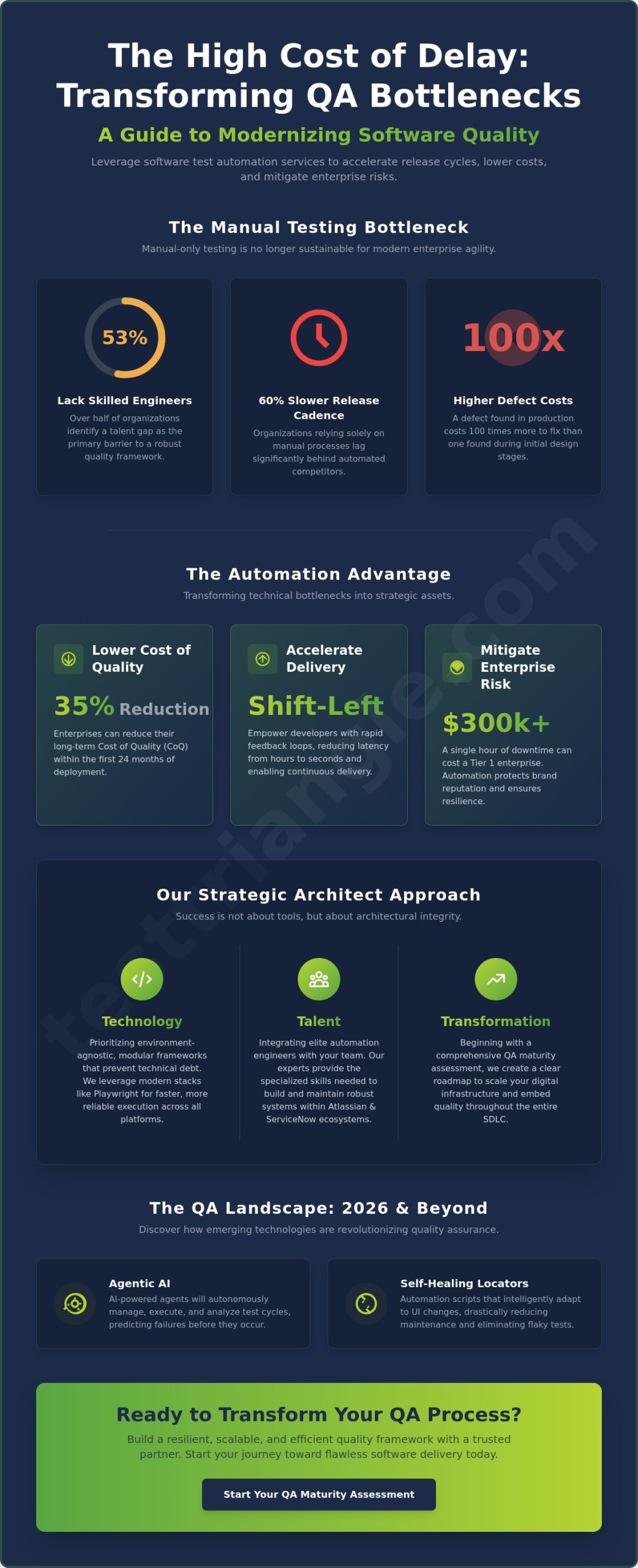

If your QA strategy still treats bug detection as a final gate rather than a continuous value driver, you’re already behind the 2026 curve. With the FDA’s final Quality Management System Regulation (QMSR) taking full effect on February 2, 2026, the margin for error in software assurance has vanished. Selecting a qa software testing company is no longer about finding a vendor; it’s about securing a strategic architect for your digital ecosystem.

You’ve likely felt the sting of reputational damage from high post-release defect rates or the frustration of QA silos that stall your DevOps pipelines. It’s exhausting when your testing team can’t scale fast enough to meet major release deadlines. This guide empowers you to master the evaluation process for a high-tier partner that aligns technology, talent, and transformation to achieve a truly flawless delivery cycle. By prioritizing a risk-based approach to software assurance, we’ll provide a strategic checklist to help you reduce the cost of quality through automation while ensuring your new partner integrates seamlessly with your existing Jira and Atlassian workflows.

Key Takeaways

  • Transition from reactive testing to proactive Quality Engineering to safeguard your digital infrastructure against the escalating global costs of software failure.
  • Utilize our 10-point evaluation checklist to select a qa software testing company that offers the specialized domain expertise necessary for complex enterprise environments.
  • Integrate advanced AI-driven defect analysis and robust DevOps consulting into your toolchain to optimize performance and shorten time-to-market.
  • Match your organizational needs with flexible delivery models, including specialized pharma IT staffing and managed services, for scalable 24/7 testing coverage.
  • Align your digital transformation goals with a partner that leverages Atlassian and ServiceNow expertise to ensure a flawless, secure, and robust software delivery lifecycle.

Defining the Strategic Role of a QA Software Testing Company in 2026

Software failure is no longer just a technical glitch; it’s a multi-trillion dollar liability. By 2026, the global cost of poor software quality is projected to exceed $2.5 trillion, driven by complex legacy systems and the rapid acceleration of AI-integrated applications. To survive this environment, your qa software testing company must transition from a reactive vendor to a “Strategic Architect.” This model doesn’t just look for bugs after the code is written. Instead, it aligns Technology, Talent, and Transformation to secure your entire digital ecosystem from the ground up.

As enterprises prioritize AWS cloud migration and large-scale digital transformation, the risk of operational downtime increases. A high-tier partner mitigates this risk by acting as a steady hand, ensuring that new infrastructures aren’t just functional but resilient. While foundational software testing focuses on verifying code against requirements, the 2026 landscape demands a partner that anticipates architectural weaknesses before they manifest as customer-facing failures.

Quality Engineering vs. Traditional Software Testing

Traditional testing often acts as a bottleneck, occurring at the end of the development cycle where fixes are most expensive. In contrast, Quality Engineering (QE) adopts a “Shift-Left” philosophy, integrating validation protocols into the earliest stages of the software development lifecycle. This proactive approach ensures that quality is built into the product rather than inspected at the end. By leveraging automated pipelines and predictive analytics, QE allows teams to identify high-risk areas during the design phase, significantly accelerating release cycles.

Quality Engineering is a holistic discipline of continuous improvement that embeds quality standards into every phase of the development lifecycle.

The Business Impact of Flawless Software Delivery

Flawless delivery is the cornerstone of brand reputation. In an era where 88% of users won’t return to a site after a single bad experience, the stakes for your digital interfaces are absolute. Robust testing doesn’t just catch errors; it reduces long-term maintenance costs and prevents the accumulation of technical debt that stifles innovation. When your QA partner integrates seamlessly with your IT Service Management Solutions, they create a feedback loop that improves not just the software, but the entire delivery toolchain.

By combining technical expertise with adaptable delivery models, a strategic qa software testing company empowers your business to scale without compromising stability. You aren’t just buying a service; you’re investing in a “Trusted Partner” dedicated to your long-term operational excellence. This alignment ensures that every release strengthens your market position rather than creating a reputational liability.

The Enterprise QA Evaluation Checklist: 10 Critical Selection Criteria

Selecting a qa software testing company requires more than a cursory glance at a service list. For decision-makers comparing multiple vendors, a structured checklist is essential to distinguish between superficial technical skills and deep domain expertise. While many firms can write a script, few understand the nuances of System Integration Testing (SIT) within complex enterprise architectures. You need a partner that balances human intuition with AI-driven efficiency, ensuring machine learning optimizes your test suites without losing the critical eye of a seasoned engineer.

Industry experts often emphasize how to find a good company for independent software QA testing services by focusing on transparency and work ethic. This transparency is vital when evaluating how a partner manages the balance between manual rigor and automated speed. Your evaluation should prioritize these ten critical pillars: deep domain knowledge, toolchain mastery, SIT capabilities, Atlassian integration, AI-driven automation, ISO compliance, CMMI maturity, security testing, performance benchmarking, and communication transparency.

Technical Proficiency and Toolchain Expertise

Mastery in automation frameworks like Selenium, Playwright, and Cypress is a baseline requirement. However, true value lies in how these tools integrate with your existing reporting structures. A superior qa software testing company should demonstrate deep proficiency in Atlassian Implementation Services. This ensures every defect discovered is automatically logged, tracked, and resolved within your Jira ecosystem, creating a single source of truth for your development and QA teams.

Certifications and Compliance Standards

Process predictability is the hallmark of an institutional-grade partner. ISO 27001 and ISO 9001 certifications aren’t optional; they’re the foundation of enterprise security and quality management. For sectors like Life Sciences, verify that the vendor understands GxP compliance and validated software testing protocols. Assessing a partner’s CMMI Level maturity provides a data-backed guarantee that their delivery models are repeatable and optimized for risk mitigation.

Security and Performance Benchmarks

Security shouldn’t be an afterthought. Evaluate your partner’s approach to the OWASP Top 10 and their ability to conduct deep penetration testing. Simultaneously, ensure they can handle high-load performance benchmarks for global applications, moving beyond simple stress tests to complex user-journey simulations. For a deeper look at these evolving standards, explore our insights on Software QA Services in 2026. If you’re ready to move beyond generic testing and implement a strategic quality framework, reach out to our consulting team for a tailored evaluation.

Choosing a QA Software Testing Company in 2026: The Strategic Enterprise Checklist

Beyond Testing: Integrating DevOps, AI, and Ecosystem Stability

By integrating quality protocols directly into the CI/CD pipeline, a strategic qa software testing company ensures that speed doesn’t compromise ecosystem stability. In the 2026 landscape, a partner must act as a DevOps consultant, leveraging ServiceNow to manage incident response and AWS to maintain high availability during deployments. This integration moves beyond simple verification; it creates a robust framework where quality is a constant state rather than a final phase. By aligning these technical platforms, enterprises can achieve a seamless flow between development, testing, and operations.

Implementing a “Shift-Right” approach allows for continuous monitoring and testing in production environments, providing real-time feedback on user experience and system performance. This methodology ensures that even after a release, the digital infrastructure remains resilient under varying global loads. By utilizing telemetry data to inform future test cycles, a “Trusted Partner” helps businesses close the loop between production reality and development expectations, significantly reducing the risk of unexpected outages.

The Role of AI and Machine Learning in Modern QA

By utilizing Artificial Intelligence Services, modern QA teams can accelerate test case creation and predict vulnerabilities before they manifest in the code. AI-driven predictive defect analysis identifies high-risk modules by analyzing historical data from Jira and ServiceNow, allowing for targeted testing efforts that optimize resource allocation. This human-led, AI-driven balance ensures that machine learning handles the high-volume tasks of test data generation while senior architects focus on strategic risk mitigation and complex edge cases.

QA as a Catalyst for Digital Transformation

Moving from a traditional gatekeeper role to a digital enabler is essential for businesses undergoing rapid AWS cloud migrations. A strategic qa software testing company provides the technical rigor needed to ensure that complex data transfers and architectural shifts don’t disrupt business continuity. While Manual Testing in 2026 remains critical for human-centric validation, the overall transformation strategy must be backed by automated stability checks and proactive performance monitoring to ensure a flawless user experience across all digital touchpoints.

Flexible Engagement Models: Matching Talent to Project Complexity

By aligning talent with project complexity, a premier qa software testing company ensures that resource allocation remains as agile as the development cycle itself. Global enterprises frequently encounter seasonal peaks or project-specific surges that demand rapid scaling without the overhead of permanent hires. Utilizing remote and offshore resources provides the dual benefit of cost optimization and 24/7 testing coverage, ensuring that verification continues across every time zone. This adaptability is a cornerstone of the “Talent” pillar in our Technology, Talent, Transformation methodology, allowing businesses to leverage specialized expertise exactly when it’s needed most.

Adopting flexible engagement models allows a “Strategic Architect” to tailor delivery to the specific risk profile of a project. Whether you’re managing a legacy migration or a high-speed AWS cloud deployment, the ability to pivot between different levels of support is critical for maintaining ecosystem stability. This approach ensures that technical rigor is never sacrificed for speed, providing the steady hand needed to navigate a fast-changing technological landscape.

Managed Outsourcing vs. Staff Augmentation

Choosing between a fully managed QA department and individual staff augmentation depends on your internal management capacity and the maturity of your existing processes. By opting for Managed Outsourcing Services, you transfer the responsibility of delivery, toolchain management, and reporting to your “Trusted Partner.” This model is ideal for enterprises seeking an end-to-end solution for their quality lifecycle. Conversely, staff augmentation allows you to fill specific skill gaps within your internal team, maintaining direct control over daily workflows while injecting high-level technical expertise into your Jira and Atlassian environments. Regardless of the model, establishing rigorous communication protocols and ensuring a cultural fit is vital for the success of distributed teams.

Specialized Staffing for Regulated Industries

Regulated sectors like Pharmaceuticals and Banking require more than just technical testing; they demand an intimate understanding of GxP compliance and stringent data protection laws. Hiring for these niche roles is notoriously difficult, as only a small percentage of generalist testers possess the specialized domain knowledge required for validated software environments. A qa software testing company that maintains a dedicated staffing arm offers a significant competitive edge by providing pre-vetted experts who understand the nuances of regulatory audits. By leveraging our Staffing Solutions, you gain access to a global talent pool specifically trained for high-stakes delivery. This ensures your digital transformation remains robust while meeting the complex requirements of the FDA’s February 2, 2026, Quality Management System Regulation.

If you need to scale your quality engineering capabilities with specialized talent, schedule a consultation with our staffing experts to find the right engagement model for your next release.

Why Test Triangle is Your Trusted Partner for Flawless Digital Transformation

By integrating deep technical knowledge with recognized industry standards, Test Triangle serves as a premier qa software testing company that bridges the gap between complex code and business outcomes. Our status as an Atlassian Gold Partner and ServiceNow expert ensures that your quality assurance frameworks aren’t just isolated silos but are deeply embedded in your operational toolchain. We operate as a “Strategic Architect,” providing the steady hand needed to navigate the rapid shifts of the 2026 digital landscape. With a presence spanning Europe, North America, and Asia, we offer the global reach required to support multinational enterprises while maintaining the localized precision needed for regional compliance. This global footprint allows us to provide 24/7 testing coverage, ensuring that your release cycles never stall due to time zone constraints.

Adopting a holistic view of the software lifecycle allows us to elevate your testing from a mere checklist to a strategic advantage. By combining technical expertise with adaptable delivery models, Test Triangle helps businesses reduce costs while accelerating time-to-market. Our institutional maturity, reinforced by our pride in being a client of Enterprise Ireland, means we bring a level of discipline and precision that is rare in the tech sector. We don’t just offer services; we offer the security of knowing your complex digital infrastructures are in safe hands.

A Strategic Partnership Approach

Moving beyond the traditional vendor-client dynamic, we prioritize deep strategic alignment with your long-term business goals. By offering flexible engagement models and specialized talent, Test Triangle ensures that your digital infrastructure remains resilient as you scale. Our commitment to operational stability means we don’t just find bugs; we optimize your entire delivery lifecycle to prevent them. This partnership approach empowers your team to focus on innovation while we manage the technical rigor of risk mitigation. We understand the relief that comes with a “flawless” release, and we work tirelessly to ensure your digital transformation is a source of growth rather than a reputational risk. Consult with our QA experts today to align your quality strategy with your transformation roadmap.

Proven Excellence in Software Quality

By applying our signature “Technology. Talent. Transformation.” methodology, we’ve delivered superior results across diverse sectors including Banking, Healthcare, and Life Sciences. Our team leverages best-in-class tools like Jira Service Management and AWS to drive measurable success in every release cycle. Whether you’re navigating the complexities of Pharma IT staffing or executing a large-scale cloud migration, our disciplined and globally-minded engineers provide the expertise needed for a flawless user experience. As the February 2, 2026, deadline for the FDA’s new Quality Management System Regulation approaches, our experience in validated software testing becomes an invaluable asset for your compliance strategy. Choosing Test Triangle means securing a qa software testing company that is as invested in your success as you are, ensuring that your software delivery is always robust, secure, and strategic.

Secure Your Digital Future with Strategic Quality Engineering

Navigating the complexities of a $2.5 trillion global failure risk requires a partner that transcends basic bug hunting. By adopting a proactive Quality Engineering mindset and utilizing a rigorous 10-point evaluation checklist, your organization can transform QA from a bottleneck into a competitive accelerator. Selecting a qa software testing company that prioritizes risk-based assurance ensures your digital transformation remains robust even as regulations like the FDA’s February 2, 2026, update reshape the industry.

Success in this landscape depends on the seamless integration of Technology, Talent, and Transformation. As an Atlassian Gold Partner and ISO 27001 Certified entity, Test Triangle provides the institutional maturity needed to stabilize your digital ecosystem. We leverage best-in-class tools and flexible engagement models to protect your brand reputation and optimize the cost of quality across every release cycle.

Don’t leave your software delivery to chance. Elevate your software quality with Test Triangle; contact our Strategic Consultants today to begin your journey toward flawless delivery. Your path to a secure and scalable digital future starts with a trusted partner.

Frequently Asked Questions

What should I look for in a QA software testing company in 2026?

Prioritize a partner that operates as a “Strategic Architect” by aligning technology, talent, and transformation with your business goals. You need a qa software testing company that offers deep integration with Atlassian and ServiceNow toolchains. Ensure they utilize a risk-based assurance model to meet the February 2, 2026, FDA Quality Management System Regulation standards. This approach guarantees that your quality framework remains robust and compliant in a fast-changing landscape.

How much does it cost to outsource software testing services?

Outsourcing costs in 2026 vary based on expertise; with hourly rates typically ranging from $25 to over $200. Specialized services like security penetration testing often start at $2,000 for web assessments; while comprehensive AI model evaluations can begin at $1,500 per cycle. Large applications with complex integrations may exceed $100,000 for a full release cycle. These investments help you avoid the $150,000 annual salary costs of hiring senior in-house QA architects.

Can a QA company help with our Atlassian or ServiceNow implementation?

A high-level partner provides specialized consulting to ensure these platforms support your quality goals. As an Atlassian Gold Partner, we integrate QA reporting directly into Jira Service Management to eliminate silos in your DevOps pipeline. We also leverage ServiceNow expertise to optimize incident response and ecosystem stability. This ensures your toolchain isn’t just a repository for data but a driver of continuous improvement and digital transformation.

What is the difference between manual testing and automated testing services?

Manual testing focuses on human-centric validation and exploratory checks that automation cannot replicate. Automated testing utilizes frameworks like Selenium or Playwright to accelerate high-volume regression cycles and performance benchmarks. While automation handles the repetitive tasks to reduce the cost of quality, manual experts provide the strategic oversight needed for complex user journeys. Both disciplines are essential for achieving a flawless software delivery cycle in enterprise environments.

Is it better to hire a local QA company or an offshore partner?

Hybrid engagement models offer the most effective balance of local strategic oversight and offshore scalability. Offshore resources provide 24/7 testing coverage and cost efficiencies; while local experts ensure cultural alignment and compliance with regional data laws like GDPR. This versatility allows you to scale your testing teams quickly for major releases without compromising communication. We utilize this global footprint to support enterprises across Europe, North America, and Asia seamlessly.

How does a QA partner ensure data security and IP protection?

A professional qa software testing company maintains ISO 27001 certification to guarantee institutional-grade security protocols. We implement strict non-disclosure agreements and utilize isolated test environments with encrypted data handling to protect your intellectual property. By conducting regular internal audits and adhering to global security standards, we provide a steady hand that mitigates risk. This commitment ensures your complex digital infrastructures and proprietary code remain secure throughout the transformation process.

What industries do you specialize in for software testing?

We specialize in highly regulated sectors including Banking, Life Sciences, and Healthcare. Our dedicated Pharma IT staffing arm provides experts who understand GxP compliance and the rigorous validation required for medical device software. We ensure your projects meet the specific mandates of the ISO 13485:2016 standards that took effect in early 2026. This industry-specific knowledge allows us to deliver superior results where precision and regulatory adherence are non-negotiable.

How quickly can a QA team be onboarded for a new project?

Onboarding typically occurs within 5 to 10 business days depending on the complexity of your requirements. Our flexible staffing solutions allow us to deploy pre-vetted experts who are already proficient in Jira, ServiceNow, and modern automation frameworks. This rapid deployment ensures you can meet tight release deadlines without sacrificing technical rigor. We focus on a methodical transition that aligns our talent with your existing workflows for immediate operational impact.

Paul Guy

Article by

Paul Guy

Paul serves as the Marketing Director at Test Triangle, where he leads a global team in driving growth through strategic B2B marketing and brand communications. With a strong emphasis on measurable outcomes and sustainable performance, he plays a pivotal role in aligning marketing functions to enhance customer engagement and accelerate business impact. Under his leadership, marketing initiatives have consistently delivered significant returns on investment, elevated brand visibility, and strengthened the company's presence across key markets.


With software failures costing the global economy an estimated $2.41 trillion according to a report by CISQ, the financial risk of technical debt is a reality you likely face every day. You’ve probably felt the frustration of seeing your CI/CD pipeline stall because testing couldn’t scale alongside your complex enterprise architecture. By evolving your software qa services from a final gatekeeper into a strategic architect of resilience, you’ll protect your bottom line while maintaining a relentless pace of innovation.

We understand that balancing speed with stability feels like an impossible trade-off in today’s regulated sectors. This article reveals how modern quality engineering drives business value by integrating seamlessly with your DevOps workflows and Atlassian tools like Jira. As your Trusted Partner, we’ll show you how to leverage Technology. Talent. Transformation. to achieve a faster time-to-market without sacrificing the flawless performance your global enterprise expects.

Key Takeaways

  • By transitioning from tactical testing to strategic quality engineering, organizations can effectively mitigate the rising costs of software failure and drive long-term digital resilience.
  • Discover how modern software qa services utilize Shift-Left and Shift-Right strategies to identify logic flaws during design while maintaining real-world monitoring in production environments.
  • Learn to build resilient, self-healing automation frameworks that accelerate CI/CD pipelines and ensure flawless performance across functional and non-functional requirements.
  • Explore the benefits of integrating QA workflows directly into the Atlassian and ServiceNow ecosystems to achieve maximum transparency and seamless defect tracking.
  • Evaluate flexible engagement models, including managed services and staff augmentation, to align specialized talent with your specific enterprise scaling needs.

Defining Modern Software QA Services: Beyond the Bug Hunt

In the high-stakes environment of global enterprise software, Software Quality Assurance (SQA) has evolved into a systematic, end-to-end discipline that ensures digital products align with rigorous requirements throughout the development lifecycle. Modern software qa services represent a departure from traditional “bug hunting” by prioritizing the prevention of defects rather than their mere detection. By shifting from a tactical testing mindset to a strategic Quality Engineering approach, organizations can address the $2.41 trillion in global losses caused by poor software quality, as reported by the Consortium for Information & Quality (CISQ) in 2022. Effectively, comprehensive QA services act as a strategic insurance policy that mitigates business risk by ensuring every deployment enhances operational stability and brand integrity.

The Core Components of a QA Strategy

By aligning testing objectives with overarching business KPIs, Quality Planning ensures that every technical check serves a commercial purpose. This strategic alignment allows teams to prioritize high-value features and critical security protocols. Process Improvement follows this by refining development workflows to eliminate bottlenecks; it focuses on preventing defects before they ever enter the codebase. Finally, Continuous Feedback loops leverage data-driven insights to optimize performance in real-time. This methodical approach transforms QA from a siloed activity into a cross-functional driver of excellence, often integrated through Atlassian implementation to ensure full transparency across the SDLC.

Why QA is the Backbone of Digital Transformation

As enterprises look to scale rapidly, robust and reliable codebases become the primary engine of growth. Digital transformation fails when underlying systems are fragile; it’s why high-quality engineering is essential for sustaining momentum. By facilitating seamless user experiences across diverse platforms, modern software qa services ensure that brand promises are kept regardless of the device or environment. Early identification of architectural flaws reduces long-term maintenance costs by as much as 30% compared to fixing issues post-release. Through our managed outsourcing services, we act as your Trusted Partner to provide the steady hand needed to navigate these complexities. We believe that true resilience is built at the intersection of Technology. Talent. Transformation.

The Strategic Framework: Shift-Left and Shift-Right Testing

By implementing a dual-track testing strategy, organizations can effectively break the traditional silos that often turn quality assurance into a project bottleneck. Instead of treating testing as a final checkpoint, modern software qa services embed quality into every phase of the software development lifecycle. This comprehensive approach, often described as Shift-left and shift-right testing, ensures that technical debt doesn’t accumulate during high-velocity development cycles. By balancing early-stage validation with real-world production monitoring, enterprises achieve a state of digital resilience that supports both rapid innovation and operational stability.

Implementing Shift-Left in Agile Environments

Integrating QA engineers directly into sprint planning sessions allows for the identification of logic flaws before a single line of code is written. This proactive involvement transforms the role of quality from reactive “bug hunting” to proactive quality engineering. While automation handles repetitive regression tasks, strategic Manual Testing remains essential for validating user-centric requirements and early-stage design concepts. By adopting Test Driven Development (TDD) as a foundational practice, teams can reduce the cost of rework by as much as 50% in high-performing DevOps environments. This “Shift-Left” mindset prioritizes:

  • Requirement validation to eliminate ambiguity in the design phase.
  • Unit testing and static code analysis to catch syntax errors instantly.
  • Continuous integration loops that provide immediate feedback to developers.

The Rise of Shift-Right and Observability

Extending quality protocols into production environments through observability and real-world monitoring provides a critical safety net for unpredictable user behaviors. This “Shift-Right” strategy identifies edge case failures that are virtually impossible to replicate in isolated staging environments. By leveraging A/B testing and canary releases, teams can deploy new features to a limited subset of users, mitigating risk while collecting live performance data. This production data then flows back into the development cycle, informing future testing scenarios and ensuring that software qa services evolve alongside actual user demands. Turning live metrics into actionable insights allows your organization to maintain a flawless user experience even as complexity grows. If you’re ready to refine your testing architecture for 2026, consult with our strategic architects to design a roadmap tailored to your enterprise needs.

Software QA Services in 2026: A Strategic Guide to Quality Engineering

Specialized QA Services for Complex Enterprise Needs

By leveraging specialized software qa services, global enterprises can move beyond basic validation to achieve true technical excellence. According to the IEEE Computer Society, software quality encompasses both the degree to which a system meets its specified requirements and the robustness of the processes used to develop it. Achieving this balance requires a sophisticated mix of functional and non-functional testing. While functional checks ensure the application does what it’s supposed to, non-functional testing validates how it performs under pressure, its level of security, and its overall reliability. In complex, multi-platform architectures, the role of SIT (System Integration Testing) becomes paramount for ensuring that data flows correctly between disparate microservices and legacy systems.

Modern quality engineering also demands the implementation of resilient, self-healing automation frameworks. These frameworks are essential for high-velocity CI/CD pipelines where manual intervention would cause unacceptable delays. To protect your digital assets, security testing must be woven into these automated loops, specifically addressing OWASP Top 10 compliance to mitigate risks like broken access control and cryptographic failures. By combining these technical disciplines, we help you build a robust foundation for scalable growth.

Performance and Scalability Testing

Maintaining stability during peak traffic loads is a non-negotiable requirement for global enterprises. We utilize stress testing to identify the exact breaking points of your application, ensuring it can handle sudden surges in user activity without latency spikes. By identifying bottlenecks in cloud-native infrastructures and microservices, our software qa services optimize response times for international users. This methodical approach ensures that your platform remains accessible and performant, regardless of geographic location or concurrent user volume.

Compliance and Validated Testing for Pharma and Finance

Highly regulated sectors like Life Sciences and Banking face unique hurdles that generic testing providers often overlook. Navigating GxP, HIPAA, and GDPR requirements demands rigorous documentation and a deep understanding of data integrity standards. To meet these challenges, we provide specialized Pharma IT staffing to ensure that your QA team possesses the domain expertise required for validated environments. We automate compliance checks to ensure your systems remain audit-ready at all times, reducing the risk of regulatory penalties while accelerating your time-to-market. This commitment to precision makes us a Trusted Partner in your digital transformation journey.

Choosing the Right Engagement Model for Software QA

Selecting the optimal delivery model is a critical decision that determines the scalability and cost-efficiency of your quality engineering initiatives. Many organizations mistakenly prioritize low hourly rates, yet industry benchmarks from 2024 indicate that “cheap” testing often leads to a 40% increase in post-release defect remediation costs. By evaluating Software Testing Outsourcing through the lens of long-term business value, you ensure that your software qa services act as a catalyst for growth rather than a recurring expense. Whether you require a full-scale managed team or targeted expertise to bridge a technical gap, the right model must align with your internal culture and technological roadmap.

Managed QA Services provide a comprehensive solution where we assume end-to-end accountability for the quality function. This model is ideal for enterprises undergoing significant digital transformation, as it allows internal leadership to focus on core product strategy while we manage the execution of complex test suites. Alternatively, Staff Augmentation serves as a surgical intervention; it brings in specialized talent to address specific hurdles, such as securing a microservices architecture or accelerating a migration to AWS. For most global organizations, a Hybrid Model offers the best of both worlds. It combines your team’s deep domain knowledge with our external technical rigor to create a robust, failsafe environment. This approach ensures your software qa services remain agile and responsive to changing market demands.

When to Outsource vs. In-house

Analyzing the total cost of ownership (TCO) reveals that maintaining an internal QA department involves significant overhead, including recruitment, training, and infrastructure costs. By leveraging Managed Outsourcing Services, you gain the ability to scale your testing capacity up or down within 48 hours to meet fluctuating sprint demands. We maintain control and visibility through transparent reporting and real-time KPIs integrated directly into your existing Jira dashboards. This ensures that while the execution is external, the strategic oversight remains firmly in your hands.

The Strategic Architect Approach

Moving beyond the traditional “vendor” relationship, we position ourselves as your Trusted Partner. A Strategic Architect doesn’t just execute test scripts; they understand your industry’s unique pressures and regulatory requirements. When evaluating a qa software testing company for your enterprise, it’s essential to apply a rigorous checklist that assesses cultural alignment, technical depth, and regulatory expertise. By utilizing global delivery models, we offer 24/7 coverage that follows the sun, ensuring that your code is tested while your local teams rest. This “Technology. Talent. Transformation.” triad ensures that every engagement is characterized by cultural alignment and technical precision. Ready to optimize your quality strategy? Speak with our engagement specialists today to identify the model that fits your business objectives.

Optimizing QA with Atlassian and ServiceNow Ecosystems

By integrating software qa services directly into the industry-standard Atlassian and ServiceNow ecosystems, organizations achieve a level of transparency that siloed testing tools simply cannot provide. Utilizing Atlassian Consulting allows teams to automate defect tracking and reporting within Jira and Confluence, ensuring that every stakeholder has real-time visibility into project health. This integration eliminates the friction between development and operations, facilitating a seamless transition from quality engineering to production support. This synchronization ensures that ServiceNow implementation workflows are fully aligned with the QA lifecycle, allowing for instant incident escalation and faster time-to-resolution when issues arise in live environments.

Jira Service Management for QA Feedback

Bridging the gap between development teams and end-users is essential for maintaining high software quality in live environments. By leveraging Jira Service Management, we automate the flow of bug reports from production directly back into the testing backlog. This closed-loop system reduces resolution times by 25% or more in complex enterprise settings by providing developers with immediate, context-rich data. Integrated communication channels ensure that feedback is never lost, allowing for a more responsive and user-centric development cycle. This methodical approach ensures that your software qa services are informed by actual user behavior, driving continuous improvement and digital resilience.

The Test Triangle Advantage

Our holistic approach combines deep IT Service Management (ITSM) knowledge with specialized quality engineering expertise to deliver superior business outcomes. We provide customized solutions tailored to the unique regulatory and operational demands of the Pharma, Finance, and Retail sectors. In the pharmaceutical industry, our teams ensure that all software systems meet GxP compliance standards, while in finance, we prioritize the integrity of transactional data and high-availability systems. By leveraging our IT service management solutions, global enterprises can ensure that their digital transformation initiatives are supported by a robust, scalable infrastructure. Test Triangle stands as the strategic choice for global enterprises seeking a partner that delivers precision, stability, and visionary technical leadership.

Elevate your software quality with our strategic QA services and discover how our triad of Technology. Talent. Transformation. can drive your long-term success and operational stability.

Architecting a Resilient Digital Future

By evolving your testing frameworks into a strategic Quality Engineering discipline, you secure your digital infrastructure against the $2.41 trillion risk of software failure identified by CISQ in 2022. We’ve explored how balancing Shift-Left validation with Shift-Right observability ensures that your applications remain robust under real-world pressure. Integrating these software qa services directly into your Jira and ServiceNow ecosystems provides the transparency required for rapid global scaling without compromising on stability.

As an Atlassian Gold Solution Partner and a client of Enterprise Ireland, we bring institutional maturity to every project. Our specialized expertise in the Pharma and Banking sectors allows us to navigate complex GxP and financial regulations with absolute precision. Through our triad of Technology. Talent. Transformation. we act as your Trusted Partner in achieving flawless operational stability. Partner with a Strategic Architect for your Software QA Services to optimize your release cycles today. Your journey toward a resilient and scalable digital landscape is well within reach.

Frequently Asked Questions

What are the main types of software QA services available in 2026?

Modern QA encompasses functional, non-functional, and specialized engineering like System Integration Testing (SIT). In 2026, the focus has shifted toward AI-driven automation and observability-driven shift-right testing. These services ensure that complex microservices architectures remain robust under peak loads while maintaining a flawless user experience across all digital platforms and global environments.

How much do software QA services typically cost for an enterprise project?

Pricing for enterprise-grade software qa services is determined by the specific engagement model and technical scope of the project. While we don’t provide fixed prices without a consultation, industry data from 2024 indicates that organizations investing in quality engineering early save 40% in long-term remediation costs. We advocate for a value-driven approach that prioritizes total cost of ownership (TCO).

Can I outsource software QA without losing control over my development process?

You retain absolute strategic control by integrating external QA experts into your existing DevOps and Atlassian workflows. By utilizing transparent reporting through Jira dashboards, you maintain real-time visibility into every testing phase. This collaborative model ensures that while we handle technical execution, your internal leadership directs the product roadmap and business priorities without friction.

What is the difference between manual testing and automated QA services?

Manual testing addresses exploratory validation and human-centric design, while automated QA handles repetitive regression and performance tasks. Automation is essential for maintaining speed in high-velocity CI/CD pipelines. However, manual testing remains critical for identifying logic flaws and validating user experience in early-stage development cycles where scripts simply can’t replicate human intuition and nuanced feedback.

How does QA integration with Atlassian Jira improve development speed?

Integrating QA with Jira improves speed by centralizing defect management and creating immediate feedback loops between testers and developers. This synchronization reduces the feedback cycle by 25% on average in enterprise environments. By automating reporting through Atlassian ecosystems, your team eliminates manual bottlenecks and accelerates the journey from code commit to production deployment with full transparency.

What happens if we skip professional QA services during a digital transformation?

Neglecting professional validation during digital transformation exposes your business to the $2.41 trillion risk of software failure reported by CISQ. Technical debt builds up rapidly without a strategic quality framework, eventually turning the QA phase into a project bottleneck. This often leads to post-production defects that are 30 times more expensive to fix than those found during the design phase.

How do QA services ensure compliance in the pharmaceutical industry?

QA services ensure pharmaceutical compliance by implementing GxP-validated protocols and adhering to HIPAA and GDPR data standards. We provide specialized talent who maintain rigorous documentation to ensure your systems are always audit-ready. This methodical approach protects data integrity and minimizes the risk of regulatory penalties in highly sensitive, regulated sectors like life sciences and banking.

What are the key KPIs for measuring the success of a QA services provider?

The effectiveness of a provider is measured through KPIs like defect leakage rates, mean time to detect (MTTD), and test coverage percentages. We also track improvements in release velocity and the reduction of post-release incidents. These metrics prove how software qa services contribute to business resilience, long-term operational stability, and the overall success of your digital transformation strategy.

Paul Guy

Article by

Paul Guy

Paul serves as the Marketing Director at Test Triangle, where he leads a global team in driving growth through strategic B2B marketing and brand communications. With a strong emphasis on measurable outcomes and sustainable performance, he plays a pivotal role in aligning marketing functions to enhance customer engagement and accelerate business impact. Under his leadership, marketing initiatives have consistently delivered significant returns on investment, elevated brand visibility, and strengthened the company's presence across key markets.