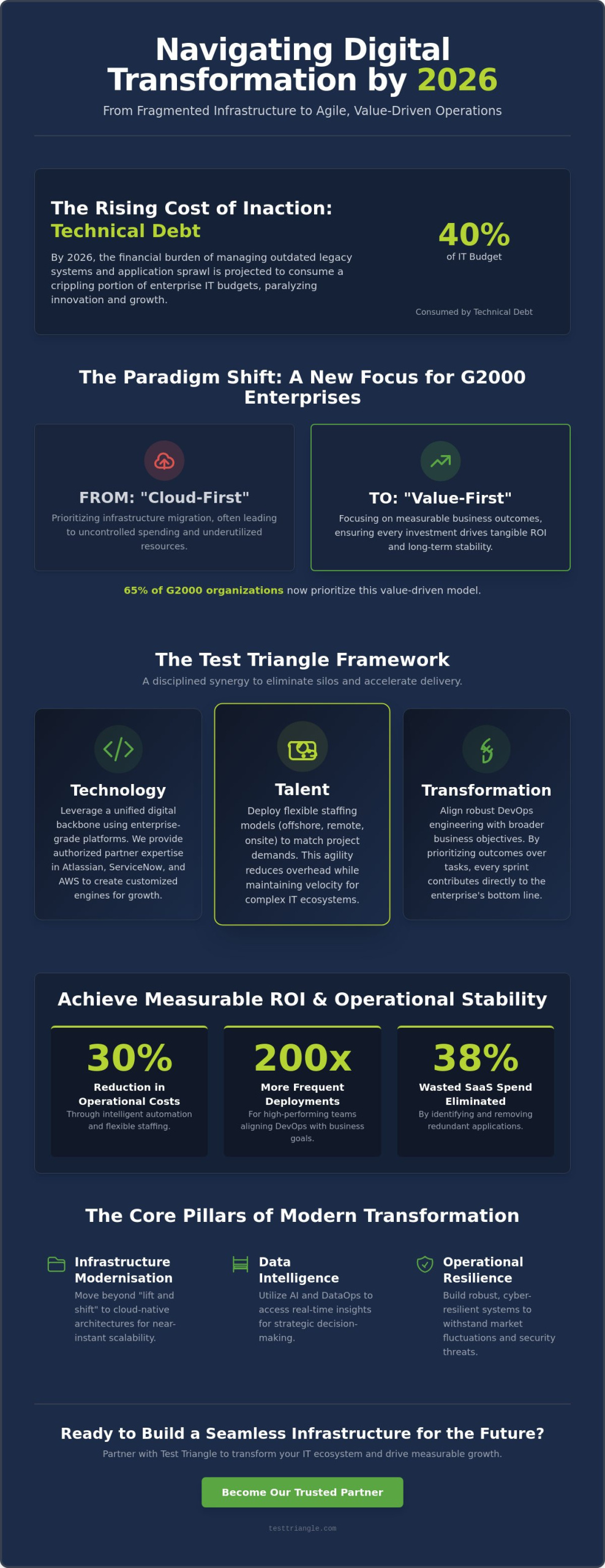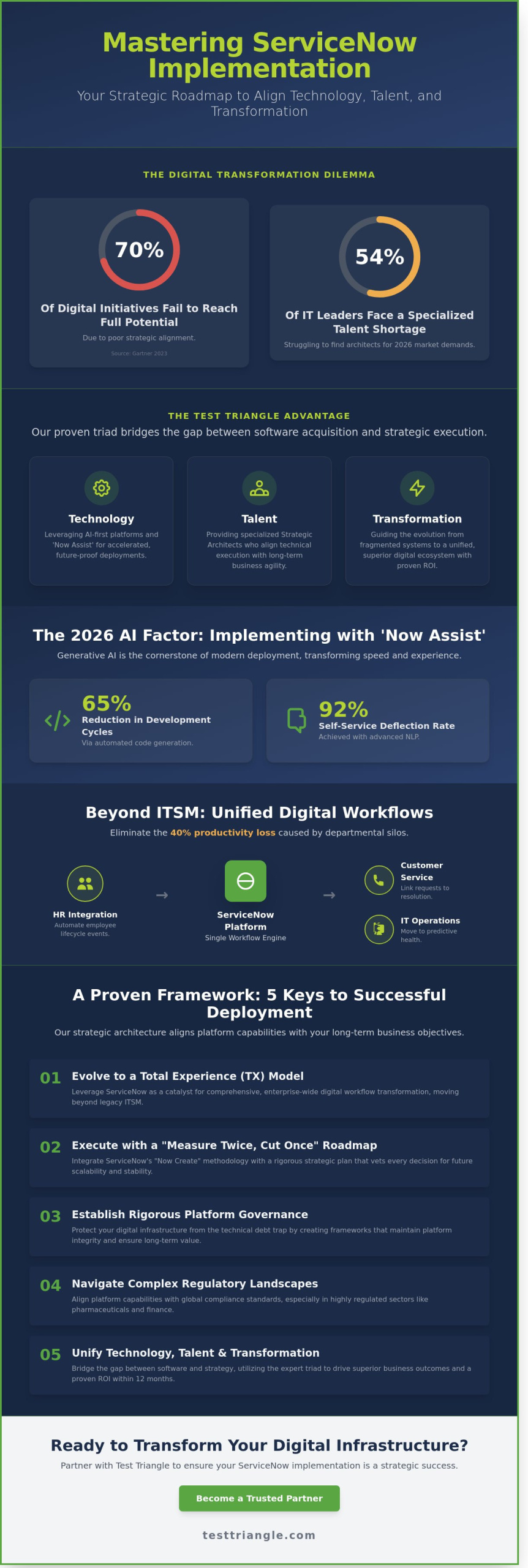
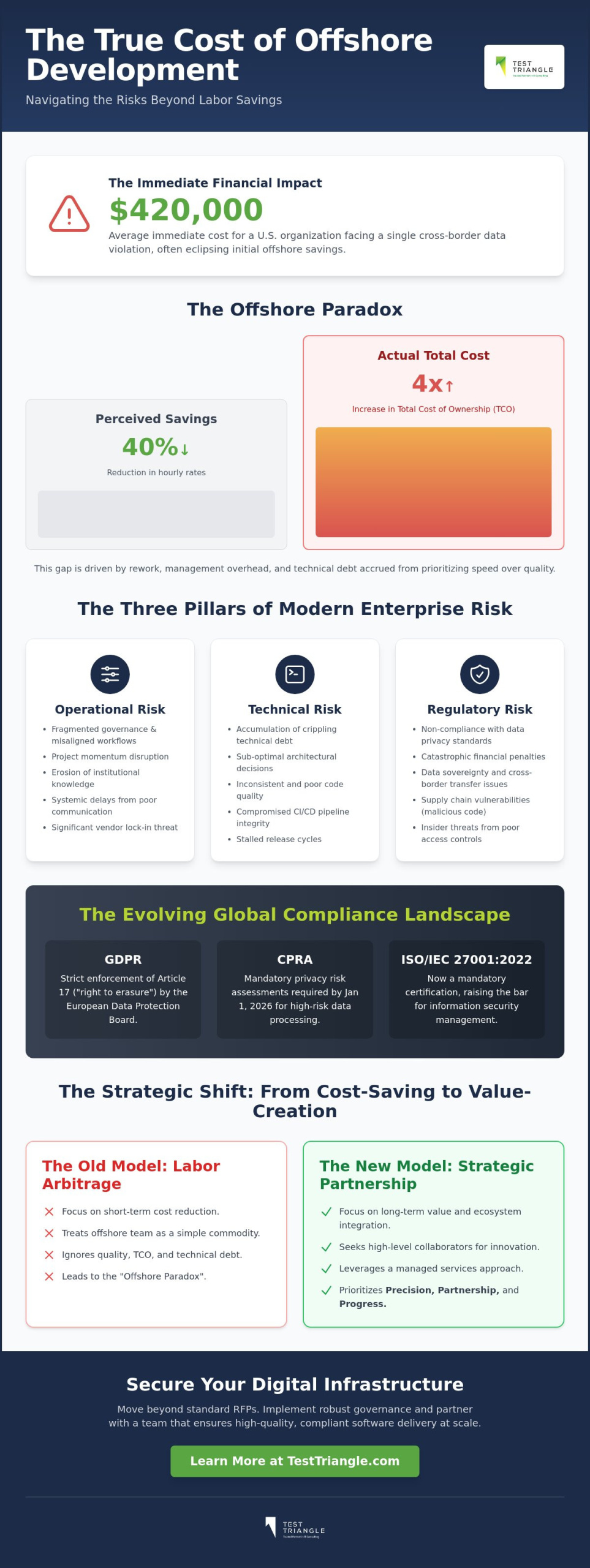
When a cross-border data violation occurs, the average U.S. organization faces $420,000 in immediate costs, a figure that often eclipses the initial savings of a distributed model. You understand that the risks of hiring offshore development teams involve more than just time zone friction; they encompass unpredictable code quality and the looming threat of technical debt in highly regulated sectors like Finance and Pharma. As global data privacy regulations tighten, including the now-mandatory ISO/IEC 27001:2022 certifications, the gap between a low-cost vendor and a strategic partner becomes a matter of institutional survival.

This article provides the methodology to evaluate, mitigate, and master these complexities to ensure your digital infrastructure remains secure and performant. We’ll explore a comprehensive risk-assessment checklist and governance strategies designed to facilitate high-quality, compliant software delivery at scale. By aligning technical execution with business outcomes, we help you secure the stability, precision, and progress necessary for long-term operational success.

Key Takeaways

  • Transition from simple labor arbitrage to strategic ecosystem integration to ensure your offshore model delivers long-term value rather than just short-term cost savings.
  • Identify and neutralize the risks of hiring offshore development teams by implementing rigorous data sovereignty protocols and intellectual property safeguards tailored for highly regulated sectors.
  • Evaluate the true total cost of ownership by accounting for the quality gap and technical debt that often result when speed is prioritized over architectural sustainability.
  • Establish robust governance through quality-centric KPIs and vendor selection processes that move beyond the standard Request for Proposal to verify actual operational maturity.
  • Leverage a managed service approach to achieve precision, partnership, and progress, ensuring high-compliance delivery across global digital infrastructures.

The Strategic Landscape of Offshore Development Risks in 2026

The global delivery landscape has undergone a fundamental transformation, shifting from a model of simple labor arbitrage to one of complex ecosystem integration. In 2026, enterprises no longer view distributed teams as a mere mechanism for reducing payroll; they seek high-level collaborators capable of driving large-scale technological evolution. However, this evolution introduces sophisticated risks of hiring offshore development teams that extend far beyond traditional logistical concerns. A foundational understanding of offshoring reveals that while the economic principles of comparative advantage remain, the execution has become significantly more precarious for those prioritizing immediate savings over long-term stability.

When global enterprises adopt a “low-cost-first” mindset, they often ignore the three pillars of risk that define modern software delivery. These pillars include:

  • Operational Risk: Disruptions in project momentum caused by fragmented governance and misaligned workflows.
  • Technical Risk: The accumulation of technical debt due to sub-optimal architectural decisions and inconsistent code quality.
  • Regulatory Risk: Non-compliance with evolving data privacy standards, such as the ISO/IEC 27001:2022 requirements, which can result in catastrophic financial penalties.

Success in this environment requires a transition toward managed outsourcing services that prioritize precision, partnership, and progress over bottom-line reduction.

The Shift from Cost-Saving to Value-Creation

Traditional offshoring models are failing because they don’t account for the speed of modern digital transformation. Many organizations fall victim to the “Offshore Paradox,” where a 40% reduction in hourly rates actually increases the total cost of ownership by a factor of four due to rework and management overhead. In this context, offshore risk is the quantifiable delta between projected labor savings and the realized technical debt accrued through sub-optimal architectural decisions. By focusing on staffing solutions that emphasize specialized expertise, companies can avoid the trap of prioritizing output volume over delivery value.

Categorising Modern Enterprise Vulnerabilities

Modern vulnerabilities often manifest within the technical infrastructure itself. If an offshore partner lacks robust environmental stability, it directly compromises the integrity of continuous integration and deployment (CI/CD) pipelines, leading to stalled release cycles. Furthermore, the risk of vendor lock-in remains a significant threat; without intentional knowledge transfer, enterprises lose internal institutional knowledge and become dangerously dependent on external entities. This erosion of transparency is frequently exacerbated by fragmented communication protocols, which turn minor misunderstandings into systemic project delays. Maintaining operational control requires a disciplined approach to governance that ensures technical managers and executive leadership remain aligned on every deliverable.

Security, Compliance, and Intellectual Property Vulnerabilities

Data sovereignty remains a primary concern for global enterprises navigating the legal complexities of cross-border data transfers. In 2026, the European Data Protection Board has made Article 17 of the GDPR, the right to erasure, a key enforcement priority. Organizations must also contend with the California Privacy Rights Act (CPRA) regulations that, as of January 1, 2026, require comprehensive privacy risk assessments for processing that presents a significant risk to consumers. These evolving mandates amplify the risks of hiring offshore development teams that lack a mature understanding of localized compliance frameworks. Beyond statutory data protection, vulnerabilities in the software supply chain emerge when using unverified resources, potentially introducing malicious code or unauthorized backdoors into production environments.

Mitigating insider threats requires more than just background checks. It demands a systemic architecture of least-privilege access and continuous monitoring. Unauthorized data access often stems from fragmented identity management between the onshore leadership and the offshore execution team. Establishing a unified security posture is essential to protect the integrity of your digital infrastructure. It’s about maintaining stability and precision throughout the development lifecycle.

Regulatory Compliance in Regulated Sectors

Maintaining GxP and HIPAA compliance presents unique challenges when development occurs in jurisdictions with non-equivalent legal protections. For organizations in the pharmaceutical and finance sectors, the necessity of Software and Digital Assurance Testing cannot be overstated. This approach ensures the creation of immutable audit trails and rigorous validation protocols required by global regulators. It’s also vital to confirm that your partner has completed the transition to the ISO/IEC 27001:2022 standard, as the previous 2013 version’s transition period ended on October 31, 2025. Ensuring these standards are met provides the peace of mind necessary for large-scale technological evolution.

Intellectual Property and Contractual Safeguards

Protecting proprietary algorithms requires contracts that go beyond standard service agreements. To effectively manage the risks of hiring offshore development teams, every offshore contract must include explicit clauses regarding the ownership of work product and the immediate transfer of intellectual property rights upon creation. Utilizing code escrow and secure, encrypted repository management further reduces the risk of asset loss. Standardizing security testing as a non-negotiable component of the Definition of Done (DoD) ensures that protection is baked into the development lifecycle rather than added as an afterthought. If you’re concerned about your current security posture, consulting with a strategic compliance partner can help bridge the gap between technical execution and regulatory certainty.

The ‘Hidden’ Operational Costs: Communication, Culture, and Technical Debt

Operational efficiency often suffers when organizations overlook the subtle friction points inherent in distributed delivery models. While the initial balance sheet might suggest significant savings, the risks of hiring offshore development teams frequently manifest as a “Quality Gap.” This occurs when external teams prioritize velocity and ticket closure over sustainable code architecture. This short-term focus creates a fragile foundation that complicates future scaling and integration efforts. When speed is the only metric, the resulting technical debt acts as a high-interest loan that your internal team will eventually have to repay with interest.

Time zone differences introduce another layer of complexity, often resulting in a 24-hour delay for critical bug fixes. If a production-grade issue is identified at the end of a domestic business day, it may sit idle for half a cycle before an offshore team even begins the triage process. This lag erodes your time-to-market and can be devastating in high-stakes environments like Finance or Pharma. Cultural nuances in requirements gathering also lead to “The Yes-Man” syndrome. This is a phenomenon where offshore partners agree to ambiguous or impossible specifications to avoid perceived conflict, ultimately leading to misaligned deliverables and expensive rework.

The Long-Term Burden of Technical Debt

Quick and dirty code might meet an immediate deadline, but it leads to exponential maintenance costs in later years. To mitigate this, organizations must integrate professional manual testing into their quality assurance strategy. While automation provides speed, manual oversight is essential for catching complex logic errors that automated scripts often miss. Establishing a rigorous code review process ensures that every pull request adheres to your internal standards, protecting your architectural integrity from the onset.

Bridging the Cultural and Communication Divide

Success requires a single source of truth to synchronize disparate workflows. Implementing tools like Jira and Confluence provides the necessary transparency to track progress and document decisions in real-time. Engaging in professional Atlassian Consulting allows you to optimize these platforms for global collaboration, ensuring that your governance model supports asynchronous communication. This structure prevents project bottlenecks, transforming a fragmented team into a cohesive, high-performing unit that values precision and operational stability.

A Framework for Risk Mitigation and Governance

Mitigating the risks of hiring offshore development teams requires a disciplined transition from tactical procurement to a strategic governance framework. While many organizations rely on a standard Request for Proposal (RFP) to vet potential partners, this approach often fails to uncover the operational maturity required for enterprise-grade delivery. A robust selection process must evaluate a vendor’s ability to integrate with your existing digital infrastructure and their commitment to institutional stability. By shifting from a simple “Offshore Staffing” mindset to a comprehensive managed service model, enterprises ensure higher levels of accountability and a shared investment in long-term business outcomes. This methodology replaces fragmented execution with a structured approach that prioritizes precision, performance, and protection.

Establishing transparency across the Software Development Life Cycle (SDLC) is only possible through the integration of shared Key Performance Indicators (KPIs). These metrics should move beyond simple output volume, such as lines of code or ticket velocity, to focus on qualitative benchmarks like defect density and architectural adherence. When governance is treated as a core pillar of the partnership, technical managers gain the visibility needed to manage complex digital assets with confidence. To ensure your distributed model is built on a foundation of technical rigor, speak with our strategic consultants about building a custom governance framework.

Establishing Rigorous Governance Protocols

Integrating Quality Assurance from Day One

Quality cannot be an afterthought in a distributed environment; it must be baked into the delivery pipeline through continuous testing. Utilizing Software Test Automation Services is essential for providing real-time oversight of remote teams, allowing every commit to be validated automatically against your security and functional requirements. By leveraging DevOps Consulting, organizations can build a unified delivery pipeline that synchronizes onshore leadership with offshore execution. This systemic improvement reduces the risks of hiring offshore development teams by creating a transparent, automated environment where progress is measurable and results are predictable.
Navigating the Strategic Risks of Hiring Offshore Development Teams in 2026

The Test Triangle Advantage: Precision, Partnership, and Progress

Test Triangle addresses the fundamental risks of hiring offshore development teams by replacing fragmented, “set and forget” models with a rigorous managed service framework. Our approach ensures that every line of code and every architectural decision aligns with your enterprise goals, effectively neutralizing the Quality Gap and technical debt discussed in previous sections. By integrating industry-leading platforms like Atlassian and ServiceNow directly into our delivery model, we provide the total project visibility necessary for executive leadership to maintain operational control over complex digital infrastructures. This combination of offshore cost-efficiency and local strategic oversight allows global organizations to scale with confidence, clarity, and control.

Our personality is that of a strategic visionary who remains deeply practical, ensuring that your long-term success is never sacrificed for short-term gains. We act as a steady hand in a fast-changing technological landscape, emphasizing organizational progress through the combination of human expertise and sophisticated technical tools. By choosing a partner that values stability, precision, and scalable growth, you empower your organization to navigate the complexities of 2026 with a reliable long-term collaborator at your side.

Managed Outsourcing: Beyond Simple Staffing

Our Managed Outsourcing Services provide the high-level governance that typical offshore teams lack, positioning us as a reliable corporate partner rather than a mere service provider. Having an Ireland-based strategic partner manage global delivery centers means you benefit from institutional maturity, ensuring that cultural and communication barriers are proactively dismantled. For instance, our methodologies have successfully reduced technical debt for global healthcare providers by implementing disciplined code review and automated validation protocols. This approach transforms global delivery from a source of operational anxiety into a driver of systemic improvement.

Enterprise-Grade IT Staffing for Global Compliance

We offer a unique approach to IT Staffing for specialized roles, particularly within the highly regulated Pharma and Finance sectors. Our rigorous vetting process ensures that every resource is not only technically proficient but also fully aligned with your specific compliance requirements and corporate culture. We recognize that stability and precision are non-negotiable in high-stakes environments, which is why our staffing models are built on a foundation of technical rigor and institutional maturity. To optimize your current delivery model and eliminate the risks of hiring offshore development teams, connect with our strategic consultants to audit your existing strategy and establish a path toward high-quality, compliant software delivery at scale.

Securing Your Enterprise Delivery for 2026 and Beyond

The landscape of 2026 demands more than just cost-efficiency; it requires a disciplined commitment to security and quality. Mitigating the risks of hiring offshore development teams involves a fundamental shift from tactical staffing to a managed service model that prioritizes data sovereignty and architectural integrity. By establishing rigorous governance and integrating quality assurance into the core of your SDLC, you ensure that global delivery remains a catalyst for growth rather than a source of technical debt.

As a strategic Atlassian and ServiceNow partner with specialized expertise in Pharma and Finance compliance, Test Triangle provides the institutional maturity necessary for high-stakes environments. Our global reach is anchored by local, Dublin-based leadership, offering the precision and stability required to manage complex digital infrastructures with confidence. This combined approach ensures that technical managers and executive leadership remain aligned on every deliverable, fostering a spirit of partnership and support.

Secure your digital transformation with Test Triangle’s Managed Services and experience the peace of mind that comes from a reliable long-term collaboration. Your path to scalable, compliant, and high-quality software delivery starts with a partner dedicated to your long-term operational success.

Frequently Asked Questions

What are the most common security risks when hiring offshore development teams?

The most common security risks include data sovereignty violations, supply chain compromises, and unmonitored insider threats. In 2026, the risks of hiring offshore development teams are amplified by stricter privacy laws like the CPRA and updated GDPR enforcement. Organizations must implement zero-trust architectures and continuous monitoring to prevent unauthorized access to sensitive digital infrastructure, ensuring that remote resources remain as secure as internal assets.

How can I protect my intellectual property when working with offshore developers?

Protecting intellectual property requires a multi-layered approach that combines ironclad contractual safeguards with technical enforcement. Secure your proprietary algorithms by including explicit IP transfer clauses in every agreement and utilizing encrypted code repositories with strict access controls. Implementing code escrow services provides an additional fail-safe, ensuring that your organization retains full ownership and access to the work product even if the partnership dissolves, thereby maintaining institutional stability.

Is it possible to maintain high code quality with a low-cost offshore team?

Maintaining high code quality with a low-cost team is achievable only through a disciplined governance framework and professional oversight. While lower hourly rates often signal a “Quality Gap,” integrating automated testing and rigorous code reviews can mitigate the accumulation of technical debt. Success depends on shifting the focus from output volume to qualitative benchmarks, ensuring that the final deliverable meets enterprise-grade standards without sacrificing the initial cost-efficiency of the distributed model.

How do I manage the time zone differences effectively in a DevOps environment?

Effective time zone management in a DevOps environment relies on robust asynchronous communication and a “Single Source of Truth.” By leveraging platforms like Jira and Confluence, teams can synchronize workflows without requiring real-time overlap for every task. This structure prevents project bottlenecks and ensures that continuous integration and deployment pipelines remain active, transforming potential 24-hour delays into a rhythmic, around-the-clock development cycle that accelerates your time-to-market.

What compliance standards should I look for in an offshore development partner?

Essential compliance standards for offshore partners include ISO/IEC 27001:2022 for information security and SOC 2 for operational controls. In specialized sectors like Finance or Pharma, you must also verify adherence to GxP or HIPAA requirements to ensure audit readiness. Selecting a partner with these official endorsements provides the peace of mind necessary for large-scale technological evolution, ensuring that your global delivery centers operate within recognized global benchmarks.

What happens if an offshore project fails to meet its technical requirements?

When an offshore project fails to meet technical requirements, the primary recourse is the enforcement of predefined Service Level Agreements (SLAs). These agreements should include specific remediation protocols and financial penalties for non-compliance with quality metrics. To prevent such failures, conduct regular third-party audits and maintain a transparent delivery pipeline, allowing you to identify and correct architectural deviations before they evolve into systemic project failures or unmanageable technical debt.

How does managed outsourcing differ from traditional offshore staffing?

Managed outsourcing differs from traditional staffing by providing a comprehensive governance layer and end-to-end accountability. While traditional staffing merely provides labor, managed outsourcing integrates strategic oversight, quality assurance, and project management into a cohesive service. This model addresses the risks of hiring offshore development teams by ensuring that the provider is deeply invested in your long-term success, offering a steady hand to manage complex digital transformations.

Can offshore teams effectively integrate with Atlassian or ServiceNow platforms?

Offshore teams can effectively integrate with Atlassian or ServiceNow platforms when supported by specialized consulting expertise. These ecosystems provide the necessary project visibility and ITSM rigor to synchronize global delivery centers with onshore leadership. Professional implementation ensures that your distributed workflows are optimized for transparency and precision, allowing technical managers to track every deliverable within a unified, high-performance environment that supports organizational progress.

Paul Guy

Article by

Paul Guy

Paul serves as the Marketing Director at Test Triangle, where he leads a global team in driving growth through strategic B2B marketing and brand communications. With a strong emphasis on measurable outcomes and sustainable performance, he plays a pivotal role in aligning marketing functions to enhance customer engagement and accelerate business impact. Under his leadership, marketing initiatives have consistently delivered significant returns on investment, elevated brand visibility, and strengthened the company's presence across key markets.

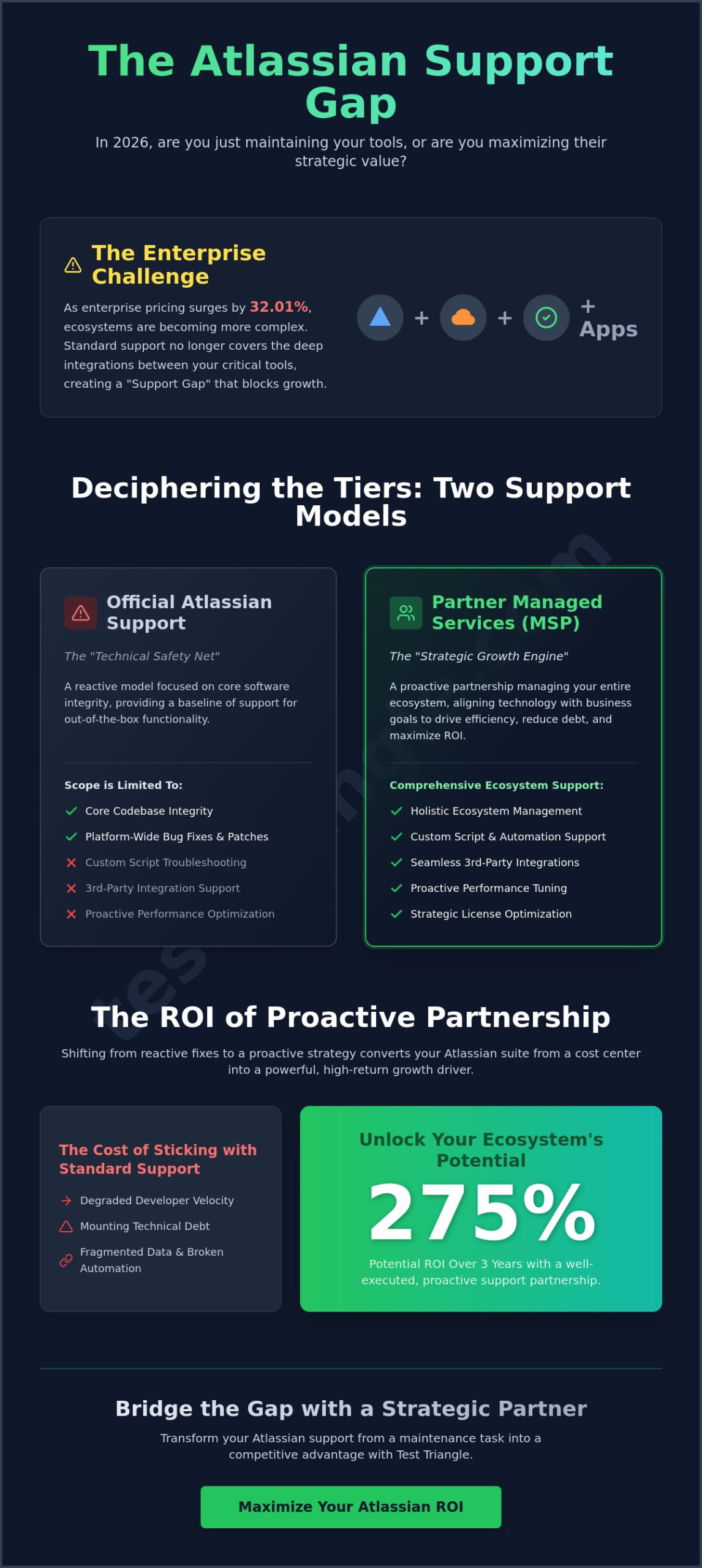
While enterprise Atlassian pricing has surged by 32.01% as of May 2026, the most successful global organizations aren’t scaling back; they’re fundamentally restructuring their approach to atlassian support. You likely recognize the friction of waiting on high-volume portals for critical fixes or the technical debt that accumulates when Jira isn’t seamlessly integrated with ServiceNow and AWS. It’s common to feel that your investment is being consumed by reactive troubleshooting rather than driving the digital transformation your roadmap requires.

This guide promises to move you beyond the limitations of standard maintenance into a strategic managed services model that secures your infrastructure and maximizes ROI. By aligning expert-led cloud migration with disciplined license management, you can transform your toolset into a predictable, high-performance engine for growth. We will examine the critical 2026 updates to Data Center pricing, the implications of Atlassian’s new AI data policies, and the methodology for achieving a 230% return on your ecosystem investment through proactive, SLA-backed partnership.

Key Takeaways

  • Learn to transition from fragmented tool maintenance to a unified digital transformation strategy that aligns your technical infrastructure with long-term business objectives.
  • Distinguish between basic software fixes and comprehensive atlassian support by understanding the strategic advantages of a Managed Service Provider in complex enterprise environments.
  • Identify the financial and operational benefits of a proactive configuration approach designed to eliminate system bottlenecks and reduce the accumulation of technical debt.
  • Utilize a structured audit framework to evaluate your current support health and uncover hidden inefficiencies in user adoption and cross-platform tool integration.
  • Implement a methodology-driven partnership model that bridges the gap between technical execution and executive-level business outcomes to ensure scalable growth.

The evolution of the Atlassian Corporation software suite has transitioned from a collection of standalone project management tools into a foundational architecture for the modern enterprise. By 2026, the complexity of these environments has grown exponentially, driven by the necessity of deep integrations between Jira, AWS, and specialized marketplace apps that can increase base costs by up to 150%. Global organizations no longer view these tools as isolated silos; they are the central nervous system of digital transformation. However, as configurations become more bespoke, standard atlassian support often hits a ceiling. It focuses on the software’s functional uptime rather than the strategic health of the entire ecosystem. This creates a critical “Support Gap” where technical managers find themselves caught between vendor-level documentation and the unique requirements of their own complex, multi-platform workflows.

The Interconnected Enterprise: Beyond Jira and Confluence

Current enterprise digital strategies demand that Atlassian tools serve as the primary anchor for IT Service Management solutions. When Jira Service Management is expected to bridge the gap between HR, legal, and engineering, the challenge of maintaining cross-platform data integrity becomes a primary business risk. Relying on “business as usual” support models during periods of rapid scaling often leads to fragmented data and broken automation. True operational stability requires a support framework that understands how a change in a Confluence permissions scheme might ripple through a ServiceNow integration or an AWS-hosted database. Without this holistic oversight, the technical debt accumulated through quick-fix configurations can eventually stall the very agility these tools were meant to provide.

The High Cost of System Inefficiency

Systemic bottlenecks in your Atlassian stack are more than just an IT inconvenience; they are a direct drain on profitability. Slow ticket resolution and poor tool configuration significantly degrade developer velocity and team morale, leading to a measurable loss in organizational agility. While well-executed implementations can yield a 275% ROI over three years, achieving this requires a disciplined approach to atlassian support that prioritizes proactive optimization over reactive fire-fighting. By integrating robust support with expert DevOps Consulting, enterprises can ensure their tools accelerate rather than hinder the release cycle. This strategic alignment converts technical execution into tangible business outcomes, providing the precision, pace, and power needed to maintain a competitive edge in a fast-changing technological landscape.

Deciphering the Tiers: Official Support vs. Partner Managed Services

For global enterprises, the distinction between maintaining software and managing an ecosystem is often the difference between stagnation and scalable growth. While every subscription includes a baseline of atlassian support, many organizations mistakenly assume this vendor-level coverage includes the hands-on administration required for complex, bespoke environments. In reality, a clear hierarchy exists between the technical safety net provided by the software vendor and the strategic, proactive partnership offered by a Managed Service Provider (MSP). Understanding these boundaries is essential for leadership teams aiming to secure stability, scalability, and security across their digital infrastructure.

Official Atlassian Support: The Technical Safety Net

The primary mandate of official vendor support is to ensure the integrity of the core codebase. This includes delivering critical security patches, resolving platform-wide bugs, and maintaining high uptime for cloud services. While tiers like “Enterprise” offer accelerated response times for high-severity incidents, the scope remains strictly limited to the software’s out-of-the-box functionality. They won’t troubleshoot your custom Groovy scripts in Jira Service Management or optimize a convoluted Confluence permissions hierarchy that’s slowing down your global teams. When you submit a ticket to the global queue, you’re interacting with experts on the product, not experts on your specific business logic or your unique ServiceNow integration.

Managed Services: The Strategic Extension of Your IT Team

A Managed Service Provider acts as a highly disciplined extension of your internal operations, focusing on the systemic health of your entire stack. Unlike reactive ticketing systems, an MSP utilizes a methodology-driven approach to identify performance degradation before it impacts user productivity. This level of partnership provides access to specialized Atlassian Consulting for workflow automation, ensuring that your tools evolve alongside your business requirements. By assigning dedicated account managers who understand your long-term roadmap, an MSP bridges the gap between technical execution and executive goals. This results in predictable monthly costs and guaranteed SLAs that go beyond simple “uptime” to encompass actual operational efficiency. If your organization requires a more tailored approach to overcome specific architectural bottlenecks, it’s often beneficial to discuss your ecosystem’s specific requirements with a strategic partner who can provide the depth of expertise that community forums and standard documentation lack.

Overcoming the Reactive Trap: The ROI of Proactive Support

Operating an enterprise environment through reactive troubleshooting is a high-risk strategy that often results in compounding technical debt and unforeseen operational pauses. While many organizations treat atlassian support as a break-fix utility, the most resilient global firms leverage it as a strategic asset to drive visibility, velocity, and value. By shifting the focus from resolving active failures to preventing them, businesses can secure the 230% to 275% ROI typically associated with well-executed implementations. This proactive approach ensures that every configuration is “Right-First-Time,” eliminating the costly cycles of reconfiguration that occur when tools are scaled without a disciplined architectural blueprint.

Strategic oversight also extends to the financial health of the ecosystem. With enterprise pricing for Atlassian products increasing by 32.01% as of May 2026, and marketplace apps potentially adding up to 150% to base costs, proactive license management is no longer optional. A managed support model identifies underutilized seats and redundant plugins, ensuring that your expenditure remains lean and targeted. Furthermore, integrating continuous Software Test Automation Services into your support framework allows for the rapid validation of new workflows. This methodology ensures that system updates don’t disrupt established DevOps pipelines, maintaining a steady cadence of delivery across the organization.

Preventative Maintenance for Cloud and Data Center

Maintaining a healthy Atlassian instance requires regular, high-level audits to prevent “instance sprawl” and the formation of data silos. This is particularly critical for organizations in highly regulated sectors, such as pharmaceuticals, where data integrity and compliance are paramount. Proactive atlassian support involves security hardening that goes far beyond standard platform patches, implementing bespoke permission schemes and data contribution settings that align with the latest 2026 AI data sharing policies. This level of preventative care ensures that your infrastructure remains a secure, compliant, and high-performance environment for global collaboration.

Strategic Roadmapping and Cloud Migration

With the Data Center end-of-life approaching on March 28, 2029, and 94% of enterprises already operating in the cloud, strategic roadmapping has become a core component of modern support. Utilizing dedicated support hours for long-term planning allows organizations to execute complex Atlassian Cloud migrations without data loss or significant downtime. By aligning tool evolution with specific organizational growth targets, a managed service provider ensures that your technology stack remains a catalyst for progress. This forward-looking methodology transforms your support investment into a reliable engine for large-scale technological evolution and sustained business success.

Audit Checklist: Identifying Gaps in Your Current Support Infrastructure

To transition from a reactive posture to a strategic framework, enterprises must first conduct a rigorous diagnostic of their current ecosystem health. Evaluating your infrastructure involves more than checking server uptime; it requires a deep dive into the friction points that impede organizational velocity. Many global firms find their internal atlassian support desks overwhelmed by low-level administrative tasks, which prevents senior engineers from focusing on high-value digital transformation projects. By utilizing a structured framework to identify these gaps, leadership can determine whether their existing model supports long-term scalability or if it’s time to transition toward Managed Outsourcing Services to secure operational stability.

Technical Integrity: Operational Audit Points

A comprehensive audit begins with a review of average time-to-resolution (TTR) for internal tickets and an assessment of the complexity within third-party app integrations. If your team struggles to maintain data integrity between Jira and AWS, or if custom workflows are causing frequent system timeouts, your current support layer is likely insufficient. You should evaluate the scalability of your permission schemes and security protocols, especially as you navigate the regulatory requirements of 2026. These technical benchmarks provide the data necessary to justify a shift in your service delivery model. Identifying these bottlenecks early allows for a more disciplined approach to system optimization, ensuring that your tools aren’t just functional but are actively contributing to team morale and developer velocity.

Capacity Planning: Resource and Staffing Evaluation

Beyond the technical layer, organizations must honestly assess the burden placed on their human capital. If routine maintenance like license reconciliation or version upgrades consistently derails your roadmap, your internal team is overstretched. This often indicates a need for specialized IT Staffing Services to bridge specific expertise gaps without the overhead of permanent hires. The “Build vs. Buy” decision for Atlassian expertise hinges on whether you can maintain the required pace of innovation internally. Relying on a strategic visionary who remains deeply practical is often more cost-effective than attempting to recruit and retain a full-time, multi-disciplinary team. To gain a clearer understanding of how your current resources align with your 2026 growth targets, you should request a comprehensive infrastructure audit from a strategic partner who understands the nuances of global enterprise management.

Atlassian Support: A Strategic Guide to Enterprise Managed Services in 2026

Test Triangle: Elevating Atlassian Support into a Strategic Partnership

Test Triangle operates as a strategic visionary for global enterprises, moving beyond the transactional nature of standard vendor relationships to provide a high-level corporate partnership. Our proprietary Methodology-Action-Result framework ensures that every technical intervention is directly mapped to a specific business objective; this converts complex technical debt into measurable operational value. By aligning atlassian support with your broader digital roadmap, we bridge the gap between technical execution and executive-level outcomes. Our global delivery model offers unparalleled flexibility, providing contract, remote, and offshore support options that adapt to your unique organizational rhythm and time-zone requirements. This versatility, combined with deep multi-platform expertise across Atlassian, ServiceNow, and AWS, allows us to manage complex digital infrastructures with precision, pace, and power.

A Holistic Approach to IT Service Management

The seamless integration of atlassian support with our ServiceNow Consulting Services creates a unified IT Service Management layer that eliminates operational silos and drives systemic improvement. We deliver end-to-end digital transformation through strategic advisory, ensuring that your tools serve as a catalyst for organizational progress rather than a source of technical friction. For organizations operating within the pharmaceutical and financial sectors, we provide customized support packages specifically designed to navigate the rigorous compliance and security standards of 2026. This holistic oversight ensures that your technology stack remains secure, scalable, and stable, providing the peace of mind necessary for long-term innovation and large-scale technological evolution.

Your Long-Term Collaborator for Scalable Growth

We position ourselves as a reliable long-term collaborator, emphasizing a profound commitment to risk reduction and operational stability as the cornerstones of our identity. Our approach is built on a foundation of institutional maturity, where we operate as a steady hand in a fast-changing technological landscape to reassure global enterprises that their infrastructures are managed with expertise. By focusing on the combination of human expertise and technical precision, we empower leadership teams to achieve sustainable, scalable, and secure growth. We bridge the gap. This disciplined methodology transforms your support investment into a reliable engine for success. To begin transforming your infrastructure into a high-performance asset, you can optimise your ecosystem with Test Triangle Atlassian Support.

Securing Your Digital Future: The Path to Operational Excellence

The transition toward a proactive managed services model isn’t just a technical upgrade; it’s a strategic necessity for the modern enterprise aiming to offset rising costs and increasing technical complexity. By moving beyond the reactive trap, you unlock the potential for significant ROI while ensuring that your infrastructure remains resilient against the specific challenges of 2026. A disciplined approach to atlassian support ensures that your tools evolve alongside your business, turning project management software into a unified engine for digital transformation. This methodology ensures that every configuration contributes to your organization’s long-term stability, scalability, and security.

As an Atlassian Gold Solution Partner with a global presence spanning Europe, North America, and Asia, Test Triangle provides the specialized expertise required to manage ecosystems in highly regulated industries. We operate as a steady hand, focusing on risk reduction and technical precision to ensure your long-term success. Our Methodology-Action-Result framework bridges the gap between technical execution and executive goals, reinforcing our identity as a reliable long-term collaborator. Explore Strategic Atlassian Support Solutions to begin your journey toward a more efficient and scalable infrastructure. We’re ready to help you empower your teams and secure your digital future.

Frequently Asked Questions

What is the difference between Atlassian Standard and Partner Support?

Official Atlassian support focuses primarily on the functional integrity of the software codebase, providing reactive fixes for bugs and platform-wide outages. In contrast, a strategic partner provides a proactive managed service that encompasses your entire ecosystem, including custom workflow configurations, third-party integrations, and long-term architectural roadmapping. This partnership model ensures that your tools are optimized for your specific business logic rather than just maintaining basic uptime.

How much does managed Atlassian support typically cost?

The financial investment for managed atlassian support is determined by the complexity of your technical environment, your total seat count, and the specific service level agreements required by your organization. While licensing costs are fixed by the vendor, managed service fees are tailored to the depth of strategic oversight and administrative burden you choose to outsource. Most enterprises find this model more economical than recruiting a full-time, multi-disciplinary internal team to manage a scaling infrastructure.

Can a partner help with Atlassian Cloud migration support?

Yes, an expert partner manages the entire end-to-end migration lifecycle to ensure data integrity and minimal operational downtime. This includes performing pre-migration audits, resolving app compatibility issues, and executing the final transition with disciplined precision. By leveraging specialized Atlassian Consulting, organizations can navigate the complexities of cloud-native features and AI data sharing policies without risking their historical data or established DevOps pipelines.

Do I still need an internal Jira administrator if I have partner support?

Many global organizations choose to reallocate their internal resources toward core business innovation by utilizing a partner as their primary administrator. While you may retain a light internal touchpoint for high-level approvals, a managed service provider handles the routine maintenance, user provisioning, and performance tuning. This approach eliminates the institutional risk associated with “single point of failure” staffing and ensures your infrastructure is managed by a versatile team of experts.

What are the typical SLAs for enterprise Atlassian managed services?

Enterprise-grade SLAs are highly structured and typically categorize incidents by severity to ensure that critical system failures receive immediate prioritization. These agreements often guarantee specific response and resolution times, alongside commitments to system performance and security hardening. By establishing these benchmarks, enterprises gain the peace of mind that comes from predictable service quality and a reliable long-term collaborator invested in their operational stability.

How does Atlassian support integrate with ServiceNow workflows?

A strategic partner provides the technical bridge necessary to synchronize Jira Service Management with ServiceNow, ensuring a unified flow of data across your IT Service Management layer. This integration allows for automated ticket mirroring, consistent status updates, and centralized reporting across both platforms. This methodology eliminates data silos and provides leadership with a comprehensive view of organizational performance and resource allocation.

Is third-party support secure for highly regulated industries?

Managed support providers implement rigorous security protocols and compliance frameworks specifically designed for highly regulated sectors like pharmaceuticals and finance. This includes adhering to strict data residency requirements, implementing bespoke permission schemes, and ensuring all administrative actions are fully auditable. This level of security hardening goes beyond standard platform patches to protect your intellectual property and maintain regulatory alignment.

What happens to my official Atlassian subscription if I hire a partner?

Your official software subscription remains active and continues to provide you with the core platform and vendor-level security updates. The partner acts as an expert service layer on top of this subscription, managing your Atlassian Licences and providing the hands-on administration that the vendor does not offer. This relationship ensures you receive the best of both worlds: a world-class software foundation and the strategic expertise required to make it perform at scale.

Paul Guy

Article by

Paul Guy

Paul serves as the Marketing Director at Test Triangle, where he leads a global team in driving growth through strategic B2B marketing and brand communications. With a strong emphasis on measurable outcomes and sustainable performance, he plays a pivotal role in aligning marketing functions to enhance customer engagement and accelerate business impact. Under his leadership, marketing initiatives have consistently delivered significant returns on investment, elevated brand visibility, and strengthened the company's presence across key markets.

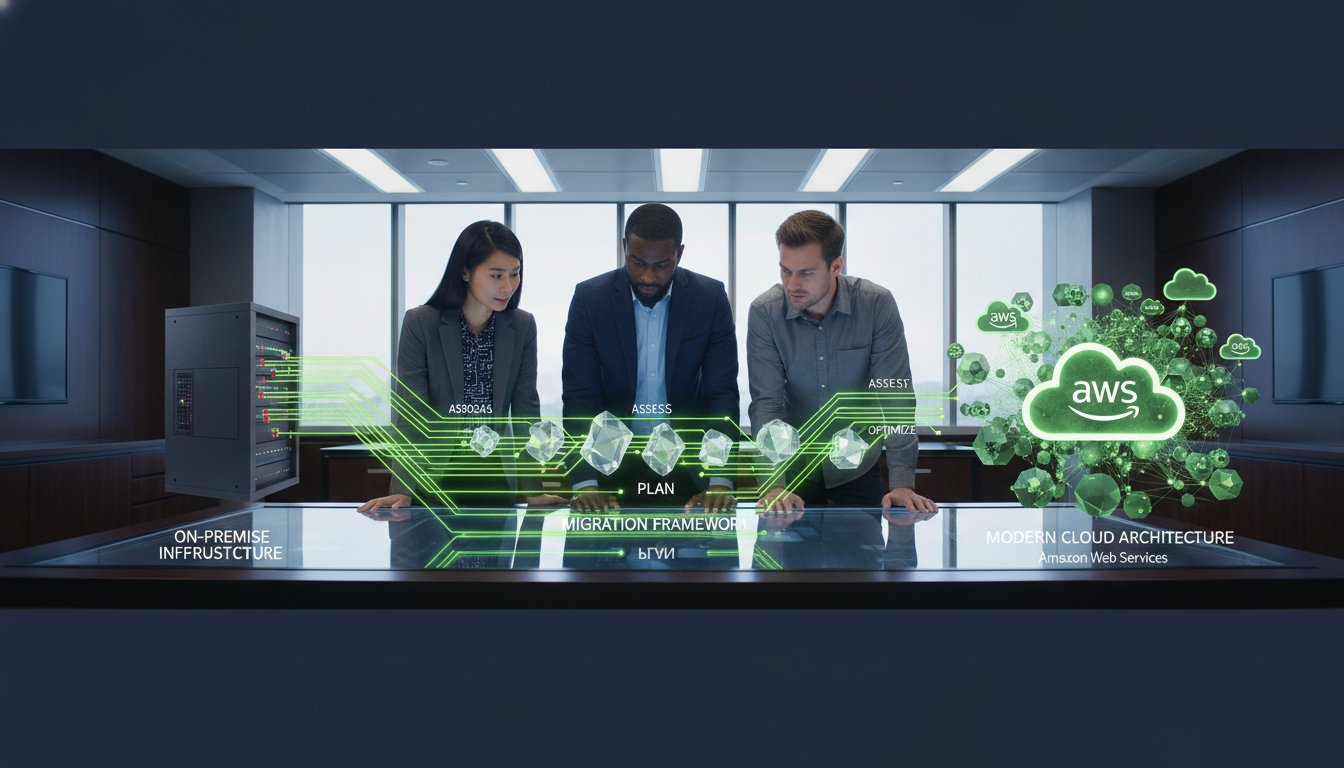
The fastest way to fail your cloud transition is to treat your aws migration strategy for legacy applications as a simple infrastructure swap rather than a holistic business evolution. While many enterprises view legacy monoliths as anchors of technical debt, these systems often house the core logic that defines your market advantage. Transitioning them to the cloud requires more than just moving data; it demands a precise, risk-mitigated framework that balances operational stability with the need for modern performance.

You’re likely facing the daunting reality of monolithic systems, where the fear of extended downtime or data loss often outweighs the desire for innovation. We understand that managing regulatory compliance hurdles and a lack of internal AWS expertise can make the move feel impossible. This guide provides a definitive roadmap to master these complexities, ensuring your transition results in scalable infrastructure and faster release cycles through integrated DevOps practices. We’ll explore the shift to AI-driven discovery using AWS Transform, the implementation of the 7 Rs framework, and how to achieve data liquidity for the next generation of enterprise intelligence.

Key Takeaways

  • Recognize the compounding risks of technical debt to see why keeping on-premise monoliths isn’t a sustainable option in 2026.
  • Select the optimal aws migration strategy for legacy applications by leveraging the 7 Rs framework to balance immediate speed with long-term optimization.
  • Secure your business continuity by choosing the migration model that’s best for your data integrity and downtime requirements.
  • Establish a high-performance environment through precise landing zone configuration and AI-enhanced discovery phases that reduce planning timelines.
  • Boost your release cycles by combining DevOps consulting with rigorous automation testing so your new environment’s ready for scale.

The Strategic Imperative: Why Legacy Migration to AWS is Non-Negotiable in 2026

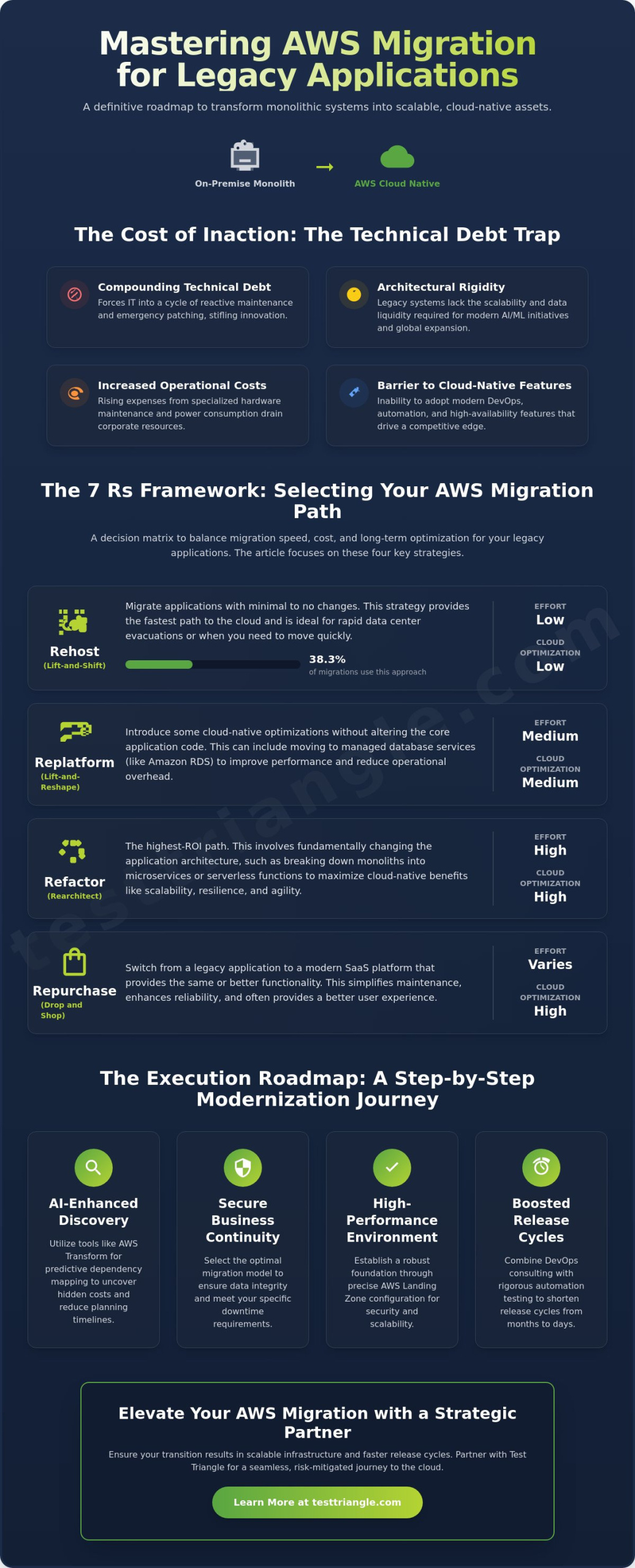
In 2026, the definition of a legacy application has shifted from a measure of chronological age to a metric of architectural rigidity. These systems often represent the core of an enterprise’s operations, yet they remain isolated from the data liquidity required for modern AI and machine learning initiatives. Organizations that fail to implement a comprehensive aws migration strategy for legacy applications find themselves trapped in a cycle of reactive maintenance. This stagnation prevents the adoption of cloud-native features that drive competitive differentiation and systemic growth.

The “cost of inaction” is no longer a theoretical risk but a documented drain on corporate resources. Maintaining on-premise monoliths leads to a significant increase in operational costs compared to modernized cloud alternatives, often due to the rising price of specialized hardware maintenance and power consumption. Beyond the financial burden, the lack of scalability in traditional environments creates a glass ceiling for global expansion. Establishing a modern aws migration strategy for legacy applications facilitates a move to cloud computing, allowing for a strategic realignment where infrastructure serves as a foundation for stability, precision, and scalable growth.

Overcoming the Technical Debt Trap

Technical debt is a structural barrier to innovation that forces IT departments to prioritize emergency patching over the delivery of new business value. AWS Transform and other AI-driven tools now allow for predictive dependency mapping, which uncovers these hidden costs before the migration begins. By offloading hardware management to AWS, firms achieve a state of operational excellence where human expertise is redirected toward high-impact projects. Integrating automation testing during this phase ensures that the technical debt isn’t just relocated, but actively eliminated through refactored, high-quality code.

The Business Value of Cloud Agility

True agility is found in the ability to pivot at the speed of the market. AWS enables this through a globally distributed infrastructure that guarantees high availability and low latency for international users. This transition empowers teams to adopt DevOps consulting methodologies, which significantly shortens release cycles from months to days. The result is a more resilient digital presence that directly influences customer satisfaction and long-term brand loyalty. By mapping these technical milestones to specific business KPIs, such as reduced downtime and improved deployment frequency, leadership can track the tangible ROI of their digital transformation efforts.

The 7 Rs Framework: Selecting Your AWS Migration Strategy

Selecting the appropriate aws migration strategy for legacy applications is a pivotal decision that dictates the long-term agility of your digital ecosystem. The 7 Rs framework serves as the definitive architecture for these decisions, categorizing workloads based on their technical complexity and business value. While rehosting remains a common entry point, accounting for 38.3% of migrations according to 2026 industry data, it’s often just the first step in a broader modernization journey that prioritizes systemic improvement over simple relocation.

Each strategy within the framework offers a different balance of speed, cost, and optimization:

  • Rehost (Lift-and-Shift): This approach provides the fastest path to the cloud by migrating applications with minimal changes, making it ideal for rapid data center evacuations.
  • Replatform (Lift-and-Reshape): By introducing cloud-optimizations like managed database services, you can improve performance without altering the core application code.
  • Refactor/Rearchitect: This high-ROI path involves breaking down monoliths into microservices or serverless architectures to maximize the benefits of cloud-native scalability.
  • Repurchase: Some legacy functions are better served by shifting to industry-leading SaaS platforms, which simplifies maintenance and enhances reliability.

A Decision Matrix for Legacy Systems

A structured decision matrix is essential for evaluating whether to prioritize speed or optimization. For non-core applications, a Rehost strategy allows for immediate cost savings on hardware maintenance. However, mission-critical monoliths that drive your primary revenue streams usually warrant a Refactor approach. This ensures that the application can handle modern traffic patterns and integrate with AI-driven analytics. Organizations must weigh the initial modernization effort against the long-term operational efficiency gained through cloud-native features. If your current systems are too rigid for a direct move, a phased aws migration strategy for legacy applications might involve an initial rehost followed by incremental refactoring.

Integration with Modern Ecosystems

Successful migration extends beyond the infrastructure layer to include your entire operational toolset. Utilizing Atlassian Consulting ensures that your migration workflows are documented and managed with precision, maintaining visibility across all stakeholders. Similarly, a robust ServiceNow Implementation allows for seamless ITSM integration, providing a unified view of your hybrid cloud environment. This level of technical rigor is necessary for managing sensitive legacy data that may require a phased transition rather than a “big bang” migration. If you’re unsure which path fits your current technical debt profile, it’s often helpful to consult with a strategic partner to map your journey.

AWS Migration Strategy for Legacy Applications: The 2026 Strategic Enterprise Guide

Mitigating Risk: Challenges in Migrating Mission-Critical Applications

Transitioning core business logic from on-premise environments to the cloud introduces unique vulnerabilities that demand a sophisticated, risk-mitigated aws migration strategy for legacy applications. For global enterprises, the primary concern remains the preservation of data integrity during high-volume transfers. While a “Big Bang” migration cutover offers immediate finality, it often introduces unacceptable levels of business risk for mission-critical systems. Conversely, an incremental approach allows for gradual validation, ensuring that each component of the legacy monolith is stable within the AWS ecosystem before proceeding to the next phase of the journey.

In highly regulated sectors such as Pharmaceuticals and Finance, these risks are compounded by strict legal mandates. Navigating GxP or SOC 2 requirements during a cloud transition isn’t a secondary concern; it’s a foundational requirement that dictates the entire technical roadmap. AWS provides a comprehensive compliance program, but the responsibility for configuring these tools correctly remains with the organization. This necessitates a strategic focus on security, stability, and scalability, ensuring that every architectural decision aligns with both global regulations and long-term business objectives.

Security and Compliance Guardrails

Utilizing AWS Identity and Access Management (IAM) alongside advanced encryption protocols ensures that legacy data remains protected throughout its journey. For enterprises operating in sensitive markets, maintaining GDPR or GxP compliance requires more than just technical configuration. It requires a documented trail of verification. Integrating Digital Assurance into your migration pipeline allows for the continuous validation of security protocols. This provides the peace of mind that comes from knowing your infrastructure meets the highest global standards of quality and security.

The Human Element of Migration

Technical transformation is inextricably linked to organizational change. Legacy IT departments often harbor a natural resistance to cloud adoption, fearing that their specialized knowledge will become obsolete. Overcoming this hurdle requires a commitment to upskilling and clear communication regarding the new operational landscape. When internal expertise is stretched thin, leveraging IT Staffing Services can fill critical AWS skill gaps. This provides the temporary specialized talent needed to execute a complex aws migration strategy for legacy applications without disrupting daily operations. Our adaptable approach to service delivery ensures that your internal teams are supported by seasoned experts who value precision and organizational progress.

The Execution Roadmap: A Step-by-Step Modernization Journey

Executing a high-performance aws migration strategy for legacy applications is a disciplined four-phase process that transforms technical debt into operational equity. While many organizations rush into the execution phase, a strategic partner understands that the precision of the discovery phase dictates the success of the entire modernization journey. This roadmap is designed to move your mission-critical systems with a composed, solution-oriented approach that prioritizes stability and precision.

The journey follows a methodical progression across four distinct stages:

  • Phase 1: Discovery and Assessment: Utilizing AWS Transform, the successor to AWS Migration Hub launched in May 2025, we use predictive analytics to map complex application dependencies and identify potential friction points.
  • Phase 2: Detailed Design: This stage focuses on the configuration of the AWS Landing Zone, establishing a secure, multi-account environment that anchors your infrastructure in recognized global benchmarks.
  • Phase 3: Migration Execution: Data synchronization is managed via AWS Application Migration Service (MGN). As of May 2026, MGN supports CentOS Stream 9 and provides local EBS snapshot storage within AWS Local Zones.
  • Phase 4: Validation and Tuning: The final stage involves rigorous performance testing and post-cutover monitoring to ensure the new environment meets all functional and business requirements.

The Critical Role of Migration Testing

Digital assurance is the cornerstone of risk mitigation. Implementing System Integration Testing (SIT) ensures that cross-platform data flows remain intact when legacy monoliths interact with modern cloud services. Automating regression testing is equally vital to prevent old bugs from creeping into the new environment. While automation handles the bulk of the workload, our framework for manual testing provides the validation needed for complex edge cases that automated scripts might overlook. This combination of human expertise and technical tools ensures that your aws migration strategy for legacy applications delivers a resilient, high-performance outcome.

Performance Tuning and Optimization

Post-cutover health is managed through AWS CloudWatch, which provides real-time visibility into application performance and resource consumption. Right-sizing EC2 instances, such as the t4g.nano which starts at $0.0042/hr as of May 2026, ensures that you’re only paying for the compute power you actually need. Establishing a DevOps consulting framework allows for continuous improvement, turning your migrated application into a dynamic asset that evolves with your business. This steady hand in a fast-changing landscape ensures long-term operational stability and scalable growth. If you’re ready to modernize your legacy portfolio without disrupting business operations, reach out to our strategic consultants to begin your assessment.

Strategic Partnership: Elevating Your AWS Migration with Test Triangle

Developing a successful aws migration strategy for legacy applications requires a partner that understands the delicate balance between technical modernization and operational continuity. Test Triangle stands as a reliable long-term collaborator, offering a unique combination of high-level strategic vision and practical execution. By aligning our DevOps consulting methodology with rigorous digital assurance, we ensure that your transition to the cloud is not merely a relocation of assets but a strategic leap in operational capacity. Our approach prioritizes stability, precision, and performance, providing the peace of mind necessary for global enterprises to evolve without compromise.

For organizations operating in highly regulated sectors such as Pharmaceuticals or Finance, a generic migration path is insufficient. We specialize in creating tailored migration frameworks that account for complex GxP and GDPR requirements, ensuring that every architectural decision remains compliant with global benchmarks. This institutional maturity allows us to manage your digital infrastructure with expertise, transforming rigid monoliths into agile, cloud-native systems. Our adaptable approach to service delivery means we can function as a steady hand throughout the entire lifecycle, from the initial discovery phase to the final performance tuning of your new environment.

Beyond the technical cutover, we address the critical SERP gap of post-migration support through our comprehensive Managed Outsourcing Services. This ensures that your infrastructure remains optimized and secure long after the initial migration is complete. To fill specialized skill gaps during the transition, our IT Staffing Services provide access to top-tier AWS talent, allowing your internal teams to focus on core business objectives while we handle the complexities of the cloud transition. This global delivery model offers the versatility and discipline required to manage large-scale technological evolution effectively.

A Holistic Approach to Digital Transformation

A truly effective aws migration strategy for legacy applications must integrate seamlessly with your existing enterprise ecosystem. We leverage our expertise in Atlassian Consulting and ServiceNow Implementation to ensure that your new AWS environment is fully aligned with your ITSM and project management workflows. This holistic integration facilitates proactive monitoring and maintenance, ensuring long-term stability and operational excellence. Test Triangle acts as a reliable long-term collaborator, deeply invested in your organization’s sustained success and technical maturity.

Next Steps for Enterprise Leaders

The journey toward a modernized, high-performance infrastructure begins with a clear understanding of your current technical debt and cloud readiness. Our consultants are prepared to develop a customized roadmap for your legacy application portfolio, identifying the most efficient path for your specific business needs. By requesting a comprehensive cloud readiness assessment, you can gain the clarity required to initiate a risk-mitigated transition. We invite you to contact our strategic consultants today to begin your transformation journey and secure your enterprise’s digital future.

Securing Your Competitive Edge through Modernization

Transitioning from rigid on-premise monoliths to a high-performance cloud environment is the defining challenge for enterprise leaders in 2026. By implementing a risk-mitigated aws migration strategy for legacy applications, your organization can effectively eliminate technical debt while achieving the data liquidity required for next-generation AI initiatives. Success in this journey depends on a methodical approach that balances the speed of rehosting with the long-term ROI of refactoring, all while maintaining strict compliance in regulated sectors.

As a strategic partner with global delivery centers across Europe, North America, and Asia, we provide the institutional maturity required to manage complex digital infrastructures. Our status as a strategic partner for AWS, Atlassian, and ServiceNow, combined with our proven expertise in highly regulated industry migrations, ensures your transition is handled with technical rigor. We remain committed to your long-term success, acting as a reliable collaborator to navigate the evolving cloud landscape. To transform your legacy portfolio into a scalable asset, Partner with Test Triangle for your AWS Migration Strategy. Your path to operational excellence is ready for execution.

Frequently Asked Questions

What is the most cost-effective AWS migration strategy for legacy apps?

Rehosting is generally the most cost-effective initial aws migration strategy for legacy applications because it requires the fewest code modifications and reduces upfront labor costs. While this “lift-and-shift” method provides a rapid exit from expensive on-premise hardware, enterprises often find that Replatforming offers better long-term value by reducing the overhead of managing underlying operating systems and databases.

How long does a typical legacy application migration to AWS take?

Migration timelines vary based on the complexity of the portfolio, with individual applications often taking between six to ten weeks for a full transition. For large-scale enterprise portfolios, the process can span several months. Utilizing AI-driven discovery tools within AWS Transform can significantly accelerate this timeline by reducing the manual effort required for dependency mapping and portfolio assessment.

What are the main risks of migrating monolithic applications to the cloud?

The primary risks include data integrity loss during the transfer process and extended downtime that can disrupt core business operations. Technical debt within the monolith can also lead to performance bottlenecks if the application isn’t properly tuned for the cloud environment. These risks are mitigated through rigorous performance testing and a phased, incremental migration approach rather than a single cutover.

Do I need to rewrite my entire application to move it to AWS?

You don’t need to rewrite your application to move it to the cloud. Strategies like Rehosting and Replatforming allow you to migrate workloads with little to no changes to the existing code base. Rewriting, or Refactoring, is a selective strategic choice reserved for applications that require the extreme scalability and cost-efficiency of serverless or microservices architectures.

How does AWS ensure data security during the migration process?

AWS provides a secure foundation through robust encryption for data in transit and at rest, complemented by Identity and Access Management (IAM) for granular control. Using the AWS Application Migration Service (MGN), which recently added support for RHEL 10.1 and SLES 15 service packs, ensures that your data is replicated securely within a controlled environment that meets global security standards.

Can I migrate legacy applications that require specific regulatory compliance?

Yes, legacy applications requiring GxP, GDPR, or PCI DSS compliance can be migrated by utilizing AWS services that are already within the scope of these programs. A successful aws migration strategy for legacy applications in regulated sectors involves careful landing zone configuration and continuous digital assurance to ensure that every architectural layer remains compliant with industry-specific legal requirements.

What is the difference between Rehosting and Refactoring in AWS migration?

Rehosting involves moving an application to the cloud “as-is” by hosting it on EC2 instances, which is the fastest migration path. Refactoring is a more intensive process where the application is rearchitected to utilize cloud-native features like AWS Lambda or Amazon EKS. While Refactoring requires more effort, it delivers higher performance and lower operational costs over time.

How can I minimize downtime during a legacy application cutover?

Minimizing downtime is achieved through continuous data replication and an incremental migration model that allows for extensive validation before the final switch. By establishing a robust DevOps framework and performing comprehensive automation testing in a staging environment, you can ensure that the final cutover is a low-risk event that maintains business continuity for your global users.

Paul Guy

Article by

Paul Guy

Paul serves as the Marketing Director at Test Triangle, where he leads a global team in driving growth through strategic B2B marketing and brand communications. With a strong emphasis on measurable outcomes and sustainable performance, he plays a pivotal role in aligning marketing functions to enhance customer engagement and accelerate business impact. Under his leadership, marketing initiatives have consistently delivered significant returns on investment, elevated brand visibility, and strengthened the company's presence across key markets.


Did you know that while 94% of enterprises have integrated at least one cloud service by 2026, 38% of these migrations still exceed their original budget? This fiscal friction often stems from parallel running costs or unforeseen complexities in data sovereignty. For global leadership, the prospect of an AWS Cloud Migration shouldn’t feel like a gamble with your operational stability or a test of your team’s existing skill gaps. It’s natural to feel uneasy about potential business downtime or the tightening grip of regulations like India’s DPDPA 2025 updates and Canada’s 2026 sovereign cloud policies.

You deserve a transition that prioritizes precision over guesswork. We’ve designed this strategic guide to help you master the complexities of enterprise evolution; providing a professional roadmap that ensures security, scalable growth, and a significant reduction in technical debt. By exploring the 7 Rs of migration and the latest AI-driven discovery tools, we’ll outline a clear path to improved system performance that aligns with your 2026 digital transformation goals. This approach ensures your organization achieves precision, partnership, and progress throughout the entire lifecycle.

Key Takeaways

  • Identify how the “7 Rs” framework provides a disciplined methodology for categorizing workloads, ensuring each application follows the most efficient path toward modernization.
  • Learn to navigate a structured AWS Cloud Migration roadmap that moves from initial portfolio assessment to the establishment of a secure, compliant landing zone.
  • Address the critical human element of technological change by bridging internal skill gaps and overcoming cultural resistance within highly regulated enterprise environments.
  • Discover how to maximize post-migration ROI by optimizing ServiceNow and Atlassian ecosystems through specialized DevOps consulting and managed support.
  • Shift your operational focus from simple relocation to systemic evolution, utilizing agentic AI to accelerate modernization timelines and improve long-term system performance.

The Strategic Imperative: Why AWS Cloud Migration Defines Enterprise Success in 2026

In 2026, the concept of cloud migration has moved far beyond simple data transfer. It’s now a fundamental catalyst for systemic enterprise evolution and digital maturity. An effective AWS Cloud Migration represents a shift from static infrastructure to a dynamic, machine-speed environment where agentic AI and predictive analytics define the pace of business. Modern organizations don’t view this transition as a one-time technical task. Instead, they recognize it as a strategic opportunity to rebuild their operational core for a future that demands constant adaptation. It’s about building a foundation that supports continuous improvement, operational stability, and long-term resilience.

By moving from rigid capital expenditure (CapEx) models to a performance-driven operational (OpEx) framework, enterprises gain the agility to respond to market shifts in real-time. This isn’t just about reducing costs; it’s about optimizing value across the entire digital ecosystem. We approach every migration through a specific “Test Triangle” perspective: Strategy, Security, and Scalability. This trifecta ensures that your technological evolution is grounded in practical business outcomes. When you align your high-level mission with technical execution, you create a steady hand in a fast-changing landscape.

Beyond Cost Savings: The Modern Drivers of Migration

Modern migration is fueled by a need for operational resilience. In a volatile global market, the ability to maintain business continuity through AWS’s distributed infrastructure is a competitive necessity. Innovation velocity has also become a primary driver. The cloud allows for rapid prototyping and the deployment of AI-driven applications that would be impossible in legacy environments. Additionally, AWS’s carbon-efficient infrastructure helps organizations meet increasingly strict corporate sustainability mandates. This turns technical decisions into environmental, social, and governance (ESG) victories by utilizing real-time carbon footprint reporting.

The Risks of Inertia: What Happens When You Delay?

Delaying your cloud journey creates a compounding burden of technical debt. Aging on-premises data centers become increasingly expensive to maintain and lack the modern cloud-native protections required to thwart sophisticated security threats. There is also a significant human cost. The widening talent gap means that top IT professionals actively seek out cloud-native environments. If you aren’t evolving, you’ll struggle to attract the experts needed to run your business. Our staffing solutions can help bridge this gap, but the underlying infrastructure must be modern to sustain a high-performing team.

Selecting Your Path: The 7 Rs of AWS Migration Strategy

Successful cloud evolution requires more than just moving data; it demands a disciplined methodology to categorize every workload within your enterprise portfolio. The “7 Rs” framework serves as this strategic compass, allowing leadership to balance speed, cost, and long-term digital maturity. By assigning a specific migration path to each application, you avoid the “complexity trap” that often stalls large-scale transitions. Whether your goal is immediate data center exit or a complete overhaul for AI readiness, selecting the right path is the most critical decision in your AWS Cloud Migration journey. It’s about matching technical execution to specific business outcomes, ensuring that every move contributes to operational stability and scalable growth.

Tactical Execution: Rehost, Relocate, and Repurchase

For organizations prioritizing speed and risk reduction, tactical strategies offer the path of least resistance. Rehosting, or “lift-and-shift,” remains the most common approach, accounting for 38.3% of migrations according to 2026 industry data. It allows you to move applications to the cloud without modifying the core code, making it ideal for large-scale legacy environments. Relocating leverages VMware Cloud on AWS to move hundreds of instances simultaneously at the hypervisor level, maintaining operational consistency. Meanwhile, repurchasing involves shifting from perpetual licenses to modern SaaS models. This is an excellent opportunity to transition legacy service desks to a modern ServiceNow implementation or move project management to the cloud with expert Atlassian consulting.

Strategic Transformation: Replatform and Refactor

When the objective is systemic improvement rather than simple relocation, strategic transformation becomes the priority. Replatforming involves making targeted optimizations, such as migrating to managed database services, to boost performance without a full architectural rewrite. Refactoring, however, is the gold standard for 2026. This approach re-architects applications to be cloud-native, enabling full integration with agentic AI and serverless computing. While it requires more upfront investment, refactoring delivers the highest levels of scalability and long-term ROI. If you’re unsure which path aligns with your fiscal year goals, our team can help you evaluate your portfolio architecture to find the optimal balance.

Finally, a robust AWS Cloud Migration strategy must include portfolio hygiene through Retaining and Retiring. Retaining involves keeping specific workloads on-premises to meet strict sovereign cloud procurement policies, such as Canada’s 2026 data residency requirements. Retiring focuses on decommissioning redundant or obsolete systems, which can significantly reduce technical debt and streamline your security perimeter. By rigorously applying these seven categories, you transform a chaotic move into a structured, predictable evolution that empowers your entire organization.

AWS Cloud Migration: A Strategic Step-by-Step Guide for Enterprise Evolution in 2026

A Step-by-Step Roadmap to a Seamless AWS Transition

Transitioning to a cloud-native ecosystem requires a methodical, phase-gated approach that prioritizes operational stability over sheer speed. A successful AWS Cloud Migration isn’t a single event but a journey that demands technical precision, organizational readiness, and expert partnership. By following a structured roadmap, enterprises can navigate the complexities of 2026’s digital landscape while mitigating the risks of business downtime and regulatory non-compliance. This process moves logically from broad portfolio assessment to specific service optimization, ensuring that your technological evolution is both intentional and well-organized.

Phase 1 & 2: Preparation and Foundation

The journey begins with a Comprehensive Portfolio Assessment and Business Case Validation. During this stage, conducting an Optimization and Licensing Assessment (OLA) is essential to right-size your cloud footprint, preventing the over-provisioning that often leads to budget overruns. Establishing a Cloud Center of Excellence (CCoE) ensures cross-functional alignment, bringing together leadership from IT, finance, and security to drive a unified vision. We then move into the Mobilisation Stage, where we build your AWS Landing Zone. This involves designing a multi-account structure that enforces strict security guardrails and compliance foundations, providing a steady hand for your complex digital infrastructure.

Phase 3 & 4: Migration and Quality Assurance

In the Execution phase, we implement automated waves of workload transfers. In 2026, we utilize tools like AWS Migration Hub, which now incorporates predictive analytics to map application dependencies. This intelligence can reduce the discovery phase by months, allowing for a more efficient and disciplined move. However, the migration is only complete once it passes through rigorous validation. Data Migration Testing plays a critical role here, ensuring that data integrity is maintained and that no business logic errors are introduced during the transition. By focusing on precision and human expertise, we confirm that all performance benchmarks are met before the final cutover.

To minimize operational impact, final cutover strategies often employ blue-green deployments or canary releases. These methodologies allow for a seamless transition by running the new environment alongside the old, providing the peace of mind that comes from risk reduction. After the cutover, we shift our focus to post-migration validation, where we continuously monitor system performance and scalability. This methodical rhythm ensures that your organization doesn’t just reach the cloud but thrives within it, achieving the operational efficiency and scalable growth promised at the start of the journey.

Overcoming Enterprise Migration Challenges: People, Process, and Security

While technical frameworks provide the architecture, the primary friction points of an AWS Cloud Migration frequently reside within organizational culture and human capital. Addressing the internal skills gap while managing cultural resistance to change is a prerequisite for leadership teams pursuing long-term operational stability. In highly regulated sectors such as Finance and Pharmaceuticals, organizations often fall into a “complexity trap” where legacy processes conflict with cloud-native agility. Navigating these hurdles requires a composed, solution-oriented approach that prioritizes precision, partnership, and progress. By treating the transition as a human-centric evolution rather than a mere server move, you ensure that your digital infrastructure remains resilient and your workforce remains empowered.

The Human Element: Staffing and Training

Executing a large-scale evolution requires a specialized workforce, including Cloud Architects, DevOps engineering professionals, and Security Specialists. Many organizations find that their existing IT teams possess deep institutional knowledge but lack the specific cloud-native expertise required for a seamless transition. To bridge these immediate project needs, savvy enterprises leverage professional IT Staffing Services to inject high-level expertise into their migration waves. Additionally, integrating remote offshore resources allows for continuous delivery cycles and significant cost-efficiency without compromising technical rigor. This dual approach empowers your organization to maintain momentum while simultaneously upskilling your internal workforce for the new operational reality.

Security and Compliance in the Cloud

Security isn’t a peripheral concern; it’s a foundational pillar of the “Test Triangle” methodology. Implementing Zero Trust architectures within your AWS environment from day one ensures that every access request is verified, regardless of its origin. In highly regulated industries, automating compliance monitoring is the only way to consistently meet evolving standards like GDPR, HIPAA, or GxP. Staying current with OWASP Top 10 2025 news is equally critical, as emerging vulnerability categories directly inform the security guardrails you must enforce within your cloud environment. The AWS Shared Responsibility Model defines cloud security as a collaborative effort where AWS manages the security of the cloud, while the customer remains responsible for security in the cloud. By clearly defining these boundaries, you achieve the peace of mind that comes from comprehensive risk reduction and systemic protection.

If your internal teams are facing a skills bottleneck that threatens your timeline, contact us to discuss strategic staffing solutions that align with your migration goals. This collaboration ensures your transition remains on track while building the institutional maturity needed for long-term success.

Maximizing Post-Migration ROI: Modernization and Managed Support

The successful completion of an AWS Cloud Migration is not the final destination; it’s the foundation for systemic enterprise evolution. While many organizations focus purely on the technical cutover, the most successful global players shift their focus toward modernization to unlock the full potential of their cloud environment. This evolution involves moving beyond simple workload management to embracing cloud-native architectures that support agentic AI and predictive analytics. By partnering with a reliable Managed Service Provider, leadership teams can maintain system health while exercising rigorous cost control. Utilizing tools like AWS Cost Explorer on a monthly basis ensures that your cloud spend remains optimized, preventing the budget creep that historically affects nearly 38% of enterprise migrations.

Integrating Your Enterprise Ecosystem

Integrating your established enterprise tools into the AWS ecosystem creates a “single pane of glass” view for your IT Service Management (ITSM) across complex hybrid environments. Enhancing your Atlassian implementation with cloud-native scalability allows your development teams to operate with greater agility and precision. Similarly, by integrating ServiceNow consulting services with AWS data lakes, you can streamline workflows and derive deeper insights from your operational data. This synergy ensures that your infrastructure remains manageable, secure, and fully aligned with your high-level business outcomes; providing the peace of mind that comes from a well-organized digital estate.

The Path to DevOps Maturity

A successful AWS Cloud Migration serves as the critical starting line for advanced DevOps consulting initiatives that drive long-term digital maturity. Implementing Infrastructure as Code (IaC) allows for repeatable, error-free environment provisioning, which is essential for maintaining stability as your organization scales. This methodical approach to automation reduces technical debt and empowers your workforce to focus on high-value innovation rather than routine maintenance. Ultimately, your cloud journey is a process of constant refinement where human expertise and technical tools combine to drive organizational progress. Understanding the evolving landscape of DevOps engineering in 2026 can help enterprise leaders avoid common misconceptions that stall automation efforts and prevent technical investments from translating into measurable business outcomes. Migration is never a static destination; it is the catalyst for continuous digital innovation and sustainable growth in a fast-changing technological landscape.

Secure Your Digital Future Through Strategic Evolution

Transitioning to the cloud in 2026 is no longer a matter of simple technical feasibility; it’s a strategic necessity for enterprises aiming to lead in an increasingly machine-speed economy. We’ve explored how a disciplined approach to modernization empowers organizations to shed technical debt while embracing agentic AI and cloud-native scalability. By aligning your application portfolio with the 7 Rs framework and prioritizing human-centric staffing, you transform potential operational risks into clear competitive advantages. This journey requires a steady hand and a commitment to long-term digital maturity.

As an AWS Consulting Partner with specialized expertise in highly regulated sectors like Pharma and Finance, Test Triangle acts as a reliable long-term collaborator for your digital journey. Our global delivery model and 24/7 managed support ensure your infrastructure remains resilient, secure, and optimized long after the initial cutover. Partner with Test Triangle for your strategic AWS Cloud Migration roadmap today to achieve the precision, stability, and growth your enterprise deserves. Your path to a modernized, high-performance future starts here.

Frequently Asked Questions

What is the average timeline for an enterprise AWS cloud migration?

The average timeline for an enterprise AWS Cloud Migration typically ranges from six to twenty-four months, depending on the complexity of your application portfolio and the chosen strategy. While small-scale proof-of-concept projects can be executed in weeks, large-scale systemic evolution requires a methodical approach that accounts for discovery, foundation building, and validation. Factors like data volume, regulatory requirements, and internal team readiness significantly influence the overall duration.

How much does AWS cloud migration cost for a mid-sized organization?

Costs for a mid-sized organization vary based on the scale of the workloads and the selected 7 Rs strategy. Major expenses often include parallel running costs, where organizations maintain both on-premise and cloud environments for three to eighteen months. Additionally, data transfer fees and underlying infrastructure provisioned during replication contribute to the total investment. Utilizing a professional roadmap helps identify these hidden expenses early, ensuring fiscal transparency and long-term ROI.

Can I migrate legacy applications to AWS without rewriting the code?

You can certainly migrate legacy applications without rewriting code by utilizing the Rehosting or “Lift-and-Shift” strategy. This approach is the most common path for data center exits, as it moves applications directly to AWS infrastructure with minimal modification. While this provides a rapid transition, it won’t immediately unlock cloud-native benefits like auto-scaling or AI integration. It serves as a practical first step before pursuing deeper modernization in subsequent phases.

What are the most common risks associated with AWS cloud migration?

The most common risks associated with an AWS Cloud Migration include unexpected business downtime, internal skill gaps, and complex regulatory compliance hurdles. Without a disciplined transition plan, organizations may face data integrity issues or security vulnerabilities in their new environment. Mitigating these risks requires a combination of robust testing methodologies and strategic staffing to ensure that technical execution aligns with operational stability and security benchmarks.

How does AWS migration impact my existing Atlassian or ServiceNow licences?

Migration offers a strategic opportunity to optimize your existing Atlassian or ServiceNow ecosystem by transitioning from perpetual licenses to modern SaaS models. While the underlying business logic remains consistent, moving these platforms to the cloud often requires a licensing assessment to ensure compliance and cost-efficiency. Our experts help align these tools with your new AWS environment, providing a single pane of glass view for your IT service management operations.

Is AWS cloud migration secure for highly regulated industries like healthcare?

AWS migration is highly secure for regulated sectors like healthcare, provided organizations implement a Zero Trust architecture and follow the Shared Responsibility Model. AWS provides specialized services and infrastructure that comply with global standards such as HIPAA, GDPR, and GxP. By automating compliance monitoring and enforcing strict data residency guardrails, enterprises can achieve a level of security that often surpasses traditional on-premise data centers.

What is the difference between cloud migration and cloud modernization?

Cloud migration focuses on moving workloads from on-premise infrastructure to the cloud, whereas modernization involves re-architecting applications to utilize cloud-native features. Migration is the initial step that establishes the foundation, while modernization unlocks advanced capabilities like serverless computing and agentic AI integration. Both are essential components of a digital transformation journey, but modernization is what ultimately drives maximum scalability and long-term performance improvements.

How do I choose between a Lift-and-Shift and a Refactoring strategy?

Choosing between Lift-and-Shift and Refactoring depends on your application’s criticality and your digital maturity goals. Lift-and-Shift is ideal for organizations needing a fast data center exit with low risk and minimal upfront investment. In contrast, Refactoring is the preferred choice for core applications that require maximum scalability or AI integration. A balanced approach often involves rehosting non-critical systems while refactoring high-value workloads to ensure optimal ROI.

Paul Guy

Article by

Paul Guy

Paul serves as the Marketing Director at Test Triangle, where he leads a global team in driving growth through strategic B2B marketing and brand communications. With a strong emphasis on measurable outcomes and sustainable performance, he plays a pivotal role in aligning marketing functions to enhance customer engagement and accelerate business impact. Under his leadership, marketing initiatives have consistently delivered significant returns on investment, elevated brand visibility, and strengthened the company's presence across key markets.
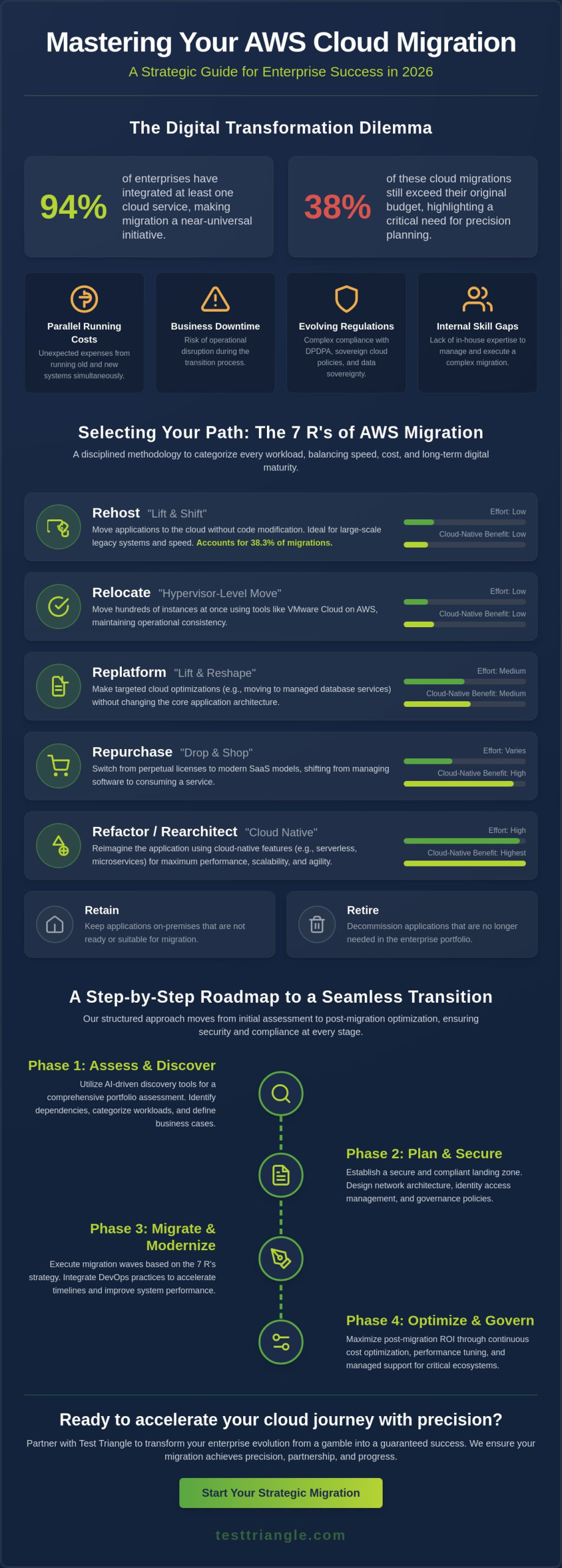

By the end of 2026, Gartner projects that 75% of new Application Development will occur on low-code platforms, yet many enterprises remain tethered to legacy architectures that stifle this very agility. You likely feel the constant pressure of finding specialized talent while managing inconsistent software quality that drives up maintenance costs. It’s a common frustration to see digital transformation stall because your current systems can’t keep pace with a market where AWS holds a 32% share and Vue.js has reached version 3.5.33. We understand that the relief of mitigating risks only comes when your technical debt is finally addressed through a steady, expert hand.

To bridge the gap between these choices, many enterprises are turning to flexible staffing models as a way to maintain control without the overhead of a massive permanent workforce. This approach allows you to own the intellectual property of a custom build while leveraging external expertise and Remote Tech Talent Placement to accelerate delivery. It’s a method that provides the relief of mitigating risks while empowering your internal teams to focus on high-level strategic architecture rather than just writing code.

By integrating elite talent with high-level strategy, Test Triangle helps global enterprises replace outdated legacy systems with scalable, secure software architectures. This guide provides a clear roadmap to master the complexities of modern development through a lens that balances cutting-edge technology with flexible engagement models. You’ll learn how to leverage the triad of Technology, Talent, and Transformation to ensure your digital infrastructure remains compliant with the April 26, 2027 ADA accessibility standards while driving long-term operational stability as a strategic partner in your success.

Key Takeaways

  • Transition from viewing software as a cost center to a strategic asset by adopting microservices-based architectures that drive enterprise-wide agility.
  • Implement Cloud-Native designs and seamless API integrations to build a resilient infrastructure capable of evolving alongside global technological standards.
  • Master the Build vs. Buy debate by analyzing the long-term Total Cost of Ownership for custom Application Development against standard SaaS licensing models.
  • Elevate development velocity and ensure superior software quality by integrating DevOps consulting and automated testing into the core of your operational heartbeat.
  • Secure a competitive advantage by utilizing flexible engagement models that provide access to elite talent through a trusted partner committed to your digital transformation.

Modern Application Development has transitioned from a back-office technical function to a primary driver of enterprise value. By 2026, global organizations have realized that viewing software as a mere cost center leads to stagnation and high maintenance costs. Instead, successful leaders treat their software ecosystem as a strategic asset that requires a “Strategic Architect” approach. This perspective ensures that every technical decision aligns with long-term business goals, effectively mitigating the technical debt that often accumulates when speed is prioritized over architectural integrity.

The technological landscape in 2026 is defined by a decisive shift from monolithic structures to microservices-based architectures. While monolithic systems provided simplicity in the past, they now act as anchors that slow down digital transformation. By leveraging microservices, enterprises gain the ability to scale specific components of their infrastructure independently, ensuring that a surge in user demand doesn’t compromise the entire system’s stability. Custom software provides a distinct competitive moat that generic SaaS products cannot replicate. While SaaS offers rapid deployment, it often lacks the flexibility required to support unique business processes or integrate deeply with existing legacy data.

The Evolution of the Software Development Life Cycle (SDLC)

The industry has moved beyond the rigid constraints of Waterfall and the sometimes chaotic speed of pure Agile toward a model of Continuous Development. Modern enterprises now utilize a hybrid approach that combines the structured planning of traditional methods with the rapid iteration of DevOps. This balance allows for the stability required in high-stakes environments while maintaining the velocity needed to respond to market shifts. The software development lifecycle serves as a structured framework for systematic risk mitigation and consistent value delivery throughout the functional lifespan of an enterprise asset.

Why Custom Application Development Matters in 2026

In highly regulated sectors like Finance and Pharma, “off-the-shelf” solutions frequently fail to meet stringent compliance and security requirements. Custom Application Development allows for the embedding of specific regulatory logic directly into the software, ensuring that data privacy and audit trails are flawless by design. As organizations prepare for the April 26, 2027 ADA accessibility deadline, custom builds offer the precision needed to meet WCAG 2.1 Level AA standards across all platforms. Integrating robust IT Service Management solutions ensures that these custom applications are supported by a reliable service desk and clear operational workflows, bridging the gap between technical execution and superior business outcomes.

Architectural Pillars: Building for Scalability and Resilience

Establishing a robust architectural foundation requires more than technical skill; it demands a visionary perspective on how software interacts with global infrastructure. By prioritizing cloud-native designs, enterprises leverage the inherent elasticity of providers like AWS, which currently holds 32% of the market, to handle fluctuating workloads without manual intervention. This shift ensures that Application Development projects result in software that is not just functional but inherently resilient against the system-wide failures common in older, monolithic setups. When evaluating the Build vs. Buy paradigm, the architectural flexibility of a custom cloud-native build often outweighs the rigid constraints of generic SaaS platforms, and a well-executed AWS Cloud Migration is frequently the critical first step in achieving that flexibility.

Security by Design has become a non-negotiable requirement in 2026. With new regulations like the Texas App Store Accountability Act now in effect, protection must be embedded into the initial code rather than treated as a final layer. This proactive stance mitigates risks before they manifest, providing the “flawless” security that global enterprises demand. Furthermore, robust database management acts as the engine for data-centric business decisions. By ensuring high availability and low latency in data retrieval, organizations can optimize their operations in real-time, turning raw information into a superior strategic advantage.

Microservices and Containerisation

Breaking down a monolith into microservices accelerates deployment cycles by allowing teams to update individual components without risking the entire ecosystem. Docker and Kubernetes have emerged as the industry standards for managing these complex environments, providing the orchestration needed for flawless performance at scale. Enterprises should consider this transition when legacy maintenance costs begin to exceed the investment required for modernization. This modular approach improves fault tolerance, as the failure of one service doesn’t lead to a total system blackout. It’s a disciplined way to ensure your digital infrastructure remains versatile and globally competitive.

API-First Strategy and Integration

A modern application must be built to “talk” to existing IT ecosystems, including ServiceNow, Atlassian, and hybrid cloud environments. An API-first strategy ensures that your software acts as a connective tissue rather than an isolated silo. A strategic Atlassian Implementation ensures that these APIs drive real-world workflow automation, allowing Jira and other tools to sync perfectly with your custom builds. This level of integration maintains data integrity across diverse platforms, ensuring that both IT managers and C-suite executives have access to a single, reliable version of truth. If you’re ready to align your architecture with your business goals, speak with our strategic architects today to explore a tailored roadmap.

Application Development: A Strategic Guide to Enterprise Scalability in 2026

The Build vs. Buy Debate: Aligning Development with Business Strategy

Deciding between purchasing a subscription and investing in custom Application Development is a pivotal moment in any digital transformation strategy. While SaaS offers an immediate solution, it often imposes a “feature rigidity” that limits your ability to innovate beyond the vendor’s roadmap. By contrast, custom development provides the strategic flexibility needed to build unique competitive advantages that competitors cannot simply buy off the shelf. However, the Total Cost of Ownership (TCO) extends far beyond the initial build. You must account for long-term maintenance, security updates, and the potential for vendor lock-in that often accompanies proprietary platforms. A disciplined approach evaluates these factors against the specific business outcomes required for long-term operational stability.

To bridge the gap between these choices, many enterprises are turning to flexible staffing models as a way to maintain control without the overhead of a massive permanent workforce. This approach allows you to own the intellectual property of a custom build while leveraging external expertise to accelerate delivery. It’s a method that provides the relief of mitigating risks while empowering your internal teams to focus on high-level strategic architecture rather than just writing code.

Flexible Talent Models: Contract, Remote, and Offshore

By utilizing specialized staffing solutions, organizations can scale their technical teams within 14 days rather than the standard 45-day recruitment cycle. This agility is essential when facing a sudden surge in project scope or a shift in technological requirements. Comparing the ROI of permanent placements against remote offshore resources reveals that a hybrid model often yields the highest efficiency; you get the stability of core internal leads combined with the cost-effectiveness of global talent that can reduce overhead by 40%. For highly regulated sectors, such as Life Sciences, Pharma IT Staffing ensures that developers possess the necessary compliance knowledge to navigate GxP and data integrity standards flawlessly.

Low-Code vs. Custom Code: A Hybrid Future

Low-code platforms are excellent for rapid prototyping and internal administrative tools where speed outweighs uniqueness. As noted previously, while low-code may account for 75% of new builds by late 2026, core business logic and customer-facing features should remain within a custom-developed, proprietary environment to prevent competitors from easily replicating your service model. By employing Managed Outsourcing Services, you can effectively maintain these hybrid codebases. This ensures that your low-code experiments integrate seamlessly with your robust, custom-built core, allowing for a steady hand in a fast-changing technological landscape.

Optimising the Development Lifecycle: DevOps, Testing, and AI

Integrating DevOps consulting into your operational framework acts as the high-velocity engine that drives modern Application Development. This strategic alignment ensures that software is no longer a static deliverable but a living asset that evolves alongside market demands. Quality assurance serves as the silent partner in this process, providing the essential guardrails that prevent technical debt from compromising your digital transformation. By leveraging automated testing, enterprises can reduce their time-to-market while maintaining the robust stability required for global operations. It’s a disciplined approach that moves beyond simple coding to focus on long-term operational excellence.

The successful integration of these methodologies provides the relief of mitigating risks before they reach the production environment. Instead of treating security and performance as final hurdles, a strategic architect embeds them into the core of the lifecycle. This proactive stance ensures that your digital infrastructure remains secure, scalable, and superior to generic, off-the-shelf alternatives.

The DevOps Engine: CI/CD and Automation

Continuous Integration and Continuous Deployment (CI/CD) protocols eliminate the manual bottlenecks that historically delayed software releases by weeks. Implementing a shift-left approach allows teams to identify security vulnerabilities and performance lags during the initial coding phase rather than at the finish line. This methodology ensures that every code commit is automatically validated, providing immediate feedback to developers and accelerating the overall delivery rhythm. DevOps transforms development from a temporary project into a continuous product mindset that prioritizes long-term scalability.

QA and Testing: Beyond the Basics

Even with the rise of sophisticated automation, Manual Testing in 2026 remains vital for ensuring a human-centric user experience that scripts might overlook. For global enterprises managing massive validation projects, QA Outsourcing provides the specialized talent needed to maintain flawless quality across diverse platforms. Performance and security testing are no longer optional extras; they’re the primary shields protecting your enterprise reputation in an era of increasing cyber threats. It’s about ensuring that every release meets the highest standards of precision and reliability.

Leveraging AI for Intelligent Development

Strategic use of Artificial Intelligence Services enables teams to refactor legacy code and generate UI variations at unprecedented speeds. However, AI-generated code carries inherent risks that demand human oversight and rigorous testing to avoid subtle logic flaws. By using AI-driven analytics for predictive maintenance, enterprises can identify potential application failures before they impact the end-user. This intelligent layer adds a new dimension to your digital infrastructure, allowing for a steady hand in a fast-changing technological landscape. To see how these tools can elevate your specific projects, schedule a strategic DevOps consultation with our team today.

Strategic Partnerships: Elevating Development through Technology and Talent

By synthesizing technical rigor with a deep understanding of business objectives, Test Triangle positions itself as more than a service provider; we operate as a Strategic Architect for your digital future. Our core philosophy—Technology. Talent. Transformation.—serves as the foundation for every Application Development project we undertake. This holistic approach ensures that your software isn’t just a functional tool but a scalable asset designed for long-term operational stability. As a Trusted Partner, we bridge the gap between complex technical execution and high-level business strategy, providing the relief of mitigating risks while empowering your organization to innovate at scale.

By leveraging partner-aligned expertise in Atlassian, ServiceNow, and AWS, we anchor our solutions in recognized global standards. Utilizing specialized Atlassian implementation strategies allows us to optimize Jira Service Management to act as the central nervous system for your development teams. This integration ensures that your workflows are rhythmic, methodical, and highly structured, mirroring the efficiency we bring to every client engagement. To begin your digital transformation journey, we recommend a strategic assessment that evaluates your current technical debt against your 2026 growth targets.

Partnering for Global Success

Operating as a proud client of Enterprise Ireland, Test Triangle provides a global footprint that supports enterprises across Europe, North America, and Asia. Our flexible engagement models allow for the rapid scaling of specialized teams, ensuring that your projects remain on track regardless of geographic complexity. In a recent transformation project for a Tier-1 banking institution, we reduced system downtime by 22% by modernizing their legacy middleware with a cloud-native architecture. This real-world impact demonstrates how strategic partnership elevates technical projects into drivers of enterprise efficiency. By combining technical expertise with adaptable managed outsourcing services, we help businesses reduce costs while elevating the quality of their software output.

The Road Ahead: Future-Proofing Your Applications

Future-proofing your applications requires looking beyond current trends toward the next wave of innovation, including quantum computing and advanced edge development. As these technologies mature, the importance of continuous learning and training for development teams cannot be overstated. By investing in the ongoing professional development of your talent, you ensure that your digital assets remain superior in performance and security. A steady hand in a fast-changing technological landscape is essential for maintaining a competitive moat. To begin your journey toward a robust, scalable future, contact Test Triangle for a Strategic Technology Roadmap today and secure your position as a digital leader.

Architecting a Resilient Digital Future

Success in modern Application Development requires a disciplined alignment of architectural precision and elite talent models. By transitioning from rigid monolithic systems to flexible cloud-native designs, enterprises secure the scalability needed to thrive in a global market. Integrating DevOps automation with human-centric manual testing ensures that your software remains robust while accelerating delivery cycles. This strategic approach effectively mitigates technical debt and positions your digital infrastructure as a long-term value driver.

As an Enterprise Ireland client and an authorized partner for Atlassian and ServiceNow, Test Triangle provides the steady hand required to lead your next phase of growth. By leveraging our signature triad of Technology. Talent. Transformation., we help you optimize every stage of the software lifecycle. It’s time to elevate your operations through a relationship with a Trusted Partner dedicated to your long-term stability and success. Partner with Test Triangle for Strategic Application Development and begin building a superior digital moat today. Your roadmap to flawless transformation starts with a single strategic assessment.

Frequently Asked Questions

What is the primary difference between custom application development and SaaS?

Custom Application Development provides enterprises with full ownership of their intellectual property and the strategic flexibility to build unique competitive moats that generic SaaS platforms cannot replicate. While SaaS offers a rapid initial setup, it often imposes feature rigidity and vendor lock-in that can stifle long-term innovation. By investing in a custom build, you ensure the software aligns perfectly with your specific business processes and integrates seamlessly with your existing digital infrastructure.

How much does enterprise application development typically cost in 2026?

Total investment for enterprise software is primarily influenced by the complexity of the architecture and the scale of the required talent pool. Organizations must also account for recurring infrastructure costs, such as AWS S3 storage at $0.023 per GB or Azure Blob Storage at $0.018 per GB, to maintain their operational heartbeat. A strategic architect optimizes these expenditures by implementing FinOps practices that ensure technical execution remains cost-effective and superior in performance.

How long does it take to build a custom enterprise-level application?

Developing a production-ready Minimum Viable Product (MVP) for a complex enterprise environment typically requires a timeline of 120 to 240 days. This duration allows for the methodical execution of the discovery phase, architectural design, and the rigorous security testing necessary for global compliance. By utilizing flexible engagement models, enterprises can scale their teams to meet tight deadlines without sacrificing the precision or stability of the final deliverable.

What are the most popular programming languages for application development today?

React continues to lead the market with a 44.7% usage rate among developers, followed by Angular at 18.2% and Vue.js at 17.6%, which reached version 3.5.33 in April 2026. For high-performance, cloud-native systems, languages like Go and Rust are increasingly leveraged to drive efficiency within microservices architectures. Selecting the right stack is a strategic decision that impacts your ability to recruit elite talent and maintain the software over its functional lifespan.

Can I outsource application development without losing control of my project?

Maintaining project control during outsourcing is achieved by establishing a transparent governance framework supported by industry-leading tools like Jira Service Management. By partnering with a Trusted Partner who emphasizes clear communication and methodical reporting, you retain full oversight of the strategic roadmap while leveraging external technical expertise. This approach provides the relief of mitigating risks while ensuring that your internal standards for quality and security are met flawlessly.

How does DevOps improve the application development process?

DevOps accelerates the development rhythm by eliminating manual bottlenecks through the implementation of Continuous Integration and Continuous Deployment (CI/CD) pipelines. By adopting a shift-left strategy, teams identify performance lags and security vulnerabilities early in the lifecycle, which significantly reduces the cost of late-stage remediation. This transformation ensures that the software remains robust and resilient, providing a steady hand in a fast-changing technological landscape.

What role does AI play in modern application development workflows?

AI serves as an intelligent layer that optimizes workflows by automating routine tasks such as code refactoring and the generation of UI variations. While low-code platforms are projected to account for 75% of new development by late 2026, human oversight remains essential to validate the logic and security of AI-generated components. Predictive analytics also leverage AI to identify potential system failures before they impact the end-user, ensuring long-term operational stability.

How do I choose the right application development partner for my business?

Selecting the ideal partner requires evaluating their institutional maturity and their ability to operate across diverse sectors like Banking and Life Sciences. You should prioritize an Enterprise Ireland client with authorized expertise in global standards such as Atlassian and ServiceNow. A superior partner acts as a Strategic Architect, embodying the triad of Technology, Talent, and Transformation to ensure your digital infrastructure is secure, scalable, and built for future growth.

Paul Guy

Article by

Paul Guy

Paul serves as the Marketing Director at Test Triangle, where he leads a global team in driving growth through strategic B2B marketing and brand communications. With a strong emphasis on measurable outcomes and sustainable performance, he plays a pivotal role in aligning marketing functions to enhance customer engagement and accelerate business impact. Under his leadership, marketing initiatives have consistently delivered significant returns on investment, elevated brand visibility, and strengthened the company's presence across key markets.


By 2026, the financial burden of managing technical debt will consume 40% of the average enterprise IT budget, effectively paralyzing innovation for any organization relying on fragmented Digital Transformation Services. You already understand that reconciling application sprawl with rigid compliance requirements often leads to significant business disruption during cloud transitions. It’s a delicate balance that requires more than just new software; it requires a steady hand to maintain continuity. At Test Triangle, we believe that true agility isn’t found in tools alone but in the strategic orchestration of complex ecosystems.

As your Trusted Partner, we promise to show you how a disciplined synergy of technology, talent, and transformation drives measurable ROI while ensuring long-term operational stability. By aligning robust DevOps practices with Jira Service Management and other high-tier ITSM platforms, global enterprises can finally eliminate silos and accelerate delivery cycles. This roadmap previews how to leverage flexible staffing models and intelligent automation to reduce operational costs by 30% and achieve a seamless infrastructure for the years ahead. Technology. Talent. Transformation.

Key Takeaways

  • Understand the pivotal shift from “Cloud-First” to “Value-First” strategies, ensuring your organizational evolution prioritizes measurable ROI and long-term operational stability.
  • By leveraging our specialized Digital Transformation Services, enterprises can synchronize technology and talent to eliminate fragmented infrastructure and accelerate global agility.
  • Evaluate the strategic integration of Atlassian, ServiceNow, and AWS to create robust, automated workflows that empower a modern and distributed workforce.
  • Gain actionable insights from real-world case studies demonstrating how a multi-phase DevOps roadmap can successfully modernize complex, high-stakes IT environments.
  • Learn to identify a trusted partner by prioritizing institutional maturity and specialized industry knowledge to mitigate risks in sensitive sectors like Life Sciences.

What are Digital Transformation Services in the 2026 Landscape?

By integrating advanced technological frameworks with organizational culture, Digital Transformation Services enable global enterprises to pivot from rigid legacy structures to agile, value-driven operations. This evolution is no longer about simple digitization; it’s about a fundamental shift in how value is delivered across the entire business ecosystem. By 2026, the global economy has moved from “Cloud-First” strategies, which often resulted in uncontrolled spending, to “Value-First” models. Recent data from IDC indicates that 65% of G2000 organizations now prioritize specific business outcomes over infrastructure migration alone to ensure long-term financial viability.

To ensure your strategy aligns with these value-driven models, you can learn more about AEConsulting and their strategic advisory services.

In sectors like Banking and Life Sciences, the stakes remain exceptionally high. These industries often rely on legacy systems that are over 25 years old. They require specialized transformation approaches that respect strict regulatory compliance while introducing modern flexibility. By leveraging the expertise of a Trusted Partner, these organizations can modernize without disrupting critical patient care or financial transactions. Managed Service Providers (MSPs) play a vital role here. They ensure post-transformation stability by providing the continuous oversight needed to maintain peak performance. This holistic approach combines Technology, Talent, and Transformation to secure a competitive edge in a volatile market.

The Core Pillars of Modern Transformation

Infrastructure Modernisation now moves beyond simple lift and shift strategies. It focuses on cloud-native architectures that allow for near-instant scalability. Data Intelligence has also evolved. By utilizing AI and DataOps, executives can now access real-time insights that drive strategic decision-making. Operational Resilience ensures that systems are robust enough to withstand global market fluctuations and security threats. Since 2024, cyber-resilience has become a non-negotiable component of any successful transformation roadmap.

The 2026 ROI Reality Check

The metrics for success have shifted. Companies now prioritize value-creation metrics over traditional cost-cutting measures to measure the health of their digital investments. A primary barrier to this agility is Application Sprawl. Industry audits from 2025 show that 38% of SaaS spend is wasted on redundant or underutilized tools. Identifying these inefficiencies is the first step toward reclaiming operational speed and improving the bottom line. Digital Transformation is the intersection of operational efficiency and technological innovation.

This spirit of innovation is not limited to the tech sector; forward-thinking consumer brands are also redefining their industries with bold, modern concepts. To see how this translates to a contemporary dining experience that fuels the modern workforce, you can learn more about Tacoverse.

The Test Triangle Framework: Technology, Talent, and Transformation

By integrating a triad of core competencies, Test Triangle ensures that Digital Transformation Services move beyond theoretical planning into operational reality. Technology alone rarely solves structural inefficiency; real progress requires a Strategic Architect approach to bridge the gap between legacy systems and modern cloud environments. By deploying flexible engagement models, enterprises can toggle between offshore, remote, and onsite staffing as project demands fluctuate. This agility reduces overhead while maintaining a steady velocity for complex IT ecosystems.

Aligning DevOps engineering with broader business objectives accelerates time-to-market. When engineering teams prioritize business outcomes over mere ticket completion, deployment frequency can increase significantly. Based on 2024 DORA metrics, high-performing teams see 200 times more frequent code deployments than their peers. This strategic alignment ensures every sprint contributes directly to the enterprise’s bottom line.

Technology: Leveraging Global Standards

By anchoring digital infrastructure in platforms like Atlassian, ServiceNow, and AWS, organizations build a unified digital backbone. Authorized partner expertise is critical because it transforms a standard platform deployment into a customized engine for growth. Test Triangle ensures flawless execution by applying rigorous automation and performance testing. This methodology eliminates manual errors and secures the robust performance required for 2026 enterprise standards. Utilizing Digital Transformation Services that prioritize platform customization allows for a 30 percent improvement in operational efficiency according to recent industry benchmarks.

Talent: The Human Engine of Change

The global IT talent gap is projected to reach 85 million people by 2030, according to research by Korn Ferry. Test Triangle solves this through specialized recruitment and the Managed Staffing model. Unlike traditional recruitment, this model provides ongoing oversight and performance management, ensuring that resources remain aligned with the client’s long-term roadmap.

Pharma IT staffing requires a different pedagogical approach than general tech staffing. It demands a deep understanding of GxP compliance and validated systems that generalists lack. By sourcing niche experts who understand these regulatory nuances, businesses can leverage specialized Digital Transformation Services to maintain regulatory integrity while innovating. This specialized focus reduces the risk of compliance failures, which can cost life sciences firms millions in potential fines and delayed product launches.

Digital Transformation Services: A Strategic Roadmap for Enterprise Agility in 2026

Platform Selection: Atlassian, ServiceNow, and AWS Integration

By aligning technical architecture with long-term business goals, enterprises ensure their Digital Transformation Services yield measurable ROI rather than just incremental change. Selecting the right platform isn’t merely a procurement decision; it’s a strategic commitment to an operational engine. Through precise ServiceNow implementation, organizations transform IT Service Management (ITSM) from a reactive cost center into a proactive value driver. According to the 2024 ServiceNow Value Report, companies leveraging automated workflows see a 30% reduction in Mean Time to Resolution (MTTR), directly enhancing the modern workforce’s productivity.

Atlassian consulting provides the necessary framework to bridge the historical gap between development and operations teams. By deploying Jira Service Management, businesses accelerate deployment cycles by up to 40%, creating a unified language for technical and non-technical stakeholders. Building on this, AWS Cloud Migration offers the elastic foundation required for 2026’s data-intensive applications. Flexera’s 2024 State of the Cloud Report indicates that 69% of IT leaders now prioritize heavy cloud migration to achieve the scalability needed for AI-driven Digital Transformation Services.

  • ServiceNow: Best for orchestrating complex enterprise-wide workflows and cross-departmental service delivery.
  • Atlassian: Ideal for high-velocity software teams requiring deep integration between project management and incident response.
  • AWS: The essential infrastructure layer for hosting microservices and managing global data footprints.

Choosing the Right Engine for Your Transformation

Deciding when to prioritize specific platforms depends on the organization’s primary friction points. If the goal is enterprise-wide workflow automation across HR, legal, and IT, ServiceNow offers the most robust governance. Conversely, software-centric organizations find a strategic advantage in Atlassian’s ecosystem, where Jira’s agility supports rapid iteration. For those maintaining legacy hardware, hybrid-cloud strategies combining AWS with on-premise requirements provide a low-risk path toward modernization without disrupting core stability.

The Power of Integrated Ecosystems

Breaking down silos requires more than just new software; it demands functional interoperability. Integrating ServiceNow with AWS drives cross-departmental efficiency by allowing automated infrastructure provisioning directly from service tickets. For Atlassian users, the case for Atlassian Cloud Migration is increasingly clear. Forrester’s 2023 Total Economic Impact study shows that cloud-migrated teams experience a 20% reduction in administrative overhead while gaining superior security and instant access to feature updates. A Trusted Partner acts as the strategic intermediary that translates complex technical features into sustainable business outcomes through rigorous platform optimization. By focusing on Technology. Talent. Transformation., Test Triangle ensures these ecosystems don’t just exist, but excel.

Case Study: Modernising Global Operations for a High-Stakes Enterprise

Facing the complexities of a global market, a high-stakes enterprise recently sought to rectify its fragmented IT infrastructure. This organization, a leader in the financial services sector, struggled with 18 disparate legacy systems that hampered data flow and slowed response times. By partnering with Test Triangle, they moved away from siloed operations toward a unified, agile environment. This strategic shift was not merely a technical upgrade; it was a total overhaul designed to ensure long-term operational stability and market competitiveness through tailored Digital Transformation Services.

Phase 1: Strategic Technology Roadmapping

By conducting a comprehensive 6-week audit of the client’s existing technical debt, our team identified 45 redundant applications that were draining resources without adding value. We acted as a Strategic Architect, mapping out a roadmap that prioritized the decommissioning of obsolete software while identifying key performance indicators (KPIs) to measure success. These metrics focused on Mean Time to Recovery (MTTR) and deployment lead times. To mitigate risks, we established a robust security and compliance framework that aligned with ISO 27001 standards, ensuring that every step of the transformation remained secure and audit-ready.

Phase 2: Execution and Talent Integration

Leveraging our flexible engagement models, we deployed a specialized team of offshore DevOps engineers to accelerate the development of a modern CI/CD pipeline. This talent integration allowed the client to scale their technical capabilities without the overhead of local hiring. We implemented automated testing services to replace manual, error-prone cycles, ensuring superior software quality across all business units. To further eliminate release bottlenecks that were stalling delivery, the enterprise also evaluated outsourced QA services as a force multiplier for their internal testing teams. By utilizing Atlassian tools such as Jira Service Management and Confluence, we provided a transparent project management environment. This ensured that stakeholders had real-time visibility into the transformation’s progress, fostering a culture of accountability and precision.

The results of this collaboration underscore the power of our core philosophy: Technology. Talent. Transformation. Within the first 12 months of implementation, the enterprise achieved a 30% reduction in annual operational costs. Furthermore, the frequency of software deployments increased from once per quarter to twice per week, representing a significant boost in enterprise agility. This transition allowed the client to respond to market shifts in days rather than months, securing their position as a modern digital leader.

As a Trusted Partner, Test Triangle provides the strategic oversight and technical depth required to optimize your legacy environment. Explore our Digital Transformation Services

Selecting Your Digital Transformation Services Partner

By prioritizing a blend of global reach and local technical expertise, enterprises can secure Digital Transformation Services that don’t just innovate but also stabilize. Selecting a partner in 2026 requires looking beyond basic technical proficiency to find “Institutional Maturity.” This trait ensures a provider understands the complex regulatory frameworks of sectors like Life Sciences or Banking, where a single compliance error can result in millions of euros in fines. By aligning with a partner that possesses deep industry-specific knowledge, businesses can mitigate 100% of the risks associated with GxP compliance and data integrity standards.

Flexible engagement models are another non-negotiable factor for long-term scalability. As market conditions shift, your partner must offer the agility to pivot from a pure consultancy role to a full-scale technical delivery team. This versatility prevents the “vendor lock-in” that frequently stalls growth in 40% of enterprise-level projects. By combining high-level strategic oversight with on-demand technical talent, Test Triangle provides the steady hand required to maintain operational equilibrium during rapid shifts in the technological landscape.

The Trusted Partner Checklist

By conducting a rigorous audit of potential partners, IT leaders can ensure their Digital Transformation Services are built on a foundation of recognized excellence. Use the following criteria to evaluate your options:

  • Certifications and Partnerships: Verify that the firm is an authorized partner for Atlassian, ServiceNow, and AWS. These credentials guarantee that your team is leveraging the full power of Jira Service Management and cloud-native architectures.
  • Industry Experience: Ensure they have a proven track record in your specific niche. In the Life Sciences sector, for example, they must demonstrate an understanding of validated systems and regulatory nuances.
  • Scalability: A true partner provides more than just a roadmap; they provide the specialized talent to execute it. They should offer the capacity to scale your technical workforce by 50% or more within a single quarter if project demands increase.

Drive Your Transformation Today

Initiating your journey begins with a structured discovery session designed to audit your legacy environment and identify immediate automation opportunities. By launching a 90-day pilot project, your organization can demonstrate tangible ROI, often achieving a 25% reduction in manual processing times before a full-scale rollout begins. This phased approach allows for the “fail-fast” mentality required for modern agility without risking the stability of your core business functions.

Test Triangle stands ready to serve as your Strategic Architect in an increasingly complex world. We don’t just provide tools; we provide the visionary leadership and practical execution needed to turn your digital roadmap into a competitive advantage. Reach out to our consultants today to begin your evolution. Technology. Talent. Transformation.

Securing Your Competitive Advantage for 2026

Navigating the complex 2026 landscape requires more than just adopting new software; it demands a holistic integration of Atlassian, ServiceNow, and AWS to ensure operational fluidity. By leveraging the Test Triangle framework of Technology, Talent, and Transformation, global enterprises bridge the gap between legacy systems and modern agility. Selecting the right Digital Transformation Services partner is the final, most critical step in this strategic journey. As an Authorized Atlassian and ServiceNow Partner, Test Triangle provides the technical rigor needed to support Fortune 500 companies within the Finance and Life Sciences sectors. With global delivery centers operating in Dublin, London, and Hyderabad, we ensure around-the-clock strategic support and localized expertise. By aligning robust platform integrations with a culture of continuous improvement, your organization can achieve the enterprise agility required for the 2026 marketplace. It’s time to turn your strategic roadmap into a tangible competitive advantage and lead your industry with confidence.

Partner with Test Triangle for your Digital Transformation journey

Frequently Asked Questions

What are the primary benefits of digital transformation services for large enterprises?

Enhanced operational agility and data-driven decision-making are the primary benefits for large organizations. By integrating Digital Transformation Services, enterprises can reduce time-to-market by 30% according to McKinsey reports. This strategic shift allows organizations to leverage real-time analytics to optimize supply chains and elevate customer experiences across global touchpoints. We help you transition from legacy constraints to a flexible, scalable architecture.

How does Test Triangle ensure business continuity during a cloud migration?

Test Triangle ensures business continuity by utilizing a phased migration approach backed by 24/7 monitoring. By leveraging Atlassian and ServiceNow integrations, we maintain 99.9% uptime during the transition. Our consultants implement robust disaster recovery protocols that guarantee data integrity. Your critical systems remain operational while we migrate legacy workloads to the cloud, providing a flawless transition without service interruptions.

What is the difference between digital transformation and simple IT modernization?

Digital transformation involves a fundamental cultural and operational shift, whereas IT modernization focuses solely on upgrading legacy hardware or software. Modernization might replace a server, but transformation leverages technology to redefine the entire business model. According to Gartner, 91% of businesses are engaged in digital initiatives. Only those who integrate talent and technology achieve true enterprise agility through a strategic, vision-led approach.

How do you manage compliance and security in digital transformation for the pharmaceutical industry?

We manage compliance by implementing GxP-compliant frameworks and automated validation tools within the digital ecosystem. By integrating Jira Service Management with strict audit trails, Test Triangle ensures every software update meets FDA 21 CFR Part 11 requirements. This strategic approach mitigates risk while accelerating the deployment of critical life sciences applications. We prioritize security to ensure your data remains protected in highly regulated environments.

Why is talent acquisition a critical component of digital transformation services?

Talent acquisition is a critical component because 70% of digital initiatives fail due to a lack of skilled personnel according to BCG data. Successful Digital Transformation Services require a blend of technical expertise and strategic vision that internal teams often lack. By securing specialized talent through our flexible engagement models, organizations bridge the skills gap. This ensures that new technologies are adopted effectively across the enterprise.

Can digital transformation services help in reducing long-term IT maintenance costs?

Yes, digital transformation reduces long-term maintenance costs by replacing fragmented legacy systems with scalable, automated cloud infrastructures. Organizations often see a 20% reduction in operational expenditures within the first 24 months. By optimizing workflows and leveraging AI-driven analytics, enterprises eliminate the technical debt that typically consumes 60% of corporate IT budgets. This shift allows you to reallocate resources toward innovation rather than upkeep.

How long does a typical enterprise-level digital transformation project take?

A typical enterprise-level digital transformation project spans 12 to 24 months depending on the complexity of the infrastructure. While initial pilot phases deliver measurable results within 6 months, achieving full organizational agility requires a multi-year roadmap. Test Triangle utilizes a methodical framework to deliver incremental value throughout this timeline. We ensure that strategic objectives are met at every milestone while maintaining operational stability.

What role does DevOps play in a successful digital transformation strategy?

DevOps acts as the engine for continuous delivery by bridging the gap between development and operations teams. By implementing automated CI/CD pipelines, businesses increase deployment frequency by 200 times compared to traditional models. This collaboration is essential for a successful strategy because it fosters a culture of stability and rapid innovation. We leverage tools like Jira to accelerate software delivery and ensure a robust digital landscape. Enterprises looking to further strengthen their release confidence should also explore a quality assurance outsourcing strategy to scale AI-augmented testing capabilities alongside their DevOps pipelines.

Paul Guy

Article by

Paul Guy

Paul serves as the Marketing Director at Test Triangle, where he leads a global team in driving growth through strategic B2B marketing and brand communications. With a strong emphasis on measurable outcomes and sustainable performance, he plays a pivotal role in aligning marketing functions to enhance customer engagement and accelerate business impact. Under his leadership, marketing initiatives have consistently delivered significant returns on investment, elevated brand visibility, and strengthened the company's presence across key markets.
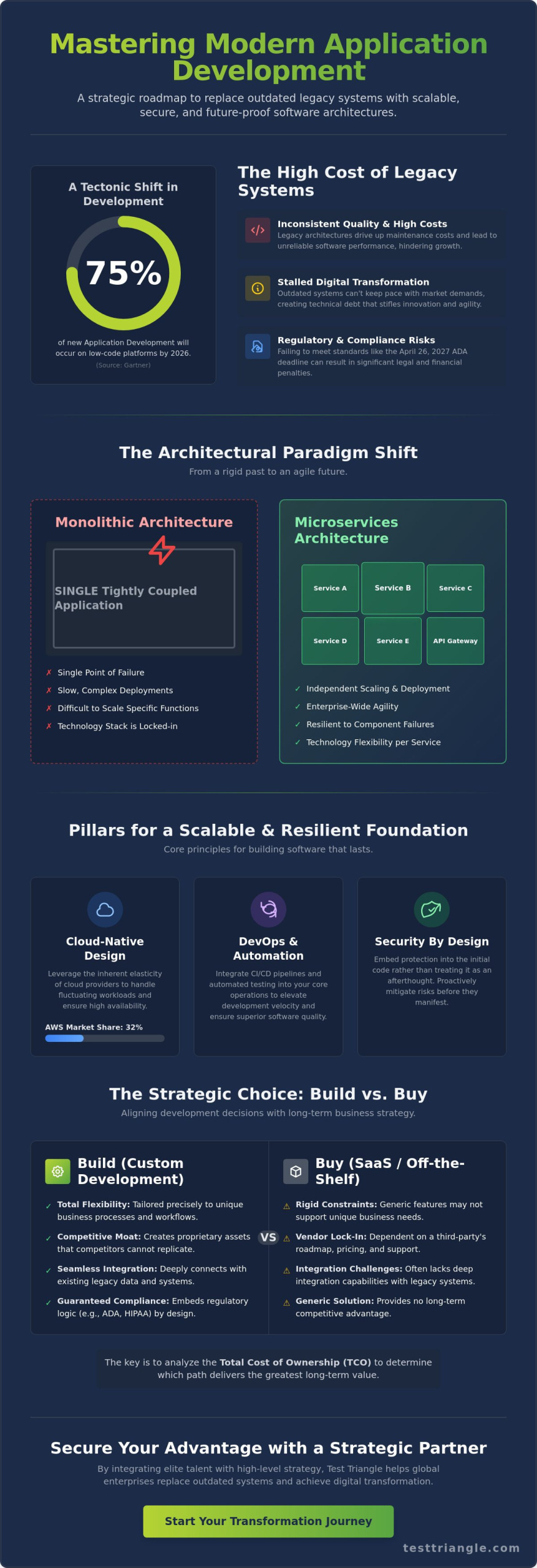

According to a 2023 Gartner report, 70% of digital transformation initiatives fail to reach their full potential due to poor strategic alignment and talent shortages. You likely recognize that a successful ServiceNow Implementation requires more than just technical configuration; it’s a process that demands total synchronization of your organizational culture and legacy data. Finding specialized architects who understand the nuances of 2026 market demands is a persistent struggle for 54% of IT leaders globally. By combining technical expertise with adaptable delivery models, Test Triangle helps businesses eliminate these risks while ensuring their complex digital infrastructures are in safe hands.

This guide empowers you to master the complexities of your deployment through a strategic roadmap designed to align Technology, Talent, and Transformation. As your Trusted Partner, we’ll demonstrate how to drive seamless workflow automation and establish scalable platform governance that delivers a proven ROI within 12 months. We’ll explore the specific frameworks necessary to transition from fragmented legacy systems to a unified, superior digital ecosystem.

Key Takeaways

  • By evolving from legacy ITSM to a Total Experience (TX) model, enterprises can leverage ServiceNow as a catalyst for comprehensive, enterprise-wide digital workflow transformation.
  • Discover how to execute a flawless ServiceNow Implementation by integrating the “Now Create” methodology with a strategic “Measure Twice, Cut Once” technical roadmap.
  • Protect your digital infrastructure from the technical debt trap by establishing rigorous governance frameworks that maintain platform integrity and ensure long-term scalability.
  • Navigate complex regulatory landscapes in the pharmaceutical and financial sectors by aligning platform capabilities with global compliance standards and industry-specific requirements.
  • Bridge the gap between software acquisition and strategic execution by utilizing the triad of Technology, Talent, and Transformation to drive superior business outcomes.

The Strategic Landscape of ServiceNow Implementation in 2026

By positioning the platform as the central nervous system of the enterprise, modern ServiceNow Implementation involves a total transformation of digital workflows rather than a simple software deployment. In 2026, the platform has transcended its origins as a tactical ticketing tool to become a Total Experience (TX) powerhouse. This evolution requires a “Strategic Architect” mindset, where technical execution aligns perfectly with long-term business agility. Organizations that treat this process as a mere IT project often fail to capture the full ROI. Instead, a successful ServiceNow Implementation relies on a holistic view of the ServiceNow company overview, acknowledging its shift from a cloud-based provider to an AI-first platform-as-a-service leader. By leveraging our Technology. Talent. Transformation. triad, Test Triangle acts as a Trusted Partner to ensure these complex infrastructures deliver measurable competitive advantages.

Beyond ITSM: The Rise of Unified Digital Workflows

The 2026 enterprise landscape demands a unified pane of glass that connects HR, Customer Service, and IT operations seamlessly. By integrating these disparate functions into a single workflow engine, businesses can eliminate the 40% productivity loss typically caused by departmental silos. Our flexible engagement models focus on creating a frictionless environment where data flows across the organization without manual intervention. Cross-Departmental Synergy is the orchestrated alignment of distinct business units through a shared digital fabric that ensures data consistency and operational speed.

  • HR Integration: Automating employee lifecycle events from onboarding to retirement.
  • Customer Service: Linking front-end requests directly to back-end IT resolution teams.
  • IT Operations: Moving from reactive troubleshooting to predictive system health management.

The 2026 AI Factor: Implementing with ‘Now Assist’

The 2026 release of ServiceNow has made ‘Now Assist’ the cornerstone of every deployment strategy. By embedding Generative AI (GenAI) into the core architecture, the platform now offers automated code generation that reduces development cycles by up to 65%. This shift allows our architects to accelerate the implementation timeline, moving from conceptual design to go-live faster than ever before. AI doesn’t just speed up the build; it transforms the end-user experience. With advanced natural language processing, self-service capabilities have reached a 92% deflection rate, significantly reducing the burden on human agents. Through this AI-first approach, we empower clients to drive innovation while maintaining a robust and secure digital environment.

By combining technical expertise with adaptable delivery models, Test Triangle helps businesses reduce costs and elevate their operational standards. We remain committed to delivering superior results that reflect our status as a visionary partner in the global technology ecosystem.

A Proven Framework: The 5 Pillars of Successful Deployment

Executing a ServiceNow Implementation requires more than technical proficiency; it demands a strategic architecture that aligns platform capabilities with long-term business objectives. At Test Triangle, we enhance the standard “Now Create” methodology with our own layer of strategic rigour. We operate on a “Measure Twice, Cut Once” philosophy. This means every technical decision is vetted against its impact on future scalability and operational stability. By shifting from project-based thinking to platform-based thinking, we ensure your investment doesn’t become a static tool but evolves as a dynamic engine for growth.

The initial 30 days of any engagement determine its trajectory. During this window, we prioritize stakeholder alignment across the C-suite and IT operations. We’ve observed that 65% of implementation delays stem from misaligned expectations rather than technical hurdles. By securing executive buy-in and defining clear ownership early, we mitigate risks before they manifest as costly bottlenecks.

Discovery and Strategic Roadmapping

Success begins with a comprehensive audit of your current state versus your desired future architecture. We don’t just look at software; we analyze the workflows that drive your business. We establish key performance indicators (KPIs), such as a 25% reduction in mean time to resolution (MTTR), from Day 1. Our teams develop a “Value Realization” map that tracks these metrics throughout the lifecycle. This ensures every configuration choice translates into a tangible business outcome, providing a clear path for digital transformation.

Agile Configuration vs. Customization

We advocate for an “Out-of-the-Box” (OOTB) first approach. While customization offers specific tailoring, it often creates a maintenance liability that complicates future upgrades. Adhering to at least 80% OOTB functionality reduces technical debt by nearly 40% over three years. We only recommend customization when it provides a distinct competitive advantage. Use this checklist to evaluate custom scripts:

  • Does the feature exist in the upcoming ServiceNow roadmap?
  • Will this script break during a standard version upgrade?
  • Can the requirement be met through low-code Flow Designer logic?
  • Is the business value higher than the long-term maintenance cost?

Rigorous Quality Assurance and Testing

Test Triangle leverages a decade of expertise in manual and automated testing to safeguard your environment. User Acceptance Testing (UAT) is the most common failure point in a ServiceNow Implementation, often due to insufficient test coverage. We bridge this gap by integrating Manual Testing as the vital foundation for validating complex, human-centric workflows. By combining this with automated regression suites, we ensure that new configurations don’t disrupt existing services. This dual-layered approach provides the “flawless execution” our global partners expect, ensuring your platform remains robust and reliable under enterprise-level demand.

ServiceNow Implementation Guide: Strategic Frameworks for 2026

Mitigating Risk: Governance and the Technical Debt Trap

The most frequent reservation stakeholders express during a ServiceNow Implementation is the fear of the platform devolving into an unmanageable tangle of customizations. Without a rigorous governance framework, the initial agility of the system quickly erodes into technical debt. Neglecting platform health leads to a 30% increase in upgrade cycle times within the first two years of operation. This stagnation occurs when teams prioritize short-term “quick fixes” over architectural integrity. By positioning a Strategic Architect at the helm post-deployment, Test Triangle ensures that every configuration aligns with the long-term roadmap. This role acts as a guardian of the “Out-of-the-Box” functionality, ensuring that regular health checks identify and remediate performance bottlenecks before they impact the end-user experience.

Establishing a ServiceNow Center of Excellence (CoE)

A successful CoE functions as the central nervous system for platform growth, comprising a Platform Owner, Lead Architect, and representatives from diverse business units. By centralizing decision rights, the CoE effectively eliminates “shadow IT” where individual departments create siloed, non-standard workflows. This structured oversight ensures that every new feature request undergoes a rigorous impact analysis to maintain a clean ServiceNow Implementation. Organizations that leverage a formal CoE achieve a 25% higher ROI on their platform investment over a three-year period compared to those with decentralized management.

Managing Legacy Integration and Data Integrity

Integrating modern workflows with existing infrastructure requires a surgical approach to data movement. When organizations execute an AWS Cloud Migration, the synchronization between cloud assets and the ServiceNow Configuration Management Database (CMDB) becomes a critical failure point. The “Extract, Transform, Load” (ETL) process in ServiceNow presents unique challenges, specifically regarding data mapping and the reconciliation of duplicate records from legacy systems. Maintaining data hygiene in the CMDB isn’t a one-time event; it’s a continuous discipline. By utilizing automated discovery tools and strict identification rules, we transform the CMDB into a reliable “single source of truth” that supports informed decision-making across the enterprise. Through our commitment to Technology, Talent, and Transformation, Test Triangle serves as a Trusted Partner in securing your digital foundation. Enterprises managing complex tool ecosystems alongside ServiceNow often benefit from Atlassian consulting services Dublin to ensure that platforms like Jira and Confluence are equally optimized and integrated within their broader digital strategy. For organizations seeking a comprehensive approach to enterprise-wide tool optimization, exploring Atlassian Consulting strategies for 2026 can provide the strategic framework needed to transform your software ecosystem from a static utility into a dynamic engine for growth.

Industry-Specific Implementation: Pharma and Regulated Sectors

By combining technical expertise with adaptable delivery models, Test Triangle elevates ServiceNow Implementation beyond simple software deployment. We understand that for global enterprises in pharma and finance, the cost of non-compliance is staggering, with average costs reaching $14.8 million according to 2023 industry reports. Our strategic architects build robust frameworks that prioritize security and auditability, ensuring that digital transformation doesn’t compromise regulatory standing. We act as a Trusted Partner, bridging the gap between high-level business goals and the granular requirements of global regulators.

Just as we provide specialized expertise for regulated IT environments, other complex sectors like urban transport require similar precision; for example, ML Traffic Engineers Australia offers the specialized traffic planning needed to navigate modern infrastructure challenges.

GxP Compliance and Validated Systems for Life Sciences

Pharmaceutical organizations operate under the strict scrutiny of the FDA and EMA, where system integrity is a matter of patient safety. Executing a ServiceNow Implementation in a validated environment requires a methodical approach that aligns with GAMP 5 guidelines. By leveraging specialized Pharma IT Staffing, firms can bridge the talent gap and ensure that every configuration change is documented and tested. We focus on the following core requirements:

  • CFR Part 11 Compliance: We automate the capture of electronic signatures and time-stamped audit trails to meet 21 CFR Part 11 standards.
  • Validation Lifecycle Management: Our team manages the Installation Qualification (IQ), Operational Qualification (OQ), and Performance Qualification (PQ) processes.
  • Data Integrity: We implement strict access controls and data encryption to prevent unauthorized alterations of critical records.

Using these structured methodologies reduces manual documentation errors by approximately 40%. This precision allows life sciences companies to accelerate their “Technology. Talent. Transformation.” journey without fearing the next regulatory audit.

Operational Resilience in Highly Regulated Finance

The financial sector faces a shifting landscape with the Digital Operational Resilience Act (DORA) mandating strict compliance by January 2025. Financial institutions can’t afford downtime; they require systems that are both agile and unbreakable. We help banking clients automate risk management workflows, transforming reactive processes into proactive defense strategies. Our setups emphasize high availability and disaster recovery, targeting a 99.99% uptime to maintain market stability.

Secure your operational future with a partner who understands the complexities of regulated industries. Consult with our compliance experts today to begin your strategic ServiceNow journey.

Partnering for Transformation: The Test Triangle Advantage

By aligning technical proficiency with long-term business objectives, Test Triangle transcends the traditional role of a software reseller. We operate as a strategic architect, ensuring that your ServiceNow implementation serves as a catalyst for organizational change. With a localized presence in Dublin and London, we provide the high-touch consultation global enterprises require, while our international footprint facilitates 24/7 operational continuity. We don’t just deliver a platform; we build a resilient digital foundation. Our status as a trusted partner is reinforced by our work with Enterprise Ireland and our success in highly regulated sectors like Banking and Life Sciences. We bridge the gap between initial software acquisition and the complex reality of strategic execution, ensuring that every workflow contributes to your broader digital evolution.

Flexible Engagement Models: Onshore, Offshore, and Hybrid

Scalability remains a primary concern for 68% of enterprise IT leaders who face fluctuating project demands. To address this, we offer specialized IT Staffing Services that integrate seamlessly with your internal teams for long-term platform support. Our “Follow the Sun” model leverages offices in Dublin, Hyderabad, and Austin to provide uninterrupted support across all global time zones. This hybrid approach allows organizations to balance the cost-efficiency of offshore resources with the high-context proximity of onshore consultants. By deploying managed services that adapt to your specific needs, businesses maintain platform health without the overhead of permanent full-time hires. This flexibility ensures that your ServiceNow implementation remains agile, allowing you to scale resources up or down based on real-time operational requirements.

  • Onshore Support: Direct access to senior consultants in Dublin and London for high-level strategy and complex integrations.
  • Offshore Efficiency: Cost-effective technical maintenance and development through our Hyderabad excellence center.
  • Follow the Sun: Continuous monitoring and 24/7 incident response to minimize downtime across global offices.

Technology. Talent. Transformation: Our Signature Approach

Our core value proposition rests on a triad that defines every project we undertake. First, we leverage cutting-edge technology to automate legacy processes and eliminate manual bottlenecks. Second, our deep recruitment expertise ensures you have access to the specialized talent necessary to manage and evolve the platform. Finally, we drive transformation by aligning IT outputs with measurable business KPIs. As an authorized partner, we ensure your investment yields maximum ROI through disciplined execution and continuous optimization. We focus on mitigating risks while empowering your workforce to focus on high-value innovation. Our methodology transforms IT from a cost center into a primary driver of corporate agility and stability.

Ready to elevate your IT infrastructure? Schedule a ServiceNow Strategic Roadmap Session today to define your path toward operational excellence.

Mastering the Next Frontier of Digital Transformation

Navigating the complexities of a ServiceNow Implementation in 2026 requires more than just technical migration; it demands a robust 5 pillar framework that prioritizes governance to eliminate technical debt before it compromises your ROI. By integrating industry specific protocols for the Pharma and Finance sectors, global enterprises ensure compliance while accelerating their digital evolution. Test Triangle serves as your Trusted Partner, operating through a global delivery model across Dublin, London, Austin, and Hyderabad to provide strategic oversight. As an Authorized ServiceNow Partner, we ensure your infrastructure benefits from the highest standards of precision. By aligning technical execution with long term business outcomes, we’ll help you secure a superior competitive advantage in an increasingly automated marketplace.

Through our unique blend of Technology. Talent. Transformation., we empower your organization to move beyond basic automation toward a state of flawless operational excellence. Elevate your enterprise workflows with our ServiceNow Implementation experts. It’s time to build a more resilient and scalable digital future.

Frequently Asked Questions

What is the typical timeline for a ServiceNow implementation in 2026?

By leveraging AI-driven automation tools available in 2026, a standard ServiceNow implementation typically spans between 4 and 9 months. This timeline accounts for the initial discovery phase and the subsequent deployment of core ITSM modules. While basic setups finish within 16 weeks, complex global deployments involving multiple business units often require the full 36 week cycle to ensure operational stability across the enterprise.

How much does a ServiceNow implementation cost for a mid-sized enterprise?

Mid-sized enterprises should allocate a budget based on industry benchmarks, such as those found in Forrester Total Economic Impact reports, which indicate initial deployment costs often range from $150,000 to $500,000. This investment covers licensing fees, technical labor, and data migration. By adopting flexible engagement models, companies can distribute these costs over several fiscal quarters to better align with their digital transformation objectives and budgetary constraints.

What is the difference between ServiceNow configuration and customization?

Configuration involves using the native tools and settings within the platform to align with business processes, while customization requires writing new code to change the underlying functionality. By prioritizing configuration, organizations maintain a cleaner path for future upgrades and reduce technical debt. Customization should only be utilized when 100% of the business requirement cannot be met by existing out-of-the-box features, as it increases long-term maintenance overhead.

Do we need to hire a full-time ServiceNow administrator before implementation?

Hiring a full-time ServiceNow administrator is recommended at least 3 months before the go-live date to ensure a seamless transition from the implementation team to internal operations. This role provides the necessary technical oversight to manage the 2 annual platform upgrades and daily system maintenance. As a Trusted Partner, we often suggest that teams lacking internal talent leverage managed services to bridge this gap during the initial 12 months of platform maturity.

How does ServiceNow integrate with existing AWS cloud infrastructure?

ServiceNow integrates with AWS cloud infrastructure through the Cloud Management Hub and pre-built Spoke connectors, allowing for automated provisioning and real-time asset discovery. By using the ServiceNow implementation process to link these systems, IT teams gain 95% visibility into their cloud spend and resource utilization. This connection enables the automation of common tasks, such as restarting EC2 instances or managing S3 buckets, directly from the ServiceNow service portal.

What are the risks of a Big Bang implementation vs. a phased rollout?

A Big Bang implementation carries a 40% higher risk of operational disruption compared to a phased rollout due to the simultaneous change across all departments. While the single-date transition offers a faster total timeline, it often overwhelms the support desk with a high volume of concurrent user issues. A phased approach allows the organization to optimize workflows in smaller increments, ensuring that each module is stable before the next phase begins.

Can ServiceNow help with GxP compliance in the pharmaceutical industry?

ServiceNow supports GxP compliance in the pharmaceutical industry by providing robust audit trails, electronic signatures, and validated documentation through its Life Sciences industry modules. By implementing the platform’s GRC suite, firms can automate 85% of their compliance reporting tasks. This strategic alignment of Technology, Talent, and Transformation ensures that all digital workflows meet the stringent regulatory requirements set by the FDA and other global health authorities.

Paul Guy

Article by

Paul Guy

Paul serves as the Marketing Director at Test Triangle, where he leads a global team in driving growth through strategic B2B marketing and brand communications. With a strong emphasis on measurable outcomes and sustainable performance, he plays a pivotal role in aligning marketing functions to enhance customer engagement and accelerate business impact. Under his leadership, marketing initiatives have consistently delivered significant returns on investment, elevated brand visibility, and strengthened the company's presence across key markets.