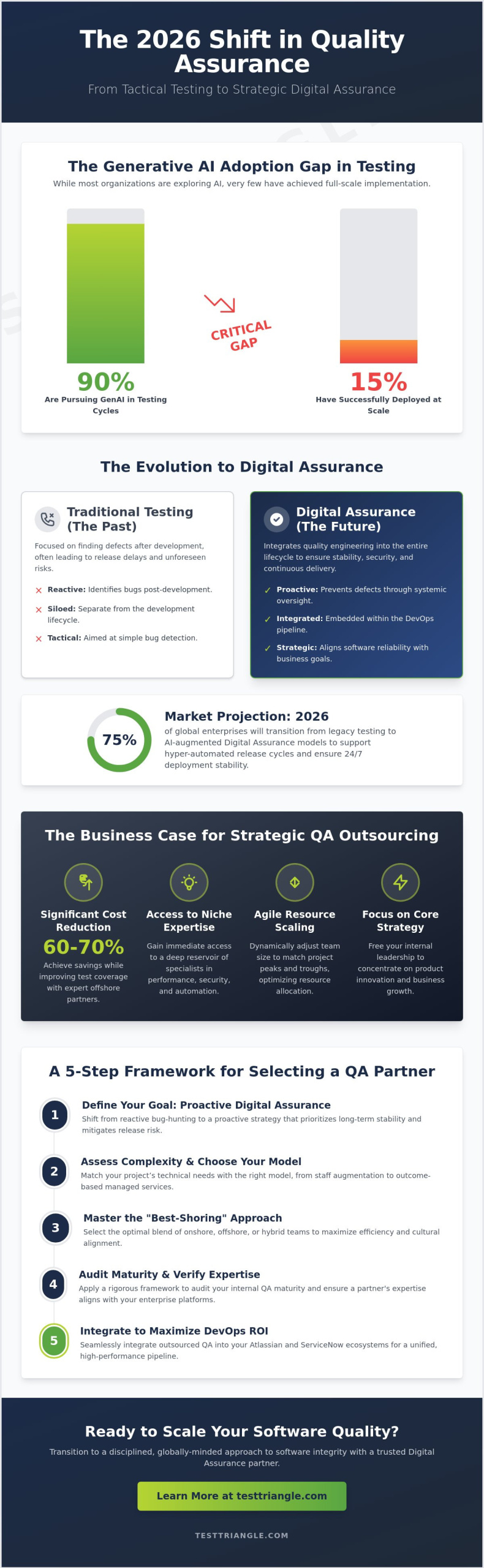
While nearly 90% of organizations are currently pursuing generative AI in their testing cycles, only 15% of enterprises have successfully deployed these technologies at scale. This gap reveals a critical friction point in quality assurance outsourcing, where the simple goal of cost reduction has evolved into a strategic necessity for deep digital assurance. If you’ve found that local recruitment costs are prohibitive or that generic freelancers provide inconsistent quality, you’re likely searching for a more disciplined, versatile, and globally-minded approach to software integrity.

We recognize that managing complex digital infrastructures requires a partner who values stability, precision, and growth over quick fixes. This article provides a strategic roadmap to help you scale your software quality, reduce release risks, and navigate the transition toward AI-augmented testing models. We’ll examine the latest 2026 shifts in the Atlassian ecosystem, including the integration of Rovo agents into Jira workflows, and provide a methodical framework for choosing an outsourcing model that delivers both technical rigor and operational efficiency for your enterprise ecosystem.

Key Takeaways

  • Understand the 2026 shift from reactive testing to proactive Digital Assurance, ensuring your software lifecycle prioritizes long-term stability and risk mitigation.
  • Navigate the spectrum of quality assurance outsourcing by matching your project’s technical complexity with the appropriate model, from staff augmentation to outcome-based managed services.
  • Master the “best-shoring” approach to geographic delivery, selecting the optimal blend of onshore, offshore, or hybrid teams to maximize operational efficiency and cultural alignment.
  • Apply a rigorous 5-step framework to audit your internal QA maturity and verify that a partner’s technical expertise aligns with your specific enterprise platforms.
  • Enhance your DevOps ROI by seamlessly integrating outsourced QA functions into your existing Atlassian and ServiceNow environments for a unified, high-performance ecosystem.

The Evolution of Quality Assurance Outsourcing in 2026

Modern enterprise ecosystems in 2026 demand more than just technical bug detection; they require a comprehensive alignment between software reliability and business objectives. As global organizations face the pressure of hyper-automated release cycles, quality assurance outsourcing has transitioned from a tactical cost-saving measure into a foundational pillar of digital resilience. This evolution is driven by the necessity to manage complex, AI-integrated infrastructures where traditional testing methods often fall short of providing the required speed and security. Global leaders now seek strategic partners who offer stability, security, and scalability rather than mere contract labor. It’s a shift that prioritizes long-term operational excellence over short-term fixes.

Digital Assurance vs. Traditional Software Testing

The shift toward software and digital assurance represents a fundamental change in how quality is perceived within the DevOps lifecycle. While traditional testing focused on identifying defects after development, Digital Assurance integrates quality engineering into every phase of the pipeline to ensure continuous delivery. By 2026, it is projected that 75% of global enterprises will have transitioned from legacy testing to AI-augmented QA models to support these rapid cycles. This methodology prioritizes self-healing automation scripts and predictive analytics, allowing teams to maintain 24/7 deployment stability without compromising brand reputation. It doesn’t just identify errors; it prevents them through systemic oversight and technical rigor.

The Business Case for Outsourcing QA

Building an internal team capable of handling modern performance, security, and compatibility testing is often cost-prohibitive for even the largest global enterprises. Through strategic outsourcing, companies can access a deep reservoir of niche expertise without the overheads of permanent recruitment or specialized training. Data from industry reports suggests that organizations leveraging offshore partners can achieve cost reductions of 60-70% while simultaneously improving testing coverage through advanced toolsets. This model provides the agility to scale resources during project peaks, ensuring that technical managers and executive leadership maintain absolute control over release quality. Digital Assurance is a proactive business continuity strategy that safeguards operational stability against the volatility of the digital landscape.

Strategic Engagement Models: Beyond Simple Staff Augmentation

Selecting an appropriate engagement model requires a deep understanding of your organization’s internal capabilities and long-term technical objectives. In 2026, the industry has moved beyond simple transactional relationships toward a strategic guide to global collaboration, where the choice of model directly impacts your ability to innovate. Within the framework of quality assurance outsourcing, technical leaders must balance the need for direct oversight with the benefits of provider-led accountability. This balance is critical for maintaining the high standards of security and reliability expected in modern enterprise ecosystems.

Managed Testing Services (MTS)

Managed Testing Services (MTS) represent the most comprehensive end of the outsourcing spectrum, positioning the vendor as a fully accountable partner for your quality outcomes. This model transitions the burden of process management, tool selection, and talent development to the provider, allowing your internal leadership to focus on core product strategy. By establishing clear Service Level Agreements (SLAs) and utilizing outcome-based billing, you ensure that the cost of quality is directly tied to tangible results. It’s an ideal solution for enterprises managing legacy systems or complex ServiceNow implementations that require consistent, year-round maintenance and systemic oversight. This model fosters a sense of institutional maturity, ensuring that your digital infrastructure remains resilient against evolving market demands.

Staff Augmentation and Dedicated QA Teams

Conversely, organizations requiring high-velocity development and tight integration often prefer IT staffing services to bolster their internal teams. This model provides the agility to scale testing capacity during critical project peaks, such as the weeks leading up to a major Atlassian Spring Release. By embedding dedicated QA professionals into your existing Agile or DevOps workflows, you maintain full control over the testing methodology while benefiting from the specialized skills of external experts. This hybrid approach often yields the best of both worlds: the institutional knowledge of your core team combined with the execution speed of offshore talent. It’s a versatile strategy for maintaining 24/7 testing cycles across different time zones, ensuring that code is validated as quickly as it’s written. Ultimately, this approach delivers scalability, speed, and security to your development pipeline.

If you’re uncertain which model fits your current infrastructure, speaking with a strategic consultant can help clarify your requirements and identify the most efficient path forward.
Quality Assurance Outsourcing in 2026: A Strategic Guide to Digital Assurance

Evaluating Geographic Delivery: Onshore, Offshore, and Hybrid Advantage

In the current technological landscape, the geographic distribution of testing operations is no longer a binary choice between domestic oversight and international cost savings. Modern quality assurance outsourcing requires a “best-shoring” strategy, which involves the methodical alignment of specific project tasks with the most efficient geographic delivery model. For instance, high-level strategic consulting and initial requirement gathering often thrive in an onshore or nearshore environment where real-time collaboration is seamless. Conversely, large-scale execution and regression testing benefit from the resource depth found in offshore centers. This balanced approach ensures that global enterprises maintain operational stability while leveraging the global talent pool to achieve 24/7 delivery cycles.

Success in a distributed model hinges on overcoming traditional barriers such as communication gaps and time-zone disparities. By implementing structured reporting frameworks and utilizing integrated platforms like Jira and ServiceNow, organizations can bridge these divides effectively. A global presence is particularly vital for highly regulated sectors like finance and healthcare, where local knowledge of regional standards must be combined with global engineering excellence. This synergy allows for the creation of a resilient testing ecosystem that is both culturally aligned and technically proficient. It’s about establishing a foundation of precision, performance, and protection in every global engagement.

Cost vs. Quality: Finding the Equilibrium

While the allure of low hourly rates in offshore regions remains strong, technical leaders must look toward the Total Cost of Ownership (TCO) rather than isolated line items. Engaging with a partner solely on price often results in significant technical debt, as poor initial testing leads to expensive rework and delayed releases. By 2026, the most successful enterprises are those that prioritize engineering standards over raw cost. They leverage remote offshore resources for their scalability and technical depth, but they do so within a framework of rigorous quality gates. This ensures that the cost-efficiency of quality assurance outsourcing doesn’t come at the expense of software integrity or long-term business agility.

Security and Compliance in Global Delivery

Managing data sovereignty and intellectual property protection is a non-negotiable requirement when operating across international borders. Strategic partners must demonstrate an institutional commitment to security through certifications like ISO 27001 and strict adherence to GDPR protocols. For organizations in the pharmaceutical or financial sectors, compliance requirements are even more stringent, necessitating a partner who understands the nuances of data residency and encrypted communication. Ensuring that your managed outsourcing services mirror the security standards of your internal infrastructure provides the peace of mind necessary for large-scale technological evolution. This methodical approach to compliance safeguards your brand reputation while empowering your team to innovate with confidence.

A 5-Step Framework for Selecting a Quality Assurance Partner

Selecting a partner for quality assurance outsourcing is a high-stakes decision that requires a methodical approach to ensure technical and operational alignment. This process moves beyond simple price comparisons, focusing instead on the long-term stability and scalability of your digital infrastructure. A disciplined framework allows technical managers to verify that a potential collaborator possesses the institutional maturity required to manage complex enterprise ecosystems. By following a structured path of selection, scrutiny, and success, you can mitigate the risks associated with large-scale technological evolution.

  • Step 1: Audit internal maturity. Begin by defining your current QA maturity level and identifying specific technical requirements. This baseline ensures you don’t over-invest in unnecessary services while highlighting critical gaps in your current testing cycle.
  • Step 2: Vet the technical stack. Ensure the partner possesses deep expertise in your specific platforms. This includes verifying their proficiency in modern automation frameworks and their ability to integrate with your existing DevOps toolchain.
  • Step 3: Assess operational fit. Evaluate how the partner’s communication protocols and agile methodologies align with your internal scrum teams. Seamless integration is essential for maintaining velocity in high-pressure release environments.
  • Step 4: Evaluate proof of concept (PoC). Request a targeted PoC to validate the partner’s execution capabilities. Analyzing past performance in your specific industry provides a reliable benchmark for their future contributions.
  • Step 5: Finalize the legal framework. Establish a robust commercial agreement that prioritizes data sovereignty and IP protection. This foundation of security allows for a reliable, long-term collaboration.

Technical Vetting and Tool Proficiency

A strategic partner must demonstrate more than general testing knowledge; they must be experts in the specific tools that drive your business. This is why vetting for Atlassian Consulting and Jira proficiency is non-negotiable for enterprises relying on the Atlassian ecosystem. Your partner should navigate AI-enhanced tools like Playwright or Selenium with precision, ensuring that automation frameworks are self-healing and resilient. They must also support your specific CI/CD pipelines, providing the technical rigor necessary to maintain 24/7 deployment stability. It’s about ensuring your toolchain remains a source of strength rather than a bottleneck.

Industry-Specific Expertise and Case Studies

Domain knowledge is the differentiator between a generic service provider and a strategic visionary. In highly regulated sectors like Life Sciences or Finance, your partner must understand the nuances of compliance and data residency. You can verify a company’s track record through independent reviews on platforms like Clutch, focusing on their ability to handle complex, industry-specific challenges. While automation is a priority, understanding the evolving role of manual testing in 2026 is equally important for exploratory and usability scenarios. This comprehensive expertise ensures your digital assurance strategy is both practical and progressive.

If you’re ready to enhance your testing strategy with a partner who values precision and performance, schedule a technical consultation with our experts today.

Integrating Outsourced QA into your Atlassian and DevOps Ecosystem

To achieve true digital resilience, global organizations must move beyond viewing testing as a siloed activity and instead treat it as a core component of their operational fabric. Integrating quality assurance outsourcing into your existing Atlassian and ServiceNow environments ensures that every defect discovered is contextualized within your broader IT Service Management framework. By configuring Jira for real-time visibility and transparent reporting, you empower stakeholders to make data-driven decisions regarding release readiness. Our managed outsourcing services go beyond simple execution by providing ongoing system optimization that aligns your toolchain with evolving project requirements. This methodology transforms your environment into a high-performance engine that delivers visibility, velocity, and value to every stakeholder. For a deeper look at these systemic improvements, our DevOps Consulting Guide provides a comprehensive roadmap for accelerating enterprise transformation.

Platform Optimisation for Seamless Testing

Maximising ROI in a modern DevOps lifecycle requires a partner who understands the intricate dependencies between your testing protocols and your infrastructure tools. It’s not enough to simply track bugs; you must optimize your platforms to support automated workflows and self-healing scripts. When your outsourced QA team operates directly within your ServiceNow and Atlassian instances, they provide a level of technical rigor that generic providers can’t match. This integration ensures that performance data flows seamlessly from the testing environment to executive dashboards, providing the peace of mind that comes from total technical control. It’s a strategic approach that prioritizes long-term stability over short-term fixes, ensuring your digital infrastructure remains resilient against the volatility of the 2026 market.

Achieving Scalable Growth with Test Triangle

Test Triangle bridges the historical gap between temporary staffing and high-level technical consulting, offering a unified partnership that addresses both human expertise and technical tools. We don’t just provide resources; we implement the structures necessary for a “Quality First” culture across your entire organization. This journey often begins with a comprehensive software and digital assurance testing audit to identify performance bottlenecks and security vulnerabilities. By moving from evaluation to execution through a strategic pilot project, you can validate the efficacy of our methodology before scaling across your enterprise ecosystem. This process ensures that your digital transformation remains disciplined, versatile, and globally-minded. Contact Test Triangle for a strategic QA consultation to begin your transition toward a more resilient and scalable digital future.

Securing Your Digital Future through Strategic Assurance

The transition toward a hyper-automated release environment in 2026 necessitates a fundamental shift from reactive testing to a holistic Digital Assurance strategy. By integrating specialized technical expertise directly into your DevOps toolchain, you ensure that software quality becomes a driver of innovation rather than a bottleneck. Effective quality assurance outsourcing isn’t merely about headcount; it’s about establishing a reliable long-term collaboration that prioritizes security, scalability, and systemic stability across your entire enterprise ecosystem.

As an Atlassian Gold Solution Partner with global delivery centres across Europe, North America, and Asia, Test Triangle possesses the institutional maturity required to manage complex digital infrastructures with precision. Our teams offer specialised expertise in Pharma and Finance IT compliance, ensuring that your technological evolution remains grounded in rigorous industry standards. We’re committed to your operational excellence through a disciplined blend of human expertise and industry-leading technical tools. Partner with Test Triangle for Strategic QA Outsourcing to begin your journey toward a more resilient and high-performing digital ecosystem. We look forward to supporting your long-term success and operational stability.

Frequently Asked Questions

What are the primary benefits of quality assurance outsourcing for enterprises?

Enterprises leverage quality assurance outsourcing to achieve systemic cost reductions while gaining immediate access to specialized skills in performance, security, and compatibility testing. This strategic alignment allows your internal leadership to focus on core product innovation while a partner maintains the technical rigor of the testing lifecycle, ultimately delivering visibility, velocity, and value to the organization.

How do I choose between offshore and nearshore QA outsourcing?

The choice between these models depends on your specific requirement for real-time collaboration versus large-scale execution capacity. Nearshore models are ideal for projects requiring high-velocity agile collaboration within similar time zones; however, offshore delivery is often better suited for regression testing where cost-efficiency and 24/7 coverage are the primary objectives.

Is it possible to integrate outsourced QA teams into our existing Jira workflows?

Modern QA teams operate directly within your Atlassian ecosystem, ensuring that every bug report and test case is contextualized within your existing Jira and ServiceNow instances. This deep integration allows technical managers to maintain absolute control over the release pipeline while benefiting from the execution speed and precision provided by an external partner.

How does QA outsourcing impact our time-to-market for new software releases?

Strategic outsourcing accelerates time-to-market by implementing “shift-left” testing methodologies that identify defects earlier in the development cycle when they’re less expensive to resolve. This continuous validation process ensures that software reaches the market with fewer release risks, allowing your team to maintain a competitive pace in a fast-changing technological landscape.

What security measures should a QA outsourcing company have in place?

A reputable partner must implement comprehensive security measures, including ISO 27001 certification, strict GDPR compliance, and robust data encryption protocols for all international communications. These standards ensure data sovereignty and IP protection, providing the peace of mind necessary for managing complex digital infrastructures in highly regulated industries through precision, performance, and protection.

Can I outsource both manual and automated testing to the same partner?

A versatile partner manages both manual and automated testing to provide a comprehensive digital assurance strategy that covers technical accuracy and exploratory usability. This hybrid approach ensures that your software remains both technically sound and user-centric, as automated scripts handle repetitive regression while manual experts focus on complex user journeys and edge cases.

What is the typical cost structure for managed testing services in 2026?

In 2026, most organizations prefer managed service models that utilize outcome-based billing tied to specific service level agreements or monthly retainers for dedicated teams. This structure provides predictable budgeting and ensures that the partner is deeply invested in your long-term success rather than just completing transactional tasks.

How do I ensure a smooth knowledge transfer when starting with a new QA partner?

Successful knowledge transfer requires a methodical approach involving a structured documentation audit, shadow testing periods, and a clear communication framework. By following a disciplined transition plan, you ensure that the new team gains the institutional knowledge required to maintain operational stability and technical precision from the first day of the engagement.

Paul Guy

Article by

Paul Guy

Paul serves as the Marketing Director at Test Triangle, where he leads a global team in driving growth through strategic B2B marketing and brand communications. With a strong emphasis on measurable outcomes and sustainable performance, he plays a pivotal role in aligning marketing functions to enhance customer engagement and accelerate business impact. Under his leadership, marketing initiatives have consistently delivered significant returns on investment, elevated brand visibility, and strengthened the company's presence across key markets.

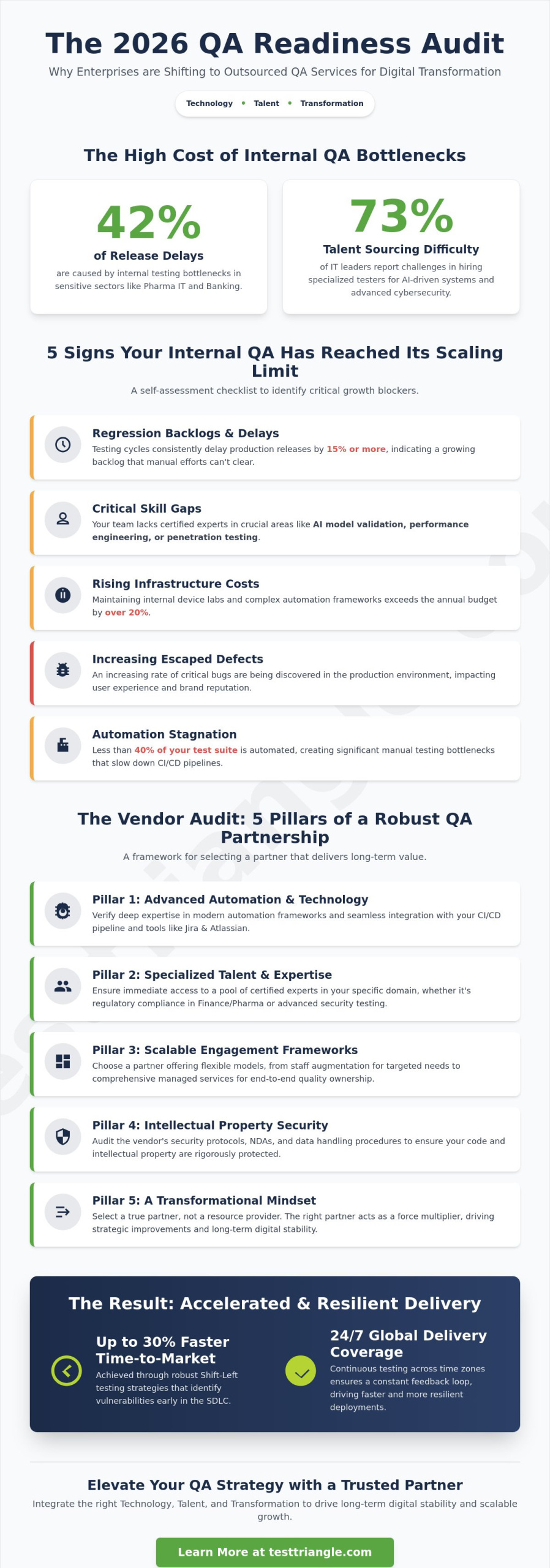

If your 2026 product roadmap relies on testing cycles that mirror 2023 methodologies, you’re likely accumulating technical debt that will stall your digital transformation by Q4. Most enterprise leaders agree that internal testing bottlenecks now cause nearly 42% of release delays in sensitive sectors like Pharma IT and Banking. By integrating high-quality outsourced qa services into your delivery pipeline, you can mitigate these risks while maintaining the agility required for global competition. At Test Triangle, we believe that the right partnership should act as a force multiplier for your internal teams, rather than a temporary fix for capacity issues.

You deserve a strategy that delivers predictable testing costs and immediate access to specialized expertise in security and performance. This article provides a comprehensive, 5-pillar checklist designed to help you evaluate and select a partner that aligns with your long-term vision. By following this framework, you’ll learn how to achieve faster time-to-market and ensure a seamless Jira or Atlassian integration across your entire ecosystem. We’ll explore how the synergy of Technology, Talent, and Transformation can elevate your operational stability and drive sustainable success through 2026 and beyond.

Key Takeaways

  • Understand the evolution of QA from a cost-focused necessity to a strategic enabler capable of bridging the 2026 specialized talent gap.
  • Identify the optimal engagement framework for your organization by distinguishing between staff augmentation and comprehensive managed testing services.
  • Master the essential technical and regulatory benchmarks required to evaluate high-performing outsourced qa services in sectors like Finance and Pharma.
  • Audit prospective partners using five critical pillars designed to verify advanced automation depth and the security of your intellectual property.
  • Learn how to leverage the “Technology. Talent. Transformation.” triad to integrate a trusted partner that drives long-term digital stability and scalable growth.

The Strategic Shift: Why Enterprises Prioritise Outsourced QA Services in 2026

By repositioning quality assurance from a reactive cost center to a proactive strategic enabler, global enterprises are fundamentally rewriting their digital transformation playbooks. In 2026, the complexity of software ecosystems has reached a tipping point where internal teams often struggle to maintain the pace of innovation while ensuring flawless performance. By leveraging outsourced qa services, organizations gain access to high-level expertise that bridges the gap between technical execution and business outcomes. This shift allows leadership to focus on core product development while a outsourced software testing partner manages the intricate demands of modern quality protocols.

The 2026 talent market presents a significant challenge, as 73% of IT leaders report difficulty in hiring specialized testers for AI-driven systems and advanced cybersecurity protocols. Shifting from a fixed operational overhead to flexible engagement models enables companies to scale their testing capacity based on project demands without the long-term burden of internal headcount. Test Triangle serves as a Trusted Partner in this landscape, providing the necessary agility to navigate market fluctuations. Strategic QA is the intersection of risk mitigation and speed.

Checklist: 5 Signs Your Internal QA Team Has Reached Its Scaling Limit

  • Regression Backlogs: Testing cycles consistently delay production releases by 15% or more.
  • Skill Gaps: Your team lacks certified experts in AI model validation or penetration testing.
  • Infrastructure Costs: Maintaining internal device labs and automation frameworks exceeds your annual budget by 20%.
  • Escaped Defects: Critical bugs are reaching production environments at an increasing rate.
  • Automation Stagnation: Less than 40% of your test suite is automated, leading to manual bottlenecks.

Beyond Cost Savings: The Value of a Fresh Perspective

By introducing independent validation into legacy development cycles, external audits identify critical blind spots that internal teams might overlook due to institutional familiarity. Unbiased validation ensures that production-level defects are minimized before they impact the end-user experience. This objective approach allows outsourced qa services to deliver a superior level of precision. Through our core philosophy of Technology. Talent. Transformation, we help businesses optimize their quality benchmarks while maintaining operational stability.

The 2026 Release Pressure: Speed vs. Quality

CI/CD pipelines frequently fail to deliver on their promise of speed when they lack a robust, outsourced automation strategy to handle the heavy lifting. Implementing a Shift-Left testing methodology has been shown to improve time-to-market metrics by up to 30% by identifying vulnerabilities during the earliest stages of the SDLC. Global delivery centres further accelerate this process by providing 24/7 coverage, ensuring that testing continues across every time zone. This continuous feedback loop drives faster deployments and more resilient software architectures.

Defining Your Model: A Checklist for Choosing Engagement Frameworks

By integrating specialized expertise with adaptable delivery models, enterprises can optimize their outsourced qa services to achieve superior software quality. The shift toward 2026’s decentralized development environments requires a strategic evaluation of how external talent fits into your existing ecosystem. Selecting the right framework isn’t merely a procurement decision; it’s a foundational step in your digital transformation. Many organizations now leverage Cem Kaner’s outsourcing checklist to establish a baseline for vendor technical depth and accountability before committing to a specific model. This rigorous vetting ensures that the chosen partner can provide the necessary Technology, Talent, and Transformation required for long-term stability.

Managed Services: Relieving the Management Burden

Handing over full ownership of the QA process to a Trusted Partner allows internal leadership to focus on high-level product innovation. In this model, the partner manages the entire testing lifecycle, from strategy design to execution. Success is governed by Service Level Agreements (SLAs) that guarantee outcomes rather than just logged hours. For instance, a robust SLA might mandate a 98% test case execution rate or a 24-hour turnaround for critical defect reporting. A dedicated QA Lead acts as the Strategic Architect within this environment, aligning the testing roadmap with your business objectives. This model is ideal for mature organizations looking to drive efficiency through specialized outsourced qa services while maintaining high-level oversight via tools like Jira Service Management.

Staff Augmentation: Plugging Specific Skill Gaps

When specific technical gaps emerge, such as a sudden need for performance testing or security audits in 2026’s complex API ecosystems, staff augmentation provides immediate relief. This model allows for rapid scaling, enabling teams to add specialized talent for short-term projects without the 35% overhead cost typically associated with permanent hires. Achieving seamless integration requires the outsourced resources to adopt your internal culture and technical standards. Recent data from 2025 indicates that 82% of successful staff augmentation projects utilized shared communication protocols to ensure remote resources remained synchronized with in-house developers. It’s a practical way to leverage global talent while maintaining direct control over the daily testing activities.

Selecting the right geographic location for your resources depends on your “Follow the Sun” strategy and communication requirements:

  • Onshore: Essential for projects with strict regulatory compliance or those requiring real-time, same-timezone collaboration with the C-suite.
  • Nearshore: Offers a balance of cost-efficiency and 2 to 4 hour overlap windows, facilitating agile ceremonies and rapid feedback loops.
  • Offshore: Most effective for large-scale regression testing and high-volume execution where significant cost reduction is the primary driver.

Flexible engagement models are no longer a luxury but a necessity for navigating fluctuating project demands. By choosing a partner that offers adaptable frameworks, you ensure your testing capacity can expand or contract alongside your product roadmap. To see how these models function in a real-world environment, you can explore our strategic approach to quality engineering.

The Ultimate Checklist for Evaluating Outsourced QA Services in 2026

Technical and Regulatory Readiness: The Specialized QA Checklist

Generalist providers often fail in high-stakes sectors because they lack the domain-specific rigor required for 2026’s complex regulatory environment. By failing to account for sector-specific nuances in Finance and Pharma, these providers introduce liability rather than mitigating it. A 2025 industry report indicated that 62% of data breaches in regulated sectors stemmed from third-party software vulnerabilities. Selecting outsourced qa services requires a partner who understands that a bug in a clinical trial system isn’t just a technical glitch; it’s a compliance failure. To ensure your organization remains audit-ready, use this essential 2026 certification checklist:

  • ISO 27001:2022: The gold standard for information security management systems.
  • SOC2 Type II: Critical for confirming the operational effectiveness of security controls over time.
  • GxP (GLP, GCP, GMP): Essential for any software touching the life sciences supply chain.
  • PCI DSS 4.0: The mandatory requirement for any provider handling financial transaction data.

By prioritizing these standards, Test Triangle acts as a Strategic Architect, ensuring your digital infrastructure remains robust against evolving threats. Validated Software Testing isn’t an optional add-on for Healthcare; it’s the foundation of patient safety and data privacy. A partner must navigate these regulatory roadmaps with precision, moving beyond simple bug hunting to provide comprehensive risk mitigation.

Life Sciences and Pharma IT Specialization

By integrating Computer System Validation (CSV) protocols directly into the software development lifecycle, Test Triangle ensures that every release meets the stringent requirements of 21 CFR Part 11. Maintaining data integrity throughout the testing lifecycle requires more than just technical skill; it demands a disciplined approach to audit trails and electronic signatures. As of January 2026, 78% of Life Sciences organizations prioritize partners who demonstrate deep CSV expertise. It’s vital to remember that “compliance is not a checkbox but a continuous process” that defines the reliability of your entire IT estate.

Ecosystem Alignment: Atlassian, ServiceNow, and AWS

By aligning testing workflows with your existing toolstack, a sophisticated provider accelerates your digital transformation. Your outsourced qa services partner must be a Strategic Architect who leverages Jira Service Management for seamless defect tracking and real-time visibility. This integration ensures that every identified issue is categorized, prioritized, and resolved within a unified ecosystem. When utilizing AWS cloud-native testing tools, your partner can automate infrastructure provisioning, reducing the testing cycle time by 35% compared to legacy methods. This synergy between technology, talent, and transformation allows your business to scale without compromising on quality or security.

The Vendor Audit: 5 Critical Pillars of a Robust QA Partnership

Selecting outsourced qa services requires a shift from simple vendor selection to strategic architectural alignment. By 2026, 74% of global enterprises will prioritize partners who integrate predictive analytics into their testing lifecycle. This audit ensures your chosen provider isn’t just a resource supplier but a catalyst for digital transformation. By combining technical expertise with adaptable delivery models, a mature partner helps businesses reduce operational friction while maintaining high velocity.

Step 1 involves assessing technical depth. A sophisticated partner moves beyond basic manual scripts to implement AI-driven automation that achieves 90% regression coverage. Step 2 focuses on security; your code represents your primary competitive advantage and requires protection through rigorous protocols. Step 3 establishes communication governance, creating a “heartbeat” through integrated platforms like Jira Service Management. Step 4 evaluates innovation, specifically how the vendor leverages machine learning to predict defect density. Finally, Step 5 examines scalability. A partner must provide access to specialized talent within 48 hours to meet shifting project demands.

Evaluating the “Talent” Pillar

By leveraging rigorous vetting processes, Test Triangle ensures that every engineer possesses both technical certifications and domain-specific expertise. We review recruitment standards to confirm that 95% of the talent bench holds advanced certifications in tools like Selenium, Tricentis Tosca, or Playwright. Continuous training within our partner ecosystems ensures our team masters niche technologies, such as blockchain testing or 5G protocol validation, before they become mainstream requirements. This depth of talent allows us to act as a Trusted Partner in complex environments.

The Security Audit Checklist

Protecting intellectual property is the cornerstone of a professional partnership. A robust audit must verify these specific standards to mitigate risk:

  • Encryption Standards: Implementation of AES-256 for all data at rest and TLS 1.3 for data in transit across all testing environments.
  • Access Controls: Biometric physical security at offshore delivery centres and mandatory multi-factor authentication (MFA) for all logical access to client repositories.
  • Contractual Safeguards: Explicit clauses in the Master Service Agreement (MSA) ensuring 100% client ownership of all test scripts, frameworks, and generated documentation.

By aligning Technology. Talent. Transformation., we help organizations accelerate their release cycles without compromising on precision. Our flexible engagement models allow you to scale resources up or down based on real-time project metrics, ensuring your digital infrastructure remains resilient. This methodical approach to outsourced qa services transforms testing from a bottleneck into a strategic asset.

Ready to elevate your software quality through a strategic partnership? Consult with our QA architects today to secure your digital future.

Technology. Talent. Transformation: Integrating Test Triangle’s QA Expertise

By aligning technical proficiency with strategic business objectives, Test Triangle functions as a Trusted Partner rather than a traditional vendor. Our Dublin-based headquarters provides the high-level governance and strategic oversight required by European enterprises, while our global delivery centers ensure 24/7 operational continuity. We don’t just provide outsourced qa services; we integrate ourselves into your software development lifecycle to drive long-term stability. In a 2024 partnership with a Tier-1 global financial institution, our team overhauled a fragmented testing process. This intervention resulted in a 65% reduction in post-release defects within the first twelve months, proving that strategic alignment outweighs simple staff augmentation.

Our onboarding journey follows a rigorous, four-step methodology designed for clarity and speed:

  • Comprehensive Audit: we evaluate your current QA maturity and identify hidden bottlenecks in your pipeline.
  • Strategic Roadmap: our consultants design a tailored framework specifically aligned with your 2026 delivery goals.
  • Knowledge Transfer: we synchronize our specialized teams with your internal stakeholders to ensure cultural and technical fit.
  • Flawless Execution: we launch automated and manual testing cycles supported by real-time, transparent reporting.

Our Approach to Managed Platform Support

By optimizing Atlassian and ServiceNow environments, we ensure your quality management tools work in harmony with your engineering workflows. We leverage Jira Service Management to provide transparent, data-driven insights into every testing cycle. Combining DevOps engineering with QA allows us to accelerate your digital transformation, ensuring that speed never compromises security. Our flexible delivery models allow growing enterprises to scale their testing capacity up or down based on project demands. It’s a model that provides the agility needed in a volatile market while maintaining a robust quality gate.

Next Steps for Your QA Strategy

Establishing a modern testing framework requires a shift from reactive bug-fixing to proactive quality engineering. You can initiate this shift by scheduling a QA maturity assessment with our senior consultants. We specialize in transitioning organizations from slow, manual legacy testing to high-velocity, automated frameworks that support continuous integration. Our expertise in outsourced qa services ensures your transition is seamless, data-backed, and risk-mitigated. For a deeper exploration of how quality assurance outsourcing is evolving in 2026, including the integration of AI-augmented testing models and Rovo agents into Jira workflows, our strategic guide provides a comprehensive roadmap for enterprises navigating this shift. We’re ready to help you build a resilient digital infrastructure that scales.

Future-Proofing Your Enterprise through Strategic Quality Excellence

Navigating the software landscape of 2026 requires more than a simple checklist; it demands a synergy of technical rigor and operational agility. By aligning specialized engagement models with strict regulatory demands, global enterprises can transform quality assurance from a functional necessity into a strategic asset. Selecting the right outsourced qa services ensures that your digital infrastructure remains resilient against evolving security threats and rapid market shifts.

Test Triangle serves as a Strategic Architect for your testing needs. As an Atlassian Gold Solution Partner and a recognized Enterprise Ireland client, we provide the institutional maturity required for complex digital transformations. Our global delivery centres in Dublin, London, and Hyderabad offer the 24/7 technical expertise necessary to maintain a flawless user experience across all platforms. We bridge the gap between technical execution and business outcomes through our core pillars: Technology. Talent. Transformation.

It’s time to elevate your quality standards and drive scalable growth with a trusted partner who understands your long-term vision. Partner with Test Triangle for Strategic QA Transformation and secure your path toward operational stability today.

Frequently Asked Questions

What are the main benefits of outsourced QA services for enterprises?

Enterprises leverage outsourced qa services to accelerate release cycles by 30% and reduce operational overhead. By accessing global talent pools, companies secure specialized skills like AI-driven automation without the 40% higher cost of internal hiring. This strategic shift allows internal teams to focus on core innovation while external experts ensure a flawless user experience across all digital touchpoints.

How do I ensure data security when working with an offshore QA team?

We ensure data integrity by implementing ISO 27001 and SOC 2 Type II compliant frameworks for every offshore engagement. By utilizing secure VPN tunnels and multi-factor authentication, our teams maintain a zero-trust architecture that protects sensitive intellectual property. Our protocols align with GDPR and CCPA standards, ensuring that 100% of data handling remains transparent and audited by our security lead.

Can outsourced QA services integrate with our existing Jira and DevOps tools?

Our outsourced qa services integrate directly into your existing CI/CD pipelines via Jira Service Management and the wider Atlassian toolset. By aligning with your DevOps workflows, we automate bug reporting and tracking to ensure real-time visibility into the testing lifecycle. This synchronization eliminates communication silos and accelerates the feedback loop between developers and testers, resulting in a 25% increase in sprint velocity.

What is the difference between QA staff augmentation and managed testing services?

QA staff augmentation provides individual experts to work under your internal management, whereas managed testing services offer a fully autonomous team responsible for end-to-end delivery. In a staff augmentation model, you retain 100% control over daily tasks; however, managed services shift the accountability for KPIs and outcomes to the partner. This distinction allows you to choose between tactical support and strategic, results-driven transformation.

Why is specialized QA important for the pharmaceutical and life sciences industries?

Specialized QA is critical for pharmaceutical sectors because it ensures compliance with GxP and FDA 21 CFR Part 11 regulations. By applying rigorous validation protocols, we mitigate the risk of non-compliance which can lead to significant regulatory fines. Our approach integrates automated compliance checks into the software lifecycle, protecting patient safety and data accuracy in these highly regulated environments.

How do we measure the ROI of outsourcing our quality assurance?

You measure ROI by tracking metrics such as defect leakage rates and the reduction in cost-per-test hour. Organizations typically see a 15% reduction in post-release defects within the first 12 months of a strategic partnership. By calculating the difference between internal overhead and the output of a flexible engagement model, you can quantify the total value delivered to your bottom line.

What should be included in a QA outsourcing Service Level Agreement (SLA)?

A robust SLA must include specific targets for defect turnaround times, test coverage percentages, and resource availability. We define clear benchmarks, such as a 24-hour resolution window for critical bugs, to ensure accountability and performance stability. These documented standards act as a roadmap for our partnership, ensuring that Technology, Talent, and Transformation remain aligned with your business objectives.

How quickly can an outsourced QA team be onboarded into our project?

Our team can typically be fully onboarded and integrated into your project within 10 to 14 business days. By following a structured knowledge transfer framework, we minimize downtime and begin delivering actionable insights during the very first sprint. This rapid deployment model allows your organization to scale testing capacity instantly without the 60-day lead time common in traditional recruitment cycles.

Paul Guy

Article by

Paul Guy

Paul serves as the Marketing Director at Test Triangle, where he leads a global team in driving growth through strategic B2B marketing and brand communications. With a strong emphasis on measurable outcomes and sustainable performance, he plays a pivotal role in aligning marketing functions to enhance customer engagement and accelerate business impact. Under his leadership, marketing initiatives have consistently delivered significant returns on investment, elevated brand visibility, and strengthened the company's presence across key markets.
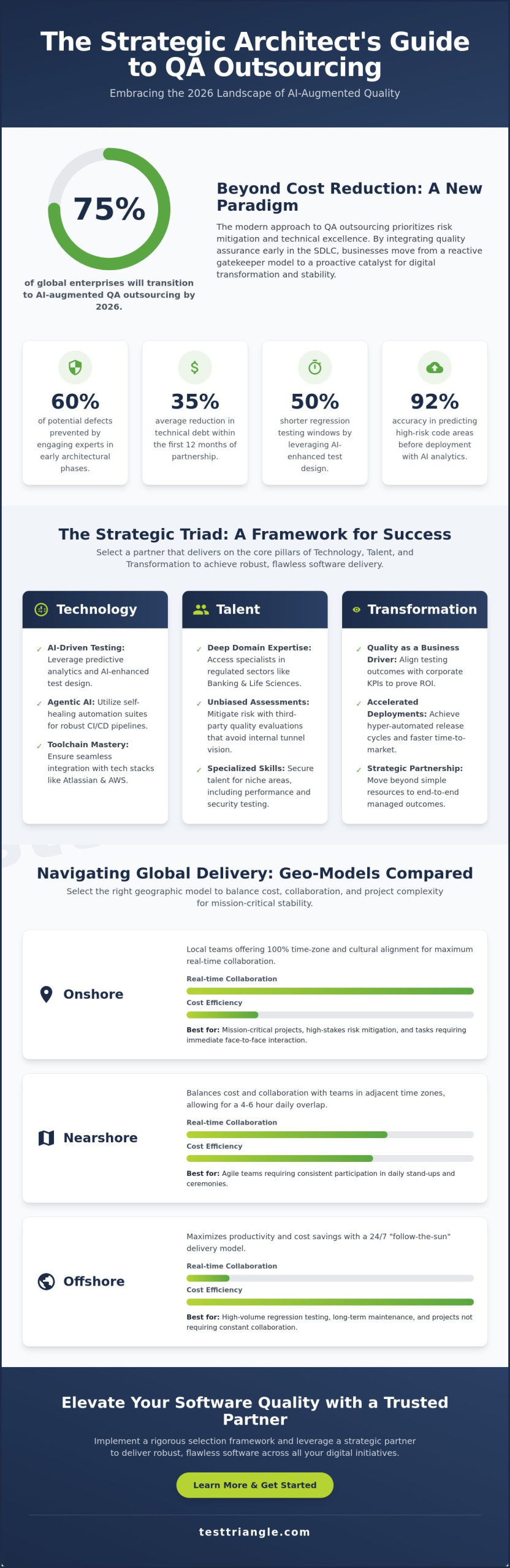

By 2026, industry projections indicate that 75% of global enterprises will transition from legacy testing to AI-augmented qa outsourcing models to support hyper-automated release cycles. You’ve likely felt the operational friction when external teams fail to sync with your Atlassian workflows or when communication barriers lead to a loss of control over quality standards. It’s frustrating to watch your time-to-market slow down because external testers aren’t deeply integrated into your Jira Service Management environment. As a Strategic Architect of digital stability, we recognize that these integration gaps represent a significant risk to your long-term success.

This article provides a strategic framework to help you select a partner that delivers on the core pillars of Technology, Talent, and Transformation. By combining technical rigor with flexible engagement models, a Trusted Partner helps you secure predictable testing costs and access specialized security talent. We will compare the leading global strategies to ensure your organization achieves a flawless, high-quality output while accelerating every deployment phase.

Key Takeaways

  • By moving beyond traditional cost-reduction models, you will learn to reposition quality processes as a strategic catalyst for comprehensive digital transformation.
  • Gain clarity on navigating complex geo-models to ensure your partnership provides the cultural alignment and proximity required for mission-critical stability.
  • Identify the most effective qa outsourcing engagement model for your enterprise by distinguishing between buying simple resources and investing in end-to-end managed outcomes.
  • Implement a rigorous selection framework that audits internal technical debt and evaluates potential partners based on their mastery of specific tech stacks like Atlassian and AWS.
  • Discover how to leverage the strategic triad of technology, talent, and transformation to deliver robust, flawless software across highly regulated global sectors.

Beyond Cost Reduction: The Strategic Value of QA Outsourcing in 2026

By repositioning quality assurance from a final-stage gatekeeper to a continuous strategic asset, global enterprises are fundamentally rewriting their digital roadmaps. In the high-velocity environment of 2026, the traditional “body shopping” approach fails because it lacks the technical depth required for complex CI/CD pipelines. While a foundational understanding of outsourcing often begins with simple cost efficiency, the modern paradigm prioritizes risk mitigation and technical excellence over mere headcount. Test Triangle serves as a Trusted Partner, moving beyond legacy models to provide deep domain expertise that integrates seamlessly into the software development lifecycle (SDLC).

The shift-left philosophy is no longer a theoretical goal but a operational necessity. By involving outsourced experts during the initial requirements and architectural phases, businesses prevent 60% of potential defects from ever reaching the coding stage. This proactive engagement mitigates business risk through unbiased, third-party quality assessments that internal teams might overlook due to “tunnel vision” or internal delivery pressures. Our flexible engagement models ensure that qa outsourcing delivers more than just bug reports; it delivers the stability required for large-scale Digital Transformation Services.

Quality Assurance as a Business Driver

By aligning testing outcomes with corporate KPIs, enterprises can quantify the ROI of their quality initiatives with unprecedented precision. Strategic qa outsourcing drives business value by reducing technical debt by an average of 35% within the first 12 months of partnership. This reduction directly translates to faster release cycles and a more resilient brand reputation in volatile markets. Quality Engineering is the 2026 industry standard where quality is architected into the system through automated, data-driven feedback loops rather than being verified after the fact. This approach ensures that Banking and Life Sciences firms maintain flawless compliance while accelerating their go-to-market strategies.

The 2026 AI-Driven Testing Landscape

By leveraging AI-enhanced test design, organizations are shortening their regression testing windows by 50% compared to 2024 benchmarks. Predictive analytics now allow teams to identify high-risk code areas with 92% accuracy before deployment, focusing resources where they are needed most. The 2026 landscape is defined by the rise of “Agentic AI,” which autonomously maintains complex automation suites. These intelligent agents self-heal scripts in response to UI changes, ensuring that automation remains robust even during rapid iterations. Through this blend of Technology. Talent. Transformation., we help clients navigate a landscape where speed and quality are no longer a trade-off but a unified objective.

By establishing a strategic partnership with external experts, global enterprises transform quality assurance from a potential bottleneck into a competitive advantage. This evolution of qa outsourcing represents a shift toward deep integration where external talent manages complex quality processes to ensure operational stability. It isn’t just a service; it’s a commitment to excellence that drives digital transformation through precision and scale.

Selecting the appropriate geographic model determines the velocity and success of your testing initiatives:

  • The Onshore Model: Local teams provide 100% time-zone alignment and cultural synchronicity. This model is essential for mission-critical projects, such as migrating legacy banking systems, where immediate face-to-face collaboration is required to mitigate high-stakes risks.
  • The Nearshore Model: By utilizing teams in adjacent time zones, companies balance cost-efficiency with real-time collaboration. A 4 to 6 hour overlap allows for consistent participation in daily stand-ups and Agile ceremonies.
  • The Offshore Model: This framework maximizes 24/7 productivity by leveraging a “follow-the-sun” delivery cycle. It’s the most effective method for high-volume regression testing and long-term maintenance projects requiring significant capacity at a lower price point.

Choosing the Right Geographic Strategy

Evaluating time-zone overlap requirements is a non-negotiable step for modern Agile and Scrum workflows. Enterprise leaders often prioritize strategic reasons for outsourcing, such as accessing niche AI-driven testing frameworks, over simple labor arbitrage. Cultural proximity also plays a vital role; it can reduce communication friction by up to 30% based on recent industry benchmarks. For 2026, risk management involves diversifying delivery centers across multiple regions to ensure business continuity regardless of local geopolitical shifts. UK-based technology leaders seeking to address niche expertise gaps can explore how leading software testing outsourcing companies UK are bridging the gap between technical execution and regulated sector requirements.

Hybrid Delivery: The Best of All Worlds

By combining onshore strategic leadership with offshore execution excellence, Test Triangle provides a robust framework for scalable growth. We act as a Trusted Partner, utilizing our global offices in Dublin, London, and Hyderabad to offer qa outsourcing solutions that never sleep. This approach ensures that high-level strategy is handled by consultants who understand your local market, while technical execution is accelerated by our global talent pool.

Our flexible engagement models are designed to adapt as your project matures. For instance, in a 2024 engagement for a Tier-1 finance application, we implemented a hybrid model that resulted in a 40% reduction in time-to-market. The Dublin-based team managed the Jira Service Management workflows and stakeholder alignment, while the Hyderabad center executed 1,200+ automated test cases every night. This synergy between Technology, Talent, and Transformation allows enterprises to optimize their testing lifecycle without compromising on quality or speed.

QA Outsourcing in 2026: A Strategic Comparison for Global Enterprises

Comparing Engagement Models: Managed Services vs. Team Augmentation

By evaluating the specific needs of a digital ecosystem, global enterprises determine whether they require an end-to-end solution or targeted technical support. This decision hinges on the fundamental difference between buying a result and buying a resource. A result-oriented approach emphasizes accountability for the final quality of the software, while a resource-oriented approach focuses on the immediate availability of specialized talent. Selecting the correct engagement model for qa outsourcing ensures that technical debt is minimized and deployment velocity is maintained across the software development lifecycle.

Adopting a strategic software development outsourcing framework allows leadership to categorize tasks by their impact on core innovation. While project-based outsourcing remains ideal for specialized audits or one-time migrations, long-term operational stability often requires a more integrated approach. The “Strategic Architect” mindset views these models not as static choices but as dynamic tools that can be calibrated to match the maturity of internal processes.

When to Choose Managed Services

Managed QA Services provide a robust solution for organizations that prefer to delegate end-to-end responsibility for quality outcomes. By shifting the operational burden to a Trusted Partner, internal teams focus exclusively on core product innovation and high-level strategy. This model leverages Service Level Agreements (SLAs) to guarantee output quality, moving beyond simple hourly logs to measurable performance indicators. Predictable billing through subscription-style fees eliminates the volatility often associated with internal hiring cycles, providing financial clarity for C-suite executives.

The Flexibility of Staff Augmentation

Scaling a team to meet project-specific demand requires the agility that only staff augmentation provides. Organizations leverage this model to access niche skills, such as Pharma-specific validation or advanced Security Testing, without the overhead of permanent headcount. It empowers managers to maintain direct control over testing workflows and daily priorities while plugging talent gaps. This model supports the “Technology. Talent. Transformation.” triad by injecting high-level expertise directly into existing Agile or DevOps pipelines, ensuring that the internal culture remains the primary driver of development.

Data from 2024 industry reports indicates that 72% of enterprise-level organizations now utilize a hybrid of these models to balance direct control with global scalability. Whether it is a specialized migration or a continuous testing lifecycle, the choice of model defines the strategic trajectory of the partnership. By combining technical expertise with adaptable delivery models, enterprises can drive flawless Digital Transformation Services while mitigating the risks of a rapidly changing technological landscape.

The Strategic Architect’s Framework for Selecting a QA Partner

Selecting a partner for qa outsourcing requires a methodical approach that goes beyond simple cost-benefit analysis. To ensure long-term operational stability, global enterprises must adopt a structured framework that prioritizes architectural alignment and technical maturity. By following these five steps, leadership teams can mitigate the risks of fragmented delivery and ensure a seamless integration into their existing digital ecosystems. Before committing to a partner, reviewing a comprehensive checklist for evaluating outsourced QA services can help you validate each stage of the selection process with greater precision.

  • Step 1: Audit internal technical debt and automation maturity. Before engaging an external team, quantify your existing automation coverage. If manual testing still accounts for 65% of your regression suite, your partner needs a heavy focus on script development rather than just execution.
  • Step 2: Evaluate tech stack depth. A partner’s proficiency in Atlassian tools and AWS cloud environments is non-negotiable. Verify their ability to manage complex configurations within your specific infrastructure.
  • Step 3: Verify industry-specific compliance. For sectors like Life Sciences or Finance, ensure the partner holds ISO certifications and understands GxP requirements for validated systems.
  • Step 4: Assess Tool Synergy. Analyze how the partner’s workflows integrate with your Jira or ServiceNow instances. Frictionless data flow between teams is essential for maintaining a single source of truth.
  • Step 5: Validate through a Proof-of-Concept (PoC). Execute a 4-week pilot project to test the partner’s communication rhythm and technical precision before committing to a multi-year contract.

Evaluating Technical and Tool Expertise

By anchoring their processes in the Atlassian and DevOps toolchains, a superior QA partner ensures that testing isn’t a bottleneck but an accelerator. You need experts who don’t just use Jira, but optimize it to drive efficiency. Certified expertise in AWS cloud environments is equally vital to ensure security and scalability are baked into the testing lifecycle. Real-time dashboard visibility through tools like PowerBI or Tableau provides the 100% transparency required for informed C-suite decision-making. Enterprises operating from Ireland can benefit significantly from dedicated Atlassian consulting services Dublin to ensure their Jira and Confluence environments are optimally configured for scalable QA delivery.

Industry Compliance and Security

In the Pharmaceutical and Banking sectors, compliance isn’t optional. Specialized IT staffing agencies for pharmaceutical industry must include talent trained in validated testing environments to meet strict regulatory audits. Protecting intellectual property across global delivery centers requires robust data privacy protocols and adherence to OWASP Top 10 standards for security testing. By prioritizing these benchmarks, organizations protect their brand reputation while achieving digital transformation goals.

Ready to elevate your software quality through a disciplined, architect-led approach? Technology. Talent. Transformation.

Explore our QA Outsourcing Engagement Models

Elevating Software Quality with Test Triangle’s Strategic Approach

By aligning technical rigor with high-level business objectives, Test Triangle redefines the standard for qa outsourcing in a volatile global market. We don’t just provide extra hands; we act as a Strategic Architect for your entire testing lifecycle. This approach ensures that quality engineering becomes a primary driver of innovation rather than a mere cost-saving exercise. Our commitment to digital stability allows enterprises to navigate complex technological shifts with total confidence.

Technology. Talent. Transformation.

Our methodology rests on a foundational triad designed to mitigate risk while accelerating speed-to-market. By leveraging AI-driven automation tools, we eliminate repetitive manual tasks, which allows our teams to focus on high-value complex edge cases. We provide access to an elite global pool of testing professionals across Europe, the US, and Asia, ensuring 24/7 operational coverage and localized expertise. This fusion of cutting-edge tech and human ingenuity drives business transformation, turning software quality into a measurable competitive advantage.

Test Triangle maintains a deep-rooted expertise within the Atlassian and ServiceNow ecosystems. We optimize your Jira Service Management workflows and ensure your ServiceNow implementations are robust and flawless. Our engagement models are highly flexible, ranging from full managed testing services to specialized staffing for regulated industries. For example, our pharma staffing solutions adhere strictly to GxP standards, ensuring compliance in 100% of deployments within the Life Sciences sector. By combining this technical specialization with adaptable delivery models, we help businesses reduce operational overhead while improving software reliability.

Getting Started with Your Strategic QA Roadmap

Transitioning from a fragmented testing process to a unified Quality Engineering (QE) model requires a methodical plan. Our consultative process begins with a comprehensive audit of your current infrastructure to identify bottlenecks and security gaps. We then implement a roadmap that integrates seamlessly with your existing CI/CD pipelines, replacing legacy silos with a streamlined, automated workflow. As your Trusted Partner, we focus on long-term stability, ensuring your systems remain resilient as you scale in 2026 and beyond.

To begin your journey toward operational excellence and superior qa outsourcing results, Schedule a consultation with our Strategic Architects today.

Architecting Your Path to Flawless Software Delivery

Navigating the complexities of the 2026 digital landscape requires more than just technical oversight; it demands a strategic alignment of quality and business objectives. Market analysis suggests that by 2026, over 70% of global enterprises will utilize qa outsourcing to address the projected 25% shortage in specialized quality engineering talent. Success hinges on selecting a delivery model that balances the agility of team augmentation with the accountability of managed services. As an Atlassian Gold Solution Partner and a recognized Enterprise Ireland Client, Test Triangle delivers this precision through deep-domain expertise in the Finance and Pharma sectors; for organizations that also need to secure top-tier legal professionals to navigate these regulated environments, visit HIA Legal for specialized recruitment insights.

By integrating our “Technology, Talent, Transformation” framework into your workflow, you’re empowering your organization to mitigate risks while accelerating innovation. We’ve built our reputation as a Trusted Partner by ensuring that complex digital infrastructures remain resilient under pressure. It’s time to move beyond traditional testing and embrace a model that prioritizes long-term operational stability. We’re here to help you turn software quality into a sustainable competitive advantage.

Partner with Test Triangle for Flawless Software Delivery

Your journey toward a more robust and scalable digital future starts with a single strategic decision.

Frequently Asked Questions

What is the difference between QA outsourcing and software testing services?

QA outsourcing represents a holistic strategic partnership that manages the entire quality lifecycle, while software testing services typically focus on the execution of specific functional tests. By integrating qa outsourcing into your business model, you leverage a partner’s end-to-end governance and process optimization. Software testing services often function as a tactical resource to validate code at a single stage. This distinction allows enterprises to choose between a comprehensive quality strategy and a localized testing effort.

How do I ensure data security when outsourcing QA to an offshore team?

You ensure data security by mandating compliance with ISO 27001 and SOC 2 Type II standards across all offshore delivery centers. Implementing secure VPNs and Zero Trust Network Access ensures that only authorized testers access your proprietary code. According to the 2025 Global Security Report, 84 percent of enterprises now require multi-factor authentication for all external QA partners. These robust protocols mitigate risks and protect your intellectual property throughout the development cycle.

Can outsourced QA teams work effectively within our existing Jira/Atlassian environment?

Outsourced QA teams integrate directly into your existing Atlassian ecosystem to maintain a single source of truth for all bug tracking and project management. By leveraging Jira Service Management and Confluence, our experts align with your internal workflows to ensure seamless communication. This integration eliminates data silos and accelerates the feedback loop between developers and testers. Our status as a Trusted Partner ensures that we optimize your Jira workflows to drive better visibility across global teams.

What are the typical costs associated with QA outsourcing in 2026?

Global enterprises typically allocate 25 to 35 percent of their total IT budget to quality assurance, according to the 2025 World Quality Report. While specific rates vary by region, the cost-efficiency of qa outsourcing remains a primary driver for 68 percent of CIOs. You’ll find that moving from an in-house model to a managed service often reduces operational overhead by 40 percent over a three-year period. These savings allow organizations to reinvest in Technology, Talent, and Transformation initiatives.

How does QA outsourcing support DevOps and CI/CD pipelines?

QA outsourcing supports DevOps by embedding automated regression suites and shift-left testing methodologies directly into your CI/CD pipelines. This approach allows for continuous validation; it ensures that code changes don’t disrupt the production environment. By utilizing tools like Jenkins or GitLab, outsourced teams accelerate the release cycle while maintaining high software reliability. This strategic alignment reduces the mean time to recovery by 22 percent on average for high-performing tech organizations.

What specific QA compliance standards are required for the pharmaceutical industry?

Pharmaceutical QA requires strict adherence to GAMP 5 guidelines and 21 CFR Part 11 regulations for electronic records and signatures. Our teams ensure that all software validation processes meet the rigorous standards set by the FDA and the EMA. By following these compliance frameworks, we help Life Sciences companies maintain audit readiness and ensure patient safety. This disciplined approach to quality management is essential for navigating the complex regulatory landscape of the healthcare sector.

Is staff augmentation better than managed services for a startup?

Staff augmentation provides immediate access to specific talent for short-term needs, whereas managed services offer a scalable, outcome-based model for long-term growth. Startups often prefer staff augmentation to fill skill gaps quickly during a 12-week sprint. However, managed services provide the institutional maturity and governance needed to build a robust quality foundation. Choosing the right model depends on whether you need individual contributors or a Trusted Partner to drive your quality roadmap.

How do we measure the success of a QA outsourcing partnership?

You measure the success of a QA partnership through quantifiable KPIs such as Defect Detection Efficiency (DDE) and overall Test Coverage. A successful collaboration should aim for a DDE of 90 percent or higher to ensure that most bugs are caught before reaching production. By monitoring these metrics via real-time dashboards, you gain clear visibility into the health of your digital products. Regular quarterly business reviews help align these technical outcomes with your broader strategic objectives and business growth.

Paul Guy

Article by

Paul Guy

Paul serves as the Marketing Director at Test Triangle, where he leads a global team in driving growth through strategic B2B marketing and brand communications. With a strong emphasis on measurable outcomes and sustainable performance, he plays a pivotal role in aligning marketing functions to enhance customer engagement and accelerate business impact. Under his leadership, marketing initiatives have consistently delivered significant returns on investment, elevated brand visibility, and strengthened the company's presence across key markets.


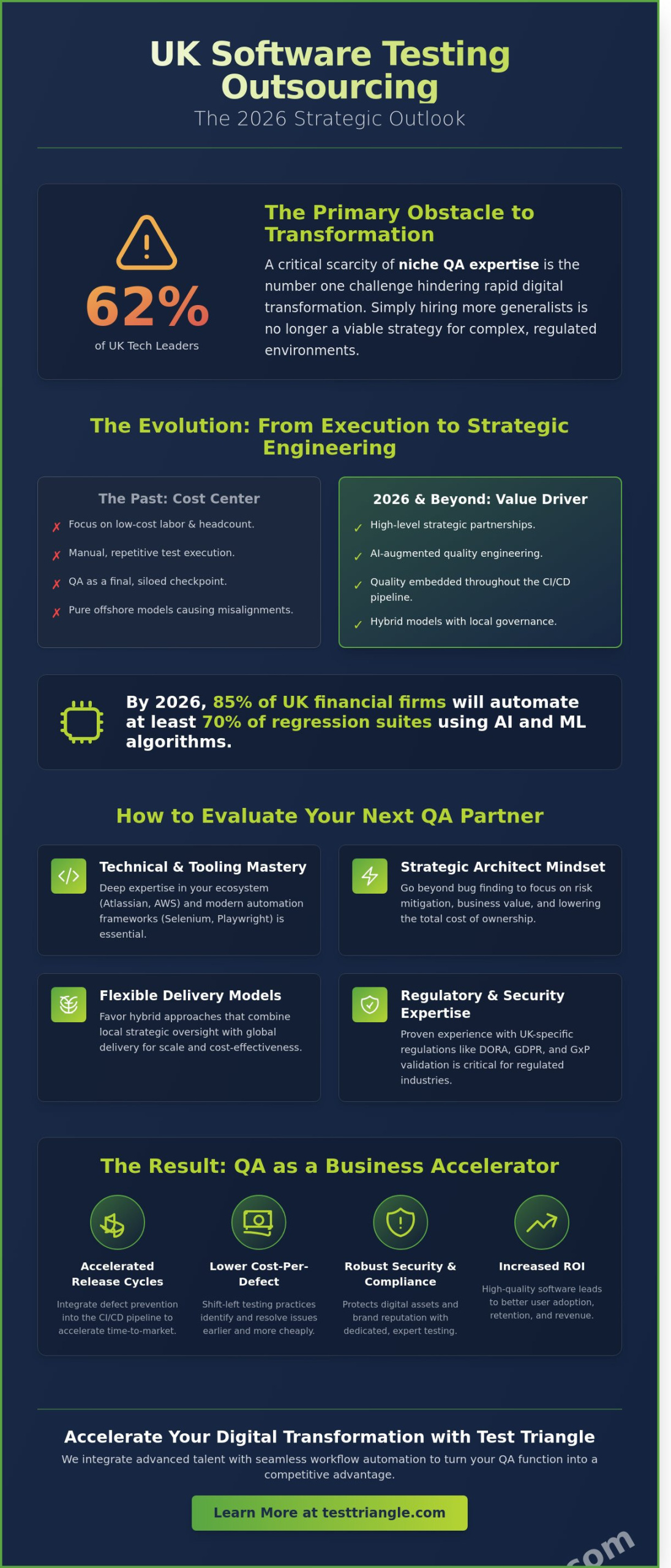
Recent 2024 industry insights reveal that 62% of UK technology leaders now identify the scarcity of niche QA expertise as the primary obstacle to achieving rapid digital transformation. By 2026, simply hiring more hands will no longer suffice; instead, the most resilient enterprises will leverage software testing outsourcing companies UK to bridge the gap between technical execution and business outcomes. You’ve likely felt the pressure of slow time-to-market caused by QA bottlenecks and the persistent difficulty of finding specialised testers who understand the nuances of regulated sectors.

Bridging the talent gap in the UK’s competitive tech market requires a versatile approach to human capital. We provide contract, remote, and permanent IT placements that allow you to scale your team within 48 to 72 hours when project demands spike. For enterprises seeking long-term stability, our Managed Service Provider (MSP) subscriptions provide a steady pulse of QA expertise. This model ensures that your software remains robust and secure long after the initial launch. We offer flexible engagement models that adapt to your specific budget and timeline requirements. To explore how we can elevate your quality standards, contact our London office for a strategic QA consultation today. Additionally, if you are managing corporate relocations or property acquisitions, you can explore Residential Sales options via our specialized legal consultancy.

It’s understandable to feel frustrated when a lack of transparency in outsourced reporting creates unnecessary security risks and misaligned workflows. Through a strategic commitment to Technology, Talent, and Transformation, you can shift your QA function from a cost centre into a driver of superior software quality. This guide provides a framework to select a partner that aligns with your Jira and DevOps ecosystems, ensuring you achieve a lower cost-per-defect and faster release cycles. We’ll explore the selection criteria needed to build a robust, scalable testing team that functions as a trusted extension of your own department.

Key Takeaways

  • Gain a strategic advantage by understanding the 2026 shift toward AI-augmented quality engineering and the necessity of local oversight for complex digital infrastructures.
  • Master the evaluation process for software testing outsourcing companies UK by prioritizing technical expertise in Atlassian and AWS ecosystems alongside essential cultural alignment.
  • Optimize your QA budget and project outcomes by determining the most effective delivery model—onshore, offshore, or hybrid—based on your specific risk profile and scale.
  • Ensure robust compliance and security within regulated UK industries by implementing specialized GxP validation and financial-grade testing protocols.
  • Accelerate your digital transformation by leveraging a partnership model that integrates advanced talent with seamless ServiceNow and Jira workflow automation.

The Evolution of Software Testing Outsourcing in the UK for 2026

By integrating local strategic oversight with global delivery capabilities, software testing outsourcing companies UK are redefining how enterprises maintain digital integrity in 2026. The landscape has shifted from a focus on low-cost labor to a demand for high-level strategic partnership. This evolution requires a deep understanding of the UK’s unique regulatory environment and rising consumer expectations for flawless digital experiences. To appreciate this shift, it’s essential to understand what is software testing outsourcing in the context of a modern, AI-driven ecosystem where quality is no longer a final checkpoint but a continuous thread.

The transition from manual execution to AI-augmented quality engineering is now a baseline requirement for competitive UK firms. By 2026, 85% of UK-based financial institutions have automated at least 70% of their regression suites using machine learning algorithms. This shift allows the “Strategic Architect” to focus on high-level risk mitigation rather than repetitive script maintenance. By leveraging advanced predictive analytics, these architects anticipate potential failure points before a single line of code is written, ensuring that technology, talent, and transformation remain perfectly aligned.

UK enterprises are increasingly abandoning pure offshore models in favor of hybrid approaches. By maintaining a local presence for governance and a global team for scale, organizations ensure that strategic decisions remain aligned with UK business hours and cultural nuances. This hybridity provides the flexibility needed to respond to market shifts while maintaining the technical rigor required for complex digital infrastructures. As a trusted partner, software testing outsourcing companies UK provide the steady hand needed to manage these multifaceted delivery models.

Current Market Dynamics and UK Trends

By addressing the critical shortage of local SDET talent, outsourcing has become a primary driver for UK technological growth. A 2025 industry report highlighted a 32% deficit in domestic software development engineers in test, forcing companies to look toward specialized partners. Demand for specialized testing in Security, Performance, and API integrity has surged as the Digital Operational Resilience Act (DORA) and updated GDPR protocols impose stricter penalties for system failures. These regulations demand a level of precision that only a dedicated QA partner can provide through robust, scalable testing frameworks.

Why Outsourcing QA is a Strategic Business Driver

Beyond simple cost reduction, outsourcing QA has become a vital tool for business agility and risk mitigation. By handing over complex infrastructure to a trusted partner, C-suite executives experience the psychological relief of knowing their digital assets are under constant, expert surveillance. Quality Engineering serves as a catalyst for ROI by embedding defect prevention mechanisms directly into the CI/CD pipeline, thereby accelerating release cycles and reducing the total cost of ownership. This strategic approach transforms QA from a cost center into a value-generating engine that drives long-term operational stability. Organizations looking to maximize this value should also consider how Digital Transformation Services can be strategically orchestrated alongside QA to eliminate application sprawl and accelerate enterprise agility.

Selection Criteria: How to Evaluate UK Software Testing Partners

Selecting the right software testing outsourcing companies UK requires a shift from vendor-centric thinking to strategic alignment. By prioritizing technical depth over mere headcount, enterprises ensure their complex digital infrastructures remain resilient. In 2026, the evaluation process goes beyond basic bug detection; it focuses on how a partner integrates into high-stakes environments like AWS, ServiceNow, or complex Atlassian ecosystems. Professional organizations don’t just provide testers; they provide a “Strategic Architect” mindset that views quality as a driver of business value.

Technical Competency and Tooling Proficiency

By embedding technical excellence into the Application Lifecycle Management (ALM) toolchain, a partner elevates the entire development process. Expertise in Jira and the broader Atlassian suite isn’t optional; it’s the foundation for real-time visibility and project health. When you evaluate automation frameworks, look for proficiency in Selenium and Playwright, alongside AI-driven tools that have been shown to reduce regression times by 35% compared to traditional scripts.

A culture of continuous learning, evidenced by ISTQB certifications and regular upskilling in cloud-native testing, ensures that the talent assigned to your project remains ahead of the curve. This level of technical maturity is a core benchmark within the UK government’s Digital Marketplace, where rigorous testing protocols are mandatory for public sector and regulated industry compliance. By choosing a partner that mirrors these standards, you mitigate the risks inherent in digital transformation.

Operational Stability and Global Reach

By maintaining a physical presence in London and Dublin while leveraging global delivery hubs, a partner provides the “Global Experience with Local Support” formula that modern enterprises demand. This hybrid model allows for 24/7 coverage without losing the nuances of UK-based communication and cultural alignment. You should verify operational stability through metrics such as a 92% client retention rate and a minimum of 10 years of experience in the UK market.

Transparency is a cornerstone of this relationship. It’s delivered through real-time dashboards and comprehensive reporting frameworks that offer a granular view of quality metrics. Scalability is equally vital; your partner must demonstrate the ability to ramp up specialized resources across time zones within a 14-day window. This agility ensures that your testing capacity grows in tandem with your roadmap.

By combining these criteria, organizations find a steady hand to guide their digital growth through “Technology. Talent. Transformation.” It’s about building a relationship with a Trusted Partner that values precision and operational stability. To see how these standards are applied in real-world scenarios, you can explore our strategic testing frameworks.

Software Testing Outsourcing Companies UK: 2026 Strategic Selection Guide

Comparison of Delivery Models: Onshore, Offshore, and Hybrid

By evaluating the structural nuances of delivery frameworks, organizations can align their quality assurance strategies with overarching business objectives. Selecting from the top software testing outsourcing companies UK requires a granular understanding of how geographical proximity impacts both speed and security. Onshore models provide maximum alignment for front-facing projects, though they typically command a 40% to 60% premium over international alternatives. Conversely, offshore models offer maximum cost-efficiency for high-volume manual testing and repetitive regression suites, provided the client can manage the inherent communication lag.

The hybrid model has emerged as the strategic standard for 2026. This approach utilizes UK-based leadership to oversee global technical resources, ensuring that accountability remains local while execution scales globally. By leveraging this structure, enterprises maintain 24/7 productivity cycles without sacrificing the cultural and regulatory alignment necessary for complex UK markets.

The Pros and Cons of Traditional Outsourcing

Pure offshore management often conceals hidden costs that erode the initial price advantage. Research indicates that organizations frequently encounter a 20% to 30% management overhead when attempting to bridge significant time-zone gaps and cultural differences without local mediation. For entities operating within highly regulated sectors, onshore testing remains a non-negotiable standard. This alignment mirrors the strategic priorities outlined in the UK Government’s approach to technology suppliers, which emphasizes the necessity of robust supplier management to mitigate operational risks in public service delivery.

Developing a risk-reward matrix is essential for model selection. High-complexity projects involving sensitive data or government contracts demand onshore proximity. Low-complexity, high-volume tasks are better suited for offshore execution. The hybrid model sits in the center, offering a balanced risk profile for 75% of enterprise digital transformation initiatives.

Test Triangle’s Flexible Engagement Model

By combining technical expertise with adaptable delivery models, Test Triangle helps businesses reduce costs while maintaining rigorous quality standards. Our blended teams provide 24/7 coverage, ensuring that testing cycles continue overnight while UK-based consultants remain the primary point of contact for strategic decision-making. This structure brings our “Technology. Talent. Transformation.” triad into action, providing the stability of a Trusted Partner alongside the scalability of a global workforce.

Our flexible engagement model focuses on driving measurable outcomes. In a recent engagement for a Tier 1 financial institution, we implemented a hybrid automation framework that successfully reduced time-to-market by 40%. By integrating Jira Service Management and our bespoke automation toolsets, we delivered a flawless transition that prioritized both speed and security. This methodical approach ensures that we don’t just act as a vendor; we function as a Strategic Architect for your digital future.

Addressing Compliance and Security in Regulated UK Industries

In the high-stakes environment of 2026, software testing outsourcing companies UK must provide more than just functional verification. They must act as guardians of regulatory integrity. For the 650 pharmaceutical companies operating in the UK and the massive fintech sector, compliance isn’t a checkbox; it’s a license to operate. By integrating rigorous security protocols directly into the delivery lifecycle, Test Triangle ensures that digital transformation doesn’t come at the cost of legal exposure or data breaches. Our strategic approach focuses on mitigating risks before they manifest in production environments.

Specialized Testing for Pharmaceuticals and Healthcare

Life Sciences firms must adhere to GxP guidelines and MHRA standards with absolute precision. Validated software testing requires a level of documentation and rigour that standard QA models often lack. Test Triangle supports Pharma IT through specialized staffing and GAMP 5 compliant testing frameworks. By leveraging Atlassian tools like Jira Service Management to create immutable audit trails, we help labs and healthcare providers maintain 100% traceability. This methodical oversight is essential for navigating MHRA requirements, where even minor data integrity issues can stall a product launch for months. Similarly, in the broader health sector, contesto.co.uk offers essential operational support and out-of-hours management for care providers.

Cybersecurity and Resilience in Fintech

The UK banking sector continues to face evolving threats, with the FCA reporting hundreds of significant cyber incidents annually. To counter these risks, we integrate OWASP Top 10 2025 standards directly into the DevOps pipeline. Selecting from the top software testing outsourcing companies UK requires a partner who understands that security is a continuous process, not a static event. Our “Security by Design” philosophy involves:

  • Continuous Penetration Testing: Identifying vulnerabilities in real-time as code is committed.
  • Automated Security Audits: Utilizing AI-driven tools to scan for configuration drifts in cloud-native banking apps.
  • Data Privacy Assurance: Ensuring GDPR compliance through robust data masking and anonymization in outsourced test environments.

By combining technical expertise with flexible engagement models, Test Triangle helps financial institutions build resilient systems that withstand both market volatility and malicious actors. We leverage our deep experience with ServiceNow and Jira to harmonize security workflows with business objectives, ensuring that every update is both fast and flawless.

Our unique signature of Technology. Talent. Transformation. ensures that your compliance journey is handled by a Trusted Partner who values stability and precision. We don’t just find bugs; we architect secure digital futures for the UK’s most regulated sectors.

Ensure your digital infrastructure meets the highest regulatory and security standards. Partner with Test Triangle for expert-led compliance and security testing.

Test Triangle: Your Strategic Partner for QA Transformation

By bridging the gap between technical execution and business outcomes, Test Triangle has emerged as a premier choice among software testing outsourcing companies UK. We aren’t merely a service provider; we operate as a “Strategic Architect” for your digital ecosystem. Our commitment as a “Trusted Partner” means we take full ownership of your QA maturity, moving beyond simple bug detection to drive holistic operational stability. We serve global enterprises across high-stakes sectors like Banking and Life Sciences, where precision isn’t optional. Every engagement begins with a comprehensive strategic audit, providing a clear roadmap that aligns your testing goals with your broader corporate vision.

Our approach is rooted in the deep integration of industry-leading platforms. By leveraging our status as an expert in Atlassian and ServiceNow, we create seamless workflows that eliminate the silos between development and quality assurance. We don’t just provide a team; we provide a framework for excellence. Our signature triad—Technology. Talent. Transformation.—serves as the foundation for every project we undertake. This ensures that your software isn’t just functional, but also robust, scalable, and ready for the demands of 2026 and beyond.

The Synergy of Testing and DevOps Implementation

By integrating testing directly into your DevOps framework, we eliminate the friction that often slows down release cycles. We optimize Jira Service Management to create a single source of truth, ensuring that every bug report and test case is visible to stakeholders in real time. This transparency accelerates Digital Transformation Services by embedding automated CI/CD pipelines into your development workflow, which can reduce manual testing effort by up to 35%. We also leverage AWS Cloud Migration expertise to build elastic test environments. These environments scale automatically to meet demand, allowing for rigorous performance testing without the capital expenditure of permanent hardware.

Flexible Staffing and Managed Services

Bridging the talent gap in the UK’s competitive tech market requires a versatile approach to human capital. We provide contract, remote, and permanent IT placements that allow you to scale your team within 48 to 72 hours when project demands spike. For enterprises seeking long-term stability, our Managed Service Provider (MSP) subscriptions provide a steady pulse of QA expertise. This model ensures that your software remains robust and secure long after the initial launch. We offer flexible engagement models that adapt to your specific budget and timeline requirements. To explore how we can elevate your quality standards, contact our London office for a strategic QA consultation today.

Future-Proofing Your Quality Engineering Strategy for 2026

Navigating the complex landscape of software testing outsourcing companies UK in 2026 requires more than a simple vendor agreement; it demands a strategic alliance built on technical rigor and verified security. By prioritizing ISO 9001 and ISO 27001 certifications, enterprises can effectively mitigate the risks associated with evolving UK data protection mandates and complex digital ecosystems. Organizations must leverage flexible delivery models that bridge the gap between local London expertise and global scalability from established hubs like Dublin and Hyderabad. As an Atlassian Gold Solution Partner, Test Triangle integrates these elements to drive measurable QA transformation through our core pillars: Technology, Talent, and Transformation.

By aligning your testing strategy with 2026 industry benchmarks, you ensure that your software isn’t just functional but remains truly resilient against rapid market shifts. It’s essential to select a partner that balances specialized talent with advanced technology to maintain a competitive edge. This commitment to precision helps organizations reduce operational friction while accelerating time-to-market. Your journey toward a robust, high-performance digital infrastructure starts with choosing a partner that understands the nuances of your industry. It’s time to elevate your standards and achieve the flawless execution your customers expect today.

Partner with a Strategic Architect for your QA needs

Frequently Asked Questions

How do UK software testing outsourcing companies charge for their services?

By leveraging flexible engagement models, software testing outsourcing companies UK typically structure costs through Time and Materials (T&M), fixed-price contracts, or monthly managed service subscriptions. Most UK enterprises opt for T&M models for agile projects to maintain budget fluidity. According to the 2024 State of Testing Report, 42 percent of organizations now prefer outcome-based pricing to ensure that costs align directly with delivered quality benchmarks and specific project milestones.

What is the difference between a QA vendor and a strategic testing partner?

A QA vendor provides transactional bug-finding services, while a strategic testing partner integrates into your business lifecycle to drive long-term digital transformation. We act as a Strategic Architect, focusing on risk mitigation and ROI rather than just executing test cases. This partnership approach ensures that your software testing outsourcing companies UK selection results in a robust, scalable infrastructure that supports 100 percent of your business goals and operational stability.

Can I outsource software testing if my company uses a highly regulated GxP environment?

You can absolutely outsource testing in GxP environments by partnering with firms that adhere to GAMP 5 and ISO 9001:2015 standards. Test Triangle maintains rigorous compliance protocols to support Life Sciences and Healthcare clients operating under FDA 21 CFR Part 11 regulations. By implementing validated testing processes, we ensure that 100 percent of your digital documentation meets the strict audit requirements of highly regulated industries without compromising on speed or precision.

How does Test Triangle ensure communication quality between UK clients and offshore teams?

Test Triangle ensures communication excellence through a structured governance framework that includes daily stand-ups and real-time collaboration via the Atlassian ecosystem. By aligning our offshore teams with UK business hours, we provide a 4-hour overlap for synchronous strategic planning. We utilize our signature triad of Technology, Talent, Transformation to bridge cultural gaps, ensuring that every project milestone is communicated with 100 percent clarity and professional rigor.

Is it possible to integrate an outsourced QA team into my existing Jira/Atlassian workflow?

It’s standard practice to integrate our outsourced QA teams directly into your existing Jira Service Management or Atlassian toolchain to maintain workflow continuity. We mirror your internal sprint cycles and permission levels, ensuring that our engineers function as a seamless extension of your department. This integration allows for real-time tracking of defect density and test coverage, providing your leadership team with 100 percent visibility into the development pipeline at every stage.

What are the typical cost savings when moving from internal QA to a hybrid outsourcing model?

Transitioning to a hybrid outsourcing model typically yields cost savings between 30 percent and 45 percent compared to maintaining an entirely in-house QA department. These savings stem from reduced recruitment overhead and the elimination of expensive infrastructure costs for specialized device labs. By optimizing resource allocation, businesses can reinvest these funds into core product innovation while maintaining a 24/7 testing cycle that significantly accelerates time-to-market for new digital products.

What security certifications should I look for in a UK testing partner?

You should prioritize partners holding ISO 27001 for information security management and Cyber Essentials Plus for technical infrastructure protection. These certifications prove that a partner can manage sensitive data across global borders without compromising integrity or compliance. At Test Triangle, we anchor our security protocols in these recognized standards to ensure that your intellectual property remains 100 percent secure throughout the entire software testing lifecycle.

How quickly can a testing team be ramped up for a new project?

A dedicated testing team can typically be ramped up and fully operational within 10 to 20 business days. This timeline includes initial knowledge transfer, environment setup, and the integration of our engineers into your specific Jira workflows. By maintaining a pre-vetted talent pool of ISTQB-certified professionals, we accelerate the onboarding process, allowing your project to move from the discovery phase to execution without experiencing significant delays or resource gaps.

Paul Guy

Article by

Paul Guy

Paul serves as the Marketing Director at Test Triangle, where he leads a global team in driving growth through strategic B2B marketing and brand communications. With a strong emphasis on measurable outcomes and sustainable performance, he plays a pivotal role in aligning marketing functions to enhance customer engagement and accelerate business impact. Under his leadership, marketing initiatives have consistently delivered significant returns on investment, elevated brand visibility, and strengthened the company's presence across key markets.