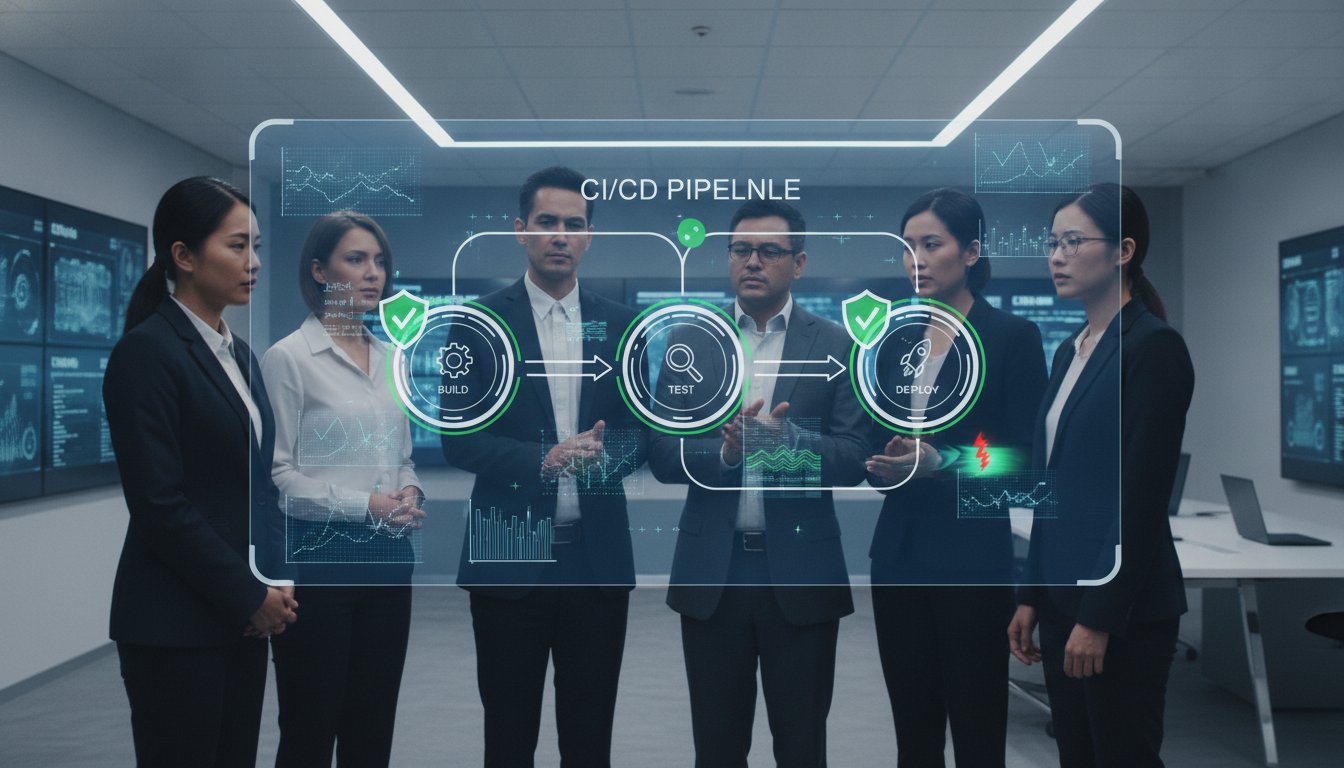
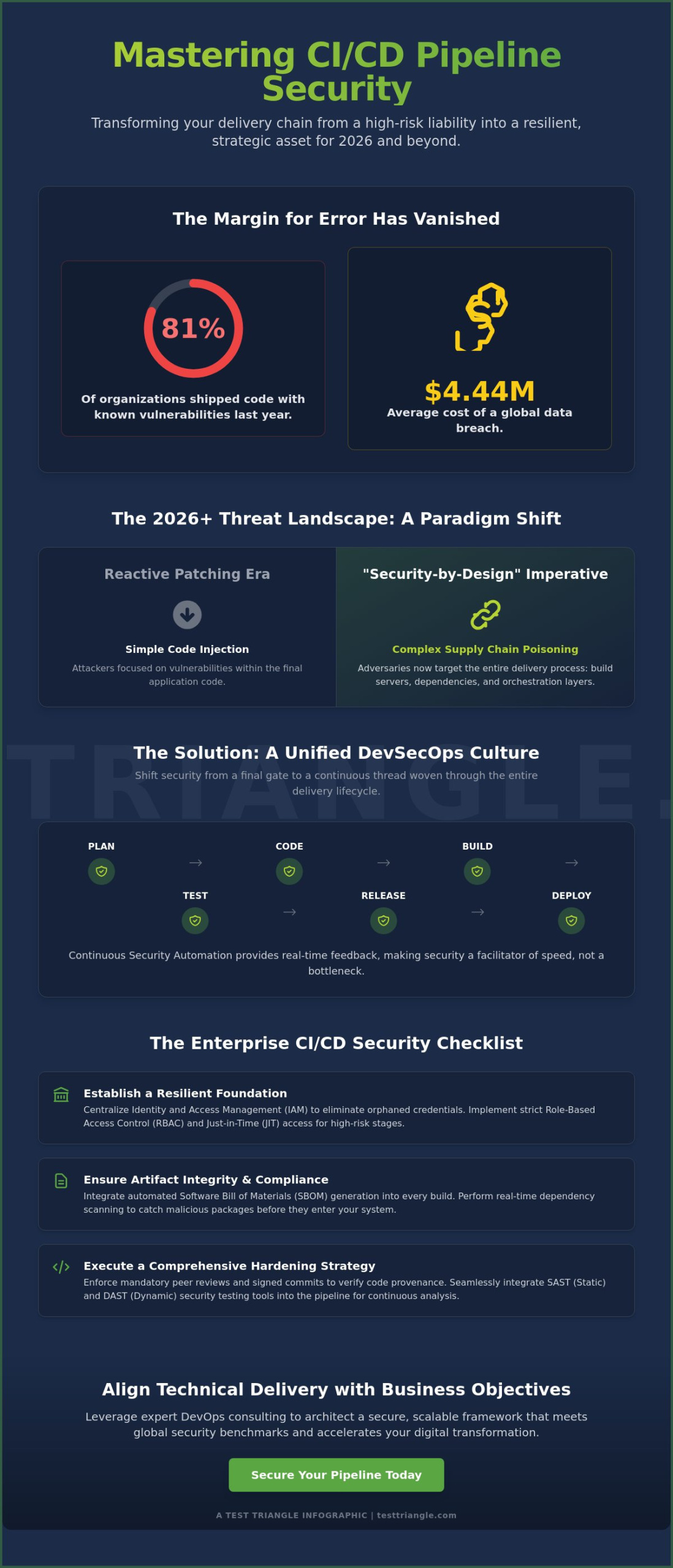
With 81% of organizations admitting they shipped code with known vulnerabilities into production last year, the margin for error in software delivery has effectively vanished. You’ve likely felt the mounting tension between the demand for rapid release cycles and the critical need to protect an infrastructure where global breach costs now average $4.44 million. Adopting sophisticated ci/cd pipeline security best practices is the only way to resolve this conflict, transforming your delivery chain from a potential liability into a resilient, strategic asset. This guide promises to equip you with a comprehensive framework to master modern delivery complexities, ensuring your organization stays ahead of the sophisticated threats emerging in 2026.
We’ll provide a methodical checklist that bridges the gap between high-level security policy and practical, automated execution. By examining the latest NIST DevSecOps practices and OWASP standards, we’ll show you how to eliminate secrets exposure and verify supply chain integrity without sacrificing momentum. You’ll discover how a disciplined approach to pipeline hardening results in both reduced risk and enhanced operational stability, positioning your enterprise as a leader in secure digital transformation.
Key Takeaways
- Analyze the evolution of the 2026 threat landscape to transition from reactive patching toward a sophisticated, “Security-by-Design” architecture that protects against complex supply chain poisoning.
- Establish a resilient foundation for your delivery infrastructure by centralizing identity management and implementing ci/cd pipeline security best practices that eliminate high-risk orphaned credentials.
- Ensure continuous compliance and artifact integrity by integrating automated Software Bill of Materials (SBOM) generation and real-time dependency scanning into your existing workflows.
- Execute a comprehensive hardening strategy using a tactical checklist that prioritizes mandatory peer reviews, signed commits, and the seamless integration of SAST and DAST tools.
- Align your technical delivery with long-term business objectives by leveraging expert DevOps consulting to architect a secure, scalable framework that meets global security benchmarks.
Securing the Software Supply Chain: The 2026 CI/CD Threat Landscape
The digital perimeter has effectively dissolved, placing the software delivery engine at the center of the enterprise risk profile. In 2026, the sophistication of adversaries has reached a critical juncture where the integrity of the delivery process is as vital as the code itself. The evolution from simple code injection to complex supply chain poisoning reflects a maturation of cyber-adversaries who now target the build server and orchestration layers rather than just the application. Implementing robust ci/cd pipeline security best practices is no longer a tactical option but a strategic imperative for any organization aiming to maintain operational stability and customer trust.
Adopting a “Security-by-Design” approach is essential to counter these threats, moving beyond the era of reactive patching which often leaves systems exposed for critical windows. A 2025 survey revealed that 81% of organizations admitted to shipping code with known vulnerabilities, a statistic that underscores the failure of traditional perimeter-based defenses. By integrating security protocols directly into the continuous integration (CI) and continuous delivery (CD) workflow, enterprises can validate every artifact before it reaches production, thereby neutralizing threats at the source. This proactive posture is particularly vital as AI-generated code increases the volume and velocity of vulnerabilities, requiring automated, intelligent oversight to maintain a secure posture.
Identifying Vulnerabilities in Modern Pipelines
Modern delivery environments are often compromised by third-party plugins and automated integrations that lack rigorous security vetting. These tools, while enhancing productivity, frequently introduce unmanaged risks that bypass traditional firewalls. The rise of “Shadow DevOps”—where teams spin up unmanaged pipeline environments outside of official corporate governance—creates significant blind spots that attackers are eager to exploit. In 2026, a Supply Chain Attack is defined as a strategic compromise of third-party components or delivery infrastructure designed to inject malicious payloads into trusted downstream environments. Data from 2025 indicates that 1.6% of organizations using npm have already encountered at least one malicious dependency, proving that trust must be verified, not assumed.
The Shift from DevOps to DevSecOps
Transitioning from DevOps to DevSecOps requires a fundamental cultural and technical shift that prioritizes security, stability, and scalability. This evolution moves security from a final checkpoint to a continuous thread woven through the entire development lifecycle. Security automation is the primary driver of this change, as it reduces the friction between developers and security teams by providing real-time feedback within existing workflows. When security is automated, it becomes a facilitator of speed rather than a bottleneck. A unified, security-first delivery culture empowers teams to own the security of their code, ensuring that every release is backed by a strategic framework of automated controls and expert human oversight. This alignment provides the peace of mind necessary for large-scale technological evolution in a volatile threat environment.
Hardening the Pipeline: Identity and Secrets Management
Centralizing identity and access management (IAM) within the orchestration layer serves as the most effective method for eliminating orphaned credentials that frequently persist after organizational shifts. By integrating these identities with enterprise-wide directories, security teams maintain a single source of truth, ensuring that access is revoked instantly across all environments. Role-Based Access Control (RBAC) complements this by defining precise boundaries for what each user or service account can execute, which prevents unauthorized modifications to pipeline configurations. These ci/cd pipeline security best practices focus on reducing the blast radius of any potential compromise by ensuring that no single identity possesses excessive reach.
For high-risk deployment stages, strategic implementation of Just-in-Time (JIT) access provides a sophisticated layer of protection by granting elevated permissions only for the duration of a specific task. This approach, combined with the use of enterprise-grade secrets vaults rather than insecure environment variables, ensures that sensitive data like API keys and certificates are encrypted at rest and in transit. Unlike static environment variables, modern vaults offer dynamic secret generation and comprehensive audit logs, providing the transparency required for rigorous regulatory compliance. Organizations looking to integrate these rigorous controls into their existing workflows often find that consulting with strategic experts is the most efficient path to long-term operational stability.
Implementing Zero Trust and Least Privilege
A zero-trust architecture dictates that every service, runner, and user must be verified before interacting with the delivery pipeline. This methodology aligns with the NSA and CISA CI/CD Security Guidelines, which advocate for the continuous rotation of access keys and the strict limitation of runner permissions. By auditing these interactions in real-time, organizations can identify anomalous behavior before it escalates into a breach. Reducing the attack surface requires a disciplined commitment to the principle of least privilege, ensuring that pipeline runners only access the specific resources necessary for their immediate build tasks.
Eliminating Hardcoded Secrets and Credential Leaks
Despite the availability of advanced tools, credential leaks remain a primary vulnerability, with 2025 data showing that 32% of all scanner-detected repository secrets were tied directly to CI/CD systems. Implementing automated pre-commit hooks is a vital first step, as it prevents sensitive data from ever entering the version control system. Continuous scanning must extend beyond the code itself to include build logs and artifact metadata, where secrets often hide in plain sight. In 2026, a single leaked API key isn’t just a technical oversight; it’s a multi-million dollar invitation for automated adversaries to dismantle your entire digital infrastructure in seconds.
Integrity Assurance: Validating Code and Dependencies
Maintaining the absolute integrity of software components has become a primary challenge for the modern enterprise, particularly as the complexity of the dependency graph continues to expand. In an environment where 1.6% of organizations using npm have encountered at least one malicious dependency, verifying the provenance of every library is a non-negotiable pillar of ci/cd pipeline security best practices. Establishing a “Trusted Registry” for all container images and build artifacts ensures that only vetted, internal resources are utilized during the orchestration process, effectively neutralizing the risk of public repository poisoning. This strategic isolation allows organizations to solidify, secure, and scale their delivery pipelines with the confidence that their foundational components remain untainted by external adversaries.
Automating Software Composition Analysis (SCA) to identify known vulnerabilities (CVEs) in real-time provides a critical layer of defense that operates at the speed of modern development. By integrating these scans directly into the build cycle, teams can detect and remediate security flaws before they are baked into the final artifact. This proactive validation is further reinforced by implementing cryptographic code signing, which ensures artifact integrity from the moment of creation to the point of deployment. By enforcing signature verification at the production gate, enterprises can guarantee that the code running in their environments is exactly what was approved during the build phase, providing total transparency and operational stability.
Software Bill of Materials (SBOM) and Third-Party Risk
In 2026, the Software Bill of Materials (SBOM) has evolved from a static compliance requirement into a dynamic, real-time inventory that is essential for proactive risk management. Generating a comprehensive SBOM for every build cycle allows security teams to maintain a transparent view of all direct and transitive dependencies. This level of visibility is a cornerstone of Software and Digital Assurance Testing, ensuring that third-party risks are identified and mitigated with surgical precision. Linking SBOM analysis with global vulnerability databases enables a rapid response to emerging threats, transforming a complex supply chain into a manageable, secure asset.
Code Signing and Immutable Build Artifacts
Digital signatures serve as the definitive mechanism for verifying the origin and state of code, acting as a cryptographic seal that prevents unauthorized tampering. The use of immutable build artifacts is essential in this framework; once an artifact is signed and stored, it must never be modified, ensuring that what was tested is exactly what is deployed. Organizations should reference the OWASP CI/CD Security Cheat Sheet to refine their signature verification protocols and ensure that no unsigned or unverified code can bypass the final deployment gate. This disciplined approach to artifact management provides the precision, protection, and peace of mind required to navigate the volatile 2026 threat landscape.
The Enterprise CI/CD Security Best Practices Checklist
Transitioning from theoretical frameworks to operational excellence requires a disciplined application of technical controls across every stage of the delivery lifecycle. To achieve a resilient posture, organizations must move beyond generic security advice and implement a granular, multi-layered defense strategy. This checklist serves as a strategic roadmap for hardening your infrastructure, ensuring that ci/cd pipeline security best practices are embedded into the very fabric of your organizational workflows. By prioritizing these controls, enterprises can achieve a state of continuous compliance while maintaining the high-velocity delivery required by modern market demands.
A comprehensive security posture begins with these foundational pillars:
- Secure Source Control: Enforce strict branch protection rules that mandate peer reviews for all changes and require cryptographically signed commits to verify author identity.
- Automated Security Scanning: Integrate Static Application Security Testing (SAST), Dynamic Application Security Testing (DAST), and Software Composition Analysis (SCA) into every pipeline execution to identify vulnerabilities in real-time.
- Environment Isolation: Utilize ephemeral build runners that are destroyed after each task and operate within isolated network segments to prevent lateral movement by adversaries.
- Deployment Gates: Establish automated approval workflows that block deployments if security scan results exceed predefined risk thresholds.
- Audit and Logging: Maintain immutable, centralized logs of all pipeline activities to provide a definitive trail for forensic analysis and regulatory reporting.
Pre-Build and Source Control Hardening
Securing the entry point of your pipeline is critical for preventing the injection of malicious code or unauthorized configuration changes. Mandating Multi-Factor Authentication (MFA) for all repository access is a baseline requirement that significantly reduces the risk of credential-based attacks. Enterprises must also restrict the use of unverified third-party GitHub Actions or GitLab runners, as these external components often bypass internal security vetting. Configuring real-time webhooks for alerting on suspicious configuration changes allows your security team to detect, defend, and decouple potential threats before they propagate through the build cycle.
Build and Test Stage Security Controls
Maintaining developer velocity while enforcing rigorous security standards requires a sophisticated approach to test execution. Running security scans in parallel with traditional functional tests ensures that identifying vulnerabilities doesn’t become a bottleneck for release cycles. Organizations should implement strict ‘fail-build’ thresholds for critical and high-severity issues, ensuring that no known high-risk code reaches production. Leveraging Software Test Automation Services allows for the seamless integration of these security checks into a broader quality assurance framework. For organizations ready to architect a more resilient delivery engine, speaking with a strategic consultant can provide the clarity needed to navigate these technical complexities.
Strategic Implementation: Scaling Security with Expert Consulting
Scaling security across a fragmented enterprise infrastructure requires a departure from siloed tool implementation toward a unified, strategic technology roadmap. For global organizations, the challenge isn’t just identifying vulnerabilities but maintaining a consistent security posture across thousands of concurrent pipelines. Engaging in high-level DevOps Consulting allows enterprises to architect secure delivery pipelines that are resilient by design and compliant by default. This strategic oversight ensures that ci/cd pipeline security best practices are not merely local optimizations but are standardized across the entire digital estate, providing the institutional maturity necessary for long-term stability.
Managed services play a pivotal role in this evolution by providing continuous monitoring and governance that internal teams may struggle to maintain amidst rapid scaling. Bridging the persistent DevSecOps talent gap is another critical hurdle; for instance, Square Skills provides accredited IT training to help internal teams stay current, while specialized IT staffing services provide the human expertise required to implement complex security controls without slowing down the development engine. By combining expert consulting with dedicated technical talent, organizations can transform their delivery systems into secure, scalable, and sophisticated assets. This holistic approach ensures that your technological evolution is backed by both a practical framework and the specialized skills needed for execution.
Atlassian and ServiceNow Integration for Security Governance
True governance is achieved when security incidents are tracked and remediated with the same rigor as production bugs. Leveraging industry-standard platforms like Jira and ServiceNow for automated incident tracking ensures that every vulnerability identified in the pipeline is assigned, audited, and resolved within established SLAs. Optimizing these environments through expert Atlassian Implementation allows teams to create a unified dashboard for security compliance. This integration provides executive leadership with real-time visibility into the organization’s risk profile, bridging the gap between technical execution and business outcomes. When security data is centralized, it becomes a powerful tool for informed decision-making and operational efficiency.
Custom Security Roadmapping for Global Enterprises
Standardized security controls often fail to account for the unique regulatory pressures of industries such as finance or pharmaceuticals. A tailored security roadmap addresses these specific requirements by aligning technical delivery with global benchmarks and industry-specific mandates. Establishing a long-term strategic partnership ensures that your security posture evolves alongside the threat landscape, moving from basic hardening to advanced, predictive defense. Test Triangle serves as a steady, strategic, and secure partner, empowering enterprises to navigate the complexities of digital transformation with absolute confidence. This collaborative approach provides the peace of mind that comes from knowing your infrastructure is managed by a reliable long-term collaborator dedicated to your operational success.
Architecting Resilience in the 2026 Delivery Landscape
Mastering the complexities of modern software delivery requires a shift from fragmented toolsets to a unified, strategic framework of automated controls and expert oversight. By prioritizing the ci/cd pipeline security best practices outlined in this guide, including the rigorous validation of SBOMs and the centralization of identity management, your organization can effectively neutralize emerging supply chain threats. These technical measures provide the essential foundation for maintaining operational stability while accelerating the pace of digital innovation. Achieving this level of maturity demands a partner with a global presence and deep expertise in navigating highly regulated industries.
As an Atlassian Platinum Partner with a proven track record in complex digital transformations, Test Triangle acts as a reliable long-term collaborator for enterprises seeking to harden their infrastructure. Our approach ensures that security assurance is woven into every stage of the development lifecycle, providing the peace of mind necessary for large-scale technological evolution. We invite you to Secure Your Pipeline with Strategic DevOps Consulting and begin your journey toward a more stable, precise, and scalable future. Your organization’s progress is our primary objective, and we’re ready to help you build a delivery engine that is truly steady, strategic, and secure.
Frequently Asked Questions
What is the most critical stage to secure in a CI/CD pipeline?
The source control repository is the most critical stage to secure because it acts as the primary root of trust for the entire delivery ecosystem. If an adversary compromises the entry point through unauthorized code injection or credential theft, every subsequent stage of the pipeline becomes a vehicle for malicious propagation. Ensuring robust branch protections and mandatory peer reviews at this stage prevents vulnerabilities from entering the build cycle, which fundamentally protects the integrity of the downstream environment.
How can I integrate security without slowing down my deployment frequency?
Integrating security without sacrificing velocity requires the strategic parallelization of automated scanning tools within the orchestration layer. By running SAST and SCA scans alongside functional tests, teams identify critical flaws in real-time without blocking the main delivery path. This approach ensures that ci/cd pipeline security best practices become a facilitator of speed, as catching vulnerabilities early reduces the time-consuming remediation cycles typically required just before a production release.
Is it better to use open-source or commercial security scanning tools?
Enterprise environments generally benefit more from commercial security tools due to their advanced integration capabilities, comprehensive support, and alignment with global compliance standards. While open-source tools provide valuable baseline scanning, commercial platforms offer the sophisticated reporting and centralized governance required by large-scale organizations. Selecting a toolset that bridges the gap between technical execution and executive visibility ensures that security remains a manageable, strategic asset rather than a fragmented collection of scripts.
How does Zero Trust apply specifically to CI/CD workflows?
Zero Trust in CI/CD workflows dictates that every user, build runner, and service account must be explicitly verified before accessing pipeline resources. This methodology eliminates the concept of an “internal” trusted network, requiring continuous authentication and the strict application of the principle of least privilege. By ensuring that runners are ephemeral and have no persistent access to production environments, organizations significantly reduce the potential blast radius of a compromised identity or tool.
What are the most common mistakes in CI/CD secrets management?
The most frequent failures in secrets management include hardcoding credentials in version control and using static environment variables for sensitive data. Many organizations also struggle with long-lived API keys that lack automated rotation, creating a persistent attack surface for adversaries. Transitioning to dynamic secrets generated by enterprise-grade vaults ensures that credentials are short-lived and encrypted, providing the technical rigor necessary to prevent catastrophic data breaches in volatile environments.
How often should pipeline security configurations be audited?
Pipeline security configurations should be monitored in real-time through automated webhooks and audited formally at least once per quarter. Continuous monitoring allows security teams to detect and remediate drift in configuration settings before they can be exploited. These periodic deep dives ensure that your ci/cd pipeline security best practices remain aligned with evolving industry standards and internal compliance requirements, providing the institutional maturity needed for long-term operational stability.
Can automated security testing completely replace manual security reviews?
Automated security testing cannot completely replace manual reviews; instead, the two should function as complementary components of a comprehensive assurance strategy. Automation excels at identifying known vulnerabilities and pattern-based flaws at high velocity, while manual reviews are essential for uncovering complex logic errors and architectural weaknesses. A balanced approach leverages human expertise to interpret automated results, ensuring that the most critical risks are addressed with strategic precision and technical depth.
What role does an SBOM play in pipeline security?
A Software Bill of Materials (SBOM) acts as a definitive, transparent inventory of every component and dependency within a build artifact. In the context of 2026 security standards, the SBOM is vital for identifying transitive risks and ensuring compliance with third-party licensing requirements. By integrating dynamic SBOM generation into each build cycle, enterprises maintain the visibility required to respond instantly when new vulnerabilities are discovered in common libraries or upstream packages.

Article by
Paul Guy
Paul serves as the Marketing Director at Test Triangle, where he leads a global team in driving growth through strategic B2B marketing and brand communications. With a strong emphasis on measurable outcomes and sustainable performance, he plays a pivotal role in aligning marketing functions to enhance customer engagement and accelerate business impact. Under his leadership, marketing initiatives have consistently delivered significant returns on investment, elevated brand visibility, and strengthened the company's presence across key markets.