
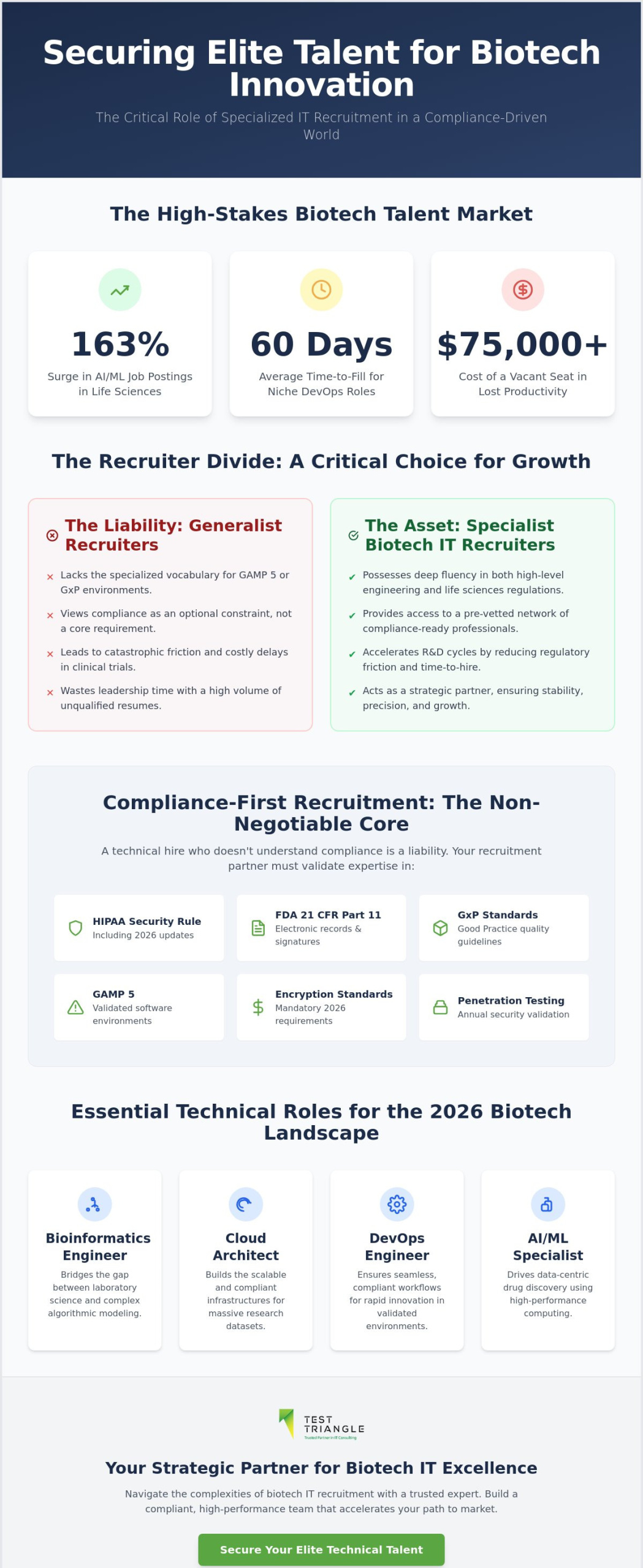
With AI/ML job postings in the life sciences sector surging by 163% and the average time-to-fill for niche DevOps roles stretching to 60 days, the cost of a vacant technical seat in your lab can exceed $75,000 in lost productivity before a single line of code is written. Finding a specialized IT recruiter for biotech startups has become a critical mission for leadership teams who are tired of receiving resumes for generic software engineers who lack a fundamental grasp of GxP or the latest 2026 HIPAA Security Rule updates. You likely realize that in a highly regulated environment, a technical hire who doesn’t understand compliance isn’t just a poor fit; they’re a liability to your clinical timelines and data integrity.

This article empowers biotech leaders to secure elite technical talent capable of mastering the intersection of rapid innovation and stringent life sciences compliance. We’ll examine how a strategic approach to IT staffing services and DevOps consulting can accelerate your R&D cycles by providing access to a pre-vetted network of compliance-ready professionals. By prioritizing candidates who understand mandatory 2026 encryption standards and annual penetration testing requirements, you can achieve the stability, precision, and scalable growth necessary to lead the market. We explore the methodology behind faster time-to-hire for bioinformatics roles and the strategic reduction of regulatory friction through expert technical alignment.

Key Takeaways

  • Learn why the shift toward data-centric drug discovery necessitates a departure from traditional hiring models in favor of specialized, regulatory-aware technical vetting.
  • Identify the essential technical roles, such as Bioinformatics Engineers and Cloud Architects, required to build the scalable and compliant infrastructures defining the 2026 biotech landscape.
  • Discover how a dedicated IT recruiter for biotech startups bridges the expertise gap by validating candidates for both high-level engineering skills and proficiency in FDA 21 CFR Part 11.
  • Evaluate strategic staffing frameworks that balance permanent leadership with agile contract resources to ensure your team remains responsive during critical clinical trial phases.
  • Understand the operational benefits of a recruitment methodology that leverages platforms like Atlassian and ServiceNow to create seamless, compliant workflows for rapid innovation.

The Evolving Landscape of IT Recruitment for Biotech Startups

By integrating advanced computational power with traditional Biotechnology, the industry has transitioned into a data-centric era where drug discovery occurs as much in silicon as it does in the petri dish. This shift has birthed “Bio-IT”, a multidisciplinary domain where high-performance computing meets molecular biology to accelerate therapeutic breakthroughs. For organizations at the frontier of this evolution, the search for a strategic IT recruiter for biotech startups is no longer a peripheral HR task; it’s a fundamental requirement for operational survival. In 2026, the surge in AI/ML job postings by 163% year-over-year highlights a market that prizes candidates who can bridge the gap between laboratory science and complex algorithmic modeling.

Addressing the 2026 talent market requires a sophisticated understanding of how data flows from the lab bench to the cloud. Modern drug discovery relies on massive datasets that demand high-performance computing (HPC) clusters and specialized data engineering. Traditional IT staffing models often fail here because they treat technology as a standalone utility rather than an integrated component of the scientific process. By establishing a recruitment methodology that prioritizes regulatory literacy alongside technical prowess, organizations can transform their hiring process into a competitive advantage that drives both innovation and stability.

The Complexity of the Biotech Startup Ecosystem

Biotech startups operate under a unique pressure cooker of venture capital milestones, where securing series-level funding depends on the rapid scaling of technical infrastructure. Leadership must balance the “fail fast” mentality inherent in software development with the “zero error” reality of life sciences regulations. A robust IT framework acts as the guardian of intellectual property, ensuring that sensitive research data remains secure and accessible during pivotal growth phases. By aligning staffing solutions with these high-stakes objectives, firms can ensure their technical teams support both rapid innovation and long-term IP protection. This strategic alignment provides the peace of mind necessary to focus on core R&D while the digital foundation remains secure and scalable.

Why Generalist IT Recruiters Fall Short

Generalist agencies often lack the specialized vocabulary required to vet candidates for GAMP 5 or validated software environments. They frequently source engineers who view compliance as an optional constraint rather than a core technical requirement. This misalignment leads to catastrophic friction during onboarding, as engineers struggle with GxP standards they’ve never encountered. When an IT recruiter for biotech startups fails to understand these nuances, the result is often a costly delay in clinical trials. A 12-week vacancy for a critical role can cost a startup $75,000 in lost productivity, but a bad hire in a regulated environment can cost even more in compliance remediation and lost time. Precision, partnership, and progress are only possible when the recruiter treats compliance as a technical specification, not a secondary hurdle.

Essential Technical Roles Driving Biotech Innovation in 2026

As legislative bodies focus on closing the biotechnology workforce gap, the demand for specialized technical talent has moved beyond simple software development into highly specific, hybrid domains. By engaging a dedicated IT recruiter for biotech startups, leadership teams can bypass the noise of generic resumes to identify professionals who possess the rare combination of scientific literacy and engineering excellence. These roles form the digital backbone of modern drug discovery, ensuring that every byte of data generated in the lab is captured, analyzed, and secured according to 2026 standards. Identifying these individuals requires an assessment framework that goes beyond traditional coding tests to evaluate how technical decisions impact clinical validity.

The following roles represent the critical hires necessary for maintaining a competitive edge in a data-driven life sciences environment:

  • Bioinformatics Engineers: These professionals manage the complex intersection of biology and big data, developing the algorithms that process genomic sequences and proteomic profiles.
  • Cloud Architects for Life Sciences: Tasked with building scalable, compliant AWS or Azure environments, these architects ensure that infrastructure can handle massive datasets while meeting stringent regulatory hurdles.
  • DevOps Engineers with GxP Awareness: By automating software delivery while maintaining rigorous audit trails, they enable rapid iteration without compromising the integrity of the validated state.
  • Laboratory Information Management System (LIMS) Specialists: These experts integrate diverse lab hardware with enterprise software, creating a seamless flow of information that reduces manual transcription errors.
  • Data Integrity Officers: They serve as the guardians of clinical datasets, ensuring that all digital information remains reliable, secure, and fully traceable throughout the product lifecycle.

Niche Engineering for Drug Discovery

Securing talent for drug discovery requires vetting for deep proficiencies in Python and R, specifically applied to genomic data formats and molecular modeling. Candidates must demonstrate experience with high-performance computing (HPC) clusters to facilitate the massive parallel processing required for virtual screening and lead optimization. The search for these niche experts is precisely why a specialized IT recruiter for biotech startups has become an essential collaborator. Organizations benefit from leveraging professional IT staffing services to identify these rare hybrids who understand full-stack development within scientific workflows. If your current hiring pipeline is failing to deliver these specialized profiles, it might be time to discuss your strategic technical requirements with an expert partner.

Infrastructure and Security Specialists

In the 2026 biotech landscape, the Cloud Security Architect serves as the primary architect of zero-trust environments, ensuring that every data exchange across distributed research networks adheres to mandatory encryption and real-time auditability standards. Cybersecurity experts now focus heavily on protecting proprietary therapeutic research from sophisticated intellectual property theft. As research teams become increasingly remote and offshore, cloud-native security protocols must evolve to protect collaborative environments without stifling the speed of innovation. This disciplined approach to infrastructure ensures that your digital assets remain as secure as your physical laboratory samples.

Compliance-First Recruitment: Bridging IT and Life Sciences

Compliance-first recruitment represents a fundamental evolution in how technical talent is sourced for the life sciences sector. It’s the rigorous process of vetting candidates for both high-level engineering capabilities and deep-seated regulatory literacy. When a specialized IT recruiter for biotech startups evaluates a candidate, they don’t just look for coding proficiency; they look for an inherent understanding of how that code exists within a regulated ecosystem. This approach ensures that every hire contributes to the maintenance of GxP standards across the entire tech stack, from laboratory instruments to cloud-based data warehouses. By prioritizing this dual-competency, startups can build teams that are ready to operate in high-stakes environments from day one.

Effective vetting in 2026 requires a deep dive into a candidate’s experience with FDA 21 CFR Part 11 and EU Annex 11. These regulations govern electronic records and signatures, making them the cornerstone of digital integrity in clinical trials. A recruiter must assess whether a developer understands the necessity of immutable audit trails or if they view such requirements as technical debt. By focusing on candidates who’ve successfully navigated validated systems, startups can avoid the friction that occurs when traditional software engineers encounter the rigid documentation requirements of medical research. This specialized vetting process acts as a filter, ensuring only those who treat compliance as a technical specification reach the interview stage.

Software Quality Assurance and Validation

In the biotech sector, software quality isn’t just about finding bugs; it’s about proving that a system consistently performs according to its intended use. Manual and automated testing are non-negotiable components of this process, serving as the primary evidence of a system’s reliability. Recruiters must assess candidates on their ability to author and execute complex validation scripts that satisfy both internal quality standards and external regulatory bodies. This level of precision is why Software and Digital Assurance Testing remains a critical service for any biotech organization looking to scale without compromising its clinical validity. Teams that master these testing protocols can accelerate their development cycles while maintaining a constant state of audit-readiness.

Data Governance and Regulatory Alignment

Modern IT talent must navigate a complex web of HIPAA, GDPR, and localized data residency laws. A strategic IT recruiter for biotech startups identifies “compliance-aware” developers through behavioral interviewing that targets their history with data privacy and security. These professionals understand how to leverage platforms like Atlassian for more than just task management; they use these tools to build the robust documentation trails required for regulatory submissions. This intersection of technical execution and administrative rigor is what separates a standard engineer from a life sciences technical specialist. Choosing a partner who prioritizes this alignment ensures your digital infrastructure remains a stable asset rather than a regulatory liability.
Strategic IT Recruiter for Biotech Startups: Navigating Compliance and Innovation in 2026

Strategic Staffing Models: Balancing Agility with Technical Rigor

Orchestrating the growth trajectory of a life sciences venture requires more than just identifying talent; it demands a sophisticated deployment of diverse staffing models that align with specific developmental milestones. A specialized IT recruiter for biotech startups acts as a strategic architect, helping leadership teams determine when to invest in permanent technical leadership and when to leverage the flexibility of contract resources. Permanent placements serve as the foundation for long-term intellectual property growth, ensuring that core institutional knowledge remains within the organization as it moves through the clinical pipeline. Contract staffing provides the necessary agility to scale engineering teams rapidly for specific trial phases or data migration projects without the long-term overhead of full-time headcount.

Globalized research initiatives often rely on offshore and remote talent pools to access expertise in niche fields like computational chemistry or bioinformatics. The challenge lies in maintaining local compliance and data residency requirements while managing a distributed workforce. By utilizing a hybrid approach that combines managed outsourcing for non-core IT functions with a dedicated internal team, biotech organizations can maintain a lean operational profile. This multi-layered strategy ensures that technical capacity never becomes a bottleneck for scientific progress, allowing researchers to remain focused on therapeutic breakthroughs while the digital infrastructure remains robust and responsive.

Scaling from Seed to Series B

During the transition from seed funding to Series B, the technical needs of a startup shift from generalist oversight to specialized functional leadership. Initially, a “Head of IT” may manage everything from office hardware to cloud security, but rapid expansion necessitates the introduction of dedicated leads for DevOps, data integrity, and software validation. Utilizing temporary contract staff to bridge these gaps during high-growth periods allows for immediate execution without the delays associated with permanent executive searches. Implementing these Staffing Solutions enables organizations to maintain lean operations while ensuring that each new hire possesses the specific technical rigor required for the next stage of funding.

Managed Services as a Growth Lever

Outsourcing specialized functions such as DevOps and IT Service Management allows biotech leaders to redirect their internal resources toward core research and development. Managed models provide 24/7 support for global research teams, ensuring that critical data pipelines remain operational across different time zones. For a deeper analysis of how these models apply to the broader life sciences sector, consult our IT Staffing Agencies for Pharmaceutical Industry Guide. This approach reduces onboarding friction while providing a scalable framework for digital transformation. If you’re ready to optimize your technical workforce through a combination of agility, alignment, and assurance, you should contact our strategic staffing experts to discuss a tailored recruitment roadmap.

Test Triangle: Your Strategic Partner for Biotech IT Excellence

Success in the life sciences sector requires a partner who understands that technical execution and regulatory alignment are inseparable. Test Triangle distinguishes itself as a premier IT recruiter for biotech startups by employing a unique methodology: technical vetting conducted by engineers, for engineers. This peer-level assessment ensures that every candidate is evaluated not just on their resume, but on their ability to solve complex problems within a validated software environment. Our established presence across Europe and North America provides global startups with a reliable collaborator capable of navigating diverse regulatory landscapes while maintaining a steady hand in a fast-changing technological environment.

Beyond traditional placement, we leverage our deep expertise in platforms like Atlassian and ServiceNow to build compliant, high-performance workflows that support rapid innovation. Whether your organization requires a single bioinformatics specialist or a comprehensive suite of Managed Outsourcing Services, we provide the scalability and technical rigor necessary for long-term stability. Our role as a strategic visionary remains deeply practical, focusing on the combination of human expertise and technical tools to drive organizational progress. We act as a reliable long-term collaborator, ensuring your digital infrastructure evolves in lockstep with your therapeutic breakthroughs.

Technical Depth Meets Strategic Vision

Our background in software and digital assurance testing provides us with a distinct advantage in the recruitment space. We understand the nuances of quality because we implement the very platforms we staff for, offering specialized services like Atlassian Implementation to ensure your team has the right tools for compliant documentation. This dual-layered expertise allows us to deliver on our commitment of Precision, Partnership, and Progress. By placing candidates who possess both the technical skill and the strategic vision to support your clinical goals, we reduce onboarding friction and empower your leadership to focus on core research.

Getting Started with Test Triangle

Our engagement begins with a consultative approach designed to understand your specific therapeutic pipeline and venture-backed growth targets. We don’t believe in generic staffing; instead, we create customized recruitment roadmaps that align with your funding milestones and technical requirements. This disciplined process ensures that your hiring strategy supports both immediate project needs and long-term IP security. We invite you to consult with Test Triangle for a comprehensive technical talent audit to identify critical gaps in your current infrastructure and secure the elite talent your mission demands.

Scaling Your Scientific Vision Through Technical Excellence

The 2026 biotech landscape requires a technical foundation that is as rigorous as the science it supports. By prioritizing compliance-first recruitment and specialized roles like Bioinformatics Engineers, your organization can bridge the gap between rapid innovation and stringent regulatory standards. Partnering with a dedicated IT recruiter for biotech startups ensures that your technical team is not only proficient in high-performance computing but also inherently aware of GxP and data integrity mandates. This strategic alignment provides the peace of mind necessary to focus on core research while your digital assets remain secure and accessible.

Test Triangle brings over a decade of expertise in software testing and life sciences compliance to every engagement. Our strategic partnerships with Atlassian, ServiceNow, and AWS allow us to implement the very platforms we staff, providing a unique depth of technical verification. We offer flexible global delivery models tailored to startup budgets, ensuring your organization achieves Alignment, Assurance, and Acceleration. Ready to build a technical team that accelerates your clinical timelines? Consult with Test Triangle for Specialized Biotech IT Staffing today to secure the elite talent your therapeutic pipeline deserves. Your next breakthrough depends on a digital foundation that is secure, scalable, and compliant.

Frequently Asked Questions

What is the difference between a general IT recruiter and a biotech IT recruiter?

A biotech IT recruiter focuses on the intersection of technical skill and regulatory literacy, whereas a generalist focuses primarily on coding proficiency. Specialized recruiters vet for experience with GxP, FDA 21 CFR Part 11, and the specific data integrity requirements of life sciences. This ensures that technical hires don’t just write code but maintain the validated state of the software ecosystem.

How does a biotech IT recruiter verify a candidate’s compliance knowledge?

Verification is achieved through behavioral interviewing and technical assessments that target a candidate’s history with validated systems. Recruiters ask for specific examples of creating audit trails, managing electronic records, or executing validation scripts. This rigorous process filters out engineers who view compliance as an optional constraint rather than a core technical requirement.

Can an IT recruiter help with hiring for bioinformatics and data science roles?

Yes, a specialized IT recruiter for biotech startups is essential for sourcing bioinformatics and data science roles that require proficiency in Python, R, and genomic data formats. These roles demand a rare hybrid of biological understanding and high-performance computing expertise. A niche recruiter uses deep industry networks to find talent capable of managing the massive datasets defining 2026 drug discovery.

What are the typical recruitment fees for biotech IT startups in 2026?

Industry data for 2026 indicates that contingency-based fees typically range from 20% to 30% of a candidate’s first-year salary. For startups seeking different cost structures, fixed-fee models may range between $4,900 and $21,900 per hire. Fractional or hourly recruitment models are also available, often resulting in a cost of $2,000 to $7,000 per hire depending on the role’s complexity.

How long does it take to hire a specialized IT engineer for a biotech startup?

The average time-to-fill for technical roles in 2026 varies by specialization, with DevOps roles taking approximately 60 days and AI/ML specialists requiring up to 89 days. Standard backend engineering roles typically fill within 48 days. These timelines reflect the high demand for niche expertise and the rigorous vetting required for compliant-ready talent.

Should biotech startups use contract or permanent IT staff for clinical trial phases?

Permanent staff should form the core technical leadership to preserve intellectual property, while contract staffing is ideal for scaling during specific trial phases or project milestones. Contract resources allow startups to manage data migration tasks or infrastructure surges without long-term headcount commitments. This hybrid approach maintains lean operations while ensuring technical capacity meets the demands of the clinical pipeline.

Is it possible to find remote IT talent that understands local biotech regulations?

It is possible to secure remote IT talent that understands local regulations by targeting professionals with experience in specific jurisdictions like the EU or North America. Recruiters vet these candidates for their grasp of GDPR or HIPAA residency requirements. This allows startups to tap into global expertise while ensuring every data exchange adheres to mandatory encryption and auditability standards.

How does Test Triangle ensure the technical quality of its IT placements?

Test Triangle ensures technical quality by utilizing a methodology where technical vetting is conducted by engineers, for engineers. We assess candidates on their ability to implement and support platforms like Atlassian and ServiceNow within regulated environments. This peer-level evaluation guarantees that every placement meets the high standards of precision, partnership, and progress required for biotech excellence.

Paul Guy

Article by

Paul Guy

Paul serves as the Marketing Director at Test Triangle, where he leads a global team in driving growth through strategic B2B marketing and brand communications. With a strong emphasis on measurable outcomes and sustainable performance, he plays a pivotal role in aligning marketing functions to enhance customer engagement and accelerate business impact. Under his leadership, marketing initiatives have consistently delivered significant returns on investment, elevated brand visibility, and strengthened the company's presence across key markets.

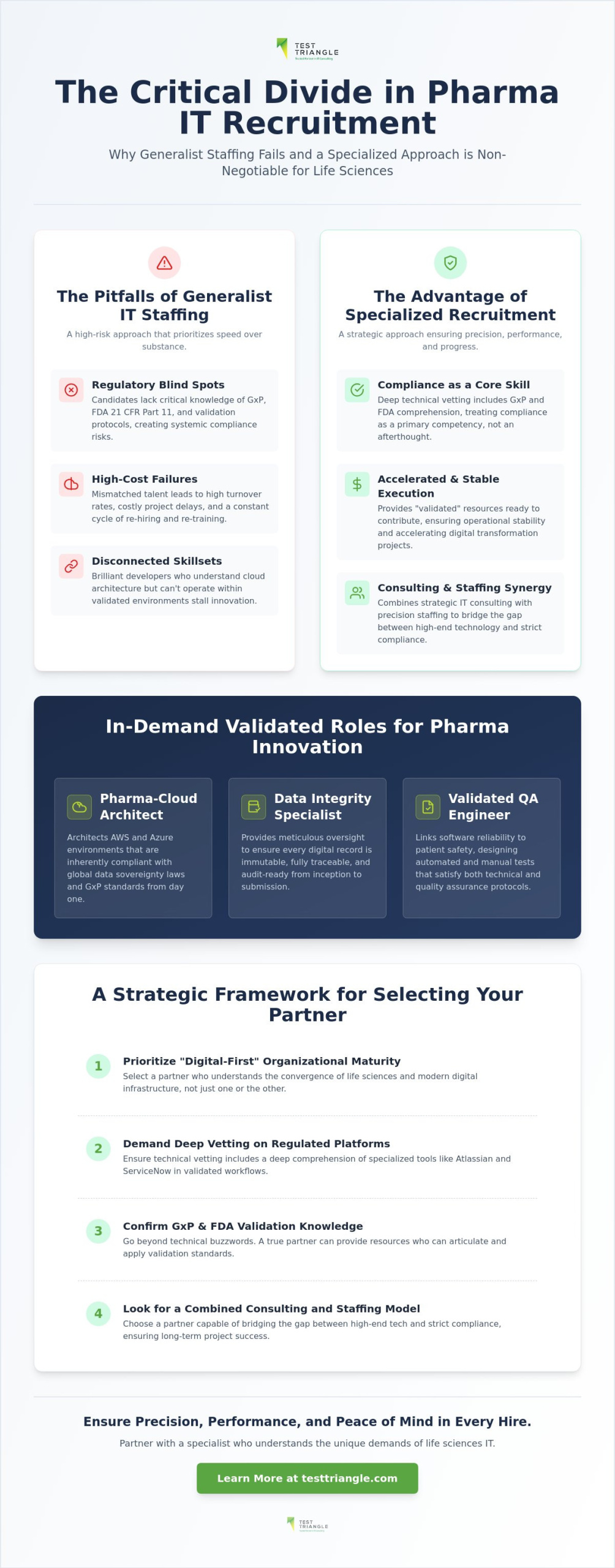

Could the greatest threat to your digital transformation be a recruiter who treats a pharmaceutical environment like a standard tech startup? In the high-stakes world of life sciences, the standard approach to Technology & Pharmaceutical Recruitment often falls short because it ignores the non-negotiable reality of regulatory compliance. You’ve likely felt the frustration of interviewing brilliant developers who lack any concept of GxP or FDA validation requirements. It’s a common pain point; general IT staffing firms often prioritize speed over the specific technical rigor required for life sciences, leading to high turnover and project delays.

We understand that finding talent for complex cloud migrations or DevOps integration in a regulated space is a delicate balancing act. You need professionals who treat compliance as a core feature rather than an afterthought. This article demonstrates how a strategic approach to talent acquisition can reduce your time-to-hire for niche roles and ensure your team is ready for the demands of digital transformation. We’ll examine the specific methodologies used to identify “validated” tech talent who can maintain operational stability while driving innovation through human expertise and technical precision.

Key Takeaways

  • Learn how the convergence of life sciences and digital infrastructure is reshaping Technology & Pharmaceutical Recruitment to prioritize “digital-first” organizational maturity.
  • Identify the critical technical competencies required for modern pharmaceutical innovation, including the specialized use of Atlassian and ServiceNow platforms in regulated workflows.
  • Understand the high-risk pitfalls of generalist IT staffing and why technical vetting must include a deep comprehension of GxP and FDA validation standards.
  • Master a strategic framework for selecting recruitment partners who can provide “validated” resources capable of bridging the gap between high-end tech and strict compliance.
  • Discover how a combined consulting and staffing approach ensures operational stability and accelerates the execution of large-scale digital transformation projects.

The Convergence of Technology & Pharmaceutical Recruitment in 2026

Technology & Pharmaceutical Recruitment represents the sophisticated intersection where life sciences meet high-velocity digital infrastructure. By 2026, the traditional boundaries between laboratory research and information technology have effectively dissolved. Within the pharmaceutical industry, the focus has shifted from manual, lab-centric processes to cloud-native environments that rely on real-time data processing and automated workflows. This evolution demands a recruitment strategy that prioritizes candidates who possess both technical fluency and a deep understanding of the regulatory frameworks that govern drug development. It’s a matter of ensuring precision, performance, and peace of mind in every hire.

Generalist recruitment agencies often struggle in this specialized landscape because they fail to grasp the nuances of GxP and FDA 21 CFR Part 11. Hiring a developer who understands cloud architecture but lacks knowledge of electronic record-keeping compliance can lead to systemic failures. In a regulated environment, code isn’t just functional; it must be “validated.” This requirement necessitates a partner who offers specialized IT Staffing Services tailored to the specific rigors of the life sciences sector. Without this niche expertise, organizations risk significant operational delays and regulatory scrutiny.

Digital Assurance: The New Standard for Life Sciences

Software testing is no longer a peripheral activity; it’s a central pillar of patient safety. As AI and machine learning become integrated into R&D pipelines, the need for Software and Digital Assurance Testing has reached an all-time high. Validated talent is the most critical asset for 2026. These are professionals who can design automated testing frameworks that satisfy both technical performance benchmarks and stringent quality assurance protocols. When Technology & Pharmaceutical Recruitment is executed with this level of technical depth, it ensures that innovation doesn’t outpace safety.

The Regulatory Reality of Modern Tech Hiring

The technical requirements of GxP in IT staffing are absolute. A single oversight in how a system manages data integrity can stall a drug launch, costing organizations millions in lost revenue and potential legal penalties. Bridging the gap between agile development and rigid regulatory frameworks is the primary challenge for modern leadership. Successful recruitment involves identifying tech leads who can maintain the speed of a DevOps environment while ensuring every change is documented and compliant. It’s about finding the steady hand that understands how to innovate within the lines, ensuring progress never comes at the expense of precision.

Specialized Roles Driving Pharmaceutical Innovation

The landscape of Technology & Pharmaceutical Recruitment is undergoing a profound transformation as organizations seek out hybrid experts who can navigate the tension between rapid innovation and absolute regulatory adherence. In 2026, the most sought-after profile is the “Pharma-Cloud” Architect. These professionals possess the unique ability to architect AWS and Azure environments that are inherently compliant with global data sovereignty laws and GxP standards. They don’t simply move data to the cloud; they build resilient, secure infrastructures that serve as the foundation for the next generation of digital therapeutics and drug discovery platforms. Alongside them, data integrity specialists have become the essential backbone of clinical trials, providing the meticulous oversight needed to ensure that every digital record is immutable and fully traceable from inception to final submission.

Software Testing and QA in a Regulated Environment

Within a sector where software reliability is inextricably linked to patient safety, quality assurance has evolved into a high-stakes discipline. While the industry leans heavily toward efficiency, Manual Testing continues to be a vital requirement for the nuanced validation of pharmaceutical software where automated scripts might miss subtle regulatory non-compliance in user interfaces. For organizations developing digital health applications, integrating software test automation services is the most effective way to accelerate time-to-market while maintaining the rigorous documentation standards required by auditors. Finding talent that understands the complexities of System Integration Testing (SIT) for healthcare APIs is equally critical, as these professionals ensure that data flows securely and accurately across the entire healthcare ecosystem.

DevOps and Platform Engineering for Life Sciences

Accelerating software delivery in a pharmaceutical context requires a specialized methodology that prioritizes stability alongside speed. Engaging in professional DevOps Consulting allows organizations to build CI/CD pipelines where “Compliance-as-Code” is the default setting, ensuring that every deployment is automatically vetted against regulatory requirements. Recruitment for specialized Atlassian implementation and ServiceNow consulting roles has become a strategic priority, as these platforms provide the structured environment necessary for managing complex pharmaceutical workflows and change control. These tools act as the operational nervous system, connecting technical execution with business outcomes and regulatory oversight. If you’re looking to bridge the talent gap in your digital infrastructure, it’s beneficial to discuss your specific technical requirements with a partner who understands the nuances of Technology & Pharmaceutical Recruitment.

Why Generalist IT Staffing Fails the Pharmaceutical Industry

Generalist recruitment platforms often prioritize volume over validity, a strategy that inevitably collapses within the pharmaceutical sector. While a top-tier developer from a standard tech hub might possess exceptional coding skills, their lack of exposure to GxP environments creates a significant “Compliance Gap.” In this industry, technical execution cannot be decoupled from regulatory adherence. Technology & Pharmaceutical Recruitment requires a partner who understands that a single oversight in data handling can compromise years of research and development. Precision is not optional.

The hidden costs of poor technical vetting are immense. Beyond the immediate expense of turnover, a candidate who ignores audit trail requirements or fails to document system changes properly can trigger severe regulatory friction during an inspection. This is the difference between basic IT staffing and strategic talent orchestration. We focus on placing professionals who act as a steady hand, ensuring that digital transformation projects remain compliant, stable, and scalable. Our methodology prioritizes the peace of mind that comes from knowing every technical contributor understands the gravity of pharmaceutical safety and the necessity of rigorous documentation.

The Nuance of Pharmaceutical Data Integrity

Data integrity is the non-negotiable foundation of the life sciences. Recruits must be intimately familiar with ALCOA+ principles: Attributable, Legible, Contemporaneous, Original, and Accurate. A developer who treats an audit trail as a secondary feature rather than a core requirement poses a fundamental risk to clinical trial validity. Compliance is the priority. Specialized agencies vet for “Validation Awareness,” ensuring that every technical lead recognizes their role in maintaining the chain of custody for critical health data. This rigorous screening process eliminates candidates who lack the discipline required for high-stakes pharmaceutical environments.

Managing Flexible Staffing Models in Pharma

High-velocity clinical projects often require a rapid influx of specialized talent. Utilizing professional IT Staffing Services allows organizations to scale their teams with precision, partnership, and progress. This model is particularly effective for managing the security risks associated with remote or offshore resources. By implementing a standardized vetting process that accounts for global compliance standards, organizations can leverage distributed tech teams without compromising on security or data sovereignty. This strategic approach ensures that Technology & Pharmaceutical Recruitment serves as a catalyst for growth rather than a source of risk. It’s about building a reliable, long-term collaboration that supports your operational stability and long-term success.

A Strategic Framework for Selecting Recruitment Partners

Selecting a partner for Technology & Pharmaceutical Recruitment requires a significant departure from traditional procurement metrics. It’s a strategic decision that directly impacts the integrity of your digital infrastructure and the success of your regulatory submissions. A high-level partner must demonstrate a sophisticated blend of IT Service Management (ITSM) expertise and a granular understanding of the life sciences sector. This ensures that every technical resource is not just capable of executing a task, but is also “validated” to operate within GxP and FDA-regulated environments. Reliability is the cornerstone of this selection process.

A robust framework for evaluation should prioritize the following criteria to ensure organizational progress and risk reduction:

  • Ecosystem Alignment: Look for strategic partnerships with platform leaders like Atlassian, ServiceNow, and AWS, as these relationships signal a deep alignment with the tools driving modern pharmaceutical workflows.
  • Operational Flexibility: The ability to pivot between permanent placements, contract staffing, and comprehensive managed services allows for scalable growth and adaptable service delivery.
  • Technical Depth: A partner must possess deep-rooted expertise in software and digital assurance testing to guarantee that all technical implementations meet the highest standards of quality and security.

Vetting for Technical Rigor

When you evaluate potential collaborators, it’s essential to ask specific questions about their internal technical screening. Does the agency employ in-house technical experts who conduct rigorous interviews before a candidate ever reaches your desk? You should prioritize agencies that also provide technology consulting. This dual perspective ensures they understand the practical, day-to-day challenges of your digital transformation projects. This internal vetting process reduces the burden on your leadership and guarantees that only the most qualified, compliance-aware talent is presented. It’s about finding a steady hand in a fast-changing landscape.

Evaluating Long-Term Strategic Value

The transition from simple placement fees to genuine partnership value is a hallmark of institutional maturity. Selecting a partner who offers Managed Outsourcing Services provides long-term project stability and ensures that technical knowledge remains within your organization even as individual roles evolve. This strategic approach supports your overarching digital transformation roadmap, turning recruitment into a functional asset for sustainable innovation. If you require a partner who values precision and partnership, contact our strategic recruitment team to discuss your specific talent requirements for 2026 and beyond.

Technology & Pharmaceutical Recruitment: Expert Strategies

Test Triangle: Precision, Partnership, and Progress in Pharma IT

Test Triangle occupies a unique position in the industry by bridging the gap between high-end technology consulting and specialized recruitment. Our methodology is built on the premise that effective Technology & Pharmaceutical Recruitment requires more than just a database of resumes; it demands a deep, functional understanding of the software ecosystems that power modern life sciences. Because we are practitioners in DevOps and digital assurance, our staffing solutions are backed by the same technical rigor we apply to our consulting engagements. This ensures that every professional we place is capable of maintaining operational stability while driving systemic improvement across your digital infrastructure.

Our Atlassian Consulting Services provide a distinct advantage for pharmaceutical organizations looking to harmonize their development and compliance workflows. By integrating these industry-leading platforms directly into our service descriptions, we signal a voice that is closely aligned with the specific tools your teams use every day. Global pharmaceutical leaders trust us with their most sensitive digital projects because we operate as a steady hand, providing the human expertise and technical tools necessary for scalable growth in a highly regulated landscape. We position ourselves as a reliable collaborator deeply invested in your long-term success.

The ‘Validated Staffing’ Advantage

Sourcing and vetting technical talent for a GxP-regulated environment requires a disciplined approach that generalist agencies cannot replicate. We integrate ServiceNow Consulting into our talent search to identify candidates who are proficient in managing complex service architectures and automated compliance checks. Our internal technical experts conduct exhaustive screenings to ensure that every candidate possesses a high standard of quality and security awareness. We deliver talent that is technically elite and regulatorily ready. This process reduces risk and provides the peace of mind that comes from a reliable long-term collaboration.

Your Partner in Digital Transformation

Our commitment to your success extends beyond the initial placement to support your entire IT lifecycle. By leveraging our IT Service Management solutions, pharmaceutical enterprises can achieve a sense of order and comprehensive coverage across their global operations. We don’t just provide resources; we empower your organization to evolve through the successful execution of cloud migrations and digital transformation initiatives. As a strategic visionary with a practical focus, we remain deeply invested in your operational stability and long-term success. It’s time to secure your pharmaceutical tech future with Test Triangle and experience the benefits of precision, partnership, and progress.

Securing Your Competitive Advantage in a Regulated Landscape

The evolution toward a digital-first pharmaceutical industry requires a fundamental shift in how global organizations approach talent acquisition. Success in 2026 depends on bridging the gap between high-velocity technical execution and the rigid requirements of GxP compliance. By prioritizing “validated” talent and moving away from the inherent risks of generalist staffing, your organization can ensure long-term operational stability and the successful execution of complex digital transformation projects. It’s about aligning human expertise with the technical tools that drive progress.

As an Atlassian Gold Solution Partner and ServiceNow Strategic Partner with over 14 years of specialized IT and Pharma staffing expertise, we provide the steady hand necessary to navigate this complex environment. We understand that specialized talent acquisition is not merely about filling roles; it’s about building the resilient human infrastructure required for life-saving innovation. We invite you to Partner with the specialists in Technology & Pharmaceutical Recruitment to reduce your time-to-hire and ensure your technical teams are regulatorily ready. We look forward to supporting your journey toward technical precision and sustainable growth.

Frequently Asked Questions

What is the difference between general IT recruitment and pharmaceutical tech recruitment?

Pharmaceutical tech recruitment focuses on “validated” talent who understand regulatory frameworks like GxP, whereas general IT recruitment prioritizes speed and general coding proficiency. In the life sciences sector, technical execution must be paired with an understanding of data integrity and audit trails. Technology & Pharmaceutical Recruitment requires a partner who can bridge the gap between high-velocity tech and stringent compliance, ensuring every hire contributes to operational stability and regulatory success.

Why is GxP compliance important for IT staff in the pharmaceutical industry?

GxP compliance is essential because it ensures that software systems used in drug development produce reliable, accurate, and traceable data. For IT staff, this means following strict documentation protocols and maintaining clear audit trails for every system change. Non-compliance can lead to failed audits, drug launch delays, and significant legal penalties, making “compliance-aware” talent a critical asset for risk reduction and peace of mind.

Can you provide temporary contract staff for short-term clinical trial projects?

Yes, we provide highly specialized temporary contract staff tailored to the specific needs of clinical trial projects. Our flexible delivery model allows pharmaceutical organizations to scale technical teams rapidly with professionals who already understand the regulatory rigors of the life sciences sector. This approach ensures project continuity and technical precision without the long-term overhead of permanent hires, supporting your organization’s adaptable service delivery and progress.

How do you vet candidates for their understanding of FDA 21 CFR Part 11?

We vet candidates using a multi-layered technical screening process that includes specific scenarios related to electronic records and signatures. Our in-house technical experts evaluate a candidate’s ability to implement immutable audit trails and secure data access controls. This ensures every recruit understands the functional requirements of FDA 21 CFR Part 11, moving beyond surface-level knowledge to practical, compliant technical execution that protects your research integrity.

What are the benefits of using a specialized agency for Atlassian and ServiceNow roles in pharma?

Specialized agencies ensure that Atlassian and ServiceNow platforms are implemented within a compliant framework that supports pharmaceutical workflows. General recruiters often overlook the validation requirements of these tools, but a specialized partner ensures your ITSM and DevOps pipelines are regulatorily ready. This alignment between technical tools and business outcomes provides the peace of mind that your digital infrastructure is managed with institutional maturity and precision.

How does software testing expertise improve the quality of tech recruits?

Software testing expertise allows us to evaluate candidates from a quality assurance perspective, ensuring they treat compliance as a core feature rather than an afterthought. Because we provide technology consulting and testing services, we can identify candidates who possess the technical rigor to design automated, validated testing frameworks. This methodology results in elite talent who can maintain the speed of development while ensuring absolute software reliability and safety.

Do you offer remote or offshore staffing solutions for pharmaceutical companies?

We offer adaptable remote and offshore staffing solutions that prioritize global compliance and data sovereignty. By implementing a standardized vetting process, we ensure distributed tech teams operate within the same GxP and security standards as on-site resources. This allows pharmaceutical companies to leverage a global talent pool while maintaining the stability and security necessary for sensitive projects through strategic Technology & Pharmaceutical Recruitment.

How do recruitment fees work for permanent vs. contract placements in the tech-pharma sector?

Recruitment fees are structured differently based on the level of engagement and the specific talent acquisition model required. Permanent placements typically involve a one-time fee based on the candidate’s compensation package, while contract placements are managed through a standard hourly or daily rate. We focus on providing partnership value rather than just placement fees, ensuring our models support a reliable long-term collaboration and operational stability.

Paul Guy

Article by

Paul Guy

Paul serves as the Marketing Director at Test Triangle, where he leads a global team in driving growth through strategic B2B marketing and brand communications. With a strong emphasis on measurable outcomes and sustainable performance, he plays a pivotal role in aligning marketing functions to enhance customer engagement and accelerate business impact. Under his leadership, marketing initiatives have consistently delivered significant returns on investment, elevated brand visibility, and strengthened the company's presence across key markets.
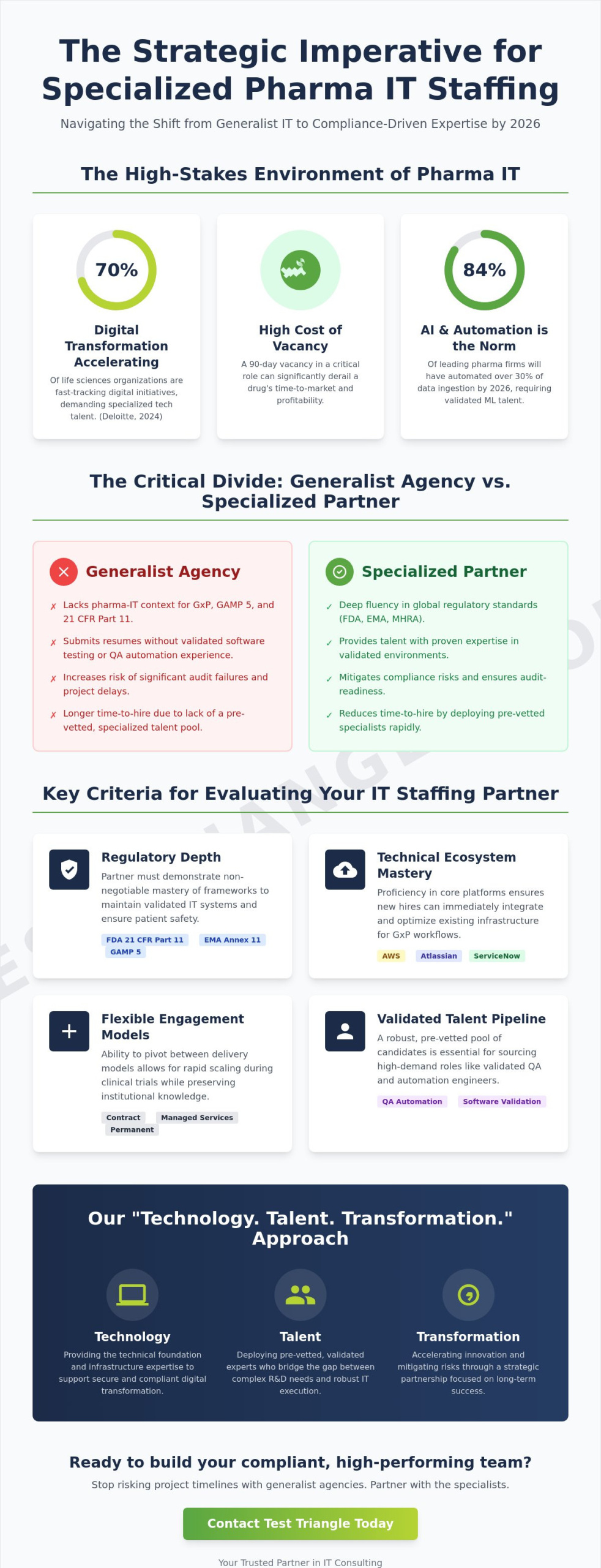

Can your current recruitment partner distinguish between a standard Java developer and an engineer who can validate software under the strict requirements of 21 CFR Part 11? In an era where a 2024 Deloitte Life Sciences report indicates that 70% of organizations are accelerating digital transformation, the cost of a 90 day vacancy in a critical project can significantly derail a drug’s time-to-market. Finding specialized IT staffing agencies for pharmaceutical industry is no longer a luxury. It’s a strategic necessity to ensure your digital infrastructure remains robust, secure, and compliant.

You’ve likely experienced the frustration of generalist agencies providing resumes that lack the specific pharma-IT context required for GAMP 5 standards. This strategic guide helps you identify a Trusted Partner who bridges the gap between advanced technology and rigorous compliance. We’ll show you how to reduce time-to-hire for specialized roles, ensure 100% compliance in software validation, and scale teams through flexible engagement models. Through the synergy of Technology, Talent, and Transformation, we’ll explore how to optimize your workforce to meet the high-stakes demands of 2026.

Key Takeaways

  • Gain insights into the 2026 shift from generalist IT to specialized life sciences expertise, ensuring your digital transformation leverages AI and machine learning within a secure pharmaceutical framework.
  • Learn to identify the most effective IT staffing agencies for pharmaceutical industry by evaluating their mastery of global regulatory standards like FDA and EMA alongside proficiency in AWS, Atlassian, and ServiceNow.
  • Pinpoint the high-demand roles essential for modern pharma, including validated software testing and QA automation engineers capable of streamlining GxP workflows.
  • Compare contract, managed services, and permanent placement models to select the flexible delivery strategy that optimizes project scaling and preserves long-term institutional knowledge.
  • Understand how a “Technology. Talent. Transformation.” approach provides a robust foundation for mitigating risks and accelerating innovation through strategic technical partnerships.

The Evolution of Pharmaceutical IT Staffing in 2026

By the start of 2026, the role of IT staffing agencies for pharmaceutical industry has shifted from providing generalist support to delivering specialized life sciences technology experts. This evolution is driven by the realization that general IT knowledge is insufficient for the high-stakes environment of drug development. The industry now seeks the “Strategic Architect” persona, a professional who functions as a bridge between complex R&D requirements and robust IT infrastructure. These individuals possess a dual fluency in biological workflows and cloud architecture; they ensure that digital tools serve the ultimate goal of therapeutic innovation rather than creating technical bottlenecks.

The integration of AI and machine learning into digital transformation roadmaps has further accelerated this trend. In 2026, 84% of leading pharmaceutical firms have automated at least 30% of their data ingestion processes, which requires talent capable of training models within a strictly validated environment. Speed and agility in recruitment have become critical benchmarks for success. When a clinical trial timeline is at risk, a delay of even two weeks in securing a specialized database administrator can result in millions of dollars in lost market exclusivity. Rapid deployment of pre-vetted talent is no longer a luxury; it’s a strategic requirement for maintaining a competitive edge.

Digital Transformation as a Driver for Specialized Talent

By migrating legacy systems to AWS and other cloud environments, pharmaceutical companies seek to optimize their “Molecule to Market” workflows. This transition requires niche expertise to ensure that data remains accessible yet secure across global borders. To maintain this balance, many enterprises utilize managed outsourcing services to provide long-term operational stability. This model allows firms to leverage high-level technical talent without the overhead of permanent internal expansion, driving efficiency across the entire product lifecycle and ensuring that digital infrastructure scales alongside research demands.

Regulatory Pressures and the Need for Validated Expertise

The complexity of global compliance standards has intensified, making general IT staffing a risky proposition for modern life sciences firms. By 2026, the distinction between standard IT and GxP-compliant systems is absolute. Generalist agencies often lack the rigor to vet for GAMP 5 knowledge, which exposes companies to significant audit risks. Understanding the broader Health Technology Overview reveals that technical resources must be validated to ensure patient safety and data integrity. Hiring unvetted resources leads to non-compliance costs that frequently exceed the initial project budget, making specialized technical vetting a strategic necessity for any IT staffing agencies for pharmaceutical industry.

Key Criteria for Evaluating Pharma IT Staffing Agencies

Selecting the right IT staffing agencies for pharmaceutical industry projects requires a transition from traditional recruitment metrics toward a focus on regulatory maturity. By aligning technical talent with GxP compliance, organizations can maintain data integrity while accelerating digital transformation. A strategic partner must demonstrate mastery over the FDA 21 CFR Part 11 requirements and EMA Annex 11 standards to ensure that software validation isn’t an afterthought. This proficiency is vital because approximately 75% of pharmaceutical companies now prioritize compliance-by-design in their cloud migrations. Agencies should possess deep expertise in the Atlassian and ServiceNow ecosystems, leveraging these tools to automate documentation and audit trails.

  • Regulatory Depth: Extensive knowledge of FDA, EMA, and MHRA frameworks is non-negotiable for maintaining the validated state of IT systems.
  • Technical Ecosystems: Proficiency in AWS, Atlassian, and ServiceNow ensures that new hires can immediately optimize existing infrastructure.
  • Flexible Engagement Models: The ability to pivot between contract, permanent, and remote offshore talent allows for rapid scaling during clinical trial phases.
  • Validation Track Record: Proven experience in Computer System Validation (CSV) and Software Quality Assurance (SQA) specifically for life sciences.
  • Pre-qualified Talent: Access to a pool of candidates who already understand the nuances of data integrity and laboratory information management systems (LIMS).

Assessing Technical and Compliance Synergy

To verify an agency’s competence, it’s essential to test their understanding of data integrity principles. Effective IT staffing agencies for pharmaceutical industry partners will demonstrate how they evaluate a candidate’s ability to implement ALCOA+ standards within software development. Addressing Pharmaceutical Labor Shortages requires a partner that doesn’t just fill roles but provides staffing solutions that include continuous training on evolving GxP standards. This ensures that “right-shoring” strategies balance cost-efficiency with the rigorous security demands of the 2026 regulatory environment. Technology. Talent. Transformation.

Vetting the Recruitment Process

The screening process for DevOps and automation roles must be rigorous and technically grounded. Strategic agencies often use their own senior consultants to interview candidates, ensuring that the talent’s practical skills match their theoretical knowledge. This peer-to-peer vetting process reduces the risk of bad hires by 30% in specialized life science roles. Organizations should also look for agencies that offer Functional Service Provider (FSP) capabilities. This model allows for more granular control over specific IT functions while leveraging the agency’s specialized management expertise. By integrating these high-level screening methods, a Trusted Partner ensures that every placement contributes to long-term operational stability. Explore how a tailored recruitment strategy can stabilize your project timelines and improve deployment frequency.

IT Staffing Agencies for Pharmaceutical Industry: The 2026 Strategic Guide

Specialized Roles: Sourcing for the Modern Pharma Ecosystem

By aligning technical talent with rigid regulatory requirements, IT staffing agencies for pharmaceutical industry provide the specialized expertise needed to maintain a competitive edge. A 2024 report from the Center for Strategic and International Studies (CSIS) identifies critical pharmaceutical manufacturing labor shortages, particularly in digital quality control and advanced manufacturing sectors. To bridge this gap, enterprises must source professionals who understand both the technical code and the compliance landscape. This dual-competency is the hallmark of a “Strategic Architect” approach to talent acquisition.

QA and Testing: The Backbone of Pharma IT

Reliable software validation acts as the primary defense against regulatory friction and patient risk. While the industry pushes toward total efficiency, Manual Testing remains a vital component for exploratory scenarios and nuanced validation that automated scripts might overlook. By integrating human-centric quality assurance with automated testing within regulated software life cycles, organizations achieve a robust validation strategy. Specialized staffing ensures that System Integration Testing (SIT) and User Acceptance Testing (UAT) phases reach “flawless” execution, preventing costly delays in product launches and ensuring every software iteration meets GxP standards.

Optimizing Platforms with Atlassian and ServiceNow Consulting

Agile drug development requires seamless collaboration, which is why many firms leverage Atlassian implementation to unify their research and development teams. When managed by certified experts, these tools streamline GxP workflows and improve transparency across the global supply chain. Similarly, implementing IT service management solutions through ServiceNow allows for compliant infrastructure management and rapid incident response. Hiring platform-certified experts via a dedicated agency reduces implementation risks significantly, as these specialists possess the specific knowledge required to configure environments for strict regulatory audits and complex internal controls.

The modern ecosystem also demands DevOps engineers who are proficient in secure, compliant cloud environments. These professionals build the technical guardrails that allow for rapid deployment without sacrificing data integrity or security. Sourcing these specialists through a partner with proven DevOps Consulting expertise ensures that your CI/CD pipelines are architected to meet both speed and compliance requirements from day one. Additionally, with pharmaceutical M&A activity reaching 214 billion dollars in 2023, data migration specialists have become indispensable. These experts manage the complex transition of legacy data into modern systems, ensuring that historical records remain intact and audit-ready during large-scale corporate consolidations. By partnering with IT staffing agencies for pharmaceutical industry, companies secure the specialized talent necessary to navigate these high-stakes digital transitions with confidence.

Comparing Delivery Models: Contract, Managed Services, and FSP

Selecting the right engagement framework is a critical decision for pharmaceutical CIOs aiming to balance operational agility with strict regulatory oversight. By aligning technical requirements with specific delivery models, IT staffing agencies for pharmaceutical industry allow organizations to mitigate risks associated with talent shortages. Each model offers distinct advantages based on project duration, budget flexibility, and the depth of institutional knowledge required. By combining Technology, Talent, and Transformation, Test Triangle serves as a Trusted Partner that helps enterprises navigate these complex choices with precision.

  • Contract Staffing: This model enables rapid scaling to meet short-term project milestones. It’s particularly effective for localized bursts of activity such as a global ERP rollout or a specific LIMS implementation.
  • Permanent Placement: This approach focuses on building long-term institutional knowledge. It ensures that core systems are managed by talent deeply invested in the company’s specific compliance culture and long-term vision.
  • Managed Services: By outsourcing entire technical functions, enterprises achieve predictable outcomes and service level agreements (SLAs). This shifts the focus from individual headcount to holistic system performance and reliability.
  • Functional Service Provider (FSP): A hybrid approach that targets specific clinical or IT domains. FSPs offer a middle ground; they provide specialized expertise without the overhead of full-scale outsourcing, allowing for high levels of domain control.

When to Choose Temporary Contract Staff

In 2025, industry data indicated that 64% of pharmaceutical enterprises utilized contract staffing to address skills gaps during peak validation or migration periods. Temporary resources are essential when navigating the “burst” phases of software development life cycles (SDLC) or Computer System Validation (CSV). Leveraging staffing solutions allows firms to manage budget constraints through flexible, margin-based billing. This strategy also provides a strategic advantage by integrating remote offshore resources for 24/7 support. It ensures that critical infrastructure stays operational across all time zones while maintaining lower operational costs.

Maximizing ROI with Managed Outsourcing

Transitioning from traditional “body shopping” to outcome-based IT delivery is a cornerstone of modern digital transformation. Managed services reduce the burden of internal talent acquisition placement fees, which often range from 15% to 25% of a candidate’s annual salary. To fully understand how these costs compare against industry benchmarks and how to structure them as a strategic investment, review this executive guide on recruitment and talent acquisition placement fees. By partnering with managed outsourcing services, organizations move toward a model where the partner is accountable for deliverables rather than hours worked. For a deeper dive into how these models compare in specialized environments, consult this guide on QA outsourcing. This strategic shift optimizes resource allocation and elevates the quality of technical output through standardized processes and shared accountability. For a broader perspective on how talent delivery frameworks are evolving across the industry, explore this strategic comparison of IT Staffing Services in 2026 to benchmark your approach against leading enterprise models.

Ready to optimize your technical delivery model for 2026? Consult with our strategic architects today to build a resilient talent roadmap.

Test Triangle: Your Trusted Partner for Pharma IT Transformation

Test Triangle operates at the intersection of Technology. Talent. Transformation. As one of the premier IT staffing agencies for pharmaceutical industry leaders, we bridge the gap between complex regulatory requirements and technical excellence. By leveraging our elite strategic partnerships with Atlassian, ServiceNow, and AWS, we provide superior staffing solutions that align with 2026 industry standards for security and scalability. Our global footprint ensures that clients receive localized expertise combined with cost-effective offshore delivery models, maintaining a 24/7 development cycle that keeps pace with global R&D demands.

We’re committed to delivering flawless digital transformation by deploying specialized pharma-IT talent who understand the nuances of the life sciences sector. Our candidates aren’t just technical experts; they’re professionals trained to operate within the stringent boundaries of highly regulated environments. This dual focus ensures that your technical evolution never comes at the cost of compliance or data integrity.

Our Approach to Pharma IT Staffing

By applying our deep-rooted consulting expertise, we rigorously vet the world’s top 1% of IT talent to ensure they meet the high bars set by global enterprises. Our selection process involves multi-stage technical assessments and cultural fit evaluations that prioritize long-term operational stability. Our flexible engagement models allow pharmaceutical leaders to scale their teams dynamically based on project phases, whether you require a single specialist or an entire managed team. Discover our IT service management solutions tailored for life sciences to see how we integrate high-tier talent with optimized operational workflows.

Driving Business Value Through Strategic Talent

The business value we provide is rooted in precision and speed. In a recent 2025 engagement for a Tier-1 pharmaceutical firm, our rapid DevOps deployment strategy reduced their time-to-market for new data analytics platforms by 22%. We mitigate recruitment risks by focusing exclusively on GxP-compliant skillsets, ensuring every hire understands the 21 CFR Part 11 requirements and data residency laws. This specialized focus prevents costly compliance failures and accelerates your digital roadmap by eliminating the learning curve associated with generalist IT staff. Elevate your technical infrastructure with our specialized Pharma IT staffing to secure your position at the forefront of medical innovation.

Our commitment to excellence ensures that your organization remains agile. We don’t just fill roles; we build the technical foundations that support the next generation of life-saving therapies. By choosing a partner that understands the specific pressures of the pharmaceutical sector, you ensure that your digital transformation is both robust and future-proof.

Securing Your Competitive Edge in the 2026 Pharma Landscape

By 2026, the success of life sciences enterprises will depend on the seamless integration of specialized technical talent into highly regulated workflows. Selecting the right partner among IT staffing agencies for pharmaceutical industry requires a focus on both technical proficiency and strict adherence to GxP and GAMP 5 compliance standards. Organizations that leverage flexible engagement models, such as Functional Service Provider (FSP) or Managed Services, realize greater operational agility and cost efficiency. We’ve seen that a structured approach to sourcing talent is no longer optional; it’s a strategic necessity for maintaining regulatory integrity across global borders.

By combining deep domain expertise with global delivery centers in Ireland, the UK, the USA, and India, Test Triangle empowers organizations to navigate these complexities with confidence. As an authorized Atlassian and ServiceNow partner, we provide the robust infrastructure needed to drive digital transformation. We’re committed to your long-term stability through our signature approach: Technology. Talent. Transformation. Optimize your pharmaceutical IT infrastructure with Test Triangle’s specialized staffing solutions. Your journey toward a more resilient and compliant digital future starts today.

Frequently Asked Questions

What makes pharma IT staffing different from general IT recruitment?

Pharma IT staffing requires specialized knowledge of GxP regulations and validated environments that general recruitment lacks. By prioritizing candidates with experience in 21 CFR Part 11 and EudraLex Volume 4, IT staffing agencies for pharmaceutical industry ensure that technical talent understands the intersection of software performance and patient safety. This rigorous selection process prevents compliance breaches that can cost organizations millions in regulatory fines.

How do IT staffing agencies ensure candidates understand GAMP 5 compliance?

Agencies verify GAMP 5 competency through structured technical assessments and past project audits focused on the V-Model lifecycle. By evaluating a candidate’s ability to document User Requirement Specifications and perform Risk Assessments, partners ensure every hire can maintain validated states. At Test Triangle, we leverage our 15 years of industry experience to vet talent against the latest ISPE guidelines, ensuring they’re ready for regulated environments.

Can I hire remote offshore IT staff for a regulated pharmaceutical project?

You can hire remote offshore staff provided the agency maintains strict data integrity protocols and secure access controls that meet GDPR and HIPAA standards. Effective models use encrypted VPNs and multi-factor authentication to ensure offshore developers work within the client’s validated infrastructure. Reports from 2024 indicate that 65% of global pharma firms now use hybrid offshore models to accelerate digital transformation while maintaining 100% data sovereignty.

What are the typical fees for pharmaceutical IT staffing placements?

Placement fees for specialized pharmaceutical IT roles typically range from 20% to 30% of the candidate’s first-year annual salary according to industry benchmarks from Staffing Industry Analysts. These rates reflect the scarcity of talent capable of navigating complex Computer System Validation requirements. For a comprehensive breakdown of how these fee structures compare across contingency and retained search models, refer to this detailed analysis of recruitment and talent acquisition placement fees in the 2026 market. For contract roles, agencies usually apply a standard markup that covers payroll taxes, insurance, and administrative overhead, ensuring a transparent cost structure for the client.

How long does it take to onboard a validated software tester through an agency?

Onboarding a validated software tester generally takes 15 to 21 business days from the initial request to the start date. This timeline includes technical screening, GxP training verification, and the completion of site-specific background checks. By utilizing a pre-vetted talent pool, IT staffing agencies for pharmaceutical industry reduce the standard 42-day hiring cycle by more than 50%, allowing projects to stay on schedule.

What is the Functional Service Provider (FSP) model in pharma IT?

The Functional Service Provider model involves outsourcing specific IT functions, such as data management or quality assurance, to a dedicated partner rather than hiring individual contractors. This strategic approach allows companies to scale resources up or down based on clinical trial phases or product launch cycles. It provides a 25% improvement in operational efficiency by centralizing management and standardizing delivery across the entire functional unit.

Is it better to use contract or permanent IT staff for a ServiceNow implementation?

Contract staff are often superior for the initial ServiceNow implementation phase because they provide immediate, high-level expertise for a finite project timeline. Once the core architecture is established, transitioning to a permanent team ensures long-term stability and platform evolution. Utilizing flexible engagement models allows organizations to leverage Technology, Talent, and Transformation without committing to long-term overhead during the intensive build phase.

How do agencies like Test Triangle vet technical talent for life sciences?

Test Triangle employs a multi-layered vetting process that combines automated coding challenges with peer-to-peer technical interviews conducted by subject matter experts. We verify specific experience with Atlassian tools and Jira Service Management to ensure candidates can operate within modern DevOps Consulting frameworks. This methodology guarantees that every placement possesses both the technical rigor and the regulatory mindset required for high-stakes life sciences environments, positioning us as a Trusted Partner.

Paul Guy

Article by

Paul Guy

Paul serves as the Marketing Director at Test Triangle, where he leads a global team in driving growth through strategic B2B marketing and brand communications. With a strong emphasis on measurable outcomes and sustainable performance, he plays a pivotal role in aligning marketing functions to enhance customer engagement and accelerate business impact. Under his leadership, marketing initiatives have consistently delivered significant returns on investment, elevated brand visibility, and strengthened the company's presence across key markets.