



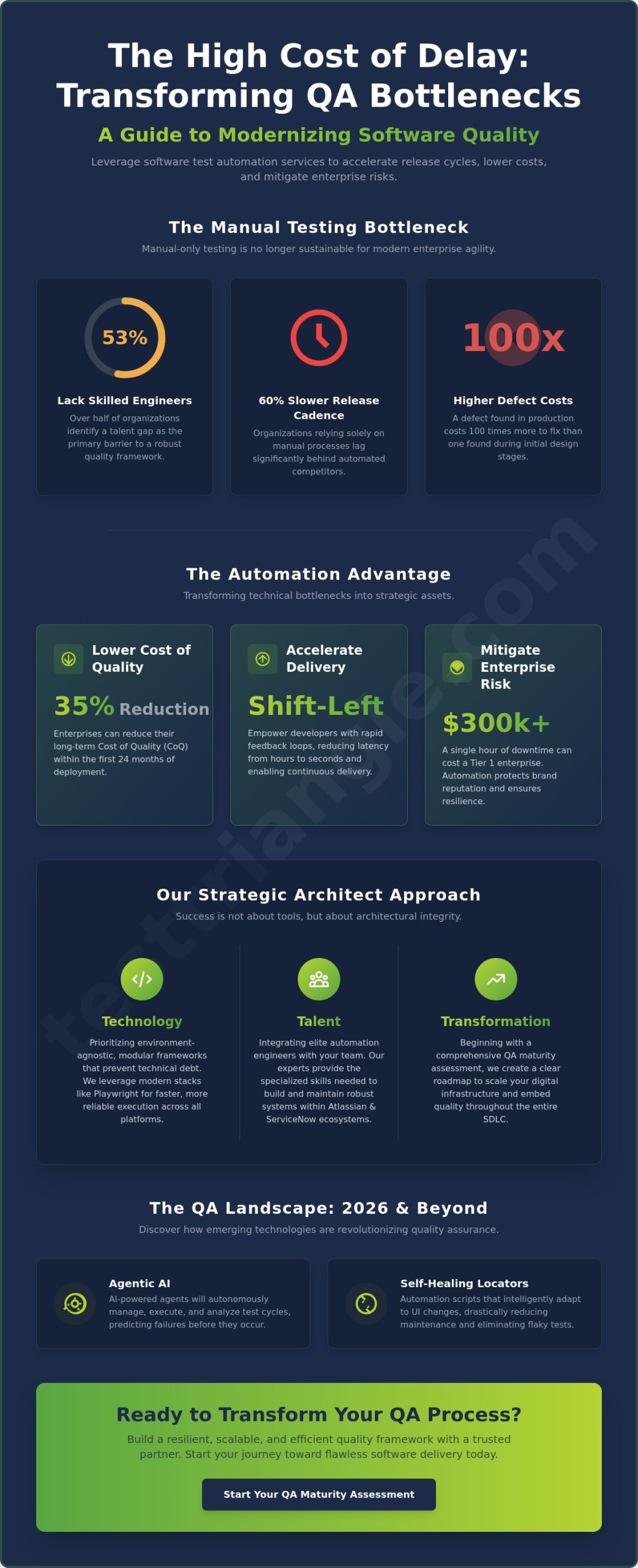
According to the 2023 World Quality Report, 53% of organizations identify a lack of skilled automation engineers as the primary barrier to achieving a robust quality framework. You’ve likely seen release cycles stall as manual regression suites struggle to keep pace with daily deployment demands. It’s frustrating when fragile scripts create high maintenance overhead, turning what should be an efficiency tool into a significant drain on your engineering resources. By leveraging professional software test automation services, you can transform these persistent technical bottlenecks into strategic assets that drive long-term operational stability.
This guide promises to show you how to accelerate release cycles and mitigate enterprise risks by integrating elite automation frameworks with specialized technical talent. We’ll examine the methodologies required to lower the cost of quality while significantly improving software reliability and security. You’ll gain a clear roadmap for scaling your digital infrastructure through the disciplined application of Technology, Talent, and Transformation.
Key Takeaways
- Understand why manual-only testing is no longer sustainable for modern enterprise agility and how to leverage software test automation services to achieve continuous delivery.
- Learn to prioritize a “Strategic Architect” approach over a tool-first mentality to ensure your automation framework remains maintainable and environment-agnostic.
- Explore the 2026 technological landscape to discover how Agentic AI and self-healing locators are revolutionizing the efficiency of modern quality assurance cycles.
- Identify high-impact automation wins by conducting a comprehensive QA maturity assessment as a foundational step in your digital transformation roadmap.
- Discover how integrating elite talent with Atlassian and ServiceNow ecosystems creates the visibility needed for flawless, scalable software delivery.
The Strategic Value of Software Test Automation Services in 2026
By integrating sophisticated frameworks into the development pipeline, software test automation services enable organizations to achieve continuous delivery without sacrificing precision. In the current enterprise environment, manual testing alone is no longer a sustainable model for agility. Industry data from 2025 indicates that organizations relying solely on manual processes experience a 60% slower release cadence compared to those utilizing automated workflows. As a Trusted Partner, Test Triangle views automation not as a luxury, but as a catalyst for digital transformation. We help businesses shift from viewing testing as a final, isolated phase to treating quality as a constant, integrated thread throughout the entire Software Development Life Cycle (SDLC).
The financial justification for this transition is rooted in the Cost of Quality (CoQ). While manual efforts scale linearly with product complexity, automated suites offer a non-linear return on investment by absorbing repetitive tasks. Research suggests that fixing a defect during the production phase costs 100 times more than identifying it during the initial design or coding stages. By implementing software test automation services, enterprises can reduce their long-term CoQ by an estimated 35% within the first 24 months of deployment. This strategic architecting of the QA process ensures that Technology. Talent. Transformation. work in unison to drive scalable growth.
Beyond Speed: The Business Case for Automation
Accelerating time-to-market is the most visible benefit of automation, yet its impact on structural integrity is equally vital. By deploying robust regression suites, teams eliminate human error in high-volume, repetitive tasks that often lead to burnout and oversight. Test automation provides the foundational structure needed to empower developers with rapid feedback loops. This “shift-left” approach allows engineers to identify and rectify logic flaws within minutes of code submission. By leveraging these rapid cycles, enterprises drive higher parallelization and reduce feedback latency from hours to seconds, ensuring that every release meets rigorous global standards.
Mitigating Risks in a Digital-First Economy
In an era where a single hour of downtime can cost a Tier 1 enterprise upwards of $300,000, protecting brand reputation is a primary business objective. Automated vulnerability scanning and compliance checks ensure that security is woven into the code rather than treated as an afterthought. Test Triangle utilizes flexible engagement models to help clients navigate these complexities in sectors like Banking and Life Sciences, where precision is mandatory. Test automation serves as a strategic risk-mitigation layer that identifies vulnerabilities and logic flaws before they impact the end-user experience. By combining technical expertise with adaptable delivery models, we ensure that your digital infrastructure remains resilient against evolving market demands.
Designing a Robust Automation Framework: Technology Meets Talent
Success in software test automation services isn’t about buying a software license; it’s about architectural integrity. Adopting a tool-first mentality often leads to “shelfware,” where expensive platforms sit idle because they lack a strategic foundation. By prioritizing a “Strategic Architect” approach, Test Triangle ensures that frameworks are environment-agnostic and modular. This method prevents the accumulation of technical debt, which can consume up to 40% of a development budget according to 2023 industry benchmarks. A well-designed framework allows for seamless execution across development, staging, and production environments without requiring script modifications for every new release.
The Technology: Selecting the Right Stack
Choosing between open-source tools like Playwright and commercial suites requires a rigorous evaluation of your digital ecosystem. While Selenium remains a staple for many, 2024 trends show a 30% increase in Playwright adoption due to its native auto-waiting features and faster execution speeds. Your stack must support cross-browser execution and real-device testing, especially for mobile applications where fragmented OS versions can cause 15% higher failure rates on emulators than on physical hardware. Integrating these tools with cloud environments like AWS Device Farm or Azure DevTest Labs allows for massive parallel execution, reducing regression cycles from days to mere hours. This technological precision ensures that software test automation services deliver a measurable return on investment through accelerated feedback loops.
The Talent: The Human Factor in Automation
Technology alone cannot solve complex quality challenges. Skilled engineers are the backbone of an effective test automation strategy, as they possess the foresight to build “auto-healing” scripts that adapt to minor UI changes. Without this expertise, teams often face “automation debt,” where maintaining old scripts takes more time than performing manual testing. Leveraging hybrid delivery models, including on-site leadership and offshore execution, provides the 24/7 coverage required for global enterprises. Test Triangle acts as a Trusted Partner, bridging the gap between manual testers and automation experts through our signature triad: Technology. Talent. Transformation. Structured upskilling programs ensure that manual QA professionals can transition into automation roles, retaining deep domain knowledge while gaining technical proficiency.
A robust framework must live within the heart of the CI/CD pipeline rather than existing as an isolated silo. By automating trigger-based execution in Jira Service Management or Jenkins, organizations accelerate their release velocity without sacrificing stability. Statistics from the 2023 State of DevOps Report indicate that high-performing teams with integrated automation achieve 208 times more frequent code deployments. This seamless integration ensures that quality is a continuous process, allowing your business to pivot quickly in a competitive market while maintaining a flawless user experience.
Navigating the Automation Landscape: Tools, AI, and Engagement Models
By integrating sophisticated software test automation services into the SDLC, organizations accelerate release cycles while maintaining architectural integrity. The current market divides between traditional code-centric frameworks like Playwright and the 40% growth in low-code solutions recorded in late 2024. While code-driven scripts offer granular control for complex logic, low-code platforms empower non-technical stakeholders to contribute to quality assurance. Looking toward 2026, the industry anticipates a shift toward Agentic AI. These systems won’t just follow scripts; they’ll autonomously adapt to UI changes via self-healing locators, which can reduce manual script maintenance by up to 70%.
AI-Enhanced Testing: Hype vs. Reality
By leveraging predictive test design, AI-driven tools identify high-risk areas before code reaches production. Generative AI now produces 90% of synthetic test data for banking and life sciences sectors, ensuring privacy compliance. However, human oversight remains critical. Without expert validation, AI hallucinations lead to false positives that disrupt the CI/CD pipeline. Our approach ensures that AI serves as a force multiplier for talent, not a replacement for strategic intuition.
Flexible Engagement Models for Global Enterprises
Enterprise leaders must choose between managed QA services and staff augmentation based on their long-term roadmap. Managed services provide SLA-backed results, shifting the burden of delivery to a trusted partner. Conversely, staff augmentation allows for 24-hour scaling during peak development cycles. Fixed-price projects suit defined technology roadmaps, while time-and-materials models offer the agility required for evolving digital transformations. By aligning these models with tools like Jira Service Management, we ensure transparency across every sprint.
Aligning your automation strategy with specific business objectives requires a disciplined evaluation of your current maturity level. We’ve observed that 65% of automation initiatives fail when they lack a clear connection to business KPIs like “Time to Market” or “Cost per Defect.” By mapping software test automation services to core revenue-generating features, Test Triangle helps enterprises achieve a 25% improvement in operational stability. We focus on three pillars to drive this success:
- Strategic Selection: Choosing tools that integrate with Atlassian and ServiceNow ecosystems.
- Risk Mitigation: Implementing self-healing scripts to prevent pipeline bottlenecks.
- Scalable Growth: Utilizing flexible engagement models to adapt to market shifts.
By combining technical expertise with adaptable delivery models, Test Triangle helps businesses reduce costs and elevate their digital presence. Our commitment to Technology. Talent. Transformation. ensures that your quality engineering efforts translate into long-term competitive advantages. We act as a steady hand, guiding your organization through the complexities of modern software delivery.
Implementing Automation: A Roadmap to Digital Transformation
Transitioning to an automated environment requires more than just tool selection; it demands a fundamental shift in quality culture. Before deploying software test automation services, we conduct a comprehensive QA maturity assessment to evaluate existing workflows. This diagnostic phase identifies systemic bottlenecks, often revealing that manual regression cycles consume 70% of a QA team’s capacity. By targeting “low-hanging fruit,” such as stable, high-volume smoke tests, businesses realize immediate efficiency gains. Success is measured through rigorous KPIs. We track test coverage targets of 80% or higher, maintain pass rates above 95%, and aim for a 50% reduction in execution time during the initial 120 days.
Scaling these frameworks across multiple product lines requires a modular architecture. By centralizing core libraries and decentralized execution, enterprises ensure consistency while allowing individual business units to adapt to unique sprint cycles. This strategic approach transforms testing from a late-stage hurdle into a continuous, value-driven process. Organizations that adopt this scalable model typically see a 30% increase in release frequency within the first year of implementation.
The Step-by-Step Implementation Process
Phase 1 focuses on environment stabilization and framework architecture design. We establish robust containers and select language-agnostic tools to ensure long-term viability. During Phase 2, the team scripts core regression tests and integrates them into CI/CD pipelines, enabling “shift-left” defect detection. Phase 3 drives continuous optimization, expanding the scope to include non-functional testing like performance and security. This phased methodology ensures that software test automation services deliver scalable results without disrupting ongoing development cycles.
Specialized Requirements: Pharma and Finance
In highly regulated sectors, automation must satisfy strict compliance mandates. For life sciences, we navigate GxP and Computer System Validation (CSV) requirements by maintaining 21 CFR Part 11 compliant logs. Banking and high-frequency trading platforms require automated testing that handles millisecond-level latency and complex transactional logic. We implement comprehensive audit trails and automated documentation to ensure every test run is ready for regulatory scrutiny. This precision mitigates risk while accelerating the delivery of critical financial and healthcare applications.
Ready to modernize your quality assurance strategy? Connect with a Strategic Architect to begin your transformation.
Elevating Quality with Test Triangle: Your Strategic Partner
By integrating advanced technical frameworks with elite engineering teams, Test Triangle delivers a holistic approach to quality engineering. Our methodology rests on a unique triad: Technology, Talent, and Transformation. This framework ensures that software test automation services are not just a technical checkbox but a primary driver of long-term business value. With a robust presence in Dublin, London, and major global tech hubs, we’ve supported over 250 enterprises in achieving 99.9% system reliability through rigorous automated protocols. Our flexible delivery models allow organizations to scale resources based on fluctuating project demands, which ensures operational stability while reducing the total cost of quality.
As a Strategic Architect in the QA space, we recognize that technical execution must align with business outcomes. By leveraging our deep expertise in both Atlassian and ServiceNow ecosystems, we provide stakeholders with a single source of truth for their digital health. Our consultants don’t just write scripts; they transform the way your organization perceives quality. We focus on mitigating risks early in the lifecycle, which prevents expensive post-release failures and protects your brand reputation in highly competitive markets like Banking and Life Sciences.
Atlassian Integration: Making Quality Visible
By linking automated test results directly to Jira Service Management, we eliminate the silos that traditionally separate development and operations. This integration optimizes the entire Atlassian stack, fostering a culture of seamless QA-Dev collaboration where defects are identified 40% faster than in manual environments. We design and implement custom dashboards that translate complex technical metrics into high-level business insights. These visualizations provide C-suite executives with real-time visibility into software health, allowing for data-driven decisions regarding release readiness and infrastructure security. It’s about turning hidden data into actionable intelligence that drives the bottom line.
Your Next Steps Toward Flawless Execution
Achieving a robust testing environment begins with a clear understanding of your current technical debt and pipeline efficiency. You can request a strategic QA audit from our expert consultants to identify critical bottlenecks and modernization opportunities in your existing stack. Partnering with an Enterprise Ireland supported firm means you gain access to a partner that meets rigorous international standards for innovation and service delivery. This institutional maturity allows us to handle complex, large-scale migrations and automation projects with precision. Contact Test Triangle to accelerate your digital transformation and discover how our specialized software test automation services can secure your company’s digital future.
Driving Digital Transformation: The Path to Flawless Execution
By 2026, the demand for resilient software architectures will require more than just basic scripts. It’ll demand a sophisticated fusion of AI-driven tools and high-level human expertise to maintain a competitive edge. Leveraging professional software test automation services isn’t just a technical choice; it’s a strategic move to ensure your digital infrastructure remains robust under the pressure of global scale. By combining technical rigor with flexible engagement models, organizations can accelerate their release cycles while mitigating the risks inherent in complex digital ecosystems. A comprehensive quality strategy also demands attention to platform-specific failures, which is why pairing automation with dedicated compatibility testing services is essential for achieving true enterprise digital assurance in 2026.
As an Enterprise Ireland client and an Atlassian Gold Solution Partner, Test Triangle brings institutional maturity to every project. Our global delivery centers in Dublin, London, and Hyderabad ensure we provide the “Technology. Talent. Transformation.” needed to support specialized sectors like banking and life sciences. We’re ready to act as your Strategic Architect, building the scalable frameworks your business deserves. Partner with Test Triangle for Strategic Test Automation to elevate your quality standards and drive sustainable growth. Your journey toward a flawless digital future is well within reach.
Frequently Asked Questions
What are the primary benefits of software test automation services?
Software test automation services provide a 70% increase in test execution speed compared to traditional manual processes. By leveraging robust frameworks, organizations can achieve 90% regression test coverage, ensuring that new code deployments don’t compromise existing functionality. This strategic approach allows your team to focus on high-value exploratory testing while maintaining a flawless user experience across all digital touchpoints.
How much does it cost to implement an automated testing framework?
The cost to implement an automated testing framework varies based on the three main pillars of technology, talent, and transformation. According to the 2023 World Quality Report, organizations typically allocate 25% of their total IT budget to quality assurance and testing activities. Initial investments cover license fees for tools like Atlassian Jira and the engineering hours required to build a scalable, maintainable architecture.
Can legacy applications be integrated into a modern automation suite?
Legacy applications can be integrated into modern suites by utilizing custom wrappers and API-driven interfaces. By mapping legacy workflows to contemporary automation tools, we bridge the gap between technical debt and digital transformation. This process often involves using middleware or service virtualization to ensure that 20-year-old mainframe systems communicate effectively with cloud-native environments, preserving institutional knowledge while accelerating delivery cycles.
What is the difference between manual testing and automated testing?
Manual testing focuses on human-centric elements like UX and exploratory edge cases, while automated testing executes repetitive, high-volume scripts with 100% precision. While manual efforts are essential for initial feature validation, software test automation services are required to handle the 1,000+ regression tests common in modern CI/CD pipelines. This balance ensures that your software remains robust under the pressure of rapid, daily releases.
How does AI improve the efficiency of test automation services?
AI improves efficiency by enabling self-healing scripts that automatically adjust to UI changes, reducing maintenance effort by 40%. By leveraging machine learning algorithms, our systems can predict high-risk areas in the codebase based on historical defect data. This proactive approach elevates the testing process from a reactive bottleneck to a strategic asset that anticipates failures before they reach the production environment.
What industries benefit most from specialized QA automation?
Banking and Life Sciences benefit most due to the 100% compliance requirements and rigorous regulatory standards they must meet. In the financial sector, where a single minute of downtime can cost 5,600 dollars according to Gartner, automated suites provide the necessary security and stability. These industries leverage our flexible engagement models to ensure their complex infrastructures remain compliant with global data protection laws.
How do you measure the ROI of test automation services?
You measure ROI by calculating the reduction in defect leakage and the total hours saved during the regression cycle. A successful implementation typically sees a 50% reduction in post-release bugs within the first 12 months. By tracking these metrics within Jira Service Management, we provide stakeholders with a clear view of how automated testing reduces the total cost of ownership while accelerating the path to digital maturity.
Why should I outsource my test automation to a specialized firm?
Outsourcing to a specialized firm provides immediate access to the “Technology. Talent. Transformation.” triad without the 6-month lead time required to hire in-house experts. As a Trusted Partner, we bring battle-tested frameworks and deep expertise in tools like ServiceNow and Atlassian. This strategic alignment allows your internal teams to focus on core business logic while we ensure your underlying digital infrastructure remains flawlessly scalable.

Article by
Paul Guy
Paul serves as the Marketing Director at Test Triangle, where he leads a global team in driving growth through strategic B2B marketing and brand communications. With a strong emphasis on measurable outcomes and sustainable performance, he plays a pivotal role in aligning marketing functions to enhance customer engagement and accelerate business impact. Under his leadership, marketing initiatives have consistently delivered significant returns on investment, elevated brand visibility, and strengthened the company's presence across key markets.