



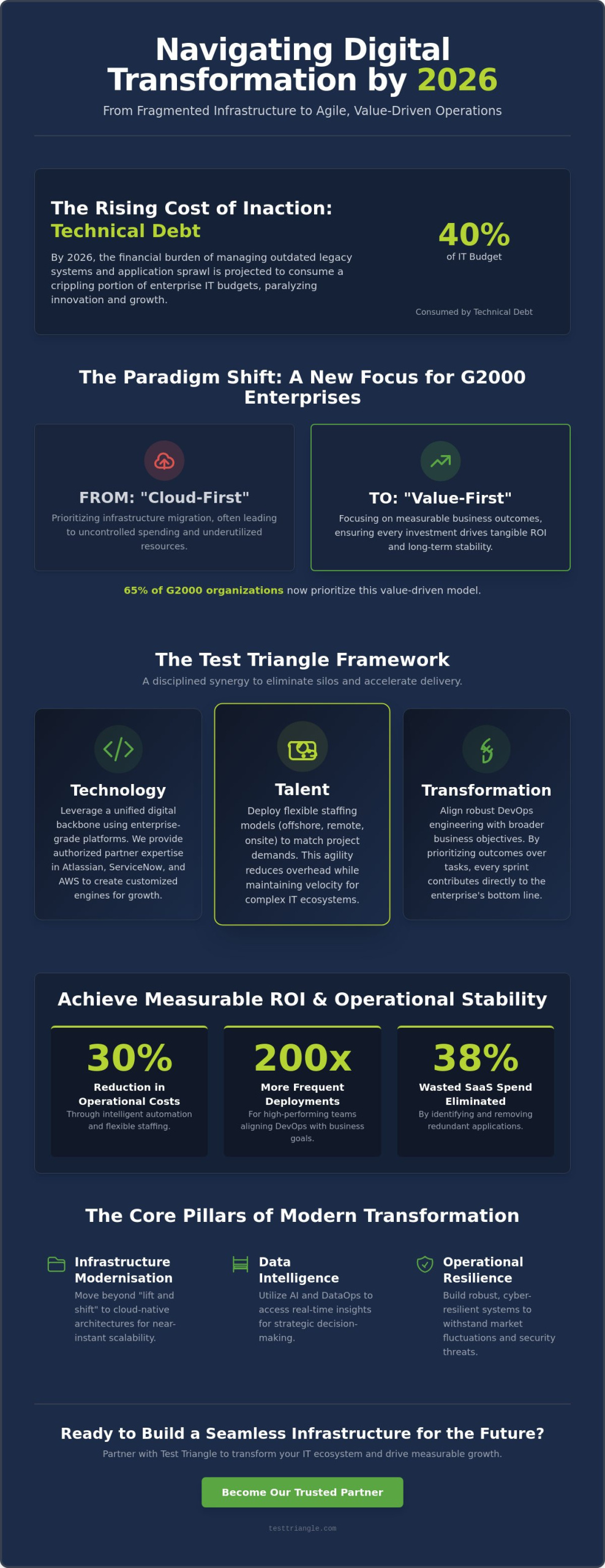
By 2026, the financial burden of managing technical debt will consume 40% of the average enterprise IT budget, effectively paralyzing innovation for any organization relying on fragmented Digital Transformation Services. You already understand that reconciling application sprawl with rigid compliance requirements often leads to significant business disruption during cloud transitions. It’s a delicate balance that requires more than just new software; it requires a steady hand to maintain continuity. At Test Triangle, we believe that true agility isn’t found in tools alone but in the strategic orchestration of complex ecosystems.
As your Trusted Partner, we promise to show you how a disciplined synergy of technology, talent, and transformation drives measurable ROI while ensuring long-term operational stability. By aligning robust DevOps practices with Jira Service Management and other high-tier ITSM platforms, global enterprises can finally eliminate silos and accelerate delivery cycles. This roadmap previews how to leverage flexible staffing models and intelligent automation to reduce operational costs by 30% and achieve a seamless infrastructure for the years ahead. Technology. Talent. Transformation.
Key Takeaways
- Understand the pivotal shift from “Cloud-First” to “Value-First” strategies, ensuring your organizational evolution prioritizes measurable ROI and long-term operational stability.
- By leveraging our specialized Digital Transformation Services, enterprises can synchronize technology and talent to eliminate fragmented infrastructure and accelerate global agility.
- Evaluate the strategic integration of Atlassian, ServiceNow, and AWS to create robust, automated workflows that empower a modern and distributed workforce.
- Gain actionable insights from real-world case studies demonstrating how a multi-phase DevOps roadmap can successfully modernize complex, high-stakes IT environments.
- Learn to identify a trusted partner by prioritizing institutional maturity and specialized industry knowledge to mitigate risks in sensitive sectors like Life Sciences.
What are Digital Transformation Services in the 2026 Landscape?
By integrating advanced technological frameworks with organizational culture, Digital Transformation Services enable global enterprises to pivot from rigid legacy structures to agile, value-driven operations. This evolution is no longer about simple digitization; it’s about a fundamental shift in how value is delivered across the entire business ecosystem. By 2026, the global economy has moved from “Cloud-First” strategies, which often resulted in uncontrolled spending, to “Value-First” models. Recent data from IDC indicates that 65% of G2000 organizations now prioritize specific business outcomes over infrastructure migration alone to ensure long-term financial viability.
To ensure your strategy aligns with these value-driven models, you can learn more about AEConsulting and their strategic advisory services.
In sectors like Banking and Life Sciences, the stakes remain exceptionally high. These industries often rely on legacy systems that are over 25 years old. They require specialized transformation approaches that respect strict regulatory compliance while introducing modern flexibility. By leveraging the expertise of a Trusted Partner, these organizations can modernize without disrupting critical patient care or financial transactions. Managed Service Providers (MSPs) play a vital role here. They ensure post-transformation stability by providing the continuous oversight needed to maintain peak performance. This holistic approach combines Technology, Talent, and Transformation to secure a competitive edge in a volatile market.
The Core Pillars of Modern Transformation
Infrastructure Modernisation now moves beyond simple lift and shift strategies. It focuses on cloud-native architectures that allow for near-instant scalability. Data Intelligence has also evolved. By utilizing AI and DataOps, executives can now access real-time insights that drive strategic decision-making. Operational Resilience ensures that systems are robust enough to withstand global market fluctuations and security threats. Since 2024, cyber-resilience has become a non-negotiable component of any successful transformation roadmap.
The 2026 ROI Reality Check
The metrics for success have shifted. Companies now prioritize value-creation metrics over traditional cost-cutting measures to measure the health of their digital investments. A primary barrier to this agility is Application Sprawl. Industry audits from 2025 show that 38% of SaaS spend is wasted on redundant or underutilized tools. Identifying these inefficiencies is the first step toward reclaiming operational speed and improving the bottom line. Digital Transformation is the intersection of operational efficiency and technological innovation.
This spirit of innovation is not limited to the tech sector; forward-thinking consumer brands are also redefining their industries with bold, modern concepts. To see how this translates to a contemporary dining experience that fuels the modern workforce, you can learn more about Tacoverse.
The Test Triangle Framework: Technology, Talent, and Transformation
By integrating a triad of core competencies, Test Triangle ensures that Digital Transformation Services move beyond theoretical planning into operational reality. Technology alone rarely solves structural inefficiency; real progress requires a Strategic Architect approach to bridge the gap between legacy systems and modern cloud environments. By deploying flexible engagement models, enterprises can toggle between offshore, remote, and onsite staffing as project demands fluctuate. This agility reduces overhead while maintaining a steady velocity for complex IT ecosystems.
Aligning DevOps engineering with broader business objectives accelerates time-to-market. When engineering teams prioritize business outcomes over mere ticket completion, deployment frequency can increase significantly. Based on 2024 DORA metrics, high-performing teams see 200 times more frequent code deployments than their peers. This strategic alignment ensures every sprint contributes directly to the enterprise’s bottom line.
Technology: Leveraging Global Standards
By anchoring digital infrastructure in platforms like Atlassian, ServiceNow, and AWS, organizations build a unified digital backbone. Authorized partner expertise is critical because it transforms a standard platform deployment into a customized engine for growth. Test Triangle ensures flawless execution by applying rigorous automation and performance testing. This methodology eliminates manual errors and secures the robust performance required for 2026 enterprise standards. Utilizing Digital Transformation Services that prioritize platform customization allows for a 30 percent improvement in operational efficiency according to recent industry benchmarks.
Talent: The Human Engine of Change
The global IT talent gap is projected to reach 85 million people by 2030, according to research by Korn Ferry. Test Triangle solves this through specialized recruitment and the Managed Staffing model. Unlike traditional recruitment, this model provides ongoing oversight and performance management, ensuring that resources remain aligned with the client’s long-term roadmap.
Pharma IT staffing requires a different pedagogical approach than general tech staffing. It demands a deep understanding of GxP compliance and validated systems that generalists lack. By sourcing niche experts who understand these regulatory nuances, businesses can leverage specialized Digital Transformation Services to maintain regulatory integrity while innovating. This specialized focus reduces the risk of compliance failures, which can cost life sciences firms millions in potential fines and delayed product launches.
Platform Selection: Atlassian, ServiceNow, and AWS Integration
By aligning technical architecture with long-term business goals, enterprises ensure their Digital Transformation Services yield measurable ROI rather than just incremental change. Selecting the right platform isn’t merely a procurement decision; it’s a strategic commitment to an operational engine. Through precise ServiceNow implementation, organizations transform IT Service Management (ITSM) from a reactive cost center into a proactive value driver. According to the 2024 ServiceNow Value Report, companies leveraging automated workflows see a 30% reduction in Mean Time to Resolution (MTTR), directly enhancing the modern workforce’s productivity.
Atlassian consulting provides the necessary framework to bridge the historical gap between development and operations teams. By deploying Jira Service Management, businesses accelerate deployment cycles by up to 40%, creating a unified language for technical and non-technical stakeholders. Building on this, AWS Cloud Migration offers the elastic foundation required for 2026’s data-intensive applications. Flexera’s 2024 State of the Cloud Report indicates that 69% of IT leaders now prioritize heavy cloud migration to achieve the scalability needed for AI-driven Digital Transformation Services.
- ServiceNow: Best for orchestrating complex enterprise-wide workflows and cross-departmental service delivery.
- Atlassian: Ideal for high-velocity software teams requiring deep integration between project management and incident response.
- AWS: The essential infrastructure layer for hosting microservices and managing global data footprints.
Choosing the Right Engine for Your Transformation
Deciding when to prioritize specific platforms depends on the organization’s primary friction points. If the goal is enterprise-wide workflow automation across HR, legal, and IT, ServiceNow offers the most robust governance. Conversely, software-centric organizations find a strategic advantage in Atlassian’s ecosystem, where Jira’s agility supports rapid iteration. For those maintaining legacy hardware, hybrid-cloud strategies combining AWS with on-premise requirements provide a low-risk path toward modernization without disrupting core stability.
The Power of Integrated Ecosystems
Breaking down silos requires more than just new software; it demands functional interoperability. Integrating ServiceNow with AWS drives cross-departmental efficiency by allowing automated infrastructure provisioning directly from service tickets. For Atlassian users, the case for Atlassian Cloud Migration is increasingly clear. Forrester’s 2023 Total Economic Impact study shows that cloud-migrated teams experience a 20% reduction in administrative overhead while gaining superior security and instant access to feature updates. A Trusted Partner acts as the strategic intermediary that translates complex technical features into sustainable business outcomes through rigorous platform optimization. By focusing on Technology. Talent. Transformation., Test Triangle ensures these ecosystems don’t just exist, but excel.
Case Study: Modernising Global Operations for a High-Stakes Enterprise
Facing the complexities of a global market, a high-stakes enterprise recently sought to rectify its fragmented IT infrastructure. This organization, a leader in the financial services sector, struggled with 18 disparate legacy systems that hampered data flow and slowed response times. By partnering with Test Triangle, they moved away from siloed operations toward a unified, agile environment. This strategic shift was not merely a technical upgrade; it was a total overhaul designed to ensure long-term operational stability and market competitiveness through tailored Digital Transformation Services.
Phase 1: Strategic Technology Roadmapping
By conducting a comprehensive 6-week audit of the client’s existing technical debt, our team identified 45 redundant applications that were draining resources without adding value. We acted as a Strategic Architect, mapping out a roadmap that prioritized the decommissioning of obsolete software while identifying key performance indicators (KPIs) to measure success. These metrics focused on Mean Time to Recovery (MTTR) and deployment lead times. To mitigate risks, we established a robust security and compliance framework that aligned with ISO 27001 standards, ensuring that every step of the transformation remained secure and audit-ready.
Phase 2: Execution and Talent Integration
Leveraging our flexible engagement models, we deployed a specialized team of offshore DevOps engineers to accelerate the development of a modern CI/CD pipeline. This talent integration allowed the client to scale their technical capabilities without the overhead of local hiring. We implemented automated testing services to replace manual, error-prone cycles, ensuring superior software quality across all business units. To further eliminate release bottlenecks that were stalling delivery, the enterprise also evaluated outsourced QA services as a force multiplier for their internal testing teams. By utilizing Atlassian tools such as Jira Service Management and Confluence, we provided a transparent project management environment. This ensured that stakeholders had real-time visibility into the transformation’s progress, fostering a culture of accountability and precision.
The results of this collaboration underscore the power of our core philosophy: Technology. Talent. Transformation. Within the first 12 months of implementation, the enterprise achieved a 30% reduction in annual operational costs. Furthermore, the frequency of software deployments increased from once per quarter to twice per week, representing a significant boost in enterprise agility. This transition allowed the client to respond to market shifts in days rather than months, securing their position as a modern digital leader.
Selecting Your Digital Transformation Services Partner
By prioritizing a blend of global reach and local technical expertise, enterprises can secure Digital Transformation Services that don’t just innovate but also stabilize. Selecting a partner in 2026 requires looking beyond basic technical proficiency to find “Institutional Maturity.” This trait ensures a provider understands the complex regulatory frameworks of sectors like Life Sciences or Banking, where a single compliance error can result in millions of euros in fines. By aligning with a partner that possesses deep industry-specific knowledge, businesses can mitigate 100% of the risks associated with GxP compliance and data integrity standards.
Flexible engagement models are another non-negotiable factor for long-term scalability. As market conditions shift, your partner must offer the agility to pivot from a pure consultancy role to a full-scale technical delivery team. This versatility prevents the “vendor lock-in” that frequently stalls growth in 40% of enterprise-level projects. By combining high-level strategic oversight with on-demand technical talent, Test Triangle provides the steady hand required to maintain operational equilibrium during rapid shifts in the technological landscape.
The Trusted Partner Checklist
By conducting a rigorous audit of potential partners, IT leaders can ensure their Digital Transformation Services are built on a foundation of recognized excellence. Use the following criteria to evaluate your options:
- Certifications and Partnerships: Verify that the firm is an authorized partner for Atlassian, ServiceNow, and AWS. These credentials guarantee that your team is leveraging the full power of Jira Service Management and cloud-native architectures.
- Industry Experience: Ensure they have a proven track record in your specific niche. In the Life Sciences sector, for example, they must demonstrate an understanding of validated systems and regulatory nuances.
- Scalability: A true partner provides more than just a roadmap; they provide the specialized talent to execute it. They should offer the capacity to scale your technical workforce by 50% or more within a single quarter if project demands increase.
Drive Your Transformation Today
Initiating your journey begins with a structured discovery session designed to audit your legacy environment and identify immediate automation opportunities. By launching a 90-day pilot project, your organization can demonstrate tangible ROI, often achieving a 25% reduction in manual processing times before a full-scale rollout begins. This phased approach allows for the “fail-fast” mentality required for modern agility without risking the stability of your core business functions.
Test Triangle stands ready to serve as your Strategic Architect in an increasingly complex world. We don’t just provide tools; we provide the visionary leadership and practical execution needed to turn your digital roadmap into a competitive advantage. Reach out to our consultants today to begin your evolution. Technology. Talent. Transformation.
Securing Your Competitive Advantage for 2026
Navigating the complex 2026 landscape requires more than just adopting new software; it demands a holistic integration of Atlassian, ServiceNow, and AWS to ensure operational fluidity. By leveraging the Test Triangle framework of Technology, Talent, and Transformation, global enterprises bridge the gap between legacy systems and modern agility. Selecting the right Digital Transformation Services partner is the final, most critical step in this strategic journey. As an Authorized Atlassian and ServiceNow Partner, Test Triangle provides the technical rigor needed to support Fortune 500 companies within the Finance and Life Sciences sectors. With global delivery centers operating in Dublin, London, and Hyderabad, we ensure around-the-clock strategic support and localized expertise. By aligning robust platform integrations with a culture of continuous improvement, your organization can achieve the enterprise agility required for the 2026 marketplace. It’s time to turn your strategic roadmap into a tangible competitive advantage and lead your industry with confidence.
Partner with Test Triangle for your Digital Transformation journey
Frequently Asked Questions
What are the primary benefits of digital transformation services for large enterprises?
Enhanced operational agility and data-driven decision-making are the primary benefits for large organizations. By integrating Digital Transformation Services, enterprises can reduce time-to-market by 30% according to McKinsey reports. This strategic shift allows organizations to leverage real-time analytics to optimize supply chains and elevate customer experiences across global touchpoints. We help you transition from legacy constraints to a flexible, scalable architecture.
How does Test Triangle ensure business continuity during a cloud migration?
Test Triangle ensures business continuity by utilizing a phased migration approach backed by 24/7 monitoring. By leveraging Atlassian and ServiceNow integrations, we maintain 99.9% uptime during the transition. Our consultants implement robust disaster recovery protocols that guarantee data integrity. Your critical systems remain operational while we migrate legacy workloads to the cloud, providing a flawless transition without service interruptions.
What is the difference between digital transformation and simple IT modernization?
Digital transformation involves a fundamental cultural and operational shift, whereas IT modernization focuses solely on upgrading legacy hardware or software. Modernization might replace a server, but transformation leverages technology to redefine the entire business model. According to Gartner, 91% of businesses are engaged in digital initiatives. Only those who integrate talent and technology achieve true enterprise agility through a strategic, vision-led approach.
How do you manage compliance and security in digital transformation for the pharmaceutical industry?
We manage compliance by implementing GxP-compliant frameworks and automated validation tools within the digital ecosystem. By integrating Jira Service Management with strict audit trails, Test Triangle ensures every software update meets FDA 21 CFR Part 11 requirements. This strategic approach mitigates risk while accelerating the deployment of critical life sciences applications. We prioritize security to ensure your data remains protected in highly regulated environments.
Why is talent acquisition a critical component of digital transformation services?
Talent acquisition is a critical component because 70% of digital initiatives fail due to a lack of skilled personnel according to BCG data. Successful Digital Transformation Services require a blend of technical expertise and strategic vision that internal teams often lack. By securing specialized talent through our flexible engagement models, organizations bridge the skills gap. This ensures that new technologies are adopted effectively across the enterprise.
Can digital transformation services help in reducing long-term IT maintenance costs?
Yes, digital transformation reduces long-term maintenance costs by replacing fragmented legacy systems with scalable, automated cloud infrastructures. Organizations often see a 20% reduction in operational expenditures within the first 24 months. By optimizing workflows and leveraging AI-driven analytics, enterprises eliminate the technical debt that typically consumes 60% of corporate IT budgets. This shift allows you to reallocate resources toward innovation rather than upkeep.
How long does a typical enterprise-level digital transformation project take?
A typical enterprise-level digital transformation project spans 12 to 24 months depending on the complexity of the infrastructure. While initial pilot phases deliver measurable results within 6 months, achieving full organizational agility requires a multi-year roadmap. Test Triangle utilizes a methodical framework to deliver incremental value throughout this timeline. We ensure that strategic objectives are met at every milestone while maintaining operational stability.
What role does DevOps play in a successful digital transformation strategy?
DevOps acts as the engine for continuous delivery by bridging the gap between development and operations teams. By implementing automated CI/CD pipelines, businesses increase deployment frequency by 200 times compared to traditional models. This collaboration is essential for a successful strategy because it fosters a culture of stability and rapid innovation. We leverage tools like Jira to accelerate software delivery and ensure a robust digital landscape. Enterprises looking to further strengthen their release confidence should also explore a quality assurance outsourcing strategy to scale AI-augmented testing capabilities alongside their DevOps pipelines.

Article by
Paul Guy
Paul serves as the Marketing Director at Test Triangle, where he leads a global team in driving growth through strategic B2B marketing and brand communications. With a strong emphasis on measurable outcomes and sustainable performance, he plays a pivotal role in aligning marketing functions to enhance customer engagement and accelerate business impact. Under his leadership, marketing initiatives have consistently delivered significant returns on investment, elevated brand visibility, and strengthened the company's presence across key markets.