



With the IT Service Management market reaching a valuation of USD 14.85 billion in 2026, operational efficiency has become the primary differentiator for the modern global enterprise. Many leadership teams still struggle with the inherent friction caused by disconnected platforms, where manual ticket duplication and a lack of cross-departmental visibility stall organizational progress. Successfully integrating jira with servicenow for itsm is no longer a mere technical preference; it’s a strategic imperative for those aiming to align high-velocity development with the rigorous stability of ITIL standards.
You likely recognize that data silos between Dev and Ops don’t just slow down work, they create significant risks to your service reliability and customer satisfaction. We’re here to help you architect a seamless bridge between these two powerhouses to eliminate silos and accelerate operational velocity. This guide explores the methodologies required to achieve real-time bidirectional synchronization and improved Mean Time to Resolution (MTTR). We’ll also examine how automated reporting across both platforms provides the high-level visibility needed to manage a complex, scalable digital infrastructure with absolute confidence and precision.
Key Takeaways
- Understand the architectural foundations for integrating jira with servicenow for itsm to align high-velocity engineering teams with the governance requirements of enterprise service management.
- Evaluate the strategic trade-offs between ServiceNow IntegrationHub Spokes and custom API builds to select a deployment model that prioritizes long-term maintenance and scalability.
- Establish a unified source of truth by implementing rigorous data mapping and workflow orchestration that eliminates fragmented data and manual entry errors.
- Secure your enterprise ecosystem by adopting advanced synchronization protocols that ensure data privacy and compliance during complex cross-platform migrations.
- Recognize how a disciplined, dual-platform consultancy can bridge the gap between strategic roadmapping and technical execution to accelerate your digital transformation journey.
The Strategic Case for Integrating Jira with ServiceNow
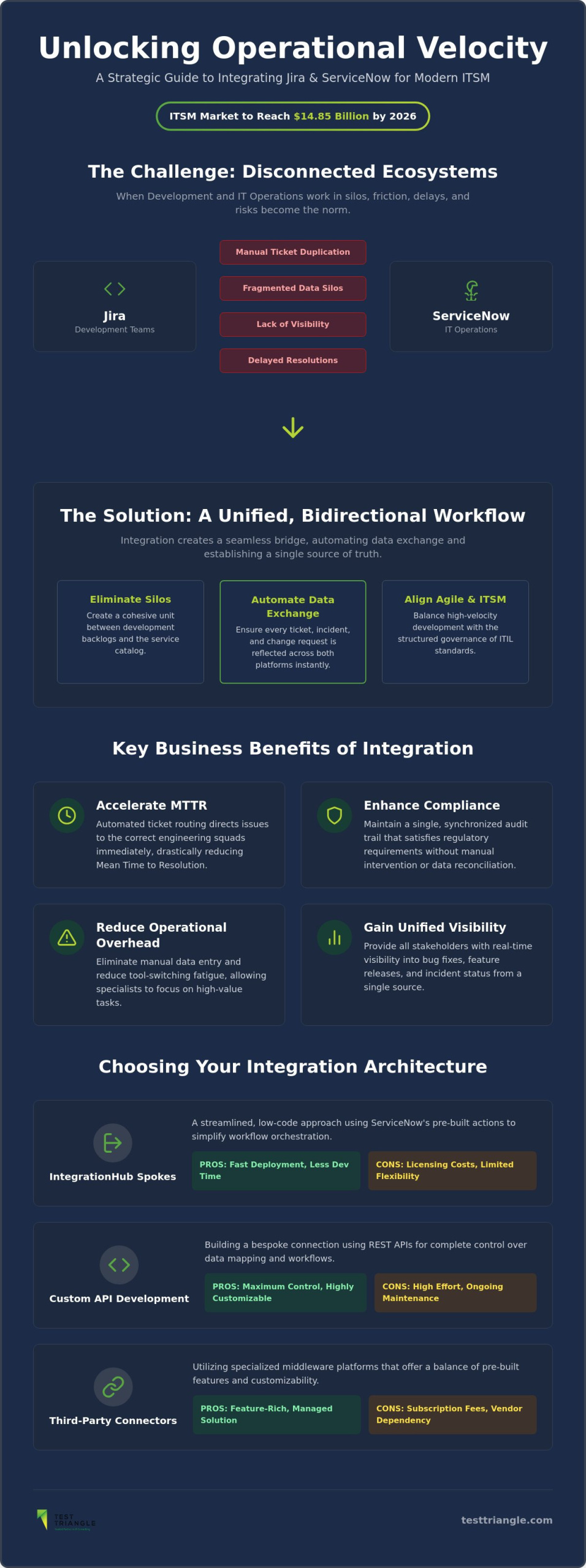
By architecting a unified workflow between engineering and service operations, global enterprises can transcend the limitations of disconnected ecosystems and foster a culture of systemic improvement. The strategic case for integrating jira with servicenow for itsm rests upon the elimination of “Siloed Operations,” a state where fragmented data and delayed incident resolution become the standard rather than the exception. When development teams reside in Jira and service desks operate within ServiceNow, the lack of a synchronized bridge forces manual ticket duplication, which inevitably introduces human error and technical debt. Modern enterprises require a reliable, automated flow that ensures the engineering backlog and the service catalog function as a single, cohesive unit.
The return on investment for such an integration is primarily realized through the increased accuracy of the Configuration Management Database (CMDB) and the reduction of administrative overhead. By automating the exchange of data, organizations can ensure that every change request or incident reported in ServiceNow is reflected accurately within the development lifecycle. This alignment is critical for those seeking to bridge the gap between high-velocity Agile development and the structured governance of IT Service Management (ITSM) frameworks. As your organization moves through its digital transformation, establishing this connection allows for a disciplined approach to growth that balances speed with operational stability.
Breaking Down the Developer-Agent Barrier
Providing service desk agents with real-time visibility into bug fixes and feature releases empowers them to provide accurate updates to stakeholders without leaving their primary environment. Simultaneously, developers gain access to context-rich incident reports, ensuring they’ve the necessary data to address root causes efficiently. ITSM integration is the linchpin of modern enterprise operational efficiency. By leveraging IT Service Management services that prioritize this connectivity, companies can ensure that technical context isn’t lost during the handoff between departments.
Key Business Benefits in 2026
As we look toward the operational demands of 2026, the benefits of integrating jira with servicenow for itsm extend beyond simple data transfer. Organizations can expect to see a significant acceleration in Mean Time to Resolution (MTTR) as automated ticket routing directs issues to the correct engineering squads immediately. Compliance and auditability are also enhanced, as the integration maintains a single, synchronized audit trail that satisfies regulatory requirements without manual intervention. Finally, reducing tool-switching fatigue improves the overall employee experience, allowing your specialists to focus on high-value tasks rather than navigating disparate software interfaces. This holistic approach ensures that your digital infrastructure remains resilient, scalable, and fully aligned with your long-term business objectives.
Technical Architectures: Choosing the Right Integration Path
Selecting the appropriate technical architecture for integrating jira with servicenow for itsm requires a balance between speed to value and long-term maintainability. This decision shouldn’t be viewed as a one-time setup but rather as a strategic ITSM implementation that evolves alongside your enterprise needs. Organizations must evaluate three primary paths: native integration hubs, custom REST API builds, or specialized third-party connectors. Each method presents distinct trade-offs regarding data volume, security protocols, and the internal capacity required for ongoing management. A steady hand is needed to navigate these options to ensure the resulting bridge is both resilient and scalable.
ServiceNow IntegrationHub Spokes represent the most streamlined approach, offering pre-built actions that significantly reduce development time. These spokes simplify the connection to Jira by providing a low-code environment for workflow orchestration. While they excel in ease of use, enterprises must account for potential licensing costs and the limitations of standardized logic. When assessing the stability of Jira Service Management connectors for enterprise-scale traffic, it’s vital to ensure they can handle high-frequency synchronization without degrading platform performance. Reliability is a cornerstone of our architectural recommendations.
Native IntegrationHub vs. Custom REST APIs
Choosing between native tools and custom builds often comes down to the complexity of your business logic. Native Spokes offer a supported, reliable framework that minimizes the risk of breakage during platform updates. Conversely, custom REST API integrations provide the flexibility to handle unique, non-standard requirements that pre-built tools might miss. While custom code avoids additional licensing fees, it often accumulates technical debt that can become a burden during major version upgrades. For organizations prioritizing security, the choice of authentication is non-negotiable. Modern standards require OAuth 2.0 to ensure robust, token-based security, moving away from the vulnerabilities associated with Basic Auth.
Third-Party Integration Platforms (iPaaS)
For complex, multi-tool ecosystems, leveraging an Integration Platform as a Service (iPaaS) like Workato or MuleSoft can be advantageous. These platforms act as a resilient buffer, managing high-frequency data transfers and providing sophisticated error-handling mechanisms that native connections might lack. This architecture is particularly effective when integrating jira with servicenow for itsm across diverse global business units. If your team requires expert guidance to determine the most stable path forward, our Atlassian Implementation services provide the deep architectural insights necessary for a successful deployment. You can also connect with our consultants to evaluate which architecture best fits your current digital infrastructure.
Data Mapping and Workflow Orchestration Best Practices
Success in integrating jira with servicenow for itsm depends less on the physical connection between servers and more on the logical orchestration of data between platforms. Establishing a definitive “Source of Truth” is the foundational step in this process; organizations must decide which platform owns specific data points to prevent circular updates and data corruption. For instance, while ServiceNow typically owns the overall incident status and business priority, Jira serves as the primary record for technical sub-tasks and engineering-specific metadata. By clearly defining these ownership boundaries, enterprises can maintain a clean, reliable data environment that supports both ITIL governance and Agile velocity.
Deciding between bidirectional and unidirectional synchronization is a strategic choice influenced by your specific operational requirements. While a unidirectional push from ServiceNow to Jira is often sufficient for simple task escalations, a comprehensive Jira and ServiceNow integration usually requires bidirectional flow to keep both service agents and developers informed in real-time. This synchronization must also extend to unstructured data, such as attachments and comments. Handling these elements requires sophisticated mapping to overcome technical hurdles like varying file size limits and formatting differences, ensuring that the full context of an issue is available to all stakeholders regardless of their preferred interface.
Essential Field Mapping Framework
A robust mapping framework ensures that ServiceNow Incidents translate accurately into Jira Issues by aligning critical fields such as Priority, Severity, and Description. Synchronizing user identities is equally vital, as it ensures the original reporter in ServiceNow is recognized within the Jira environment, which maintains accountability and streamlines communication. Field mapping must account for data validation rules on both platforms to prevent sync failures that could disrupt your ServiceNow Implementation and overall service delivery. When these fields are correctly aligned, the resulting visibility provides a stable foundation for cross-departmental collaboration and reporting.
Managing Workflow Logic
Effective orchestration involves automating the creation of Jira issues directly from ServiceNow triggers, such as the selection of a specific service category or the assignment to a specialized engineering group. Closing the loop is the final stage of this automation; when a developer marks a Jira issue as “Done,” the corresponding ServiceNow incident should automatically transition to a resolved state. To maintain system integrity, conflict resolution protocols must be established to handle scenarios where data is updated on both sides simultaneously. By implementing these automated loops through expert IT Service Management Services, organizations can eliminate the lag time between engineering fixes and service desk resolutions, directly improving the end-user experience.
Mitigating Risks: Maintenance, Security, and Scalability
The endurance of an enterprise-grade bridge depends on its ability to withstand the continuous evolution of its host platforms. When integrating jira with servicenow for itsm, organizations often encounter “Integration Fragility,” where a version update on one side disrupts the logic on the other. For instance, with ServiceNow’s scheduled “Australia” release in the second quarter of 2026 and Atlassian’s ongoing Cloud-first transitions, maintaining a rigid connection is no longer viable. A dedicated staging environment is essential for vetting these updates, allowing your technical teams to simulate data flows and identify potential breaks before they impact production environments. This proactive approach ensures that your service delivery remains uninterrupted despite the rapid pace of software updates.
Security remains a paramount concern, particularly regarding the synchronization of Personally Identifiable Information (PII). Enterprises must ensure that sensitive data isn’t inappropriately mirrored across platforms, which could lead to compliance violations under international data protection frameworks. Performance monitoring is equally critical to prevent “integration loops,” where a change in one system triggers an endless cycle of updates that degrades platform performance and consumes unnecessary API calls. By establishing rigorous monitoring protocols, you can detect anomalous behaviors early, ensuring your digital infrastructure remains stable and responsive. Reliability is built through constant vigilance and technical rigor.
Governance and Long-term Maintenance
Long-term stability requires a disciplined approach to documentation and oversight. Developing an integration registry allows your architects to document every data flow, dependency, and transformation logic in a central repository. This registry is vital for managing API versioning and deprecation, ensuring that your bridge doesn’t become obsolete as Atlassian or ServiceNow update their endpoints. Establishing a clear protocol for these changes prevents the accumulation of technical debt and simplifies the onboarding of new team members. Implementing these IT Service Management solutions provides the governance framework necessary to manage complex dependencies and maintain operational continuity.
Security Best Practices for 2026
As we look toward the security landscape of 2026, the Principle of Least Privilege (PoLP) must be applied to all integration service accounts to minimize the potential blast radius of a credential compromise. Service accounts should only possess the specific permissions required to read or write the necessary fields, rather than having broad administrative access. Data in transit between ServiceNow and Atlassian Cloud should adhere to the highest encryption standards, safeguarding your corporate intelligence from interception. Regular security auditing of integration logs is necessary to detect unauthorized access or anomalous data transfers that might signal a security event. If you’re concerned about the resilience or compliance of your current setup, contact our security specialists to conduct a comprehensive risk assessment of your integration architecture.
Partnering for Success: The Test Triangle Advantage
Achieving a seamless bridge between engineering velocity and service stability requires more than just technical configuration; it demands a partner who understands the intricate nuances of both ecosystems. While many organizations attempt a DIY approach, the complexity of integrating jira with servicenow for itsm often leads to technical debt and operational friction. Test Triangle provides the dual-platform expertise necessary to orchestrate these systems with precision, partnership, and performance. Our methodology guides you from initial strategic roadmapping through to rigorous technical execution, ensuring your digital infrastructure remains resilient as it scales.
The initial setup of an integration is merely the beginning of the journey. To prevent the “integration maintenance fatigue” that often plagues large-scale deployments, we offer Managed Outsourcing Services designed to maintain the long-term health of your cross-platform workflows. This proactive management ensures that your synchronization logic remains intact during platform updates and that your data remains secure. Our commitment to excellence has delivered tangible business outcomes, including a case where we enabled a global enterprise to reduce their Mean Time to Resolution (MTTR) by 40% through a unified and automated ITSM architecture.
Comprehensive Consulting and Implementation
Our Atlassian and ServiceNow consultants don’t work in isolation. They collaborate closely to build resilient architectures that satisfy the specific requirements of both development and operations teams. This cross-functional expertise is particularly valuable for clients in highly regulated industries, such as pharmaceuticals and finance, where data integrity and auditability are non-negotiable. By leveraging our ServiceNow Consulting Services, your organization gains access to tailored implementation support that aligns your technical tools with your broader business objectives, ensuring a stable foundation for digital transformation.
Future-Proofing Your ITSM Ecosystem
As your DevOps maturity grows, your integration must evolve to support more sophisticated workflows and automation logic. We focus on continuous optimization, helping you refine your data mapping and workflow orchestration to meet changing market demands. Beyond technical implementation, we provide the agility to scale your internal capacity through flexible staffing and recruitment models, giving you access to global talent when you need it most. We’re a reliable collaborator invested in your long-term success and operational stability. Contact Test Triangle today to start your ITSM integration journey and transform your service delivery model for 2026 and beyond.
Architecting a Unified Enterprise Ecosystem
Establishing a seamless bridge between your development and service management teams represents a fundamental shift from simple tool connectivity toward total operational alignment. By prioritizing stable technical architectures and rigorous data mapping, your organization can effectively eliminate silos while maintaining the highest standards of security and compliance. Successfully integrating jira with servicenow for itsm provides the visibility and speed required to navigate the complex digital landscape of 2026 with absolute confidence. This strategic integration ensures that your engineering velocity is always balanced by the structural integrity of your service management framework.
As an authorized Atlassian and ServiceNow Partner with a global presence and Dublin-based strategic leadership, Test Triangle provides the specialized expertise necessary to manage these complex digital infrastructures. We’re specialists in pharmaceutical and financial IT compliance, ensuring that your most sensitive data remains secure and your workflows meet every regulatory benchmark. Our team is committed to acting as your reliable long-term collaborator, guiding you through the technical execution and strategic optimization of your cross-platform environment.
Optimise your ITSM workflows with Test Triangle’s integration experts and take the next step in your digital transformation journey. We’re here to help you build a more connected and efficient future.
Frequently Asked Questions
Is it possible to integrate Jira and ServiceNow without using third-party plugins?
Yes, you can establish a direct connection between these platforms by utilizing native REST APIs or the ServiceNow IntegrationHub. This approach provides maximum control over your unique business logic but requires significant internal development expertise to manage long-term API maintenance and security protocols. Choosing this path when integrating jira with servicenow for itsm ensures stability, precision, and growth while maintaining total architectural control over your digital infrastructure.
What are the main differences between Jira Service Management and ServiceNow for ITSM?
ServiceNow is typically positioned as a comprehensive Enterprise Service Management platform for global organizations, while Jira Service Management offers a high-velocity, developer-centric approach. While both platforms support ITIL frameworks, ServiceNow provides deeper capabilities for complex CMDB management and cross-departmental orchestration. Organizations often choose ServiceNow for its institutional maturity and its ability to act as a steady hand across diverse, highly regulated industries.
How does bidirectional synchronisation work between Jira issues and ServiceNow incidents?
Bidirectional synchronization functions through a series of webhooks and API calls that trigger real-time updates across both ecosystems. When a service agent updates a ServiceNow incident, the integration hub pushes those changes to the corresponding Jira issue to ensure engineering and operations teams remain perfectly aligned. This methodical flow allows both departments to maintain a single, synchronized audit trail without the risks associated with manual ticket duplication.
What are the most common challenges when mapping fields between these two platforms?
The most frequent hurdles involve aligning disparate state transitions and ensuring that data validation rules don’t cause synchronization failures. Discrepancies in mandatory fields or attachment size limits can disrupt the flow of information, which requires a disciplined approach to technical mapping and workflow orchestration. Successfully navigating these challenges provides the peace of mind derived from risk reduction and the empowerment found in large-scale technological evolution.
Can I integrate Jira Cloud with an on-premise ServiceNow instance?
Yes, you can bridge Jira Cloud with an on-premise ServiceNow instance by utilizing a ServiceNow Management, Instrumentation, and Discovery (MID) Server. This architecture allows for secure, outbound communication from your internal network to the Atlassian Cloud environment without exposing your infrastructure to unnecessary external risks. It’s a practical solution for global enterprises that must balance modern cloud development with the security requirements of on-premise legacy systems.
How do I ensure that integration doesn’t negatively impact ServiceNow performance?
To safeguard platform performance, you should implement asynchronous processing and rigorous monitoring to detect and prevent integration loops. Throttling API calls during peak hours ensures that integrating jira with servicenow for itsm doesn’t consume excessive system resources or impact the end-user experience. Maintaining this operational efficiency requires a solution-oriented approach that prioritizes the long-term success and stability of your entire digital infrastructure.
What is the best way to handle user synchronisation between Atlassian and ServiceNow?
Utilizing a centralized Identity Provider is the most effective method for managing user synchronization across your enterprise software ecosystem. By mapping users through a single source of truth, such as Azure AD or Okta, you ensure consistent identity management and simplify the permissioning process for both platforms. This strategy reduces administrative overhead and enhances your security posture by ensuring that only authorized personnel have access to sensitive technical data.
How much maintenance does a custom-built Jira-ServiceNow integration typically require?
Custom integrations require a high level of ongoing maintenance to address API versioning, security patches, and platform deprecations. Organizations often find that the total cost of ownership for custom code exceeds that of pre-built tools when factoring in the human expertise needed for continuous optimization. Partnering with a reliable collaborator for managed services can mitigate these risks, providing the stability, precision, and security needed to navigate complex technical landscapes.

Article by
Paul Guy
Paul serves as the Marketing Director at Test Triangle, where he leads a global team in driving growth through strategic B2B marketing and brand communications. With a strong emphasis on measurable outcomes and sustainable performance, he plays a pivotal role in aligning marketing functions to enhance customer engagement and accelerate business impact. Under his leadership, marketing initiatives have consistently delivered significant returns on investment, elevated brand visibility, and strengthened the company's presence across key markets.