



What if the premium your organization pays for digital stability is actually subsidizing a provider’s internal inefficiencies rather than fueling your own technological evolution? Many enterprise leaders feel the weight of opaque Managed Service Provider Subscription Fees that continue to climb even as service levels stagnate or critical resources remain underutilized. It’s a common frustration to find your budget tied up in “shelfware” or rigid retainers that prioritize ticket volume over the strategic health of your ServiceNow or Atlassian ecosystems.
This 2026 guide is designed to help you master the complexities of modern pricing structures, allowing you to align your investment with specific business outcomes and long-term operational stability. You’ll discover a clear framework for comparing complex quotes and learn how to shift the conversation from basic maintenance to high-impact platform optimization. We will explore current industry benchmarks for per-user and co-managed models, identify the hidden costs in low-tier plans, and provide the methodology needed to secure a partnership that prioritizes your ROI through disciplined DevOps and ITSM integration.
Key Takeaways
- Understand why traditional break-fix models have been superseded by recurring structures. These frameworks prioritize continuous digital transformation and operational stability.
- Master the nuances of Managed Service Provider Subscription Fees by comparing per-user and per-device models. This ensures your IT spend remains predictable in a remote-first environment.
- Identify hidden value drivers and setup costs to prevent paying for underutilized “shelfware” or services that don’t scale.
- Establish a rigorous evaluation framework for reviewing SLAs and RFP responses. Your service levels must effectively support business-critical platforms like ServiceNow.
- Learn how to bridge the gap between technical execution and strategic success. Integrating specialized Atlassian implementation expertise into your managed support model is a critical differentiator.
Navigating the 2026 Landscape of Managed Service Provider Subscription Fees
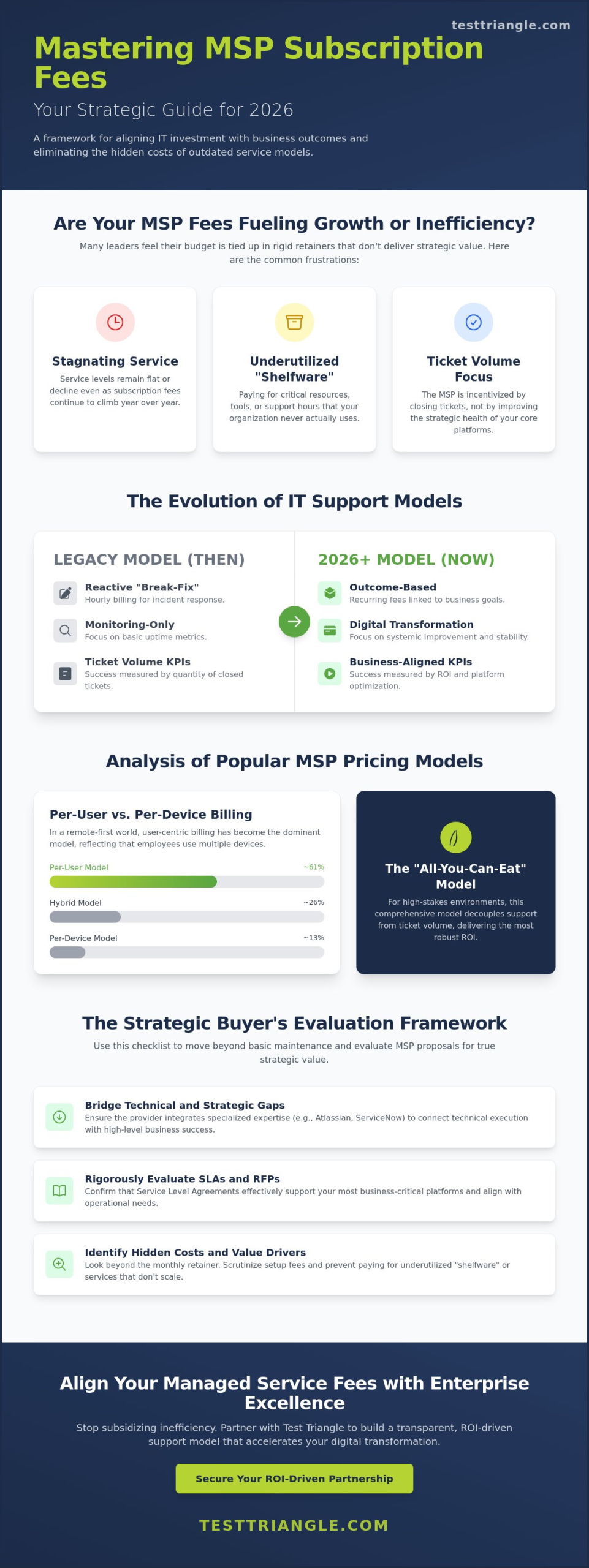
Defining Managed Service Provider Subscription Fees in 2026 requires a perspective that views technology as a driver of institutional maturity rather than a simple cost center. In the current market, the reactive “break-fix” hourly model has been almost entirely marginalized in favor of recurring subscriptions that guarantee operational continuity and risk mitigation. Leaders must understand what a managed service provider is in this new era: a long-term collaborator that manages complex digital infrastructures through systemic improvement rather than mere incident response. This shift reflects a broader economic reality where global volatility demands predictable, outcome-linked expenditure that aligns with long-term strategic goals.
The transition from “Monitoring-Only” to “Outcome-Based” pricing represents the most significant change in how enterprises evaluate their IT investments. While legacy providers focused on uptime and ticket volume, the modern framework prioritizes the acceleration of specific business objectives. Global economic shifts, including talent scarcity in specialized technical fields and the rising costs of cybersecurity insurance, have naturally influenced MSP margin expectations and base rates. However, the move toward transparent, value-driven models ensures that organizations can justify these costs by measuring the direct impact on their digital transformation journey.
The Evolution of Value-Based IT Support
The industry has reached a tipping point where uptime metrics alone no longer justify high-level retainers. Modern enterprises are prioritizing business-aligned performance indicators, shifting the focus of Managed Service Provider Subscription Fees toward Precision, Progress, Performance. By integrating advanced automation and cognitive computing into their internal workflows, providers are effectively reducing the overhead of commoditized tasks. This allows them to redirect human capital toward high-level strategic architecture. Consequently, organizations are now prioritizing platform-specific expertise over generalist support, recognizing that specialized knowledge is required to optimize complex environments.
Subscription Fees vs. Professional Service Fees
Maintaining a clear distinction between recurring maintenance and project-based consulting is essential for transparent budgeting and margin management. While subscription fees cover the ongoing health, security, and incremental updates of your IT service management ecosystem, one-time initiatives usually fall under professional service fees. For instance, a full-scale Atlassian implementation or a major ServiceNow migration requires a time-and-materials approach due to its unique scope. Identifying which IT needs fit a subscription model depends on the frequency and predictability of the requirement. A robust Service Level Agreement (SLA) acts as the definitive boundary, ensuring that both parties agree on what constitutes “business as usual” versus a specialized transformation project.
Analysis of Popular Managed Service Provider Pricing Models
Selecting the appropriate framework for Managed Service Provider Subscription Fees is a critical decision that influences both operational agility and budgetary precision. In a remote-first work environment, the debate between “Per-User” and “Per-Device” models has largely settled in favor of user-centric billing. This shift reflects the reality that modern professionals often operate across multiple endpoints, making device-based tracking an administrative burden. While approximately 13% of providers still rely on per-device pricing as their primary model, around 26% have transitioned to a hybrid approach that combines elements of both to better reflect the complexity of modern enterprise infrastructures.
For organizations managing high-stakes environments, the “All-You-Can-Eat” model often provides the most robust ROI. This comprehensive structure decouples support from ticket volume, encouraging a proactive partnership where the provider is incentivized to eliminate root-cause issues rather than billing for repetitive fixes. When evaluating these models, it’s vital to align the chosen tier with your actual needs. Many enterprises find themselves overpaying for “Gold” tier packages that include redundant compliance features, when a “Silver” tier combined with targeted ServiceNow consulting services would offer a more precise fit for their operational requirements.
The Per-User Pricing Model: The 2026 Standard
Per-user billing has emerged as the industry standard because it simplifies scalability during periods of rapid organizational growth. This model aligns the provider’s incentives with the client’s success; fewer technical disruptions lead to lower operational costs for the MSP, fostering a culture of Stability, Security, Success. To prevent overbilling, enterprises must implement rigorous audits of “active user” counts within their directory services. Ensuring that subscription fees are only applied to current, authorized personnel is a fundamental step in maintaining a lean and efficient IT budget. If you’re looking to optimize your resource allocation, you might consider how tailored staffing strategies can complement your existing support structure.
Tiered and À La Carte Options
Tiered structures allow organizations to construct a custom service stack that matches specific platform needs without the risks associated with pure à la carte pricing. While à la carte models offer initial flexibility, they often lead to “nickel and diming” for essential security patches or routine maintenance tasks. A more strategic approach involves evaluating tiered packages against your internal DevOps and QA capabilities. For instance, an organization with a strong internal testing team may only require a subscription that covers specialized Atlassian implementation support and high-level architectural guidance, rather than a full-service helpdesk retainer.
Beyond the Monthly Retainer: Identifying Hidden Costs and Value Drivers
While the monthly retainer is the most visible element of Managed Service Provider Subscription Fees, the true total cost of ownership is often dictated by variables that sit just below the surface. Strategic procurement requires a granular understanding of how onboarding fees, platform licensing, and integrated personnel models impact the long-term budget. A common pitfall for enterprises is failing to account for “out-of-scope” triggers. These are specific events or requests that fall outside the standard agreement, leading to unexpected billing spikes that can disrupt even the most disciplined financial planning. By identifying these triggers during the negotiation phase, you can ensure your expenditure remains predictable and aligned with your ROI targets.
Platform licensing for ecosystems like Atlassian and ServiceNow also plays a significant role in your overall spend. Whether your provider manages these licenses on your behalf or you maintain them internally, the complexity of these environments often necessitates specialized oversight. Integrating staffing solutions directly into your managed service framework allows for more sophisticated margin management. This approach enables you to fill specific skill gaps, such as specialized manual or automation testing, without the need to upgrade your entire service tier for the entire organization.
Onboarding and Implementation Charges
A professional system audit and environment baseline are the core components of a legitimate onboarding fee. This initial phase is not merely a setup cost; it’s a rigorous process that ensures your provider understands the nuances of your digital infrastructure. When negotiating multi-year managed service contracts, it’s often possible to amortize these setup fees or tie them to specific implementation milestones. You must ensure that comprehensive knowledge transfer is explicitly included in this phase. This prevents vendor lock-in and guarantees that your internal teams remain empowered and informed throughout the partnership.
The Role of Specialized Talent in MSP Fees
The integration of managed outsourcing services can significantly lower your subscription overhead by optimizing the delivery model. By balancing high-level local strategic consulting with cost-effective technical execution teams, providers can offer a more versatile and globally-minded support structure. This model provides “fractional” access to elite DevOps and QA experts who might be too expensive to hire as full-time internal resources. This hybrid approach delivers Precision, Proximity, Productivity, ensuring that your technical managers have the specific expertise they need exactly when they need it, without inflating the base subscription rate.
The Strategic Buyer’s Framework for Evaluating MSP Proposals
Evaluating Managed Service Provider Subscription Fees through the lens of a Request for Proposal (RFP) demands a rigorous methodology that transcends basic cost comparisons. A strategic buyer doesn’t merely look for the lowest monthly retainer; instead, they seek to understand the correlation between the fee structure and the provider’s ability to deliver operational resilience. This evaluation process should involve five critical questions designed to expose the depth of a provider’s strategic commitment. These include inquiries into their methodology for license optimization, their internal security protocols, and how they define “value” beyond basic ticket resolution. By forcing providers to articulate their impact on your long-term digital health, you can distinguish between a simple vendor and a high-level corporate partner.
When assessing an SLA for business-critical environments such as ServiceNow, it’s essential to look for guarantees that protect against systemic failure rather than just slow response times. Cheaper bids often indicate a lack of platform-specific expertise, which can be disastrous during complex Atlassian Cloud migrations or infrastructure overhauls. Using the “Cost of Downtime” as a benchmark allows technical leaders to justify higher-tier managed service subscriptions to executive stakeholders. If an hour of system unavailability costs the enterprise significantly more than the annual premium for expert support, the decision to prioritize quality becomes a matter of risk management rather than just procurement. High-level support delivers Stability, Scalability, Security, protecting your most valuable digital assets from preventable disruptions.
Auditing Vendor Expertise and Certifications
Authorized partnership status, such as being an Atlassian Platinum partner, should significantly influence your fee tolerance. These endorsements serve as official benchmarks of a provider’s technical depth and their direct line to platform-level support. Industry-specific experience is equally vital, particularly in highly regulated sectors like Pharma or Finance where compliance is non-negotiable. You must verify the MSP’s internal security protocols and their history of managing diverse, complex digital infrastructures. A partner’s ability to operate across these rigid regulatory frameworks ensures that your organizational progress isn’t hindered by compliance gaps.
Negotiating for Scalability and Flexibility
Building “ramp-up/ramp-down” clauses into your agreement ensures that Managed Service Provider Subscription Fees reflect the actual usage of your cloud-based tools. As your organization evolves, your support needs will fluctuate; your contract should be versatile enough to accommodate these shifts without punitive penalties. It’s also critical to review the exit strategy early in the relationship. Offboarding and data migration costs should be transparently defined to prevent financial friction at the end of the collaboration. If you are ready to move beyond generic support and secure a partner who understands the complexities of your digital ecosystem, reach out to our team today for a strategic consultation.
Test Triangle: Aligning Managed Service Fees with Enterprise Excellence
Test Triangle operates as a strategic visionary for global enterprises, ensuring that Managed Service Provider Subscription Fees are never viewed as a static overhead but as a catalyst for systemic improvement. Our philosophy centers on transparent, outcome-linked models that prioritize the long-term health of your digital infrastructure. We recognize that a one-size-fits-all approach fails to address the nuances of complex environments. Therefore, we customize our fee structures to align precisely with your specific digital transformation roadmap, ensuring every dollar spent contributes to measurable operational progress and institutional maturity.
The “Test Triangle Advantage” lies in our unique ability to bridge the gap between technical execution and business outcomes. By combining deep technical expertise in manual and automation testing with strategic IT service management solutions, we offer a comprehensive support framework that generalist providers cannot match. We seamlessly integrate specialized Atlassian implementation expertise into our ongoing managed support, ensuring that your platforms are not only maintained but continuously optimized for peak performance. This integrated approach delivers Precision, Proactivity, Partnership, positioning us as a reliable collaborator deeply invested in your stability.
Strategic Platform Optimisation
Our managed services move beyond the limitations of ticket-based metrics to focus on holistic system health and efficiency. We believe that true value is found in preventing disruptions before they occur, which is why our methodology emphasizes proactive monitoring and architectural refinement. As highlighted in our strategic guide to Atlassian consulting, organizations that prioritize strategic oversight over basic maintenance often see a significant reduction in long-term operational spend. By leveraging a global presence, we provide extended availability across diverse time zones, delivering high-level expertise without the premium price tag typically associated with localized, around-the-clock coverage.
Your Partner in Long-Term Operational Stability
We act as a disciplined extension of your internal IT and DevOps teams, fostering a spirit of partnership that is deeply invested in your long-term success. Our commitment to transparent billing ensures that your Managed Service Provider Subscription Fees remain predictable, with regular Strategic Business Reviews (SBRs) providing clear visibility into performance and ROI. We prioritize organizational stability through a combination of human expertise and industry-leading technical tools, ensuring a steady hand in a fast-changing landscape. To define a managed service model that fits your 2026 goals and empowers your technological evolution, contact our team for a detailed consultation.
Securing Your Digital Future Through Strategic Partnership
Mastering the nuances of Managed Service Provider Subscription Fees is no longer just a procurement task; it’s a strategic imperative for organizations aiming for long-term operational stability. By shifting from reactive, ticket-based expenditure to outcome-linked models, enterprises can transform their IT budget into a powerful engine for digital evolution. This guide has detailed the importance of auditing platform-specific expertise and identifying hidden value drivers to ensure your investment delivers Precision, Progress, Performance. As technical landscapes grow more complex, the ability to align recurring costs with tangible business milestones becomes the definitive marker of a mature digital strategy.
As an Atlassian Platinum Partner and ServiceNow Specialist Partner, Test Triangle provides the institutional maturity required to manage your most complex digital infrastructures with confidence. Our global delivery model ensures you receive expert support across all time zones, allowing your internal teams to focus on high-level innovation rather than routine maintenance. We remain committed to transparent, disciplined collaboration that prioritizes your strategic success and operational resilience. Optimise your IT spend with a strategic Managed Service consultation from Test Triangle and take the first step toward a more predictable, value-driven technological landscape. We look forward to supporting your journey toward enterprise excellence.
Frequently Asked Questions
What is the average monthly cost for a Managed Service Provider subscription?
In the 2026 US market, Managed Service Provider Subscription Fees typically range from $110 to $400 per user per month. These rates vary based on the depth of the service catalog, including whether the package incorporates advanced security monitoring, compliance oversight, or specialized platform management. Organizations opting for co-managed models, where they retain an internal IT lead, often see lower per-user rates compared to those requiring full-service outsourcing.
Do MSP subscription fees usually include software licenses like Atlassian or ServiceNow?
Subscription fees generally cover the management and optimization of the platform rather than the underlying software licenses themselves. Licensing for enterprise ecosystems like ServiceNow or Atlassian is usually treated as a separate pass-through cost or managed directly by the client. However, working with a partner who can provide Atlassian Licenses as part of a consolidated agreement often simplifies the procurement process and ensures that seat counts are audited for maximum efficiency.
How often should an MSP review and adjust their subscription fees?
Subscription fees should be reviewed annually or during scheduled Strategic Business Reviews (SBRs) to ensure they remain aligned with your actual resource consumption. These reviews allow both parties to adjust for changes in headcount, infrastructure complexity, or new regulatory requirements. A transparent review process prevents budgetary drift and guarantees that your expenditure continues to reflect the strategic value delivered to the enterprise.
What is the difference between an MSP subscription and a traditional IT support contract?
A modern MSP subscription is a proactive, outcome-based model that prioritizes systemic health through a predictable recurring fee. In contrast, traditional IT support often follows a reactive “break-fix” approach where costs are tied to ticket volume or hourly rates. The subscription model aligns the provider’s incentives with your success; they are motivated to eliminate root-cause issues to reduce their own operational overhead while maintaining your stability.
Are there hidden costs in MSP onboarding that I should look out for?
Hidden costs often emerge in the form of system auditing, environment baselining, and complex data migration tasks that fall outside the initial quote. You should also verify if knowledge transfer sessions and the integration of legacy tools are included in the setup fee. Ensuring these activities are clearly defined in the Service Level Agreement prevents unexpected billing spikes and ensures a steady hand during the transition period.
Can I negotiate a lower subscription fee by using offshore technical resources?
Utilizing a global delivery model that incorporates remote offshore resources can significantly optimize your Managed Service Provider Subscription Fees without sacrificing technical rigor. This hybrid approach allows you to access specialized talent for execution-heavy tasks like automation testing while maintaining local strategic oversight. It provides a versatile, globally-minded support structure that delivers high-level expertise at a more sustainable price point for large-scale digital infrastructures.
How do I calculate the ROI of my Managed Service Provider subscription fees?
ROI is calculated by measuring the reduction in system downtime, the speed of digital transformation initiatives, and the cost-efficiency gained by reallocating internal staff to strategic projects. You must also account for the risk mitigation provided by expert platform oversight, which prevents costly configuration errors and security gaps. A successful subscription delivers Stability, Scalability, Security, providing value that transcends simple maintenance to drive organizational progress.
What happens to my subscription fees if my company scales rapidly?
Per-user pricing models are designed to scale automatically, ensuring that your costs stay aligned with your headcount as you grow. To maintain financial precision, it’s essential to build “ramp-up/ramp-down” clauses into your agreement to accommodate rapid changes without punitive penalties. This flexibility ensures that your managed service model remains an adaptable collaborator that supports your growth rather than a rigid financial burden during periods of expansion.

Article by
Paul Guy
Paul serves as the Marketing Director at Test Triangle, where he leads a global team in driving growth through strategic B2B marketing and brand communications. With a strong emphasis on measurable outcomes and sustainable performance, he plays a pivotal role in aligning marketing functions to enhance customer engagement and accelerate business impact. Under his leadership, marketing initiatives have consistently delivered significant returns on investment, elevated brand visibility, and strengthened the company's presence across key markets.