



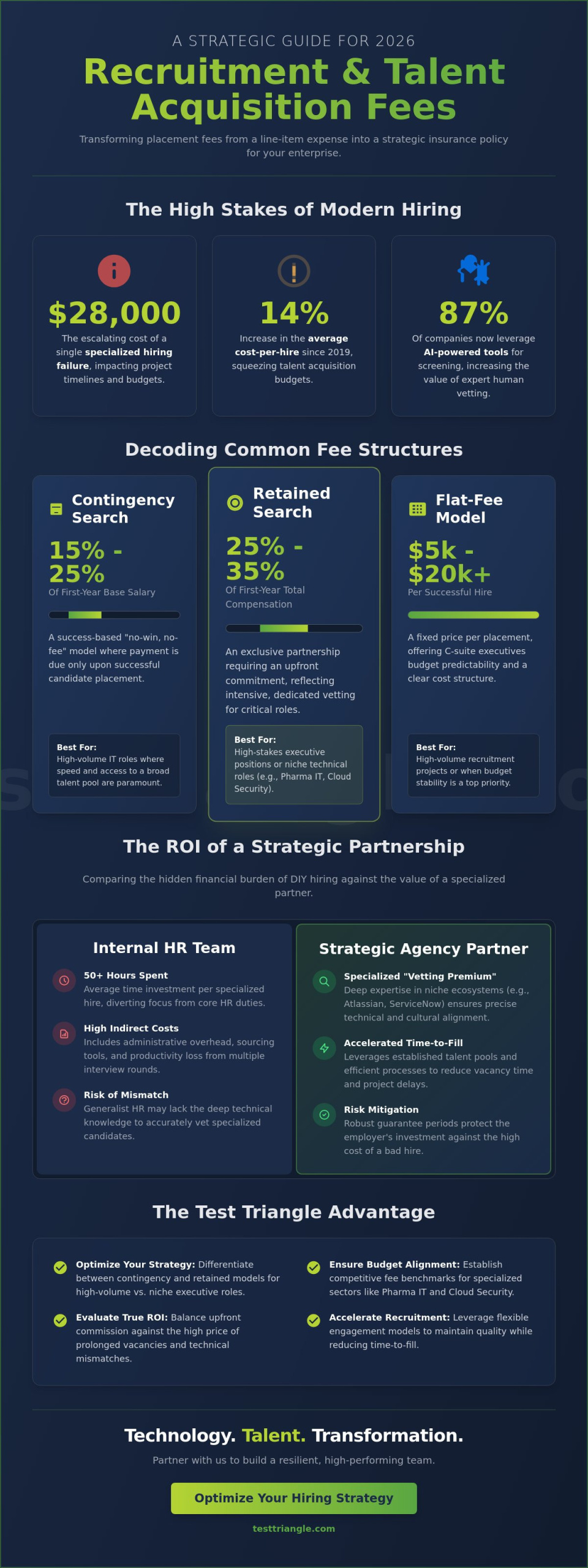
In 2026, viewing Recruitment and Talent Acquisition Placement Fees as a mere line-item expense is a strategic oversight that ignores the escalating $28,000 cost of specialized hiring failures. You’ve likely felt the pressure of the 14% increase in cost-per-hire since 2019, particularly when traditional agencies offer opaque pricing for critical DevOps or Pharma roles. It’s a common frustration to manage rising costs while the risk of a “bad hire” remains high in a market where 87% of companies now leverage AI-powered tools for candidate screening.
By aligning your financial models with current industry benchmarks, you can transform these fees into a strategic insurance policy that protects your digital transformation. This guide provides the clarity you need to master complex fee structures, ranging from the 15% contingency models to the 35% retained search benchmarks. We’ll explore how to leverage data-driven metrics and flexible engagement models to reduce your time-to-fill and secure the specialized talent your enterprise requires. Through a clear analysis of ROI and market trends, we’ll outline a path toward a transparent partnership that prioritizes long-term operational stability. Technology. Talent. Transformation.
Key Takeaways
- Differentiate between contingency and retained search models to optimize your strategy for both high-volume IT staffing and niche executive requirements.
- Establish competitive benchmarks for Recruitment and Talent Acquisition Placement Fees within specialized sectors like Pharma IT and Cloud Security to ensure budget alignment.
- Evaluate the true ROI of professional placements by balancing upfront commission costs against the high price of prolonged vacancies and technical talent mismatches.
- Leverage flexible engagement models and strategic technical partnerships to accelerate your recruitment lifecycle while maintaining the highest standards of candidate quality.
Understanding Recruitment and Talent Acquisition Placement Fees in 2026
By defining Recruitment and Talent Acquisition Placement Fees as the professional commission paid for the successful identification, vetting, and placement of specialized talent, global enterprises can shift their perspective from viewing recruitment as a cost center to seeing it as a strategic asset. In the high-stakes environment of 2026, the traditional “headhunting” model has evolved into a sophisticated talent acquisition strategy. This transition is driven by a 14% increase in the average cost-per-hire since 2019, which now stands at $4,700 for general roles and often exceeds $28,000 for specialized technical positions. As 87% of organizations now utilize AI-powered software to manage their pipelines, the value of a placement fee is no longer just about the introduction; it’s about the precision of the match in an increasingly automated landscape.
The core components of a modern placement fee encompass much more than a simple search. They include advanced sourcing across global talent pools, rigorous technical screening that mirrors real-world project demands, and robust guarantee periods that protect the employer’s investment. By integrating these elements, a professional recruitment partner mitigates the risk of a “bad hire,” which is a critical necessity given that 31% of organizations now rank talent acquisition as a top-three HR priority for 2026.
The Evolution of Recruitment Fees
Digital transformation has fundamentally reshaped the marketplace, moving the industry away from a basic recruitment agency finder’s fee toward what is now recognized as a “vetting premium.” In specialized ecosystems such as Atlassian or ServiceNow, the requirement for recruiter expertise has reached an all-time high. A partner must understand the nuances of Jira Service Management or complex ServiceNow workflows to effectively screen candidates for enterprise-level roles. This specialized knowledge ensures that the candidates presented aren’t just technically capable but are also culturally and operationally aligned with the client’s long-term digital strategy. Recruitment and Talent Acquisition Placement Fees represent a strategic investment in organizational stability and long-term operational resilience.
Direct vs. Indirect Costs of Talent Acquisition
Comparing internal HR hours to a one-time agency placement fee often reveals the hidden financial burden of do-it-yourself hiring. Internal teams frequently spend over 50 hours on a single specialized hire, accounting for sourcing, multiple interview rounds, and administrative overhead. By leveraging Managed Outsourcing Services, enterprises can redirect their internal resources toward core business objectives while a trusted partner handles the heavy lifting of technical vetting. This approach embodies the philosophy of “Technology. Talent. Transformation.” by reducing indirect hiring friction and accelerating the path to productivity. When organizations optimize their fee structures, they don’t just fill seats; they drive scalable growth through precise talent alignment.
Common Fee Structures: Contingency, Retained, and Flat Rates
By aligning the selection of a fee model with the specific complexity of a role, enterprises can effectively manage their Recruitment and Talent Acquisition Placement Fees while ensuring superior candidate quality. The 2026 market offers three primary frameworks, each designed to balance risk and commitment differently. Contingency search remains the most prevalent success-based model, where fees typically range from 15% to 25% of a candidate’s first-year base salary. This “no-win, no-fee” approach is highly effective for high-volume IT roles where speed and access to a broad talent pool are paramount. However, for high-stakes executive positions or specialized Pharma IT roles, a retained search model is often necessary. This requires an upfront commitment and generally commands between 25% and 35% of the candidate’s total first-year compensation, reflecting the intensive vetting required for these critical placements.
Budget predictability is becoming a top priority for C-suite executives, leading to a rise in flat-fee recruitment models. These fixed prices, which range from $5,000 to $20,000 per hire depending on role complexity, offer a stable alternative to percentage-based billing. While percentage-based models scale with salary, flat fees provide a clear cost structure for high-volume hiring or roles with high base salaries but moderate search difficulty. Selecting the right model requires a strategic understanding of contingency and retained fees to ensure the investment matches the role’s organizational impact.
Contingency vs. Retained Search Models
Deciding between contingency and retained models often hinges on the level of exclusivity and the required search precision. By granting exclusivity to a trusted partner through a retained agreement, businesses gain access to a dedicated team that prioritizes their search above all others, resulting in success rates often exceeding 90%. Conversely, non-exclusive contingency searches are useful for filling multiple standard technical roles simultaneously. The following table outlines the typical benchmarks as of March 2026:
- Contingency Model: 15-25% fee range; best for mid-level IT and high-volume needs; success-based payment.
- Retained Model: 25-35% fee range; best for Executive and niche Pharma roles; paid in installments.
- Flat Fee Model: $5,000-$20,000 per hire; best for budget predictability in standardized roles; fixed-cost payment.
Contract and Remote Placement Fees
By leveraging margin-based billing for temporary and offshore staff, organizations can achieve significant cost-efficiency without sacrificing technical rigor. Unlike permanent placement fees, contract staffing utilizes a “markup” model where the agency adds a percentage to the hourly or monthly rate of the resource. This is particularly advantageous for remote offshore resources, which are becoming a standard part of the global talent pool as 70% of the workforce is projected to work remotely at least part-time by the end of 2026. These IT Staffing Services allow companies to scale their teams rapidly while maintaining high-quality output through a flexible engagement model. If you’re looking to optimize your technical headcount through a strategic partnership, reach out to our team today to discuss a tailored solution. Technology. Talent. Transformation.
Industry-Specific Benchmarks: IT and Pharma Placement Fees
By leveraging industry benchmarks, enterprises can better understand why Recruitment and Talent Acquisition Placement Fees for specialized sectors like Pharma and IT often reach 20% to 30% of a candidate’s annual salary as of April 30, 2026. This premium reflects the intensive technical due diligence required to identify professionals who don’t just possess coding skills but understand the operational nuances of high-stakes environments. While general recruitment costs might hover around $4,700, the specialized nature of Cloud Migration or Cybersecurity roles elevates the search complexity. For a deeper look at these variables, consult this comprehensive guide to recruitment fees which details the factors influencing costs across different professional models.
Global market dynamics also play a significant role in fee variance. In the United States, niche executive roles in specialized tech hubs frequently command the upper 30% bracket; meanwhile, the Irish and UK markets maintain competitive benchmarks between 20% and 25% for senior technical talent. A candidate’s proficiency in specific ecosystems, such as Atlassian or ServiceNow, serves as a significant fee driver. These certifications validate a candidate’s ability to drive enterprise-level transformation, making them highly sought after in a market where 81% of employers now prioritize skills-based hiring over formal education. As a Trusted Partner, we recognize that these certifications aren’t just badges; they’re indicators of a candidate’s immediate ability to leverage Jira Service Management or ServiceNow workflows to optimize business operations.
The Premium for Validated Software Testing Talent
Pharma IT staffing requires a level of technical vetting that far exceeds standard recruitment. Candidates must demonstrate expertise in GxP and regulatory compliance, ensuring that every digital implementation meets the rigid standards of Life Sciences. This scarcity of “validated” talent directly impacts Recruitment and Talent Acquisition Placement Fees, as the search involves a much smaller pool of qualified professionals. By engaging specialized IT Staffing Agencies for Pharmaceutical Industry, businesses can mitigate the risks associated with regulatory non-compliance. The investment in a 25% to 30% fee is often a fraction of the cost of a failed regulatory audit or a compromised software validation process. For organizations navigating GAMP 5 alignment and CSV requirements, a dedicated Pharma IT Staffing strategy for Life Sciences talent is essential to securing professionals who bridge the gap between technical agility and regulatory compliance.
DevOps and Cloud Migration Talent Costs
Benchmarking fees for AWS and Azure certified professionals reveals a consistent trend toward high-value, high-cost placements. In the DevOps space, the cost of a “bad hire” is particularly high, often exceeding $15,000 in immediate lost productivity and potential infrastructure downtime. This makes a 20% to 25% placement fee look like a strategic bargain when it secures a candidate capable of managing complex cloud migrations flawlessly. Our approach of “Strategy. Technology. Talent.” ensures that every placement is vetted against the specific technical requirements of your digital infrastructure. We don’t just find candidates; we secure the architects of your digital future, ensuring that your investment in talent drives measurable business outcomes and scalable growth. Technology. Talent. Transformation.
Beyond the Invoice: Evaluating ROI and Mitigating Hiring Risks
By evaluating the return on investment through the lens of long-term operational stability, executives can see that Recruitment and Talent Acquisition Placement Fees are a strategic safeguard against the escalating costs of technical turnover. While a 20% fee might appear high on an initial invoice, it’s a bargain when compared to the $15,000+ cost associated with a technical hiring failure in a standard role. This figure can skyrocket to over $28,000 for specialized architects or senior DevOps engineers. In high-stakes sectors like Banking or Pharma, where a single bad hire can derail a multi-million dollar digital transformation, the rigorous vetting provided by a professional partner is essential. By ensuring that candidates possess verified proficiency in tools like Jira Service Management, a strategic partner reduces the risk of project delays and infrastructure instability.
The Hidden Cost of Slow Hiring
Quantifying the daily revenue loss when critical technical roles remain vacant is vital for calculating true ROI. For global enterprises, a vacant position in an Atlassian or ServiceNow project can lead to bottlenecks that stall entire development cycles and delay critical product launches. By leveraging professional Atlassian Implementation Services, businesses can accelerate their time-to-fill by as much as 26-75%, ensuring that projects remain on track and operational efficiency is maintained. This approach mitigates the indirect costs of lost productivity, which often exceed the direct placement fee within just a few weeks of a vacancy. Strategic staffing isn’t just about filling seats; it’s about maintaining the momentum of your digital transformation and ensuring that your technical roadmap remains secure.
Risk Mitigation and Guarantee Clauses
Protecting your investment requires robust guarantee periods that hold the recruitment partner accountable for the quality of the placement. In 2026, standard industry terms for permanent roles typically include 60, 90, or 120-day replacement clauses, providing a necessary safety net for the organization’s capital. These clauses ensure that if a candidate doesn’t meet the expected performance benchmarks or cultural fit requirements, the agency provides a replacement at no additional cost. We leverage our deep technical expertise to ensure “right-first-time” placements, significantly reducing the likelihood of ever needing to trigger these clauses. A technical vetting process is the most effective insurance policy for your hiring budget. By partnering with a Trusted Partner who understands the intricacies of your digital infrastructure, you can confidently build a high-performing team. To secure the specialized talent your next project requires, consult with our strategic staffing experts. Technology. Talent. Transformation.
The Test Triangle Advantage: Strategic Talent Acquisition Models
By moving beyond the transactional mindset of traditional headhunting, Test Triangle transforms Recruitment and Talent Acquisition Placement Fees into a strategic investment in digital excellence. We don’t operate as a mere service provider; instead, we function as a Strategic Architect for your workforce, ensuring that every placement aligns with your long-term operational stability. Our institutional maturity, reinforced by our status as a client of Enterprise Ireland, allows us to navigate the complex talent requirements of the Banking, Pharma, and Life Sciences sectors with precision. In an era where 87% of companies utilize AI-powered screening, our human-centric, technical vetting process provides the “strategic insurance” needed to protect your hiring budget from the high costs of technical failure.
Our commitment to your success extends past the initial invoice. As a Trusted Partner, we prioritize “Technology. Talent. Transformation.” to ensure that your digital infrastructure is supported by the highest caliber of professionals. This approach allows us to offer flexible engagement models that adapt to your specific project milestones, whether you require permanent onsite leadership or remote offshore resources to scale your development capacity. By aligning our fee structures with your business outcomes, we ensure that your 2026 talent acquisition strategy is both cost-effective and high-performing. For a detailed comparison of staffing, managed services, and offshore delivery models, explore our analysis of IT Staffing Services in 2026: A Strategic Comparison of Talent Delivery Models to identify the optimal fit for your technical requirements.
Integrating Talent with Technology
By leveraging our deep consulting background in DevOps and software testing, we provide a level of candidate vetting that traditional agencies cannot match. Our expertise as an Atlassian and ServiceNow partner means we understand the technical nuances of IT Service Management Solutions, allowing us to identify “ready-to-deploy” resources for complex Jira and AWS environments. This technical due diligence ensures that candidates possess the specific skills required to drive your digital transformation from day one. When you invest in Recruitment and Talent Acquisition Placement Fees through Test Triangle, you aren’t just buying a resume; you’re securing a validated expert who has been screened by practitioners who understand the technology.
Global Reach, National Expertise
Our presence across Ireland, the UK, and India allows us to offer a unique blend of local market knowledge and global cost-efficiency. This “Global Reach, National Expertise” model enables us to provide IT Staffing Services that are both scalable and precise. Whether you need to navigate the evolving regulatory landscape of non-compete agreements in Healthcare or require specialized GxP expertise in Pharma, our flexible staffing models adapt to your budget. By utilizing Managed Outsourcing Services, you can leverage offshore talent pools to reduce overhead while maintaining the high-quality output your enterprise demands. To optimize your technical headcount for the challenges of 2026, contact Test Triangle today for a strategic talent acquisition consultation. Technology. Talent. Transformation.
Strategic Talent Acquisition as a Catalyst for Digital Resilience
By reframing Recruitment and Talent Acquisition Placement Fees as a strategic investment rather than a cost center, global enterprises can secure the specialized talent necessary to drive digital transformation in an increasingly complex market. The escalating $4,700 average cost-per-hire, which frequently exceeds $28,000 for niche technical roles as of March 2026, underscores the critical importance of a “right-first-time” approach. Leveraging industry benchmarks and robust guarantee clauses provides the financial predictability required to scale operations without compromising on candidate quality or project momentum.
As a Trusted Partner for global enterprises, Test Triangle combines deep technical expertise in Atlassian, ServiceNow, and AWS with a sophisticated vetting process to mitigate hiring risks. Our specialized experience in validated software testing and Pharma IT Staffing for Life Sciences talent ensures that your organization remains compliant and operationally stable. By aligning your hiring strategy with our flexible engagement models, you can accelerate project timelines and achieve measurable business outcomes through precise talent alignment. Optimize Your Talent Strategy with Test Triangle to secure the architects of your digital future. Technology. Talent. Transformation.
Frequently Asked Questions
What is the average recruitment placement fee for IT roles in 2026?
Average fees for specialized IT roles typically range from 20% to 30% of the candidate’s first-year annual salary as of April 30, 2026. This benchmark reflects the intensive technical vetting required for complex positions in DevOps, Cybersecurity, and Cloud Migration. For standard mid-level IT roles, contingency fees generally hover between 20% and 22%, ensuring a balance between search speed and candidate quality.
How are recruitment fees calculated for permanent vs. contract staff?
Permanent placement fees are calculated as a one-time percentage of the candidate’s first-year total compensation, while contract staffing utilizes a margin-based markup model. For permanent hires, the fee is paid upon successful placement. In contrast, contract or remote offshore resources involve an ongoing markup added to the hourly or monthly rate, providing the flexibility needed to scale teams according to project milestones.
Can recruitment and talent acquisition placement fees be negotiated?
Yes, Recruitment and Talent Acquisition Placement Fees are often negotiable based on hiring volume or the level of exclusivity granted to the partner. Organizations that commit to a retained search model or exclusive contingency agreements can often secure more favorable terms. This strategic alignment allows a Trusted Partner to dedicate more resources to the search, ensuring superior vetting and a reduced time-to-fill for critical roles.
What happens if a placed candidate leaves within the guarantee period?
If a candidate departs within the specified guarantee period, the recruitment partner is contractually obligated to provide a replacement at no additional cost. Standard industry guarantee clauses in 2026 typically cover 60, 90, or 120 days. This protection mitigates the financial risk of a “bad hire,” which can cost over $15,000 in lost productivity. Technical vetting remains the best insurance against triggering these clauses.
Why are placement fees for Pharma IT roles higher than general IT?
Pharma IT fees are higher because candidates must possess specialized GxP and regulatory compliance expertise in addition to technical skills. The scarcity of talent capable of navigating validated software testing environments increases search complexity significantly. These placements command 20% to 30% of the annual salary because the cost of a regulatory audit failure far outweighs the investment in a professional placement fee.
What is the difference between contingency and retained recruitment fees?
Contingency fees are success-based “no-win, no-fee” models, whereas retained fees require an upfront commitment for high-stakes executive searches. Contingency models usually range from 15% to 25% and are ideal for high-volume technical hiring. Retained searches command 25% to 35% and provide a dedicated team for niche roles, ensuring a flawless match through an exhaustive, exclusive search process.
How do offshore and remote placement fees differ from local hiring?
Offshore placement fees typically utilize flexible engagement models that leverage lower overhead costs in global talent hubs like India. While local hiring involves standard permanent placement percentages, offshore resources are often managed through a markup or managed service model. This approach allows enterprises to leverage global talent pools for cost-efficiency while maintaining the high-quality output required for digital transformation. Technology. Talent. Transformation.
Is it more cost-effective to use an agency or hire an in-house recruiter?
Agency partnerships are generally more cost-effective for specialized roles where the average cost-per-hire exceeds $28,000. In-house teams often lack the niche technical networks and specialized vetting tools required for DevOps or Pharma IT roles. By leveraging an agency’s existing infrastructure and technical expertise, you reduce indirect hiring friction and accelerate your path to productivity without the fixed overhead of a large internal HR team.

Article by
Paul Guy
Paul serves as the Marketing Director at Test Triangle, where he leads a global team in driving growth through strategic B2B marketing and brand communications. With a strong emphasis on measurable outcomes and sustainable performance, he plays a pivotal role in aligning marketing functions to enhance customer engagement and accelerate business impact. Under his leadership, marketing initiatives have consistently delivered significant returns on investment, elevated brand visibility, and strengthened the company's presence across key markets.