
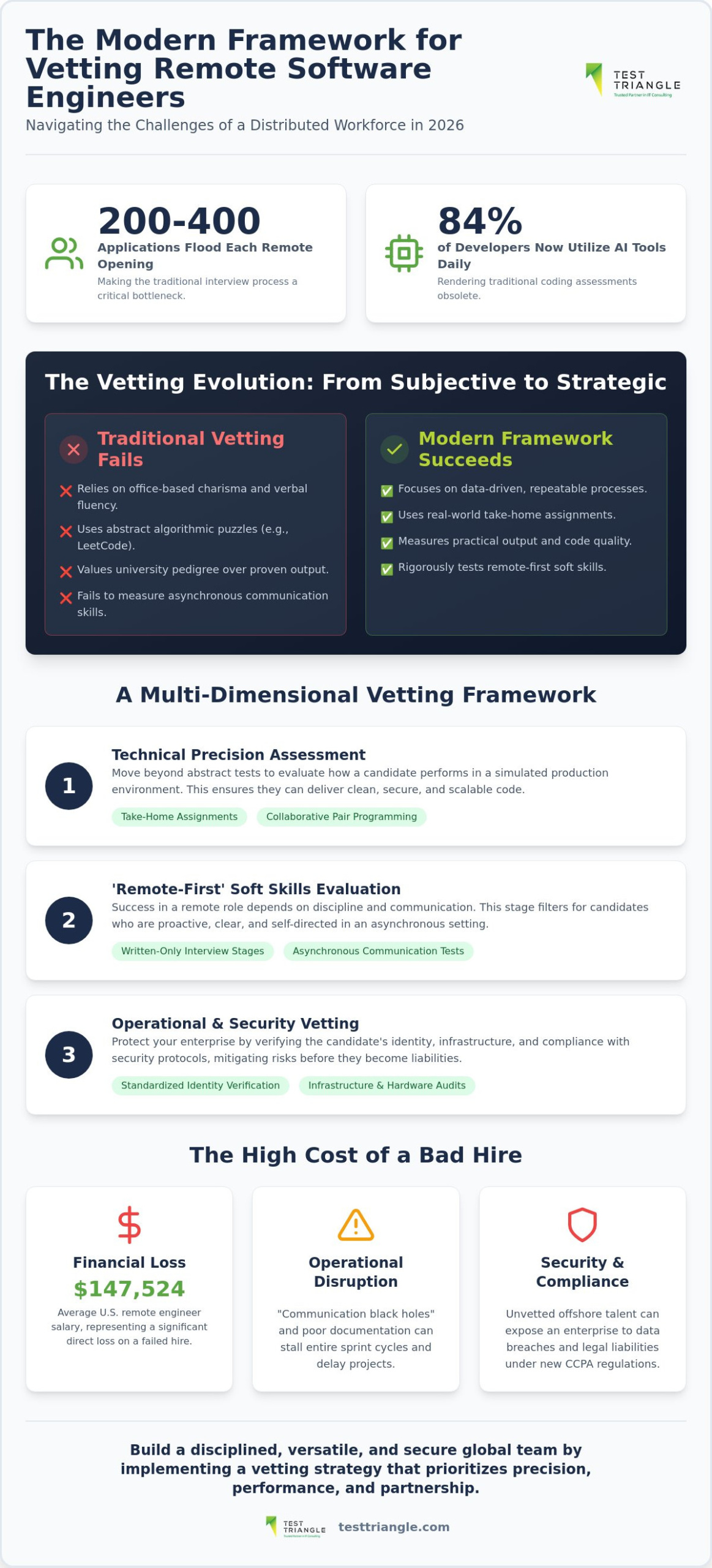
With an average of 200 to 400 applications flooding every remote developer opening in 2026, the traditional interview process has become a bottleneck rather than a filter. Learning how to vet remote software engineers effectively is no longer just a recruitment task; it’s a strategic imperative for maintaining digital stability and operational excellence. You’ve likely felt the sting of high turnover when a candidate’s impressive interview performance fails to translate into actual output. This gap, coupled with the increasing complexity of data privacy mandates like the updated CCPA regulations, creates a landscape where hiring mistakes are both costly and risky.

We understand that enterprise growth relies on precision, performance, and partnership. This framework will empower you to master a multi-dimensional vetting strategy designed to secure elite talent while insulating your infrastructure from technical and operational risks. You’ll gain a repeatable process that reduces time-to-hire and ensures every new engineer possesses the remote-first soft skills necessary for long-term success. By prioritizing technical rigor alongside asynchronous communication, you can build a global team that is disciplined, versatile, and secure.

Key Takeaways

  • Replace abstract algorithmic testing with real-world take-home assignments and collaborative pair programming to accurately measure a candidate’s technical precision and practical output.
  • Evaluate critical “Remote-First” soft skills by utilizing written-only interview stages that rigorously test a candidate’s capacity for proactive, asynchronous communication.
  • Learn how to vet remote software engineers effectively through a multi-stage framework that balances technical expertise with operational security and hardware compliance.
  • Mitigate global recruitment risks by implementing standardized identity verification and infrastructure audits for offshore resources to maintain institutional stability.
  • Accelerate your digital transformation by partnering with a strategic collaborator who integrates recruitment outsourcing with technical consulting to deliver scalable, high-quality engineering talent.

The Evolution of Remote Engineering Vetting in 2026

In the current distributed environment, The Evolution of Remote Engineering Vetting in 2026 has transitioned from a simple talent acquisition task into a rigorous, multi-stage risk mitigation process. Global enterprises now recognize that technical proficiency alone is insufficient to guarantee project stability or security compliance. To understand how to vet remote software engineers effectively, leadership must view the process as a comprehensive audit of a candidate’s ability to operate within complex, often asynchronous, digital ecosystems. This shift requires moving beyond “skill-checking” syntax and toward “system-thinking” evaluations that measure how an engineer integrates their output into larger architectural frameworks and team workflows.

The rise of generative AI has fundamentally altered this landscape, as approximately 84% of developers now utilize AI tools in their daily work. This high adoption rate means that traditional coding assessments are often compromised by automated assistance. Modern vetting protocols must therefore pivot to evaluate a candidate’s capacity to validate, debug, and secure AI-generated code rather than merely assessing their ability to write it from scratch. By focusing on these high-level oversight capabilities, organizations ensure they are hiring engineers who provide strategic value rather than those who simply manage tool outputs.

Why Traditional Interviewing Fails Remote Talent

Standard 1:1 interviews often reward office-based charisma and verbal fluency, traits that rarely correlate with the deep work and self-direction required for remote success. High-pressure live coding sessions ignore the reality of modern engineering, where developers thrive in quiet, focused environments with access to documentation and collaborative tools. Relying on an elite university pedigree or past employment at “Big Tech” firms frequently results in a misalignment between interview performance and actual remote output. Remote Vetting Maturity is the institutional capacity to validate technical aptitude, asynchronous communication, and operational security through a standardized, data-driven framework that eliminates subjective bias.

The Risks of Poor Vetting in Distributed Teams

A failed hire in a remote setting carries significant financial and operational burdens, especially when the average U.S. remote software engineer salary has reached $147,524. Beyond the direct loss of capital, unvetted engineers can create “communication black holes” where lack of documentation and proactive updates stall entire sprint cycles. Security and compliance present even greater dangers. With new 2026 regulations like the updated CCPA requiring mandatory cybersecurity audits, hiring offshore talent without rigorous background checks and infrastructure verification can expose an enterprise to severe legal liabilities and data breaches. Integrating professional IT staffing services helps mitigate these risks by providing a steady hand in a fast-changing technological landscape.

Multi-Dimensional Technical Assessment Strategies

Mastering how to vet remote software engineers effectively requires a transition from isolated coding puzzles to holistic technical evaluations. In an era where over 50% of developers interact with AI tools daily, testing for syntax memorization has become obsolete. Instead, enterprises must deploy assessments that simulate the architectural complexity and legacy debt found in actual production environments. This multi-dimensional approach ensures that a candidate’s technical precision aligns with the long-term scalability goals of the organization, providing the peace of mind that comes from a resilient digital infrastructure.

Moving Beyond LeetCode: Real-World Problem Solving

Effective vetting prioritizes take-home assignments that mirror actual sprint tickets rather than abstract algorithmic challenges. These tasks should require the candidate to implement a feature while adhering to specific software and digital assurance testing standards, ensuring they prioritize quality, security, and performance from the first line of code. Clear expectations for documentation are essential; a remote engineer’s ability to explain their logic in writing is just as critical as the code itself. While AI-detection tools can provide useful context, they should be used to facilitate a discussion about how the candidate validates and tests AI-assisted output, reflecting the reality of modern development workflows where human oversight remains the final safeguard.

Code Review and Collaborative Debugging Exercises

Collaborative pair programming sessions within a remote-first tool environment reveal how an engineer navigates existing, complex codebases. This stage allows managers to evaluate the candidate’s ability to identify technical debt and communicate its impact to stakeholders who may not have a technical background. Proficiency with version control and CI/CD pipelines is non-negotiable for distributed teams where automated deployment is the standard for operational efficiency. Observing how a candidate gives and receives constructive feedback during a code review session provides deep insight into their professional maturity and potential for seamless team integration.

Securing top-tier talent involves more than just identifying skill sets; it requires a strategic partner who understands the nuances of global technical recruitment. If you are looking to refine your engineering pipeline with disciplined, versatile, and high-performing experts, you can connect with our strategic consulting team to explore tailored staffing solutions that prioritize stability, precision, and growth.

Evaluating ‘Remote-First’ Soft Skills and Cultural Synchronization

While technical precision forms the foundation of a successful hire, the ability to thrive in a distributed environment depends entirely on a specific subset of “remote-first” soft skills. In the 2026 landscape, where 53% of remote-capable workers operate in hybrid or fully remote models, the primary challenge is no longer just finding talent, but identifying engineers who possess the self-discipline and proactive nature required for isolated deep work. Understanding how to vet remote software engineers effectively involves a shift in focus from synchronous verbal fluency to asynchronous written mastery. This ensures that your global team maintains institutional stability through Clarity, Consistency, and Contribution, even when working across disparate time zones and cultural contexts.

Asynchronous Communication and Documentation Proficiency

In a distributed ecosystem, high-quality documentation is a non-negotiable requirement rather than an optional task. We recommend conducting a “Slack-style” interview stage where candidates must respond to technical prompts and project updates via written chat. This exercise allows hiring managers to gauge the candidate’s written clarity, professional tone, and ability to convey complex ideas without the aid of real-time verbal cues. Reviewing a candidate’s past contributions to README files or internal wikis provides tangible evidence of their “Documentation-First” mentality. By integrating these evaluations into your Atlassian consulting workflows, you can ensure that every new hire contributes to a searchable, scalable knowledge base that empowers the entire organization.

Self-Management and Proactive Problem Ownership

Vetting for high individual agency is critical for teams where direct supervision is minimal and project success relies on personal accountability. During behavioral assessments, focus on questions that reveal how a candidate “unblocks” themselves when they encounter a technical hurdle in isolation. You should look for a “Solve-and-report” mindset, where the engineer takes initiative to find a solution and documents the process, rather than a “Wait-and-see” attitude that leads to costly sprint delays. Red flags often include a lack of curiosity about the broader business impact or a history of relying on synchronous meetings to define daily tasks. An engineer who proactively manages their time and communicates progress without prompting is essential for maintaining the operational efficiency promised to your stakeholders.

Strategic growth in a global market requires engineers who are not only technically gifted but also culturally adaptable. Evaluating a candidate’s awareness of cultural nuances and their ability to synchronize with various time zones prevents the formation of communication silos. This disciplined approach to vetting ensures that your remote engineering team functions as a cohesive, versatile unit capable of driving long-term technological evolution.

Operational Vetting: Security, Compliance, and Infrastructure

Operational vetting serves as the critical final layer of defense for global enterprises looking to maintain digital integrity within a distributed workforce. While previous stages focus on technical aptitude and soft skill synchronization, learning how to vet remote software engineers effectively at the enterprise level demands a rigorous audit of the candidate’s physical and digital workspace. This phase mitigates the risks associated with data breaches and intellectual property theft, ensuring that every addition to your workforce aligns with established institutional standards for security, governance, and compliance.

Data Security and Intellectual Property Protection

Vetting for secure coding practices is no longer an elective skill; it’s a fundamental requirement for protecting sensitive customer data and maintaining the peace of mind derived from risk reduction. During this stage, managers must verify the candidate’s understanding of vulnerability management and encryption protocols to ensure alignment with global standards like GDPR and the 2026 CCPA updates. Implementing strict NDAs and IP assignment agreements before sharing any proprietary codebase is essential for long-term stability. Organizations can utilize IT Service Management solutions to establish secure remote access protocols, providing the oversight necessary to monitor resource activity without compromising the speed of digital transformation.

Verifying Remote Infrastructure and Tool Proficiency

A candidate’s technical brilliance is effectively neutralized if their remote infrastructure lacks the stability required for high-load engineering tasks. This requires a formal verification of internet redundancy, hardware security, and the ability to operate within secure virtual desktop environments or encrypted VPNs. Proficiency with industry-standard platforms is equally vital. Assessing a candidate’s familiarity with Atlassian implementation ensures they can navigate complex project tracking and documentation workflows from day one. This practical verification confirms that the engineer possesses the “tools of the trade” necessary for scalable growth in a fast-changing technological landscape.

Beyond the hardware, identity verification remains a cornerstone of offshore recruitment, especially as transparency obligations under the EU AI Act take full effect in August 2026. Conducting thorough background checks and verifying professional credentials through official channels protects the organization from the “black hole” effect of unvetted talent. By treating operational vetting as a strategic audit rather than a mere formality, technical leaders can build teams that are not only productive but also resilient and compliant. To ensure your engineering pipeline meets these rigorous security benchmarks, consult with our recruitment experts to implement a secure, globally-minded staffing strategy.
How to Vet Remote Software Engineers Effectively: The 2026 Enterprise Framework

Scaling Your Remote Engineering Team with Test Triangle

Scaling a distributed workforce in 2026 requires more than just a high volume of candidates; it demands a disciplined approach to talent integration that aligns with your institutional goals. While the previous sections outlined the complexities of technical and operational audits, executing this framework internally can strain HR resources and delay critical project timelines. Test Triangle provides a sophisticated alternative by offering staffing solutions that function as an extension of your own leadership team. We don’t just provide resources. We deliver strategic partners who are pre-vetted for technical precision and remote-first synchronization, ensuring your digital infrastructure remains resilient during periods of rapid growth.

Our methodology ensures that every engineer is equipped to integrate seamlessly into your established DevOps Consulting workflows. By combining deep technical consulting with recruitment expertise, we bridge the gap between initial hiring and long-term value creation. This dual approach allows your organization to maintain operational efficiency while pursuing large-scale digital transformation. When you understand how to vet remote software engineers effectively through a professional partner, you gain the freedom to focus on high-level strategy while we manage the intricacies of talent validation and technical alignment.

Our Managed Outsourcing and Staffing Methodology

Our proprietary vetting process exceeds standard recruitment by focusing on Precision, Performance, and Partnership. We leverage a global footprint to identify niche engineering talent across any time zone, ensuring that your team maintains 24/7 momentum without the friction of cultural or communication silos. Whether you require contract-based expertise for a specific project, remote/offshore teams for cost-efficiency, or permanent placements for long-term stability, our flexible staffing models adapt to your specific operational needs. Every candidate undergoes a rigorous pre-vetting phase that includes technical simulations and an audit of their remote-readiness, providing you with a shortlist of only the most qualified professionals.

From Vetting to Value: Ensuring Long-Term Retention

The journey doesn’t end once the contract is signed. We prioritize the long-term success of your engineering team by providing continuous performance monitoring and support, which significantly reduces the turnover risks common in remote roles. By handling the administrative burden of global compliance, payroll, and the evolving 2026 data privacy regulations, we empower your technical managers to focus on innovation rather than paperwork. This comprehensive support structure ensures that your remote engineers remain engaged, productive, and aligned with your corporate vision. Discover how Test Triangle vets and manages elite remote engineering teams.

Building a Resilient Remote Engineering Ecosystem

Securing elite talent in a distributed landscape requires a transition from traditional recruitment to a comprehensive, multi-dimensional audit of technical and operational readiness. By prioritizing real-world assessments and asynchronous communication proficiency, organizations can bridge the gap between interview performance and actual production output. Mastering how to vet remote software engineers effectively ensures that your digital infrastructure remains robust while mitigating the security and compliance risks inherent in global talent acquisition. This strategic approach provides the peace of mind necessary for sustainable growth in highly regulated sectors like Pharma and Finance.

As an Atlassian Gold Solution Partner with a global presence across Europe, North America, and Asia, Test Triangle serves as a reliable long-term collaborator for enterprises navigating complex digital transformations. Our disciplined methodology guarantees that every placement aligns with your specific technical benchmarks and security standards. We empower your organization to focus on high-level innovation by providing the steady hand needed to manage global engineering resources with Stability, Security, and Scalability. It’s time to optimize your distributed workforce with a partner who understands the nuances of enterprise-grade engineering.

Secure Vetted Remote Engineering Talent with Test Triangle

Frequently Asked Questions

How do you verify if a remote software engineer is using AI to cheat on a technical test?

Shift from assessing the final code output to evaluating the candidate’s logic and validation process. Since approximately 84% of developers now use AI tools, the goal isn’t to ban them but to ensure the engineer can debug, test, and explain the AI-generated logic. Use follow-up code review sessions where the candidate must justify architectural choices and explain technical debt. This approach reveals whether they truly understand the system or are simply managing tool outputs.

What are the most important soft skills for a remote software engineer in 2026?

Asynchronous communication, proactive agency, and “Documentation-First” mentalities are the most critical traits for distributed success. Engineers must be able to unblock themselves in isolation and provide clear, written updates that maintain institutional knowledge. This ensures project momentum continues even when team members are offline. Vetting for these skills is a vital part of learning how to vet remote software engineers effectively to prevent communication silos and costly sprint delays.

How long should a thorough remote vetting process take?

A comprehensive enterprise vetting process typically spans 10 to 20 business days from the initial screen to the final offer. This duration allows for multi-stage technical assessments, background checks, and operational infrastructure audits without compromising quality. While the average number of applications for remote roles has reached 200 to 400 in 2026, specialized partners can help reduce this time-to-hire by providing pre-vetted candidates who already meet your specific security and technical benchmarks.

What is the best way to conduct technical interviews for offshore engineers in different time zones?

Utilize a mix of asynchronous assessments and strategic, overlapping interview windows to accommodate global schedules. Start with written “Slack-style” technical prompts and take-home projects that mirror actual tickets. This allows you to evaluate their output in a real-world setting. When live interaction is required, use collaborative environments within platforms like Atlassian to observe their problem-solving process in real-time, ensuring they can synchronize with your existing DevOps workflows.

Should I use take-home assignments or live coding for remote vetting?

A hybrid strategy is most effective for modern enterprise requirements. Take-home assignments allow candidates to demonstrate deep work and documentation skills in a low-pressure environment, which is the reality of remote work. Conversely, short live coding or pair programming sessions are essential for vetting collaborative debugging and real-time communication. This balanced approach ensures you evaluate both the technical precision and the interpersonal versatility required for long-term project stability.

How do you vet for security and compliance when hiring remote engineers globally?

Conduct rigorous infrastructure audits and identity verification to ensure alignment with global standards like GDPR and the 2026 CCPA updates. You must verify that the candidate’s remote workspace meets hardware security requirements and that they can operate within encrypted VPNs. Implementing formal privacy risk assessments is mandatory as of January 1, 2026, for high-risk data activities. Professional staffing partners help mitigate these risks by managing the administrative burden of global compliance and payroll.

Paul Guy

Article by

Paul Guy

Paul serves as the Marketing Director at Test Triangle, where he leads a global team in driving growth through strategic B2B marketing and brand communications. With a strong emphasis on measurable outcomes and sustainable performance, he plays a pivotal role in aligning marketing functions to enhance customer engagement and accelerate business impact. Under his leadership, marketing initiatives have consistently delivered significant returns on investment, elevated brand visibility, and strengthened the company's presence across key markets.

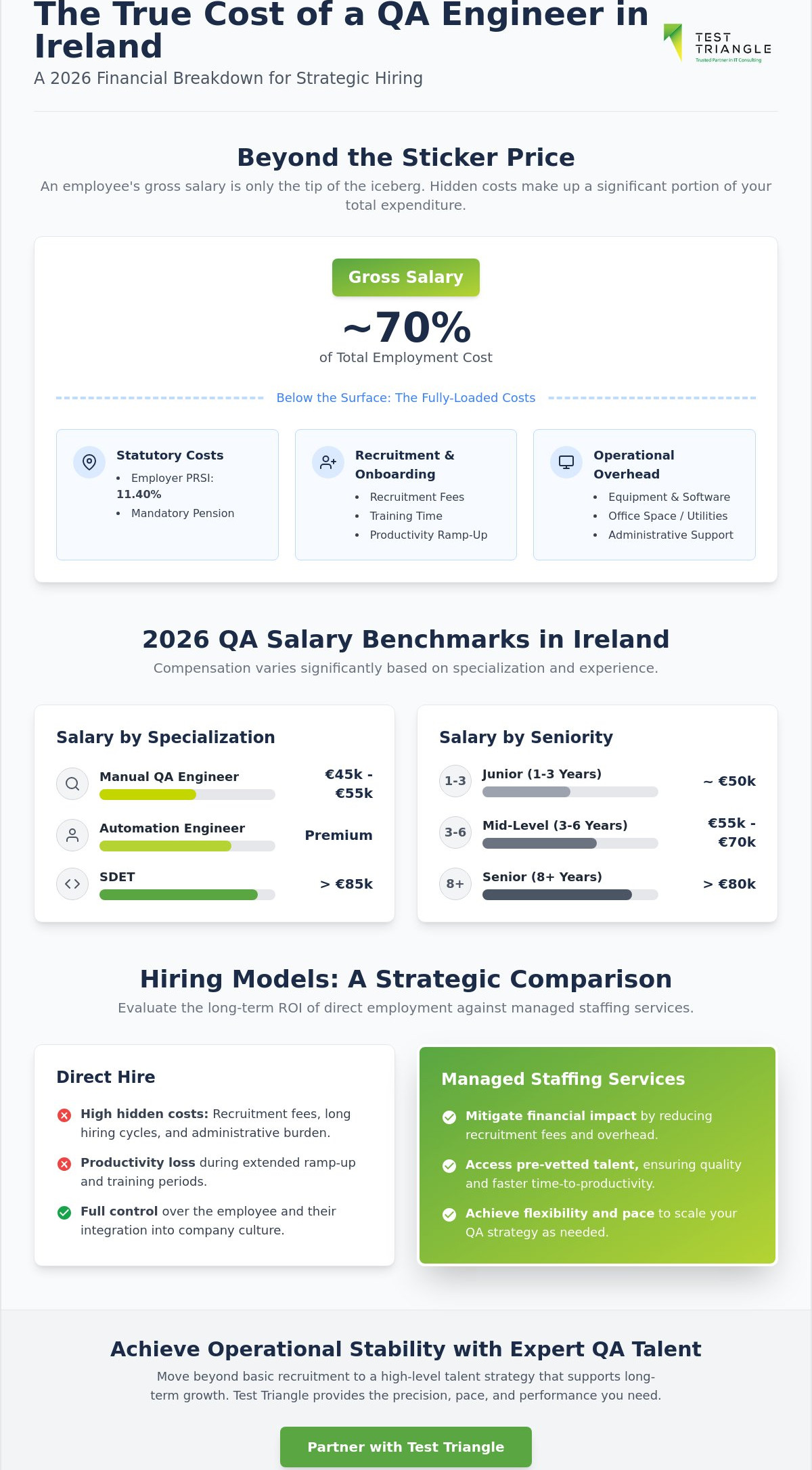

Did you know that the gross salary on a candidate’s contract represents barely 70% of your actual organizational expenditure? In 2026, the “sticker price” for technical talent is a deceptive metric that often leads to significant budgetary shortfalls for global enterprises. You recognize that securing top-tier expertise requires more than just a competitive offer. It demands a sophisticated understanding of the fiscal realities within the Irish market. Calculating the true cost to hire a full time qa engineer in ireland now involves accounting for the “My Future Fund” pension mandates, updated PRSI adjustments, and the rising overhead of specialized recruitment.

This guide provides a meticulous breakdown of salary benchmarks, statutory contributions, and the hidden costs of equipment and onboarding. We’ll deliver a comprehensive 2026 budget framework alongside a strategic analysis of direct hiring versus managed services. By prioritizing precision, pace, and performance, you can ensure your quality assurance strategy remains compliant, scalable, and cost-effective. You’ll move beyond simple headcount to achieve operational stability through precise financial planning and expert resource allocation. This structured approach allows you to transition from basic recruitment to a high-level talent strategy that supports long-term growth.

Key Takeaways

  • Establish accurate 2026 salary benchmarks for Irish QA professionals by differentiating between manual testing roles and high-premium SDET or Automation positions.
  • Quantify the comprehensive cost to hire a full time qa engineer in ireland by integrating the 11.40% Employer PRSI rate and mandatory “My Future Fund” pension contributions into your fiscal planning.
  • Compare the long-term ROI of direct employment against managed staffing services to mitigate the hidden financial impact of recruitment fees and productivity losses during ramp-up.
  • Discover how to leverage hybrid delivery models and strategic automation to significantly reduce your cost per defect while maintaining high standards of software quality.
  • Utilize a proven framework for vetting specialized talent to ensure your organizational infrastructure remains secure, scalable, and resilient in a competitive national market.

The 2026 Landscape: Base Salary Expectations for QA Engineers in Ireland

Ireland’s technology sector has reached a level of maturity where quality is no longer a post-development afterthought. In 2026, the demand for sophisticated software testing has intensified, driven by the rapid adoption of AI-generated code and the necessity for continuous delivery. This surge in complexity has fundamentally altered the financial baseline for technical talent. When organizations evaluate the cost to hire a full time qa engineer in ireland, they must recognize that base salaries have adjusted to reflect both the scarcity of specialized skills and the increased cost of living in hubs like Dublin, Cork, and Galway. Current data indicates an average gross salary of approximately €70,715 per year, though this figure fluctuates significantly based on the candidate’s technical stack and strategic value.

Salary Breakdown by Specialisation

The market no longer views QA as a monolithic discipline. Manual QA Engineers, focusing on exploratory and functional validation, typically see ranges between €45,000 and €55,000 depending on the complexity of the industry. However, the true premium lies in Automation Testing. Engineers proficient in Selenium, Cypress, or Playwright command higher compensation due to their ability to accelerate release cycles. At the top of the pyramid, Software Development Engineers in Test (SDET) bridge the gap between development and quality, often exceeding the €85,000 mark. Their expertise in building custom test frameworks ensures long-term operational stability and risk reduction for enterprise-scale infrastructures. It’s a shift toward building quality in, rather than testing it at the end.

The Influence of Seniority on National Averages

Seniority remains a primary driver of compensation variance. Junior QA professionals with one to three years of experience enter the market at around €50,012, focusing on execution and basic bug reporting. The mid-level tier, spanning three to six years of experience, represents the most competitive hiring bracket. These engineers are expected to lead initiatives and integrate testing into DevOps workflows, with salaries in Dublin often ranging from €55,000 to €70,000. For QA Leads and Managers, the focus shifts toward strategic oversight and team mentorship. Senior-level engineers with over eight years of experience frequently earn €80,437 or more. Securing these leaders requires a deep understanding of the total cost to hire a full time qa engineer in ireland, as their impact on systemic improvement and organizational progress is profound. Companies seeking to navigate this competitive environment often leverage IT staffing services to access vetted talent without the traditional overhead of internal recruitment. This approach provides the flexibility, precision, and pace required to sustain growth in a volatile market.

Calculating the Fully-Loaded Cost: Beyond the Sticker Price

To accurately determine the cost to hire a full time qa engineer in ireland, strategic leaders must transition from basic salary accounting to a comprehensive evaluation of total organizational impact. While the base salary serves as a visible financial anchor, the fully-loaded cost encompasses statutory taxes, mandatory benefits, and the operational infrastructure required to sustain high-performance output. In the competitive Irish technology landscape, failing to account for these variables often results in significant budgetary discrepancies that can jeopardize project timelines and operational stability.

Statutory and Mandatory Contributions

Employer PRSI remains a critical, yet often underestimated, component of the Irish employment framework. From October 1, 2026, the employer PRSI rate is established at 11.40% for employees earning above the €441 weekly threshold. This statutory contribution, which supports the national social insurance system, applies to almost all QA engineering roles given current market rates. Additionally, the introduction of the “My Future Fund” auto-enrolment pension scheme on January 1, 2026, has introduced a new mandatory expense. During the initial phase, employers are legally obligated to contribute 1.5% of the employee’s gross earnings. When you factor in the statutory entitlement of 20 days annual leave and 10 public holidays, the cost of non-productive time alone accounts for approximately 12% of the annual budget. These mandatory elements form a non-negotiable baseline for compliance and fiscal planning.

Operational Overheads and Tooling

Beyond statutory requirements, the physical and digital infrastructure needed for specialized testing introduces further overheads. Equipping a QA professional with high-performance hardware and mobile testing devices typically requires an initial capital expenditure between €2,500 and €4,500. Furthermore, the recurring costs of software licenses for platforms such as Atlassian Jira or specialized automation suites must be integrated into the departmental budget. Recruitment fees also represent a substantial upfront investment; specialized agencies in Ireland typically command premiums ranging from 15% to 25% of the candidate’s first-year salary. For an engineer with a €70,000 base, this single fee can exceed €17,000. To ensure your financial projections align with current market realities, it’s often beneficial to consult with a strategic talent partner who can provide a granular breakdown of these variables. By synthesizing these direct and indirect expenses, organizations can achieve the clarity, compliance, and confidence required to build a resilient and cost-effective quality assurance function.

Direct Hire vs. Managed Staffing: A Strategic Comparison

Choosing between a permanent employee and a managed partner is a decision that defines an organization’s agility, scalability, and stability. While a direct hire offers long-term integration and cultural alignment, the total cost to hire a full time qa engineer in ireland often includes a significant period of negative ROI during the onboarding phase. In a market where specialized talent is highly mobile, leaders must evaluate whether the traditional employment model provides the necessary flexibility to handle project peaks without inflating permanent headcount. Strategic resource allocation requires a shift from viewing QA as a fixed cost to treating it as a dynamic capability that can be scaled based on immediate technical requirements.

Financial Comparison Framework

Evaluating engagement models requires a clear understanding of upfront investment versus long-term predictability. A direct hire involves high initial expenditures, including recruitment fees that typically range from 15% to 25% of the annual salary, alongside the statutory PRSI and pension obligations discussed previously. Conversely, contract staffing offers lower long-term commitment but often carries higher day rates that can strain operational budgets during extended projects. Managed QA services provide a middle ground of fixed-cost predictability. By shifting the burden of recruitment, training, and retention to a partner, organizations can mitigate the financial risks associated with attrition. This model ensures that the cost to hire a full time qa engineer in ireland is replaced by a transparent service fee that covers expertise, infrastructure, and delivery guarantees.

Operational Impact and Management Burden

The “Management Tax” is perhaps the most overlooked factor in the direct hire equation. Every permanent engineer requires dedicated time for 1:1 meetings, performance reviews, and career development. For senior leadership, these hours represent a significant diversion from high-level digital transformation initiatives. Furthermore, the infrastructure requirements for in-house teams, from secure hardware to specialized testing environments, add layers of complexity to internal IT operations. Utilizing managed outsourcing services allows enterprises to offload this administrative oversight. Instead of managing individuals, executive leadership can focus on managing outcomes. This approach reduces the hidden costs of “ramp-up time,” as managed teams often arrive with established methodologies and industry-standard tools already in place. By prioritizing results over headcount, organizations achieve a level of operational efficiency that supports rapid, sustainable growth in a competitive technological landscape.

Optimising QA ROI: Strategic Models for Modern Testing

Achieving a sustainable return on investment requires more than just managing the cost to hire a full time qa engineer in ireland; it demands a fundamental shift in how testing resources are deployed. As enterprises face a projected 15% CAGR in the global automation testing market through 2034, the focus must move toward systemic efficiency and risk reduction. By integrating advanced tooling with flexible resource models, organizations can maintain high standards of quality while insulating their budgets from the volatility of the national talent market. This structured approach ensures that every euro spent contributes directly to operational stability and product resilience.

Automation as a Cost-Saving Lever

Strategic automation serves as a powerful multiplier for organizational productivity. While the initial setup of frameworks requires a specific capital injection, the long-term reduction in repetitive manual testing hours provides a clear path to fiscal stability. Leveraging high-efficiency software test automation services allows teams to execute regression suites with a precision and pace that human testers cannot replicate. By 2026, organizations implementing comprehensive automation frameworks typically project a 40% reduction in manual regression cycles compared to traditional manual-only models. This “shift-left” methodology identifies defects earlier in the development lifecycle, which significantly lowers the complexity and expense of remediation before code reaches production.

Flexible Staffing and Augmentation

Hybrid delivery models offer a practical solution for managing the fluctuating demands of modern software development. By retaining in-house leadership to maintain institutional knowledge and partnering with specialized IT staffing services, companies can scale their testing capacity without the burden of permanent headcount. This versatility is particularly valuable when managing non-core applications through targeted QA outsourcing, allowing the internal team to focus on mission-critical features. Streamlining these workflows further requires a robust technical foundation; a professional Atlassian implementation ensures that requirements, test cases, and defects are synchronized across the entire DevOps pipeline. To explore how these strategic models can stabilize your technical budget and enhance delivery speed, connect with our consulting team for a tailored resource assessment. You’ll gain the clarity needed to transition from a reactive hiring cycle to a proactive, value-driven quality strategy.

The Fully-Loaded Cost to Hire a Full-Time QA Engineer in Ireland (2026 Guide)

Partnering with Test Triangle for High-Performance QA Talent

Navigating the fiscal complexities of the Irish technology market requires more than just a recruitment agency; it demands a strategic partner capable of aligning technical execution with broader organizational goals. When you evaluate the comprehensive cost to hire a full time qa engineer in ireland, the value of a proven methodology becomes clear. Test Triangle has established itself as a steady hand for national enterprises, providing the institutional maturity and technical rigor necessary to secure high-performance talent. Our approach is built on a foundation of reliability, resilience, and results, ensuring that your digital infrastructure remains secure and scalable in a volatile landscape.

We employ a rigorous vetting process that transcends basic resume screening. By combining deep technical assessments with cultural alignment evaluations, we ensure that every engineer we provide possesses the discipline and versatility required for enterprise-scale projects. This meticulous selection process mitigates the risks of attrition and underperformance, protecting your investment and maintaining operational stability. Whether your strategy requires a permanent placement to anchor a core team or managed services to handle project-specific surges, our engagement models are designed for adaptability. We bridge the gap between complex technical requirements and tangible business outcomes, allowing your leadership to focus on digital transformation while we manage the operational cadence of quality assurance.

Our Expertise in Quality Assurance

Our legacy is rooted in a comprehensive understanding of the software lifecycle, moving seamlessly from foundational manual testing services to the implementation of cutting-edge AI-driven automation. We adhere to global industry standards while maintaining a deep national reach, positioning ourselves as a reliable long-term collaborator for companies operating in highly regulated environments. This commitment to quality ensures that your testing function evolves alongside your technology stack, providing the precision, pace, and performance your customers expect. We don’t just provide headcount; we deliver a strategic capability that reduces risk and empowers technological evolution.

Next Steps for Your QA Strategy

Transitioning to a more efficient resource model starts with a clear assessment of your current capabilities and future needs. We provide expert consulting on your 2026 QA roadmap, helping you refine your budget to account for the true cost to hire a full time qa engineer in ireland while exploring high-ROI alternatives. Our pre-vetted talent pool is ready to support your next milestone with institutional maturity and technical expertise. Contact Test Triangle today for a bespoke staffing consultation to ensure your quality assurance strategy is built for sustainable growth and long-term success.

Secure Your Quality Strategy for 2026

The evolution of the Irish technology market requires a fundamental shift from reactive hiring to strategic resource management. It’s clear that understanding the true cost to hire a full time qa engineer in ireland is the first step in protecting your organizational budget from the combined impact of statutory increases and competitive talent demands. By integrating advanced automation with flexible staffing models, you can achieve a level of operational stability that traditional employment structures often fail to provide. This approach ensures that your complex digital infrastructure remains resilient while your leadership team focuses on high-level innovation and systemic growth.

Test Triangle brings over 10 years of expertise in Irish IT staffing, serving as a reliable long-term collaborator for global enterprises in highly regulated sectors like Pharma and Finance. As Atlassian and ServiceNow Platinum Partners, we provide the specialized talent and technical rigor required to sustain growth and mitigate risk. You can optimise your QA costs with Test Triangle staffing solutions to ensure your quality assurance function is both scalable and cost-effective. We’re ready to help you build a resilient testing strategy that supports your long-term success through precision, pace, and performance.

Frequently Asked Questions

What is the average base salary for a QA Engineer in Ireland in 2026?

The average gross salary for a Software QA Engineer currently stands at approximately €70,715 per year. Entry-level professionals typically earn around €50,012, while senior-level engineers with over eight years of experience can command €80,437 or more. In Dublin, the salary range for a Quality Engineer generally fluctuates between €55,000 and €70,000 depending on the specific technical stack required.

How much should I budget for Employer PRSI for a tech role?

Budget 11.40% for Employer PRSI contributions for any employee earning more than €441 per week. This rate, effective from October 1, 2026, is a mandatory statutory requirement for the majority of technical roles in the Irish market. For positions earning €441 or less per week, the rate is 9.15%. Incorporating these figures into the total cost to hire a full time qa engineer in ireland is vital for fiscal accuracy.

Does the 2026 pension auto-enrolment apply to all tech hires?

The “My Future Fund” auto-enrolment scheme applies to all eligible employees not already participating in a qualifying pension plan. Since its launch on January 1, 2026, employers are legally obligated to contribute a minimum of 1.5% of an employee’s gross earnings during the initial three-year phase. This mandate introduces a new fixed overhead that must be integrated into your annual payroll and compliance strategy.

Is it cheaper to hire a manual tester or an automation engineer?

Manual testers generally command lower base salaries, typically ranging from €45,000 to €55,000, compared to automation specialists who often exceed €70,000. However, automation engineers provide superior long-term value by significantly reducing manual testing hours and accelerating delivery cycles. While the initial investment is higher, the increased efficiency and reduced cost per defect often result in a higher overall return on investment.

What are the typical recruitment agency fees in Ireland?

Recruitment agency fees for specialized QA talent typically range from 15% to 25% of the candidate’s first-year gross salary. For international placements, these fees can span from €4,000 to over €12,000 depending on the role’s seniority and specialization. While direct recruitment platforms might offer lower upfront costs between €2,500 and €4,000, they often require a greater investment of internal HR resources and management time.

How long does it take to hire a qualified QA engineer in the current market?

Securing a qualified QA professional usually requires between four and eight weeks in the current competitive landscape. This timeframe includes sourcing candidates, conducting rigorous technical assessments, and navigating standard notice periods. High demand for specific expertise in tools like Selenium or Cypress can extend this duration. Strategic organizations often utilize staffing partners to bypass these delays and access pre-vetted talent immediately.

Can I save costs by using a managed QA service instead of a direct hire?

Managed QA services often provide significant cost advantages by eliminating the hidden overheads of recruitment, onboarding, and continuous training. This model allows organizations to offload the “management tax” and infrastructure costs to a specialized partner. By replacing the variable cost to hire a full time qa engineer in ireland with a predictable, outcome-based fee, companies can achieve greater operational stability and financial clarity.

What equipment and SaaS costs should I expect for a new QA hire?

Expect an initial expenditure between €2,500 and €4,500 for high-performance hardware and essential mobile testing devices. Additionally, recurring SaaS license fees for platforms such as Jira, ServiceNow, or specialized automated testing suites must be factored into the departmental budget. These tools are indispensable for maintaining the precision and pace required to support complex digital infrastructures and ensure long-term product quality.

Paul Guy

Article by

Paul Guy

Paul serves as the Marketing Director at Test Triangle, where he leads a global team in driving growth through strategic B2B marketing and brand communications. With a strong emphasis on measurable outcomes and sustainable performance, he plays a pivotal role in aligning marketing functions to enhance customer engagement and accelerate business impact. Under his leadership, marketing initiatives have consistently delivered significant returns on investment, elevated brand visibility, and strengthened the company's presence across key markets.
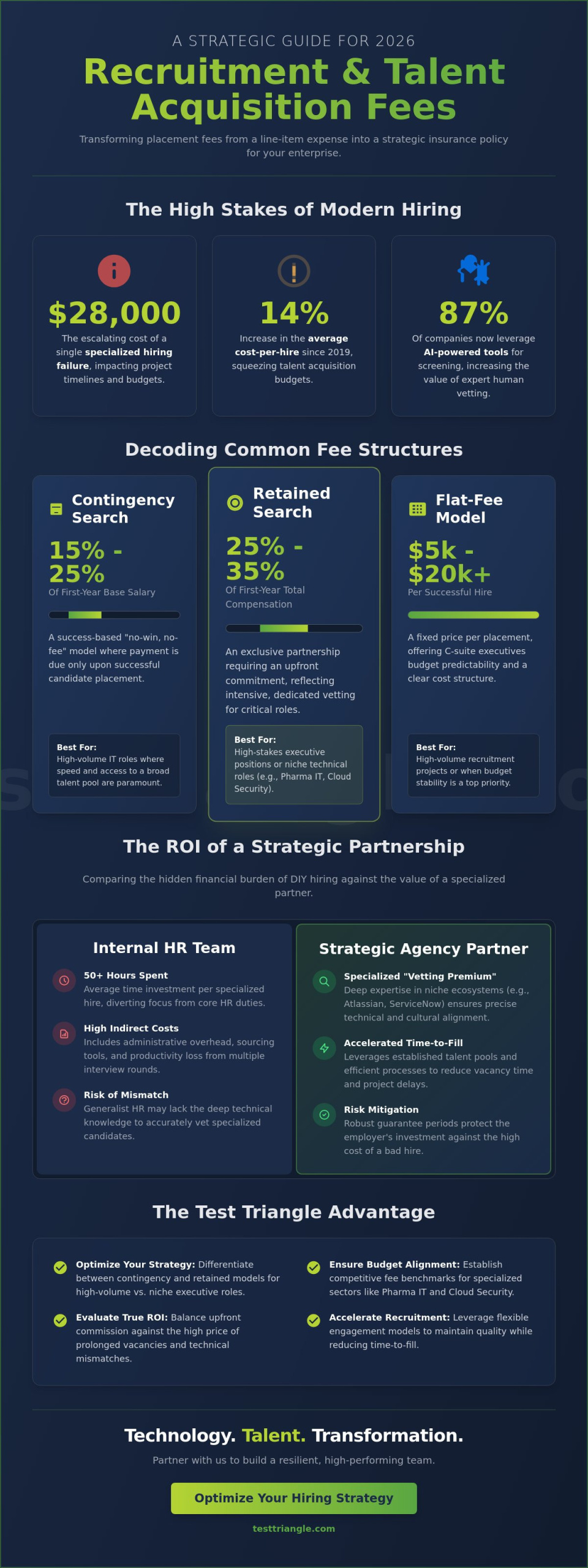

In 2026, viewing Recruitment and Talent Acquisition Placement Fees as a mere line-item expense is a strategic oversight that ignores the escalating $28,000 cost of specialized hiring failures. You’ve likely felt the pressure of the 14% increase in cost-per-hire since 2019, particularly when traditional agencies offer opaque pricing for critical DevOps or Pharma roles. It’s a common frustration to manage rising costs while the risk of a “bad hire” remains high in a market where 87% of companies now leverage AI-powered tools for candidate screening.

By aligning your financial models with current industry benchmarks, you can transform these fees into a strategic insurance policy that protects your digital transformation. This guide provides the clarity you need to master complex fee structures, ranging from the 15% contingency models to the 35% retained search benchmarks. We’ll explore how to leverage data-driven metrics and flexible engagement models to reduce your time-to-fill and secure the specialized talent your enterprise requires. Through a clear analysis of ROI and market trends, we’ll outline a path toward a transparent partnership that prioritizes long-term operational stability. Technology. Talent. Transformation.

Key Takeaways

  • Differentiate between contingency and retained search models to optimize your strategy for both high-volume IT staffing and niche executive requirements.
  • Establish competitive benchmarks for Recruitment and Talent Acquisition Placement Fees within specialized sectors like Pharma IT and Cloud Security to ensure budget alignment.
  • Evaluate the true ROI of professional placements by balancing upfront commission costs against the high price of prolonged vacancies and technical talent mismatches.
  • Leverage flexible engagement models and strategic technical partnerships to accelerate your recruitment lifecycle while maintaining the highest standards of candidate quality.

Understanding Recruitment and Talent Acquisition Placement Fees in 2026

By defining Recruitment and Talent Acquisition Placement Fees as the professional commission paid for the successful identification, vetting, and placement of specialized talent, global enterprises can shift their perspective from viewing recruitment as a cost center to seeing it as a strategic asset. In the high-stakes environment of 2026, the traditional “headhunting” model has evolved into a sophisticated talent acquisition strategy. This transition is driven by a 14% increase in the average cost-per-hire since 2019, which now stands at $4,700 for general roles and often exceeds $28,000 for specialized technical positions. As 87% of organizations now utilize AI-powered software to manage their pipelines, the value of a placement fee is no longer just about the introduction; it’s about the precision of the match in an increasingly automated landscape.

The core components of a modern placement fee encompass much more than a simple search. They include advanced sourcing across global talent pools, rigorous technical screening that mirrors real-world project demands, and robust guarantee periods that protect the employer’s investment. By integrating these elements, a professional recruitment partner mitigates the risk of a “bad hire,” which is a critical necessity given that 31% of organizations now rank talent acquisition as a top-three HR priority for 2026.

The Evolution of Recruitment Fees

Digital transformation has fundamentally reshaped the marketplace, moving the industry away from a basic recruitment agency finder’s fee toward what is now recognized as a “vetting premium.” In specialized ecosystems such as Atlassian or ServiceNow, the requirement for recruiter expertise has reached an all-time high. A partner must understand the nuances of Jira Service Management or complex ServiceNow workflows to effectively screen candidates for enterprise-level roles. This specialized knowledge ensures that the candidates presented aren’t just technically capable but are also culturally and operationally aligned with the client’s long-term digital strategy. Recruitment and Talent Acquisition Placement Fees represent a strategic investment in organizational stability and long-term operational resilience.

Direct vs. Indirect Costs of Talent Acquisition

Comparing internal HR hours to a one-time agency placement fee often reveals the hidden financial burden of do-it-yourself hiring. Internal teams frequently spend over 50 hours on a single specialized hire, accounting for sourcing, multiple interview rounds, and administrative overhead. By leveraging Managed Outsourcing Services, enterprises can redirect their internal resources toward core business objectives while a trusted partner handles the heavy lifting of technical vetting. This approach embodies the philosophy of “Technology. Talent. Transformation.” by reducing indirect hiring friction and accelerating the path to productivity. When organizations optimize their fee structures, they don’t just fill seats; they drive scalable growth through precise talent alignment.

Common Fee Structures: Contingency, Retained, and Flat Rates

By aligning the selection of a fee model with the specific complexity of a role, enterprises can effectively manage their Recruitment and Talent Acquisition Placement Fees while ensuring superior candidate quality. The 2026 market offers three primary frameworks, each designed to balance risk and commitment differently. Contingency search remains the most prevalent success-based model, where fees typically range from 15% to 25% of a candidate’s first-year base salary. This “no-win, no-fee” approach is highly effective for high-volume IT roles where speed and access to a broad talent pool are paramount. However, for high-stakes executive positions or specialized Pharma IT roles, a retained search model is often necessary. This requires an upfront commitment and generally commands between 25% and 35% of the candidate’s total first-year compensation, reflecting the intensive vetting required for these critical placements.

Budget predictability is becoming a top priority for C-suite executives, leading to a rise in flat-fee recruitment models. These fixed prices, which range from $5,000 to $20,000 per hire depending on role complexity, offer a stable alternative to percentage-based billing. While percentage-based models scale with salary, flat fees provide a clear cost structure for high-volume hiring or roles with high base salaries but moderate search difficulty. Selecting the right model requires a strategic understanding of contingency and retained fees to ensure the investment matches the role’s organizational impact.

Contingency vs. Retained Search Models

Deciding between contingency and retained models often hinges on the level of exclusivity and the required search precision. By granting exclusivity to a trusted partner through a retained agreement, businesses gain access to a dedicated team that prioritizes their search above all others, resulting in success rates often exceeding 90%. Conversely, non-exclusive contingency searches are useful for filling multiple standard technical roles simultaneously. The following table outlines the typical benchmarks as of March 2026:

  • Contingency Model: 15-25% fee range; best for mid-level IT and high-volume needs; success-based payment.
  • Retained Model: 25-35% fee range; best for Executive and niche Pharma roles; paid in installments.
  • Flat Fee Model: $5,000-$20,000 per hire; best for budget predictability in standardized roles; fixed-cost payment.

Contract and Remote Placement Fees

By leveraging margin-based billing for temporary and offshore staff, organizations can achieve significant cost-efficiency without sacrificing technical rigor. Unlike permanent placement fees, contract staffing utilizes a “markup” model where the agency adds a percentage to the hourly or monthly rate of the resource. This is particularly advantageous for remote offshore resources, which are becoming a standard part of the global talent pool as 70% of the workforce is projected to work remotely at least part-time by the end of 2026. These IT Staffing Services allow companies to scale their teams rapidly while maintaining high-quality output through a flexible engagement model. If you’re looking to optimize your technical headcount through a strategic partnership, reach out to our team today to discuss a tailored solution. Technology. Talent. Transformation.

Recruitment and Talent Acquisition Placement Fees: The 2026 Executive Guide

Industry-Specific Benchmarks: IT and Pharma Placement Fees

By leveraging industry benchmarks, enterprises can better understand why Recruitment and Talent Acquisition Placement Fees for specialized sectors like Pharma and IT often reach 20% to 30% of a candidate’s annual salary as of April 30, 2026. This premium reflects the intensive technical due diligence required to identify professionals who don’t just possess coding skills but understand the operational nuances of high-stakes environments. While general recruitment costs might hover around $4,700, the specialized nature of Cloud Migration or Cybersecurity roles elevates the search complexity. For a deeper look at these variables, consult this comprehensive guide to recruitment fees which details the factors influencing costs across different professional models.

Global market dynamics also play a significant role in fee variance. In the United States, niche executive roles in specialized tech hubs frequently command the upper 30% bracket; meanwhile, the Irish and UK markets maintain competitive benchmarks between 20% and 25% for senior technical talent. A candidate’s proficiency in specific ecosystems, such as Atlassian or ServiceNow, serves as a significant fee driver. These certifications validate a candidate’s ability to drive enterprise-level transformation, making them highly sought after in a market where 81% of employers now prioritize skills-based hiring over formal education. As a Trusted Partner, we recognize that these certifications aren’t just badges; they’re indicators of a candidate’s immediate ability to leverage Jira Service Management or ServiceNow workflows to optimize business operations.

The Premium for Validated Software Testing Talent

Pharma IT staffing requires a level of technical vetting that far exceeds standard recruitment. Candidates must demonstrate expertise in GxP and regulatory compliance, ensuring that every digital implementation meets the rigid standards of Life Sciences. This scarcity of “validated” talent directly impacts Recruitment and Talent Acquisition Placement Fees, as the search involves a much smaller pool of qualified professionals. By engaging specialized IT Staffing Agencies for Pharmaceutical Industry, businesses can mitigate the risks associated with regulatory non-compliance. The investment in a 25% to 30% fee is often a fraction of the cost of a failed regulatory audit or a compromised software validation process. For organizations navigating GAMP 5 alignment and CSV requirements, a dedicated Pharma IT Staffing strategy for Life Sciences talent is essential to securing professionals who bridge the gap between technical agility and regulatory compliance.

DevOps and Cloud Migration Talent Costs

Benchmarking fees for AWS and Azure certified professionals reveals a consistent trend toward high-value, high-cost placements. In the DevOps space, the cost of a “bad hire” is particularly high, often exceeding $15,000 in immediate lost productivity and potential infrastructure downtime. This makes a 20% to 25% placement fee look like a strategic bargain when it secures a candidate capable of managing complex cloud migrations flawlessly. Our approach of “Strategy. Technology. Talent.” ensures that every placement is vetted against the specific technical requirements of your digital infrastructure. We don’t just find candidates; we secure the architects of your digital future, ensuring that your investment in talent drives measurable business outcomes and scalable growth. Technology. Talent. Transformation.

Beyond the Invoice: Evaluating ROI and Mitigating Hiring Risks

By evaluating the return on investment through the lens of long-term operational stability, executives can see that Recruitment and Talent Acquisition Placement Fees are a strategic safeguard against the escalating costs of technical turnover. While a 20% fee might appear high on an initial invoice, it’s a bargain when compared to the $15,000+ cost associated with a technical hiring failure in a standard role. This figure can skyrocket to over $28,000 for specialized architects or senior DevOps engineers. In high-stakes sectors like Banking or Pharma, where a single bad hire can derail a multi-million dollar digital transformation, the rigorous vetting provided by a professional partner is essential. By ensuring that candidates possess verified proficiency in tools like Jira Service Management, a strategic partner reduces the risk of project delays and infrastructure instability.

The Hidden Cost of Slow Hiring

Quantifying the daily revenue loss when critical technical roles remain vacant is vital for calculating true ROI. For global enterprises, a vacant position in an Atlassian or ServiceNow project can lead to bottlenecks that stall entire development cycles and delay critical product launches. By leveraging professional Atlassian Implementation Services, businesses can accelerate their time-to-fill by as much as 26-75%, ensuring that projects remain on track and operational efficiency is maintained. This approach mitigates the indirect costs of lost productivity, which often exceed the direct placement fee within just a few weeks of a vacancy. Strategic staffing isn’t just about filling seats; it’s about maintaining the momentum of your digital transformation and ensuring that your technical roadmap remains secure.

Risk Mitigation and Guarantee Clauses

Protecting your investment requires robust guarantee periods that hold the recruitment partner accountable for the quality of the placement. In 2026, standard industry terms for permanent roles typically include 60, 90, or 120-day replacement clauses, providing a necessary safety net for the organization’s capital. These clauses ensure that if a candidate doesn’t meet the expected performance benchmarks or cultural fit requirements, the agency provides a replacement at no additional cost. We leverage our deep technical expertise to ensure “right-first-time” placements, significantly reducing the likelihood of ever needing to trigger these clauses. A technical vetting process is the most effective insurance policy for your hiring budget. By partnering with a Trusted Partner who understands the intricacies of your digital infrastructure, you can confidently build a high-performing team. To secure the specialized talent your next project requires, consult with our strategic staffing experts. Technology. Talent. Transformation.

The Test Triangle Advantage: Strategic Talent Acquisition Models

By moving beyond the transactional mindset of traditional headhunting, Test Triangle transforms Recruitment and Talent Acquisition Placement Fees into a strategic investment in digital excellence. We don’t operate as a mere service provider; instead, we function as a Strategic Architect for your workforce, ensuring that every placement aligns with your long-term operational stability. Our institutional maturity, reinforced by our status as a client of Enterprise Ireland, allows us to navigate the complex talent requirements of the Banking, Pharma, and Life Sciences sectors with precision. In an era where 87% of companies utilize AI-powered screening, our human-centric, technical vetting process provides the “strategic insurance” needed to protect your hiring budget from the high costs of technical failure.

Our commitment to your success extends past the initial invoice. As a Trusted Partner, we prioritize “Technology. Talent. Transformation.” to ensure that your digital infrastructure is supported by the highest caliber of professionals. This approach allows us to offer flexible engagement models that adapt to your specific project milestones, whether you require permanent onsite leadership or remote offshore resources to scale your development capacity. By aligning our fee structures with your business outcomes, we ensure that your 2026 talent acquisition strategy is both cost-effective and high-performing. For a detailed comparison of staffing, managed services, and offshore delivery models, explore our analysis of IT Staffing Services in 2026: A Strategic Comparison of Talent Delivery Models to identify the optimal fit for your technical requirements.

Integrating Talent with Technology

By leveraging our deep consulting background in DevOps and software testing, we provide a level of candidate vetting that traditional agencies cannot match. Our expertise as an Atlassian and ServiceNow partner means we understand the technical nuances of IT Service Management Solutions, allowing us to identify “ready-to-deploy” resources for complex Jira and AWS environments. This technical due diligence ensures that candidates possess the specific skills required to drive your digital transformation from day one. When you invest in Recruitment and Talent Acquisition Placement Fees through Test Triangle, you aren’t just buying a resume; you’re securing a validated expert who has been screened by practitioners who understand the technology.

Global Reach, National Expertise

Our presence across Ireland, the UK, and India allows us to offer a unique blend of local market knowledge and global cost-efficiency. This “Global Reach, National Expertise” model enables us to provide IT Staffing Services that are both scalable and precise. Whether you need to navigate the evolving regulatory landscape of non-compete agreements in Healthcare or require specialized GxP expertise in Pharma, our flexible staffing models adapt to your budget. By utilizing Managed Outsourcing Services, you can leverage offshore talent pools to reduce overhead while maintaining the high-quality output your enterprise demands. To optimize your technical headcount for the challenges of 2026, contact Test Triangle today for a strategic talent acquisition consultation. Technology. Talent. Transformation.

Strategic Talent Acquisition as a Catalyst for Digital Resilience

By reframing Recruitment and Talent Acquisition Placement Fees as a strategic investment rather than a cost center, global enterprises can secure the specialized talent necessary to drive digital transformation in an increasingly complex market. The escalating $4,700 average cost-per-hire, which frequently exceeds $28,000 for niche technical roles as of March 2026, underscores the critical importance of a “right-first-time” approach. Leveraging industry benchmarks and robust guarantee clauses provides the financial predictability required to scale operations without compromising on candidate quality or project momentum.

As a Trusted Partner for global enterprises, Test Triangle combines deep technical expertise in Atlassian, ServiceNow, and AWS with a sophisticated vetting process to mitigate hiring risks. Our specialized experience in validated software testing and Pharma IT Staffing for Life Sciences talent ensures that your organization remains compliant and operationally stable. By aligning your hiring strategy with our flexible engagement models, you can accelerate project timelines and achieve measurable business outcomes through precise talent alignment. Optimize Your Talent Strategy with Test Triangle to secure the architects of your digital future. Technology. Talent. Transformation.

Frequently Asked Questions

What is the average recruitment placement fee for IT roles in 2026?

Average fees for specialized IT roles typically range from 20% to 30% of the candidate’s first-year annual salary as of April 30, 2026. This benchmark reflects the intensive technical vetting required for complex positions in DevOps, Cybersecurity, and Cloud Migration. For standard mid-level IT roles, contingency fees generally hover between 20% and 22%, ensuring a balance between search speed and candidate quality.

How are recruitment fees calculated for permanent vs. contract staff?

Permanent placement fees are calculated as a one-time percentage of the candidate’s first-year total compensation, while contract staffing utilizes a margin-based markup model. For permanent hires, the fee is paid upon successful placement. In contrast, contract or remote offshore resources involve an ongoing markup added to the hourly or monthly rate, providing the flexibility needed to scale teams according to project milestones.

Can recruitment and talent acquisition placement fees be negotiated?

Yes, Recruitment and Talent Acquisition Placement Fees are often negotiable based on hiring volume or the level of exclusivity granted to the partner. Organizations that commit to a retained search model or exclusive contingency agreements can often secure more favorable terms. This strategic alignment allows a Trusted Partner to dedicate more resources to the search, ensuring superior vetting and a reduced time-to-fill for critical roles.

What happens if a placed candidate leaves within the guarantee period?

If a candidate departs within the specified guarantee period, the recruitment partner is contractually obligated to provide a replacement at no additional cost. Standard industry guarantee clauses in 2026 typically cover 60, 90, or 120 days. This protection mitigates the financial risk of a “bad hire,” which can cost over $15,000 in lost productivity. Technical vetting remains the best insurance against triggering these clauses.

Why are placement fees for Pharma IT roles higher than general IT?

Pharma IT fees are higher because candidates must possess specialized GxP and regulatory compliance expertise in addition to technical skills. The scarcity of talent capable of navigating validated software testing environments increases search complexity significantly. These placements command 20% to 30% of the annual salary because the cost of a regulatory audit failure far outweighs the investment in a professional placement fee.

What is the difference between contingency and retained recruitment fees?

Contingency fees are success-based “no-win, no-fee” models, whereas retained fees require an upfront commitment for high-stakes executive searches. Contingency models usually range from 15% to 25% and are ideal for high-volume technical hiring. Retained searches command 25% to 35% and provide a dedicated team for niche roles, ensuring a flawless match through an exhaustive, exclusive search process.

How do offshore and remote placement fees differ from local hiring?

Offshore placement fees typically utilize flexible engagement models that leverage lower overhead costs in global talent hubs like India. While local hiring involves standard permanent placement percentages, offshore resources are often managed through a markup or managed service model. This approach allows enterprises to leverage global talent pools for cost-efficiency while maintaining the high-quality output required for digital transformation. Technology. Talent. Transformation.

Is it more cost-effective to use an agency or hire an in-house recruiter?

Agency partnerships are generally more cost-effective for specialized roles where the average cost-per-hire exceeds $28,000. In-house teams often lack the niche technical networks and specialized vetting tools required for DevOps or Pharma IT roles. By leveraging an agency’s existing infrastructure and technical expertise, you reduce indirect hiring friction and accelerate your path to productivity without the fixed overhead of a large internal HR team.

Paul Guy

Article by

Paul Guy

Paul serves as the Marketing Director at Test Triangle, where he leads a global team in driving growth through strategic B2B marketing and brand communications. With a strong emphasis on measurable outcomes and sustainable performance, he plays a pivotal role in aligning marketing functions to enhance customer engagement and accelerate business impact. Under his leadership, marketing initiatives have consistently delivered significant returns on investment, elevated brand visibility, and strengthened the company's presence across key markets.