



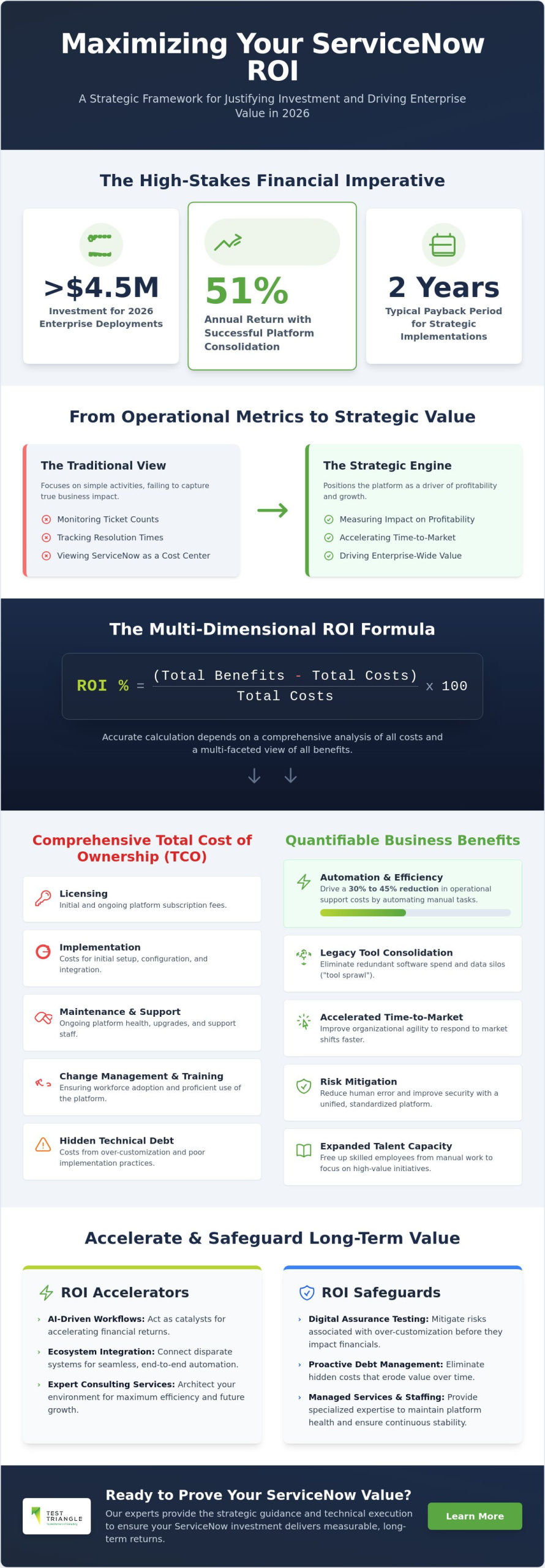
While enterprise deployments in 2026 can require investments exceeding $4.5 million, organizations that successfully execute platform consolidation are realizing an annual return of 51% and a two year payback period. It’s a significant figure that highlights the platform’s potential, yet many leaders still struggle with calculating ServiceNow implementation roi because traditional metrics often fail to capture the nuances of digital transformation. You likely recognize that ServiceNow is more than a ticketing tool; it’s a strategic engine for growth. However, the constant pressure to justify escalating licensing fees while managing the hidden costs of technical debt can make financial validation feel like a moving target.
We’ve designed this framework to bridge the gap between technical execution and executive accountability by providing a clear reporting structure for your investment. You’ll learn how to quantify soft benefits such as user experience improvements, identify the automation areas that drive a 30% to 45% reduction in operational support costs, and validate the consolidation of redundant legacy tools. This guide moves beyond static spreadsheets to offer a dynamic methodology, ensuring you can secure long term operational stability and prove that your ServiceNow roadmap is a disciplined driver of enterprise value.
Key Takeaways
- Transition from monitoring basic operational activities to measuring strategic business value to ensure your platform investment aligns with 2026 enterprise objectives.
- Master a multi-dimensional framework for calculating servicenow implementation roi that accurately accounts for both direct cost reductions and indirect productivity enhancements.
- Identify how AI-driven workflows and broader digital transformation services act as catalysts for accelerating financial returns and expanding organizational talent capacity.
- Safeguard your long-term financial outcomes by implementing rigorous digital assurance testing to mitigate the risks associated with over-customization and technical debt.
- Explore how managed services and strategic IT staffing provide the specialized expertise required to maintain platform health and drive continuous operational stability.
The Strategic Imperative of Quantifying ServiceNow Business Value
In the high-stakes corporate environment of 2026, a standard Return on Investment (ROI) calculation is no longer sufficient to justify the scale of enterprise software commitments. Leaders must define ServiceNow ROI as the measurable impact of digitized workflows on overall enterprise profitability. This shift is essential because current market dynamics demand a transition from monitoring simple operational activities to identifying strategic value drivers that empower global growth. By moving beyond the narrow scope of ticket counts, organizations can position ServiceNow as a steady hand that guides the enterprise through technological volatility while ensuring long-term operational stability.
Establishing a baseline for calculating ServiceNow implementation roi requires a clear distinction between activity and value. While resolving a high volume of tickets suggests a productive service desk, it doesn’t necessarily correlate with financial gain if those tickets represent avoidable friction or redundant manual work. True value is realized when automation reduces the cost per transaction and mitigates the risks associated with human error. This approach transforms the platform from a back-office expense into a disciplined engine for strategy, execution, and success.
Shifting from Operational Metrics to Strategic Outcomes
While ticket resolution time remains a common KPI, it’s a surface-level metric that fails to capture the needs of modern enterprises. For global organizations, the more critical metric is the connection between workflow speed and the time-to-market for new business services. When you leverage ServiceNow consulting services to architect your environment, you aren’t just fixing IT issues; you’re accelerating the entire organization’s ability to respond to market shifts. Platform consolidation plays a vital role here by eliminating the redundant software spend and data silos that often plague large-scale digital infrastructures. Reducing this “tool sprawl” provides the peace of mind that comes from a unified, secure, and highly efficient digital ecosystem.
The Total Cost of Ownership (TCO) Equation
A comprehensive approach to calculating ServiceNow implementation roi must account for the full Total Cost of Ownership, which extends far beyond initial licensing. You’ve got to factor in the implementation phase, ongoing platform maintenance, and the inevitable costs of organizational change management. Many enterprises find that the balance between internal staffing and external expertise significantly impacts the TCO baseline. Utilizing managed outsourcing services often proves more cost-effective than maintaining a massive internal team, as it provides access to specialized skills without the overhead of full-time recruitment. Furthermore, don’t overlook the cost of training; ensuring your workforce is empowered to use the platform’s advanced automation is the only way to safeguard your investment and drive the precision, performance, and peace of mind your stakeholders expect.
A Multi-Dimensional Formula for Calculating Implementation ROI
To move beyond anecdotal evidence of success, organizations must adopt a rigorous mathematical approach to financial validation. The standard formula for calculating ServiceNow implementation roi is expressed as: (Total Benefits – Total Costs) / Total Costs x 100. While the equation appears straightforward, its accuracy depends on a comprehensive Total Cost of Ownership (TCO) calculation that accounts for licensing, implementation, and the organizational change management required for adoption. In the context of 2026 enterprise deployments, ServiceNow ROI acts as a longitudinal measure of platform maturity and cost recovery, reflecting an organization’s ability to extract continuous value from digitized workflows over time.
Time to Value (TTV) is a critical component of this framework, particularly for large scale deployments that may span 9 to 12 months. Shortening the TTV ensures that the organization begins realizing cost offsets earlier in the lifecycle, which is vital for maintaining stakeholder confidence. If you’re looking to refine your specific financial model, you might consider how our ServiceNow consulting services can help align these metrics with your broader corporate objectives.
Quantifying Direct Cost Savings
Direct savings provide the most immediate evidence of fiscal discipline. By automating incident management and request fulfillment, organizations can achieve a 35% to 50% reduction in IT labor hours, allowing staff to pivot toward innovation. Furthermore, properly architected deployments typically see a 30% to 50% decrease in Mean Time to Repair (MTTR) within the first six months, which significantly reduces the financial impact of system downtime. Platform consolidation further strengthens the balance sheet; by eliminating the maintenance fees of redundant legacy tools, CIOs can realize an annual ROI of approximately 51%. This systematic approach ensures stability, scalability, and success across the digital infrastructure.
Measuring Indirect Productivity Gains
Indirect gains often represent the largest portion of long term value, though they require more nuanced tracking. Improved employee self-service adoption is a primary driver here; when mature knowledge management and AI assisted workflows are in place, First Contact Resolution (FCR) rates should exceed 70%. This shift reduces administrative friction by allowing cross-departmental workflows to trigger automatically, bypassing manual bottlenecks. We also recommend quantifying the “Experience Factor,” which measures the productivity boost derived from high quality internal and customer interactions. When employees spend less time navigating complex legacy processes, they’re empowered to focus on strategic growth. To explore how these metrics apply to your unique environment, you can reach out to our strategic team for a detailed assessment.
Accelerating Returns through Ecosystem Integration and AI
ServiceNow serves as a powerful catalyst for broader Digital Transformation Services, acting as the connective tissue between disparate enterprise systems. When you integrate ServiceNow with ecosystems like AWS and Atlassian, you create a multiplier effect that significantly enhances the value of each individual platform. This interconnectedness is a pivotal factor when calculating ServiceNow implementation roi, as the returns are no longer confined to IT service management but extend across the entire software development lifecycle. By leveraging DevOps Consulting to align these tools, organizations can accelerate release cycles and ensure that technical execution directly supports business agility.
One of the most profound, yet frequently overlooked, benefits is the ROI of Talent Capacity. By automating the mundane, repetitive tasks that consume your workforce’s time, you empower your existing staff to focus on high-value innovation. This transition from “keeping the lights on” to driving strategic growth provides a sense of empowerment and institutional maturity. It’s about more than just saving hours; it’s about repurposing human expertise to solve complex challenges that a machine cannot, thereby securing your company’s long-term competitive advantage through stability, precision, and scalable growth.
The ROI of Platform Integration
The value of seamless data synchronization between ServiceNow and DevOps tools cannot be overstated. When information flows freely between platforms, you effectively eliminate the data silos that lead to miscommunication and project delays. This integration reduces “swivel-chair management,” where employees manually copy data from one system to another; this process is both inefficient and prone to error. By automating these handoffs, enterprises see a marked improvement in operational precision. This level of coordination ensures that every stakeholder operates from a single source of truth, fostering a culture of reliability and trust.
AI and Machine Learning Returns
The adoption of AI and Machine Learning within the ServiceNow platform offers some of the most quantifiable returns in 2026. Virtual Agents and Predictive Intelligence are no longer experimental; they’re essential tools for handling high-volume requests without human intervention. Mature enterprises report up to a 99.2% reduction in event noise through AIOps, which allows IT teams to ignore the clutter and focus on genuine threats. This AI-driven root cause analysis can cut Mean Time to Resolution (MTTR) by as much as 50%, directly impacting system stability and user satisfaction. Additionally, the role of GenAI in reducing the time required for documentation and knowledge base creation further accelerates the recovery of your initial investment, making the process of calculating ServiceNow implementation roi a clear demonstration of technological evolution.
Safeguarding ROI: Eliminating Technical Debt and Implementation Pitfalls
The mathematical model for calculating ServiceNow implementation roi is only as resilient as the platform’s underlying architecture. While the initial business case often focuses on immediate automation gains, long term financial success is frequently compromised by the silent accumulation of technical debt. Over-customization stands as the primary driver of this value erosion; when organizations deviate too far from standard features to satisfy niche departmental requests, they inadvertently create a rigid environment that is expensive to maintain and difficult to evolve. This complexity often leads to “shadow IT” workarounds, where frustrated users return to manual spreadsheets, effectively nullifying the productivity gains promised during the planning phase.
It’s a common misconception to view ServiceNow implementation as a one-and-done capital expense. In reality, the platform requires a disciplined, evergreen approach to ensure that the cost of recovery doesn’t eventually exceed the value of the digitized workflows. Organizations that fail to account for the ongoing necessity of platform health checks often see their ROI drop by 40% to 60% due to scope creep and technical inefficiencies. To ensure your investment remains a strategic asset rather than a legacy burden, you can consult with our architectural experts for a comprehensive platform audit.
The High Cost of Technical Debt
Custom code acts as a heavy anchor during the twice yearly ServiceNow upgrade cycle, significantly increasing the labor hours required for testing and remediation. To maintain a high “Upgradeability Score,” strategic leaders are increasingly prioritizing a return to Out-of-the-Box (OOTB) functionality. This methodology ensures that the enterprise can immediately leverage new features, such as advanced AI capabilities, without being held back by bespoke scripts that break during version transitions. By treating OOTB as a mandatory standard, you protect the platform’s institutional maturity and ensure that your TCO remains predictable and manageable.
Assurance and Testing as ROI Safeguards
The cost of poor quality is a direct hit to your bottom line, making Software and Digital Assurance Testing an essential protector of your investment. Automated regression testing is particularly vital for every new release, as it provides the peace of mind that existing workflows remain intact while new features are deployed. While automation handles the repetitive checks, Manual Testing remains indispensable for validating complex user journeys and ensuring that the human experience matches technical expectations. This rigorous QA approach prevents production defects that would otherwise result in costly system downtime and lost employee productivity, effectively safeguarding the precision and performance of your digital infrastructure.
Optimising Long-Term ROI with Managed Services and Flexible Staffing
Achieving a sustainable return requires more than just a successful initial deployment; it demands a resource strategy that balances technical rigor with fiscal agility. While the mathematical framework for calculating ServiceNow implementation roi accounts for licensing and technical debt, the long term trajectory of that value is often determined by the quality of ongoing support. By positioning ServiceNow Consulting Services as the bridge between operational costs and business value, enterprises can ensure that their digital infrastructure remains aligned with evolving corporate objectives. This disciplined approach provides the peace of mind that comes from knowing your platform is managed by experts who prioritize resilience, reliability, and return.
Managed Services vs. In-House Maintenance
Transitioning to a fixed-fee model through Managed Outsourcing Services offers a predictable cost structure that is often superior to the variable expenses of internal hiring. When you maintain a large in-house team, you’re responsible for recruitment, training, and retention in a highly competitive market for ServiceNow specialists. Conversely, a managed service provider grants you immediate access to global expertise, including remote and offshore resources that can provide round-the-clock support without the overhead of permanent headcount. This continuous optimisation prevents platform stagnation, ensuring that your environment is always leveraging the latest automation capabilities to drive cost recovery.
Scaling with Flexible Staffing Models
Specific industries require specialized knowledge to maintain compliance and quality standards. For instance, highly regulated sectors often turn to IT staffing agencies for pharmaceutical industry requirements to find vetted professionals who understand the nuances of GxP compliance within ServiceNow. Utilizing Staffing Solutions allows you to scale your team with “just-in-time” talent for specific implementation phases or complex upgrades. This flexibility is a vital component when calculating ServiceNow implementation roi, as it reduces placement fees and allows you to pay only for the specialized skills you need, when you need them.
Ultimately, the path to long term success is paved through partnership. By choosing a reliable long-term collaborator, you move beyond the role of a service consumer and become a strategic partner in your own technological evolution. This collaborative spirit ensures that your ServiceNow investment continues to deliver operational stability and measurable profitability through a combination of human expertise and technical precision. We remain committed to your long term growth, providing the steady hand needed to navigate a fast changing technological landscape with strategy, support, and success.
Driving Sustained Enterprise Value Through Strategic Platform Governance
When organizations navigate the complexities of the 2026 digital landscape, calculating ServiceNow implementation roi must evolve from a one-time audit into a continuous discipline of value realization. By prioritizing out-of-the-box functionality to mitigate technical debt and integrating AI-driven workflows to enhance talent capacity, enterprise leaders can transform their digital infrastructure into a resilient engine for profitability. Achieving this level of institutional maturity requires a steady hand and a reliable long-term collaborator who understands the intricate requirements of highly regulated industries like Pharma and Finance.
As an Authorized ServiceNow and Atlassian Partner, we provide a global delivery model that leverages offshore cost advantages to deliver precision, performance, and peace of mind. Our approach ensures that your technological evolution is managed with the specialized expertise necessary to safeguard your investment and drive scalable growth. Maximize your platform value with our ServiceNow Consulting Services and secure the operational stability your enterprise deserves. We look forward to supporting your journey toward digital excellence and long-term success.
Frequently Asked Questions
How long does it typically take to see a positive ROI from ServiceNow?
Most global enterprises realize a full return on their investment within a 24 month period. While initial operational improvements such as labor hour recovery often manifest within the first six months, the break-even point typically occurs once the organization has successfully executed platform consolidation and moved into a state of continuous optimization. This timeline ensures that the stabilization phase is complete and the compounding benefits of automated governance are fully realized.
What are the most important KPIs for measuring ServiceNow implementation success?
Success is measured through a sophisticated blend of financial and operational indicators, specifically Mean Time to Resolution (MTTR), labor hour recovery, and the total reduction in legacy tool licensing fees. Strategic leaders also prioritize tracking First Contact Resolution (FCR) rates and self-service adoption levels. These metrics provide a comprehensive view of how digitized workflows are reducing administrative friction and empowering the workforce to focus on high-value innovation.
Does over-customising ServiceNow really decrease its long-term ROI?
Extensive customization significantly erodes long term value by increasing the technical debt and labor costs associated with bi-annual platform upgrades. By deviating from out-of-the-box functionality, organizations create a rigid environment that requires manual remediation during every version transition, which eventually inflates the Total Cost of Ownership. Maintaining architectural discipline ensures the platform remains agile and capable of adopting new features, such as advanced AI, without costly bespoke re-engineering.
How can I calculate the ROI of ServiceNow AI and automation features?
Evaluating the impact of AI involves measuring ticket deflection rates through virtual agents and the reduction in event noise provided by AIOps. When calculating ServiceNow implementation roi for these advanced modules, it’s essential to quantify the talent capacity gained by your technical staff. Shifting human expertise from routine alert management to strategic growth projects represents a substantial gain in organizational productivity and institutional maturity.
Is it better to use an MSP or in-house staff for ServiceNow maintenance to maximize ROI?
Utilizing a Managed Service Provider (MSP) often delivers a more predictable return by replacing variable internal recruitment and training costs with a disciplined, fixed-fee model. This strategic approach provides immediate access to a global pool of certified specialists, ensuring that platform maintenance is handled with precision and reliability. While in-house teams offer internal proximity, the MSP model typically fosters greater operational stability through continuous, expert-led optimization and risk reduction.
What is the role of testing and QA in protecting ServiceNow investment value?
Rigorous digital assurance acts as a critical safeguard that prevents production defects from compromising system availability and user trust. Automated regression testing ensures that new releases don’t disrupt established workflows, while manual validation protects the integrity of complex user journeys. By preventing unplanned downtime and the associated loss of employee productivity, a disciplined testing strategy directly protects the financial integrity of your large-scale technological evolution.
How do I justify the recurring licensing costs of ServiceNow to my CFO?
Justifying recurring fees requires framing ServiceNow as a unified platform that drives cost recovery through the consolidation of redundant legacy software. You should highlight the potential for a 51% annual ROI and the 30% to 45% reduction in operational support costs achieved through mature ITSM automation. Demonstrating how the platform acts as a steady hand that reduces enterprise risk allows executive leadership to view licensing as a strategic investment in long-term success.
Can ServiceNow ROI be measured across non-IT departments like HR or Legal?
Measuring calculating ServiceNow implementation roi across non-IT functions is highly effective when focusing on metrics such as onboarding speed and case resolution efficiency. Organizations utilizing HR Service Delivery frequently report a 60% to 75% improvement in new hire onboarding time, which significantly reduces administrative bottlenecks. These cross-departmental efficiencies ensure that the benefits of digitized workflows are felt across the entire enterprise, providing a consistent and empowered experience for all employees.

Article by
Paul Guy
Paul serves as the Marketing Director at Test Triangle, where he leads a global team in driving growth through strategic B2B marketing and brand communications. With a strong emphasis on measurable outcomes and sustainable performance, he plays a pivotal role in aligning marketing functions to enhance customer engagement and accelerate business impact. Under his leadership, marketing initiatives have consistently delivered significant returns on investment, elevated brand visibility, and strengthened the company's presence across key markets.