



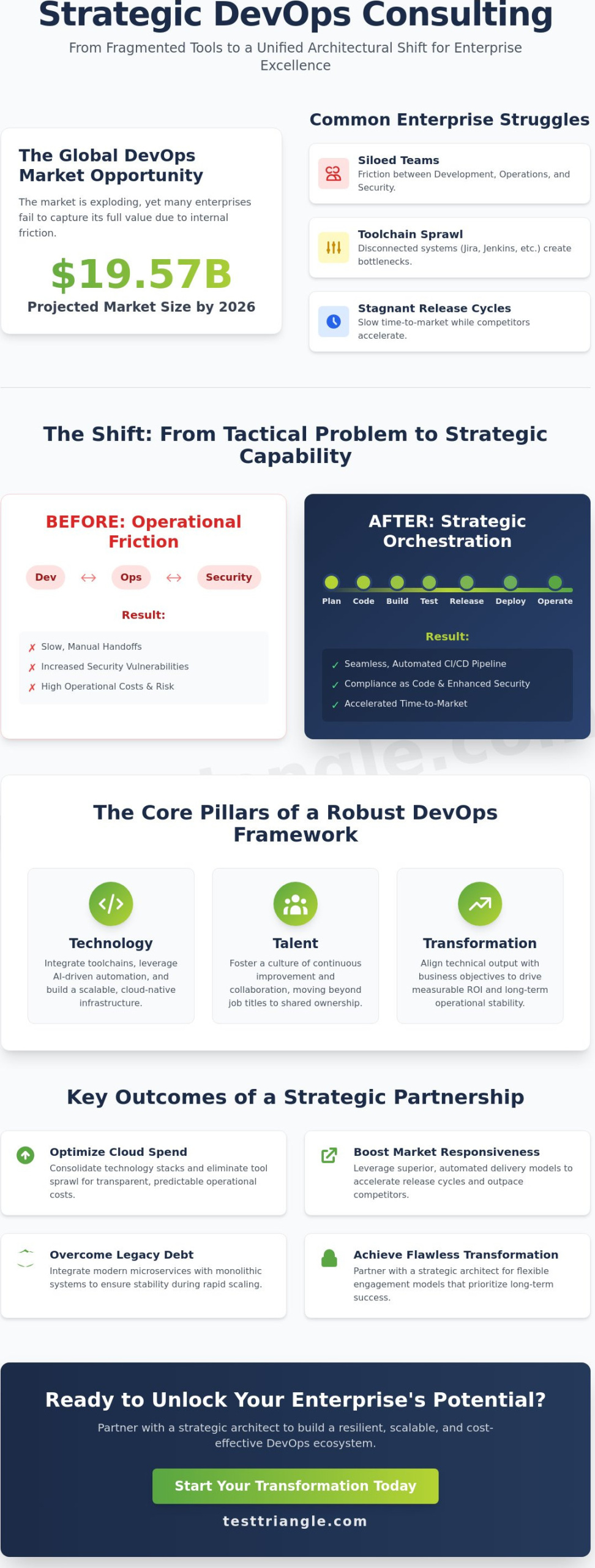
With the global DevOps market projected to reach up to $19.57 billion by the end of 2026, why do so many enterprises still struggle with siloed teams and stagnant release cycles? Many organizations invest heavily in the latest versions of Jenkins 2.563 or Docker 29.4.3, yet they fail to achieve the operational excellence they were promised. Strategic DevOps Consulting bridges this gap by shifting the focus from a mere technical patch to a comprehensive architectural shift. By combining technical expertise with adaptable delivery models, a trusted partner helps you move beyond basic automation toward a scalable, secure, and cost-effective delivery model.
It’s frustrating to see security vulnerabilities or talent shortages stall your digital evolution while competitors accelerate their time-to-market. We believe that true transformation requires a disciplined balance of Technology, Talent, and Transformation to drive superior business outcomes. This guide explores how strategic alignment elevates your CI/CD pipeline, automates compliance as code, and leverages AI-driven automation to create a robust, cloud-native infrastructure. You’ll discover the roadmap to transparent operational costs and a culture of continuous improvement that ensures your digital workloads, 95% of which are now cloud-native, remain resilient and high-performing.
Key Takeaways
- Transition from viewing DevOps as a simple job description to a sophisticated strategic capability that aligns your technical output with overarching business objectives.
- Implement the triad of Technology, Talent, and Transformation to build a resilient framework capable of navigating the stringent requirements of the life sciences and finance sectors.
- Leverage professional DevOps Consulting to optimize your cloud spend while boosting market responsiveness through superior, automated delivery models.
- Overcome the friction of legacy debt by integrating modern microservices with monolithic systems to ensure your infrastructure remains stable during rapid scaling.
- Partner with a strategic architect to access flexible engagement models that prioritize long-term operational stability and a flawless digital transformation.
What is DevOps Consulting in the Modern Enterprise Landscape?
Professional DevOps Consulting functions as a high-level strategic advisory service, purposefully designed to bridge the structural and cultural gaps between software development and IT operations. While the industry once viewed What is DevOps? as a specific job title, the landscape in 2026 treats it as a critical strategic capability that dictates an organization’s competitive edge. Most enterprises begin their journey in a state of operational friction, characterized by fragmented toolchains and siloed communication that hinder the flow of value. By implementing a unified framework, consultants transform these disparate elements into a seamless, automated, and secure delivery pipeline that drives tangible business value.
The entry state for many global firms is often a “toolchain sprawl” where disparate systems like Jira, ServiceNow, and various CI/CD tools don’t communicate effectively. This fragmentation leads to slow release cycles and security vulnerabilities that expose the business to significant risk. The primary goal of a modern advisory partner is to eliminate these bottlenecks by creating a “single pane of glass” for operational visibility. By combining technical expertise with adaptable delivery models, Test Triangle helps businesses reduce costs and elevate their deployment frequency without compromising on security or stability.
The Evolution of DevOps: From Automation to Strategic Orchestration
Modern practices have transcended the era of manual Jenkins scripts and basic Docker containers, moving toward AI-driven orchestration and NoOps concepts. Strategic Orchestration is the precise alignment of business goals with automated infrastructure. This ensures that every code deployment directly supports the bottom line. Unlike traditional IT consulting that often focuses on isolated technical tasks, a holistic DevOps Consulting approach prioritizes the triad of Technology, Talent, and Transformation. This ensures that the digital infrastructure is not just functional but also inherently scalable and resilient against the demands of a fast-changing technological landscape.
Why Enterprises Require a Strategic Architect for Digital Transformation
Managing complex multi-cloud environments across platforms like AWS and Azure requires more than technical proficiency; it demands a visionary architect. Organizations often fall victim to tool sprawl, where an excess of uncoordinated software leads to soaring costs and security gaps. By leveraging managed outsourcing services, enterprises can consolidate their technology stack under the guidance of a Strategic Architect. This persona serves as the essential link between C-suite ROI expectations and the daily realities of developer workflows, mitigating risks while accelerating the pace of digital transformation across the enterprise.
The Core Pillars of a Robust DevOps Consulting Framework
To achieve operational excellence in 2026, a robust DevOps Consulting framework must rest upon three foundational pillars: Technology, Talent, and Transformation. This triad ensures that digital transformation isn’t merely a technical upgrade but a strategic alignment of organizational assets. By tailoring this framework to the specific regulatory demands of sectors like finance or healthcare, a Strategic Architect provides the precision required for high-stakes environments. A security-first mindset and continuous feedback loops further strengthen the ecosystem, ensuring that improvements are iterative and risks are mitigated in real-time. This holistic approach prevents the common pitfall of treating DevOps as a series of isolated tasks rather than a unified business capability.
Technology: Integrating Atlassian and ServiceNow Ecosystems
By integrating a comprehensive Atlassian implementation with ServiceNow consulting services, enterprises create a unified ecosystem for collaboration and incident management. This synergy addresses the common gap where development velocity outpaces operational oversight, leading to friction during releases. Jira Service Management acts as the bridge between development velocity and operational stability, ensuring that change management remains fluid yet controlled. When these platforms are synchronized, the resulting visibility allows for a flawless flow of information across the entire software development life cycle (SDLC).
Talent: Bridging the Skills Gap with Flexible Staffing Models
Finding specialized DevOps engineering talent remains a primary obstacle for many global firms operating in a competitive market. By leveraging flexible staffing solutions, including offshore and remote resources, organizations can fill critical skills gaps without the overhead of traditional long-term hiring. Expert consultants do more than just provide temporary labor; they offer essential mentorship to internal teams to ensure long-term sustainability. This transfer of knowledge empowers your existing workforce, turning a temporary staffing need into a permanent upgrade of your internal technical culture.
Transformation: DevSecOps and Regulatory Compliance
DevSecOps represents the essential integration of security at every stage of the software development life cycle. This practice is particularly vital for highly regulated sectors such as the pharmaceutical industry, where data integrity and compliance are non-negotiable. Automated compliance checks reduce the “audit tax” on development teams, allowing them to focus on innovation rather than manual paperwork. Understanding the challenges of scaling DevOps within large, rigid structures is key to overcoming legacy inertia. By codifying security policies, a Trusted Partner ensures that your infrastructure remains robust and compliant by design. If your organization is ready to move beyond basic automation, you might consider how a tailored consultation can refine your delivery model and drive strategic growth.
Calculating the Business Value: ROI and Performance Metrics
Quantifying the success of a digital evolution requires moving beyond simple speed metrics to focus on business resilience and market responsiveness. While faster deployments are a welcome byproduct, the true value of DevOps Consulting lies in its ability to align technical output with organizational stability. By reducing the Total Cost of Ownership (TCO) of cloud infrastructure, a strategic advisory partner ensures that every dollar spent on AWS or Azure translates into a measurable competitive advantage. Enterprises that fail to modernize often face a steep “cost of inaction,” where revenue is lost to preventable downtime and sluggish release cycles that allow competitors to seize market share.
By leveraging managed outsourcing services, organizations can replace unpredictable IT spending with transparent, scalable cost structures. This financial predictability is essential for C-suite executives who need to justify transformation budgets. A robust DevOps consulting framework provides the necessary roadmap to transition from a reactive “firefighting” mode to a proactive, value-driven operations model. This shift doesn’t just save money; it empowers teams to innovate without the fear of systemic failure.
Measuring Success with DORA Metrics
To achieve a flawless view of organizational performance, we utilize the four key DORA metrics: Deployment Frequency, Lead Time for Changes, Change Failure Rate, and Time to Restore Service. These data points offer stakeholders a transparent look at how efficiently the engineering team delivers value. By shifting the focus from vanity metrics to these core indicators, leadership can make informed decisions about where to allocate resources for maximum impact.
| Metric Category | Traditional IT Focus | DevOps-Driven Business Value |
|---|---|---|
| Release Velocity | Scheduled quarterly releases | On-demand deployment frequency |
| Quality Assurance | Manual bug tracking | Automated change failure rate reduction |
| Recovery Speed | Reactive troubleshooting | Proactive time to restore service |
| Financial Impact | High Capital Expenditure (CapEx) | Optimized Operational Expenditure (OpEx) |
Operational Efficiency and Cloud Cost Optimization
Effective DevOps Consulting integrates FinOps principles to ensure that cloud environments remain lean and efficient. Through the implementation of Infrastructure as Code (IaC), teams can provision resources automatically, which significantly reduces manual errors and resource waste. This level of precision is particularly important for Application Development projects that are architected for cloud-native efficiency from the ground up. By automating the lifecycle of cloud assets, enterprises can drive superior operational excellence while maintaining strict control over their global digital footprint.
Navigating the Challenges of Scaling DevOps in Large Organizations
Large-scale enterprises often face a unique set of hurdles that smaller, more agile firms don’t encounter. The most frequent objection encountered during DevOps Consulting engagements is the belief that the organizational culture isn’t ready for such a radical shift. This cultural inertia is often compounded by significant legacy debt, where modern pipelines must be integrated with older, monolithic systems that weren’t designed for continuous delivery. Rather than attempting a “big bang” implementation that risks systemic failure, we advocate for a phased roadmap. This methodical approach allows for iterative wins, ensuring that the transformation remains manageable and aligned with long-term business goals.
Another persistent challenge is the “security bottleneck,” where security teams are traditionally perceived as the “department of No.” In a high-stakes corporate environment, security cannot be an afterthought or a final gate that slows down the entire release cycle. By integrating security into the initial design phase, a Strategic Architect helps you move toward a model where compliance is automated and transparent. This shift doesn’t just accelerate delivery; it creates a more robust and resilient infrastructure that can withstand the complexities of a global digital footprint.
Overcoming Cultural Inertia and Siloed Mindsets
Breaking down silos requires a transition to a “Shared Responsibility” model where developers and operations teams share the same KPIs. When both groups are incentivized to prioritize stability and speed equally, the friction between “building” and “running” software begins to dissolve. Many organizations are now leveraging Internal Developer Platforms (IDP) to reduce the cognitive load on engineering teams, providing them with self-service tools that adhere to organizational standards. It’s vital to remember that executive sponsorship is the single most important factor in DevOps transformation success. Without a clear mandate from leadership, even the best technical tools will fail to deliver their full potential.
Modernizing Legacy Systems for Continuous Delivery
Modernizing monolithic systems doesn’t require a total rewrite from day one. We often utilize the “Strangler Fig Pattern” to gradually migrate functionality from old systems to new microservices, ensuring that the business remains operational throughout the transition. During this delicate process, software and digital assurance testing plays a critical role in maintaining stability and preventing regressions. High-quality software test automation services are also essential to maintain rigorous standards during periods of rapid scaling. By combining technical precision with a disciplined transformation strategy, you can bridge the gap between your legacy past and a cloud-native future. If you’re ready to address these challenges head-on, you can schedule a consultation to begin building your strategic roadmap.
Test Triangle: Your Trusted Partner in Strategic DevOps Transformation
By centering our methodology on the triad of Technology, Talent, and Transformation, Test Triangle provides a comprehensive framework for enterprise success. We position ourselves as a Trusted Partner that understands the intricate regulatory and operational nuances of the Banking, Healthcare, and Retail sectors. Our global reach is balanced by deep technical expertise in industry-leading platforms, ensuring that your DevOps Consulting engagement is anchored in recognized global standards. We help organizations move beyond the consideration phase by providing the strategic clarity needed to execute complex digital shifts with confidence and precision.
Our approach ensures that we aren’t just delivering a static report; we function as Strategic Architects who build the actual pipelines and train your internal talent for long-term sustainability. This hands-on methodology is supported by flexible engagement models that range from targeted staffing solutions to full managed outsourcing services. As a proud client of Enterprise Ireland, we maintain a level of institutional maturity that reassures global corporations their infrastructure is in capable hands. We leverage our proficiency in Atlassian implementation and ServiceNow consulting services to create a unified ecosystem that bridges the gap between development speed and operational stability.
Why Our Strategic Architect Approach Drives Results
We don’t believe in one-size-fits-all solutions. Our consultants work within your specific ecosystem to optimize workflows and eliminate the “tool sprawl” that often hinders large-scale enterprises. By integrating Jira Service Management and other partner tools directly into our service descriptions, we signal that our voice is inseparable from the industry-leading platforms we support. This ensures that your transformation is not just a technical upgrade but a strategic alignment of your entire IT service management landscape.
Next Steps: Embarking on Your DevOps Maturity Journey
Embarking on a maturity journey requires a clear, actionable plan. A typical DevOps Consulting engagement with Test Triangle follows a disciplined 30-60-90 day roadmap designed to deliver immediate value:
- Days 1-30: Conduct a comprehensive DevOps Maturity Assessment to identify quick wins and baseline metrics.
- Days 31-60: Implement core automation pipelines and integrate critical ITSM tools to enhance visibility.
- Days 61-90: Scale these practices across departments and establish continuous feedback loops for long-term health.
This structured progression ensures that transformation is iterative rather than disruptive. By starting with a maturity assessment, we identify the specific bottlenecks that hinder your progress and develop a tailored strategy to eliminate them. It’s time to elevate your operational excellence and drive scalable business outcomes. Contact Test Triangle today to schedule your strategic DevOps assessment and take the first step toward a flawless digital future.
Architecting a Resilient Future Through Strategic Orchestration
Navigating the complexities of a cloud-native landscape requires more than just modern tools; it demands a disciplined alignment of organizational assets. By prioritizing the triad of Technology, Talent, and Transformation, enterprises can successfully bridge the gap between development velocity and operational stability. We’ve explored how professional DevOps Consulting provides a roadmap to mitigate risks, optimize cloud spend, and overcome the cultural inertia that often stalls large-scale digital evolution. It’s essential to focus on building a robust delivery pipeline that drives measurable business value through superior technical execution.
As an Atlassian Gold Solution Partner and ServiceNow Implementation Specialist, Test Triangle serves as a Trusted Partner for global firms in the finance, healthcare, and pharmaceutical sectors. Our global presence ensures that we understand the stringent compliance needs of highly regulated industries. By leveraging our flexible engagement models, you can access the specialized expertise required to drive flawless results and maintain a competitive edge. Accelerate your digital transformation with Test Triangle’s expert DevOps consulting. We’re ready to help you turn your strategic vision into a scalable, high-performing reality.
Frequently Asked Questions
What is the primary difference between DevOps consulting and staff augmentation?
DevOps Consulting provides a high-level strategic framework and architectural guidance, whereas staff augmentation focuses on filling specific technical roles within an existing team. While staffing provides the necessary talent to execute tasks, consulting addresses the underlying transformation of processes and culture. This dual approach ensures that you have both the visionary leadership and the practical capacity required to achieve long-term operational stability.
How long does a typical DevOps transformation project take to show ROI?
Most organizations begin to see a measurable return on investment within three to six months of initiating a strategic engagement. Initial wins usually stem from automating repetitive manual tasks and reducing deployment errors, which immediately lowers operational friction. Achieving full enterprise-wide maturity and maximum cost optimization typically requires a sustained commitment of twelve to eighteen months, depending on the complexity of your legacy infrastructure.
Can DevOps consulting help with regulatory compliance in the pharmaceutical industry?
Yes, strategic advisory services are essential for codifying security policies and ensuring continuous compliance in highly regulated sectors like the pharmaceutical industry. By automating validation processes and creating machine-readable audit trails, consultants help reduce the manual burden of regulatory documentation. This approach ensures that your delivery pipeline remains robust and compliant with global standards without sacrificing development velocity.
What tools are essential for a modern enterprise DevOps stack in 2026?
The modern enterprise stack in 2026 relies on a combination of open-source dominance and AI-driven orchestration tools. Essential components include Kubernetes 1.36.0 for container orchestration, Terraform 1.15.2 for infrastructure as code, and Docker 29.4.3 for containerization. Integrating these with the latest stable version of Jenkins 2.563 ensures a flawless, automated delivery pipeline that supports autonomous agents and predictive analytics.
Do we need to migrate to the cloud before hiring a DevOps consultant?
You don’t need to complete a cloud migration before engaging a consultant; in fact, hiring an expert early ensures that your migration strategy is architected for cloud-native efficiency. A consultant helps you decide between “lift-and-shift” and refactoring approaches based on your long-term business goals. For organizations planning a move to Amazon Web Services, following a structured AWS Cloud Migration strategy ensures that your transition is precise, cost-effective, and aligned with your DevOps maturity goals. This proactive guidance prevents the common mistake of simply moving legacy inefficiencies into a more expensive cloud environment.
How does DevOps consulting improve software security and DevSecOps?
Consulting improves security by shifting vulnerability scanning and policy enforcement to the earliest stages of the software development life cycle. This practice, known as DevSecOps, integrates automated dependency checks and secret management directly into the CI/CD pipeline. By codifying security rules, you ensure that every code deployment is inherently secure and resilient against emerging threats.
What are the common pitfalls of scaling DevOps across a global organization?
The primary pitfalls of scaling across a global organization include inconsistent technical standards and the “tool sprawl” that occurs when regional teams adopt disparate platforms. Without a unified strategy, these silos create friction and increase the total cost of ownership. A strategic partner harmonizes these efforts by establishing a centralized Internal Developer Platform that provides self-service access to standardized tools.
How do you measure the success of a DevOps consulting engagement?
Success is measured by tangible business outcomes such as improved market responsiveness, transparent operational costs, and enhanced system resilience. While technical indicators are important, the ultimate goal is to achieve a culture of continuous improvement where technology and talent are perfectly aligned. A successful engagement results in a digital infrastructure that’s not only faster but also more secure and cost-effective. To better understand how DevOps engineering myths can stall enterprise transformation, exploring the common misconceptions that prevent organizations from realizing their full potential is an essential step in any maturity journey.

Article by
Paul Guy
Paul serves as the Marketing Director at Test Triangle, where he leads a global team in driving growth through strategic B2B marketing and brand communications. With a strong emphasis on measurable outcomes and sustainable performance, he plays a pivotal role in aligning marketing functions to enhance customer engagement and accelerate business impact. Under his leadership, marketing initiatives have consistently delivered significant returns on investment, elevated brand visibility, and strengthened the company's presence across key markets.