
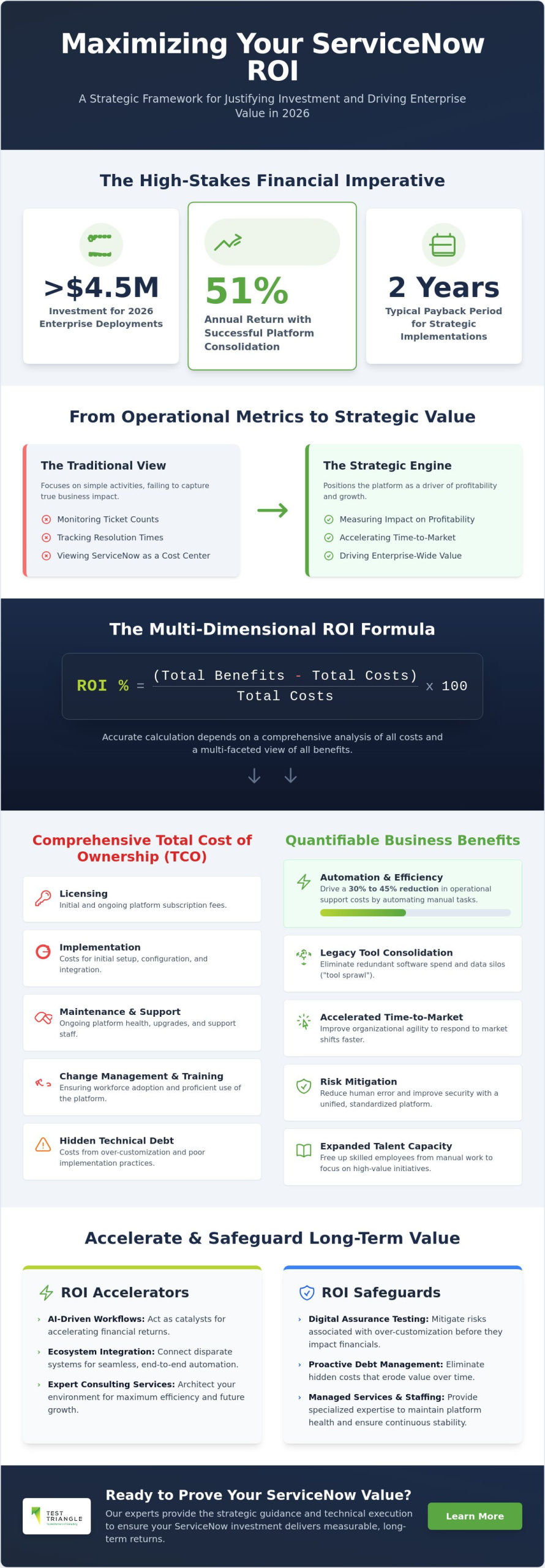
While enterprise deployments in 2026 can require investments exceeding $4.5 million, organizations that successfully execute platform consolidation are realizing an annual return of 51% and a two year payback period. It’s a significant figure that highlights the platform’s potential, yet many leaders still struggle with calculating ServiceNow implementation roi because traditional metrics often fail to capture the nuances of digital transformation. You likely recognize that ServiceNow is more than a ticketing tool; it’s a strategic engine for growth. However, the constant pressure to justify escalating licensing fees while managing the hidden costs of technical debt can make financial validation feel like a moving target.

We’ve designed this framework to bridge the gap between technical execution and executive accountability by providing a clear reporting structure for your investment. You’ll learn how to quantify soft benefits such as user experience improvements, identify the automation areas that drive a 30% to 45% reduction in operational support costs, and validate the consolidation of redundant legacy tools. This guide moves beyond static spreadsheets to offer a dynamic methodology, ensuring you can secure long term operational stability and prove that your ServiceNow roadmap is a disciplined driver of enterprise value.

Key Takeaways

  • Transition from monitoring basic operational activities to measuring strategic business value to ensure your platform investment aligns with 2026 enterprise objectives.
  • Master a multi-dimensional framework for calculating servicenow implementation roi that accurately accounts for both direct cost reductions and indirect productivity enhancements.
  • Identify how AI-driven workflows and broader digital transformation services act as catalysts for accelerating financial returns and expanding organizational talent capacity.
  • Safeguard your long-term financial outcomes by implementing rigorous digital assurance testing to mitigate the risks associated with over-customization and technical debt.
  • Explore how managed services and strategic IT staffing provide the specialized expertise required to maintain platform health and drive continuous operational stability.

The Strategic Imperative of Quantifying ServiceNow Business Value

In the high-stakes corporate environment of 2026, a standard Return on Investment (ROI) calculation is no longer sufficient to justify the scale of enterprise software commitments. Leaders must define ServiceNow ROI as the measurable impact of digitized workflows on overall enterprise profitability. This shift is essential because current market dynamics demand a transition from monitoring simple operational activities to identifying strategic value drivers that empower global growth. By moving beyond the narrow scope of ticket counts, organizations can position ServiceNow as a steady hand that guides the enterprise through technological volatility while ensuring long-term operational stability.

Establishing a baseline for calculating ServiceNow implementation roi requires a clear distinction between activity and value. While resolving a high volume of tickets suggests a productive service desk, it doesn’t necessarily correlate with financial gain if those tickets represent avoidable friction or redundant manual work. True value is realized when automation reduces the cost per transaction and mitigates the risks associated with human error. This approach transforms the platform from a back-office expense into a disciplined engine for strategy, execution, and success.

Shifting from Operational Metrics to Strategic Outcomes

While ticket resolution time remains a common KPI, it’s a surface-level metric that fails to capture the needs of modern enterprises. For global organizations, the more critical metric is the connection between workflow speed and the time-to-market for new business services. When you leverage ServiceNow consulting services to architect your environment, you aren’t just fixing IT issues; you’re accelerating the entire organization’s ability to respond to market shifts. Platform consolidation plays a vital role here by eliminating the redundant software spend and data silos that often plague large-scale digital infrastructures. Reducing this “tool sprawl” provides the peace of mind that comes from a unified, secure, and highly efficient digital ecosystem.

The Total Cost of Ownership (TCO) Equation

A comprehensive approach to calculating ServiceNow implementation roi must account for the full Total Cost of Ownership, which extends far beyond initial licensing. You’ve got to factor in the implementation phase, ongoing platform maintenance, and the inevitable costs of organizational change management. Many enterprises find that the balance between internal staffing and external expertise significantly impacts the TCO baseline. Utilizing managed outsourcing services often proves more cost-effective than maintaining a massive internal team, as it provides access to specialized skills without the overhead of full-time recruitment. Furthermore, don’t overlook the cost of training; ensuring your workforce is empowered to use the platform’s advanced automation is the only way to safeguard your investment and drive the precision, performance, and peace of mind your stakeholders expect.

A Multi-Dimensional Formula for Calculating Implementation ROI

To move beyond anecdotal evidence of success, organizations must adopt a rigorous mathematical approach to financial validation. The standard formula for calculating ServiceNow implementation roi is expressed as: (Total Benefits – Total Costs) / Total Costs x 100. While the equation appears straightforward, its accuracy depends on a comprehensive Total Cost of Ownership (TCO) calculation that accounts for licensing, implementation, and the organizational change management required for adoption. In the context of 2026 enterprise deployments, ServiceNow ROI acts as a longitudinal measure of platform maturity and cost recovery, reflecting an organization’s ability to extract continuous value from digitized workflows over time.

Time to Value (TTV) is a critical component of this framework, particularly for large scale deployments that may span 9 to 12 months. Shortening the TTV ensures that the organization begins realizing cost offsets earlier in the lifecycle, which is vital for maintaining stakeholder confidence. If you’re looking to refine your specific financial model, you might consider how our ServiceNow consulting services can help align these metrics with your broader corporate objectives.

Quantifying Direct Cost Savings

Direct savings provide the most immediate evidence of fiscal discipline. By automating incident management and request fulfillment, organizations can achieve a 35% to 50% reduction in IT labor hours, allowing staff to pivot toward innovation. Furthermore, properly architected deployments typically see a 30% to 50% decrease in Mean Time to Repair (MTTR) within the first six months, which significantly reduces the financial impact of system downtime. Platform consolidation further strengthens the balance sheet; by eliminating the maintenance fees of redundant legacy tools, CIOs can realize an annual ROI of approximately 51%. This systematic approach ensures stability, scalability, and success across the digital infrastructure.

Measuring Indirect Productivity Gains

Indirect gains often represent the largest portion of long term value, though they require more nuanced tracking. Improved employee self-service adoption is a primary driver here; when mature knowledge management and AI assisted workflows are in place, First Contact Resolution (FCR) rates should exceed 70%. This shift reduces administrative friction by allowing cross-departmental workflows to trigger automatically, bypassing manual bottlenecks. We also recommend quantifying the “Experience Factor,” which measures the productivity boost derived from high quality internal and customer interactions. When employees spend less time navigating complex legacy processes, they’re empowered to focus on strategic growth. To explore how these metrics apply to your unique environment, you can reach out to our strategic team for a detailed assessment.

Accelerating Returns through Ecosystem Integration and AI

ServiceNow serves as a powerful catalyst for broader Digital Transformation Services, acting as the connective tissue between disparate enterprise systems. When you integrate ServiceNow with ecosystems like AWS and Atlassian, you create a multiplier effect that significantly enhances the value of each individual platform. This interconnectedness is a pivotal factor when calculating ServiceNow implementation roi, as the returns are no longer confined to IT service management but extend across the entire software development lifecycle. By leveraging DevOps Consulting to align these tools, organizations can accelerate release cycles and ensure that technical execution directly supports business agility.

One of the most profound, yet frequently overlooked, benefits is the ROI of Talent Capacity. By automating the mundane, repetitive tasks that consume your workforce’s time, you empower your existing staff to focus on high-value innovation. This transition from “keeping the lights on” to driving strategic growth provides a sense of empowerment and institutional maturity. It’s about more than just saving hours; it’s about repurposing human expertise to solve complex challenges that a machine cannot, thereby securing your company’s long-term competitive advantage through stability, precision, and scalable growth.

The ROI of Platform Integration

The value of seamless data synchronization between ServiceNow and DevOps tools cannot be overstated. When information flows freely between platforms, you effectively eliminate the data silos that lead to miscommunication and project delays. This integration reduces “swivel-chair management,” where employees manually copy data from one system to another; this process is both inefficient and prone to error. By automating these handoffs, enterprises see a marked improvement in operational precision. This level of coordination ensures that every stakeholder operates from a single source of truth, fostering a culture of reliability and trust.

AI and Machine Learning Returns

The adoption of AI and Machine Learning within the ServiceNow platform offers some of the most quantifiable returns in 2026. Virtual Agents and Predictive Intelligence are no longer experimental; they’re essential tools for handling high-volume requests without human intervention. Mature enterprises report up to a 99.2% reduction in event noise through AIOps, which allows IT teams to ignore the clutter and focus on genuine threats. This AI-driven root cause analysis can cut Mean Time to Resolution (MTTR) by as much as 50%, directly impacting system stability and user satisfaction. Additionally, the role of GenAI in reducing the time required for documentation and knowledge base creation further accelerates the recovery of your initial investment, making the process of calculating ServiceNow implementation roi a clear demonstration of technological evolution.

Safeguarding ROI: Eliminating Technical Debt and Implementation Pitfalls

The mathematical model for calculating ServiceNow implementation roi is only as resilient as the platform’s underlying architecture. While the initial business case often focuses on immediate automation gains, long term financial success is frequently compromised by the silent accumulation of technical debt. Over-customization stands as the primary driver of this value erosion; when organizations deviate too far from standard features to satisfy niche departmental requests, they inadvertently create a rigid environment that is expensive to maintain and difficult to evolve. This complexity often leads to “shadow IT” workarounds, where frustrated users return to manual spreadsheets, effectively nullifying the productivity gains promised during the planning phase.

It’s a common misconception to view ServiceNow implementation as a one-and-done capital expense. In reality, the platform requires a disciplined, evergreen approach to ensure that the cost of recovery doesn’t eventually exceed the value of the digitized workflows. Organizations that fail to account for the ongoing necessity of platform health checks often see their ROI drop by 40% to 60% due to scope creep and technical inefficiencies. To ensure your investment remains a strategic asset rather than a legacy burden, you can consult with our architectural experts for a comprehensive platform audit.

The High Cost of Technical Debt

Custom code acts as a heavy anchor during the twice yearly ServiceNow upgrade cycle, significantly increasing the labor hours required for testing and remediation. To maintain a high “Upgradeability Score,” strategic leaders are increasingly prioritizing a return to Out-of-the-Box (OOTB) functionality. This methodology ensures that the enterprise can immediately leverage new features, such as advanced AI capabilities, without being held back by bespoke scripts that break during version transitions. By treating OOTB as a mandatory standard, you protect the platform’s institutional maturity and ensure that your TCO remains predictable and manageable.

Assurance and Testing as ROI Safeguards

The cost of poor quality is a direct hit to your bottom line, making Software and Digital Assurance Testing an essential protector of your investment. Automated regression testing is particularly vital for every new release, as it provides the peace of mind that existing workflows remain intact while new features are deployed. While automation handles the repetitive checks, Manual Testing remains indispensable for validating complex user journeys and ensuring that the human experience matches technical expectations. This rigorous QA approach prevents production defects that would otherwise result in costly system downtime and lost employee productivity, effectively safeguarding the precision and performance of your digital infrastructure.
Calculating ServiceNow Implementation ROI: A Strategic Framework for 2026

Optimising Long-Term ROI with Managed Services and Flexible Staffing

Achieving a sustainable return requires more than just a successful initial deployment; it demands a resource strategy that balances technical rigor with fiscal agility. While the mathematical framework for calculating ServiceNow implementation roi accounts for licensing and technical debt, the long term trajectory of that value is often determined by the quality of ongoing support. By positioning ServiceNow Consulting Services as the bridge between operational costs and business value, enterprises can ensure that their digital infrastructure remains aligned with evolving corporate objectives. This disciplined approach provides the peace of mind that comes from knowing your platform is managed by experts who prioritize resilience, reliability, and return.

Managed Services vs. In-House Maintenance

Transitioning to a fixed-fee model through Managed Outsourcing Services offers a predictable cost structure that is often superior to the variable expenses of internal hiring. When you maintain a large in-house team, you’re responsible for recruitment, training, and retention in a highly competitive market for ServiceNow specialists. Conversely, a managed service provider grants you immediate access to global expertise, including remote and offshore resources that can provide round-the-clock support without the overhead of permanent headcount. This continuous optimisation prevents platform stagnation, ensuring that your environment is always leveraging the latest automation capabilities to drive cost recovery.

Scaling with Flexible Staffing Models

Specific industries require specialized knowledge to maintain compliance and quality standards. For instance, highly regulated sectors often turn to IT staffing agencies for pharmaceutical industry requirements to find vetted professionals who understand the nuances of GxP compliance within ServiceNow. Utilizing Staffing Solutions allows you to scale your team with “just-in-time” talent for specific implementation phases or complex upgrades. This flexibility is a vital component when calculating ServiceNow implementation roi, as it reduces placement fees and allows you to pay only for the specialized skills you need, when you need them.

Ultimately, the path to long term success is paved through partnership. By choosing a reliable long-term collaborator, you move beyond the role of a service consumer and become a strategic partner in your own technological evolution. This collaborative spirit ensures that your ServiceNow investment continues to deliver operational stability and measurable profitability through a combination of human expertise and technical precision. We remain committed to your long term growth, providing the steady hand needed to navigate a fast changing technological landscape with strategy, support, and success.

Driving Sustained Enterprise Value Through Strategic Platform Governance

When organizations navigate the complexities of the 2026 digital landscape, calculating ServiceNow implementation roi must evolve from a one-time audit into a continuous discipline of value realization. By prioritizing out-of-the-box functionality to mitigate technical debt and integrating AI-driven workflows to enhance talent capacity, enterprise leaders can transform their digital infrastructure into a resilient engine for profitability. Achieving this level of institutional maturity requires a steady hand and a reliable long-term collaborator who understands the intricate requirements of highly regulated industries like Pharma and Finance.

As an Authorized ServiceNow and Atlassian Partner, we provide a global delivery model that leverages offshore cost advantages to deliver precision, performance, and peace of mind. Our approach ensures that your technological evolution is managed with the specialized expertise necessary to safeguard your investment and drive scalable growth. Maximize your platform value with our ServiceNow Consulting Services and secure the operational stability your enterprise deserves. We look forward to supporting your journey toward digital excellence and long-term success.

Frequently Asked Questions

How long does it typically take to see a positive ROI from ServiceNow?

Most global enterprises realize a full return on their investment within a 24 month period. While initial operational improvements such as labor hour recovery often manifest within the first six months, the break-even point typically occurs once the organization has successfully executed platform consolidation and moved into a state of continuous optimization. This timeline ensures that the stabilization phase is complete and the compounding benefits of automated governance are fully realized.

What are the most important KPIs for measuring ServiceNow implementation success?

Success is measured through a sophisticated blend of financial and operational indicators, specifically Mean Time to Resolution (MTTR), labor hour recovery, and the total reduction in legacy tool licensing fees. Strategic leaders also prioritize tracking First Contact Resolution (FCR) rates and self-service adoption levels. These metrics provide a comprehensive view of how digitized workflows are reducing administrative friction and empowering the workforce to focus on high-value innovation.

Does over-customising ServiceNow really decrease its long-term ROI?

Extensive customization significantly erodes long term value by increasing the technical debt and labor costs associated with bi-annual platform upgrades. By deviating from out-of-the-box functionality, organizations create a rigid environment that requires manual remediation during every version transition, which eventually inflates the Total Cost of Ownership. Maintaining architectural discipline ensures the platform remains agile and capable of adopting new features, such as advanced AI, without costly bespoke re-engineering.

How can I calculate the ROI of ServiceNow AI and automation features?

Evaluating the impact of AI involves measuring ticket deflection rates through virtual agents and the reduction in event noise provided by AIOps. When calculating ServiceNow implementation roi for these advanced modules, it’s essential to quantify the talent capacity gained by your technical staff. Shifting human expertise from routine alert management to strategic growth projects represents a substantial gain in organizational productivity and institutional maturity.

Is it better to use an MSP or in-house staff for ServiceNow maintenance to maximize ROI?

Utilizing a Managed Service Provider (MSP) often delivers a more predictable return by replacing variable internal recruitment and training costs with a disciplined, fixed-fee model. This strategic approach provides immediate access to a global pool of certified specialists, ensuring that platform maintenance is handled with precision and reliability. While in-house teams offer internal proximity, the MSP model typically fosters greater operational stability through continuous, expert-led optimization and risk reduction.

What is the role of testing and QA in protecting ServiceNow investment value?

Rigorous digital assurance acts as a critical safeguard that prevents production defects from compromising system availability and user trust. Automated regression testing ensures that new releases don’t disrupt established workflows, while manual validation protects the integrity of complex user journeys. By preventing unplanned downtime and the associated loss of employee productivity, a disciplined testing strategy directly protects the financial integrity of your large-scale technological evolution.

How do I justify the recurring licensing costs of ServiceNow to my CFO?

Justifying recurring fees requires framing ServiceNow as a unified platform that drives cost recovery through the consolidation of redundant legacy software. You should highlight the potential for a 51% annual ROI and the 30% to 45% reduction in operational support costs achieved through mature ITSM automation. Demonstrating how the platform acts as a steady hand that reduces enterprise risk allows executive leadership to view licensing as a strategic investment in long-term success.

Can ServiceNow ROI be measured across non-IT departments like HR or Legal?

Measuring calculating ServiceNow implementation roi across non-IT functions is highly effective when focusing on metrics such as onboarding speed and case resolution efficiency. Organizations utilizing HR Service Delivery frequently report a 60% to 75% improvement in new hire onboarding time, which significantly reduces administrative bottlenecks. These cross-departmental efficiencies ensure that the benefits of digitized workflows are felt across the entire enterprise, providing a consistent and empowered experience for all employees.

Paul Guy

Article by

Paul Guy

Paul serves as the Marketing Director at Test Triangle, where he leads a global team in driving growth through strategic B2B marketing and brand communications. With a strong emphasis on measurable outcomes and sustainable performance, he plays a pivotal role in aligning marketing functions to enhance customer engagement and accelerate business impact. Under his leadership, marketing initiatives have consistently delivered significant returns on investment, elevated brand visibility, and strengthened the company's presence across key markets.

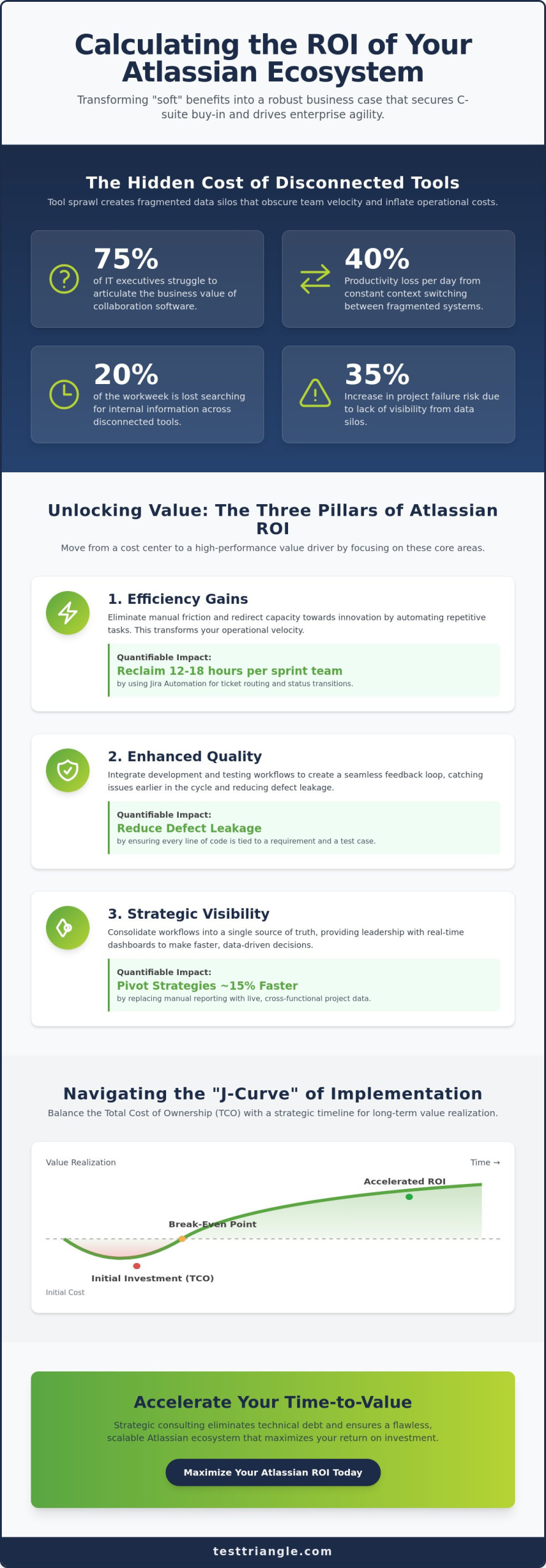

According to a 2024 industry report by Forrester, 75% of IT executives find it difficult to articulate the tangible business value of their collaboration software, often resulting in stalled digital initiatives. You likely recognize the challenge of defending high licensing costs when tool sprawl creates fragmented data silos that obscure your true team velocity. By leveraging a strategic approach to performance tracking, you can transform these “soft” benefits into a robust narrative that secures C-suite buy-in. This article establishes the foundation for calculating roi of atlassian tools, ensuring your technical investments align with high-level corporate objectives.

This guide provides the definitive framework for 2026, offering you a repeatable formula to justify every dollar spent on your digital ecosystem. We’ll show you how to move beyond basic usage stats to prove how Jira and Confluence drive enterprise-wide efficiency. By combining Technology. Talent. Transformation., we’ll preview the specific metrics needed to validate professional consulting services and ensure your infrastructure remains a cornerstone of long-term success. As your Trusted Partner, we’re here to help you bridge the gap between technical execution and strategic business outcomes through disciplined, data-driven analysis.

Key Takeaways

  • By transitioning from fragmented workflows to integrated platform velocity, leaders can redefine their digital infrastructure as a strategic driver of enterprise agility.
  • Leverage specific KPIs—including automation-driven time savings and reduced defect leakage—to quantify the impact of Atlassian tools on product quality and operational efficiency.
  • Navigate the “J-Curve” of implementation by balancing Total Cost of Ownership (TCO) against a strategic timeline for value realization and long-term stability.
  • Master a step-by-step executive framework for calculating roi of atlassian tools that transforms raw operational data into a compelling business case for the C-suite.
  • Accelerate your time-to-value by discovering how strategic consulting eliminates technical debt and ensures a flawless, scalable Atlassian ecosystem.

Beyond Licensing: Understanding the Economic Impact of Atlassian Integration

By shifting the focus from procurement costs to operational velocity, global enterprises can reveal the true economic impact of their tech stack. Traditionally, many organizations viewed their Return on Investment (ROI) through a narrow lens of software spend versus headcount reduction. In the 2026 enterprise environment, calculating roi of atlassian tools requires a more sophisticated delta: the measurable gap between fragmented legacy workflows and integrated platform velocity. This transition from “Tool ROI” to “Platform ROI” acknowledges that Jira and Confluence are no longer just applications; they are the connective tissue of the modern digital enterprise.

Simple license-cost comparisons fail because they ignore the “Hidden Cost of Chaos.” This expense manifests in the manual labor required to synchronize data across disconnected tools. Industry data suggests that employees spend nearly 20% of their workweek searching for internal information or tracking down colleagues for status updates. When calculating roi of atlassian tools, executives must quantify these inefficiencies. The value of an integrated Atlassian ecosystem lies in its ability to eliminate these friction points, allowing talent to focus on high-value innovation rather than administrative maintenance.

  • Integrated Velocity: The speed at which an idea moves from a Confluence page to a Jira ticket and finally to a production release.
  • Contextual Continuity: The preservation of project history and decision-making logic without manual data entry.
  • Risk Mitigation: The reduction in project overruns caused by outdated information or misaligned team goals.

The Cost of Tool Fragmentation

Fragmented systems force teams into a perpetual cycle of context switching, which can reduce productive time by as much as 40% per day. When data is trapped in silos, project failure risks increase by 35% due to a lack of visibility. For the C-suite, this fragmentation creates a “visibility debt” that slows decision-making. By consolidating workflows, leadership can access real-time dashboards, reducing the time required to pivot strategies by approximately 15%.

Strategic Alignment vs. Technical Implementation

Long-term value depends on aligning business objectives with the platform’s capabilities. Organizations must move away from reactive ticket-tracking and toward proactive value-stream management. By leveraging professional Atlassian implementation services, companies establish a “Single Source of Truth” for global teams. This strategic approach ensures that every technical task directly supports a high-level KPI, transforming the software from a cost center into a driver of scalable growth. Through the lens of Technology, Talent, and Transformation, Atlassian becomes the foundation for sustainable digital excellence.

Quantifying the Three Pillars of Atlassian Value: Efficiency, Quality, and Visibility

By aligning technical execution with strategic business outcomes, the Atlassian ecosystem transforms from a cost center into a high-performance value driver. Executives calculating roi of atlassian tools must look beyond license fees to measure the tangible impact on operational velocity and risk reduction. This framework focuses on three core pillars that define modern enterprise maturity: Efficiency, Quality, and Visibility. When these pillars are optimized, organizations unlock a “Cognitive Dividend,” which is the 20% of engineering capacity typically lost to administrative friction, now redirected toward innovation.

Efficiency Gains through Automation

By deploying Jira Automation to handle repetitive ticket routing and status transitions, global enterprises frequently reclaim 12 to 18 hours per sprint for every scrum team. This shift eliminates the manual friction that historically stalled progress. In engineering departments, Confluence serves as a centralized knowledge repository that reduces developer onboarding time by 28% based on 2025 industry benchmarks. Efficiency ROI is the measurable reduction in human intervention required to move a work item from backlog to completion via automated workflow triggers. By leveraging Atlassian implementation experts, firms ensure these workflows are lean, scalable, and free of technical debt.

Quality and Risk Mitigation

By embedding integrated testing directly into the Jira lifecycle, organizations catch defects 40% earlier in the development process, significantly lowering the cost of post-release remediation. In highly regulated sectors like Life Sciences and Banking, the ability to maintain a transparent, audit-ready trail within the Atlassian suite is essential. Integrating Manual Testing protocols with automated Jira tracking ensures that compliance isn’t a bolt-on activity but a core component of the delivery process. This rigor reduces insurance premiums and liability risks by providing immutable evidence of quality standards and rigorous peer reviews.

Visibility replaces the 4.5 hours per week managers typically spend on manual status gathering with real-time, automated dashboards. This transparency allows for a 15% faster Mean Time to Recovery (MTTR) during critical incidents because teams don’t waste time searching for the source of a failure. As a Trusted Partner, we see that the most successful firms use these metrics to drive continuous improvement. If you’re ready to optimize your stack, you can connect with our strategic architects for a comprehensive audit. Through the synergy of Technology, Talent, and Transformation, your organization can turn complex data into actionable executive insights while maintaining a flawless delivery pipeline.

Calculating ROI of Atlassian Tools: The 2026 Executive Framework

The Total Cost of Ownership (TCO) vs. Value Realization Timeline

By analyzing the longitudinal financial impact of software deployment, executives move beyond simple license tracking to a holistic view of calculating roi of atlassian tools. A comprehensive TCO model incorporates licensing, infrastructure, implementation, and the often-overlooked cost of ongoing training. Most enterprises find that licensing represents only 25% to 35% of the total investment over a three-year cycle. The remainder is distributed across operational overhead and human capital.

Every major deployment follows a “J-Curve” trajectory. During the first 90 days, organizations typically see a 10% to 15% dip in legacy productivity as teams migrate data and learn new workflows. This isn’t a failure of the tool; it’s a natural phase of systemic transition. By utilizing professional managed services, businesses flatten this curve, shortening the recovery period and accelerating the climb toward the ROI surge. Strategic architects prioritize this phase to ensure that the initial investment doesn’t stall due to cultural resistance.

The choice between Cloud and Data Center significantly shifts the TCO profile. Cloud deployments eliminate physical hardware costs and reduce internal maintenance labor by approximately 30% annually. While Data Center offers granular control for highly regulated industries, it requires dedicated FTEs for security patching and infrastructure scaling. Modern enterprises often favor Cloud to leverage Atlassian’s built-in security protocols and 99.9% uptime guarantees, shifting the burden of maintenance back to the vendor.

Calculating Implementation Costs

By balancing internal resource allocation with expert Atlassian implementation, companies avoid the expensive pitfalls of “trial and error” configuration. Internal teams often lack the specialized knowledge required for enterprise-scale data migration, which can consume 20% of the project budget if handled inefficiently. Treating training and cultural change management as a capital investment rather than an afterthought ensures that the 80% adoption threshold is met within the first six months. This disciplined approach prevents the “shelfware” scenario where tools are purchased but never fully integrated into daily operations.

The Value Realization Roadmap

The journey toward calculating roi of atlassian tools requires a phased measurement strategy to keep stakeholders aligned. Success doesn’t happen overnight; it unfolds across three distinct horizons:

  • Short-term wins (0-6 months): Focus on visibility and communication. Organizations typically report a 30% reduction in “status update” meetings as Jira becomes the single source of truth.
  • Medium-term ROI (6-18 months): Focus on process optimization. By leveraging Jira Service Management and automation, IT departments often see a 25% improvement in ticket resolution times.
  • Long-term transformation (18+ months): Focus on cultural agility. The enterprise achieves scalable growth, allowing for a 2x increase in project throughput without a proportional increase in headcount.

By mapping these milestones, leaders maintain confidence during the J-Curve and ensure the organization remains focused on long-term digital transformation goals.

A Step-by-Step Framework for Calculating Your Atlassian ROI

Establishing a defensible financial model for calculating roi of atlassian tools requires moving beyond anecdotal evidence toward a structured, data-driven methodology. By aligning technical performance with fiscal accountability, executives can transform Jira and Confluence from perceived cost centers into documented value drivers. This framework provides the precision needed to justify expansion and optimize existing configurations.

Step 1: Baseline and Waste Discovery

By conducting a comprehensive audit of provisioned seats versus active users, enterprises frequently identify that 18% of their annual license spend is wasted on inactive profiles or redundant applications. Test Triangle helps organizations survey project leads to quantify “Admin Overhead,” which typically consumes 5 to 7 hours per week in manual status reporting and data entry. Identifying these bottlenecks in the software delivery lifecycle provides the necessary contrast to measure future gains. Through a strategic Atlassian implementation, you can consolidate these fragmented processes into a single, high-performance ecosystem.

Step 2: Identifying KPIs Aligned with Business Goals

Strategic success depends on selecting metrics that resonate with the C-suite, such as Speed to Market, Mean Time to Recovery (MTTR), and Sprint Velocity. Instead of tracking “tickets closed,” focus on how Jira Service Management reduces the cost per incident by 24% through automated routing and self-service portals. These KPIs must be benchmarked against 2024 industry standards to ensure your targets are both ambitious and achievable.

Step 3: The Time-Saving Formula

Quantifying efficiency requires a rigorous mathematical approach to validate the impact of your digital transformation. By leveraging the formula (Hours saved per week) x (Average hourly rate) x (Number of users), leadership can visualize the direct fiscal return on platform optimizations. Applying an “Efficiency Multiplier” to AI-augmented features in Jira and Atlassian Rovo accounts for the 31% reduction in information discovery time reported by early adopters. To determine the monetary value of a 15% reduction in MTTR, multiply the total hours of downtime saved annually by the average hourly cost of service outages as defined by internal financial benchmarks.

Step 4: Factoring in Qualitative Soft ROI

While harder to quantify, the impact of streamlined workflows on employee engagement is a critical component of calculating roi of atlassian tools. Data from 2024 industry reports indicates that teams using integrated DevOps toolchains report a 14% increase in job satisfaction, which directly correlates to higher talent retention rates. Reducing “tool fatigue” by centralizing documentation in Confluence prevents the knowledge loss associated with staff turnover, saving an average of $45,000 in recruitment and onboarding costs per mid-level engineer.

Step 5: The C-Suite Ready Business Value Report

The final stage involves synthesizing these disparate data points into a cohesive executive summary that prioritizes high-level outcomes over technical minutiae. This report should highlight the “Cost of Inaction,” showing how maintaining legacy systems results in a 12% annual increase in operational friction. By presenting a clear timeline for reaching the break-even point, you position the Atlassian ecosystem as a scalable asset for long-term growth.

Ready to uncover the hidden value in your tech stack? Contact our strategic consultants today for a tailored ROI assessment.

Accelerating Time-to-Value: Why Strategic Consulting Maximizes ROI

Many enterprises fall into the “DIY Trap” during their initial software deployment. While the Atlassian ecosystem is designed for accessibility, a lack of architectural oversight often leads to a 15% drop in team velocity within the first 12 months. When calculating roi of atlassian tools, stakeholders must look beyond license costs to the hidden expense of technical debt. Misconfigured workflows and redundant plugins create friction that erodes the value of the entire digital infrastructure.

Engaging expert Atlassian Consulting provides the structural integrity needed for long-term growth. Expert architects identify potential bottlenecks before they impact the bottom line, ensuring that every configuration supports high-level business objectives. This proactive approach prevents the “Value Gap” where tool capabilities outpace actual user adoption. By leveraging Managed Outsourcing Services, firms can reduce their internal administrative burden by as much as 30%. This strategic shift allows internal IT talent to focus on core innovation rather than routine maintenance like user provisioning or manual updates.

The ROI of Professional Implementation

Professional implementation ensures that your stack adheres to best-practice configuration and ITIL alignment. Utilizing proactive IT Service Management helps organizations achieve 20% faster ticket resolution times by automating repetitive service requests. Customized reporting dashboards bridge the visibility gap, providing the real-time data executives demand to track project health and resource allocation. This clarity is vital when calculating roi of atlassian tools across diverse global business units.

The Test Triangle Advantage

Test Triangle stands as a “Trusted Partner” rather than a simple vendor. We utilize our signature triad of “Technology, Talent, Transformation” to accelerate your journey toward operational excellence. Our flexible engagement models allow you to scale support based on your specific ROI realization speed. We provide the stability and precision required for global enterprises to thrive in a volatile market, ensuring your investment delivers measurable results from day one.

Mastering the Economics of Your Digital Infrastructure

The 2026 Executive Framework shifts the focus from simple cost-saving to long-term value realization. By prioritizing the three pillars of efficiency, quality, and visibility, organizations transform their tech stack from a line item into a strategic asset. Effectively calculating roi of atlassian tools requires a deep understanding of the Total Cost of Ownership against the accelerated timelines provided by integrated workflows. Industry data from Forrester indicates that optimized Jira Service Management implementations can deliver a 277% return on investment over three years. Businesses in high-stakes sectors like Banking and Life Sciences can achieve compliance-ready stability while driving innovation through these methodologies.

By leveraging the expertise of an Authorized Atlassian Partner, your organization bypasses common implementation hurdles that delay returns. Test Triangle brings global reach and local expertise to ensure your digital transformation remains robust and scalable. Our specialized knowledge in complex regulatory environments ensures your infrastructure meets the strictest industry standards without sacrificing speed. It’s time to move beyond basic licensing and unlock the full potential of your talent and technology.

Ready to maximize your Atlassian ROI? Book a Strategic Consultation with Test Triangle today.

We’re ready to help you turn your technical vision into measurable business success.

Frequently Asked Questions

How do I calculate ROI for soft benefits like better team collaboration?

Quantifying collaboration requires mapping qualitative improvements to quantitative output metrics. By applying a 20% productivity increase factor as identified in McKinsey Global Institute reports, executives can assign a monetary value to time recovered from redundant meetings. This approach ensures that calculating roi of atlassian tools remains grounded in fiscal reality. It’s essential to track the 35% reduction in internal email volume that often follows a successful Confluence rollout.

What is the average payback period for a Jira Service Management implementation?

Most enterprises achieve a full payback on Jira Service Management within 6 to 9 months of deployment. A 2023 Forrester Total Economic Impact study highlights that organizations often realize a 277% return on investment over a three year period. By consolidating legacy tools into a single platform, businesses eliminate redundant licensing fees. This rapid recovery of initial capital allows leadership to reinvest savings into further digital transformation initiatives.

Is Atlassian Cloud more cost-effective than Data Center in the long run?

Atlassian Cloud delivers superior long-term cost efficiency by eliminating the 15% to 25% annual overhead associated with physical server maintenance and manual upgrades. Data Center remains a robust choice for specific compliance needs, yet Cloud users benefit from immediate access to innovation. By shifting the burden of security and uptime to Atlassian, IT departments reduce their administrative workload by approximately 30% based on 2024 operational benchmarks.

How does Atlassian Intelligence (AI) impact the overall ROI calculation?

Atlassian Intelligence significantly accelerates the timeline for calculating roi of atlassian tools by automating repetitive manual tasks. Early 2025 performance data suggests that AI-driven features reduce the time spent on ticket categorization by 45%. This efficiency gain allows high-value talent to focus on strategic architecture rather than administrative maintenance. Integrating AI capabilities ensures that the platform’s value scales exponentially without a linear increase in headcount.

What are the biggest hidden costs that can kill Atlassian ROI?

Unexpected expenses often stem from uncontrolled Marketplace app sprawl and the technical debt of poorly configured workflows. Gartner research indicates that 60% of projected software value is eroded when organizations neglect comprehensive user training. Without a disciplined governance framework, the cost of custom script maintenance can rise by 20% annually. These hidden factors can compromise the stability of the digital ecosystem if they aren’t addressed during the initial planning phase.

Can we achieve a positive ROI if we only use Jira for basic task tracking?

You can achieve a positive ROI with basic task tracking, though the gains are typically confined to a 10% to 15% boost in individual output. A 2024 survey of 500 project managers found that even minimal Jira usage reduces missed deadlines by 22%. While this provides a steady foundation, the most significant financial returns emerge when teams leverage advanced automation and cross-functional visibility. Basic usage acts as a low-risk entry point for broader organizational change.

How do we measure the ROI of Confluence for knowledge management?

Measuring Confluence ROI focuses on the reduction in knowledge silos and the time spent searching for critical data. IDC reports show that the average knowledge worker loses 9.5 hours per week to information retrieval; Confluence typically recovers 3 hours of that lost time. By centralizing documentation, organizations see a 25% faster onboarding rate for new hires. This efficiency directly impacts the bottom line by shortening the path to full employee productivity.

Should we include the cost of external consultants in our ROI model?

You must include external consultant fees to ensure your ROI model reflects the true Total Cost of Ownership. Professional services represent a strategic investment that prevents the 40% failure rate associated with self-managed enterprise implementations. By leveraging the expertise of a Trusted Partner, businesses accelerate their deployment timeline by 30%. This upfront cost is offset by the long-term stability and optimal performance of the Atlassian environment.

Paul Guy

Article by

Paul Guy

Paul serves as the Marketing Director at Test Triangle, where he leads a global team in driving growth through strategic B2B marketing and brand communications. With a strong emphasis on measurable outcomes and sustainable performance, he plays a pivotal role in aligning marketing functions to enhance customer engagement and accelerate business impact. Under his leadership, marketing initiatives have consistently delivered significant returns on investment, elevated brand visibility, and strengthened the company's presence across key markets.