



Is your IT infrastructure a catalyst for growth or a bottleneck for innovation? Many global enterprises find that simply deploying Jira Service Management isn’t enough to overcome the friction of legacy systems or the complexity of modern cloud migrations. Engaging a certified Atlassian ITSM partner isn’t just about technical implementation; it’s about securing a strategic collaborator who understands how to bridge the gap between high-velocity DevOps and enterprise-grade governance.
We recognize the pressure of managing escalating operational costs, particularly following the 32% increase in enterprise pricing seen in early 2026, and the legitimate fear of business downtime during critical transitions. This article provides a clear framework to evaluate and select a partner who’ll accelerate your service delivery and maximize your JSM investment. You’ll discover how the right expertise transforms fragmented workflows into a scalable service desk that reduces mean time to resolution and delivers transparent, predictable licensing costs through a methodology-driven approach.
Key Takeaways
- Understand why the integration of DevOps and Jira Service Management is essential for replacing siloed, legacy frameworks with high-velocity service delivery.
- Identify the critical benchmarks for selection, including why the “ITSM Specialized” badge is a non-negotiable requirement for a qualified Atlassian ITSM partner.
- Learn a structured two-phase approach to legacy migration that prioritizes strategic roadmapping and robust governance to ensure seamless user adoption.
- Explore how transitioning to managed services facilitates continuous platform optimization, allowing your internal teams to focus on core business innovation.
- Discover the benefits of a holistic partnership model that combines technical rigor with scalable staffing and quality assurance solutions.
The Strategic Shift to High-Velocity IT Service Management
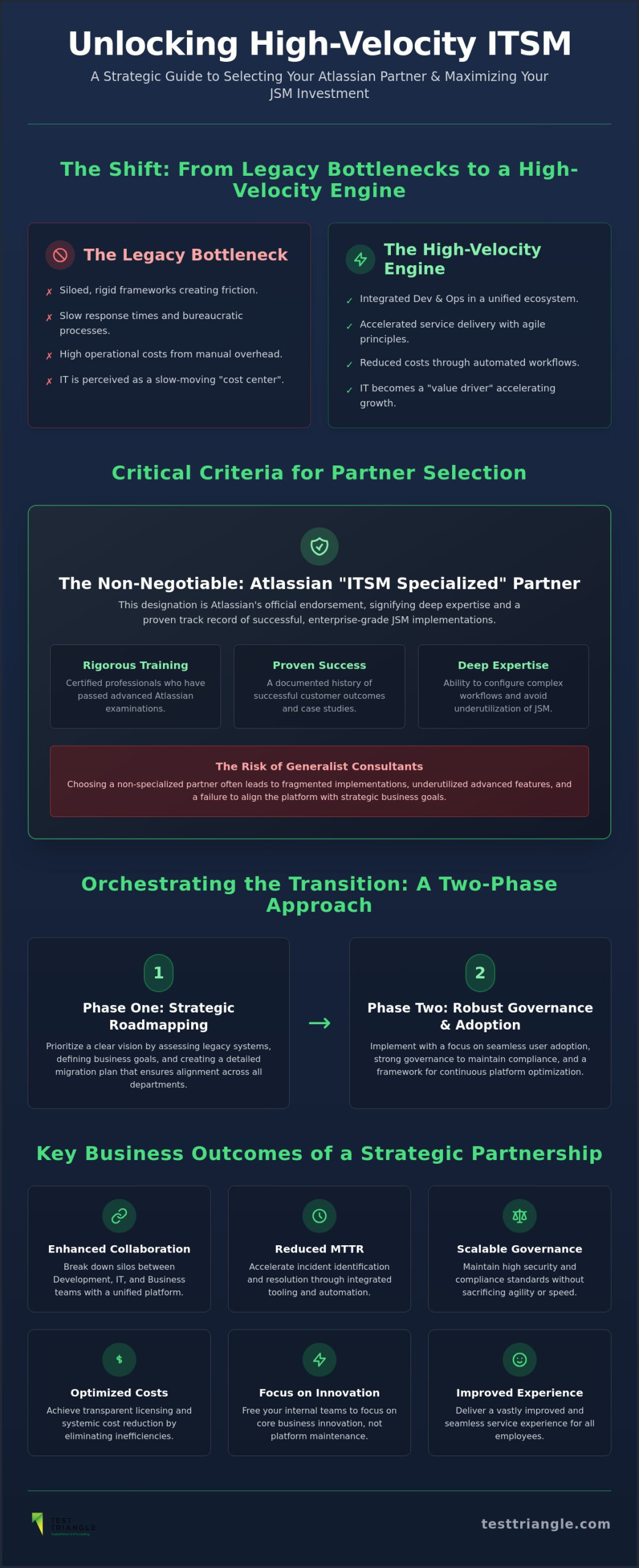
The modern landscape for IT Service Management (ITSM) has undergone a fundamental transformation, moving away from the rigid, siloed structures that once defined corporate IT. For global enterprises, legacy frameworks often become barriers to progress, creating friction between departments and slowing down response times in a market that demands instant resolution. High-Velocity ITSM is the integration of agile principles into traditional service governance, ensuring that speed doesn’t come at the expense of stability. By choosing a certified Atlassian ITSM partner, companies can bridge the gap between development and operations, ensuring that Jira Service Management (JSM) acts as a collaborative engine rather than just another ticketing tool.
A successful partnership focuses on three core business outcomes: operational efficiency, systemic cost reduction, and a vastly improved employee experience. When Dev and Ops teams work within a unified ecosystem, the friction of handoffs disappears, allowing for a seamless flow of information that drives value across the entire organization. This strategic alignment ensures that IT isn’t just supporting the business but is actively accelerating its growth.
Moving Beyond Legacy ITSM Frameworks
Traditional ITIL implementations were frequently criticized for being overly bureaucratic and slow, often failing to keep pace with the rapid deployment cycles of modern software development. An Atlassian ITSM partner helps organizations modernize these practices by implementing ITIL 4 principles, which prioritize flexibility and value streams over rigid adherence to process. This shift allows IT departments to move from being perceived as a “cost centre” to becoming a “value driver.” By optimizing the platform to support iterative improvements and faster feedback loops, businesses can reduce manual overhead and focus their resources on innovation rather than maintenance.
The Role of Jira Service Management in Digital Transformation
Jira Service Management serves as the unified platform that connects Dev, IT, and business teams, providing a single source of truth for all service-related activities. Leveraging Digital Transformation Services allows enterprises to align their IT infrastructure with broader commercial goals, ensuring that every technical adjustment contributes to the bottom line. Automated workflows play a critical role here, as they eliminate repetitive manual tasks and reduce the likelihood of human error. This automation doesn’t just save time; it empowers teams to handle complex requests with precision, ensuring that the service desk can scale alongside the business without a proportional increase in headcount.
Ultimately, the transition to a high-velocity model results in:
- Reduced MTTR: Faster incident identification and resolution through integrated tooling.
- Enhanced Collaboration: Breaking down silos between development and IT operations.
- Scalable Governance: Maintaining compliance and security standards without sacrificing agility.
Critical Criteria for Selecting an Atlassian ITSM Partner
Selecting an Atlassian ITSM partner involves evaluating more than just a list of past clients; it requires a rigorous assessment of their ability to align technical architecture with long-term business strategy. As enterprises face increasingly complex digital environments, the distinction between a basic service provider and a strategic collaborator becomes clear through their technical depth and industry-specific insight. A partner’s role is to ensure that Jira Service Management doesn’t just function as a standalone tool but acts as a central nervous system for your entire service delivery model.
Atlassian Specialized Partner Status vs. Generalist Consultants
The “ITSM Specialized” badge serves as a non-negotiable baseline for any serious enterprise engagement. This designation isn’t merely a marketing label; it’s an official endorsement from Atlassian that the partner has achieved a high level of training, passed rigorous certifications, and demonstrated a track record of successful customer outcomes. Choosing a generalist consultant often leads to a fragmented implementation where the platform’s advanced features are underutilized. Specialized partners possess the deep subject matter expertise required to configure complex workflows that maximize ROI and ensure the platform scales alongside your organizational growth.
Technical Depth and Integration Capabilities
Effective service management requires a unified view of the entire technology stack. A proficient partner must demonstrate the ability to integrate JSM with existing CI/CD pipelines, ensuring that development and operations teams share a single source of truth. The importance of expert Atlassian Implementation cannot be overstated, as it directly reduces delivery risk and prevents the creation of technical debt. Beyond basic ticketing, you should assess their capabilities in Asset Management and the design of Configuration Management Databases (CMDB), which are essential for maintaining visibility in modern, hybrid-cloud environments.
In highly regulated sectors such as finance or life sciences, a partner’s understanding of compliance frameworks is paramount. They must ensure that data residency, audit trails, and security protocols are baked into the platform from day one to meet GxP or GDPR standards. This industry-specific lens prevents costly rework and ensures your infrastructure remains both agile and compliant. If you’re operating within these complex parameters, it’s often beneficial to begin by discussing your specific governance requirements with an expert who understands the intersection of technology and regulation.
When vetting potential collaborators, prioritize those who can demonstrate:
- Ecosystem Breadth: Seamless integration across Confluence, Opsgenie, and Bitbucket.
- Migration Proficiency: A proven methodology for moving legacy data into the Atlassian Cloud without loss of integrity.
- Strategic Vision: The ability to translate technical features into tangible business outcomes like reduced MTTR.
Orchestrating the Transition: Legacy Migration to Jira Service Management
Transitioning from legacy ITSM tools to Jira Service Management is a high-stakes evolution that requires a disciplined, multi-phased methodology. For global enterprises, the objective isn’t merely to replicate old workflows in a new environment but to fundamentally improve service delivery speeds and organizational agility. A certified Atlassian ITSM partner orchestrates this transition through a structured roadmap that prioritizes business continuity and data integrity above all else.
The migration lifecycle follows a rigorous path designed to eliminate technical debt and align IT operations with broader business objectives. This process is broken down into four critical phases:
- Phase 1: Discovery and Strategic Roadmapping. We align the technical platform with overarching organizational goals to ensure every configuration serves a commercial purpose.
- Phase 2: Governance and Process Design. This stage establishes robust compliance frameworks and security protocols, ensuring the platform is ready for highly regulated environments.
- Phase 3: Technical Migration and Data Integrity. We execute the data transfer with precision, mapping legacy information to new structures while maintaining full auditability.
- Phase 4: Training and Enablement. This final stage empowers your internal teams to master their new high-velocity tools, ensuring a smooth transition and immediate productivity.
Mitigating Risk During Enterprise Cloud Migrations
Global enterprises operating across multiple time zones require zero-downtime strategies to prevent operational paralysis during a move to Cloud. A strategic Atlassian ITSM partner manages these complexities by addressing data residency requirements and security encryption standards throughout the transition. Platform stability is further reinforced through Software and Digital Assurance Testing, which identifies potential data discrepancies before they impact the live environment. This methodology ensures a steady hand during the most volatile stages of digital evolution.
Designing for User Adoption and Self-Service
A platform’s technical perfection means little if end-users find it difficult to navigate. Designing for adoption begins with building intuitive service portals that prioritize the employee experience and encourage self-service. By leveraging knowledge management within Confluence, organizations can empower users to resolve common issues independently, significantly reducing ticket volumes. We measure the success of these implementations through tangible outcomes, specifically focusing on reduced mean time to resolution (MTTR) and high customer satisfaction (CSAT) scores.
Beyond Implementation: Maximising Value through Managed Services
The successful deployment of Jira Service Management marks the start of a digital journey rather than its conclusion. For global enterprises, the real challenge lies in maintaining peak performance while navigating the relentless pace of technological change. An Atlassian ITSM partner provides the strategic oversight needed to transform a functional tool into a high-performance asset through continuous platform optimization. By moving beyond the initial setup, organizations can ensure their infrastructure remains resilient, responsive, and ready for future scale. This long-term collaboration ensures that your technical environment evolves in lockstep with your commercial objectives, providing a steady hand in a fast-changing landscape.
Leveraging Managed Outsourcing Services allows internal IT teams to step away from the burden of routine maintenance and focus on high-impact innovation. Proactive system monitoring and performance tuning are essential components of this model, as they identify potential bottlenecks before they escalate into service-disrupting incidents. Managed Service Provider models provide predictable monthly costs while ensuring high platform availability through dedicated support structures and rigorous performance standards.
Predictable Costs with MSP Subscription Models
Comparing the total cost of ownership between internal hiring and Managed Service Provider Subscription Fees reveals a significant advantage for the outsourced model. Building an in-house team requires substantial investment in recruitment, ongoing training, and retention, whereas a managed service provides immediate access to a pool of certified experts. This approach includes a dedicated helpdesk for Atlassian environment support, allowing your organization to scale its support capacity effortlessly as business demands grow without the complexity of managing additional headcount.
Continuous Improvement and Feature Adoption
Atlassian’s release cycle is rapid, frequently introducing sophisticated capabilities like the AI-powered Rovo and advanced automation triggers. Staying ahead of these updates requires constant vigilance and technical agility that internal teams often lack the bandwidth to maintain. Through Quarterly Business Reviews (QBRs), your partner aligns platform performance with your specific business KPIs, ensuring that new features are adopted strategically rather than haphazardly. These sessions provide a structured framework to evaluate system health, user adoption rates, and workflow efficiency. Ongoing training programs keep your internal teams proficient in the latest JSM capabilities, fostering a culture of excellence and ensuring you extract maximum value from your software investment. If your team is ready to offload the complexities of platform management, you can request a consultation to explore our managed service frameworks.
Test Triangle: Your Strategic Atlassian ITSM Partner for 2026
Test Triangle provides a sophisticated global perspective that balances local strategic support with offshore delivery efficiency, ensuring that complex digital infrastructures remain stable while scaling at pace. As a certified Atlassian ITSM partner, we don’t operate as a mere service provider; instead, we position ourselves as a reliable long-term collaborator dedicated to your operational stability and technological evolution. Our methodology integrates high-level business goals with technical rigor, allowing us to manage sophisticated environments in highly regulated sectors like finance and life sciences with absolute precision. We empower enterprises to achieve organizational progress through the seamless combination of human expertise and industry-leading technical tools.
A Comprehensive IT Ecosystem Approach
We bridge the critical gap between IT Service Management Solutions and technical execution by leveraging our deep understanding of the entire software development lifecycle (SDLC). This holistic expertise ensures that your ITSM framework isn’t an isolated silo but a central component of your DevOps and QA strategies. By supporting diverse industries through tailored Consulting and Training, we empower organizations to adopt high-velocity practices that drive measurable value. Our approach focuses on three core pillars: strategy, stability, and scalability. This unified framework allows technical managers and executive leadership to align their vision, ensuring that platform performance directly supports business KPIs.
Flexible Staffing and Expert Resourcing
Maintaining a high-velocity service desk requires more than just the right software; it requires immediate access to specialized talent who can navigate the complexities of the Atlassian ecosystem. Through our IT Staffing Services, enterprises can access top-tier talent to scale their internal teams with contract, remote, or offshore resources as needed. This flexibility allows you to adjust your support capacity without the long-term overhead of permanent hiring, ensuring your platform remains optimized even as your organization grows. We provide the versatile, disciplined, and globally-minded support necessary to maintain a steady hand in a fast-changing technological landscape.
Whether you’re navigating a complex cloud migration or seeking to optimize your existing Jira Service Management investment, our team provides the strategic vision and practical execution needed to ensure long-term success. We invite you to contact Test Triangle today to begin your high-velocity ITSM journey and discover the peace of mind that comes from a truly strategic partnership.
Empowering Your High-Velocity Future
Selecting the right Atlassian ITSM partner is the difference between a simple tool implementation and a total strategic transformation. By moving away from rigid legacy frameworks and embracing the convergence of DevOps and ITSM, your organization gains the agility needed to thrive in a fast-paced market. A disciplined approach to migration ensures that technical integrity and regulatory compliance are maintained, while managed services provide the continuous optimization required for long-term platform health.
As an ISO 9001:2015 and ISO 27001:2013 certified Atlassian Solution Partner with a global presence across Europe, North America, and Asia, Test Triangle is ready to support your digital evolution. Our team combines technical rigor with a deep commitment to your operational stability and scalable growth. It’s time to transform your service desk into a scalable engine for progress through the combination of human expertise and industry-leading technical tools.
Partner with Test Triangle for your Atlassian ITSM Transformation and take the first step toward a more efficient, collaborative, and secure future. We’re here to ensure your technology stack supports your long-term success.
Frequently Asked Questions
What is an Atlassian ITSM Specialized Partner?
An Atlassian ITSM Specialized Partner is a consultant who has earned an official designation by meeting rigorous training, certification, and customer success benchmarks specifically for Jira Service Management. This status ensures the partner possesses the technical depth required to handle complex enterprise configurations and strategic migrations. Engaging a specialized collaborator provides the peace of mind that your infrastructure is managed by experts who understand the nuances of high-velocity service delivery.
How does Jira Service Management compare to ServiceNow for enterprise ITSM?
Jira Service Management is often preferred for its superior integration with development teams and its faster time to value compared to traditional legacy platforms. While a 2024 Forrester report identifies both Atlassian and ServiceNow as dominant market leaders, JSM provides a more agile, cost effective alternative that bridges the gap between Dev and Ops. It’s particularly effective for organizations that want to eliminate silos and foster a culture of collaborative service management without the excessive complexity of older frameworks.
What are the typical phases of an Atlassian ITSM implementation?
A standard implementation begins with strategic discovery to align the platform with business goals, followed by a design phase focused on governance and process architecture. Once the foundation is set, the partner executes the technical migration and data transfer while maintaining full auditability. The final phase involves team enablement and training to ensure that end users and agents are fully proficient with the new high-velocity tools from day one.
Can an Atlassian partner help with JSM licensing and cost optimization?
Yes, an experienced Atlassian ITSM partner provides critical oversight for licensing to ensure your organization avoids overprovisioning and unnecessary marketplace app expenses. They help navigate the complexities of annual versus monthly billing and enterprise pricing tiers to ensure your budget is used effectively. By optimizing your license footprint, a partner ensures that you maximize your return on investment while maintaining full access to essential features.
How do Managed Services work for Atlassian platforms?
Managed services involve a long-term partnership where an external team of experts handles the day to day administration, monitoring, and optimization of your Atlassian environment. This model provides predictable operational costs and ensures high platform availability through proactive performance tuning and incident prevention. It allows your internal IT staff to move away from routine maintenance tasks and focus on high-impact digital transformation initiatives that drive business growth.
What is the role of DevOps in modern IT Service Management?
DevOps acts as the strategic bridge that connects software development cycles with IT operations to accelerate the flow of value to the customer. In a modern ITSM environment, this convergence allows for automated incident response, faster change management, and seamless feedback loops. By integrating these two disciplines within Jira Service Management, enterprises can achieve a high-velocity model that reduces friction and improves overall service reliability.
How does Test Triangle handle ITSM migrations for highly regulated industries?
Test Triangle utilizes a security-first methodology backed by ISO 27001:2013 and ISO 9001:2015 certifications to ensure the highest standards of data integrity and compliance. We implement rigorous audit trails and data residency protocols that are essential for clients in the finance, healthcare, and life sciences sectors. This disciplined approach minimizes risk during the transition to Cloud, ensuring that your organization remains compliant with global regulations like GDPR or GxP.
What metrics should we use to measure the success of an ITSM partner?
The success of an Atlassian ITSM partner should be measured through tangible improvements in operational efficiency, specifically focusing on reduced Mean Time to Resolution (MTTR) and increased Customer Satisfaction (CSAT) scores. You should also evaluate the partner’s impact on platform adoption rates and the reduction of manual ticket volumes through successful automation. A truly strategic collaborator will demonstrate how these technical improvements contribute to broader business outcomes and long-term stability.

Article by
Paul Guy
Paul serves as the Marketing Director at Test Triangle, where he leads a global team in driving growth through strategic B2B marketing and brand communications. With a strong emphasis on measurable outcomes and sustainable performance, he plays a pivotal role in aligning marketing functions to enhance customer engagement and accelerate business impact. Under his leadership, marketing initiatives have consistently delivered significant returns on investment, elevated brand visibility, and strengthened the company's presence across key markets.