Is your IT infrastructure a catalyst for growth or a bottleneck for innovation? Many global enterprises find that simply deploying Jira Service Management isn’t enough to overcome the friction of legacy systems or the complexity of modern cloud migrations. Engaging a certified Atlassian ITSM partner isn’t just about technical implementation; it’s about securing a strategic collaborator who understands how to bridge the gap between high-velocity DevOps and enterprise-grade governance.

We recognize the pressure of managing escalating operational costs, particularly following the 32% increase in enterprise pricing seen in early 2026, and the legitimate fear of business downtime during critical transitions. This article provides a clear framework to evaluate and select a partner who’ll accelerate your service delivery and maximize your JSM investment. You’ll discover how the right expertise transforms fragmented workflows into a scalable service desk that reduces mean time to resolution and delivers transparent, predictable licensing costs through a methodology-driven approach.

Key Takeaways

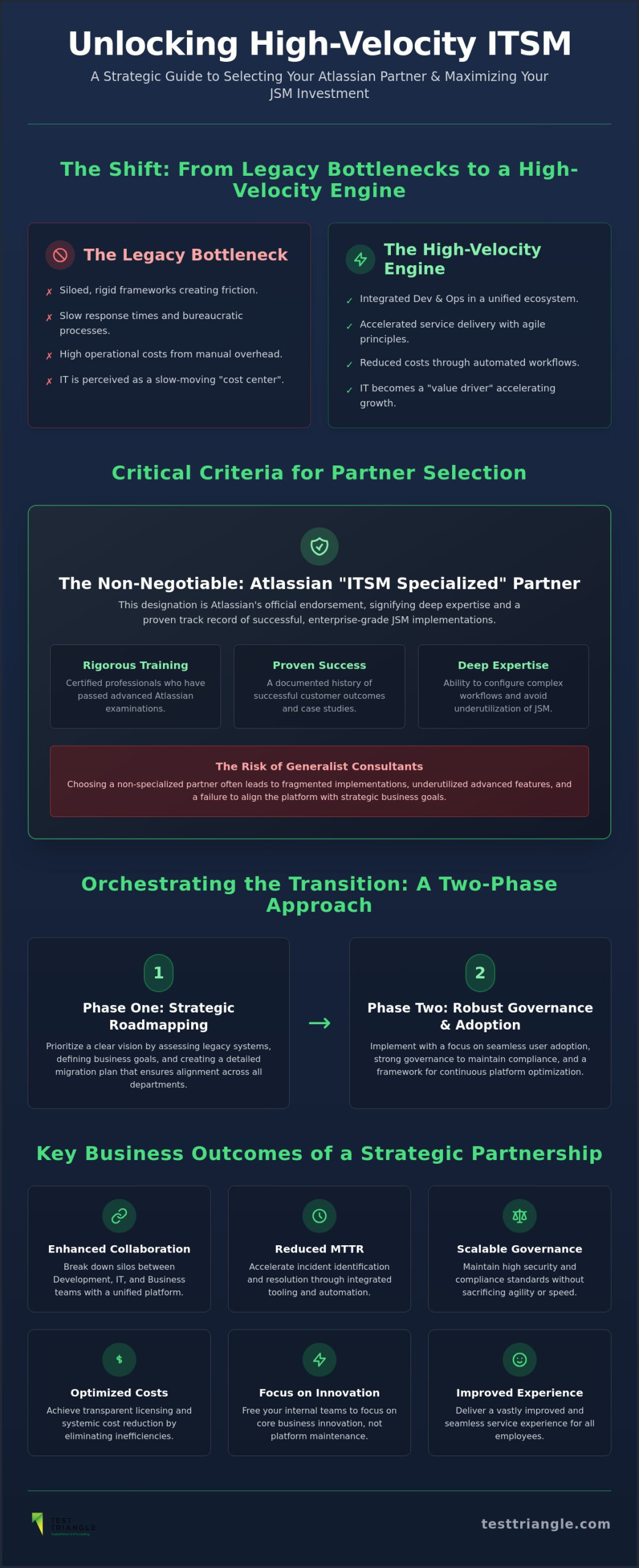
  • Understand why the integration of DevOps and Jira Service Management is essential for replacing siloed, legacy frameworks with high-velocity service delivery.
  • Identify the critical benchmarks for selection, including why the “ITSM Specialized” badge is a non-negotiable requirement for a qualified Atlassian ITSM partner.
  • Learn a structured two-phase approach to legacy migration that prioritizes strategic roadmapping and robust governance to ensure seamless user adoption.
  • Explore how transitioning to managed services facilitates continuous platform optimization, allowing your internal teams to focus on core business innovation.
  • Discover the benefits of a holistic partnership model that combines technical rigor with scalable staffing and quality assurance solutions.

The Strategic Shift to High-Velocity IT Service Management

The modern landscape for IT Service Management (ITSM) has undergone a fundamental transformation, moving away from the rigid, siloed structures that once defined corporate IT. For global enterprises, legacy frameworks often become barriers to progress, creating friction between departments and slowing down response times in a market that demands instant resolution. High-Velocity ITSM is the integration of agile principles into traditional service governance, ensuring that speed doesn’t come at the expense of stability. By choosing a certified Atlassian ITSM partner, companies can bridge the gap between development and operations, ensuring that Jira Service Management (JSM) acts as a collaborative engine rather than just another ticketing tool.

A successful partnership focuses on three core business outcomes: operational efficiency, systemic cost reduction, and a vastly improved employee experience. When Dev and Ops teams work within a unified ecosystem, the friction of handoffs disappears, allowing for a seamless flow of information that drives value across the entire organization. This strategic alignment ensures that IT isn’t just supporting the business but is actively accelerating its growth.

Moving Beyond Legacy ITSM Frameworks

Traditional ITIL implementations were frequently criticized for being overly bureaucratic and slow, often failing to keep pace with the rapid deployment cycles of modern software development. An Atlassian ITSM partner helps organizations modernize these practices by implementing ITIL 4 principles, which prioritize flexibility and value streams over rigid adherence to process. This shift allows IT departments to move from being perceived as a “cost centre” to becoming a “value driver.” By optimizing the platform to support iterative improvements and faster feedback loops, businesses can reduce manual overhead and focus their resources on innovation rather than maintenance.

The Role of Jira Service Management in Digital Transformation

Jira Service Management serves as the unified platform that connects Dev, IT, and business teams, providing a single source of truth for all service-related activities. Leveraging Digital Transformation Services allows enterprises to align their IT infrastructure with broader commercial goals, ensuring that every technical adjustment contributes to the bottom line. Automated workflows play a critical role here, as they eliminate repetitive manual tasks and reduce the likelihood of human error. This automation doesn’t just save time; it empowers teams to handle complex requests with precision, ensuring that the service desk can scale alongside the business without a proportional increase in headcount.

Ultimately, the transition to a high-velocity model results in:

  • Reduced MTTR: Faster incident identification and resolution through integrated tooling.
  • Enhanced Collaboration: Breaking down silos between development and IT operations.
  • Scalable Governance: Maintaining compliance and security standards without sacrificing agility.

Critical Criteria for Selecting an Atlassian ITSM Partner

Selecting an Atlassian ITSM partner involves evaluating more than just a list of past clients; it requires a rigorous assessment of their ability to align technical architecture with long-term business strategy. As enterprises face increasingly complex digital environments, the distinction between a basic service provider and a strategic collaborator becomes clear through their technical depth and industry-specific insight. A partner’s role is to ensure that Jira Service Management doesn’t just function as a standalone tool but acts as a central nervous system for your entire service delivery model.

Atlassian Specialized Partner Status vs. Generalist Consultants

The “ITSM Specialized” badge serves as a non-negotiable baseline for any serious enterprise engagement. This designation isn’t merely a marketing label; it’s an official endorsement from Atlassian that the partner has achieved a high level of training, passed rigorous certifications, and demonstrated a track record of successful customer outcomes. Choosing a generalist consultant often leads to a fragmented implementation where the platform’s advanced features are underutilized. Specialized partners possess the deep subject matter expertise required to configure complex workflows that maximize ROI and ensure the platform scales alongside your organizational growth.

Technical Depth and Integration Capabilities

Effective service management requires a unified view of the entire technology stack. A proficient partner must demonstrate the ability to integrate JSM with existing CI/CD pipelines, ensuring that development and operations teams share a single source of truth. The importance of expert Atlassian Implementation cannot be overstated, as it directly reduces delivery risk and prevents the creation of technical debt. Beyond basic ticketing, you should assess their capabilities in Asset Management and the design of Configuration Management Databases (CMDB), which are essential for maintaining visibility in modern, hybrid-cloud environments.

In highly regulated sectors such as finance or life sciences, a partner’s understanding of compliance frameworks is paramount. They must ensure that data residency, audit trails, and security protocols are baked into the platform from day one to meet GxP or GDPR standards. This industry-specific lens prevents costly rework and ensures your infrastructure remains both agile and compliant. If you’re operating within these complex parameters, it’s often beneficial to begin by discussing your specific governance requirements with an expert who understands the intersection of technology and regulation.

When vetting potential collaborators, prioritize those who can demonstrate:

  • Ecosystem Breadth: Seamless integration across Confluence, Opsgenie, and Bitbucket.
  • Migration Proficiency: A proven methodology for moving legacy data into the Atlassian Cloud without loss of integrity.
  • Strategic Vision: The ability to translate technical features into tangible business outcomes like reduced MTTR.

Orchestrating the Transition: Legacy Migration to Jira Service Management

Transitioning from legacy ITSM tools to Jira Service Management is a high-stakes evolution that requires a disciplined, multi-phased methodology. For global enterprises, the objective isn’t merely to replicate old workflows in a new environment but to fundamentally improve service delivery speeds and organizational agility. A certified Atlassian ITSM partner orchestrates this transition through a structured roadmap that prioritizes business continuity and data integrity above all else.

The migration lifecycle follows a rigorous path designed to eliminate technical debt and align IT operations with broader business objectives. This process is broken down into four critical phases:

  • Phase 1: Discovery and Strategic Roadmapping. We align the technical platform with overarching organizational goals to ensure every configuration serves a commercial purpose.
  • Phase 2: Governance and Process Design. This stage establishes robust compliance frameworks and security protocols, ensuring the platform is ready for highly regulated environments.
  • Phase 3: Technical Migration and Data Integrity. We execute the data transfer with precision, mapping legacy information to new structures while maintaining full auditability.
  • Phase 4: Training and Enablement. This final stage empowers your internal teams to master their new high-velocity tools, ensuring a smooth transition and immediate productivity.

Mitigating Risk During Enterprise Cloud Migrations

Global enterprises operating across multiple time zones require zero-downtime strategies to prevent operational paralysis during a move to Cloud. A strategic Atlassian ITSM partner manages these complexities by addressing data residency requirements and security encryption standards throughout the transition. Platform stability is further reinforced through Software and Digital Assurance Testing, which identifies potential data discrepancies before they impact the live environment. This methodology ensures a steady hand during the most volatile stages of digital evolution.

Designing for User Adoption and Self-Service

A platform’s technical perfection means little if end-users find it difficult to navigate. Designing for adoption begins with building intuitive service portals that prioritize the employee experience and encourage self-service. By leveraging knowledge management within Confluence, organizations can empower users to resolve common issues independently, significantly reducing ticket volumes. We measure the success of these implementations through tangible outcomes, specifically focusing on reduced mean time to resolution (MTTR) and high customer satisfaction (CSAT) scores.

Beyond Implementation: Maximising Value through Managed Services

The successful deployment of Jira Service Management marks the start of a digital journey rather than its conclusion. For global enterprises, the real challenge lies in maintaining peak performance while navigating the relentless pace of technological change. An Atlassian ITSM partner provides the strategic oversight needed to transform a functional tool into a high-performance asset through continuous platform optimization. By moving beyond the initial setup, organizations can ensure their infrastructure remains resilient, responsive, and ready for future scale. This long-term collaboration ensures that your technical environment evolves in lockstep with your commercial objectives, providing a steady hand in a fast-changing landscape.

Leveraging Managed Outsourcing Services allows internal IT teams to step away from the burden of routine maintenance and focus on high-impact innovation. Proactive system monitoring and performance tuning are essential components of this model, as they identify potential bottlenecks before they escalate into service-disrupting incidents. Managed Service Provider models provide predictable monthly costs while ensuring high platform availability through dedicated support structures and rigorous performance standards.

Predictable Costs with MSP Subscription Models

Comparing the total cost of ownership between internal hiring and Managed Service Provider Subscription Fees reveals a significant advantage for the outsourced model. Building an in-house team requires substantial investment in recruitment, ongoing training, and retention, whereas a managed service provides immediate access to a pool of certified experts. This approach includes a dedicated helpdesk for Atlassian environment support, allowing your organization to scale its support capacity effortlessly as business demands grow without the complexity of managing additional headcount.

Continuous Improvement and Feature Adoption

Atlassian’s release cycle is rapid, frequently introducing sophisticated capabilities like the AI-powered Rovo and advanced automation triggers. Staying ahead of these updates requires constant vigilance and technical agility that internal teams often lack the bandwidth to maintain. Through Quarterly Business Reviews (QBRs), your partner aligns platform performance with your specific business KPIs, ensuring that new features are adopted strategically rather than haphazardly. These sessions provide a structured framework to evaluate system health, user adoption rates, and workflow efficiency. Ongoing training programs keep your internal teams proficient in the latest JSM capabilities, fostering a culture of excellence and ensuring you extract maximum value from your software investment. If your team is ready to offload the complexities of platform management, you can request a consultation to explore our managed service frameworks.
Scale Faster with a Certified Atlassian ITSM Partner

Test Triangle: Your Strategic Atlassian ITSM Partner for 2026

Test Triangle provides a sophisticated global perspective that balances local strategic support with offshore delivery efficiency, ensuring that complex digital infrastructures remain stable while scaling at pace. As a certified Atlassian ITSM partner, we don’t operate as a mere service provider; instead, we position ourselves as a reliable long-term collaborator dedicated to your operational stability and technological evolution. Our methodology integrates high-level business goals with technical rigor, allowing us to manage sophisticated environments in highly regulated sectors like finance and life sciences with absolute precision. We empower enterprises to achieve organizational progress through the seamless combination of human expertise and industry-leading technical tools.

A Comprehensive IT Ecosystem Approach

We bridge the critical gap between IT Service Management Solutions and technical execution by leveraging our deep understanding of the entire software development lifecycle (SDLC). This holistic expertise ensures that your ITSM framework isn’t an isolated silo but a central component of your DevOps and QA strategies. By supporting diverse industries through tailored Consulting and Training, we empower organizations to adopt high-velocity practices that drive measurable value. Our approach focuses on three core pillars: strategy, stability, and scalability. This unified framework allows technical managers and executive leadership to align their vision, ensuring that platform performance directly supports business KPIs.

Flexible Staffing and Expert Resourcing

Maintaining a high-velocity service desk requires more than just the right software; it requires immediate access to specialized talent who can navigate the complexities of the Atlassian ecosystem. Through our IT Staffing Services, enterprises can access top-tier talent to scale their internal teams with contract, remote, or offshore resources as needed. This flexibility allows you to adjust your support capacity without the long-term overhead of permanent hiring, ensuring your platform remains optimized even as your organization grows. We provide the versatile, disciplined, and globally-minded support necessary to maintain a steady hand in a fast-changing technological landscape.

Whether you’re navigating a complex cloud migration or seeking to optimize your existing Jira Service Management investment, our team provides the strategic vision and practical execution needed to ensure long-term success. We invite you to contact Test Triangle today to begin your high-velocity ITSM journey and discover the peace of mind that comes from a truly strategic partnership.

Empowering Your High-Velocity Future

Selecting the right Atlassian ITSM partner is the difference between a simple tool implementation and a total strategic transformation. By moving away from rigid legacy frameworks and embracing the convergence of DevOps and ITSM, your organization gains the agility needed to thrive in a fast-paced market. A disciplined approach to migration ensures that technical integrity and regulatory compliance are maintained, while managed services provide the continuous optimization required for long-term platform health.

As an ISO 9001:2015 and ISO 27001:2013 certified Atlassian Solution Partner with a global presence across Europe, North America, and Asia, Test Triangle is ready to support your digital evolution. Our team combines technical rigor with a deep commitment to your operational stability and scalable growth. It’s time to transform your service desk into a scalable engine for progress through the combination of human expertise and industry-leading technical tools.

Partner with Test Triangle for your Atlassian ITSM Transformation and take the first step toward a more efficient, collaborative, and secure future. We’re here to ensure your technology stack supports your long-term success.

Frequently Asked Questions

What is an Atlassian ITSM Specialized Partner?

An Atlassian ITSM Specialized Partner is a consultant who has earned an official designation by meeting rigorous training, certification, and customer success benchmarks specifically for Jira Service Management. This status ensures the partner possesses the technical depth required to handle complex enterprise configurations and strategic migrations. Engaging a specialized collaborator provides the peace of mind that your infrastructure is managed by experts who understand the nuances of high-velocity service delivery.

How does Jira Service Management compare to ServiceNow for enterprise ITSM?

Jira Service Management is often preferred for its superior integration with development teams and its faster time to value compared to traditional legacy platforms. While a 2024 Forrester report identifies both Atlassian and ServiceNow as dominant market leaders, JSM provides a more agile, cost effective alternative that bridges the gap between Dev and Ops. It’s particularly effective for organizations that want to eliminate silos and foster a culture of collaborative service management without the excessive complexity of older frameworks.

What are the typical phases of an Atlassian ITSM implementation?

A standard implementation begins with strategic discovery to align the platform with business goals, followed by a design phase focused on governance and process architecture. Once the foundation is set, the partner executes the technical migration and data transfer while maintaining full auditability. The final phase involves team enablement and training to ensure that end users and agents are fully proficient with the new high-velocity tools from day one.

Can an Atlassian partner help with JSM licensing and cost optimization?

Yes, an experienced Atlassian ITSM partner provides critical oversight for licensing to ensure your organization avoids overprovisioning and unnecessary marketplace app expenses. They help navigate the complexities of annual versus monthly billing and enterprise pricing tiers to ensure your budget is used effectively. By optimizing your license footprint, a partner ensures that you maximize your return on investment while maintaining full access to essential features.

How do Managed Services work for Atlassian platforms?

Managed services involve a long-term partnership where an external team of experts handles the day to day administration, monitoring, and optimization of your Atlassian environment. This model provides predictable operational costs and ensures high platform availability through proactive performance tuning and incident prevention. It allows your internal IT staff to move away from routine maintenance tasks and focus on high-impact digital transformation initiatives that drive business growth.

What is the role of DevOps in modern IT Service Management?

DevOps acts as the strategic bridge that connects software development cycles with IT operations to accelerate the flow of value to the customer. In a modern ITSM environment, this convergence allows for automated incident response, faster change management, and seamless feedback loops. By integrating these two disciplines within Jira Service Management, enterprises can achieve a high-velocity model that reduces friction and improves overall service reliability.

How does Test Triangle handle ITSM migrations for highly regulated industries?

Test Triangle utilizes a security-first methodology backed by ISO 27001:2013 and ISO 9001:2015 certifications to ensure the highest standards of data integrity and compliance. We implement rigorous audit trails and data residency protocols that are essential for clients in the finance, healthcare, and life sciences sectors. This disciplined approach minimizes risk during the transition to Cloud, ensuring that your organization remains compliant with global regulations like GDPR or GxP.

What metrics should we use to measure the success of an ITSM partner?

The success of an Atlassian ITSM partner should be measured through tangible improvements in operational efficiency, specifically focusing on reduced Mean Time to Resolution (MTTR) and increased Customer Satisfaction (CSAT) scores. You should also evaluate the partner’s impact on platform adoption rates and the reduction of manual ticket volumes through successful automation. A truly strategic collaborator will demonstrate how these technical improvements contribute to broader business outcomes and long-term stability.

Paul Guy

Article by

Paul Guy

Paul serves as the Marketing Director at Test Triangle, where he leads a global team in driving growth through strategic B2B marketing and brand communications. With a strong emphasis on measurable outcomes and sustainable performance, he plays a pivotal role in aligning marketing functions to enhance customer engagement and accelerate business impact. Under his leadership, marketing initiatives have consistently delivered significant returns on investment, elevated brand visibility, and strengthened the company's presence across key markets.

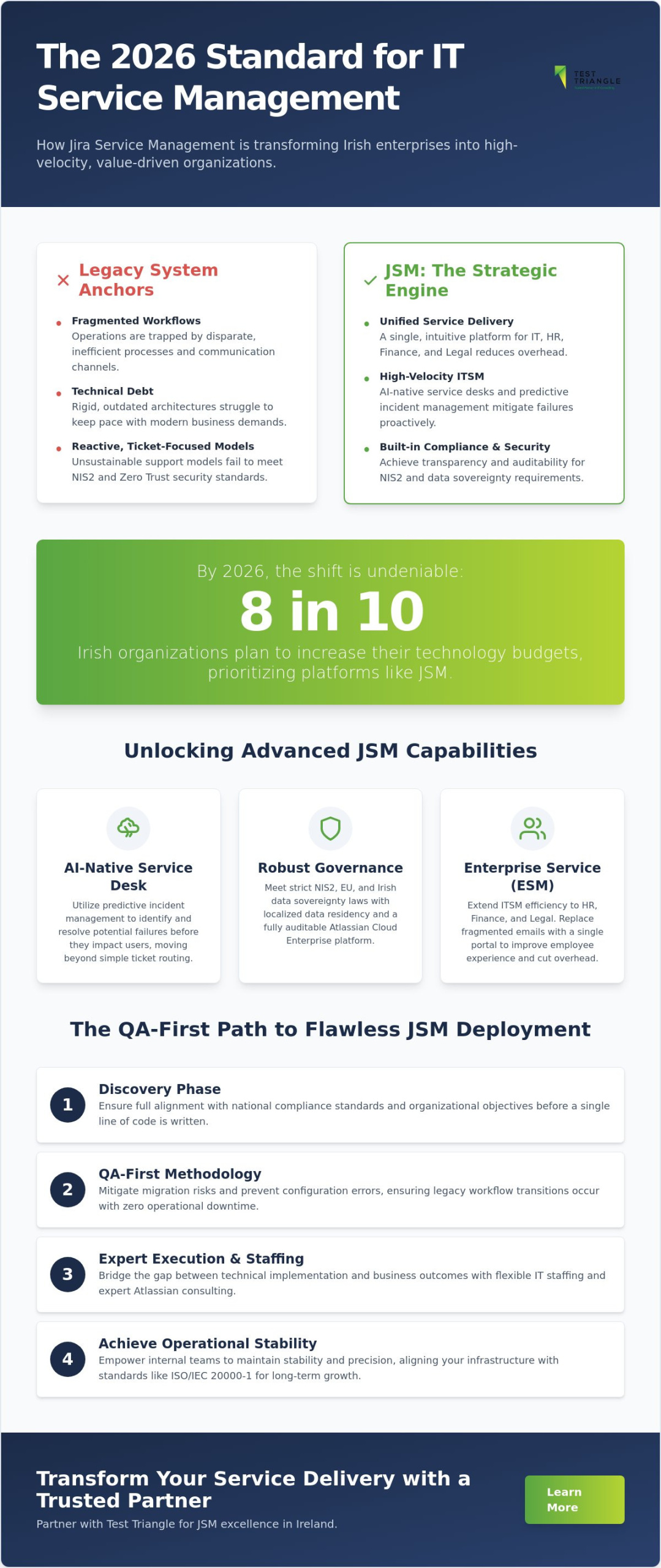
What if the very tools meant to streamline your operations are actually the ones anchoring your enterprise to legacy inefficiencies? While eight in ten Irish organizations plan to increase their technology budgets in 2026, many still find themselves trapped by fragmented workflows and a lack of internal expertise for complex Atlassian Cloud migrations. Selecting a partner for Jira Service Management consulting Ireland is no longer just a technical decision; it’s a strategic imperative for any business aiming to transform its service delivery into a high-velocity, value-driven asset.

You likely recognize that a reactive, ticket-focused model is unsustainable in an era where NIS2 compliance and Zero Trust security are the standard. This article demonstrates how to orchestrate a sophisticated ITSM platform that reduces mean time to resolution while fostering seamless integration between DevOps and IT support. We will examine the critical steps for establishing a scalable ESM framework, implementing agentic automation, and proving tangible ROI through a combination of rigorous methodology, expert execution, and operational stability. By aligning your infrastructure with international standards like ISO/IEC 20000-1, you can ensure your technology serves as a steady hand for long-term growth.

Key Takeaways

  • Understand how the 2026 shift toward AI-native service desks and predictive incident management transforms Jira Service Management into a core engine for high-velocity enterprise service delivery.
  • Learn why a QA-first methodology is essential for mitigating migration risks, ensuring that legacy workflow transitions occur without operational downtime or configuration errors.
  • Discover the strategic necessity of the Discovery Phase in your deployment roadmap to ensure full alignment with national compliance standards and organizational objectives.
  • Explore how specialized Jira Service Management consulting Ireland bridges the gap between technical execution and business outcomes by providing a scalable platform tailored to complex regulatory landscapes.
  • Gain insight into how flexible IT staffing and expert Atlassian consulting empower internal teams to maintain stability and precision within a rapidly evolving technological environment.

Why Jira Service Management is the ITSM Standard in Ireland for 2026

By 2026, the Irish corporate landscape has moved past the experimental phase of digital transformation, establishing Jira Service Management (JSM) as the definitive engine for high-velocity service delivery. While legacy platforms often struggle with the weight of technical debt and rigid architectures, JSM provides a streamlined framework that empowers organizations to respond to incidents with surgical precision. This shift is particularly evident in Ireland, where the intersection of strict regulatory requirements and the need for operational agility has made specialized Jira Service Management consulting Ireland a prerequisite for enterprise success. Organizations are now leveraging AI-native service desks that go beyond simple ticket routing, utilizing predictive incident management to identify and mitigate potential system failures before they impact the end-user.

Data sovereignty remains a non-negotiable priority for Irish enterprises, especially under the oversight of the Data Protection Commission and the requirements of the NIS2 Directive. Atlassian Cloud has achieved a level of maturity that satisfies the rigorous security audits of the finance and pharmaceutical sectors, offering localized data residency that ensures compliance with Irish and EU laws. By consolidating fragmented tools into a single, secure platform, businesses can achieve a level of transparency and auditability that traditional legacy environments simply can’t match. This evolution allows technical managers to focus on strategic growth rather than the maintenance of fragile, outdated systems.

The 2026 Atlassian Cloud Landscape

The retirement of legacy server environments has catalyzed a transition toward cloud-native ecosystems where scalability and security are built into the foundation. For highly regulated industries in Ireland, the 2026 Atlassian Cloud Enterprise offering provides the robust governance structures necessary to manage complex digital infrastructures with confidence. High-Velocity IT Service Management (ITSM) in 2026 is defined as the seamless integration of automated workflows and real-time data to deliver service at the pace of modern business innovation. Strategic migration is no longer an option but a critical step in maintaining a competitive edge in a landscape that values stability and precision.

Beyond IT: The Rise of Enterprise Service Management (ESM)

The utility of JSM has expanded far beyond the technical department, as Irish organizations increasingly adopt Enterprise Service Management (ESM) to unify HR, Finance, and Legal workflows. By replacing fragmented, email-based processes with a single, intuitive portal, companies can drastically reduce administrative overhead and improve the employee experience. This centralized approach eliminates the bottlenecks associated with manual data entry and disparate communication channels, allowing departments to manage requests with the same rigor and efficiency as the IT team. The result is a cohesive operational environment where every service request is tracked, measured, and optimized for maximum business value.

Strategic Consulting: Unlocking Advanced JSM Capabilities

Effective Jira Service Management consulting Ireland requires more than a standard technical setup; it demands the expertise of a Strategic Architect who can bridge the gap between high-level business objectives and granular system configurations. This role is pivotal in ensuring that your platform doesn’t just function, but actively drives organizational progress. By focusing on a holistic framework of Technology, Talent, and Transformation, experts help enterprises move beyond the initial installation phase. The goal is to cultivate a culture of continuous improvement where core ITSM processes are optimized to support long-term stability and scalable growth. This strategic alignment ensures that every automated trigger and workflow transition serves a specific business outcome.

Avoiding the complexity bottleneck is a primary concern for growing enterprises. Without expert guidance, it’s easy to over-engineer workflows, creating rigid structures that hinder rather than help service delivery. Custom workflow design must prioritize simplicity and flexibility, allowing the system to adapt as the organization evolves. By auditing existing legacy processes and stripping away redundant steps, consultants transform JSM from a simple ticketing tool into a sophisticated engine for operational excellence. This transformation is not just about software; it’s about empowering your people to work smarter and providing them with the tools to succeed in a fast-paced digital environment.

Alemba and Multi-Tool Integration Strategies

Modern enterprise environments are rarely homogenous, often requiring JSM to coexist with existing platforms like ServiceNow or Alemba. A sophisticated integration strategy ensures that data flows seamlessly between the service desk and executive reporting layers, providing leadership with a unified view of operational health. You can explore these complex IT Service Management Solutions to understand how hybrid toolsets can be harmonized to eliminate data silos and improve decision-making speed. If you’re ready to refine your service architecture, feel free to reach out to our team for a detailed strategy session.

Asset and Knowledge Management Optimization

Leveraging JSM Assets allows Irish organizations to maintain a comprehensive, real-time inventory of their national infrastructure, which is essential for proactive risk management and compliance. By building a robust knowledge base within Confluence, businesses empower users to resolve common issues independently. This self-service culture, supported by AI-driven deflection and predictive search, significantly reduces Tier 1 ticket volume. Such a proactive approach allows your internal technical staff to move away from repetitive tasks and focus on high-impact strategic initiatives that drive the business forward.

The QA-First Approach to Jira Service Management Implementation

While many service providers focus exclusively on technical configuration, a truly robust implementation requires a rigorous quality assurance foundation to prevent operational friction. Test Triangle’s deep-seated heritage in software testing provides a distinct advantage when delivering Jira Service Management consulting Ireland. We recognize that for an Irish enterprise, the primary objection to migration is the fear of downtime or the inadvertent carry-over of misconfigured legacy workflows. By applying a QA-first mindset, we ensure that every system transition is defined by precision, performance, and peace of mind. Our commitment to stability, scalability, and security allows your organization to evolve without the risk of service degradation.

Our proprietary “Assess-Build-Test-Migrate” methodology is engineered to eliminate business disruption at every stage of the lifecycle. During the assessment phase, we identify potential bottlenecks in your existing processes that could hinder cloud performance. The build phase translates these strategic requirements into technical configurations, which are then subjected to exhaustive validation in a staged environment. Before any data moves to the live production instance, we rigorously verify every automation rule and permission scheme to prevent security vulnerabilities or workflow stalls. This disciplined approach ensures that your new service desk is fully optimized and operational from the moment of go-live.

Validating Legacy Workflow Migrations

Legacy technical debt is often a silent killer of enterprise productivity. When migrating from older on-premise systems, inefficient scripts or redundant approval loops are frequently replicated in the new environment, undermining the benefits of modern software. Our team utilizes a sophisticated blend of manual and automated testing to sanitize these workflows before they reach the cloud. By reviewing our Manual Testing in 2026: A Strategic Guide, you can understand how we prioritize human oversight to catch complex nuances that automated tools might overlook. This ensures your Jira Service Management consulting Ireland project results in a clean, high-performance environment that supports your long-term objectives.

Performance Testing for the Service Desk

A service portal is only as effective as its responsiveness under pressure. Large Irish organizations must account for peak incident periods where concurrent user access can spike significantly, potentially slowing down critical support functions. We integrate performance testing directly into the deployment cycle to guarantee that the user interface remains fluid when your team needs it most. Our Software Test Automation Services provide the necessary framework for simulating enterprise-level loads, ensuring that your digital infrastructure remains stable and reliable during high-traffic events. This focus on technical rigor ensures that your ITSM investment continues to deliver tangible value as your organization scales.

Steps to a Flawless Jira Service Management Deployment

A successful deployment in 2026 is defined by its ability to balance rapid technical execution with long-term operational stability. For Irish organizations, this transition involves a structured roadmap that moves beyond simple installation to achieve comprehensive digital evolution. By engaging with specialized Jira Service Management consulting Ireland, enterprises can navigate the complexities of modern ITSM with a steady hand. The process begins with a focus on preparation, precision, and progress, ensuring that every configuration choice supports the broader business strategy and meets the demands of a fast-changing technological landscape.

Discovery and Governance Mapping

The Discovery Phase stands as the most critical step for ensuring national compliance, particularly as organizations adapt to the requirements of the NIS2 Directive and GDPR. During this stage, we identify key service owners and define ITIL-aligned service catalogs that provide a unified entry point for all internal and external requests. ITIL 4 alignment within JSM ensures that service management practices are integrated, flexible, and value-driven across the entire enterprise service value chain. Establishing robust governance frameworks at the outset is essential to prevent “Jira sprawl,” a common issue where fragmented project configurations lead to administrative bottlenecks and data silos.

Migration and Data Integrity

Preserving the integrity of your historical data is paramount when moving away from legacy ITSM tools. Our migration strategy focuses on maintaining comprehensive audit trails while ensuring that field mapping and user permissions remain intact throughout the transition. This meticulous approach prevents the loss of critical institutional knowledge and ensures a seamless experience for both service agents and end-users. To learn more about our methodology for secure transitions, you can examine our specialized Atlassian Implementation Services.

The journey doesn’t end with the initial go-live; it transitions into a phase of enterprise-wide adoption and ongoing optimization. High user adoption rates are secured through tailored stakeholder training that empowers teams to leverage the full suite of JSM capabilities. As your long-term collaborator, we provide continuous support to refine automation rules and integrate emerging AI functionalities, ensuring your platform remains a strategic asset. If you’re ready to begin your deployment journey with a partner committed to your long-term success, contact our expert consulting team today to discuss your specific requirements.

Expert Jira Service Management Consulting in Ireland

Partnering with Test Triangle for JSM Excellence in Ireland

In a business environment defined by rapid technological shifts and increasing regulatory scrutiny, Test Triangle serves as the strategic steady hand for organizations seeking Jira Service Management consulting Ireland. We recognize that true digital evolution requires more than just the deployment of a tool; it necessitates a holistic alignment of Technology, Talent, and Transformation. By positioning ourselves as a reliable long-term collaborator, we provide the institutional maturity and technical rigor needed to manage complex digital infrastructures with confidence. Our approach ensures that your ITSM investment isn’t just a functional utility, but a scalable platform that drives operational stability and measurable business value.

The success of any Jira Service Management implementation depends on the seamless integration of human expertise and sophisticated software. We bridge the gap between technical execution and business outcomes by ensuring that your internal teams are empowered and supported at every stage of the journey. This commitment to partnership allows technical managers and executive leadership to find peace of mind, knowing their systems are designed for precision, performance, and progress. Whether you’re migrating from a legacy environment or optimizing an existing cloud instance, our methodology focuses on risk reduction and systemic improvement.

Flexible Engagement Models

Recognizing that every enterprise has unique operational requirements, we offer adaptable service delivery models that range from project-based implementations to comprehensive managed services. With Ireland’s IT job market seeing a projected 12-15% increase in demand for specialized roles in 2026, finding the right expertise internally can be a significant challenge. Our Staffing Solutions leverage deep recruitment expertise to provide flexible Atlassian talent, ensuring your internal teams have the support they need to maintain a high-velocity service desk. This versatility allows Irish firms to scale their technical capabilities without the overhead of traditional hiring cycles.

Future-Proofing Your ITSM Strategy

A strategic partnership with Test Triangle is focused on long-term success rather than a one-time technical setup. We ensure your JSM environment is prepared for the innovations of 2027 and beyond, integrating advanced AI governance and agentic automation as they emerge. By maintaining a focus on international standards such as ISO/IEC 20000-1, we help you build a resilient infrastructure that remains compliant and efficient in a fast-changing landscape. For a deeper look at how we navigate these complexities, you can refer to our Atlassian Consulting Services Dublin: The 2026 Strategic Partner Guide. This forward-thinking approach guarantees that your service delivery model remains a strategic asset for years to come.

Strategic Mastery for Modern Enterprise Service Delivery

Transforming your service delivery from a reactive cost center into a proactive strategic asset requires a fusion of technical rigor and visionary leadership. By prioritizing a QA-first methodology and aligning your infrastructure with international standards, you ensure that your organization is prepared for the high-velocity demands of the 2026 digital landscape. It’s clear that the successful adoption of these platforms hinges on a disciplined approach that balances immediate operational needs with long-term scalability, ensuring that every automated workflow serves a concrete business outcome.

As an Atlassian Gold Solution Partner with over 15 years of ITSM and DevOps expertise, Test Triangle provides the steady hand necessary for complex transitions. Our proven “Assess-Build-Test-Migrate” methodology guarantees that your deployment is defined by Stability, Scalability, and Security. When you choose our specialized Jira Service Management consulting Ireland, you’re securing a reliable long-term collaborator dedicated to your organizational progress. Take the next step in your digital transformation and Consult with our Jira Service Management Strategic Architects Today. We’re ready to help you navigate the future with confidence.

Frequently Asked Questions

Why should we choose Jira Service Management over ServiceNow for our Irish operations?

Jira Service Management offers a more flexible, cost-effective alternative to ServiceNow, particularly for organizations seeking rapid deployment and seamless integration with existing Atlassian tools like Jira Software. While ServiceNow is a powerful platform, many Irish enterprises prefer JSM’s lower total cost of ownership and its ability to unify development and IT operations within a single ecosystem. This synergy reduces tool sprawl and accelerates service delivery across the entire organization by eliminating silos between teams.

How long does a typical Jira Service Management implementation take for an enterprise?

A typical enterprise-level Jira Service Management implementation generally spans 8 to 12 weeks, depending on the complexity of your existing workflows and data migration requirements. Smaller pilot projects can often be launched in as little as 4 weeks, allowing for an iterative approach to enterprise-wide adoption. This timeline includes the critical discovery and testing phases to ensure that the final configuration aligns with your strategic business goals and operational standards.

Can JSM support our non-IT departments like HR and Finance?

Yes, Jira Service Management is designed to support Enterprise Service Management (ESM) across departments such as HR, Finance, and Legal. By utilizing specialized templates and custom request types, non-IT teams can manage internal employee requests through a unified portal, replacing fragmented email chains with structured, automated workflows. This centralization improves transparency and ensures that every department adheres to the same high standards of service delivery, significantly reducing administrative overhead.

What are the primary benefits of working with a certified Atlassian partner in Ireland?

Partnering with a certified expert for Jira Service Management consulting Ireland provides access to specialized technical knowledge and strategic oversight that internal teams often lack. Certified partners bring a wealth of experience in managing complex Atlassian Cloud migrations and ensuring that configurations meet local regulatory standards. This collaboration reduces implementation risks and guarantees that your platform is optimized for long-term operational stability, allowing your staff to focus on core business objectives.

How does JSM help with GDPR compliance and data sovereignty in 2026?

JSM supports GDPR compliance and data sovereignty through robust data residency controls that allow Irish organizations to specify where their information is stored within the Atlassian Cloud. In 2026, these features are essential for meeting the requirements of the NIS2 Directive, providing the necessary audit trails and incident reporting capabilities. By centralizing data on a secure, compliant platform, businesses can manage sensitive information with confidence and precision while meeting all legal obligations.

Is it possible to migrate our historical data from a legacy ITSM tool into JSM?

It is entirely possible to migrate historical audit trails and ticket data from legacy ITSM tools into Jira Service Management using specialized migration frameworks. Our team ensures that field mapping and user permissions are preserved, maintaining the integrity of your institutional knowledge throughout the process. This transition allows you to decommission outdated systems while retaining access to the critical data required for long-term trend analysis and compliance reporting without disruption.

What is the expected ROI of a strategic JSM consulting engagement?

The expected ROI of a strategic JSM consulting engagement is realized through significant reductions in mean time to resolution (MTTR) and the elimination of redundant software licensing costs. By automating repetitive tasks and improving self-service deflection, organizations can lower their Tier 1 ticket volume, allowing technical staff to focus on high-value initiatives. These efficiencies contribute to a leaner, more agile service desk that directly supports organizational growth and improves the overall employee experience.

How does Test Triangle integrate QA testing into the JSM implementation process?

Test Triangle integrates QA testing into the JSM implementation process by applying a rigorous “Assess-Build-Test-Migrate” methodology that validates every automation rule before go-live. We utilize both manual and automated testing to ensure that workflows perform under enterprise-level load and that permissions are correctly configured for all user groups. This focus on quality assurance prevents the introduction of technical debt and ensures a seamless transition for your end-users and service agents.

Paul Guy

Article by

Paul Guy

Paul serves as the Marketing Director at Test Triangle, where he leads a global team in driving growth through strategic B2B marketing and brand communications. With a strong emphasis on measurable outcomes and sustainable performance, he plays a pivotal role in aligning marketing functions to enhance customer engagement and accelerate business impact. Under his leadership, marketing initiatives have consistently delivered significant returns on investment, elevated brand visibility, and strengthened the company's presence across key markets.


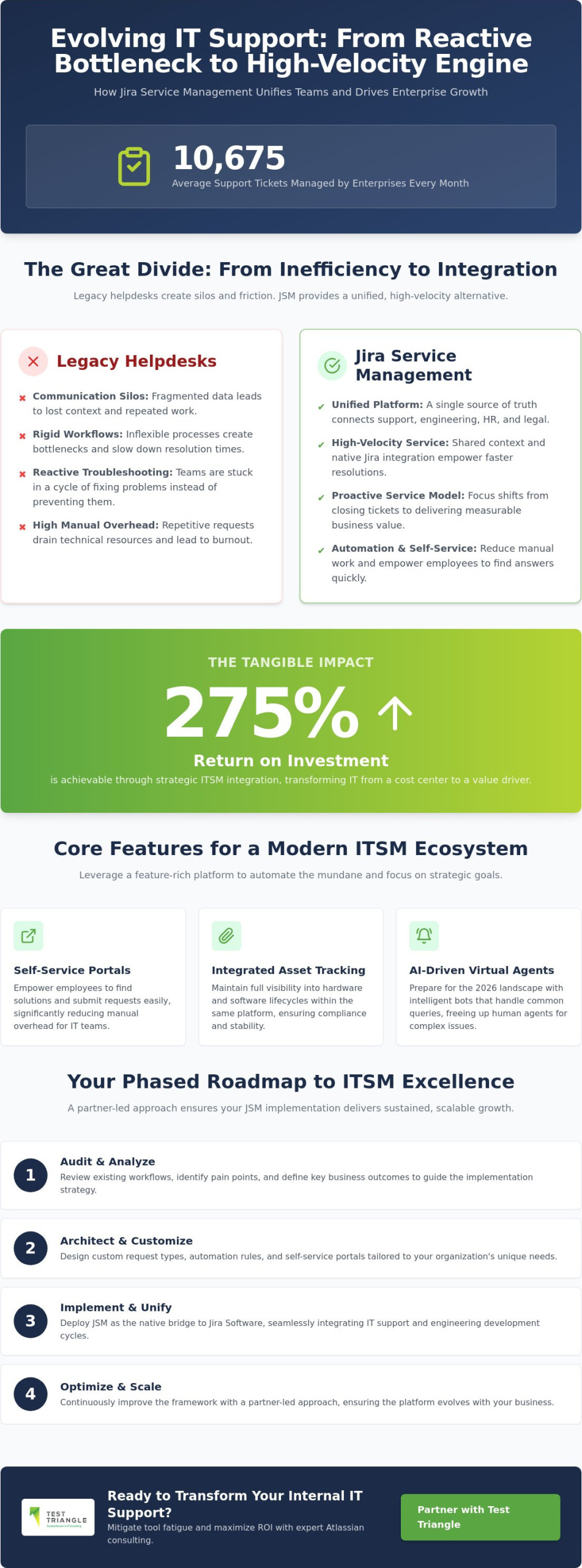
With the average enterprise now managing over 10,675 support tickets every month, the traditional separation between service desks and engineering teams has become an operational liability. You’ve likely felt the friction of communication silos and the mounting pressure of repetitive manual requests that drain your team’s technical resources. Implementing jira service management for internal it support offers a decisive shift from reactive troubleshooting to a state of high-velocity service delivery. By aligning your support workflows directly with Jira Software, you eliminate the visibility gaps that often stall asset lifecycles and resolution times.

This guide provides a comprehensive roadmap to architecting a unified, automated, and scalable internal ecosystem. We’ll explore how a 275% return on investment is achievable through strategic ITSM integration while examining the 2026 technical landscape, including AI-driven virtual agents and Forge API enhancements. You’ll discover the methodology behind transforming fragmented support into a disciplined, versatile, and globally-minded operation that prioritizes business outcomes over mere ticket counts. We’ll show you how to leverage this integrated framework to ensure your digital infrastructure remains a stable, high-performance asset for the long term.

Key Takeaways

  • Learn how to pivot from a traditional, reactive helpdesk to a proactive service model that aligns with enterprise-scale digital evolution and long-term operational stability.
  • Master the deployment of self-service portals and integrated asset tracking to significantly reduce manual overhead while maintaining full visibility into hardware and software lifecycles.
  • Understand how to unify your support and engineering teams by implementing jira service management for internal it support as a native bridge to existing Jira Software development cycles.
  • Follow a phased strategic roadmap designed to audit existing workflows and architect custom request types that maximize employee adoption and technical precision.
  • Discover how a partner-led approach to implementation mitigates tool fatigue and ensures your ITSM framework delivers sustained, scalable growth across complex, highly regulated environments.

The Strategic Evolution of Internal IT Support: Why Jira Service Management Matters

In the current enterprise environment, the role of internal IT has transitioned from a back-office utility to a central pillar of organizational resilience. Jira Service Management (JSM) serves as a comprehensive ITSM solution designed to orchestrate these complex interactions across a unified digital landscape. By leveraging the robust architecture of Jira (software), JSM allows organizations to move beyond the limitations of reactive helpdesks into a proactive, high-velocity model. This evolution is critical for managing the unique pressures of 2026, where hybrid work models and AI-driven workflows demand a platform that can seamlessly integrate IT, HR, and Legal departments into a singular service engine. Managing internal requests in 2026 requires more than just a digital logbook; it requires a system that understands the nuances of modern service delivery through stability, precision, and scalable growth.

Adopting jira service management for internal it support addresses the modern reality where support teams handle an average of 10,675 tickets monthly. Without a unified platform, these volumes lead to fragmentation, data loss, and employee burnout. Organizations that prioritize IT service management services find that consolidating their request management onto a single platform reduces technical debt and improves enterprise-wide productivity. This strategic shift ensures that IT is no longer a bottleneck but a catalyst for digital transformation, providing the peace of mind that comes from risk reduction and operational stability.

Understanding the High-Velocity Support Model

High-velocity service management represents the intersection of speed, quality, and deep team collaboration. Unlike traditional, tiered support structures that often create bottlenecks between levels, JSM empowers internal agents to resolve tickets faster through shared context. When support teams have immediate access to technical data and historical resolutions, they can address complex issues without unnecessary escalations. This model fosters a culture of continuous improvement where the focus shifts from simply closing tickets to delivering measurable business value. By empowering agents with integrated tools, the organization achieves a professional pace that mirrors the operational efficiency promised to stakeholders.

Why Legacy Helpdesks Fail Modern Internal Teams

Traditional helpdesks frequently succumb to systemic inefficiencies such as siloed data and rigid, inflexible workflows. These legacy systems often force teams into constant context switching between disparate support tools and development environments, which significantly degrades productivity. Rigid workflows in older systems fail to account for the speed at which modern dev teams operate. When jira service management for internal it support is implemented effectively, it eliminates these barriers by providing a native connection to the engineering toolchain. This integration ensures that information flows freely across the organization, preventing the data fragmentation that typically leads to slow resolution times and poor employee experiences. It acts as a steady hand in a fast-changing landscape, ensuring that human expertise and technical tools work in perfect harmony.

Optimizing Internal Workflows with Jira Service Management Core Features

To achieve the high-velocity engine described earlier, organizations must move beyond simple ticket logging and embrace a feature-rich ecosystem that prioritizes precision, productivity, and progress. Integrating jira service management for internal it support allows teams to automate the mundane and focus on the complex, transforming the service desk into a strategic asset. This transition is anchored in the broader framework of IT Service Management (ITSM), where the goal is to align technical delivery with specific business outcomes. Advanced SLAs empower internal teams to monitor performance with granular detail, ensuring that critical infrastructure issues are addressed before they impact organizational stability. Transitioning to conversational ticketing through Slack and Microsoft Teams meets employees where they already work, reducing the friction of request submission and accelerating the initial response phase.

Empowering Employees through Self-Service and Knowledge Bases

Modern service delivery relies on the seamless integration of Confluence to create a searchable, AI-driven internal help center. This setup allows the system to ‘deflect’ common queries by suggesting relevant articles as users type their requests, effectively resolving issues before they even reach an agent’s queue. In the 2026 landscape, AI-powered virtual agents can reduce ticket resolution times by as much as 75%, allowing your technical staff to focus on high-level digital transformation. As you scale, remember that self-service is not just a convenience; it is a strategic necessity for scaling internal IT without increasing headcount. This approach ensures that your team remains a lean, effective force capable of supporting a growing global enterprise.

Modern Asset Management for Internal Infrastructure

The Assets feature, formerly known as Insight, provides a sophisticated framework for tracking the entire lifecycle of internal company hardware and software. By linking these assets directly to support incidents, agents gain immediate visibility into the affected machine’s history, configuration, and dependencies, which leads to significantly faster triage and resolution. In 2026, this level of detail is essential for the growing trend of ‘sustainable IT,’ where precise tracking helps organizations reduce hardware waste and optimize resource allocation. This systematic approach to asset management provides the peace of mind that comes from knowing every piece of your digital infrastructure is accounted for and maintained with professional rigor. If you’re looking to refine your current asset strategy, it’s beneficial to speak with a strategic consultant who understands the nuances of the Atlassian ecosystem.

Bridging the Gap: Integrating IT Support with Engineering and DevOps

A common hesitation among IT leadership is the perception that jira service management for internal it support introduces unnecessary complexity for relatively straightforward internal needs. This perspective often overlooks the strategic value of an integrated ecosystem where support and development operate on a single source of truth. By utilizing a platform that natively bridges these functions, organizations replace fragmented communication with a disciplined, high-velocity workflow. This integration allows for a definitive “Shift Left” approach, where service desk insights inform engineering priorities early in the lifecycle, ultimately reducing the cost of remediation and enhancing the overall stability of the digital infrastructure. It is a transition from being a mere service provider to becoming a reliable long-term collaborator within the business.

The Synergy Between Jira Software and Service Management

Turning internal support tickets into actionable development tasks is a seamless process within the Atlassian stack. When an employee reports a recurring software glitch, the service agent can instantly create a linked issue in Jira Software, ensuring that the engineering team has the full context of the user’s experience without manual data entry. Bi-directional syncing ensures that as the developer moves the task through the sprint, the support agent is automatically updated, allowing for transparent communication with the internal stakeholder. This synergy underscores why Manual Testing in 2026: A Strategic Guide remains relevant; quality is not just a final check but a continuous effort that begins at the first point of internal contact and moves through the entire development cycle.

Accelerating Incident and Change Management

Managing complex infrastructure changes requires a level of precision that legacy systems simply cannot provide. JSM enables internal IT teams to implement automated change management workflows that include sophisticated risk assessment and deployment gating. By integrating directly with CI/CD tools, the platform can automatically flag high-risk changes, requiring manual approval only when specific thresholds are met, which significantly reduces internal system downtime. This level of technical rigor aligns perfectly with broader DevOps Consulting objectives, where the goal is to accelerate enterprise transformation through the combination of human expertise and technical tools. Utilizing jira service management for internal it support in this capacity transforms the service desk into a steady hand that guides organizational progress amidst a fast-changing technological landscape.

A Strategic Roadmap for Implementing JSM for Internal IT in 2026

Transitioning to a high-velocity service model requires more than a technical migration; it demands a structured, phased implementation that prioritizes long-term operational stability. A successful deployment of jira service management for internal it support begins with institutional maturity and a clear vision of the desired end-state. Organizations that skip the strategic planning phase often find themselves managing the same historical inefficiencies in a newer, more expensive environment. By following a disciplined roadmap, global enterprises ensure their digital infrastructure is managed with the expertise required to support large-scale technological evolution and systemic improvement.

Auditing and Mapping Internal Workflows

Mirroring existing, inefficient processes in a modern tool is a primary recipe for failure. Phase 1 of your roadmap must focus on a comprehensive audit of current support interactions to identify bottlenecks and redundant manual efforts. This discovery phase is where professional IT Service Management Services provide the most value, offering a steady hand to help teams deconstruct complex workflows and rebuild them for maximum velocity. By mapping these journeys before configuration, you ensure that the resulting platform is optimized for the speed and quality required in 2026. This process allows you to identify which repetitive internal requests are prime candidates for automation in later phases.

Configuring for the Employee Experience

Phase 2 involves shifting to an “internal customer” mindset to design portal groups that prioritize ease of use and intuitive navigation. The configuration of low-code forms allows IT teams to capture comprehensive data during the initial request, which reduces the need for back-and-forth communication and accelerates resolution times. The Employee Portal serves as the digital front door of the modern enterprise. By creating a unified, intuitive interface, you empower your workforce and foster a culture of self-sufficiency that reduces the overall burden on your technical staff. This approach ensures that technical managers and executive leadership both see the tangible benefits of a streamlined request process.

Once the foundation is set, Phase 3 focuses on implementing automation rules to handle repetitive internal tasks like access provisioning and hardware requests. Finally, Phase 4 establishes a continuous improvement cycle based on JSM reporting, where data-driven insights lead to systemic improvements and progress. This methodical rhythm ensures that your team remains a reliable collaborator in the company’s growth. If you are ready to begin your transformation with precision and confidence, it is time to consult with an implementation expert who can guide your team through each phase of this strategic evolution.

Jira Service Management for Internal IT Support: A 2026 Strategic Guide

Maximizing ROI with Professional Atlassian Consulting Services

While Jira Service Management is inherently intuitive, the transition for a global enterprise involves layers of complexity that often exceed the capacity of internal teams. A DIY approach frequently results in “tool fatigue,” where over-engineered workflows and fragmented data lead to low user adoption and stalled digital transformation. By choosing to implement jira service management for internal it support through a professional lens, organizations ensure that their technical infrastructure is not just a ticketing system, but a strategic engine for growth. This journey requires a steady hand to navigate the nuances of high-velocity service delivery while maintaining operational stability and security across the entire ecosystem.

Avoiding Common Implementation Pitfalls

The risks of a poorly executed rollout are substantial, ranging from over-engineered workflows that frustrate agents to data migration errors that obscure historical insights. Many organizations underestimate the critical role of change management, failing to realize that a tool is only as effective as the people who use it. Utilizing expert Atlassian Implementation Services allows you to mitigate these risks through a disciplined methodology that prioritizes clarity and comprehensive detail. Our consultants focus on aligning technical execution with your specific business outcomes, ensuring that the platform scales alongside your organizational needs without introducing unnecessary friction or technical debt. This approach provides the stability, precision, and progress necessary for a successful transition.

The Test Triangle Advantage: Strategic Partnership for Scalable Growth

A professional partnership extends far beyond the initial deployment phase. Maintaining a complex Atlassian environment requires ongoing optimization, governance, and technical rigor to ensure sustained performance in a fast-changing landscape. By leveraging Managed Outsourcing Services, enterprises benefit from the peace of mind that comes from proactive risk reduction and continuous systemic improvement. Test Triangle acts as a reliable long-term collaborator, bridging the gap between technical managers and executive leadership through data-driven insights and institutional maturity. We empower your team to focus on core innovation while we manage the daily complexities of your ITSM framework.

Achieving true high-velocity service is a journey of evolution rather than a one-time event. It requires a commitment to quality and a versatile approach to service delivery that can adapt to new technical challenges as they arise. When you partner with Test Triangle for your Jira Service Management journey, you gain more than a service provider; you gain a strategic visionary dedicated to your long-term success. We invite you to transform your internal IT operations into a powerhouse of efficiency and resilience through our proven expertise and human-centric technical tools.

Architecting a High-Velocity Future for Internal Support

Achieving a high-velocity service engine requires a disciplined alignment of people, processes, and platforms that transforms the traditional support desk into a strategic business asset. By implementing jira service management for internal it support, your organization can finally bridge the gap between reactive troubleshooting and proactive engineering. This integrated framework not only accelerates resolution times through advanced automation but also provides the institutional maturity needed to manage complex asset lifecycles and cross-departmental requests with stability and precision.

As an Atlassian Gold Solution Partner with a global presence across Europe, North America, and Asia, Test Triangle understands the technical rigor required for highly regulated industries like Finance and Pharma. We act as a reliable long-term collaborator to ensure your digital transformation remains scalable, secure, and aligned with executive business goals. Modernize your internal IT with Test Triangle’s Atlassian Consulting and empower your workforce with a platform built for the complexities of 2026. Your journey toward operational excellence is within reach.

Frequently Asked Questions

Is Jira Service Management suitable for small internal IT teams?

Jira Service Management is an ideal solution for small teams because it offers a free tier for up to three agents while providing the same enterprise-grade automation found in larger deployments. This scalability allows lean departments to maintain high-velocity support and professional service portals without the burden of excessive infrastructure costs. As your organization expands, the platform grows with you, ensuring a stable, precise, and scalable service engine.

How does JSM integrate with Slack and Microsoft Teams for internal support?

The platform utilizes conversational ticketing to transform chat messages into actionable support requests directly within the agent’s queue. By meeting employees in their existing communication channels, internal IT reduces the friction of ticket submission and accelerates the initial response phase. Bi-directional syncing ensures that all updates made in Slack or Teams are reflected in the central ticket, maintaining a single source of truth across the enterprise.

What is the difference between Jira Service Desk and Jira Service Management?

Jira Service Management is the comprehensive successor to Jira Service Desk, offering significantly expanded capabilities in incident, change, and asset management. While the older Service Desk focused primarily on request fulfillment, JSM provides a unified platform that bridges the gap between development and operations teams. This evolution enables organizations to manage complex digital infrastructures with greater visibility and technical rigor.

Can we use Jira Service Management for non-IT departments like HR or Finance?

JSM is specifically designed for Enterprise Service Management, allowing departments like HR, Finance, and Legal to leverage the same high-velocity framework for their internal requests. Centralizing these functions creates a unified digital front door for employees, which improves the user experience and provides executive leadership with comprehensive visibility into service performance. This approach fosters organizational progress through the combination of human expertise and technical tools.

How does JSM help with internal asset management and tracking?

The Assets feature within JSM provides a sophisticated database for tracking the entire lifecycle of hardware and software across your digital landscape. By linking these assets directly to support incidents, agents gain immediate context regarding a user’s device history and configuration, which leads to faster resolution times. Implementing jira service management for internal it support in this way ensures that your technical resources are managed with professional discipline and long-term stability.

What are the common challenges when migrating to Jira Service Management Cloud?

Organizations often face hurdles related to complex data mapping, app compatibility, and the need to maintain security compliance in highly regulated industries. A primary risk is mirroring inefficient legacy processes in the new cloud environment, which can lead to low adoption and technical debt. Partnering with a strategic visionary for your migration helps mitigate these risks through a structured audit and a disciplined transition methodology.

How long does a typical JSM implementation for internal IT take?

A standard implementation can range from several weeks for basic setups to several months for complex enterprise deployments involving multiple internal departments. The specific timeline is influenced by the volume of data migration, the complexity of custom automation rules, and the depth of integration with Jira Software. Following a phased roadmap allows teams to achieve immediate business value while building toward a more comprehensive service ecosystem.

Does Jira Service Management support ITIL 4 practices for internal teams?

JSM is PinkVerify certified for ITIL 4, providing native support for critical practices such as incident, problem, change, and service request management. This certification ensures that internal teams can implement recognized global benchmarks with confidence and technical precision. Using jira service management for internal it support allows your team to adopt these best practices while maintaining the flexibility to adapt workflows to your unique operational requirements.

Paul Guy

Article by

Paul Guy

Paul serves as the Marketing Director at Test Triangle, where he leads a global team in driving growth through strategic B2B marketing and brand communications. With a strong emphasis on measurable outcomes and sustainable performance, he plays a pivotal role in aligning marketing functions to enhance customer engagement and accelerate business impact. Under his leadership, marketing initiatives have consistently delivered significant returns on investment, elevated brand visibility, and strengthened the company's presence across key markets.