



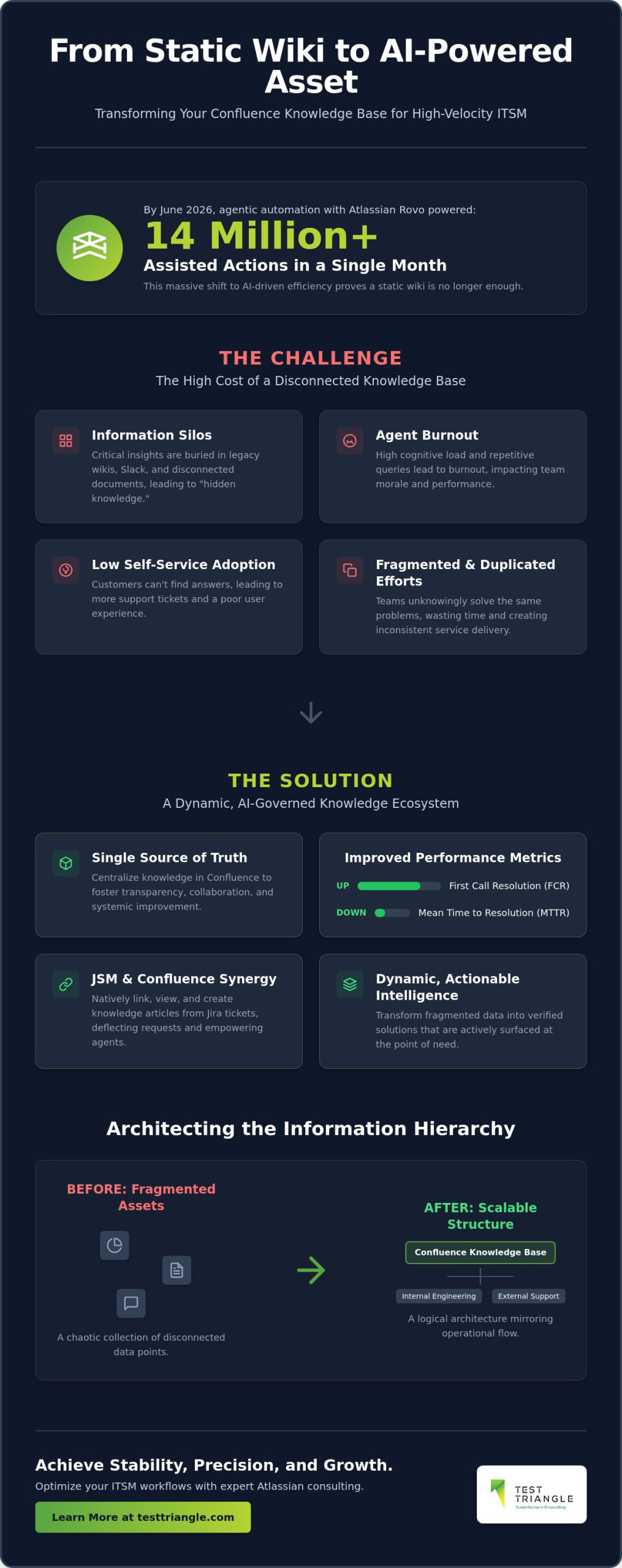
Did you know that by June 2026, agentic automation powered by Atlassian Rovo supported more than 14 million assisted actions in a single month? This massive shift toward AI-driven efficiency highlights a critical reality for global enterprises: a static wiki is no longer enough to support modern service delivery. To maintain operational stability, your organization needs a robust confluence knowledge base for itsm that functions as a dynamic, AI-governed engine rather than a forgotten digital archive.
We recognize that information silos across Slack and legacy wikis often lead to low self-service adoption and agent burnout, creating a fragmented landscape that hinders organizational progress. This guide demonstrates how to transform these disparate data points into a high-velocity asset by leveraging strategic Atlassian governance to drive precision, performance, and progress. You’ll discover the methodology required to establish a single source of truth, increase first-call resolution rates, and secure a seamless integration between Jira Service Management and Confluence. By bridging the gap between technical execution and business outcomes, we’ll outline a path toward a scalable, secure, and sophisticated knowledge ecosystem that empowers your workforce and satisfies your customers.
Key Takeaways
- Understand the evolution from static documentation to a dynamic ecosystem, positioning a confluence knowledge base for itsm as a high-velocity asset that drives organizational progress.
- Master the architectural principles of information hierarchy to establish a scalable source of truth that bridges the gap between internal engineering and external support.
- Harness the capabilities of Atlassian Rovo to eliminate information silos, enabling teams to surface critical insights across fragmented SaaS tools with AI-driven precision.
- Follow a structured implementation roadmap to audit and transition legacy assets into optimized templates that reduce agent burnout and accelerate resolution.
- Leverage strategic Atlassian consulting to achieve the stability, precision, and growth necessary for managing complex digital infrastructures.
The Strategic Role of a Confluence Knowledge Base in Modern ITSM
In the high-velocity environment of 2026, the traditional wiki has evolved into a sophisticated engine for operational stability. A confluence knowledge base for itsm is no longer a passive repository of “how-to” articles; it’s a strategic asset that powers the entire service lifecycle. By 2026, the paradigm has shifted from static documentation to dynamic knowledge sharing. This evolution ensures that information isn’t just stored but is actively surfaced at the point of need, transforming fragmented data into actionable intelligence. This transition is essential for organizations aiming to achieve institutional maturity and maintain a competitive edge in complex digital landscapes.
Effective knowledge management serves as a cornerstone of the ITIL 4 Service Value System, ensuring that every service interaction contributes to value co-creation. When teams integrate their knowledge assets directly into IT Service Management (ITSM) frameworks, the impact on performance metrics is profound. We see a direct correlation between advanced knowledge governance and improvements in First Call Resolution (FCR) and Mean Time to Resolution (MTTR). By providing agents with immediate access to verified solutions, enterprises reduce the cognitive load on staff, mitigate agent burnout, and deliver the peace of mind that comes from predictable, high-quality service outcomes.
Breaking Down Information Silos in Global Enterprises
Fragmented data remains a significant barrier to organizational progress. In many global enterprises, critical insights are often buried within legacy wikis, disconnected PDF repositories, or transient chat histories. These silos create “hidden knowledge” that is inaccessible to the broader team, leading to duplicated efforts and inconsistent service delivery. Confluence acts as a unified layer that bridges these gaps, providing a single source of truth for cross-functional DevOps and IT teams. This centralized approach fosters a culture of transparency and collaboration, allowing organizations to capitalize on their collective expertise and drive systemic improvement through stability, precision, and growth.
The Symbiosis of Jira Service Management and Confluence
The native integration between Jira Service Management and Confluence creates a powerful synergy that redefines the agent and customer experience. Within the agent workspace, team members can view, link, or even create knowledge articles directly from a ticket, ensuring that the confluence knowledge base for itsm stays current with real-world issues. Simultaneously, customer portals leverage this data to deflect incoming requests by suggesting relevant articles as users type their queries. Implementing professional IT Service Management solutions ensures this integration is optimized for high-velocity delivery, allowing your organization to scale its support capabilities without a linear increase in headcount. This collaborative framework positions your company as a reliable long-term partner capable of navigating the complexities of modern digital infrastructure.
Architecting the Information Hierarchy for High-Velocity Service Delivery
Establishing a high-performance confluence knowledge base for itsm requires a logical architecture that mirrors your organization’s operational flow rather than just a collection of documents. By designing a scalable space structure that distinguishes between internal engineering documentation and external customer support content, enterprises can ensure that technical staff and end-users access the precise information they require without cognitive overhead. This structural precision is supported by rigorous naming conventions and metadata standards, which empower search algorithms to surface relevant articles with surgical accuracy. When sensitive technical data is involved, utilizing page restrictions and granular permissions becomes a critical component of your risk reduction strategy, maintaining security without sacrificing the speed of service delivery.
Preventing “knowledge rot” is a primary challenge for global organizations, requiring a proactive content lifecycle policy that identifies and archives outdated entries. Without these safeguards, the accumulation of irrelevant documentation can lead to agent confusion and increased resolution times. Implementing a structured hierarchy allows your team to move from a state of reactive information gathering to a proactive, solution-oriented environment. If you’re looking for guidance on refining these structures, discussing your knowledge architecture with our specialists can provide the clarity needed for long-term success.
Designing Spaces for Scalability and Precision
Strategic space organization begins with a clear distinction between Global Knowledge Spaces, which house universal policies, and Departmental Workspaces, which contain specialized technical insights. By employing Space Categories, administrators can organize content for different user personas, ensuring that a DevOps engineer and a front-office clerk see the most relevant data for their specific roles. Integrating Atlassian implementation best practices during the initial setup phase ensures that the technical architecture remains resilient as your digital infrastructure evolves, providing a steady hand in a fast-changing technological landscape.
Implementing Robust Governance and Content Lifecycle
Knowledge Governance is the systematic oversight of content accuracy and relevance. This discipline requires clearly defined roles, including Knowledge Owners who oversee space strategy, Subject Matter Experts (SMEs) who verify technical accuracy, and Knowledge Managers who facilitate the overall flow of information. To maintain institutional maturity, we recommend a 90-day review cycle for critical ITSM documentation, such as Runbooks and Post-Incident Reports (PIRs). Adhering to these ensures that your confluence knowledge base for itsm remains a reliable, high-velocity asset that supports operational stability and empowers your workforce through large-scale technological evolution.
Leveraging Atlassian Intelligence and Rovo for Knowledge Discovery
In the high-velocity technological landscape of 2026, the ability to surface relevant information across disparate platforms has become the defining characteristic of an elite service desk. Atlassian Rovo serves as a sophisticated AI operating layer that connects work and knowledge, not just within your confluence knowledge base for itsm, but across more than 50 connected third-party applications. By June 2026, Rovo supported more than 14 million assisted actions in a single month, demonstrating its maturity as a tool for global enterprises. This AI-driven discovery engine understands user intent with surgical precision, ensuring that customers find exact solutions through self-service portals while agents receive real-time recommendations during active incident management. By integrating these capabilities, organizations can move beyond simple keyword searches to a model of intelligent knowledge surfacing that significantly reduces cognitive load.
While the benefits are substantial, we recognize the inherent risks associated with AI-generated content, particularly regarding technical accuracy. Addressing the challenge of “AI Hallucinations” requires a disciplined human-in-the-loop validation process where Subject Matter Experts (SMEs) verify AI-drafted articles before they’re published to the wider organization. This strategic oversight ensures that while Atlassian Intelligence handles the heavy lifting of summarization and tone adjustment, the technical integrity of your documentation remains uncompromised. Adhering to these ITIL best practices ensures that AI remains a tool for augmentation rather than a source of operational risk.
Rovo: The AI Search Engine for the Modern Enterprise
Rovo’s ability to index data from third-party applications like Slack, Google Drive, and GitHub eliminates the friction of context switching by providing a unified search experience. Beyond simple discovery, Rovo Agents can be deployed to automate repetitive knowledge tasks, such as identifying and updating “Known Errors” based on recent deployment logs or developer commits. For organizations looking to bridge the gap between development and operations, our insights on DevOps Consulting offer a blueprint for integrating these AI agents directly into the CI/CD pipeline. This systemic improvement allows your team to maintain a high-velocity confluence knowledge base for itsm that evolves at the same pace as your software delivery.
Enhancing the Agent Experience with Atlassian Intelligence
Atlassian Intelligence provides a suite of internal tools designed to accelerate agent workflows, such as the ability to draft comprehensive Post-Incident Reports (PIRs) directly from Jira ticket history. This feature extracts key timelines, root causes, and resolution steps, allowing agents to focus on strategic improvements rather than administrative documentation. Additionally, the “Smart Links” feature provides instant context for technical terms or internal projects without requiring the user to leave the page. Ultimately, AI in ITSM is a force multiplier that converts raw data into actionable intelligence at the point of service. This approach empowers technical managers and executive leadership alike by fostering an environment of institutional maturity and operational stability.
Implementation Roadmap: Transitioning from Static to Dynamic Knowledge
Transitioning to a high-velocity confluence knowledge base for itsm requires more than a simple data transfer; it demands a structured audit of existing assets to identify critical gaps in technical documentation. By analyzing legacy wikis, shared drives, and disconnected repositories, organizations can determine which assets remain relevant and which require immediate decommissioning to prevent information bloat. Once this audit is complete, selecting and customizing ITSM-specific templates, such as standardized “How-to” guides, “Known Errors” logs, and “Change Plans,” ensures that all future content adheres to a consistent, professional standard. This methodical approach establishes a foundation for operational stability and systemic improvement across the entire service value chain.
Executing a phased migration strategy is essential for minimizing operational downtime during large-scale digital transformations. We recommend launching a pilot program with a “Champion Team,” a small, versatile group of technical experts who can refine the structure and workflows before a global rollout occurs. To measure the success of this transition, enterprises must establish clear KPIs for knowledge health. Metrics such as “Article Usefulness” scores and “Deflection Rate” provide tangible evidence of the system’s impact on service efficiency, ensuring that technical managers and executive leadership can track organizational progress with precision. This disciplined framework allows for the combination of human expertise and technical tools to deliver a superior service experience.
The Data Migration and Cleanup Phase
A critical component of this roadmap is the “ROT” analysis, which requires teams to Remove, Outdate, or Transform legacy content. This process ensures that the new environment isn’t polluted with redundant or trivial information that could lead to agent burnout. During the technical migration, preserving link integrity is paramount to prevent broken cross-references that frustrate both agents and customers. Leveraging Software and Digital Assurance Testing ensures data parity after the migration, confirming that the technical architecture remains robust and secure. This level of rigor is what distinguishes a seasoned expert from a mere service provider in the complex landscape of enterprise IT.
Training and Cultural Adoption Strategies
Sustainable success relies on shifting the organizational mindset from “Knowledge is Power” to “Knowledge Sharing is Power.” Adopting a Knowledge Centered Service (KCS) methodology encourages continuous content creation as a natural byproduct of the problem-solving process, ensuring the confluence knowledge base for itsm remains a living asset. To drive this cultural evolution, we propose gamification strategies that reward Subject Matter Experts (SMEs) for their contributions and peer-reviewed accuracy. This approach fosters a spirit of partnership and support, ensuring that knowledge management becomes a core competency of the enterprise, ultimately delivering stability, scalability, and success. If your organization is ready to modernize its service delivery, consult with our Atlassian experts to begin your strategic implementation roadmap today.
Optimizing ITSM Workflows with Test Triangle’s Atlassian Consulting
Test Triangle operates as a strategic visionary in the Atlassian ecosystem, providing the high-level expertise required to transform a standard confluence knowledge base for itsm into a bespoke enterprise asset. While the technical tools provide the framework, it’s our deep institutional maturity that allows us to align these platforms with your specific business outcomes. By leveraging our “Partner Approach” to digital transformation, we ensure that every configuration choice serves the dual goals of risk reduction and operational stability. This expert oversight significantly reduces the “Time to Value” for new deployments, allowing global enterprises to bypass common implementation pitfalls and achieve immediate systemic improvement. Our methodology connects technical rigor with a deep understanding of your operational needs, ensuring that the transition from fragmented information to a unified truth is both seamless and sustainable.
We don’t just implement software; we engineer environments that foster collaboration and empower your workforce through human expertise and technical tools. This collaborative framework positions our team as a steady hand in a fast-changing technological landscape, emphasizing organizational progress through a combination of precision, performance, and progress. As a reliable long-term collaborator, we’re deeply invested in your long-term success and operational stability, ensuring that your digital infrastructure remains resilient as your organization evolves.
Customized ITSM Solutions for Regulated Industries
For organizations operating within highly regulated sectors such as finance, healthcare, and pharmaceuticals, a generic knowledge setup is insufficient to meet modern standards. We specialize in tailoring Confluence to meet stringent compliance requirements, ensuring that every article and workflow maintains a robust audit trail for future reviews. This level of precision is explored further in our Atlassian Partner Guide, which outlines the methodology for scaling enterprise quality across complex digital infrastructures. By prioritizing security and standards, we provide the peace of mind necessary for large-scale technological evolution in even the most scrutinized industries.
Maximizing ROI Through Strategic Atlassian Licensing
Achieving a high return on investment requires a disciplined approach to license management within the Atlassian Cloud ecosystem. Test Triangle optimizes your license spend by ensuring that your subscription tiers align perfectly with your actual usage and growth projections, preventing unnecessary overhead. Beyond the initial setup, our Managed Outsourcing Services provide recurring monthly support that addresses system maintenance, updates, and ongoing environment optimization. This steady hand ensures that your confluence knowledge base for itsm remains a high-velocity asset that grows alongside your organization, delivering stability, scalability, and success. Partner with Test Triangle for your Atlassian Transformation to secure the stability and growth your enterprise demands.
Scaling Success, Securing Stability, Sustaining Growth
The transition from fragmented documentation to a high-velocity knowledge ecosystem requires a disciplined combination of technical precision and strategic governance. By architecting a robust information hierarchy and leveraging the agentic automation of Atlassian Rovo, global enterprises can transform their service delivery from a reactive cost center into a proactive, AI-powered asset. Establishing a confluence knowledge base for itsm isn’t merely a software implementation; it’s a commitment to institutional maturity that empowers your workforce and satisfies your customers through predictable, high-quality outcomes. This journey involves bridging the gap between technical execution and business value, ensuring that your organization remains resilient in a fast-changing technological landscape.
As an Atlassian Platinum Solution Partner with a global presence, Test Triangle acts as a steady hand for organizations navigating complex legacy-to-cloud migrations across diverse, highly regulated industries. We position ourselves as a reliable long-term collaborator, deeply invested in your operational stability and long-term success. Our experts provide the strategic visionary perspective needed to reduce risk and maximize the ROI of your Atlassian ecosystem. Accelerate your ITSM maturity with Test Triangle’s Atlassian Consulting and secure the future of your enterprise knowledge management. We’re ready to help you turn your digital infrastructure into a competitive advantage.
Frequently Asked Questions
How does Confluence integrate with Jira Service Management for ITSM?
Confluence integrates with Jira Service Management by establishing a direct link between service tickets and your documentation repository, allowing agents to surface solutions without leaving their active workspace. This native synergy enables automated article suggestions within the customer portal, which effectively deflects common requests before they enter the support queue.
What are the best templates for an IT knowledge base in Confluence?
The most effective templates for an IT knowledge base include standardized “How-to” articles, “Known Error” logs, and comprehensive “Post-Incident Reports” (PIRs). These structured frameworks ensure that all technical documentation remains consistent, professional, and easily searchable across the entire enterprise service value chain.
Can Confluence handle complex permissions for external customer documentation?
Yes, Confluence provides granular page restrictions and space-level permissions that allow organizations to manage sensitive technical data while maintaining public-facing support content. This dual-layered security model ensures that internal engineering details remain protected while end-users receive the precise information they need for self-service resolution.
How does Atlassian Rovo change the way teams find knowledge in 2026?
In 2026, Atlassian Rovo revolutionizes discovery by indexing information across more than 50 third-party applications, including Slack, Google Drive, and GitHub. This capability allows a confluence knowledge base for itsm to serve as a unified search hub, surfacing relevant insights with AI-driven intent regardless of where the data was originally created.
What is the difference between a service desk and a knowledge base?
A service desk is a transactional platform designed for managing incoming requests and incidents, whereas a knowledge base is a centralized repository for storing verified solutions and documentation. While the service desk facilitates the interaction between the user and the agent, the knowledge base provides the intelligence required to resolve issues with precision and speed.
How often should we audit our Confluence knowledge base articles?
We recommend a structured 90-day review cycle for critical documentation, supplemented by trigger-based audits following major software releases or significant system changes. This proactive approach prevents the accumulation of outdated information and ensures that your knowledge assets remain a reliable source of truth for both agents and customers.
What are the common mistakes when setting up a Confluence KB for IT teams?
Common errors include failing to establish clear naming conventions and neglecting to implement a formal governance policy for the content lifecycle. Without these structural safeguards, a confluence knowledge base for itsm can quickly become a fragmented archive of irrelevant data, leading to low user adoption and increased agent burnout.
How can we measure the ROI of our knowledge management strategy?
Measuring the ROI of your knowledge strategy requires a disciplined analysis of request deflection rates, which quantify the number of tickets avoided through effective self-service. Additionally, tracking improvements in Mean Time to Resolution (MTTR) and First Call Resolution (FCR) provides tangible evidence of how a high-velocity knowledge ecosystem reduces operational costs and enhances service quality.

Article by
Paul Guy
Paul serves as the Marketing Director at Test Triangle, where he leads a global team in driving growth through strategic B2B marketing and brand communications. With a strong emphasis on measurable outcomes and sustainable performance, he plays a pivotal role in aligning marketing functions to enhance customer engagement and accelerate business impact. Under his leadership, marketing initiatives have consistently delivered significant returns on investment, elevated brand visibility, and strengthened the company's presence across key markets.