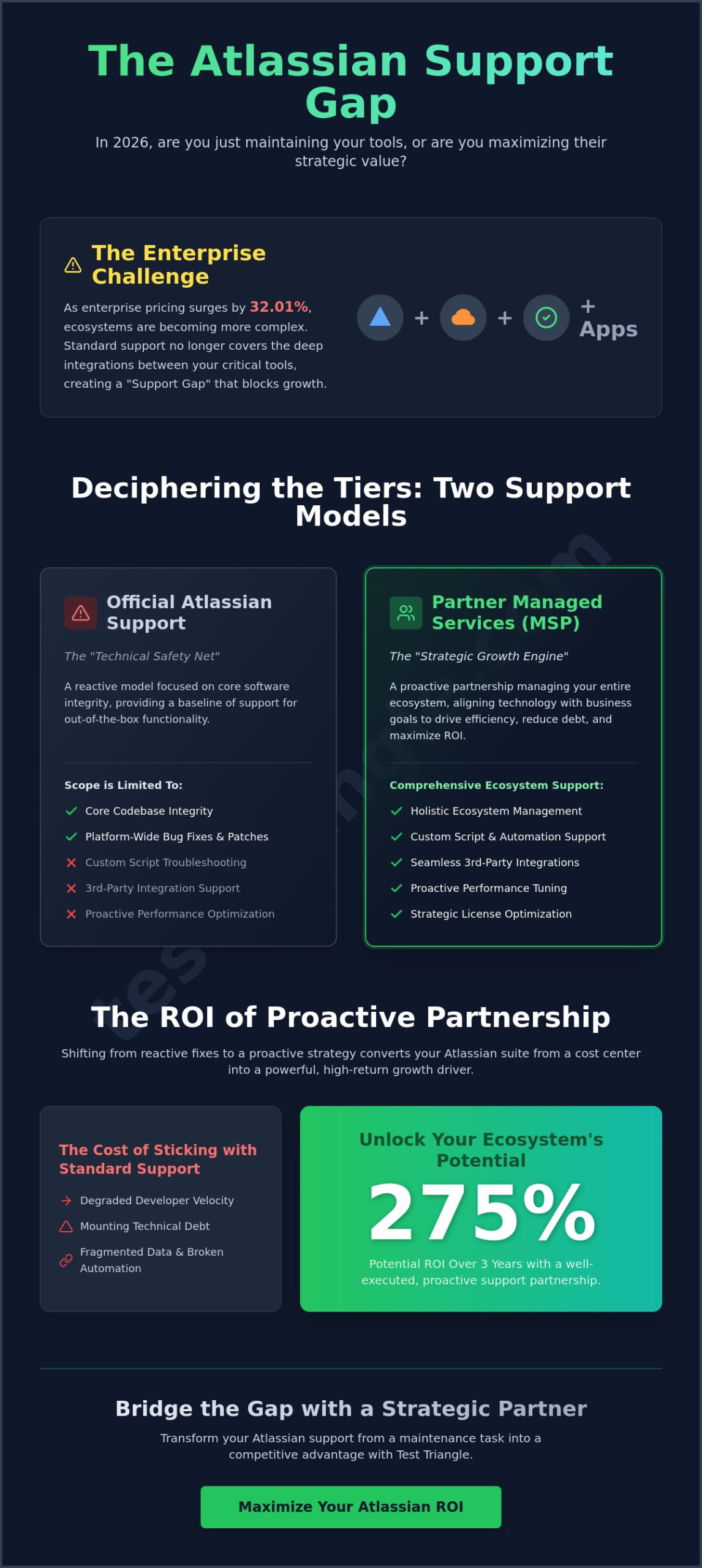
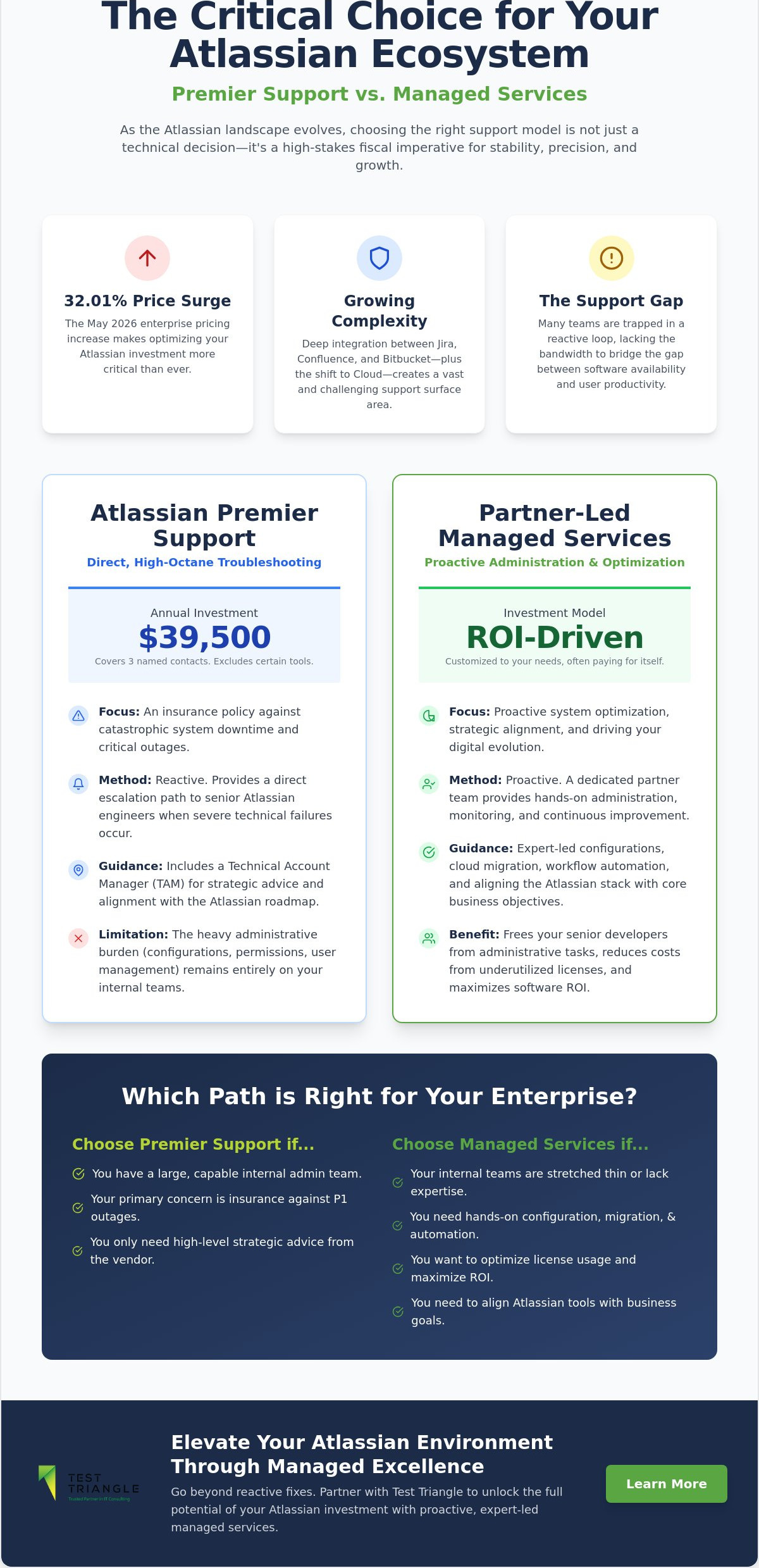
Is your organization paying for the rapid resolution of problems that should never have occurred in the first place? While the $39,500 annual investment for Atlassian Premier Support provides a direct line to senior engineers for critical outages, it often leaves the heavy administrative burden on your internal teams. Evaluating the choice between atlassian premier support vs managed services has become a high-stakes fiscal decision, especially following the 32.01% surge in enterprise pricing seen in May 2026. You need a solution that doesn’t just react to failures but actively drives your digital evolution.
We understand that managing complex cloud migrations and underutilized licenses can drain your resources and stall your strategic roadmap. This guide examines the critical differences between direct vendor troubleshooting and the proactive, partner-led oversight required to truly master your ecosystem. You’ll gain a clear framework for reducing system downtime, securing expert-led configurations, and ensuring a measurable return on your software investment through stability, precision, and growth.
Key Takeaways
- Understand why the 2026 Atlassian ecosystem requires more than simple ticket resolution to maintain operational stability in high-pressure corporate environments.
- Analyze the strategic distinction of atlassian premier support vs managed services to determine whether your enterprise needs reactive vendor troubleshooting or proactive system optimization.
- Identify the internal resource gaps that necessitate a shift from basic administrative maintenance to a comprehensive, partner-led management model.
- Discover how a hybrid support framework can maximize platform availability while simultaneously driving digital transformation and workflow efficiency.
- Learn to align your Atlassian roadmap with broader business objectives by leveraging specialized expertise in cloud migration and cross-platform integration.
Navigating the Atlassian Support Ecosystem in 2026
The Atlassian ecosystem has transformed from a collection of standalone productivity tools into the central nervous system of the modern enterprise. As we progress through 2026, the traditional model of reactive, ticket-based assistance has become insufficient for global organizations operating at scale. Relying on the “Standard” support tier often leaves teams stranded during complex outages or configuration failures, as these basic levels are designed for minor troubleshooting rather than the intricate demands of a distributed, high-velocity infrastructure. The decision-making process for leadership now centers on a fundamental choice between atlassian premier support vs managed services, representing a shift from simply maintaining software to strategically empowering the business.
Internal administration without external expertise carries significant hidden costs that often go unnoticed until a system audit occurs. These include the opportunity cost of diversion, where senior developers are frequently pulled away from core product builds to manage Jira schemes or permission hierarchies. It also includes the risk of underutilized licenses, which can account for a substantial portion of the average annual enterprise spend on Atlassian products. Choosing between atlassian premier support vs managed services is therefore not just a technical preference but a financial imperative to protect software ROI and operational continuity.
The Complexity of Modern Atlassian Stacks
Modern environments are no longer siloed. The deep integration between Jira, Confluence, and Bitbucket creates a vast support surface area where a single misconfiguration can ripple across the entire development lifecycle. With the accelerating shift to Atlassian Cloud, maintenance requirements have pivoted from server patching to sophisticated identity management, API governance, and cross-platform orchestration. To thrive in this environment, enterprises require a foundation of stability, precision, and scalability. Without a dedicated Managed service provider (MSP) to oversee these connections, the internal administrative burden often leads to technical debt that slows down innovation and increases operational risk.
Identifying the Support Gap
Organizations often realize they have outgrown standard support when internal administrators spend more time on user permissions than on high-value workflow automation. There is a clear distinction between technical troubleshooting, which focuses on why a feature isn’t working, and strategic business alignment, which ensures the toolset actually drives revenue. Many teams find themselves stuck in a loop of reactive fixes, lacking the bandwidth to implement a comprehensive Atlassian implementation strategy. The support gap is the distance between software availability and user productivity.
Atlassian Premier Support: Direct High-Octane Troubleshooting
Atlassian Premier Support serves as the definitive direct vendor lifeline for organizations that require immediate, high-priority access to the engineers who build the software. For an annual investment of $39,500, this tier provides coverage for three named contacts across the primary product suite, excluding specific tools like Opsgenie or Jira Align which require separate agreements. It’s a specialized service designed to protect platform availability by offering a direct escalation path for the most severe technical failures. When weighing atlassian premier support vs managed services, it’s vital to recognize that Premier Support is primarily an insurance policy against catastrophic system downtime rather than a tool for day-to-day administrative relief.
The relationship is often anchored by a Technical Account Manager (TAM) who acts as a strategic advisor within the Atlassian organization. This individual helps align your technical requirements with the product roadmap, ensuring that your enterprise isn’t blindsided by major architectural shifts. However, while the TAM provides high-level guidance, they don’t function as a hands-on administrator. Incorporating a robust service delivery model requires understanding that vendor support is fundamentally a reactive mechanism focused on the health of the core application, not the specific nuances of your business processes.
Core Benefits of the Premier Tier
The primary value proposition of the Premier tier lies in its financially backed Service Level Agreements (SLAs). For critical (L1) issues, Atlassian guarantees an initial response time of one hour, providing peace of mind during high-stakes incidents. You’re not just getting a faster ticket response; you’re gaining access to senior support engineers who understand the platform’s source code and can navigate complex bug fixes that standard support teams might miss. Additionally, the vendor provides periodic proactive health checks and system performance analysis to identify potential bottlenecks before they lead to a total system failure.
Where Premier Support Ends
Despite its technical depth, Premier Support maintains a strict “Hands-Off” policy regarding your internal configurations. Atlassian engineers will troubleshoot why a workflow has crashed, but they won’t build a new custom workflow for your HR department or manage your complex user permission schemes. Furthermore, this tier explicitly excludes troubleshooting for third-party Marketplace apps, which can often add up to 150% to the base cost of your software and introduce significant stability risks. If you’re struggling to bridge the gap between vendor response and internal execution, you can consult with our strategic advisors to explore a more comprehensive approach. Ultimately, Premier Support fixes the platform, but it doesn’t run your business operations.
Atlassian Managed Services: Proactive Administration and Optimization
While Premier Support provides a vital technical safety net for platform-level incidents, Atlassian Managed Services function as a strategic engine for continuous organizational growth. This model represents a comprehensive, hands-on extension of your internal IT department, moving beyond the limitations of reactive troubleshooting to embrace proactive system evolution. When evaluating atlassian premier support vs managed services, the primary distinction lies in the scope of execution. Managed services don’t just ensure the software is running; they ensure it’s optimized to meet the specific, shifting demands of your global enterprise. By integrating a dedicated team into your operational structure, your organization gains the ability to transform raw technical capacity into streamlined business value through vision, velocity, and versatility.
The operational philosophy of a managed model shifts the focus from ticket-based response times to business-centric outcomes. Instead of measuring success by how quickly a bug is acknowledged, success is defined by system health, user adoption rates, and the seamless automation of complex cross-departmental workflows. This partnership provides the steady hand required to manage the daily administrative burden that often overwhelms internal teams. It allows your high-value talent to focus on core innovation while experts handle the intricate details of your Atlassian environment, ensuring that your digital infrastructure remains a competitive advantage rather than a maintenance bottleneck.
The Strategic Advantage of a Managed Partner
A managed partner delivers end-to-end administration that encompasses everything from granular user management and permission schemes to the design of sophisticated custom workflows. This level of involvement ensures that your instance remains clean, performant, and scalable as your organization expands. Beyond simple maintenance, these services provide robust governance and compliance frameworks, ensuring that your data handling and access controls meet the rigorous standards of highly regulated industries. For organizations initiating new projects, leveraging specialized Atlassian Implementation Services within a managed framework ensures that the foundation of your ecosystem is built correctly from day one.
Beyond Troubleshooting: Proactive Growth
Managed services drive proactive growth through regular system audits and targeted user training sessions that identify and eliminate operational friction. Unlike direct vendor support, a managed partner actively vets, installs, and maintains critical Marketplace plugins, mitigating the risks associated with third-party app sprawl. This holistic oversight is particularly critical for organizations pursuing broader DevOps Consulting initiatives, where the seamless integration of Jira and Bitbucket into the CI/CD pipeline is essential for maintaining development speed. By choosing a partner-led approach, you secure a reliable long-term collaborator dedicated to the ongoing optimization of your entire software delivery lifecycle.
The Critical Choice: Direct Vendor Support vs. Strategic Partner Managed Services
Determining the optimal path between atlassian premier support vs managed services requires a candid assessment of your organization’s internal maturity and long-term technical objectives. While the $39,500 annual investment for Premier Support secures a high-priority escalation path to Atlassian’s senior engineers, it assumes your team can handle everything short of a platform-level bug. The strategic divide often rests on whether you possess a dedicated “Atlassian Champion” in-house. If your internal administrators are already stretched thin by daily user requests and complex scheme clean-ups, adding a vendor-side escalation point won’t solve the underlying productivity bottleneck. You must decide if you’re paying for a safety net or a growth engine.
For many global enterprises, the most effective strategy is a “Hybrid” approach that leverages the strengths of both models. In this scenario, Premier Support provides the technical insurance needed for massive-scale Cloud or Data Center deployments, while a strategic partner handles the proactive administration, workflow automation, and cross-platform integrations. This combination ensures that the platform remains stable at the infrastructure level while the business logic continues to evolve at the pace of your market. A cost-benefit analysis should weigh the fixed license-based support fees against the flexible, outcome-based subscriptions of a managed partner, focusing on the total cost of ownership rather than just the initial price tag.
- Internal Expertise: If your team lacks certified administrators, managed services provide immediate institutional maturity.
- Operational Focus: Choose Premier for reactive troubleshooting; choose managed services for proactive system optimization and roadmapping.
- Integration Complexity: Organizations with deep ServiceNow or AWS integrations require the hands-on expertise of a partner-led model.
- Scalability Requirements: Managed services allow for rapid scaling without the overhead of permanent internal hires.
When to Choose Atlassian Premier Support
This tier is best suited for organizations that already maintain a highly skilled internal IT department. If your team is capable of designing complex Jira workflows and only requires direct vendor intervention for platform-level performance analysis or source code issues, the Premier tier is an ideal fit. It focuses on the core pillars of stability, precision, and scalability at the infrastructure level, ensuring that your massive-scale deployments meet strict uptime requirements without the need for external administrative help.
When to Choose Managed Services
Managed services are the superior choice for teams undergoing rapid digital transformation or those migrating to Atlassian Cloud. If your business requires sophisticated workflow automation, complex ITSM migrations, or simply lacks a dedicated administrator, a partner-led model offers the necessary versatility. For organizations needing to bridge a temporary talent gap, utilizing Managed Outsourcing Services provides a flexible staffing solution that scales alongside your project demands. To determine which model aligns with your 2026 roadmap, you can schedule a strategic consultation with our team today.
Test Triangle: Elevating Atlassian Environments Through Managed Excellence
Test Triangle positions itself as the strategic visionary for enterprises navigating the complexities of modern digital infrastructure. Our unique methodology transcends basic troubleshooting by combining deep technical rigor with a high-level business vision, ensuring that your software tools are perfectly aligned with your commercial objectives. When navigating the nuances of atlassian premier support vs managed services, the value of a steady hand cannot be overstated. We provide the expertise required to manage high-stakes Atlassian Cloud migrations and complex ServiceNow Implementation projects, bridging the gap between disparate platforms to create a unified, high-performance ecosystem.
Engagement models within our framework are designed with institutional maturity in mind, offering the flexibility that global enterprises demand. Whether your organization requires project-based milestones for a specific digital transformation or a recurring monthly subscription for ongoing administrative excellence, we adapt our delivery to match your internal cadence. Unlike the centralized, often anonymous queues of direct vendor support, our global presence ensures superior regional attention. This localized focus allows us to act as a reliable long-term collaborator, providing the peace of mind that comes from knowing your infrastructure is managed by experts who understand your specific market challenges.
Our Atlassian Consulting Framework
The foundation of our partnership begins with a methodical Discovery and Advisory phase. During this stage, we work to align your existing Atlassian stack with long-term corporate roadmaps, identifying areas where configuration improvements can drive immediate efficiency gains. Our Solution Design and Build phase then crafts bespoke workflows tailored to the unique regulatory and operational requirements of industries such as Finance, Healthcare, and Retail. For organizations seeking localized strategic support, our Atlassian Consulting Services Dublin team provides the proximity and platform expertise needed to accelerate your digital maturity.
Achieving Operational Stability
Operational stability is achieved through a combination of human expertise and disciplined technical tools. Our managed services are specifically engineered to reduce risk and empower your internal teams to lead large-scale technological evolution without being bogged down by administrative debt. We provide dedicated helpdesk support under robust Service Level Agreements, ensuring that your users receive the expert-led configuration and troubleshooting they need to remain productive. This proactive oversight doesn’t just fix issues; it prevents them, allowing your leadership to maintain a composed, solution-oriented focus on long-term success. By choosing a partner-led model, you secure the stability, precision, and scalable growth required to thrive in a fast-changing landscape. Contact Test Triangle for a strategic Atlassian audit to begin optimizing your software spend and operational efficiency today.
Securing Your Strategic Atlassian Roadmap for 2026
The evolution of the enterprise digital landscape demands a shift from reactive troubleshooting to proactive orchestration. Success in the coming year requires more than just keeping the lights on; it necessitates a sophisticated alignment of platform health and business agility. By understanding the functional boundaries of atlassian premier support vs managed services, leadership can move beyond simple ticket resolution toward a model of continuous optimization. Our methodology ensures that your Atlassian ecosystem remains a robust foundation for progress rather than an administrative burden, providing the stability, precision, and scalability your organization deserves.
Leveraging our status as a Global Atlassian Partner, we deliver strategic expertise in Finance and Pharma alongside comprehensive ITSM and DevOps integration. We act as your reliable long-term collaborator, providing the steady hand required to navigate complex migrations and architectural shifts with total confidence. It’s time to transform your software investment into a high-performance engine for growth and innovation.
Optimise your Atlassian stack with Test Triangle’s Managed Services
Empower your teams to achieve new heights of productivity and secure your digital future with a partner dedicated to your long-term success.
Frequently Asked Questions
What is the main difference between Atlassian Premier Support and Managed Services?
The fundamental distinction lies in the nature of the engagement: Premier Support is a reactive technical lifeline provided by the vendor for platform-level issues, whereas Managed Services represent a proactive, hands-on extension of your internal team. While the vendor focuses on the health of the core software, a managed partner oversees daily configurations, user management, and strategic optimization. This ensures your ecosystem isn’t just running, but actively driving business value.
Can I have both Atlassian Premier Support and a Managed Services partner?
Organizations often adopt a hybrid model to maximize both platform stability and operational efficiency. In this scenario, you utilize Atlassian Premier Support as a high-priority escalation point for critical vendor-side bugs while your Managed Services partner handles the intricate execution of your internal workflows and integrations. This dual-layered strategy provides a comprehensive safety net for global enterprises with zero tolerance for system downtime or administrative bottlenecks.
Does Atlassian Premier Support include help with Jira workflow configuration?
No, Atlassian Premier Support does not include hands-on assistance with internal configurations like Jira workflows, permission schemes, or project setups. The vendor’s engineers are strictly focused on troubleshooting the underlying platform and resolving software defects rather than building bespoke business logic. To achieve tailored workflow design that meets your specific operational needs, you require the strategic involvement and practical execution provided by a managed services provider.
How much do Atlassian Managed Services typically cost compared to Premier Support?
Pricing structures for atlassian premier support vs managed services follow different models based on the scope of the engagement. Premier Support involves a fixed annual fee that provides standardized vendor access for a limited number of named contacts. Conversely, Managed Services pricing is customized based on the complexity of your ecosystem, the volume of administrative tasks, and your required service levels. This tailored approach ensures your investment aligns directly with the strategic expertise your business requires.
Is Managed Services better for Atlassian Cloud or Data Center?
Managed Services provide essential value across both Cloud and Data Center deployments, though the operational focus shifts to address the unique requirements of each environment. For Cloud instances, the emphasis remains on identity governance, API management, and cross-platform orchestration. For Data Center, the priority often centers on infrastructure health, performance tuning, and complex version upgrades. In both cases, a partner-led model ensures your environment remains performant and scalable as your organization evolves.
What happens if my third-party Marketplace apps break under Premier Support?
Atlassian Premier Support specifically excludes troubleshooting and maintenance for third-party Marketplace applications. If a critical plugin fails or causes system instability, the vendor will typically direct you to the individual app developer for assistance. A Managed Services partner takes full ownership of your entire stack, vetting and maintaining these integrations to ensure they don’t compromise your system’s overall stability. This proactive oversight reduces the risk of third-party software conflicts.
How does Test Triangle handle Atlassian Cloud migrations within its managed services?
We manage the entire cloud migration lifecycle through a disciplined framework that prioritizes data integrity and minimal user disruption. Our approach begins with a comprehensive assessment of your existing instance, followed by strategic cleanup and mapping to ensure a seamless transition to the Cloud. By acting as a steady hand throughout the process, we mitigate the risks associated with complex migrations while ensuring your new environment is optimized for immediate organizational productivity.
Do Managed Services include user training and onboarding?
Yes, comprehensive user training and structured onboarding are core components of our managed offerings. We believe that technological evolution is only successful when paired with high levels of user adoption and proficiency. By providing targeted training sessions and clear documentation, we empower your teams to fully utilize the advanced features of your Atlassian stack. This commitment to human expertise ensures that your organization realizes the maximum return on its software investment through improved workflow efficiency.

Article by
Paul Guy
Paul serves as the Marketing Director at Test Triangle, where he leads a global team in driving growth through strategic B2B marketing and brand communications. With a strong emphasis on measurable outcomes and sustainable performance, he plays a pivotal role in aligning marketing functions to enhance customer engagement and accelerate business impact. Under his leadership, marketing initiatives have consistently delivered significant returns on investment, elevated brand visibility, and strengthened the company's presence across key markets.