
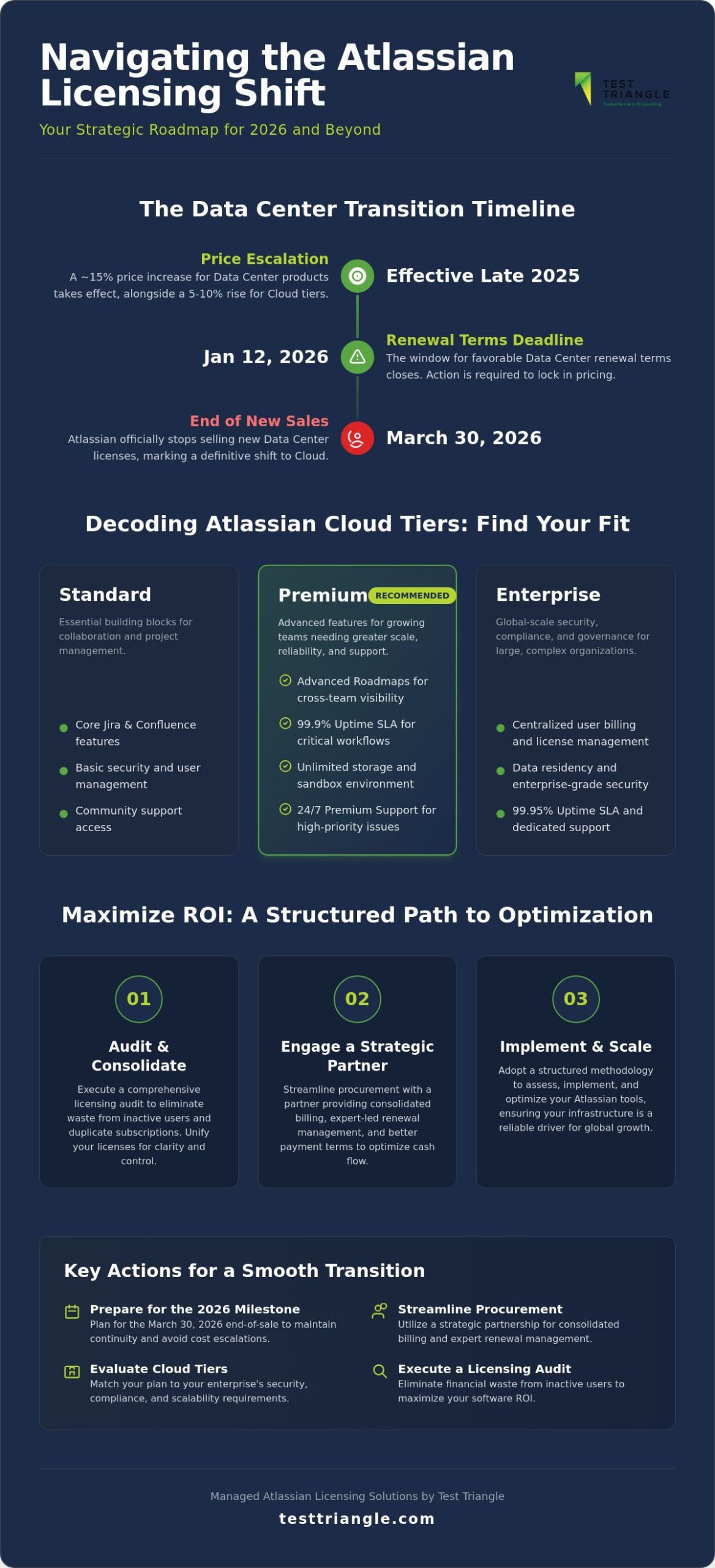
By March 30, 2026, the option to purchase new Atlassian Data Center licenses will officially vanish, marking a definitive shift in how global enterprises must architect their digital ecosystems. You likely recognize the mounting pressure of this transition, particularly as a 15% price increase for Data Center products takes effect while the window for favorable renewal terms narrows toward the January 12, 2026, hard stop. Managing Atlassian Licences across multiple products often leads to technical debt and financial waste, leaving many leadership teams feeling they’re overpaying for underutilized seats without a clear path forward.

This guide empowers you to regain control over your software spend by providing a clear roadmap for license consolidation and strategic growth. You’ll learn how to evaluate the ROI of Premium versus Enterprise tiers, navigate the critical journey from Data Center to Cloud, and leverage expert partnerships to secure better payment terms. We’ll examine the specific steps required to achieve precision, predictability, and performance in your licensing strategy, ensuring your infrastructure remains a catalyst for innovation rather than a budgetary burden.

Key Takeaways

  • Prepare for the March 30, 2026, end-of-sale milestone for Data Center products to maintain operational continuity and avoid unnecessary cost escalations.
  • Evaluate the functional distinctions between Cloud tiers to ensure your selected plan matches your enterprise’s specific security, compliance, and scale requirements.
  • Streamline your procurement of Atlassian Licences through a strategic partnership that provides consolidated billing and expert-led renewal management.
  • Execute a comprehensive licensing audit to eliminate waste from inactive users and duplicate subscriptions, maximizing your overall software return on investment.
  • Adopt a structured methodology to assess, implement, and optimize your digital tools, transforming your software ecosystem into a reliable driver of global growth.

The year 2026 represents a pivotal juncture for enterprise software architecture. As organizations move toward greater operational maturity, Atlassian Licences have evolved from simple software permissions into the essential gateway for enterprise agility and global collaboration. This shift is driven by a fundamental change in how teams interact with their tools. By anchoring your technology stack in a unified licensing framework, you create a stable foundation for Atlassian implementation that scales alongside your business objectives.

Understanding Atlassian’s corporate history reveals a consistent trajectory toward platform unification. This evolution culminates on March 30, 2026, a critical milestone where new Data Center license sales will cease entirely. For global enterprises, this isn’t merely a procurement deadline; it’s a strategic mandate to modernize. Waiting until the final hour risks operational disruption and creates unnecessary friction in your digital transformation journey. A strategic partner acts as a steady hand during this process, helping you navigate the complexities of Atlassian Licences while ensuring your global software spend remains optimized for maximum ROI.

The 2026 Cloud Mandate

The migration from self-managed infrastructure to high-performance Cloud environments is now a prerequisite for staying competitive. For industries like Life Sciences and Finance, where regulatory oversight is stringent, Atlassian Cloud offers advanced security protocols and automated compliance features that were previously difficult to maintain on-premise. Atlassian Cloud Licensing is a flexible, subscription-based model for modern DevOps. This model allows for rapid scaling and provides immediate access to the latest AI-driven features, ensuring your teams aren’t held back by legacy hardware limitations.

Data Center Transition: Deadlines and Decisions

Organizations still reliant on Data Center infrastructure must act with precision. The roadmap for 2026 requires a clear-eyed assessment of current user tiers and future growth projections. Delaying this transition introduces significant risks, including potential compliance gaps as support for older versions eventually sunsets. To ensure a seamless transition, your approach should focus on Strategy, Security, and Scalability. By mapping out these three pillars early, you avoid the pitfalls of a rushed migration and ensure your infrastructure remains robust during the shift to Cloud.

Decoding Cloud Tiers: Standard, Premium, and Enterprise

Selecting the appropriate tier for Atlassian Licences requires more than a simple comparison of feature lists; it demands a deep alignment with your organization’s operational maturity and long-term roadmap. While the Standard tier provides the essential building blocks for collaboration, the leap to Premium or Enterprise is often necessitated by the need for advanced orchestration and centralized governance. As Atlassian’s commercial strategy continues to prioritize Cloud innovation, enterprises must weigh the 5-10% price increases effective late 2025 against the functional gains in security and automation. Understanding these nuances is critical for technical leaders who must justify software spend while ensuring their teams remain unencumbered by tool limitations.

Standard vs. Premium: When to Upgrade

When does the upgrade become non-negotiable? The primary tipping point usually occurs when cross-team visibility becomes a bottleneck, making the Advanced Roadmaps feature in Jira Software Premium indispensable for complex project tracking. Beyond project management, the Premium tier offers a 99.9% uptime SLA and unlimited storage, providing the reliability required for mission-critical workflows. Managers should evaluate their current environment using this quick checklist:

  • Are teams struggling with manual status reporting across multiple projects?
  • Do you require a sandbox environment to test configurations before deployment?
  • Is your data growth approaching the limits of a Standard subscription?
  • Does your team require 24/7 “Premium” support for high-priority incidents?

If you answered yes to more than two, the Standard tier has likely been outgrown.

The Enterprise Advantage: Global Scale and Security

For global organizations managing thousands of users across disparate business units, the Enterprise tier serves as the ultimate catalyst for scale. It introduces multi-site management, allowing administrators to partition data and configurations while maintaining a unified billing and security posture. This tier is also the primary home for advanced AI capabilities like Rovo, which accelerates knowledge discovery across the entire ecosystem. We view this level of investment as a cornerstone of digital transformation services, offering a value proposition built on Peace, Performance, and Partnership.

Central to this scale is Atlassian Guard, which provides the centralized security and user provisioning necessary to mitigate risk in highly regulated environments. Since Guard Standard saw a 5% price adjustment in late 2025, optimizing its deployment within an Enterprise license often yields better consolidated value than managing fragmented security tools across various instances. It’s a strategic move that simplifies compliance while empowering your global workforce. If you’re uncertain which tier aligns with your 2026 growth targets, consulting with a strategic partner can clarify the financial and technical implications of your choice.

The Strategic Advantage of Partner-Led Licensing Procurement

While many procurement departments assume that purchasing directly from a vendor’s portal is the most efficient path, global enterprises often find that this approach lacks the nuance required for complex, multi-region deployments. Direct purchasing frequently forces organizations into rigid payment structures and anonymous support queues that don’t account for the unique operational hurdles of highly regulated sectors. By contrast, securing Atlassian Licences through an authorized partner transforms a routine transaction into a strategic asset. This collaborative model provides the Strategy, Support, and Stability required to ensure your software ecosystem remains resilient amidst shifting market demands. Partners don’t just process orders; they provide a layer of local expertise that bridges the gap between global product roadmaps and specific regional requirements.

Consolidated Billing and Financial Optimization

Managing a fragmented software portfolio across multiple vendors often results in administrative friction and hidden costs. Partner-led procurement alleviates this burden by offering consolidated billing, which simplifies the accounts payable process for diverse IT environments. Because partners often reinvest reselling commissions into value-added services, clients benefit from a more comprehensive support structure without increasing their direct software spend. This financial efficiency is particularly valuable when integrated with managed outsourcing services, as it allows for local currency invoicing and flexible payment terms that align with corporate fiscal cycles. Such adaptability ensures that your technology investments remain predictable, providing a clear methodology for scaling your digital infrastructure without the risk of currency fluctuations or unforeseen budgetary gaps.

Expert Guidance: Beyond the Transaction

The true value of a partner lies in their ability to move beyond the “anonymous portal” experience, acting instead as a dedicated strategic visionary for your technical infrastructure. While Atlassian provides excellent documentation for Decoding Cloud Tiers, a partner applies that information to your specific business context to prevent over-provisioning. This expertise is vital for aligning the procurement of Atlassian Licences with broader Atlassian implementation services, ensuring that every seat purchased is mapped to a functional requirement. For enterprises in Life Sciences and Finance, this seasoned guidance provides a steady hand in navigating compliance and security benchmarks that standard support channels might overlook. By choosing a reliable long-term collaborator, you gain access to a depth of institutional knowledge that secures your operational stability and empowers your teams to focus on core innovation rather than administrative maintenance.

Maximizing ROI: Auditing and Optimizing License Spend

Maintaining the health of your technical ecosystem requires more than just functional updates; it demands rigorous fiscal oversight to prevent budgetary drift. Many enterprises unknowingly leak capital through unoptimized Atlassian Licences, where seat counts often reflect historical peaks or forgotten project teams rather than current active requirements. Establishing a disciplined approach to “License Hygiene” isn’t just a cost-saving exercise; it’s a strategic necessity that ensures your infrastructure remains lean, responsive, and fully aligned with your actual operational reality. By connecting a clear audit methodology to specific decommissioning actions, you transform your software spend from a fixed overhead into a dynamic, ROI-driven asset.

User Management and Seat Optimization

Stale accounts represent one of the most common sources of financial waste in large-scale software deployments. A methodical audit begins by identifying users who haven’t authenticated within the last 90 days, allowing administrators to deactivate those accounts and potentially drop to a more cost-effective user tier. This is particularly critical as organizations prepare for the 15% price increase for Data Center products effective February 17, 2026. Consolidating user tiers across Jira and Confluence further streamlines your billing, ensuring you aren’t paying for high-tier access for personnel who only require basic functionality. License Optimization is a continuous process of aligning seat count with active engagement.

App and Marketplace Audit

The Atlassian Marketplace offers immense functional extensibility, yet it frequently accounts for a significant portion of the total cost of ownership. Because many apps operate on a per-user licensing model, a single underutilized plugin can inflate your annual bill by thousands of dollars. Managers should implement a rigorous evaluation framework that weighs app utility against its recurring cost, often discovering that native Cloud features now fulfill requirements once met by third-party tools. Aligning these audits with your broader IT service management solutions ensures that your entire technical stack is optimized for performance and security. If you’re ready to eliminate waste and reclaim your IT budget, schedule a comprehensive license audit with our experts today.
Atlassian Licences in 2026: The Strategic Enterprise Guide to Optimization and Scale

Scaling with Confidence: Test Triangle’s Managed Licensing Solutions

By positioning our firm as a reliable long-term collaborator, we provide the institutional maturity required to manage complex digital infrastructures with absolute precision. Our methodology follows a rigorous “Assess, Implement, and Optimize” framework, ensuring that every decision regarding your Atlassian Licences is rooted in data-driven insights and strategic foresight. We integrate seasoned human expertise with industry-leading technical tools to bridge the gap between high-level business objectives and technical execution, allowing your organization to achieve scalable growth without compromising operational stability. This commitment to organizational progress ensures that your technology stack remains a catalyst for innovation rather than a source of technical debt.

Our approach is designed to provide the peace of mind that comes from risk reduction and systemic improvement. We recognize that managing a global software spend requires more than just administrative oversight; it requires a strategic visionary who can anticipate market shifts and vendor roadmap changes. Whether you’re navigating the 2026 Data Center milestones or optimizing a massive Cloud Enterprise footprint, our team acts as a steady hand. We ensure your licensing strategy is the foundation for broader digital transformation, aligning your procurement cycles with your actual operational capacity and long-term technical goals.

A Tailored Approach to Enterprise Needs

We adapt our service delivery to match your specific corporate milestones, recognizing that the journey to a modernized Cloud environment is unique for every enterprise. There’s a profound sense of empowerment found in large-scale technological evolution when it’s guided by experts who understand the nuances of highly regulated industries. To understand how we align our resources with your long-term goals, we encourage you to consult our strategic partner guide for deeper insights into our collaborative model.

Getting Started: The Path to Optimization

The journey toward a leaner ecosystem begins with an initial discovery phase to evaluate your current health. This comprehensive check identifies immediate opportunities for cost reduction while mapping out a future-proof architecture for your Atlassian Licences that supports your 2026 growth targets. We facilitate a seamless transition from a general need for improvement to a specific, high-performance technical solution that addresses your unique pain points. We remain dedicated to your success through our core values of Precision, Partnership, and Progress.

Securing Your Enterprise Future in the Atlassian Ecosystem

Navigating the complexities of the 2026 transition requires a proactive stance on technical architecture and procurement strategy. Audit your usage. Select the cloud tier that aligns with your organizational maturity. These actions transform your infrastructure into a lean engine for global growth. The upcoming milestones for Data Center products serve as a vital catalyst to modernize your environment, ensuring your teams have access to high-performance tools while maintaining strict compliance in highly regulated sectors.

As an authorized Atlassian Solution Partner with specialized expertise in Life Sciences and Financial compliance, Test Triangle provides the steady hand necessary to optimize your Atlassian Licences. Our global delivery model and 24/7 support availability ensure that your digital evolution is managed with the highest standards of quality and security. We’re committed to being your reliable long-term collaborator, helping you achieve Stability, Security, and Success in every phase of your software lifecycle.

Optimize your Atlassian Licensing with Test Triangle today and take the first step toward a more predictable and scalable technical future. We look forward to helping you turn these systemic changes into a definitive competitive advantage.

Frequently Asked Questions

How do I buy Atlassian licenses in 2026?

Enterprises can procure Atlassian Licences directly through the vendor’s portal or by collaborating with an authorized solution partner. While direct purchasing is available, partnering with a strategic visionary allows you to align procurement with a comprehensive digital roadmap. This collaborative approach ensures that your license acquisition supports long-term operational stability and provides access to favorable payment terms that aren’t typically available through anonymous self-service portals.

What is the difference between Jira Standard and Premium licenses?

Jira Premium extends the core functionality of the Standard tier by introducing Advanced Roadmaps for cross-project visibility and a 99.9% uptime SLA for mission-critical reliability. Organizations requiring unlimited storage and 24/7 support will find the Premium tier provides the necessary empowerment for large-scale technological evolution. It’s designed for teams that have outgrown basic task management and require sophisticated orchestration across multiple global workstreams.

Can I still purchase Atlassian Data Center licenses after March 2026?

No new Data Center licenses will be available for purchase after the March 30, 2026, end-of-sale deadline. Existing customers maintain the ability to renew their current subscriptions or expand user tiers until March 30, 2028. However, all Data Center products will reach their final end-of-life on March 28, 2029, making it essential to plan your migration to Cloud well before these hard stops occur.

How can I optimize my Atlassian license costs to avoid overpaying?

Optimizing your software spend requires a disciplined methodology that includes deactivating inactive users and auditing the utility of high-cost Marketplace apps. By implementing regular “License Hygiene” checks, you ensure your seat count reflects active engagement rather than historical peaks. This practice prevents the financial waste associated with underutilized assets and allows you to consolidate user tiers across Jira and Confluence for maximum efficiency.

What are the benefits of buying Atlassian licenses through an authorized partner?

Authorized partners provide consolidated billing and local currency invoicing, which simplifies administrative overhead for global procurement teams. Beyond the transaction, a partner acts as a steady hand by offering strategic implementation advice and seasoned expertise in highly regulated industries. This partnership ensures that your Atlassian Licences are managed with precision, providing a layer of support that bridges the gap between technical execution and business outcomes.

Is Atlassian Guard required for all Cloud Enterprise subscriptions?

Atlassian Guard is bundled within the Cloud Enterprise tier to provide the centralized security and user provisioning necessary for managing global scale. While it isn’t a separate requirement for Enterprise users, it serves as the foundational security layer that enables single sign-on (SSO) and automated lifecycle management. This integration simplifies compliance for technical managers while empowering the workforce with secure, seamless access to essential tools.

How much do Atlassian licenses cost for large enterprise teams?

Final costs for enterprise deployments are determined by the specific user tier and the selected Cloud or Data Center plan. Effective late 2025 and early 2026, list prices for Cloud products increased by 5% to 10%, while Data Center products saw a 15% adjustment. Enterprises should consult with a partner to receive a tailored quote that reflects their specific user count and functional requirements.

Can I switch from monthly to annual Atlassian billing for better rates?

Transitioning from monthly to annual billing is a highly effective strategy for securing better rates and ensuring budgetary predictability. Annual subscriptions lock in current pricing for a twelve-month period and typically offer a lower total cost of ownership compared to the cumulative expense of twelve monthly payments. This shift allows financial leadership to plan with confidence while reducing the administrative burden of monthly invoice processing.

Paul Guy

Article by

Paul Guy

Paul serves as the Marketing Director at Test Triangle, where he leads a global team in driving growth through strategic B2B marketing and brand communications. With a strong emphasis on measurable outcomes and sustainable performance, he plays a pivotal role in aligning marketing functions to enhance customer engagement and accelerate business impact. Under his leadership, marketing initiatives have consistently delivered significant returns on investment, elevated brand visibility, and strengthened the company's presence across key markets.

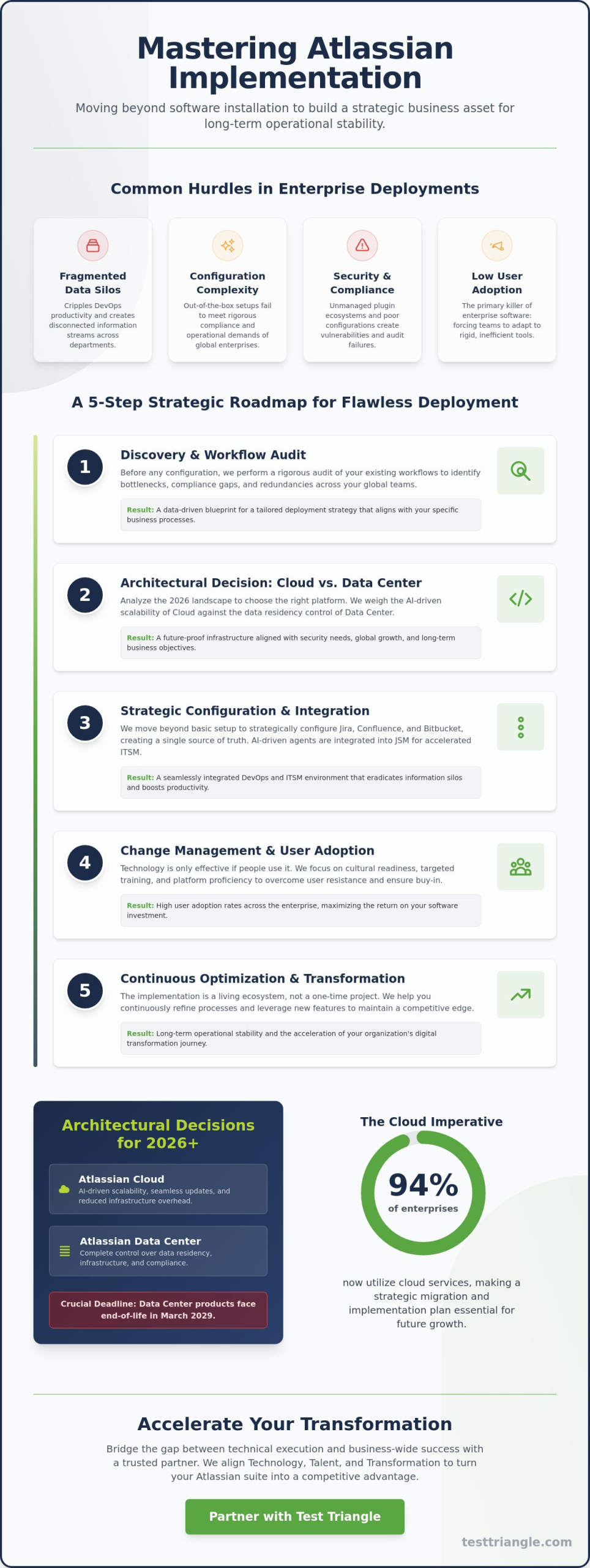
If you view your upcoming Atlassian Implementation as a mere software installation, you’ve already compromised your enterprise’s operational stability for the next decade. With 94% of enterprises now utilizing cloud services and Atlassian Data Center products facing a definitive end-of-life in March 2029, the stakes for a flawless deployment have never been higher. You’re likely struggling with fragmented data silos and the high complexity of Jira Service Management configurations, all while trying to mitigate security risks during a high-pressure migration.

We understand that the true challenge isn’t just technical; it’s about overcoming resistance among legacy teams and ensuring your infrastructure supports global growth. By combining technical expertise with a focus on long-term operational stability, Test Triangle helps you align Technology, Talent, and Transformation to turn these hurdles into a competitive advantage. This guide promises a comprehensive roadmap to master the complexities of your deployment, helping you achieve a seamlessly integrated DevOps and ITSM environment.

We’ll examine how to leverage the latest Jira 11.3 LTS features and AI-driven agents to drive a higher ROI from your software investments and ensure robust, scalable growth for your global organization.

Key Takeaways

  • Discover how to move beyond basic configurations by treating your Atlassian Implementation as a holistic business asset tailored for the rigorous demands of regulated industries.
  • Apply a 5-step strategic roadmap built on the Method-Action-Result framework to ensure your deployment is grounded in a comprehensive workflow audit.
  • Analyze the 2026 architectural landscape to determine whether the AI-driven scalability of the Cloud or the residency control of Data Center best serves your global infrastructure.
  • Secure long-term operational stability by prioritizing change management and platform proficiency to overcome the primary killer of enterprise software: user resistance.
  • Accelerate your digital transformation by leveraging the expertise of a Trusted Partner who bridges the gap between technical execution and business-wide transformation.

Defining Atlassian Implementation as a Strategic Business Asset

Atlassian Implementation represents the holistic process of configuring, integrating, and optimizing the software suite to drive enterprise-scale operations. It is a fundamental shift from basic tool adoption to a strategic alignment of business goals. As the Atlassian Corporation has evolved into a powerhouse of collaboration and ITSM tools, the complexity of managing these systems has grown exponentially. For global enterprises in 2026, a standard “out-of-the-box” setup is no longer sufficient. Sectors like finance, healthcare, and retail face rigorous compliance requirements and data residency laws that generic configurations simply cannot address. By choosing a dedicated Atlassian Implementation strategy, organizations move beyond simple installation to build a robust foundation for digital transformation.

The role of a Strategic Architect is vital in this landscape. Instead of merely checking boxes on a configuration list, these experts engage in deep business process re-engineering. They examine how work flows from a developer’s keyboard in Bitbucket to a support agent’s queue in Jira Service Management. This ensures that the technology serves the talent, rather than forcing teams to adapt to rigid, inefficient tools. By aligning Jira, Confluence, and Bitbucket, enterprises create a single source of truth that eliminates departmental silos and provides C-suite executives with the real-time data needed for informed decision-making.

The Core Components of an Enterprise Stack

Building a superior digital infrastructure requires a methodical approach to each product in the stack. By following a structured delivery model, Test Triangle helps businesses elevate their operational maturity through these core pillars:

  • Strategic Mapping of Jira Software: We optimize Jira for agile development and complex project tracking, ensuring workflows match your specific team dynamics.
  • Confluence as a Knowledge Hub: We leverage Confluence as a high-velocity knowledge management center, capturing institutional intelligence to prevent data loss.
  • AI-Driven ITSM: By integrating Jira Service Management, we accelerate service delivery through modern, task-specific AI agents that handle routine requests flawlessly.

By focusing on these components, enterprises can achieve a seamlessly integrated environment that supports global growth.

Why Implementation Fails Without Strategic Oversight

Success is never guaranteed by the software alone. Many organizations fail because they ignore the hidden costs of tool sprawl and unmanaged plugin ecosystems. Without professional IT Service Management services, businesses often face data fragmentation that cripples DevOps productivity. This fragmentation creates security risks and makes compliance audits nearly impossible to pass. Atlassian Implementation is a multi-layered journey involving technical precision and cultural readiness.

A 5-Step Strategic Roadmap for Flawless Atlassian Deployment

Achieving operational stability requires more than just a software setup; it demands a disciplined framework that aligns technical execution with business objectives. We utilize a Method-Action-Result framework to ensure every phase of your deployment delivers measurable value. By establishing clear protocols from the outset, global enterprises can mitigate the risks of data silos and configuration errors that often plague unguided installations. Success isn’t found in a setup wizard. It’s found in a structured path that treats your infrastructure as a living ecosystem.

Every successful Atlassian Implementation begins with a rigorous Discovery Phase. Before a single license is provisioned, we audit your existing workflows to identify bottlenecks and redundancies. This step is critical for organizations operating across multiple time zones where a lack of coordination can lead to significant downtime. By integrating sophisticated IT Service Management solutions, we bridge the gap between development and operations, ensuring that your ITSM environment is as agile as your DevOps pipeline. To minimize disruption, we employ an Iterative Rollout strategy, allowing for departmental transitions that respect local operational hours and minimize the impact on global productivity.

Phase 1 & 2: Audit and Architectural Design

By conducting a comprehensive audit of current software testing and DevOps processes, our architects identify the specific needs of your talent pool. We design a scalable hierarchy for Jira projects and Confluence spaces that supports future growth without creating administrative overhead. For clients in highly regulated sectors, we ensure every architectural decision maintains compliance with industry-standard benchmarks such as GxP for life sciences or ISO standards for financial services. This strategic mapping ensures your data remains secure and your processes stay audit-ready.

Phase 3 to 5: Configuration, Migration, and Optimization

During the execution of your Atlassian Implementation, our focus remains on data integrity and performance. We develop custom workflows that automate repetitive tasks, which helps reduce lead times and empowers teams to focus on high-value innovation. Migration isn’t a one-time event but a transition into continuous optimization. We implement feedback cycles to ensure the platform evolves alongside your business requirements. If you’re ready to elevate your digital infrastructure, it’s time to consult with our strategic architects to build a robust roadmap for your enterprise transformation.

Architectural Decisions: Cloud-First vs. Data Center in 2026

By analyzing the current technological trajectory, enterprises face a pivotal choice between the rapid innovation of the Cloud and the granular control of the Data Center. With the official end-of-life for Atlassian Data Center products set for March 28, 2029, the window for long-term on-premise planning is narrowing. However, for organizations in banking or life sciences, the transition isn’t always immediate. A robust Atlassian Implementation requires a nuanced understanding of these architectural paths to ensure that technology serves as a catalyst for growth rather than a legacy burden. While 94% of enterprises have already embraced cloud services, the decision to migrate must be balanced against specific regulatory and operational needs.

In 2026, Atlassian Cloud has matured into a superior platform, boasting task-specific AI agents like Rovo, which now serves over 5 million monthly active users. Scalability is no longer a manual effort; it’s a native feature that allows global teams to expand without infrastructure bottlenecks. By leveraging Atlassian Consulting, businesses can navigate the complexities of this migration, ensuring that the shift to cloud-native environments enhances rather than hinders operational stability. For those not yet ready for a full transition, a hybrid approach often serves as the most effective strategy, particularly when utilizing the Bitbucket Hybrid License to maintain continuity across diverse environments.

Security and Compliance in the Atlassian Cloud

Modern Atlassian Implementation plans must address the rigorous demands of GDPR, HIPAA, and industry-specific security protocols from day one. By adopting a “Zero Trust” architecture, we ensure that every access point within your Jira and Confluence environment is verified and secure. We treat security not as a peripheral feature but as the bedrock of a successful cloud implementation. This disciplined approach mitigates risks and provides the institutional maturity required to operate in a global digital landscape.

Infrastructure Integration: ServiceNow and AWS

To achieve a truly unified enterprise service desk, it’s essential to synchronize your Atlassian tools with ServiceNow Consulting Services. This integration allows for a seamless flow of data between development and support teams, reducing resolution times and elevating the user experience. For organizations that still require Data Center deployments for specific workloads, leveraging AWS provides the high-availability and robust infrastructure needed to maintain performance. By combining these powerful platforms, Test Triangle helps you build a scalable ecosystem that supports both current operations and future transformation.

Mitigating Risks and Driving Adoption Through Change Management

Transformation serves as the final, most critical pillar of our core triad: Technology, Talent, Transformation. Even the most technically perfect Atlassian Implementation will fail if your workforce is unable or unwilling to adopt the new system. User resistance remains the primary implementation killer in 2026, often stemming from a lack of platform proficiency or fear of disrupted workflows. By proactively addressing these human factors, we ensure your digital infrastructure becomes a catalyst for productivity rather than a source of friction.

Bridging internal skill gaps is a priority for any global enterprise. We leverage specialized staffing solutions to provide the technical expertise required during high-pressure transition phases. This isn’t just about filling seats; it’s about injecting high-level knowledge into your team to accelerate the learning curve. We champion a “Train-the-Trainer” model to embed platform sustainability within your organization. This approach empowers your internal leads to become self-sufficient, ensuring that your investment in the Atlassian stack continues to yield a high ROI long after the initial deployment is complete.

Talent Alignment: Ensuring Your Team is Ready

Identifying “Atlassian Champions” within your departments is essential for driving organic adoption. These individuals act as internal advocates, providing peer-to-peer support and demonstrating the tangible benefits of the new workflows. For specialized sectors, we utilize IT staffing agencies for the pharmaceutical industry to source expert Jira administrators who understand the unique regulatory constraints of GxP environments. By fostering a continuous learning culture, we help your talent evolve alongside your technology.

The Role of Managed Services in Post-Implementation Success

System health requires vigilant oversight that extends beyond the initial rollout. Utilizing Managed Outsourcing Services ensures that your platform remains optimized, secure, and up-to-date with the latest feature releases. We help you transition from project-based work to “Managed Excellence” through clearly defined SLAs that prioritize uptime and performance. A successful Atlassian Implementation is a living process that evolves with your business goals. If you’re ready to secure the future of your digital operations, reach out to our strategic consultants today.

Strategic Atlassian Implementation: A Comprehensive Guide for Enterprise Transformation in 2026

Accelerating Transformation with Test Triangle’s Consulting Expertise

Partnering with a global IT leader allows your organization to move beyond basic software adoption into a state of operational excellence. Test Triangle operates at the critical intersection of DevOps, Quality Assurance, and Atlassian ecosystem management. By adopting a “Strategic Architect” approach, we solve the most complex digital challenges facing modern enterprises. Our commitment to flawless execution ensures that your Atlassian Implementation is not just a technical success but a catalyst for business-wide transformation. We prioritize robust security and scalability, ensuring your infrastructure remains resilient in a fast-changing technological landscape.

By combining technical expertise with Software and Digital Assurance Testing, we provide a safety net for your enterprise rollout. This integrated approach ensures that every workflow, automation, and integration is rigorously validated before it reaches your end users. A bug-free rollout is essential for maintaining trust among your talent and ensuring that your digital transformation goals are met without costly setbacks. We leverage adaptable delivery models to meet the unique needs of your business, providing a steady hand through every phase of the deployment journey.

Why Choose a Trusted Partner?

As a proud client of Enterprise Ireland, Test Triangle is recognized for its technical rigor and institutional maturity. We’ve a proven track record of supporting diverse sectors, including Banking and Life Sciences, where precision is non-negotiable. The “Heartbeat” of our service is methodical and highly structured. We move logically from broad capabilities to specific technical solutions, ensuring that every stakeholder remains informed. This results-driven communication style creates a sense of order and comprehensive coverage, mirroring the efficiency we bring to your internal operations.

Next Steps for Your Digital Journey

Initiating your Atlassian Implementation project begins with a dedicated discovery session to audit your current environment and define clear success metrics. Our “Technology. Talent. Transformation.” approach provides a concise summary of our value proposition, ensuring that your long-term success is anchored in recognized global standards. We invite you to engage with our strategic consultants to build a scalable infrastructure that supports your global growth. Contact Test Triangle today to start your journey toward a more stable and efficient digital future.

Architecting Your Digital Future with Strategic Precision

By anchoring your digital transformation in a disciplined roadmap, you empower your teams to innovate without the burden of legacy silos. We’ve examined how architectural precision and proactive change management serve as the foundation for long-term operational stability. A successful Atlassian Implementation requires more than just technical configuration; it demands a strategic alignment of your entire business ecosystem to meet the rigorous standards of 2026. As a Strategic Partner of Atlassian, ServiceNow, and AWS, Test Triangle brings institutional maturity to every project, ensuring your infrastructure is both robust and scalable.

By leveraging our global presence across Europe, North America, and Asia, we provide the steady hand needed to navigate complex migrations and integrations. We remain committed to our core triad of Technology. Talent. Transformation. to help you achieve a state of managed excellence. It’s time to move beyond fragmented data and embrace a flawlessly integrated environment that supports your global growth. Elevate your enterprise with strategic Atlassian Implementation from Test Triangle and secure your competitive advantage today.

Frequently Asked Questions

What is the typical timeline for an enterprise Atlassian implementation?

A typical enterprise timeline ranges from three to nine months depending on user count and integration complexity. By following a structured discovery and audit phase, we ensure every milestone aligns with your business transformation goals. This methodical approach allows global teams to transition without disrupting active development cycles or service delivery. We prioritize a phased rollout to maintain operational stability throughout the process.

How do we migrate from Jira Server to Atlassian Cloud without losing data?

We ensure data integrity by utilizing the Atlassian Cloud Migration Assistant alongside custom pre-migration scripts to audit and clean your database. By performing comprehensive trial migrations in sandbox environments, we validate every data point before the final cutover. This disciplined process eliminates the risk of data loss and ensures a flawless transition to cloud-native environments that support your long-term growth.

Can Atlassian tools be integrated with legacy systems like ServiceNow?

Atlassian tools can be seamlessly synchronized with ServiceNow using robust APIs or specialized integration connectors. By bridging these platforms, we create a unified enterprise service desk that allows information to flow between development and IT support teams without friction. This integration optimizes incident management and accelerates resolution times across your entire digital infrastructure, ensuring a superior experience for both employees and customers.

Is it possible to implement Atlassian Cloud in highly regulated industries like Healthcare or Finance?

Implementing Atlassian Cloud in highly regulated sectors is entirely possible through Atlassian’s Enterprise plans which offer advanced data residency and compliance features. We configure these environments to meet specific GDPR, HIPAA, and ISO requirements, ensuring that your Atlassian Implementation remains secure and audit-ready. This approach provides the institutional maturity needed for Banking and Life Sciences to thrive in the cloud while mitigating compliance risks.

What is the difference between an Atlassian implementation and a simple software setup?

A simple software setup focuses on basic installation, whereas a strategic Atlassian Implementation involves deep business process re-engineering and architectural design. We align the toolset with your unique talent and transformation goals to create a scalable ecosystem. This ensures the platform supports long-term operational stability rather than just providing a generic project management tool that fails to meet enterprise demands.

What happens if our internal team doesn’t have the expertise for a complex Jira configuration?

If your internal team lacks specialized Jira configuration expertise, we provide high-level IT Staffing Services to fill those critical skill gaps. Our experts act as Strategic Architects, guiding your staff through complex setups while embedding best practices within your organization. This ensures your platform is configured correctly from day one without placing an undue burden on your existing resources or compromising your technical standards.

How does Test Triangle ensure security during the Atlassian migration process?

Security is maintained through a Zero Trust framework and end-to-end encryption of all data in transit and at rest. By conducting rigorous security audits and vulnerability testing during the migration, we mitigate risks and protect your intellectual property from potential threats. As a Trusted Partner, we prioritize your data’s safety as the bedrock of the entire transformation process, ensuring a secure transition for your global operations.

What are the ongoing costs associated with a managed Atlassian environment?

Ongoing costs typically include annual software licenses and investment in Managed Outsourcing Services for continuous optimization and system health. By partnering with us, you gain a predictable cost model that ensures your platform evolves with your business requirements. This strategic oversight helps you leverage your licenses more effectively and drives a higher ROI from your software investments by maintaining peak operational performance.

Paul Guy

Article by

Paul Guy

Paul serves as the Marketing Director at Test Triangle, where he leads a global team in driving growth through strategic B2B marketing and brand communications. With a strong emphasis on measurable outcomes and sustainable performance, he plays a pivotal role in aligning marketing functions to enhance customer engagement and accelerate business impact. Under his leadership, marketing initiatives have consistently delivered significant returns on investment, elevated brand visibility, and strengthened the company's presence across key markets.