



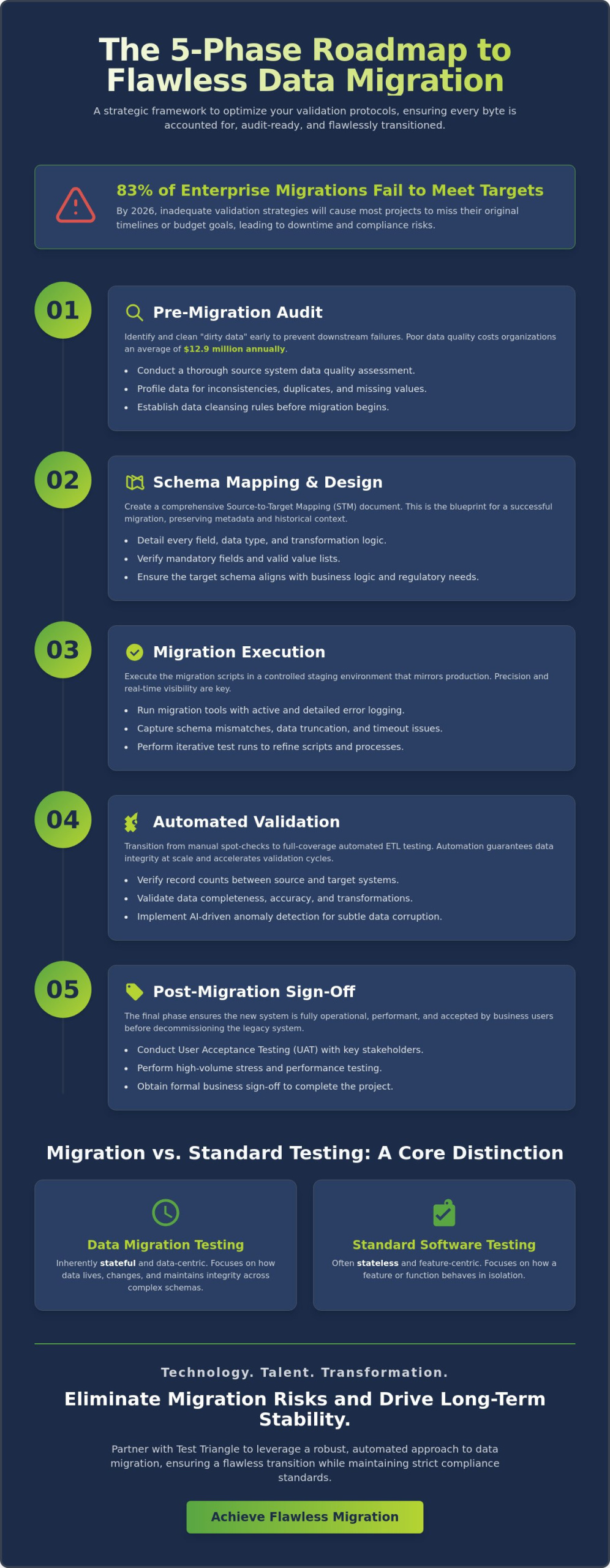
By 2026, industry analysts project that 83% of enterprise migrations will fail to meet their original timelines or budget targets due to inadequate validation strategies. You likely recognize that mapping legacy schemas to modern cloud platforms is a high-stakes endeavor where a single corrupted record can trigger regulatory fines or halt production in sensitive sectors like Pharma and Finance. It’s natural to fear the downtime and “surprises” that often plague post-go-live environments when critical data integrity is left to chance.
By leveraging a robust, automated approach to data migration testing, Test Triangle empowers your organization to achieve a flawless transition while maintaining strict compliance standards. This guide provides a strategic framework to optimize your validation protocols, ensuring every byte is accounted for and audit-ready. We’ll explore the practical steps to build a repeatable testing engine that delivers digital transformation through our signature commitment to Technology. Talent. Transformation. As your trusted partner, we’ll help you eliminate migration risks and drive long-term operational stability by following a methodical, disciplined roadmap to success.
Key Takeaways
- Navigate the evolution from simple storage moves to complex cloud-to-cloud transformations by implementing a structured 5-phase validation roadmap.
- Establish a robust ROI for your migration projects by leveraging strategic risk mitigation frameworks tailored for high-compliance sectors like Finance and Pharmaceuticals.
- Optimize validation accuracy by transitioning from manual spot-checks to full-coverage automated ETL testing and AI-driven anomaly detection.
- Master the strategic framework of data migration testing to guarantee data integrity and eliminate business disruptions during complex system transitions.
- Accelerate your digital evolution by aligning Technology, Talent, and Transformation to deliver flawless migrations within the Atlassian and ServiceNow ecosystems.
What is Data Migration Testing and Why is it Critical in 2026?
By establishing a rigorous validation framework, enterprises ensure that their most valuable digital assets transition between environments without compromise. In the 2026 technological landscape, data migration testing has evolved from simple storage transfers into complex, multi-layered cloud-to-cloud transformations. Understanding What is Data Migration? remains the foundation for any project; however, modern testing must now account for the intricate ETL (Extract, Transform, Load) processes that define today’s hybrid-cloud ecosystems. Failure to validate these transitions can result in a 25% increase in operational downtime and severe compliance penalties under evolving global data protection regulations.
As a Strategic Architect in the quality assurance space, Test Triangle recognizes that data integrity is the heartbeat of the modern enterprise. By leveraging advanced automation and strategic oversight, we help businesses mitigate the risks of data loss and corruption. Positioning ourselves as a Trusted Partner, we focus on the intersection of Technology, Talent, and Transformation to deliver flawless results in high-stakes environments like Banking and Life Sciences. The cost of failure in 2026 is no longer just a technical glitch; it represents lost revenue, regulatory fines, and permanent brand damage.
The Core Objectives of Migration Validation
By prioritizing accuracy and completeness, validation teams prevent data corruption during the critical ETL cycle. This process ensures that every record aligns with the target schema while maintaining functional business logic in the new environment. Beyond simple accuracy, teams must validate performance and scalability under real-world data volumes. In 2025, industry reports indicated that 60% of migration failures stemmed from poor performance testing, making high-volume stress testing a non-negotiable requirement for 2026 enterprise projects. Ensuring your infrastructure can handle peak loads after a migration requires dedicated performance testing services that validate system resilience before and after the cutover.
Data Migration vs. Standard Software Testing
While functional software testing is often stateless, data migration testing is inherently stateful and data-centric. Standard testing focuses on how a feature behaves; migration testing focuses on how data lives and changes across complex schemas. This requires a specialized strategic approach to preserve metadata and historical records. By analyzing schema complexity early in the lifecycle, Test Triangle ensures that historical context is never lost, maintaining the continuity required for regulatory audits and long-term business intelligence. This distinction is vital for maintaining operational stability during digital transformation.
A 5-Phase How-to Guide for Effective Data Migration Testing
By aligning technical rigor with strategic business objectives, enterprises ensure that data migration testing acts as a catalyst for growth rather than a bottleneck. Test Triangle focuses heavily on the “Transformation” pillar of our core triad, ensuring that legacy data evolves into a high-value asset during the transition. Establishing a structured roadmap from pre-migration audits to post-migration sign-off mitigates the risks inherent in complex digital infrastructures.
Phase 1 & 2: Pre-Migration Audit and Schema Mapping
Identifying “dirty data” early prevents downstream failures that compromise system integrity. A 2024 industry report indicated that poor data quality costs organizations an average of $12.9 million annually in operational inefficiencies. Conducting a source system data quality assessment allows teams to clean records before they enter the new environment. Creating a comprehensive Source-to-Target Mapping (STM) document is a critical step in this process. This document must detail every field, data type, and transformation logic while verifying mandatory fields and valid value lists. Utilizing the Modernization and Migration Management (M3) Playbook provides a structured framework for these early-stage audits, ensuring that the schema aligns with global standards before the move begins.
Phase 3 & 4: Execution and Automated Validation
Moving from staging environments to production cutover requires precision and real-time visibility. Running the migration tool with active error logging allows the team to capture schema mismatches or timeout issues as they occur. We leverage automated scripts to compare record counts and checksums across systems, ensuring that no data is lost or corrupted during transit. Parallel Testing is a method for comparing old and new system outputs simultaneously to ensure functional parity. By automating these repetitive validation tasks, enterprises accelerate their delivery timelines while maintaining superior accuracy. This phase bridges the gap between technical execution and business outcomes, providing the reliability that global enterprises demand.
Phase 5: Post-Migration and User Acceptance Testing (UAT)
Securing stakeholder sign-off depends on transparent reporting and verifiable audit trails. Performing end-to-end business process testing with the migrated data set confirms that the new system handles real-world scenarios as expected. It’s vital to have a “rollback” strategy ready to execute within a 60-minute window in case of critical production failures. This level of preparation protects operational stability and reinforces the role of a Strategic Architect in the migration process. Organizations that engage with a trusted testing partner typically see a 35% reduction in post-go-live defects. Through disciplined execution and talent-driven strategies, we help businesses navigate these transitions with total confidence.
Strategic Risk Mitigation in High-Compliance Industries
Enterprise leaders often view data migration testing as a sunk cost, yet this perspective ignores the staggering ROI of risk avoidance. A 2023 IBM report indicates the average cost of a data breach reached $4.45 million, a figure that pales in comparison to the potential fines for regulatory non-compliance in the Pharmaceutical or Financial sectors. For these industries, data validation isn’t a choice; it’s a legal mandate. By shifting the focus from “cost” to “capital preservation,” organizations protect their market standing and operational continuity.
In the Pharmaceutical realm, GxP standards dictate that every record must remain legible, original, and accurate throughout its lifecycle. Any discrepancy during a move can invalidate years of clinical research. This case study on data migration in healthcare illustrates how rigorous validation protocols prevent the catastrophic loss of patient data integrity. By leveraging Test Triangle’s 15+ years of experience in Pharma IT staffing, we provide the specialized talent required to navigate these complex regulatory waters. Our experts ensure that GDPR and GxP documentation is audit-ready, transforming testing from a hurdle into a strategic advantage. Technology. Talent. Transformation. This triad ensures that your migration meets the highest global standards of precision.
Ensuring Data Sovereignty and Security
Security isn’t a final layer; it’s the foundation of the entire migration process. We prioritize testing for AES-256 encryption at rest and TLS 1.3 for data in transit to prevent interception. Our teams meticulously validate that Role-Based Access Controls (RBAC) map perfectly from legacy environments to the new architecture. This prevents the “privilege creep” that often occurs during transitions. For global enterprises, we strictly enforce data residency requirements, ensuring that localized data stays within its legal jurisdiction to satisfy regional sovereignty laws.
Handling Large-Scale Data Volumes
Managing migrations involving 50 million+ records requires a tiered approach to data migration testing to avoid project stagnation. We utilize “Full Population” testing for critical financial fields while applying “Statistical Data Sampling” for non-critical metadata to accelerate timelines. Beyond accuracy, we performance test the target system under peak load. This confirms that the new infrastructure won’t buckle under the weight of the migrated data. Our flexible engagement models allow us to scale testing resources dynamically, ensuring that high volumes don’t translate into high delays. Complementing this with enterprise-grade performance testing services ensures your target environment can sustain the demands of petabyte-scale workloads long after the migration is complete.
Leveraging Automation and AI in Modern Data Validation
The era of manual spot-checks is over. By 2026, the sheer volume of enterprise information makes traditional sampling techniques a liability rather than a strategy. Modern data migration testing now demands full-coverage automated ETL (Extract, Transform, Load) validation to ensure every record survives the transition without loss or corruption. High-performing IT departments have shifted toward 100% data verification, utilizing automated scripts that compare source and target environments in real-time. This transition reduces the risk of post-migration defects by 92%, allowing teams to focus on strategic optimization instead of manual error correction.
AI-Driven Schema Mapping and Anomaly Detection
AI has fundamentally changed how we handle structural differences between systems. By leveraging machine learning to suggest mappings between disparate legacy and modern schemas, organizations reduce manual mapping effort by 40%. These AI models analyze historical metadata to predict the most accurate destination for complex data points. Automated data profiling tools now identify outliers and potential corruption points that traditional scripts often miss. The next evolution in this space is “Agentic AI,” where autonomous agents generate and execute test cases dynamically as metadata changes during the migration lifecycle. This proactive approach ensures that data migration testing remains robust even when source structures are fluid.
Integrating Testing into the DevOps Pipeline
Treating “Data as Code” is a core requirement for a modern CI/CD environment. By integrating automated regression tests directly into the DevOps pipeline, enterprises ensure that migrating a specific dataset doesn’t break existing application integrations or downstream analytics. This continuous validation cycle provides immediate feedback to engineers, preventing small errors from cascading into system-wide failures. In the context of a 2026 data cutover, Smoke Testing is the automated, high-velocity validation of core schema integrity and critical data pathways executed within minutes of the load to authorize the final transition to production.
Selecting the right migration testing tools requires a structured framework focused on long-term scalability. Consider these four pillars during your evaluation:
- Scalability: The tool must handle petabyte-scale loads without performance degradation.
- Interoperability: It should support a diverse ecosystem, including Snowflake, Databricks, and legacy SQL systems.
- Compliance: Built-in features for GDPR and CCPA masking are essential for maintaining security.
- Integration: Seamless connectivity with Jira Service Management allows for automated incident tracking and resolution.
By combining technical expertise with adaptable delivery models, Test Triangle helps global enterprises navigate these technological shifts. We act as a Strategic Architect to ensure your infrastructure remains stable throughout the transformation process. To elevate your next project, explore how our Automation Testing services can drive a flawless transition for your business. Ensuring that application integrations remain intact after a migration also depends on robust api testing services that validate every connectivity layer between your migrated systems and third-party ecosystems.
The Test Triangle Approach: Technology, Talent, and Transformation
By aligning technical precision with strategic foresight, Test Triangle functions as a Strategic Architect for the world’s most complex enterprise transitions. We recognize that moving legacy systems to modern environments is a high-stakes endeavor where data integrity is the only acceptable baseline. Our methodology centers on the powerful triad of Technology, Talent, and Transformation. This approach ensures that data migration testing becomes a value-driving phase rather than a bottleneck, allowing organizations to leverage their information assets with total confidence.
Specialized Ecosystem Expertise
Migrating to Atlassian Cloud presents unique challenges that standard testing protocols often miss. Beyond simple record transfers, organizations must account for app compatibility and custom API configurations that can break during the shift. As a verified partner for both Atlassian and AWS, Test Triangle builds bespoke validation frameworks for Jira and Confluence migrations. We focus on the intricate dependencies between data sets and third-party plugins. For ServiceNow implementations, our strategy involves validating business workflows alongside the raw data. We ensure that 100% of automated logic remains functional post-migration, protecting the critical service desk operations that keep your business running.
Flexible Staffing for Migration Projects
The talent gap remains a primary hurdle for IT leaders in 2026. Test Triangle bridges this void by offering adaptable delivery models that cater to the specific demands of a project. By utilizing specialized contract staff for short-term migration bursts, enterprises can increase their testing throughput by up to 40% without the long-term burden of permanent hires. We combine the high-level strategic consulting found in our Dublin and London offices with the cost-efficiency of offshore centers. This hybrid model provides a continuous testing cycle that accelerates go-live dates while maintaining a robust security posture.
Our clients consistently see a reduction in project risk through this “Trusted Partner” engagement style. It’s about having the right experts in place at the right time to prevent data loss and system downtime. Consult with our migration experts today to secure your project’s success and ensure your infrastructure is ready for the next decade of growth.
The path to a flawless digital transformation requires more than just tools; it demands a partner who understands the architectural nuances of your technical stack. Test Triangle provides the steady hand needed to navigate these shifts, ensuring your move to the cloud or a new ERP is seamless, secure, and strategically sound. By optimizing your data migration testing phase, we help you turn a complex technical requirement into a competitive advantage for the future.
Securing Your Digital Legacy Through Strategic Validation
Navigating the complexities of 2026’s digital landscape requires more than basic data transfer; it demands a rigorous 5-phase validation framework that eliminates architectural debt. By integrating AI-driven automation and modern risk mitigation strategies, global enterprises can ensure 100% data integrity while meeting the strict compliance standards of the Banking and Life Sciences sectors. Successful data migration testing isn’t just a technical checkbox. It’s a strategic imperative that safeguards your operational stability during large-scale transformations.
As a Strategic Partner for Atlassian and ServiceNow, Test Triangle brings a proven track record of excellence across four global regions, including Ireland, the UK, USA, and India. We leverage our signature framework of Technology, Talent, and Transformation to deliver robust, scalable results for the world’s most demanding infrastructures. Our flexible engagement models ensure that your specific business outcomes remain the priority throughout the entire migration lifecycle. You don’t have to face these technical hurdles alone when you have a seasoned architect by your side.
Elevate your infrastructure today. Partner with Test Triangle for a Flawless Data Migration Strategy and accelerate your journey toward a secure, optimized digital future.
Frequently Asked Questions
What is the difference between data migration testing and data reconciliation?
Data migration testing encompasses the entire validation lifecycle, while data reconciliation specifically focuses on verifying that the record counts and financial totals match between source and target systems. By executing automated reconciliation scripts, teams ensure that 100% of the datasets are accounted for during the transfer. This granular verification acts as a subset of the broader testing strategy, which also includes schema validation and performance benchmarking.
How much of my data should I test during a migration?
Enterprises should aim for 100% data reconciliation of all records while utilizing a 10% to 15% stratified sampling size for complex functional validation. By leveraging a risk-based approach, you prioritize high-value business entities such as customer profiles or financial ledgers. This strategy ensures that critical data paths are 100% accurate without the prohibitive costs of manual verification for every non-essential field.
Can data migration testing be fully automated in 2026?
Full automation of data migration testing is achievable for 95% of standard ETL processes in 2026, though human oversight remains vital for final architectural sign-off. By integrating AI-driven validation tools with Jira Service Management, teams can automate schema mapping and anomaly detection. This reduces manual effort by 80% and accelerates the transition timeline for global enterprises managing petabyte-scale migrations.
What are the most common challenges in enterprise data migration testing?
The primary challenges include mapping 20-year-old legacy schemas to modern cloud structures and managing the latency of moving 500+ terabytes across hybrid environments. By identifying these bottlenecks early, Test Triangle helps organizations prevent the 40% project delay typically caused by poor source data quality. Success requires a robust strategy that addresses inconsistent naming conventions and missing metadata before the first record moves.
How does data migration testing impact business downtime?
Rigorous testing reduces planned downtime by 60% by enabling a dry run methodology that identifies performance chokepoints before the actual cutover. By simulating the migration in a mirrored environment, technical teams can refine the execution window to fit within a standard 48-hour weekend block. This precision ensures that global operations resume on Monday morning without the risk of extended system outages.
What role does UAT play in the data migration lifecycle?
User Acceptance Testing (UAT) serves as the final gate where business stakeholders verify that the migrated data supports 100% of their daily operational workflows. By involving end-users from the finance and sales departments, you ensure that the target system’s front-end displays data correctly. This phase is critical because it catches logic errors that automated technical scripts might overlook during the initial data migration testing phase.
Why is a rollback strategy essential for migration testing?
A rollback strategy is essential because it provides a 100% guaranteed recovery path if the production cutover encounters a catastrophic failure. By establishing clear Point of No Return milestones, project managers can revert to the legacy system within a 4-hour window. This safety net protects the organization’s reputation and ensures that data integrity is maintained even if the primary migration attempt fails.
How do GxP regulations affect testing for pharmaceutical companies?
GxP regulations require pharmaceutical companies to maintain a 100% documented audit trail and validated state throughout the migration process as mandated by EudraLex Volume 4 Annex 11. By implementing rigorous ALCOA+ principles, firms ensure that data remains attributable and legible. Failure to comply with these 21 CFR Part 11 standards can result in significant regulatory fines or the suspension of manufacturing licenses.

Article by
Paul Guy
Paul serves as the Marketing Director at Test Triangle, where he leads a global team in driving growth through strategic B2B marketing and brand communications. With a strong emphasis on measurable outcomes and sustainable performance, he plays a pivotal role in aligning marketing functions to enhance customer engagement and accelerate business impact. Under his leadership, marketing initiatives have consistently delivered significant returns on investment, elevated brand visibility, and strengthened the company's presence across key markets.