
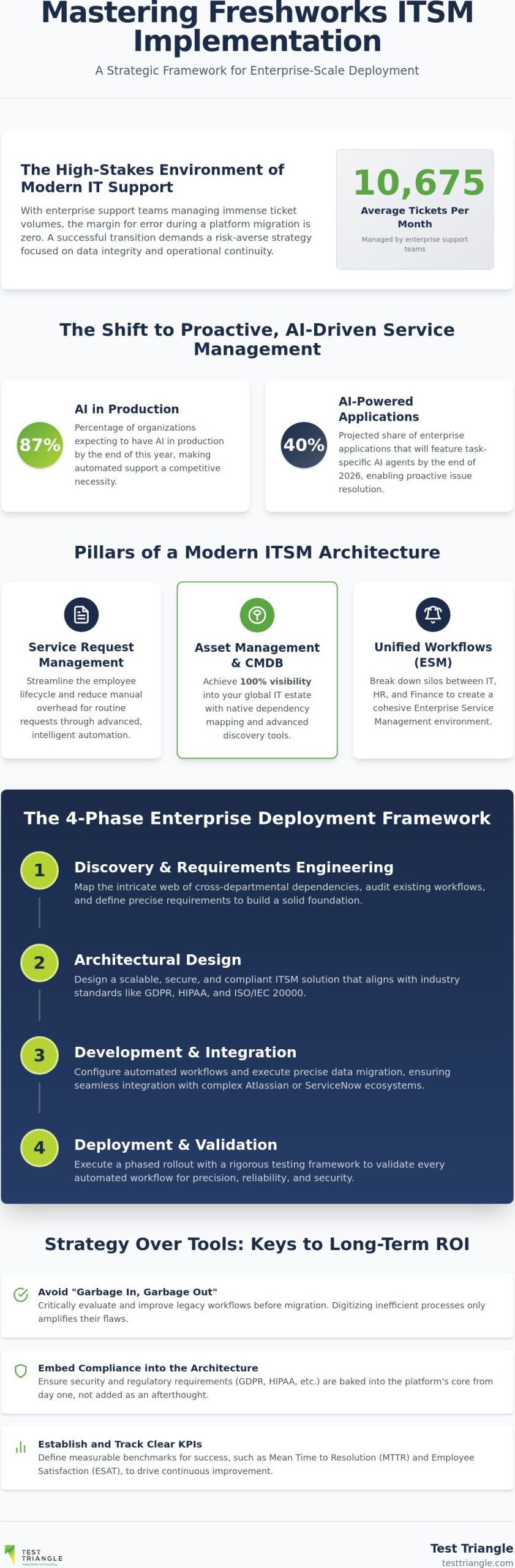
With research indicating that enterprise support teams now manage an average of 10,675 tickets monthly, the margin for error during a platform migration has effectively vanished. You’ve likely felt the tension between the necessity of modern automation and the legitimate fear that a Freshworks ITSM implementation might disrupt your existing Atlassian or AWS ecosystems. It’s a valid concern for strategic leaders who prioritize data integrity and operational continuity above all else. We recognize that a successful transition requires more than just a software configuration; it demands a steady hand to manage the evolution of your digital backbone.

This guide provides the authoritative framework you need to master these complexities and secure a substantial long-term ROI. By connecting rigorous deployment methodologies with specific architectural actions, we’ll demonstrate how to achieve a risk-averse transition that reduces manual overhead through intelligent, automated workflows. You’ll receive a comprehensive preview of the steps required to build a future-proof ITSM architecture that scales with your global ambitions. From navigating the new “Dew” user interface to leveraging native ITAM discovery tools, we’ll ensure your organization moves from legacy constraints to a state of empowered, scalable growth.

Key Takeaways

  • Understand why global enterprises view Freshworks deployment as a strategic realignment of IT services rather than a mere technical migration.
  • Master a phased implementation roadmap designed to identify cross-departmental dependencies and ensure absolute operational stability during the transition.
  • Secure your digital infrastructure by executing a Freshworks ITSM implementation that guarantees data integrity across complex Atlassian or ServiceNow ecosystems.
  • Implement a rigorous testing framework to validate automated workflows, ensuring that every integration performs with precision, reliability, and security.
  • Discover the value of a strategic partnership in achieving long-term ROI through continuous platform optimization and expert managed services.

Freshworks ITSM implementation represents a fundamental shift in how global organizations harmonize their technology stacks with overarching corporate objectives. In 2026, this process has evolved beyond simple ticket routing into a sophisticated realignment of IT services and business goals. Enterprises are increasingly abandoning rigid legacy systems in favor of Freshworks because it facilitates a seamless transition to AI-driven service management. This migration isn’t merely about adopting new software; it’s a strategic catalyst for broader digital transformation that empowers teams to move from reactive troubleshooting to proactive, automated employee experiences. By prioritizing stability, precision, and scalability, we help organizations turn their service desk into a high-performance engine of organizational progress.

The shift toward proactive support is driven by the rapid maturation of agentic AI. With 87% of organizations expecting to have AI in production by the end of this year, the ability to autonomously handle IT support tasks has become a competitive necessity. Freshworks provides the architecture required to deploy these task-specific AI agents, which are projected to be featured in 40% of enterprise applications by the close of 2026. This evolution allows IT departments to anticipate infrastructure bottlenecks before they impact the end user, ensuring that digital services remain resilient in a high-volume environment where support teams often handle over 10,000 tickets monthly.

The Core Components of Modern ITSM

A robust IT Service Management (ITSM) framework rests upon several foundational pillars that ensure operational stability and service excellence. While incident, problem, and change management remain the essential mechanisms for maintaining uptime, modern implementation also prioritizes the following areas:

  • Service Request Management: Streamlining the employee lifecycle through advanced automation that reduces manual overhead for routine requests.
  • Asset Management and CMDB: Achieving 100% visibility into the global IT estate through native application dependency mapping and advanced discovery tools.
  • Unified Workflows: Breaking down silos between IT, HR, and finance to create a cohesive Enterprise Service Management (ESM) environment.

Why Enterprise Strategy Supersedes Tool Configuration

Success in a Freshworks ITSM implementation is rarely determined by the software’s technical features alone, but rather by the strategic foresight applied before the first configuration step. Migrating legacy workflows without critical evaluation often leads to a “garbage in, garbage out” scenario, where inefficient processes are simply digitized rather than improved. We advocate for aligning platform capabilities with specific industry compliance standards, such as GDPR, HIPAA, or ISO/IEC 20000, to ensure that security and regulatory requirements are baked into the architecture. Establishing clear KPIs, such as Mean Time to Resolution (MTTR) and employee satisfaction (ESAT), provides a measurable benchmark for success. For organizations seeking to optimize these outcomes, engaging with specialized IT Service Management Services ensures that the deployment remains a disciplined, high-value evolution.

A Strategic Framework for Enterprise-Grade Deployment

Executing a successful Freshworks ITSM implementation requires a disciplined, phased approach that prioritizes long-term operational stability over rapid, superficial setup. By adopting a structured framework of Discovery, Design, Development, and Deployment, organizations can systematically address the complexities of modern digital infrastructure while ensuring that technical rigor never compromises the user experience. This methodology transforms the migration process into a series of intentional, value-driven actions that mitigate risk and maximize ROI. For global enterprises, this phased roadmap serves as a blueprint for institutional maturity, moving beyond basic tool configuration to establish a resilient service architecture.

Phase 1: Discovery and Requirements Engineering

Before any configuration occurs, a deep investigative phase is essential to map the intricate web of cross-departmental dependencies that define your service landscape. This involves conducting comprehensive stakeholder interviews to uncover hidden friction points in current service delivery that simple software settings often overlook. We recommend auditing existing data structures with extreme precision to ensure a validated migration that maintains historical audit trails. This level of rigor is a hallmark of professional IT Service Management, where the goal is to align technology with the specific operational needs of the institution. During this phase, the integration landscape is also defined, identifying exactly how Freshworks will interact with existing Atlassian, AWS, or ServiceNow environments to prevent data silos.

Phase 2: Workflow Design and Automation Strategy

Designing the “To-Be” state allows organizations to eliminate redundant manual steps and replace them with intelligent, automated sequences. Leveraging Freddy, the Freshworks AI engine, enables the creation of sophisticated incident routing and self-service capabilities that handle the increasing ticket volumes reported by 34% of support teams. With the May 5, 2026, update introducing advanced approval chains and groups, we can now build robust governance matrices that maintain security without introducing operational bottlenecks. Utilizing the latest sandbox environments, which were upgraded in May 2026 for enhanced performance and stability, allows for iterative development and stakeholder feedback in a secure environment before any changes hit production.

To ensure a seamless transition, we advocate for a phased “pilot” deployment that targets specific departments before a full-scale rollout. This strategy allows for real-world validation in a controlled environment, providing the peace of mind that comes from a risk-averse transition. If you’re looking to secure your digital backbone through an expert-led transition, our team is ready to discuss your specific implementation requirements.

Data Migration and Cross-Platform Integration Excellence

Achieving data integrity during a Freshworks ITSM implementation is a non-negotiable requirement for global enterprises that rely on historical audit trails for regulatory compliance and operational continuity. We treat migration as a high-stakes strategic operation where the objective is zero data loss while transitioning from legacy systems. This process requires a deep understanding of how information flows across your entire digital ecosystem to maintain continuity and security. By establishing a rigorous, reliable, and resilient validation framework, we ensure your institutional knowledge remains intact during the transition to an AI-driven platform. Our methodology prioritizes precision, performance, and progress to safeguard your data assets through every stage of the evolution.

Integrating with Atlassian and ServiceNow

In complex multi-platform environments, maintaining synergy between development and support teams is essential for operational efficiency. Integrating Freshservice with Atlassian tools like Jira Software allows for a unified view of the product lifecycle, where bug reports automatically sync with development backlogs. This creates a closed-loop system that accelerates resolution times and improves collaboration across technical silos. For organizations navigating phased enterprise mergers, bridging the gap between Freshworks and ServiceNow ensures that service delivery remains uninterrupted while platforms are consolidated. Specialized Atlassian implementation services can complement your Freshworks strategy by ensuring these two powerhouses work in perfect harmony rather than in isolation.

The Role of AWS in ITSM Scalability

Scalability is a cornerstone of enterprise-grade service management, and leveraging AWS cloud infrastructure provides the performance needed to support global operations. Optimizing platform performance through strategic AWS cloud migration allows organizations to handle spikes in ticket volume without any degradation in service quality. This regional hosting approach also ensures compliance with global data residency requirements, which is critical for highly regulated industries like finance or healthcare. By connecting Freshworks to enterprise security operations for real-time monitoring and logging, we create a transparent, secure, and future-proof ITSM environment. This integration ensures your service management platform isn’t just a support tool, but a vital component of your broader DevOps and security pipelines that facilitates faster incident resolution and systemic improvement.
Expert Freshworks ITSM Implementation: A Complete Guide

Quality Assurance: The Critical Pillar of ITSM Success

A sophisticated Freshworks ITSM implementation is often undermined by a lack of architectural validation, where organizations prioritize software configuration over rigorous quality assurance. While legacy approaches treat testing as a final, perfunctory step before go-live, we view it as a continuous strategic pillar that ensures every workflow, integration, and automated sequence performs with absolute precision. This disciplined approach to quality reduces the risk of service downtime and protects the integrity of your digital infrastructure. By establishing a comprehensive testing framework, global enterprises can move forward with the confidence that their service management platform is resilient, reliable, and ready for large-scale operation.

Validation and Software Testing Protocols

In the complex multi-tool environments we’ve previously discussed, System Integration Testing (SIT) becomes the primary mechanism for ensuring that data flows seamlessly between Freshworks, Atlassian, and AWS ecosystems. This phase validates that the API calls and webhooks powering your cross-platform workflows don’t fail under real-world conditions. Equally critical is User Acceptance Testing (UAT), which ensures that the frontline agents find the new “Dew” user interface, mandatory as of January 30, 2026, to be intuitive and efficient. Utilizing professional manual testing services is essential here to validate human-centric workflows and identify complex edge cases that automated scripts might overlook. This qualitative feedback loop ensures that the platform meets the practical needs of your global support teams.

Continuous Quality in ITSM

Maintaining a high-performance ITSM environment requires more than a successful initial rollout; it demands a long-term commitment to continuous quality. As Freshworks introduces updates, such as the May 5, 2026, enhancement to approval chains, regression testing becomes vital to prevent new configurations from disrupting existing core services. Implementing software test automation services allows for rapid, repeatable validation of the platform during every update cycle or feature rollout. This automation ensures that your service desk maintains peak speed even under heavy global load, providing the performance stability required for enterprise-grade service management. By fostering a “Culture of Quality,” we help you transition from a state of reactive troubleshooting to one of empowered, scalable growth where your ITSM architecture is always optimized for success.

Ensuring your platform is bug-free and fully optimized is the final step in a truly strategic deployment. If you’re ready to validate your service management architecture with a rigorous testing framework, contact our quality assurance experts today.

Maximizing ROI Through Strategic Implementation Partnership

A successful Freshworks ITSM implementation marks the beginning of a long-term strategic journey rather than the conclusion of a technical project. The complexity of managing these systems is reflected in Freshworks’ Q1 2026 financials, which show a 29% year-over-year increase in customers with an Annual Recurring Revenue exceeding $100,000. This growth highlights a clear trend: global enterprises are moving beyond basic setups to seek sophisticated, high-value configurations. Achieving a sustainable return on investment requires a disciplined approach that balances immediate operational stability with future-proof scalability. By positioning a strategic partner as a steady hand, organizations can reduce their total cost of ownership and ensure that their ITSM architecture remains a catalyst for organizational progress.

Long-Term Support and Managed Services

The transition from “go-live” to “steady-state” is a critical phase where many organizations lose momentum. Continuous platform optimization is essential because the technological landscape moves quickly. For instance, the July 9, 2026, deprecation of the fdk test command in favor of fdk unit-test demonstrates how developer tools and underlying architectures are constantly shifting. Professional managed outsourcing services provide the 24/7 oversight necessary to navigate these updates without disrupting service delivery. This partnership model allows for strategic technology roadmapping, ensuring that your Freshworks environment evolves alongside your business requirements and leverages new features like agentic AI as they mature.

Securing the Right Talent for ITSM

Addressing the talent gap is often the most significant hurdle in maintaining a high-performance service desk. Specialized industries, such as life sciences, require technical resources who understand both the software and the regulatory environment. Utilizing IT staffing agencies for the pharmaceutical industry ensures that you have access to compliant, expert talent capable of managing complex data residency and security protocols. Flexible staffing models, including offshore and contract placements, allow implementation projects to scale quickly without the overhead of permanent hires. This targeted approach to talent acquisition bridges the skills gap and empowers your internal teams to focus on high-level digital transformation while experts manage the technical rigor of the Freshworks ITSM implementation.

Ultimately, the value of an expert-led delivery model lies in its ability to deliver precision, performance, and peace of mind. As your organization grows, a reliable collaborator provides the institutional maturity needed to operate across diverse, highly regulated sectors. We remain committed to your long-term success, offering the technical depth and strategic visionary perspective required to turn your IT service management into a competitive advantage.

Securing Your Digital Future Through Strategic Service Evolution

Transitioning to a modern service architecture requires a disciplined fusion of technical rigor and strategic foresight. We’ve explored how a phased roadmap, anchored by exhaustive discovery and meticulous quality assurance, transforms the risk of service disruption into an opportunity for systemic improvement. By integrating your service management environment with existing Atlassian and AWS ecosystems, you establish a resilient, high-performance infrastructure that scales with your global ambitions. This methodical approach ensures that your Freshworks ITSM implementation isn’t just a technical deployment, but a cornerstone of your long-term digital maturity and operational stability.

As a reliable collaborator with a global presence across Europe, North America, and Asia, we bring deep expertise in highly regulated sectors like Pharma and Finance to every engagement. Our strategic partnerships with Atlassian, ServiceNow, and AWS allow us to manage complex digital infrastructures with the precision your enterprise demands. Optimize your IT service delivery with Test Triangle’s strategic ITSM consulting. We’re ready to help you navigate the complexities of technological evolution and achieve the scalable growth your organization deserves.

Frequently Asked Questions

What is the typical timeline for a Freshworks ITSM implementation?

Standard deployments in 2026 range from two to four weeks for straightforward configurations; however, complex global migrations typically require three to six months to complete. This duration accounts for the rigorous discovery and requirements engineering phases necessary to map intricate cross-departmental dependencies before the first configuration step occurs.

Can Freshworks integrate with my existing Atlassian Jira environment?

Yes, Freshworks maintains native synergy with the Atlassian ecosystem to provide a unified view of development and support lifecycles. This integration allows for automated synchronization between Jira Software and Freshservice, which ensures that technical teams remain aligned and informed without the need for manual data entry or duplicate ticketing.

How does Freshservice differ from legacy ITSM tools during migration?

Freshservice prioritizes a configuration-first approach that significantly reduces the reliance on the lengthy, custom development cycles common in legacy systems. This modern architecture facilitates a more agile Freshworks ITSM implementation by replacing rigid coding with flexible, automated workflows that are designed to scale with your digital infrastructure.

What are the key risks of a DIY ITSM implementation?

The primary risks of a DIY approach include the creation of technical debt through inefficient workflow design and the potential for significant data loss during the transition. Without professional oversight, organizations often digitize existing process flaws, which leads to a “garbage in, garbage out” scenario that compromises long-term operational stability and ROI.

Is data migration from ServiceNow to Freshworks complex?

Migrating from ServiceNow is a high-stakes operation that requires a strategic approach to maintain historical audit trails and complex data structures. While the technical transfer is manageable, the challenge lies in re-mapping sophisticated approval chains and dependencies to ensure absolute operational continuity and compliance with global data residency requirements.

How does Freddy AI improve the implementation ROI?

Freddy AI improves ROI by transitioning the service desk from reactive troubleshooting to proactive, autonomous task management. By leveraging agentic AI to handle routine requests, organizations can effectively manage the high ticket volumes reported by support teams without increasing headcount, thereby reducing the total cost of ownership.

Do I need a dedicated team to manage Freshworks after implementation?

While a dedicated internal team is an option, many global enterprises prefer utilizing managed services for ongoing platform optimization and 24/7 support. This partnership model ensures your Freshworks ITSM implementation evolves with your business requirements while addressing the common talent gap found in specialized IT service management.

What testing is required before a Freshworks go-live?

A successful go-live requires a rigorous framework that includes System Integration Testing (SIT), User Acceptance Testing (UAT), and comprehensive performance testing. These protocols validate that every integration performs under peak global load and that the user interface meets the practical needs of frontline agents across all regions.

Paul Guy

Article by

Paul Guy

Paul serves as the Marketing Director at Test Triangle, where he leads a global team in driving growth through strategic B2B marketing and brand communications. With a strong emphasis on measurable outcomes and sustainable performance, he plays a pivotal role in aligning marketing functions to enhance customer engagement and accelerate business impact. Under his leadership, marketing initiatives have consistently delivered significant returns on investment, elevated brand visibility, and strengthened the company's presence across key markets.

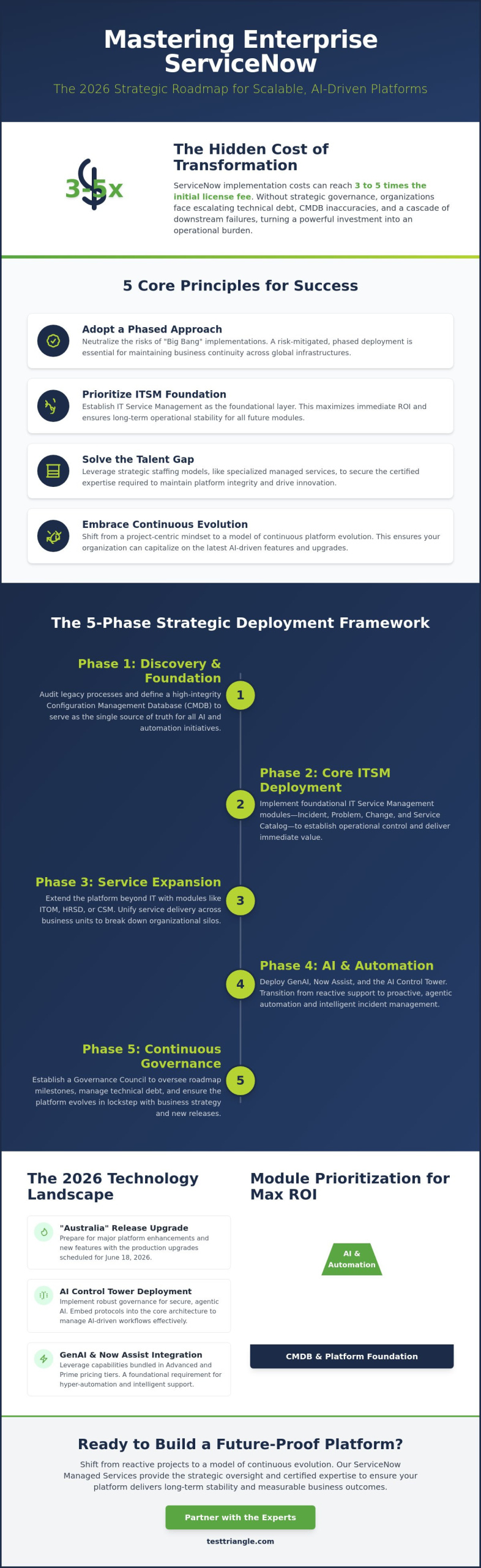

With ServiceNow implementation costs typically reaching three to five times the initial license fee, the strategic challenge for global organizations isn’t just the initial purchase; it’s the persistent governance of a rapidly evolving digital ecosystem. You’ve likely seen how unmanaged technical debt and CMDB inaccuracies can turn a transformative vision into a series of downstream failures. To solve this, sophisticated servicenow managed services for enterprises provide the technical rigor, strategic oversight, and specialized talent required to maintain platform integrity. We focus on delivering precision, performance, and progress through a methodology that connects architectural health to measurable business outcomes.

This guide offers a comprehensive 2026 roadmap designed to help you master the complexities of enterprise-scale deployments with a structured, risk-mitigated approach. You’ll learn how to align IT workflows with your broader corporate objectives while ensuring your platform remains scalable as you grow. We’ll preview the critical phases of the “Australia” release upgrade, the integration of the new Prime pricing tier capabilities, and the deployment of the AI Control Tower for secure, agentic automation. By the end of this article, you’ll have a clear path to achieve long-term operational stability and a platform that evolves alongside your enterprise.

Key Takeaways

  • Learn why a phased, risk-mitigated approach to deployment is essential for maintaining business continuity across global infrastructures, effectively neutralizing the risks associated with high-stakes “Big Bang” implementations.
  • Leverage specialized servicenow managed services for enterprises to navigate the 2026 strategic roadmap, ensuring that technical configurations remain precisely aligned with high-level corporate objectives and systemic growth.
  • Identify the optimal order of operations for module integration, prioritizing IT Service Management as the foundational layer to maximize immediate return on investment and long-term operational stability.
  • Solve the persistent talent gap by evaluating strategic staffing models that secure the certified expertise required to maintain platform integrity amidst a rapidly changing technological landscape.
  • Shift from a project-centric mindset to a model of continuous platform evolution, ensuring your organization is positioned to capitalize on the latest AI-driven features and version upgrades.

The Architecture of Success: Defining the ServiceNow Implementation Roadmap

The architecture of success in modern digital infrastructure isn’t built on static project plans; it’s forged through a living strategic document that synchronizes complex IT workflows with overarching corporate goals. For global organizations, the “Big Bang” deployment model often results in catastrophic operational friction, making a phased transition the superior choice for maintaining business continuity while scaling technical capabilities. Establishing a robust, multi-year roadmap serves as a definitive risk-mitigation tool for large-scale digital transformation. In 2026, the “Assess, Align, Accelerate” framework has become the industry benchmark, particularly as firms prepare for the “Australia” release production upgrades scheduled for June 18. By utilizing servicenow managed services for enterprises, leadership teams can ensure this framework isn’t just theoretical but translates into tangible platform stability, precision, and progress.

Strategic Alignment and Executive Buy-in

Successful platform adoption requires a shift from purely technical metrics to specific corporate KPIs. By mapping platform capabilities directly to business outcomes, such as reducing mean time to resolution or improving employee retention through seamless service delivery, IT leaders can secure sustained funding. We recommend establishing a Governance Council to oversee roadmap milestones, ensuring that every configuration choice supports the enterprise’s long-term vision. Identifying “Quick Wins” during the initial ninety days is essential to demonstrate immediate value to stakeholders, effectively justifying the implementation costs which typically range from three to five times the first-year license fee.

The 2026 Landscape: AI and Hyper-automation

Since its inception, ServiceNow has evolved from a ticketing tool into a comprehensive workflow engine that now prioritizes agentic AI. The 2026 roadmap must integrate GenAI and Now Assist into early phases, especially as these capabilities are now bundled within the Advanced and Prime pricing tiers. Preparing data structures for AI-driven incident management is no longer optional; it’s a foundational requirement for hyper-automation. Strategic servicenow managed services for enterprises focus on future-proofing the platform against evolving regulatory requirements, such as the June 2026 Chemical Regulatory framework, by ensuring that data governance and AI Control Tower protocols are embedded into the core architecture from day one. This proactive approach leads to a scalable, secure, and sophisticated digital environment that empowers the global workforce.

The 5-Phase Strategic Framework for Enterprise Deployment

Executing a global deployment requires more than just technical configuration; it demands a methodical progression that balances speed with architectural integrity. By adopting a five-phase framework, organizations can transform their digital infrastructure from a collection of siloed tools into a unified engine for growth. High-tier servicenow managed services for enterprises provide the necessary guardrails during this transition, ensuring that each phase builds upon a stable foundation rather than compounding technical debt. This disciplined approach allows leadership to maintain visibility while the platform scales across diverse business units.

Phase 1 focuses on Discovery and Foundation, where teams audit legacy processes to define the core Configuration Management Database (CMDB). This stage is critical because ServiceNow’s AI-driven strategy relies heavily on high-quality data to fuel automation and agentic AI. Phase 2 moves into Core ITSM Deployment, establishing incident, problem, and change management workflows that standardize service delivery. Once these essentials are in place, Phase 3 introduces IT Operations Management (ITOM) for full-stack observability. Phase 4 extends the platform’s reach into HR Service Delivery (HRSD) or Strategic Portfolio Management (SPM), aligning technical output with business value. Finally, Phase 5 centers on Continuous Optimization, where the platform is refined to meet shifting enterprise needs.

Phase 1: The Criticality of a Clean CMDB

The CMDB acts as the single source of truth for the entire roadmap. If the data within this database is fragmented or outdated, every downstream process, from automated ticket routing to AI-driven insights, will fail. Enterprises must decide between automated discovery tools and manual data entry, though automation is almost always preferred for maintaining accuracy at scale. Avoiding the “garbage in, garbage out” trap requires a disciplined approach to data governance that starts on day one. It’s the difference between a platform that provides clarity and one that creates confusion.

Scaling Through Managed Services

As the deployment matures, the focus shifts from initial setup to long-term operational health. Transitioning to professional Managed Service Provider (MSP) support through servicenow managed services for enterprises allows internal IT teams to focus on innovation while experts handle the complexities of platform maintenance. This model ensures stability through recurring optimization audits and dedicated helpdesk support that scales with your needs. To ensure your platform remains a high-performance asset, it’s vital to discuss your specific operational requirements with a strategic partner. This partnership provides the institutional maturity needed to manage the “Australia” release and future platform evolutions with precision.

Order of Operations: Prioritising Modules for Maximum ROI

Determining the precise sequence of module activation is a high-stakes decision that dictates the speed of realized value across the organization. While the platform’s versatility is vast, establishing IT Service Management (ITSM) as the foundational layer remains the strategic standard for 90% of enterprises. This preference isn’t merely traditional; it’s a structural necessity because ITSM provides the essential data taxonomies and service schemas required to support more advanced automation. By utilizing servicenow managed services for enterprises, leadership teams can navigate these priorities with a steady hand, ensuring that each new capability rests on a stable, high-performance base that supports systemic growth.

When comparing early ITOM (IT Operations Management) versus HRSD (HR Service Delivery) integration, the choice typically hinges on the organization’s most pressing operational friction. If the enterprise suffers from frequent service outages or lacks visibility into complex cloud infrastructures, ITOM offers the immediate benefit of full-stack observability. Conversely, if the primary goal is to centralize and automate employee requests across global offices, HRSD provides a more visible impact on internal productivity. A common objection arises regarding whether industry-specific modules should be implemented first to address niche requirements. While these modules offer deep functionality, deploying them before the core ITSM engine often creates architectural silos that are difficult to reconcile during later stages of the roadmap.

For organizations focused on technical agility, integrating ServiceNow with Atlassian ecosystems is a critical milestone for achieving DevOps synergy. This connection creates a seamless bridge between the service desk and the development pipeline, allowing for automated ticket synchronization and improved visibility. By aligning these industry-leading platforms, enterprises can achieve a level of speed, security, and scalability that traditional siloed approaches cannot match.

The ITSM-First Approach

Standardizing service desks through an ITSM-first strategy is the most effective way to reduce operational friction and create a unified user experience. By mapping incident management directly to business impact levels, IT teams can prioritize resources based on actual financial or operational risk. The minimum viable platform for a successful enterprise launch consists of a governed CMDB core, a functional incident management workflow, and a standardized service portal. This foundational setup allows the enterprise to capture clean data from day one, which is essential for fueling the AI-driven insights promised in the 2026 roadmap.

Expanding to ITOM and Beyond

Once the foundation is secure, leveraging AIOps within the ITOM module allows organizations to transition from reactive firefighting to proactive maintenance. This evolution is particularly powerful when integrating ServiceNow with AWS cloud environments, where automated discovery and event management can significantly reduce mean time to resolution. Linking your ServiceNow Implementation to broader DevOps Consulting goals ensures that your platform doesn’t just manage services but actively accelerates digital transformation. This strategic expansion transforms the platform into a versatile engine for enterprise-wide innovation and long-term stability.

ServiceNow Managed Services for Enterprises: The 2026 Strategic Roadmap

Overcoming the Talent Gap: Staffing Your Roadmap

The primary bottleneck for global organizations executing a 2026 roadmap isn’t the platform’s architecture; it’s the acute shortage of certified ServiceNow architects and developers. This talent gap often halts progress between the discovery and deployment phases, as enterprises struggle to secure specialists who understand the nuances of the “Australia” release and its bundled AI capabilities. The “Build vs. Buy” dilemma is a constant pressure for IT leadership. While training internal staff is a valuable long-term objective, the immediate requirements of a high-stakes rollout often demand the technical rigor and institutional maturity that only servicenow managed services for enterprises can provide. Specialized recruiters play a vital role here, sourcing hard-to-find talent that bridges the gap between technical execution and business strategy.

To maintain momentum without inflating permanent headcount, many organizations utilize IT Staffing Services to fill tactical gaps during the most labor-intensive milestones. This approach allows for a versatile staffing model that adjusts to the project’s pulse, ensuring that your roadmap doesn’t stall due to a lack of specialized human capital. If your organization is facing a critical expertise shortage, it is time to consult with our staffing experts to secure the certified talent necessary for a seamless deployment.

Hybrid Staffing Models for Global Rollouts

Balancing permanent on-site leadership with remote offshore resources is a proven strategy for maintaining 24/7 development cycles. Using contract specialists for high-intensity Phase 2 and 3 milestones allows enterprises to scale their technical capacity rapidly without the long-term burden of high overhead. This model frequently utilizes margin-based billing for temporary tech staff, providing a cost-effective way to access elite skills during critical transition periods. It’s a disciplined approach that prioritizes operational speed while maintaining strict budget control.

Quality Assurance and Testing Roles

Manual and Automation Testing are non-negotiable requirements for any enterprise roadmap. Integrating QA engineers early in the deployment process prevents the accumulation of technical debt that can cripple a platform’s performance over time. System Integration Testing (SIT) is particularly crucial in multi-platform environments where ServiceNow must communicate flawlessly with AWS, Atlassian, or legacy ERP systems. Following a structured testing guide ensures that every configuration is validated against rigorous security and performance standards before reaching production, safeguarding the integrity of your digital ecosystem.

The Final Milestone: Partnership and Long-Term Evolution

The final milestone in a successful enterprise deployment is the fundamental shift from a project-centric view to a platform-centric philosophy. While the initial go-live represents a significant achievement, the true value of servicenow managed services for enterprises is realized through continuous, incremental evolution. This “platform mindset” ensures that your digital infrastructure remains responsive to shifting market conditions rather than becoming a legacy burden. Precision drives progress. To maintain this momentum, regular version upgrades are essential. With the “Australia” release production upgrades scheduled for June 18, 2026, organizations must stay current to access critical innovations like the AI Control Tower or the bundled Now Assist capabilities now included in the Prime pricing tier. Neglecting these updates doesn’t just stall innovation; it increases security risks and technical debt.

As a seasoned expert in the field, Test Triangle acts as a steady hand in this fast-changing landscape, positioning itself as the strategic collaborator for your IT Service Management solutions. We focus on the peace of mind derived from risk reduction and the empowerment found in large-scale technological evolution. Stability requires constant motion. Transitioning to a managed model allows your internal leadership to focus on high-level strategy while we manage the technical rigor of platform health, ensuring your investment continues to deliver measurable ROI long after the initial implementation.

Measuring Roadmap Maturity

Determining the success of your deployment requires tracking key performance indicators (KPIs) that reflect real business impact. We recommend focusing on metrics such as the reduction in mean time to resolution (MTTR), the accuracy of CMDB data, and overall user adoption rates across different modules. Annual “Health Checks” are a non-negotiable part of this process. These audits identify system bloat and misconfigurations before they cause downstream failures. By leveraging the strategic trinity of Atlassian, ServiceNow, and AWS, organizations can achieve a level of enterprise-wide agility that ensures every workflow is optimized for speed and security.

Ready to Accelerate Your Transformation?

Our “Assess, Align, Accelerate” value proposition is designed to lead your organization from a general need for improvement to a specific, high-performance technical solution. This methodical approach ensures that your ServiceNow environment remains a scalable asset that grows alongside your enterprise. We invite you to explore Test Triangle’s comprehensive IT services to see how our versatile staffing and implementation models can support your long-term goals. Reviewing your strategic roadmap with a consultant today is the best way to ensure your digital infrastructure is prepared for the complexities of the 2026 landscape. Your roadmap is the bridge between technology and business outcome.

Mastering the Evolution of Enterprise Workflows

Achieving operational excellence at scale requires a transition from reactive maintenance to a disciplined, phased strategy that prioritizes architectural health and specialized expertise. By following a structured roadmap, organizations can ensure their digital infrastructure remains resilient while capitalizing on agentic AI and automated governance. Utilizing servicenow managed services for enterprises provides the institutional maturity needed to navigate complex version upgrades and talent shortages with confidence. We focus on delivering precision, performance, and progress through a methodology that transforms technical debt into a scalable engine for growth.

As a ServiceNow Authorized Partner with a global presence across Europe, North America, and Asia, Test Triangle is uniquely positioned to support high-compliance sectors like Finance and Pharma. We act as a reliable long-term collaborator, ensuring your platform aligns with both technical benchmarks and overarching business goals. It’s time to secure your digital future and eliminate the friction of unmanaged systems. Book a Strategic ServiceNow Roadmap Consultation with Test Triangle to refine your deployment strategy. Your journey toward a more efficient and empowered enterprise begins with a single, strategic step.

Frequently Asked Questions

What is the typical timeline for a ServiceNow enterprise implementation?

A standard enterprise-scale deployment typically spans six to twelve months, though the exact duration depends on the complexity of legacy integrations and the scope of the initial modules. While smaller organizations might achieve a go-live in a shorter window, global firms require a more methodical pace to ensure data integrity and user adoption across multiple business units. This timeline includes the critical discovery phase and the subsequent iterative testing cycles necessary for a risk-mitigated launch.

Should we start with ITSM or ITOM in our roadmap?

Enterprises should almost always prioritize IT Service Management (ITSM) as the foundational layer of their roadmap. Because ITSM establishes the core service taxonomies and incident workflows, it provides the essential data structure required for IT Operations Management (ITOM) to function effectively. Starting with ITSM allows teams to standardize the user experience before introducing the advanced observability and AIOps capabilities offered by ITOM.

How much does a ServiceNow implementation usually cost for a global firm?

Total investment for a global firm is determined by a combination of licensing tiers, implementation complexity, and ongoing support requirements. Since ServiceNow operates on a custom-quote basis, organizations must account for the fulfiller base size and the number of integrated business units when budgeting. Utilizing servicenow managed services for enterprises helps manage these costs by providing a predictable expenditure model for long-term maintenance and platform evolution.

What are the most common reasons for ServiceNow roadmap failure?

Roadmap failures most frequently stem from poor governance, inadequate data quality in the CMDB, and a lack of specialized technical talent. When organizations treat the platform as a one-time project rather than a living ecosystem, they often accumulate technical debt that hinders future upgrades. Success requires a disciplined approach that aligns technical configuration with high-level business objectives while maintaining a steady hand through continuous platform evolution.

How do we handle data migration from legacy systems to ServiceNow?

Handling data migration requires a rigorous “clean as you go” strategy to avoid transferring legacy inaccuracies into the new environment. Teams should utilize automated discovery tools to validate existing assets while manually auditing critical service relationships to ensure the CMDB remains a single source of truth. This process often involves a phased migration where data is mapped, transformed, and validated in a staging environment before the final production cutover.

What is the role of a ServiceNow Implementation Specialist versus a Generalist?

A ServiceNow Implementation Specialist possesses deep, certified expertise in specific modules like HRSD or ITOM, ensuring that complex configurations follow industry best practices. In contrast, a Generalist provides broader oversight of the platform’s daily operations and basic maintenance tasks. For global organizations, the strategic visionary role of a Specialist is essential during the high-intensity deployment phases to prevent architectural silos and ensure long-term scalability.

Can ServiceNow be integrated with Atlassian Jira for DevOps?

Integrating ServiceNow with Atlassian Jira is a standard practice for organizations seeking to achieve seamless ticket synchronization between service desks and development teams. This connection allows developers to remain within their preferred environment while IT managers maintain visibility and governance within the ServiceNow platform. By aligning these industry-leading tools, enterprises can accelerate delivery cycles while maintaining strict compliance and security standards.

How often should we update our ServiceNow roadmap?

Roadmaps should be reviewed and updated at least quarterly to account for platform release cycles and shifting business priorities. This methodical rhythm allows leadership to adjust the order of operations based on realized ROI and emerging operational needs. Regular updates ensure that your organization is prepared to leverage the latest innovations and bundled AI capabilities, keeping the platform aligned with your broader digital transformation goals.

Paul Guy

Article by

Paul Guy

Paul serves as the Marketing Director at Test Triangle, where he leads a global team in driving growth through strategic B2B marketing and brand communications. With a strong emphasis on measurable outcomes and sustainable performance, he plays a pivotal role in aligning marketing functions to enhance customer engagement and accelerate business impact. Under his leadership, marketing initiatives have consistently delivered significant returns on investment, elevated brand visibility, and strengthened the company's presence across key markets.