



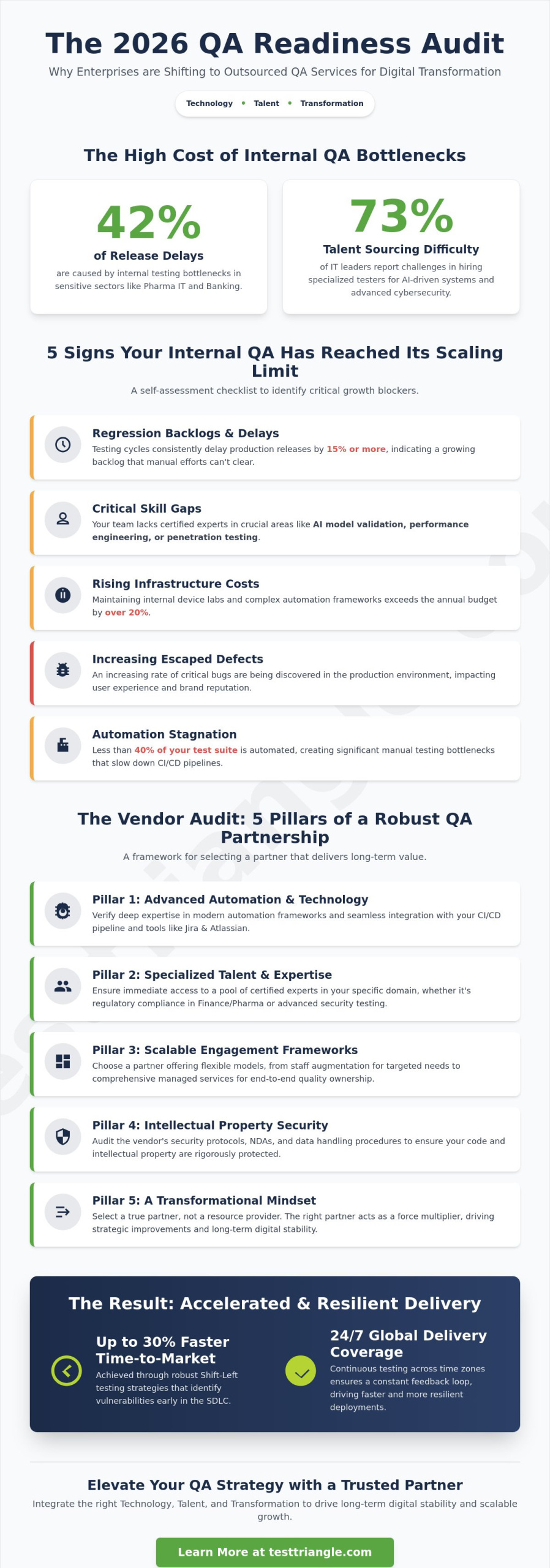
If your 2026 product roadmap relies on testing cycles that mirror 2023 methodologies, you’re likely accumulating technical debt that will stall your digital transformation by Q4. Most enterprise leaders agree that internal testing bottlenecks now cause nearly 42% of release delays in sensitive sectors like Pharma IT and Banking. By integrating high-quality outsourced qa services into your delivery pipeline, you can mitigate these risks while maintaining the agility required for global competition. At Test Triangle, we believe that the right partnership should act as a force multiplier for your internal teams, rather than a temporary fix for capacity issues.
You deserve a strategy that delivers predictable testing costs and immediate access to specialized expertise in security and performance. This article provides a comprehensive, 5-pillar checklist designed to help you evaluate and select a partner that aligns with your long-term vision. By following this framework, you’ll learn how to achieve faster time-to-market and ensure a seamless Jira or Atlassian integration across your entire ecosystem. We’ll explore how the synergy of Technology, Talent, and Transformation can elevate your operational stability and drive sustainable success through 2026 and beyond.
Key Takeaways
- Understand the evolution of QA from a cost-focused necessity to a strategic enabler capable of bridging the 2026 specialized talent gap.
- Identify the optimal engagement framework for your organization by distinguishing between staff augmentation and comprehensive managed testing services.
- Master the essential technical and regulatory benchmarks required to evaluate high-performing outsourced qa services in sectors like Finance and Pharma.
- Audit prospective partners using five critical pillars designed to verify advanced automation depth and the security of your intellectual property.
- Learn how to leverage the “Technology. Talent. Transformation.” triad to integrate a trusted partner that drives long-term digital stability and scalable growth.
The Strategic Shift: Why Enterprises Prioritise Outsourced QA Services in 2026
By repositioning quality assurance from a reactive cost center to a proactive strategic enabler, global enterprises are fundamentally rewriting their digital transformation playbooks. In 2026, the complexity of software ecosystems has reached a tipping point where internal teams often struggle to maintain the pace of innovation while ensuring flawless performance. By leveraging outsourced qa services, organizations gain access to high-level expertise that bridges the gap between technical execution and business outcomes. This shift allows leadership to focus on core product development while a outsourced software testing partner manages the intricate demands of modern quality protocols.
The 2026 talent market presents a significant challenge, as 73% of IT leaders report difficulty in hiring specialized testers for AI-driven systems and advanced cybersecurity protocols. Shifting from a fixed operational overhead to flexible engagement models enables companies to scale their testing capacity based on project demands without the long-term burden of internal headcount. Test Triangle serves as a Trusted Partner in this landscape, providing the necessary agility to navigate market fluctuations. Strategic QA is the intersection of risk mitigation and speed.
- Regression Backlogs: Testing cycles consistently delay production releases by 15% or more.
- Skill Gaps: Your team lacks certified experts in AI model validation or penetration testing.
- Infrastructure Costs: Maintaining internal device labs and automation frameworks exceeds your annual budget by 20%.
- Escaped Defects: Critical bugs are reaching production environments at an increasing rate.
- Automation Stagnation: Less than 40% of your test suite is automated, leading to manual bottlenecks.
Beyond Cost Savings: The Value of a Fresh Perspective
By introducing independent validation into legacy development cycles, external audits identify critical blind spots that internal teams might overlook due to institutional familiarity. Unbiased validation ensures that production-level defects are minimized before they impact the end-user experience. This objective approach allows outsourced qa services to deliver a superior level of precision. Through our core philosophy of Technology. Talent. Transformation, we help businesses optimize their quality benchmarks while maintaining operational stability.
The 2026 Release Pressure: Speed vs. Quality
CI/CD pipelines frequently fail to deliver on their promise of speed when they lack a robust, outsourced automation strategy to handle the heavy lifting. Implementing a Shift-Left testing methodology has been shown to improve time-to-market metrics by up to 30% by identifying vulnerabilities during the earliest stages of the SDLC. Global delivery centres further accelerate this process by providing 24/7 coverage, ensuring that testing continues across every time zone. This continuous feedback loop drives faster deployments and more resilient software architectures.
Defining Your Model: A Checklist for Choosing Engagement Frameworks
By integrating specialized expertise with adaptable delivery models, enterprises can optimize their outsourced qa services to achieve superior software quality. The shift toward 2026’s decentralized development environments requires a strategic evaluation of how external talent fits into your existing ecosystem. Selecting the right framework isn’t merely a procurement decision; it’s a foundational step in your digital transformation. Many organizations now leverage Cem Kaner’s outsourcing checklist to establish a baseline for vendor technical depth and accountability before committing to a specific model. This rigorous vetting ensures that the chosen partner can provide the necessary Technology, Talent, and Transformation required for long-term stability.
Managed Services: Relieving the Management Burden
Handing over full ownership of the QA process to a Trusted Partner allows internal leadership to focus on high-level product innovation. In this model, the partner manages the entire testing lifecycle, from strategy design to execution. Success is governed by Service Level Agreements (SLAs) that guarantee outcomes rather than just logged hours. For instance, a robust SLA might mandate a 98% test case execution rate or a 24-hour turnaround for critical defect reporting. A dedicated QA Lead acts as the Strategic Architect within this environment, aligning the testing roadmap with your business objectives. This model is ideal for mature organizations looking to drive efficiency through specialized outsourced qa services while maintaining high-level oversight via tools like Jira Service Management.
Staff Augmentation: Plugging Specific Skill Gaps
When specific technical gaps emerge, such as a sudden need for performance testing or security audits in 2026’s complex API ecosystems, staff augmentation provides immediate relief. This model allows for rapid scaling, enabling teams to add specialized talent for short-term projects without the 35% overhead cost typically associated with permanent hires. Achieving seamless integration requires the outsourced resources to adopt your internal culture and technical standards. Recent data from 2025 indicates that 82% of successful staff augmentation projects utilized shared communication protocols to ensure remote resources remained synchronized with in-house developers. It’s a practical way to leverage global talent while maintaining direct control over the daily testing activities.
Selecting the right geographic location for your resources depends on your “Follow the Sun” strategy and communication requirements:
- Onshore: Essential for projects with strict regulatory compliance or those requiring real-time, same-timezone collaboration with the C-suite.
- Nearshore: Offers a balance of cost-efficiency and 2 to 4 hour overlap windows, facilitating agile ceremonies and rapid feedback loops.
- Offshore: Most effective for large-scale regression testing and high-volume execution where significant cost reduction is the primary driver.
Flexible engagement models are no longer a luxury but a necessity for navigating fluctuating project demands. By choosing a partner that offers adaptable frameworks, you ensure your testing capacity can expand or contract alongside your product roadmap. To see how these models function in a real-world environment, you can explore our strategic approach to quality engineering.
Technical and Regulatory Readiness: The Specialized QA Checklist
Generalist providers often fail in high-stakes sectors because they lack the domain-specific rigor required for 2026’s complex regulatory environment. By failing to account for sector-specific nuances in Finance and Pharma, these providers introduce liability rather than mitigating it. A 2025 industry report indicated that 62% of data breaches in regulated sectors stemmed from third-party software vulnerabilities. Selecting outsourced qa services requires a partner who understands that a bug in a clinical trial system isn’t just a technical glitch; it’s a compliance failure. To ensure your organization remains audit-ready, use this essential 2026 certification checklist:
- ISO 27001:2022: The gold standard for information security management systems.
- SOC2 Type II: Critical for confirming the operational effectiveness of security controls over time.
- GxP (GLP, GCP, GMP): Essential for any software touching the life sciences supply chain.
- PCI DSS 4.0: The mandatory requirement for any provider handling financial transaction data.
By prioritizing these standards, Test Triangle acts as a Strategic Architect, ensuring your digital infrastructure remains robust against evolving threats. Validated Software Testing isn’t an optional add-on for Healthcare; it’s the foundation of patient safety and data privacy. A partner must navigate these regulatory roadmaps with precision, moving beyond simple bug hunting to provide comprehensive risk mitigation.
Life Sciences and Pharma IT Specialization
By integrating Computer System Validation (CSV) protocols directly into the software development lifecycle, Test Triangle ensures that every release meets the stringent requirements of 21 CFR Part 11. Maintaining data integrity throughout the testing lifecycle requires more than just technical skill; it demands a disciplined approach to audit trails and electronic signatures. As of January 2026, 78% of Life Sciences organizations prioritize partners who demonstrate deep CSV expertise. It’s vital to remember that “compliance is not a checkbox but a continuous process” that defines the reliability of your entire IT estate.
Ecosystem Alignment: Atlassian, ServiceNow, and AWS
By aligning testing workflows with your existing toolstack, a sophisticated provider accelerates your digital transformation. Your outsourced qa services partner must be a Strategic Architect who leverages Jira Service Management for seamless defect tracking and real-time visibility. This integration ensures that every identified issue is categorized, prioritized, and resolved within a unified ecosystem. When utilizing AWS cloud-native testing tools, your partner can automate infrastructure provisioning, reducing the testing cycle time by 35% compared to legacy methods. This synergy between technology, talent, and transformation allows your business to scale without compromising on quality or security.
The Vendor Audit: 5 Critical Pillars of a Robust QA Partnership
Selecting outsourced qa services requires a shift from simple vendor selection to strategic architectural alignment. By 2026, 74% of global enterprises will prioritize partners who integrate predictive analytics into their testing lifecycle. This audit ensures your chosen provider isn’t just a resource supplier but a catalyst for digital transformation. By combining technical expertise with adaptable delivery models, a mature partner helps businesses reduce operational friction while maintaining high velocity.
Step 1 involves assessing technical depth. A sophisticated partner moves beyond basic manual scripts to implement AI-driven automation that achieves 90% regression coverage. Step 2 focuses on security; your code represents your primary competitive advantage and requires protection through rigorous protocols. Step 3 establishes communication governance, creating a “heartbeat” through integrated platforms like Jira Service Management. Step 4 evaluates innovation, specifically how the vendor leverages machine learning to predict defect density. Finally, Step 5 examines scalability. A partner must provide access to specialized talent within 48 hours to meet shifting project demands.
Evaluating the “Talent” Pillar
By leveraging rigorous vetting processes, Test Triangle ensures that every engineer possesses both technical certifications and domain-specific expertise. We review recruitment standards to confirm that 95% of the talent bench holds advanced certifications in tools like Selenium, Tricentis Tosca, or Playwright. Continuous training within our partner ecosystems ensures our team masters niche technologies, such as blockchain testing or 5G protocol validation, before they become mainstream requirements. This depth of talent allows us to act as a Trusted Partner in complex environments.
The Security Audit Checklist
Protecting intellectual property is the cornerstone of a professional partnership. A robust audit must verify these specific standards to mitigate risk:
- Encryption Standards: Implementation of AES-256 for all data at rest and TLS 1.3 for data in transit across all testing environments.
- Access Controls: Biometric physical security at offshore delivery centres and mandatory multi-factor authentication (MFA) for all logical access to client repositories.
- Contractual Safeguards: Explicit clauses in the Master Service Agreement (MSA) ensuring 100% client ownership of all test scripts, frameworks, and generated documentation.
By aligning Technology. Talent. Transformation., we help organizations accelerate their release cycles without compromising on precision. Our flexible engagement models allow you to scale resources up or down based on real-time project metrics, ensuring your digital infrastructure remains resilient. This methodical approach to outsourced qa services transforms testing from a bottleneck into a strategic asset.
Ready to elevate your software quality through a strategic partnership? Consult with our QA architects today to secure your digital future.
Technology. Talent. Transformation: Integrating Test Triangle’s QA Expertise
By aligning technical proficiency with strategic business objectives, Test Triangle functions as a Trusted Partner rather than a traditional vendor. Our Dublin-based headquarters provides the high-level governance and strategic oversight required by European enterprises, while our global delivery centers ensure 24/7 operational continuity. We don’t just provide outsourced qa services; we integrate ourselves into your software development lifecycle to drive long-term stability. In a 2024 partnership with a Tier-1 global financial institution, our team overhauled a fragmented testing process. This intervention resulted in a 65% reduction in post-release defects within the first twelve months, proving that strategic alignment outweighs simple staff augmentation.
Our onboarding journey follows a rigorous, four-step methodology designed for clarity and speed:
- Comprehensive Audit: we evaluate your current QA maturity and identify hidden bottlenecks in your pipeline.
- Strategic Roadmap: our consultants design a tailored framework specifically aligned with your 2026 delivery goals.
- Knowledge Transfer: we synchronize our specialized teams with your internal stakeholders to ensure cultural and technical fit.
- Flawless Execution: we launch automated and manual testing cycles supported by real-time, transparent reporting.
Our Approach to Managed Platform Support
By optimizing Atlassian and ServiceNow environments, we ensure your quality management tools work in harmony with your engineering workflows. We leverage Jira Service Management to provide transparent, data-driven insights into every testing cycle. Combining DevOps engineering with QA allows us to accelerate your digital transformation, ensuring that speed never compromises security. Our flexible delivery models allow growing enterprises to scale their testing capacity up or down based on project demands. It’s a model that provides the agility needed in a volatile market while maintaining a robust quality gate.
Next Steps for Your QA Strategy
Establishing a modern testing framework requires a shift from reactive bug-fixing to proactive quality engineering. You can initiate this shift by scheduling a QA maturity assessment with our senior consultants. We specialize in transitioning organizations from slow, manual legacy testing to high-velocity, automated frameworks that support continuous integration. Our expertise in outsourced qa services ensures your transition is seamless, data-backed, and risk-mitigated. For a deeper exploration of how quality assurance outsourcing is evolving in 2026, including the integration of AI-augmented testing models and Rovo agents into Jira workflows, our strategic guide provides a comprehensive roadmap for enterprises navigating this shift. We’re ready to help you build a resilient digital infrastructure that scales.
Future-Proofing Your Enterprise through Strategic Quality Excellence
Navigating the software landscape of 2026 requires more than a simple checklist; it demands a synergy of technical rigor and operational agility. By aligning specialized engagement models with strict regulatory demands, global enterprises can transform quality assurance from a functional necessity into a strategic asset. Selecting the right outsourced qa services ensures that your digital infrastructure remains resilient against evolving security threats and rapid market shifts.
Test Triangle serves as a Strategic Architect for your testing needs. As an Atlassian Gold Solution Partner and a recognized Enterprise Ireland client, we provide the institutional maturity required for complex digital transformations. Our global delivery centres in Dublin, London, and Hyderabad offer the 24/7 technical expertise necessary to maintain a flawless user experience across all platforms. We bridge the gap between technical execution and business outcomes through our core pillars: Technology. Talent. Transformation.
It’s time to elevate your quality standards and drive scalable growth with a trusted partner who understands your long-term vision. Partner with Test Triangle for Strategic QA Transformation and secure your path toward operational stability today.
Frequently Asked Questions
What are the main benefits of outsourced QA services for enterprises?
Enterprises leverage outsourced qa services to accelerate release cycles by 30% and reduce operational overhead. By accessing global talent pools, companies secure specialized skills like AI-driven automation without the 40% higher cost of internal hiring. This strategic shift allows internal teams to focus on core innovation while external experts ensure a flawless user experience across all digital touchpoints.
How do I ensure data security when working with an offshore QA team?
We ensure data integrity by implementing ISO 27001 and SOC 2 Type II compliant frameworks for every offshore engagement. By utilizing secure VPN tunnels and multi-factor authentication, our teams maintain a zero-trust architecture that protects sensitive intellectual property. Our protocols align with GDPR and CCPA standards, ensuring that 100% of data handling remains transparent and audited by our security lead.
Can outsourced QA services integrate with our existing Jira and DevOps tools?
Our outsourced qa services integrate directly into your existing CI/CD pipelines via Jira Service Management and the wider Atlassian toolset. By aligning with your DevOps workflows, we automate bug reporting and tracking to ensure real-time visibility into the testing lifecycle. This synchronization eliminates communication silos and accelerates the feedback loop between developers and testers, resulting in a 25% increase in sprint velocity.
What is the difference between QA staff augmentation and managed testing services?
QA staff augmentation provides individual experts to work under your internal management, whereas managed testing services offer a fully autonomous team responsible for end-to-end delivery. In a staff augmentation model, you retain 100% control over daily tasks; however, managed services shift the accountability for KPIs and outcomes to the partner. This distinction allows you to choose between tactical support and strategic, results-driven transformation.
Why is specialized QA important for the pharmaceutical and life sciences industries?
Specialized QA is critical for pharmaceutical sectors because it ensures compliance with GxP and FDA 21 CFR Part 11 regulations. By applying rigorous validation protocols, we mitigate the risk of non-compliance which can lead to significant regulatory fines. Our approach integrates automated compliance checks into the software lifecycle, protecting patient safety and data accuracy in these highly regulated environments.
How do we measure the ROI of outsourcing our quality assurance?
You measure ROI by tracking metrics such as defect leakage rates and the reduction in cost-per-test hour. Organizations typically see a 15% reduction in post-release defects within the first 12 months of a strategic partnership. By calculating the difference between internal overhead and the output of a flexible engagement model, you can quantify the total value delivered to your bottom line.
What should be included in a QA outsourcing Service Level Agreement (SLA)?
A robust SLA must include specific targets for defect turnaround times, test coverage percentages, and resource availability. We define clear benchmarks, such as a 24-hour resolution window for critical bugs, to ensure accountability and performance stability. These documented standards act as a roadmap for our partnership, ensuring that Technology, Talent, and Transformation remain aligned with your business objectives.
How quickly can an outsourced QA team be onboarded into our project?
Our team can typically be fully onboarded and integrated into your project within 10 to 14 business days. By following a structured knowledge transfer framework, we minimize downtime and begin delivering actionable insights during the very first sprint. This rapid deployment model allows your organization to scale testing capacity instantly without the 60-day lead time common in traditional recruitment cycles.

Article by
Paul Guy
Paul serves as the Marketing Director at Test Triangle, where he leads a global team in driving growth through strategic B2B marketing and brand communications. With a strong emphasis on measurable outcomes and sustainable performance, he plays a pivotal role in aligning marketing functions to enhance customer engagement and accelerate business impact. Under his leadership, marketing initiatives have consistently delivered significant returns on investment, elevated brand visibility, and strengthened the company's presence across key markets.