



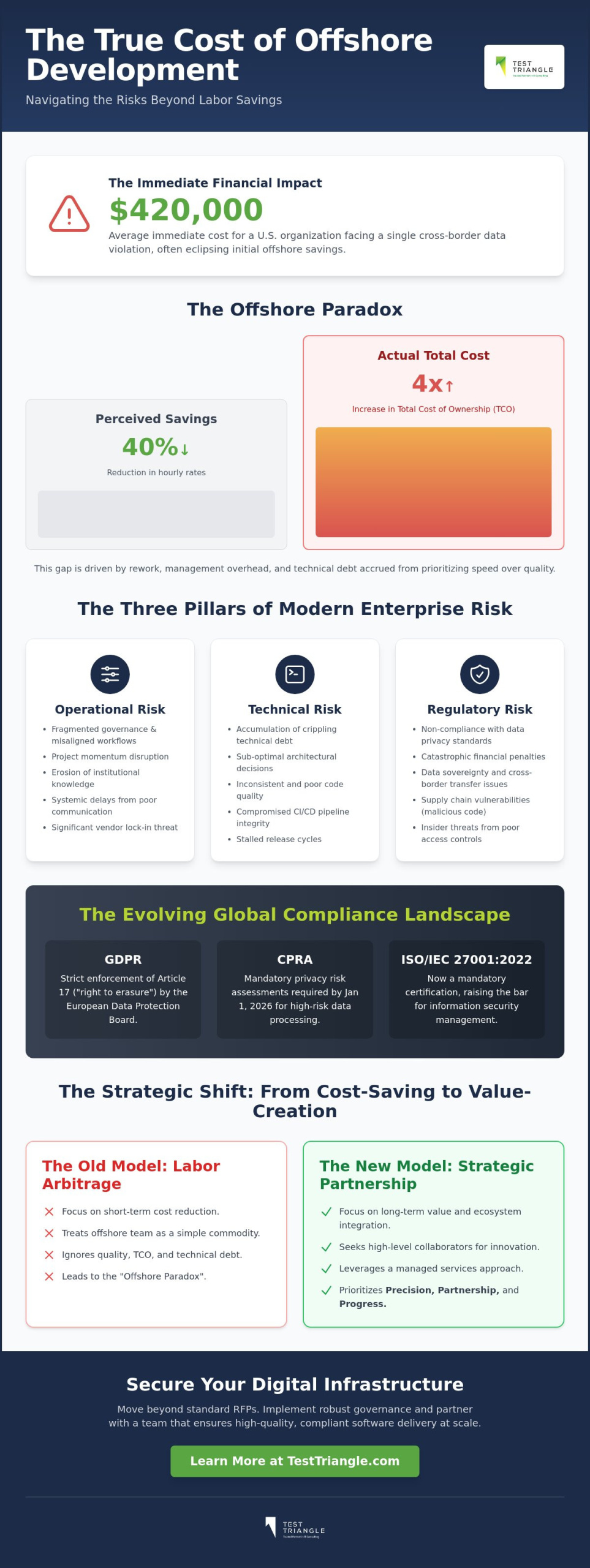
When a cross-border data violation occurs, the average U.S. organization faces $420,000 in immediate costs, a figure that often eclipses the initial savings of a distributed model. You understand that the risks of hiring offshore development teams involve more than just time zone friction; they encompass unpredictable code quality and the looming threat of technical debt in highly regulated sectors like Finance and Pharma. As global data privacy regulations tighten, including the now-mandatory ISO/IEC 27001:2022 certifications, the gap between a low-cost vendor and a strategic partner becomes a matter of institutional survival.
This article provides the methodology to evaluate, mitigate, and master these complexities to ensure your digital infrastructure remains secure and performant. We’ll explore a comprehensive risk-assessment checklist and governance strategies designed to facilitate high-quality, compliant software delivery at scale. By aligning technical execution with business outcomes, we help you secure the stability, precision, and progress necessary for long-term operational success.
Key Takeaways
- Transition from simple labor arbitrage to strategic ecosystem integration to ensure your offshore model delivers long-term value rather than just short-term cost savings.
- Identify and neutralize the risks of hiring offshore development teams by implementing rigorous data sovereignty protocols and intellectual property safeguards tailored for highly regulated sectors.
- Evaluate the true total cost of ownership by accounting for the quality gap and technical debt that often result when speed is prioritized over architectural sustainability.
- Establish robust governance through quality-centric KPIs and vendor selection processes that move beyond the standard Request for Proposal to verify actual operational maturity.
- Leverage a managed service approach to achieve precision, partnership, and progress, ensuring high-compliance delivery across global digital infrastructures.
The Strategic Landscape of Offshore Development Risks in 2026
The global delivery landscape has undergone a fundamental transformation, shifting from a model of simple labor arbitrage to one of complex ecosystem integration. In 2026, enterprises no longer view distributed teams as a mere mechanism for reducing payroll; they seek high-level collaborators capable of driving large-scale technological evolution. However, this evolution introduces sophisticated risks of hiring offshore development teams that extend far beyond traditional logistical concerns. A foundational understanding of offshoring reveals that while the economic principles of comparative advantage remain, the execution has become significantly more precarious for those prioritizing immediate savings over long-term stability.
When global enterprises adopt a “low-cost-first” mindset, they often ignore the three pillars of risk that define modern software delivery. These pillars include:
- Operational Risk: Disruptions in project momentum caused by fragmented governance and misaligned workflows.
- Technical Risk: The accumulation of technical debt due to sub-optimal architectural decisions and inconsistent code quality.
- Regulatory Risk: Non-compliance with evolving data privacy standards, such as the ISO/IEC 27001:2022 requirements, which can result in catastrophic financial penalties.
Success in this environment requires a transition toward managed outsourcing services that prioritize precision, partnership, and progress over bottom-line reduction.
The Shift from Cost-Saving to Value-Creation
Traditional offshoring models are failing because they don’t account for the speed of modern digital transformation. Many organizations fall victim to the “Offshore Paradox,” where a 40% reduction in hourly rates actually increases the total cost of ownership by a factor of four due to rework and management overhead. In this context, offshore risk is the quantifiable delta between projected labor savings and the realized technical debt accrued through sub-optimal architectural decisions. By focusing on staffing solutions that emphasize specialized expertise, companies can avoid the trap of prioritizing output volume over delivery value.
Categorising Modern Enterprise Vulnerabilities
Modern vulnerabilities often manifest within the technical infrastructure itself. If an offshore partner lacks robust environmental stability, it directly compromises the integrity of continuous integration and deployment (CI/CD) pipelines, leading to stalled release cycles. Furthermore, the risk of vendor lock-in remains a significant threat; without intentional knowledge transfer, enterprises lose internal institutional knowledge and become dangerously dependent on external entities. This erosion of transparency is frequently exacerbated by fragmented communication protocols, which turn minor misunderstandings into systemic project delays. Maintaining operational control requires a disciplined approach to governance that ensures technical managers and executive leadership remain aligned on every deliverable.
Security, Compliance, and Intellectual Property Vulnerabilities
Data sovereignty remains a primary concern for global enterprises navigating the legal complexities of cross-border data transfers. In 2026, the European Data Protection Board has made Article 17 of the GDPR, the right to erasure, a key enforcement priority. Organizations must also contend with the California Privacy Rights Act (CPRA) regulations that, as of January 1, 2026, require comprehensive privacy risk assessments for processing that presents a significant risk to consumers. These evolving mandates amplify the risks of hiring offshore development teams that lack a mature understanding of localized compliance frameworks. Beyond statutory data protection, vulnerabilities in the software supply chain emerge when using unverified resources, potentially introducing malicious code or unauthorized backdoors into production environments.
Mitigating insider threats requires more than just background checks. It demands a systemic architecture of least-privilege access and continuous monitoring. Unauthorized data access often stems from fragmented identity management between the onshore leadership and the offshore execution team. Establishing a unified security posture is essential to protect the integrity of your digital infrastructure. It’s about maintaining stability and precision throughout the development lifecycle.
Regulatory Compliance in Regulated Sectors
Maintaining GxP and HIPAA compliance presents unique challenges when development occurs in jurisdictions with non-equivalent legal protections. For organizations in the pharmaceutical and finance sectors, the necessity of Software and Digital Assurance Testing cannot be overstated. This approach ensures the creation of immutable audit trails and rigorous validation protocols required by global regulators. It’s also vital to confirm that your partner has completed the transition to the ISO/IEC 27001:2022 standard, as the previous 2013 version’s transition period ended on October 31, 2025. Ensuring these standards are met provides the peace of mind necessary for large-scale technological evolution.
Intellectual Property and Contractual Safeguards
Protecting proprietary algorithms requires contracts that go beyond standard service agreements. To effectively manage the risks of hiring offshore development teams, every offshore contract must include explicit clauses regarding the ownership of work product and the immediate transfer of intellectual property rights upon creation. Utilizing code escrow and secure, encrypted repository management further reduces the risk of asset loss. Standardizing security testing as a non-negotiable component of the Definition of Done (DoD) ensures that protection is baked into the development lifecycle rather than added as an afterthought. If you’re concerned about your current security posture, consulting with a strategic compliance partner can help bridge the gap between technical execution and regulatory certainty.
The ‘Hidden’ Operational Costs: Communication, Culture, and Technical Debt
Operational efficiency often suffers when organizations overlook the subtle friction points inherent in distributed delivery models. While the initial balance sheet might suggest significant savings, the risks of hiring offshore development teams frequently manifest as a “Quality Gap.” This occurs when external teams prioritize velocity and ticket closure over sustainable code architecture. This short-term focus creates a fragile foundation that complicates future scaling and integration efforts. When speed is the only metric, the resulting technical debt acts as a high-interest loan that your internal team will eventually have to repay with interest.
Time zone differences introduce another layer of complexity, often resulting in a 24-hour delay for critical bug fixes. If a production-grade issue is identified at the end of a domestic business day, it may sit idle for half a cycle before an offshore team even begins the triage process. This lag erodes your time-to-market and can be devastating in high-stakes environments like Finance or Pharma. Cultural nuances in requirements gathering also lead to “The Yes-Man” syndrome. This is a phenomenon where offshore partners agree to ambiguous or impossible specifications to avoid perceived conflict, ultimately leading to misaligned deliverables and expensive rework.
The Long-Term Burden of Technical Debt
Quick and dirty code might meet an immediate deadline, but it leads to exponential maintenance costs in later years. To mitigate this, organizations must integrate professional manual testing into their quality assurance strategy. While automation provides speed, manual oversight is essential for catching complex logic errors that automated scripts often miss. Establishing a rigorous code review process ensures that every pull request adheres to your internal standards, protecting your architectural integrity from the onset.
Bridging the Cultural and Communication Divide
Success requires a single source of truth to synchronize disparate workflows. Implementing tools like Jira and Confluence provides the necessary transparency to track progress and document decisions in real-time. Engaging in professional Atlassian Consulting allows you to optimize these platforms for global collaboration, ensuring that your governance model supports asynchronous communication. This structure prevents project bottlenecks, transforming a fragmented team into a cohesive, high-performing unit that values precision and operational stability.
A Framework for Risk Mitigation and Governance
Mitigating the risks of hiring offshore development teams requires a disciplined transition from tactical procurement to a strategic governance framework. While many organizations rely on a standard Request for Proposal (RFP) to vet potential partners, this approach often fails to uncover the operational maturity required for enterprise-grade delivery. A robust selection process must evaluate a vendor’s ability to integrate with your existing digital infrastructure and their commitment to institutional stability. By shifting from a simple “Offshore Staffing” mindset to a comprehensive managed service model, enterprises ensure higher levels of accountability and a shared investment in long-term business outcomes. This methodology replaces fragmented execution with a structured approach that prioritizes precision, performance, and protection.
Establishing transparency across the Software Development Life Cycle (SDLC) is only possible through the integration of shared Key Performance Indicators (KPIs). These metrics should move beyond simple output volume, such as lines of code or ticket velocity, to focus on qualitative benchmarks like defect density and architectural adherence. When governance is treated as a core pillar of the partnership, technical managers gain the visibility needed to manage complex digital assets with confidence. To ensure your distributed model is built on a foundation of technical rigor, speak with our strategic consultants about building a custom governance framework.
Establishing Rigorous Governance Protocols
Integrating Quality Assurance from Day One
Quality cannot be an afterthought in a distributed environment; it must be baked into the delivery pipeline through continuous testing. Utilizing Software Test Automation Services is essential for providing real-time oversight of remote teams, allowing every commit to be validated automatically against your security and functional requirements. By leveraging DevOps Consulting, organizations can build a unified delivery pipeline that synchronizes onshore leadership with offshore execution. This systemic improvement reduces the risks of hiring offshore development teams by creating a transparent, automated environment where progress is measurable and results are predictable.
The Test Triangle Advantage: Precision, Partnership, and Progress
Test Triangle addresses the fundamental risks of hiring offshore development teams by replacing fragmented, “set and forget” models with a rigorous managed service framework. Our approach ensures that every line of code and every architectural decision aligns with your enterprise goals, effectively neutralizing the Quality Gap and technical debt discussed in previous sections. By integrating industry-leading platforms like Atlassian and ServiceNow directly into our delivery model, we provide the total project visibility necessary for executive leadership to maintain operational control over complex digital infrastructures. This combination of offshore cost-efficiency and local strategic oversight allows global organizations to scale with confidence, clarity, and control.
Our personality is that of a strategic visionary who remains deeply practical, ensuring that your long-term success is never sacrificed for short-term gains. We act as a steady hand in a fast-changing technological landscape, emphasizing organizational progress through the combination of human expertise and sophisticated technical tools. By choosing a partner that values stability, precision, and scalable growth, you empower your organization to navigate the complexities of 2026 with a reliable long-term collaborator at your side.
Managed Outsourcing: Beyond Simple Staffing
Our Managed Outsourcing Services provide the high-level governance that typical offshore teams lack, positioning us as a reliable corporate partner rather than a mere service provider. Having an Ireland-based strategic partner manage global delivery centers means you benefit from institutional maturity, ensuring that cultural and communication barriers are proactively dismantled. For instance, our methodologies have successfully reduced technical debt for global healthcare providers by implementing disciplined code review and automated validation protocols. This approach transforms global delivery from a source of operational anxiety into a driver of systemic improvement.
Enterprise-Grade IT Staffing for Global Compliance
We offer a unique approach to IT Staffing for specialized roles, particularly within the highly regulated Pharma and Finance sectors. Our rigorous vetting process ensures that every resource is not only technically proficient but also fully aligned with your specific compliance requirements and corporate culture. We recognize that stability and precision are non-negotiable in high-stakes environments, which is why our staffing models are built on a foundation of technical rigor and institutional maturity. To optimize your current delivery model and eliminate the risks of hiring offshore development teams, connect with our strategic consultants to audit your existing strategy and establish a path toward high-quality, compliant software delivery at scale.
Securing Your Enterprise Delivery for 2026 and Beyond
The landscape of 2026 demands more than just cost-efficiency; it requires a disciplined commitment to security and quality. Mitigating the risks of hiring offshore development teams involves a fundamental shift from tactical staffing to a managed service model that prioritizes data sovereignty and architectural integrity. By establishing rigorous governance and integrating quality assurance into the core of your SDLC, you ensure that global delivery remains a catalyst for growth rather than a source of technical debt.
As a strategic Atlassian and ServiceNow partner with specialized expertise in Pharma and Finance compliance, Test Triangle provides the institutional maturity necessary for high-stakes environments. Our global reach is anchored by local, Dublin-based leadership, offering the precision and stability required to manage complex digital infrastructures with confidence. This combined approach ensures that technical managers and executive leadership remain aligned on every deliverable, fostering a spirit of partnership and support.
Secure your digital transformation with Test Triangle’s Managed Services and experience the peace of mind that comes from a reliable long-term collaboration. Your path to scalable, compliant, and high-quality software delivery starts with a partner dedicated to your long-term operational success.
Frequently Asked Questions
What are the most common security risks when hiring offshore development teams?
The most common security risks include data sovereignty violations, supply chain compromises, and unmonitored insider threats. In 2026, the risks of hiring offshore development teams are amplified by stricter privacy laws like the CPRA and updated GDPR enforcement. Organizations must implement zero-trust architectures and continuous monitoring to prevent unauthorized access to sensitive digital infrastructure, ensuring that remote resources remain as secure as internal assets.
How can I protect my intellectual property when working with offshore developers?
Protecting intellectual property requires a multi-layered approach that combines ironclad contractual safeguards with technical enforcement. Secure your proprietary algorithms by including explicit IP transfer clauses in every agreement and utilizing encrypted code repositories with strict access controls. Implementing code escrow services provides an additional fail-safe, ensuring that your organization retains full ownership and access to the work product even if the partnership dissolves, thereby maintaining institutional stability.
Is it possible to maintain high code quality with a low-cost offshore team?
Maintaining high code quality with a low-cost team is achievable only through a disciplined governance framework and professional oversight. While lower hourly rates often signal a “Quality Gap,” integrating automated testing and rigorous code reviews can mitigate the accumulation of technical debt. Success depends on shifting the focus from output volume to qualitative benchmarks, ensuring that the final deliverable meets enterprise-grade standards without sacrificing the initial cost-efficiency of the distributed model.
How do I manage the time zone differences effectively in a DevOps environment?
Effective time zone management in a DevOps environment relies on robust asynchronous communication and a “Single Source of Truth.” By leveraging platforms like Jira and Confluence, teams can synchronize workflows without requiring real-time overlap for every task. This structure prevents project bottlenecks and ensures that continuous integration and deployment pipelines remain active, transforming potential 24-hour delays into a rhythmic, around-the-clock development cycle that accelerates your time-to-market.
What compliance standards should I look for in an offshore development partner?
Essential compliance standards for offshore partners include ISO/IEC 27001:2022 for information security and SOC 2 for operational controls. In specialized sectors like Finance or Pharma, you must also verify adherence to GxP or HIPAA requirements to ensure audit readiness. Selecting a partner with these official endorsements provides the peace of mind necessary for large-scale technological evolution, ensuring that your global delivery centers operate within recognized global benchmarks.
What happens if an offshore project fails to meet its technical requirements?
When an offshore project fails to meet technical requirements, the primary recourse is the enforcement of predefined Service Level Agreements (SLAs). These agreements should include specific remediation protocols and financial penalties for non-compliance with quality metrics. To prevent such failures, conduct regular third-party audits and maintain a transparent delivery pipeline, allowing you to identify and correct architectural deviations before they evolve into systemic project failures or unmanageable technical debt.
How does managed outsourcing differ from traditional offshore staffing?
Managed outsourcing differs from traditional staffing by providing a comprehensive governance layer and end-to-end accountability. While traditional staffing merely provides labor, managed outsourcing integrates strategic oversight, quality assurance, and project management into a cohesive service. This model addresses the risks of hiring offshore development teams by ensuring that the provider is deeply invested in your long-term success, offering a steady hand to manage complex digital transformations.
Can offshore teams effectively integrate with Atlassian or ServiceNow platforms?
Offshore teams can effectively integrate with Atlassian or ServiceNow platforms when supported by specialized consulting expertise. These ecosystems provide the necessary project visibility and ITSM rigor to synchronize global delivery centers with onshore leadership. Professional implementation ensures that your distributed workflows are optimized for transparency and precision, allowing technical managers to track every deliverable within a unified, high-performance environment that supports organizational progress.

Article by
Paul Guy
Paul serves as the Marketing Director at Test Triangle, where he leads a global team in driving growth through strategic B2B marketing and brand communications. With a strong emphasis on measurable outcomes and sustainable performance, he plays a pivotal role in aligning marketing functions to enhance customer engagement and accelerate business impact. Under his leadership, marketing initiatives have consistently delivered significant returns on investment, elevated brand visibility, and strengthened the company's presence across key markets.