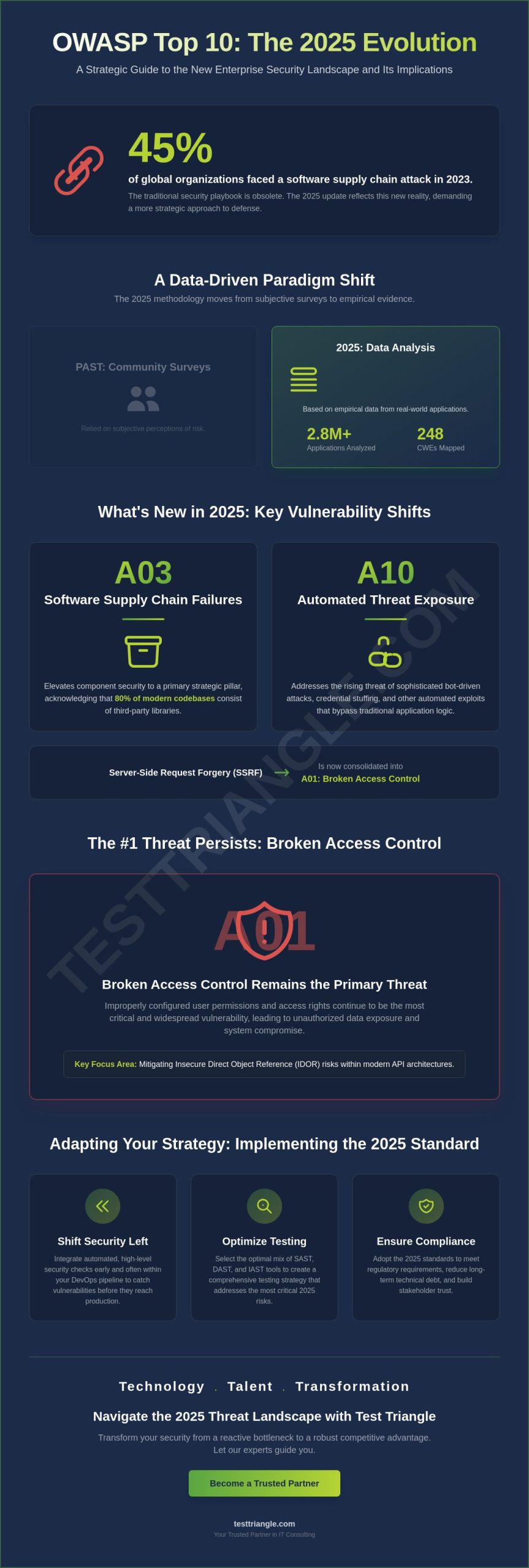
In a landscape where 45% of global organizations reported a software supply chain attack in 2023, the traditional security playbook is rapidly becoming obsolete. You’ve likely felt the mounting pressure of integrating complex security protocols into high-velocity DevOps pipelines while managing an increasingly volatile risk surface. It’s difficult to maintain a flawless defense when vulnerability categories evolve faster than your internal documentation can keep pace. Staying ahead of the owasp top 10 2025 news is no longer just a compliance checkbox; it’s a strategic requirement for any enterprise committed to long-term operational stability.
By aligning technical rigor with strategic foresight, Test Triangle helps global businesses transform their security posture from a reactive bottleneck into a robust competitive advantage. In this article, you’ll discover the critical updates in the 2025 framework and learn how to leverage these insights to optimize your testing strategy. We’ll provide a clear understanding of emerging risks and actionable steps for compliance. Our goal is to empower your team to drive digital transformation through our core philosophy: Technology. Talent. Transformation. As your Trusted Partner, we’ll ensure your security roadmap is both visionary and deeply practical.
Key Takeaways
- By analyzing data from millions of applications, you will understand how the latest owasp top 10 2025 news reshapes the global standard for enterprise application security and risk awareness.
- Identify the two entirely new vulnerability categories introduced this year and learn why the consolidation of SSRF into Access Control requires a strategic update to your defense protocols.
- Gain actionable insights into why Broken Access Control remains the primary threat to digital stability and how to effectively mitigate IDOR risks within modern API architectures.
- Elevate your DevOps pipeline by integrating high-level security checks and selecting the optimal mix of SAST, DAST, and IAST tools to address the most critical 2025 risks.
- Leverage our “Technology, Talent, and Transformation” framework to transition from a reactive security posture to a robust, architected defense led by a trusted strategic partner.
The Evolution of Web Security: Understanding the OWASP Top 10 2025
The OWASP Top 10 remains the definitive global benchmark for application security awareness, providing a critical lens through which enterprises view digital risk. As organizations prepare for the 2026 fiscal year, the latest owasp top 10 2025 news signals a fundamental change in the security paradigm. By moving beyond a simple list of technical flaws, the OWASP organization now provides a strategic roadmap for systemic resilience. This update isn’t just a routine refresh. It’s a call to action for enterprises to shift their focus from identifying symptoms to addressing the root-cause vulnerabilities that lead to catastrophic breaches.
Strategic security requires a steady hand and a clear vision. By aligning with these updated standards, Test Triangle helps global enterprises leverage technology to protect their most valuable assets. This evolution is critical for any firm navigating digital transformation, as it establishes a foundation of trust and operational stability. Security is no longer a peripheral concern; it’s the core of business continuity and enterprise growth.
The Methodology Behind the 2025 Update
The 2025 update utilizes a rigorous, data-driven approach that analyzes 2.8 million applications across diverse industries. This methodology marks a departure from the community-survey models used in previous years, which often relied on subjective perceptions of risk. By mapping findings to 248 specific Common Weakness Enumerations (CWEs), the framework provides an empirical basis for security investment. This granular detail allows IT leaders to:
- Identify high-frequency vulnerabilities across complex application portfolios.
- Optimize resource allocation by targeting systemic weaknesses rather than isolated bugs.
- Drive measurable improvements in code quality and deployment safety.
This evidence-based strategy ensures that the latest owasp top 10 2025 news reflects the actual threats facing modern digital infrastructures. It allows for a more disciplined approach to risk management that prioritizes actual data over industry trends.
Why Compliance with 2025 Standards Matters
Adhering to the 2025 standards is essential for maintaining regulatory compliance in highly scrutinized sectors like finance and healthcare. By adopting these benchmarks, organizations demonstrate a commitment to superior security that satisfies both auditors and stakeholders. Implementing these standards early reduces the long-term maintenance costs and technical debt that typically follow a security breach. It’s a proactive investment in the brand’s reputation and operational integrity. As a Trusted Partner, Test Triangle emphasizes that security isn’t a hurdle to innovation but an accelerant for growth. Through the synergy of Technology, Talent, and Transformation, businesses can achieve a robust security posture that supports long-term success and global scalability.
What’s New in 2025? Key Shifts in the Vulnerability Landscape
By analyzing the strategic updates within the official OWASP Top 10 2025, global enterprises can identify a decisive pivot toward systemic architectural integrity. The latest owasp top 10 2025 news reveals that security is no longer confined to isolated code quality; it now encompasses the entire digital ecosystem. This shift reflects a landscape where 80% of modern application codebases consist of third-party libraries, necessitating a broader defensive perimeter.
The 2025 update introduces two entirely new categories that address the complexities of modern automation and artificial intelligence. First, A03:2025 – Software Supply Chain Failures elevates component security from a sub-task to a primary strategic pillar. Second, A10:2025 – Automated Threat Exposure addresses the rise of sophisticated bot-driven attacks and credential stuffing that bypass traditional logic. By integrating these categories, the OWASP Foundation acknowledges that cloud-native environments and configuration-driven apps require more than just “patching”; they require a robust, zero-trust architecture.
The consolidation of Server-Side Request Forgery (SSRF) into Access Control highlights a logical evolution in risk management. Security architects now recognize that SSRF is fundamentally a failure to enforce authorization at the network or service boundary. By grouping these risks, the 2025 framework helps organizations streamline their remediation efforts through a unified policy engine.
A03:2025 – Software Supply Chain Failures
The elevation of supply chain security to a standalone priority stems from a 45% increase in attacks targeting CI/CD pipelines and developer environments since 2022. Modern risks aren’t just limited to “old” code; they involve unverified APIs, compromised build tools, and malicious dependencies hidden in deep package trees. Software Supply Chain Failures represent the risk of unverified components. By leveraging strategic security testing, businesses can validate every link in their delivery chain to ensure that third-party integrations don’t become Trojan horses for enterprise data.
Consolidation and Re-ranking: The 2021 vs 2025 View
The hierarchy of risk has shifted significantly to reflect the reality of cloud-heavy infrastructures. Security Misconfiguration has climbed to the #2 spot, driven by the fact that 65% of cloud breaches now originate from preventable configuration errors rather than complex exploits.
- A01: Broken Access Control (Remains #1 due to its persistent impact on data privacy)
- A02: Security Misconfiguration (Moved up from #4 in 2021)
- A03: Software Supply Chain Failures (New standalone category for 2025)
- A04: Cryptographic Failures (Shifted down slightly as encryption standards mature)
- A05: Injection (Now includes broader AI-driven injection patterns)
Merging standalone categories into broader umbrellas allows the OWASP Top 10 2025 news to focus on the root causes of failure rather than specific symptoms. This approach empowers a Trusted Partner to help clients build more resilient systems through Technology. Talent. Transformation.
Dominant Risks: Why Broken Access Control and Misconfigurations Still Lead
The OWASP Top 10 2025 reinforces a critical reality for enterprise leaders: Broken Access Control remains the most pervasive threat to digital integrity. Data from the OWASP Foundation indicates that 94% of applications tested exhibited some form of broken access control, with a mean incidence rate of 3.81%. This persistence is driven by the proliferation of modern APIs, where Insecure Direct Object References (IDOR) allow unauthorized users to manipulate parameters to access sensitive data. By failing to implement rigorous server-side validation, developers inadvertently leave doors open for catastrophic data exfiltration.
Recent owasp top 10 2025 news highlights that modern software engineering relies too heavily on vulnerable default configurations. While automated security testing identifies approximately 60% of common vulnerabilities, it often misses the nuanced logic flaws that lead to these breaches. By combining automated scans with strategic oversight, Test Triangle helps organizations identify these flaws early in the lifecycle, preventing costly post-deployment remediation.
The Complexity of Access Control in Distributed Systems
Managing permissions becomes exponentially harder as enterprises scale their microservices and Atlassian ecosystems. In a distributed architecture, a single user request might traverse 12 or more distinct services, increasing the surface area for privilege escalation. By adopting a “Least Privilege” architectural principle, organizations ensure that every module operates with the minimum necessary permissions. This strategic approach prevents lateral movement during a breach. Our teams leverage deep expertise in Jira and ServiceNow to optimize identity and access management (IAM) protocols, ensuring that your Technology. Talent. Transformation. strategy remains secure.
Mitigating Security Misconfigurations
Security misconfigurations frequently occur in cloud environments where 65% of breaches originate from human error in setting up container orchestration. By implementing “Security as Code,” enterprises automate the deployment of hardened configurations, preventing the drift that occurs during rapid release cycles. While automated scans catch open ports or default passwords, they cannot fully grasp complex business logic. Integrating Manual Testing alongside automated tools provides a robust defense against sophisticated exploits.
As a Trusted Partner, Test Triangle delivers a superior level of security by combining technical precision with strategic oversight. We ensure that every configuration aligns with global compliance standards, protecting your digital assets from the evolving threats identified in the owasp top 10 2025 news
Implementing the 2025 Standard: Shifting Security Left in your DevOps Pipeline
By embedding rigorous security protocols directly into the CI/CD pipeline, global enterprises can identify and neutralize vulnerabilities before they ever reach a production environment. The latest owasp top 10 2025 news confirms that reactive security models are failing to keep pace with rapid deployment cycles. To maintain a robust defense, organizations must leverage a strategic mix of Static Application Security Testing (SAST), Dynamic Application Security Testing (DAST), and Interactive Application Security Testing (IAST). This multi-layered toolset allows teams to scan source code, analyze running applications, and monitor execution flows simultaneously.
Building a “Security Culture” is the foundation of this transformation. When developers take direct ownership of code safety, the burden on security teams decreases and software quality improves. It’s a shift that requires more than just tools; it demands a fundamental change in how teams perceive their roles. By empowering engineers with the right training, enterprises ensure that security is a shared responsibility rather than an isolated checkpoint.
Automation vs. Manual Expertise
Automated tools excel at identifying 85% of common vulnerabilities, such as injection flaws or broken access controls, at incredible speeds. They provide the technical backbone of a modern security strategy. Human expertise remains indispensable for addressing A04:2025 – Insecure Design. This category focuses on architectural flaws that require a deep understanding of business logic which software can’t yet replicate.
To scale these efforts effectively, many organizations utilize QA Outsourcing to gain access to specialized talent. These experts interpret complex data and provide the human insight needed to solve nuanced problems. By blending automation with manual penetration testing, businesses achieve a level of precision that tools alone can’t provide. The owasp top 10 2025 news updates suggest that shifting security left is no longer optional for competitive enterprises.
Securing the Atlassian and ServiceNow Environments
Applying OWASP 2025 principles to enterprise platforms like Jira Service Management and ServiceNow is critical for maintaining operational integrity. Custom plugins and third-party integrations often serve as overlooked entry points for attackers. During a complex AWS cloud migration, security must be integrated into the architecture from the very first day. This proactive stance prevents the accumulation of technical debt and ensures that digital transformation services deliver long-term value.
By prioritizing security during platform upgrades and cloud transitions, enterprises protect their most sensitive data assets. Test Triangle acts as a Strategic Architect in these scenarios, ensuring your ecosystem is both agile and resilient. Partner with Test Triangle to secure your enterprise DevOps pipeline today.
Navigating the 2025 Threat Landscape with Test Triangle
Test Triangle serves as a Strategic Architect for global enterprises, ensuring that security isn’t just a reactive measure but a foundational pillar of operational stability. By aligning our custom security testing services with the latest owasp top 10 2025 news, we empower organizations to mitigate risks before they manifest as costly breaches. Our methodology centers on a proven triad: Technology, Talent, and Transformation. This framework allows us to provide a steady hand in a fast-changing landscape, helping firms in sectors like Banking and Life Sciences maintain flawless digital infrastructures. We’ve built our reputation on being a Trusted Partner that’s deeply invested in the long-term success of our clients.
By combining technical expertise with adaptable delivery models, Test Triangle helps businesses reduce costs while elevating their security posture. We don’t just provide a service; we deliver a comprehensive roadmap that addresses the unique challenges of the 2025 threat environment. Our global presence ensures that we can support complex infrastructures across multiple time zones, providing the reliability that modern enterprises demand.
Technology: Advanced Tooling and Integration
By leveraging our expertise in industry-leading security platforms, we help businesses optimize their existing stacks for maximum visibility. Our consultants refine DevOps pipelines to incorporate real-time vulnerability feedback, ensuring that security is a continuous process rather than a final gate. This proactive integration reduces the time to remediation by approximately 40% in high-velocity development environments. We’ve mastered the art of technical integration, specifically by embedding automated OWASP 2025 security checks into Atlassian workflows to ensure that Jira Service Management becomes a central hub for risk remediation. This approach ensures that developers receive actionable security data without leaving their primary work environment.
Talent and Transformation: Long-term Strategic Partnership
Addressing the sophisticated risks highlighted in the owasp top 10 2025 news requires more than software; it demands specialized human intelligence. We bridge the global skills gap by providing the elite talent needed to manage complex security environments, from penetration testers to DevSecOps engineers. Our flexible engagement models allow us to act as a Strategic Architect, driving digital transformation that’s secure by design rather than by accident. By embedding security into the very fabric of the development culture, we’ve helped clients ensure that 90% of new features meet rigorous security standards before they ever reach production. This cultural shift is essential for maintaining a robust defense in an era of automated attacks.
Our commitment to excellence is reflected in our ability to scale security teams rapidly to meet emerging threats. Whether you’re navigating a migration or securing a new AI-driven application, our consultants provide the precision and discipline required for success. Consult with our experts on your OWASP 2025 security roadmap to begin your journey toward a more robust and resilient digital future.
Fortifying Your Enterprise Against the 2025 Vulnerability Landscape
Adapting to the latest owasp top 10 2025 news requires more than a reactive posture; it demands a strategic overhaul of your development lifecycle. By prioritizing the mitigation of Broken Access Control and addressing persistent misconfigurations, global enterprises can reduce their attack surface before code ever reaches production. Organizations operating within high-compliance sectors like Pharmaceuticals and Finance must align their DevOps pipelines with these updated 2025 standards to maintain operational integrity. Shifting security left ensures that vulnerabilities are identified early, helping organizations avoid the $4.45 million average cost of a data breach reported by IBM in 2023.
As an Authorized Atlassian and ServiceNow Strategic Partner, Test Triangle provides the specialized expertise needed to navigate these complex shifts. Our global delivery model is built on the pillars of Technology, Talent, and Transformation, ensuring your digital infrastructure remains robust against emerging threats. By choosing a Trusted Partner with a proven track record in rigorous regulatory environments, you’re investing in a secure and scalable future. We’re ready to help you optimize your security strategy and drive long-term resilience.
Contact Test Triangle for a Comprehensive OWASP 2025 Security Audit
Frequently Asked Questions
What is the most significant change in the OWASP Top 10 2025?
The elevation of Software Supply Chain Failures to a primary risk category is the most critical update in the 2025 list. This shift responds to a 40% increase in supply chain attacks documented in the 2024 ENISA Threat Landscape report. By prioritizing this category, OWASP encourages global enterprises to move beyond internal code audits and scrutinize third-party dependencies. This strategic focus ensures that your security posture remains robust against complex, multi-stage digital intrusions.
How does A03:2025 Software Supply Chain Failures differ from previous versions?
A03:2025 expands its scope by focusing explicitly on the provenance and security of external components. While the 2021 version touched on integrity, the 2025 update demands rigorous verification of the 80% of modern application code that typically originates from open-source libraries. This change requires organizations to implement automated Software Bill of Materials (SBOM) management. By adopting these measures, your team can effectively mitigate risks associated with unverified third-party scripts and plugins.
Is SSRF still a standalone category in the 2025 OWASP list?
Server-Side Request Forgery (SSRF) remains a distinct category, though its ranking has shifted based on 2024 exploit frequency data. Organizations must still treat SSRF as a high-priority threat because it allows attackers to bypass firewalls and access internal microservices. This persistence in the owasp top 10 2025 news highlights the ongoing vulnerability of cloud-native architectures where metadata services are frequently targeted. You shouldn’t overlook this risk just because other categories have gained more visibility.
Why did Security Misconfiguration move up to the second position in 2025?
Security Misconfiguration rose to the number two spot because it accounts for 35% of successful cloud breaches identified in 2024 industry data. As enterprises accelerate their digital transformation, the complexity of managing permissions across thousands of containers often leads to human error. By addressing this early, your team can prevent the unauthorized access that stems from default credentials and overly permissive cloud buckets. It’s a vital area where automated configuration audits can deliver immediate security improvements.
How can my organization transition from the 2021 to the 2025 OWASP standards?
Transitioning requires an immediate gap analysis to map your current 2021 controls against the updated 2025 risk definitions. You should update your DevSecOps pipelines by January 2026 to include specific checks for supply chain integrity and advanced configuration validation. Through the synergy of Technology, Talent, and Transformation, Test Triangle acts as a Strategic Architect during this process. We help you leverage automated tools to align your security roadmap with these evolving global standards flawlessly.
What tools are best for testing against the OWASP Top 10 2025?
Effective testing requires a combination of Static Analysis Security Testing (SAST) and Dynamic Analysis Security Testing (DAST) tools like Checkmarx or Burp Suite Professional. To address the latest owasp top 10 2025 news, you must also integrate Software Composition Analysis (SCA) tools such as Snyk to monitor third-party vulnerabilities. These platforms provide the technical rigor needed to identify complex flaws like insecure direct object references. Using integrated tools within Jira Service Management ensures that your remediation workflows remain efficient.
Does OWASP Top 10 2025 apply to mobile applications or just web apps?
The OWASP Top 10 2025 focuses primarily on web application risks, though many of its principles apply to the backend APIs used by mobile apps. For mobile-specific threats, organizations should refer to the OWASP Mobile Top 10, which was last updated in late 2023. By combining both standards, enterprises ensure a flawless security layer across their entire digital ecosystem. This approach protects both browser-based interfaces and native mobile applications from common vulnerabilities like broken access control and data leaks.
How often does OWASP update its Top 10 list?
OWASP typically updates the Top 10 list every three to four years, with previous iterations released in 2017, 2021, and now 2025. These updates rely on data contributed by over 500 security organizations and hundreds of thousands of vulnerability reports. This structured cadence allows your business to plan long-term security investments while staying informed about the most prevalent threats. As a Trusted Partner, we monitor these cycles to ensure your defensive strategies evolve alongside the changing technological landscape.

Article by
Paul Guy
Paul serves as the Marketing Director at Test Triangle, where he leads a global team in driving growth through strategic B2B marketing and brand communications. With a strong emphasis on measurable outcomes and sustainable performance, he plays a pivotal role in aligning marketing functions to enhance customer engagement and accelerate business impact. Under his leadership, marketing initiatives have consistently delivered significant returns on investment, elevated brand visibility, and strengthened the company's presence across key markets.