


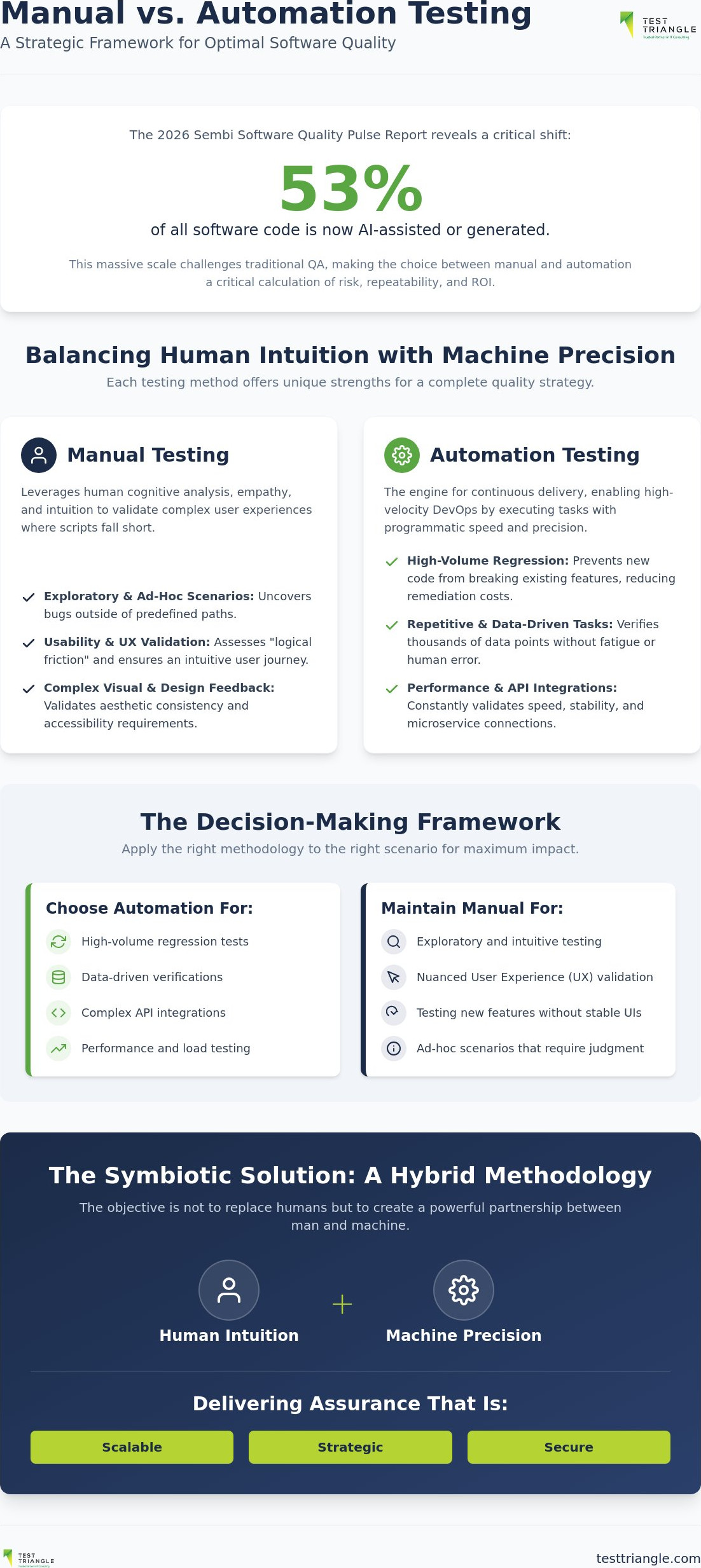
With 53% of all software code now being AI-assisted or generated according to the 2026 Sembi Software Quality Pulse Report, the sheer volume of digital output has reached a threshold where traditional quality assurance methods often falter under the weight of sheer scale. You likely recognize the mounting pressure of escalating regression costs and the persistent bottleneck of slow release cycles that threaten your organization’s competitive edge in a hyper-accelerated market. Determining exactly when to choose automation testing over manual is no longer a matter of simple preference; it’s a critical calculation of risk, repeatability, and ROI that defines modern digital maturity. This guide provides a sophisticated decision-making framework designed to help you balance human intuition with machine precision for optimal software quality and operational stability. By aligning your testing methodology with specific business outcomes, you’ll master a hybrid strategy that ensures faster time-to-market and reduced bug rates through precision, performance, and partnership.
Key Takeaways
- Align your quality assurance strategy with the 2026 technological landscape by integrating AI-augmented tools that bridge the gap between programmatic precision and human intuition.
- Identify the high-volume, repetitive regression scenarios where transitioning to automated scripts effectively mitigates human error and secures your release schedule.
- Master the “Automation Break-even Point” formula to determine when to choose automation testing over manual based on a comprehensive analysis of initial investment, maintenance, and long-term ROI.
- Protect your user experience by maintaining manual testing protocols for exploratory and ad-hoc scenarios that require the sophisticated judgment only a “human-in-the-loop” can provide.
- Implement a hybrid delivery model that leverages an adaptable approach to service delivery, ensuring your digital infrastructure remains scalable, strategic, and secure.
Manual vs. Automation: Balancing Human Intuition with Machine Precision
The shift from manual execution to programmatic verification represents more than a tactical change in tooling; it signals a fundamental evolution in how enterprises perceive quality. By moving beyond the binary choice of “manually clicking” versus “writing code,” sophisticated organizations now treat the selection process as a strategic technology roadmapping exercise. In this 2026 digital ecosystem, where AI-augmented tools increasingly blur the distinction between human-led and machine-led processes, the core challenge is determining when to choose automation testing over manual to maximize both coverage and capital efficiency. This decision necessitates a disciplined evaluation of where human intuition provides a competitive advantage and where machine precision secures the release pipeline.
The Enduring Value of Manual Assurance
Human cognitive analysis remains an irreplaceable pillar of high-standard software delivery, particularly when validating complex usability and accessibility requirements that scripts simply cannot interpret. While machines excel at binary outcomes, they lack the empathy required to validate nuanced user experience (UX) benchmarks. Professional testers apply a layer of critical judgment that identifies “logical friction”—those subtle design flaws that technically function but practically frustrate the end-user. For a deeper dive into these human-centric methodologies, our Manual Testing 2026 Guide outlines how exploratory testing provides the peace of mind that automated scripts often miss by focusing solely on predicted paths.
The Strategic Mandate for Automation
The transition to Test automation serves as the primary engine for continuous delivery, enabling teams to operate within the high-velocity requirements of modern DevOps environments. By implementing a “Test Early, Test Often” methodology, organizations can identify regressions at the point of injection, which drastically reduces the cost of remediation. This systemic improvement is essential for maintaining operational stability as application complexity grows. Establishing a clear threshold for when to choose automation testing over manual allows leadership to allocate resources with surgical precision, ensuring that expensive human capital isn’t wasted on rote verification. Automating these predictable paths allows your engineering talent to focus on high-value exploratory work, ensuring that speed never comes at the expense of security or reliability.
Ultimately, the objective is to create a symbiotic relationship between man and machine. This hybrid approach ensures that your digital infrastructure is managed with the expertise required for large-scale technological evolution. By combining technical rigor with human insight, you achieve a level of assurance that is scalable, strategic, and secure.
Prime Scenarios for Automation: Accelerating Velocity and Verifying Reliability
The decision regarding when to choose automation testing over manual often rests on the physical and cognitive limitations of human testers. While human intuition is superior for identifying aesthetic inconsistencies, it remains susceptible to fatigue during high-volume, repetitive tasks. In the current enterprise landscape, where 72% of organizations now utilize test automation to manage growing complexity, scripts provide the unwavering precision necessary to verify thousands of data points without the risk of oversight. This programmatic rigor is particularly vital for data-driven testing and complex API integrations, where the interplay of microservices requires constant, simultaneous validation that exceeds manual capacity.
Adhering to Best Practices In Quality Assurance involves recognizing that automation is not a replacement for human thought but a tool for systemic improvement. By delegating rote verification to a machine, organizations empower their QA teams to focus on high-value exploratory work. This strategic allocation of resources ensures that your digital infrastructure remains resilient as it scales, providing a steady hand in an increasingly volatile technological environment.
Regression Testing and CI/CD Integration
Regression testing has emerged as the primary candidate for automation in 2026, serving as a protective shield for core functionality during rapid update cycles. By integrating automated suites directly into your CI/CD pipelines, you ensure that every code commit is validated against established benchmarks before it reaches production. Our Software Test Automation Services focus on creating these seamless feedback loops, utilizing deep integrations with the Atlassian and ServiceNow ecosystems. This approach ensures that reporting is transparent, actionable, and aligned with your broader IT service management goals, effectively reducing post-release bug rates through continuous, programmatic oversight.
Performance and Load Benchmarking
Manual testing protocols are fundamentally incapable of simulating the stress of 10,000 concurrent enterprise users interacting with a system. Automation provides the only viable path for performance, load, and stress testing, allowing organizations to identify systemic bottlenecks that could lead to catastrophic downtime and lost revenue. By executing these high-load scenarios in controlled environments, you gain the empirical data needed to optimize infrastructure and ensure a seamless user experience under any conditions. If you are currently evaluating your existing QA roadmap, you may wish to connect with our strategic consultants to discuss how to implement a scalable, secure performance framework that protects your long-term operational stability.
The Case for Manual Testing: Navigating Complexity and Validating User Experience
While the previous sections established the necessity of machine precision for high-volume tasks, a strategic framework must also account for the inherent limitations of scripted logic. Determining when to choose automation testing over manual is often about identifying where human oversight provides the final layer of institutional security. In highly regulated sectors like pharmaceuticals, manual validation serves as a critical compliance gate. Scripts verify if a field accepts a specific data type, but they cannot assess the clinical context or the procedural integrity required by global health authorities. This “Human-in-the-Loop” necessity ensures that complex business logic remains aligned with both technical specifications and regulatory mandates, providing a level of assurance that is perceptive, purposeful, and precise.
During early-stage product development, where user interfaces remain volatile and requirements shift rapidly, the cost of maintaining automated scripts often outweighs their utility. Human testers adapt instantly to these changes, providing immediate feedback that machines cannot replicate. Industry leaders frequently highlight various reasons for manual testing, particularly its unique capacity to assess user journeys and inclusivity through a lens of critical judgment. This approach allows organizations to manage risk while fostering the innovation necessary for successful digital evolution.
Exploratory Testing and Creative Problem Solving
Exploratory testing functions as a high-level cognitive hunt for unscripted defects that traditional automation typically ignores. Professional testers use their intuition to simulate erratic user behaviors, identifying “edge case” bugs that exist outside the predicted paths of a script. This methodology is essential for digital transformation services, where the integration of legacy systems with modern cloud architectures often creates unpredictable failure points. By applying creative problem-solving techniques, testers uncover deep-seated architectural flaws, ensuring that your digital infrastructure remains stable under real-world conditions.
Usability and Accessibility (a11y) Audits
Machines are fundamentally incapable of feeling if a user interface is intuitive or frustrating. While automation can check for the presence of alt-text, it cannot determine if that text provides meaningful context for a visually impaired user. Manual testing addresses these legal and ethical mandates by employing human auditors to validate accessibility against global standards. This ensures that your software is not only compliant with regulations but also provides a seamless experience for every user. By prioritizing human-centric validation, you demonstrate a commitment to quality that transcends simple code verification, positioning your brand as a reliable and responsible global partner.
Calculating the ROI: A Decision-Making Framework for Enterprise QA
For executive leadership and technical managers alike, the decision regarding when to choose automation testing over manual is fundamentally a capital allocation exercise. Achieving optimal software quality requires a disciplined understanding of the “Automation Break-even Point,” which occurs when the cumulative cost of manual execution—calculated as the sum of labor hours, hourly rates, and execution frequency—surpasses the total cost of automated ownership. While manual testing offers lower entry costs, it creates a linear expense model that scales poorly as application complexity increases. Conversely, automation requires a higher initial investment in tool licensing, cloud infrastructure, and specialized staffing, but it eventually flattens the cost curve through repeatability and speed.
Neglecting this transition often leads to significant “Technical Debt,” where the hidden costs of human error and delayed release cycles compound over time. To avoid these systemic bottlenecks, organizations must evaluate their projects through a qualitative lens, considering the lifespan of the application and the stability of its core features. A project intended to remain in production for more than six months, or one requiring weekly regression cycles, almost always mandates a shift toward programmatic verification to ensure long-term operational stability.
The Cost of Maintenance vs. The Cost of Execution
Analyzing the time-and-materials cost of manual testing reveals a persistent drain on resources as teams repeat the same verification steps across dozens of development cycles. While professional software test automation services require a sophisticated technical foundation, they eliminate the fatigue-induced errors that characterize high-volume manual work. Automation ROI is formally defined as the specific juncture where the cumulative expenses of manual labor across multiple release cycles exceed the total cost of automated ownership, including initial development and ongoing script maintenance. By identifying this point early, you can transition from a reactive posture to a proactive, scalable quality strategy.
Risk-Based Testing Allocation
Effective budget distribution relies on the “Testing Pyramid” methodology, which prioritizes automation for high-risk, high-frequency features while reserving manual oversight for the UI-heavy top layer. This strategic focus ensures that your most critical business logic is validated continuously without inflating the QA budget. Our IT consulting experts specialize in defining these roadmaps, helping global enterprises determine exactly when to choose automation testing over manual to protect their digital infrastructure. To align your testing methodology with your broader business objectives, we invite you to request a strategic QA audit with our senior advisors today.
Test Triangle’s Hybrid Methodology: Delivering Scalable, Strategic, and Secure Assurance
Test Triangle functions as a high-level corporate partner for global enterprises navigating the complexities of modern quality assurance. We recognize that the strategic decision regarding when to choose automation testing over manual is rarely a binary choice; it’s a sophisticated allocation of diverse resources based on risk and ROI. Our methodology emphasizes an adaptable approach to service delivery, ensuring that your digital infrastructure is managed with the precision and performance required for sustained growth. By integrating deep expertise in industry-leading platforms such as Atlassian and ServiceNow, we create unified QA workflows that bridge the gap between rapid development cycles and long-term operational stability.
This hybrid strategy allows organizations to move beyond the limitations of a single methodology. By combining human intuition with machine precision, we provide a steady hand in a fast-changing technological landscape. This approach focuses on risk reduction and the empowerment found in large-scale technological evolution, positioning your company as a leader in digital maturity. Our role is to act as a reliable collaborator, deeply invested in your long-term success and the stability of your complex digital environments.
Managed Outsourcing and Staffing Solutions
Securing the specialized talent required for advanced programmatic verification remains a significant hurdle for organizations facing budget constraints. Our staffing solutions provide immediate access to the technical expertise needed to build and maintain robust automation frameworks. For enterprises seeking a more comprehensive partnership, our managed outsourcing services offer long-term QA stability through a combination of on-site leadership and remote offshore resources. This hybrid staffing model allows you to scale your testing efforts with surgical precision, ensuring that your budget remains aligned with your current project demands. It provides the peace of mind that comes from knowing your mission-critical systems are managed by a disciplined, versatile, and globally-minded team.
Strategic Digital Transformation
Quality assurance serves as the foundational pillar for successful digital transformation services. We don’t view testing in isolation. Instead, we integrate security and performance validation directly into your automated pipelines to mitigate risk at every stage of the software lifecycle. This holistic view ensures that your technological evolution is not only fast but also secure and resilient. By helping you determine exactly when to choose automation testing over manual, we empower your organization to focus human expertise on innovation while machines handle the rote verification tasks. This synergy defines a mature digital enterprise that is prepared for the future.
The path to software excellence requires a collaborator who understands that quality is a continuous journey of systemic improvement. We invite you to partner with Test Triangle for a strategic QA assessment and discover how our hybrid methodology can transform your testing from a bottleneck into a competitive advantage.
Securing Your Digital Future Through Strategic Assurance
Mastering the transition from manual execution to programmatic verification is essential for maintaining a competitive edge in the 2026 digital ecosystem. By applying a disciplined ROI framework, you can determine exactly when to choose automation testing over manual to ensure your quality assurance remains scalable, strategic, and secure. This hybrid methodology allows your organization to protect core digital infrastructures through machine precision while reserving human ingenuity for the complex user experience challenges that define market leadership. As an Atlassian Gold Solution Partner with ISO 9001:2015 certified quality management, Test Triangle provides the institutional maturity required to manage complex global infrastructures. Our delivery centers across Europe, North America, and Asia offer a versatile, globally-minded approach to service delivery that adapts to your specific operational needs. We remain a steady hand in a fast-changing landscape, empowering your teams to achieve faster time-to-market without compromising reliability. Consult with our QA Strategic Visionaries Today to align your testing roadmap with your long-term business objectives. We’re ready to help you transform your QA from a cost center into a powerful engine for organizational growth.
Frequently Asked Questions
Is automation testing always better than manual testing?
Automation is not inherently superior; rather, its value is context-dependent. While it excels at high-volume regression and performance benchmarking, manual testing remains the definitive choice for exploratory, usability, and ad-hoc scenarios requiring human intuition. The strategic decision of when to choose automation testing over manual should be based on the project’s specific requirements for repeatability versus creative analysis.
How do I calculate the ROI of switching to automated testing?
ROI is determined by identifying the “Automation Break-even Point,” where the total cost of automated ownership, including initial scripting, tool licensing, and infrastructure, becomes lower than the cumulative expense of manual execution over multiple cycles. You must factor in the hourly rate of testers and the frequency of test execution. This quantitative approach ensures that your quality assurance budget is allocated with surgical precision to maximize long-term operational stability.
Can automation testing completely replace manual testers in 2026?
Total replacement is neither feasible nor desirable in the 2026 digital landscape. While AI-augmented tools manage a significant portion of code generation, human oversight is essential for validating complex business logic and ensuring accessibility compliance. A hybrid methodology creates a symbiotic relationship where machines handle rote verification while human experts focus on high-level strategy and exploratory bug hunting. This balance provides the peace of mind derived from comprehensive, multi-layered assurance.
What are the best test cases to automate first?
Priority should be given to stable, high-volume regression suites and smoke tests that protect core functionality during rapid release cycles. Additionally, data-driven scenarios and complex API integrations that require thousands of permutations are ideal candidates for early automation. By focusing on these repetitive, fatigue-prone tasks first, you immediately reduce the risk of human error and accelerate your time-to-market. This targeted execution serves as the foundation for a scalable, strategic testing framework.
What is the cost of maintaining automated test scripts?
Maintenance costs typically account for a significant portion of the total automation budget, often varying based on the volatility of the application’s user interface. As software evolves, scripts must be updated to reflect architectural changes, which requires continuous technical oversight. Selecting resilient frameworks like Playwright or Selenium 4 can help mitigate these expenses. Understanding these hidden costs is vital when evaluating when to choose automation testing over manual for long-term projects.
How does DevOps consulting impact the choice between manual and automated testing?
Professional DevOps consulting facilitates the seamless integration of quality gates directly into your CI/CD pipeline, which naturally shifts the balance toward automated verification. This strategic alignment ensures that testing isn’t a bottleneck but a continuous feedback loop that supports high-velocity delivery. Consultants help identify the optimal “Testing Pyramid” structure for your organization, ensuring that automated units and integration tests provide a stable foundation while manual efforts are reserved for high-value validation.
Which industries benefit most from a hybrid testing approach?
Highly regulated sectors, such as pharmaceuticals and financial services, derive significant value from a hybrid approach that combines programmatic rigor with strict human-in-the-loop validation. These industries require the precision of automation for data integrity and the perceptive judgment of manual testers for compliance and risk management. Similarly, complex e-commerce platforms use this duality to balance high-speed backend transactions with an intuitive, empathetic user experience that machines cannot fully evaluate.
What skills do manual testers need to transition to automation?
Transitioning testers must develop proficiency in programming languages such as JavaScript, Python, or Java, alongside a deep understanding of automation frameworks like Playwright or Appium. Beyond coding, they need to master the logic of test architecture and the mechanics of CI/CD integration within ecosystems like Atlassian or ServiceNow. This evolution from manual execution to quality engineering empowers professionals to contribute to large-scale technological progress through the sophisticated application of technical tools.

Article by
Paul Guy
Paul serves as the Marketing Director at Test Triangle, where he leads a global team in driving growth through strategic B2B marketing and brand communications. With a strong emphasis on measurable outcomes and sustainable performance, he plays a pivotal role in aligning marketing functions to enhance customer engagement and accelerate business impact. Under his leadership, marketing initiatives have consistently delivered significant returns on investment, elevated brand visibility, and strengthened the company's presence across key markets.