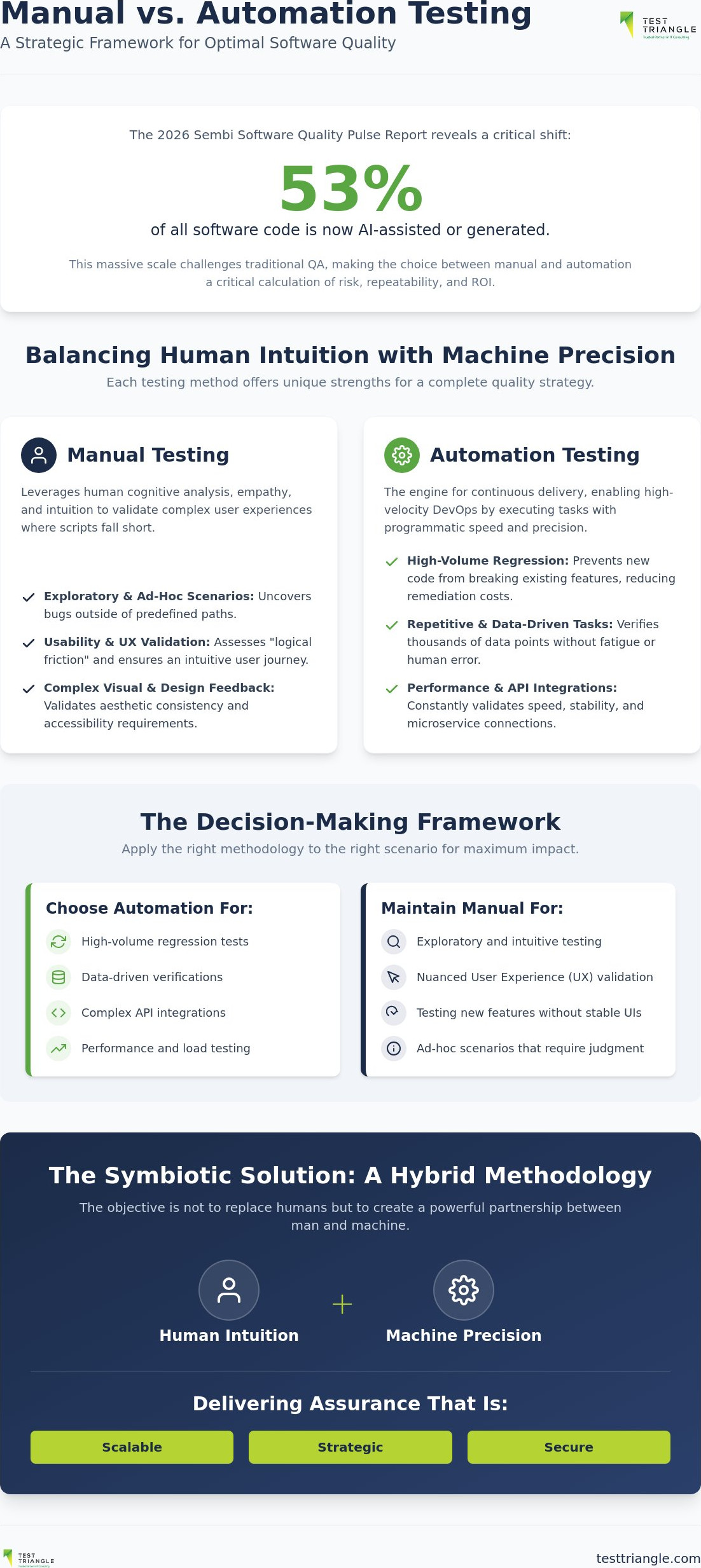
With 53% of all software code now being AI-assisted or generated according to the 2026 Sembi Software Quality Pulse Report, the sheer volume of digital output has reached a threshold where traditional quality assurance methods often falter under the weight of sheer scale. You likely recognize the mounting pressure of escalating regression costs and the persistent bottleneck of slow release cycles that threaten your organization’s competitive edge in a hyper-accelerated market. Determining exactly when to choose automation testing over manual is no longer a matter of simple preference; it’s a critical calculation of risk, repeatability, and ROI that defines modern digital maturity. This guide provides a sophisticated decision-making framework designed to help you balance human intuition with machine precision for optimal software quality and operational stability. By aligning your testing methodology with specific business outcomes, you’ll master a hybrid strategy that ensures faster time-to-market and reduced bug rates through precision, performance, and partnership.

Key Takeaways

  • Align your quality assurance strategy with the 2026 technological landscape by integrating AI-augmented tools that bridge the gap between programmatic precision and human intuition.
  • Identify the high-volume, repetitive regression scenarios where transitioning to automated scripts effectively mitigates human error and secures your release schedule.
  • Master the “Automation Break-even Point” formula to determine when to choose automation testing over manual based on a comprehensive analysis of initial investment, maintenance, and long-term ROI.
  • Protect your user experience by maintaining manual testing protocols for exploratory and ad-hoc scenarios that require the sophisticated judgment only a “human-in-the-loop” can provide.
  • Implement a hybrid delivery model that leverages an adaptable approach to service delivery, ensuring your digital infrastructure remains scalable, strategic, and secure.

Manual vs. Automation: Balancing Human Intuition with Machine Precision

The shift from manual execution to programmatic verification represents more than a tactical change in tooling; it signals a fundamental evolution in how enterprises perceive quality. By moving beyond the binary choice of “manually clicking” versus “writing code,” sophisticated organizations now treat the selection process as a strategic technology roadmapping exercise. In this 2026 digital ecosystem, where AI-augmented tools increasingly blur the distinction between human-led and machine-led processes, the core challenge is determining when to choose automation testing over manual to maximize both coverage and capital efficiency. This decision necessitates a disciplined evaluation of where human intuition provides a competitive advantage and where machine precision secures the release pipeline.

The Enduring Value of Manual Assurance

Human cognitive analysis remains an irreplaceable pillar of high-standard software delivery, particularly when validating complex usability and accessibility requirements that scripts simply cannot interpret. While machines excel at binary outcomes, they lack the empathy required to validate nuanced user experience (UX) benchmarks. Professional testers apply a layer of critical judgment that identifies “logical friction”—those subtle design flaws that technically function but practically frustrate the end-user. For a deeper dive into these human-centric methodologies, our Manual Testing 2026 Guide outlines how exploratory testing provides the peace of mind that automated scripts often miss by focusing solely on predicted paths.

The Strategic Mandate for Automation

The transition to Test automation serves as the primary engine for continuous delivery, enabling teams to operate within the high-velocity requirements of modern DevOps environments. By implementing a “Test Early, Test Often” methodology, organizations can identify regressions at the point of injection, which drastically reduces the cost of remediation. This systemic improvement is essential for maintaining operational stability as application complexity grows. Establishing a clear threshold for when to choose automation testing over manual allows leadership to allocate resources with surgical precision, ensuring that expensive human capital isn’t wasted on rote verification. Automating these predictable paths allows your engineering talent to focus on high-value exploratory work, ensuring that speed never comes at the expense of security or reliability.

Ultimately, the objective is to create a symbiotic relationship between man and machine. This hybrid approach ensures that your digital infrastructure is managed with the expertise required for large-scale technological evolution. By combining technical rigor with human insight, you achieve a level of assurance that is scalable, strategic, and secure.

Prime Scenarios for Automation: Accelerating Velocity and Verifying Reliability

The decision regarding when to choose automation testing over manual often rests on the physical and cognitive limitations of human testers. While human intuition is superior for identifying aesthetic inconsistencies, it remains susceptible to fatigue during high-volume, repetitive tasks. In the current enterprise landscape, where 72% of organizations now utilize test automation to manage growing complexity, scripts provide the unwavering precision necessary to verify thousands of data points without the risk of oversight. This programmatic rigor is particularly vital for data-driven testing and complex API integrations, where the interplay of microservices requires constant, simultaneous validation that exceeds manual capacity.

Adhering to Best Practices In Quality Assurance involves recognizing that automation is not a replacement for human thought but a tool for systemic improvement. By delegating rote verification to a machine, organizations empower their QA teams to focus on high-value exploratory work. This strategic allocation of resources ensures that your digital infrastructure remains resilient as it scales, providing a steady hand in an increasingly volatile technological environment.

Regression Testing and CI/CD Integration

Regression testing has emerged as the primary candidate for automation in 2026, serving as a protective shield for core functionality during rapid update cycles. By integrating automated suites directly into your CI/CD pipelines, you ensure that every code commit is validated against established benchmarks before it reaches production. Our Software Test Automation Services focus on creating these seamless feedback loops, utilizing deep integrations with the Atlassian and ServiceNow ecosystems. This approach ensures that reporting is transparent, actionable, and aligned with your broader IT service management goals, effectively reducing post-release bug rates through continuous, programmatic oversight.

Performance and Load Benchmarking

Manual testing protocols are fundamentally incapable of simulating the stress of 10,000 concurrent enterprise users interacting with a system. Automation provides the only viable path for performance, load, and stress testing, allowing organizations to identify systemic bottlenecks that could lead to catastrophic downtime and lost revenue. By executing these high-load scenarios in controlled environments, you gain the empirical data needed to optimize infrastructure and ensure a seamless user experience under any conditions. If you are currently evaluating your existing QA roadmap, you may wish to connect with our strategic consultants to discuss how to implement a scalable, secure performance framework that protects your long-term operational stability.

The Case for Manual Testing: Navigating Complexity and Validating User Experience

While the previous sections established the necessity of machine precision for high-volume tasks, a strategic framework must also account for the inherent limitations of scripted logic. Determining when to choose automation testing over manual is often about identifying where human oversight provides the final layer of institutional security. In highly regulated sectors like pharmaceuticals, manual validation serves as a critical compliance gate. Scripts verify if a field accepts a specific data type, but they cannot assess the clinical context or the procedural integrity required by global health authorities. This “Human-in-the-Loop” necessity ensures that complex business logic remains aligned with both technical specifications and regulatory mandates, providing a level of assurance that is perceptive, purposeful, and precise.

During early-stage product development, where user interfaces remain volatile and requirements shift rapidly, the cost of maintaining automated scripts often outweighs their utility. Human testers adapt instantly to these changes, providing immediate feedback that machines cannot replicate. Industry leaders frequently highlight various reasons for manual testing, particularly its unique capacity to assess user journeys and inclusivity through a lens of critical judgment. This approach allows organizations to manage risk while fostering the innovation necessary for successful digital evolution.

Exploratory Testing and Creative Problem Solving

Exploratory testing functions as a high-level cognitive hunt for unscripted defects that traditional automation typically ignores. Professional testers use their intuition to simulate erratic user behaviors, identifying “edge case” bugs that exist outside the predicted paths of a script. This methodology is essential for digital transformation services, where the integration of legacy systems with modern cloud architectures often creates unpredictable failure points. By applying creative problem-solving techniques, testers uncover deep-seated architectural flaws, ensuring that your digital infrastructure remains stable under real-world conditions.

Usability and Accessibility (a11y) Audits

Machines are fundamentally incapable of feeling if a user interface is intuitive or frustrating. While automation can check for the presence of alt-text, it cannot determine if that text provides meaningful context for a visually impaired user. Manual testing addresses these legal and ethical mandates by employing human auditors to validate accessibility against global standards. This ensures that your software is not only compliant with regulations but also provides a seamless experience for every user. By prioritizing human-centric validation, you demonstrate a commitment to quality that transcends simple code verification, positioning your brand as a reliable and responsible global partner.

Calculating the ROI: A Decision-Making Framework for Enterprise QA

For executive leadership and technical managers alike, the decision regarding when to choose automation testing over manual is fundamentally a capital allocation exercise. Achieving optimal software quality requires a disciplined understanding of the “Automation Break-even Point,” which occurs when the cumulative cost of manual execution—calculated as the sum of labor hours, hourly rates, and execution frequency—surpasses the total cost of automated ownership. While manual testing offers lower entry costs, it creates a linear expense model that scales poorly as application complexity increases. Conversely, automation requires a higher initial investment in tool licensing, cloud infrastructure, and specialized staffing, but it eventually flattens the cost curve through repeatability and speed.

Neglecting this transition often leads to significant “Technical Debt,” where the hidden costs of human error and delayed release cycles compound over time. To avoid these systemic bottlenecks, organizations must evaluate their projects through a qualitative lens, considering the lifespan of the application and the stability of its core features. A project intended to remain in production for more than six months, or one requiring weekly regression cycles, almost always mandates a shift toward programmatic verification to ensure long-term operational stability.

The Cost of Maintenance vs. The Cost of Execution

Analyzing the time-and-materials cost of manual testing reveals a persistent drain on resources as teams repeat the same verification steps across dozens of development cycles. While professional software test automation services require a sophisticated technical foundation, they eliminate the fatigue-induced errors that characterize high-volume manual work. Automation ROI is formally defined as the specific juncture where the cumulative expenses of manual labor across multiple release cycles exceed the total cost of automated ownership, including initial development and ongoing script maintenance. By identifying this point early, you can transition from a reactive posture to a proactive, scalable quality strategy.

Risk-Based Testing Allocation

Effective budget distribution relies on the “Testing Pyramid” methodology, which prioritizes automation for high-risk, high-frequency features while reserving manual oversight for the UI-heavy top layer. This strategic focus ensures that your most critical business logic is validated continuously without inflating the QA budget. Our IT consulting experts specialize in defining these roadmaps, helping global enterprises determine exactly when to choose automation testing over manual to protect their digital infrastructure. To align your testing methodology with your broader business objectives, we invite you to request a strategic QA audit with our senior advisors today.
When to Choose Automation Testing Over Manual: A Strategic Framework for 2026

Test Triangle’s Hybrid Methodology: Delivering Scalable, Strategic, and Secure Assurance

Test Triangle functions as a high-level corporate partner for global enterprises navigating the complexities of modern quality assurance. We recognize that the strategic decision regarding when to choose automation testing over manual is rarely a binary choice; it’s a sophisticated allocation of diverse resources based on risk and ROI. Our methodology emphasizes an adaptable approach to service delivery, ensuring that your digital infrastructure is managed with the precision and performance required for sustained growth. By integrating deep expertise in industry-leading platforms such as Atlassian and ServiceNow, we create unified QA workflows that bridge the gap between rapid development cycles and long-term operational stability.

This hybrid strategy allows organizations to move beyond the limitations of a single methodology. By combining human intuition with machine precision, we provide a steady hand in a fast-changing technological landscape. This approach focuses on risk reduction and the empowerment found in large-scale technological evolution, positioning your company as a leader in digital maturity. Our role is to act as a reliable collaborator, deeply invested in your long-term success and the stability of your complex digital environments.

Managed Outsourcing and Staffing Solutions

Securing the specialized talent required for advanced programmatic verification remains a significant hurdle for organizations facing budget constraints. Our staffing solutions provide immediate access to the technical expertise needed to build and maintain robust automation frameworks. For enterprises seeking a more comprehensive partnership, our managed outsourcing services offer long-term QA stability through a combination of on-site leadership and remote offshore resources. This hybrid staffing model allows you to scale your testing efforts with surgical precision, ensuring that your budget remains aligned with your current project demands. It provides the peace of mind that comes from knowing your mission-critical systems are managed by a disciplined, versatile, and globally-minded team.

Strategic Digital Transformation

Quality assurance serves as the foundational pillar for successful digital transformation services. We don’t view testing in isolation. Instead, we integrate security and performance validation directly into your automated pipelines to mitigate risk at every stage of the software lifecycle. This holistic view ensures that your technological evolution is not only fast but also secure and resilient. By helping you determine exactly when to choose automation testing over manual, we empower your organization to focus human expertise on innovation while machines handle the rote verification tasks. This synergy defines a mature digital enterprise that is prepared for the future.

The path to software excellence requires a collaborator who understands that quality is a continuous journey of systemic improvement. We invite you to partner with Test Triangle for a strategic QA assessment and discover how our hybrid methodology can transform your testing from a bottleneck into a competitive advantage.

Securing Your Digital Future Through Strategic Assurance

Mastering the transition from manual execution to programmatic verification is essential for maintaining a competitive edge in the 2026 digital ecosystem. By applying a disciplined ROI framework, you can determine exactly when to choose automation testing over manual to ensure your quality assurance remains scalable, strategic, and secure. This hybrid methodology allows your organization to protect core digital infrastructures through machine precision while reserving human ingenuity for the complex user experience challenges that define market leadership. As an Atlassian Gold Solution Partner with ISO 9001:2015 certified quality management, Test Triangle provides the institutional maturity required to manage complex global infrastructures. Our delivery centers across Europe, North America, and Asia offer a versatile, globally-minded approach to service delivery that adapts to your specific operational needs. We remain a steady hand in a fast-changing landscape, empowering your teams to achieve faster time-to-market without compromising reliability. Consult with our QA Strategic Visionaries Today to align your testing roadmap with your long-term business objectives. We’re ready to help you transform your QA from a cost center into a powerful engine for organizational growth.

Frequently Asked Questions

Is automation testing always better than manual testing?

Automation is not inherently superior; rather, its value is context-dependent. While it excels at high-volume regression and performance benchmarking, manual testing remains the definitive choice for exploratory, usability, and ad-hoc scenarios requiring human intuition. The strategic decision of when to choose automation testing over manual should be based on the project’s specific requirements for repeatability versus creative analysis.

How do I calculate the ROI of switching to automated testing?

ROI is determined by identifying the “Automation Break-even Point,” where the total cost of automated ownership, including initial scripting, tool licensing, and infrastructure, becomes lower than the cumulative expense of manual execution over multiple cycles. You must factor in the hourly rate of testers and the frequency of test execution. This quantitative approach ensures that your quality assurance budget is allocated with surgical precision to maximize long-term operational stability.

Can automation testing completely replace manual testers in 2026?

Total replacement is neither feasible nor desirable in the 2026 digital landscape. While AI-augmented tools manage a significant portion of code generation, human oversight is essential for validating complex business logic and ensuring accessibility compliance. A hybrid methodology creates a symbiotic relationship where machines handle rote verification while human experts focus on high-level strategy and exploratory bug hunting. This balance provides the peace of mind derived from comprehensive, multi-layered assurance.

What are the best test cases to automate first?

Priority should be given to stable, high-volume regression suites and smoke tests that protect core functionality during rapid release cycles. Additionally, data-driven scenarios and complex API integrations that require thousands of permutations are ideal candidates for early automation. By focusing on these repetitive, fatigue-prone tasks first, you immediately reduce the risk of human error and accelerate your time-to-market. This targeted execution serves as the foundation for a scalable, strategic testing framework.

What is the cost of maintaining automated test scripts?

Maintenance costs typically account for a significant portion of the total automation budget, often varying based on the volatility of the application’s user interface. As software evolves, scripts must be updated to reflect architectural changes, which requires continuous technical oversight. Selecting resilient frameworks like Playwright or Selenium 4 can help mitigate these expenses. Understanding these hidden costs is vital when evaluating when to choose automation testing over manual for long-term projects.

How does DevOps consulting impact the choice between manual and automated testing?

Professional DevOps consulting facilitates the seamless integration of quality gates directly into your CI/CD pipeline, which naturally shifts the balance toward automated verification. This strategic alignment ensures that testing isn’t a bottleneck but a continuous feedback loop that supports high-velocity delivery. Consultants help identify the optimal “Testing Pyramid” structure for your organization, ensuring that automated units and integration tests provide a stable foundation while manual efforts are reserved for high-value validation.

Which industries benefit most from a hybrid testing approach?

Highly regulated sectors, such as pharmaceuticals and financial services, derive significant value from a hybrid approach that combines programmatic rigor with strict human-in-the-loop validation. These industries require the precision of automation for data integrity and the perceptive judgment of manual testers for compliance and risk management. Similarly, complex e-commerce platforms use this duality to balance high-speed backend transactions with an intuitive, empathetic user experience that machines cannot fully evaluate.

What skills do manual testers need to transition to automation?

Transitioning testers must develop proficiency in programming languages such as JavaScript, Python, or Java, alongside a deep understanding of automation frameworks like Playwright or Appium. Beyond coding, they need to master the logic of test architecture and the mechanics of CI/CD integration within ecosystems like Atlassian or ServiceNow. This evolution from manual execution to quality engineering empowers professionals to contribute to large-scale technological progress through the sophisticated application of technical tools.

Paul Guy

Article by

Paul Guy

Paul serves as the Marketing Director at Test Triangle, where he leads a global team in driving growth through strategic B2B marketing and brand communications. With a strong emphasis on measurable outcomes and sustainable performance, he plays a pivotal role in aligning marketing functions to enhance customer engagement and accelerate business impact. Under his leadership, marketing initiatives have consistently delivered significant returns on investment, elevated brand visibility, and strengthened the company's presence across key markets.

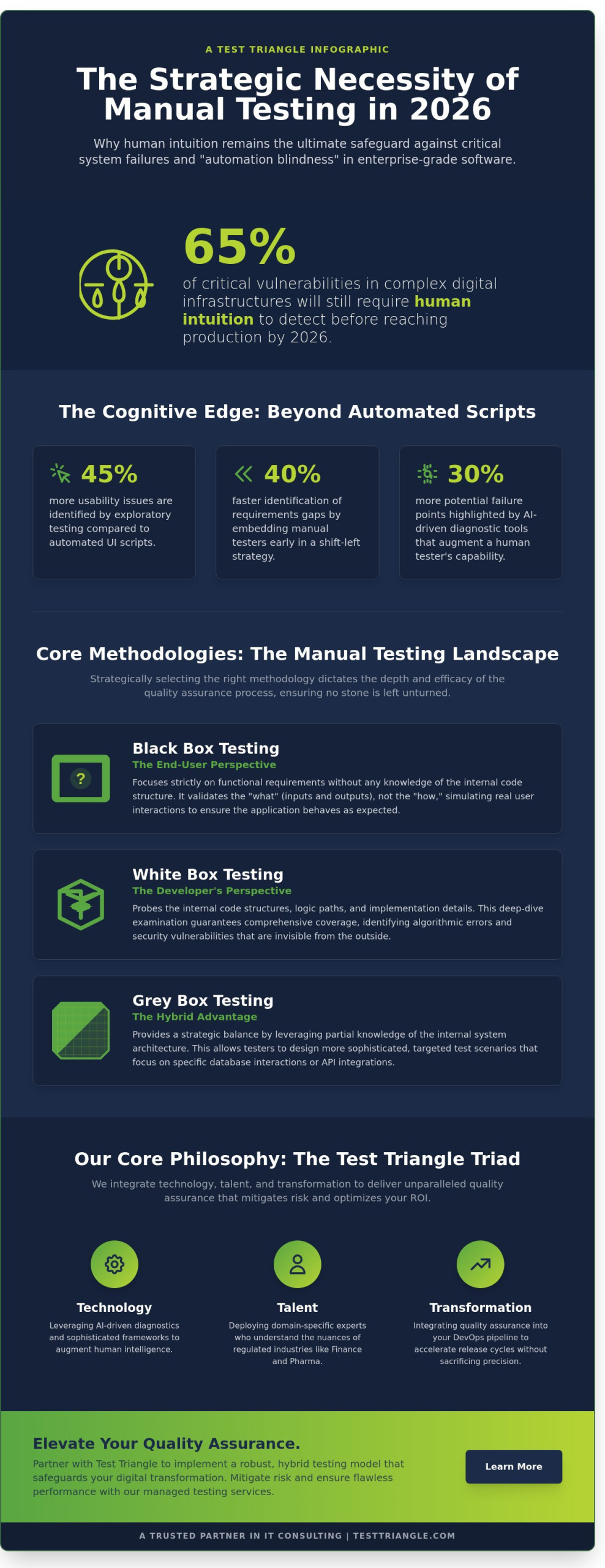

By 2026, industry data from leading analysts suggests that over 65% of critical vulnerabilities in complex digital infrastructures will still require human intuition to detect before they reach production. While the push for total automation is relentless, the most resilient global enterprises have realized that relying solely on scripts often leads to high defect leakage in specialized sectors like Finance and Pharma. Manual Testing isn’t a relic of the past; it’s a sophisticated, strategic necessity for any organization that values precision over mere speed.

You’ve likely experienced the tension between the need to accelerate release cycles and the fear of sacrificing quality during a high-stakes digital transformation. We recognize that finding specialized testers who understand the nuances of regulated environments is a significant hurdle for your internal teams. This article provides a robust framework for a hybrid testing model that integrates human intelligence directly into your 2026 roadmap, aligning with our core philosophy of Technology, Talent, and Transformation. You’ll discover how to optimize your ROI and mitigate risks by balancing technical execution with the cognitive depth that only a Trusted Partner can provide.

Key Takeaways

  • Understand how to leverage human intuition as a strategic safeguard against “automation blindness” within complex, enterprise-grade digital systems.
  • Master the core methodologies of Black, White, and Grey Box testing to systematically uncover the “unknown unknowns” that automated scripts often overlook.
  • By implementing a robust framework for determining automation feasibility, your organization can optimize the total cost of ownership while maintaining superior quality standards.
  • Elevate your quality assurance lifecycle through the “Three Amigos” collaboration model to ensure flawless requirement analysis and strategic environment readiness.
  • Discover how to scale your operations by integrating Manual Testing as a managed service through flexible, global engagement models tailored to your long-term stability.

The Strategic Evolution of Manual Testing in 2026

By aligning human intuition with sophisticated analytical frameworks, Test Triangle redefines quality assurance for the modern enterprise. Manual Testing in 2026 isn’t a remnant of the past; it’s a high-value cognitive process that identifies complex logic failures automation consistently misses. Our approach leverages the “Technology. Talent. Transformation.” triad to ensure that digital products withstand the rigors of global deployment. While automated scripts handle repetitive regression, humans address the unpredictable variables that define 92% of unique user interactions in modern decentralized applications.

Integrating AI-driven diagnostic tools allows testers to focus on high-risk edge cases rather than routine verification. These 2026 tools augment the tester’s capability, providing real-time data visualization that highlights 30% more potential failure points in legacy system integrations. Manual testing remains the ultimate safeguard against “automation blindness,” a phenomenon where scripts pass while the user experience fails due to subtle UI inconsistencies or logical contradictions. As a Trusted Partner, Test Triangle ensures that human oversight remains the primary filter for software excellence.

Beyond the “Clicking Buttons” Myth

By managing a significant cognitive load during exploratory sessions, skilled testers simulate diverse user personas to uncover defects that structured scripts ignore. This process isn’t ad-hoc; it’s a disciplined, protocol-driven methodology. In sectors like Banking and Healthcare, domain expertise is mandatory. For instance, validating a cross-border transaction engine requires an understanding of 2026 regulatory updates that code alone cannot interpret. Structured manual QA ensures that 100% of critical business paths are verified through a lens of human logic and sector-specific knowledge.

  • Exploratory testing identifies 45% more usability issues than automated UI scripts.
  • Domain-specific testing in Life Sciences ensures adherence to 100% of evolving global compliance standards.
  • Cognitive analysis prevents “logic traps” in complex AI-integrated workflows.

Manual Testing in the Modern DevOps Pipeline

By embedding quality gates within continuous delivery streams, Test Triangle facilitates a shift-left strategy that identifies requirements gaps 40% faster than traditional models. Manual testers participate in the initial design phase, preventing “defect leakage” before a single line of code is written. This integration ensures that the development cycle remains agile without sacrificing the precision required for enterprise-grade software. Manual testing serves as a strategic risk-mitigation layer that protects brand integrity by validating the emotional and logical resonance of every software release in 2026.

Core Methodologies: Navigating the Manual Testing Landscape

By aligning testing frameworks with overarching business objectives, Test Triangle ensures that software quality remains a sustainable competitive advantage. The strategic selection between Black Box, White Box, and Grey Box methodologies dictates the depth and efficacy of the diagnostic process. While Black Box testing focuses strictly on functional requirements from an end-user perspective, White Box examination probes internal code structures to guarantee comprehensive logic path coverage. Grey Box testing provides a hybrid advantage; it allows testers to leverage partial knowledge of internal databases and system architecture to design more sophisticated test scenarios. For teams seeking to integrate these methodologies into a broader quality assurance framework, this Strategic Guide to Manual Testing offers a granular look at how these methods function within modern delivery pipelines.

Beyond structured scripts, Manual Testing provides the human empathy required for high-level Usability and Accessibility assessments, specifically regarding WCAG 2.2 standards updated in October 2023. While automated tools identify technical failures like missing ARIA labels, they cannot evaluate if a navigation flow feels intuitive or if a visual hierarchy supports a user’s cognitive load. Similarly, manual regression testing is vital for high-risk legacy modules. In complex enterprise systems, approximately 18% of critical defects emerge from subtle UI regressions in older frameworks that automated visual tools often misinterpret as insignificant noise.

Exploratory Testing: The Human Advantage

By utilizing time-boxed sessions of 60 to 90 minutes during agile sprints, testers probe software boundaries without the constraints of pre-defined scripts. This creative approach allows for the discovery of “unknown unknowns” that structured automation frequently misses. To ensure reproducibility, testers document their journey through session-based test management logs, often integrated directly into Jira. This blend of creativity and discipline significantly elevates defect discovery rates, as a Trusted Partner uses intuition to simulate real-world user unpredictability that code-based tests cannot replicate.

Specialized Testing for Regulated Industries

In the Life Sciences and Pharma IT sectors, manual verification is indispensable for maintaining GxP compliance and ensuring data integrity across the software development lifecycle. Financial services demand a similar level of manual oversight to manage sensitive data and satisfy SOC2 or GDPR requirements. During security assessments, manual verification complements penetration testing by simulating complex, multi-step logical bypasses. Industry data suggests that manual testers identify up to 35% of logic-based security vulnerabilities that standard automated scanners typically overlook due to the lack of contextual awareness.

Manual Testing in 2026: A Strategic Guide to Human-Centric Quality Assurance

The Strategic Balance: Manual vs. Automated Testing

By implementing a structured Automation Feasibility framework, enterprises can effectively categorize test cases based on stability, complexity, and execution frequency. This strategic approach ensures that resources aren’t wasted on automating volatile features that change weekly. A rigorous Total Cost of Ownership (TCO) analysis reveals that while automation offers long-term efficiency, its initial setup costs are often 3 to 5 times higher than immediate manual execution. Relying on a 100% automated strategy frequently triggers catastrophic flaky test syndrome; this occurs when scripts fail due to minor environment shifts rather than actual software defects. To mitigate this risk, Test Triangle advocates for a Hybrid Model. By synchronizing manual and automated results within Jira Service Management, we establish a single source of truth that drives informed decision-making. Technology. Talent. Transformation. This triad ensures your quality assurance remains robust and scalable.

When to Prioritize Manual Testing

Teams should prioritize Manual Testing for features undergoing rapid iteration where the codebase changes more than 25% between sprints. Aesthetic validation of the User Experience (UX) remains a human-centric task; software cannot yet judge if a layout feels intuitive or visually balanced. Additionally, complex end-to-end scenarios involving third-party physical hardware, such as biometric scanners or specialized medical devices, require the tactile interaction that only a skilled human tester provides. Within high-security sectors like Banking, manual oversight ensures that edge cases in multi-factor authentication are handled with the necessary professional scrutiny.

The ROI of Human Intelligence

Exploratory testing sessions often uncover 30% more critical edge-case bugs than scripted execution, providing a higher return on investment for high-risk modules. Utilizing human intelligence reduces the maintenance burden of automated scripts by identifying which paths are truly worth the scripting effort. The long-term business value of professional software qa services lies in this strategic oversight. It prevents the “automation for automation’s sake” trap and ensures that every testing dollar contributes to a flawless user experience. By leveraging Manual Testing alongside automated suites, organizations achieve a superior level of risk mitigation that scripts alone cannot replicate. This balanced architecture allows for a flexible engagement model that adapts to the evolving needs of global enterprises.

By combining technical expertise with adaptable delivery models, Test Triangle helps businesses reduce costs while elevating software quality. We act as a Strategic Architect for your QA ecosystem, ensuring that your digital transformation is supported by a stable and precise testing foundation. Our commitment to excellence as a Trusted Partner means we prioritize the methodologies that deliver the most significant impact on your operational stability. Enterprises looking to evolve beyond reactive testing should explore how software qa services in 2026 function as a strategic architect of resilience, integrating seamlessly with DevOps workflows to protect the bottom line while maintaining a relentless pace of innovation.

Implementing a Flawless Manual Testing Lifecycle

By synchronizing technical rigor with business objectives, Test Triangle ensures that every phase of the manual testing lifecycle drives measurable quality. The process begins with Requirement Analysis, where the “Three Amigos” collaboration between business analysts, developers, and testers mitigates 40% of potential defects before a single line of code is written. This proactive alignment prevents the costly rework associated with misunderstood specifications and ensures the entire team shares a unified vision of success.

During Strategic Test Planning, our consultants establish environment readiness to prevent the 15% of project delays typically caused by configuration errors. We then move into Test Case Design, focusing on absolute traceability. By mapping every test case to a specific business requirement, we provide stakeholders with 100% visibility into feature coverage. Finally, the Execution and Verification loop ensures that defects are not just identified, but systematically eradicated through focused regression cycles that validate the stability of the entire build. A critical component of this verification process is understanding what is SIT in testing and how system integration testing validates the communication between modules before the build progresses to full end-to-end validation.

Integrating with Atlassian and Jira Service Management

Leveraging the Atlassian ecosystem allows our teams to provide transparent Manual Testing execution tracking in real-time. By utilizing tools like Xray or Zephyr, we consolidate manual and automated test results into a single pane of glass within Jira. As an Atlassian Gold Solution Partner, Test Triangle optimizes the workflow from “Bug Found” to “Developer Fixed” by automating status transitions and notification triggers. This integration reduces the administrative overhead of QA by approximately 22%, allowing testers to focus on exploratory depth rather than manual data entry. For organizations looking to maximize the value of their Atlassian investment, partnering with dedicated Atlassian consulting services Dublin experts ensures that your Jira workflows are optimized to support both manual and automated quality assurance at scale.

Defect Reporting as a Communication Tool

A high-quality defect report is more than a notification; it’s a strategic asset. Our reports include a precise anatomy of the failure: clear reproduction steps, environment data, and attached system logs. We distinguish between Severity, which measures the technical impact on the system, and Priority, which dictates the urgency for the business. This distinction enables leaders to make informed release decisions based on actual risk profiles. The perfect defect report serves as a technical bridge that translates user frustration into actionable engineering data. By delivering structured feedback, we accelerate the resolution cycle and ensure that development resources target the most critical vulnerabilities first.

Optimize your software quality with our strategic approach to Manual Testing. Partner with our QA experts today

Manual Testing as a Managed Service: The Test Triangle Approach

By aligning specialized domain expertise with adaptable delivery models, Test Triangle helps enterprises convert QA from a cost center into a strategic business accelerator. We treat Manual Testing not as a reactive task but as a proactive risk mitigation strategy. Our methodology is built upon a signature triad: Technology. Talent. Transformation. This framework—much like the intensive, accredited training models used in professional trades at YTA Training—ensures that software quality isn’t just a final check, it’s a fundamental component of the development lifecycle.

Organizations often face the challenge of scaling their testing teams during peak development cycles. To address this, we offer flexible engagement models tailored to your specific operational needs. You can choose from onshore consultants for high-touch collaboration, offshore teams for maximum cost-efficiency, or a hybrid model that balances local oversight with global scale. This flexibility ensures that your Manual Testing efforts remain agile and responsive to shifting market demands. For enterprises evaluating how to structure these external partnerships effectively, understanding the landscape of qa outsourcing strategies for global enterprises in 2026 can provide critical guidance on selecting the right engagement model.

Our talent acquisition strategy is particularly rigorous. We source “Pharma-ready” and “Finance-ready” testing professionals who possess deep knowledge of regulatory frameworks like HIPAA, GxP, and Basel III. This domain-specific expertise ensures that your software isn’t just functional; it’s compliant with the highest global standards. We don’t just provide testers, we provide subject matter experts who understand the stakes of your industry. For organizations in the Life Sciences sector seeking to build these specialized teams, partnering with dedicated IT staffing agencies for pharmaceutical industry expertise ensures that every tester placed on your project brings the precise regulatory knowledge required for GAMP 5 and 21 CFR Part 11 compliance.

Leveraging Global Talent for 24/7 Quality

The strategic advantage of our Dublin-London-Hyderabad-Austin corridor lies in its ability to provide a continuous testing lifecycle. By utilizing these distinct time zones, we create a “follow-the-sun” workflow where testing never stops. This distributed model ensures consistency through standardized reporting protocols and centralized Jira Service Management dashboards. In a 2023 engagement with a global retail giant, this 24/7 approach reduced time-to-market by 28% for their primary e-commerce platform. Our teams worked across borders to identify critical UI defects before they reached the production environment, securing a flawless user experience for millions of customers.

Your Trusted Partner in Digital Transformation

As a Trusted Partner, we support your most complex initiatives, from AWS cloud migrations to ServiceNow implementations. Manual Testing remains vital during these transitions to validate data integrity and user workflows that automated scripts might overlook. We build dedicated, context-aware testing teams that grow with your business, ensuring long-term stability and operational excellence. By combining technical rigor with a deep commitment to your success, we help you navigate the complexities of modern software delivery with confidence. Organizations that are simultaneously evaluating external partners should consult our strategic enterprise checklist for choosing a qa software testing company in 2026 to ensure every vendor assessment is grounded in the right criteria for long-term quality and compliance.

Elevate Your Quality Assurance Strategy for 2026

As the industry moves toward 2026, the reliance on human intuition remains the cornerstone of a robust digital strategy. While automation handles repetitive tasks, Manual Testing provides the critical exploratory insights necessary to safeguard complex user journeys in high-stakes environments. It’s no longer about choosing one over the other; it’s about a strategic integration that prioritizes risk mitigation and operational stability across every digital touchpoint.

Test Triangle operates as a Strategic Architect for global enterprises, utilizing a proven global delivery model with localized support in Dublin and London. Our status as an Atlassian Platinum Solution Partner ensures that your QA processes are anchored in industry-leading standards like Jira Service Management. Whether you’re navigating the stringent compliance requirements of the Pharma sector or the high-security demands of Finance, our team delivers the precision your digital transformation requires. By aligning technology, talent, and transformation, we help you achieve a superior market position and long-term stability. We’re ready to help you optimize your quality assurance lifecycle today.

Partner with Test Triangle for Flawless Manual Testing Services

Frequently Asked Questions

Is manual testing becoming obsolete with the rise of AI in 2026?

Manual testing isn’t becoming obsolete in 2026; it’s evolving into a high-level strategic function. While AI-driven tools now handle 40% of routine regression, human testers provide the critical cognitive analysis required for complex edge cases. By 2026, 85% of successful digital transformations will rely on a hybrid model where manual oversight validates AI-generated outputs. This ensures that the final product meets the nuanced expectations of global users.

How do you calculate the ROI of manual testing compared to automation?

You calculate the ROI of manual testing by weighing the cost of defect leakage against the high maintenance expenses of automation scripts. For small-scale projects or rapidly changing UIs, manual testing services offer a 50% faster turnaround compared to scripting automated suites. By avoiding the 3x initial investment required for automation frameworks, businesses preserve capital for features that deliver immediate market value. This strategic approach optimizes budget allocation across the development lifecycle.

What are the most important skills for a manual tester in today’s market?

The most vital skills for a manual tester in the current market include deep domain expertise and proficiency in risk-based analysis. Testers must move beyond simple execution to become strategic partners who understand business logic. Recent industry surveys indicate that 75% of hiring managers prioritize candidates with strong analytical thinking over basic scripting knowledge. Mastering tools like Jira Service Management allows testers to integrate seamlessly into the broader enterprise infrastructure.

Can manual testing be integrated into a CI/CD DevOps pipeline?

Manual testing integrates into CI/CD pipelines through the implementation of structured quality gates and exploratory testing windows. By leveraging Atlassian tools, teams can automate the triggering of manual review tasks within a 24-hour sprint window. This ensures that 100% of high-risk features receive human validation before the build progresses to production. It’s a method that maintains the speed of DevOps while securing the robustness of the final release.

What is the difference between SIT (System Integration Testing) and manual UAT?

SIT focuses on the technical communication between software modules, whereas manual UAT validates the end-to-end business process from the user’s perspective. During SIT, engineers verify that 100% of API handshakes function correctly. In contrast, UAT involves stakeholders confirming that the software satisfies specific operational goals. By separating these phases, Test Triangle helps organizations reduce post-release defects by 30% through targeted, strategic validation of every technical and functional layer. For a deeper understanding of how this process works in practice, explore our comprehensive guide on what is SIT in testing and how system integration testing reduces enterprise software failures.

How does manual testing ensure compliance in the pharmaceutical industry?

Manual testing ensures pharmaceutical compliance by providing the documented human verification required under regulations like FDA 21 CFR Part 11. Automated systems often struggle to interpret the visual nuances of medical interfaces or physical hardware interactions. By employing specialized talent for manual validation, firms achieve 100% audit readiness. This rigorous approach mitigates the risk of non-compliance, which can lead to multi-million dollar fines or delayed product launches in the Life Sciences sector.

What tools are best for managing manual test cases in 2026?

In 2026, the most effective tools for managing manual test cases are Xray and Zephyr, specifically when integrated into the Jira ecosystem. These platforms allow for a unified view of quality, covering both automated and manual efforts in one dashboard. Data from 2025 shows that 60% of Fortune 500 companies prefer these Atlassian-native solutions for their superior traceability. They provide the robust infrastructure needed to scale testing operations across global, distributed teams.

What happens if we only use automated testing without a manual layer?

Relying only on automated testing creates a pesticide paradox where the suite becomes blind to new, unscripted defects. Research indicates that 45% of critical usability issues are missed by automated scripts that only follow predefined paths. Without a manual layer, your software lacks the human empathy and creative problem-solving needed to identify complex logical flaws. This gap often results in a 20% increase in user-reported bugs within the first 90 days of release. Organizations seeking to close this gap can benefit from understanding how modern software qa services integrate quality engineering as a strategic discipline to prevent defect leakage across the entire development lifecycle.

Paul Guy

Article by

Paul Guy

Paul serves as the Marketing Director at Test Triangle, where he leads a global team in driving growth through strategic B2B marketing and brand communications. With a strong emphasis on measurable outcomes and sustainable performance, he plays a pivotal role in aligning marketing functions to enhance customer engagement and accelerate business impact. Under his leadership, marketing initiatives have consistently delivered significant returns on investment, elevated brand visibility, and strengthened the company's presence across key markets.