



Did you know that the gross salary on a candidate’s contract represents barely 70% of your actual organizational expenditure? In 2026, the “sticker price” for technical talent is a deceptive metric that often leads to significant budgetary shortfalls for global enterprises. You recognize that securing top-tier expertise requires more than just a competitive offer. It demands a sophisticated understanding of the fiscal realities within the Irish market. Calculating the true cost to hire a full time qa engineer in ireland now involves accounting for the “My Future Fund” pension mandates, updated PRSI adjustments, and the rising overhead of specialized recruitment.
This guide provides a meticulous breakdown of salary benchmarks, statutory contributions, and the hidden costs of equipment and onboarding. We’ll deliver a comprehensive 2026 budget framework alongside a strategic analysis of direct hiring versus managed services. By prioritizing precision, pace, and performance, you can ensure your quality assurance strategy remains compliant, scalable, and cost-effective. You’ll move beyond simple headcount to achieve operational stability through precise financial planning and expert resource allocation. This structured approach allows you to transition from basic recruitment to a high-level talent strategy that supports long-term growth.
Key Takeaways
- Establish accurate 2026 salary benchmarks for Irish QA professionals by differentiating between manual testing roles and high-premium SDET or Automation positions.
- Quantify the comprehensive cost to hire a full time qa engineer in ireland by integrating the 11.40% Employer PRSI rate and mandatory “My Future Fund” pension contributions into your fiscal planning.
- Compare the long-term ROI of direct employment against managed staffing services to mitigate the hidden financial impact of recruitment fees and productivity losses during ramp-up.
- Discover how to leverage hybrid delivery models and strategic automation to significantly reduce your cost per defect while maintaining high standards of software quality.
- Utilize a proven framework for vetting specialized talent to ensure your organizational infrastructure remains secure, scalable, and resilient in a competitive national market.
The 2026 Landscape: Base Salary Expectations for QA Engineers in Ireland
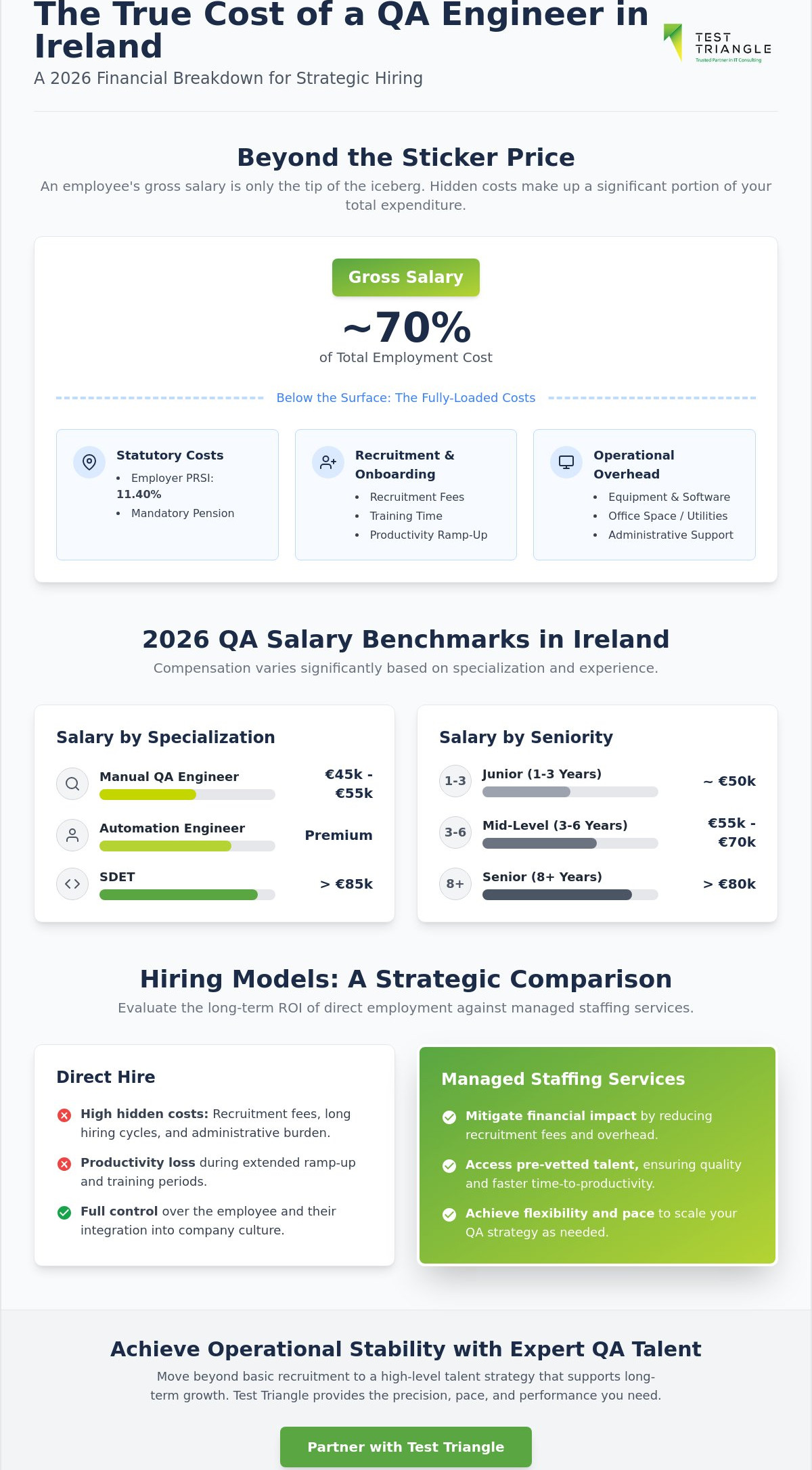
Ireland’s technology sector has reached a level of maturity where quality is no longer a post-development afterthought. In 2026, the demand for sophisticated software testing has intensified, driven by the rapid adoption of AI-generated code and the necessity for continuous delivery. This surge in complexity has fundamentally altered the financial baseline for technical talent. When organizations evaluate the cost to hire a full time qa engineer in ireland, they must recognize that base salaries have adjusted to reflect both the scarcity of specialized skills and the increased cost of living in hubs like Dublin, Cork, and Galway. Current data indicates an average gross salary of approximately €70,715 per year, though this figure fluctuates significantly based on the candidate’s technical stack and strategic value.
Salary Breakdown by Specialisation
The market no longer views QA as a monolithic discipline. Manual QA Engineers, focusing on exploratory and functional validation, typically see ranges between €45,000 and €55,000 depending on the complexity of the industry. However, the true premium lies in Automation Testing. Engineers proficient in Selenium, Cypress, or Playwright command higher compensation due to their ability to accelerate release cycles. At the top of the pyramid, Software Development Engineers in Test (SDET) bridge the gap between development and quality, often exceeding the €85,000 mark. Their expertise in building custom test frameworks ensures long-term operational stability and risk reduction for enterprise-scale infrastructures. It’s a shift toward building quality in, rather than testing it at the end.
The Influence of Seniority on National Averages
Seniority remains a primary driver of compensation variance. Junior QA professionals with one to three years of experience enter the market at around €50,012, focusing on execution and basic bug reporting. The mid-level tier, spanning three to six years of experience, represents the most competitive hiring bracket. These engineers are expected to lead initiatives and integrate testing into DevOps workflows, with salaries in Dublin often ranging from €55,000 to €70,000. For QA Leads and Managers, the focus shifts toward strategic oversight and team mentorship. Senior-level engineers with over eight years of experience frequently earn €80,437 or more. Securing these leaders requires a deep understanding of the total cost to hire a full time qa engineer in ireland, as their impact on systemic improvement and organizational progress is profound. Companies seeking to navigate this competitive environment often leverage IT staffing services to access vetted talent without the traditional overhead of internal recruitment. This approach provides the flexibility, precision, and pace required to sustain growth in a volatile market.
Calculating the Fully-Loaded Cost: Beyond the Sticker Price
To accurately determine the cost to hire a full time qa engineer in ireland, strategic leaders must transition from basic salary accounting to a comprehensive evaluation of total organizational impact. While the base salary serves as a visible financial anchor, the fully-loaded cost encompasses statutory taxes, mandatory benefits, and the operational infrastructure required to sustain high-performance output. In the competitive Irish technology landscape, failing to account for these variables often results in significant budgetary discrepancies that can jeopardize project timelines and operational stability.
Statutory and Mandatory Contributions
Employer PRSI remains a critical, yet often underestimated, component of the Irish employment framework. From October 1, 2026, the employer PRSI rate is established at 11.40% for employees earning above the €441 weekly threshold. This statutory contribution, which supports the national social insurance system, applies to almost all QA engineering roles given current market rates. Additionally, the introduction of the “My Future Fund” auto-enrolment pension scheme on January 1, 2026, has introduced a new mandatory expense. During the initial phase, employers are legally obligated to contribute 1.5% of the employee’s gross earnings. When you factor in the statutory entitlement of 20 days annual leave and 10 public holidays, the cost of non-productive time alone accounts for approximately 12% of the annual budget. These mandatory elements form a non-negotiable baseline for compliance and fiscal planning.
Operational Overheads and Tooling
Beyond statutory requirements, the physical and digital infrastructure needed for specialized testing introduces further overheads. Equipping a QA professional with high-performance hardware and mobile testing devices typically requires an initial capital expenditure between €2,500 and €4,500. Furthermore, the recurring costs of software licenses for platforms such as Atlassian Jira or specialized automation suites must be integrated into the departmental budget. Recruitment fees also represent a substantial upfront investment; specialized agencies in Ireland typically command premiums ranging from 15% to 25% of the candidate’s first-year salary. For an engineer with a €70,000 base, this single fee can exceed €17,000. To ensure your financial projections align with current market realities, it’s often beneficial to consult with a strategic talent partner who can provide a granular breakdown of these variables. By synthesizing these direct and indirect expenses, organizations can achieve the clarity, compliance, and confidence required to build a resilient and cost-effective quality assurance function.
Direct Hire vs. Managed Staffing: A Strategic Comparison
Choosing between a permanent employee and a managed partner is a decision that defines an organization’s agility, scalability, and stability. While a direct hire offers long-term integration and cultural alignment, the total cost to hire a full time qa engineer in ireland often includes a significant period of negative ROI during the onboarding phase. In a market where specialized talent is highly mobile, leaders must evaluate whether the traditional employment model provides the necessary flexibility to handle project peaks without inflating permanent headcount. Strategic resource allocation requires a shift from viewing QA as a fixed cost to treating it as a dynamic capability that can be scaled based on immediate technical requirements.
Financial Comparison Framework
Evaluating engagement models requires a clear understanding of upfront investment versus long-term predictability. A direct hire involves high initial expenditures, including recruitment fees that typically range from 15% to 25% of the annual salary, alongside the statutory PRSI and pension obligations discussed previously. Conversely, contract staffing offers lower long-term commitment but often carries higher day rates that can strain operational budgets during extended projects. Managed QA services provide a middle ground of fixed-cost predictability. By shifting the burden of recruitment, training, and retention to a partner, organizations can mitigate the financial risks associated with attrition. This model ensures that the cost to hire a full time qa engineer in ireland is replaced by a transparent service fee that covers expertise, infrastructure, and delivery guarantees.
Operational Impact and Management Burden
The “Management Tax” is perhaps the most overlooked factor in the direct hire equation. Every permanent engineer requires dedicated time for 1:1 meetings, performance reviews, and career development. For senior leadership, these hours represent a significant diversion from high-level digital transformation initiatives. Furthermore, the infrastructure requirements for in-house teams, from secure hardware to specialized testing environments, add layers of complexity to internal IT operations. Utilizing managed outsourcing services allows enterprises to offload this administrative oversight. Instead of managing individuals, executive leadership can focus on managing outcomes. This approach reduces the hidden costs of “ramp-up time,” as managed teams often arrive with established methodologies and industry-standard tools already in place. By prioritizing results over headcount, organizations achieve a level of operational efficiency that supports rapid, sustainable growth in a competitive technological landscape.
Optimising QA ROI: Strategic Models for Modern Testing
Achieving a sustainable return on investment requires more than just managing the cost to hire a full time qa engineer in ireland; it demands a fundamental shift in how testing resources are deployed. As enterprises face a projected 15% CAGR in the global automation testing market through 2034, the focus must move toward systemic efficiency and risk reduction. By integrating advanced tooling with flexible resource models, organizations can maintain high standards of quality while insulating their budgets from the volatility of the national talent market. This structured approach ensures that every euro spent contributes directly to operational stability and product resilience.
Automation as a Cost-Saving Lever
Strategic automation serves as a powerful multiplier for organizational productivity. While the initial setup of frameworks requires a specific capital injection, the long-term reduction in repetitive manual testing hours provides a clear path to fiscal stability. Leveraging high-efficiency software test automation services allows teams to execute regression suites with a precision and pace that human testers cannot replicate. By 2026, organizations implementing comprehensive automation frameworks typically project a 40% reduction in manual regression cycles compared to traditional manual-only models. This “shift-left” methodology identifies defects earlier in the development lifecycle, which significantly lowers the complexity and expense of remediation before code reaches production.
Flexible Staffing and Augmentation
Hybrid delivery models offer a practical solution for managing the fluctuating demands of modern software development. By retaining in-house leadership to maintain institutional knowledge and partnering with specialized IT staffing services, companies can scale their testing capacity without the burden of permanent headcount. This versatility is particularly valuable when managing non-core applications through targeted QA outsourcing, allowing the internal team to focus on mission-critical features. Streamlining these workflows further requires a robust technical foundation; a professional Atlassian implementation ensures that requirements, test cases, and defects are synchronized across the entire DevOps pipeline. To explore how these strategic models can stabilize your technical budget and enhance delivery speed, connect with our consulting team for a tailored resource assessment. You’ll gain the clarity needed to transition from a reactive hiring cycle to a proactive, value-driven quality strategy.
Partnering with Test Triangle for High-Performance QA Talent
Navigating the fiscal complexities of the Irish technology market requires more than just a recruitment agency; it demands a strategic partner capable of aligning technical execution with broader organizational goals. When you evaluate the comprehensive cost to hire a full time qa engineer in ireland, the value of a proven methodology becomes clear. Test Triangle has established itself as a steady hand for national enterprises, providing the institutional maturity and technical rigor necessary to secure high-performance talent. Our approach is built on a foundation of reliability, resilience, and results, ensuring that your digital infrastructure remains secure and scalable in a volatile landscape.
We employ a rigorous vetting process that transcends basic resume screening. By combining deep technical assessments with cultural alignment evaluations, we ensure that every engineer we provide possesses the discipline and versatility required for enterprise-scale projects. This meticulous selection process mitigates the risks of attrition and underperformance, protecting your investment and maintaining operational stability. Whether your strategy requires a permanent placement to anchor a core team or managed services to handle project-specific surges, our engagement models are designed for adaptability. We bridge the gap between complex technical requirements and tangible business outcomes, allowing your leadership to focus on digital transformation while we manage the operational cadence of quality assurance.
Our Expertise in Quality Assurance
Our legacy is rooted in a comprehensive understanding of the software lifecycle, moving seamlessly from foundational manual testing services to the implementation of cutting-edge AI-driven automation. We adhere to global industry standards while maintaining a deep national reach, positioning ourselves as a reliable long-term collaborator for companies operating in highly regulated environments. This commitment to quality ensures that your testing function evolves alongside your technology stack, providing the precision, pace, and performance your customers expect. We don’t just provide headcount; we deliver a strategic capability that reduces risk and empowers technological evolution.
Next Steps for Your QA Strategy
Transitioning to a more efficient resource model starts with a clear assessment of your current capabilities and future needs. We provide expert consulting on your 2026 QA roadmap, helping you refine your budget to account for the true cost to hire a full time qa engineer in ireland while exploring high-ROI alternatives. Our pre-vetted talent pool is ready to support your next milestone with institutional maturity and technical expertise. Contact Test Triangle today for a bespoke staffing consultation to ensure your quality assurance strategy is built for sustainable growth and long-term success.
Secure Your Quality Strategy for 2026
The evolution of the Irish technology market requires a fundamental shift from reactive hiring to strategic resource management. It’s clear that understanding the true cost to hire a full time qa engineer in ireland is the first step in protecting your organizational budget from the combined impact of statutory increases and competitive talent demands. By integrating advanced automation with flexible staffing models, you can achieve a level of operational stability that traditional employment structures often fail to provide. This approach ensures that your complex digital infrastructure remains resilient while your leadership team focuses on high-level innovation and systemic growth.
Test Triangle brings over 10 years of expertise in Irish IT staffing, serving as a reliable long-term collaborator for global enterprises in highly regulated sectors like Pharma and Finance. As Atlassian and ServiceNow Platinum Partners, we provide the specialized talent and technical rigor required to sustain growth and mitigate risk. You can optimise your QA costs with Test Triangle staffing solutions to ensure your quality assurance function is both scalable and cost-effective. We’re ready to help you build a resilient testing strategy that supports your long-term success through precision, pace, and performance.
Frequently Asked Questions
What is the average base salary for a QA Engineer in Ireland in 2026?
The average gross salary for a Software QA Engineer currently stands at approximately €70,715 per year. Entry-level professionals typically earn around €50,012, while senior-level engineers with over eight years of experience can command €80,437 or more. In Dublin, the salary range for a Quality Engineer generally fluctuates between €55,000 and €70,000 depending on the specific technical stack required.
How much should I budget for Employer PRSI for a tech role?
Budget 11.40% for Employer PRSI contributions for any employee earning more than €441 per week. This rate, effective from October 1, 2026, is a mandatory statutory requirement for the majority of technical roles in the Irish market. For positions earning €441 or less per week, the rate is 9.15%. Incorporating these figures into the total cost to hire a full time qa engineer in ireland is vital for fiscal accuracy.
Does the 2026 pension auto-enrolment apply to all tech hires?
The “My Future Fund” auto-enrolment scheme applies to all eligible employees not already participating in a qualifying pension plan. Since its launch on January 1, 2026, employers are legally obligated to contribute a minimum of 1.5% of an employee’s gross earnings during the initial three-year phase. This mandate introduces a new fixed overhead that must be integrated into your annual payroll and compliance strategy.
Is it cheaper to hire a manual tester or an automation engineer?
Manual testers generally command lower base salaries, typically ranging from €45,000 to €55,000, compared to automation specialists who often exceed €70,000. However, automation engineers provide superior long-term value by significantly reducing manual testing hours and accelerating delivery cycles. While the initial investment is higher, the increased efficiency and reduced cost per defect often result in a higher overall return on investment.
What are the typical recruitment agency fees in Ireland?
Recruitment agency fees for specialized QA talent typically range from 15% to 25% of the candidate’s first-year gross salary. For international placements, these fees can span from €4,000 to over €12,000 depending on the role’s seniority and specialization. While direct recruitment platforms might offer lower upfront costs between €2,500 and €4,000, they often require a greater investment of internal HR resources and management time.
How long does it take to hire a qualified QA engineer in the current market?
Securing a qualified QA professional usually requires between four and eight weeks in the current competitive landscape. This timeframe includes sourcing candidates, conducting rigorous technical assessments, and navigating standard notice periods. High demand for specific expertise in tools like Selenium or Cypress can extend this duration. Strategic organizations often utilize staffing partners to bypass these delays and access pre-vetted talent immediately.
Can I save costs by using a managed QA service instead of a direct hire?
Managed QA services often provide significant cost advantages by eliminating the hidden overheads of recruitment, onboarding, and continuous training. This model allows organizations to offload the “management tax” and infrastructure costs to a specialized partner. By replacing the variable cost to hire a full time qa engineer in ireland with a predictable, outcome-based fee, companies can achieve greater operational stability and financial clarity.
What equipment and SaaS costs should I expect for a new QA hire?
Expect an initial expenditure between €2,500 and €4,500 for high-performance hardware and essential mobile testing devices. Additionally, recurring SaaS license fees for platforms such as Jira, ServiceNow, or specialized automated testing suites must be factored into the departmental budget. These tools are indispensable for maintaining the precision and pace required to support complex digital infrastructures and ensure long-term product quality.

Article by
Paul Guy
Paul serves as the Marketing Director at Test Triangle, where he leads a global team in driving growth through strategic B2B marketing and brand communications. With a strong emphasis on measurable outcomes and sustainable performance, he plays a pivotal role in aligning marketing functions to enhance customer engagement and accelerate business impact. Under his leadership, marketing initiatives have consistently delivered significant returns on investment, elevated brand visibility, and strengthened the company's presence across key markets.