



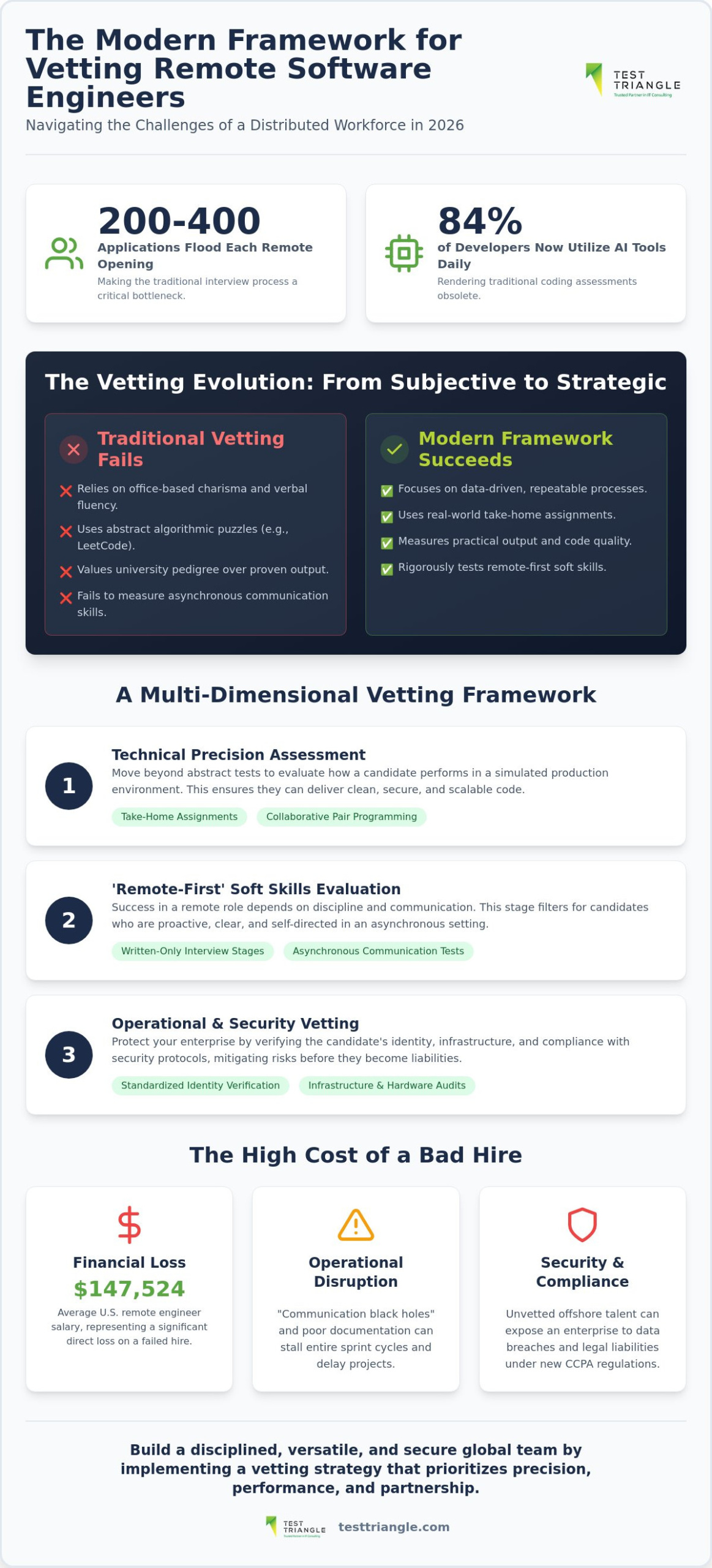
With an average of 200 to 400 applications flooding every remote developer opening in 2026, the traditional interview process has become a bottleneck rather than a filter. Learning how to vet remote software engineers effectively is no longer just a recruitment task; it’s a strategic imperative for maintaining digital stability and operational excellence. You’ve likely felt the sting of high turnover when a candidate’s impressive interview performance fails to translate into actual output. This gap, coupled with the increasing complexity of data privacy mandates like the updated CCPA regulations, creates a landscape where hiring mistakes are both costly and risky.
We understand that enterprise growth relies on precision, performance, and partnership. This framework will empower you to master a multi-dimensional vetting strategy designed to secure elite talent while insulating your infrastructure from technical and operational risks. You’ll gain a repeatable process that reduces time-to-hire and ensures every new engineer possesses the remote-first soft skills necessary for long-term success. By prioritizing technical rigor alongside asynchronous communication, you can build a global team that is disciplined, versatile, and secure.
Key Takeaways
- Replace abstract algorithmic testing with real-world take-home assignments and collaborative pair programming to accurately measure a candidate’s technical precision and practical output.
- Evaluate critical “Remote-First” soft skills by utilizing written-only interview stages that rigorously test a candidate’s capacity for proactive, asynchronous communication.
- Learn how to vet remote software engineers effectively through a multi-stage framework that balances technical expertise with operational security and hardware compliance.
- Mitigate global recruitment risks by implementing standardized identity verification and infrastructure audits for offshore resources to maintain institutional stability.
- Accelerate your digital transformation by partnering with a strategic collaborator who integrates recruitment outsourcing with technical consulting to deliver scalable, high-quality engineering talent.
The Evolution of Remote Engineering Vetting in 2026
In the current distributed environment, The Evolution of Remote Engineering Vetting in 2026 has transitioned from a simple talent acquisition task into a rigorous, multi-stage risk mitigation process. Global enterprises now recognize that technical proficiency alone is insufficient to guarantee project stability or security compliance. To understand how to vet remote software engineers effectively, leadership must view the process as a comprehensive audit of a candidate’s ability to operate within complex, often asynchronous, digital ecosystems. This shift requires moving beyond “skill-checking” syntax and toward “system-thinking” evaluations that measure how an engineer integrates their output into larger architectural frameworks and team workflows.
The rise of generative AI has fundamentally altered this landscape, as approximately 84% of developers now utilize AI tools in their daily work. This high adoption rate means that traditional coding assessments are often compromised by automated assistance. Modern vetting protocols must therefore pivot to evaluate a candidate’s capacity to validate, debug, and secure AI-generated code rather than merely assessing their ability to write it from scratch. By focusing on these high-level oversight capabilities, organizations ensure they are hiring engineers who provide strategic value rather than those who simply manage tool outputs.
Why Traditional Interviewing Fails Remote Talent
Standard 1:1 interviews often reward office-based charisma and verbal fluency, traits that rarely correlate with the deep work and self-direction required for remote success. High-pressure live coding sessions ignore the reality of modern engineering, where developers thrive in quiet, focused environments with access to documentation and collaborative tools. Relying on an elite university pedigree or past employment at “Big Tech” firms frequently results in a misalignment between interview performance and actual remote output. Remote Vetting Maturity is the institutional capacity to validate technical aptitude, asynchronous communication, and operational security through a standardized, data-driven framework that eliminates subjective bias.
The Risks of Poor Vetting in Distributed Teams
A failed hire in a remote setting carries significant financial and operational burdens, especially when the average U.S. remote software engineer salary has reached $147,524. Beyond the direct loss of capital, unvetted engineers can create “communication black holes” where lack of documentation and proactive updates stall entire sprint cycles. Security and compliance present even greater dangers. With new 2026 regulations like the updated CCPA requiring mandatory cybersecurity audits, hiring offshore talent without rigorous background checks and infrastructure verification can expose an enterprise to severe legal liabilities and data breaches. Integrating professional IT staffing services helps mitigate these risks by providing a steady hand in a fast-changing technological landscape.
Multi-Dimensional Technical Assessment Strategies
Mastering how to vet remote software engineers effectively requires a transition from isolated coding puzzles to holistic technical evaluations. In an era where over 50% of developers interact with AI tools daily, testing for syntax memorization has become obsolete. Instead, enterprises must deploy assessments that simulate the architectural complexity and legacy debt found in actual production environments. This multi-dimensional approach ensures that a candidate’s technical precision aligns with the long-term scalability goals of the organization, providing the peace of mind that comes from a resilient digital infrastructure.
Moving Beyond LeetCode: Real-World Problem Solving
Effective vetting prioritizes take-home assignments that mirror actual sprint tickets rather than abstract algorithmic challenges. These tasks should require the candidate to implement a feature while adhering to specific software and digital assurance testing standards, ensuring they prioritize quality, security, and performance from the first line of code. Clear expectations for documentation are essential; a remote engineer’s ability to explain their logic in writing is just as critical as the code itself. While AI-detection tools can provide useful context, they should be used to facilitate a discussion about how the candidate validates and tests AI-assisted output, reflecting the reality of modern development workflows where human oversight remains the final safeguard.
Code Review and Collaborative Debugging Exercises
Collaborative pair programming sessions within a remote-first tool environment reveal how an engineer navigates existing, complex codebases. This stage allows managers to evaluate the candidate’s ability to identify technical debt and communicate its impact to stakeholders who may not have a technical background. Proficiency with version control and CI/CD pipelines is non-negotiable for distributed teams where automated deployment is the standard for operational efficiency. Observing how a candidate gives and receives constructive feedback during a code review session provides deep insight into their professional maturity and potential for seamless team integration.
Securing top-tier talent involves more than just identifying skill sets; it requires a strategic partner who understands the nuances of global technical recruitment. If you are looking to refine your engineering pipeline with disciplined, versatile, and high-performing experts, you can connect with our strategic consulting team to explore tailored staffing solutions that prioritize stability, precision, and growth.
Evaluating ‘Remote-First’ Soft Skills and Cultural Synchronization
While technical precision forms the foundation of a successful hire, the ability to thrive in a distributed environment depends entirely on a specific subset of “remote-first” soft skills. In the 2026 landscape, where 53% of remote-capable workers operate in hybrid or fully remote models, the primary challenge is no longer just finding talent, but identifying engineers who possess the self-discipline and proactive nature required for isolated deep work. Understanding how to vet remote software engineers effectively involves a shift in focus from synchronous verbal fluency to asynchronous written mastery. This ensures that your global team maintains institutional stability through Clarity, Consistency, and Contribution, even when working across disparate time zones and cultural contexts.
Asynchronous Communication and Documentation Proficiency
In a distributed ecosystem, high-quality documentation is a non-negotiable requirement rather than an optional task. We recommend conducting a “Slack-style” interview stage where candidates must respond to technical prompts and project updates via written chat. This exercise allows hiring managers to gauge the candidate’s written clarity, professional tone, and ability to convey complex ideas without the aid of real-time verbal cues. Reviewing a candidate’s past contributions to README files or internal wikis provides tangible evidence of their “Documentation-First” mentality. By integrating these evaluations into your Atlassian consulting workflows, you can ensure that every new hire contributes to a searchable, scalable knowledge base that empowers the entire organization.
Self-Management and Proactive Problem Ownership
Vetting for high individual agency is critical for teams where direct supervision is minimal and project success relies on personal accountability. During behavioral assessments, focus on questions that reveal how a candidate “unblocks” themselves when they encounter a technical hurdle in isolation. You should look for a “Solve-and-report” mindset, where the engineer takes initiative to find a solution and documents the process, rather than a “Wait-and-see” attitude that leads to costly sprint delays. Red flags often include a lack of curiosity about the broader business impact or a history of relying on synchronous meetings to define daily tasks. An engineer who proactively manages their time and communicates progress without prompting is essential for maintaining the operational efficiency promised to your stakeholders.
Strategic growth in a global market requires engineers who are not only technically gifted but also culturally adaptable. Evaluating a candidate’s awareness of cultural nuances and their ability to synchronize with various time zones prevents the formation of communication silos. This disciplined approach to vetting ensures that your remote engineering team functions as a cohesive, versatile unit capable of driving long-term technological evolution.
Operational Vetting: Security, Compliance, and Infrastructure
Operational vetting serves as the critical final layer of defense for global enterprises looking to maintain digital integrity within a distributed workforce. While previous stages focus on technical aptitude and soft skill synchronization, learning how to vet remote software engineers effectively at the enterprise level demands a rigorous audit of the candidate’s physical and digital workspace. This phase mitigates the risks associated with data breaches and intellectual property theft, ensuring that every addition to your workforce aligns with established institutional standards for security, governance, and compliance.
Data Security and Intellectual Property Protection
Vetting for secure coding practices is no longer an elective skill; it’s a fundamental requirement for protecting sensitive customer data and maintaining the peace of mind derived from risk reduction. During this stage, managers must verify the candidate’s understanding of vulnerability management and encryption protocols to ensure alignment with global standards like GDPR and the 2026 CCPA updates. Implementing strict NDAs and IP assignment agreements before sharing any proprietary codebase is essential for long-term stability. Organizations can utilize IT Service Management solutions to establish secure remote access protocols, providing the oversight necessary to monitor resource activity without compromising the speed of digital transformation.
Verifying Remote Infrastructure and Tool Proficiency
A candidate’s technical brilliance is effectively neutralized if their remote infrastructure lacks the stability required for high-load engineering tasks. This requires a formal verification of internet redundancy, hardware security, and the ability to operate within secure virtual desktop environments or encrypted VPNs. Proficiency with industry-standard platforms is equally vital. Assessing a candidate’s familiarity with Atlassian implementation ensures they can navigate complex project tracking and documentation workflows from day one. This practical verification confirms that the engineer possesses the “tools of the trade” necessary for scalable growth in a fast-changing technological landscape.
Beyond the hardware, identity verification remains a cornerstone of offshore recruitment, especially as transparency obligations under the EU AI Act take full effect in August 2026. Conducting thorough background checks and verifying professional credentials through official channels protects the organization from the “black hole” effect of unvetted talent. By treating operational vetting as a strategic audit rather than a mere formality, technical leaders can build teams that are not only productive but also resilient and compliant. To ensure your engineering pipeline meets these rigorous security benchmarks, consult with our recruitment experts to implement a secure, globally-minded staffing strategy.
Scaling Your Remote Engineering Team with Test Triangle
Scaling a distributed workforce in 2026 requires more than just a high volume of candidates; it demands a disciplined approach to talent integration that aligns with your institutional goals. While the previous sections outlined the complexities of technical and operational audits, executing this framework internally can strain HR resources and delay critical project timelines. Test Triangle provides a sophisticated alternative by offering staffing solutions that function as an extension of your own leadership team. We don’t just provide resources. We deliver strategic partners who are pre-vetted for technical precision and remote-first synchronization, ensuring your digital infrastructure remains resilient during periods of rapid growth.
Our methodology ensures that every engineer is equipped to integrate seamlessly into your established DevOps Consulting workflows. By combining deep technical consulting with recruitment expertise, we bridge the gap between initial hiring and long-term value creation. This dual approach allows your organization to maintain operational efficiency while pursuing large-scale digital transformation. When you understand how to vet remote software engineers effectively through a professional partner, you gain the freedom to focus on high-level strategy while we manage the intricacies of talent validation and technical alignment.
Our Managed Outsourcing and Staffing Methodology
Our proprietary vetting process exceeds standard recruitment by focusing on Precision, Performance, and Partnership. We leverage a global footprint to identify niche engineering talent across any time zone, ensuring that your team maintains 24/7 momentum without the friction of cultural or communication silos. Whether you require contract-based expertise for a specific project, remote/offshore teams for cost-efficiency, or permanent placements for long-term stability, our flexible staffing models adapt to your specific operational needs. Every candidate undergoes a rigorous pre-vetting phase that includes technical simulations and an audit of their remote-readiness, providing you with a shortlist of only the most qualified professionals.
From Vetting to Value: Ensuring Long-Term Retention
The journey doesn’t end once the contract is signed. We prioritize the long-term success of your engineering team by providing continuous performance monitoring and support, which significantly reduces the turnover risks common in remote roles. By handling the administrative burden of global compliance, payroll, and the evolving 2026 data privacy regulations, we empower your technical managers to focus on innovation rather than paperwork. This comprehensive support structure ensures that your remote engineers remain engaged, productive, and aligned with your corporate vision. Discover how Test Triangle vets and manages elite remote engineering teams.
Building a Resilient Remote Engineering Ecosystem
Securing elite talent in a distributed landscape requires a transition from traditional recruitment to a comprehensive, multi-dimensional audit of technical and operational readiness. By prioritizing real-world assessments and asynchronous communication proficiency, organizations can bridge the gap between interview performance and actual production output. Mastering how to vet remote software engineers effectively ensures that your digital infrastructure remains robust while mitigating the security and compliance risks inherent in global talent acquisition. This strategic approach provides the peace of mind necessary for sustainable growth in highly regulated sectors like Pharma and Finance.
As an Atlassian Gold Solution Partner with a global presence across Europe, North America, and Asia, Test Triangle serves as a reliable long-term collaborator for enterprises navigating complex digital transformations. Our disciplined methodology guarantees that every placement aligns with your specific technical benchmarks and security standards. We empower your organization to focus on high-level innovation by providing the steady hand needed to manage global engineering resources with Stability, Security, and Scalability. It’s time to optimize your distributed workforce with a partner who understands the nuances of enterprise-grade engineering.
Secure Vetted Remote Engineering Talent with Test Triangle
Frequently Asked Questions
How do you verify if a remote software engineer is using AI to cheat on a technical test?
Shift from assessing the final code output to evaluating the candidate’s logic and validation process. Since approximately 84% of developers now use AI tools, the goal isn’t to ban them but to ensure the engineer can debug, test, and explain the AI-generated logic. Use follow-up code review sessions where the candidate must justify architectural choices and explain technical debt. This approach reveals whether they truly understand the system or are simply managing tool outputs.
What are the most important soft skills for a remote software engineer in 2026?
Asynchronous communication, proactive agency, and “Documentation-First” mentalities are the most critical traits for distributed success. Engineers must be able to unblock themselves in isolation and provide clear, written updates that maintain institutional knowledge. This ensures project momentum continues even when team members are offline. Vetting for these skills is a vital part of learning how to vet remote software engineers effectively to prevent communication silos and costly sprint delays.
How long should a thorough remote vetting process take?
A comprehensive enterprise vetting process typically spans 10 to 20 business days from the initial screen to the final offer. This duration allows for multi-stage technical assessments, background checks, and operational infrastructure audits without compromising quality. While the average number of applications for remote roles has reached 200 to 400 in 2026, specialized partners can help reduce this time-to-hire by providing pre-vetted candidates who already meet your specific security and technical benchmarks.
What is the best way to conduct technical interviews for offshore engineers in different time zones?
Utilize a mix of asynchronous assessments and strategic, overlapping interview windows to accommodate global schedules. Start with written “Slack-style” technical prompts and take-home projects that mirror actual tickets. This allows you to evaluate their output in a real-world setting. When live interaction is required, use collaborative environments within platforms like Atlassian to observe their problem-solving process in real-time, ensuring they can synchronize with your existing DevOps workflows.
Should I use take-home assignments or live coding for remote vetting?
A hybrid strategy is most effective for modern enterprise requirements. Take-home assignments allow candidates to demonstrate deep work and documentation skills in a low-pressure environment, which is the reality of remote work. Conversely, short live coding or pair programming sessions are essential for vetting collaborative debugging and real-time communication. This balanced approach ensures you evaluate both the technical precision and the interpersonal versatility required for long-term project stability.
How do you vet for security and compliance when hiring remote engineers globally?
Conduct rigorous infrastructure audits and identity verification to ensure alignment with global standards like GDPR and the 2026 CCPA updates. You must verify that the candidate’s remote workspace meets hardware security requirements and that they can operate within encrypted VPNs. Implementing formal privacy risk assessments is mandatory as of January 1, 2026, for high-risk data activities. Professional staffing partners help mitigate these risks by managing the administrative burden of global compliance and payroll.

Article by
Paul Guy
Paul serves as the Marketing Director at Test Triangle, where he leads a global team in driving growth through strategic B2B marketing and brand communications. With a strong emphasis on measurable outcomes and sustainable performance, he plays a pivotal role in aligning marketing functions to enhance customer engagement and accelerate business impact. Under his leadership, marketing initiatives have consistently delivered significant returns on investment, elevated brand visibility, and strengthened the company's presence across key markets.