
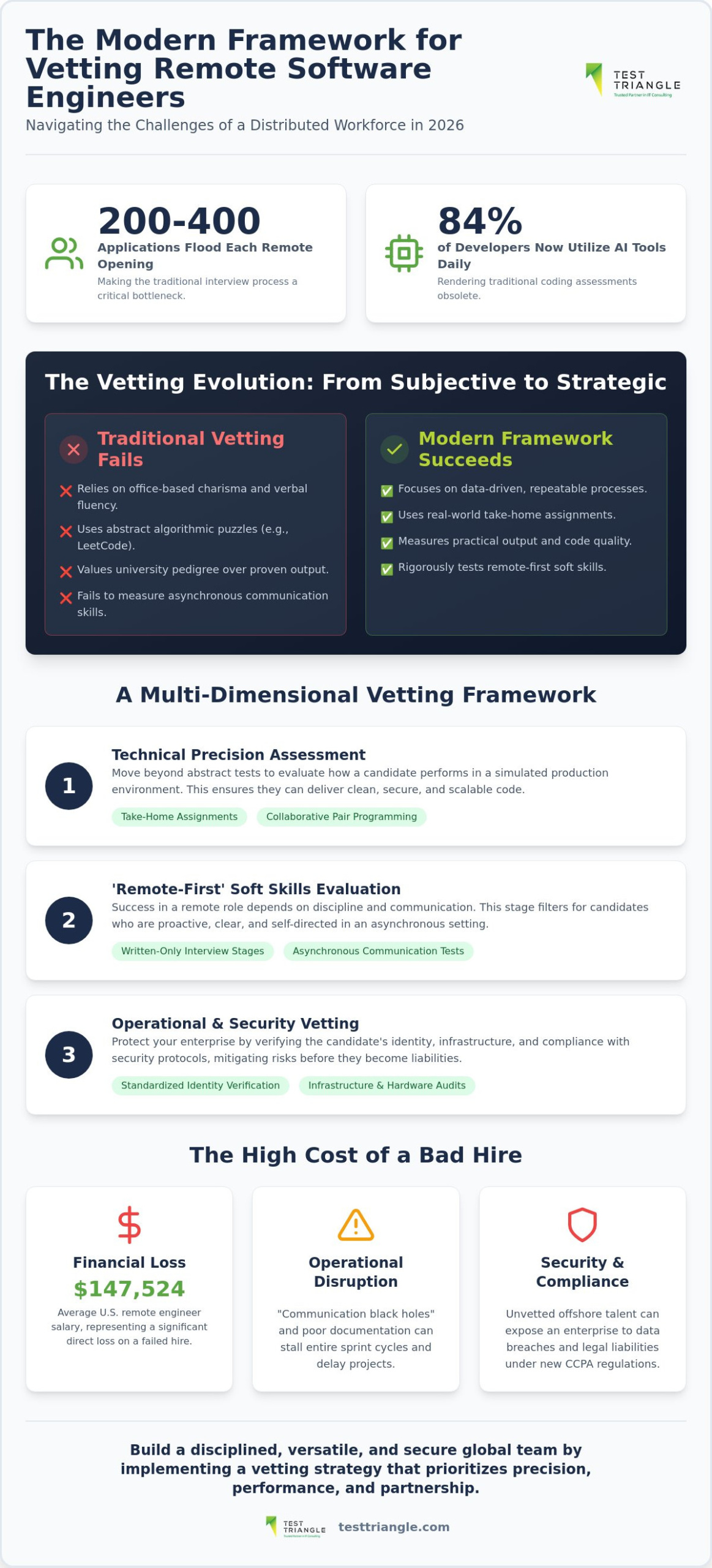
With an average of 200 to 400 applications flooding every remote developer opening in 2026, the traditional interview process has become a bottleneck rather than a filter. Learning how to vet remote software engineers effectively is no longer just a recruitment task; it’s a strategic imperative for maintaining digital stability and operational excellence. You’ve likely felt the sting of high turnover when a candidate’s impressive interview performance fails to translate into actual output. This gap, coupled with the increasing complexity of data privacy mandates like the updated CCPA regulations, creates a landscape where hiring mistakes are both costly and risky.

We understand that enterprise growth relies on precision, performance, and partnership. This framework will empower you to master a multi-dimensional vetting strategy designed to secure elite talent while insulating your infrastructure from technical and operational risks. You’ll gain a repeatable process that reduces time-to-hire and ensures every new engineer possesses the remote-first soft skills necessary for long-term success. By prioritizing technical rigor alongside asynchronous communication, you can build a global team that is disciplined, versatile, and secure.

Key Takeaways

  • Replace abstract algorithmic testing with real-world take-home assignments and collaborative pair programming to accurately measure a candidate’s technical precision and practical output.
  • Evaluate critical “Remote-First” soft skills by utilizing written-only interview stages that rigorously test a candidate’s capacity for proactive, asynchronous communication.
  • Learn how to vet remote software engineers effectively through a multi-stage framework that balances technical expertise with operational security and hardware compliance.
  • Mitigate global recruitment risks by implementing standardized identity verification and infrastructure audits for offshore resources to maintain institutional stability.
  • Accelerate your digital transformation by partnering with a strategic collaborator who integrates recruitment outsourcing with technical consulting to deliver scalable, high-quality engineering talent.

The Evolution of Remote Engineering Vetting in 2026

In the current distributed environment, The Evolution of Remote Engineering Vetting in 2026 has transitioned from a simple talent acquisition task into a rigorous, multi-stage risk mitigation process. Global enterprises now recognize that technical proficiency alone is insufficient to guarantee project stability or security compliance. To understand how to vet remote software engineers effectively, leadership must view the process as a comprehensive audit of a candidate’s ability to operate within complex, often asynchronous, digital ecosystems. This shift requires moving beyond “skill-checking” syntax and toward “system-thinking” evaluations that measure how an engineer integrates their output into larger architectural frameworks and team workflows.

The rise of generative AI has fundamentally altered this landscape, as approximately 84% of developers now utilize AI tools in their daily work. This high adoption rate means that traditional coding assessments are often compromised by automated assistance. Modern vetting protocols must therefore pivot to evaluate a candidate’s capacity to validate, debug, and secure AI-generated code rather than merely assessing their ability to write it from scratch. By focusing on these high-level oversight capabilities, organizations ensure they are hiring engineers who provide strategic value rather than those who simply manage tool outputs.

Why Traditional Interviewing Fails Remote Talent

Standard 1:1 interviews often reward office-based charisma and verbal fluency, traits that rarely correlate with the deep work and self-direction required for remote success. High-pressure live coding sessions ignore the reality of modern engineering, where developers thrive in quiet, focused environments with access to documentation and collaborative tools. Relying on an elite university pedigree or past employment at “Big Tech” firms frequently results in a misalignment between interview performance and actual remote output. Remote Vetting Maturity is the institutional capacity to validate technical aptitude, asynchronous communication, and operational security through a standardized, data-driven framework that eliminates subjective bias.

The Risks of Poor Vetting in Distributed Teams

A failed hire in a remote setting carries significant financial and operational burdens, especially when the average U.S. remote software engineer salary has reached $147,524. Beyond the direct loss of capital, unvetted engineers can create “communication black holes” where lack of documentation and proactive updates stall entire sprint cycles. Security and compliance present even greater dangers. With new 2026 regulations like the updated CCPA requiring mandatory cybersecurity audits, hiring offshore talent without rigorous background checks and infrastructure verification can expose an enterprise to severe legal liabilities and data breaches. Integrating professional IT staffing services helps mitigate these risks by providing a steady hand in a fast-changing technological landscape.

Multi-Dimensional Technical Assessment Strategies

Mastering how to vet remote software engineers effectively requires a transition from isolated coding puzzles to holistic technical evaluations. In an era where over 50% of developers interact with AI tools daily, testing for syntax memorization has become obsolete. Instead, enterprises must deploy assessments that simulate the architectural complexity and legacy debt found in actual production environments. This multi-dimensional approach ensures that a candidate’s technical precision aligns with the long-term scalability goals of the organization, providing the peace of mind that comes from a resilient digital infrastructure.

Moving Beyond LeetCode: Real-World Problem Solving

Effective vetting prioritizes take-home assignments that mirror actual sprint tickets rather than abstract algorithmic challenges. These tasks should require the candidate to implement a feature while adhering to specific software and digital assurance testing standards, ensuring they prioritize quality, security, and performance from the first line of code. Clear expectations for documentation are essential; a remote engineer’s ability to explain their logic in writing is just as critical as the code itself. While AI-detection tools can provide useful context, they should be used to facilitate a discussion about how the candidate validates and tests AI-assisted output, reflecting the reality of modern development workflows where human oversight remains the final safeguard.

Code Review and Collaborative Debugging Exercises

Collaborative pair programming sessions within a remote-first tool environment reveal how an engineer navigates existing, complex codebases. This stage allows managers to evaluate the candidate’s ability to identify technical debt and communicate its impact to stakeholders who may not have a technical background. Proficiency with version control and CI/CD pipelines is non-negotiable for distributed teams where automated deployment is the standard for operational efficiency. Observing how a candidate gives and receives constructive feedback during a code review session provides deep insight into their professional maturity and potential for seamless team integration.

Securing top-tier talent involves more than just identifying skill sets; it requires a strategic partner who understands the nuances of global technical recruitment. If you are looking to refine your engineering pipeline with disciplined, versatile, and high-performing experts, you can connect with our strategic consulting team to explore tailored staffing solutions that prioritize stability, precision, and growth.

Evaluating ‘Remote-First’ Soft Skills and Cultural Synchronization

While technical precision forms the foundation of a successful hire, the ability to thrive in a distributed environment depends entirely on a specific subset of “remote-first” soft skills. In the 2026 landscape, where 53% of remote-capable workers operate in hybrid or fully remote models, the primary challenge is no longer just finding talent, but identifying engineers who possess the self-discipline and proactive nature required for isolated deep work. Understanding how to vet remote software engineers effectively involves a shift in focus from synchronous verbal fluency to asynchronous written mastery. This ensures that your global team maintains institutional stability through Clarity, Consistency, and Contribution, even when working across disparate time zones and cultural contexts.

Asynchronous Communication and Documentation Proficiency

In a distributed ecosystem, high-quality documentation is a non-negotiable requirement rather than an optional task. We recommend conducting a “Slack-style” interview stage where candidates must respond to technical prompts and project updates via written chat. This exercise allows hiring managers to gauge the candidate’s written clarity, professional tone, and ability to convey complex ideas without the aid of real-time verbal cues. Reviewing a candidate’s past contributions to README files or internal wikis provides tangible evidence of their “Documentation-First” mentality. By integrating these evaluations into your Atlassian consulting workflows, you can ensure that every new hire contributes to a searchable, scalable knowledge base that empowers the entire organization.

Self-Management and Proactive Problem Ownership

Vetting for high individual agency is critical for teams where direct supervision is minimal and project success relies on personal accountability. During behavioral assessments, focus on questions that reveal how a candidate “unblocks” themselves when they encounter a technical hurdle in isolation. You should look for a “Solve-and-report” mindset, where the engineer takes initiative to find a solution and documents the process, rather than a “Wait-and-see” attitude that leads to costly sprint delays. Red flags often include a lack of curiosity about the broader business impact or a history of relying on synchronous meetings to define daily tasks. An engineer who proactively manages their time and communicates progress without prompting is essential for maintaining the operational efficiency promised to your stakeholders.

Strategic growth in a global market requires engineers who are not only technically gifted but also culturally adaptable. Evaluating a candidate’s awareness of cultural nuances and their ability to synchronize with various time zones prevents the formation of communication silos. This disciplined approach to vetting ensures that your remote engineering team functions as a cohesive, versatile unit capable of driving long-term technological evolution.

Operational Vetting: Security, Compliance, and Infrastructure

Operational vetting serves as the critical final layer of defense for global enterprises looking to maintain digital integrity within a distributed workforce. While previous stages focus on technical aptitude and soft skill synchronization, learning how to vet remote software engineers effectively at the enterprise level demands a rigorous audit of the candidate’s physical and digital workspace. This phase mitigates the risks associated with data breaches and intellectual property theft, ensuring that every addition to your workforce aligns with established institutional standards for security, governance, and compliance.

Data Security and Intellectual Property Protection

Vetting for secure coding practices is no longer an elective skill; it’s a fundamental requirement for protecting sensitive customer data and maintaining the peace of mind derived from risk reduction. During this stage, managers must verify the candidate’s understanding of vulnerability management and encryption protocols to ensure alignment with global standards like GDPR and the 2026 CCPA updates. Implementing strict NDAs and IP assignment agreements before sharing any proprietary codebase is essential for long-term stability. Organizations can utilize IT Service Management solutions to establish secure remote access protocols, providing the oversight necessary to monitor resource activity without compromising the speed of digital transformation.

Verifying Remote Infrastructure and Tool Proficiency

A candidate’s technical brilliance is effectively neutralized if their remote infrastructure lacks the stability required for high-load engineering tasks. This requires a formal verification of internet redundancy, hardware security, and the ability to operate within secure virtual desktop environments or encrypted VPNs. Proficiency with industry-standard platforms is equally vital. Assessing a candidate’s familiarity with Atlassian implementation ensures they can navigate complex project tracking and documentation workflows from day one. This practical verification confirms that the engineer possesses the “tools of the trade” necessary for scalable growth in a fast-changing technological landscape.

Beyond the hardware, identity verification remains a cornerstone of offshore recruitment, especially as transparency obligations under the EU AI Act take full effect in August 2026. Conducting thorough background checks and verifying professional credentials through official channels protects the organization from the “black hole” effect of unvetted talent. By treating operational vetting as a strategic audit rather than a mere formality, technical leaders can build teams that are not only productive but also resilient and compliant. To ensure your engineering pipeline meets these rigorous security benchmarks, consult with our recruitment experts to implement a secure, globally-minded staffing strategy.
How to Vet Remote Software Engineers Effectively: The 2026 Enterprise Framework

Scaling Your Remote Engineering Team with Test Triangle

Scaling a distributed workforce in 2026 requires more than just a high volume of candidates; it demands a disciplined approach to talent integration that aligns with your institutional goals. While the previous sections outlined the complexities of technical and operational audits, executing this framework internally can strain HR resources and delay critical project timelines. Test Triangle provides a sophisticated alternative by offering staffing solutions that function as an extension of your own leadership team. We don’t just provide resources. We deliver strategic partners who are pre-vetted for technical precision and remote-first synchronization, ensuring your digital infrastructure remains resilient during periods of rapid growth.

Our methodology ensures that every engineer is equipped to integrate seamlessly into your established DevOps Consulting workflows. By combining deep technical consulting with recruitment expertise, we bridge the gap between initial hiring and long-term value creation. This dual approach allows your organization to maintain operational efficiency while pursuing large-scale digital transformation. When you understand how to vet remote software engineers effectively through a professional partner, you gain the freedom to focus on high-level strategy while we manage the intricacies of talent validation and technical alignment.

Our Managed Outsourcing and Staffing Methodology

Our proprietary vetting process exceeds standard recruitment by focusing on Precision, Performance, and Partnership. We leverage a global footprint to identify niche engineering talent across any time zone, ensuring that your team maintains 24/7 momentum without the friction of cultural or communication silos. Whether you require contract-based expertise for a specific project, remote/offshore teams for cost-efficiency, or permanent placements for long-term stability, our flexible staffing models adapt to your specific operational needs. Every candidate undergoes a rigorous pre-vetting phase that includes technical simulations and an audit of their remote-readiness, providing you with a shortlist of only the most qualified professionals.

From Vetting to Value: Ensuring Long-Term Retention

The journey doesn’t end once the contract is signed. We prioritize the long-term success of your engineering team by providing continuous performance monitoring and support, which significantly reduces the turnover risks common in remote roles. By handling the administrative burden of global compliance, payroll, and the evolving 2026 data privacy regulations, we empower your technical managers to focus on innovation rather than paperwork. This comprehensive support structure ensures that your remote engineers remain engaged, productive, and aligned with your corporate vision. Discover how Test Triangle vets and manages elite remote engineering teams.

Building a Resilient Remote Engineering Ecosystem

Securing elite talent in a distributed landscape requires a transition from traditional recruitment to a comprehensive, multi-dimensional audit of technical and operational readiness. By prioritizing real-world assessments and asynchronous communication proficiency, organizations can bridge the gap between interview performance and actual production output. Mastering how to vet remote software engineers effectively ensures that your digital infrastructure remains robust while mitigating the security and compliance risks inherent in global talent acquisition. This strategic approach provides the peace of mind necessary for sustainable growth in highly regulated sectors like Pharma and Finance.

As an Atlassian Gold Solution Partner with a global presence across Europe, North America, and Asia, Test Triangle serves as a reliable long-term collaborator for enterprises navigating complex digital transformations. Our disciplined methodology guarantees that every placement aligns with your specific technical benchmarks and security standards. We empower your organization to focus on high-level innovation by providing the steady hand needed to manage global engineering resources with Stability, Security, and Scalability. It’s time to optimize your distributed workforce with a partner who understands the nuances of enterprise-grade engineering.

Secure Vetted Remote Engineering Talent with Test Triangle

Frequently Asked Questions

How do you verify if a remote software engineer is using AI to cheat on a technical test?

Shift from assessing the final code output to evaluating the candidate’s logic and validation process. Since approximately 84% of developers now use AI tools, the goal isn’t to ban them but to ensure the engineer can debug, test, and explain the AI-generated logic. Use follow-up code review sessions where the candidate must justify architectural choices and explain technical debt. This approach reveals whether they truly understand the system or are simply managing tool outputs.

What are the most important soft skills for a remote software engineer in 2026?

Asynchronous communication, proactive agency, and “Documentation-First” mentalities are the most critical traits for distributed success. Engineers must be able to unblock themselves in isolation and provide clear, written updates that maintain institutional knowledge. This ensures project momentum continues even when team members are offline. Vetting for these skills is a vital part of learning how to vet remote software engineers effectively to prevent communication silos and costly sprint delays.

How long should a thorough remote vetting process take?

A comprehensive enterprise vetting process typically spans 10 to 20 business days from the initial screen to the final offer. This duration allows for multi-stage technical assessments, background checks, and operational infrastructure audits without compromising quality. While the average number of applications for remote roles has reached 200 to 400 in 2026, specialized partners can help reduce this time-to-hire by providing pre-vetted candidates who already meet your specific security and technical benchmarks.

What is the best way to conduct technical interviews for offshore engineers in different time zones?

Utilize a mix of asynchronous assessments and strategic, overlapping interview windows to accommodate global schedules. Start with written “Slack-style” technical prompts and take-home projects that mirror actual tickets. This allows you to evaluate their output in a real-world setting. When live interaction is required, use collaborative environments within platforms like Atlassian to observe their problem-solving process in real-time, ensuring they can synchronize with your existing DevOps workflows.

Should I use take-home assignments or live coding for remote vetting?

A hybrid strategy is most effective for modern enterprise requirements. Take-home assignments allow candidates to demonstrate deep work and documentation skills in a low-pressure environment, which is the reality of remote work. Conversely, short live coding or pair programming sessions are essential for vetting collaborative debugging and real-time communication. This balanced approach ensures you evaluate both the technical precision and the interpersonal versatility required for long-term project stability.

How do you vet for security and compliance when hiring remote engineers globally?

Conduct rigorous infrastructure audits and identity verification to ensure alignment with global standards like GDPR and the 2026 CCPA updates. You must verify that the candidate’s remote workspace meets hardware security requirements and that they can operate within encrypted VPNs. Implementing formal privacy risk assessments is mandatory as of January 1, 2026, for high-risk data activities. Professional staffing partners help mitigate these risks by managing the administrative burden of global compliance and payroll.

Paul Guy

Article by

Paul Guy

Paul serves as the Marketing Director at Test Triangle, where he leads a global team in driving growth through strategic B2B marketing and brand communications. With a strong emphasis on measurable outcomes and sustainable performance, he plays a pivotal role in aligning marketing functions to enhance customer engagement and accelerate business impact. Under his leadership, marketing initiatives have consistently delivered significant returns on investment, elevated brand visibility, and strengthened the company's presence across key markets.

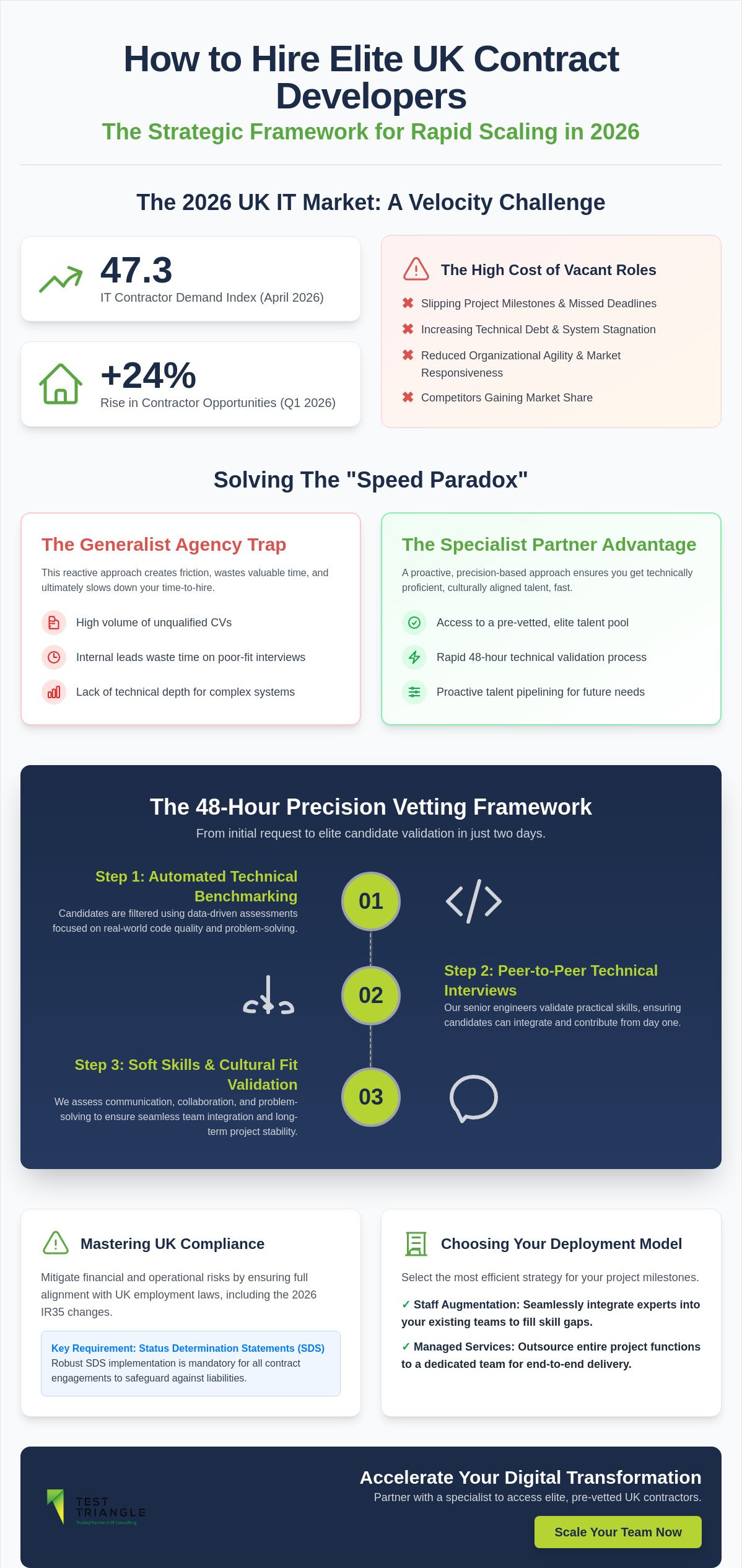

With the UK IT contractor demand index climbing to 47.3 in April 2026, representing the largest month-on-month improvement since early 2025, the race for specialized technical talent has officially intensified. If your critical project milestones are slipping due to a lack of available expertise, you’re likely focused on how to hire contract developers quickly in UK markets while maintaining the high standards your digital infrastructure requires. It’s a common challenge to find that generalist agencies often deliver candidates who lack the technical depth needed for complex, large-scale systems.

We recognize that true operational efficiency requires a balance of speed, precision, and rigorous compliance. This guide empowers you to master the methodologies for rapid technical acquisition while safeguarding your organization against the complexities of the April 2026 IR35 threshold changes and new umbrella company liabilities. You’ll discover a strategic framework for accessing pre-vetted talent pools, ensuring full alignment with UK employment laws, and achieving the seamless project execution necessary for long-term stability and growth.

Key Takeaways

  • Identify the strategic methodologies required for how to hire contract developers quickly in UK tech hubs while maintaining the high standards of quality and security essential for global enterprises.
  • Establish a precision-paced vetting framework that leverages automated technical benchmarks to filter and validate elite candidates within a 48-hour timeframe.
  • Mitigate financial and operational risks by understanding the 2026 IR35 compliance requirements and implementing robust Status Determination Statements for all contract engagements.
  • Analyze the comparative advantages of staff augmentation and managed service models to select the most efficient deployment strategy for your specific project milestones.
  • Accelerate your digital transformation by accessing a pre-vetted talent pool of Atlassian and ServiceNow certified experts who integrate seamlessly into your existing DevOps culture.

The Velocity Gap: Why UK Enterprises Struggle with Rapid Staffing

The UK IT contractor market is currently witnessing a significant resurgence in 2026. With contractor opportunities rising by 24% in the first quarter compared to the previous year, the demand for specialized skills has outpaced traditional recruitment cycles. Many organizations are struggling with how to hire contract developers quickly in UK regions because they rely on outdated “post-and-pray” strategies. These methods fail in a high-velocity landscape where the best talent is secured within days, not weeks. A strategic visionary approach to human capital management is required to bridge this velocity gap and maintain a competitive edge.

Understanding the dynamics of contingent work is no longer just an HR function; it’s a core strategic necessity for digital transformation. High-level corporate leaders now recognize that talent acquisition must be as agile as the software development lifecycles it supports. When recruitment delays occur, the costs extend far beyond the hiring fee. Stagnant projects lead to missed market windows, allowing competitors to capture market share while your internal roadmap remains stalled by a lack of specialized execution.

The True Cost of Empty Seats

When a DevOps engineering role remains vacant, the impact isn’t just a slower roadmap; it’s a compounding increase in technical debt. In 2026, staffing bottlenecks act as a friction point that prevents legacy system modernization. Every day a seat is empty, your organizational agility diminishes. This makes it harder to respond to market shifts or security threats. The IT contractor demand index rose to 47.3 in April 2026, which highlights that your competitors are actively filling these gaps while you may still be reviewing irrelevant applications. Calculating the impact of these delays on deployment cycles often reveals a financial loss that dwarfs the cost of a premium contractor rate.

Generalist vs. Specialist: The Speed Paradox

Generalist agencies often create what we call a “speed paradox.” They provide a high volume of CVs quickly, but the lack of rigorous technical vetting means your internal leads spend more time interviewing unqualified candidates. This friction actually slows down the time-to-hire. This is why many enterprises are shifting toward a reliable long-term collaborator rather than a transactional vendor. By moving from reactive hiring to proactive talent pipelining, you ensure that when a project scales, the expertise is already validated. This transition allows for how to hire contract developers quickly in UK markets to become a repeatable, reliable process rather than a frantic search. Specialized partners understand the nuances of the 2026 tech stack, ensuring that candidates are not just available, but technically proficient and culturally aligned.

Precision-Paced Vetting: A Framework for Rapid Technical Validation

Rapidly scaling a technical team requires a shift from traditional, drawn-out interview cycles to a data-driven validation model. By implementing Software and Digital Assurance Testing methodologies early in the recruitment phase, enterprises can verify a developer’s code quality before they ever reach a formal interview. This approach is vital for organizations seeking how to hire contract developers quickly in UK markets, as it effectively eliminates the guesswork often associated with generalist agency referrals. We prioritize a multi-layered technical assessment that focuses on real-world application, ensuring candidates can handle the complexities of enterprise platforms like Atlassian and ServiceNow.

Peer-to-peer technical interviews serve as a secondary layer of validation, significantly reducing onboarding friction by ensuring the candidate can collaborate within your specific environment. While technical prowess is non-negotiable, validating soft skills such as communication and cross-functional collaboration is equally important for long-term project stability. Before finalizing any contract engagement, it’s essential to use the official Check Employment Status for Tax (CEST) tool to ensure the proposed working arrangement aligns with current IR35 regulations. This proactive compliance check prevents future legal bottlenecks and maintains the momentum of your hiring process.

Automated Vetting: Speed Without Sacrifice

We utilize standardized coding challenges tailored to UK enterprise requirements, allowing us to filter candidates within a 48-hour window. These assessments evaluate proficiency in both Manual Testing and automation principles. Technical Validation is the cornerstone of rapid staffing in 2026, serving as the definitive proof of a candidate’s ability to deliver high-quality code under pressure. By leveraging these automated benchmarks, you can quickly identify top-tier talent without sacrificing the technical rigor your infrastructure demands.

The 72-Hour Onboarding Blueprint

Creating a ‘Plug-and-Play’ environment is necessary for immediate project impact. This involves streamlining documentation, background checks, and hardware provisioning into a consolidated 72-hour workflow. Establishing clear Service Level Agreements (SLAs) with your recruitment partners ensures that administrative hurdles don’t undermine your speed-to-hire. If you’re ready to optimize your technical acquisition and secure elite talent, you can consult with our staffing experts to build a custom vetting and onboarding roadmap that meets your specific project timelines.

Deployment Models Compared: Augmentation, Managed Services, and Offshore Synergy

Selecting the appropriate deployment model is as critical as the initial talent validation. While mastering how to hire contract developers quickly in UK tech ecosystems is essential, the structural framework you choose dictates the long-term scalability of your digital infrastructure. In 2026, UK enterprises are moving away from simple headcount additions toward outcome-based architectures that prioritize flexibility, focus, and flow. The ongoing technical skills shortage has a measurable impact on productivity, making the choice between internal team expansion and external stream management a high-stakes executive decision.

Staff augmentation provides the most direct route for scaling internal teams during immediate project bursts. This model allows technical leads to retain granular control over development methodologies while injecting specialized expertise into existing workflows. It remains a primary strategy for those seeking how to hire contract developers quickly in UK hubs to meet aggressive sprint deadlines. Conversely, managed models offer a way to offload entire workstreams, transferring delivery risk and administrative overhead to a strategic partner who manages the project through to completion.

Staff Augmentation vs. Managed Services

Retaining control is often necessary for core proprietary systems, but outsourcing provides maximum speed for secondary workstreams or platform migrations. Our Managed Outsourcing Services deliver a framework for long-term stability by providing dedicated teams that operate under rigorous Service Level Agreements. Evaluating the ROI of each model requires a deep analysis of project duration, where augmentation excels in short-term bursts and managed services offer better cost-efficiency for sustained, complex evolutions.

The Strategic Value of Remote and Offshore Resources

Hybrid models are the 2026 trend for resilient UK enterprise architectures. By integrating local contract developers with remote offshore resources, organizations can implement a “follow-the-sun” development cycle. This synergy ensures that development and quality assurance continue 24/7, significantly accelerating deployment cycles while maintaining time-zone alignment with UK leadership. Managing this global delivery model requires robust communication protocols and standardized digital assurance testing to ensure that quality remains consistent across all distributed teams, regardless of their physical location.

Compliance is often perceived as a friction point that delays digital evolution, yet it serves as the essential foundation for scalable growth. Mastering how to hire contract developers quickly in UK markets in 2026 requires a deep understanding of the regulatory shifts that took effect on April 6, 2026. Specifically, the increased thresholds for “small” companies, now defined by a turnover of no more than ÂŁ15 million and a balance sheet total of no more than ÂŁ7.5 million, have shifted the responsibility of IR35 status determination for many smaller organizations. For larger global enterprises, the requirement to issue accurate Status Determination Statements (SDS) remains a critical path item that, if managed poorly, can stall a project before the first line of code is written.

Strategic leaders recognize that regulatory hurdles shouldn’t dictate the pace of innovation. By integrating compliance checks directly into the procurement cycle, organizations can maintain project momentum while ensuring full adherence to the Border Security, Asylum and Immigration Act 2025 requirements. This proactive stance on how to hire contract developers quickly in UK regions ensures that your search for talent remains both rapid and resilient, protecting the organization from the joint and several liability risks associated with umbrella company failures that became a primary focus for HMRC in early 2026.

IR35: From Obstacle to Opportunity

A professional IT Staffing Service acts as a strategic buffer, managing the administrative and legal complexities of IR35 so that your internal technical leads can focus on delivery. IR35 compliance is a risk-mitigation tool for UK executives that ensures organizational stability, protects against backdated tax liabilities, and maintains the integrity of the technical supply chain. By standardizing contract templates and automating the SDS workflow, we enable rapid deployment without compromising on regulatory rigor. We’ve found that ‘Inside IR35’ roles remain highly attractive to elite talent when paired with competitive day rates and clear project outcomes, proving that stability, security, and scalability are achievable within a compliant framework.

Security and Intellectual Property Protection

Maintaining enterprise-grade security in a remote contract environment is a multi-dimensional challenge involving data protection, access control, and intellectual property rights. The role of IT Service Management Solutions is pivotal here, providing the structured framework necessary for managing granular permissions and ensuring that contract staff only access the repositories relevant to their specific workstreams. Protecting your assets requires more than just technical barriers; it demands standardized non-disclosure agreements (NDAs) that are ready for immediate signature as part of the 72-hour onboarding blueprint. This proactive stance on GDPR and data security ensures that your rapid scaling efforts don’t inadvertently create vulnerabilities in your digital infrastructure.

Our approach integrates compliance directly into the talent acquisition cycle, turning a potential bottleneck into a streamlined process for technical growth. If you need to navigate these regulatory complexities while maintaining project momentum, contact our compliance and staffing experts today to secure your technical roadmap.

How to Hire Contract Developers Quickly in the UK: A Strategic 2026 Guide

Test Triangle: Your Strategic Partner for Rapid Technical Scaling

Navigating the complexities of the UK technical landscape requires more than just a recruitment agency; it demands a partner who understands the intersection of technical excellence and strategic delivery. We bridge the gap between immediate resource needs and long-term architectural stability by combining DevOps Consulting with elite talent acquisition. Our approach to how to hire contract developers quickly in UK markets is built on a foundation of technical validation, ensuring that every professional we deploy is equipped to handle the rigorous demands of high-regulation sectors like Finance, Healthcare, and Pharma. By aligning our recruitment methodologies with your broader digital transformation goals, we provide the peace of mind that comes from risk reduction and operational stability.

As a reliable long-term collaborator, we prioritize the empowerment of your internal teams through the seamless integration of high-level expertise. Our institutional maturity allows us to operate across diverse, highly regulated industries where precision and scalable growth are non-negotiable. We don’t just fill seats; we provide a steady hand in a fast-changing technological landscape, ensuring that your organizational progress is supported by a combination of human expertise and advanced technical tools. This strategic visionary approach ensures that your search for how to hire contract developers quickly in UK tech hubs results in a high-quality, compliant, and technically proficient workforce.

Niche Expertise in Enterprise Ecosystems

Accelerating your digital transformation depends on the rapid integration of specialists who understand your specific platform ecosystem. Through our Atlassian Implementation services and ServiceNow Consulting Services, we provide access to a pre-vetted pool of certified experts who reduce time-to-value from the moment they’re onboarded. This specialized knowledge ensures that workflows are optimized and technical debt is minimized, allowing your core team to focus on high-level innovation rather than troubleshooting basic integration friction. Our ability to provide niche expertise at pace is what sets us apart as a corporate partner dedicated to your success.

The Test Triangle Advantage

Our ‘Source, Vet, Manage’ methodology is the cornerstone of our service delivery, reflecting our commitment to stability, precision, and pace. Because our DNA is rooted in software and digital assurance, we apply a testing-first mindset to every placement, ensuring higher code quality and operational resilience from day one. We provide a validated solution that aligns with your enterprise-grade standards and regulatory compliance requirements, moving beyond transactional staffing to true strategic partnership. If you’re ready to scale your technical capabilities with precision, contact our UK staffing experts today to secure the elite talent your next project milestone demands.

Scaling for Success: Securing Your Technical Future in 2026

The 2026 UK technology landscape demands an approach that prioritizes speed without compromising on the technical rigor or regulatory compliance essential for enterprise stability. By transitioning from reactive hiring to a proactive, data-driven validation model, organizations can effectively solve the challenge of how to hire contract developers quickly in UK tech hubs. Success hinges on a robust understanding of the latest IR35 thresholds and the implementation of precision-paced vetting frameworks that identify elite talent within days.

Choosing the right deployment model, whether through staff augmentation or managed outsourcing, ensures your digital infrastructure remains resilient and scalable. As an Atlassian Gold Solution Partner and ServiceNow Specialist Partner, we combine niche platform expertise with ISO 9001:2015 and ISO 27001:2013 certified processes to deliver quality at pace. We’re committed to acting as your reliable long-term collaborator, providing the steady hand needed to navigate a fast-changing technical environment and ensure your roadmap remains on track.

Ready to transform your talent acquisition strategy and bridge the velocity gap? Accelerate your project with our elite UK contract developers today and secure your organizational growth with confidence.

Frequently Asked Questions

How quickly can I realistically hire a contract developer in the UK?

You can realistically secure a high-quality developer within 48 to 72 hours when leveraging a pre-vetted talent pool and a streamlined vetting framework. This rapid turnaround is essential for maintaining project momentum and avoiding the stagnation that occurs with traditional recruitment cycles. We achieve this speed by bypassing the friction of generalist agencies, focusing instead on how to hire contract developers quickly in UK markets through technical validation and established pipelines.

What are the current IR35 rules for hiring IT contractors in 2026?

As of April 6, 2026, the thresholds for a company to be considered “small” for IR35 purposes have increased to a turnover of no more than ÂŁ15 million and a balance sheet total of ÂŁ7.5 million. For organizations meeting these criteria, the responsibility for determining IR35 status reverts to the contractor’s own Personal Service Company. Larger enterprises must still provide a robust Status Determination Statement (SDS) to mitigate tax risks and ensure full compliance with HMRC regulations.

How do I ensure a contract developer has the right technical skills?

Ensuring technical proficiency requires a multi-layered assessment that prioritizes real-world application through automated testing benchmarks and peer-to-peer interviews. We utilize a rigorous validation process that filters candidates within 48 hours, focusing on code quality and architectural understanding. This methodology eliminates the “speed paradox” where high candidate volume from generalist agencies actually slows down the hiring process due to a lack of technical depth.

Is it better to hire remote or on-site contract developers in the UK?

Hybrid hiring models are the preferred standard in 2026, offering a balance of organizational agility and access to niche skills. Remote developers allow for “follow-the-sun” development cycles, which accelerate project delivery through 24/7 execution across distributed teams. While on-site staff may be preferred for certain sensitive legacy systems, a remote-first approach often provides superior cost-efficiency and time-zone alignment for global enterprises.

What is the difference between staff augmentation and managed services?

Staff augmentation allows you to scale internal teams for immediate project bursts while retaining granular control over development methodologies. Managed services involve offloading entire workstreams to a strategic partner who manages the project through to completion under strict Service Level Agreements. This distinction is vital when determining how to hire contract developers quickly in UK hubs while balancing delivery risk and administrative overhead for long-term success.

How can I protect my company’s IP when hiring contractors?

Protecting intellectual property requires a combination of standardized non-disclosure agreements (NDAs) and robust IT Service Management (ITSM) access controls. By implementing granular permissions, you ensure that contract staff only access the specific repositories and data required for their assigned workstreams. This disciplined approach maintains high standards of security and keeps your enterprise assets protected throughout the duration of the contract engagement.

Does Test Triangle provide specialized developers for Atlassian and ServiceNow?

Yes, we provide access to a pre-vetted pool of experts specifically certified in the Atlassian and ServiceNow ecosystems. As an Atlassian Gold Solution Partner and ServiceNow Specialist Partner, we ensure that our developers possess the niche expertise required for seamless platform implementation and optimization. This specialized knowledge reduces time-to-value, allowing your organization to achieve stability, precision, and pace from the first day of the engagement.

What are the common pitfalls to avoid in rapid UK tech hiring?

Common pitfalls include relying on generalist agencies that provide irrelevant CVs and failing to prepare for the upcoming October 2026 changes to Right to Work checks. Organizations often struggle when they lack a “plug-and-play” onboarding environment, which leads to compounding technical debt and missed market windows. Partnering with a reliable long-term collaborator ensures that you avoid these bottlenecks through a versatile, globally-minded, and disciplined acquisition strategy.

Paul Guy

Article by

Paul Guy

Paul serves as the Marketing Director at Test Triangle, where he leads a global team in driving growth through strategic B2B marketing and brand communications. With a strong emphasis on measurable outcomes and sustainable performance, he plays a pivotal role in aligning marketing functions to enhance customer engagement and accelerate business impact. Under his leadership, marketing initiatives have consistently delivered significant returns on investment, elevated brand visibility, and strengthened the company's presence across key markets.