



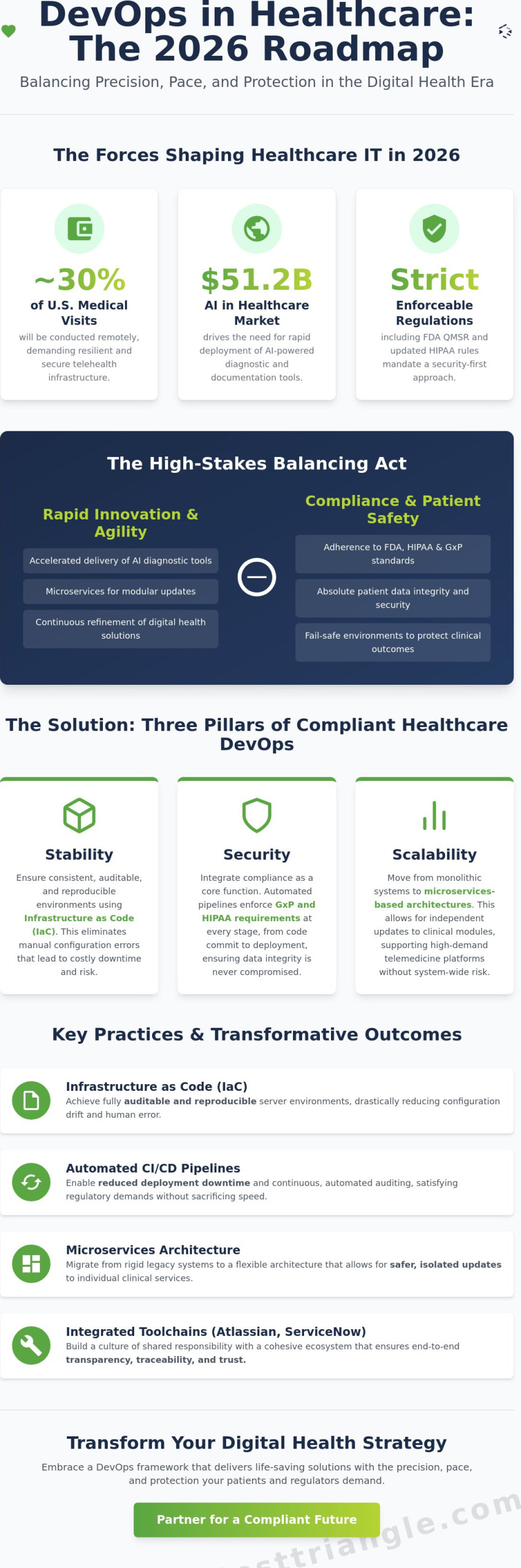
By the end of 2026, nearly 30% of all medical visits in the U.S. will occur remotely, yet many organizations remain shackled by legacy technical debt that threatens both patient safety and regulatory standing. For leadership navigating devops adoption in healthcare industry frameworks, the challenge isn’t just about speed; it’s about maintaining absolute integrity under the FDA’s Quality Management System Regulation (QMSR) that became enforceable on February 2, 2026. You likely feel the tension between the need for rapid digital evolution and the heavy burden of mandatory multi-factor authentication and annual penetration testing required by the latest HIPAA Security Rule updates. It’s a high-stakes environment where the traditional “move fast and break things” mentality is rightfully viewed as a risk to clinical outcomes.
We believe that high-velocity innovation doesn’t have to compromise your compliance posture. This strategic roadmap provides the clarity you need to balance rigorous GxP standards with the agility of modern engineering, transforming your pipeline into a source of automated trust. By integrating sophisticated platforms like Atlassian and ServiceNow into a cohesive ecosystem, your team can achieve reduced deployment downtime and automated auditing. You’ll discover how a disciplined approach to DevOps empowers your organization to deliver life-saving digital solutions with precision, pace, and protection. We’ll preview the essential shifts in AI model governance and ISO/IEC 27001:2022 standards that will define the healthcare landscape through 2026.
Key Takeaways
- To address rising patient expectations for remote monitoring, this guide explores the methodology for migrating from monolithic legacy systems to secure, microservices-based healthcare architectures.
- By implementing Infrastructure as Code within your devops adoption in healthcare industry strategy, your team can ensure that every environment is consistent, auditable, and reproducible.
- By bridging the gap between development agility and validated stability, you will learn to engineer automated pipelines that satisfy stringent GxP and HIPAA requirements without sacrificing deployment frequency.
- Through the integration of industry-leading Atlassian platforms, organizations can build a culture of shared responsibility that ensures every digital health solution is founded on transparency, traceability, and trust.
The Paradigm Shift: Why Healthcare is Embracing DevOps in 2026
The global healthcare sector is undergoing a fundamental restructuring as organizations migrate from rigid, monolithic legacy systems toward agile, microservices-based architectures. This transition is no longer a peripheral IT project; it’s a strategic necessity driven by a global artificial intelligence in healthcare market valued at 51.20 billion dollars in 2026. By decoupling core functionalities, providers can update specific clinical modules without jeopardizing the entire patient data ecosystem. This modular approach aligns with core DevOps principles, allowing for the continuous refinement of digital health tools while maintaining the high standards of safety required in a clinical setting.
Achieving successful devops adoption in healthcare industry frameworks requires a sophisticated understanding of the 2026 regulatory environment. With the FDA’s Quality Management System Regulation (QMSR) having gone into effect on February 2, 2026, cybersecurity is now an enforceable component of medical device quality. Organizations must balance operational efficiency with the mandatory implementation of technical controls, such as the required multi-factor authentication and encryption protocols finalized by the Department of Health and Human Services. The business case is clear: automation isn’t just about speed, it’s about engineering a fail-safe environment where patient safety and data integrity are hard-coded into the deployment process.
Beyond the Pandemic: The 2026 Healthcare IT Landscape
The digital acceleration of the early 2020s left many hospitals with significant technical debt, characterized by fragmented systems and rushed software deployments. By 2026, the focus has shifted from reactive maintenance to a proactive, predictive management model. With remote visits predicted to comprise 25% to 30% of all U.S. medical consultations by the end of this year, the underlying infrastructure must be resilient enough to support high-occupancy telemedicine platforms without latency or security breaches. This requires a transition from manual oversight to automated monitoring that can anticipate system failures before they impact patient care.
Strategic Drivers for DevOps Adoption
The business case for devops adoption in healthcare industry initiatives rests on the dual pillars of risk mitigation and clinical excellence. Automated pipelines eliminate the manual configuration errors that frequently lead to downtime, directly reducing the operational costs associated with system failures. More importantly, these methodologies accelerate the delivery of diagnostic software updates, ensuring that clinicians have access to the latest AI-powered documentation tools. We view these capabilities as fundamental to our broader digital transformation services, positioning technology as a steady hand that guides organizational progress toward scalable growth and enhanced patient outcomes.
The Technical Pillars: Building a Compliant Healthcare DevOps Pipeline
Healthcare DevOps represents a specialized methodology that integrates software development, operations, and compliance into a unified, high-integrity lifecycle. Unlike standard enterprise environments, devops adoption in healthcare industry frameworks must treat regulatory requirements as functional specifications rather than external constraints. This approach ensures that every code commit undergoes rigorous verification before it reaches a clinical setting. By engineering a pipeline that prioritizes stability, security, and scalability, organizations can maintain the pace of innovation required by 2026 market demands without compromising the stringent standards of patient safety.
Infrastructure as Code (IaC) serves as the bedrock of this transformation, allowing teams to define medical environments through version-controlled scripts. This methodology ensures that every deployment is consistent, auditable, and reproducible, which is essential for aligning with the FDA’s Quality Management System Regulation (QMSR). When infrastructure is treated as code, manual configuration errors are eliminated; this provides a clear audit trail that simplifies premarket submissions. Continuous Integration and Deployment (CI/CD) pipelines must be specifically tailored for these validated environments, incorporating automated gates that prevent non-compliant code from advancing through the delivery lifecycle.
Compliance as Code (CaC)
In the 2026 regulatory landscape, manual compliance checks are no longer sufficient to manage the complexity of modern health data. Compliance as Code (CaC) automates the enforcement of HIPAA and GDPR policies directly within the delivery pipeline, ensuring that data at rest and in transit remains encrypted by default. By integrating software and digital assurance testing into the earliest stages of development, teams can identify vulnerability risks before they manifest in production. These automated systems generate real-time auditing logs, providing a transparent record of security posture that satisfies the annual penetration testing mandates of the updated HIPAA Security Rule.
Infrastructure Resilience and Scalability
Modern clinical applications require high-availability architectures that can scale dynamically to meet patient demand. Utilizing cloud-native tools allows for the implementation of self-healing systems that automatically detect and remediate service interruptions, preventing critical downtime during remote surgical procedures or diagnostic sessions. Containerization technologies, such as Docker and Kubernetes, play a vital role in isolating sensitive medical data, ensuring that microservices remain decoupled and secure. This modularity allows for rapid updates to telemedicine platforms while maintaining a hardened perimeter around Electronic Health Records. If you’re ready to modernize your infrastructure, you can discuss your compliance architecture with our strategic advisors to ensure your pipeline is future-proofed for 2026.
High-Impact Applications: Transforming EHR, Telemedicine, and AI
The strategic implementation of devops adoption in healthcare industry frameworks manifests most clearly through the modernization of patient-facing and diagnostic applications. As the global telemedicine market is estimated to exceed 188.93 billion dollars in 2026, the demand for low-latency, high-security connections has become a clinical imperative. Modern DevOps practices enable the seamless automation of Electronic Health Record (EHR) updates, ensuring that critical patient data remains accessible without the disruptive downtime that historically plagued legacy maintenance windows. This creates a foundation of resilience, reliability, and responsiveness that is essential for maintaining continuity of care in high-pressure environments.
Beyond EHRs, the integration of AI-powered diagnostics in radiology and pathology requires a robust MLOps lifecycle to manage model retraining and deployment. With the global artificial intelligence in healthcare market predicted to reach a valuation of approximately 744.34 billion dollars by 2035, managing these complex models through automated pipelines ensures diagnostic accuracy and regulatory alignment. Similarly, pharmacy management systems benefit from streamlined supply chain integrations. Real-time inventory tracking prevents medication shortages and enhances patient safety through precise distribution, illustrating how automation bridges the gap between logistical efficiency and clinical outcomes.
Modernizing EHR with Atlassian and ServiceNow
Effective EHR management requires a high degree of transparency and structured collaboration between IT departments and clinical staff. Utilizing Jira allows organizations to maintain compliance-ready task management, where every modification to a clinical workflow is documented and traceable for future audits. For rapid incident response within these complex systems, leveraging ServiceNow consulting services ensures that EHR anomalies are identified and remediated before they impact patient care. This synergy between industry-leading platforms fosters a culture of institutional accountability, allowing teams to navigate digital transformations with a sense of security and precision.
Scaling AI and Remote Patient Monitoring (RPM)
Remote patient monitoring is set to manage a significant portion of chronic conditions as medical visits shift toward outpatient settings through 2026. Scaling these services requires securing the “Internet of Medical Things” (IoMT) through automated security testing that identifies vulnerabilities across diverse device integrations. By implementing MLOps, healthcare providers can ensure continuous model retraining, which is vital for maintaining the integrity of diagnostic AI. This disciplined approach to model governance ensures that data remains consistent across the entire patient journey, from initial remote consultation to long-term chronic care management, while satisfying the EU AI Act’s requirements for human oversight.
Navigating Regulatory Hurdles: GxP and HIPAA-Ready Automation
Achieving successful devops adoption in healthcare industry frameworks requires a fundamental reconciliation between the velocity of Agile development and the rigidity of GxP validation. While traditional validation processes often relied on manual, paper-based documentation that created significant bottlenecks, modern healthcare DevOps leverages “Compliance as Code” to automate these requirements. By implementing automated verification and validation (V&V) protocols, organizations can ensure that every software iteration meets predefined safety and efficacy standards before it ever reaches a clinical environment. This transition replaces reactive auditing with proactive, continuous compliance, allowing technical managers to maintain a steady hand over increasingly complex digital health ecosystems.
GxP compliance in DevOps is the automated alignment of technical output with regulatory safety standards. Managing risk in this high-stakes environment depends on granular access controls and sophisticated identity management. By restricting system access based on specific clinical or technical roles, organizations can prevent unauthorized modifications that might compromise patient data. This strategy is particularly vital given the 2026 HIPAA Security Rule updates, which have shifted many previously addressable safeguards to mandatory requirements. Through the integration of these controls directly into the deployment pipeline, healthcare providers can achieve a state of Validation, Verification, and Visibility that satisfies both internal stakeholders and external auditors.
GxP-Validated DevOps Pipelines
A validated pipeline must serve as a “Single Source of Truth,” capturing every change control and audit trail automatically. Within a continuous delivery model, the software validation lifecycle is no longer a separate phase but an integrated stream of automated tests and electronic signatures. This ensures that the documentation required for ISO 13485:2016 or QMSR compliance is generated in real-time, reducing the burden on quality assurance teams. For organizations seeking the specialized expertise to build these complex systems, partnering with IT staffing agencies for pharmaceutical industry can provide the compliance-focused talent necessary to bridge the gap between engineering and regulation.
Security by Design in Healthcare
Security by design requires the integration of OWASP standards and automated vulnerability scanning at the very beginning of the development lifecycle. By treating security as a non-negotiable stage of the pipeline, organizations can identify potential breaches before they pose a threat to patient safety. This is especially critical as the 2026 regulatory landscape mandates biannual vulnerability scans and annual penetration testing. Automation ensures these checks are performed consistently and documented thoroughly, providing the peace of mind that comes from a hardened, resilient infrastructure. To begin architecting your compliant pipeline, consult with our DevOps experts today.
Strategic Execution: Partnering for Scalable Digital Transformation
Strategic execution within the healthcare sector requires a deliberate departure from siloed departmental operations toward a culture of shared responsibility. For leadership, successful devops adoption in healthcare industry frameworks depends on the seamless alignment of developers, operations teams, and clinicians. This unified approach ensures that technical decisions are always informed by clinical realities, fostering an environment where innovation serves patient outcomes without compromising safety. By utilizing a robust Atlassian implementation, organizations can achieve the transparency required to manage complex workflows, providing stakeholders with real-time visibility into the development lifecycle and regulatory status of critical health applications.
Building this infrastructure requires more than just tools; it demands a partner who possesses a deep understanding of both high-velocity engineering and the rigid constraints of life sciences. Selecting a collaborator who can provide comprehensive DevOps Consulting ensures that your digital evolution is anchored in institutional maturity rather than temporary fixes. We position ourselves as a reliable long-term collaborator, offering the Precision, Performance, and Peace of mind necessary to navigate the complexities of 2026 and beyond. Measuring maturity involves tracking specific Key Performance Indicators (KPIs) such as deployment frequency for EHR updates, Mean Time to Recovery (MTTR) for clinical systems, and the success rate of automated compliance audits.
Managed Services and Talent Acquisition
The persistent healthcare IT skills gap often prevents organizations from realizing the full potential of their devops adoption in healthcare industry initiatives. Addressing this challenge requires access to engineers who understand the delicate intersection of cloud-native technology and life sciences compliance. By leveraging managed outsourcing services, healthcare providers can augment their teams with specialized talent without the overhead of lengthy recruitment cycles. This strategic staffing model allows for the rapid scaling of automation efforts while maintaining the high standards of quality and security expected in a safety-critical industry.
Phased Implementation Roadmap
Transforming a complex healthcare ecosystem is most effective when approached as a methodical, phased progression. The journey begins with Phase 1, which involves assessing current maturity levels and identifying the legacy constraints that hinder agility. In Phase 2, organizations should establish a compliant pilot pipeline for non-critical systems, allowing teams to refine their automated verification protocols in a controlled environment. Finally, Phase 3 focuses on scaling these validated automation patterns across the entire enterprise. This structured cadence ensures that every step forward is supported by a stable foundation, mirroring the operational efficiency promised to our global partners.
Future-Proofing Healthcare Through Automated Integrity
The 2026 healthcare landscape demands a departure from reactive maintenance toward a future defined by resilience, rigor, and reliability. As we’ve explored, successful devops adoption in healthcare industry frameworks allow organizations to navigate the complexities of QMSR and HIPAA updates while accelerating the delivery of life-saving digital health solutions. By engineering “Automated Trust” through Compliance as Code and high-availability architectures, providers can focus on clinical excellence rather than the fear of regulatory breaches. These methodologies transform technical debt into a strategic advantage, ensuring that telemedicine and AI-powered diagnostics operate on a foundation of absolute data integrity.
Achieving this level of maturity requires more than just technical tools; it requires a steady hand and a reliable long-term collaborator. As an Atlassian Gold Solution Partner with extensive experience in pharmaceutical and healthcare IT, we offer a global delivery model supported by specialized compliance experts who understand your unique operational constraints. We’re deeply invested in your long-term success, helping you bridge the gap between technical execution and high-level business outcomes through disciplined ServiceNow and Atlassian implementations.
Take the first step toward a more secure and agile future today. Explore our Strategic DevOps Consulting for Healthcare to begin your transformation. We look forward to supporting your journey toward scalable, compliant growth.
Frequently Asked Questions
Is DevOps safe for life-critical healthcare applications?
DevOps is inherently safer than traditional manual deployments because it replaces human error with automated, reproducible pipelines. By engineering “Automated Trust,” organizations ensure that every software iteration undergoes rigorous verification before reaching a clinical setting. This methodology provides the Precision, Pace, and Protection required to maintain patient safety in high-stakes environments where manual configuration errors could lead to catastrophic system failures.
How does DevOps impact HIPAA compliance and data privacy?
DevOps strengthens HIPAA compliance by transforming addressable safeguards into mandatory, automated technical controls within the delivery pipeline. Modern devops adoption in healthcare industry frameworks integrate multi-factor authentication and encryption protocols directly into the code, ensuring that data at rest and in transit remains protected by default. This shift allows for continuous monitoring and real-time remediation of privacy risks that manual audits might overlook.
What is the role of “Compliance as Code” in medical software development?
Compliance as Code translates complex regulatory requirements into executable scripts that automatically audit and enforce policies during the development lifecycle. This approach ensures that every code commit is checked against GxP and HIPAA standards before it can advance to production. It provides a transparent, version-controlled record of compliance that simplifies premarket submissions and satisfies the increasingly stringent demands of global health authorities.
Can DevOps be implemented in organizations with heavy legacy infrastructure?
DevOps is highly effective for legacy environments when implemented through a phased approach that utilizes containerization to isolate and modernize specific modules. By wrapping monolithic cores in microservices, organizations can update patient-facing features without disrupting the stability of underlying systems. This strategy allows healthcare providers to gradually reduce technical debt while maintaining the operational continuity of their critical clinical services.
What are the most common challenges when adopting DevOps in healthcare?
The primary hurdles include cultural resistance to rapid change, significant legacy technical debt, and the perceived conflict between Agile speed and validated stability. Successful devops adoption in healthcare industry initiatives require a fundamental shift in mindset where compliance is viewed as a functional requirement rather than a bottleneck. Overcoming these challenges necessitates a disciplined roadmap that balances engineering agility with the rigorous documentation standards required for medical software.
How do Atlassian tools like Jira and Confluence support healthcare DevOps?
Atlassian tools provide the essential “Single Source of Truth” required for maintaining comprehensive audit trails and transparent change management. Jira allows teams to track clinical workflows and compliance tasks with granular precision, while Confluence serves as a centralized repository for validated documentation and standard operating procedures. This integration fosters a culture of shared responsibility, ensuring that every stakeholder has visibility into the software’s regulatory status.
What is the difference between standard DevOps and GxP-validated DevOps?
Standard DevOps focuses on velocity and efficiency, whereas GxP-validated DevOps prioritizes rigorous proof that software performs its intended function safely and consistently. Validated pipelines require electronic signatures, automated verification protocols, and detailed traceability matrices that satisfy Good Practice regulations. This specialized approach ensures that the speed of continuous delivery never compromises the high standards of efficacy required for medical devices and pharmaceutical applications.
How long does it typically take to see ROI from healthcare DevOps adoption?
Organizations typically begin to see measurable ROI within six to twelve months as deployment downtime decreases and manual auditing costs are reduced. Long-term value is realized through faster time-to-market for digital health solutions and the mitigation of expensive compliance breach risks. While the initial investment in devops adoption in healthcare industry frameworks is significant, the resulting operational efficiency and scalable growth provide a sustainable competitive advantage.

Article by
Paul Guy
Paul serves as the Marketing Director at Test Triangle, where he leads a global team in driving growth through strategic B2B marketing and brand communications. With a strong emphasis on measurable outcomes and sustainable performance, he plays a pivotal role in aligning marketing functions to enhance customer engagement and accelerate business impact. Under his leadership, marketing initiatives have consistently delivered significant returns on investment, elevated brand visibility, and strengthened the company's presence across key markets.