



What if your primary development platform could double as your most vigilant regulatory guardian? In an era where the cost of non-compliance can reach millions, many financial institutions still treat audit preparation as a manual, reactive exercise that stalls innovation. Leveraging jira for financial services compliance isn’t just about tracking tickets; it’s about architecting a strategic framework that bridges the gap between high-velocity engineering and the uncompromising standards of EBA, BaFin, and DORA. We understand the persistent tension between maintaining developer speed and the fear of audit failure due to fragmented documentation.
This guide demonstrates how to transform your existing workflows into a centralised, immutable audit trail that provides real-time visibility for risk management teams. You’ll learn the methodology for automating compliance reporting and securing data residency to meet the strict thresholds set by regulators in 2026. By the end of this article, you’ll have a clear roadmap for integrating governance directly into your technical delivery; this ensures that regulatory excellence becomes a natural byproduct of your operational rhythm rather than a bottleneck to your growth.
Key Takeaways
- Discover how to pivot from reactive, manual documentation to a “Compliance as Code” model that ensures continuous oversight across the Atlassian ecosystem.
- Understand the strategic advantages of Jira Cloud Enterprise, focusing on how robust data residency controls satisfy stringent national and regional sovereignty laws.
- Learn to architect immutable workflows and automated history logs that prevent unauthorized approval bypasses while maintaining a centralized, audit-ready evidence trail.
- Explore the integration of automated testing and DevOps pipelines to achieve seamless, end-to-end traceability from requirement to deployment.
- Gain a structured roadmap for optimizing jira for financial services compliance, ensuring a secure and efficient migration of regulated workloads to modern cloud environments.
Navigating the Regulatory Landscape: Why Jira is Essential for Modern Finance
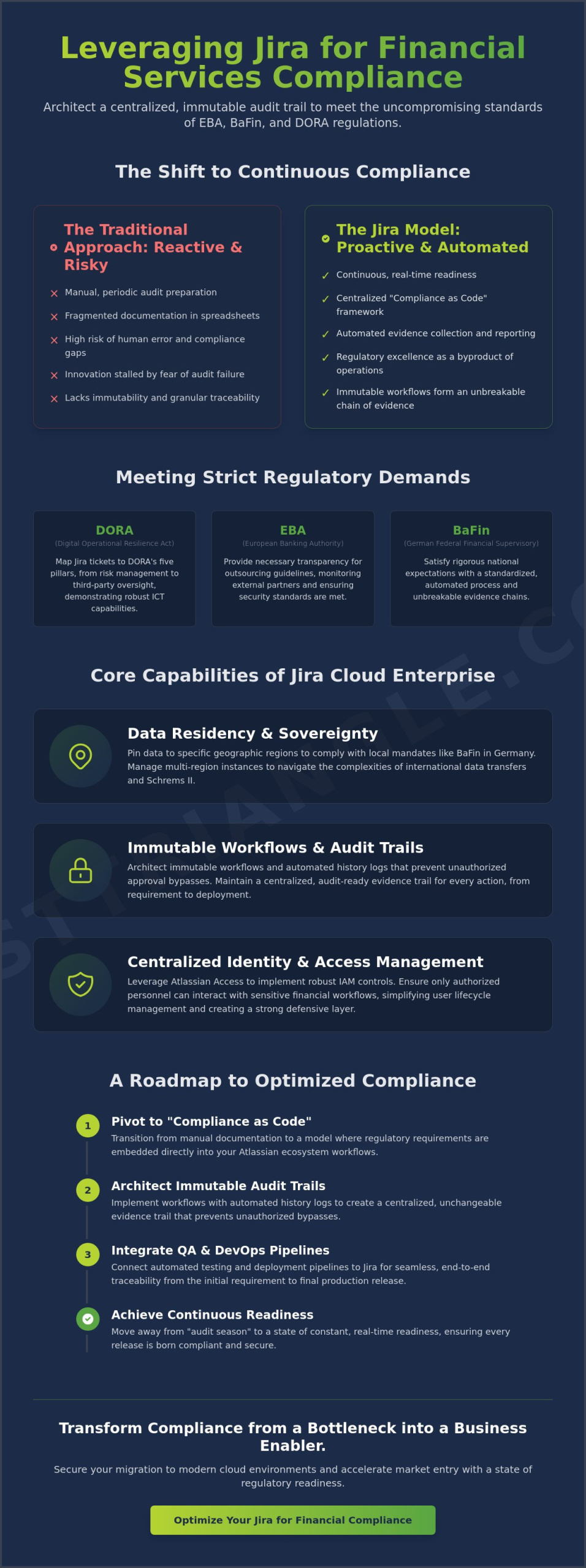
The financial sector is witnessing a fundamental shift in how governance is executed. Traditional oversight, once characterized by periodic, retrospective reviews, has been replaced by a demand for persistent, real-time visibility. As organizations face the complexities of Navigating the Regulatory Landscape, the limitations of manual spreadsheets and fragmented documentation have become clear. These legacy methods fail under the scrutiny of 2026 regulatory standards because they lack the immutability and granular traceability required to prove that every decision follows a defined risk protocol. By adopting jira for financial services compliance, global enterprises can transition to a “Compliance as Code” model, where regulatory requirements are baked directly into the technical lifecycle. This strategic approach creates a single source of truth that aligns software development with high-level risk management, ensuring that every action is documented, authorized, and ready for inspection.
Addressing EBA, BaFin, and DORA Requirements
The Digital Operational Resilience Act (DORA) demands that institutions demonstrate robust ICT risk management and reporting capabilities. Jira serves as the central engine for these requirements, allowing teams to map specific tickets to the five pillars of DORA, from risk management to third-party oversight. For firms adhering to European Banking Authority (EBA) outsourcing guidelines, the platform provides the necessary transparency to monitor external partners and ensure that security standards are consistently met. By utilizing jira for financial services compliance, organizations can build a framework where every ticket represents a record of trust. This creates an unbreakable chain of evidence that satisfies the rigorous expectations of BaFin and other national regulators, transforming compliance from a manual burden into a standardized, automated process. This focus on verified participation is increasingly vital across the fintech landscape, where platforms like tyriantrade.com are setting new standards for transparency in modern financial markets.
The Shift Toward Continuous Compliance
The objective for modern financial leaders is to move away from the frantic preparation of “audit season” and toward a state of constant, real-time readiness. By automating the collection of evidence through custom fields and history logs, firms drastically reduce the operational cost and human error associated with proving adherence to standards. This proactive stance allows technical managers to identify and remediate gaps before they escalate into regulatory findings. It fosters an environment where security and speed coexist, rather than compete. Continuous compliance is a strategic business enabler that accelerates market entry by ensuring that every release is born in a state of regulatory readiness.
Jira Cloud Enterprise: Architecting Security and Data Sovereignty
Jira Cloud Enterprise represents a strategic evolution for global financial institutions, offering a sophisticated security framework designed to meet the rigorous demands of modern regulators. While Atlassian manages the underlying cloud infrastructure, including physical security and platform availability, the institution retains responsibility for data classification, user permissions, and configuration. This shared responsibility model is essential for maintaining jira for financial services compliance, as it empowers organizations to tailor their security posture to specific operational risks. By leveraging Atlassian Access, technical leaders can implement centralized identity and access management, ensuring that only authorized personnel can interact with sensitive financial workflows; this creates a robust defensive layer that simplifies the complexities of user lifecycle management.
Data Residency and Sovereignty Strategies
In an increasingly fragmented regulatory environment, the ability to pin data to specific geographic regions is a non-negotiable requirement for compliance with local mandates such as those from BaFin in Germany. Global entities must navigate the complexities of international data transfers and the implications of the Schrems II ruling, which necessitates a granular approach to data sovereignty. Jira Cloud Enterprise allows for the management of multi-region instances, enabling firms to store data locally while maintaining a unified global operation. This capability is vital for institutions monitored by the Financial Crimes Enforcement Network, where the intersection of data location and reporting accuracy is critical for anti-money laundering efforts and the detection of illicit financial activity.
Advanced Security Layers for High-Stakes Environments
To further fortify the digital perimeter, Jira Cloud Enterprise introduces advanced security features like Bring Your Own Key encryption, providing organizations with total control over their data encryption keys. This level of technical rigor is complemented by IP allow-listing and mobile device management integrations, which restrict access to trusted networks and devices. Such measures provide the demonstrable governance that regulators now expect in 2026, where evidence of proactive risk mitigation is as important as the mitigation itself. Utilizing the Atlassian Trust Center offers auditors the necessary transparency and reassurance regarding the platform’s independent security certifications. For organizations seeking to align these technical capabilities with their unique regulatory obligations, a consultation with a strategic implementation partner can help bridge the gap between platform features and audit readiness. This collaborative approach ensures that your infrastructure provides visibility, verification, and validity at every level of the organization.
Implementing Robust Audit Trails: Workflows and Governance in Jira
Establishing a defensible regulatory posture requires more than just high-level policy; it necessitates the technical translation of those policies into the daily tools used by development and operations teams. When utilizing jira for financial services compliance, the primary objective is to move beyond simple task management toward a framework of “Precision, Proof, and Protection.” This is achieved by architecting workflows that act as unassailable gates, ensuring that no code reaches production without passing through every mandatory approval stage. By automating the collection of evidence through custom fields and background history logs, organizations create a persistent record of every decision made. This transformation allows technical managers to present a comprehensive, immutable audit trail to regulators, proving that the institution’s governance standards are being enforced at the level of individual tickets rather than just on paper.
A critical component of this strategy involves leveraging Jira Service Management to formalize Change Advisory Board (CAB) processes. By integrating change requests directly with development issues, teams achieve end-to-end traceability that links a specific business requirement to its technical execution and final approval. This structured approach balances team autonomy with organizational accountability, allowing developers to move quickly within the safety of defined guardrails. To ensure these configurations are optimized for both performance and scrutiny, many institutions rely on specialized Atlassian implementation services to bridge the gap between out-of-the-box functionality and the complex demands of financial audits.
Designing Immutable Workflows for Regulatory Approval
To satisfy the strict requirements of 2026 audits, workflows must be designed to prevent retrospective editing of records. By configuring specific workflow properties, such as setting jira.issue.editable to false in “Closed” or “Approved” states, administrators can lock issues once they reach a terminal status. This technical safeguard is often supplemented by digital signature requirements and mandatory multi-factor approval steps, ensuring that high-risk changes are verified by the correct stakeholders. Automating “Definition of Done” checklists further reinforces this by requiring that all compliance-related tasks, such as security scans or peer reviews, are completed before a ticket can transition to the next stage.
Advanced Permissions and Access Control Strategies
Effective governance relies on the principle of least privilege, where access is granted only to the extent necessary for a specific role. Configuring project-level permissions and issue security levels allows institutions to wall off sensitive data while maintaining operational transparency for the broader team. For external audits, organizations can establish “View Only” security levels, providing regulators with direct access to the evidence they need without risking the integrity of the data. The underlying audit log serves as the final layer of defense, meticulously tracking who changed what, where, and when, providing the granular visibility required to maintain a state of continuous regulatory readiness.
Beyond Tracking: Integrating Quality Assurance and DevOps for Compliance
Achieving true regulatory excellence requires a fundamental shift from passive ticket tracking to active, integrated validation within the software delivery lifecycle. By establishing a seamless connection between Jira, Bitbucket, and CI/CD pipelines, financial institutions can create an unbreakable link between a regulatory requirement and the specific code change that addresses it. This level of end-to-end traceability is indispensable for maintaining jira for financial services compliance, as it allows auditors to verify that every deployment has undergone the necessary security scans and peer reviews before reaching production. It effectively eliminates the visibility gap between development teams and risk management officers, providing executive leadership with a clear, data-driven view of the organization’s security posture. This approach ensures that compliance is not a final hurdle but a continuous thread woven into the fabric of technical delivery.
Automated Testing as a Compliance Validator
Automated testing serves as a primary engine for validating complex regulatory requirements at scale without sacrificing operational agility. By linking test execution results directly to Jira requirements, teams provide immediate evidence of adherence to standards like DORA or the EBA guidelines. Utilizing Software Test Automation Services empowers organizations to accelerate regression audits, ensuring that rapid release cycles don’t inadvertently introduce compliance vulnerabilities. These integrated systems can generate automated “Compliance Reports” that aggregate test data and coverage metrics, offering a transparent and objective record for internal and external stakeholders. This methodology transforms quality assurance from a cost center into a strategic asset that supports “Security, Speed, and Stability.”
Compliance as Code: Bridging Dev and Risk Management
While automation handles repetitive validation, Manual Testing remains a critical component for verifying complex financial logic and nuanced edge cases that automated scripts might overlook. This human oversight is essential for ensuring that subjective regulatory interpretations are correctly translated into technical functionality. Integrating these manual checks into a unified DevOps framework helps reduce “Compliance Debt” by identifying and remediating risks early in the development process. Expert DevOps Consulting helps organizations align their technical velocity with the necessary regulatory rigor, creating a culture where risk management is a shared responsibility. To ensure your QA framework meets the highest standards of audit readiness, reach out to our strategic advisors for a comprehensive evaluation of your integrated compliance workflows.
Strategic Implementation: Optimising Jira for Financial Compliance
The successful deployment of jira for financial services compliance requires more than technical configuration; it demands a phased, strategic roadmap that accounts for the intricate dependencies of regulated data. Moving from legacy on-premise environments to a modernised cloud infrastructure is a transition that must be managed with surgical precision to avoid operational disruption. A specialized Atlassian Consulting partner provides the necessary expertise to navigate these complexities, ensuring that every workflow is optimised for auditability before a single byte of data is moved. By positioning compliance as a core component of your broader digital transformation, your organisation can leverage these rigorous standards to drive systemic improvements in efficiency and security. This proactive approach transforms regulatory obligations into a competitive advantage, establishing a foundation for “Stability, Scalability, and Success.”
Migration Strategies: Moving Regulated Data Safely
A secure transition begins with a comprehensive pre-migration audit of all existing workflows, custom fields, and permission schemes to identify potential compliance gaps. As organisations move away from Jira Data Center, following the end of new subscription sales on March 30, 2026, the focus shifts to maintaining continuity while adopting the advanced features of Jira Cloud Enterprise. Managing this transition without downtime requires a parallel-run strategy where workloads are migrated in calculated waves. This process provides an ideal opportunity for “pruning” legacy data; by removing obsolete records and streamlining configurations, institutions ensure a lean instance that’s easier to govern and defend during regulatory inspections. Such meticulous preparation ensures that jira for financial services compliance remains a robust, high-performance engine throughout the migration lifecycle.
Managed Support for Sustained Operational Stability
Ensuring long-term adherence to evolving standards requires more than a one-time implementation; it necessitates continuous oversight and proactive environment management. The role of Managed Outsourcing Services is vital here, providing the dedicated expertise needed for quarterly compliance health checks and iterative system tuning. These regular reviews identify emerging risks and ensure that the platform remains aligned with the latest requirements from DORA or the European Banking Authority. Training your internal teams to uphold the integrity of the compliance engine is equally critical, as human expertise must complement technical tools to maintain a state of perpetual readiness. This collaborative model ensures that your institution remains a reliable long-term collaborator with regulators, projecting an image of institutional maturity and operational excellence.
Future-Proofing Your Regulatory Framework with Atlassian
Transitioning to jira for financial services compliance allows your institution to move beyond manual oversight toward a model of continuous, automated governance. By architecting immutable workflows and integrating quality assurance directly into your delivery pipeline, you ensure that every technical decision is backed by a verifiable audit trail. This strategic alignment doesn’t just satisfy regulators; it empowers your teams to innovate with confidence within secure, predefined guardrails. As an Atlassian Gold Solution Partner with ISO 9001 and ISO 27001 certifications, we specialize in guiding global enterprises through the complexities of highly regulated sectors like finance and pharma. We understand that operational stability is the cornerstone of your reputation. Our methodology focuses on delivering a resilient infrastructure that bridges the gap between high-velocity engineering and uncompromising security standards. Secure your financial future with Test Triangle’s Atlassian Consulting Services and transform your compliance engine into a catalyst for operational excellence. We’re ready to help you navigate the path toward long-term stability and scalable growth.
Frequently Asked Questions
Is Jira Cloud compliant with the Digital Operational Resilience Act (DORA)?
Jira Cloud supports DORA compliance by providing the necessary framework for ICT risk management, incident reporting, and operational resilience. While Atlassian provides the secure infrastructure, the institution is responsible for configuring workflows that align with the five pillars of DORA. This collaborative model ensures that risk management is integrated directly into technical operations; this provides the transparency and traceability required for modern regulatory inspections.
How does Jira handle data residency for German financial institutions under BaFin?
Atlassian allows German financial institutions to satisfy BaFin requirements by pinning primary data to the Frankfurt region. This geographic control ensures that sensitive financial information remains within the specified jurisdiction, addressing strict national sovereignty laws. By leveraging these data residency settings, organizations maintain high standards of “Privacy, Protection, and Provenance.” This localized approach mitigates the risks associated with international data transfers and ensures a stable regulatory posture.
Can Jira be used to automate evidence collection for financial audits?
Jira automates the collection of audit evidence by utilizing custom fields, mandatory transition screens, and comprehensive history logs that track every issue modification. This systemic approach replaces manual spreadsheets with a centralized, immutable record of all activities and approvals. By configuring jira for financial services compliance in this way, technical managers can generate real-time reports that prove adherence to internal controls. This reduces the administrative burden of audit preparation and enhances the accuracy of regulatory filings.
What is the difference between Jira Standard and Jira Cloud Enterprise for compliance?
Jira Cloud Enterprise offers significant compliance advantages over the Standard plan, including unlimited instances and advanced data residency controls across multiple global regions. While Standard provides basic tracking, Enterprise includes Atlassian Access for centralized identity management and a 99.95% uptime SLA. These high-level features are essential for global institutions that require “Security, Scalability, and Sovereignty” to manage complex digital infrastructures across diverse regulatory landscapes.
Does Atlassian offer a Business Associate Agreement (BAA) or equivalent for financial services?
Atlassian provides a Financial Services Addendum (FSA) and specialized compliance documentation that address the specific regulatory needs of the financial sector. While a Business Associate Agreement (BAA) is specific to healthcare, the FSA covers critical requirements such as audit rights and data security standards. These legal frameworks reassure global enterprises that their partnership with Atlassian is built on a foundation of “Trust, Transparency, and Total Accountability.”
How can we ensure that developers don’t bypass compliance gates in Jira?
Organizations ensure that developers don’t bypass compliance gates by implementing immutable workflow properties and mandatory approval steps that require digital signatures. By setting specific transition conditions and validators, administrators can prevent issues from moving forward until all regulatory requirements are met. This technical enforcement creates a disciplined environment where governance is a natural byproduct of the development lifecycle; this ensures that no code reaches production without authorized verification.
What are the key Jira apps for financial services compliance?
Key apps for enhancing jira for financial services compliance include ScriptRunner for complex automation, Xray for integrated test management, and specialized audit log exporters. These tools extend the native capabilities of the platform to provide the granular visibility and reporting required for financial audits. By integrating these industry-leading software platforms, institutions can build a comprehensive compliance engine that bridges the gap between technical execution and business outcomes.
How does Test Triangle assist with Jira compliance implementation?
Test Triangle serves as a reliable long-term collaborator by providing specialized Atlassian Consulting and managed support tailored to the unique needs of the financial sector. Our team focuses on architecting secure, audit-ready environments that satisfy EBA and DORA requirements while maintaining operational agility. Through proactive environment management and systemic improvement, we empower organizations to achieve “Precision, Performance, and Peace of Mind” in their digital transformation journey.

Article by
Paul Guy
Paul serves as the Marketing Director at Test Triangle, where he leads a global team in driving growth through strategic B2B marketing and brand communications. With a strong emphasis on measurable outcomes and sustainable performance, he plays a pivotal role in aligning marketing functions to enhance customer engagement and accelerate business impact. Under his leadership, marketing initiatives have consistently delivered significant returns on investment, elevated brand visibility, and strengthened the company's presence across key markets.