



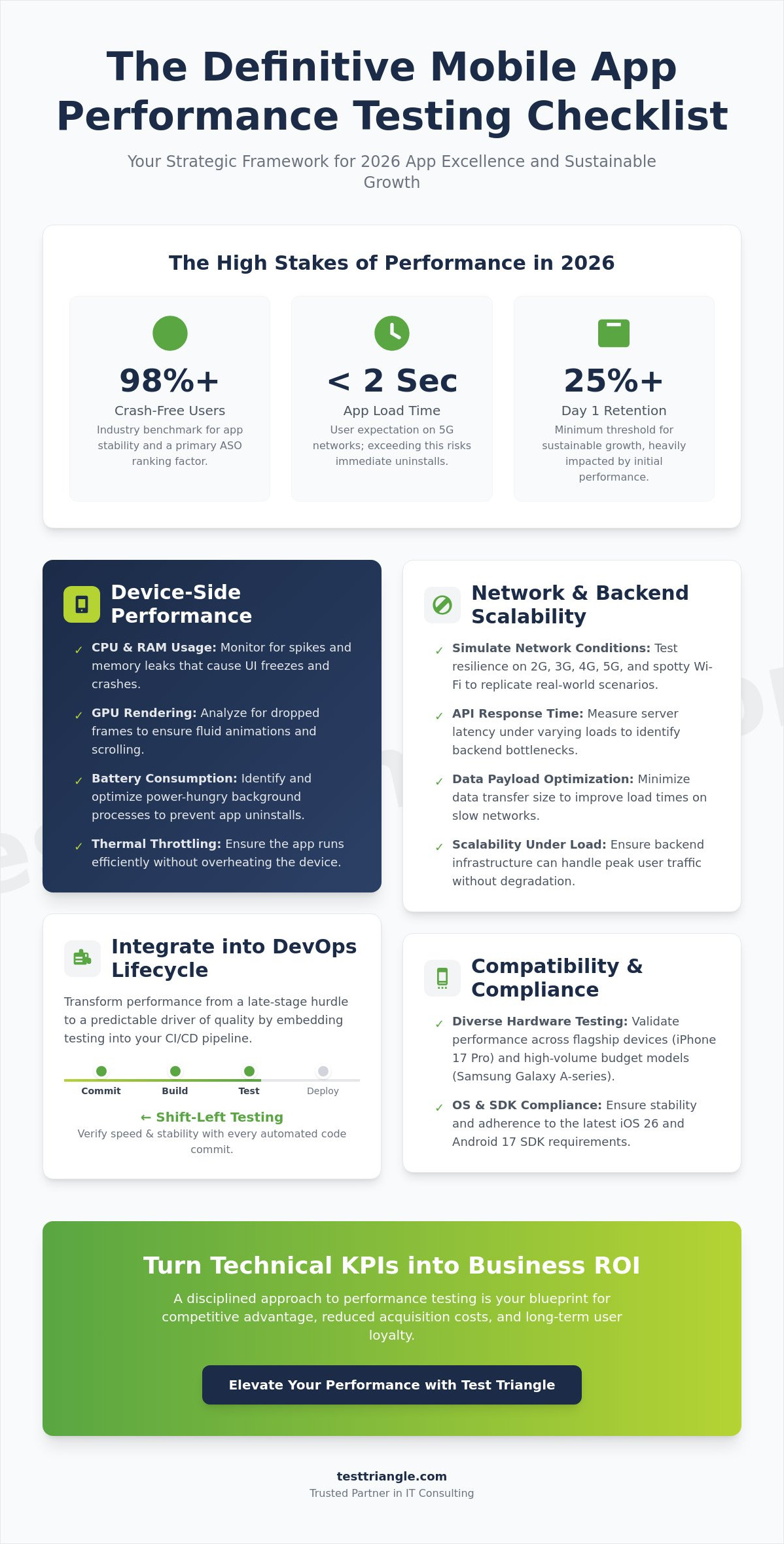
With industry benchmarks now demanding a crash-free user rate of over 98 percent and app load times under two seconds, the margin for technical error in 2026 has effectively vanished. You likely recognize that high uninstallation rates often stem from subtle lag or the failure to replicate unpredictable network conditions during the development cycle. It’s frustrating when performance testing remains a late-stage afterthought rather than a core component of your sprint. This comprehensive mobile app performance testing checklist provides the strategic framework you need to bridge the gap between technical execution and business outcomes.
By adopting a DevOps-aligned approach, you can transform performance from a reactive hurdle into a predictable driver of user retention. We promise to guide you through a repeatable framework designed to eliminate bottlenecks and ensure your applications remain compliant with the latest iOS 26 and Android 17 SDK requirements. This guide previews the essential protocols for testing across diverse hardware, from the flagship iPhone 17 Pro to high-volume budget devices, ensuring your digital infrastructure achieves the operational stability required for long-term global success.
Key Takeaways
- Quantify the strategic impact of mobile responsiveness by analyzing how millisecond delays directly correlate with enterprise revenue loss within the competitive 2026 landscape.
- Deploy a rigorous mobile app performance testing checklist that systematically monitors CPU spikes, battery drain, and network resilience to eliminate bottlenecks before deployment.
- Integrate performance metrics into the DevOps lifecycle to facilitate shift-left testing, ensuring that speed and stability are verified with every automated code commit.
- Enhance backend scalability by emulating diverse network conditions and optimizing data payloads to maintain high-performance standards across complex global infrastructures.
- Align technical KPIs with long-term business growth by utilizing expert performance engineering and flexible staffing solutions to drive sustainable digital transformation.
The High Stakes of Mobile Performance in the 2026 Digital Economy
In the digital economy of 2026, the correlation between application speed and enterprise profitability has reached a critical inflection point. Global enterprises now recognize that millisecond delays are no longer mere technical inconveniences; they’re direct catalysts for revenue erosion and brand degradation. While 5G ubiquity promised seamless connectivity, it paradoxically raised the bar for app responsiveness. When users operate on high-speed networks, their psychological threshold for latency drops significantly. If an application fails to load instantly, the user doesn’t blame the network; they blame the brand. By grounding your strategy in the foundational principles of Software performance testing, your organization can move from reactive troubleshooting to proactive engineering.
Adopting a performance-first mindset requires a fundamental shift in how we approach the development lifecycle. It’s about moving beyond the “fix it if it breaks” mentality and embracing a culture of precision, pace, and performance. This strategic evolution is particularly vital for App Store Optimization (ASO). In 2026, both Apple and Google utilize performance vitals as primary ranking factors. Applications that fail to meet the industry benchmark of 98 percent crash-free users or load times under two seconds find themselves buried in search results, regardless of their feature set. Implementing a comprehensive mobile app performance testing checklist ensures that visibility remains high and technical debt remains low.
User Retention and the Cost of Latency
The financial implications of performance bottlenecks are most visible in user retention rates. For subscription-based models, even a minor increase in lag can fuel negative brand sentiment and trigger immediate uninstalls. We see this reflected in current benchmarks where day 1 retention must exceed 25 percent to sustain growth. When performance is treated as an afterthought, the cost of reclaiming a lost user often exceeds the initial acquisition spend. Maintaining stability across diverse hardware, from the flagship iPhone 17 to the widely used Samsung Galaxy A-series, is essential for preserving the user base you’ve worked hard to build.
Performance as a Competitive Differentiator
In saturated markets like finance and retail, “stable” has become the new “fast.” Enterprises that prioritize consistent, reliable user experiences can significantly reduce long-term customer acquisition costs by fostering organic loyalty. Benchmarking your application against industry leaders isn’t just about matching their speed; it’s about exceeding their reliability. Through our specialized performance testing services, we act as a reliable long-term collaborator, helping you transform technical KPIs into tangible business ROI. This disciplined approach to QA ensures that your digital transformation efforts result in scalable growth rather than operational instability. A well-executed mobile app performance testing checklist acts as the blueprint for this competitive advantage, allowing your team to deploy with confidence every time.
The Definitive Mobile App Performance Testing Checklist
Executing a robust mobile app performance testing checklist requires more than just measuring speed; it demands a deep dive into how an application interacts with the host hardware under varying conditions. In 2026, where devices like the iPhone 17 Pro and Samsung Galaxy S26 offer immense processing power, users expect fluid interactions that don’t compromise device health. Monitoring CPU, RAM, and GPU spikes is essential. High resource utilization often results in frame drops or unresponsive UI elements. By aligning your strategy with Apple’s official performance guide, you can ensure that your application utilizes system resources efficiently without triggering thermal throttling.
Battery consumption remains a top reason for app uninstalls. Identifying power-hungry background processes through rigorous analysis prevents your app from being flagged by OS-level energy monitors. Similarly, testing for thermal impact during prolonged heavy usage is vital. Devices that overheat will automatically throttle performance, leading to a degraded user experience that your testing suite must account for. Startup time benchmarks, specifically the ‘First Contentful Paint’, determine the user’s initial perception of quality. If the app doesn’t become interactive within that two-second window, abandonment rates climb. To prevent crashes during extended sessions, memory leak detection must be a non-negotiable part of your QA cycle. Ensuring long-session stability is a hallmark of institutional maturity in software development.
On-Device Performance Metrics
Maintaining a consistent 60 or 120 FPS frame rate is critical for modern displays. Beyond visual smoothness, your checklist should evaluate storage footprint and cache management. Inefficient caching can bloat the app size, leading to storage warnings on budget devices like the Samsung Galaxy A07. Additionally, the impact of sensors such as GPS, Biometrics, and high-resolution cameras must be measured, as these components significantly drain resources when active. For enterprises seeking to refine these processes, our specialized performance testing services provide the technical rigor needed for scalable growth.
Stability and Reliability Under Pressure
Determining the breaking point through stress testing helps you understand the absolute limits of your architecture. Spike testing evaluates how the app recovers after a sudden user influx, while soak testing identifies performance degradation over several hours of continuous use. This methodical approach ensures that your application remains reliable during peak traffic events. If you are looking to optimize your current QA framework or need expert oversight, you can connect with our strategic consultants to discuss a tailored mobile app performance testing checklist for your specific enterprise needs.
Network Resilience and Backend Scalability Analysis
While on-device metrics establish the baseline for fluid interaction, the true measure of enterprise-grade reliability lies in an application’s ability to navigate the volatile nature of global networks. In the 2026 ecosystem, where 5G ubiquity is high but consistency remains elusive in transit hubs or rural corridors, your mobile app performance testing checklist must prioritize network resilience. By emulating 3G, 4G, and spotty Wi-Fi environments, your engineering team can ensure that the application remains functional even when connectivity is compromised. Leveraging the latest Google I/O 2026 performance tools, such as the updated ProfilingManager, allows developers to gain granular visibility into how varying connection qualities impact real-time data synchronization and user experience.
Identifying backend bottlenecks that masquerade as app lag is a sophisticated exercise in root-cause analysis that requires a holistic view of the technology stack. Data payload optimization is a critical component of this strategy; reducing API response sizes ensures that even users on legacy connections don’t suffer from prolonged wait times. Beyond simple speed, the architecture must support robust offline mode functionality. Ensuring graceful degradation when connectivity is lost prevents the app from hanging or crashing, which is essential for maintaining the high standards of stability that global enterprises demand. By focusing on server-side response times, you can isolate whether a delay originates in the mobile client or the cloud infrastructure, allowing for more precise remediation and improved operational efficiency.
API and Integration Performance
The modern mobile landscape relies heavily on a web of third-party integrations and SDKs, each of which introduces potential latency. Evaluating the speed and reliability of these external services is paramount to preventing a single failed integration from compromising the entire user journey. To maintain peak efficiency, enterprises often utilize specialized API testing services to validate seamless data flow and manage concurrent request handling at the gateway level. This disciplined approach to integration testing ensures that your digital infrastructure remains resilient under heavy load, providing the peace of mind that comes from comprehensive risk reduction.
Global Connectivity Standards
Operating on a global scale requires strict adherence to international connectivity standards and protocol optimization. Your testing suite should compare the performance of HTTP/2 versus HTTP/3 to determine which protocol offers the best multiplexing and header compression for your specific use case. Testing for cross-border latency and CDN efficiency is vital for apps with a distributed user base, as it highlights geographical performance disparities. For real-time communication apps, handling packet loss and jitter is a non-negotiable requirement. Integrating these factors into your mobile app performance testing checklist ensures that your application provides a consistent, high-quality experience regardless of the user’s physical location or network hardware.
Integrating Performance into the DevOps Lifecycle
The structural evolution of enterprise software development necessitates that performance is no longer treated as a concluding validation phase but as an intrinsic element of the continuous delivery pipeline. By adopting a shift-left strategy, organizations can identify latency issues during the earliest development stages, effectively neutralizing technical debt before it compounds. This proactive integration ensures that every line of code is scrutinized for its impact on system resources, transforming your mobile app performance testing checklist from a static document into a dynamic, automated component of your CI/CD environment. Our DevOps Consulting framework emphasizes this cultural shift, aligning engineering efforts with high-level business ROI.
Automated performance regression acts as a critical safeguard, preventing incremental speed degradation with every code commit. To maintain this standard, development teams must establish strict performance budgets, which define acceptable thresholds for resource consumption and response times. When a build exceeds these predefined limits, automated gates within the deployment pipeline trigger immediate alerts, allowing for rapid remediation. This disciplined approach ensures that the final product remains lean and responsive, even as new features are introduced at a rapid cadence. By grounding your methodology in these rigorous standards, you achieve the institutional maturity required to operate within highly regulated, global industries through precision, predictability, and progress.
Automated Testing Frameworks
Selecting the right tools for Software Test Automation Services is paramount for building a resilient performance infrastructure. Your framework should facilitate the creation of scalable load scripts that accurately mimic real-world user journeys across diverse device profiles. Integrating these performance gates into platforms like Jenkins, GitLab, or Azure DevOps ensures that stability is verified at every stage of the lifecycle. This methodical automation reduces the reliance on manual oversight while increasing the precision of your quality assurance efforts through continuous detection, diagnosis, and delivery.
Performance Observability
Transitioning from basic monitoring to deep system observability allows enterprises to analyze log data and predict performance failures before they manifest as user-facing issues. By utilizing APM tools and AI-driven analytics, technical managers can perform sophisticated root cause analysis of lag, identifying the exact microservice or database query responsible for latency. This level of visibility provides the peace of mind that comes from comprehensive risk reduction and operational stability. If your organization is ready to modernize its delivery pipeline, consult with our DevOps experts to integrate a high-performance culture into your existing infrastructure.
Strategic QA Partnership: Elevating Performance with Test Triangle
Managing the intricate requirements of the 2026 digital landscape requires more than just a mobile app performance testing checklist; it demands a synergy between technical rigor and strategic foresight. As a reliable long-term collaborator, Test Triangle provides high-level IT Consulting designed to manage the complex digital infrastructures of global enterprises with expertise and precision. We focus on risk reduction and organizational progress, ensuring that your digital transformation initiatives are supported by a steady hand in a fast-changing technological environment. By aligning technical execution with business outcomes, we empower your leadership to make data-driven decisions that foster sustainable growth and operational stability.
Our commitment to excellence is reflected in our flexible Staffing Solutions, which provide access to specialized performance engineers capable of handling the most demanding QA workflows. Whether you’re optimizing for the latest iOS 26 features or ensuring Android 17 compatibility, our experts integrate seamlessly into your existing teams to deliver measurable results. We believe in an adaptable approach to service delivery, combining human expertise with industry-leading tools to assess, automate, and accelerate your path to market. This disciplined methodology ensures that your application meets the high standards of quality and security expected by today’s sophisticated user base.
Custom QA and Staffing Models
Bridging the talent gap in specialized performance engineering often requires a versatile, globally-minded strategy. Through our Managed Outsourcing Services, enterprises can reduce operational overhead while significantly increasing the quality of their performance assurance protocols. This model allows you to scale your QA team dynamically, providing the agility needed for major product launches without the long-term burden of internal recruitment. Our remote and offshore experts bring institutional maturity to every project, ensuring that your mobile app performance testing checklist is executed with the highest degree of technical discipline.
Enterprise Platform Optimisation
Specialized enterprise ecosystems like Atlassian and ServiceNow require a unique approach to mobile performance that standard QA providers often overlook. Our expertise in Atlassian Implementation ensures that your mobile integrations remain responsive and scalable under heavy enterprise loads. Similarly, we specialize in ServiceNow Consulting Services to ensure that mobile interfaces provide the efficiency required for modern IT service management. If your organization is ready to elevate its performance standards, the next step is to request a comprehensive performance audit to identify and eliminate hidden bottlenecks within your digital infrastructure.
Future-Proofing Enterprise Mobile Excellence
In the rapidly shifting technological landscape of 2026, maintaining a competitive edge requires a disciplined commitment to technical rigor and operational stability. By implementing a DevOps-aligned mobile app performance testing checklist, your organization can move beyond reactive troubleshooting to embrace a culture of precision, pace, and performance. This strategic evolution ensures that your digital infrastructure remains resilient across global networks while consistently meeting the high standards of a sophisticated user base through methodical detection, diagnosis, and delivery.
As an Atlassian Gold Solution Partner and Strategic ServiceNow Implementation Partner, Test Triangle acts as a reliable long-term collaborator for enterprises navigating large-scale digital transformations. Our global presence and specialized QA expertise provide the peace of mind derived from risk reduction and the empowerment found in scalable growth. We invite you to secure your application’s future with Test Triangle’s Performance Testing Services and transform your technical KPIs into tangible business ROI. Your journey toward seamless user experiences and sustained market leadership begins with a partnership built on stability, precision, and trust.
Frequently Asked Questions
What is the most critical metric in a mobile app performance testing checklist?
App load time and crash-free user rates represent the most critical indicators within any mobile app performance testing checklist. Industry benchmarks for 2026 dictate that applications must become interactive within two seconds to avoid immediate user abandonment. Additionally, maintaining a crash-free rate above 98 percent ensures the operational stability required for enterprise-level user retention and long-term brand loyalty across diverse hardware ecosystems.
How often should I perform mobile performance testing in a DevOps cycle?
Performance testing should be integrated continuously into the DevOps cycle through automated regression suites triggered by every code commit. This shift-left approach identifies latency issues during the earliest development stages, preventing technical debt from compounding over time. By establishing automated performance gates in your CI/CD pipeline, you ensure that speed and stability are verified through every iteration of the software lifecycle.
Can I rely on simulators for performance testing, or do I need real devices?
While simulators provide initial utility during early development, real devices are essential for capturing accurate hardware interactions and thermal impacts. Simulators cannot replicate the nuances of GPU throttling, sensor drain, or unpredictable network jitter found on physical handsets like the iPhone 17 or Galaxy S26. Utilizing a diverse real-device cloud ensures your application remains resilient across varying hardware specifications and environmental conditions.
How does battery consumption affect my app’s performance ranking?
Excessive battery consumption negatively impacts your app’s ranking by triggering OS-level energy warnings and increasing uninstallation rates. Both Apple and Google utilize performance vitals as primary ranking factors in 2026; applications that drain resources excessively are deprioritized in search results. Monitoring power-hungry background processes ensures your application remains compliant with the efficiency standards required for high global visibility and user satisfaction.
What is the difference between load testing and stress testing for mobile apps?
Load testing evaluates application behavior under expected user volumes to ensure consistent response times during normal operation. In contrast, stress testing pushes the infrastructure to its absolute breaking point to identify how the system fails and recovers under extreme conditions. Both methodologies are vital components of a comprehensive mobile app performance testing checklist, providing the technical rigor needed for scalable growth during peak traffic events.
How do I test mobile app performance for users with poor network connectivity?
Testing for poor connectivity involves network latency emulation to simulate 3G, 4G, and high-jitter environments. This process ensures that your application implements graceful degradation and robust offline functionality when a stable connection is unavailable. By analyzing data payload sizes and API response times under these constrained conditions, you can optimize the user experience for a globally distributed audience operating on inconsistent infrastructure.
What are performance budgets, and how do they help development teams?
Performance budgets are predefined thresholds for metrics such as bundle size, CPU usage, and load times that development teams must not exceed. These budgets act as a strategic framework for managing technical debt and ensuring that new features don’t compromise system responsiveness. By adhering to these limits, teams maintain the institutional maturity required to deliver lean, high-performance applications that align with technical KPIs and business ROI.
Should I outsource my mobile performance testing or keep it in-house?
The decision to outsource performance testing often depends on the need for specialized expertise and flexible scaling during major product launches. Partnering with an external provider for performance testing or IT staffing services allows enterprises to bridge the talent gap with offshore experts while reducing internal overhead. This strategic collaboration provides the peace of mind that comes from comprehensive risk reduction and expert oversight of complex digital infrastructures.

Article by
Paul Guy
Paul serves as the Marketing Director at Test Triangle, where he leads a global team in driving growth through strategic B2B marketing and brand communications. With a strong emphasis on measurable outcomes and sustainable performance, he plays a pivotal role in aligning marketing functions to enhance customer engagement and accelerate business impact. Under his leadership, marketing initiatives have consistently delivered significant returns on investment, elevated brand visibility, and strengthened the company's presence across key markets.