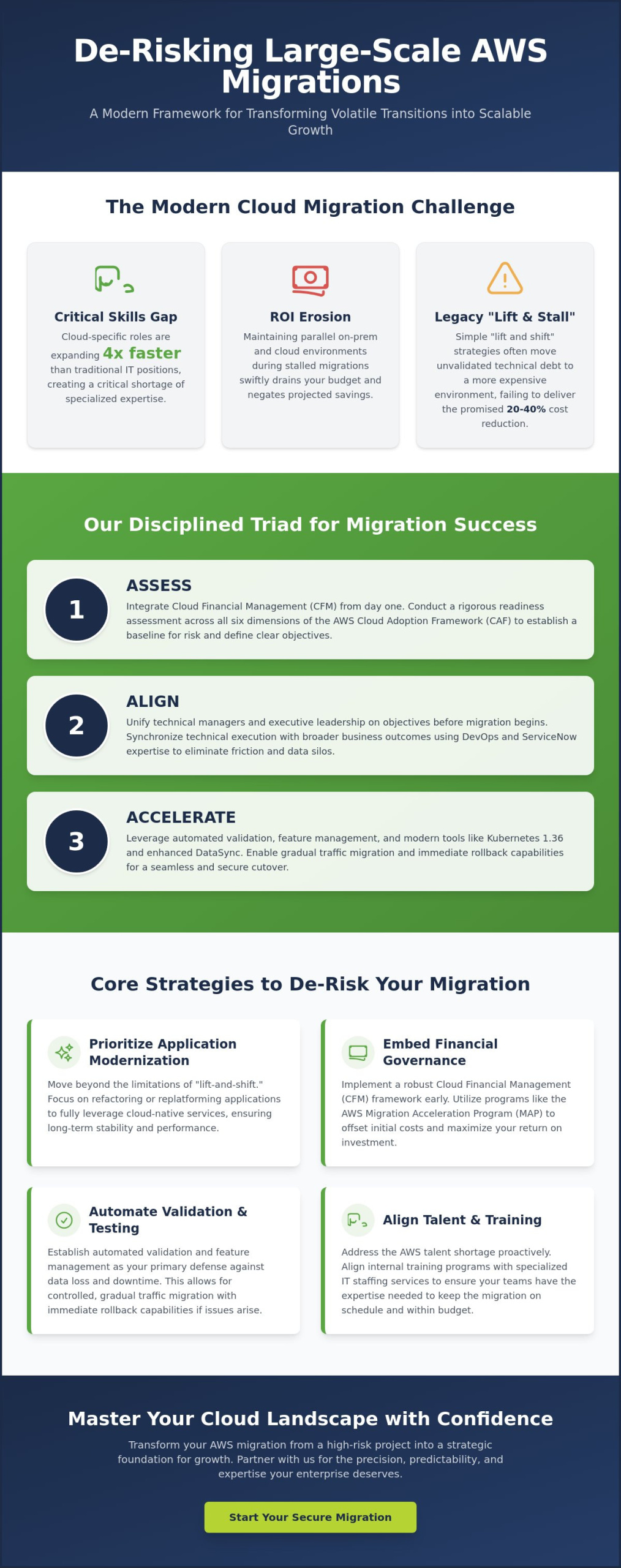
With cloud-specific roles currently expanding four times faster than traditional IT positions, global enterprises face a critical shortage of the specialized expertise required to maintain stability during massive infrastructure shifts. You’ve likely seen how the financial burden of maintaining parallel environments can swiftly drain your migration ROI, leaving leadership questioning the initial business case. Successfully de-risking a large scale aws cloud migration demands more than just basic tooling; it requires a disciplined integration of Cloud Financial Management, automated validation, and strategic talent alignment. By shifting from a simple lift-and-shift mindset toward a modernized, AI-enhanced framework, your organization can transform a volatile transition into a foundation for sustainable, scalable growth.
This article outlines a comprehensive methodology for mitigating the technical, financial, and operational hazards inherent in enterprise-level AWS transitions. We’ll examine how to utilize the latest 2026 updates, such as Kubernetes 1.36 support and enhanced DataSync protocols, to ensure your cutover is seamless and secure. You’ll discover a structured approach to validate data integrity, reduce operational downtime, and eliminate the fear of security breaches. Our goal is to provide the precision, predictability, and partnership necessary to help your team master the cloud landscape with absolute confidence and institutional maturity.
Key Takeaways
- Integrate Cloud Financial Management (CFM) principles early in the assessment phase to maximize ROI and leverage the AWS Migration Acceleration Program to offset initial infrastructure investments.
- Establish automated validation and feature management as your primary defense against data loss, allowing for gradual traffic migration and immediate rollback capabilities during complex cutovers.
- Implement a robust, multi-layered framework for de-risking a large scale aws cloud migration that prioritizes application modernization over the inherent limitations of traditional lift-and-shift strategies.
- Address the critical AWS talent shortage by aligning internal training with specialized IT staffing services to ensure your migration remains on schedule and within budget.
- Leverage global DevOps consulting and ServiceNow expertise to synchronize your technical execution with broader business outcomes for a secure, high-performance digital evolution.
Navigating the Complexity of Large-Scale AWS Cloud Migrations
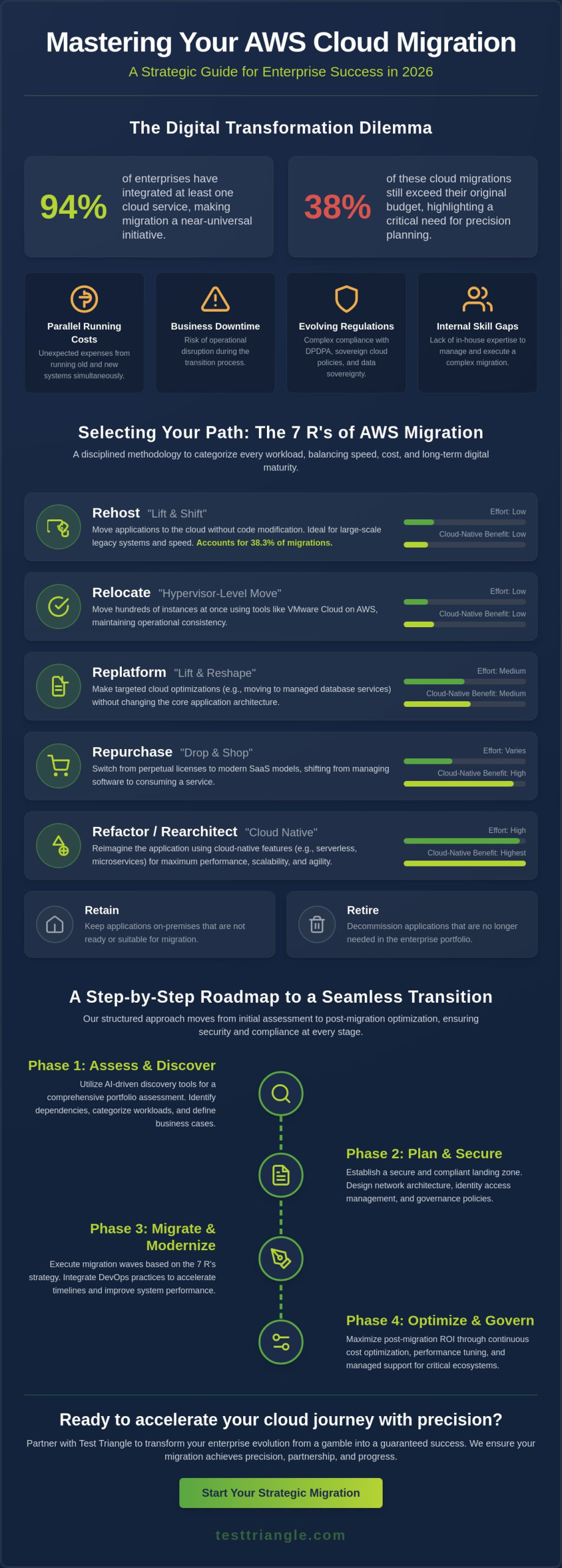
Large-scale migration risk in 2026 has evolved from simple data transfer challenges into a multi-dimensional puzzle of architectural compatibility and operational readiness. As global enterprises attempt to modernize, they often find that foundational cloud computing concepts must be re-evaluated to accommodate AI-driven discovery and automated landing zones. Successfully de-risking a large scale aws cloud migration requires a departure from the legacy ‘lift and shift’ mentality, which frequently results in ‘lift and stall’ scenarios where unvalidated technical debt is simply moved to a more expensive environment. Without a rigorous strategy that prioritizes modernization over mere relocation, organizations risk inheriting unmanaged legacy architectures that fail to deliver the promised 20-40% reduction in infrastructure costs.
Our methodology centers on a disciplined triad: Assess, Align, and Accelerate. This framework ensures that technical managers and executive leadership are unified in their objectives before the first workload is moved. By establishing a baseline for risk early in the process, we help organizations identify which of the ‘6Rs’ (Rehost, Replatform, Refactor, Repurchase, Retire, Retain) best serves their long-term stability and growth. It’s a process that demands institutional maturity and a steady hand to manage the fast-changing technological landscape.
Identifying Common Failure Points in Enterprise Migrations
Inadequate readiness assessments across the six dimensions of the AWS Cloud Adoption Framework (CAF) remain a primary cause of project failure. When organizations overlook the governance or people perspectives, they create friction that slows technical execution. The impact of fragmented data silos on migration predictability is equally severe. When disparate data sets are moved without a unified governance model, they create security vulnerabilities that often emerge during the critical transition phase. This lack of visibility leads to unvalidated legacy architectures that compromise the target environment and introduce unnecessary risk.
The Cost of Stalled Migrations and ROI Erosion
Maintaining parallel environments is one of the most significant drains on a migration business case. For every month a migration stalls, the enterprise pays twice for the same infrastructure, rapidly eroding the projected return on investment. Speed without validation is the primary driver of budget overruns, as unplanned downtime during cutover can cause catastrophic disruptions to global service delivery. Organizations don’t just face technical hurdles; they face financial ones that can derail digital transformation. Quantifying the business impact of these delays reveals that de-risking a large scale aws cloud migration is not merely a technical requirement but a financial imperative for the modern enterprise that values software and digital assurance testing as a cornerstone of its strategy.
Implementing a Cloud Financial Management (CFM) Framework
A successful migration isn’t just a technical achievement; it’s a financial one. Successfully de-risking a large scale aws cloud migration requires a rigorous Cloud Financial Management (CFM) framework established during the initial Assess phase. By integrating financial oversight early, organizations can prevent the budget creep that often follows unmanaged resource sprawl. This proactive stance allows technical managers to justify infrastructure spend by directly linking it to operational stability and performance gains.
Utilizing the AWS Migration Acceleration Program (MAP) provides a structured mechanism to offset initial investment costs through credits and incentives across the Assess, Mobilize, and Migrate phases. This strategic alignment is essential for de-risking data and cloud migrations, ensuring that the transition remains economically viable while maintaining high standards of data consistency. By leveraging the AWS Pricing Calculator during the Mobilize phase, teams can generate high-fidelity estimates that anchor the project in financial reality and organizational progress.
To prevent ‘bill shock’, enterprises should deploy automated cost-monitoring tools, such as the AWS Cost and Usage Report 2.0, which now includes granular details for services like Amazon Athena and Redshift. Establishing clear financial milestones allows leadership to track migration health against the original business case. This methodical approach transforms cloud spending from an unpredictable variable into a manageable asset that supports scalable growth. If you need assistance auditing your current cloud spend or planning a cost-effective transition, our team is ready to discuss your migration strategy.
Avoiding Parallel Environment Cost Traps
The financial burden of maintaining legacy on-premises hardware alongside new cloud instances can quickly erode ROI. Rapid decommissioning strategies are vital. Organizations should prioritize optimizing resource allocation to prevent over-provisioning, which often occurs when teams replicate on-premises capacity in the cloud without right-sizing. Leveraging Reserved Instances and Savings Plans early in the roadmap provides a predictable cost structure, securing long-term stability and reducing the risk of ballooning operational expenses.
Aligning Business Drivers with Technical Execution
Technical milestones must translate into tangible business outcomes. If a database migration is complete, the associated cost savings from retiring the old license should be immediately visible in transparent financial reporting. This transparency secures executive buy-in and reinforces the image of IT as a value-generating partner. Cloud Financial Management functions as a strategic discipline that aligns cloud consumption with overarching corporate objectives rather than acting as a mere tactical accounting exercise.
De-Risking Through Continuous Testing and Feature Management
While the financial frameworks discussed previously provide the economic foundation for a transition, automated testing serves as the primary technical mechanism for de-risking a large scale aws cloud migration. In the 2026 enterprise landscape, where application dependencies are increasingly intricate, treating quality assurance as a post-migration afterthought is no longer viable. Instead, a strategic approach integrates continuous validation into every phase of the migration lifecycle, ensuring that each architectural shift is backed by empirical data rather than assumptions. This methodical verification process allows organizations to maintain operational stability while accelerating their modernization efforts.
Performance testing plays a critical role in validating cloud-native scalability before high-traffic workloads are transitioned. By simulating real-world demand within the AWS environment, teams can identify bottlenecks in Amazon EKS clusters or RDS configurations before they impact the end-user experience. This level of rigor ensures that the target infrastructure doesn’t just host applications but optimizes them for the superior performance standards expected of modern digital platforms. It’s about achieving precision, stability, and growth through disciplined technical execution.
Automated Validation for Large-Scale Data Integrity
Validating massive datasets without disrupting production environments requires a sophisticated blend of automation and strategy. Organizations must ensure schema consistency and data accuracy across complex hybrid environments, where legacy on-premises databases must remain synchronized with cloud-native targets. By implementing comprehensive data migration testing, teams can detect anomalies in real-time, preventing the data loss or corruption that often derails large-scale cutovers. Utilizing specialized software test automation services allows for the creation of accelerated feedback loops, providing the peace of mind that comes from knowing every record is accounted for and secure.
Feature Management: The Safety Net for Cloud Cutover
Feature management acts as a vital safety net during the final stages of a migration, allowing teams to decouple deployment from release for risk-free testing in live environments. By implementing feature toggles, organizations can execute gradual traffic migrations, moving small percentages of users to the new infrastructure while monitoring system health. This approach significantly reduces the blast radius of potential errors. If an issue is detected, the ability to trigger an instant rollback ensures that service remains uninterrupted.
- Canary Releases: Monitor performance on a subset of users before a full-scale rollout.
- Decoupled Deployment: Test code in production without exposing it to the entire user base.
- Instant Rollbacks: Mitigate technical hazards with a single toggle, preserving the customer experience.
This level of control empowers enterprises to evolve their digital infrastructure with a sense of security and institutional maturity, turning a complex cutover into a predictable, non-event. By synchronizing technical methodology with these advanced release strategies, global organizations can manage their complex digital infrastructures with unparalleled expertise and reliability.
Bridging the Specialized AWS Skills Gap
The most sophisticated technical roadmap remains vulnerable without the specific human capital required for its execution. Since cloud-specific roles are expanding four times faster than traditional IT positions, the resulting scarcity of qualified architects has become a primary bottleneck for the modern enterprise. Successfully de-risking a large scale aws cloud migration depends on securing these specialized skills at the precise moment they are needed. Relying solely on internal upskilling often leads to project delays, as the learning curve for complex AI services and automated landing zones can be steep and unpredictable.
Leveraging remote offshore resources provides a strategic advantage by enabling 24/7 migration cycles. This continuous execution model accelerates timelines and ensures that critical workflows are managed with constant vigilance. For organizations operating in highly regulated sectors, the need for precision is non-negotiable. Utilizing specialized pharma IT staffing ensures that your migration team understands the nuances of the HIPAA Security Rule updates finalized in May 2026 and the upcoming EU AI Act enforcement in August. This level of industry-specific expertise is a cornerstone of our identity as a reliable long-term collaborator.
Strategic IT Staffing Models for Global Enterprises
Balancing permanent talent with flexible contract resources allows organizations to maintain a lean core team while scaling up for high-intensity migration phases. Our staffing solutions provide immediate access to vetted AWS experts who possess the institutional maturity to operate within diverse, complex environments. By integrating specialized recruiters into your planning process, you significantly reduce the time-to-hire for niche roles such as Cloud Security Architects. This agility ensures that your migration velocity remains consistent, even as technical requirements evolve. To secure the specific talent your project demands, contact our staffing specialists today.
Maintaining Operational Stability During Talent Transitions
Knowledge transfer protocols are essential to prevent ‘brain drain’ once the primary migration phase concludes. By utilizing managed services to bridge the gap during internal upskilling, enterprises ensure that their new cloud infrastructure remains optimized and secure. This human-centric approach is vital for de-risking a large scale aws cloud migration, as it ensures that technical debt is not replaced by talent debt. Expert-led DevOps engineering is an absolute necessity for achieving the long-term stability and scalable growth promised by a modernized AWS environment. This steady hand in a fast-changing technological landscape allows your organization to focus on innovation while we manage the complexities of the underlying infrastructure through precision, predictability, and partnership.
Test Triangle: Your Strategic Partner for Secure AWS Evolution
As global enterprises move toward the 2026 digital horizon, the intersection of infrastructure and platform management becomes the ultimate risk frontier. Successfully de-risking a large scale aws cloud migration requires a partner who understands that the cloud isn’t just a destination, but an evolving ecosystem that must be managed with institutional maturity. Test Triangle brings specialized expertise in DevOps consulting to ensure that your CI/CD pipelines and deployment strategies are optimized for the high standards of the AWS environment. By maintaining Atlassian ecosystem stability during these complex transitions, we help your development teams remain productive and focused on innovation rather than infrastructure discrepancies.
Our methodology extends beyond the initial cutover to provide the peace of mind found in long-term operational stability. Through managed outsourcing services, we deliver post-migration optimization that ensures your cloud environment continues to evolve alongside your business needs. This adaptable approach allows your organization to leverage the full power of AWS while we manage the technical rigor required for sustained performance. We don’t just facilitate a move; we engineer a foundation for stability, scalability, and success.
Integrating ServiceNow and AWS for Seamless ITSM
De-risking critical workflows involves more than just server migration; it requires the synchronization of your IT Service Management (ITSM) with your new cloud-native reality. Through strategic ServiceNow implementation on AWS, we optimize IT workflows to handle incident management with the speed and precision that cloud environments demand. Maintaining CMDB accuracy during massive infrastructure shifts is a common failure point that we address through rigorous validation and automated discovery. By utilizing our IT service management solutions, your organization can reduce operational friction and ensure that governance remains intact throughout the digital transformation process.
Sustaining Excellence with Long-Term Collaboration
The transition from migration to modernization is where true value is realized. Test Triangle’s commitment to reliability, precision, and growth ensures that your AWS environment remains a high-performance asset long after the final server is decommissioned. We position ourselves as a steady hand in a fast-changing technological landscape, helping you navigate complex regulatory updates and technical shifts with confidence. Our goal is to empower your leadership through risk reduction and strategic clarity. To ensure your transition is backed by global expertise, contact Test Triangle for a strategic AWS migration audit and begin your journey toward a secure, modernized future. De-risking a large scale aws cloud migration is a complex endeavor, but with the right collaborator, it becomes a predictable path to organizational progress.
Securing Your Future in the Cloud Ecosystem
Transitioning to a cloud-native state requires a disciplined synthesis of financial transparency, technical validation, and specialized talent acquisition. By establishing a robust Cloud Financial Management framework and integrating continuous automated testing, global enterprises can transform a high-stakes transition into a predictable engine for growth. De-risking a large scale aws cloud migration is ultimately about achieving institutional maturity through the careful alignment of technical execution with long-term business objectives. This methodical approach ensures that your infrastructure doesn’t just function; it excels under the rigorous demands of a modern digital economy.
Test Triangle stands as a reliable long-term collaborator with a global presence across Europe, North America, and Asia, offering specialized expertise in highly regulated sectors like Pharma and Finance. Our strategic partnerships with AWS, Atlassian, and ServiceNow allow us to manage your complex digital infrastructure with the precision, predictability, and partnership your organization demands. We invite you to secure your digital transformation with Test Triangle’s AWS migration expertise and ensure your evolution is managed by a steady hand. Together, we can turn technological complexity into a sustainable competitive advantage.
Frequently Asked Questions
What are the primary risks associated with a large-scale AWS cloud migration?
The primary risks include the accumulation of technical debt, security vulnerabilities during the cutover phase, and financial erosion caused by unmanaged parallel environments. In the 2026 landscape, AI-driven discovery failures can also lead to misaligned landing zones and architectural instability. Successfully de-risking a large scale aws cloud migration requires identifying these failure points early to ensure that modernization takes precedence over simple relocation.
How can we manage parallel environment costs during a long-term migration?
Managing parallel environment costs requires the disciplined integration of Cloud Financial Management (CFM) and rapid decommissioning schedules for on-premises hardware. Organizations should utilize tools like the AWS Pricing Calculator to generate high-fidelity estimates and prevent the over-provisioning that often drains ROI. By right-sizing instances and leveraging Savings Plans early in the roadmap, enterprises can protect their business case throughout the transition.
What role does automated testing play in de-risking a cloud transition?
Automated testing serves as the primary technical mechanism for validating system behavior and data accuracy in the new environment. It allows teams to execute comprehensive regression suites and performance benchmarks without manual intervention, which significantly accelerates feedback loops. This rigorous validation ensures that complex application dependencies are preserved and that the target infrastructure meets the high standards of security required for enterprise stability.
Is it better to retrain existing staff or hire AWS specialists for a migration?
A hybrid approach that combines internal upskilling with specialized IT staffing services is often the most effective strategy for maintaining migration velocity. While retraining builds long-term institutional knowledge, hiring AWS specialists provides the immediate expertise needed to navigate complex architectural shifts. This balance ensures that your project doesn’t stall due to the steep learning curve associated with advanced cloud-native services and automated landing zones.
How can we ensure data integrity when moving massive enterprise datasets to AWS?
Ensuring data integrity involves implementing schema consistency checks and utilizing high-performance tools like AWS DataSync. As of June 2026, DataSync Enhanced mode offers a cost-effective way to manage large transfers at $0.015 per gigabyte in the US East (Ohio) region. Rigorous validation testing must be performed to confirm that every record is accurately moved, preventing the data corruption that can derail global service delivery.
What is the AWS Migration Acceleration Program (MAP) and how does it reduce risk?
The AWS Migration Acceleration Program (MAP) is a comprehensive three-phase methodology that provides financial incentives and technical best practices to reduce migration risk. It offers credits and support across the Assess, Mobilize, and Migrate phases to offset the initial infrastructure investment. This structured framework ensures that organizations follow proven pathways, leading to a more predictable and cost-effective transition to a modernized cloud environment.
How do we maintain uptime for critical tools like ServiceNow during migration?
Maintaining uptime for ServiceNow requires a strategic integration of ITSM workflows with AWS native monitoring tools like CloudWatch. Organizations must ensure CMDB accuracy during infrastructure shifts to prevent service disruptions and fragmented data silos. By implementing strategic IT service management solutions, teams can synchronize incident management and governance, ensuring that critical business tools remain operational and optimized throughout the migration lifecycle.
How long does a typical large-scale enterprise AWS migration take to de-risk?
The duration of a large-scale migration varies based on architectural complexity, but the de-risking process typically begins with a 3-6 month mobilization phase. For technical reference, the AWS Application Migration Service (MGN) provides a 90-day free period for each source server, which often serves as a window for initial validation. A full-scale enterprise evolution toward modernization can take 12-24 months to achieve complete operational stability and ROI.

Article by
Paul Guy
Paul serves as the Marketing Director at Test Triangle, where he leads a global team in driving growth through strategic B2B marketing and brand communications. With a strong emphasis on measurable outcomes and sustainable performance, he plays a pivotal role in aligning marketing functions to enhance customer engagement and accelerate business impact. Under his leadership, marketing initiatives have consistently delivered significant returns on investment, elevated brand visibility, and strengthened the company's presence across key markets.