



How can your organization maintain a “Compliance-First, Agile-Always” posture when the deadline for GAMP 5 Second Edition alignment arrives in August 2026? You’ve likely realized that finding professionals who possess both technical agility and deep Computer System Validation (CSV) experience is becoming the industry’s most significant hurdle. It’s frustrating to watch critical digital transformation projects stall because IT talent doesn’t fully grasp the nuances of 21 CFR Part 11 or the impending EU GMP Annex 11 revisions.
For leaders looking to navigate this dual imperative, it is helpful to explore Healthcare & Life Sciences Staffing options that provide access to specialists who understand the rigorous demands of the pharma sector.
This guide demonstrates how to refine your Pharma IT Staffing strategy to secure specialized experts who bridge the gap between life sciences innovation and rigorous regulatory compliance. By aligning your recruitment methodology with high-level business outcomes, you’ll learn how to reduce time-to-hire for specialized roles while ensuring 100% compliance in every technical placement. We’ll examine how a focus on precision, performance, and partnership can optimize your IT infrastructure through the strategic implementation of platforms like Atlassian and ServiceNow.
Key Takeaways
- Understand the critical transition from generalist support to specialized validation roles that safeguard data integrity within GxP environments.
- Identify the core technical competencies, including Atlassian and ServiceNow expertise, required to automate complex pharmaceutical workflows while ensuring regulatory alignment.
- Evaluate the strategic advantages of varied engagement models, such as Recruitment Outsourcing Managed Services, to achieve the optimal balance of operational flexibility and technical rigor.
- Refine your Pharma IT Staffing process with structured assessment techniques designed to verify a candidate’s mastery of FDA and EMA regulatory frameworks.
- Discover how a long-term partnership with a strategic visionary can future-proof your digital infrastructure through precision, progress, and partnership.
Understanding the Evolution of Pharma IT Staffing
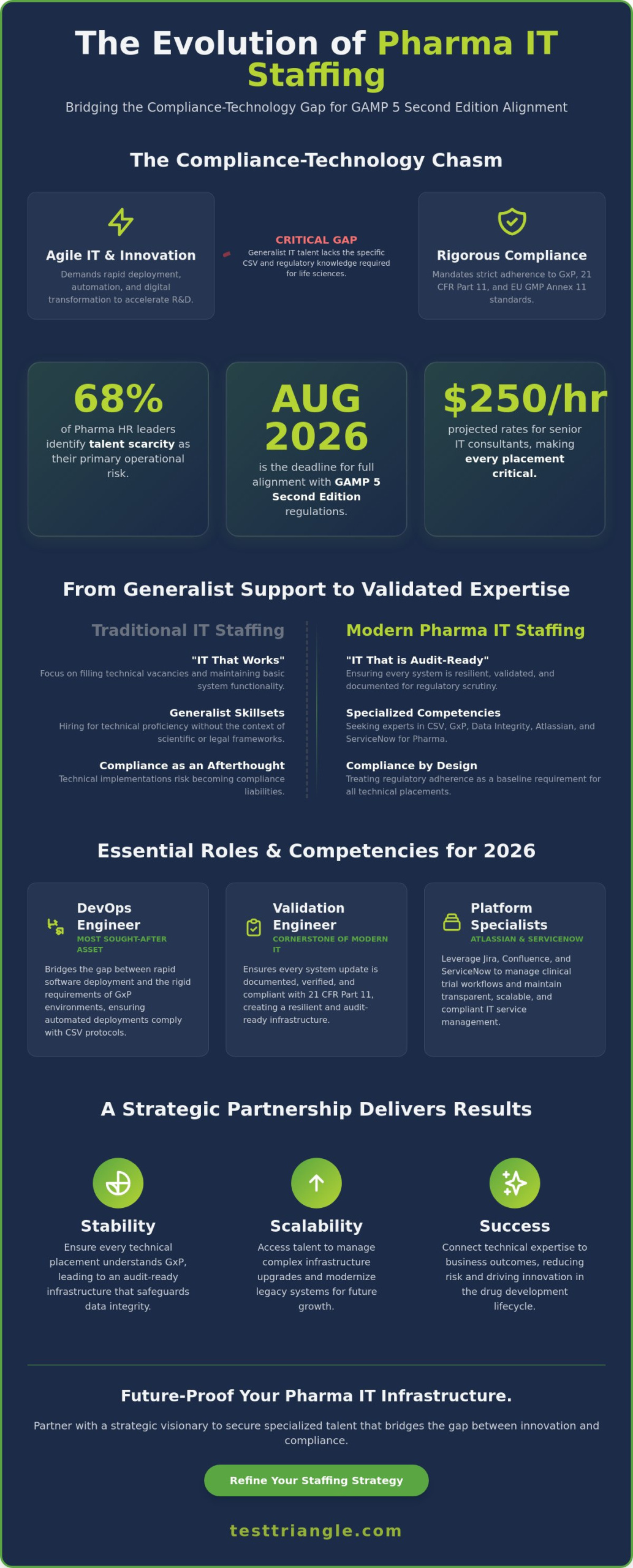
Pharma IT Staffing is no longer just about filling technical vacancies; it’s the strategic intersection of high-level digital execution and uncompromising regulatory adherence. In the complex field of Pharmacoinformatics, the demand for generalist IT support has been replaced by a need for specialists who understand the scientific and legal context of their work. As we move through 2026, the industry has shifted away from “IT that works” toward IT that is audit-ready, resilient, and fully validated. This evolution requires a disciplined, versatile, and globally-minded approach to talent acquisition.
The current landscape is defined by a dual imperative: accelerating digital transformation while maintaining absolute compliance with GxP and 21 CFR Part 11 standards. It’s not enough to hire a DevOps engineer who can manage a pipeline. You need a professional who understands how automated deployments interact with computerized system validation (CSV) protocols in a highly regulated environment. This ensures stability, scalability, and success across the entire drug development lifecycle.
The Compliance-Technology Gap
Generalist staffing models often falter in the life sciences because they overlook the rigorous documentation required for regulatory approval. By August 2026, organizations are expected to align fully with GAMP 5 Second Edition, which emphasizes a risk-based approach to AI and cloud computing. This regulatory shift means that technical placements must now possess a deep understanding of data integrity and lifecycle management. Without this specialized knowledge, technical implementations risk becoming compliance liabilities rather than operational assets. We focus on bridging this gap by identifying talent that treats compliance as a baseline requirement rather than an afterthought.
Digital Transformation in Life Sciences
The transition toward AI-driven drug discovery and decentralized clinical trials has created an unprecedented demand for data integrity experts and cloud migration specialists. Modernizing legacy laboratory systems is a necessity for survival in a market where R&D costs continue to climb. Through specialized staffing solutions, enterprises can access the talent needed to manage complex infrastructure upgrades while ensuring that every byte of data remains secure. This methodology connects technical expertise to business results, providing the peace of mind that comes from reduced risk and systemic improvement.
Essential Roles and Technical Competencies for 2026
Identifying the right human capital is the most critical factor in achieving technological maturity in a market defined by rapid change and heavy regulation. As 68% of pharmaceutical HR leaders identify talent scarcity as their primary operational risk, the focus of Pharma IT Staffing has shifted toward professionals who can manage the delicate balance of innovation and compliance. It’s no longer sufficient to hire for technical proficiency alone; the modern life sciences enterprise requires individuals who understand the scientific implications of their digital work. With senior IT consultant rates reaching $250 per hour in 2026, the financial stakes of every placement have never been higher.
DevOps engineers with specific life sciences experience are currently the most sought-after assets in the industry. These professionals possess the rare ability to bridge the gap between rapid software deployment and the rigid requirements of GxP environments. Alongside them, the Validation Engineer has emerged as a cornerstone of the modern IT team. This role ensures that every system update is documented, verified, and compliant with 21 CFR Part 11, providing the peace of mind that comes from a resilient and audit-ready infrastructure.
Enterprise Platform Specialists
Integrating Atlassian Consulting into your R&D strategy allows for the seamless management of clinical trial workflows through Jira and Confluence. These tools, when managed by specialists, provide a single source of truth for complex global projects. Similarly, leveraging ServiceNow experts for compliant IT Service Management ensures that internal processes remain transparent and scalable. Research from Kearney suggests that strategic talent in digital transformation is the true differentiator for success, rather than the tools themselves. This methodical approach to platform management reduces operational friction and empowers teams to focus on core pharmaceutical innovation.
Quality Assurance and Validation Experts
The demand for manual and automated testing professionals has surged as companies look to protect their data integrity and intellectual property. In 2026, security testing is not a separate phase but an integrated component of the development lifecycle. Sourcing talent for large-scale data migration projects requires a disciplined eye for detail to prevent data loss during the move to cloud-based systems. A reliable partner can help you discuss your specific talent requirements to ensure your team is equipped for these challenges. Our focus remains on providing the human expertise needed to support organizational progress through every stage of the digital journey.
- Cloud Architects with GxP experience to manage $45 billion market growth in life sciences software.
- AI Engineers capable of integrating machine learning into the drug discovery lifecycle.
- Cybersecurity Architects specializing in protecting decentralized clinical trial data.
- ITSM Specialists focused on ServiceNow workflow automation and audit-readiness.
Evaluating Pharma IT Staffing Models: FSP vs. Contract vs. Managed Services
Selecting the appropriate engagement model is a strategic decision that directly impacts an organization’s ability to remain agile while upholding strict regulatory standards. As the pharmaceutical industry moves toward a blended workforce, the choice between permanent, contract, and managed service models must be dictated by the specific technical requirements and the associated regulatory risk. Since 2023, the demand for contingent labor in the life sciences has grown by 41%, reflecting a broader trend toward accessing specialized expertise for project-based needs. This shift allows enterprises to maintain a core team of strategic leaders while utilizing flexible layers for technical execution, ensuring Scalability, Security, and Stability across the digital landscape.
While many organizations utilize the Functional Service Provider (FSP) model for clinical data management, this approach often lacks the technical depth required for complex IT infrastructure projects. For long-term operational stability and systemic improvement, managed outsourcing services offer a more robust framework. This model provides the peace of mind that comes from risk reduction, as the provider takes full accountability for service delivery and compliance. By aligning IT talent with high-level business outcomes, pharmaceutical leaders can focus on innovation rather than the administrative burden of talent acquisition.
Contract and Temporary Staffing
Utilizing temporary contract staff is a highly effective strategy for managing peak project demands, such as large-scale system migrations or the impending August 2026 GAMP 5 alignment deadline. This model offers a 3x faster time-to-fill for open roles compared to traditional permanent hiring, allowing for rapid response to changing market conditions. In 2026, the strategic advantage of remote and offshore IT resources is undeniable, providing access to global talent pools while managing costs through margin-based billing. This flexibility ensures that specialized validation or DevOps projects don’t stall due to local talent scarcity.
Managed Services and Strategic Partnerships
Transitioning from simple staffing to a Managed Service Provider (MSP) model represents a shift toward a long-term collaborative partnership. This approach integrates industry-leading platforms like ServiceNow directly into the service description, ensuring that Service Level Agreements (SLAs) are closely aligned with pharmaceutical quality standards. A strategic partner acts as a steady hand, providing the human expertise and technical tools necessary for sustainable growth. This methodical rhythm of service delivery reduces the internal burden of recruitment and training, allowing your internal leadership to prioritize large-scale technological evolution and long-term success.
Ensuring Compliance and Cultural Fit in Technical Recruitment
Success in Pharma IT Staffing depends on more than just matching a resume to a job description; it requires a disciplined verification of a candidate’s “compliance DNA.” In a sector where a single data integrity failure can jeopardize years of research, the primary objection for hiring managers is often whether a technical expert truly respects the GxP environment. You aren’t just looking for someone who can write code. You’re looking for someone who understands that in a validated system, every change must be documented, tested, and approved. This institutional maturity is what separates a standard IT professional from a life sciences specialist who values stability and precision.
Establishing a “compliance culture” within technical teams ensures that regulatory requirements are viewed as a catalyst for quality rather than a hurdle to speed. When your IT staff operates with this mindset, they provide the peace of mind that comes from risk reduction and systemic improvement. Leveraging specialized recruitment and talent acquisition fees for expert vetting allows enterprises to outsource the heavy lifting of regulatory screening to a partner who understands the complex nuances of pharmaceutical manufacturing.
Vetting for Regulatory Competence
Vetting for regulatory competence involves structured interview techniques that go beyond surface-level definitions. Ask candidates to describe their specific role during a past FDA or EMA audit; their answer should reveal their proficiency in validated software environments and their commitment to data integrity. Background checks and credential verification are non-negotiable in this highly regulated industry. A methodical approach to screening identifies individuals who can maintain 100% compliance while managing complex digital infrastructures. To ensure your next hire possesses these critical traits, consult with our talent acquisition experts for a specialized vetting strategy.
Bridging the Gap Between IT and Science
Bridging the gap between IT and science requires technical staff to understand the pharmaceutical “Molecule to Market” lifecycle. When a DevOps engineer understands how their deployment pipeline affects clinical researcher productivity, they become a strategic collaborator rather than a mere service provider. Onboarding strategies must emphasize this connection, fostering a culture where technical teams feel deeply invested in long-term patient outcomes. This alignment ensures that digital transformation remains a practical tool for organizational progress, allowing your business to operate as a steady hand in a fast-changing technological landscape.
Future-Proofing Your Pharma IT Infrastructure with Test Triangle
Test Triangle stands as a strategic visionary in the life sciences sector, redefining the standards of Pharma IT Staffing by merging human expertise with technical rigor. We don’t just fill roles; we build resilient ecosystems. Our approach moves beyond the transactional nature of traditional recruitment to provide a steady hand in a fast-changing technological landscape. By aligning specialized talent with high-level business objectives, we ensure that your digital infrastructure remains validated, agile, and fully prepared for the regulatory demands of 2026. This commitment to institutional maturity provides the peace of mind derived from risk reduction and long-term operational stability.
A Blended Approach to Talent and Technology
By integrating specialized staffing solutions with high-level DevOps consulting, we empower life sciences enterprises to accelerate their digital transformation journeys without compromising on quality. This methodology connects technical execution to specific business outcomes, ensuring that every professional placed within your organization contributes to systemic improvement. We offer customized training programs for all placed staff, which guarantees immediate ROI and seamless integration into your existing GxP workflows. This synergy between talent and technology allows your internal leadership to focus on large-scale innovation while we manage the complexities of technical execution.
The Test Triangle Advantage
Our proven track record as one of the premier IT staffing agencies for pharmaceutical industry is built on a foundation of precision, progress, and partnership. We leverage our deep-rooted partnerships with industry-leading platforms like Atlassian and ServiceNow to source niche talent that understands both the software and the scientific context. With access to a global pool of pre-vetted, compliance-aware professionals, we provide the versatile human capital necessary to manage complex digital infrastructures across diverse regions. Our global presence ensures that talent scarcity never becomes an operational risk for your R&D or manufacturing projects.
Navigating the complexities of recruitment and talent acquisition in 2026 requires a partner who is deeply invested in your long-term success. We provide strategic guidance that bridges the gap between technical managers and executive leadership, ensuring that every staffing decision supports organizational progress. Our disciplined approach to vetting and placement means your team is always equipped with the specialized skills needed to maintain 100% compliance in an increasingly scrutinised regulatory environment. Partnering with us means choosing a reliable collaborator dedicated to empowering your enterprise through large-scale technological evolution and sustainable growth.
Building a Resilient Digital Foundation for 2026
The transition toward a “Compliance-First, Agile-Always” infrastructure requires a deliberate shift in how your organization approaches human capital. You’ve identified that the intersection of technical proficiency and regulatory awareness is the new baseline for success in a landscape defined by evolving GAMP 5 and Annex 11 requirements. Establishing a long-term partnership with a strategic visionary ensures that your Pharma IT Staffing needs are met with precision, providing the stability required for large-scale technological evolution and systemic improvement.
As an Atlassian Platinum Solution Partner and ServiceNow Premier Partner, we leverage our ISO 9001:2015 certified quality management to deliver pre-vetted experts who understand the scientific implications of their technical work. This disciplined methodology reduces time-to-hire while reinforcing your data integrity protocols across the entire drug development lifecycle. We remain committed to your long-term success by providing a steady hand through every phase of digital transformation, allowing your leadership to focus on core pharmaceutical innovation with total peace of mind.
Secure your specialized Pharma IT talent with Test Triangle today to ensure your team is equipped for the challenges of 2026 and beyond. We look forward to empowering your enterprise through human expertise and technical excellence.
Frequently Asked Questions
What is the difference between general IT staffing and Pharma IT staffing?
Pharma IT staffing differs from general recruitment by requiring a deep understanding of GxP environments and computerized system validation (CSV). While general IT focuses on technical proficiency, life sciences roles demand professionals who can navigate the rigid documentation standards of the FDA and EMA. This ensures that every digital implementation supports data integrity and patient safety from the outset.
How do you ensure IT staff are compliant with FDA 21 CFR Part 11?
Ensuring compliance with FDA 21 CFR Part 11 involves verifying a candidate’s mastery of electronic records and signature protocols through structured technical assessments. We evaluate their ability to implement audit trails and security controls within validated systems. This disciplined vetting process guarantees that every professional understands the legal implications of their technical work.
What are the typical recruitment fees for specialized Pharma IT roles in 2026?
Recruitment fees for specialized roles in 2026 vary based on the complexity of the position and the engagement model chosen. Organizations should evaluate these costs as a strategic investment in risk reduction and long-term operational stability. It’s advisable to consult with a specialized partner to discuss specific talent acquisition structures tailored to your digital transformation goals.
Can I use remote or offshore IT staff for validated pharmaceutical projects?
Remote or offshore IT staff can be effectively utilized for validated projects if they operate within a secure, GxP-compliant framework. The global nature of Pharma IT Staffing in 2026 allows enterprises to access niche talent pools while maintaining strict data governance. Success depends on clear communication protocols and a partner who can manage the logistical complexities of international compliance.
Which IT roles are currently in highest demand within the life sciences sector?
High-demand roles currently include Validation Engineers, DevOps Engineers with life sciences experience, and AI Specialists capable of managing drug discovery data. There’s also a significant need for Cybersecurity Architects who can protect decentralized clinical trial infrastructures. These roles are essential for maintaining a resilient and audit-ready digital ecosystem.
How does a Functional Service Provider (FSP) model differ from traditional staffing?
The Functional Service Provider (FSP) model focuses on outsourcing an entire department or project function rather than individual roles. Unlike traditional staffing, which provides human capital for specific vacancies, the FSP model offers a more integrated approach to technical execution. This allows pharmaceutical companies to scale their operations while maintaining high standards of quality and efficiency.
What technical certifications should I look for in a Pharma IT candidate?
Look for candidates who combine platform-specific certifications, such as Atlassian Certified Professional or ServiceNow System Administrator, with industry-recognized credentials like GAMP 5 training. Technical proficiency must be paired with a demonstrated understanding of quality risk management. This combination ensures the professional can handle both the technical tools and the regulatory context.
How can specialized staffing help with Atlassian or ServiceNow implementation?
Specialized staffing provides access to consultants who understand how to configure Atlassian and ServiceNow platforms specifically for pharmaceutical workflows. These experts ensure that your IT Service Management tools are fully validated and capable of managing complex clinical data. This strategic alignment reduces implementation risks and accelerates the path to digital maturity.

Article by
Paul Guy
Paul serves as the Marketing Director at Test Triangle, where he leads a global team in driving growth through strategic B2B marketing and brand communications. With a strong emphasis on measurable outcomes and sustainable performance, he plays a pivotal role in aligning marketing functions to enhance customer engagement and accelerate business impact. Under his leadership, marketing initiatives have consistently delivered significant returns on investment, elevated brand visibility, and strengthened the company's presence across key markets.