



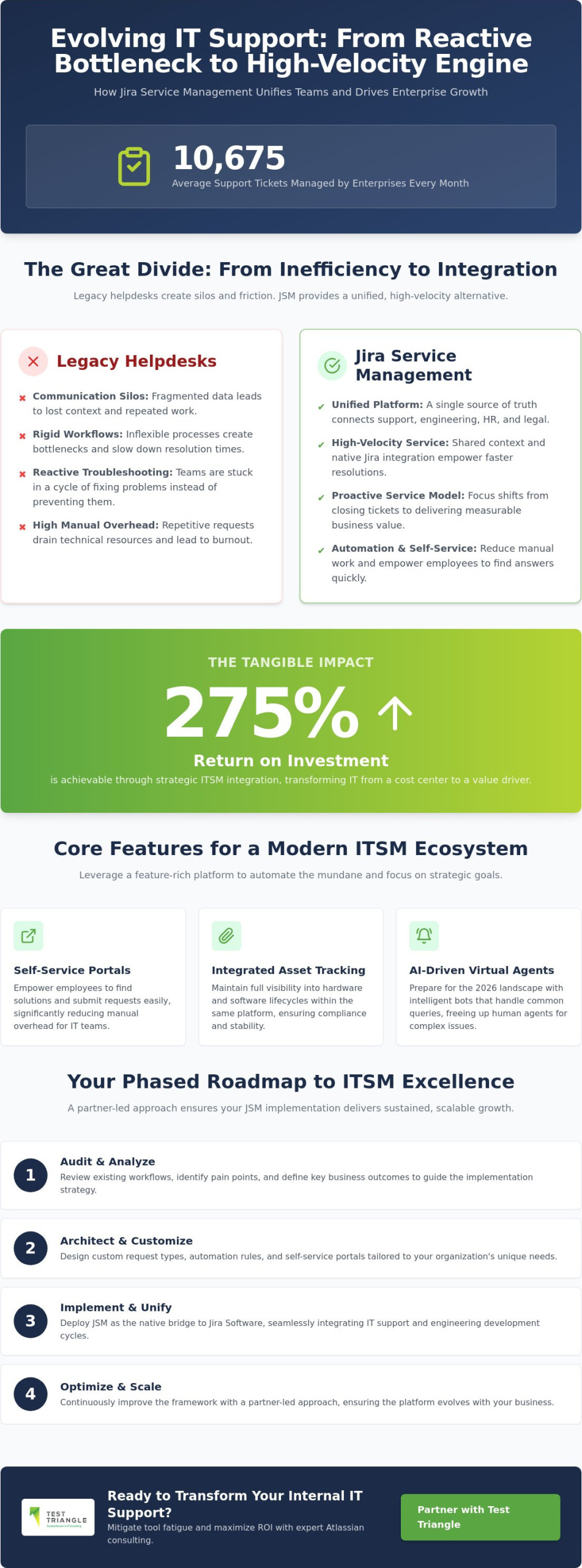
With the average enterprise now managing over 10,675 support tickets every month, the traditional separation between service desks and engineering teams has become an operational liability. You’ve likely felt the friction of communication silos and the mounting pressure of repetitive manual requests that drain your team’s technical resources. Implementing jira service management for internal it support offers a decisive shift from reactive troubleshooting to a state of high-velocity service delivery. By aligning your support workflows directly with Jira Software, you eliminate the visibility gaps that often stall asset lifecycles and resolution times.
This guide provides a comprehensive roadmap to architecting a unified, automated, and scalable internal ecosystem. We’ll explore how a 275% return on investment is achievable through strategic ITSM integration while examining the 2026 technical landscape, including AI-driven virtual agents and Forge API enhancements. You’ll discover the methodology behind transforming fragmented support into a disciplined, versatile, and globally-minded operation that prioritizes business outcomes over mere ticket counts. We’ll show you how to leverage this integrated framework to ensure your digital infrastructure remains a stable, high-performance asset for the long term.
Key Takeaways
- Learn how to pivot from a traditional, reactive helpdesk to a proactive service model that aligns with enterprise-scale digital evolution and long-term operational stability.
- Master the deployment of self-service portals and integrated asset tracking to significantly reduce manual overhead while maintaining full visibility into hardware and software lifecycles.
- Understand how to unify your support and engineering teams by implementing jira service management for internal it support as a native bridge to existing Jira Software development cycles.
- Follow a phased strategic roadmap designed to audit existing workflows and architect custom request types that maximize employee adoption and technical precision.
- Discover how a partner-led approach to implementation mitigates tool fatigue and ensures your ITSM framework delivers sustained, scalable growth across complex, highly regulated environments.
The Strategic Evolution of Internal IT Support: Why Jira Service Management Matters
In the current enterprise environment, the role of internal IT has transitioned from a back-office utility to a central pillar of organizational resilience. Jira Service Management (JSM) serves as a comprehensive ITSM solution designed to orchestrate these complex interactions across a unified digital landscape. By leveraging the robust architecture of Jira (software), JSM allows organizations to move beyond the limitations of reactive helpdesks into a proactive, high-velocity model. This evolution is critical for managing the unique pressures of 2026, where hybrid work models and AI-driven workflows demand a platform that can seamlessly integrate IT, HR, and Legal departments into a singular service engine. Managing internal requests in 2026 requires more than just a digital logbook; it requires a system that understands the nuances of modern service delivery through stability, precision, and scalable growth.
Adopting jira service management for internal it support addresses the modern reality where support teams handle an average of 10,675 tickets monthly. Without a unified platform, these volumes lead to fragmentation, data loss, and employee burnout. Organizations that prioritize IT service management services find that consolidating their request management onto a single platform reduces technical debt and improves enterprise-wide productivity. This strategic shift ensures that IT is no longer a bottleneck but a catalyst for digital transformation, providing the peace of mind that comes from risk reduction and operational stability.
Understanding the High-Velocity Support Model
High-velocity service management represents the intersection of speed, quality, and deep team collaboration. Unlike traditional, tiered support structures that often create bottlenecks between levels, JSM empowers internal agents to resolve tickets faster through shared context. When support teams have immediate access to technical data and historical resolutions, they can address complex issues without unnecessary escalations. This model fosters a culture of continuous improvement where the focus shifts from simply closing tickets to delivering measurable business value. By empowering agents with integrated tools, the organization achieves a professional pace that mirrors the operational efficiency promised to stakeholders.
Why Legacy Helpdesks Fail Modern Internal Teams
Traditional helpdesks frequently succumb to systemic inefficiencies such as siloed data and rigid, inflexible workflows. These legacy systems often force teams into constant context switching between disparate support tools and development environments, which significantly degrades productivity. Rigid workflows in older systems fail to account for the speed at which modern dev teams operate. When jira service management for internal it support is implemented effectively, it eliminates these barriers by providing a native connection to the engineering toolchain. This integration ensures that information flows freely across the organization, preventing the data fragmentation that typically leads to slow resolution times and poor employee experiences. It acts as a steady hand in a fast-changing landscape, ensuring that human expertise and technical tools work in perfect harmony.
Optimizing Internal Workflows with Jira Service Management Core Features
To achieve the high-velocity engine described earlier, organizations must move beyond simple ticket logging and embrace a feature-rich ecosystem that prioritizes precision, productivity, and progress. Integrating jira service management for internal it support allows teams to automate the mundane and focus on the complex, transforming the service desk into a strategic asset. This transition is anchored in the broader framework of IT Service Management (ITSM), where the goal is to align technical delivery with specific business outcomes. Advanced SLAs empower internal teams to monitor performance with granular detail, ensuring that critical infrastructure issues are addressed before they impact organizational stability. Transitioning to conversational ticketing through Slack and Microsoft Teams meets employees where they already work, reducing the friction of request submission and accelerating the initial response phase.
Empowering Employees through Self-Service and Knowledge Bases
Modern service delivery relies on the seamless integration of Confluence to create a searchable, AI-driven internal help center. This setup allows the system to ‘deflect’ common queries by suggesting relevant articles as users type their requests, effectively resolving issues before they even reach an agent’s queue. In the 2026 landscape, AI-powered virtual agents can reduce ticket resolution times by as much as 75%, allowing your technical staff to focus on high-level digital transformation. As you scale, remember that self-service is not just a convenience; it is a strategic necessity for scaling internal IT without increasing headcount. This approach ensures that your team remains a lean, effective force capable of supporting a growing global enterprise.
Modern Asset Management for Internal Infrastructure
The Assets feature, formerly known as Insight, provides a sophisticated framework for tracking the entire lifecycle of internal company hardware and software. By linking these assets directly to support incidents, agents gain immediate visibility into the affected machine’s history, configuration, and dependencies, which leads to significantly faster triage and resolution. In 2026, this level of detail is essential for the growing trend of ‘sustainable IT,’ where precise tracking helps organizations reduce hardware waste and optimize resource allocation. This systematic approach to asset management provides the peace of mind that comes from knowing every piece of your digital infrastructure is accounted for and maintained with professional rigor. If you’re looking to refine your current asset strategy, it’s beneficial to speak with a strategic consultant who understands the nuances of the Atlassian ecosystem.
Bridging the Gap: Integrating IT Support with Engineering and DevOps
A common hesitation among IT leadership is the perception that jira service management for internal it support introduces unnecessary complexity for relatively straightforward internal needs. This perspective often overlooks the strategic value of an integrated ecosystem where support and development operate on a single source of truth. By utilizing a platform that natively bridges these functions, organizations replace fragmented communication with a disciplined, high-velocity workflow. This integration allows for a definitive “Shift Left” approach, where service desk insights inform engineering priorities early in the lifecycle, ultimately reducing the cost of remediation and enhancing the overall stability of the digital infrastructure. It is a transition from being a mere service provider to becoming a reliable long-term collaborator within the business.
The Synergy Between Jira Software and Service Management
Turning internal support tickets into actionable development tasks is a seamless process within the Atlassian stack. When an employee reports a recurring software glitch, the service agent can instantly create a linked issue in Jira Software, ensuring that the engineering team has the full context of the user’s experience without manual data entry. Bi-directional syncing ensures that as the developer moves the task through the sprint, the support agent is automatically updated, allowing for transparent communication with the internal stakeholder. This synergy underscores why Manual Testing in 2026: A Strategic Guide remains relevant; quality is not just a final check but a continuous effort that begins at the first point of internal contact and moves through the entire development cycle.
Accelerating Incident and Change Management
Managing complex infrastructure changes requires a level of precision that legacy systems simply cannot provide. JSM enables internal IT teams to implement automated change management workflows that include sophisticated risk assessment and deployment gating. By integrating directly with CI/CD tools, the platform can automatically flag high-risk changes, requiring manual approval only when specific thresholds are met, which significantly reduces internal system downtime. This level of technical rigor aligns perfectly with broader DevOps Consulting objectives, where the goal is to accelerate enterprise transformation through the combination of human expertise and technical tools. Utilizing jira service management for internal it support in this capacity transforms the service desk into a steady hand that guides organizational progress amidst a fast-changing technological landscape.
A Strategic Roadmap for Implementing JSM for Internal IT in 2026
Transitioning to a high-velocity service model requires more than a technical migration; it demands a structured, phased implementation that prioritizes long-term operational stability. A successful deployment of jira service management for internal it support begins with institutional maturity and a clear vision of the desired end-state. Organizations that skip the strategic planning phase often find themselves managing the same historical inefficiencies in a newer, more expensive environment. By following a disciplined roadmap, global enterprises ensure their digital infrastructure is managed with the expertise required to support large-scale technological evolution and systemic improvement.
Auditing and Mapping Internal Workflows
Mirroring existing, inefficient processes in a modern tool is a primary recipe for failure. Phase 1 of your roadmap must focus on a comprehensive audit of current support interactions to identify bottlenecks and redundant manual efforts. This discovery phase is where professional IT Service Management Services provide the most value, offering a steady hand to help teams deconstruct complex workflows and rebuild them for maximum velocity. By mapping these journeys before configuration, you ensure that the resulting platform is optimized for the speed and quality required in 2026. This process allows you to identify which repetitive internal requests are prime candidates for automation in later phases.
Configuring for the Employee Experience
Phase 2 involves shifting to an “internal customer” mindset to design portal groups that prioritize ease of use and intuitive navigation. The configuration of low-code forms allows IT teams to capture comprehensive data during the initial request, which reduces the need for back-and-forth communication and accelerates resolution times. The Employee Portal serves as the digital front door of the modern enterprise. By creating a unified, intuitive interface, you empower your workforce and foster a culture of self-sufficiency that reduces the overall burden on your technical staff. This approach ensures that technical managers and executive leadership both see the tangible benefits of a streamlined request process.
Once the foundation is set, Phase 3 focuses on implementing automation rules to handle repetitive internal tasks like access provisioning and hardware requests. Finally, Phase 4 establishes a continuous improvement cycle based on JSM reporting, where data-driven insights lead to systemic improvements and progress. This methodical rhythm ensures that your team remains a reliable collaborator in the company’s growth. If you are ready to begin your transformation with precision and confidence, it is time to consult with an implementation expert who can guide your team through each phase of this strategic evolution.
Maximizing ROI with Professional Atlassian Consulting Services
While Jira Service Management is inherently intuitive, the transition for a global enterprise involves layers of complexity that often exceed the capacity of internal teams. A DIY approach frequently results in “tool fatigue,” where over-engineered workflows and fragmented data lead to low user adoption and stalled digital transformation. By choosing to implement jira service management for internal it support through a professional lens, organizations ensure that their technical infrastructure is not just a ticketing system, but a strategic engine for growth. This journey requires a steady hand to navigate the nuances of high-velocity service delivery while maintaining operational stability and security across the entire ecosystem.
Avoiding Common Implementation Pitfalls
The risks of a poorly executed rollout are substantial, ranging from over-engineered workflows that frustrate agents to data migration errors that obscure historical insights. Many organizations underestimate the critical role of change management, failing to realize that a tool is only as effective as the people who use it. Utilizing expert Atlassian Implementation Services allows you to mitigate these risks through a disciplined methodology that prioritizes clarity and comprehensive detail. Our consultants focus on aligning technical execution with your specific business outcomes, ensuring that the platform scales alongside your organizational needs without introducing unnecessary friction or technical debt. This approach provides the stability, precision, and progress necessary for a successful transition.
The Test Triangle Advantage: Strategic Partnership for Scalable Growth
A professional partnership extends far beyond the initial deployment phase. Maintaining a complex Atlassian environment requires ongoing optimization, governance, and technical rigor to ensure sustained performance in a fast-changing landscape. By leveraging Managed Outsourcing Services, enterprises benefit from the peace of mind that comes from proactive risk reduction and continuous systemic improvement. Test Triangle acts as a reliable long-term collaborator, bridging the gap between technical managers and executive leadership through data-driven insights and institutional maturity. We empower your team to focus on core innovation while we manage the daily complexities of your ITSM framework.
Achieving true high-velocity service is a journey of evolution rather than a one-time event. It requires a commitment to quality and a versatile approach to service delivery that can adapt to new technical challenges as they arise. When you partner with Test Triangle for your Jira Service Management journey, you gain more than a service provider; you gain a strategic visionary dedicated to your long-term success. We invite you to transform your internal IT operations into a powerhouse of efficiency and resilience through our proven expertise and human-centric technical tools.
Architecting a High-Velocity Future for Internal Support
Achieving a high-velocity service engine requires a disciplined alignment of people, processes, and platforms that transforms the traditional support desk into a strategic business asset. By implementing jira service management for internal it support, your organization can finally bridge the gap between reactive troubleshooting and proactive engineering. This integrated framework not only accelerates resolution times through advanced automation but also provides the institutional maturity needed to manage complex asset lifecycles and cross-departmental requests with stability and precision.
As an Atlassian Gold Solution Partner with a global presence across Europe, North America, and Asia, Test Triangle understands the technical rigor required for highly regulated industries like Finance and Pharma. We act as a reliable long-term collaborator to ensure your digital transformation remains scalable, secure, and aligned with executive business goals. Modernize your internal IT with Test Triangle’s Atlassian Consulting and empower your workforce with a platform built for the complexities of 2026. Your journey toward operational excellence is within reach.
Frequently Asked Questions
Is Jira Service Management suitable for small internal IT teams?
Jira Service Management is an ideal solution for small teams because it offers a free tier for up to three agents while providing the same enterprise-grade automation found in larger deployments. This scalability allows lean departments to maintain high-velocity support and professional service portals without the burden of excessive infrastructure costs. As your organization expands, the platform grows with you, ensuring a stable, precise, and scalable service engine.
How does JSM integrate with Slack and Microsoft Teams for internal support?
The platform utilizes conversational ticketing to transform chat messages into actionable support requests directly within the agent’s queue. By meeting employees in their existing communication channels, internal IT reduces the friction of ticket submission and accelerates the initial response phase. Bi-directional syncing ensures that all updates made in Slack or Teams are reflected in the central ticket, maintaining a single source of truth across the enterprise.
What is the difference between Jira Service Desk and Jira Service Management?
Jira Service Management is the comprehensive successor to Jira Service Desk, offering significantly expanded capabilities in incident, change, and asset management. While the older Service Desk focused primarily on request fulfillment, JSM provides a unified platform that bridges the gap between development and operations teams. This evolution enables organizations to manage complex digital infrastructures with greater visibility and technical rigor.
Can we use Jira Service Management for non-IT departments like HR or Finance?
JSM is specifically designed for Enterprise Service Management, allowing departments like HR, Finance, and Legal to leverage the same high-velocity framework for their internal requests. Centralizing these functions creates a unified digital front door for employees, which improves the user experience and provides executive leadership with comprehensive visibility into service performance. This approach fosters organizational progress through the combination of human expertise and technical tools.
How does JSM help with internal asset management and tracking?
The Assets feature within JSM provides a sophisticated database for tracking the entire lifecycle of hardware and software across your digital landscape. By linking these assets directly to support incidents, agents gain immediate context regarding a user’s device history and configuration, which leads to faster resolution times. Implementing jira service management for internal it support in this way ensures that your technical resources are managed with professional discipline and long-term stability.
What are the common challenges when migrating to Jira Service Management Cloud?
Organizations often face hurdles related to complex data mapping, app compatibility, and the need to maintain security compliance in highly regulated industries. A primary risk is mirroring inefficient legacy processes in the new cloud environment, which can lead to low adoption and technical debt. Partnering with a strategic visionary for your migration helps mitigate these risks through a structured audit and a disciplined transition methodology.
How long does a typical JSM implementation for internal IT take?
A standard implementation can range from several weeks for basic setups to several months for complex enterprise deployments involving multiple internal departments. The specific timeline is influenced by the volume of data migration, the complexity of custom automation rules, and the depth of integration with Jira Software. Following a phased roadmap allows teams to achieve immediate business value while building toward a more comprehensive service ecosystem.
Does Jira Service Management support ITIL 4 practices for internal teams?
JSM is PinkVerify certified for ITIL 4, providing native support for critical practices such as incident, problem, change, and service request management. This certification ensures that internal teams can implement recognized global benchmarks with confidence and technical precision. Using jira service management for internal it support allows your team to adopt these best practices while maintaining the flexibility to adapt workflows to your unique operational requirements.

Article by
Paul Guy
Paul serves as the Marketing Director at Test Triangle, where he leads a global team in driving growth through strategic B2B marketing and brand communications. With a strong emphasis on measurable outcomes and sustainable performance, he plays a pivotal role in aligning marketing functions to enhance customer engagement and accelerate business impact. Under his leadership, marketing initiatives have consistently delivered significant returns on investment, elevated brand visibility, and strengthened the company's presence across key markets.