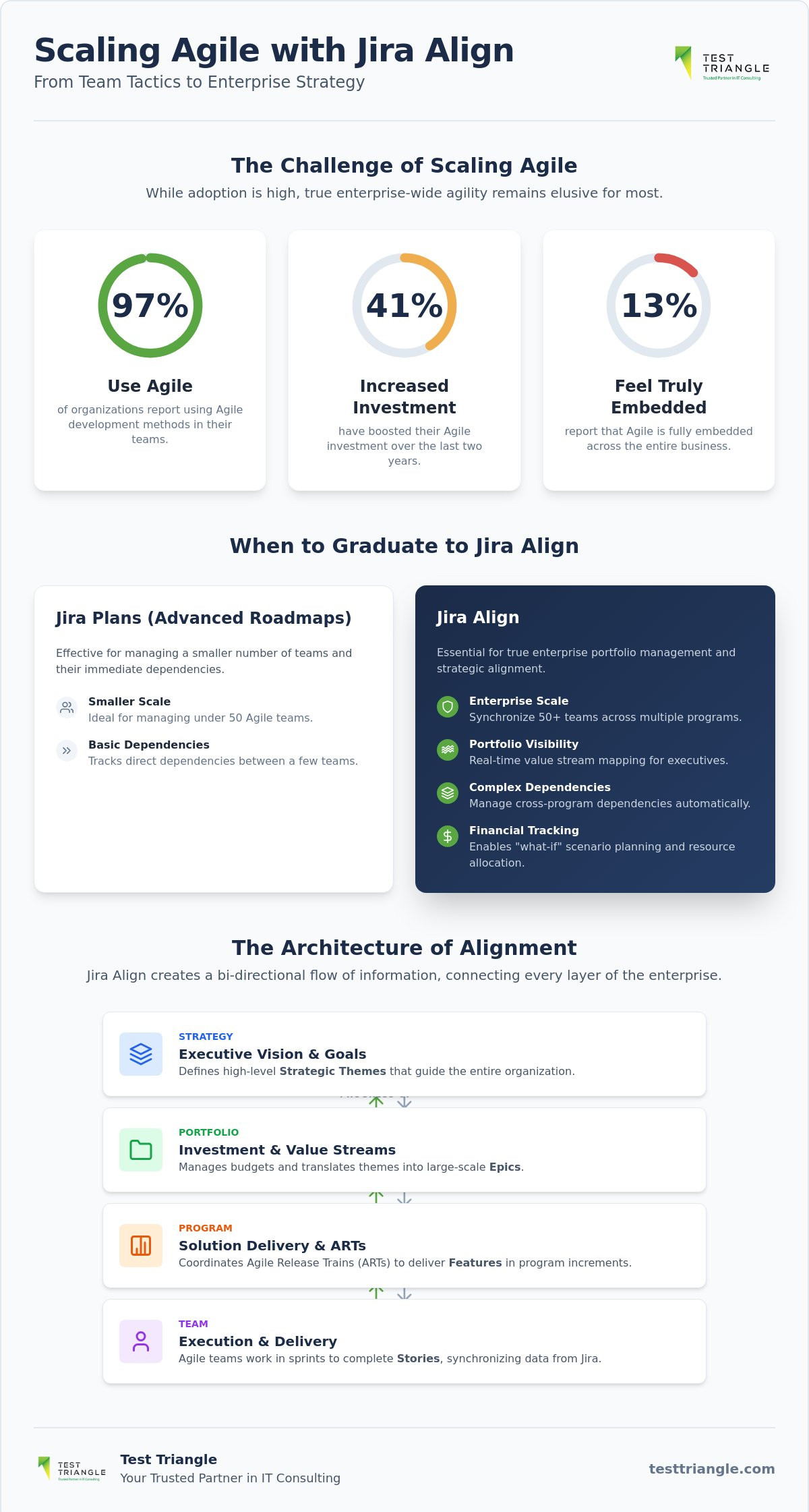
While 97% of organizations report using Agile development, a staggering 41% have increased their investment over the last two years only to find that a mere 13% feel Agile is truly embedded across their business. This disconnect often stems from a lack of visibility into cross-team dependencies and strategic goals that fail to reflect in daily development work. If you’re struggling to understand how to scale agile with jira align across hundreds of manual Jira boards, you’re not alone in seeking a more disciplined approach to digital transformation.

We understand that your primary objective is to move beyond simple output tracking and toward genuine outcome alignment. This 2026 strategic guide promises to help you master the complexities of enterprise-scale agility by connecting team-level execution to executive strategy using the latest Jira Align v.11.25 capabilities and preparing for the v.11.27.0 feature set. You’ll learn how to replace manual reporting with real-time visibility into portfolio health and automated dependency management. We’ll explore the implementation of framework-agnostic strategies that ensure your investments directly drive delivery, providing the stability, precision, and growth your global enterprise requires for long-term success.

Key Takeaways

  • Master the multi-layered architecture of Jira Align to effectively bridge the visibility gap between high-level executive strategy and granular team execution.
  • Evaluate the flexibility of various scaling frameworks, including SAFe and LeSS, to determine the optimal configuration for your unique organizational requirements.
  • Execute a structured implementation roadmap that prioritizes data hygiene and executive alignment to ensure a successful transition when learning how to scale agile with jira align.
  • Leverage predictive AI-driven insights to identify delivery risks and resource bottlenecks before they impact your portfolio’s strategic health.
  • Transform fragmented team data into a bi-directional flow of information that empowers leadership with real-time visibility into the relationship between investment and delivery.

What is Jira Align and Why Does Enterprise Agility Require It?

By establishing a bi-directional flow of information, Jira Align functions as the enterprise-scale bridge that connects high-level executive strategy with granular team-level execution. While Jira Software excels at managing the tactical workflows of individual teams, it often leaves a visibility gap when organizations attempt to synchronize multiple Agile Release Trains (ARTs) across a global footprint. For organizations with 500 or more developers, the challenge isn’t just about managing tasks; it’s about ensuring that every line of code contributes to a defined business outcome. Jira Align provides the necessary infrastructure to align, accelerate, and achieve these objectives through real-time data synchronization across the entire enterprise.

Understanding how to scale agile with jira align requires a fundamental shift in perspective, moving from tracking team outputs to measuring strategic outcomes. As organizations adopt the Scaled Agile Framework (SAFe) or other enterprise models, the complexity of managing cross-team dependencies often becomes a bottleneck. Jira Align resolves this by aggregating data from hundreds of Jira boards into a single, coherent portfolio view, providing the institutional maturity required to manage digital transformation at scale. For those moving toward this level of maturity, engaging with Atlassian implementation experts ensures that the technical configuration mirrors the organizational strategy.

The Disconnect Between Strategy and Execution

In many large-scale environments, development often becomes a “black box” to C-suite stakeholders, where strategic goals are set at the top but lose clarity as they cascade down to the teams. This misalignment results in wasted resources on low-value features that don’t move the needle on key business metrics. By implementing Jira Align, companies transition from project-centric models to product-centric delivery. This shift allows leadership to see exactly how investment translates into progress, ensuring that daily development work remains anchored in the company’s long-term vision and operational stability.

Jira Align vs. Jira Plans (Advanced Roadmaps)

Deciding when to graduate from Jira Plans to Jira Align is a critical strategic milestone. While Jira Plans is effective for managing a small number of teams and their immediate dependencies, it lacks the depth required for true portfolio management and financial tracking. The tipping point for Jira Align investment typically occurs when:

  • Organizations need to synchronize 50 or more agile teams across multiple programs.
  • Executive leadership requires real-time visibility into value stream mapping and strategic snapshots.
  • Financial tracking and “what-if” scenario planning become necessary for resource allocation.
  • The complexity of cross-program dependencies exceeds what manual reporting can reliably manage.

Jira Align v.11.25 provides the sophisticated toolset needed to manage these complexities, offering a level of precision that standard roadmapping tools simply cannot match.

The Architecture of Alignment: How Jira Align Functions

Jira Align operates on a hierarchical architecture specifically engineered to synchronize the disparate layers of a global enterprise. Unlike standard project management tools that focus on linear task completion, this platform establishes a bi-directional flow of information between technical execution and business value. Understanding how to scale agile with jira align requires a deep dive into its four primary levels of scale: Strategy, Portfolio, Program, and Team. By connecting these layers, the platform ensures that every story point delivered at the team level contributes directly to a Strategic Theme defined at the executive level. This structural integrity is what allows organizations to move beyond simply “doing” agile to truly Achieving Agility across the entire business ecosystem.

The core of this functionality lies in the “Room” concept, which provides tailored environments for different stakeholders to collaborate. These Rooms act as command centers, aggregating data from Jira Software and transforming it into actionable insights. For instance, while developers work within their familiar Jira boards, their progress is automatically rolled up into Program and Portfolio views. This data hierarchy ensures that Epics, Features, and Stories remain tethered to the overarching mission, eliminating the manual data entry that often plagues large-scale transformations. If your organization is struggling to map these complex relationships, you may benefit from a professional consultation on enterprise architecture design to ensure your data hygiene supports your scaling goals.

The Strategy and Portfolio Rooms

The Strategy Room is where executive leadership defines the long-term goals and Strategic Themes that drive the enterprise. Here, the focus shifts from individual projects to funding value streams, allowing for more flexible resource allocation based on real-time performance. By tracking Investment Themes, portfolio managers can ensure that budgets remain aligned with business priorities. This level of oversight provides the peace of mind that comes from knowing capital is being deployed toward the highest-value initiatives, rather than being lost in low-impact development cycles.

The Program and Team Layers

At the Program and Team layers, the architecture focuses on execution and dependency management. The Program Board serves as a vital visualization tool, highlighting cross-team dependencies that could jeopardize delivery timelines. Meanwhile, the Team Room provides developers with a clear view of how their specific stories contribute to the broader Program increment. This visibility empowers teams by providing context, while the automated roll-up of story points provides leadership with an accurate, real-time reflection of program-level progress. This seamless integration ensures that how to scale agile with jira align becomes a matter of operational rhythm rather than constant manual intervention.

Selecting Your Framework: SAFe, LeSS, or Hybrid?

Choosing the right framework is a pivotal decision that defines the trajectory of an enterprise’s agility journey and its ultimate operational stability. While many organizations gravitate toward the Scaled Agile Framework (SAFe) due to its comprehensive structure, Jira Align provides the necessary flexibility to support diverse methodologies including LeSS, Scrum@Scale, and the Spotify model. This framework-agnostic capability allows enterprises to customize the platform to fit their unique organizational DNA, ensuring that the software adapts to the business rather than forcing the business to adapt to the software. By establishing this adaptable foundation, leadership can maintain institutional maturity while allowing teams the autonomy they need to excel.

In many global infrastructures, it’s common to find hybrid environments where different departments employ varying agile methodologies simultaneously to meet their specific delivery needs. Understanding how to scale agile with jira align in these complex scenarios involves mapping disparate terminologies into a unified, coherent interface. By translating team-level data into a standardized language of Features and Strategic Themes, the platform provides a cohesive view of progress across the entire enterprise, regardless of the underlying framework used by individual teams. This alignment ensures that technical managers and executive leadership remain synchronized, fostering a spirit of partnership and shared success across the organization.

Optimizing the Scaled Agile Framework (SAFe)

For organizations committed to SAFe, Jira Align acts as a powerful accelerator by automating the labor-intensive aspects of PI Planning and reducing the manual effort associated with big-room synchronization. The digital Program Board provides a real-time visualization of the Agile Release Train (ART), allowing release train engineers to identify and resolve blockers instantly before they jeopardize the current Program Increment (PI). Jira Align proactively manages cross-team dependencies by providing automated conflict alerts and visual health indicators to prevent delivery delays and maintain release predictability.

Beyond Frameworks: Value Stream Management

True organizational progress requires moving beyond mere framework compliance to focus on the efficient flow of value from concept to cash. Jira Align empowers leadership to identify systemic bottlenecks within complex value streams, providing the data necessary to optimize resource allocation and improve time-to-market. By mapping these enterprise value streams, organizations can ensure that every development effort is directly contributing to revenue generation or strategic growth. To achieve this level of operational excellence, many enterprises leverage Digital Transformation Services to refine their processes and ensure their technology stack fully supports their value delivery goals.

Implementation Roadmap: Steps to Scale Agile Successfully

Scaling agile at the enterprise level requires a methodical, multi-phased approach that prioritizes organizational readiness over technical configuration. When considering how to scale agile with jira align, the most successful implementations follow a structured roadmap that begins with executive alignment and value stream identification. This initial phase ensures that leadership agrees on the definition of value before any data is synchronized. Following this, organizations must move through a rigorous process of data hygiene, pilot programs, and eventual portfolio-wide expansion to ensure long-term stability and precision. Moving too quickly without these foundations often leads to fragmented visibility and wasted resources.

The roadmap typically unfolds across five distinct phases designed to build institutional maturity and operational stability:

  • Phase 1: Executive Alignment: Defining the strategic themes and value streams that will anchor the transformation. This phase focuses on connecting business outcomes to technical delivery.
  • Phase 2: Data Hygiene: Standardizing Jira Software configurations to ensure a “single source of truth.” This involves cleaning up legacy boards and field configurations that could distort portfolio reporting.
  • Phase 3: The Pilot Program: Selecting a single Program or Agile Release Train (ART) for initial rollout. This allows the organization to test and refine its configuration in a controlled environment.
  • Phase 4: Scaling Out: Expanding the implementation across the full enterprise portfolio once successful patterns and governance models are established.
  • Phase 5: Continuous Optimization: Refining executive dashboards to track ROI. As of the v.11.25 release in mid-2026, these dashboards offer more granular insights into the relationship between investment and delivery.

Preparing Your Data for Jira Align

The “Garbage In, Garbage Out” risk is the single most common cause of implementation failure in large organizations. Before synchronizing any data, technical managers must standardize issue types, statuses, and field configurations across all team-level boards. Mapping Jira Software projects to the Align Program layer effectively requires a disciplined approach to metadata to ensure that story points roll up accurately. You can discover how DevOps Consulting supports this level of data integrity by establishing automated guardrails for your development lifecycle.

Training and Cultural Adoption

Successful scaling is as much about people as it is about platforms. To overcome “tool fatigue” in large-scale enterprise environments, organizations should establish a Center of Excellence (CoE) to provide long-term governance and support. This body serves as the steady hand that ensures the platform evolves alongside the business, maintaining the institutional maturity required for global operations. You can explore Atlassian Consulting for tailored training programs that help your teams embrace these new ways of working. If you’re ready to begin your journey, request a strategic roadmap assessment to ensure your implementation is built on a foundation of expert knowledge.
How to Scale Agile with Jira Align: The 2026 Enterprise Strategic Guide

Future-Proofing Your Scale: Jira Align in 2026 and Beyond

As we move deeper into 2026, the metrics of success for enterprise agility are undergoing a fundamental transformation, shifting the focus from simple team velocity to the tangible measurement of Business Value Delivered. Mastering how to scale agile with jira align now involves leveraging advanced machine learning algorithms that predict delivery risks and resource bottlenecks before they impact the bottom line. This evolution ensures that the “Strategy Collection” within the Atlassian ecosystem is no longer just a repository of goals but a dynamic engine for organizational progress. By integrating Jira Align with broader strategic tools, enterprises can achieve a level of precision that was previously unattainable, allowing technical execution to stay perfectly in sync with high-level corporate objectives.

The integration of AI-driven portfolio insights marks a departure from reactive reporting toward a more disciplined, proactive management style. In the current landscape, the ability to anticipate resource constraints across multiple value streams provides the peace of mind that comes from systemic risk reduction. For global enterprises operating in highly regulated industries, this predictive capability is essential for maintaining operational stability and ensuring that large-scale technological evolution remains on track. Understanding how to scale agile with jira align in this context means moving beyond basic synchronization to embrace a platform that actively suggests optimizations for your investment themes.

The Human + AI Enterprise

Augmenting PMO decision-making with AI-generated “what-if” scenarios allows leadership to explore various resource allocation models without disrupting current delivery cycles. This synergy between automated insights and human leadership ensures that strategic intuition is backed by data-driven certainty, empowering technical managers to make informed adjustments in real time. In 2026, AI in portfolio management serves as a predictive rather than reactive force, identifying potential slippage weeks before it manifests in development boards. This transition allows organizations to maintain a steady hand in a fast-changing technological landscape, emphasizing progress through a combination of human expertise and technical precision.

Partnering for Long-Term Success

Navigating the complexities of a mature Atlassian ecosystem requires more than just technical configuration; it demands a strategic visionary who remains deeply practical. While “out-of-the-box” implementations often fail to account for unique organizational DNA, a custom approach ensures that the platform supports your specific digital transformation goals. Test Triangle acts as a reliable long-term collaborator, providing the institutional maturity and human expertise needed to turn technical tools into scalable growth engines. To ensure your organization is positioned for success in an increasingly complex environment, Contact Test Triangle for a Strategic Jira Align Roadmap and secure the expert guidance required for your agile journey.

Mastering Enterprise Agility: Your Strategic Path Forward

Achieving a seamless connection between executive vision and team execution requires more than just a software implementation; it demands a disciplined commitment to data hygiene and architectural alignment. By leveraging the multi-layered structure of Jira Align, organizations can move beyond simple task tracking to visualize the genuine business value delivered across every value stream. Whether you’re adopting SAFe or a hybrid model, the platform provides the flexibility needed to maintain institutional maturity while utilizing AI-driven insights to predict delivery risks. Learning how to scale agile with jira align is the definitive step toward a future where strategy and delivery are perfectly synchronized.

As an Authorized Atlassian Gold Solution Partner with specialized expertise in highly regulated industries like Finance and Pharma, Test Triangle acts as a reliable long-term collaborator for your digital transformation. Our global delivery model offers the remote and offshore flexibility necessary to support your complex digital infrastructure with precision and stability. Scale Your Enterprise Agility with Test Triangle's Atlassian Experts today and empower your organization with the tools and expertise required for sustainable, scalable growth.

Frequently Asked Questions

What is the minimum team size recommended for Jira Align?

Jira Align is specifically engineered for large-scale environments, typically recommended for organizations managing 50 or more agile teams or at least 500 developers. While smaller organizations might find value in its reporting, the platform’s architecture is optimized for the complexity of multiple Agile Release Trains (ARTs) and high-level portfolio management. Investing in this tool is most effective when your primary challenge is synchronizing work across hundreds of people rather than just a few squads.

How long does a typical Jira Align implementation take?

A standard enterprise implementation of Jira Align generally spans three to six months, moving from initial configuration to full cultural adoption. This timeline is heavily influenced by your organization’s existing agile maturity and the complexity of your value streams. Starting with a focused pilot program allows you to establish successful patterns before expanding to the broader portfolio, ensuring a more stable and predictable rollout across the global enterprise.

Can Jira Align integrate with tools other than Jira Software?

While Jira Align is naturally optimized for the Atlassian ecosystem, it supports integration with other work management platforms such as Azure DevOps. This flexibility allows global organizations to maintain a single source of truth at the portfolio level even if different departments utilize various team-level tools. Establishing these bi-directional links ensures that strategic themes remain visible across the entire infrastructure, regardless of the specific software used for daily execution.

What is the difference between Jira Align and Advanced Roadmaps?

The primary difference lies in scale and strategic depth, as Jira Plans (Advanced Roadmaps) focuses on team-level delivery while Jira Align bridges the gap to executive strategy. Advanced Roadmaps is ideal for coordinating up to 20 teams, but it lacks the financial tracking and portfolio-level insights required for true enterprise agility. Jira Align provides the institutional maturity needed to manage value streams and strategic snapshots that smaller roadmapping tools cannot support.

Does Jira Align support the Scaled Agile Framework (SAFe) natively?

Jira Align provides native, comprehensive support for the Scaled Agile Framework (SAFe) and is often considered the industry standard for this methodology. The interface directly maps SAFe terminology such as ARTs, PIs, and Strategic Themes to ensure a seamless transition for practitioners. However, its framework-agnostic design means it remains versatile enough to support LeSS, Scrum@Scale, or custom hybrid models effectively while maintaining operational stability.

What are the common pitfalls when scaling agile with Jira Align?

The most significant pitfall is neglecting data hygiene, which leads to a “Garbage In, Garbage Out” scenario that undermines executive reporting. Many organizations also fail by treating the platform as a team-level task manager rather than a strategic alignment tool. Successfully learning how to scale agile with jira align requires strong executive buy-in and a clear focus on organizational change management to overcome tool fatigue and ensure long-term adoption.

How does Jira Align help with dependency management?

Jira Align facilitates automated dependency management by visualizing cross-team links on the digital Program Board to identify potential delivery risks instantly. This real-time visibility allows technical managers to resolve blockers before they impact the Program Increment (PI) schedule or strategic objectives. By replacing manual spreadsheets with automated conflict alerts, the platform provides the precision needed to maintain a steady flow of value across complex, global development environments.

Paul Guy

Article by

Paul Guy

Paul serves as the Marketing Director at Test Triangle, where he leads a global team in driving growth through strategic B2B marketing and brand communications. With a strong emphasis on measurable outcomes and sustainable performance, he plays a pivotal role in aligning marketing functions to enhance customer engagement and accelerate business impact. Under his leadership, marketing initiatives have consistently delivered significant returns on investment, elevated brand visibility, and strengthened the company's presence across key markets.
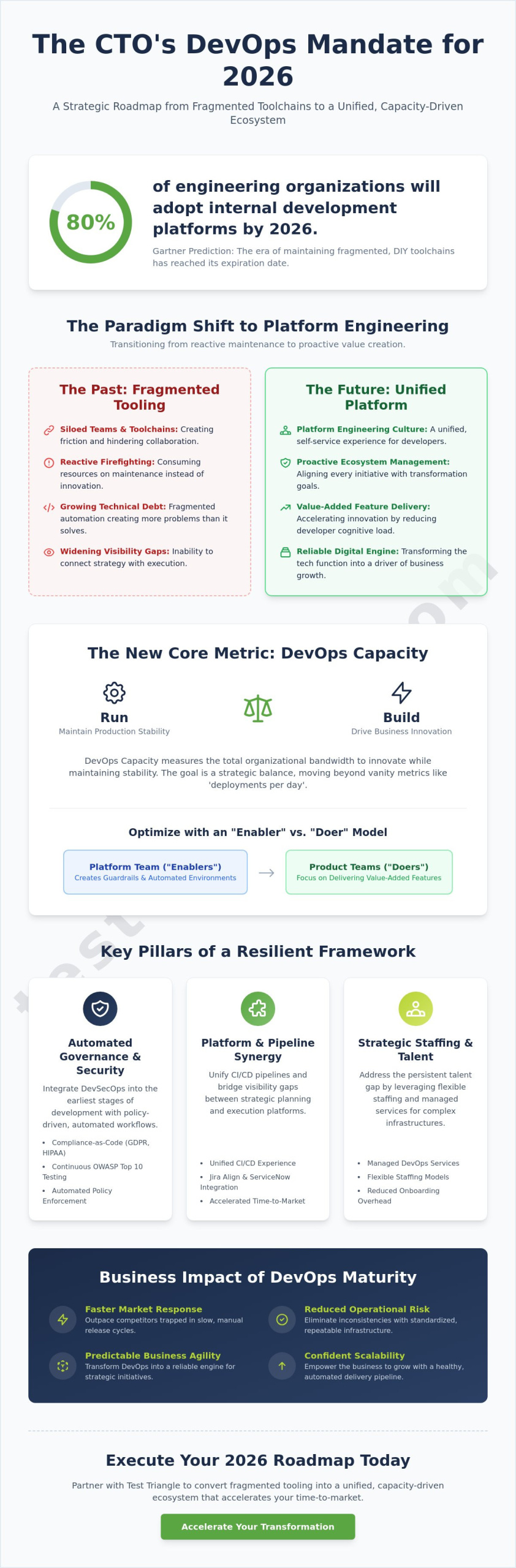
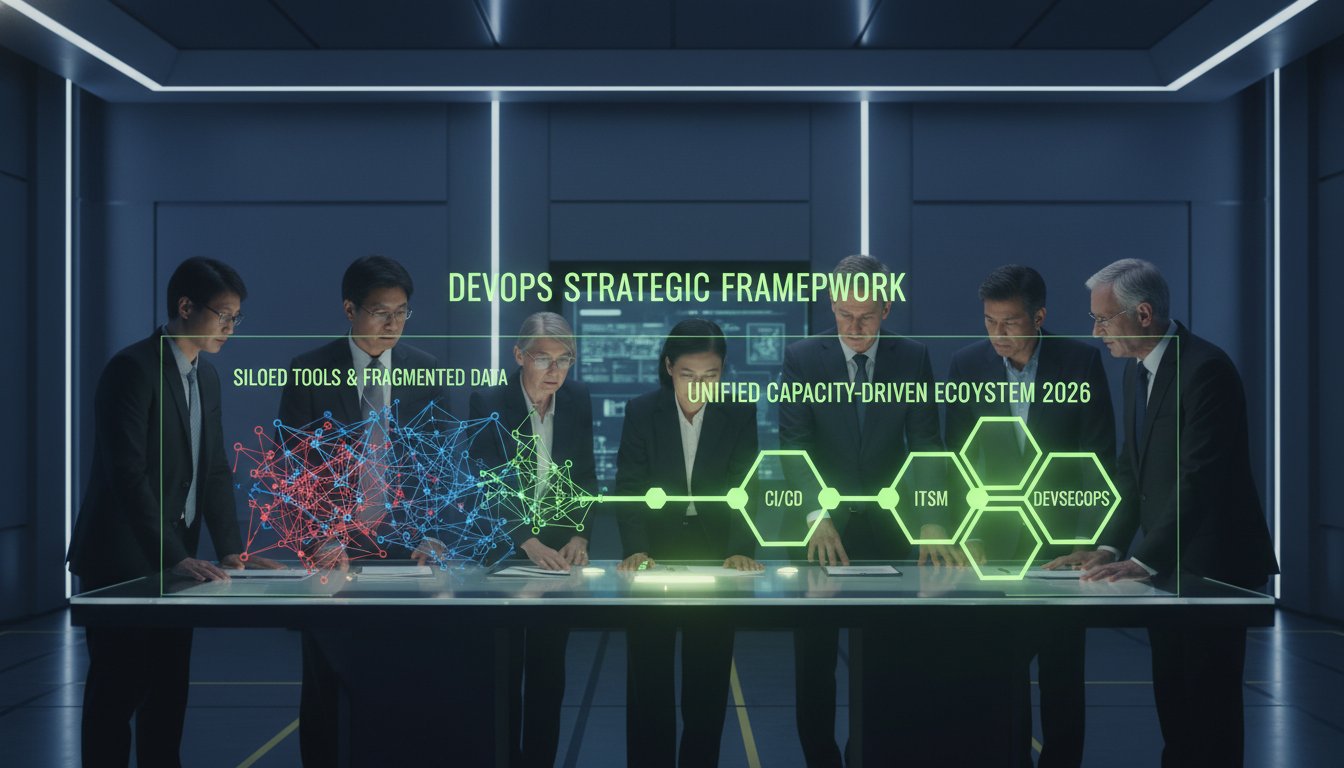
With Gartner predicting that 80% of engineering organizations will adopt internal development platforms by the close of 2026, the era of fragmented, DIY toolchains has reached its expiration. You’ve likely recognized that maintaining high-velocity delivery in complex hybrid environments is becoming unsustainable as specialized talent shortages persist and visibility gaps widen across the development lifecycle. Crafting a resilient devops strategy for chief technology officers is no longer merely an exercise in tool selection; it’s a strategic necessity to orchestrate a unified ecosystem that delivers precision, pace, and performance.

We understand that your objective is to evolve your technical function from a technical cost center into a reliable engine for digital transformation. This framework provides a high-level roadmap to help you transition from fragmented tooling to a capacity-driven ecosystem that scales with your business goals. You’ll gain insights into unifying ITSM and DevOps platforms to reduce time-to-market, ensuring governance through automated compliance, and leveraging the 2026 ServiceNow “Australia” release to secure a sustainable competitive advantage.

Key Takeaways

  • Transition from managing siloed teams to a platform engineering culture where DevOps Capacity serves as a primary metric for executive performance and organizational scalability.
  • Develop a resilient devops strategy for chief technology officers that unifies CI/CD pipelines and integrates DevSecOps into the earliest stages of the development lifecycle.
  • Align executive strategic roadmaps with technical execution by bridging the visibility gap between Atlassian Jira Align and ServiceNow ITSM platforms.
  • Address the persistent talent gap by leveraging flexible staffing models and managed DevOps services to maintain complex, hybrid-cloud infrastructures without compromising security.
  • Implement a 2026 strategic roadmap that converts fragmented tooling into a unified, capacity-driven ecosystem designed to accelerate time-to-market.

The Evolution of DevOps Strategy: A 2026 Mandate for CTOs

The landscape of software delivery has fundamentally changed, moving beyond the era where DevOps was treated as a siloed department or a collection of scripts. For the modern CTO, a devops strategy for chief technology officers now demands a transition toward platform engineering, where the goal is to provide a frictionless, self-service experience for developers. This evolution is driven by the realization that fragmented automation efforts often create more technical debt than they solve. By 2026, successful leaders are those who treat the DevOps philosophy as a foundational cultural asset, ensuring that every automation initiative aligns directly with long-term digital transformation goals. This shift requires a disciplined focus on organizational progress through the combination of human expertise and technical tools, moving away from reactive firefighting toward proactive ecosystem management.

From Tool-Centric to Capacity-Centric Leadership

DevOps Capacity is the primary metric for 2026 CTOs, representing the total bandwidth an organization possesses to innovate while maintaining the stability of current production environments. This metric forces a departure from vanity statistics like the number of deployments per day, focusing instead on the strategic balance between “run” and “build” activities. To optimize this, leaders must evaluate the “Enabler” versus “Doer” ratio within their engineering teams. A high-performing platform team acts as an enabler, creating the guardrails and automated environments that allow product teams to be the doers. When this ratio is balanced, the organization achieves a state of stability, speed, and scalability, significantly reducing the cognitive load on developers and accelerating the delivery of value-added features.

The Business Impact of Strategic DevOps Maturity

Mature DevOps practices aren’t just technical achievements; they’re significant drivers of market share and customer retention. When an organization can deploy with high frequency without security compromises, it responds to market shifts faster than competitors trapped in manual release cycles. Strategic maturity involves reducing operational risk through standardized, repeatable infrastructure that eliminates the inconsistencies of manual environments. By leveraging Atlassian implementation services to unify tracking and managed outsourcing services to handle infrastructure complexity, CTOs can transform DevOps into a predictable engine of business agility. This approach ensures that technical debt reduction isn’t a separate project but a continuous, automated byproduct of a healthy delivery pipeline that empowers the business to scale with confidence.

Designing a Resilient Framework: The Three Pillars of Modern DevOps

A resilient framework requires more than just automation; it demands a structured approach to orchestration across your entire digital estate. When building a devops strategy for chief technology officers, the focus must shift toward three core pillars that ensure stability while accelerating delivery. This framework serves as the strategic blueprint for scaling digital operations without compromising on security or governance. By 2026, the transition from fragmented, siloed automation to a unified ecosystem is the only way to manage the increasing complexity of hybrid and multi-cloud environments.

Pillar 1: Automated Governance and Security

Governance in 2026 means moving beyond basic scripts to intelligent, policy-driven workflows. This is particularly vital for organizations in highly regulated industries like finance or healthcare where Compliance-as-Code is now a requirement to meet standards like GDPR, HIPAA, and PCI-DSS. By integrating software qa services directly into the delivery stream, you ensure that security isn’t a final hurdle but a continuous process. This proactive stance addresses the OWASP Top 10 through automated security testing that runs with every commit. Leaders who succeed in implementing DevOps at this level find that security becomes an enabler of speed rather than a blocker, providing the peace of mind that comes from systemic risk reduction.

Pillar 2: Platform Engineering and Developer Experience (DevEx)

Pillar 3: Data-Driven Continuous Improvement

Data is the final pillar. You can’t improve what you don’t measure. Utilizing DORA metrics to track velocity and stability provides the “Radical Transparency” needed for executive oversight. In 2026, AI-driven insights are no longer optional for maintaining a competitive edge. Analysis shows that teams using AI-powered testing frameworks achieve 83% test coverage, a significant increase from the 54% achieved with traditional methods. These feedback loops allow for predictive failure prevention and the implementation of self-healing systems. This data-driven approach ensures your ecosystem remains resilient under pressure and allows for the continuous optimization of your delivery pipeline.

If you’re ready to modernize your infrastructure, you might consider how a tailored consultation can align these pillars with your specific business objectives.

Platform Synergy: Leveraging Atlassian and ServiceNow for Governance

Achieving a “Single Pane of Glass” across the entire software development lifecycle (SDLC) remains a top priority for technology leaders seeking to eliminate visibility gaps. A robust devops strategy for chief technology officers in 2026 relies on the synergy between Atlassian and ServiceNow to bridge the historic divide between engineering velocity and operational stability. By integrating these industry-leading platforms, you create a unified governance layer that translates raw technical output into actionable business intelligence. This orchestration ensures that your digital transformation isn’t just fast, but also aligned with the broader corporate mission, providing a disciplined foundation for long-term growth.

Strategic alignment often fails when executive roadmaps don’t reflect real-world engineering capacity. Through specialized Atlassian Consulting, organizations can leverage Jira Align to synchronize high-level objectives with the daily tasks of development teams. A precise Atlassian implementation provides the scalable project tracking necessary to manage complex portfolios, ensuring that resources are allocated to the highest-value initiatives. This visibility allows CTOs to pivot with confidence, backed by real-time data from the engineering floor, while maintaining the rigorous standards required in global enterprise environments.

While Atlassian drives the development journey, ServiceNow implementation acts as the critical bridge to IT Service Management (ITSM). The 2026 ServiceNow “Australia” release, scheduled for broad production upgrades by mid-June, introduces enhanced capabilities for automating the connection between CI/CD pipelines and change management records. This integration reduces manual intervention and eliminates the friction often found in release cycles. By automating the flow of information between Jira and ServiceNow, you achieve Visibility, Velocity, and Value, turning your DevOps function into a transparent and predictable business asset.

Unifying the Enterprise Ecosystem

Consolidating your stack around Jira, Bitbucket, and Confluence creates a seamless developer journey that minimizes context switching and improves team morale. This consolidation directly addresses the pain of tool sprawl, which often leads to fragmented data and security vulnerabilities. When combined with comprehensive IT service management solutions, these platforms provide a disciplined framework for incident response and workflow optimization. It’s about ensuring your teams remain focused on building rather than maintaining their own toolsets, allowing for a more versatile and globally-minded engineering culture.

Strategic Asset Management and Compliance

Automated governance requires more than just code; it requires an immutable audit trail that stands up to scrutiny. Integrating platform logging across the ecosystem ensures that every change is documented, meeting stringent global regulatory standards for data residency and sovereignty. This unified approach also allows for better management of software licenses and cloud spend through centralized oversight. By managing these assets strategically, you reduce unnecessary costs and ensure that your global cloud deployments remain compliant with evolving international laws, providing the peace of mind that comes from systemic risk reduction.

Solving the Talent Gap: Strategic Staffing Models for 2026

The global demand for skilled DevOps professionals continues to outpace supply, creating a strategic bottleneck for organizations aiming to execute a sophisticated devops strategy for chief technology officers. As of 2026, the average salary for a DevOps engineer in the US has reached approximately $140,000, with senior roles often exceeding $180,000. For the CTO, solving this talent gap requires a move away from traditional, slow-moving recruitment toward more agile, capacity-driven models. By leveraging specialized staffing solutions, you can scale your engineering capacity without the prohibitive overhead of permanent headcount, ensuring your roadmap remains on track even in a volatile labor market.

In highly regulated sectors such as Pharmaceuticals or Finance, the challenge is even more acute. Sourcing talent that understands both the technical CI/CD pipeline and the nuances of GxP or banking regulations is exceptionally difficult. A disciplined approach to staffing involves identifying partners who provide pre-vetted experts familiar with automated compliance and security protocols. This ensures that your technical evolution doesn’t stall due to a lack of specialized knowledge, providing the peace of mind that comes from systemic reliability and expertise.

In-House vs. Outsourced DevOps: An ROI Comparison

Evaluating the total cost of ownership (TCO) for a DevOps function reveals that permanent hires often involve hidden expenses, including recruitment fees, training, and retention incentives. Managed DevOps Services offer a compelling alternative by providing immediate access to a broad pool of expertise at a predictable cost. This model is particularly effective for “Burst Capacity,” allowing you to scale up for major cloud migrations or platform upgrades without long-term commitment. The following table illustrates the strategic trade-offs between these two models:

FeatureIn-House Permanent HiresManaged DevOps Services
Hiring CycleTypically 3 to 6 monthsImmediate to 2 weeks
Expertise DepthSpecific to individual hiresAccess to full consultant pool
ScalabilityDifficult and slowHighly flexible and rapid
Risk ProfileHigh (attrition risk)Low (contractual stability)

Remote and Offshore Talent Integration

Managing global, distributed DevOps engineering teams requires a focus on cultural and technical alignment. To succeed, you must establish clear communication protocols and standardized toolsets that transcend time zones. Utilizing specialized IT staffing services allows you to tap into offshore talent pools while maintaining the high standards of quality and security your enterprise demands. This approach not only reduces time-to-hire but also provides a versatile, globally-minded workforce capable of supporting complex infrastructures around the clock. By integrating these resources into your core platform engineering culture, you achieve a state of Stability, Precision, and Scalable Growth.

If you need to scale your engineering team quickly with specialized talent, contact our staffing experts to discuss a customized model for your organization.

DevOps Strategy for Chief Technology Officers: The 2026 Strategic Framework

Executing Your Roadmap: How Test Triangle Accelerates Transformation

Test Triangle acts as more than a service provider; we are a strategic visionary and practical collaborator for global enterprises navigating the complexities of modern software delivery. Executing a devops strategy for chief technology officers requires a nuanced understanding of how technical tools, human talent, and business governance intersect to drive organizational progress. We provide the institutional maturity needed to transition from fragmented, siloed automation to a unified, capacity-driven ecosystem. Our methodology connects deep Atlassian expertise with specialized staffing models to ensure that your transformation roadmap remains both ambitious and achievable in a volatile technological landscape.

A Holistic Approach to IT Service Management

Operational excellence is only achieved when development speed is balanced by rigorous governance and systemic reliability. By integrating comprehensive IT Service Management solutions into your core DevOps strategy, we bridge the historic divide between innovation and stability. Our strategic partnerships with AWS and ServiceNow allow us to orchestrate environments that are secure, compliant, and highly performant. Our proven success in the pharmaceutical sector, for instance, demonstrates our ability to scale DevOps functions while maintaining strict adherence to global compliance standards, ensuring that digital evolution never comes at the cost of regulatory risk. This holistic approach provides the Stability, Security, and Scalability required for high-stakes enterprise environments.

Your Long-Term Collaborator for Scalable Growth

We’re deeply invested in your organization’s long-term success through a disciplined focus on risk reduction and empowerment found in large-scale technological evolution. Whether you require project-based DevOps Consulting or the sustained support provided by Managed Outsourcing Services, our delivery models remain adaptable to your specific business objectives. We don’t just implement tools; we foster a platform engineering culture that empowers your teams to build, deploy, and scale with confidence. This partnership provides the Precision, Pace, and Power necessary to thrive as you navigate the 2026 ServiceNow “Australia” release and beyond, positioning your company as a leader in digital maturity.

The journey from an initial assessment to full-scale platform optimization begins with a clear understanding of your current DevOps capacity and technical debt. By identifying visibility gaps and talent shortages early, we help you build a resilient framework that delivers tangible business value and reduces time-to-market. Contact us today to begin your comprehensive 2026 devops strategy for chief technology officers assessment and secure a steady hand for your digital transformation journey.

Orchestrating Future-Proof Digital Ecosystems

The transition toward platform engineering and capacity-driven metrics represents a fundamental shift in how successful enterprises deliver value. By unifying the Atlassian and ServiceNow ecosystems, you establish the visibility and governance necessary to scale without security compromises. Addressing the specialized talent gap through flexible staffing models ensures your roadmap remains resilient against market volatility, providing the peace of mind that comes from systemic stability. A robust devops strategy for chief technology officers is no longer just a technical objective; it’s a strategic mandate for sustainable growth in 2026.

As an Atlassian Gold Solution Partner and ServiceNow Premier Partner with a global delivery footprint across Europe, North America, and Asia, Test Triangle acts as a reliable long-term collaborator for your digital transformation. We’re committed to helping you navigate this complex landscape with precision and institutional maturity. Partner with Test Triangle for your 2026 DevOps Strategy to secure a steady hand for your organization’s future. We look forward to empowering your engineering teams and driving your long-term operational success.

Frequently Asked Questions

What are the key components of a DevOps strategy for CTOs in 2026?

A successful devops strategy for chief technology officers in 2026 prioritizes platform engineering, DevSecOps, and AI-driven observability. These components work together to create a unified, capacity-driven ecosystem that reduces cognitive load on developers. By focusing on internal development platforms and automated governance, CTOs can ensure that technical execution aligns with long-term digital transformation goals and organizational stability.

How does platform engineering differ from traditional DevOps?

Platform engineering focuses on building internal development platforms (IDPs) that provide “Golden Paths” for developers, whereas traditional DevOps often relied on manual collaboration between siloed teams. Gartner predicts that 80% of software engineering organizations will adopt these platforms by 2026. This shift empowers developers through self-service infrastructure, allowing them to focus on product innovation rather than complex pipeline maintenance.

How can Atlassian tools improve my DevOps delivery speed?

Atlassian tools like Jira Software 12 and Bamboo 13 improve delivery speed by unifying the developer journey from planning to deployment. These major versions support modern requirements like Java 25 and Spring 7, ensuring your stack remains performant and secure. By integrating Jira Align with executive roadmaps, you achieve the visibility needed to allocate resources effectively and accelerate time-to-market.

What is the ROI of outsourcing DevOps to a managed service provider?

The ROI of outsourcing DevOps to a managed service provider is realized through reduced total cost of ownership and immediate access to specialized expertise. Instead of navigating a three to six month hiring cycle for a senior engineer with a $180,000 salary, you gain burst capacity and rapid scalability. This model provides the peace of mind derived from contractual stability and systemic risk reduction.

How do I ensure security and compliance within an automated DevOps pipeline?

Ensuring security within an automated pipeline requires integrating DevSecOps and “Compliance-as-Code” directly into the CI/CD stream. Automated testing frameworks now achieve up to 83% test coverage when powered by AI, significantly mitigating vulnerabilities like the OWASP Top 10. This proactive stance ensures that governance is maintained across global cloud deployments without slowing down the release cycle or compromising data residency.

What are the best staffing models for scaling a DevOps team globally?

The most effective models for 2026 combine permanent core leadership with flexible offshore or managed service resources. This hybrid approach addresses the talent gap by tapping into global expertise while maintaining cultural and technical alignment. Utilizing specialized IT staffing services allows CTOs to scale capacity rapidly for major migrations or platform upgrades without the long-term overhead of permanent headcount.

How does ServiceNow integration benefit a DevOps environment?

ServiceNow integration bridges the visibility gap between engineering velocity and IT Service Management (ITSM). The 2026 “Australia” release enhances this by automating change management records directly from CI/CD pipelines, reducing manual friction. This synergy creates a “Single Pane of Glass” for the entire SDLC, ensuring that every deployment is documented and compliant with stringent global regulatory standards.

Why should a CTO prioritize “DevOps Capacity” over simple automation?

Prioritizing DevOps Capacity over simple automation ensures that your engineering organization has the bandwidth to innovate while maintaining production stability. A comprehensive devops strategy for chief technology officers treats capacity as a primary performance metric. While automation replaces manual tasks, capacity management balances the “Enabler” versus “Doer” ratio to drive long-term business agility and scalable growth.

Paul Guy

Article by

Paul Guy

Paul serves as the Marketing Director at Test Triangle, where he leads a global team in driving growth through strategic B2B marketing and brand communications. With a strong emphasis on measurable outcomes and sustainable performance, he plays a pivotal role in aligning marketing functions to enhance customer engagement and accelerate business impact. Under his leadership, marketing initiatives have consistently delivered significant returns on investment, elevated brand visibility, and strengthened the company's presence across key markets.


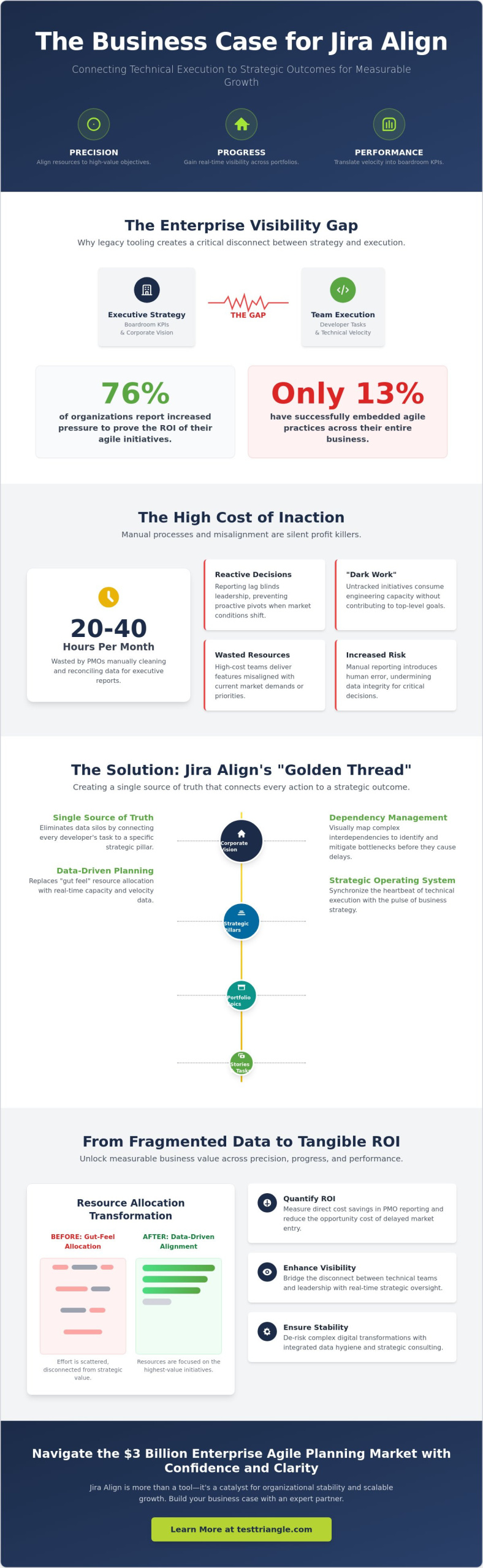
According to the 18th State of Agile Report, 76% of organizations report increased pressure to prove the ROI of their agile initiatives, yet only 13% have successfully embedded these practices across their entire business. You likely recognize that the gap between team-level execution and executive strategy isn’t just a communication hurdle; it’s a financial risk that stalls growth and obscures visibility. Building a business case for Jira Align 2026 requires more than a simple list of features. It demands a strategic narrative that links technical velocity to boardroom KPIs through precision, progress, and performance.

This guide provides a comprehensive framework to justify your investment by demonstrating how the Atlassian Strategy Collection transforms fragmented data into actionable insights. We’ll explore how to quantify reduced delivery risk, align resource allocation with high-priority objectives, and present a data-backed proposal that secures executive buy-in. By implementing a structured approach to strategic alignment, your organization can navigate the USD 3 billion enterprise agile planning market with confidence and clarity. You’ll gain the tools to prove that Jira Align is a vital catalyst for organizational stability and scalable growth.

Key Takeaways

  • Bridge the disconnect between technical teams and leadership by identifying the critical visibility gaps that prevent real-time strategic oversight in legacy environments.
  • Master a comprehensive framework for building a business case for jira align 2026 that translates technical velocity into boardroom-ready financial outcomes and strategic KPIs.
  • Quantify the tangible return on investment by measuring direct cost savings in PMO reporting and the substantial opportunity cost of delayed market entry.
  • Utilize a step-by-step proposal structure to articulate a compelling problem statement and a 30-second value proposition tailored for executive decision-makers.
  • Ensure operational stability by integrating data hygiene and strategic Atlassian consulting into your roadmap to mitigate the high failure rates associated with complex digital transformations.

The Enterprise Visibility Gap: Why Legacy Tooling Fails in 2026

As global enterprises accelerate their digital transformation initiatives, the chasm between technical output and boardroom objectives has become a critical point of failure. Building a business case for jira align 2026 requires an honest assessment of how current visibility gaps undermine enterprise agility, leaving leadership with a fragmented view of progress. While standard Jira instances excel at managing team-level tasks, they lack the native architecture to provide the real-time, portfolio-level insights necessary for strategic steering. In the 2026 landscape, where AI-assisted development has significantly increased technical velocity, the risk of “Dark Work” has escalated; this refers to untracked, low-value initiatives that consume engineering capacity without contributing to top-level goals.

Without a centralized platform to synchronize efforts, organizations often find that their increased speed only leads to faster waste. Leadership teams require a steady hand to manage this complexity, and identifying these gaps is the first step toward reclaiming operational control. By utilizing professional Atlassian implementation services, companies can bridge this divide, ensuring that every hour of development time is an investment in the corporate vision rather than a hidden cost.

The Limits of Bottom-Up Reporting

Standard Jira roll-up reports frequently lack the strategic context needed for executive oversight because they are built on a bottom-up logic that doesn’t account for cross-portfolio dependencies. PMO teams often spend 20 to 40 hours per month manually cleaning and reconciling data for quarterly business reviews; this manual effort is not only inefficient but also introduces significant human error. When data fragmentation occurs, executive decision-making becomes reactive rather than proactive. This lag in reporting makes it impossible to pivot resources effectively when market conditions shift, essentially blinding leadership to the reality of their delivery pipeline.

Strategic Misalignment as a Silent Profit Killer

Strategic misalignment is a financial drain that occurs when high-cost engineering teams deliver features that no longer match market demands or corporate priorities. Jira Align eliminates this risk by creating a “Single Source of Truth” that connects every developer’s task to a specific strategic pillar. This transparency ensures that resources are always allocated to the highest-value work, reducing the waste associated with redundant or obsolete projects. For the modern enterprise, Jira Align serves as the Strategic Operating System that synchronizes the heartbeat of technical execution with the pulse of business strategy. Through this alignment, organizations achieve the visibility, velocity, and value required to remain competitive in a hyper-accelerated market.

Strategic Value Pillars: Connecting Vision to Execution

Building a business case for jira align 2026 requires moving beyond functional checklists to emphasize strategic synchronization. By establishing a “Golden Thread” that links individual Jira tasks to high-level corporate objectives, the platform ensures that every technical effort contributes directly to the bottom line. This level of precision eliminates the “gut feel” common in legacy resource allocation, replacing it with data-driven capacity planning that respects the actual velocity of the engineering organization. When leadership can visualize the direct connection between a developer’s ticket and a strategic KPI, the justification for the investment becomes self-evident. Consequently, building a business case for jira align 2026 hinges on the ability to demonstrate this tangible link between execution and outcomes.

Dependency management remains a cornerstone of enterprise stability, particularly as projects grow in complexity. Jira Align visualizes these complex interdependencies, allowing PMOs to identify and mitigate bottlenecks before they escalate into costly delays that impact the critical path. Organizations seeking to optimize these workflows often benefit from professional implementation support to ensure their tooling reflects their unique operational maturity and strategic goals.

Atlassian Intelligence and Predictive Agility

Atlassian Intelligence (AI) serves as a force multiplier within Jira Align by identifying subtle patterns in portfolio data that often escape human observation. By automating the identification of “at-risk” epics across multiple programs, the platform provides a layer of predictive agility that is indispensable in 2026. AI-generated executive summaries further streamline the reporting process, distilling complex technical status into concise, strategic updates for leadership. This proactive approach reduces delivery risk and ensures that resources are always directed toward the most impactful initiatives.

Scaling Framework Support (SAFe, LeSS, and Beyond)

While the platform natively supports the Scaled Agile Framework (SAFe) 6.0+, its true strength lies in its adaptability to hybrid or “homegrown” methodologies. This flexibility is vital as the 18th State of Agile Report indicates that 41% of organizations are increasing their investment in scaling agile, often moving away from rigid frameworks toward more tailored approaches. By automating workflow governance, Jira Align reduces the “framework tax,” allowing teams to focus on delivery rather than administrative compliance.

Building a Business Case for Jira Align 2026: The Executive Guide to Enterprise Agility

Quantifying the Return: Financial Modeling and the Cost of Inaction

Securing executive approval in the 2026 fiscal environment requires a shift from qualitative narratives to rigorous financial modeling. Building a business case for jira align 2026 necessitates a clear articulation of how the platform transforms operational expenses into strategic assets. Direct cost savings are most visible in the radical reduction of manual reporting hours; PMO leaders often reclaim 30% of their capacity by eliminating the arduous task of aggregating data from disparate Jira instances. This reclaimed time allows high-value personnel to focus on strategic analysis rather than data entry, effectively increasing the intellectual yield of the leadership team. When technical execution is synchronized with business outcomes, the resulting efficiency gains drive precision, profit, and performance across the entire delivery pipeline.

Risk mitigation serves as another critical pillar of the financial case. By identifying cross-team dependencies early, Jira Align prevents the cascading delay effect that often leads to project failures or significant budget overruns. Quantifying the avoided cost of these failures provides a defensive layer to the ROI model, reassuring the board that the investment acts as a hedge against market volatility. Organizations that prioritize this level of oversight often engage in Atlassian implementation to ensure their reporting structures are robust enough to support such high-level financial scrutiny.

The COI (Cost of Inaction) Framework

The Cost of Inaction (COI) represents the silent drain on enterprise resources caused by maintaining fragmented legacy systems. In the hyper-accelerated 2026 market, the daily loss of misaligned developer capacity can reach staggering figures as teams work on low-priority features that don’t move the needle on corporate KPIs. A delayed pivot cycle, caused by a lack of real-time visibility, doesn’t just stall progress; it compounds technical and strategic debt. Choosing to wait until the next fiscal year to address these gaps increases the eventual cost of transformation, making the current status quo the most expensive option available to the organization.

Building a Multi-Year ROI Projection

A sophisticated business case must present a multi-year view to manage executive expectations and demonstrate long-term value. Year 1 is typically the investment phase, focused on implementation, training, and the critical task of data hygiene to ensure the “Single Source of Truth” is accurate. By Years 2 and 3, the organization enters the realization phase, where reduced waste and improved strategic throughput become the dominant drivers of the balance sheet. Key metrics such as Net Present Value (NPV) and the Payback Period should be highlighted to show how the platform pays for itself through accelerated time-to-market for high-priority features.

Constructing the Proposal: A Step-by-Step Business Case Framework

Building a business case for jira align 2026 requires a structured approach that translates technical complexities into executive value. A successful proposal begins with a punchy Executive Summary. This 30-second value proposition must emphasize how the platform acts as a bridge between high-level vision and team-level execution. It’s followed by a Problem Statement that uses internal data to highlight current delivery friction, such as the significant capacity loss caused by manual data reconciliation. By positioning the software as a strategic operating system rather than just another tool, you shift the conversation from cost to capability. The objective is to demonstrate that building a business case for jira align 2026 is an investment in organizational stability and scalable growth.

The Implementation Roadmap should outline a phased approach to ensure early wins and maintain momentum. This prevents the “big bang” failure risk often associated with large-scale digital transformations. Finally, the Financial Justification ties everything together by presenting the ROI and COI models clearly. If you require expert guidance in drafting a proposal that resonates with your board, please contact our strategic advisory team to discuss your specific requirements and ensure your proposal is backed by industry-leading expertise.

Phase 1: Identifying Pain Points and Stakeholders

Phase 1 focuses on identifying the specific pain points that hinder delivery. You must conduct interviews with Program Managers and Product Owners to uncover hidden inefficiencies and “Dark Work” that drains resources. Identifying the right Executive Sponsor is crucial; this is typically the leader who suffers most from a lack of real-time visibility into strategic initiatives. By mapping current tool gaps to specific business failures or delays, you create a compelling narrative that demands immediate action from the board.

Phase 2: Defining Success Metrics (KPIs)

Phase 2 involves defining success metrics to track progress and justify the continued investment. Select three to five core metrics such as Cycle Time, Say/Do Ratio, and Strategic Allocation percentage. Establishing a baseline before implementation is essential to measure the platform’s impact accurately. For instance, a primary goal might be to increase strategic alignment from 40% to 85% within 12 months. These KPIs provide the data-backed evidence needed to prove the platform’s value to skeptical stakeholders.

De-risking Implementation: The Role of Strategic Atlassian Consulting

While building a business case for jira align 2026 provides the necessary financial and strategic justification for the board, the path to implementation is fraught with systemic risks that can undermine even the most robust proposal. Industry data indicates that 70% of digital transformations fail to meet their primary objectives, often because organizations attempt to scale complex frameworks on top of fragmented data. To avoid these pitfalls, enterprises must prioritize data hygiene by auditing and cleaning their underlying Jira Software instances before attempting a portfolio-level rollout. Without a foundation of accurate, standardized data, the strategic insights promised by Jira Align will remain obscured, effectively neutralizing the ROI you’ve worked to establish. This transition requires a steady hand to ensure that technical execution remains perfectly synchronized with organizational goals.

De-risking this evolution requires a partner who understands that software is merely a vehicle for cultural and operational change. Success depends on customizing the platform to mirror your specific organizational culture rather than forcing a rigid adherence to a single framework. A partner-led pilot program acts as a crucial proof-of-concept, allowing leadership to witness immediate value through improved visibility and reduced friction before a full-scale rollout. By demonstrating early wins, you maintain momentum and secure the long-term commitment needed for strategy, synchronization, and success. Building a business case for jira align 2026 is only the beginning; the true value is realized through a disciplined, expert-led implementation that manages complexity with precision.

Test Triangle’s Strategic Approach to Jira Align

Our Atlassian Consulting services are designed to ensure strategy-to-execution parity by bridging the gap between high-level vision and team-level tasks. We recognize that global enterprises require more than a one-time setup, which is why our Managed Service Provider model focuses on long-term optimization and scalable growth. By integrating Jira Align with your existing IT Service Management ecosystem, we create a unified environment where data flows seamlessly across all functions. This holistic approach reduces operational risk and provides the peace of mind that comes from knowing your digital infrastructure is managed by seasoned experts.

Next Steps: Securing Your 2026 Strategic Roadmap

Moving from a proposal to a functional reality requires a clear, actionable roadmap that addresses both technical and cultural hurdles. We recommend beginning with a tailored Jira Align readiness assessment to identify potential data bottlenecks and stakeholder misalignments. Developing a proof-of-concept (PoC) is the most effective way to win internal buy-in, as it provides tangible evidence of how the platform solves specific delivery friction. When you are ready to transform your strategic vision into technical reality, partner with Test Triangle for your Jira Align Transformation to ensure your organization achieves the enterprise agility required for the 2026 landscape.

Achieving Strategic Synchronicity: Your Path to 2026 Agility

Navigating the complexities of enterprise agility requires a fundamental shift from reactive task management to proactive strategic steering. By addressing the persistent visibility gap and utilizing rigorous financial modeling, leadership can transform technical velocity into measurable business outcomes that resonate in the boardroom. Building a business case for jira align 2026 is ultimately about establishing a foundation for long-term operational stability; this ensures that every resource is aligned with the corporate vision to reduce waste and accelerate time-to-market. This structured approach provides the clarity needed to lead with confidence in an increasingly volatile global landscape.

As an Atlassian Gold Solution Partner with extensive expertise in global digital transformation, Test Triangle serves as a reliable collaborator for organizations seeking specialized managed services and enterprise scalability. Our methodology prioritizes vision, velocity, and value, providing the technical rigor and strategic foresight required to de-risk your evolution. You’re invited to take the next step in your organizational maturity by leveraging our seasoned expertise to validate your roadmap. Secure your Jira Align Readiness Assessment for 2026 today to begin your journey toward a truly synchronized enterprise. Your path to sustainable growth is within reach.

Frequently Asked Questions

What is the typical ROI timeframe for a Jira Align implementation?

Most global enterprises realize a full return on investment within 12 to 18 months following a successful rollout. The first year is typically an investment phase focused on establishing data hygiene and workflow governance, while the subsequent years see significant gains from waste reduction and improved throughput. By the second year, the reduction in manual reporting hours and the acceleration of high-priority features usually offset the initial capital expenditure.

How does Jira Align differ from Jira Portfolio or Advanced Roadmaps?

Jira Align is an enterprise-grade strategic platform designed to connect execution to strategy across multiple portfolios, whereas Advanced Roadmaps, now known as Jira Plans, focuses on cross-team planning within a single Jira instance. While Plans is effective for tactical coordination at the team level, Align provides the necessary visibility for executive-level resource allocation and portfolio steering. It acts as the strategic operating system for the entire organization rather than a team-level scheduling tool.

Is Jira Align only for organizations using the SAFe framework?

No, the platform is highly versatile and natively supports various frameworks including LeSS, Scrum@Scale, and hybrid or homegrown methodologies. Its inherent flexibility allows organizations to customize the tool to their specific operational culture and maturity level. This adaptability is a critical factor when building a business case for jira align 2026, as it ensures the platform remains relevant even as your scaling approach evolves.

What are the minimum infrastructure requirements for Jira Align in 2026?

As of 2026, Jira Align is a cloud-only solution that is integrated into the Atlassian Strategy Collection, requiring no on-premise hardware or Data Center installations. Organizations must ensure their underlying Jira Software data is standardized and synchronized to provide a reliable foundation for portfolio-level reporting. Because it’s a cloud-native platform, your infrastructure focus should remain on data security, user access management, and robust API connectivity with your existing IT ecosystem.

How much does a Jira Align implementation cost for an enterprise?

Implementation costs are determined by the scale of your organization, the number of integrated users, and the complexity of your current Jira environment. Total investment includes both the licensing for the Atlassian Strategy Collection and professional advisory services to ensure a successful configuration. While costs vary, the focus of your proposal should be on the cost of inaction, which often exceeds the price of implementation through lost developer capacity and missed market opportunities.

Can Jira Align integrate with non-Atlassian tools like ServiceNow or AWS?

Yes, the platform features robust integration capabilities through native connectors and comprehensive APIs that link with ServiceNow, Azure DevOps, and various cloud infrastructures. These integrations ensure that strategic data from across your entire technical landscape is aggregated into a single source of truth. This connectivity is essential for global enterprises that operate in multi-vendor environments and require a unified view of their digital transformation progress.

How does Atlassian Intelligence (AI) enhance Jira Align’s value?

Atlassian Intelligence provides predictive analytics that identify delivery bottlenecks and “at-risk” initiatives before they impact your critical path. It automates the generation of executive summaries, allowing leadership to receive real-time status updates without the need for manual data aggregation. This AI-driven insight significantly increases the platform’s value by transforming raw technical data into actionable strategic intelligence for the C-suite.

What is the biggest risk when building a business case for Jira Align?

The most significant risk when building a business case for jira align 2026 is underestimating the importance of data hygiene within your existing Jira instances. If the underlying data is inconsistent or fragmented, the portfolio-level insights will be unreliable, which can undermine executive confidence in the tool. A successful proposal must include a clear plan for data standardization and professional consulting to ensure the platform delivers a precise and trustworthy view of the organization.

Paul Guy

Article by

Paul Guy

Paul serves as the Marketing Director at Test Triangle, where he leads a global team in driving growth through strategic B2B marketing and brand communications. With a strong emphasis on measurable outcomes and sustainable performance, he plays a pivotal role in aligning marketing functions to enhance customer engagement and accelerate business impact. Under his leadership, marketing initiatives have consistently delivered significant returns on investment, elevated brand visibility, and strengthened the company's presence across key markets.