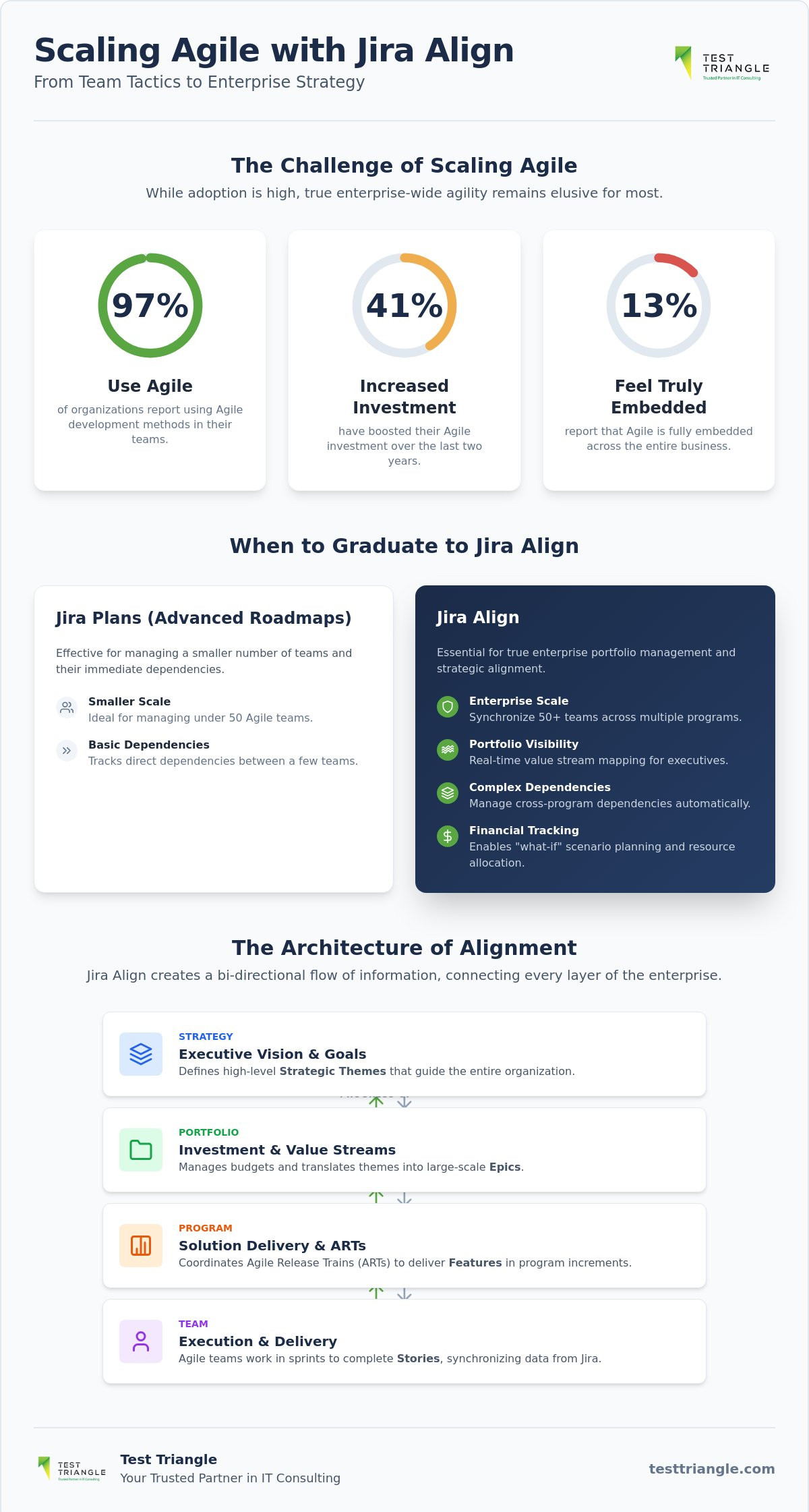
While 97% of organizations report using Agile development, a staggering 41% have increased their investment over the last two years only to find that a mere 13% feel Agile is truly embedded across their business. This disconnect often stems from a lack of visibility into cross-team dependencies and strategic goals that fail to reflect in daily development work. If you’re struggling to understand how to scale agile with jira align across hundreds of manual Jira boards, you’re not alone in seeking a more disciplined approach to digital transformation.
We understand that your primary objective is to move beyond simple output tracking and toward genuine outcome alignment. This 2026 strategic guide promises to help you master the complexities of enterprise-scale agility by connecting team-level execution to executive strategy using the latest Jira Align v.11.25 capabilities and preparing for the v.11.27.0 feature set. You’ll learn how to replace manual reporting with real-time visibility into portfolio health and automated dependency management. We’ll explore the implementation of framework-agnostic strategies that ensure your investments directly drive delivery, providing the stability, precision, and growth your global enterprise requires for long-term success.
Key Takeaways
- Master the multi-layered architecture of Jira Align to effectively bridge the visibility gap between high-level executive strategy and granular team execution.
- Evaluate the flexibility of various scaling frameworks, including SAFe and LeSS, to determine the optimal configuration for your unique organizational requirements.
- Execute a structured implementation roadmap that prioritizes data hygiene and executive alignment to ensure a successful transition when learning how to scale agile with jira align.
- Leverage predictive AI-driven insights to identify delivery risks and resource bottlenecks before they impact your portfolio’s strategic health.
- Transform fragmented team data into a bi-directional flow of information that empowers leadership with real-time visibility into the relationship between investment and delivery.
What is Jira Align and Why Does Enterprise Agility Require It?
By establishing a bi-directional flow of information, Jira Align functions as the enterprise-scale bridge that connects high-level executive strategy with granular team-level execution. While Jira Software excels at managing the tactical workflows of individual teams, it often leaves a visibility gap when organizations attempt to synchronize multiple Agile Release Trains (ARTs) across a global footprint. For organizations with 500 or more developers, the challenge isn’t just about managing tasks; it’s about ensuring that every line of code contributes to a defined business outcome. Jira Align provides the necessary infrastructure to align, accelerate, and achieve these objectives through real-time data synchronization across the entire enterprise.
Understanding how to scale agile with jira align requires a fundamental shift in perspective, moving from tracking team outputs to measuring strategic outcomes. As organizations adopt the Scaled Agile Framework (SAFe) or other enterprise models, the complexity of managing cross-team dependencies often becomes a bottleneck. Jira Align resolves this by aggregating data from hundreds of Jira boards into a single, coherent portfolio view, providing the institutional maturity required to manage digital transformation at scale. For those moving toward this level of maturity, engaging with Atlassian implementation experts ensures that the technical configuration mirrors the organizational strategy.
The Disconnect Between Strategy and Execution
In many large-scale environments, development often becomes a “black box” to C-suite stakeholders, where strategic goals are set at the top but lose clarity as they cascade down to the teams. This misalignment results in wasted resources on low-value features that don’t move the needle on key business metrics. By implementing Jira Align, companies transition from project-centric models to product-centric delivery. This shift allows leadership to see exactly how investment translates into progress, ensuring that daily development work remains anchored in the company’s long-term vision and operational stability.
Jira Align vs. Jira Plans (Advanced Roadmaps)
Deciding when to graduate from Jira Plans to Jira Align is a critical strategic milestone. While Jira Plans is effective for managing a small number of teams and their immediate dependencies, it lacks the depth required for true portfolio management and financial tracking. The tipping point for Jira Align investment typically occurs when:
- Organizations need to synchronize 50 or more agile teams across multiple programs.
- Executive leadership requires real-time visibility into value stream mapping and strategic snapshots.
- Financial tracking and “what-if” scenario planning become necessary for resource allocation.
- The complexity of cross-program dependencies exceeds what manual reporting can reliably manage.
Jira Align v.11.25 provides the sophisticated toolset needed to manage these complexities, offering a level of precision that standard roadmapping tools simply cannot match.
The Architecture of Alignment: How Jira Align Functions
Jira Align operates on a hierarchical architecture specifically engineered to synchronize the disparate layers of a global enterprise. Unlike standard project management tools that focus on linear task completion, this platform establishes a bi-directional flow of information between technical execution and business value. Understanding how to scale agile with jira align requires a deep dive into its four primary levels of scale: Strategy, Portfolio, Program, and Team. By connecting these layers, the platform ensures that every story point delivered at the team level contributes directly to a Strategic Theme defined at the executive level. This structural integrity is what allows organizations to move beyond simply “doing” agile to truly Achieving Agility across the entire business ecosystem.
The core of this functionality lies in the “Room” concept, which provides tailored environments for different stakeholders to collaborate. These Rooms act as command centers, aggregating data from Jira Software and transforming it into actionable insights. For instance, while developers work within their familiar Jira boards, their progress is automatically rolled up into Program and Portfolio views. This data hierarchy ensures that Epics, Features, and Stories remain tethered to the overarching mission, eliminating the manual data entry that often plagues large-scale transformations. If your organization is struggling to map these complex relationships, you may benefit from a professional consultation on enterprise architecture design to ensure your data hygiene supports your scaling goals.
The Strategy and Portfolio Rooms
The Strategy Room is where executive leadership defines the long-term goals and Strategic Themes that drive the enterprise. Here, the focus shifts from individual projects to funding value streams, allowing for more flexible resource allocation based on real-time performance. By tracking Investment Themes, portfolio managers can ensure that budgets remain aligned with business priorities. This level of oversight provides the peace of mind that comes from knowing capital is being deployed toward the highest-value initiatives, rather than being lost in low-impact development cycles.
The Program and Team Layers
At the Program and Team layers, the architecture focuses on execution and dependency management. The Program Board serves as a vital visualization tool, highlighting cross-team dependencies that could jeopardize delivery timelines. Meanwhile, the Team Room provides developers with a clear view of how their specific stories contribute to the broader Program increment. This visibility empowers teams by providing context, while the automated roll-up of story points provides leadership with an accurate, real-time reflection of program-level progress. This seamless integration ensures that how to scale agile with jira align becomes a matter of operational rhythm rather than constant manual intervention.
Selecting Your Framework: SAFe, LeSS, or Hybrid?
Choosing the right framework is a pivotal decision that defines the trajectory of an enterprise’s agility journey and its ultimate operational stability. While many organizations gravitate toward the Scaled Agile Framework (SAFe) due to its comprehensive structure, Jira Align provides the necessary flexibility to support diverse methodologies including LeSS, Scrum@Scale, and the Spotify model. This framework-agnostic capability allows enterprises to customize the platform to fit their unique organizational DNA, ensuring that the software adapts to the business rather than forcing the business to adapt to the software. By establishing this adaptable foundation, leadership can maintain institutional maturity while allowing teams the autonomy they need to excel.
In many global infrastructures, it’s common to find hybrid environments where different departments employ varying agile methodologies simultaneously to meet their specific delivery needs. Understanding how to scale agile with jira align in these complex scenarios involves mapping disparate terminologies into a unified, coherent interface. By translating team-level data into a standardized language of Features and Strategic Themes, the platform provides a cohesive view of progress across the entire enterprise, regardless of the underlying framework used by individual teams. This alignment ensures that technical managers and executive leadership remain synchronized, fostering a spirit of partnership and shared success across the organization.
Optimizing the Scaled Agile Framework (SAFe)
For organizations committed to SAFe, Jira Align acts as a powerful accelerator by automating the labor-intensive aspects of PI Planning and reducing the manual effort associated with big-room synchronization. The digital Program Board provides a real-time visualization of the Agile Release Train (ART), allowing release train engineers to identify and resolve blockers instantly before they jeopardize the current Program Increment (PI). Jira Align proactively manages cross-team dependencies by providing automated conflict alerts and visual health indicators to prevent delivery delays and maintain release predictability.
Beyond Frameworks: Value Stream Management
True organizational progress requires moving beyond mere framework compliance to focus on the efficient flow of value from concept to cash. Jira Align empowers leadership to identify systemic bottlenecks within complex value streams, providing the data necessary to optimize resource allocation and improve time-to-market. By mapping these enterprise value streams, organizations can ensure that every development effort is directly contributing to revenue generation or strategic growth. To achieve this level of operational excellence, many enterprises leverage Digital Transformation Services to refine their processes and ensure their technology stack fully supports their value delivery goals.
Implementation Roadmap: Steps to Scale Agile Successfully
Scaling agile at the enterprise level requires a methodical, multi-phased approach that prioritizes organizational readiness over technical configuration. When considering how to scale agile with jira align, the most successful implementations follow a structured roadmap that begins with executive alignment and value stream identification. This initial phase ensures that leadership agrees on the definition of value before any data is synchronized. Following this, organizations must move through a rigorous process of data hygiene, pilot programs, and eventual portfolio-wide expansion to ensure long-term stability and precision. Moving too quickly without these foundations often leads to fragmented visibility and wasted resources.
The roadmap typically unfolds across five distinct phases designed to build institutional maturity and operational stability:
- Phase 1: Executive Alignment: Defining the strategic themes and value streams that will anchor the transformation. This phase focuses on connecting business outcomes to technical delivery.
- Phase 2: Data Hygiene: Standardizing Jira Software configurations to ensure a “single source of truth.” This involves cleaning up legacy boards and field configurations that could distort portfolio reporting.
- Phase 3: The Pilot Program: Selecting a single Program or Agile Release Train (ART) for initial rollout. This allows the organization to test and refine its configuration in a controlled environment.
- Phase 4: Scaling Out: Expanding the implementation across the full enterprise portfolio once successful patterns and governance models are established.
- Phase 5: Continuous Optimization: Refining executive dashboards to track ROI. As of the v.11.25 release in mid-2026, these dashboards offer more granular insights into the relationship between investment and delivery.
Preparing Your Data for Jira Align
The “Garbage In, Garbage Out” risk is the single most common cause of implementation failure in large organizations. Before synchronizing any data, technical managers must standardize issue types, statuses, and field configurations across all team-level boards. Mapping Jira Software projects to the Align Program layer effectively requires a disciplined approach to metadata to ensure that story points roll up accurately. You can discover how DevOps Consulting supports this level of data integrity by establishing automated guardrails for your development lifecycle.
Training and Cultural Adoption
Successful scaling is as much about people as it is about platforms. To overcome “tool fatigue” in large-scale enterprise environments, organizations should establish a Center of Excellence (CoE) to provide long-term governance and support. This body serves as the steady hand that ensures the platform evolves alongside the business, maintaining the institutional maturity required for global operations. You can explore Atlassian Consulting for tailored training programs that help your teams embrace these new ways of working. If you’re ready to begin your journey, request a strategic roadmap assessment to ensure your implementation is built on a foundation of expert knowledge.
Future-Proofing Your Scale: Jira Align in 2026 and Beyond
As we move deeper into 2026, the metrics of success for enterprise agility are undergoing a fundamental transformation, shifting the focus from simple team velocity to the tangible measurement of Business Value Delivered. Mastering how to scale agile with jira align now involves leveraging advanced machine learning algorithms that predict delivery risks and resource bottlenecks before they impact the bottom line. This evolution ensures that the “Strategy Collection” within the Atlassian ecosystem is no longer just a repository of goals but a dynamic engine for organizational progress. By integrating Jira Align with broader strategic tools, enterprises can achieve a level of precision that was previously unattainable, allowing technical execution to stay perfectly in sync with high-level corporate objectives.
The integration of AI-driven portfolio insights marks a departure from reactive reporting toward a more disciplined, proactive management style. In the current landscape, the ability to anticipate resource constraints across multiple value streams provides the peace of mind that comes from systemic risk reduction. For global enterprises operating in highly regulated industries, this predictive capability is essential for maintaining operational stability and ensuring that large-scale technological evolution remains on track. Understanding how to scale agile with jira align in this context means moving beyond basic synchronization to embrace a platform that actively suggests optimizations for your investment themes.
The Human + AI Enterprise
Augmenting PMO decision-making with AI-generated “what-if” scenarios allows leadership to explore various resource allocation models without disrupting current delivery cycles. This synergy between automated insights and human leadership ensures that strategic intuition is backed by data-driven certainty, empowering technical managers to make informed adjustments in real time. In 2026, AI in portfolio management serves as a predictive rather than reactive force, identifying potential slippage weeks before it manifests in development boards. This transition allows organizations to maintain a steady hand in a fast-changing technological landscape, emphasizing progress through a combination of human expertise and technical precision.
Partnering for Long-Term Success
Navigating the complexities of a mature Atlassian ecosystem requires more than just technical configuration; it demands a strategic visionary who remains deeply practical. While “out-of-the-box” implementations often fail to account for unique organizational DNA, a custom approach ensures that the platform supports your specific digital transformation goals. Test Triangle acts as a reliable long-term collaborator, providing the institutional maturity and human expertise needed to turn technical tools into scalable growth engines. To ensure your organization is positioned for success in an increasingly complex environment, Contact Test Triangle for a Strategic Jira Align Roadmap and secure the expert guidance required for your agile journey.
Mastering Enterprise Agility: Your Strategic Path Forward
Achieving a seamless connection between executive vision and team execution requires more than just a software implementation; it demands a disciplined commitment to data hygiene and architectural alignment. By leveraging the multi-layered structure of Jira Align, organizations can move beyond simple task tracking to visualize the genuine business value delivered across every value stream. Whether you’re adopting SAFe or a hybrid model, the platform provides the flexibility needed to maintain institutional maturity while utilizing AI-driven insights to predict delivery risks. Learning how to scale agile with jira align is the definitive step toward a future where strategy and delivery are perfectly synchronized.
As an Authorized Atlassian Gold Solution Partner with specialized expertise in highly regulated industries like Finance and Pharma, Test Triangle acts as a reliable long-term collaborator for your digital transformation. Our global delivery model offers the remote and offshore flexibility necessary to support your complex digital infrastructure with precision and stability. Scale Your Enterprise Agility with Test Triangle's Atlassian Experts today and empower your organization with the tools and expertise required for sustainable, scalable growth.
Frequently Asked Questions
What is the minimum team size recommended for Jira Align?
Jira Align is specifically engineered for large-scale environments, typically recommended for organizations managing 50 or more agile teams or at least 500 developers. While smaller organizations might find value in its reporting, the platform’s architecture is optimized for the complexity of multiple Agile Release Trains (ARTs) and high-level portfolio management. Investing in this tool is most effective when your primary challenge is synchronizing work across hundreds of people rather than just a few squads.
How long does a typical Jira Align implementation take?
A standard enterprise implementation of Jira Align generally spans three to six months, moving from initial configuration to full cultural adoption. This timeline is heavily influenced by your organization’s existing agile maturity and the complexity of your value streams. Starting with a focused pilot program allows you to establish successful patterns before expanding to the broader portfolio, ensuring a more stable and predictable rollout across the global enterprise.
Can Jira Align integrate with tools other than Jira Software?
While Jira Align is naturally optimized for the Atlassian ecosystem, it supports integration with other work management platforms such as Azure DevOps. This flexibility allows global organizations to maintain a single source of truth at the portfolio level even if different departments utilize various team-level tools. Establishing these bi-directional links ensures that strategic themes remain visible across the entire infrastructure, regardless of the specific software used for daily execution.
What is the difference between Jira Align and Advanced Roadmaps?
The primary difference lies in scale and strategic depth, as Jira Plans (Advanced Roadmaps) focuses on team-level delivery while Jira Align bridges the gap to executive strategy. Advanced Roadmaps is ideal for coordinating up to 20 teams, but it lacks the financial tracking and portfolio-level insights required for true enterprise agility. Jira Align provides the institutional maturity needed to manage value streams and strategic snapshots that smaller roadmapping tools cannot support.
Does Jira Align support the Scaled Agile Framework (SAFe) natively?
Jira Align provides native, comprehensive support for the Scaled Agile Framework (SAFe) and is often considered the industry standard for this methodology. The interface directly maps SAFe terminology such as ARTs, PIs, and Strategic Themes to ensure a seamless transition for practitioners. However, its framework-agnostic design means it remains versatile enough to support LeSS, Scrum@Scale, or custom hybrid models effectively while maintaining operational stability.
What are the common pitfalls when scaling agile with Jira Align?
The most significant pitfall is neglecting data hygiene, which leads to a “Garbage In, Garbage Out” scenario that undermines executive reporting. Many organizations also fail by treating the platform as a team-level task manager rather than a strategic alignment tool. Successfully learning how to scale agile with jira align requires strong executive buy-in and a clear focus on organizational change management to overcome tool fatigue and ensure long-term adoption.
How does Jira Align help with dependency management?
Jira Align facilitates automated dependency management by visualizing cross-team links on the digital Program Board to identify potential delivery risks instantly. This real-time visibility allows technical managers to resolve blockers before they impact the Program Increment (PI) schedule or strategic objectives. By replacing manual spreadsheets with automated conflict alerts, the platform provides the precision needed to maintain a steady flow of value across complex, global development environments.

Article by
Paul Guy
Paul serves as the Marketing Director at Test Triangle, where he leads a global team in driving growth through strategic B2B marketing and brand communications. With a strong emphasis on measurable outcomes and sustainable performance, he plays a pivotal role in aligning marketing functions to enhance customer engagement and accelerate business impact. Under his leadership, marketing initiatives have consistently delivered significant returns on investment, elevated brand visibility, and strengthened the company's presence across key markets.