



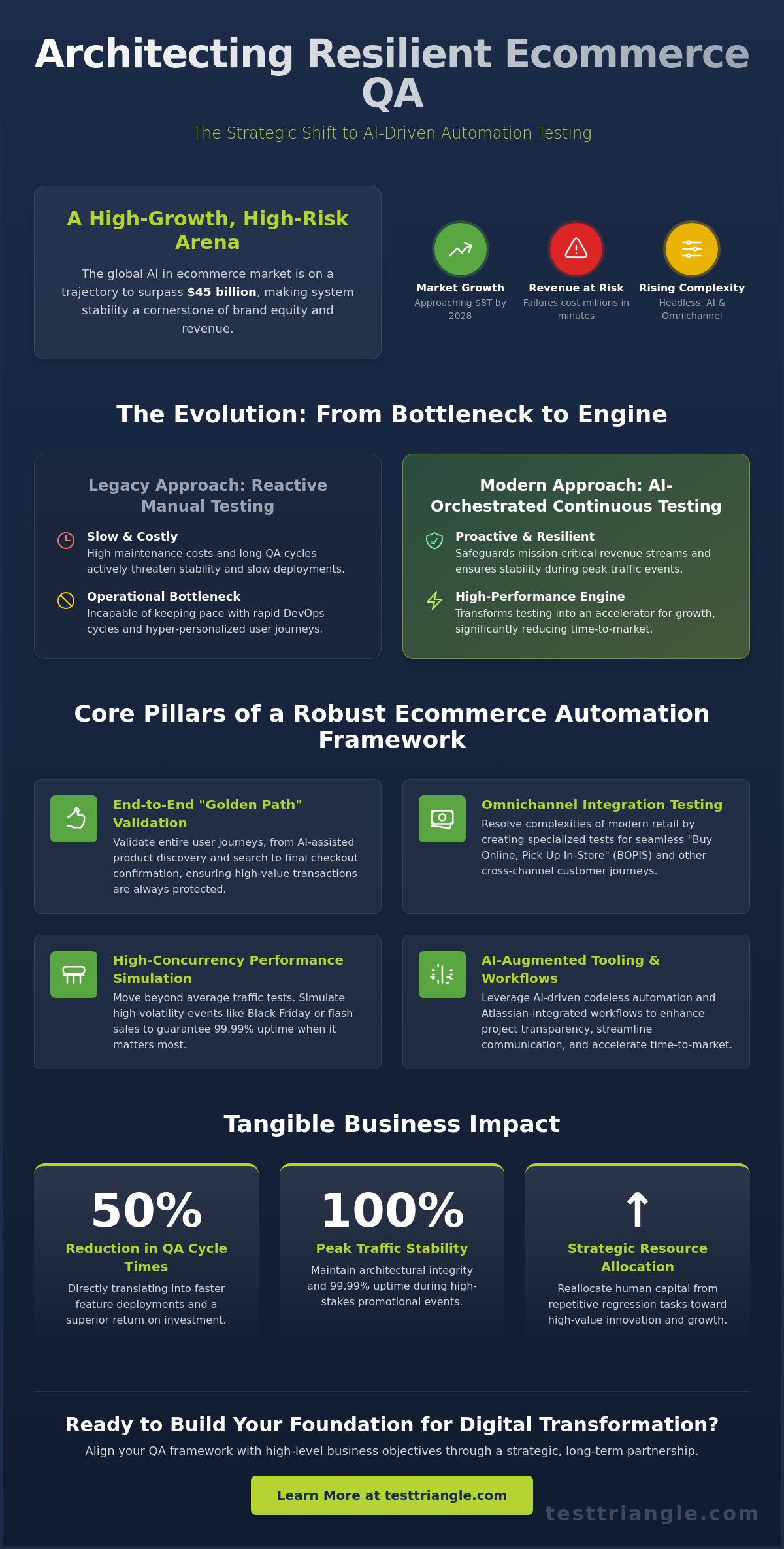
With the global AI in ecommerce market projected to reach $45.3 billion by late 2026, the margin for manual error has effectively vanished. You likely recognize that legacy scripts and high maintenance costs aren’t just operational hurdles; they’re active threats to your stability during peak traffic seasons. As retail ecosystems become increasingly fragmented across mobile, web, and physical POS systems, the demand for sophisticated automation testing for retail ecommerce platforms has transitioned from a technical preference to a core business necessity. We understand the pressure of maintaining a steady hand when a critical payment gateway risks failure during a high-stakes promotion because your testing suite couldn’t keep pace with rapid DevOps cycles.
This article provides the strategic blueprint you need to architect a scalable, AI-driven automation framework that secures omnichannel revenue while significantly accelerating your time-to-market. We’ll explore how modern tools like Playwright 1.60 are redefining framework adoption and how to ensure your deployments remain zero-defect amidst the complexities of the EU AI Act and evolving data privacy regulations. By aligning your QA strategy with systematic DevOps integration, you’ll discover how to transform testing from a bottleneck into a high-performance engine for organizational growth and long-term stability.
Key Takeaways
- Transition from reactive manual regression to AI-orchestrated continuous testing to safeguard mission-critical revenue streams and ensure operational stability during peak traffic.
- Identify the core pillars of robust automation testing for retail ecommerce platforms, focusing on end-to-end validation of the ‘Golden Path’ and high-concurrency performance simulations.
- Resolve the inherent complexities of omnichannel integration by implementing specialized testing strategies for seamless ‘Buy Online, Pick Up In-Store’ (BOPIS) customer journeys.
- Leverage AI-augmented codeless automation and Atlassian-driven workflows to enhance project transparency, streamline communication, and accelerate your organization’s time-to-market.
- Establish a reliable foundation for large-scale digital transformation by aligning your QA framework with high-level business objectives through a strategic, long-term partnership model.
The Strategic Necessity of Automation in the 2026 Retail Landscape
Global retail leaders now view digital stability as an inseparable component of brand equity. In a market where ecommerce sales are rapidly climbing toward nearly $8 trillion by 2028, the technical infrastructure supporting these transactions must be flawless. Implementing comprehensive automation testing for retail ecommerce platforms has evolved from a back-office efficiency project into a mission-critical revenue safeguard. It ensures that complex promotional logic, diverse payment integrations, and high-velocity inventory updates function correctly under the intense pressure of global traffic. Relying on outdated methods isn’t just risky; it’s a direct threat to the bottom line.
The transition from traditional manual regression to AI-orchestrated continuous testing reflects the reality of 2026 consumer behavior. Modern shoppers expect 99.99% uptime and instantaneous responses. Even a momentary glitch during a checkout process can lead to permanent cart abandonment and long-term reputational damage. By utilizing advanced test automation, organizations can maintain architectural integrity while delivering the rapid updates that keep them competitive. This shift allows for a proactive stance on quality, identifying potential failures before they ever reach the end user.
Evolving Retail Ecosystems and Testing Complexity
As brands move away from monolithic platforms toward headless commerce architectures, the number of integration points increases exponentially. AI-driven personalization engines now create unique user journeys for every visitor, which means testing a single “happy path” is no longer sufficient. While Manual Testing remains the vital foundation for validating human-centric UX and exploratory edge cases, it cannot address the sheer scale of modern data-driven environments. Automation provides the necessary coverage for these hyper-personalized scenarios, ensuring that dynamic content doesn’t break the underlying transaction logic across various touchpoints.
Economic Drivers for Automation Adoption
The financial implications of system failure during high-concurrency events like Black Friday are staggering, often resulting in millions of dollars in lost revenue within minutes. Strategic automation testing for retail ecommerce platforms reduces the long-term “QA tax” that typically slows down new feature deployments, allowing teams to innovate without compromising stability. We’ve seen that when a robust framework is implemented, retailers can achieve a 50% reduction in QA cycle times, directly translating into faster time-to-market and a superior return on investment for digital initiatives. This efficiency allows global enterprises to reallocate human capital toward high-value strategic growth rather than repetitive maintenance.
Core Pillars of a Robust Ecommerce Automation Framework
Building a resilient foundation for automation testing for retail ecommerce platforms requires moving beyond siloed script execution toward an integrated ecosystem of quality. This framework must prioritize the “Golden Path,” which encompasses the entire user journey from initial product discovery and AI-assisted search to the final checkout confirmation. By validating these critical workflows under diverse conditions, organizations ensure that high-value transactions remain uninterrupted, even as underlying codebases evolve daily. A truly strategic approach balances functional precision with high-level operational oversight, providing the stability, security, and scalability required for global growth.
Performance and load testing must simulate high-concurrency events that mirror the volatility of seasonal peaks. It’s no longer enough to test for average traffic; your systems must withstand the sudden surges characteristic of limited-edition drops or flash sales. Simultaneously, security testing has become a non-negotiable pillar to maintain PCI-DSS compliance and adhere to the stringent requirements of the EU AI Act, which is fully implemented as of summer 2026. With new data privacy laws taking effect in states like Indiana, Kentucky, and Rhode Island in early 2026, your automation suite must verify that personalization algorithms remain ethical, transparent, and compliant with regional data deletion mandates.
API and Microservices Testing for Omnichannel Flow
In a headless commerce environment, the seamless exchange of data between the frontend, inventory management systems, and CRM is the lifeblood of the operation. Our API testing services focus on validating these invisible connections to prevent catastrophic checkout failures. We meticulously verify third-party integrations, including payment gateways, complex shipping APIs, and multi-tiered loyalty programs, ensuring that a failure in one microservice doesn’t trigger a total system collapse. This rigorous validation of the middle tier is what allows for the “buy anywhere, fulfill anywhere” promise that modern consumers demand.
Data Migration and Integrity Validation
Synchronizing real-time inventory across physical storefronts and digital channels presents a significant technical hurdle. During platform re-platforming or major updates, data migration testing ensures that product catalogs, pricing logic, and customer profiles transition without corruption. Automating the verification of these massive datasets prevents the “ghost inventory” issues that lead to overselling and customer dissatisfaction. If you’re currently evaluating how to strengthen these pillars within your own infrastructure, consulting with a strategic advisor can help identify the most impactful starting point for your transformation.
Compatibility testing rounds out the framework by addressing the fragmented landscape of 2026 devices and browsers. As Playwright 1.60 and Cypress 15 dominate the framework landscape, your strategy must ensure a consistent experience across diverse OS versions and mobile hardware. This comprehensive coverage transforms automation testing for retail ecommerce platforms from a simple bug-finding exercise into a powerful engine for cross-channel brand reliability.
Overcoming Omnichannel Complexity and Integration Hurdles
The most common objection to modernizing quality assurance is the belief that legacy systems are too rigid for advanced frameworks. However, strategic automation testing for retail ecommerce platforms doesn’t require a total architectural overhaul. By wrapping aging backend systems in modern API layers, we can implement automated validation that bridges the gap between heritage databases and contemporary frontends. This incremental approach allows global enterprises to achieve stability without the risks associated with a “rip and replace” strategy. It’s about creating a steady hand that manages both the old and the new with equal precision.
Managing test data privacy has become a legal mandate in the 2026 retail environment. With the EU AI Act fully implemented and new comprehensive privacy laws in effect in Indiana, Kentucky, and Rhode Island, using production data for testing is no longer an option. Automated data masking and synthetic data generation are now essential components of a compliant framework. These tools allow teams to simulate complex customer profiles and transaction histories across all channels while ensuring that sensitive information remains secure and regulatory requirements are met across every jurisdiction.
Headless Commerce and Frontend Agnostic Testing
Decoupling the frontend experience from backend logic is essential for the rapid iteration cycles modern retail demands. By utilizing software test automation services, brands can validate multiple presentation layers against a single set of business rules. Whether a customer is interacting via a traditional web browser, a mobile app, or a voice assistant, the underlying transaction logic must remain consistent. This frontend-agnostic approach ensures a unified brand experience across the entire IoT ecosystem, protecting revenue regardless of how the customer chooses to shop.
Continuous Integration and DevOps Alignment
Speed shouldn’t come at the expense of reliability. Embedding automated suites directly into the CI/CD pipeline enables a ‘shift-left’ quality mindset where defects are identified and resolved during the development phase. This is where DevOps Consulting provides the greatest value. It bridges the gap between development velocity and operational stability. Utilizing containerization allows for isolated and scalable test environments, ensuring that your automation testing for retail ecommerce platforms remains performant and reliable as your digital infrastructure evolves.
Implementing Scalable QA: Tools, AI, and Managed Services
Selecting the right technical architecture in 2026 requires a balanced approach between established frameworks and emergent AI capabilities. While Playwright 1.60 and Cypress 15 remain the standard for high-performance scripting, many global enterprises are now integrating AI-augmented codeless automation to lower the technical barrier for non-engineering stakeholders. A truly mature strategy for automation testing for retail ecommerce platforms doesn’t view these as competing choices but as complementary layers within a unified quality ecosystem. This hybrid model allows for the precision of traditional code alongside the speed of AI-driven test generation, ensuring your infrastructure remains both robust and adaptable.
To achieve full operational visibility, testing results must be integrated directly into your broader IT management framework. We specialize in connecting automated QA outputs to Atlassian Consulting workflows, ensuring that every identified defect is automatically triaged and tracked within Jira or Confluence. Simultaneously, leveraging ServiceNow Implementation for automated incident reporting allows your service desk to respond to system anomalies in real time. This closed-loop system transforms QA from a siloed activity into a transparent, organization-wide asset that informs executive decision-making and accelerates release cycles.
The fluctuating demands of the retail calendar often make maintaining a large, permanent in-house QA team financially inefficient. Many leading brands are shifting toward Managed Outsourcing Services to secure elastic capacity that can scale alongside seasonal traffic peaks. This model provides the peace of mind that comes from expert-led execution without the overhead of long-term internal expansion. By partnering with a reliable collaborator, you can maintain high standards of quality while focusing your core team on high-value digital transformation initiatives. Contact our strategic advisors today to design a scalable QA model tailored to your 2026 growth targets.
AI and Machine Learning in Test Orchestration
Modern retail UIs change frequently to accommodate new promotions and personalization logic, often breaking traditional automation scripts. Self-healing scripts utilize machine learning to automatically adjust to minor DOM changes, drastically reducing the maintenance burden on your engineering team. Predictive analytics can now identify high-risk areas in your ecommerce codebase by analyzing historical failure patterns, allowing you to prioritize testing where it matters most. Additionally, automating visual regression ensures that your brand experience remains pixel-perfect across an ever-growing landscape of mobile devices and screen resolutions.
Strategic Staffing and Talent Acquisition
Bridging the skills gap in advanced automation requires access to specialized talent that understands both retail logic and modern toolstacks. Our IT Staffing Services provide the versatility needed to augment your existing team with seasoned experts who can hit the ground running. When evaluating the ROI of QA outsourcing versus in-house team building, consider the speed and precision that offshore or contract resources bring to peak-load testing cycles. This strategic staffing approach ensures you have the right human expertise to manage the technical tools effectively, maintaining organizational progress regardless of market volatility.
Test Triangle’s Strategic Partnership Approach for Retailers
In a technological landscape defined by rapid evolution and high-velocity commerce, we position ourselves as more than a vendor; we are a reliable long-term collaborator dedicated to your digital transformation. Implementing automation testing for retail ecommerce platforms is a critical first step, yet true operational maturity requires a broader, multi-disciplinary perspective. By combining our deep expertise in Atlassian, ServiceNow, and AWS, we provide a unified framework that ensures your infrastructure is not only robust today but remains scalable for the demands of 2026 and beyond. This approach focuses on stability, precision, and growth, allowing your leadership team to navigate complexity with absolute confidence.
Our engagement models are designed with the flexibility needed to address the unique pressures of the retail sector. Whether you require comprehensive managed services to oversee your entire QA ecosystem or specialized IT staffing to augment your internal engineering team during peak seasons, our delivery remains consistent and high-quality. We provide tailored technology roadmapping that identifies potential risks before they impact revenue, ensuring that your digital assets are protected against the volatility of the global market. This strategic alignment between technical execution and business outcomes is the cornerstone of our partnership model.
Holistic IT Service Management: Continuity, Compliance, Confidence
Operational continuity is the lifeblood of global retail, where even a few minutes of downtime can result in significant financial loss. Our IT Service Management solutions are engineered to provide 24/7 oversight, ensuring that your platforms remain performant under any load. By integrating ServiceNow Consulting, we streamline post-release support and automate incident management, creating a seamless bridge between your development teams and your end users. For retail executives, a strategic technology roadmap serves as a vital blueprint that mitigates operational risk while accelerating long-term digital evolution.
Empowering Global Retail: Talent, Tools, Transformation
Accessing the right human expertise is often the greatest hurdle in scaling a modern automation framework. Through our staffing solutions, we provide access to a global pool of elite QA engineers who specialize in the intricacies of automation testing for retail ecommerce platforms. Industry-leading retailers consistently trust our Atlassian Consulting to optimize their internal workflows, ensuring that project management remains transparent and efficient. This combination of human expertise and technical rigor allows your organization to maintain a steady hand in a fast-changing market. Partner with Test Triangle to secure your ecommerce future.
Securing Your Omnichannel Revenue through Strategic Digital Assurance
The transition toward AI-driven automation has moved from a technical preference to a fundamental requirement for maintaining operational stability in a landscape defined by hyper-personalization and strict data regulations. By architecting a framework that addresses the core pillars of functional precision and high-concurrency performance, your organization can effectively mitigate the risks associated with legacy systems and fragmented omnichannel journeys. Implementing automation testing for retail ecommerce platforms ensures that your digital infrastructure remains resilient, compliant, and prepared for the rapid surges of a global market.
As an Atlassian Gold Solution Partner and ServiceNow Specialist Partner, we offer the institutional maturity and technical rigor required to integrate quality assurance directly into your long-term business objectives. With global delivery centers strategically located across Europe, North America, and Asia, we provide the versatility and scale necessary for sustained organizational progress. We invite you to Explore our Digital Assurance and Testing Services to discover how a dedicated collaborator can empower your technological evolution. Your journey toward a zero-defect deployment future begins with a steady hand and a visionary approach to quality.
Frequently Asked Questions
What is the primary benefit of automation testing for retail ecommerce platforms?
The primary benefit of automation testing for retail ecommerce platforms is the systemic protection of mission-critical revenue streams through the reduction of operational risk. By implementing a robust framework, global enterprises ensure that high-value transactions remain uninterrupted even during high-velocity update cycles. This strategic approach allows for consistent system stability while significantly accelerating the release of new features to a competitive global market.
How does ecommerce testing differ from standard website testing in 2026?
Ecommerce testing in 2026 is distinguished by the extreme complexity of third-party integrations and the necessity of validating hyper-personalized user journeys. Unlike standard websites, retail platforms must synchronize real-time inventory, manage diverse payment gateways, and adhere to strict regional data privacy mandates like the EU AI Act. This requires a sophisticated testing strategy that accounts for the dynamic nature of transactional logic across multiple digital touchpoints.
When is the best time to automate ecommerce test cases vs. keeping them manual?
You should prioritize automation for repetitive, high-volume regression suites and critical “Golden Path” workflows that directly impact your transaction success rates. Manual testing remains the superior choice for exploratory scenarios, human-centric UX validation, and early-stage features where the interface is still undergoing significant architectural changes. A balanced strategy ensures that human expertise is reserved for qualitative assessment while technical tools handle the scale of systematic validation.
Can automation testing help with Black Friday and peak season preparation?
Automation is an essential component of peak season readiness because it allows for the simulation of high-concurrency traffic events that mirror Black Friday surges. By executing automated performance and load tests, retailers identify architectural bottlenecks before they lead to catastrophic system failure during high-traffic periods. This proactive validation provides the peace of mind that your infrastructure can withstand sudden traffic spikes without compromising the customer experience.
What are the essential tools for automating a mobile ecommerce application?
How do we integrate automation testing into our existing DevOps pipeline?
Integrating automation testing for retail ecommerce platforms into a DevOps pipeline involves embedding automated suites directly into the CI/CD workflow to enable a “shift-left” quality mindset. This process is enhanced by utilizing containerization for isolated test environments and connecting results to Atlassian or ServiceNow for transparent incident tracking and triaging. This alignment ensures that every code change is validated automatically, reducing the cycle time from development to production.
What is the role of AI in modern retail software testing?
AI transforms modern retail testing by enabling self-healing scripts that automatically adjust to frequent UI changes, which drastically reduces the long-term maintenance burden on engineering teams. Machine learning models also provide predictive analytics to identify high-risk areas in the codebase based on historical failure patterns. This intelligence allows organizations to prioritize their testing efforts strategically, focusing on the components most likely to impact system stability or customer satisfaction.
How much does it cost to implement an enterprise-grade automation framework?
The cost of implementing an enterprise-grade framework depends on the complexity of your digital ecosystem, the selected toolstack, and your preferred service engagement model. While the initial investment accounts for framework architecture and tool licenses, the long-term value is derived from reduced QA cycle times and the prevention of costly system downtime. We recommend consulting with a strategic partner to design a scalable model that aligns with your specific organizational growth targets.

Article by
Paul Guy
Paul serves as the Marketing Director at Test Triangle, where he leads a global team in driving growth through strategic B2B marketing and brand communications. With a strong emphasis on measurable outcomes and sustainable performance, he plays a pivotal role in aligning marketing functions to enhance customer engagement and accelerate business impact. Under his leadership, marketing initiatives have consistently delivered significant returns on investment, elevated brand visibility, and strengthened the company's presence across key markets.