
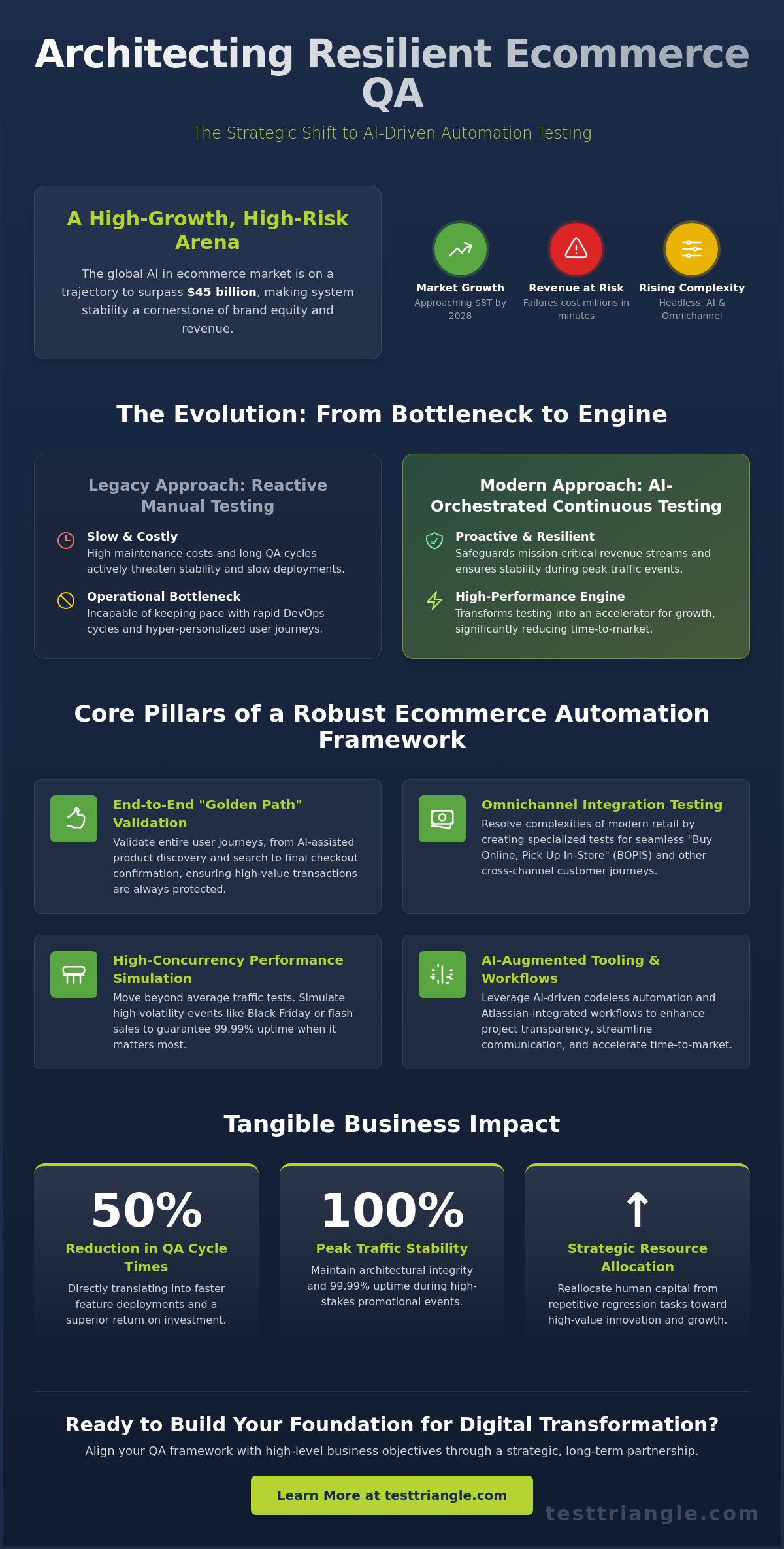
With the global AI in ecommerce market projected to reach $45.3 billion by late 2026, the margin for manual error has effectively vanished. You likely recognize that legacy scripts and high maintenance costs aren’t just operational hurdles; they’re active threats to your stability during peak traffic seasons. As retail ecosystems become increasingly fragmented across mobile, web, and physical POS systems, the demand for sophisticated automation testing for retail ecommerce platforms has transitioned from a technical preference to a core business necessity. We understand the pressure of maintaining a steady hand when a critical payment gateway risks failure during a high-stakes promotion because your testing suite couldn’t keep pace with rapid DevOps cycles.

This article provides the strategic blueprint you need to architect a scalable, AI-driven automation framework that secures omnichannel revenue while significantly accelerating your time-to-market. We’ll explore how modern tools like Playwright 1.60 are redefining framework adoption and how to ensure your deployments remain zero-defect amidst the complexities of the EU AI Act and evolving data privacy regulations. By aligning your QA strategy with systematic DevOps integration, you’ll discover how to transform testing from a bottleneck into a high-performance engine for organizational growth and long-term stability.

Key Takeaways

  • Transition from reactive manual regression to AI-orchestrated continuous testing to safeguard mission-critical revenue streams and ensure operational stability during peak traffic.
  • Identify the core pillars of robust automation testing for retail ecommerce platforms, focusing on end-to-end validation of the ‘Golden Path’ and high-concurrency performance simulations.
  • Resolve the inherent complexities of omnichannel integration by implementing specialized testing strategies for seamless ‘Buy Online, Pick Up In-Store’ (BOPIS) customer journeys.
  • Leverage AI-augmented codeless automation and Atlassian-driven workflows to enhance project transparency, streamline communication, and accelerate your organization’s time-to-market.
  • Establish a reliable foundation for large-scale digital transformation by aligning your QA framework with high-level business objectives through a strategic, long-term partnership model.

The Strategic Necessity of Automation in the 2026 Retail Landscape

Global retail leaders now view digital stability as an inseparable component of brand equity. In a market where ecommerce sales are rapidly climbing toward nearly $8 trillion by 2028, the technical infrastructure supporting these transactions must be flawless. Implementing comprehensive automation testing for retail ecommerce platforms has evolved from a back-office efficiency project into a mission-critical revenue safeguard. It ensures that complex promotional logic, diverse payment integrations, and high-velocity inventory updates function correctly under the intense pressure of global traffic. Relying on outdated methods isn’t just risky; it’s a direct threat to the bottom line.

The transition from traditional manual regression to AI-orchestrated continuous testing reflects the reality of 2026 consumer behavior. Modern shoppers expect 99.99% uptime and instantaneous responses. Even a momentary glitch during a checkout process can lead to permanent cart abandonment and long-term reputational damage. By utilizing advanced test automation, organizations can maintain architectural integrity while delivering the rapid updates that keep them competitive. This shift allows for a proactive stance on quality, identifying potential failures before they ever reach the end user.

Evolving Retail Ecosystems and Testing Complexity

As brands move away from monolithic platforms toward headless commerce architectures, the number of integration points increases exponentially. AI-driven personalization engines now create unique user journeys for every visitor, which means testing a single “happy path” is no longer sufficient. While Manual Testing remains the vital foundation for validating human-centric UX and exploratory edge cases, it cannot address the sheer scale of modern data-driven environments. Automation provides the necessary coverage for these hyper-personalized scenarios, ensuring that dynamic content doesn’t break the underlying transaction logic across various touchpoints.

Economic Drivers for Automation Adoption

The financial implications of system failure during high-concurrency events like Black Friday are staggering, often resulting in millions of dollars in lost revenue within minutes. Strategic automation testing for retail ecommerce platforms reduces the long-term “QA tax” that typically slows down new feature deployments, allowing teams to innovate without compromising stability. We’ve seen that when a robust framework is implemented, retailers can achieve a 50% reduction in QA cycle times, directly translating into faster time-to-market and a superior return on investment for digital initiatives. This efficiency allows global enterprises to reallocate human capital toward high-value strategic growth rather than repetitive maintenance.

Core Pillars of a Robust Ecommerce Automation Framework

Building a resilient foundation for automation testing for retail ecommerce platforms requires moving beyond siloed script execution toward an integrated ecosystem of quality. This framework must prioritize the “Golden Path,” which encompasses the entire user journey from initial product discovery and AI-assisted search to the final checkout confirmation. By validating these critical workflows under diverse conditions, organizations ensure that high-value transactions remain uninterrupted, even as underlying codebases evolve daily. A truly strategic approach balances functional precision with high-level operational oversight, providing the stability, security, and scalability required for global growth.

Performance and load testing must simulate high-concurrency events that mirror the volatility of seasonal peaks. It’s no longer enough to test for average traffic; your systems must withstand the sudden surges characteristic of limited-edition drops or flash sales. Simultaneously, security testing has become a non-negotiable pillar to maintain PCI-DSS compliance and adhere to the stringent requirements of the EU AI Act, which is fully implemented as of summer 2026. With new data privacy laws taking effect in states like Indiana, Kentucky, and Rhode Island in early 2026, your automation suite must verify that personalization algorithms remain ethical, transparent, and compliant with regional data deletion mandates.

API and Microservices Testing for Omnichannel Flow

In a headless commerce environment, the seamless exchange of data between the frontend, inventory management systems, and CRM is the lifeblood of the operation. Our API testing services focus on validating these invisible connections to prevent catastrophic checkout failures. We meticulously verify third-party integrations, including payment gateways, complex shipping APIs, and multi-tiered loyalty programs, ensuring that a failure in one microservice doesn’t trigger a total system collapse. This rigorous validation of the middle tier is what allows for the “buy anywhere, fulfill anywhere” promise that modern consumers demand.

Data Migration and Integrity Validation

Synchronizing real-time inventory across physical storefronts and digital channels presents a significant technical hurdle. During platform re-platforming or major updates, data migration testing ensures that product catalogs, pricing logic, and customer profiles transition without corruption. Automating the verification of these massive datasets prevents the “ghost inventory” issues that lead to overselling and customer dissatisfaction. If you’re currently evaluating how to strengthen these pillars within your own infrastructure, consulting with a strategic advisor can help identify the most impactful starting point for your transformation.

Compatibility testing rounds out the framework by addressing the fragmented landscape of 2026 devices and browsers. As Playwright 1.60 and Cypress 15 dominate the framework landscape, your strategy must ensure a consistent experience across diverse OS versions and mobile hardware. This comprehensive coverage transforms automation testing for retail ecommerce platforms from a simple bug-finding exercise into a powerful engine for cross-channel brand reliability.

Overcoming Omnichannel Complexity and Integration Hurdles

The most common objection to modernizing quality assurance is the belief that legacy systems are too rigid for advanced frameworks. However, strategic automation testing for retail ecommerce platforms doesn’t require a total architectural overhaul. By wrapping aging backend systems in modern API layers, we can implement automated validation that bridges the gap between heritage databases and contemporary frontends. This incremental approach allows global enterprises to achieve stability without the risks associated with a “rip and replace” strategy. It’s about creating a steady hand that manages both the old and the new with equal precision.

Managing test data privacy has become a legal mandate in the 2026 retail environment. With the EU AI Act fully implemented and new comprehensive privacy laws in effect in Indiana, Kentucky, and Rhode Island, using production data for testing is no longer an option. Automated data masking and synthetic data generation are now essential components of a compliant framework. These tools allow teams to simulate complex customer profiles and transaction histories across all channels while ensuring that sensitive information remains secure and regulatory requirements are met across every jurisdiction.

Headless Commerce and Frontend Agnostic Testing

Decoupling the frontend experience from backend logic is essential for the rapid iteration cycles modern retail demands. By utilizing software test automation services, brands can validate multiple presentation layers against a single set of business rules. Whether a customer is interacting via a traditional web browser, a mobile app, or a voice assistant, the underlying transaction logic must remain consistent. This frontend-agnostic approach ensures a unified brand experience across the entire IoT ecosystem, protecting revenue regardless of how the customer chooses to shop.

Continuous Integration and DevOps Alignment

Speed shouldn’t come at the expense of reliability. Embedding automated suites directly into the CI/CD pipeline enables a ‘shift-left’ quality mindset where defects are identified and resolved during the development phase. This is where DevOps Consulting provides the greatest value. It bridges the gap between development velocity and operational stability. Utilizing containerization allows for isolated and scalable test environments, ensuring that your automation testing for retail ecommerce platforms remains performant and reliable as your digital infrastructure evolves.

Implementing Scalable QA: Tools, AI, and Managed Services

Selecting the right technical architecture in 2026 requires a balanced approach between established frameworks and emergent AI capabilities. While Playwright 1.60 and Cypress 15 remain the standard for high-performance scripting, many global enterprises are now integrating AI-augmented codeless automation to lower the technical barrier for non-engineering stakeholders. A truly mature strategy for automation testing for retail ecommerce platforms doesn’t view these as competing choices but as complementary layers within a unified quality ecosystem. This hybrid model allows for the precision of traditional code alongside the speed of AI-driven test generation, ensuring your infrastructure remains both robust and adaptable.

To achieve full operational visibility, testing results must be integrated directly into your broader IT management framework. We specialize in connecting automated QA outputs to Atlassian Consulting workflows, ensuring that every identified defect is automatically triaged and tracked within Jira or Confluence. Simultaneously, leveraging ServiceNow Implementation for automated incident reporting allows your service desk to respond to system anomalies in real time. This closed-loop system transforms QA from a siloed activity into a transparent, organization-wide asset that informs executive decision-making and accelerates release cycles.

The fluctuating demands of the retail calendar often make maintaining a large, permanent in-house QA team financially inefficient. Many leading brands are shifting toward Managed Outsourcing Services to secure elastic capacity that can scale alongside seasonal traffic peaks. This model provides the peace of mind that comes from expert-led execution without the overhead of long-term internal expansion. By partnering with a reliable collaborator, you can maintain high standards of quality while focusing your core team on high-value digital transformation initiatives. Contact our strategic advisors today to design a scalable QA model tailored to your 2026 growth targets.

AI and Machine Learning in Test Orchestration

Modern retail UIs change frequently to accommodate new promotions and personalization logic, often breaking traditional automation scripts. Self-healing scripts utilize machine learning to automatically adjust to minor DOM changes, drastically reducing the maintenance burden on your engineering team. Predictive analytics can now identify high-risk areas in your ecommerce codebase by analyzing historical failure patterns, allowing you to prioritize testing where it matters most. Additionally, automating visual regression ensures that your brand experience remains pixel-perfect across an ever-growing landscape of mobile devices and screen resolutions.

Strategic Staffing and Talent Acquisition

Bridging the skills gap in advanced automation requires access to specialized talent that understands both retail logic and modern toolstacks. Our IT Staffing Services provide the versatility needed to augment your existing team with seasoned experts who can hit the ground running. When evaluating the ROI of QA outsourcing versus in-house team building, consider the speed and precision that offshore or contract resources bring to peak-load testing cycles. This strategic staffing approach ensures you have the right human expertise to manage the technical tools effectively, maintaining organizational progress regardless of market volatility.
Strategic Automation Testing for Retail Ecommerce Platforms in 2026

Test Triangle’s Strategic Partnership Approach for Retailers

In a technological landscape defined by rapid evolution and high-velocity commerce, we position ourselves as more than a vendor; we are a reliable long-term collaborator dedicated to your digital transformation. Implementing automation testing for retail ecommerce platforms is a critical first step, yet true operational maturity requires a broader, multi-disciplinary perspective. By combining our deep expertise in Atlassian, ServiceNow, and AWS, we provide a unified framework that ensures your infrastructure is not only robust today but remains scalable for the demands of 2026 and beyond. This approach focuses on stability, precision, and growth, allowing your leadership team to navigate complexity with absolute confidence.

Our engagement models are designed with the flexibility needed to address the unique pressures of the retail sector. Whether you require comprehensive managed services to oversee your entire QA ecosystem or specialized IT staffing to augment your internal engineering team during peak seasons, our delivery remains consistent and high-quality. We provide tailored technology roadmapping that identifies potential risks before they impact revenue, ensuring that your digital assets are protected against the volatility of the global market. This strategic alignment between technical execution and business outcomes is the cornerstone of our partnership model.

Holistic IT Service Management: Continuity, Compliance, Confidence

Operational continuity is the lifeblood of global retail, where even a few minutes of downtime can result in significant financial loss. Our IT Service Management solutions are engineered to provide 24/7 oversight, ensuring that your platforms remain performant under any load. By integrating ServiceNow Consulting, we streamline post-release support and automate incident management, creating a seamless bridge between your development teams and your end users. For retail executives, a strategic technology roadmap serves as a vital blueprint that mitigates operational risk while accelerating long-term digital evolution.

Empowering Global Retail: Talent, Tools, Transformation

Accessing the right human expertise is often the greatest hurdle in scaling a modern automation framework. Through our staffing solutions, we provide access to a global pool of elite QA engineers who specialize in the intricacies of automation testing for retail ecommerce platforms. Industry-leading retailers consistently trust our Atlassian Consulting to optimize their internal workflows, ensuring that project management remains transparent and efficient. This combination of human expertise and technical rigor allows your organization to maintain a steady hand in a fast-changing market. Partner with Test Triangle to secure your ecommerce future.

Securing Your Omnichannel Revenue through Strategic Digital Assurance

The transition toward AI-driven automation has moved from a technical preference to a fundamental requirement for maintaining operational stability in a landscape defined by hyper-personalization and strict data regulations. By architecting a framework that addresses the core pillars of functional precision and high-concurrency performance, your organization can effectively mitigate the risks associated with legacy systems and fragmented omnichannel journeys. Implementing automation testing for retail ecommerce platforms ensures that your digital infrastructure remains resilient, compliant, and prepared for the rapid surges of a global market.

As an Atlassian Gold Solution Partner and ServiceNow Specialist Partner, we offer the institutional maturity and technical rigor required to integrate quality assurance directly into your long-term business objectives. With global delivery centers strategically located across Europe, North America, and Asia, we provide the versatility and scale necessary for sustained organizational progress. We invite you to Explore our Digital Assurance and Testing Services to discover how a dedicated collaborator can empower your technological evolution. Your journey toward a zero-defect deployment future begins with a steady hand and a visionary approach to quality.

Frequently Asked Questions

What is the primary benefit of automation testing for retail ecommerce platforms?

The primary benefit of automation testing for retail ecommerce platforms is the systemic protection of mission-critical revenue streams through the reduction of operational risk. By implementing a robust framework, global enterprises ensure that high-value transactions remain uninterrupted even during high-velocity update cycles. This strategic approach allows for consistent system stability while significantly accelerating the release of new features to a competitive global market.

How does ecommerce testing differ from standard website testing in 2026?

Ecommerce testing in 2026 is distinguished by the extreme complexity of third-party integrations and the necessity of validating hyper-personalized user journeys. Unlike standard websites, retail platforms must synchronize real-time inventory, manage diverse payment gateways, and adhere to strict regional data privacy mandates like the EU AI Act. This requires a sophisticated testing strategy that accounts for the dynamic nature of transactional logic across multiple digital touchpoints.

When is the best time to automate ecommerce test cases vs. keeping them manual?

You should prioritize automation for repetitive, high-volume regression suites and critical “Golden Path” workflows that directly impact your transaction success rates. Manual testing remains the superior choice for exploratory scenarios, human-centric UX validation, and early-stage features where the interface is still undergoing significant architectural changes. A balanced strategy ensures that human expertise is reserved for qualitative assessment while technical tools handle the scale of systematic validation.

Can automation testing help with Black Friday and peak season preparation?

Automation is an essential component of peak season readiness because it allows for the simulation of high-concurrency traffic events that mirror Black Friday surges. By executing automated performance and load tests, retailers identify architectural bottlenecks before they lead to catastrophic system failure during high-traffic periods. This proactive validation provides the peace of mind that your infrastructure can withstand sudden traffic spikes without compromising the customer experience.

What are the essential tools for automating a mobile ecommerce application?

How do we integrate automation testing into our existing DevOps pipeline?

Integrating automation testing for retail ecommerce platforms into a DevOps pipeline involves embedding automated suites directly into the CI/CD workflow to enable a “shift-left” quality mindset. This process is enhanced by utilizing containerization for isolated test environments and connecting results to Atlassian or ServiceNow for transparent incident tracking and triaging. This alignment ensures that every code change is validated automatically, reducing the cycle time from development to production.

What is the role of AI in modern retail software testing?

AI transforms modern retail testing by enabling self-healing scripts that automatically adjust to frequent UI changes, which drastically reduces the long-term maintenance burden on engineering teams. Machine learning models also provide predictive analytics to identify high-risk areas in the codebase based on historical failure patterns. This intelligence allows organizations to prioritize their testing efforts strategically, focusing on the components most likely to impact system stability or customer satisfaction.

How much does it cost to implement an enterprise-grade automation framework?

The cost of implementing an enterprise-grade framework depends on the complexity of your digital ecosystem, the selected toolstack, and your preferred service engagement model. While the initial investment accounts for framework architecture and tool licenses, the long-term value is derived from reduced QA cycle times and the prevention of costly system downtime. We recommend consulting with a strategic partner to design a scalable model that aligns with your specific organizational growth targets.

Paul Guy

Article by

Paul Guy

Paul serves as the Marketing Director at Test Triangle, where he leads a global team in driving growth through strategic B2B marketing and brand communications. With a strong emphasis on measurable outcomes and sustainable performance, he plays a pivotal role in aligning marketing functions to enhance customer engagement and accelerate business impact. Under his leadership, marketing initiatives have consistently delivered significant returns on investment, elevated brand visibility, and strengthened the company's presence across key markets.

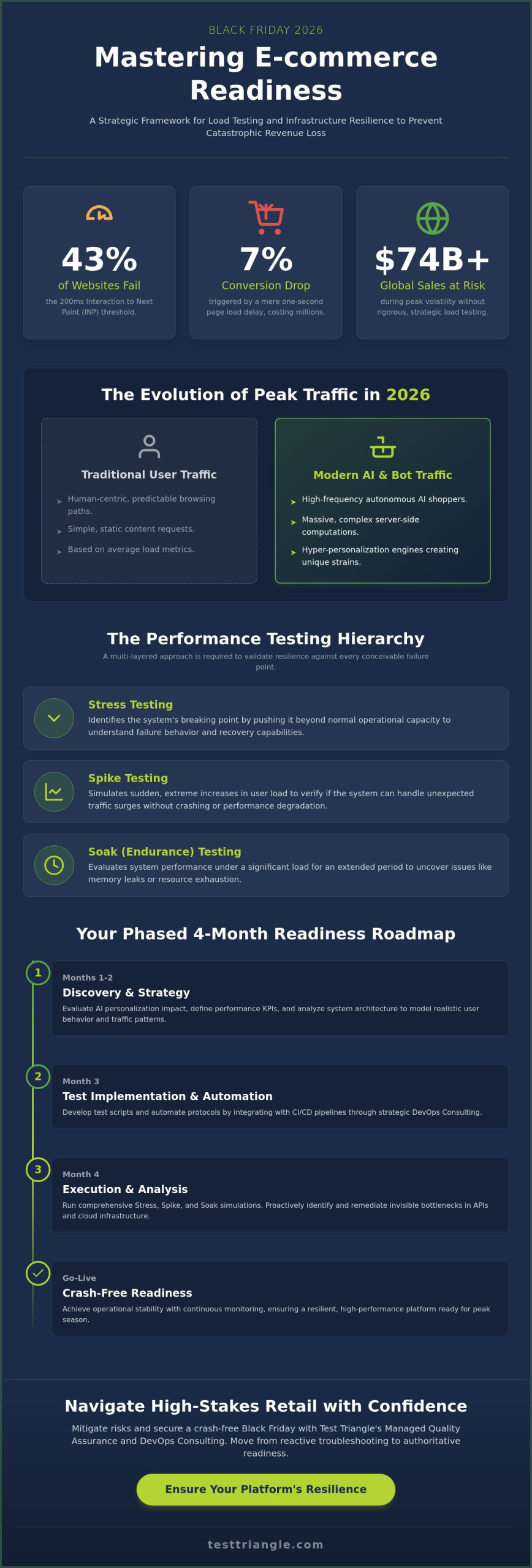

With 43% of websites currently failing the 200ms Interaction to Next Paint (INP) threshold, the technical margin for error has never been thinner for global enterprises. You understand that a mere one-second delay in page load time can trigger a 7% reduction in conversions, potentially costing your organization millions during peak volatility. Implementing rigorous load testing for ecommerce black friday 2026 is no longer a seasonal checkbox; it is a strategic necessity to protect your digital ecosystem from catastrophic system failure and unrecovered revenue loss.

We agree that the fear of third-party API instability and the difficulty of simulating realistic, high-concurrency user behavior are significant hurdles for any digital transformation leader. This guide provides the strategic framework you need to master your infrastructure readiness and ensure your platform remains resilient under the most intense traffic surges. By examining how to identify hidden bottlenecks and validate your infrastructure spend, you will move from reactive troubleshooting to a state of authoritative, crash-free readiness that delivers precision, performance, and peace-of-mind.

Key Takeaways

  • Evaluate the impact of AI-driven personalization engines on server capacity to ensure your infrastructure can withstand the sophisticated demands of the 2026 retail landscape.
  • Navigate the performance testing hierarchy by integrating stress, spike, and soak simulations into your strategy for load testing for ecommerce black friday 2026.
  • Identify invisible system bottlenecks by analyzing the technical debt often hidden within headless architectures and the limitations of automated cloud scaling.
  • Adopt a phased, four-month readiness roadmap that utilizes DevOps Consulting to automate testing protocols and secure long-term operational stability.
  • Mitigate high-stakes risks through managed quality assurance, positioning your organization for a crash-free event via strategic technical partnership.

The Strategic Imperative of Load Testing for Black Friday 2026

Software load testing is the strategic simulation of high-volume traffic designed to expose architectural weaknesses and validate system resilience before they manifest as customer-facing failures. For enterprises orchestrating load testing for ecommerce black friday 2026, this process has evolved from a seasonal checkbox into a fundamental pillar of digital assurance. We define Software load testing as the rigorous evaluation of how a system behaves under specific expected loads, ensuring that every microservice and database query performs optimally when concurrency peaks.

The 2026 retail landscape introduces unprecedented technical pressure. Hyper-personalization engines and AI-driven shopping assistants now generate massive server-side computations for every individual user session. It’s no longer enough to handle a high volume of static requests; your infrastructure must now process complex, intelligence-heavy interactions in real-time. The goal is a frictionless customer experience where the system remains invisible, even under maximum stress, preventing the catastrophic revenue loss associated with site instability.

Quantifying the “Cost of a Second” reveals the high stakes of this preparation. Research indicates that a single second of latency can trigger a 7% reduction in conversions. In an era where Black Friday sales have reached record-breaking heights of $74 billion globally, these milliseconds represent millions in abandoned carts. Comprehensive load testing for ecommerce black friday 2026 ensures that your platform doesn’t just stay online, but remains responsive enough to secure every potential transaction during the most volatile trading window of the year.

The Evolution of Peak Traffic in 2026

The composition of traffic has fundamentally changed, shifting from human-centric browsing to an environment dominated by high-frequency bot interactions and autonomous AI shoppers. These agents interact with your platform at speeds no human could match, placing unique strains on API gateways and inventory management systems. Traditional average load metrics are now obsolete. With 43% of websites currently failing the 200ms threshold for Interaction to Next Paint (INP), international retail brands must prioritize global latency testing to ensure that geographic distance doesn’t degrade the responsiveness modern consumers demand.

Risk Mitigation as a Business Value Driver

Strategic Performance Testing is a vital investment in brand equity and long-term customer loyalty. When a platform fails during a high-budget marketing campaign, the damage extends beyond immediate sales to include significant reputational harm. There are also critical legal implications to consider. With the EU AI Act and updated data privacy laws in states like Indiana and Kentucky now in effect, system instability can lead to compliance failures or data exposure during cascading failures. Validating your infrastructure spend through rigorous testing secures your organizational reputation and maximizes the ROI of your peak season initiatives.

The Performance Testing Hierarchy: Beyond Simple Load Simulation

Executing effective load testing for ecommerce black friday 2026 requires a multi-layered approach that transcends basic traffic volume simulations. While traditional methods focus on whether a site stays online, modern enterprise environments demand a more nuanced understanding of how various types of performance testing interact to secure the entire transaction lifecycle. By implementing a hierarchy of testing protocols, organizations can validate that their software and digital assurance testing efforts cover every conceivable failure point, from specific microservice latency to global system collapse.

Isolation testing serves as a critical diagnostic tool within this hierarchy. It allows technical teams to decouple specific components and identify which microservice or third-party API acts as the weakest link in the chain. For those seeking the highest level of resilience, chaos engineering introduces intentional, controlled failures into the environment. This advanced tier of readiness ensures that your system doesn’t just survive traffic; it possesses the self-healing capabilities required to maintain operations when unforeseen infrastructure issues arise during the peak shopping window.

Load vs. Stress vs. Spike Testing

Understanding the distinction between these methodologies is essential for building a robust load testing for ecommerce black friday 2026 strategy. Each serves a distinct purpose in identifying the difference between a “degradation point,” where performance begins to slow, and the “breaking point,” where the system fails entirely. Spike testing is particularly vital for simulating the sudden, extreme bursts of concurrency seen during flash sales or limited-time offers.

Test TypePrimary PurposeUser Load ProfileExpected Strategic Outcome
Load TestingValidate performance under expected peak traffic.Steady increase to anticipated maximum.Confirmation of baseline operational stability.
Stress TestingIdentify the absolute breaking point of the system.Traffic pushed beyond documented limits.Verified understanding of failure modes and recovery.
Spike TestingSimulate “Limited Time Offer” rushes.Sudden, extreme bursts of concurrency.Validation of auto-scaling and queue management.

The Role of Soak Testing in Peak Season

While spike tests handle the immediate rush, soak testing addresses the endurance required for a multi-day event. By maintaining a high load for 48 to 72 hours, teams can uncover memory leaks and database contention issues that remain hidden during shorter test cycles. This duration is also critical for validating auto-scaling cooldown periods. It ensures that infrastructure doesn’t prematurely scale down while secondary processes are still completing. To ensure your architecture is prepared for these sustained demands, you may wish to consult with a performance specialist regarding your current environment.

Load Testing for Ecommerce Black Friday 2026: A Strategic Readiness Guide

Identifying Invisible Bottlenecks in Modern Ecommerce Architectures

Relying solely on a cloud provider’s auto-scaling capabilities is a common strategic oversight. While horizontal scaling adds compute resources, it cannot resolve underlying architectural inefficiencies. In fact, rapid scaling can often exacerbate database deadlocks or reveal hidden synchronization issues that only manifest under the extreme concurrency of load testing for ecommerce black friday 2026. Modern headless commerce architectures, while offering flexibility, introduce a “headless tax.” Every interaction requires multiple API calls between decoupled layers, placing immense pressure on back-end services that might have been optimized for traditional monolithic structures. Without rigorous validation, these decoupled layers can become silent points of failure.

Database locking remains the primary cause of checkout failures during high-traffic events. When thousands of users attempt to update inventory or finalize payments simultaneously, poorly optimized query patterns lead to deadlocks that halt the entire transaction pipeline. These bottlenecks are often invisible during low-traffic periods but become catastrophic under peak demand. Integrating Performance Testing into your development lifecycle allows for the identification of these contention points long before they impact your revenue. It’s about achieving stability, scalability, and security through proactive technical discipline.

The Third-Party API Trap

Your platform’s performance is intrinsically linked to the stability of your external ecosystem. During peak events, a slow response from a credit card processor or a review widget can block critical threads, leading to abandoned carts. We recommend implementing strategies for “graceful degradation.” This ensures that if a non-essential service like a social media feed or a tracking script fails, the core checkout journey remains intact. Mocking these external responses during your test cycles is essential to isolate your internal system’s true capacity and ensure your site is not held hostage by a third-party vendor’s latency.

Microservices and Cascading Failures

Distributed systems are vulnerable to cascading failures where a single lagging service triggers a domino effect across the entire architecture. The “Circuit Breaker” pattern is a non-negotiable requirement for 2026 readiness. It prevents a failing service from being overwhelmed by continuous requests, allowing it the necessary time to recover. Without this protection, you risk “Retry Storms.” This occurs when automated retries from multiple services simultaneously hit a struggling component, effectively performing a self-inflicted DDoS attack on your own infrastructure. Testing these failover mechanisms is as important as testing the load itself.

A Phased Roadmap for Peak Season Readiness

Achieving operational resilience requires more than a last-minute stress test. For global enterprises, the journey toward successful load testing for ecommerce black friday 2026 must begin at least three to four months in advance. This lead time allows for the deep architectural adjustments identified in previous sections to be implemented without compromising the release cycle. By leveraging DevOps Consulting, organizations can automate these performance validations, moving away from manual, reactive checks toward a sophisticated “Shift-Left” methodology. This approach ensures that performance is validated at the code level before reaching staging, significantly reducing the cost of remediation.

The transition from synthetic testing to real-user monitoring (RUM) marks the final stage of this evolution. While synthetic tests provide a controlled baseline, RUM captures the actual experience of users across diverse geographies and device types. This dual-layered visibility is essential for identifying the “last mile” latencies that impact conversion rates. By integrating these insights into your Atlassian-managed workflows, your technical teams can maintain a unified view of system health and performance debt throughout the preparation phase.

Step 1: Baseline and Goal Setting

Establishing a baseline begins with a granular analysis of historical data from the 2025 peak season to set realistic growth targets for the coming year. Key Performance Indicators (KPIs) such as response time, throughput, and error rates must be defined against these projections. We prioritize the most critical user paths, specifically search functionality, cart additions, and the final checkout sequence, to ensure that high-value interactions remain frictionless even when concurrency reaches its zenith.

Step 2: Environment Mirroring and Scripting

Environment mirroring is a prerequisite for accuracy. Testing in a scaled-down environment often leads to false confidence; it fails to expose the database index issues or network latencies that only surface at production scale. We insist on full data parity, utilizing a production-sized database to identify long-term contention issues. Test scripts must be meticulously developed to include “think time” and varied user journeys, reflecting the non-linear way modern shoppers interact with AI-driven platforms.

Step 3: Execution and Iterative Optimization

The execution phase is an iterative “Test-Fix-Retest” cycle. A single test run is never sufficient to validate complex fixes. Utilizing software test automation services allows teams to run regression performance tests continuously as the infrastructure evolves. The final milestone is a full-scale simulation where the entire stack is tested at 150% of the expected peak load. To begin your architectural audit and secure your platform’s future, connect with our strategic consulting team today.

As global enterprises approach the final validation phase of their peak season roadmap, the transition from internal verification to managed digital assurance becomes a critical pivot point for risk mitigation. Test Triangle serves as a strategic visionary and practical partner, providing the technical rigor required to ensure your platform exceeds the unprecedented demands of the modern retail calendar. Implementing comprehensive load testing for ecommerce black friday 2026 requires more than just high-end tools; it demands the specialized expertise of a seasoned collaborator capable of translating technical metrics into operational certainty and executive peace of mind.

Our managed outsourcing services allow organizations to access specialized peak-season bursts of activity without the overhead of permanent internal expansion. This flexibility is complemented by our staffing solutions, which provide the niche expertise necessary for complex JMeter or Locust deployments. By integrating these resources with your existing Atlassian Implementation, we create a unified ecosystem where performance data flows directly into your development workflows. This synergy ensures that every bottleneck identified during load testing for ecommerce black friday 2026 is tracked, prioritized, and resolved with disciplined precision.

The Value of an Independent QA Partner

Internal development teams often fall victim to “development bias,” where familiarity with the codebase leads to overlooking subtle architectural flaws that only manifest under extreme stress. An independent partner provides an objective perspective, utilizing global testing teams to simulate authentic traffic patterns from diverse geographic regions. These experts don’t just deliver data; they interpret complex load test reports into actionable business intelligence. This process empowers your leadership to make informed decisions regarding infrastructure spend and marketing spend, ensuring that every dollar invested contributes to a stable, high-performing customer journey.

Ensuring Long-Term Stability Post-Black Friday

The value of a rigorous performance strategy extends far beyond the final checkout of the holiday weekend. By analyzing peak season data, we help you optimize your infrastructure costs during “normal” trading periods, ensuring you aren’t over-provisioning resources. The lessons learned during Black Friday are transformed into permanent CI/CD performance gates, preventing future code deployments from introducing regression issues. This commitment to continuous improvement is at the heart of our IT Service Management solutions, which prioritize long-term organizational progress over short-term fixes. To secure your digital future and validate your readiness for the upcoming surge, you should partner with Test Triangle for your 2026 performance strategy today.

Securing Your Competitive Advantage for the 2026 Peak Season

Mastering the complexities of modern retail requires a shift from reactive troubleshooting to a proactive, risk-based methodology. By prioritizing shift-left performance testing and addressing the bottlenecks inherent in decoupled architectures, your organization can transform technical vulnerabilities into a robust foundation for growth. We’ve explored how a phased roadmap ensures your platform remains frictionless even as AI-driven traffic peaks. Implementing rigorous load testing for ecommerce black friday 2026 is the definitive step toward protecting your revenue during the year’s most volatile trading window. Don’t leave your infrastructure’s resilience to chance when the stakes are at their highest.

As an Atlassian Gold Solution Partner with global delivery centers across Europe, North America, and Asia, Test Triangle brings institutional maturity to your digital assurance strategy. Our expertise in high-compliance sectors like Finance and Pharma ensures your infrastructure meets the highest standards of stability and security. We’re ready to act as your reliable long-term collaborator, providing the specialized insights needed to navigate this evolving landscape. Secure Your 2026 Peak Season Performance with Test Triangle and prepare your platform for unprecedented success. Your resilient future starts today.

Frequently Asked Questions

When should I start load testing for Black Friday 2026?

You should initiate your performance testing cycle at least three to four months before the peak event to allow sufficient time for identifying and remediating deep architectural flaws. Starting early ensures that your DevOps teams can integrate performance gates into the CI/CD pipeline, preventing late-stage code deployments from introducing regression issues that could compromise your 2026 readiness. This lead time is essential for conducting multiple iterations of the “Test-Fix-Retest” cycle to achieve optimal stability.

How much traffic should I simulate for a Black Friday load test?

We recommend simulating at least 150% of your anticipated peak traffic to identify the absolute breaking point of your infrastructure and validate your failover mechanisms. By analyzing historical data from the 2025 peak season and projecting growth targets for 2026, you can establish a realistic baseline that accounts for both human shoppers and the increasing volume of autonomous AI shopping agents. Testing beyond the expected peak provides the technical assurance needed to handle unexpected viral surges or aggressive marketing campaigns.

Can cloud auto-scaling replace the need for performance testing?

Cloud auto-scaling cannot replace the need for rigorous performance testing because it only addresses compute capacity rather than architectural efficiency or database health. Automated scaling often masks underlying issues like database deadlocks, poorly optimized API calls, or memory leaks, which can lead to cascading failures even when additional resources are provisioned. Relying on scaling alone without validating your system’s limits often results in unexpected costs and unrecovered revenue during high-concurrency events.

What are the most common bottlenecks found during ecommerce load testing?

The most frequent bottlenecks identified during load testing for ecommerce black friday 2026 include database contention, third-party API latency, and the technical “tax” associated with headless commerce architectures. These invisible points of failure often remain hidden during normal trading periods but become catastrophic under extreme concurrency. Identifying these issues early allows your organization to implement strategies like the “Circuit Breaker” pattern or graceful degradation to maintain a frictionless customer journey when individual services lag.

How do I test third-party payment gateway performance without making real charges?

You can validate payment workflows by utilizing vendor-provided sandbox environments or by mocking third-party responses to simulate various success and failure scenarios under load. This methodology allows your technical teams to isolate internal performance and test how the system handles external timeouts without incurring transaction fees or processing real financial data. It’s a critical step for ensuring that your checkout sequence remains resilient even if an external processor experiences its own peak-season latency.

What is the difference between load testing and stress testing for retail?

Load testing validates system behavior under the expected peak volume to ensure operational stability, while stress testing pushes the system beyond its documented limits to identify its absolute breaking point. While load testing confirms that you can meet your business goals, stress testing reveals how the system fails and how effectively it recovers. Both methodologies are essential components of a comprehensive digital assurance strategy, providing the data needed to manage infrastructure spend and mitigate the risk of catastrophic failure.

How does headless commerce affect my load testing strategy?

Headless commerce increases the complexity of your strategy by requiring the validation of decoupled front-ends and the resulting pressure on back-end APIs. Every user interaction in a headless environment typically triggers multiple API calls across distributed systems, which necessitates a deeper focus on inter-service communication latency and microservice resilience. Your testing scripts must accurately reflect these complex interaction patterns to ensure that your API gateway doesn’t become a single point of failure during high-traffic bursts.

What tools are best for simulating millions of concurrent users in 2026?

For simulating massive concurrency in 2026, industry-standard platforms like Apache JMeter 5.6.3 and Locust 2.44.0 remain the preferred choices for global enterprises due to their scalability and flexibility. These tools allow for the creation of sophisticated, intelligence-heavy interaction models that mimic the behavior of modern shoppers and AI assistants. When integrated with a managed performance testing framework, these tools provide the granular visibility required to validate end-to-end journeys across diverse geographic regions and device types.

Paul Guy

Article by

Paul Guy

Paul serves as the Marketing Director at Test Triangle, where he leads a global team in driving growth through strategic B2B marketing and brand communications. With a strong emphasis on measurable outcomes and sustainable performance, he plays a pivotal role in aligning marketing functions to enhance customer engagement and accelerate business impact. Under his leadership, marketing initiatives have consistently delivered significant returns on investment, elevated brand visibility, and strengthened the company's presence across key markets.