



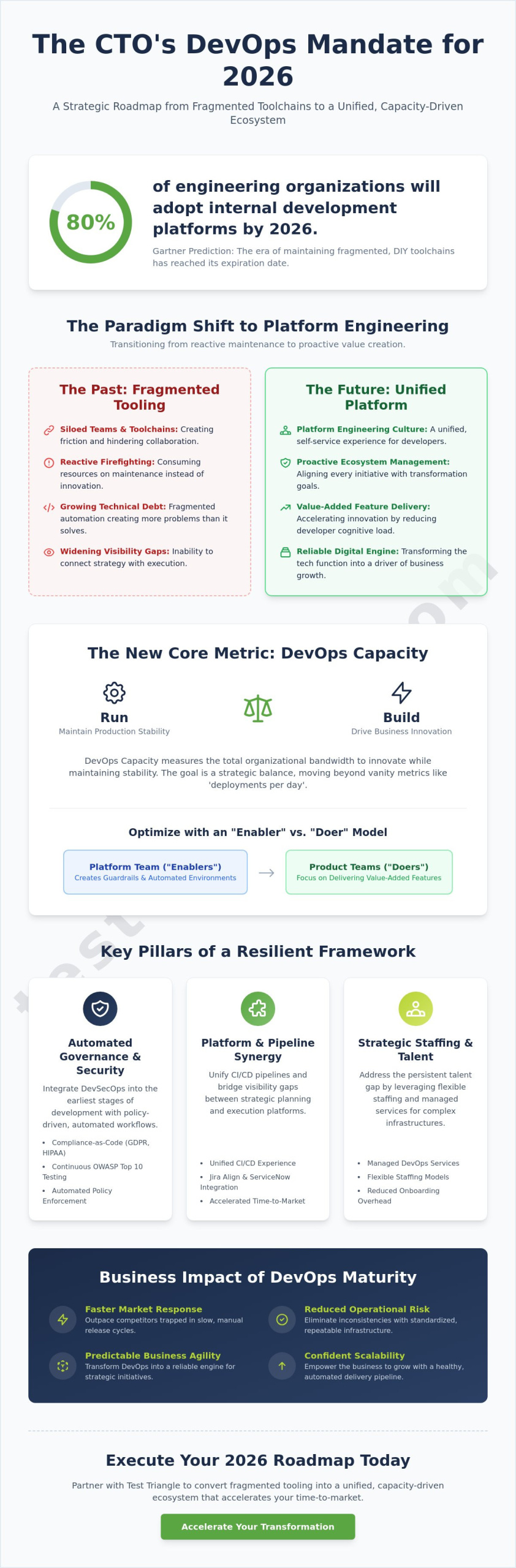
With Gartner predicting that 80% of engineering organizations will adopt internal development platforms by the close of 2026, the era of fragmented, DIY toolchains has reached its expiration. You’ve likely recognized that maintaining high-velocity delivery in complex hybrid environments is becoming unsustainable as specialized talent shortages persist and visibility gaps widen across the development lifecycle. Crafting a resilient devops strategy for chief technology officers is no longer merely an exercise in tool selection; it’s a strategic necessity to orchestrate a unified ecosystem that delivers precision, pace, and performance.
We understand that your objective is to evolve your technical function from a technical cost center into a reliable engine for digital transformation. This framework provides a high-level roadmap to help you transition from fragmented tooling to a capacity-driven ecosystem that scales with your business goals. You’ll gain insights into unifying ITSM and DevOps platforms to reduce time-to-market, ensuring governance through automated compliance, and leveraging the 2026 ServiceNow “Australia” release to secure a sustainable competitive advantage.
Key Takeaways
- Transition from managing siloed teams to a platform engineering culture where DevOps Capacity serves as a primary metric for executive performance and organizational scalability.
- Develop a resilient devops strategy for chief technology officers that unifies CI/CD pipelines and integrates DevSecOps into the earliest stages of the development lifecycle.
- Align executive strategic roadmaps with technical execution by bridging the visibility gap between Atlassian Jira Align and ServiceNow ITSM platforms.
- Address the persistent talent gap by leveraging flexible staffing models and managed DevOps services to maintain complex, hybrid-cloud infrastructures without compromising security.
- Implement a 2026 strategic roadmap that converts fragmented tooling into a unified, capacity-driven ecosystem designed to accelerate time-to-market.
The Evolution of DevOps Strategy: A 2026 Mandate for CTOs
The landscape of software delivery has fundamentally changed, moving beyond the era where DevOps was treated as a siloed department or a collection of scripts. For the modern CTO, a devops strategy for chief technology officers now demands a transition toward platform engineering, where the goal is to provide a frictionless, self-service experience for developers. This evolution is driven by the realization that fragmented automation efforts often create more technical debt than they solve. By 2026, successful leaders are those who treat the DevOps philosophy as a foundational cultural asset, ensuring that every automation initiative aligns directly with long-term digital transformation goals. This shift requires a disciplined focus on organizational progress through the combination of human expertise and technical tools, moving away from reactive firefighting toward proactive ecosystem management.
From Tool-Centric to Capacity-Centric Leadership
DevOps Capacity is the primary metric for 2026 CTOs, representing the total bandwidth an organization possesses to innovate while maintaining the stability of current production environments. This metric forces a departure from vanity statistics like the number of deployments per day, focusing instead on the strategic balance between “run” and “build” activities. To optimize this, leaders must evaluate the “Enabler” versus “Doer” ratio within their engineering teams. A high-performing platform team acts as an enabler, creating the guardrails and automated environments that allow product teams to be the doers. When this ratio is balanced, the organization achieves a state of stability, speed, and scalability, significantly reducing the cognitive load on developers and accelerating the delivery of value-added features.
The Business Impact of Strategic DevOps Maturity
Mature DevOps practices aren’t just technical achievements; they’re significant drivers of market share and customer retention. When an organization can deploy with high frequency without security compromises, it responds to market shifts faster than competitors trapped in manual release cycles. Strategic maturity involves reducing operational risk through standardized, repeatable infrastructure that eliminates the inconsistencies of manual environments. By leveraging Atlassian implementation services to unify tracking and managed outsourcing services to handle infrastructure complexity, CTOs can transform DevOps into a predictable engine of business agility. This approach ensures that technical debt reduction isn’t a separate project but a continuous, automated byproduct of a healthy delivery pipeline that empowers the business to scale with confidence.
Designing a Resilient Framework: The Three Pillars of Modern DevOps
A resilient framework requires more than just automation; it demands a structured approach to orchestration across your entire digital estate. When building a devops strategy for chief technology officers, the focus must shift toward three core pillars that ensure stability while accelerating delivery. This framework serves as the strategic blueprint for scaling digital operations without compromising on security or governance. By 2026, the transition from fragmented, siloed automation to a unified ecosystem is the only way to manage the increasing complexity of hybrid and multi-cloud environments.
Pillar 1: Automated Governance and Security
Governance in 2026 means moving beyond basic scripts to intelligent, policy-driven workflows. This is particularly vital for organizations in highly regulated industries like finance or healthcare where Compliance-as-Code is now a requirement to meet standards like GDPR, HIPAA, and PCI-DSS. By integrating software qa services directly into the delivery stream, you ensure that security isn’t a final hurdle but a continuous process. This proactive stance addresses the OWASP Top 10 through automated security testing that runs with every commit. Leaders who succeed in implementing DevOps at this level find that security becomes an enabler of speed rather than a blocker, providing the peace of mind that comes from systemic risk reduction.
Pillar 2: Platform Engineering and Developer Experience (DevEx)
Pillar 3: Data-Driven Continuous Improvement
Data is the final pillar. You can’t improve what you don’t measure. Utilizing DORA metrics to track velocity and stability provides the “Radical Transparency” needed for executive oversight. In 2026, AI-driven insights are no longer optional for maintaining a competitive edge. Analysis shows that teams using AI-powered testing frameworks achieve 83% test coverage, a significant increase from the 54% achieved with traditional methods. These feedback loops allow for predictive failure prevention and the implementation of self-healing systems. This data-driven approach ensures your ecosystem remains resilient under pressure and allows for the continuous optimization of your delivery pipeline.
If you’re ready to modernize your infrastructure, you might consider how a tailored consultation can align these pillars with your specific business objectives.
Platform Synergy: Leveraging Atlassian and ServiceNow for Governance
Achieving a “Single Pane of Glass” across the entire software development lifecycle (SDLC) remains a top priority for technology leaders seeking to eliminate visibility gaps. A robust devops strategy for chief technology officers in 2026 relies on the synergy between Atlassian and ServiceNow to bridge the historic divide between engineering velocity and operational stability. By integrating these industry-leading platforms, you create a unified governance layer that translates raw technical output into actionable business intelligence. This orchestration ensures that your digital transformation isn’t just fast, but also aligned with the broader corporate mission, providing a disciplined foundation for long-term growth.
Strategic alignment often fails when executive roadmaps don’t reflect real-world engineering capacity. Through specialized Atlassian Consulting, organizations can leverage Jira Align to synchronize high-level objectives with the daily tasks of development teams. A precise Atlassian implementation provides the scalable project tracking necessary to manage complex portfolios, ensuring that resources are allocated to the highest-value initiatives. This visibility allows CTOs to pivot with confidence, backed by real-time data from the engineering floor, while maintaining the rigorous standards required in global enterprise environments.
While Atlassian drives the development journey, ServiceNow implementation acts as the critical bridge to IT Service Management (ITSM). The 2026 ServiceNow “Australia” release, scheduled for broad production upgrades by mid-June, introduces enhanced capabilities for automating the connection between CI/CD pipelines and change management records. This integration reduces manual intervention and eliminates the friction often found in release cycles. By automating the flow of information between Jira and ServiceNow, you achieve Visibility, Velocity, and Value, turning your DevOps function into a transparent and predictable business asset.
Unifying the Enterprise Ecosystem
Consolidating your stack around Jira, Bitbucket, and Confluence creates a seamless developer journey that minimizes context switching and improves team morale. This consolidation directly addresses the pain of tool sprawl, which often leads to fragmented data and security vulnerabilities. When combined with comprehensive IT service management solutions, these platforms provide a disciplined framework for incident response and workflow optimization. It’s about ensuring your teams remain focused on building rather than maintaining their own toolsets, allowing for a more versatile and globally-minded engineering culture.
Strategic Asset Management and Compliance
Automated governance requires more than just code; it requires an immutable audit trail that stands up to scrutiny. Integrating platform logging across the ecosystem ensures that every change is documented, meeting stringent global regulatory standards for data residency and sovereignty. This unified approach also allows for better management of software licenses and cloud spend through centralized oversight. By managing these assets strategically, you reduce unnecessary costs and ensure that your global cloud deployments remain compliant with evolving international laws, providing the peace of mind that comes from systemic risk reduction.
Solving the Talent Gap: Strategic Staffing Models for 2026
The global demand for skilled DevOps professionals continues to outpace supply, creating a strategic bottleneck for organizations aiming to execute a sophisticated devops strategy for chief technology officers. As of 2026, the average salary for a DevOps engineer in the US has reached approximately $140,000, with senior roles often exceeding $180,000. For the CTO, solving this talent gap requires a move away from traditional, slow-moving recruitment toward more agile, capacity-driven models. By leveraging specialized staffing solutions, you can scale your engineering capacity without the prohibitive overhead of permanent headcount, ensuring your roadmap remains on track even in a volatile labor market.
In highly regulated sectors such as Pharmaceuticals or Finance, the challenge is even more acute. Sourcing talent that understands both the technical CI/CD pipeline and the nuances of GxP or banking regulations is exceptionally difficult. A disciplined approach to staffing involves identifying partners who provide pre-vetted experts familiar with automated compliance and security protocols. This ensures that your technical evolution doesn’t stall due to a lack of specialized knowledge, providing the peace of mind that comes from systemic reliability and expertise.
In-House vs. Outsourced DevOps: An ROI Comparison
Evaluating the total cost of ownership (TCO) for a DevOps function reveals that permanent hires often involve hidden expenses, including recruitment fees, training, and retention incentives. Managed DevOps Services offer a compelling alternative by providing immediate access to a broad pool of expertise at a predictable cost. This model is particularly effective for “Burst Capacity,” allowing you to scale up for major cloud migrations or platform upgrades without long-term commitment. The following table illustrates the strategic trade-offs between these two models:
| Feature | In-House Permanent Hires | Managed DevOps Services |
|---|---|---|
| Hiring Cycle | Typically 3 to 6 months | Immediate to 2 weeks |
| Expertise Depth | Specific to individual hires | Access to full consultant pool |
| Scalability | Difficult and slow | Highly flexible and rapid |
| Risk Profile | High (attrition risk) | Low (contractual stability) |
Remote and Offshore Talent Integration
Managing global, distributed DevOps engineering teams requires a focus on cultural and technical alignment. To succeed, you must establish clear communication protocols and standardized toolsets that transcend time zones. Utilizing specialized IT staffing services allows you to tap into offshore talent pools while maintaining the high standards of quality and security your enterprise demands. This approach not only reduces time-to-hire but also provides a versatile, globally-minded workforce capable of supporting complex infrastructures around the clock. By integrating these resources into your core platform engineering culture, you achieve a state of Stability, Precision, and Scalable Growth.
If you need to scale your engineering team quickly with specialized talent, contact our staffing experts to discuss a customized model for your organization.
Executing Your Roadmap: How Test Triangle Accelerates Transformation
Test Triangle acts as more than a service provider; we are a strategic visionary and practical collaborator for global enterprises navigating the complexities of modern software delivery. Executing a devops strategy for chief technology officers requires a nuanced understanding of how technical tools, human talent, and business governance intersect to drive organizational progress. We provide the institutional maturity needed to transition from fragmented, siloed automation to a unified, capacity-driven ecosystem. Our methodology connects deep Atlassian expertise with specialized staffing models to ensure that your transformation roadmap remains both ambitious and achievable in a volatile technological landscape.
A Holistic Approach to IT Service Management
Operational excellence is only achieved when development speed is balanced by rigorous governance and systemic reliability. By integrating comprehensive IT Service Management solutions into your core DevOps strategy, we bridge the historic divide between innovation and stability. Our strategic partnerships with AWS and ServiceNow allow us to orchestrate environments that are secure, compliant, and highly performant. Our proven success in the pharmaceutical sector, for instance, demonstrates our ability to scale DevOps functions while maintaining strict adherence to global compliance standards, ensuring that digital evolution never comes at the cost of regulatory risk. This holistic approach provides the Stability, Security, and Scalability required for high-stakes enterprise environments.
Your Long-Term Collaborator for Scalable Growth
We’re deeply invested in your organization’s long-term success through a disciplined focus on risk reduction and empowerment found in large-scale technological evolution. Whether you require project-based DevOps Consulting or the sustained support provided by Managed Outsourcing Services, our delivery models remain adaptable to your specific business objectives. We don’t just implement tools; we foster a platform engineering culture that empowers your teams to build, deploy, and scale with confidence. This partnership provides the Precision, Pace, and Power necessary to thrive as you navigate the 2026 ServiceNow “Australia” release and beyond, positioning your company as a leader in digital maturity.
The journey from an initial assessment to full-scale platform optimization begins with a clear understanding of your current DevOps capacity and technical debt. By identifying visibility gaps and talent shortages early, we help you build a resilient framework that delivers tangible business value and reduces time-to-market. Contact us today to begin your comprehensive 2026 devops strategy for chief technology officers assessment and secure a steady hand for your digital transformation journey.
Orchestrating Future-Proof Digital Ecosystems
The transition toward platform engineering and capacity-driven metrics represents a fundamental shift in how successful enterprises deliver value. By unifying the Atlassian and ServiceNow ecosystems, you establish the visibility and governance necessary to scale without security compromises. Addressing the specialized talent gap through flexible staffing models ensures your roadmap remains resilient against market volatility, providing the peace of mind that comes from systemic stability. A robust devops strategy for chief technology officers is no longer just a technical objective; it’s a strategic mandate for sustainable growth in 2026.
As an Atlassian Gold Solution Partner and ServiceNow Premier Partner with a global delivery footprint across Europe, North America, and Asia, Test Triangle acts as a reliable long-term collaborator for your digital transformation. We’re committed to helping you navigate this complex landscape with precision and institutional maturity. Partner with Test Triangle for your 2026 DevOps Strategy to secure a steady hand for your organization’s future. We look forward to empowering your engineering teams and driving your long-term operational success.
Frequently Asked Questions
What are the key components of a DevOps strategy for CTOs in 2026?
A successful devops strategy for chief technology officers in 2026 prioritizes platform engineering, DevSecOps, and AI-driven observability. These components work together to create a unified, capacity-driven ecosystem that reduces cognitive load on developers. By focusing on internal development platforms and automated governance, CTOs can ensure that technical execution aligns with long-term digital transformation goals and organizational stability.
How does platform engineering differ from traditional DevOps?
Platform engineering focuses on building internal development platforms (IDPs) that provide “Golden Paths” for developers, whereas traditional DevOps often relied on manual collaboration between siloed teams. Gartner predicts that 80% of software engineering organizations will adopt these platforms by 2026. This shift empowers developers through self-service infrastructure, allowing them to focus on product innovation rather than complex pipeline maintenance.
How can Atlassian tools improve my DevOps delivery speed?
Atlassian tools like Jira Software 12 and Bamboo 13 improve delivery speed by unifying the developer journey from planning to deployment. These major versions support modern requirements like Java 25 and Spring 7, ensuring your stack remains performant and secure. By integrating Jira Align with executive roadmaps, you achieve the visibility needed to allocate resources effectively and accelerate time-to-market.
What is the ROI of outsourcing DevOps to a managed service provider?
The ROI of outsourcing DevOps to a managed service provider is realized through reduced total cost of ownership and immediate access to specialized expertise. Instead of navigating a three to six month hiring cycle for a senior engineer with a $180,000 salary, you gain burst capacity and rapid scalability. This model provides the peace of mind derived from contractual stability and systemic risk reduction.
How do I ensure security and compliance within an automated DevOps pipeline?
Ensuring security within an automated pipeline requires integrating DevSecOps and “Compliance-as-Code” directly into the CI/CD stream. Automated testing frameworks now achieve up to 83% test coverage when powered by AI, significantly mitigating vulnerabilities like the OWASP Top 10. This proactive stance ensures that governance is maintained across global cloud deployments without slowing down the release cycle or compromising data residency.
What are the best staffing models for scaling a DevOps team globally?
The most effective models for 2026 combine permanent core leadership with flexible offshore or managed service resources. This hybrid approach addresses the talent gap by tapping into global expertise while maintaining cultural and technical alignment. Utilizing specialized IT staffing services allows CTOs to scale capacity rapidly for major migrations or platform upgrades without the long-term overhead of permanent headcount.
How does ServiceNow integration benefit a DevOps environment?
ServiceNow integration bridges the visibility gap between engineering velocity and IT Service Management (ITSM). The 2026 “Australia” release enhances this by automating change management records directly from CI/CD pipelines, reducing manual friction. This synergy creates a “Single Pane of Glass” for the entire SDLC, ensuring that every deployment is documented and compliant with stringent global regulatory standards.
Why should a CTO prioritize “DevOps Capacity” over simple automation?
Prioritizing DevOps Capacity over simple automation ensures that your engineering organization has the bandwidth to innovate while maintaining production stability. A comprehensive devops strategy for chief technology officers treats capacity as a primary performance metric. While automation replaces manual tasks, capacity management balances the “Enabler” versus “Doer” ratio to drive long-term business agility and scalable growth.

Article by
Paul Guy
Paul serves as the Marketing Director at Test Triangle, where he leads a global team in driving growth through strategic B2B marketing and brand communications. With a strong emphasis on measurable outcomes and sustainable performance, he plays a pivotal role in aligning marketing functions to enhance customer engagement and accelerate business impact. Under his leadership, marketing initiatives have consistently delivered significant returns on investment, elevated brand visibility, and strengthened the company's presence across key markets.