



Why do most enterprise leaders find their ServiceNow budgets ballooning by nearly double the initial estimate within the first eighteen months? It’s because the hidden costs of servicenow implementation aren’t just minor oversights; they’re the predictable consequences of treating a massive architectural shift as a simple software purchase. You likely already understand that the Now Platform is a cornerstone of digital evolution, yet the reality of opaque licensing and complex legacy integrations often creates a significant gap between expected value and actual spend.
We’re here to bridge that gap by uncovering the invisible financial traps and operational overheads that frequently derail even the most ambitious digital transformations. This guide delivers a transparent TCO framework designed to stabilize your budget and ensure your 2026 deployment remains strategically aligned with your broader business goals. We’ll explore how a disciplined approach to data management and training can transform potential overhead into predictable progress, securing the high ROI your organization demands while avoiding the common integration failures that stall momentum. By focusing on stability, precision, and growth, you can move from the “Zurich” release through the upcoming “Australia” update with total financial confidence.
Key Takeaways
- Identify the structural drivers behind the 40-60% budget overruns common in enterprise deployments by navigating the complex ServiceNow “Custom Quote Maze.”
- Mitigate the hidden costs of servicenow implementation by avoiding excessive architectural debt and the subsequent “upgrade tax” that restricts access to new platform features.
- Calculate the true operational impact of internal opportunity costs, ensuring that the diversion of your subject matter experts does not compromise core business stability.
- Implement a rigorous quality assurance framework and pre-implementation audit to identify technical hurdles before they escalate into expensive post-launch fixes.
- Adopt a phased rollout methodology that balances out-of-the-box functionality with essential business customization to ensure a predictable and scalable total cost of ownership.
The ServiceNow Implementation Mirage: Why Initial Quotes Are Just the Tip of the Iceberg
The initial engagement with the ServiceNow platform often begins with a sense of optimism that’s quickly tempered by the reality of the “Custom Quote Maze.” Since the company doesn’t publish a standard rate card, every enterprise enters a highly negotiated environment where the final contract reflects a unique combination of user count, selected modules, and organizational scale. This lack of transparency often masks the hidden costs of servicenow implementation, leading many executives to mistake the licensing fee for the total investment. It’s a strategic oversight that can compromise long-term operational stability.
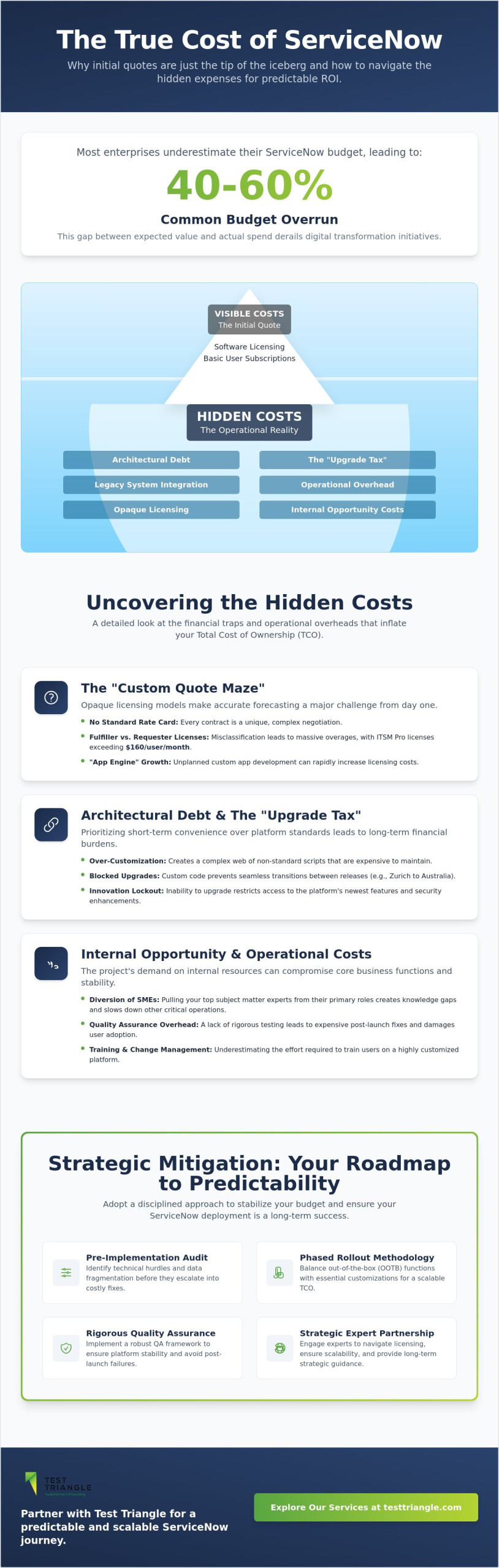
Industry data suggests that most enterprises underestimate their initial budget by 40% to 60%. This discrepancy occurs because the quote focuses on software acquisition, failing to account for the structural remediation required to make the platform functional. Think of it as the “Renovation Analogy.” Just as a contractor can’t know the state of a building’s internal wiring until the walls are opened, an implementation partner can’t fully assess the complexity of your legacy data until the project begins. If your IT foundation is fragmented, the effort to align it with ServiceNow’s architecture can easily double your projected timelines. Precision, predictability, and performance require looking far beyond the initial sales proposal.
The Gap Between Licensing and Functional Reality
A common pitfall is viewing a ServiceNow license as a finished solution rather than a sophisticated entry ticket. While the “Out-of-the-Box” (OOTB) promise is a powerful marketing narrative, it’s often a financial trap for organizations with unique regulatory requirements or complex workflows. Turning on a module is a technical task; configuring it to mirror your specific business logic requires deep strategic alignment. Without this alignment, the hidden costs of servicenow implementation surface through endless “fix-it” cycles that occur after the initial launch. True platform readiness involves bridging the gap between what the software can do and what your specific business needs it to do.
The 2026 Pricing Landscape: Fulfillers vs. Requesters
Within the 2026 fiscal environment, the distinction between Fulfiller and Requester licenses has become a critical focal point for budget stability. Fulfiller licenses, particularly for ITSM Professional with AI capabilities, carry a premium that can exceed $160 per user per month. Misclassifying users or failing to account for the growth of your “App Engine” footprint can lead to massive annual overages. To ensure a predictable roadmap, organizations must partner with experts who provide ServiceNow consulting services tailored to long-term scalability. This approach ensures that user-type classification remains accurate as your digital infrastructure evolves, providing the peace of mind that comes from financial precision and systemic improvement.
Architectural Debt: The Long-Term Cost of Over-Customization
While the initial deployment of the ServiceNow platform often focuses on immediate functional gains, the long-term financial burden of “architectural debt” represents one of the most significant hidden costs of servicenow implementation. This debt accumulates when organizations prioritize short-term convenience over platform standards, leading to a complex web of custom scripts and modified workflows. According to research on IT projects, large-scale software initiatives often exceed budgets not because of the initial build, but due to the unforeseen complexity of maintaining non-standard environments. In the ServiceNow ecosystem, this manifests as the “Upgrade Tax,” where custom code prevents your organization from seamlessly transitioning between releases like Zurich and Australia, effectively locking you out of the very innovation you’re paying for.
Integration complexity adds another layer to this financial iceberg. Connecting ServiceNow to high-scale environments like AWS or legacy ERP systems requires a disciplined approach to data throughput and API management. If your team builds custom point-to-point integrations instead of utilizing the native IntegrationHub, you aren’t just paying for the initial development. You’re committing to a permanent maintenance cycle where every third-party update risks breaking your connection. Furthermore, the cost of migrating “dirty data” into a clean ServiceNow instance is a major budget driver. Industry benchmarks suggest that organizations should allocate 20% to 30% of their total implementation budget purely for data migration and cleansing activities to avoid expensive post-launch remediation.
The High Price of Deviating from the OOTB Path
Every line of specialized script represents a future maintenance liability. To protect your return on investment, technical debt must be treated as a transparent line item in your initial budget rather than an afterthought. Strategic leaders prioritize stability, precision, and progress by enforcing a “standard-first” policy that minimizes deviations from out-of-the-box (OOTB) functionality. When customization is unavoidable, it must be documented with the same rigor applied to core business logic to ensure that future upgrades don’t become multi-month rescue missions. If you’re concerned about how your current customizations might impact future scalability, you may want to consult with a strategic partner to audit your roadmap.
Integration Hub and Third-Party API Costs
Modern ServiceNow deployments increasingly rely on automated workflows that connect to external clouds. However, many executives are surprised by transaction-based costs associated with IntegrationHub spokes and automated “pro” features. When scaling AWS Cloud Migration initiatives, the financial impact of API rate limits and data throughput charges can escalate quickly. Managing these costs requires a sophisticated understanding of how data flows between platforms. By balancing the use of IntegrationHub with a clear strategy for high-volume data exchanges, you can avoid the throughput charges that often quietly double the operational overhead of a connected enterprise.
The Operational Iceberg: Personnel, Training, and Quality Assurance
Beyond the technical architecture and licensing fees, the human element represents a massive portion of the hidden costs of servicenow implementation. Executives often overlook the “invisible” salary spend associated with their subject matter experts (SMEs). When you divert your top process owners from their core responsibilities to guide a deployment, the resulting productivity dip is a direct, yet unrecorded, expense. This internal opportunity cost is compounded by a specialized talent gap; industry professionals report that hiring dedicated ServiceNow developers often requires a 30% premium over standard IT roles due to the platform’s unique niche and the high demand for certified expertise.
The “QA Deficit” is another significant financial trap that emerges when organizations treat testing as a perfunctory final step rather than a strategic safeguard. Skipping rigorous validation leads to “post-launch shock,” where remediating a bug in a live environment can cost five to ten times more than fixing it during the development phase. Effective change management is equally vital; without it, employee resistance leads to platform underutilization. You don’t want to pay for a high-performance engine only to have your team use it like a basic spreadsheet. Success requires a disciplined focus on order, oversight, and optimization.
The Critical Role of Software and Digital Assurance
Rigorous quality assurance is the most effective way to protect your digital investment from unforeseen operational overhead. While automated tools are powerful, Manual Testing remains essential for validating complex ServiceNow workflows that involve nuanced human decision-making. By leveraging Software Test Automation Services, your organization can create a repeatable regression suite that reduces long-term maintenance spend. This “Shift Left” approach ensures that quality is baked into the methodology, preventing the architectural flaws that often derail 2026 deployment timelines.
Training and Platform Governance
Continuous learning is a mandatory operational expense, not a one-time workshop. As ServiceNow moves from the Zurich release toward Australia, your team must stay updated on new AI-driven decision intelligence and agentic capabilities to maintain peak efficiency. Establishing a Center of Excellence (CoE) is a proven strategy for preventing platform sprawl and the accumulation of “Zombie Modules”—those expensive, licensed features that sit idle because no one knows how to govern them. Strategic alignment between platform capabilities and business goals ensures that every dollar spent on training translates into tangible, scalable growth.
Strategic Mitigation: Auditing Your 2026 Implementation Roadmap
Mitigating financial risk requires a disciplined transition from reactive troubleshooting to proactive platform governance. A comprehensive pre-implementation audit serves as the diagnostic foundation, identifying the hidden costs of servicenow implementation before they manifest as significant budget overruns. This audit should scrutinize your existing data architecture and process maturity to determine whether a “Phased Rollout” or a “Big Bang” approach better suits your organizational risk profile. While a Big Bang deployment promises immediate consolidation, it frequently results in higher post-launch remediation costs. Conversely, a phased approach provides the flexibility to refine workflows based on real-world usage, ensuring that each milestone delivers stability, precision, and performance.
As we move through 2026, new financial variables have entered the landscape, specifically regarding AI compute credits and ESG reporting modules. The “Zurich” and upcoming “Australia” releases emphasize agentic AI and autonomous service management, which rely on a credit-based consumption model rather than traditional flat-fee licensing. Failing to forecast the volume of AI-driven transactions can lead to unexpected mid-quarter invoices. Furthermore, the rising demand for Environmental, Social, and Governance (ESG) transparency means that organizations must budget for specialized modules that track sustainability metrics across the digital supply chain. These emerging drivers represent the next frontier of total cost of ownership (TCO) management.
The Value of Managed Outsourcing
Comparing the expense of internal hiring against Managed Outsourcing Services is a critical step in stabilizing your post-implementation burn rate. Maintaining a full-time, in-house team of ServiceNow architects is often 30% more expensive than standard IT staffing, making a structured support model more financially viable for many global enterprises. By utilizing predictable Managed Service Provider Subscription Fees, you can eliminate the “emergency consulting” fees that occur when internal resources are overwhelmed by platform upgrades or complex integration failures. This approach positions your partner as a reliable long-term collaborator invested in your operational stability.
Forecasting for 2026 and Beyond
Strategic budget planning must account for ServiceNow’s biannual upgrade cycles, which require dedicated windows for testing and validation. The integration of Generative AI, specifically through “Now Assist,” into existing workflows necessitates a clear understanding of data throughput and compute requirements. As your ServiceNow footprint expands into multi-cloud governance, the complexity of managing cross-platform security and compliance will grow. Developing a three-year roadmap that anticipates these shifts ensures that your platform remains a driver of systemic improvement rather than a source of financial friction. To ensure your 2026 roadmap is optimized for both performance and cost, you should schedule a strategic implementation audit with our expert team.
Partnering for Predictability: The Test Triangle Approach
Achieving a successful deployment requires more than technical proficiency; it demands a disciplined methodology that prioritizes long-term financial predictability. At Test Triangle, we eliminate the anxiety associated with the hidden costs of servicenow implementation by integrating a strategic roadmapping phase that aligns platform capabilities with your specific business outcomes. Our “Testing-First” philosophy ensures that digital assurance isn’t a final hurdle but a continuous process, reducing the total cost of ownership by identifying architectural flaws before they escalate into expensive operational overhead. By balancing out-of-the-box functionality with essential, high-value customization, we protect your ability to scale without the burden of excessive technical debt.
The transition from a high-intensity implementation phase to a state of sustainable, managed growth is where many organizations struggle to maintain budget discipline. Our approach focuses on creating a seamless evolution, moving your enterprise from the initial “go-live” toward a model of continuous improvement and systemic progress. By anchoring our expertise in recognized global benchmarks, we provide the peace of mind that your complex digital infrastructure is managed with professional rigor. This methodology doesn’t just launch a platform; it establishes a foundation for stability, precision, and performance that lasts through every subsequent ServiceNow release cycle.
Comprehensive ServiceNow Consulting
To navigate the complexities of the 2026 release cycle, organizations need a partner that offers more than just technical execution. Our ServiceNow Consulting Services provide the strategic oversight necessary to ensure that every module deployment translates into tangible business value. We recognize that specialized talent is a major cost driver, which is why our IT Staffing Services are designed to fill critical niche gaps in your project team with certified experts who understand the nuances of the Now Platform. In a recent enterprise engagement, we successfully reduced implementation overruns by 25% by implementing an automated QA framework that caught integration errors in real-time, proving that rigorous validation is the ultimate cost-saving tool.
Ensuring Long-Term Operational Stability
We view our clients not as transactional accounts but as partners in a journey toward digital maturity. Transitioning from initial implementation to sustainable growth requires a reliable long-term collaborator who can provide the institutional maturity needed to operate across diverse, highly regulated industries. Our global delivery model ensures that your complex digital infrastructure receives 24/7 support, providing the empowerment found in large-scale technological evolution without the risk of downtime. This commitment to operational excellence allows your internal teams to focus on innovation while we handle the technical rigor of platform maintenance and governance. Consult with our ServiceNow experts to audit your implementation roadmap and secure your organization’s technological future.
Securing Your Digital Future through Strategic Platform Governance
Managing the total cost of ownership for a high-scale platform requires a shift from tactical software acquisition to a permanent architectural commitment. By identifying the hidden costs of servicenow implementation during the planning phase, your organization can avoid the structural debt and personnel gaps that frequently stall digital evolution. We’ve explored how a disciplined methodology rooted in quality assurance and proactive governance transforms potential financial traps into a predictable roadmap for systemic improvement. Achieving peak performance in 2026 depends on your ability to balance out-of-the-box efficiency with the essential customizations that drive unique business value.
As a seasoned expert in the global technological landscape, Test Triangle leverages its strategic partnerships with ServiceNow and AWS to provide the institutional maturity your enterprise requires. Our global presence across Europe, North America, and Asia, combined with specialized expertise in Software and Digital Assurance, ensures that your infrastructure remains resilient against the complexities of upcoming release cycles. We invite you to Download our ServiceNow TCO Framework or Book a Strategic Audit to align your platform capabilities with your long-term business goals. We’re ready to help you achieve lasting stability, scalability, and success.
Frequently Asked Questions
What is the average cost of a ServiceNow implementation in 2026?
Implementation costs typically range from three to five times the annual software licensing fees. For enterprise organizations, complex deployments often range from $100,000 to over $500,000. Professional services and implementation can account for approximately 75% of the total first year investment, with licensing making up the remaining 25%.
Why does ServiceNow customization increase long-term costs?
Excessive customization creates architectural debt that complicates the biannual upgrade cycle. When you deviate from out of the box functionality, you incur an “upgrade tax” because custom scripts must be manually remediated for every new release, such as the upcoming Australia update. This adds recurring maintenance overhead that restricts your ability to access new platform features quickly.
How much should we budget for ServiceNow training and change management?
Organizations should allocate between $50 and $150 per user specifically for role based training. This investment is crucial for preventing platform underutilization and the accumulation of licensed features that stay idle because the team lacks the expertise to govern them. Continuous learning ensures that your staff can manage the evolving AI capabilities found in the latest releases.
What are the most common “hidden” integration costs with ServiceNow?
Hidden costs often stem from data migration activities and transaction based fees within the IntegrationHub. It’s recommended to budget 20% to 30% of the total implementation cost purely for data migration to ensure a clean transition. Additionally, automated workflows and third party spokes can trigger consumption based charges that aren’t always apparent in the initial licensing quote.
Can I implement ServiceNow without a partner to save costs?
While an internal approach is possible, it often leads to higher hidden costs of servicenow implementation due to a lack of specialized platform expertise. Experienced partners reduce implementation timelines and prevent expensive post launch fixes. Furthermore, hiring dedicated internal ServiceNow architects is frequently 30% more expensive than standard IT staffing, making a partner model more cost effective for long term stability.
How do ServiceNow licensing updates in 2026 affect my budget?
The shift toward AI driven capabilities in the Zurich and Australia releases introduces credit based consumption models that require precise forecasting. ITSM Professional Edition with AI now costs $160 or more per user per month. Organizations must carefully classify users as fulfillers or requesters to avoid significant annual overages as their digital footprint expands.
What is the role of QA in reducing ServiceNow implementation costs?
Rigorous quality assurance acts as a financial safeguard by identifying technical hurdles before they reach the production environment. Catching a bug during the development phase is significantly cheaper than post launch remediation, which can cost five to ten times more in a live environment. A testing first philosophy ensures that the platform remains stable and performs as intended from day one.
Is ServiceNow ROI achievable within the first 12 months?
Yes, Forrester TEI studies have demonstrated a 264% ROI with a 6 month payback period for the Now Platform. Achieving this rapid return requires strategic alignment and a disciplined approach to the hidden costs of servicenow implementation. By managing architectural debt and focusing on out of the box functionality, organizations can secure their technological future while staying within budget.

Article by
Paul Guy
Paul serves as the Marketing Director at Test Triangle, where he leads a global team in driving growth through strategic B2B marketing and brand communications. With a strong emphasis on measurable outcomes and sustainable performance, he plays a pivotal role in aligning marketing functions to enhance customer engagement and accelerate business impact. Under his leadership, marketing initiatives have consistently delivered significant returns on investment, elevated brand visibility, and strengthened the company's presence across key markets.