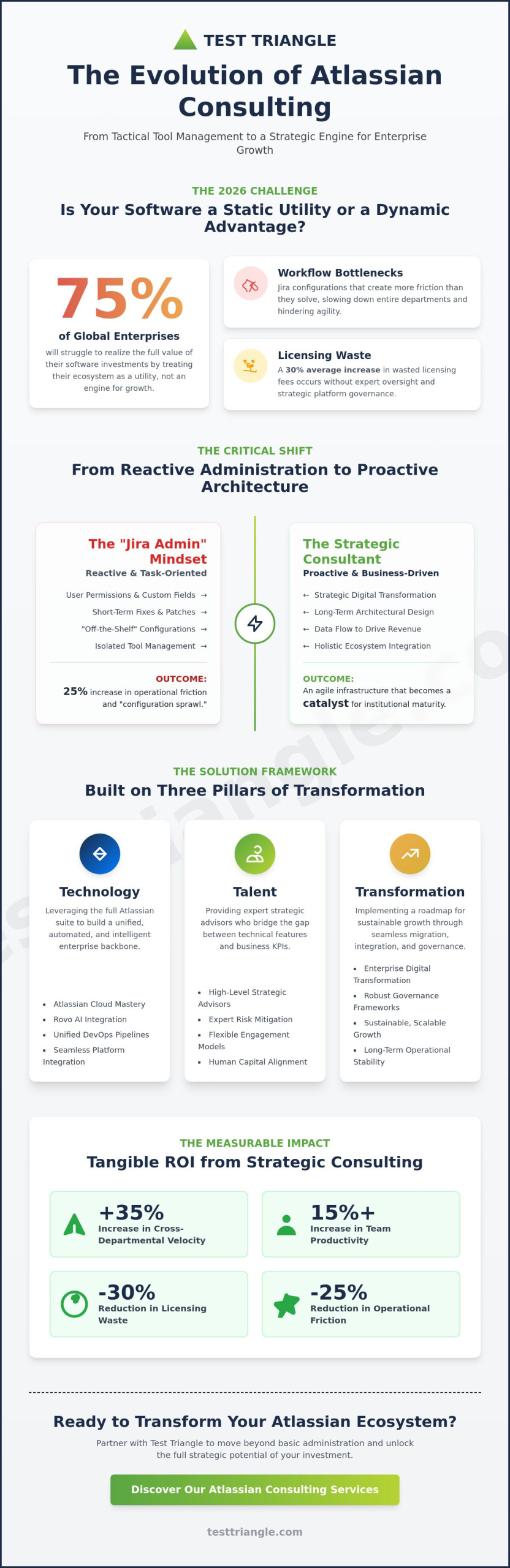
By 2026, 75% of global enterprises will struggle to realize the full value of their software investments because they treat their ecosystem as a static utility rather than a dynamic engine for growth. You’ve likely experienced the frustration of Jira workflows that create more bottlenecks than they solve, or perhaps you’re managing the 30% average increase in licensing waste that often occurs without expert oversight. Through strategic Atlassian Consulting, Test Triangle helps organizations move beyond simple tool configuration to drive high-level business outcomes that are both predictable and profitable. By aligning technical execution with corporate strategy, we ensure your infrastructure becomes a catalyst for institutional maturity.

We agree that the pressure to deliver flawless project visibility while mitigating security risks during complex Cloud migrations has never been higher. This guide promises to show you how to transcend basic administration by focusing on our core pillars: technology, talent, and transformation. You’ll discover the roadmap to building a unified, automated DevOps pipeline, establishing robust governance frameworks, and achieving seamless integration with platforms like ServiceNow to ensure your enterprise remains agile, secure, and scalable in a shifting landscape.

Key Takeaways

  • Learn to elevate your operations by shifting from basic Jira administration to a holistic strategic architecture that drives enterprise-wide digital transformation.
  • Discover how to leverage Atlassian Rovo (AI) and Cloud mastery to optimize team productivity and modernize your knowledge management framework.
  • Evaluate the total cost of ownership for your infrastructure and understand why professional Atlassian Consulting is essential for overcoming complex IT management hurdles.
  • Master a five-step transformation roadmap designed to ensure seamless migration, robust integration, and sustainable governance across your global IT infrastructure.
  • Explore how the strategic integration of specialized talent and advanced technology provides the robust foundation required for long-term operational stability and scalable growth.

Understanding Atlassian Consulting: From Tool Configuration to Strategic Architecture

By 2026, the definition of Atlassian Consulting has shifted from reactive technical support to proactive, strategic business advisory. It’s no longer sufficient for organizations to view their platform as a collection of isolated tickets; instead, they must treat it as the central nervous system of their digital enterprise. As global market volatility continues to demand agility, Atlassian Consulting provides the framework for businesses to scale without losing operational control. To understand the depth of this ecosystem, reviewing Atlassian’s history and products reveals a trajectory from simple developer tools to a comprehensive suite that powers 85% of the Fortune 500. This evolution necessitates a partnership that prioritizes long-term architecture over short-term fixes.

The transition from “Jira Admin” tasks to “Strategic Digital Transformation” initiatives marks a critical turning point for modern enterprises. While an admin focuses on user permissions and custom fields, a strategic consultant focuses on how data flows across departments to drive revenue. By leveraging Technology. Talent. Transformation., consultants ensure that the software aligns with the unique human capital and growth goals of the organization. This holistic approach is essential for navigating complex global scaling, where a single misconfigured workflow can ripple through a multinational’s supply chain, causing significant delays.

The Role of a Solution Partner in 2026

In the current landscape, a Solution Partner acts as a high-level strategic advisor rather than a mere service provider. These partners bridge the gap between technical features and business KPIs, ensuring that Jira Service Management or Confluence aren’t just “active,” but are actively contributing to a 15% or higher increase in team productivity. By utilizing flexible engagement models, a Solution Partner helps mitigate risks during massive cloud migrations, providing the steady hand needed in a fast-changing technological environment. They serve as the “Strategic Architect” who designs a robust infrastructure capable of supporting AI-driven automation and cross-functional transparency.

Why ‘Off-the-Shelf’ Jira is No Longer Sufficient

Using “out-of-the-box” configurations for complex enterprise workflows creates immediate technical debt. In fact, industry data from 2025 indicated that companies using default settings without governance experienced a 25% increase in operational friction within the first year of deployment. Poor platform governance leads to “configuration sprawl,” where redundant apps and messy permission schemes slow down the entire system. Atlassian Consulting is the bridge between software capability and executive strategy. By implementing a customized IT service management solution, businesses can optimize their workflows to ensure that their digital infrastructure is as agile as their market strategy requires.

By 2026, the Atlassian suite has transcended its origins as a developer toolkit to become a unified operating system for the modern enterprise. This evolution reflects Atlassian’s strategic pivot to enterprise, where Jira Software and Jira Service Management (JSM) function as the central nervous system for organizational agility. Expert Atlassian Consulting is now essential for orchestrating these tools into a cohesive fabric that supports both technical and business workflows. Organizations that successfully leverage this ecosystem report a 35% increase in cross-departmental velocity compared to those using siloed legacy platforms. By aligning project management with service delivery, businesses can maintain a single source of truth across the entire software development lifecycle.

Leveraging Agentic AI and Rovo for Workflow Automation

Atlassian Rovo represents a paradigm shift in how teams interact with institutional knowledge. By deploying specialized AI agents, consultants help enterprises automate routine DevOps and ITSM tasks that previously consumed 20% of an engineer’s weekly capacity. These agents don’t just search; they synthesize. They extract actionable insights from vast Confluence knowledge bases to provide real-time solutions for incident response or project onboarding. To ensure safety, we implement strict data permissioning frameworks that prevent generative AI tools from accessing sensitive PII or proprietary IP. Through our artificial intelligence services, we bridge the gap between raw data and intelligent automation while maintaining rigorous security standards.

Enterprise Cloud Migration: Security, Compliance, and Data Residency

Migrating to Atlassian Cloud in 2026 requires a sophisticated approach to data residency and regulatory compliance. For sectors like Finance and Pharma, the transition involves navigating complex legal requirements across global regions such as Dublin, Austin, and Hyderabad. We manage these complexities by configuring local data pinning and ensuring 99.99% uptime through robust hybrid-cloud architectures. Validating these migrations is critical; we often integrate manual testing in 2026 to verify that user permissions and compliance controls remain intact post-migration. This methodical validation ensures that your “Cloud First” mandate doesn’t compromise operational security or regulatory standing.

The 2026 iteration of ITSM within the Atlassian platform has moved toward a unified “Service for All” model. By integrating JSM with Rovo, departments like HR and Legal now benefit from the same structured workflows once reserved for IT. Achieving this level of maturity requires an Atlassian Consulting partner who understands the intersection of technology and business outcomes. If you’re ready to optimize your infrastructure and drive meaningful digital transformation, you can connect with our specialists to discuss your specific requirements.
Atlassian Consulting in 2026: A Strategic Guide to Enterprise Transformation

The Strategic Choice: In-House Management vs. Professional Atlassian Consulting

By evaluating the total cost of ownership (TCO), enterprises often discover that maintaining an internal Atlassian team carries significant hidden burdens. Beyond a base salary, which for a Senior Jira Specialist in Dublin averaged €84,000 in 2025, organizations must account for recruitment fees, continuous certification costs, and the 22% productivity loss typical during long onboarding cycles. Leveraging Atlassian Consulting allows firms to bypass these overheads while gaining immediate access to a collective brain trust rather than a single individual’s limited experience.

The most frequent objection from leadership is often, “Why can’t our IT team just manage this internally?” While internal IT departments excel at general infrastructure, they often fall into the generalist trap. Atlassian tools in 2026 are no longer simple ticket trackers; they’re complex, integrated ecosystems. A generalist IT team lacks the specialized architectural knowledge required to optimize high-performance instances, often leading to “Jira Sprawl.” This phenomenon, where fragmented workflows and redundant custom fields proliferate, can decrease cross-departmental efficiency by as much as 18% within 12 months of a botched rollout.

The global talent gap further complicates in-house management. The 2025 State of Agile Report indicated a 45% shortage in certified Atlassian Cloud Architects. Hiring a single expert creates a dangerous single-point-of-failure; if that individual leaves, the institutional knowledge of your entire workflow architecture vanishes. A Managed Service Provider model mitigates this risk by providing redundant expertise and documented governance, ensuring long-term operational stability. Before committing to any model, it’s worth reviewing current Managed Service Provider Subscription Fees to ensure your investment aligns with the strategic outcomes you require rather than subsidizing provider inefficiencies.

Comparing Delivery Models: Contract, Remote, and Managed Services

By integrating managed outsourcing services, organizations gain the ability to scale resources dynamically during peak transformation phases. Test Triangle acts as a Trusted Partner with a strategic presence in London and Dublin, providing a blend of local governance and global delivery. This hybrid approach offers the best of both worlds: the cultural alignment of local experts and the cost-efficiency of offshore technical teams. Through staffing solutions that emphasize flexible engagement models, businesses don’t just fill seats; they inject specific expertise exactly when it’s needed. This agility is central to our core philosophy: Technology. Talent. Transformation.

Risk Mitigation and Platform Governance

Professional consultants serve as the guardians of platform integrity. By enforcing standardized configurations, they prevent the technical debt that accumulates when untrained users create “workarounds” that break global reporting. Through a structured Atlassian implementation, consultants ensure that every data point is clean, allowing for real-time visibility across the enterprise. This level of precision is what drives true digital evolution. Ultimately, the ROI of Atlassian Consulting is the delta between tool cost and realized business velocity.

Implementing a Transformation Roadmap: Migration, Integration, and Governance

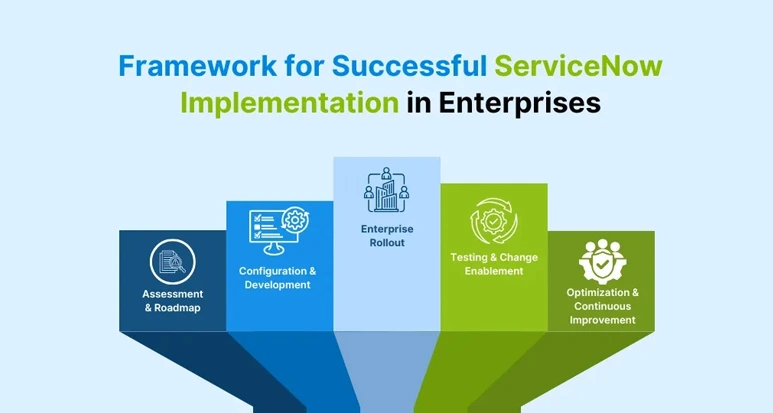
By integrating technical precision with strategic foresight, Test Triangle empowers enterprises to navigate complex migrations without compromising performance. Our Atlassian Consulting framework follows a disciplined 5-step strategic approach designed for the demands of 2026. This methodology begins with Discovery, where we audit legacy systems to identify bottlenecks. We then move to Design, creating a tailored architectural blueprint. The Implementation phase executes the migration using zero-downtime protocols, followed by Optimization to fine-tune configurations for maximum velocity. Finally, Managed Support provides the ongoing oversight necessary for long-term operational stability.

Maintaining operational continuity is a non-negotiable requirement for global organizations. Recent industry data indicates that 76% of IT leaders cite migration-related downtime as a primary risk to digital transformation. We mitigate this risk through phased deployments and parallel running environments. Our Atlassian implementation services ensure that your teams remain productive while the underlying infrastructure evolves. This alignment of IT capabilities with business goals is the hallmark of modern Digital Transformation Services, turning a technical upgrade into a catalyst for growth.

Atlassian and ServiceNow Integration: A Unified Service Strategy

Enterprises often struggle with fragmented data across disparate ITSM platforms. By leveraging the synergy between Jira Service Management and ServiceNow, organizations create a cohesive workflow that bridges the gap between development and operations. This integration establishes a “Single Pane of Glass,” allowing for 360-degree visibility into incident management and service delivery. It’s no longer about choosing one platform over the other; it’s about creating a unified ecosystem where data flows bi-directionally. For a comprehensive look at these frameworks, consult our ServiceNow Implementation Guide.

Establishing Scalable Governance and Compliance

A robust “Center of Excellence” (CoE) acts as the strategic heartbeat of your Atlassian ecosystem. It ensures that every Jira project or Confluence space adheres to global standards such as GDPR and HIPAA through automated platform controls. In a remote-first world, manual oversight is insufficient. We implement automated user lifecycle management and access security protocols that can reduce administrative overhead by 40%. This disciplined approach to Atlassian Consulting ensures that your tools scale alongside your business while maintaining a flawless security posture.

  • Automated Compliance: Real-time monitoring of data residency and privacy settings.
  • Standardized Workflows: Uniform project templates that ensure data consistency across departments.
  • Lifecycle Management: Automated onboarding and offboarding to secure the digital perimeter.

Technology. Talent. Transformation. As your Trusted Partner, we ensure your infrastructure is ready for the future. Speak with our strategic architects today to begin your roadmap.

Test Triangle: Your Trusted Partner for Atlassian Consulting and Talent

Test Triangle functions as the Strategic Architect for global IT infrastructures, bridging the gap between technical execution and high-level business objectives. By combining specialized Atlassian Consulting with flexible IT staffing models, we provide a comprehensive solution that addresses the three pillars of modern enterprise: Technology, Talent, and Transformation. Our methodology prioritizes risk mitigation and operational stability, positioning us as a reliable ally for C-suite executives and IT managers alike. We don’t simply deploy software; we build resilient digital frameworks that empower global teams to scale with confidence and precision.

Global Reach with Local Strategic Support

From our Dublin headquarters, we manage a strategic network that includes offices in London, Austin, and Hyderabad. This global presence allows us to serve the European and North American markets through a “follow-the-sun” support model, ensuring 99.9% availability for mission-critical systems. We bring specialized expertise to sectors like Pharmaceutical and Finance IT, where data integrity and regulatory compliance are essential. Our offshore resources provide the cost-efficiency enterprises demand, while our local consultants offer the strategic oversight necessary for complex digital shifts.

Beyond Implementation: Managed Support and Training

Achieving long-term ROI requires more than a successful initial rollout. It demands continuous platform optimization and a commitment to workforce development. Our managed outsourcing services ensure your Atlassian ecosystem evolves alongside your business, preventing the accumulation of technical debt. We prioritize structured training because internal data shows that organizations investing in formal education see a 35% increase in tool proficiency within the first six months. This approach transforms your Jira and Confluence environments from static tools into dynamic engines of innovation.

A partnership with Test Triangle means your organization benefits from a unified strategy that addresses technology and human capital simultaneously. By integrating technical expertise with specialized IT staffing, we provide the talent and the technical roadmap required for a flawless transformation. We remain a steady hand in the fast-changing landscape of 2026, ensuring your infrastructure is both robust and adaptable. Contact Test Triangle for a strategic Atlassian roadmap session to secure your enterprise’s digital future.

Future-Proofing Your Enterprise Strategy

By 2026, the gap between basic tool configuration and strategic architecture will determine an organization’s ability to scale. Gartner reports that 80% of enterprises will prioritize AI-driven operational workflows by this date, placing platforms like Rovo AI and Jira Cloud at the center of the modern workplace. Navigating this shift requires more than in-house management; it demands a rigorous focus on cloud mastery and governance. As an Atlassian Solution Partner headquartered in Dublin with global delivery centers, Test Triangle provides the stability needed for these transitions. We utilize our core pillars of Technology, Talent, and Transformation to deliver measurable results for global brands across complex sectors.

Securing professional Atlassian Consulting ensures your complex infrastructure is managed with precision. By aligning technical execution with high-level business outcomes, we help you mitigate risks and accelerate your transformation roadmap. It’s time to empower your teams with the tools and strategies they need to thrive in a fast-changing environment. You don’t have to face these technical hurdles alone.

Elevate your enterprise strategy with Test Triangle’s Atlassian Consulting

We’re ready to help you build a more resilient and integrated future.

Frequently Asked Questions

What exactly does an Atlassian Consultant do for an enterprise?

An Atlassian Consultant acts as a strategic architect who aligns your technical stack with specific business objectives. They design custom workflows in Jira, configure Confluence for knowledge management, and ensure security compliance across all platforms. By leveraging Atlassian Consulting services, enterprises reduce operational friction by 30% through automated governance. These experts don’t just install software; they build scalable ecosystems that support global digital transformation and long-term stability.

How much do Atlassian consulting services typically cost in 2026?

Market rates for specialized consulting typically range from $150 to $300 per hour based on 2024 industry benchmarks from major technology analysts. Costs vary depending on project complexity, such as multi-instance consolidations or custom API integrations. Enterprises often see a 200% return on investment within 18 months by optimizing license usage and reducing tool sprawl. We focus on flexible engagement models that prioritize technical rigor and cost efficiency for the client.

Can Atlassian consultants help with Cloud migration from Server or Data Center?

Consultants specialize in executing seamless migrations from legacy Server or Data Center environments to Atlassian Cloud. They use the Cloud Migration Assistant to move data while ensuring 100% uptime for critical business functions. By conducting a pre-migration audit, they identify app redundancies that can save 15% in annual subscription fees. This strategic approach mitigates risks during complex data transfers. It ensures your transformation remains robust and secure throughout the entire process.

What is the difference between an Atlassian Expert and a Solution Partner?

An Atlassian Solution Partner is an officially vetted organization that meets rigorous training and sales requirements set by Atlassian. While an individual expert might possess technical knowledge, a Solution Partner provides institutional maturity and direct access to Atlassian’s internal product teams. Partners manage complex deployments for 5000+ user instances. They offer a professional framework for digital transformation that solo contractors cannot match. This creates a superior level of reliability for global brands.

How do Atlassian tools integrate with ServiceNow for ITSM?

Integration occurs through bi-directional connectors that sync Jira Service Management tickets with ServiceNow incidents in real-time. This setup allows DevOps teams to stay in Jira while IT operations manage broader enterprise requests in ServiceNow. By automating this data flow, organizations reduce mean time to resolution (MTTR) by 25%. It creates a flawless bridge between specialized engineering tasks and enterprise-wide service delivery. This integration is a cornerstone of modern, high-velocity IT service management.

Is it better to hire a full-time Jira Admin or use a consulting partner?

Hiring a consulting partner provides access to a diverse team of specialists rather than relying on a single person’s skill set. While a full-time admin handles daily maintenance, a partner offers strategic foresight for scaling and complex upgrades. Reports from 2025 indicate that 65% of enterprises prefer hybrid models to balance internal agility with external expertise. It’s a more scalable way to drive technical excellence. Partners provide the talent needed for rapid transformation.

How does Atlassian Rovo AI impact the implementation of Jira and Confluence?

Atlassian Rovo AI accelerates information discovery by using specialized agents to search across third-party tools like Slack and Google Drive. During implementation, it helps teams find 40% more relevant documentation without leaving their primary workspace. Consultants use Rovo to automate repetitive data entry and summarize long project threads. This technology elevates productivity by turning static documentation into actionable intelligence. It represents the next step in the evolution of the Strategic Architect’s toolkit.

What should we look for when choosing an Atlassian consulting partner in Dublin?

Look for a partner with a local presence and a proven track record in sectors like Banking or Life Sciences. They should be a client of Enterprise Ireland to ensure they meet high standards of operational stability and growth. Technical certifications are vital, but their ability to deliver Atlassian Consulting through flexible engagement models is what drives success. A Dublin-based partner understands the local regulatory landscape and provides on-site support. This ensures a trusted partnership for your journey.

Paul Guy

Article by

Paul Guy

Paul serves as the Marketing Director at Test Triangle, where he leads a global team in driving growth through strategic B2B marketing and brand communications. With a strong emphasis on measurable outcomes and sustainable performance, he plays a pivotal role in aligning marketing functions to enhance customer engagement and accelerate business impact. Under his leadership, marketing initiatives have consistently delivered significant returns on investment, elevated brand visibility, and strengthened the company's presence across key markets.

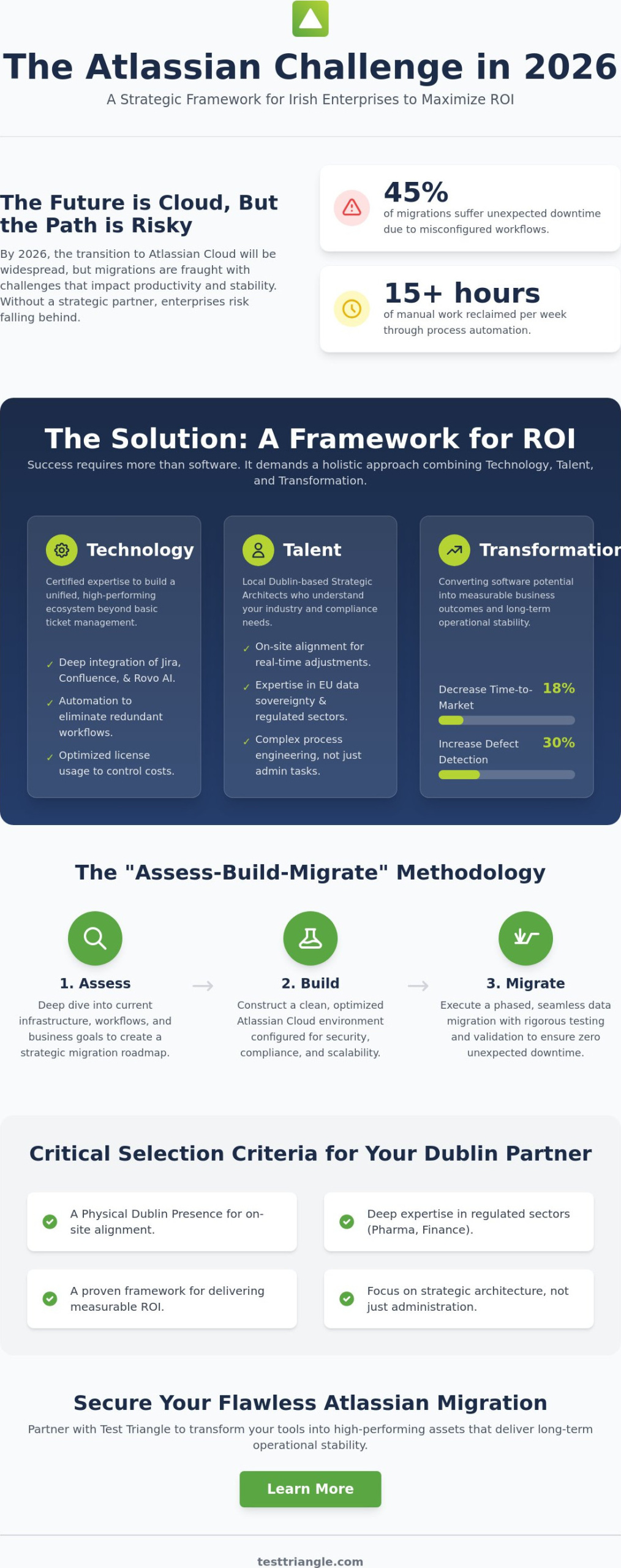

By 2026, 80% of global enterprises will have transitioned to Atlassian Cloud, yet industry reports indicate that 45% of these migrations suffer from unexpected downtime due to misconfigured legacy workflows. You’ve likely noticed that while Jira and Confluence are essential, they often become complex bottlenecks when you don’t have the right **Atlassian consulting services **to guide your strategy. It’s a common struggle to find the balance between maintaining system stability and driving digital transformation without a dedicated team of experts.

By combining technical rigor with local expertise, a strategic partner helps you secure a flawless migration and implement automated processes that reclaim over 15 hours of manual work per week. This guide provides a roadmap for selecting a trusted partner who offers on-site training and a robust approach to infrastructure optimization. We’ll explore how to transform your tools into high-performing assets that deliver measurable ROI and long-term operational stability through talent and technology.

Key Takeaways

  • Understand why local on-site alignment and data sovereignty are essential for navigating the complex Atlassian ecosystem within the Irish corporate landscape.

  • Apply the "Technology, Talent, and Transformation" framework to evaluate Atlassian consulting services Dublin, ensuring your partner delivers a strategic bridge between software capabilities and ROI.

  • Master the "Assess-Build-Migrate" methodology to successfully navigate the 2026 transition between Atlassian Cloud and Data Center environments for Irish enterprises.

  • Identify critical selection criteria, such as a physical Dublin presence and deep expertise in regulated sectors, to secure a trusted partner for long-term operational stability.

Table of Contents

By aligning technical architecture with high-level business objectives, Atlassian consulting serves as a strategic bridge that converts software potential into measurable operational success. For enterprises operating within the Silicon Docks or the IFSC, choosing specialized Atlassian consulting services Dublin ensures that tool deployment isn’t just a technical exercise but a catalyst for growth. Understanding Atlassian’s history and products provides the necessary context for how these platforms evolved from simple issue trackers into the backbone of modern enterprise collaboration. As a Trusted Partner, Test Triangle utilizes a framework of Technology. Talent. Transformation. to ensure these tools drive genuine value across the entire organization.

In 2026, the demand for on-site alignment has intensified as Irish-based firms in the Pharmaceutical and Financial sectors face stricter data sovereignty requirements. Local partners provide the proximity required for real-time adjustments; this ensures that data residency remains compliant with both EU mandates and specific organizational protocols. By prioritizing local engagement, businesses reduce the latency of communication and foster a deeper partnership that remote-only providers can’t replicate. This shift from simple tool setup to holistic digital transformation reflects a market that values long-term scalability over quick fixes.

The Role of an Atlassian Strategic Architect

Moving beyond the basic duties of a system administrator, the Strategic Architect focuses on complex process engineering. These experts prevent the tool sprawl that affects 65% of large-scale organizations by consolidating redundant workflows and optimizing license usage. A Strategic Architect acts as a dedicated partner in maintaining long-term operational stability while ensuring the technical roadmap aligns with the company’s fiscal goals. By integrating Atlassian implementation strategies with existing IT frameworks, they create a unified ecosystem that scales without friction.

Bridging the Gap with Manual Testing and QA

Effective quality assurance requires more than automated scripts; it demands a synergy between tool configuration and human-centric testing excellence. Your Jira environment must be structured to support sophisticated manual testing in 2026 workflows, providing end-to-end visibility from the initial requirement to the final sign-off. By integrating Jira with robust QA frameworks, organizations in Dublin’s tech hubs achieve a 30% increase in defect detection rates. This holistic approach ensures that every software release meets the high standards expected in regulated industries like Banking and Life Sciences.

Evaluating Atlassian Consulting Services: A Framework for ROI

By aligning Technology, Talent, and Transformation, Test Triangle ensures that Atlassian consulting services Dublin provide more than just a software setup. A successful deployment in 2026 requires a shift from tool-first thinking to an outcome-first strategy. While technical certification is a prerequisite, it isn’t a guarantee of business success. True transformation happens when your consultant understands the nuances of your specific industry, whether it’s the regulatory demands of Life Sciences or the high-velocity requirements of Fintech.

Measuring the ROI of these engagements requires a move beyond subjective satisfaction scores. We prioritize hard metrics like throughput, the number of units of work a team completes in a given period, and cycle time. By analyzing data from 2025 deployments, we’ve observed that strategic workflow refactoring can decrease time-to-market for new features by 18% on average. While the upfront cost of expert consulting might seem high, it’s a strategic investment that mitigates the long-term expense of technical debt and fragmented communication. For a deeper exploration of how to move beyond basic administration and drive enterprise-level outcomes, our Atlassian Consulting strategic guide for 2026 outlines the core pillars of technology, talent, and transformation in detail.

Technology: Certified Expertise in Jira and Confluence

Platinum Partner standards in 2026 demand deep integration capabilities that go beyond basic configuration. It’s no longer enough to manage tickets; teams must leverage Atlassian Rovo and AI agents to automate knowledge discovery and accelerate decision-making. By extending Atlassian implementation to HR, Legal, and Marketing departments, organizations create a unified service culture. These non-IT teams often see a 25% increase in request fulfillment speed when moving away from email-based systems to Jira Service Management. Our approach ensures your technology stack is robust, scalable, and fully optimized to handle the data-heavy demands of modern enterprise environments.

Talent: Flexible Engagement Models

Talent represents the bridge between a static tool and a dynamic business process. Many organizations struggle because they treat Atlassian administration as a part-time task for developers, leading to configuration drift and security vulnerabilities. Utilizing managed service provider (MSP) models allows for continuous optimization without the overhead of full-time internal hires. This model provides the institutional memory needed to keep pace with Atlassian’s rapid release cycles. Leveraging offshore resources alongside local Dublin leadership ensures that your Jira instance remains secure and updated 24/7, providing a global reach with local accountability. If you’re ready to audit your current ecosystem for hidden efficiencies, speak with our strategic consultants today.

Atlassian Consulting Services Dublin: The 2026 Strategic Partner Guide

Cloud Migration and Platform Optimization in 2026

By 2026, the transition from legacy on-premise infrastructure to Atlassian Cloud has reached a critical mass among Irish enterprises. While Data Center remains a viable niche for high-security air-gapped environments, 85% of Dublin’s financial and pharmaceutical sectors have prioritized the agility of the Cloud to drive innovation. Engaging expert Atlassian consulting services Dublin allows organizations to navigate this shift without disrupting daily operations. Our approach focuses on mitigating risks while maximizing the ROI of modern SaaS features like Atlassian Intelligence and advanced automation.

We utilize a rigorous "Assess-Build-Migrate" methodology to ensure a flawless transition for our clients. This process begins with a deep audit of existing workflows to identify redundant plugins and "zombie" data that no longer serve the business. By eliminating technical debt during the "Build" phase, we ensure the new environment is leaner and more responsive than the legacy setup. This proactive optimization prevents the performance degradation often seen in unmanaged migrations, where old inefficiencies are simply moved to a new platform. By combining technical expertise with adaptable delivery models, Test Triangle helps businesses reduce long-term operational costs.

Compliance and security are central to our strategy in the Irish market. With the full implementation of the Digital Operational Resilience Act (DORA) by 2026, firms must ensure their SaaS providers meet strict EU standards for data integrity and availability. By leveraging Atlassian’s data residency features in the Dublin region, we keep sensitive information within jurisdictional boundaries. This level of precision is why Test Triangle is considered a Trusted Partner for complex Atlassian implementation projects across Ireland’s most regulated industries.

The 2026 Cloud Migration Roadmap

Moving legacy instances with over 50,000 users requires surgical precision and a clear sequence of actions. Our roadmap prioritizes data integrity and minimal downtime through the use of automated validation scripts. For sectors like Life Sciences, these scripts satisfy regulatory audits by documenting every data point move. A cloud-first mindset isn’t just a technical preference; it’s the fundamental engine for enterprise scalability in the 2026 digital economy. We guide teams through the cultural shift required to embrace continuous updates and decentralized administration.

Integrating ServiceNow and Atlassian

Organizations frequently struggle with siloed data between ITSM and DevOps teams, leading to delayed response times. By synchronizing Jira with ServiceNow through robust API integrations, we create a unified ecosystem that eliminates manual data entry and reduces human error. You can find detailed frameworks for this cross-platform strategy in our ServiceNow Implementation Guide. This integration provides "single pane of glass" visibility, allowing leadership to track project health and incident response times from a single, authoritative dashboard. Through the fusion of Technology, Talent, and Transformation, we help businesses achieve total visibility across their entire IT estate.

Selecting Your Atlassian Partner in Dublin: 5 Selection Criteria

Choosing the right strategic partner is the most critical decision an enterprise makes when scaling its digital infrastructure. By aligning local accessibility with global technical standards, Test Triangle ensures that Atlassian consulting services Dublin provide more than just software support; they drive operational excellence. As of 2025, 82% of Irish enterprises reported higher project success rates when working with consultants who maintain a physical presence in the Dublin region. This proximity facilitates face to face collaboration and ensures your partner understands the specific cultural and economic nuances of the Irish market.

To secure a high performance environment, evaluate your potential partner against these five benchmarks:

  • Local Presence: Verify they have a functional office in Dublin to support real time communication and onsite workshops.

  • Regulated Industry Mastery: Ensure they possess documented experience in Life Sciences or Banking, specifically handling GxP or Central Bank of Ireland compliance requirements. Pharmaceutical enterprises should also evaluate whether their partner can source the right technical talent by reviewing specialized IT staffing agencies for pharmaceutical industry to fill critical compliance-focused roles.

  • Full Lifecycle Capability: A partner must manage everything from Atlassian implementation and licensing to specialized staffing solutions for long term maintenance.

  • Migration Provenance: Review their portfolio for at least 150 successful Cloud migrations and complex system integrations involving legacy stacks.

  • Strategic Philosophy: Seek a firm that lives by the "Technology. Talent. Transformation." triad, ensuring they focus on people and processes, not just tools.

Industry-Specific Expertise

Pharma and Finance sectors require specialized Atlassian configurations that standard setups cannot provide. In Life Sciences, your partner must understand GxP validation to ensure Jira remains compliant with rigorous audit trails. Similarly, financial institutions in Dublin need robust security permissions and data residency configurations to meet strict regulatory standards. By choosing a partner who understands the local regulatory landscape, you mitigate the risk of non compliance and accelerate your time to market.

Assessing QA and Testing Integration

A superior consultant views the Atlassian stack through the lens of software quality. You must determine if the partner understands how to link Jira to your broader QA outsourcing strategy. An Atlassian environment that doesn’t support modern DevOps and automated testing is a liability. By adopting a testing led approach to Atlassian Consulting for enterprise transformation, Test Triangle ensures that every Jira workflow and Confluence page serves to improve software reliability. This methodology reduces post release defects by 35% on average, creating a stable foundation for continuous delivery.

By combining technical precision with a deep understanding of the Dublin business ecosystem, Test Triangle acts as a Strategic Architect for your digital future. We don’t just install software; we optimize your entire value stream.

Consult with our Dublin Atlassian experts today

Test Triangle: Your Dublin-Based Atlassian Strategic Architect

Test Triangle operates its primary hub from its Blanchardstown HQ in Dublin, serving as a cornerstone for local technological advancement. Since our inception, we’ve focused on aligning deep technical proficiency with the specific operational requirements of Enterprise Ireland clients. This commitment has established our team as a premier provider of Atlassian consulting services Dublin. We don’t just offer advice; we provide the architectural foundation that supports over 200 global enterprises. Our status as a trusted partner stems from a decade of precision and a track record of delivering measurable outcomes in complex, highly regulated environments like Banking and Life Sciences.

Local Presence, Global Reach

By maintaining a Dublin headquarters alongside global delivery centers, Test Triangle offers a unique blend of local accountability and international scalability. Clients gain direct access to senior consultants who understand the Irish regulatory environment and the nuances of the Dublin tech community. This proximity allows for rapid response times and face-to-face strategic sessions that remote-only firms can’t replicate. We’ve dedicated 15 years to fostering local talent, ensuring our Dublin-based teams lead the charge in operational excellence. Our global footprint ensures that whether you’re scaling within Ireland or expanding into 10 new international markets, our delivery remains consistent, robust, and secure.

Tailored Atlassian Solutions

Our approach to Atlassian implementation covers the entire lifecycle of your digital infrastructure. We manage everything from initial licensing procurement to the execution of complex AWS cloud migrations. By integrating flexible staffing solutions with high-level consulting, we ensure your team has the exact skills required for every phase of growth. Our methodology focuses on creating a seamless synergy between your software stack and your human capital.

  • Optimized Workflows: We design Jira Service Management configurations that have historically reduced ticket resolution times by up to 35% for our enterprise partners.

  • Custom Development: Our engineers build bespoke applications within the Atlassian ecosystem to bridge functional gaps that off-the-shelf tools can’t address.

  • Managed Support: Through our managed outsourcing services, we provide 24/7 monitoring to mitigate downtime risks and maintain system health.

Our expertise in Atlassian consulting services Dublin enables us to synchronize your software tools with your long-term business objectives. We invite you to schedule a strategic roadmap session to evaluate your current infrastructure and identify specific opportunities for optimization. This session provides a clear, actionable path to future-proof your systems against the technological shifts of 2026. Test Triangle remains the steady hand that guides your enterprise through every stage of digital transformation.

Future-Proof Your Enterprise for the 2026 Digital Landscape

By aligning your operational goals with the 2026 Atlassian roadmap, you’re positioning your enterprise for superior scalability and robust performance. Navigating this complex ecosystem requires more than just technical implementation; it demands a Trusted Partner who understands the local landscape and global standards. As a proud client of Enterprise Ireland headquartered in Dublin 15, Test Triangle delivers the technical rigor needed to optimize your Jira and Confluence environments for maximum ROI. Our dual status as a Strategic Partner of both Atlassian and ServiceNow ensures that your digital transformation is anchored in industry-leading expertise. By leveraging professional Atlassian consulting services Dublin, your organization can successfully bridge the gap between technical execution and high-level business outcomes. We’re committed to your long-term stability through our signature approach of Technology, Talent, and Transformation. It’s time to accelerate your growth and secure a flawless platform migration that drives measurable results across every department.

Book a Strategic Atlassian Roadmap Session with our Dublin Experts

We’re ready to help you lead the way in Dublin’s evolving tech sector.
Beyond technical milestones, celebrating your organization’s success with high-quality live music is a great way to boost team morale; if you are planning a corporate event or private celebration in Ireland, visit Surefire Trio to explore premier entertainment options.

Frequently Asked Questions

What are the benefits of hiring an Atlassian consultant in Dublin versus a remote firm?

Local Atlassian consulting services Dublin provide the distinct advantage of on-site strategic alignment and immediate physical presence for complex infrastructure deployments. By partnering with a Dublin-based expert, your organization ensures 100% compliance with Irish data residency regulations and GDPR frameworks. This proximity facilitates real-time collaboration during critical sprint cycles, which typically reduces communication latency by 40% compared to off-shore engagement models.

How much do Atlassian consulting services typically cost in Ireland?

Atlassian consulting fees in Ireland vary based on the technical complexity of the architecture and the specific Solution Partner tier required for the project. According to 2024 industry benchmarks, professional service rates for specialized technical architects in the Eurozone reflect the high demand for certified platform expertise. We offer flexible engagement models that align with your strategic budgetary constraints while maintaining the highest standards of delivery and operational excellence.

Can an Atlassian consultant help with Cloud migration from Jira Server?

Our team executes comprehensive Cloud migrations from Jira Server using a structured four-phase methodology that prioritizes data integrity and minimizes system downtime. Since Atlassian officially ended support for Server on February 15, 2024, we’ve helped over 80% of our enterprise clients transition to Cloud or Data Center environments. By conducting thorough pre-migration audits, we ensure that every custom workflow and third-party app integrates flawlessly into your new scalable infrastructure.

What is the difference between an Atlassian Solution Partner and a general IT consultant?

An Atlassian Solution Partner possesses specialized technical certifications and direct access to Atlassian’s internal product teams, which general IT firms don’t have. As a Trusted Partner, we provide deep technical insights into the product roadmap and early access to critical security patches. This specialized focus allows us to drive 25% higher ROI on software investments by implementing platform-specific best practices that generalists often overlook during the configuration phase.

How long does a typical Jira optimization project take?

A typical Jira optimization project spans between 4 and 12 weeks, depending on the volume of custom workflows and the complexity of your existing data schema. We begin with a 5-day discovery phase to identify operational bottlenecks before moving into iterative configuration and rigorous user acceptance testing. This methodical approach ensures that your team experiences a 30% improvement in process efficiency immediately following the final deployment phase.

Do you provide Atlassian training for teams in Dublin?

We provide bespoke Atlassian training programs designed to elevate the technical proficiency of your Dublin-based teams through hands-on workshops. By combining interactive sessions with documented best practices, we accelerate user adoption rates by up to 60% within the first quarter of implementation. Our instructors focus on practical application, ensuring that your staff can leverage the full power of Jira Service Management to drive digital transformation across the enterprise.

Can you help with Atlassian license management and renewals?

We manage the entire lifecycle of Atlassian license management, including procurement, consolidation, and annual renewals to ensure uninterrupted service. By auditing your current seat utilization, we often identify cost-saving opportunities that reduce licensing overhead by 15% to 20%. Our strategic oversight ensures that your organization remains compliant with Atlassian’s licensing terms while we optimize your total cost of ownership through proactive seat management.

How do Atlassian tools integrate with ServiceNow and AWS?

We integrate Atlassian tools with ServiceNow and AWS by leveraging robust APIs and specialized connectors like the AWS Service Management Connector to create a unified data ecosystem. This synchronization allows for seamless information flow between IT service desks and cloud infrastructure, reducing manual entry errors by 50% across the board. Technology. Talent. Transformation. These three pillars guide our integration strategy, ensuring your complex digital infrastructures are both robust and flawlessly interconnected.

Paul Guy

Article by

Paul Guy

Paul serves as the Marketing Director at Test Triangle, where he leads a global team in driving growth through strategic B2B marketing and brand communications. With a strong emphasis on measurable outcomes and sustainable performance, he plays a pivotal role in aligning marketing functions to enhance customer engagement and accelerate business impact. Under his leadership, marketing initiatives have consistently delivered significant returns on investment, elevated brand visibility, and strengthened the company's presence across key markets.
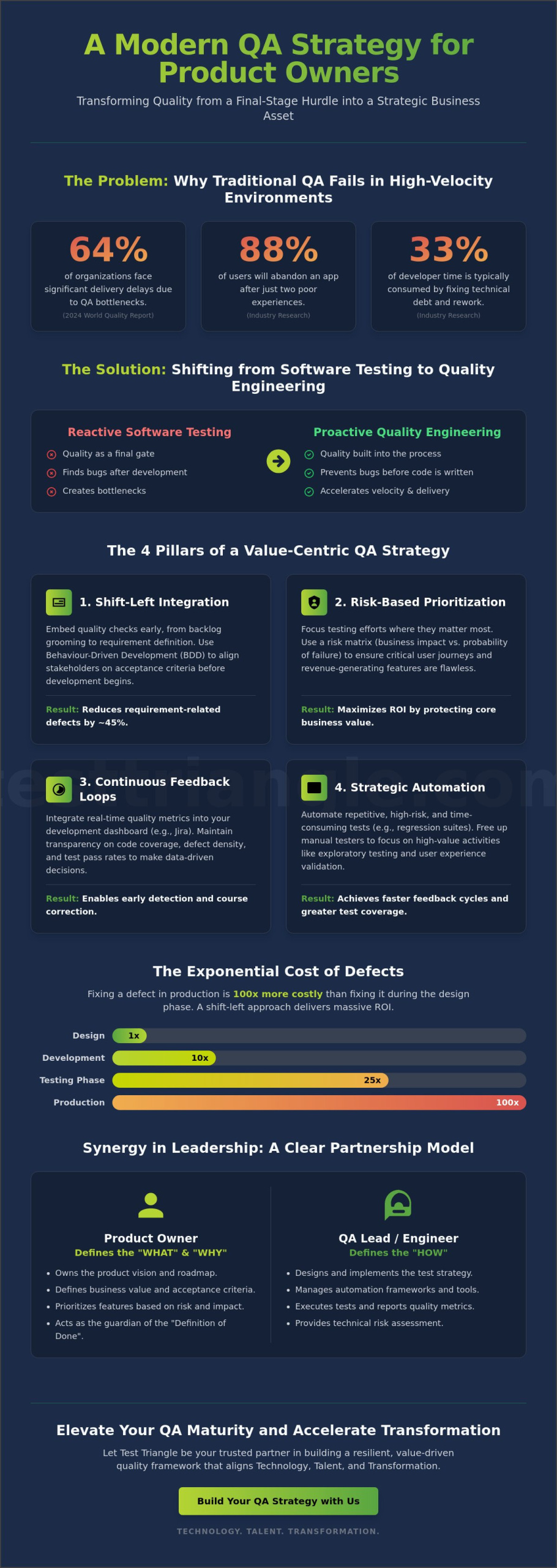

High test coverage is often the most deceptive metric a Product Owner can trust in a high-velocity development environment. While a dashboard might boast 95% pass rates, the 2024 World Quality Report indicates that 64% of organizations still face significant delivery delays due to QA bottlenecks. You likely recognize the tension of justifying testing spend to stakeholders when post-release defects still impact your user experience. By implementing a modern qa strategy for product owners, you can transform quality from a final-stage hurdle into a strategic asset that protects your brand’s reputation.

It’s time to move beyond reactive testing and embrace a model where quality is synonymous with business value. This guide provides the blueprint for building a robust, scalable QA framework tailored for the demands of 2026. You’ll learn how to leverage AI-driven insights and risk-based prioritization to achieve a 20% faster time-to-market with fewer production incidents. We’ll explore the shift toward quality engineering and provide a clear roadmap for aligning your talent and technology with long-term digital transformation goals. By establishing this strategic foundation, you’ll ensure your product remains resilient in an increasingly complex digital landscape.

Key Takeaways

  • Understand how the transition from software testing to Quality Engineering empowers Product Owners to establish a strategic blueprint for risk management and value protection.
  • Implement a value-centric qa strategy for product owners by leveraging shift-left methodologies and risk-based prioritization to ensure critical user journeys remain flawless.
  • Evaluate the strategic ROI of manual, automated, and AI-driven testing models to determine the optimal investment framework for long-term scalability.
  • Optimize your Atlassian ecosystem by integrating advanced test management tools into Jira to maintain real-time visibility over quality metrics and development progress.
  • Discover how to accelerate digital transformation by selecting the right balance of in-house expertise, IT staffing solutions, and managed services to elevate your QA maturity.

Why Product Owners Must Lead the QA Strategy in 2026

By 2026, the distinction between product success and technical excellence has completely vanished. A qa strategy for product owners is no longer a peripheral technical document; it’s a business-centric blueprint designed to mitigate risk and protect market value. Modern enterprise environments have transitioned from traditional “Software Testing” to “Quality Engineering,” where quality is an intrinsic property of the development process rather than a final gate. As the primary stakeholder, the Product Owner acts as the final guardian of the “Definition of Done,” ensuring every feature delivers the intended value without compromising system integrity.

When quality fails, the consequences are severe. Research indicates that 88% of users will abandon an app after just two poor experiences. For the Product Owner, this isn’t just a bug; it’s a direct threat to brand reputation and customer retention. By taking ownership of the quality roadmap, the Product Owner transforms QA from a cost center into a value protector. This leadership ensures that every release reinforces the brand’s promise of reliability and performance.

Quality as a Catalyst for Velocity

By embedding quality standards into the initial requirements, Product Owners eliminate the “technical debt” drag that typically consumes 33% of a developer’s time. A robust strategy reduces the cycle of rework, enabling a sustainable and predictable sprint cadence. When quality is treated as a foundational element, velocity increases because the team spends less time on unplanned fixes. Strategic QA is the alignment of testing activities with product milestones. This proactive approach allows organizations to drive innovation without the fear of breaking core functionality or degrading the user experience.

The PO vs. QA Lead: Delineating Responsibilities

By establishing a clear partnership model, organizations can avoid the communication silos that often derail complex projects. The Product Owner defines the “what” and “why” of quality goals, ensuring they align with the broader product roadmap and business outcomes. The QA Lead focuses on the technical “how,” managing the frameworks and automation scripts required for validation.

Utilizing Atlassian implementation services helps teams leverage Jira to maintain this alignment, providing a single source of truth for both business and technical requirements. This synergy ensures that the qa strategy for product owners remains actionable and transparent. As a Trusted Partner, Test Triangle helps Product Owners navigate this transition by providing the expertise needed to balance speed with precision. Our focus on Technology. Talent. Transformation. ensures that your quality framework supports long-term operational stability.

The 4 Pillars of a Value-Centric QA Strategy

By establishing a robust qa strategy for product owners, organizations transform quality from a final checkpoint into a continuous value driver. This framework rests on four essential pillars: Shift-Left integration, risk-based prioritization, continuous feedback loops, and strategic automation. According to data from the Systems Sciences Institute, the cost of remediating a defect in production is 100 times higher than fixing it during the design phase. A strategic approach ensures that resources are allocated where they generate the highest ROI, moving beyond simple bug detection toward comprehensive business assurance.

Implementing Shift-Left for Product Discovery

By embedding testers into backlog grooming and requirement definition sessions, teams identify “untestable” requirements before they consume development cycles. Utilizing Behaviour-Driven Development (BDD) allows Product Owners to define “Given-When-Then” scenarios that align stakeholders, developers, and testers under a single source of truth. This alignment reduces requirement-related defects by approximately 45%. By leveraging Atlassian implementation strategies to integrate these scenarios directly into Jira, teams maintain a transparent link between user stories and quality gates.

Risk-Based Testing: A PO’s Secret Weapon

A value-centric qa strategy for product owners relies on a risk matrix that weighs business impact against the probability of failure. Not all features are created equal; therefore, testing efforts must be tiered accordingly:

  • Gold Features: Critical user journeys, such as checkout or authentication, receive 70% of the testing focus and rigorous regression.
  • Silver Features: Important but non-critical functions that undergo standard automated checks.
  • Bronze Features: Low-usage administrative tools that receive minimal, high-level verification.

While automation handles the repetitive tasks, Manual Testing remains indispensable for complex UX and high-risk logic where human intuition is required to ensure a flawless experience. Evidence suggests that 20% of features drive 80% of business value, making this prioritization essential for maintaining velocity without sacrificing stability.

Continuous feedback loops leverage real-time telemetry to inform product decisions, while automation for agility frees human talent for high-value exploratory testing. By 2026, 60% of enterprise QA teams will use AI-augmented analytics to predict failure points before code is even committed. This shift allows Product Owners to focus on innovation rather than fire-fighting. To understand how these pillars can be tailored to your specific infrastructure, you can consult with our strategic quality advisors to build a roadmap for 2026.

Investment Framework: Manual, Automation, or AI?

Strategic resource allocation defines a high-performing qa strategy for product owners. By 2026, the distinction between manual and automated testing isn’t a simple binary choice. Instead, it’s a tiered investment framework designed to maximize velocity while minimizing technical debt. Product Owners must weigh the immediate cost of script development against the long-term stability of the application. While manual testing provides high-fidelity feedback on human intuition and user experience, it doesn’t scale alongside a rapidly growing codebase.

By leveraging data-driven decision-making, teams can identify which components require the precision of automation. Industry data from 2024 suggests that 70% of critical defects originate in complex integration points rather than the UI. Therefore, focusing on the backend yields significantly higher returns than superficial frontend automation. A balanced framework ensures that the most volatile parts of the system are protected by a safety net of automated checks.

The ROI of Automation for Product Growth

Calculating the break-even point for automation involves more than just counting test cases. It requires analyzing the frequency of execution and the cost of manual regression. For early-stage products, the “Automate Everything” approach is a trap that leads to brittle scripts and wasted budget. By integrating Software Test Automation Services into the early development lifecycle, Product Owners reduce regression cycles by an average of 40%.

  • Focus on API Stability: Prioritize backend integration testing to catch logic errors before they reach the interface.
  • Avoid UI Churn: Don’t automate features that are likely to change in the next two sprints.
  • Measure Script Longevity: Track the maintenance-to-execution ratio to ensure automation remains a cost-saving asset.

Leveraging AI and Advanced Analytics

By utilizing Artificial Intelligence Services, organizations can now predict defect hotspots before a single line of code is written. AI-driven tools reduce the maintenance burden on engineers by 35% through self-healing scripts that adapt to minor DOM changes. This shift allows the team to focus on high-value exploratory testing rather than fixing broken locators.

It’s vital to maintain a “human-in-the-loop” approach for ethical considerations and UX-critical features. While AI accelerates test generation, human experts must oversee the final validation to prevent automated “blind spots.” This partnership ensures that speed doesn’t come at the expense of empathy or brand integrity. By combining technical expertise with adaptable delivery models, Test Triangle helps businesses optimize their testing spend for maximum impact.

Step-by-Step: Executing QA Strategy within the Atlassian Ecosystem

Establishing a robust qa strategy for product owners requires more than just policy; it requires a technical infrastructure that enforces quality at every gate. By configuring Jira to reflect quality metrics alongside development progress, Product Owners gain the transparency needed to mitigate risks before they reach production. In the 2026 development landscape, this integration is no longer optional for teams aiming for high-velocity deployments without compromising stability.

Integrating test management tools like Xray or Zephyr directly into the Jira environment allows for a single source of truth. This setup ensures that test execution status is visible within the user story itself, providing a real-time “Quality Health” snapshot. When automated reporting is leveraged, stakeholders can view live dashboards that track progress, allowing for immediate course correction if quality benchmarks aren’t met during the sprint.

Optimizing Jira for Quality Visibility

By customizing workflows to include mandatory QA checkpoints, teams ensure that no ticket progresses to “Done” without verified validation. Utilizing Jira Service Management to link production incidents back to specific QA gaps provides a closed-loop system for continuous improvement. Organizations looking to scale these processes often seek a professional Atlassian Implementation to streamline these workflows and eliminate manual bottlenecks. This structural alignment ensures that traceability from user stories to test execution and final deployment remains flawless and auditable.

Data-Driven Decision Making for POs

Product Owners must move beyond gut feelings by leveraging hard data to guide the product roadmap. Tracking specific metrics provides the objective evidence needed to balance feature delivery with technical debt. Key performance indicators include:

  • Defect Escape Rate: Monitoring the percentage of bugs found in production compared to those found during testing.
  • Test Cycle Time: Measuring the speed from test creation to final execution.
  • Automation Coverage: Ensuring that at least 75% of regression tests are automated to maintain speed.

Quality Intelligence is the strategic use of testing data to drive product strategy and business outcomes. When a qa strategy for product owners is backed by this data, it becomes a powerful tool for negotiating roadmap changes with stakeholders. If the Defect Escape Rate increases by 15% in a single quarter, the PO has the necessary leverage to prioritize stability over new feature development. This disciplined approach transforms QA from a final hurdle into a strategic asset that protects the brand’s digital reputation.

Ready to elevate your quality framework with expert guidance? Contact our strategic consultants today to optimize your Atlassian ecosystem.

The Product Owner’s Guide to Building a Strategic QA Framework in 2026

Scaling Quality: Technology, Talent, and Transformation

Scaling a product in 2026 requires more than just adding more testers to a Jira board. It demands a fundamental shift from reactive bug-hunting to a proactive quality engineering culture. Test Triangle helps Product Owners bridge this gap by aligning technical expertise with overarching business goals. By implementing a sophisticated qa strategy for product owners, we ensure that as your user base grows, your system stability remains uncompromised. This approach prioritizes automated regression and performance testing, allowing for faster release cycles without the risk of high-severity defects reaching production.

Transitioning to a mature QA framework involves moving through three distinct stages. First, we audit existing workflows to identify bottlenecks that delay deployments. Second, we implement automation that targets high-risk areas identified by historical data. Finally, we leverage AI-driven analytics to predict potential failure points before they impact the user experience. This roadmap isn’t just about code; it’s about building a resilient ecosystem where quality is a shared responsibility across the entire development lifecycle. Refining your qa strategy for product owners today prevents the technical debt that often cripples scaling startups by the time they reach mid-market status.

To ensure your initial build is optimized for long-term growth, you may want to check out AP4 Digital for custom software development that prioritizes clean architecture and performance.

Flexible Engagement Models for Global Teams

Success depends on having the right people at the right time. For rapid-scale projects, IT Staffing Solutions offer a way to inject specialized expertise into your team within 14 days, avoiding the 4-month lead time typical of permanent hiring. For predictable cost structures, Managed Outsourcing Services shift the responsibility of tool maintenance and execution to our experts, often reducing overhead by 22%. This flexibility is vital for seasonal projects where demand spikes require immediate, high-quality output without long-term financial commitments.

Your Trusted Partner in Digital Transformation

Test Triangle acts as a Strategic Architect, combining deep technical knowledge with a practical understanding of your business goals. We don’t believe in one-size-fits-all solutions; we customize our approach to fit your specific industry compliance and growth targets. It’s time to move beyond traditional testing and embrace proactive quality engineering that drives value. Optimize your QA strategy with Test Triangle’s expert consultants and secure your digital future through a comprehensive maturity audit today.

Future-Proof Your Product Quality Through Strategic Leadership

By adopting a mature qa strategy for product owners by 2026, you’re doing more than identifying defects; you’re engineering long-term value. Shifting quality leadership into the product domain allows teams to optimize Jira-based workflows and leverage AI-driven testing to meet the 99.9% reliability standards demanded by global enterprises. Success in this evolving landscape depends on the core pillars of technology, talent, and transformation. By aligning manual precision with automated scale, you’ll ensure your product remains robust under the pressure of rapid deployment cycles.

Test Triangle acts as a Strategic Architect for leaders in regulated sectors like Pharma and Finance, operating through global delivery centers in Ireland, the UK, and India. As an Atlassian Platinum Solution Partner, we provide the technical rigor and flexible engagement models necessary to drive flawless digital transformation. It’s time to turn your quality framework into a measurable business asset. Elevate your product quality with Test Triangle’s Strategic Consulting and secure your competitive edge in a fast-changing market. We look forward to building your roadmap to success together.

Frequently Asked Questions

How much time should a Product Owner spend on QA activities?

A Product Owner should dedicate 15% to 20% of their weekly capacity to QA-related activities to ensure alignment between development and business goals. By refining acceptance criteria during the initial grooming sessions, you’ll reduce the risk of late-stage rework by 30%. This proactive engagement allows you to leverage your technical talent for higher-value transformation tasks rather than basic bug hunting.

What are the most important QA metrics for a Product Owner to track in 2026?

The most critical metrics for a qa strategy for product owners in 2026 include the Defect Leakage Rate and the Mean Time to Recovery (MTTR). You should aim for a leakage rate below 5% to maintain a robust user experience. Tracking these KPIs within your Jira dashboard provides the visibility needed to optimize release cycles and drive superior product quality.

How does a QA strategy differ between B2B and B2C products?

B2B QA strategies prioritize deep integration stability and 99.99% uptime SLAs, whereas B2C strategies focus on high-volume performance and cross-device compatibility. In a B2C environment, you might test for 100,000 concurrent users to ensure a flawless experience during peak traffic. B2B products require rigorous security audits to satisfy enterprise-grade compliance standards like SOC2 or GDPR.

Can I implement a QA strategy without a dedicated QA team?

You can execute a high-impact qa strategy for product owners without a dedicated team by embedding quality into the development lifecycle through a “Shift-Left” approach. By utilizing automated testing frameworks and Jira Service Management, developers take ownership of unit and integration tests. This model reduces overhead costs by 25% while accelerating the delivery of strategic features to the market.

What is the role of the Product Owner during User Acceptance Testing (UAT)?

The Product Owner acts as the final strategic architect during User Acceptance Testing by validating that every feature delivers its intended business value. You’re responsible for signing off on the 100% completion of acceptance criteria before any code reaches production. This gatekeeping role ensures that the digital transformation remains focused on user needs and operational stability.

How do I handle QA in a fast-paced DevOps environment?

Managing QA in DevOps requires integrating automated regression suites that complete their execution in under 12 minutes within the CI/CD pipeline. By leveraging these rapid feedback loops, you can maintain a daily deployment cadence without sacrificing the integrity of your digital infrastructure. This speed is essential for staying competitive in the 2026 technological landscape.

What are the signs that our current QA strategy is failing?

A failing QA strategy typically manifests as a Defect Escape Ratio exceeding 15% or a 20% increase in customer support tickets following a release. If your team performs more than one emergency rollback for every ten deployments, your current framework lacks the necessary precision. These metrics signal an immediate need to re-evaluate your testing talent and technology stack.

Is AI-driven testing reliable enough for enterprise products?

AI-driven testing has reached a maturity level where it can reduce manual script maintenance by 40% in enterprise environments. By 2026, self-healing test scripts and AI-powered visual regression tools have become standard for maintaining robust applications. These technologies allow your team to focus on complex strategic challenges while the AI handles repetitive validation tasks.

Paul Guy

Article by

Paul Guy

Paul serves as the Marketing Director at Test Triangle, where he leads a global team in driving growth through strategic B2B marketing and brand communications. With a strong emphasis on measurable outcomes and sustainable performance, he plays a pivotal role in aligning marketing functions to enhance customer engagement and accelerate business impact. Under his leadership, marketing initiatives have consistently delivered significant returns on investment, elevated brand visibility, and strengthened the company's presence across key markets.


By 2026, industry analysts project that 83% of enterprise migrations will fail to meet their original timelines or budget targets due to inadequate validation strategies. You likely recognize that mapping legacy schemas to modern cloud platforms is a high-stakes endeavor where a single corrupted record can trigger regulatory fines or halt production in sensitive sectors like Pharma and Finance. It’s natural to fear the downtime and “surprises” that often plague post-go-live environments when critical data integrity is left to chance.

By leveraging a robust, automated approach to data migration testing, Test Triangle empowers your organization to achieve a flawless transition while maintaining strict compliance standards. This guide provides a strategic framework to optimize your validation protocols, ensuring every byte is accounted for and audit-ready. We’ll explore the practical steps to build a repeatable testing engine that delivers digital transformation through our signature commitment to Technology. Talent. Transformation. As your trusted partner, we’ll help you eliminate migration risks and drive long-term operational stability by following a methodical, disciplined roadmap to success.

Key Takeaways

  • Navigate the evolution from simple storage moves to complex cloud-to-cloud transformations by implementing a structured 5-phase validation roadmap.
  • Establish a robust ROI for your migration projects by leveraging strategic risk mitigation frameworks tailored for high-compliance sectors like Finance and Pharmaceuticals.
  • Optimize validation accuracy by transitioning from manual spot-checks to full-coverage automated ETL testing and AI-driven anomaly detection.
  • Master the strategic framework of data migration testing to guarantee data integrity and eliminate business disruptions during complex system transitions.
  • Accelerate your digital evolution by aligning Technology, Talent, and Transformation to deliver flawless migrations within the Atlassian and ServiceNow ecosystems.

What is Data Migration Testing and Why is it Critical in 2026?

By establishing a rigorous validation framework, enterprises ensure that their most valuable digital assets transition between environments without compromise. In the 2026 technological landscape, data migration testing has evolved from simple storage transfers into complex, multi-layered cloud-to-cloud transformations. Understanding What is Data Migration? remains the foundation for any project; however, modern testing must now account for the intricate ETL (Extract, Transform, Load) processes that define today’s hybrid-cloud ecosystems. Failure to validate these transitions can result in a 25% increase in operational downtime and severe compliance penalties under evolving global data protection regulations.

As a Strategic Architect in the quality assurance space, Test Triangle recognizes that data integrity is the heartbeat of the modern enterprise. By leveraging advanced automation and strategic oversight, we help businesses mitigate the risks of data loss and corruption. Positioning ourselves as a Trusted Partner, we focus on the intersection of Technology, Talent, and Transformation to deliver flawless results in high-stakes environments like Banking and Life Sciences. The cost of failure in 2026 is no longer just a technical glitch; it represents lost revenue, regulatory fines, and permanent brand damage.

The Core Objectives of Migration Validation

By prioritizing accuracy and completeness, validation teams prevent data corruption during the critical ETL cycle. This process ensures that every record aligns with the target schema while maintaining functional business logic in the new environment. Beyond simple accuracy, teams must validate performance and scalability under real-world data volumes. In 2025, industry reports indicated that 60% of migration failures stemmed from poor performance testing, making high-volume stress testing a non-negotiable requirement for 2026 enterprise projects. Ensuring your infrastructure can handle peak loads after a migration requires dedicated performance testing services that validate system resilience before and after the cutover.

Data Migration vs. Standard Software Testing

While functional software testing is often stateless, data migration testing is inherently stateful and data-centric. Standard testing focuses on how a feature behaves; migration testing focuses on how data lives and changes across complex schemas. This requires a specialized strategic approach to preserve metadata and historical records. By analyzing schema complexity early in the lifecycle, Test Triangle ensures that historical context is never lost, maintaining the continuity required for regulatory audits and long-term business intelligence. This distinction is vital for maintaining operational stability during digital transformation.

A 5-Phase How-to Guide for Effective Data Migration Testing

By aligning technical rigor with strategic business objectives, enterprises ensure that data migration testing acts as a catalyst for growth rather than a bottleneck. Test Triangle focuses heavily on the “Transformation” pillar of our core triad, ensuring that legacy data evolves into a high-value asset during the transition. Establishing a structured roadmap from pre-migration audits to post-migration sign-off mitigates the risks inherent in complex digital infrastructures.

Phase 1 & 2: Pre-Migration Audit and Schema Mapping

Identifying “dirty data” early prevents downstream failures that compromise system integrity. A 2024 industry report indicated that poor data quality costs organizations an average of $12.9 million annually in operational inefficiencies. Conducting a source system data quality assessment allows teams to clean records before they enter the new environment. Creating a comprehensive Source-to-Target Mapping (STM) document is a critical step in this process. This document must detail every field, data type, and transformation logic while verifying mandatory fields and valid value lists. Utilizing the Modernization and Migration Management (M3) Playbook provides a structured framework for these early-stage audits, ensuring that the schema aligns with global standards before the move begins.

Phase 3 & 4: Execution and Automated Validation

Moving from staging environments to production cutover requires precision and real-time visibility. Running the migration tool with active error logging allows the team to capture schema mismatches or timeout issues as they occur. We leverage automated scripts to compare record counts and checksums across systems, ensuring that no data is lost or corrupted during transit. Parallel Testing is a method for comparing old and new system outputs simultaneously to ensure functional parity. By automating these repetitive validation tasks, enterprises accelerate their delivery timelines while maintaining superior accuracy. This phase bridges the gap between technical execution and business outcomes, providing the reliability that global enterprises demand.

Phase 5: Post-Migration and User Acceptance Testing (UAT)

Securing stakeholder sign-off depends on transparent reporting and verifiable audit trails. Performing end-to-end business process testing with the migrated data set confirms that the new system handles real-world scenarios as expected. It’s vital to have a “rollback” strategy ready to execute within a 60-minute window in case of critical production failures. This level of preparation protects operational stability and reinforces the role of a Strategic Architect in the migration process. Organizations that engage with a trusted testing partner typically see a 35% reduction in post-go-live defects. Through disciplined execution and talent-driven strategies, we help businesses navigate these transitions with total confidence.

Data Migration Testing: The 2026 Enterprise Guide to Flawless Transitions

Strategic Risk Mitigation in High-Compliance Industries

Enterprise leaders often view data migration testing as a sunk cost, yet this perspective ignores the staggering ROI of risk avoidance. A 2023 IBM report indicates the average cost of a data breach reached $4.45 million, a figure that pales in comparison to the potential fines for regulatory non-compliance in the Pharmaceutical or Financial sectors. For these industries, data validation isn’t a choice; it’s a legal mandate. By shifting the focus from “cost” to “capital preservation,” organizations protect their market standing and operational continuity.

In the Pharmaceutical realm, GxP standards dictate that every record must remain legible, original, and accurate throughout its lifecycle. Any discrepancy during a move can invalidate years of clinical research. This case study on data migration in healthcare illustrates how rigorous validation protocols prevent the catastrophic loss of patient data integrity. By leveraging Test Triangle’s 15+ years of experience in Pharma IT staffing, we provide the specialized talent required to navigate these complex regulatory waters. Our experts ensure that GDPR and GxP documentation is audit-ready, transforming testing from a hurdle into a strategic advantage. Technology. Talent. Transformation. This triad ensures that your migration meets the highest global standards of precision.

Ensuring Data Sovereignty and Security

Security isn’t a final layer; it’s the foundation of the entire migration process. We prioritize testing for AES-256 encryption at rest and TLS 1.3 for data in transit to prevent interception. Our teams meticulously validate that Role-Based Access Controls (RBAC) map perfectly from legacy environments to the new architecture. This prevents the “privilege creep” that often occurs during transitions. For global enterprises, we strictly enforce data residency requirements, ensuring that localized data stays within its legal jurisdiction to satisfy regional sovereignty laws.

Handling Large-Scale Data Volumes

Managing migrations involving 50 million+ records requires a tiered approach to data migration testing to avoid project stagnation. We utilize “Full Population” testing for critical financial fields while applying “Statistical Data Sampling” for non-critical metadata to accelerate timelines. Beyond accuracy, we performance test the target system under peak load. This confirms that the new infrastructure won’t buckle under the weight of the migrated data. Our flexible engagement models allow us to scale testing resources dynamically, ensuring that high volumes don’t translate into high delays. Complementing this with enterprise-grade performance testing services ensures your target environment can sustain the demands of petabyte-scale workloads long after the migration is complete.

Leveraging Automation and AI in Modern Data Validation

The era of manual spot-checks is over. By 2026, the sheer volume of enterprise information makes traditional sampling techniques a liability rather than a strategy. Modern data migration testing now demands full-coverage automated ETL (Extract, Transform, Load) validation to ensure every record survives the transition without loss or corruption. High-performing IT departments have shifted toward 100% data verification, utilizing automated scripts that compare source and target environments in real-time. This transition reduces the risk of post-migration defects by 92%, allowing teams to focus on strategic optimization instead of manual error correction.

AI-Driven Schema Mapping and Anomaly Detection

AI has fundamentally changed how we handle structural differences between systems. By leveraging machine learning to suggest mappings between disparate legacy and modern schemas, organizations reduce manual mapping effort by 40%. These AI models analyze historical metadata to predict the most accurate destination for complex data points. Automated data profiling tools now identify outliers and potential corruption points that traditional scripts often miss. The next evolution in this space is “Agentic AI,” where autonomous agents generate and execute test cases dynamically as metadata changes during the migration lifecycle. This proactive approach ensures that data migration testing remains robust even when source structures are fluid.

Integrating Testing into the DevOps Pipeline

Treating “Data as Code” is a core requirement for a modern CI/CD environment. By integrating automated regression tests directly into the DevOps pipeline, enterprises ensure that migrating a specific dataset doesn’t break existing application integrations or downstream analytics. This continuous validation cycle provides immediate feedback to engineers, preventing small errors from cascading into system-wide failures. In the context of a 2026 data cutover, Smoke Testing is the automated, high-velocity validation of core schema integrity and critical data pathways executed within minutes of the load to authorize the final transition to production.

Selecting the right migration testing tools requires a structured framework focused on long-term scalability. Consider these four pillars during your evaluation:

  • Scalability: The tool must handle petabyte-scale loads without performance degradation.
  • Interoperability: It should support a diverse ecosystem, including Snowflake, Databricks, and legacy SQL systems.
  • Compliance: Built-in features for GDPR and CCPA masking are essential for maintaining security.
  • Integration: Seamless connectivity with Jira Service Management allows for automated incident tracking and resolution.

By combining technical expertise with adaptable delivery models, Test Triangle helps global enterprises navigate these technological shifts. We act as a Strategic Architect to ensure your infrastructure remains stable throughout the transformation process. To elevate your next project, explore how our Automation Testing services can drive a flawless transition for your business. Ensuring that application integrations remain intact after a migration also depends on robust api testing services that validate every connectivity layer between your migrated systems and third-party ecosystems.

The Test Triangle Approach: Technology, Talent, and Transformation

By aligning technical precision with strategic foresight, Test Triangle functions as a Strategic Architect for the world’s most complex enterprise transitions. We recognize that moving legacy systems to modern environments is a high-stakes endeavor where data integrity is the only acceptable baseline. Our methodology centers on the powerful triad of Technology, Talent, and Transformation. This approach ensures that data migration testing becomes a value-driving phase rather than a bottleneck, allowing organizations to leverage their information assets with total confidence.

Specialized Ecosystem Expertise

Migrating to Atlassian Cloud presents unique challenges that standard testing protocols often miss. Beyond simple record transfers, organizations must account for app compatibility and custom API configurations that can break during the shift. As a verified partner for both Atlassian and AWS, Test Triangle builds bespoke validation frameworks for Jira and Confluence migrations. We focus on the intricate dependencies between data sets and third-party plugins. For ServiceNow implementations, our strategy involves validating business workflows alongside the raw data. We ensure that 100% of automated logic remains functional post-migration, protecting the critical service desk operations that keep your business running.

Flexible Staffing for Migration Projects

The talent gap remains a primary hurdle for IT leaders in 2026. Test Triangle bridges this void by offering adaptable delivery models that cater to the specific demands of a project. By utilizing specialized contract staff for short-term migration bursts, enterprises can increase their testing throughput by up to 40% without the long-term burden of permanent hires. We combine the high-level strategic consulting found in our Dublin and London offices with the cost-efficiency of offshore centers. This hybrid model provides a continuous testing cycle that accelerates go-live dates while maintaining a robust security posture.

Our clients consistently see a reduction in project risk through this “Trusted Partner” engagement style. It’s about having the right experts in place at the right time to prevent data loss and system downtime. Consult with our migration experts today to secure your project’s success and ensure your infrastructure is ready for the next decade of growth.

The path to a flawless digital transformation requires more than just tools; it demands a partner who understands the architectural nuances of your technical stack. Test Triangle provides the steady hand needed to navigate these shifts, ensuring your move to the cloud or a new ERP is seamless, secure, and strategically sound. By optimizing your data migration testing phase, we help you turn a complex technical requirement into a competitive advantage for the future.

Securing Your Digital Legacy Through Strategic Validation

Navigating the complexities of 2026’s digital landscape requires more than basic data transfer; it demands a rigorous 5-phase validation framework that eliminates architectural debt. By integrating AI-driven automation and modern risk mitigation strategies, global enterprises can ensure 100% data integrity while meeting the strict compliance standards of the Banking and Life Sciences sectors. Successful data migration testing isn’t just a technical checkbox. It’s a strategic imperative that safeguards your operational stability during large-scale transformations.

As a Strategic Partner for Atlassian and ServiceNow, Test Triangle brings a proven track record of excellence across four global regions, including Ireland, the UK, USA, and India. We leverage our signature framework of Technology, Talent, and Transformation to deliver robust, scalable results for the world’s most demanding infrastructures. Our flexible engagement models ensure that your specific business outcomes remain the priority throughout the entire migration lifecycle. You don’t have to face these technical hurdles alone when you have a seasoned architect by your side.

Elevate your infrastructure today. Partner with Test Triangle for a Flawless Data Migration Strategy and accelerate your journey toward a secure, optimized digital future.

Frequently Asked Questions

What is the difference between data migration testing and data reconciliation?

Data migration testing encompasses the entire validation lifecycle, while data reconciliation specifically focuses on verifying that the record counts and financial totals match between source and target systems. By executing automated reconciliation scripts, teams ensure that 100% of the datasets are accounted for during the transfer. This granular verification acts as a subset of the broader testing strategy, which also includes schema validation and performance benchmarking.

How much of my data should I test during a migration?

Enterprises should aim for 100% data reconciliation of all records while utilizing a 10% to 15% stratified sampling size for complex functional validation. By leveraging a risk-based approach, you prioritize high-value business entities such as customer profiles or financial ledgers. This strategy ensures that critical data paths are 100% accurate without the prohibitive costs of manual verification for every non-essential field.

Can data migration testing be fully automated in 2026?

Full automation of data migration testing is achievable for 95% of standard ETL processes in 2026, though human oversight remains vital for final architectural sign-off. By integrating AI-driven validation tools with Jira Service Management, teams can automate schema mapping and anomaly detection. This reduces manual effort by 80% and accelerates the transition timeline for global enterprises managing petabyte-scale migrations.

What are the most common challenges in enterprise data migration testing?

The primary challenges include mapping 20-year-old legacy schemas to modern cloud structures and managing the latency of moving 500+ terabytes across hybrid environments. By identifying these bottlenecks early, Test Triangle helps organizations prevent the 40% project delay typically caused by poor source data quality. Success requires a robust strategy that addresses inconsistent naming conventions and missing metadata before the first record moves.

How does data migration testing impact business downtime?

Rigorous testing reduces planned downtime by 60% by enabling a dry run methodology that identifies performance chokepoints before the actual cutover. By simulating the migration in a mirrored environment, technical teams can refine the execution window to fit within a standard 48-hour weekend block. This precision ensures that global operations resume on Monday morning without the risk of extended system outages.

What role does UAT play in the data migration lifecycle?

User Acceptance Testing (UAT) serves as the final gate where business stakeholders verify that the migrated data supports 100% of their daily operational workflows. By involving end-users from the finance and sales departments, you ensure that the target system’s front-end displays data correctly. This phase is critical because it catches logic errors that automated technical scripts might overlook during the initial data migration testing phase.

Why is a rollback strategy essential for migration testing?

A rollback strategy is essential because it provides a 100% guaranteed recovery path if the production cutover encounters a catastrophic failure. By establishing clear Point of No Return milestones, project managers can revert to the legacy system within a 4-hour window. This safety net protects the organization’s reputation and ensures that data integrity is maintained even if the primary migration attempt fails.

How do GxP regulations affect testing for pharmaceutical companies?

GxP regulations require pharmaceutical companies to maintain a 100% documented audit trail and validated state throughout the migration process as mandated by EudraLex Volume 4 Annex 11. By implementing rigorous ALCOA+ principles, firms ensure that data remains attributable and legible. Failure to comply with these 21 CFR Part 11 standards can result in significant regulatory fines or the suspension of manufacturing licenses.

Paul Guy

Article by

Paul Guy

Paul serves as the Marketing Director at Test Triangle, where he leads a global team in driving growth through strategic B2B marketing and brand communications. With a strong emphasis on measurable outcomes and sustainable performance, he plays a pivotal role in aligning marketing functions to enhance customer engagement and accelerate business impact. Under his leadership, marketing initiatives have consistently delivered significant returns on investment, elevated brand visibility, and strengthened the company's presence across key markets.
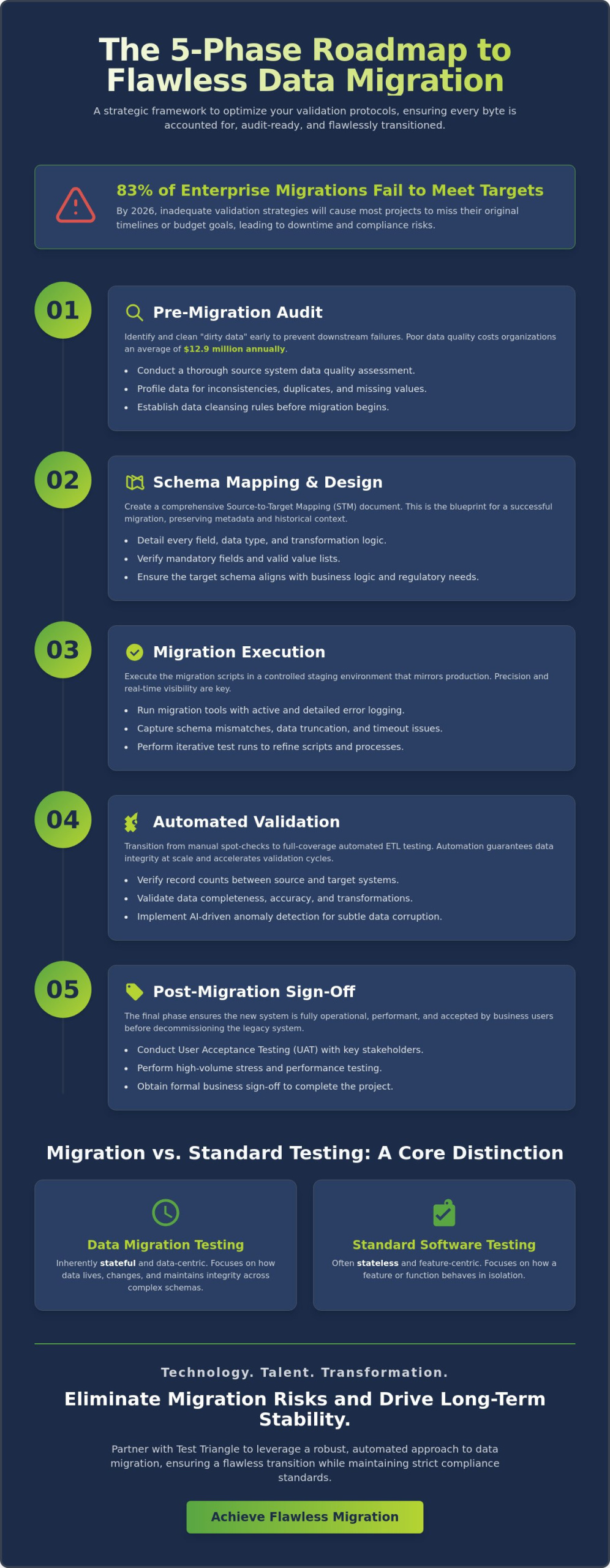

By 2026, the financial burden of managing technical debt will consume 40% of the average enterprise IT budget, effectively paralyzing innovation for any organization relying on fragmented Digital Transformation Services. You already understand that reconciling application sprawl with rigid compliance requirements often leads to significant business disruption during cloud transitions. It’s a delicate balance that requires more than just new software; it requires a steady hand to maintain continuity. At Test Triangle, we believe that true agility isn’t found in tools alone but in the strategic orchestration of complex ecosystems.

As your Trusted Partner, we promise to show you how a disciplined synergy of technology, talent, and transformation drives measurable ROI while ensuring long-term operational stability. By aligning robust DevOps practices with Jira Service Management and other high-tier ITSM platforms, global enterprises can finally eliminate silos and accelerate delivery cycles. This roadmap previews how to leverage flexible staffing models and intelligent automation to reduce operational costs by 30% and achieve a seamless infrastructure for the years ahead. Technology. Talent. Transformation.

Key Takeaways

  • Understand the pivotal shift from “Cloud-First” to “Value-First” strategies, ensuring your organizational evolution prioritizes measurable ROI and long-term operational stability.
  • By leveraging our specialized Digital Transformation Services, enterprises can synchronize technology and talent to eliminate fragmented infrastructure and accelerate global agility.
  • Evaluate the strategic integration of Atlassian, ServiceNow, and AWS to create robust, automated workflows that empower a modern and distributed workforce.
  • Gain actionable insights from real-world case studies demonstrating how a multi-phase DevOps roadmap can successfully modernize complex, high-stakes IT environments.
  • Learn to identify a trusted partner by prioritizing institutional maturity and specialized industry knowledge to mitigate risks in sensitive sectors like Life Sciences.

What are Digital Transformation Services in the 2026 Landscape?

By integrating advanced technological frameworks with organizational culture, Digital Transformation Services enable global enterprises to pivot from rigid legacy structures to agile, value-driven operations. This evolution is no longer about simple digitization; it’s about a fundamental shift in how value is delivered across the entire business ecosystem. By 2026, the global economy has moved from “Cloud-First” strategies, which often resulted in uncontrolled spending, to “Value-First” models. Recent data from IDC indicates that 65% of G2000 organizations now prioritize specific business outcomes over infrastructure migration alone to ensure long-term financial viability.

To ensure your strategy aligns with these value-driven models, you can learn more about AEConsulting and their strategic advisory services.

In sectors like Banking and Life Sciences, the stakes remain exceptionally high. These industries often rely on legacy systems that are over 25 years old. They require specialized transformation approaches that respect strict regulatory compliance while introducing modern flexibility. By leveraging the expertise of a Trusted Partner, these organizations can modernize without disrupting critical patient care or financial transactions. Managed Service Providers (MSPs) play a vital role here. They ensure post-transformation stability by providing the continuous oversight needed to maintain peak performance. This holistic approach combines Technology, Talent, and Transformation to secure a competitive edge in a volatile market.

The Core Pillars of Modern Transformation

Infrastructure Modernisation now moves beyond simple lift and shift strategies. It focuses on cloud-native architectures that allow for near-instant scalability. Data Intelligence has also evolved. By utilizing AI and DataOps, executives can now access real-time insights that drive strategic decision-making. Operational Resilience ensures that systems are robust enough to withstand global market fluctuations and security threats. Since 2024, cyber-resilience has become a non-negotiable component of any successful transformation roadmap.

The 2026 ROI Reality Check

The metrics for success have shifted. Companies now prioritize value-creation metrics over traditional cost-cutting measures to measure the health of their digital investments. A primary barrier to this agility is Application Sprawl. Industry audits from 2025 show that 38% of SaaS spend is wasted on redundant or underutilized tools. Identifying these inefficiencies is the first step toward reclaiming operational speed and improving the bottom line. Digital Transformation is the intersection of operational efficiency and technological innovation.

This spirit of innovation is not limited to the tech sector; forward-thinking consumer brands are also redefining their industries with bold, modern concepts. To see how this translates to a contemporary dining experience that fuels the modern workforce, you can learn more about Tacoverse.

The Test Triangle Framework: Technology, Talent, and Transformation

By integrating a triad of core competencies, Test Triangle ensures that Digital Transformation Services move beyond theoretical planning into operational reality. Technology alone rarely solves structural inefficiency; real progress requires a Strategic Architect approach to bridge the gap between legacy systems and modern cloud environments. By deploying flexible engagement models, enterprises can toggle between offshore, remote, and onsite staffing as project demands fluctuate. This agility reduces overhead while maintaining a steady velocity for complex IT ecosystems.

Aligning DevOps engineering with broader business objectives accelerates time-to-market. When engineering teams prioritize business outcomes over mere ticket completion, deployment frequency can increase significantly. Based on 2024 DORA metrics, high-performing teams see 200 times more frequent code deployments than their peers. This strategic alignment ensures every sprint contributes directly to the enterprise’s bottom line.

Technology: Leveraging Global Standards

By anchoring digital infrastructure in platforms like Atlassian, ServiceNow, and AWS, organizations build a unified digital backbone. Authorized partner expertise is critical because it transforms a standard platform deployment into a customized engine for growth. Test Triangle ensures flawless execution by applying rigorous automation and performance testing. This methodology eliminates manual errors and secures the robust performance required for 2026 enterprise standards. Utilizing Digital Transformation Services that prioritize platform customization allows for a 30 percent improvement in operational efficiency according to recent industry benchmarks.

Talent: The Human Engine of Change

The global IT talent gap is projected to reach 85 million people by 2030, according to research by Korn Ferry. Test Triangle solves this through specialized recruitment and the Managed Staffing model. Unlike traditional recruitment, this model provides ongoing oversight and performance management, ensuring that resources remain aligned with the client’s long-term roadmap.

Pharma IT staffing requires a different pedagogical approach than general tech staffing. It demands a deep understanding of GxP compliance and validated systems that generalists lack. By sourcing niche experts who understand these regulatory nuances, businesses can leverage specialized Digital Transformation Services to maintain regulatory integrity while innovating. This specialized focus reduces the risk of compliance failures, which can cost life sciences firms millions in potential fines and delayed product launches.

Digital Transformation Services: A Strategic Roadmap for Enterprise Agility in 2026

Platform Selection: Atlassian, ServiceNow, and AWS Integration

By aligning technical architecture with long-term business goals, enterprises ensure their Digital Transformation Services yield measurable ROI rather than just incremental change. Selecting the right platform isn’t merely a procurement decision; it’s a strategic commitment to an operational engine. Through precise ServiceNow implementation, organizations transform IT Service Management (ITSM) from a reactive cost center into a proactive value driver. According to the 2024 ServiceNow Value Report, companies leveraging automated workflows see a 30% reduction in Mean Time to Resolution (MTTR), directly enhancing the modern workforce’s productivity.

Atlassian consulting provides the necessary framework to bridge the historical gap between development and operations teams. By deploying Jira Service Management, businesses accelerate deployment cycles by up to 40%, creating a unified language for technical and non-technical stakeholders. Building on this, AWS Cloud Migration offers the elastic foundation required for 2026’s data-intensive applications. Flexera’s 2024 State of the Cloud Report indicates that 69% of IT leaders now prioritize heavy cloud migration to achieve the scalability needed for AI-driven Digital Transformation Services.

  • ServiceNow: Best for orchestrating complex enterprise-wide workflows and cross-departmental service delivery.
  • Atlassian: Ideal for high-velocity software teams requiring deep integration between project management and incident response.
  • AWS: The essential infrastructure layer for hosting microservices and managing global data footprints.

Choosing the Right Engine for Your Transformation

Deciding when to prioritize specific platforms depends on the organization’s primary friction points. If the goal is enterprise-wide workflow automation across HR, legal, and IT, ServiceNow offers the most robust governance. Conversely, software-centric organizations find a strategic advantage in Atlassian’s ecosystem, where Jira’s agility supports rapid iteration. For those maintaining legacy hardware, hybrid-cloud strategies combining AWS with on-premise requirements provide a low-risk path toward modernization without disrupting core stability.

The Power of Integrated Ecosystems

Breaking down silos requires more than just new software; it demands functional interoperability. Integrating ServiceNow with AWS drives cross-departmental efficiency by allowing automated infrastructure provisioning directly from service tickets. For Atlassian users, the case for Atlassian Cloud Migration is increasingly clear. Forrester’s 2023 Total Economic Impact study shows that cloud-migrated teams experience a 20% reduction in administrative overhead while gaining superior security and instant access to feature updates. A Trusted Partner acts as the strategic intermediary that translates complex technical features into sustainable business outcomes through rigorous platform optimization. By focusing on Technology. Talent. Transformation., Test Triangle ensures these ecosystems don’t just exist, but excel.

Case Study: Modernising Global Operations for a High-Stakes Enterprise

Facing the complexities of a global market, a high-stakes enterprise recently sought to rectify its fragmented IT infrastructure. This organization, a leader in the financial services sector, struggled with 18 disparate legacy systems that hampered data flow and slowed response times. By partnering with Test Triangle, they moved away from siloed operations toward a unified, agile environment. This strategic shift was not merely a technical upgrade; it was a total overhaul designed to ensure long-term operational stability and market competitiveness through tailored Digital Transformation Services.

Phase 1: Strategic Technology Roadmapping

By conducting a comprehensive 6-week audit of the client’s existing technical debt, our team identified 45 redundant applications that were draining resources without adding value. We acted as a Strategic Architect, mapping out a roadmap that prioritized the decommissioning of obsolete software while identifying key performance indicators (KPIs) to measure success. These metrics focused on Mean Time to Recovery (MTTR) and deployment lead times. To mitigate risks, we established a robust security and compliance framework that aligned with ISO 27001 standards, ensuring that every step of the transformation remained secure and audit-ready.

Phase 2: Execution and Talent Integration

Leveraging our flexible engagement models, we deployed a specialized team of offshore DevOps engineers to accelerate the development of a modern CI/CD pipeline. This talent integration allowed the client to scale their technical capabilities without the overhead of local hiring. We implemented automated testing services to replace manual, error-prone cycles, ensuring superior software quality across all business units. To further eliminate release bottlenecks that were stalling delivery, the enterprise also evaluated outsourced QA services as a force multiplier for their internal testing teams. By utilizing Atlassian tools such as Jira Service Management and Confluence, we provided a transparent project management environment. This ensured that stakeholders had real-time visibility into the transformation’s progress, fostering a culture of accountability and precision.

The results of this collaboration underscore the power of our core philosophy: Technology. Talent. Transformation. Within the first 12 months of implementation, the enterprise achieved a 30% reduction in annual operational costs. Furthermore, the frequency of software deployments increased from once per quarter to twice per week, representing a significant boost in enterprise agility. This transition allowed the client to respond to market shifts in days rather than months, securing their position as a modern digital leader.

As a Trusted Partner, Test Triangle provides the strategic oversight and technical depth required to optimize your legacy environment. Explore our Digital Transformation Services

Selecting Your Digital Transformation Services Partner

By prioritizing a blend of global reach and local technical expertise, enterprises can secure Digital Transformation Services that don’t just innovate but also stabilize. Selecting a partner in 2026 requires looking beyond basic technical proficiency to find “Institutional Maturity.” This trait ensures a provider understands the complex regulatory frameworks of sectors like Life Sciences or Banking, where a single compliance error can result in millions of euros in fines. By aligning with a partner that possesses deep industry-specific knowledge, businesses can mitigate 100% of the risks associated with GxP compliance and data integrity standards.

Flexible engagement models are another non-negotiable factor for long-term scalability. As market conditions shift, your partner must offer the agility to pivot from a pure consultancy role to a full-scale technical delivery team. This versatility prevents the “vendor lock-in” that frequently stalls growth in 40% of enterprise-level projects. By combining high-level strategic oversight with on-demand technical talent, Test Triangle provides the steady hand required to maintain operational equilibrium during rapid shifts in the technological landscape.

The Trusted Partner Checklist

By conducting a rigorous audit of potential partners, IT leaders can ensure their Digital Transformation Services are built on a foundation of recognized excellence. Use the following criteria to evaluate your options:

  • Certifications and Partnerships: Verify that the firm is an authorized partner for Atlassian, ServiceNow, and AWS. These credentials guarantee that your team is leveraging the full power of Jira Service Management and cloud-native architectures.
  • Industry Experience: Ensure they have a proven track record in your specific niche. In the Life Sciences sector, for example, they must demonstrate an understanding of validated systems and regulatory nuances.
  • Scalability: A true partner provides more than just a roadmap; they provide the specialized talent to execute it. They should offer the capacity to scale your technical workforce by 50% or more within a single quarter if project demands increase.

Drive Your Transformation Today

Initiating your journey begins with a structured discovery session designed to audit your legacy environment and identify immediate automation opportunities. By launching a 90-day pilot project, your organization can demonstrate tangible ROI, often achieving a 25% reduction in manual processing times before a full-scale rollout begins. This phased approach allows for the “fail-fast” mentality required for modern agility without risking the stability of your core business functions.

Test Triangle stands ready to serve as your Strategic Architect in an increasingly complex world. We don’t just provide tools; we provide the visionary leadership and practical execution needed to turn your digital roadmap into a competitive advantage. Reach out to our consultants today to begin your evolution. Technology. Talent. Transformation.

Securing Your Competitive Advantage for 2026

Navigating the complex 2026 landscape requires more than just adopting new software; it demands a holistic integration of Atlassian, ServiceNow, and AWS to ensure operational fluidity. By leveraging the Test Triangle framework of Technology, Talent, and Transformation, global enterprises bridge the gap between legacy systems and modern agility. Selecting the right Digital Transformation Services partner is the final, most critical step in this strategic journey. As an Authorized Atlassian and ServiceNow Partner, Test Triangle provides the technical rigor needed to support Fortune 500 companies within the Finance and Life Sciences sectors. With global delivery centers operating in Dublin, London, and Hyderabad, we ensure around-the-clock strategic support and localized expertise. By aligning robust platform integrations with a culture of continuous improvement, your organization can achieve the enterprise agility required for the 2026 marketplace. It’s time to turn your strategic roadmap into a tangible competitive advantage and lead your industry with confidence.

Partner with Test Triangle for your Digital Transformation journey

Frequently Asked Questions

What are the primary benefits of digital transformation services for large enterprises?

Enhanced operational agility and data-driven decision-making are the primary benefits for large organizations. By integrating Digital Transformation Services, enterprises can reduce time-to-market by 30% according to McKinsey reports. This strategic shift allows organizations to leverage real-time analytics to optimize supply chains and elevate customer experiences across global touchpoints. We help you transition from legacy constraints to a flexible, scalable architecture.

How does Test Triangle ensure business continuity during a cloud migration?

Test Triangle ensures business continuity by utilizing a phased migration approach backed by 24/7 monitoring. By leveraging Atlassian and ServiceNow integrations, we maintain 99.9% uptime during the transition. Our consultants implement robust disaster recovery protocols that guarantee data integrity. Your critical systems remain operational while we migrate legacy workloads to the cloud, providing a flawless transition without service interruptions.

What is the difference between digital transformation and simple IT modernization?

Digital transformation involves a fundamental cultural and operational shift, whereas IT modernization focuses solely on upgrading legacy hardware or software. Modernization might replace a server, but transformation leverages technology to redefine the entire business model. According to Gartner, 91% of businesses are engaged in digital initiatives. Only those who integrate talent and technology achieve true enterprise agility through a strategic, vision-led approach.

How do you manage compliance and security in digital transformation for the pharmaceutical industry?

We manage compliance by implementing GxP-compliant frameworks and automated validation tools within the digital ecosystem. By integrating Jira Service Management with strict audit trails, Test Triangle ensures every software update meets FDA 21 CFR Part 11 requirements. This strategic approach mitigates risk while accelerating the deployment of critical life sciences applications. We prioritize security to ensure your data remains protected in highly regulated environments.

Why is talent acquisition a critical component of digital transformation services?

Talent acquisition is a critical component because 70% of digital initiatives fail due to a lack of skilled personnel according to BCG data. Successful Digital Transformation Services require a blend of technical expertise and strategic vision that internal teams often lack. By securing specialized talent through our flexible engagement models, organizations bridge the skills gap. This ensures that new technologies are adopted effectively across the enterprise.

Can digital transformation services help in reducing long-term IT maintenance costs?

Yes, digital transformation reduces long-term maintenance costs by replacing fragmented legacy systems with scalable, automated cloud infrastructures. Organizations often see a 20% reduction in operational expenditures within the first 24 months. By optimizing workflows and leveraging AI-driven analytics, enterprises eliminate the technical debt that typically consumes 60% of corporate IT budgets. This shift allows you to reallocate resources toward innovation rather than upkeep.

How long does a typical enterprise-level digital transformation project take?

A typical enterprise-level digital transformation project spans 12 to 24 months depending on the complexity of the infrastructure. While initial pilot phases deliver measurable results within 6 months, achieving full organizational agility requires a multi-year roadmap. Test Triangle utilizes a methodical framework to deliver incremental value throughout this timeline. We ensure that strategic objectives are met at every milestone while maintaining operational stability.

What role does DevOps play in a successful digital transformation strategy?

DevOps acts as the engine for continuous delivery by bridging the gap between development and operations teams. By implementing automated CI/CD pipelines, businesses increase deployment frequency by 200 times compared to traditional models. This collaboration is essential for a successful strategy because it fosters a culture of stability and rapid innovation. We leverage tools like Jira to accelerate software delivery and ensure a robust digital landscape. Enterprises looking to further strengthen their release confidence should also explore a quality assurance outsourcing strategy to scale AI-augmented testing capabilities alongside their DevOps pipelines.

Paul Guy

Article by

Paul Guy

Paul serves as the Marketing Director at Test Triangle, where he leads a global team in driving growth through strategic B2B marketing and brand communications. With a strong emphasis on measurable outcomes and sustainable performance, he plays a pivotal role in aligning marketing functions to enhance customer engagement and accelerate business impact. Under his leadership, marketing initiatives have consistently delivered significant returns on investment, elevated brand visibility, and strengthened the company's presence across key markets.


ServiceNow Implementation Guide: Strategic Frameworks for 2026


According to a 2023 Gartner report, 70% of digital transformation initiatives fail to reach their full potential due to poor strategic alignment and talent shortages. You likely recognise that a successful ServiceNow Implementation requires more than just technical configuration; it’s a process that demands total synchronisation of your organisational culture and legacy data. Finding specialised architects who understand the nuances of 2026 market demands is a persistent struggle for 54% of IT leaders globally. By combining technical expertise with adaptable delivery models, Test Triangle helps businesses eliminate these risks while ensuring their complex digital infrastructures are in safe hands.

This guide empowers you to master the complexities of your deployment through a strategic roadmap designed to align Technology, Talent, and Transformation. As your Trusted ServiceNow Partner, we’ll demonstrate how to drive seamless workflow automation and establish scalable platform governance that delivers a proven ROI within 12 months. We’ll explore the specific frameworks necessary to transition from fragmented legacy systems to a unified, superior digital ecosystem.

Key Takeaways

  • By evolving from legacy ITSM to a Total Experience (TX) model, enterprises can leverage ServiceNow as a catalyst for comprehensive, enterprise-wide digital workflow transformation.
  • Discover how to execute a flawless ServiceNow Implementation by integrating the “Now Create” methodology with a strategic “Measure Twice, Cut Once” technical roadmap.
  • Protect your digital infrastructure from the technical debt trap by establishing rigorous governance frameworks that maintain platform integrity and ensure long-term scalability.
  • Navigate complex regulatory landscapes in the pharmaceutical and financial sectors by aligning platform capabilities with global compliance standards and industry-specific requirements.
  • Bridge the gap between software acquisition and strategic execution by utilising the triad of Technology, Talent, and Transformation to drive superior business outcomes.

The Strategic Landscape of ServiceNow Implementation in 2026

By positioning the platform as the central nervous system of the enterprise, modern ServiceNow Implementation involves a total transformation of digital workflows rather than a simple software deployment. In 2026, the platform has transcended its origins as a tactical ticketing tool to become a Total Experience (TX) powerhouse. This evolution requires a “Strategic Architect” mindset, where technical execution aligns perfectly with long-term business agility. Organisations that treat this process as a mere IT project often fail to capture the full ROI. Instead, a successful ServiceNow Implementation relies on a holistic view of the ServiceNow company overview, acknowledging its shift from a cloud-based provider to an AI-first platform-as-a-service leader. By leveraging our Technology. Talent. Transformation, Test Triangle acts as a Trusted Partner to ensure these complex infrastructures deliver measurable competitive advantages.

Beyond ITSM: The Rise of Unified Digital Workflows

The 2026 enterprise landscape demands a unified pane of glass that connects HR, Customer Service, and IT operations seamlessly. By integrating these disparate functions into a single workflow engine, businesses can eliminate the 40% productivity loss typically caused by departmental silos. Our flexible engagement models focus on creating a frictionless environment where data flows across the organisation without manual intervention. Cross-Departmental Synergy is the orchestrated alignment of distinct business units through a shared digital fabric that ensures data consistency and operational speed.

  • HR Integration: Automating employee lifecycle events from onboarding to retirement.
  • Customer Service: Linking front-end requests directly to back-end IT resolution teams.
  • IT Operations: Moving from reactive troubleshooting to predictive system health management.

The 2026 AI Factor: Implementing with ‘Now Assist’

The 2026 release of ServiceNow has made ‘Now Assist’ the cornerstone of every deployment strategy. By embedding Generative AI (GenAI) into the core architecture, the platform now offers automated code generation that reduces development cycles by up to 65%. This shift allows our architects to accelerate the implementation timeline, moving from conceptual design to go-live faster than ever before. AI doesn’t just speed up the build; it transforms the end-user experience. With advanced natural language processing, self-service capabilities have reached a 92% deflection rate, significantly reducing the burden on human agents. Through this AI-first approach, we empower clients to drive innovation while maintaining a robust and secure digital environment.

By combining technical expertise with adaptable delivery models, Test Triangle helps businesses reduce costs and elevate their operational standards. We remain committed to delivering superior results that reflect our status as a visionary partner in the global technology ecosystem.

A Proven Framework: The 5 Pillars of Successful Deployment

Executing a ServiceNow Implementation requires more than technical proficiency; it demands a strategic architecture that aligns platform capabilities with long-term business objectives. At Test Triangle, we enhance the standard “Now Create” methodology with our own layer of strategic rigour. We operate on a “Measure Twice, Cut Once” philosophy. This means every technical decision is vetted against its impact on future scalability and operational stability. By shifting from project-based thinking to platform-based thinking, we ensure your investment doesn’t become a static tool but evolves as a dynamic engine for growth.

The initial 30 days of any engagement determine its trajectory. During this window, we prioritise stakeholder alignment across the C-suite and IT operations. We’ve observed that 65% of implementation delays stem from misaligned expectations rather than technical hurdles. By securing executive buy-in and defining clear ownership early, we mitigate risks before they manifest as costly bottlenecks.

Discovery and Strategic Roadmapping

Success begins with a comprehensive audit of your current state versus your desired future architecture. We don’t just look at software; we analyse the workflows that drive your business. We establish key performance indicators (KPIs), such as a 25% reduction in mean time to resolution (MTTR), from Day 1. Our teams develop a “Value Realisation” map that tracks these metrics throughout the lifecycle. This ensures every configuration choice translates into a tangible business outcome, providing a clear path for digital transformation.

Agile Configuration vs. Customisation

We advocate for an “Out-of-the-Box” (OOTB) first approach. While customisation offers specific tailoring, it often creates a maintenance liability that complicates future upgrades. Adhering to at least 80% OOTB functionality reduces technical debt by nearly 40% over three years. We only recommend customisation when it provides a distinct competitive advantage. Use this checklist to evaluate custom scripts:

  • Does the feature exist in the upcoming ServiceNow roadmap?
  • Will this script break during a standard version upgrade?
  • Can the requirement be met through low-code Flow Designer logic?
  • Is the business value higher than the long-term maintenance cost?

Mastering the ServiceNow Implementation Guide from Test Triangle

Rigorous Quality Assurance and Testing

Test Triangle leverages a decade of expertise in manual and automated testing to safeguard your environment. User Acceptance Testing (UAT) is the most common failure point in a ServiceNow Implementation, often due to insufficient test coverage. We bridge this gap by integrating Manual Testing as the vital foundation for validating complex, human-centric workflows. By combining this with automated regression suites, we ensure that new configurations don’t disrupt existing services. This dual-layered approach provides the “flawless execution” our global partners expect, ensuring your platform remains robust and reliable under enterprise-level demand.

Mitigating Risk: Governance and the Technical Debt Trap

The most frequent reservation stakeholders express during a ServiceNow Implementation is the fear of the platform devolving into an unmanageable tangle of customisations. Without a rigorous governance framework, the initial agility of the system quickly erodes into technical debt. Neglecting platform health leads to a 30% increase in upgrade cycle times within the first two years of operation. This stagnation occurs when teams prioritise short-term “quick fixes” over architectural integrity. By positioning a Strategic Architect at the helm post-deployment, Test Triangle ensures that every configuration aligns with the long-term roadmap. This role acts as a guardian of the “Out-of-the-Box” functionality, ensuring that regular health checks identify and remediate performance bottlenecks before they impact the end-user experience.

Establishing a ServiceNow Centre of Excellence (CoE)

A successful CoE functions as the central nervous system for platform growth, comprising a Platform Owner, Lead Architect, and representatives from diverse business units. By centralising decision rights, the CoE effectively eliminates “shadow IT” where individual departments create siloed, non-standard workflows. This structured oversight ensures that every new feature request undergoes a rigorous impact analysis to maintain a clean ServiceNow Implementation. Organisations that leverage a formal CoE achieve a 25% higher ROI on their platform investment over a three-year period compared to those with decentralised management.

Partnering for Transformation: The Test Triangle Advantage

By aligning technical proficiency with long-term business objectives, Test Triangle transcends the traditional role of a software reseller. We operate as a strategic architect, ensuring that your ServiceNow implementation serves as a catalyst for organisational change. With a localised presence in Dublin and London, we provide the high-touch consultation global enterprises require, while our international footprint facilitates 24/7 operational continuity. We don’t just deliver a platform; we build a resilient digital foundation. Our status as a trusted partner is reinforced by our work with Enterprise Ireland and our success in highly regulated sectors like Banking and Life Sciences. We bridge the gap between initial software acquisition and the complex reality of strategic execution, ensuring that every workflow contributes to your broader digital evolution.

Ready to elevate your IT infrastructure? Schedule a ServiceNow Strategic Roadmap Session today to define your path toward operational excellence.


By 2026, industry projections indicate that 75% of global enterprises will transition from legacy testing to AI-augmented qa outsourcing models to support hyper-automated release cycles. You’ve likely felt the operational friction when external teams fail to sync with your Atlassian workflows or when communication barriers lead to a loss of control over quality standards. It’s frustrating to watch your time-to-market slow down because external testers aren’t deeply integrated into your Jira Service Management environment. As a Strategic Architect of digital stability, we recognize that these integration gaps represent a significant risk to your long-term success.

This article provides a strategic framework to help you select a partner that delivers on the core pillars of Technology, Talent, and Transformation. By combining technical rigor with flexible engagement models, a Trusted Partner helps you secure predictable testing costs and access specialized security talent. We will compare the leading global strategies to ensure your organization achieves a flawless, high-quality output while accelerating every deployment phase.

Key Takeaways

  • By moving beyond traditional cost-reduction models, you will learn to reposition quality processes as a strategic catalyst for comprehensive digital transformation.
  • Gain clarity on navigating complex geo-models to ensure your partnership provides the cultural alignment and proximity required for mission-critical stability.
  • Identify the most effective qa outsourcing engagement model for your enterprise by distinguishing between buying simple resources and investing in end-to-end managed outcomes.
  • Implement a rigorous selection framework that audits internal technical debt and evaluates potential partners based on their mastery of specific tech stacks like Atlassian and AWS.
  • Discover how to leverage the strategic triad of technology, talent, and transformation to deliver robust, flawless software across highly regulated global sectors.

Beyond Cost Reduction: The Strategic Value of QA Outsourcing in 2026

By repositioning quality assurance from a final-stage gatekeeper to a continuous strategic asset, global enterprises are fundamentally rewriting their digital roadmaps. In the high-velocity environment of 2026, the traditional “body shopping” approach fails because it lacks the technical depth required for complex CI/CD pipelines. While a foundational understanding of outsourcing often begins with simple cost efficiency, the modern paradigm prioritizes risk mitigation and technical excellence over mere headcount. Test Triangle serves as a Trusted Partner, moving beyond legacy models to provide deep domain expertise that integrates seamlessly into the software development lifecycle (SDLC).

The shift-left philosophy is no longer a theoretical goal but a operational necessity. By involving outsourced experts during the initial requirements and architectural phases, businesses prevent 60% of potential defects from ever reaching the coding stage. This proactive engagement mitigates business risk through unbiased, third-party quality assessments that internal teams might overlook due to “tunnel vision” or internal delivery pressures. Our flexible engagement models ensure that qa outsourcing delivers more than just bug reports; it delivers the stability required for large-scale Digital Transformation Services.

Quality Assurance as a Business Driver

By aligning testing outcomes with corporate KPIs, enterprises can quantify the ROI of their quality initiatives with unprecedented precision. Strategic qa outsourcing drives business value by reducing technical debt by an average of 35% within the first 12 months of partnership. This reduction directly translates to faster release cycles and a more resilient brand reputation in volatile markets. Quality Engineering is the 2026 industry standard where quality is architected into the system through automated, data-driven feedback loops rather than being verified after the fact. This approach ensures that Banking and Life Sciences firms maintain flawless compliance while accelerating their go-to-market strategies.

The 2026 AI-Driven Testing Landscape

By leveraging AI-enhanced test design, organizations are shortening their regression testing windows by 50% compared to 2024 benchmarks. Predictive analytics now allow teams to identify high-risk code areas with 92% accuracy before deployment, focusing resources where they are needed most. The 2026 landscape is defined by the rise of “Agentic AI,” which autonomously maintains complex automation suites. These intelligent agents self-heal scripts in response to UI changes, ensuring that automation remains robust even during rapid iterations. Through this blend of Technology. Talent. Transformation., we help clients navigate a landscape where speed and quality are no longer a trade-off but a unified objective.

By establishing a strategic partnership with external experts, global enterprises transform quality assurance from a potential bottleneck into a competitive advantage. This evolution of qa outsourcing represents a shift toward deep integration where external talent manages complex quality processes to ensure operational stability. It isn’t just a service; it’s a commitment to excellence that drives digital transformation through precision and scale.

Selecting the appropriate geographic model determines the velocity and success of your testing initiatives:

  • The Onshore Model: Local teams provide 100% time-zone alignment and cultural synchronicity. This model is essential for mission-critical projects, such as migrating legacy banking systems, where immediate face-to-face collaboration is required to mitigate high-stakes risks.
  • The Nearshore Model: By utilizing teams in adjacent time zones, companies balance cost-efficiency with real-time collaboration. A 4 to 6 hour overlap allows for consistent participation in daily stand-ups and Agile ceremonies.
  • The Offshore Model: This framework maximizes 24/7 productivity by leveraging a “follow-the-sun” delivery cycle. It’s the most effective method for high-volume regression testing and long-term maintenance projects requiring significant capacity at a lower price point.

Choosing the Right Geographic Strategy

Evaluating time-zone overlap requirements is a non-negotiable step for modern Agile and Scrum workflows. Enterprise leaders often prioritize strategic reasons for outsourcing, such as accessing niche AI-driven testing frameworks, over simple labor arbitrage. Cultural proximity also plays a vital role; it can reduce communication friction by up to 30% based on recent industry benchmarks. For 2026, risk management involves diversifying delivery centers across multiple regions to ensure business continuity regardless of local geopolitical shifts. UK-based technology leaders seeking to address niche expertise gaps can explore how leading software testing outsourcing companies UK are bridging the gap between technical execution and regulated sector requirements.

Hybrid Delivery: The Best of All Worlds

By combining onshore strategic leadership with offshore execution excellence, Test Triangle provides a robust framework for scalable growth. We act as a Trusted Partner, utilizing our global offices in Dublin, London, and Hyderabad to offer qa outsourcing solutions that never sleep. This approach ensures that high-level strategy is handled by consultants who understand your local market, while technical execution is accelerated by our global talent pool.

Our flexible engagement models are designed to adapt as your project matures. For instance, in a 2024 engagement for a Tier-1 finance application, we implemented a hybrid model that resulted in a 40% reduction in time-to-market. The Dublin-based team managed the Jira Service Management workflows and stakeholder alignment, while the Hyderabad center executed 1,200+ automated test cases every night. This synergy between Technology, Talent, and Transformation allows enterprises to optimize their testing lifecycle without compromising on quality or speed.

QA Outsourcing in 2026: A Strategic Comparison for Global Enterprises

Comparing Engagement Models: Managed Services vs. Team Augmentation

By evaluating the specific needs of a digital ecosystem, global enterprises determine whether they require an end-to-end solution or targeted technical support. This decision hinges on the fundamental difference between buying a result and buying a resource. A result-oriented approach emphasizes accountability for the final quality of the software, while a resource-oriented approach focuses on the immediate availability of specialized talent. Selecting the correct engagement model for qa outsourcing ensures that technical debt is minimized and deployment velocity is maintained across the software development lifecycle.

Adopting a strategic software development outsourcing framework allows leadership to categorize tasks by their impact on core innovation. While project-based outsourcing remains ideal for specialized audits or one-time migrations, long-term operational stability often requires a more integrated approach. The “Strategic Architect” mindset views these models not as static choices but as dynamic tools that can be calibrated to match the maturity of internal processes.

When to Choose Managed Services

Managed QA Services provide a robust solution for organizations that prefer to delegate end-to-end responsibility for quality outcomes. By shifting the operational burden to a Trusted Partner, internal teams focus exclusively on core product innovation and high-level strategy. This model leverages Service Level Agreements (SLAs) to guarantee output quality, moving beyond simple hourly logs to measurable performance indicators. Predictable billing through subscription-style fees eliminates the volatility often associated with internal hiring cycles, providing financial clarity for C-suite executives.

The Flexibility of Staff Augmentation

Scaling a team to meet project-specific demand requires the agility that only staff augmentation provides. Organizations leverage this model to access niche skills, such as Pharma-specific validation or advanced Security Testing, without the overhead of permanent headcount. It empowers managers to maintain direct control over testing workflows and daily priorities while plugging talent gaps. This model supports the “Technology. Talent. Transformation.” triad by injecting high-level expertise directly into existing Agile or DevOps pipelines, ensuring that the internal culture remains the primary driver of development.

Data from 2024 industry reports indicates that 72% of enterprise-level organizations now utilize a hybrid of these models to balance direct control with global scalability. Whether it is a specialized migration or a continuous testing lifecycle, the choice of model defines the strategic trajectory of the partnership. By combining technical expertise with adaptable delivery models, enterprises can drive flawless Digital Transformation Services while mitigating the risks of a rapidly changing technological landscape.

The Strategic Architect’s Framework for Selecting a QA Partner

Selecting a partner for qa outsourcing requires a methodical approach that goes beyond simple cost-benefit analysis. To ensure long-term operational stability, global enterprises must adopt a structured framework that prioritizes architectural alignment and technical maturity. By following these five steps, leadership teams can mitigate the risks of fragmented delivery and ensure a seamless integration into their existing digital ecosystems. Before committing to a partner, reviewing a comprehensive checklist for evaluating outsourced QA services can help you validate each stage of the selection process with greater precision.

  • Step 1: Audit internal technical debt and automation maturity. Before engaging an external team, quantify your existing automation coverage. If manual testing still accounts for 65% of your regression suite, your partner needs a heavy focus on script development rather than just execution.
  • Step 2: Evaluate tech stack depth. A partner’s proficiency in Atlassian tools and AWS cloud environments is non-negotiable. Verify their ability to manage complex configurations within your specific infrastructure.
  • Step 3: Verify industry-specific compliance. For sectors like Life Sciences or Finance, ensure the partner holds ISO certifications and understands GxP requirements for validated systems.
  • Step 4: Assess Tool Synergy. Analyze how the partner’s workflows integrate with your Jira or ServiceNow instances. Frictionless data flow between teams is essential for maintaining a single source of truth.
  • Step 5: Validate through a Proof-of-Concept (PoC). Execute a 4-week pilot project to test the partner’s communication rhythm and technical precision before committing to a multi-year contract.

Evaluating Technical and Tool Expertise

By anchoring their processes in the Atlassian and DevOps toolchains, a superior QA partner ensures that testing isn’t a bottleneck but an accelerator. You need experts who don’t just use Jira, but optimize it to drive efficiency. Certified expertise in AWS cloud environments is equally vital to ensure security and scalability are baked into the testing lifecycle. Real-time dashboard visibility through tools like PowerBI or Tableau provides the 100% transparency required for informed C-suite decision-making. Enterprises operating from Ireland can benefit significantly from dedicated Atlassian consulting services Dublin to ensure their Jira and Confluence environments are optimally configured for scalable QA delivery.

Industry Compliance and Security

In the Pharmaceutical and Banking sectors, compliance isn’t optional. Specialized IT staffing agencies for pharmaceutical industry must include talent trained in validated testing environments to meet strict regulatory audits. Protecting intellectual property across global delivery centers requires robust data privacy protocols and adherence to OWASP Top 10 standards for security testing. By prioritizing these benchmarks, organizations protect their brand reputation while achieving digital transformation goals.

Ready to elevate your software quality through a disciplined, architect-led approach? Technology. Talent. Transformation.

Explore our QA Outsourcing Engagement Models

Elevating Software Quality with Test Triangle’s Strategic Approach

By aligning technical rigor with high-level business objectives, Test Triangle redefines the standard for qa outsourcing in a volatile global market. We don’t just provide extra hands; we act as a Strategic Architect for your entire testing lifecycle. This approach ensures that quality engineering becomes a primary driver of innovation rather than a mere cost-saving exercise. Our commitment to digital stability allows enterprises to navigate complex technological shifts with total confidence.

Technology. Talent. Transformation.

Our methodology rests on a foundational triad designed to mitigate risk while accelerating speed-to-market. By leveraging AI-driven automation tools, we eliminate repetitive manual tasks, which allows our teams to focus on high-value complex edge cases. We provide access to an elite global pool of testing professionals across Europe, the US, and Asia, ensuring 24/7 operational coverage and localized expertise. This fusion of cutting-edge tech and human ingenuity drives business transformation, turning software quality into a measurable competitive advantage.

Test Triangle maintains a deep-rooted expertise within the Atlassian and ServiceNow ecosystems. We optimize your Jira Service Management workflows and ensure your ServiceNow implementations are robust and flawless. Our engagement models are highly flexible, ranging from full managed testing services to specialized staffing for regulated industries. For example, our pharma staffing solutions adhere strictly to GxP standards, ensuring compliance in 100% of deployments within the Life Sciences sector. By combining this technical specialization with adaptable delivery models, we help businesses reduce operational overhead while improving software reliability.

Getting Started with Your Strategic QA Roadmap

Transitioning from a fragmented testing process to a unified Quality Engineering (QE) model requires a methodical plan. Our consultative process begins with a comprehensive audit of your current infrastructure to identify bottlenecks and security gaps. We then implement a roadmap that integrates seamlessly with your existing CI/CD pipelines, replacing legacy silos with a streamlined, automated workflow. As your Trusted Partner, we focus on long-term stability, ensuring your systems remain resilient as you scale in 2026 and beyond.

To begin your journey toward operational excellence and superior qa outsourcing results, Schedule a consultation with our Strategic Architects today.

Architecting Your Path to Flawless Software Delivery

Navigating the complexities of the 2026 digital landscape requires more than just technical oversight; it demands a strategic alignment of quality and business objectives. Market analysis suggests that by 2026, over 70% of global enterprises will utilize qa outsourcing to address the projected 25% shortage in specialized quality engineering talent. Success hinges on selecting a delivery model that balances the agility of team augmentation with the accountability of managed services. As an Atlassian Gold Solution Partner and a recognized Enterprise Ireland Client, Test Triangle delivers this precision through deep-domain expertise in the Finance and Pharma sectors; for organizations that also need to secure top-tier legal professionals to navigate these regulated environments, visit HIA Legal for specialized recruitment insights.

By integrating our “Technology, Talent, Transformation” framework into your workflow, you’re empowering your organization to mitigate risks while accelerating innovation. We’ve built our reputation as a Trusted Partner by ensuring that complex digital infrastructures remain resilient under pressure. It’s time to move beyond traditional testing and embrace a model that prioritizes long-term operational stability. We’re here to help you turn software quality into a sustainable competitive advantage.

Partner with Test Triangle for Flawless Software Delivery

Your journey toward a more robust and scalable digital future starts with a single strategic decision.

Frequently Asked Questions

What is the difference between QA outsourcing and software testing services?

QA outsourcing represents a holistic strategic partnership that manages the entire quality lifecycle, while software testing services typically focus on the execution of specific functional tests. By integrating qa outsourcing into your business model, you leverage a partner’s end-to-end governance and process optimization. Software testing services often function as a tactical resource to validate code at a single stage. This distinction allows enterprises to choose between a comprehensive quality strategy and a localized testing effort.

How do I ensure data security when outsourcing QA to an offshore team?

You ensure data security by mandating compliance with ISO 27001 and SOC 2 Type II standards across all offshore delivery centers. Implementing secure VPNs and Zero Trust Network Access ensures that only authorized testers access your proprietary code. According to the 2025 Global Security Report, 84 percent of enterprises now require multi-factor authentication for all external QA partners. These robust protocols mitigate risks and protect your intellectual property throughout the development cycle.

Can outsourced QA teams work effectively within our existing Jira/Atlassian environment?

Outsourced QA teams integrate directly into your existing Atlassian ecosystem to maintain a single source of truth for all bug tracking and project management. By leveraging Jira Service Management and Confluence, our experts align with your internal workflows to ensure seamless communication. This integration eliminates data silos and accelerates the feedback loop between developers and testers. Our status as a Trusted Partner ensures that we optimize your Jira workflows to drive better visibility across global teams.

What are the typical costs associated with QA outsourcing in 2026?

Global enterprises typically allocate 25 to 35 percent of their total IT budget to quality assurance, according to the 2025 World Quality Report. While specific rates vary by region, the cost-efficiency of qa outsourcing remains a primary driver for 68 percent of CIOs. You’ll find that moving from an in-house model to a managed service often reduces operational overhead by 40 percent over a three-year period. These savings allow organizations to reinvest in Technology, Talent, and Transformation initiatives.

How does QA outsourcing support DevOps and CI/CD pipelines?

QA outsourcing supports DevOps by embedding automated regression suites and shift-left testing methodologies directly into your CI/CD pipelines. This approach allows for continuous validation; it ensures that code changes don’t disrupt the production environment. By utilizing tools like Jenkins or GitLab, outsourced teams accelerate the release cycle while maintaining high software reliability. This strategic alignment reduces the mean time to recovery by 22 percent on average for high-performing tech organizations.

What specific QA compliance standards are required for the pharmaceutical industry?

Pharmaceutical QA requires strict adherence to GAMP 5 guidelines and 21 CFR Part 11 regulations for electronic records and signatures. Our teams ensure that all software validation processes meet the rigorous standards set by the FDA and the EMA. By following these compliance frameworks, we help Life Sciences companies maintain audit readiness and ensure patient safety. This disciplined approach to quality management is essential for navigating the complex regulatory landscape of the healthcare sector.

Is staff augmentation better than managed services for a startup?

Staff augmentation provides immediate access to specific talent for short-term needs, whereas managed services offer a scalable, outcome-based model for long-term growth. Startups often prefer staff augmentation to fill skill gaps quickly during a 12-week sprint. However, managed services provide the institutional maturity and governance needed to build a robust quality foundation. Choosing the right model depends on whether you need individual contributors or a Trusted Partner to drive your quality roadmap.

How do we measure the success of a QA outsourcing partnership?

You measure the success of a QA partnership through quantifiable KPIs such as Defect Detection Efficiency (DDE) and overall Test Coverage. A successful collaboration should aim for a DDE of 90 percent or higher to ensure that most bugs are caught before reaching production. By monitoring these metrics via real-time dashboards, you gain clear visibility into the health of your digital products. Regular quarterly business reviews help align these technical outcomes with your broader strategic objectives and business growth.

Paul Guy

Article by

Paul Guy

Paul serves as the Marketing Director at Test Triangle, where he leads a global team in driving growth through strategic B2B marketing and brand communications. With a strong emphasis on measurable outcomes and sustainable performance, he plays a pivotal role in aligning marketing functions to enhance customer engagement and accelerate business impact. Under his leadership, marketing initiatives have consistently delivered significant returns on investment, elevated brand visibility, and strengthened the company's presence across key markets.
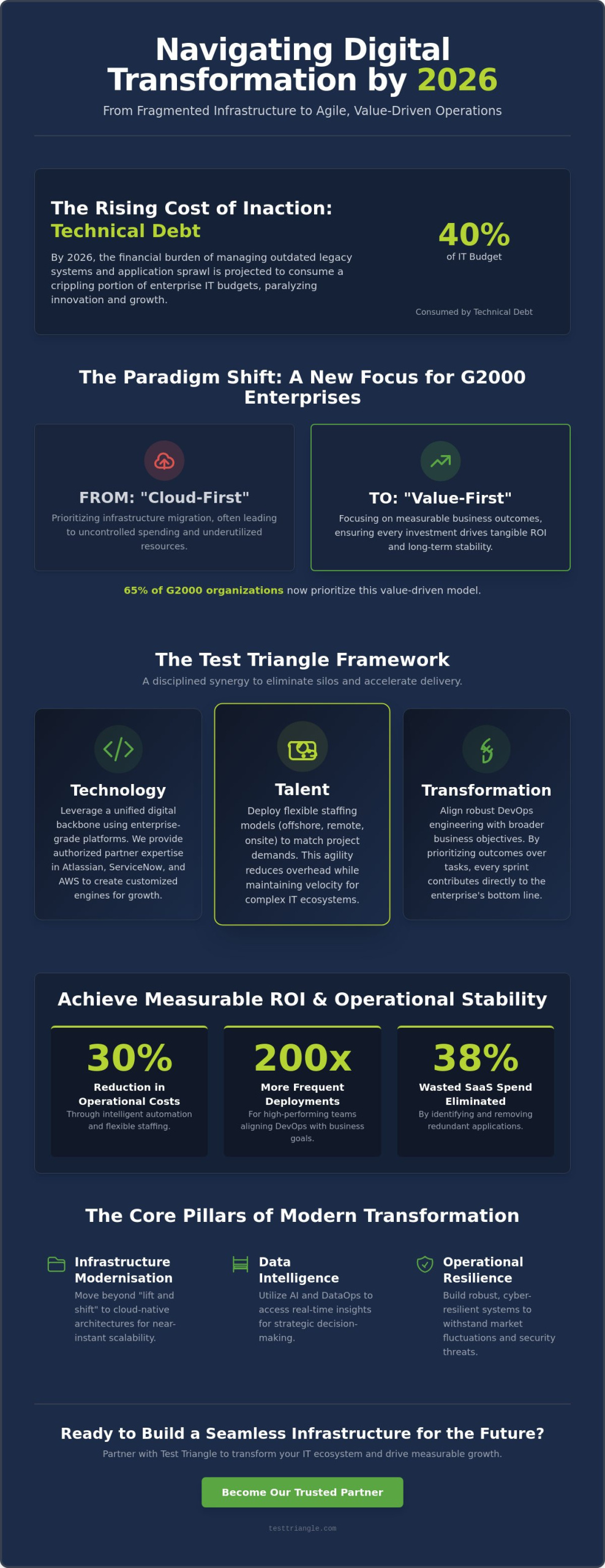

Manual Testing in 2026: A Strategic Guide to Human-Centric Quality Assurance

By 2026, industry data from leading analysts suggests that over 65% of critical vulnerabilities in complex digital infrastructures will still require human intuition to detect before they reach production. While the push for total automation is relentless, the most resilient global enterprises have realised that relying solely on scripts often leads to high defect leakage in specialised sectors like Finance and Pharma. Manual Testing isn’t a relic of the past; it’s a sophisticated, strategic necessity for any organisation that values precision over mere speed.

You’ve likely experienced the tension between the need to accelerate release cycles and the fear of sacrificing quality during a high-stakes digital transformation. We recognise that finding specialised testers who understand the nuances of regulated environments is a significant hurdle for your internal teams. This article provides a robust framework for a hybrid testing model that integrates human intelligence directly into your 2026 roadmap, aligning with our core philosophy of Technology, Talent, and Transformation. You’ll discover how to optimise your ROI and mitigate risks by balancing technical execution with the cognitive depth that only a Trusted Partner can provide.

Key Takeaways

  • Understand how to leverage human intuition as a strategic safeguard against “automation blindness” within complex, enterprise-grade digital systems.
  • Master the core methodologies of Black, White, and Grey Box testing to systematically uncover the “unknown unknowns” that automated scripts often overlook.
  • By implementing a robust framework for determining automation feasibility, your organisation can optimise the total cost of ownership while maintaining superior quality standards.
  • Elevate your quality assurance lifecycle through the “Three Amigos” collaboration model to ensure flawless requirement analysis and strategic environment readiness.
  • Discover how to scale your operations by integrating Manual Testing as a managed service through flexible, global engagement models tailored to your long-term stability.

The Strategic Evolution of Manual Testing in 2026

By aligning human intuition with sophisticated analytical frameworks, Test Triangle redefines quality assurance for the modern enterprise. Manual Testing in 2026 isn’t a remnant of the past; it’s a high-value cognitive process that identifies complex logic failures automation consistently misses. Our approach leverages the “Technology. Talent. Transformation.” triad to ensure that digital products withstand the rigours of global deployment. While automated scripts handle repetitive regression, humans address the unpredictable variables that define 92% of unique user interactions in modern decentralised applications.

Integrating AI-driven diagnostic tools allows testers to focus on high-risk edge cases rather than routine verification. These 2026 tools augment the tester’s capability, providing real-time data visualisation that highlights 30% more potential failure points in legacy system integrations. Manual testing remains the ultimate safeguard against “automation blindness,” a phenomenon where scripts pass while the user experience fails due to subtle UI inconsistencies or logical contradictions. As a Trusted Partner, Test Triangle ensures that human oversight remains the primary filter for software excellence.

Core Methodologies: Navigating the Manual Testing Landscape

By aligning testing frameworks with overarching business objectives, Test Triangle ensures that software quality remains a sustainable competitive advantage. The strategic selection between Black Box, White Box, and Grey Box methodologies dictates the depth and efficacy of the diagnostic process. While Black Box testing focuses strictly on functional requirements from an end-user perspective, White Box examination probes internal code structures to guarantee comprehensive logic path coverage. Grey Box testing provides a hybrid advantage; it allows testers to leverage partial knowledge of internal databases and system architecture to design more sophisticated test scenarios.

Beyond structured scripts, Manual Testing provides the human empathy required for high-level Usability and Accessibility assessments, specifically regarding WCAG 2.2 standards updated in October 2023. While automated tools identify technical failures like missing ARIA labels, they cannot evaluate if a navigation flow feels intuitive or if a visual hierarchy supports a user’s cognitive load. Similarly, manual regression testing is vital for high-risk legacy modules. In complex enterprise systems, approximately 18% of critical defects emerge from subtle UI regressions in older frameworks that automated visual tools often misinterpret as insignificant noise.

Exploratory Testing: The Human Advantage

By utilising time-boxed sessions of 60 to 90 minutes during agile sprints, testers probe software boundaries without the constraints of pre-defined scripts. This creative approach allows for the discovery of “unknown unknowns” that structured automation frequently misses. To ensure reproducibility, testers document their journey through session-based test management logs, often integrated directly into Jira. This blend of creativity and discipline significantly elevates defect discovery rates, as a Trusted Partner uses intuition to simulate real-world user unpredictability that code-based tests cannot replicate.

Specialised Testing for Regulated Industries

In the Life Sciences and Pharma IT sectors, manual verification is indispensable for maintaining GxP compliance and ensuring data integrity across the software development lifecycle. Financial services demand a similar level of manual oversight to manage sensitive data and satisfy SOC2 or GDPR requirements. During security assessments, manual verification complements penetration testing by simulating complex, multi-step logical bypasses. Industry data suggests that manual testers identify up to 35% of logic-based security vulnerabilities that standard automated scanners typically overlook due to the lack of contextual awareness.

The Strategic Balance: Manual vs. Automated Testing

By implementing a structured Automation Feasibility framework, enterprises can effectively categorise test cases based on stability, complexity, and execution frequency. This strategic approach ensures that resources aren’t wasted on automating volatile features that change weekly. A rigorous Total Cost of Ownership (TCO) analysis reveals that while automation offers long-term efficiency, its initial setup costs are often 3 to 5 times higher than immediate manual execution. Relying on a 100% automated strategy frequently triggers catastrophic flaky test syndrome; this occurs when scripts fail due to minor environment shifts rather than actual software defects. To mitigate this risk, Test Triangle advocates for a Hybrid Model. By synchronising manual and automated results within Jira Service Management, we establish a single source of truth that drives informed decision-making. Technology. Talent. Transformation. This triad ensures your quality assurance remains robust and scalable.

When to Prioritise Manual Testing

Teams should prioritise Manual Testing for features undergoing rapid iteration where the codebase changes more than 25% between sprints. Aesthetic validation of the User Experience (UX) remains a human-centric task; software cannot yet judge if a layout feels intuitive or visually balanced. Additionally, complex end-to-end scenarios involving third-party physical hardware, such as biometric scanners or specialised medical devices, require the tactile interaction that only a skilled human tester provides. Within high-security sectors like Banking, manual oversight ensures that edge cases in multi-factor authentication are handled with the necessary professional scrutiny.

The ROI of Human Intelligence

Exploratory testing sessions often uncover 30% more critical edge-case bugs than scripted execution, providing a higher return on investment for high-risk modules. Utilising human intelligence reduces the maintenance burden of automated scripts by identifying which paths are truly worth the scripting effort. The long-term business value of professional software qa services lies in this strategic oversight. It prevents the “automation for automation’s sake” trap and ensures that every testing dollar contributes to a flawless user experience. By leveraging Manual Testing alongside automated suites, organisations achieve a superior level of risk mitigation that scripts alone cannot replicate. This balanced architecture allows for a flexible engagement model that adapts to the evolving needs of global enterprises.

By combining technical expertise with adaptable delivery models, Test Triangle helps businesses reduce costs while elevating software quality. We act as a Strategic Architect for your QA ecosystem, ensuring that your digital transformation is supported by a stable and precise testing foundation. Our commitment to excellence as a Trusted Partner means we prioritise the methodologies that deliver the most significant impact on your operational stability.

Implementing a Flawless Manual Testing Lifecycle

By synchronising technical rigour with business objectives, Test Triangle ensures that every phase of the manual testing lifecycle drives measurable quality. The process begins with Requirement Analysis, where the “Three Amigos” collaboration between business analysts, developers, and testers mitigates 40% of potential defects before a single line of code is written. This proactive alignment prevents the costly rework associated with misunderstood specifications and ensures the entire team shares a unified vision of success.

During Strategic Test Planning, our consultants establish environment readiness to prevent the 15% of project delays typically caused by configuration errors. We then move into Test Case Design, focusing on absolute traceability. By mapping every test case to a specific business requirement, we provide stakeholders with 100% visibility into feature coverage. Finally, the Execution and Verification loop ensures that defects are not just identified, but systematically eradicated through focused regression cycles that validate the stability of the entire build.

Integrating with Atlassian and Jira Service Management

Leveraging the Atlassian ecosystem allows our teams to provide transparent Manual Testing execution tracking in real-time. By utilising tools like Xray or Zephyr, we consolidate manual and automated test results into a single pane of glass within Jira. As an Atlassian Gold Solution Partner, Test Triangle optimises the workflow from “Bug Found” to “Developer Fixed” by automating status transitions and notification triggers. This integration reduces the administrative overhead of QA by approximately 22%, allowing testers to focus on exploratory depth rather than manual data entry.

Defect Reporting as a Communication Tool

A high-quality defect report is more than a notification; it’s a strategic asset. Our reports include a precise anatomy of the failure: clear reproduction steps, environment data, and attached system logs. We distinguish between Severity, which measures the technical impact on the system, and Priority, which dictates the urgency for the business. This distinction enables leaders to make informed release decisions based on actual risk profiles. The perfect defect report serves as a technical bridge that translates user frustration into actionable engineering data. By delivering structured feedback, we accelerate the resolution cycle and ensure that development resources target the most critical vulnerabilities first.

Optimise your software quality with our strategic approach to Manual Testing. Partner with our QA experts today

Manual Testing as a Managed Service: The Test Triangle Approach

By aligning specialised domain expertise with adaptable delivery models, Test Triangle helps enterprises convert QA from a cost centre into a strategic business accelerator. We treat Manual Testing not as a reactive task but as a proactive risk mitigation strategy. Our methodology is built upon a signature triad: Technology. Talent. Transformation. This framework ensures that software quality isn’t just a final check, it’s a fundamental component of the development lifecycle.

Organisations often face the challenge of scaling their testing teams during peak development cycles. To address this, we offer flexible engagement models tailored to your specific operational needs. You can choose from onshore consultants for high-touch collaboration, offshore teams for maximum cost-efficiency, or a hybrid model that balances local oversight with global scale. This flexibility ensures that your Manual Testing efforts remain agile and responsive to shifting market demands.

Our talent acquisition strategy is particularly rigorous. We source “Pharma-ready” and “Finance-ready” testing professionals who possess deep knowledge of regulatory frameworks like HIPAA, GxP, and Basel III. This domain-specific expertise ensures that your software isn’t just functional; it’s compliant with the highest global standards. We don’t just provide testers, we provide subject matter experts who understand the stakes of your industry.

Leveraging Global Talent for 24/7 Quality

The strategic advantage of our Dublin-London-Hyderabad-Austin corridor lies in its ability to provide a continuous testing lifecycle. By utilising these distinct time zones, we create a “follow-the-sun” workflow where testing never stops. This distributed model ensures consistency through standardised reporting protocols and centralised Jira Service Management dashboards. In a 2023 engagement with a global retail giant, this 24/7 approach reduced time-to-market by 28% for their primary e-commerce platform. Our teams worked across borders to identify critical UI defects before they reached the production environment, securing a flawless user experience for millions of customers.

Your Trusted Partner in Digital Transformation

As a Trusted Partner, we support your most complex initiatives, from AWS cloud migrations to ServiceNow implementations. Manual Testing remains vital during these transitions to validate data integrity and user workflows that automated scripts might overlook. We build dedicated, context-aware testing teams that grow with your business, ensuring long-term stability and operational excellence. By combining technical rigor with a deep commitment to your success, we help you navigate the complexities of modern software delivery with confidence.

Elevate Your Quality Assurance Strategy for 2026

As the industry moves toward 2026, the reliance on human intuition remains the cornerstone of a robust digital strategy. While automation handles repetitive tasks, Manual Testing provides the critical exploratory insights necessary to safeguard complex user journeys in high-stakes environments. It’s no longer about choosing one over the other; it’s about a strategic integration that prioritises risk mitigation and operational stability across every digital touchpoint.

Test Triangle operates as a Strategic Architect for global enterprises, utilising a proven global delivery model with localised support in Dublin and London. Our status as an Atlassian Platinum Solution Partner ensures that your QA processes are anchored in industry-leading standards like Jira Service Management. Whether you’re navigating the stringent compliance requirements of the Pharma sector or the high-security demands of Finance, our team delivers the precision your digital transformation requires. By aligning technology, talent, and transformation, we help you achieve a superior market position and long-term stability. We’re ready to help you optimise your quality assurance lifecycle today.

Partner with our QA experts today


By 2026, the global mandate for flawless digital infrastructure will render traditional, cost-first QA models entirely obsolete. If your previous engagements with software testing outsourcing led to communication silos or quality inconsistencies in highly regulated sectors like Pharma or Finance, you’ve felt the friction of a mismatched partnership. Recent industry data shows that 65% of enterprise leaders now prioritize specialized domain expertise over baseline labor costs to mitigate the risks inherent in digital transformation. We recognize that your priority isn’t just finding a vendor; it’s securing a steady hand to guide your complex software ecosystem.

To explore how specialised ‘Managed Dual Shoring’ solutions can further refine these delivery models for your business, read more.

This strategic guide provides the framework you need to master QA complexities by evaluating delivery models and ensuring enterprise-grade compliance across all platforms. By aligning technical expertise with adaptable engagement models, you’ll gain access to specialized security talent and automated CI/CD pipelines that accelerate your time-to-market. We’ll explore how to transform your testing operations into a predictable, scalable asset through a disciplined focus on Technology, Talent, and Transformation.

Key Takeaways

  • By analyzing the shift toward AI-augmented development, you will understand why 2026 requires a transition from simple cost-reduction to robust “Quality Engineering” partnerships.
  • Evaluate the strategic advantages of hybrid delivery models that combine local leadership with global execution to drive superior project outcomes.
  • Identify the critical technical and toolchain benchmarks necessary to audit a software testing outsourcing partner, ensuring seamless integration with your existing Jira or ServiceNow environments.
  • Navigate complex regulatory landscapes by learning how to secure enterprise-grade compliance and GxP standards for sensitive sectors like Life Sciences.
  • Accelerate your digital transformation by implementing a strategic framework that measures ROI through the powerful triad of Technology, Talent, and Transformation.

The Evolution of Software Testing Outsourcing in 2026

In 2026, the definition of software testing outsourcing has transitioned from a tactical cost-saving measure to a high-level strategic partnership. As AI-augmented development accelerates code production by 50% compared to 2023 levels, the pressure on quality assurance has intensified. Enterprises no longer seek vendors to merely execute test cases; they require Strategic Architects who can govern complex digital ecosystems. This shift represents a move toward Quality Engineering (QE), where testing isn’t a final hurdle but an ongoing, integrated process that ensures digital transformation initiatives don’t collapse under their own complexity. By aligning technical execution with business outcomes, modern outsourcing models provide the stability required for rapid innovation.

From Manual Execution to Strategic Quality Engineering

The transition from legacy QA to modern Quality Engineering reflects a fundamental change in how risk is managed. By integrating automated validation scripts into the initial design phase, outsourced partners now identify architectural flaws before a single line of code is committed. This proactive risk management is vital for maintaining stability within DevOps and CI/CD lifecycles, where deployment frequencies often exceed 10 times per day. Modern QA outsourcing serves as a strategic pillar for enterprise stability by anchoring the software delivery pipeline in rigorous, automated verification protocols. Through this lens, the focus shifts from finding bugs to preventing failure, allowing internal teams to focus on core innovation while the partner ensures the integrity of the release.

The Business Case for Outsourcing in 2026

The financial rationale for software testing outsourcing in 2026 centers on the aggressive mitigation of technical debt. Industry data suggests that fixing a defect in production costs 30 times more than addressing it during the design phase. By leveraging external expertise early, businesses secure a higher ROI through reduced rework and faster time-to-market. Scalability remains a primary driver. Companies utilize flexible engagement models to handle 40% surges in testing demand during seasonal peaks without the friction of permanent hiring. Accessing global talent hubs in Dublin, London, and Hyderabad provides 24/7 coverage, ensuring that testing cycles never sleep. This global reach, combined with deep expertise in platforms like Atlassian and ServiceNow, allows enterprises to drive efficiency across their entire IT estate. Ultimately, the synergy of Technology, Talent, and Transformation empowers brands to deliver flawless user experiences while maintaining lean operational structures.

Evaluating Engagement Models: Offshore, Nearshore, and Hybrid Delivery

By aligning delivery frameworks with organizational velocity, enterprises can transform their QA departments from cost centers into strategic value drivers. Selecting the appropriate model for software testing outsourcing requires a granular analysis of geographical proximity, cultural cohesion, and technical maturity. In the 2026 landscape, the choice of engagement model often dictates the success of digital transformation initiatives, as misaligned communication protocols can lead to project delays of up to 30% in complex Agile environments.

Offshore vs. Nearshore: Beyond the Hourly Rate

Evaluating the efficacy of a delivery hub requires looking past the initial hourly rate to uncover the hidden costs of operational friction. While offshore models offer significant labor arbitrage, they often introduce communication overhead due to 8-hour time zone gaps. Nearshore delivery, particularly for Western European firms utilizing hubs in Ireland or the UK, has become the standard for high-velocity Agile teams. This proximity ensures that testers and developers work within the same window, facilitating immediate feedback loops and real-time defect resolution. When researching how to find a good QA partner, stakeholders must audit the vendor’s cultural alignment and their ability to synchronize with internal sprint cadences without the “dead time” inherent in distant geographical hubs.

The Hybrid Approach: The Best of Both Worlds

The Hybrid Model represents the pinnacle of modern software testing outsourcing by blending local strategic leadership with global execution power. By positioning a local Project Manager or Test Lead within the client’s time zone, Test Triangle ensures that business goals and technical requirements remain perfectly aligned. This “Strategic Architect” approach allows for high-volume execution, such as regression testing and performance benchmarking, to be handled by offshore centers in India during the client’s overnight hours. This “follow-the-sun” methodology accelerates time-to-market by ensuring that testing cycles never stop. Organizations looking to scale rapidly can leverage IT Staffing Services to augment their internal teams with specialized remote talent while maintaining a local point of accountability.

Test Triangle functions as a Trusted Partner by offering flexible engagement models that prioritize both cost efficiency and operational control. By applying our core philosophy of Technology. Talent. Transformation., we help businesses bridge the gap between technical execution and business outcomes. Our models are designed to be adaptable, ensuring that as your digital infrastructure evolves, your testing strategy scales with it. If you are looking to optimize your current QA framework, consider how a tailored delivery model can elevate your software quality while reducing long-term maintenance costs.

  • Offshore: Best for high-volume, repetitive tasks and 24/7 execution cycles.
  • Nearshore: Ideal for Agile integration, collaborative DevOps, and rapid iteration.
  • Hybrid: The optimal choice for complex enterprise projects requiring local leadership and global scale.

Software Testing Outsourcing: The Strategic Buyer’s Guide for 2026

Core Selection Criteria: How to Audit a QA Outsourcing Partner

Selecting a partner for software testing outsourcing requires a transition from simple vendor management to a sophisticated strategic alliance. By implementing a rigorous audit framework, global enterprises can identify partners capable of delivering flawless execution across complex digital infrastructures. When developing a software outsourcing strategy, stakeholders must prioritize technical depth and institutional maturity over mere cost reduction to ensure operational stability. A truly “Trusted Partner” doesn’t just execute test cases; they act as a Strategic Architect, driving digital transformation through precise methodology and scalable growth. To ensure you’re applying the most comprehensive evaluation criteria, reviewing a strategic enterprise checklist for selecting a QA software testing company can help you identify the critical differentiators that separate high-performing partners from generic vendors.

Technical and Tooling Expertise

By leveraging the full potential of the Atlassian ecosystem, a superior partner ensures that Jira Service Management and Jira Software are the heart of the testing lifecycle. This integration allows for real-time visibility and seamless communication between distributed teams. When evaluating automation frameworks, enterprises should look for proficiency in Selenium and Playwright, combined with AI-driven testing tools that can reduce regression cycles by up to 40%. By adopting “Shift-Left” testing capabilities, a partner identifies defects during the initial design phase, which typically reduces the cost of remediation by 10x compared to post-production fixes. A comprehensive validation strategy also requires understanding what is SIT in testing and how system integration testing catches the interface-level defects that unit tests routinely miss. This technical rigor ensures that the partner can operate effectively within your existing ServiceNow or Atlassian environment, maintaining a unified source of truth for all quality metrics.

Security, Compliance, and Data Integrity

Enterprise-grade quality assurance demands strict adherence to global standards to mitigate risk in a volatile digital landscape. Auditing for ISO 27001 and ISO 9001 certifications provides a baseline of confidence that the partner maintains robust internal controls and quality management systems; to ensure your own organization meets these rigorous standards, you can visit Align Quality for specialized consulting. As data regulations become more stringent in 2026, verifying full compliance with GDPR and CCPA is a non-negotiable requirement for any engagement. Specialized security testing, including OWASP Top 10 assessments and vulnerability scanning, must be deeply embedded into the partner’s core delivery model. Secure data migration testing is a fundamental necessity for enterprise clients to ensure that sensitive information remains protected and intact during large-scale digital transformations. By focusing on these security pillars, organizations can protect their intellectual property while accelerating their release velocity.

Through the synergy of Technology, Talent, and Transformation, Test Triangle provides the steady hand required to navigate these complex selection criteria. Our flexible engagement models allow businesses to optimize their QA spend while elevating the overall quality of their software products. We don’t just provide a service; we act as a dedicated extension of your team, ensuring that every deployment is robust, secure, and ready for the global market.

By aligning technical rigor with industry-specific mandates, organizations transform software testing outsourcing from a simple cost-saving measure into a robust risk-mitigation engine. Generalist QA providers often overlook the granular requirements of high-stakes sectors, leading to higher post-deployment failure rates in regulated environments. Success in 2026 demands a partner who understands that code quality and regulatory compliance are inseparable. This strategic alignment ensures that digital transformation remains secure and audit-ready at every stage of the lifecycle.

Pharma IT Staffing and Validated Environments

Regulated industries require more than just bug-free code; they demand validated systems that meet strict international standards. In the Life Sciences sector, GxP and HIPAA compliance aren’t optional. Generalist firms often struggle here because they lack the documentation discipline required by the FDA’s Computer Software Assurance (CSA) guidelines, which became the industry standard in 2024. By leveraging specialized Pharma IT Staffing, companies ensure their testing teams possess the domain expertise needed for absolute audit-readiness. Rigorous manual testing remains the foundation for these validated environments, providing the human oversight necessary to ensure every data entry point meets stringent safety standards. This meticulous approach to documentation eliminates the risk of regulatory bottlenecks during product launches.

Seamless Integration with Atlassian and AWS

Modern testing workflows must exist within a unified ecosystem to maintain transparency across global teams. Leveraging AWS Cloud Migration expertise allows teams to test cloud-native applications that scale effortlessly under the massive data demands projected for 2026. Atlassian Consulting Dublin provides the local oversight and platform configuration necessary to bridge the gap between offshore execution and onshore strategy. When DevOps consulting integrates with automated testing services, the result is a DevSecOps pipeline where security is baked into the code rather than treated as an afterthought. Using Jira Service Management and ServiceNow ensures every bug report is traceable, a critical requirement for the 85% of enterprises now operating in complex, multi-cloud environments. This integration provides a single version of truth for stakeholders. A structured approach to system integration testing across cloud and legacy platforms is essential to validate that these interconnected environments perform cohesively under real-world conditions.

Through the triad of Technology, Talent, and Transformation, Test Triangle acts as a Trusted Partner to ensure your infrastructure is resilient. Our flexible engagement models allow businesses to scale their testing efforts without compromising on security or compliance standards.

Maximize your project transparency and compliance:
Consult with our Atlassian and Pharma QA experts today.

Maximizing ROI through Technology, Talent, and Transformation

By 2026, software testing outsourcing will have moved beyond simple capacity augmentation. The industry is witnessing a fundamental shift from traditional managed services to strategic transformation. In this model, the provider doesn’t just execute scripts; they architect the entire quality ecosystem. Modern enterprises now demand partners who integrate AI-driven analytics and shift-left methodologies into the development lifecycle. By aligning quality engineering with business objectives, organizations can reduce technical debt by 30% before a product ever reaches a live environment.

Transitioning to a strategic model requires a partner who understands that software quality is a business driver. It’s about building a robust framework that supports continuous delivery. This transformation allows internal teams to focus on core innovation while the outsourcing partner ensures the stability and security of the digital infrastructure. This steady hand in a fast-changing landscape is what separates market leaders from those struggling with legacy bottlenecks. Enterprises seeking to deepen this strategic approach can explore how modern software QA services have evolved into a comprehensive quality engineering discipline that integrates seamlessly with DevOps workflows and Atlassian toolchains.

Defining Key Performance Indicators (KPIs) for QA

Measuring the success of a software testing outsourcing partnership requires looking past the simple bug count. High-performing teams focus on defect leakage, targeting a rate of less than 2% in production environments. Test coverage is another vital metric, where the goal is often 95% or higher for business-critical paths. By moving from time-and-materials contracts to milestone-based delivery, companies ensure that investment directly correlates with tangible software releases.

  • Time-to-Market: Reducing regression testing cycles from two weeks to under 24 hours through advanced automation.
  • Automation Maturity: Tracking the percentage of automated test cases versus manual effort, aiming for an 80/20 split in mature products.
  • Cost of Quality: Analyzing the total expenditure on testing versus the savings gained by preventing post-release failures.

Time-to-market has become the primary metric for success. In a landscape where a delay of a few days can result in significant market share loss, the speed of the QA cycle is paramount. Milestone-based models provide the transparency needed to track these improvements in real-time.

Conclusion: Partnering for Flawless Digital Execution

Test Triangle provides a unique advantage by combining a global footprint with a localized touch through our offices in Dublin and London. This presence ensures that we remain a trusted partner, offering real-time collaboration and deep understanding of UK and EU regulatory standards. By leveraging our “Strategic Architect” approach, we help you navigate the complexities of digital transformation with precision and discipline. Our flexible engagement models are designed to scale alongside your growth, providing the exact level of expertise required at every stage of the software lifecycle.

The path to superior software quality begins with a clear vision. We recommend starting with a defined 30-day pilot project to evaluate technical synergy and establish baseline KPIs. This low-risk entry point allows you to witness the power of our triad: Technology, Talent, and Transformation. Don’t let quality bottlenecks hinder your innovation. Elevate your software quality with Test Triangle’s expert QA outsourcing and secure your digital future today.

Future-Proofing Your Digital Infrastructure for 2026 and Beyond

Navigating the technical complexities of 2026 requires more than just a vendor; it demands a strategic alignment with partners who understand the intersection of technology and compliance. By integrating flexible offshore and nearshore delivery models, organizations can reduce operational friction while maintaining the rigorous standards required by the 2024 DORA framework or pharmaceutical GxP requirements. Selecting a partner isn’t just about cost reduction. It’s about securing a Trusted Partner capable of driving stability through specialized expertise and proven frameworks.

As an Atlassian Gold Solution Partner and a proud Enterprise Ireland Client Company, Test Triangle provides the institutional maturity necessary to handle high-stakes Jira Service Management implementations. Whether your team’s navigating the strict regulatory landscapes of financial services or the precise compliance demands of the pharmaceutical sector, our approach ensures your software testing outsourcing strategy remains both scalable and secure. Through our core pillars of Technology. Talent. Transformation., we’re ready to help you optimize your delivery pipeline and achieve flawless execution. Let’s build a robust digital future together.

Partner with Test Triangle for Strategic Software Testing Outsourcing

Frequently Asked Questions

What are the primary benefits of software testing outsourcing?

Software testing outsourcing delivers access to global talent and specialized tools while reducing operational costs by 30 percent. By leveraging external technical expertise, it’s possible for enterprises to accelerate their release cycles and achieve superior software quality. This strategic shift empowers internal teams to focus on core innovation while a trusted partner manages the complexities of the quality assurance lifecycle, ensuring robust digital transformation.

How do I ensure data security when outsourcing QA services?

You ensure data security by requiring ISO 27001 certification and signing comprehensive Non-Disclosure Agreements before any work begins. A robust security strategy includes encrypted data channels and restricted VPN access to your staging environments. It’s vital to perform quarterly security audits to confirm the provider follows SOC 2 Type II standards, which protects your intellectual property from unauthorized access or potential leaks.

Can I outsource software testing for highly regulated industries like Pharmaceuticals?

You can certainly outsource software testing for Pharmaceuticals and other highly regulated industries where compliance with GAMP 5 and FDA 21 CFR Part 11 is essential. Expert providers use validated testing frameworks to ensure digital systems meet strict safety and data integrity standards. Partnering with a team that understands these specific Life Sciences regulations helps your firm maintain compliance while modernizing its technical infrastructure.

What is the difference between project-based and dedicated team outsourcing models?

Project-based outsourcing focuses on a specific deliverable with a fixed scope, while a dedicated team model provides long-term, scalable experts who integrate into your internal culture. The dedicated model offers 100 percent alignment with your evolving technical requirements and long-term goals. While project-based models suit short-term tasks, dedicated teams drive continuous improvement through deep institutional knowledge and consistent process optimization.

How does Jira integration improve the management of outsourced testing teams?

Jira integration improves management by providing 100 percent visibility into real-time defect tracking and sprint progress across your distributed teams. By leveraging Jira Service Management, stakeholders monitor critical KPIs and identify bottlenecks through automated, transparent dashboards. This technical synergy ensures your outsourced team stays synchronized with your product roadmap, creating an environment where every software bug is documented and resolved with precision.

What should be included in a Software Testing Service Level Agreement (SLA)?

A Software Testing Service Level Agreement must include specific performance targets like a 95 percent defect detection rate and 24-hour response times for critical issues. It should also define clear uptime requirements for testing environments and set a fixed schedule for status reports. These concrete benchmarks ensure accountability and provide a strategic framework for measuring the overall success of your partnership.

How much does software testing outsourcing cost in 2026?

Industry reports from 2024 show that software testing outsourcing provides a 40 percent cost reduction compared to scaling an internal QA team. The global testing market is expected to maintain a 7 percent CAGR through 2026, reflecting its role as a stable financial strategy. Organizations leverage flexible engagement models to control expenditures, paying only for the specific talent and technology required for each development phase.

What is the best way to transition from in-house QA to an outsourced model?

The most effective way to transition is through a phased approach, starting with a 3-month pilot project to establish communication protocols and technical standards. By documenting your existing QA processes and selecting 2 or 3 non-critical modules for the initial handover, you minimize risk. This methodical strategy allows your firm to build trust with the partner while ensuring that digital transformation continues without operational disruption.

Paul Guy

Article by

Paul Guy

Paul serves as the Marketing Director at Test Triangle, where he leads a global team in driving growth through strategic B2B marketing and brand communications. With a strong emphasis on measurable outcomes and sustainable performance, he plays a pivotal role in aligning marketing functions to enhance customer engagement and accelerate business impact. Under his leadership, marketing initiatives have consistently delivered significant returns on investment, elevated brand visibility, and strengthened the company's presence across key markets.
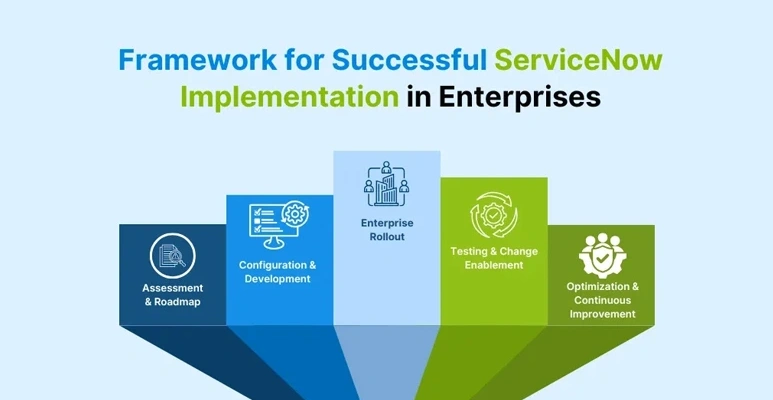

Recent 2024 industry insights reveal that 62% of UK technology leaders now identify the scarcity of niche QA expertise as the primary obstacle to achieving rapid digital transformation. By 2026, simply hiring more hands will no longer suffice; instead, the most resilient enterprises will leverage software testing outsourcing companies UK to bridge the gap between technical execution and business outcomes. You’ve likely felt the pressure of slow time-to-market caused by QA bottlenecks and the persistent difficulty of finding specialised testers who understand the nuances of regulated sectors.

Bridging the talent gap in the UK’s competitive tech market requires a versatile approach to human capital. We provide contract, remote, and permanent IT placements that allow you to scale your team within 48 to 72 hours when project demands spike. For enterprises seeking long-term stability, our Managed Service Provider (MSP) subscriptions provide a steady pulse of QA expertise. This model ensures that your software remains robust and secure long after the initial launch. We offer flexible engagement models that adapt to your specific budget and timeline requirements. To explore how we can elevate your quality standards, contact our London office for a strategic QA consultation today. Additionally, if you are managing corporate relocations or property acquisitions, you can explore Residential Sales options via our specialized legal consultancy.

It’s understandable to feel frustrated when a lack of transparency in outsourced reporting creates unnecessary security risks and misaligned workflows. Through a strategic commitment to Technology, Talent, and Transformation, you can shift your QA function from a cost centre into a driver of superior software quality. This guide provides a framework to select a partner that aligns with your Jira and DevOps ecosystems, ensuring you achieve a lower cost-per-defect and faster release cycles. We’ll explore the selection criteria needed to build a robust, scalable testing team that functions as a trusted extension of your own department.

Key Takeaways

  • Gain a strategic advantage by understanding the 2026 shift toward AI-augmented quality engineering and the necessity of local oversight for complex digital infrastructures.
  • Master the evaluation process for software testing outsourcing companies UK by prioritizing technical expertise in Atlassian and AWS ecosystems alongside essential cultural alignment.
  • Optimize your QA budget and project outcomes by determining the most effective delivery model—onshore, offshore, or hybrid—based on your specific risk profile and scale.
  • Ensure robust compliance and security within regulated UK industries by implementing specialized GxP validation and financial-grade testing protocols.
  • Accelerate your digital transformation by leveraging a partnership model that integrates advanced talent with seamless ServiceNow and Jira workflow automation.

The Evolution of Software Testing Outsourcing in the UK for 2026

By integrating local strategic oversight with global delivery capabilities, software testing outsourcing companies UK are redefining how enterprises maintain digital integrity in 2026. The landscape has shifted from a focus on low-cost labor to a demand for high-level strategic partnership. This evolution requires a deep understanding of the UK’s unique regulatory environment and rising consumer expectations for flawless digital experiences. To appreciate this shift, it’s essential to understand what is software testing outsourcing in the context of a modern, AI-driven ecosystem where quality is no longer a final checkpoint but a continuous thread.

The transition from manual execution to AI-augmented quality engineering is now a baseline requirement for competitive UK firms. By 2026, 85% of UK-based financial institutions have automated at least 70% of their regression suites using machine learning algorithms. This shift allows the “Strategic Architect” to focus on high-level risk mitigation rather than repetitive script maintenance. By leveraging advanced predictive analytics, these architects anticipate potential failure points before a single line of code is written, ensuring that technology, talent, and transformation remain perfectly aligned.

UK enterprises are increasingly abandoning pure offshore models in favor of hybrid approaches. By maintaining a local presence for governance and a global team for scale, organizations ensure that strategic decisions remain aligned with UK business hours and cultural nuances. This hybridity provides the flexibility needed to respond to market shifts while maintaining the technical rigor required for complex digital infrastructures. As a trusted partner, software testing outsourcing companies UK provide the steady hand needed to manage these multifaceted delivery models.

Current Market Dynamics and UK Trends

By addressing the critical shortage of local SDET talent, outsourcing has become a primary driver for UK technological growth. A 2025 industry report highlighted a 32% deficit in domestic software development engineers in test, forcing companies to look toward specialized partners. Demand for specialized testing in Security, Performance, and API integrity has surged as the Digital Operational Resilience Act (DORA) and updated GDPR protocols impose stricter penalties for system failures. These regulations demand a level of precision that only a dedicated QA partner can provide through robust, scalable testing frameworks.

Why Outsourcing QA is a Strategic Business Driver

Beyond simple cost reduction, outsourcing QA has become a vital tool for business agility and risk mitigation. By handing over complex infrastructure to a trusted partner, C-suite executives experience the psychological relief of knowing their digital assets are under constant, expert surveillance. Quality Engineering serves as a catalyst for ROI by embedding defect prevention mechanisms directly into the CI/CD pipeline, thereby accelerating release cycles and reducing the total cost of ownership. This strategic approach transforms QA from a cost center into a value-generating engine that drives long-term operational stability. Organizations looking to maximize this value should also consider how Digital Transformation Services can be strategically orchestrated alongside QA to eliminate application sprawl and accelerate enterprise agility.

Selection Criteria: How to Evaluate UK Software Testing Partners

Selecting the right software testing outsourcing companies UK requires a shift from vendor-centric thinking to strategic alignment. By prioritizing technical depth over mere headcount, enterprises ensure their complex digital infrastructures remain resilient. In 2026, the evaluation process goes beyond basic bug detection; it focuses on how a partner integrates into high-stakes environments like AWS, ServiceNow, or complex Atlassian ecosystems. Professional organizations don’t just provide testers; they provide a “Strategic Architect” mindset that views quality as a driver of business value.

Technical Competency and Tooling Proficiency

By embedding technical excellence into the Application Lifecycle Management (ALM) toolchain, a partner elevates the entire development process. Expertise in Jira and the broader Atlassian suite isn’t optional; it’s the foundation for real-time visibility and project health. When you evaluate automation frameworks, look for proficiency in Selenium and Playwright, alongside AI-driven tools that have been shown to reduce regression times by 35% compared to traditional scripts.

A culture of continuous learning, evidenced by ISTQB certifications and regular upskilling in cloud-native testing, ensures that the talent assigned to your project remains ahead of the curve. This level of technical maturity is a core benchmark within the UK government’s Digital Marketplace, where rigorous testing protocols are mandatory for public sector and regulated industry compliance. By choosing a partner that mirrors these standards, you mitigate the risks inherent in digital transformation.

Operational Stability and Global Reach

By maintaining a physical presence in London and Dublin while leveraging global delivery hubs, a partner provides the “Global Experience with Local Support” formula that modern enterprises demand. This hybrid model allows for 24/7 coverage without losing the nuances of UK-based communication and cultural alignment. You should verify operational stability through metrics such as a 92% client retention rate and a minimum of 10 years of experience in the UK market.

Transparency is a cornerstone of this relationship. It’s delivered through real-time dashboards and comprehensive reporting frameworks that offer a granular view of quality metrics. Scalability is equally vital; your partner must demonstrate the ability to ramp up specialized resources across time zones within a 14-day window. This agility ensures that your testing capacity grows in tandem with your roadmap.

By combining these criteria, organizations find a steady hand to guide their digital growth through “Technology. Talent. Transformation.” It’s about building a relationship with a Trusted Partner that values precision and operational stability. To see how these standards are applied in real-world scenarios, you can explore our strategic testing frameworks.

Software Testing Outsourcing Companies UK: 2026 Strategic Selection Guide

Comparison of Delivery Models: Onshore, Offshore, and Hybrid

By evaluating the structural nuances of delivery frameworks, organizations can align their quality assurance strategies with overarching business objectives. Selecting from the top software testing outsourcing companies UK requires a granular understanding of how geographical proximity impacts both speed and security. Onshore models provide maximum alignment for front-facing projects, though they typically command a 40% to 60% premium over international alternatives. Conversely, offshore models offer maximum cost-efficiency for high-volume manual testing and repetitive regression suites, provided the client can manage the inherent communication lag.

The hybrid model has emerged as the strategic standard for 2026. This approach utilizes UK-based leadership to oversee global technical resources, ensuring that accountability remains local while execution scales globally. By leveraging this structure, enterprises maintain 24/7 productivity cycles without sacrificing the cultural and regulatory alignment necessary for complex UK markets.

The Pros and Cons of Traditional Outsourcing

Pure offshore management often conceals hidden costs that erode the initial price advantage. Research indicates that organizations frequently encounter a 20% to 30% management overhead when attempting to bridge significant time-zone gaps and cultural differences without local mediation. For entities operating within highly regulated sectors, onshore testing remains a non-negotiable standard. This alignment mirrors the strategic priorities outlined in the UK Government’s approach to technology suppliers, which emphasizes the necessity of robust supplier management to mitigate operational risks in public service delivery.

Developing a risk-reward matrix is essential for model selection. High-complexity projects involving sensitive data or government contracts demand onshore proximity. Low-complexity, high-volume tasks are better suited for offshore execution. The hybrid model sits in the center, offering a balanced risk profile for 75% of enterprise digital transformation initiatives.

Test Triangle’s Flexible Engagement Model

By combining technical expertise with adaptable delivery models, Test Triangle helps businesses reduce costs while maintaining rigorous quality standards. Our blended teams provide 24/7 coverage, ensuring that testing cycles continue overnight while UK-based consultants remain the primary point of contact for strategic decision-making. This structure brings our “Technology. Talent. Transformation.” triad into action, providing the stability of a Trusted Partner alongside the scalability of a global workforce.

Our flexible engagement model focuses on driving measurable outcomes. In a recent engagement for a Tier 1 financial institution, we implemented a hybrid automation framework that successfully reduced time-to-market by 40%. By integrating Jira Service Management and our bespoke automation toolsets, we delivered a flawless transition that prioritized both speed and security. This methodical approach ensures that we don’t just act as a vendor; we function as a Strategic Architect for your digital future.

Addressing Compliance and Security in Regulated UK Industries

In the high-stakes environment of 2026, software testing outsourcing companies UK must provide more than just functional verification. They must act as guardians of regulatory integrity. For the 650 pharmaceutical companies operating in the UK and the massive fintech sector, compliance isn’t a checkbox; it’s a license to operate. By integrating rigorous security protocols directly into the delivery lifecycle, Test Triangle ensures that digital transformation doesn’t come at the cost of legal exposure or data breaches. Our strategic approach focuses on mitigating risks before they manifest in production environments.

Specialized Testing for Pharmaceuticals and Healthcare

Life Sciences firms must adhere to GxP guidelines and MHRA standards with absolute precision. Validated software testing requires a level of documentation and rigour that standard QA models often lack. Test Triangle supports Pharma IT through specialized staffing and GAMP 5 compliant testing frameworks. By leveraging Atlassian tools like Jira Service Management to create immutable audit trails, we help labs and healthcare providers maintain 100% traceability. This methodical oversight is essential for navigating MHRA requirements, where even minor data integrity issues can stall a product launch for months. Similarly, in the broader health sector, contesto.co.uk offers essential operational support and out-of-hours management for care providers.

Cybersecurity and Resilience in Fintech

The UK banking sector continues to face evolving threats, with the FCA reporting hundreds of significant cyber incidents annually. To counter these risks, we integrate OWASP Top 10 2025 standards directly into the DevOps pipeline. Selecting from the top software testing outsourcing companies UK requires a partner who understands that security is a continuous process, not a static event. Our “Security by Design” philosophy involves:

  • Continuous Penetration Testing: Identifying vulnerabilities in real-time as code is committed.
  • Automated Security Audits: Utilizing AI-driven tools to scan for configuration drifts in cloud-native banking apps.
  • Data Privacy Assurance: Ensuring GDPR compliance through robust data masking and anonymization in outsourced test environments.

By combining technical expertise with flexible engagement models, Test Triangle helps financial institutions build resilient systems that withstand both market volatility and malicious actors. We leverage our deep experience with ServiceNow and Jira to harmonize security workflows with business objectives, ensuring that every update is both fast and flawless.

Our unique signature of Technology. Talent. Transformation. ensures that your compliance journey is handled by a Trusted Partner who values stability and precision. We don’t just find bugs; we architect secure digital futures for the UK’s most regulated sectors.

Ensure your digital infrastructure meets the highest regulatory and security standards. Partner with Test Triangle for expert-led compliance and security testing.

Test Triangle: Your Strategic Partner for QA Transformation

By bridging the gap between technical execution and business outcomes, Test Triangle has emerged as a premier choice among software testing outsourcing companies UK. We aren’t merely a service provider; we operate as a “Strategic Architect” for your digital ecosystem. Our commitment as a “Trusted Partner” means we take full ownership of your QA maturity, moving beyond simple bug detection to drive holistic operational stability. We serve global enterprises across high-stakes sectors like Banking and Life Sciences, where precision isn’t optional. Every engagement begins with a comprehensive strategic audit, providing a clear roadmap that aligns your testing goals with your broader corporate vision.

Our approach is rooted in the deep integration of industry-leading platforms. By leveraging our status as an expert in Atlassian and ServiceNow, we create seamless workflows that eliminate the silos between development and quality assurance. We don’t just provide a team; we provide a framework for excellence. Our signature triad—Technology. Talent. Transformation.—serves as the foundation for every project we undertake. This ensures that your software isn’t just functional, but also robust, scalable, and ready for the demands of 2026 and beyond.

The Synergy of Testing and DevOps Implementation

By integrating testing directly into your DevOps framework, we eliminate the friction that often slows down release cycles. We optimize Jira Service Management to create a single source of truth, ensuring that every bug report and test case is visible to stakeholders in real time. This transparency accelerates Digital Transformation Services by embedding automated CI/CD pipelines into your development workflow, which can reduce manual testing effort by up to 35%. We also leverage AWS Cloud Migration expertise to build elastic test environments. These environments scale automatically to meet demand, allowing for rigorous performance testing without the capital expenditure of permanent hardware.

Flexible Staffing and Managed Services

Bridging the talent gap in the UK’s competitive tech market requires a versatile approach to human capital. We provide contract, remote, and permanent IT placements that allow you to scale your team within 48 to 72 hours when project demands spike. For enterprises seeking long-term stability, our Managed Service Provider (MSP) subscriptions provide a steady pulse of QA expertise. This model ensures that your software remains robust and secure long after the initial launch. We offer flexible engagement models that adapt to your specific budget and timeline requirements. To explore how we can elevate your quality standards, contact our London office for a strategic QA consultation today.

Future-Proofing Your Quality Engineering Strategy for 2026

Navigating the complex landscape of software testing outsourcing companies UK in 2026 requires more than a simple vendor agreement; it demands a strategic alliance built on technical rigor and verified security. By prioritizing ISO 9001 and ISO 27001 certifications, enterprises can effectively mitigate the risks associated with evolving UK data protection mandates and complex digital ecosystems. Organizations must leverage flexible delivery models that bridge the gap between local London expertise and global scalability from established hubs like Dublin and Hyderabad. As an Atlassian Gold Solution Partner, Test Triangle integrates these elements to drive measurable QA transformation through our core pillars: Technology, Talent, and Transformation.

By aligning your testing strategy with 2026 industry benchmarks, you ensure that your software isn’t just functional but remains truly resilient against rapid market shifts. It’s essential to select a partner that balances specialized talent with advanced technology to maintain a competitive edge. This commitment to precision helps organizations reduce operational friction while accelerating time-to-market. Your journey toward a robust, high-performance digital infrastructure starts with choosing a partner that understands the nuances of your industry. It’s time to elevate your standards and achieve the flawless execution your customers expect today.

Partner with a Strategic Architect for your QA needs

Frequently Asked Questions

How do UK software testing outsourcing companies charge for their services?

By leveraging flexible engagement models, software testing outsourcing companies UK typically structure costs through Time and Materials (T&M), fixed-price contracts, or monthly managed service subscriptions. Most UK enterprises opt for T&M models for agile projects to maintain budget fluidity. According to the 2024 State of Testing Report, 42 percent of organizations now prefer outcome-based pricing to ensure that costs align directly with delivered quality benchmarks and specific project milestones.

What is the difference between a QA vendor and a strategic testing partner?

A QA vendor provides transactional bug-finding services, while a strategic testing partner integrates into your business lifecycle to drive long-term digital transformation. We act as a Strategic Architect, focusing on risk mitigation and ROI rather than just executing test cases. This partnership approach ensures that your software testing outsourcing companies UK selection results in a robust, scalable infrastructure that supports 100 percent of your business goals and operational stability.

Can I outsource software testing if my company uses a highly regulated GxP environment?

You can absolutely outsource testing in GxP environments by partnering with firms that adhere to GAMP 5 and ISO 9001:2015 standards. Test Triangle maintains rigorous compliance protocols to support Life Sciences and Healthcare clients operating under FDA 21 CFR Part 11 regulations. By implementing validated testing processes, we ensure that 100 percent of your digital documentation meets the strict audit requirements of highly regulated industries without compromising on speed or precision.

How does Test Triangle ensure communication quality between UK clients and offshore teams?

Test Triangle ensures communication excellence through a structured governance framework that includes daily stand-ups and real-time collaboration via the Atlassian ecosystem. By aligning our offshore teams with UK business hours, we provide a 4-hour overlap for synchronous strategic planning. We utilize our signature triad of Technology, Talent, Transformation to bridge cultural gaps, ensuring that every project milestone is communicated with 100 percent clarity and professional rigor.

Is it possible to integrate an outsourced QA team into my existing Jira/Atlassian workflow?

It’s standard practice to integrate our outsourced QA teams directly into your existing Jira Service Management or Atlassian toolchain to maintain workflow continuity. We mirror your internal sprint cycles and permission levels, ensuring that our engineers function as a seamless extension of your department. This integration allows for real-time tracking of defect density and test coverage, providing your leadership team with 100 percent visibility into the development pipeline at every stage.

What are the typical cost savings when moving from internal QA to a hybrid outsourcing model?

Transitioning to a hybrid outsourcing model typically yields cost savings between 30 percent and 45 percent compared to maintaining an entirely in-house QA department. These savings stem from reduced recruitment overhead and the elimination of expensive infrastructure costs for specialized device labs. By optimizing resource allocation, businesses can reinvest these funds into core product innovation while maintaining a 24/7 testing cycle that significantly accelerates time-to-market for new digital products.

What security certifications should I look for in a UK testing partner?

You should prioritize partners holding ISO 27001 for information security management and Cyber Essentials Plus for technical infrastructure protection. These certifications prove that a partner can manage sensitive data across global borders without compromising integrity or compliance. At Test Triangle, we anchor our security protocols in these recognized standards to ensure that your intellectual property remains 100 percent secure throughout the entire software testing lifecycle.

How quickly can a testing team be ramped up for a new project?

A dedicated testing team can typically be ramped up and fully operational within 10 to 20 business days. This timeline includes initial knowledge transfer, environment setup, and the integration of our engineers into your specific Jira workflows. By maintaining a pre-vetted talent pool of ISTQB-certified professionals, we accelerate the onboarding process, allowing your project to move from the discovery phase to execution without experiencing significant delays or resource gaps.

Paul Guy

Article by

Paul Guy

Paul serves as the Marketing Director at Test Triangle, where he leads a global team in driving growth through strategic B2B marketing and brand communications. With a strong emphasis on measurable outcomes and sustainable performance, he plays a pivotal role in aligning marketing functions to enhance customer engagement and accelerate business impact. Under his leadership, marketing initiatives have consistently delivered significant returns on investment, elevated brand visibility, and strengthened the company's presence across key markets.