
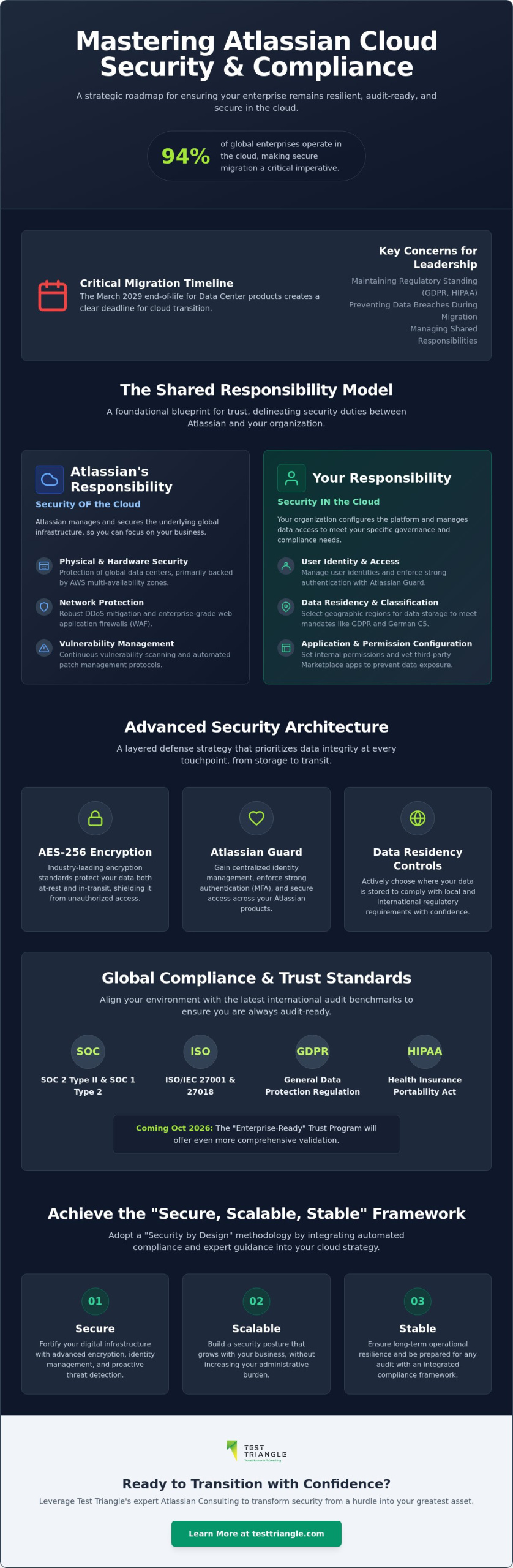
With 94% of global enterprises now operating in the cloud as of 2026, the transition from legacy systems has become an inescapable strategic imperative. While the March 2029 end-of-life for Data Center products creates a clear timeline for migration, many leadership teams remain concerned that moving sensitive workloads might compromise their regulatory standing. You’re likely grappling with the intricacies of the Shared Responsibility Model, feeling the pressure to ensure that atlassian cloud security and compliance features align perfectly with your specific industry mandates.

We understand that the fear of data breaches during migration and the difficulty of mapping features to GDPR or HIPAA requirements can stall even the most vital digital transformations. This guide empowers you to master the complex security landscape, providing a clear roadmap to ensure your enterprise remains resilient and audit-ready. By implementing the advanced encryption protocols and data residency controls available in 2026, you’ll gain the confidence to scale without increasing your administrative burden.

We’ll explore the latest SOC 1 Type 2 attestations, the upcoming “Enterprise-Ready” Trust Program launching in October 2026, and the strategic advantages of Atlassian Guard Premium. This methodical approach transforms security from a perceived hurdle into a robust foundation for long-term operational stability.

Key Takeaways

  • Define the precise boundaries of the Shared Responsibility Model to establish a clear foundation of trust and accountability between your internal teams and the Atlassian platform.
  • Implement sophisticated atlassian cloud security and compliance features, including Atlassian Guard for centralized identity management and AES-256 encryption, to fortify your digital infrastructure.
  • Navigate the complexities of international regulatory standards by aligning your environment with the latest 2026 SOC 2 Type II and ISO/IEC 27001 audit benchmarks.
  • Adopt a “security by design” methodology by integrating automated compliance checks directly into your DevOps pipeline to mitigate legacy risks during cloud migration.
  • Leverage expert Atlassian Consulting to transition from fragmented security settings to a “Secure, Scalable, Stable” framework that ensures long-term operational resilience.

Understanding the Atlassian Cloud Shared Responsibility Model

The Shared Responsibility Model functions as the foundational blueprint for trust between global enterprises and their cloud providers. It isn’t merely a technical division of labor; it’s a strategic framework that ensures organizational stability in a 2026 digital economy where data integrity is paramount. By clearly delineating which security layers are managed by the platform and which remain under your jurisdiction, this model allows leadership to allocate resources more effectively. Understanding these atlassian cloud security and compliance features is the first step toward building a resilient infrastructure that can withstand the evolving threat landscape.

The Infrastructure Layer: What Atlassian Protects

Atlassian assumes full ownership of the security “of” the cloud. This includes the physical protection of the global data center footprint, which is primarily backed by Amazon Web Services (AWS) across multiple availability zones. Their commitment to cloud security principles ensures that the underlying hardware and network layers are fortified against large-scale disruptions. You don’t have to worry about physical site access or the maintenance of server racks. Instead, you benefit from Atlassian’s sophisticated network-level protections, including robust DDoS mitigation and enterprise-grade web application firewalls. Their team manages continuous vulnerability scanning and automated patch management protocols, ensuring that the software foundation remains current without requiring manual intervention from your internal IT staff.

The Operational Layer: Your Strategic Obligations

While Atlassian secures the foundation, your organization is responsible for security “in” the cloud. This operational layer is where strategic Atlassian consulting and implementation becomes vital. You’re responsible for managing user identities, enforcing strong authentication via Atlassian Guard, and classifying data according to your internal risk profiles. In 2026, data residency has become a critical compliance requirement. You must actively select the specific geographic regions where your data resides to meet local legal mandates like GDPR or the German C5 standards. Additionally, the configuration of internal permissions and the vetting of third-party Marketplace apps fall squarely within your remit. Misconfigurations at this level are the most common cause of data exposure, making it essential to have a disciplined approach to access control. Utilizing the full suite of atlassian cloud security and compliance features requires an intentional effort to align platform capabilities with your unique corporate governance policies.

This partnership between Atlassian’s infrastructure and your operational oversight creates a comprehensive security posture. It reduces the total cost of ownership by offloading heavy lifting to the vendor while keeping you in the driver’s seat for data governance and user management.

Advanced Security Architecture: From Encryption to Atlassian Guard

Building on the shared responsibility framework, the technical architecture of the cloud environment provides the specific mechanisms required to protect corporate assets. These atlassian cloud security and compliance features represent a shift toward a holistic security posture that prioritizes data integrity at every touchpoint. In alignment with guidance from the Cloud Security Alliance, the platform implements a layered defense strategy that begins with industry-leading encryption standards. This approach ensures that information remains shielded from unauthorized access, whether it’s stored within an application or moving across the global network.

Encryption and Data Privacy Controls

Data at rest is secured using AES-256 encryption; meanwhile, data in transit relies on TLS 1.2 or higher to prevent interception. For enterprises with stringent regulatory needs, Bring Your Own Key (BYOK) capabilities allow for direct control over encryption keys. This ensures that even the cloud provider can’t access raw data without explicit authorization. Data residency features further enhance this control by allowing organizations to pin data to specific regions. In 2026, this includes expanded support for locations like Germany (C5 Type 2) and Spain (ENS). To further protect privacy, data scrubbing and anonymization tools are increasingly utilized in non-production environments to prevent the exposure of sensitive information during testing phases.

Atlassian Guard: The Enterprise Security Hub

Atlassian Guard serves as the central command center for identity and access management. It bridges the gap between your corporate directory and your cloud products, facilitating seamless Single Sign-On (SSO) with providers like Azure AD, Okta, or Google Workspace. By utilizing System for Cross-domain Identity Management (SCIM), organizations can automate user provisioning and de-provisioning. This automation is critical. It eliminates “zombie” accounts that often serve as entry points for unauthorized access. Key benefits of Guard include:

  • Enforced Security Policies: Mandatory Two-Factor Authentication (2FA) across the entire organization.
  • Centralized Visibility: A single pane of glass for monitoring user activity and API token usage.
  • Anomalous Behavior Detection: AI-driven insights that identify unusual patterns, such as rapid data egress or suspicious login attempts.

As we move through 2026, the architecture has evolved from perimeter-based defenses to a Zero Trust model. Access is no longer granted based on network location but through continuous identity verification. Since June 2026, user API token monitoring is available to all customers at no extra cost, providing a significant boost to visibility without increasing spend. To ensure these atlassian cloud security and compliance features are configured to your specific risk profile, speaking with an implementation partner can provide the necessary strategic oversight to maintain a secure and compliant environment.

Global Compliance Standards: GDPR, SOC 2, and Industry Specifics

The 2026 audit landscape demands more than just checkboxes; it requires a deep integration of regulatory controls into every workflow. Reviewing Atlassian’s SOC 2 Type II and SOC 3 reports for 2026 reveals a commitment to the highest standards of availability and confidentiality. These reports, alongside the SOC 1 Type 2 attestation achieved in Q4 2025 for Jira and Confluence, provide the transparent documentation necessary for enterprise risk assessments. By aligning with ISO/IEC 27001 and 27018, the platform offers a globally recognized benchmark for information security management that satisfies most jurisdictional requirements. However, the true strength of atlassian cloud security and compliance features lies in their ability to adapt to specific regional mandates, such as the German C5 Type 2 attestation provided in Q1 2026 or the ENS requirements in Spain slated for Q4 2026.

A significant challenge for many organizations remains the third-party ecosystem. To address this, the “Enterprise-Ready” Trust Program launches in October 2026, replacing the older “Cloud Fortified” badge with stricter standards for security and reliability. This program, combined with the “Runs on Atlassian” initiative for Forge apps, ensures that your Marketplace integrations don’t become a weak link in your compliance chain. For Australian enterprises, maintaining this chain includes ensuring that specialized financial tools like Trancher are integrated into a broader strategy for end-to-end AML/CTF program management. These initiatives allow for better control over data egress and ensure that app storage matches the data residency of the host product.

GDPR and Evolving Privacy Regulations

GDPR compliance has evolved beyond simple data processing agreements. Today, automated tools for the “right to be forgotten” allow administrators to execute data deletion and export requests across the entire site with precision. As AI adoption grows, managing data usage within Atlassian Rovo, which now serves over 5 million monthly active users, is paramount. Strategic governance ensures that AI-powered insights don’t inadvertently expose sensitive personal data, maintaining the integrity of your Data Processing Addendums (DPA). It’s essential to configure these tools to prevent unauthorized data egress while still leveraging the productivity gains of enterprise AI.

Industry-Specific Compliance: Pharma and Finance

For life sciences, GxP compliance is non-negotiable. The platform provides validated instances and comprehensive audit trails that allow for the meticulous tracking of every change, ensuring your environment remains audit-ready for health authority inspections. Similarly, financial institutions must navigate the complex requirements of BaFin, EBA, and APRA. Jira and Confluence are designed to support these standards through granular permission schemes and data residency pinning. Our expert Atlassian Consulting ensures these standards are met during implementation through rigorous validation and audit trail configuration. By leveraging these atlassian cloud security and compliance features, highly regulated firms can achieve a level of operational resilience that was previously difficult to maintain in a cloud-only environment.
Atlassian Cloud Security and Compliance Features: The 2026 Enterprise Strategic Guide

Security by Design: Integrating Compliance into Cloud Migration

Successful cloud migration requires a shift from reactive patching to a “Security by Design” philosophy. This methodology ensures that compliance isn’t an afterthought but a core component of the transition process. By leveraging atlassian cloud security and compliance features during the initial planning phases, enterprises can identify legacy risks that may have accumulated in on-premise environments over years of operation. This proactive stance reduces technical debt and streamlines cloud configurations, ensuring your new environment is built on a foundation of operational excellence and risk mitigation.

The Security Audit and Assessment Phase

Before any data moves, a comprehensive audit is essential to establish a baseline of trust. This begins with rigorous data classification to determine which workloads are suitable for the cloud and which require additional safeguards. It’s the ideal moment to implement the Principle of Least Privilege (PoLP) by cleaning up years of permission sprawl. Enterprises should also evaluate their ecosystem using the new “Enterprise-Ready” Trust Program, which replaces the Cloud Fortified badge in October 2026. Evaluating the security posture of Marketplace plugins is now more structured thanks to the Partner Security Incident Response Program established on June 18, 2026. This allows for a joint investigation of incidents affecting third-party apps, ensuring your entire ecosystem remains resilient and audit-ready from day one.

Continuous Compliance in a DevOps World

Security doesn’t end when the “migration complete” notification arrives. Integrating compliance checks into your DevOps Consulting pipeline ensures that custom integrations and configurations remain secure as they evolve. Real-time alerting and incident response planning are critical for maintaining visibility in complex cloud environments. For instance, the security bulletin from June 16, 2026, which addressed 76 high-severity and 24 critical vulnerabilities, highlights the need for rapid patch validation. By utilizing Software Test Automation Services, organizations can automatically verify that security patches don’t disrupt core functionalities. This continuous monitoring approach allows teams to respond to threats with agility while maintaining the integrity of their atlassian cloud security and compliance features.

Maintaining this level of technical rigor requires a partner who understands the intersection of security and speed. If you’re ready to build a compliant, high-performance cloud environment that scales with your ambition, contact our strategic consultants today to begin your security assessment.

Optimising Security with Test Triangle’s Atlassian Consulting

While the technical capabilities of the cloud platform are robust, the human element remains the deciding factor in enterprise resilience. Orchestrating the complex settings of atlassian cloud security and compliance features requires more than just a manual; it demands a strategic visionary who can align these tools with global business objectives. Test Triangle acts as a steady hand in this fast-changing technological landscape, employing a “Secure, Scalable, Stable” framework to ensure your digital infrastructure doesn’t just meet today’s standards but is prepared for the regulatory shifts of 2027 and beyond. By bridging the gap between raw technical features and business-critical compliance, we transform security from a cost center into a foundation for organizational progress.

Maintaining 24/7 security vigilance is a significant undertaking for internal IT departments already stretched by digital transformation demands. By leveraging our Managed Service Provider Subscription Fees model, organizations gain access to continuous monitoring and expert oversight that ensures no vulnerability goes unaddressed. This partnership model provides the peace of mind derived from risk reduction, allowing your leadership to focus on core innovation while we manage the intricacies of your cloud environment. We prioritize operational efficiency and systemic improvement, ensuring that your security posture evolves in tandem with your growth.

Strategic Roadmapping and Advisory

We don’t believe in one-size-fits-all solutions. Our consulting begins with tailored security configurations based on your specific industry risk profile, whether you’re navigating the GxP requirements of life sciences or the stringent mandates of the financial sector. We provide expert guidance on Atlassian Guard implementation and complex IAM integration with industry-leading platforms like Azure AD and Okta. To support these initiatives, our staffing solutions provide dedicated security experts who act as an extension of your team, ensuring that your atlassian cloud security and compliance features are managed with institutional maturity and technical rigor.

Long-Term Partnership and Support

Resilience is a continuous journey rather than a destination. We act as a reliable long-term collaborator, providing regular security health checks and compliance re-validation services to address the evolving threat landscape. Our approach includes training your team on Atlassian security best practices and threat awareness, empowering your workforce to become the first line of defense. This methodical and highly structured support system ensures that your organization remains audit-ready and resilient. To begin fortifying your infrastructure, contact Test Triangle today for a comprehensive Atlassian Cloud Security Assessment and secure your enterprise’s digital future.

Future-Proofing Your Enterprise Digital Ecosystem

The transition to a resilient cloud environment requires more than just deploying software; it necessitates a disciplined alignment of platform capabilities with rigorous corporate governance. By mastering the atlassian cloud security and compliance features discussed in this guide, your organization can move beyond the complexities of the Shared Responsibility Model to achieve a state of operational excellence. This strategic evolution ensures that your data remains protected, your audits stay green, and your teams remain empowered to innovate without the fear of security compromises or regulatory friction.

As an Atlassian Gold Solution Partner with ISO 27001 certified processes, Test Triangle provides the institutional maturity and technical rigor required to manage your most sensitive workloads. Our global delivery model offers 24/7 managed support, providing a Secure, Scalable, Stable foundation that acts as a reliable long-term collaborator for your business. We’re ready to help you bridge the gap between technical execution and long-term operational stability through expert-led managed services that grow with your ambition.

Secure Your Infrastructure with Test Triangle’s Atlassian Consulting and embrace the confidence of a fully compliant digital future.

Frequently Asked Questions

Is Atlassian Cloud more secure than on-premise Data Center deployments?

Atlassian Cloud provides superior security through centralized infrastructure management and rapid patch deployment. While Data Center relies on manual updates, cloud instances benefit from immediate vulnerability remediation, such as the 100 high and critical vulnerabilities addressed in June 2026. This model reduces the risk of zero-day exploits and allows your IT staff to focus on strategic governance rather than hardware maintenance.

How does Atlassian Guard help with enterprise compliance requirements?

Atlassian Guard serves as the primary engine for identity-based compliance by enforcing mandatory Two-Factor Authentication (2FA) and centralized Single Sign-On (SSO). It facilitates automated user provisioning via SCIM, which eliminates the risk of “zombie” accounts. These atlassian cloud security and compliance features provide the audit trails and access controls necessary to satisfy SOC 2 and ISO 27001 requirements across your entire digital ecosystem.

Where is my data stored in Atlassian Cloud and can I choose the location?

Your data is stored within a global network of AWS-backed data centers. Enterprise customers can utilize data residency controls to pin primary product data to specific geographic regions, such as Germany for C5 compliance or Spain for ENS requirements. This capability ensures that your organizational data remains within jurisdictional boundaries, satisfying local legal mandates and reducing the complexity of international privacy regulations.

What happens to my data security when I use Atlassian Marketplace apps?

Security for Marketplace apps is a shared responsibility between Atlassian, the app vendor, and your organization. To mitigate risks, you should prioritize apps within the “Enterprise-Ready” Trust Program or the “Runs on Atlassian” initiative. These programs ensure higher standards for data egress control and residency matching, providing a more secure and predictable environment for third-party integrations.

Does Atlassian Cloud support HIPAA compliance for healthcare organizations?

Yes, Atlassian Cloud supports HIPAA compliance for Jira, Confluence, and Jira Service Management. Organizations must enter into a Business Associate Agreement (BAA) and configure their instances to meet specific administrative and technical safeguards. This includes implementing strong encryption and granular access controls to ensure that Protected Health Information (PHI) is managed with the highest standards of confidentiality and integrity.

How can I automate security monitoring within Jira and Confluence?

Automation is achieved through Atlassian Guard’s proactive threat detection and real-time alerting systems. Since June 2026, all customers can monitor user API token usage at no extra cost to identify suspicious activity. Additionally, AI-driven insights within the platform detect anomalous user behaviors, such as rapid data exports, allowing for an immediate incident response that maintains the integrity of your atlassian cloud security and compliance features.

What is the Shared Responsibility Model in the context of Atlassian Cloud?

The Shared Responsibility Model defines the division of security obligations between the provider and the client. Atlassian is responsible for the security “of” the cloud, including physical hardware and network infrastructure. Conversely, your organization is responsible for security “in” the cloud, which encompasses user access management, data classification, and the secure configuration of your specific application instances.

How often does Atlassian undergo third-party security and compliance audits?

Atlassian undergoes rigorous third-party audits on a continuous basis to maintain its various certifications. For instance, Jira and Confluence were attested against SOC 1 Type 2 requirements in Q4 2025, and a German C5 Type 2 attestation was provided in Q1 2026. These regular evaluations ensure that the platform’s security controls remain effective against the evolving threat landscape and current global benchmarks.

Paul Guy

Article by

Paul Guy

Paul serves as the Marketing Director at Test Triangle, where he leads a global team in driving growth through strategic B2B marketing and brand communications. With a strong emphasis on measurable outcomes and sustainable performance, he plays a pivotal role in aligning marketing functions to enhance customer engagement and accelerate business impact. Under his leadership, marketing initiatives have consistently delivered significant returns on investment, elevated brand visibility, and strengthened the company's presence across key markets.
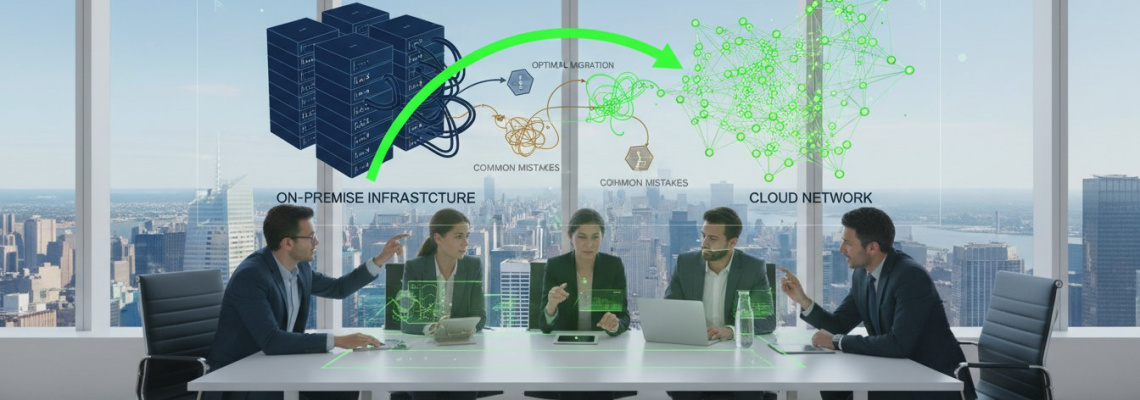
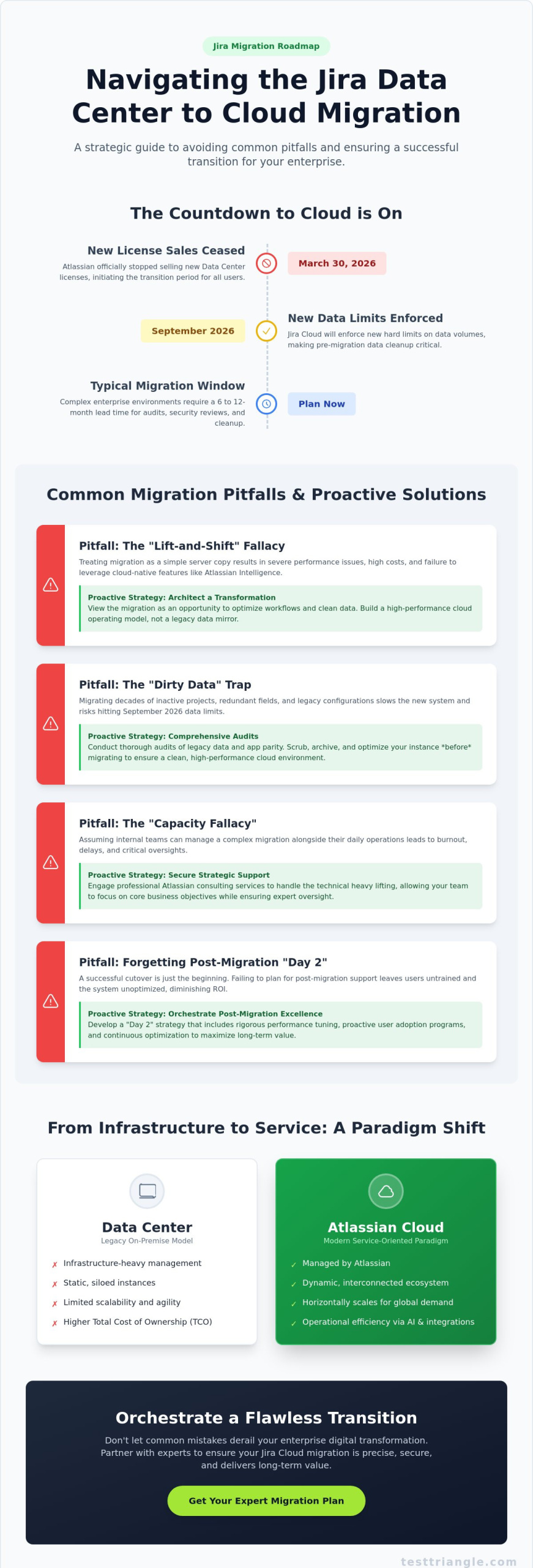
Did you know that as of March 30, 2026, Atlassian has officially ceased the sale of new Data Center licenses, effectively placing a firm countdown on your legacy infrastructure? It’s a reality that many global organizations find daunting, especially when faced with the intricate challenge of moving high-volume instances. You likely recognize that the complexity of migrating third-party apps and the risk of business downtime during cutover are not just technical hurdles; they’re significant threats to your operational continuity. By identifying common jira data center to cloud migration mistakes early, your team can pivot from a reactive posture to a proactive strategy that ensures precision, pace, and performance.

This guide identifies the critical pitfalls that derail enterprise transitions and provides a clear risk-mitigation roadmap for the current regulatory environment. We’ll examine the nuances of Atlassian Cloud features, the impact of the September 2026 data limits, and the strategic business case for professional Atlassian consulting to ensure your long-term success. Whether you’re navigating the requirements of the NIS2 Directive or managing a hybrid-sovereign cloud model, understanding these nuances is essential for a secure and high-performance transition.

Key Takeaways

  • Architect a strategic transition by moving beyond the simple “lift-and-shift” mentality to ensure your cloud environment functions as a high-performance operating model rather than a legacy data mirror.
  • Mitigate technical risks by conducting comprehensive audits of legacy data and app parity, effectively neutralizing common jira data center to cloud migration mistakes before they impact your production environment.
  • Navigate the evolving landscape of global data sovereignty and residency regulations to maintain strict compliance with modern frameworks like the NIS2 Directive and the EU Data Act.
  • Secure organizational stability by addressing the “capacity fallacy,” ensuring that internal teams have the necessary strategic support to manage both daily operations and the technical nuances of Atlassian Cloud.
  • Orchestrate a successful “Day 2” strategy that prioritizes rigorous performance tuning and proactive user adoption to maximize the long-term value of your enterprise digital transformation.

Beyond the Lift-and-Shift: The Strategic Landscape of Jira Cloud Migration in 2026

Transitioning from Jira Data Center to the Cloud is no longer a mere technical upgrade; it’s a fundamental transformation of your organizational operating model. In 2026, the distinction between maintaining a legacy environment and evolving into a cloud-native enterprise is defined by how effectively leadership views the platform as a driver of velocity. Treating this transition as a simple “lift-and-shift” operation is one of the most common jira data center to cloud migration mistakes, often resulting in severe post-migration performance issues. This outdated mentality fails to account for the architectural differences between clustered on-premise servers and the multi-tenant, service-oriented nature of the Atlassian Cloud.

Success in the current landscape requires a shift in focus from the immediate cost of migration to the long-term Total Cost of Ownership (TCO). While the initial project expenses are visible, the true value lies in the operational efficiency gained through Atlassian Intelligence and Rovo integrations. These AI-driven tools, which transform whiteboard sessions into actionable Jira items and automate status updates, require clean, structured data to function. Migrating “dirty data” or redundant workflows prevents these sophisticated systems from delivering the insights they’re designed to provide. Consequently, a strategic approach prioritizes data hygiene and workflow optimization long before the first record is moved.

The Evolution from Data Center to Cloud Architecture

The transition from Data Center to Cloud represents a move from infrastructure-heavy management to a service-oriented paradigm where Atlassian manages the underlying complexities. When understanding the fundamentals of cloud migration, it’s clear that the shift involves a total re-evaluation of how data is processed and stored globally. Atlassian Cloud utilizes a distributed architecture that scales horizontally, ensuring that performance remains consistent regardless of user volume. Cloud-Native Jira is a dynamic ecosystem of interconnected services that scale horizontally to meet global demand, rather than a static, siloed instance. This architecture allows for a level of agility and security that traditional Data Center models simply cannot replicate in a fast-paced market.

Why Planning Delays are Fatal for Enterprise Timelines

A frequent error that compromises enterprise stability is waiting too long to initiate the migration process. With the March 30, 2026 deadline for new Data Center license sales already passed, the countdown to the 2029 end-of-life is accelerating. Complex enterprise environments typically require a 6 to 12-month lead time to navigate app parity audits, security reviews, and data cleanup. Underestimating this timeline is another of the common jira data center to cloud migration mistakes that leads to rushed cutovers and avoidable downtime. Partnering with professional Atlassian Consulting Services provides the strategic oversight needed to manage these nuances, allowing your internal teams to maintain focus on core business objectives while experts handle the technical heavy lifting.

The Technical Pitfalls: Data Integrity, App Parity, and Identity Management

Technical execution often falters when organizations prioritize speed over data hygiene. Migrating decades of legacy configurations, inactive projects, and redundant custom fields creates the “Dirty Data” trap. This clutter doesn’t just slow down the system; it actively compromises the user experience and can trigger the new hard limits on data volumes that Jira Cloud will enforce starting in September 2026. Failing to scrub your instance before deployment is one of the most common jira data center to cloud migration mistakes, leading to a platform that feels bloated and unresponsive from day one.

App parity remains a significant point of friction. Many stakeholders assume that a “Cloud-compatible” version of a Data Center app provides identical functionality, but the reality is often a reduced feature set or a completely different workflow. This functional gap requires a disciplined evaluation of your app ecosystem to ensure business processes remain intact. Without rigorous sandbox testing, these discrepancies only surface post-cutover, causing immediate productivity losses and technical debt. To ensure your technical roadmap is sound, you might consider consulting with a technical strategist before finalizing your cutover plan.

Executing a Comprehensive App and Data Audit

A robust audit framework categorizes every third-party integration into three paths: Retire, Replace, or Reinstall. Retiring obsolete apps reduces licensing costs and security risks, while replacing others with cloud-native alternatives ensures long-term stability. Before utilizing the Jira Cloud Migration Assistant (JCMA), teams must perform meticulous data mapping for complex custom fields. This step ensures that critical metadata survives the transition and aligns with the Cloud’s specific data structures, preventing the loss of historical context during the transfer.

Identity and Access Management (IAM) Strategy

The shift from local LDAP or Active Directory to Atlassian Guard represents a major architectural change. Ignoring User Provisioning (SCIM) during the planning phase often results in fragmented user directories and failed Single Sign-On (SSO) attempts. Validating these permissions is vital; leveraging Software Test Automation Services allows organizations to verify that complex access hierarchies remain secure and functional across the entire enterprise. This automated validation provides the qualitative assurance needed for high-stakes environments.

Relying on a single test migration is a high-risk oversight for enterprise-scale data. Effective migrations utilize multiple sandbox environments to refine the process, identifying edge cases that only appear under heavy load or complex data interdependencies. This iterative methodology transforms a volatile technical transfer into a controlled, predictable evolution that supports long-term operational stability.

Common Jira Data Center to Cloud Migration Mistakes: A Strategic Guide for 2026

Compliance and Security Oversights: Navigating Global Data Sovereignty

A frequent misunderstanding in the migration journey is the assumption that Atlassian’s shared responsibility model provides an all-encompassing shield against local regulatory infractions. While Atlassian maintains robust platform security, the onus of data governance, residency compliance, and configuration integrity remains firmly with the enterprise. Overlooking this distinction is one of the most common jira data center to cloud migration mistakes, potentially exposing organizations to the severe penalties associated with the NIS2 Directive and the EU Data Act. In an era where cumulative GDPR fines reached €7.1 billion by early 2026, assuming “Cloud-native” equals “automatically compliant” is a risk no global leader should take.

Highly regulated sectors face even more granular challenges that require a strategic, practical approach. Pharmaceutical organizations must navigate GxP validation requirements to ensure their Jira Cloud environments remain compliant with electronic record standards. Similarly, financial institutions are often bound by the “Right to Audit” and strict encryption protocols for data at rest and in motion. Failing to account for these sector-specific mandates during the architectural phase leads to costly retrofitting or total project halts during external audits. Precision in planning is the only antidote to such high-stakes regulatory friction.

Data Sovereignty in a Post-GDPR Landscape

Jira Cloud Enterprise offers sophisticated data residency features that allow organizations to pin their data to specific geographic regions. However, selecting the wrong region for a global team can inadvertently trigger jurisdictional conflicts or latency issues. Many enterprises fail to align their data storage locations with the specific requirements of the over 140 countries that now have active data protection laws. To navigate these complexities, engaging with a Managed Service Provider ensures your cloud architecture is strategically aligned with both global performance needs and local legal mandates.

Security Configuration vs. Platform Security

There’s a critical difference between the security of the Atlassian platform and the security of how you configure your specific instance. Bulk migrations often result in the preservation of “over-privileged users,” where permissions that were safe in a siloed Data Center environment become vulnerabilities in the Cloud. This oversight can lead to unauthorized data exposure or non-compliance with internal security policies. A Zero-Trust approach to Cloud Jira access is not merely a preference; it’s a fundamental requirement for modern enterprise stability. By implementing strict identity verification and least-privilege access, organizations can mitigate the risks inherent in large-scale technological evolution while maintaining operational agility.

The Human Element: Why Change Management and Resource Underestimation Fail

Organizations often succumb to the “Capacity Fallacy,” assuming that their internal Jira administrators can maintain business-as-usual operations while simultaneously architecting a complex migration. This resource underestimation is among the most common jira data center to cloud migration mistakes; it leads to burnout, overlooked technical requirements, and eventually, a compromised transition. When internal teams are stretched thin, the meticulous attention required for data mapping and security configuration inevitably wavers, creating systemic vulnerabilities that manifest long after the cutover is complete. True operational stability requires a recognition that migration is a dedicated project, not a side task for an already burdened IT department.

Beyond the technical staffing, the human element of user adoption often becomes a primary point of failure. Ignoring the UI/UX changes between Data Center and Cloud results in immediate productivity loss as users struggle with a redesigned interface and new navigation patterns. This “Migration Anxiety” is exacerbated by a communication void where stakeholders feel uninformed about how their daily workflows will evolve. Training gaps are equally damaging, particularly when power users aren’t educated on Cloud-only features like advanced Automation or Rovo. Without a structured approach to change management, even the most technically perfect migration can be perceived as a failure by the workforce it was intended to empower.

Bridging the Internal Expertise Gap

Augmenting your core team with specialized IT Staffing Services provides the necessary bandwidth to manage complex migrations without disrupting daily output. An experienced Atlassian Solution Architect plays a pivotal role in this process, ensuring that the new Cloud environment is built to avoid architectural debt and long-term performance bottlenecks. When evaluating the investment, leaders must compare the cost of external consulting against the catastrophic financial impact of a failed 48-hour cutover. Precision in staffing is a prerequisite for a seamless, low-risk transition that protects your enterprise’s operational integrity.

A Strategic Communication and Training Roadmap

Mitigating common jira data center to cloud migration mistakes requires a structured, 4-phase communication plan: Announcement, Education, Preparation, and Support. Identifying “Champion” users within each department allows for peer-to-peer leadership, which often proves more effective than top-down directives. These advocates help bridge the gap between technical changes and practical application. Furthermore, a human-centric approach to quality is essential; referring to a Manual Testing Guide can help your team understand how to validate the user experience through the eyes of the end-user rather than just through automated scripts. This comprehensive preparation ensures that when the system goes live, your workforce is ready to leverage the new platform’s full potential.

To ensure your internal teams are supported by the right expertise during this critical evolution, speak with an enterprise migration strategist to secure your resource roadmap.

Orchestrating a Flawless Transition: A Framework for Post-Migration Excellence

The successful execution of a technical cutover isn’t the finish line; it’s the commencement of your platform’s most vulnerable phase. One of the most common jira data center to cloud migration mistakes is the “Day 2” oversight, where organizations prematurely disband their project teams once the data appears to be live. This strategic withdrawal often leads to unresolved latency issues, broken integration hooks, and a frustrated user base that lacks immediate support. Realizing the full value of your investment requires a shift from a “Migrated” status to an “Optimized” state, ensuring the system meets the rigorous speed and reliability standards expected in 2026.

True post-migration excellence is defined by how effectively you leverage the cloud-native features that weren’t available in your legacy environment. In the current landscape, this means integrating Atlassian Intelligence and Rovo to drive automated status updates and intelligent search capabilities across your entire digital ecosystem. Without proactive performance tuning and the removal of technical debt that survived the move, these sophisticated tools won’t reach their full potential. A disciplined approach to refinement ensures that your transition results in a high-performance, future-ready infrastructure rather than a mere mirror of your old on-premise limitations.

Post-Migration Hypercare and Optimization

A structured “Hypercare” period, typically spanning the first 30 days post-migration, is essential for maintaining operational cadence. During this window, dedicated support resources must be available to address edge cases that only emerge under the pressure of full-scale production. Conducting a post-migration audit is vital to identify “Ghost Data” or broken links that can occur when complex project interdependencies are moved between architectures. For organizations looking to transform this initial stability into a long-term competitive advantage, engaging with DevOps Consulting Services provides a roadmap for continuous platform evolution and systemic improvement.

Establishing a Cloud Governance Framework

Failing to update governance policies for the cloud environment often leads to “admin sprawl,” where a lack of centralized control results in redundant configurations and security vulnerabilities. Strategic management of Atlassian Marketplace app subscriptions is equally critical; organizations must monitor renewals and usage patterns to prevent licensing costs from escalating unchecked. By establishing a robust governance framework, you ensure that your Jira Cloud instance remains secure, scalable, and cost-effective. To navigate these complexities with confidence and secure your organizational progress, Partner with Test Triangle for a Risk-Free Atlassian Migration and experience the peace of mind that comes from expert-led digital transformation.

Strategizing Your Evolution to Atlassian Cloud

Successfully navigating the transition to Atlassian Cloud requires a fundamental shift in perspective, moving from a narrow focus on technical file transfers to a comprehensive strategy for organizational evolution. By proactively addressing common jira data center to cloud migration mistakes, your enterprise can effectively bypass the technical debt and compliance risks that frequently stall global digital transformations. This journey demands a disciplined approach to data hygiene, a robust governance framework, and a dedicated focus on user adoption that empowers your workforce to leverage the full potential of Atlassian Intelligence. You don’t have to manage this intricate process in isolation; the right partnership transforms a volatile project into a predictable success story.

As an Atlassian Gold Solution Partner, we provide the specialized expertise in Pharma and Finance compliance required to ensure your transition meets the most rigorous global regulatory standards. Our global delivery model offers the strategic oversight and technical precision necessary to maintain operational stability during high-stakes cutovers. Secure Your Seamless Atlassian Cloud Migration with Test Triangle and begin your journey toward a high-performance, future-ready infrastructure. Your path to a secure and scalable cloud environment starts here.

Frequently Asked Questions

What is the most common mistake in Jira Data Center to Cloud migrations?

Underestimating the architectural shift by treating the project as a simple “lift-and-shift” is the most frequent error global organizations make. This reactive approach leads to common jira data center to cloud migration mistakes such as severe performance bottlenecks and broken automation hooks. Successful transitions require a strategic overhaul of data hygiene and app parity long before the final production cutover begins.

How long does a typical enterprise Jira Cloud migration take in 2026?

Enterprise-scale migrations typically require a lead time of 6 to 12 months to navigate the complexities of global data residency and rigorous security audits. This timeline allows for meticulous planning, data scrubbing, and multiple sandbox testing phases to identify edge cases. Rushing this window often compromises the integrity of the final environment and leads to avoidable business downtime.

Can we migrate all our Jira Data Center apps to the Cloud?

Not every Data Center app has a direct Cloud equivalent with identical functionality; some require complete replacement or retirement. You must categorize your app ecosystem into those to retire, replace, or reinstall based on their specific Cloud-native capabilities. A disciplined audit prevents functional gaps that disrupt critical business processes after the transition is complete.

Is Jira Cloud as secure as Jira Data Center for regulated industries?

Jira Cloud provides robust security through Atlassian Guard, but organizations must actively manage their specific configurations to meet local regulatory mandates. This shared responsibility model ensures that while the platform is secure, the client remains accountable for data governance and user access hierarchies. Proper alignment with frameworks like the NIS2 Directive is essential for maintaining compliance in regulated sectors.

What happens if our Jira migration fails during the cutover weekend?

A failed cutover requires the immediate execution of a pre-verified rollback plan to restore services on the original Data Center instance. To avoid this scenario, teams should conduct exhaustive performance testing and sandbox rehearsals to identify technical friction points before the live migration. Minimizing downtime depends on a disciplined methodology and the foresight to have experts on standby.

How do we handle user training for the new Jira Cloud interface?

User training should follow a structured roadmap that includes early announcements and the identification of department-level “champion” advocates. These champions help bridge the gap between technical UI changes and practical daily application for their peers through peer-to-peer support. Focusing on the human element ensures that the workforce remains productive and engaged during the technological evolution.

Do we need an external Atlassian consultant for the migration?

Engaging an external Atlassian consultant is a strategic decision that provides the specialized expertise needed to avoid common jira data center to cloud migration mistakes. Professional consultants bring a global delivery model and deep technical knowledge that internal teams, often occupied with daily operations, may lack. This partnership significantly reduces project risk and ensures long-term operational stability.

What is the difference between Jira Cloud and Jira Data Center features in 2026?

By 2026, the primary differentiator is the integration of Atlassian Intelligence and Rovo, which are features exclusive to the Cloud platform. These tools offer automated status updates and intelligent search capabilities that traditional Data Center environments cannot support. The Cloud architecture also scales horizontally, providing superior performance and agility for global teams compared to siloed server clusters.

Paul Guy

Article by

Paul Guy

Paul serves as the Marketing Director at Test Triangle, where he leads a global team in driving growth through strategic B2B marketing and brand communications. With a strong emphasis on measurable outcomes and sustainable performance, he plays a pivotal role in aligning marketing functions to enhance customer engagement and accelerate business impact. Under his leadership, marketing initiatives have consistently delivered significant returns on investment, elevated brand visibility, and strengthened the company's presence across key markets.