
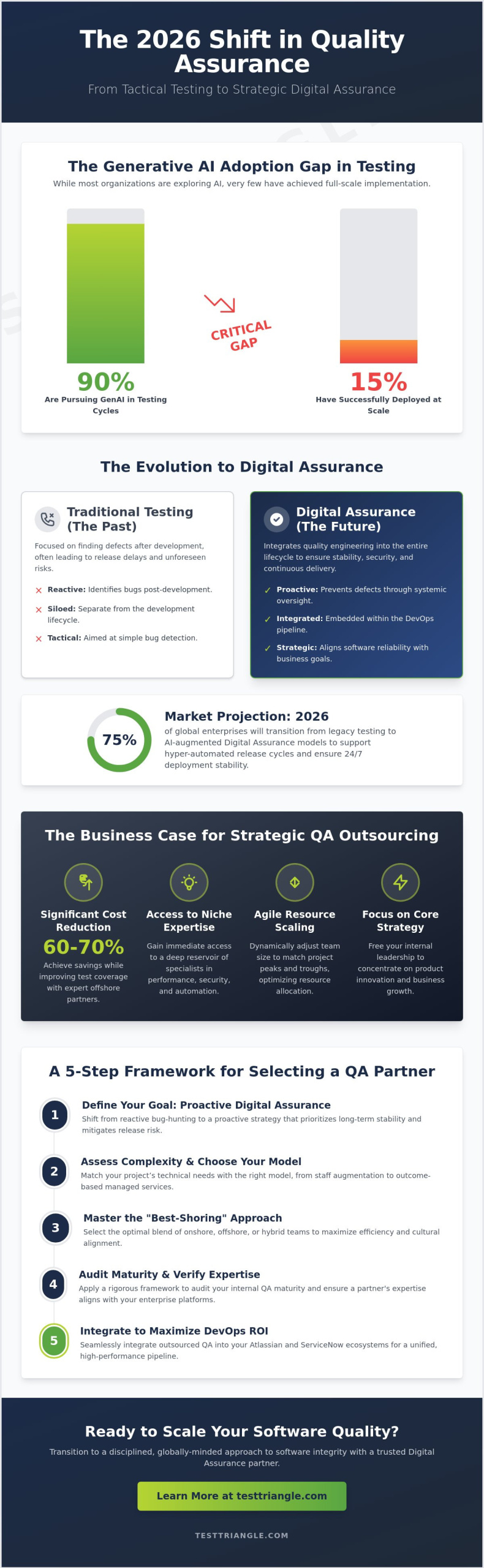
While nearly 90% of organizations are currently pursuing generative AI in their testing cycles, only 15% of enterprises have successfully deployed these technologies at scale. This gap reveals a critical friction point in quality assurance outsourcing, where the simple goal of cost reduction has evolved into a strategic necessity for deep digital assurance. If you’ve found that local recruitment costs are prohibitive or that generic freelancers provide inconsistent quality, you’re likely searching for a more disciplined, versatile, and globally-minded approach to software integrity.

We recognize that managing complex digital infrastructures requires a partner who values stability, precision, and growth over quick fixes. This article provides a strategic roadmap to help you scale your software quality, reduce release risks, and navigate the transition toward AI-augmented testing models. We’ll examine the latest 2026 shifts in the Atlassian ecosystem, including the integration of Rovo agents into Jira workflows, and provide a methodical framework for choosing an outsourcing model that delivers both technical rigor and operational efficiency for your enterprise ecosystem.

Key Takeaways

  • Understand the 2026 shift from reactive testing to proactive Digital Assurance, ensuring your software lifecycle prioritizes long-term stability and risk mitigation.
  • Navigate the spectrum of quality assurance outsourcing by matching your project’s technical complexity with the appropriate model, from staff augmentation to outcome-based managed services.
  • Master the “best-shoring” approach to geographic delivery, selecting the optimal blend of onshore, offshore, or hybrid teams to maximize operational efficiency and cultural alignment.
  • Apply a rigorous 5-step framework to audit your internal QA maturity and verify that a partner’s technical expertise aligns with your specific enterprise platforms.
  • Enhance your DevOps ROI by seamlessly integrating outsourced QA functions into your existing Atlassian and ServiceNow environments for a unified, high-performance ecosystem.

The Evolution of Quality Assurance Outsourcing in 2026

Modern enterprise ecosystems in 2026 demand more than just technical bug detection; they require a comprehensive alignment between software reliability and business objectives. As global organizations face the pressure of hyper-automated release cycles, quality assurance outsourcing has transitioned from a tactical cost-saving measure into a foundational pillar of digital resilience. This evolution is driven by the necessity to manage complex, AI-integrated infrastructures where traditional testing methods often fall short of providing the required speed and security. Global leaders now seek strategic partners who offer stability, security, and scalability rather than mere contract labor. It’s a shift that prioritizes long-term operational excellence over short-term fixes.

Digital Assurance vs. Traditional Software Testing

The shift toward software and digital assurance represents a fundamental change in how quality is perceived within the DevOps lifecycle. While traditional testing focused on identifying defects after development, Digital Assurance integrates quality engineering into every phase of the pipeline to ensure continuous delivery. By 2026, it is projected that 75% of global enterprises will have transitioned from legacy testing to AI-augmented QA models to support these rapid cycles. This methodology prioritizes self-healing automation scripts and predictive analytics, allowing teams to maintain 24/7 deployment stability without compromising brand reputation. It doesn’t just identify errors; it prevents them through systemic oversight and technical rigor.

The Business Case for Outsourcing QA

Building an internal team capable of handling modern performance, security, and compatibility testing is often cost-prohibitive for even the largest global enterprises. Through strategic outsourcing, companies can access a deep reservoir of niche expertise without the overheads of permanent recruitment or specialized training. Data from industry reports suggests that organizations leveraging offshore partners can achieve cost reductions of 60-70% while simultaneously improving testing coverage through advanced toolsets. This model provides the agility to scale resources during project peaks, ensuring that technical managers and executive leadership maintain absolute control over release quality. Digital Assurance is a proactive business continuity strategy that safeguards operational stability against the volatility of the digital landscape.

Strategic Engagement Models: Beyond Simple Staff Augmentation

Selecting an appropriate engagement model requires a deep understanding of your organization’s internal capabilities and long-term technical objectives. In 2026, the industry has moved beyond simple transactional relationships toward a strategic guide to global collaboration, where the choice of model directly impacts your ability to innovate. Within the framework of quality assurance outsourcing, technical leaders must balance the need for direct oversight with the benefits of provider-led accountability. This balance is critical for maintaining the high standards of security and reliability expected in modern enterprise ecosystems.

Managed Testing Services (MTS)

Managed Testing Services (MTS) represent the most comprehensive end of the outsourcing spectrum, positioning the vendor as a fully accountable partner for your quality outcomes. This model transitions the burden of process management, tool selection, and talent development to the provider, allowing your internal leadership to focus on core product strategy. By establishing clear Service Level Agreements (SLAs) and utilizing outcome-based billing, you ensure that the cost of quality is directly tied to tangible results. It’s an ideal solution for enterprises managing legacy systems or complex ServiceNow implementations that require consistent, year-round maintenance and systemic oversight. This model fosters a sense of institutional maturity, ensuring that your digital infrastructure remains resilient against evolving market demands.

Staff Augmentation and Dedicated QA Teams

Conversely, organizations requiring high-velocity development and tight integration often prefer IT staffing services to bolster their internal teams. This model provides the agility to scale testing capacity during critical project peaks, such as the weeks leading up to a major Atlassian Spring Release. By embedding dedicated QA professionals into your existing Agile or DevOps workflows, you maintain full control over the testing methodology while benefiting from the specialized skills of external experts. This hybrid approach often yields the best of both worlds: the institutional knowledge of your core team combined with the execution speed of offshore talent. It’s a versatile strategy for maintaining 24/7 testing cycles across different time zones, ensuring that code is validated as quickly as it’s written. Ultimately, this approach delivers scalability, speed, and security to your development pipeline.

If you’re uncertain which model fits your current infrastructure, speaking with a strategic consultant can help clarify your requirements and identify the most efficient path forward.
Quality Assurance Outsourcing in 2026: A Strategic Guide to Digital Assurance

Evaluating Geographic Delivery: Onshore, Offshore, and Hybrid Advantage

In the current technological landscape, the geographic distribution of testing operations is no longer a binary choice between domestic oversight and international cost savings. Modern quality assurance outsourcing requires a “best-shoring” strategy, which involves the methodical alignment of specific project tasks with the most efficient geographic delivery model. For instance, high-level strategic consulting and initial requirement gathering often thrive in an onshore or nearshore environment where real-time collaboration is seamless. Conversely, large-scale execution and regression testing benefit from the resource depth found in offshore centers. This balanced approach ensures that global enterprises maintain operational stability while leveraging the global talent pool to achieve 24/7 delivery cycles.

Success in a distributed model hinges on overcoming traditional barriers such as communication gaps and time-zone disparities. By implementing structured reporting frameworks and utilizing integrated platforms like Jira and ServiceNow, organizations can bridge these divides effectively. A global presence is particularly vital for highly regulated sectors like finance and healthcare, where local knowledge of regional standards must be combined with global engineering excellence. This synergy allows for the creation of a resilient testing ecosystem that is both culturally aligned and technically proficient. It’s about establishing a foundation of precision, performance, and protection in every global engagement.

Cost vs. Quality: Finding the Equilibrium

While the allure of low hourly rates in offshore regions remains strong, technical leaders must look toward the Total Cost of Ownership (TCO) rather than isolated line items. Engaging with a partner solely on price often results in significant technical debt, as poor initial testing leads to expensive rework and delayed releases. By 2026, the most successful enterprises are those that prioritize engineering standards over raw cost. They leverage remote offshore resources for their scalability and technical depth, but they do so within a framework of rigorous quality gates. This ensures that the cost-efficiency of quality assurance outsourcing doesn’t come at the expense of software integrity or long-term business agility.

Security and Compliance in Global Delivery

Managing data sovereignty and intellectual property protection is a non-negotiable requirement when operating across international borders. Strategic partners must demonstrate an institutional commitment to security through certifications like ISO 27001 and strict adherence to GDPR protocols. For organizations in the pharmaceutical or financial sectors, compliance requirements are even more stringent, necessitating a partner who understands the nuances of data residency and encrypted communication. Ensuring that your managed outsourcing services mirror the security standards of your internal infrastructure provides the peace of mind necessary for large-scale technological evolution. This methodical approach to compliance safeguards your brand reputation while empowering your team to innovate with confidence.

A 5-Step Framework for Selecting a Quality Assurance Partner

Selecting a partner for quality assurance outsourcing is a high-stakes decision that requires a methodical approach to ensure technical and operational alignment. This process moves beyond simple price comparisons, focusing instead on the long-term stability and scalability of your digital infrastructure. A disciplined framework allows technical managers to verify that a potential collaborator possesses the institutional maturity required to manage complex enterprise ecosystems. By following a structured path of selection, scrutiny, and success, you can mitigate the risks associated with large-scale technological evolution.

  • Step 1: Audit internal maturity. Begin by defining your current QA maturity level and identifying specific technical requirements. This baseline ensures you don’t over-invest in unnecessary services while highlighting critical gaps in your current testing cycle.
  • Step 2: Vet the technical stack. Ensure the partner possesses deep expertise in your specific platforms. This includes verifying their proficiency in modern automation frameworks and their ability to integrate with your existing DevOps toolchain.
  • Step 3: Assess operational fit. Evaluate how the partner’s communication protocols and agile methodologies align with your internal scrum teams. Seamless integration is essential for maintaining velocity in high-pressure release environments.
  • Step 4: Evaluate proof of concept (PoC). Request a targeted PoC to validate the partner’s execution capabilities. Analyzing past performance in your specific industry provides a reliable benchmark for their future contributions.
  • Step 5: Finalize the legal framework. Establish a robust commercial agreement that prioritizes data sovereignty and IP protection. This foundation of security allows for a reliable, long-term collaboration.

Technical Vetting and Tool Proficiency

A strategic partner must demonstrate more than general testing knowledge; they must be experts in the specific tools that drive your business. This is why vetting for Atlassian Consulting and Jira proficiency is non-negotiable for enterprises relying on the Atlassian ecosystem. Your partner should navigate AI-enhanced tools like Playwright or Selenium with precision, ensuring that automation frameworks are self-healing and resilient. They must also support your specific CI/CD pipelines, providing the technical rigor necessary to maintain 24/7 deployment stability. It’s about ensuring your toolchain remains a source of strength rather than a bottleneck.

Industry-Specific Expertise and Case Studies

Domain knowledge is the differentiator between a generic service provider and a strategic visionary. In highly regulated sectors like Life Sciences or Finance, your partner must understand the nuances of compliance and data residency. You can verify a company’s track record through independent reviews on platforms like Clutch, focusing on their ability to handle complex, industry-specific challenges. While automation is a priority, understanding the evolving role of manual testing in 2026 is equally important for exploratory and usability scenarios. This comprehensive expertise ensures your digital assurance strategy is both practical and progressive.

If you’re ready to enhance your testing strategy with a partner who values precision and performance, schedule a technical consultation with our experts today.

Integrating Outsourced QA into your Atlassian and DevOps Ecosystem

To achieve true digital resilience, global organizations must move beyond viewing testing as a siloed activity and instead treat it as a core component of their operational fabric. Integrating quality assurance outsourcing into your existing Atlassian and ServiceNow environments ensures that every defect discovered is contextualized within your broader IT Service Management framework. By configuring Jira for real-time visibility and transparent reporting, you empower stakeholders to make data-driven decisions regarding release readiness. Our managed outsourcing services go beyond simple execution by providing ongoing system optimization that aligns your toolchain with evolving project requirements. This methodology transforms your environment into a high-performance engine that delivers visibility, velocity, and value to every stakeholder. For a deeper look at these systemic improvements, our DevOps Consulting Guide provides a comprehensive roadmap for accelerating enterprise transformation.

Platform Optimisation for Seamless Testing

Maximising ROI in a modern DevOps lifecycle requires a partner who understands the intricate dependencies between your testing protocols and your infrastructure tools. It’s not enough to simply track bugs; you must optimize your platforms to support automated workflows and self-healing scripts. When your outsourced QA team operates directly within your ServiceNow and Atlassian instances, they provide a level of technical rigor that generic providers can’t match. This integration ensures that performance data flows seamlessly from the testing environment to executive dashboards, providing the peace of mind that comes from total technical control. It’s a strategic approach that prioritizes long-term stability over short-term fixes, ensuring your digital infrastructure remains resilient against the volatility of the 2026 market.

Achieving Scalable Growth with Test Triangle

Test Triangle bridges the historical gap between temporary staffing and high-level technical consulting, offering a unified partnership that addresses both human expertise and technical tools. We don’t just provide resources; we implement the structures necessary for a “Quality First” culture across your entire organization. This journey often begins with a comprehensive software and digital assurance testing audit to identify performance bottlenecks and security vulnerabilities. By moving from evaluation to execution through a strategic pilot project, you can validate the efficacy of our methodology before scaling across your enterprise ecosystem. This process ensures that your digital transformation remains disciplined, versatile, and globally-minded. Contact Test Triangle for a strategic QA consultation to begin your transition toward a more resilient and scalable digital future.

Securing Your Digital Future through Strategic Assurance

The transition toward a hyper-automated release environment in 2026 necessitates a fundamental shift from reactive testing to a holistic Digital Assurance strategy. By integrating specialized technical expertise directly into your DevOps toolchain, you ensure that software quality becomes a driver of innovation rather than a bottleneck. Effective quality assurance outsourcing isn’t merely about headcount; it’s about establishing a reliable long-term collaboration that prioritizes security, scalability, and systemic stability across your entire enterprise ecosystem.

As an Atlassian Gold Solution Partner with global delivery centres across Europe, North America, and Asia, Test Triangle possesses the institutional maturity required to manage complex digital infrastructures with precision. Our teams offer specialised expertise in Pharma and Finance IT compliance, ensuring that your technological evolution remains grounded in rigorous industry standards. We’re committed to your operational excellence through a disciplined blend of human expertise and industry-leading technical tools. Partner with Test Triangle for Strategic QA Outsourcing to begin your journey toward a more resilient and high-performing digital ecosystem. We look forward to supporting your long-term success and operational stability.

Frequently Asked Questions

What are the primary benefits of quality assurance outsourcing for enterprises?

Enterprises leverage quality assurance outsourcing to achieve systemic cost reductions while gaining immediate access to specialized skills in performance, security, and compatibility testing. This strategic alignment allows your internal leadership to focus on core product innovation while a partner maintains the technical rigor of the testing lifecycle, ultimately delivering visibility, velocity, and value to the organization.

How do I choose between offshore and nearshore QA outsourcing?

The choice between these models depends on your specific requirement for real-time collaboration versus large-scale execution capacity. Nearshore models are ideal for projects requiring high-velocity agile collaboration within similar time zones; however, offshore delivery is often better suited for regression testing where cost-efficiency and 24/7 coverage are the primary objectives.

Is it possible to integrate outsourced QA teams into our existing Jira workflows?

Modern QA teams operate directly within your Atlassian ecosystem, ensuring that every bug report and test case is contextualized within your existing Jira and ServiceNow instances. This deep integration allows technical managers to maintain absolute control over the release pipeline while benefiting from the execution speed and precision provided by an external partner.

How does QA outsourcing impact our time-to-market for new software releases?

Strategic outsourcing accelerates time-to-market by implementing “shift-left” testing methodologies that identify defects earlier in the development cycle when they’re less expensive to resolve. This continuous validation process ensures that software reaches the market with fewer release risks, allowing your team to maintain a competitive pace in a fast-changing technological landscape.

What security measures should a QA outsourcing company have in place?

A reputable partner must implement comprehensive security measures, including ISO 27001 certification, strict GDPR compliance, and robust data encryption protocols for all international communications. These standards ensure data sovereignty and IP protection, providing the peace of mind necessary for managing complex digital infrastructures in highly regulated industries through precision, performance, and protection.

Can I outsource both manual and automated testing to the same partner?

A versatile partner manages both manual and automated testing to provide a comprehensive digital assurance strategy that covers technical accuracy and exploratory usability. This hybrid approach ensures that your software remains both technically sound and user-centric, as automated scripts handle repetitive regression while manual experts focus on complex user journeys and edge cases.

What is the typical cost structure for managed testing services in 2026?

In 2026, most organizations prefer managed service models that utilize outcome-based billing tied to specific service level agreements or monthly retainers for dedicated teams. This structure provides predictable budgeting and ensures that the partner is deeply invested in your long-term success rather than just completing transactional tasks.

How do I ensure a smooth knowledge transfer when starting with a new QA partner?

Successful knowledge transfer requires a methodical approach involving a structured documentation audit, shadow testing periods, and a clear communication framework. By following a disciplined transition plan, you ensure that the new team gains the institutional knowledge required to maintain operational stability and technical precision from the first day of the engagement.

Paul Guy

Article by

Paul Guy

Paul serves as the Marketing Director at Test Triangle, where he leads a global team in driving growth through strategic B2B marketing and brand communications. With a strong emphasis on measurable outcomes and sustainable performance, he plays a pivotal role in aligning marketing functions to enhance customer engagement and accelerate business impact. Under his leadership, marketing initiatives have consistently delivered significant returns on investment, elevated brand visibility, and strengthened the company's presence across key markets.

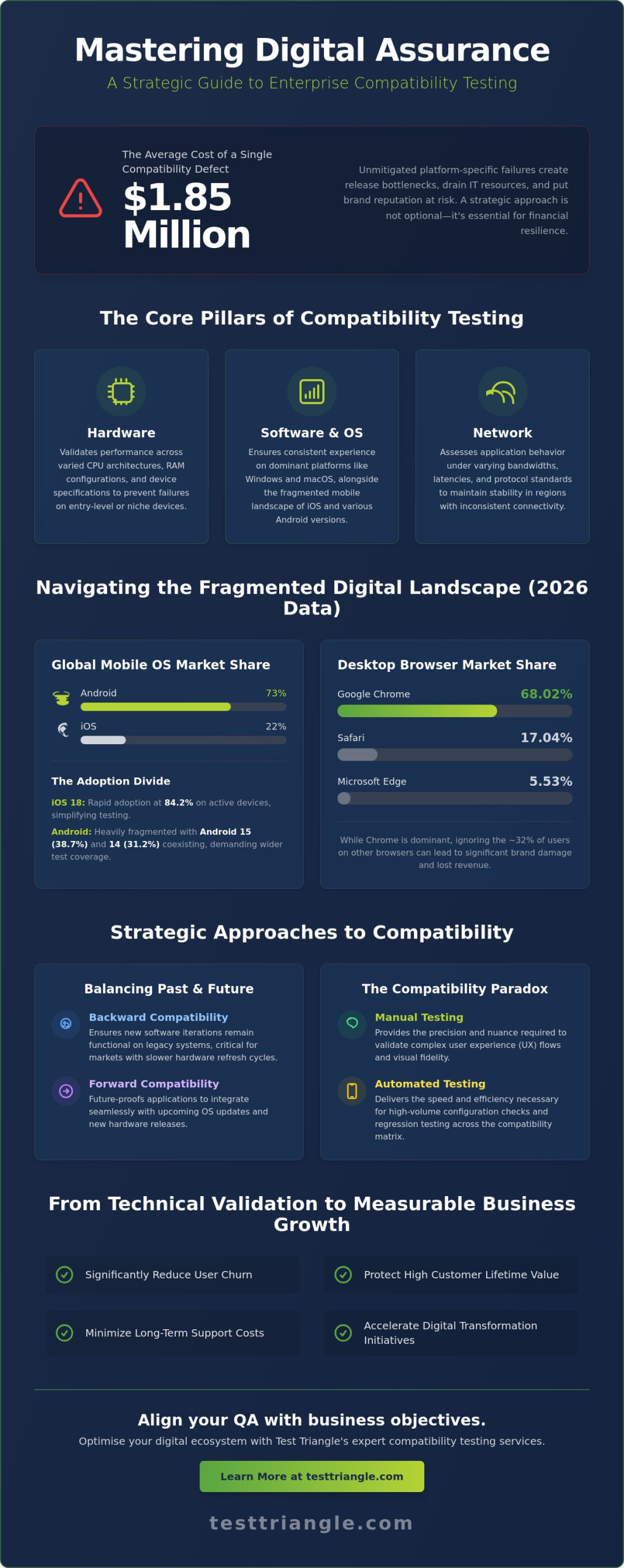

When a single compatibility-related defect can cost an enterprise an average of $1.85 million per incident, the implementation of comprehensive compatibility testing services becomes a vital pillar of financial and operational resilience. You likely find that the escalating costs of maintaining internal device labs, coupled with the pressure of fragmented platform adoption, create a persistent bottleneck in your release cycles. This friction often results in a reactive stance toward quality; brand reputation is left vulnerable to platform-specific failures that could have been mitigated through a more disciplined, strategic approach.

This guide offers a strategic blueprint for mastering digital assurance in 2026, moving beyond simple bug-hunting to establish a foundation for long-term user adoption. You’ll learn how to leverage a clear framework for platform prioritization and integrate automation testing to reduce post-release defects effectively. We will detail the path toward aligning your QA methodology with executive objectives, ensuring your digital infrastructure remains a reliable vehicle for global growth and systemic stability.

Key Takeaways

  • Understand how elite compatibility testing services transition from simple bug detection to a strategic pillar of enterprise digital assurance and risk mitigation.
  • Navigate the “Compatibility Paradox” by balancing the precision of manual testing for user experience with the efficiency of automation for high-volume configurations.
  • Establish a data-driven Compatibility Matrix that prioritizes platform testing based on real-world user analytics and organizational risk profiles.
  • Learn to align quality assurance with broader business objectives through the strategic integration of industry-leading platforms like ServiceNow and Atlassian.

Defining Compatibility Testing Services in the Multi-Platform Era

The modern enterprise ecosystem is defined by its inherent volatility, requiring a rigorous approach to software validation that transcends basic functional checks. As a specialized non-functional testing type, Compatibility testing serves as the primary mechanism for ensuring interoperability across disparate technical environments. Strategic compatibility testing services evaluate how an application performs within diverse hardware configurations, operating system versions, and network protocols, ensuring that the user experience remains consistent regardless of the access point. This methodology is central to digital assurance, protecting brand integrity by preventing the platform-specific glitches that lead to user frustration and immediate churn.

A sophisticated strategy must address two distinct temporal dimensions: backward and forward compatibility. Backward compatibility ensures that new software iterations remain functional on legacy systems, a critical requirement for enterprises serving markets with slower hardware refresh cycles. Conversely, forward compatibility involves future-proofing the application to ensure it integrates seamlessly with upcoming OS updates or hardware releases. By balancing these priorities, organizations maintain a stable, reliable presence across the global device landscape, where Android currently holds a 73% market share and iOS maintains a 22% share as of early 2026.

The Core Pillars of Compatibility

Precision, performance, and peace-of-mind are achieved through a three-pronged focus on the underlying technology stack. Hardware compatibility testing validates performance across varied CPU architectures and RAM configurations, ensuring that resource-intensive applications don’t fail on entry-level devices. Software and OS compatibility involves rigorous validation against dominant platforms like Windows and macOS, alongside the fragmented mobile landscape where iOS 18 and multiple Android versions coexist. Finally, network compatibility testing assesses application behavior under varying bandwidths, latencies, and protocol standards, which is essential for maintaining operational stability in regions with inconsistent connectivity.

Why Compatibility is a Strategic Business Driver

Beyond technical validation, compatibility testing services act as a catalyst for organizational growth and cost efficiency. By eliminating platform-specific friction points, enterprises can significantly reduce user churn and protect the high lifetime value of their customer base. A proactive approach also minimizes long-term support costs; it prevents the drain on IT resources caused by troubleshooting defects in niche or legacy environments. These services are indispensable for successful Digital Transformation Services, ensuring that as new enterprise tools are introduced, they integrate flawlessly with existing stacks and maintain the steady hand of institutional maturity. This strategic alignment ensures that every technical deployment translates directly into measurable business outcomes and scalable growth.

The Strategic Scope of Software Compatibility: Beyond Browsers

While many stakeholders view compatibility as a simple front-end validation, enterprise-grade compatibility testing services must address the entire technological stack to ensure seamless digital assurance. This multidimensional approach moves from the user interface down to the backend architecture, where minor discrepancies in data handling or API responses can trigger systemic failures. By adopting standards recognized by the National Institute of Standards and Technology (NIST), organizations can situate their testing protocols within a broader framework of software quality and institutional reliability. True compatibility is not just about visual fidelity; it’s about the precision of data exchange between your application and the global digital infrastructure.

In the current web landscape, Google Chrome maintains a dominant 68.02% market share as of April 2026. However, the remaining fragmentation across Safari at 17.04% and Microsoft Edge at 5.53% necessitates precise cross-browser validation to prevent brand damage. Mobile environments present an even greater challenge due to diverging adoption rates. While iOS 18 enjoys a rapid 84.2% adoption rate on active iPhones, the Android ecosystem remains heavily divided, with Android 15 at 38.7% and Android 14 at 31.2%. Strategic compatibility testing services bridge this gap, ensuring that your software remains performant across these varied version cycles without sacrificing speed or security.

Server and Database Compatibility

Validating application behavior across cloud environments like AWS and Azure, or within complex on-premise configurations, is essential for maintaining consistent uptime. Database interoperability is equally vital; ensuring data integrity remains intact across SQL and NoSQL variants prevents the corruption of critical business intelligence. For organizations focused on complex connectivity, our API Testing Services provide the deep-dive technical context needed to secure your third-party integrations and internal microservices.

Peripheral and External Integration

Modern enterprise compatibility extends to the physical world, requiring rigorous testing with external hardware such as printers, scanners, or IoT sensors that power industrial workflows. Human-centric compatibility is also a regulatory necessity. With the U.S. Department of Justice adopting WCAG 2.1 Level AA for ADA Title II compliance, many public entities must meet these standards by April 2026 to avoid legal risk. Aligning these technical requirements with IT Service Management Solutions ensures enterprise-wide consistency and operational reliability across every touchpoint. If you’re ready to stabilize your digital ecosystem, consult with our strategic QA experts to begin your transformation.

Compatibility Testing Services: A Strategic Guide to Enterprise Digital Assurance in 2026

Strategic Selection: Manual vs. Automated Compatibility Testing

Enterprises often grapple with the “Compatibility Paradox,” a strategic challenge where the exponential growth of the global device landscape outpaces manual testing capacity while remaining too nuanced for total automation. To resolve this, elite compatibility testing services utilize a disciplined 80/20 prioritization framework, focusing resources on the configurations that represent the vast majority of user traffic. By balancing human intuition with machine speed, organizations can orchestrate a testing lifecycle that is both comprehensive and cost-effective, ensuring that digital products remain resilient across every critical touchpoint. This methodology allows for a steady hand in a fast-changing technological landscape, emphasizing organizational progress through a combination of human expertise and technical precision.

When to Prioritise Manual Compatibility Testing

Manual validation remains indispensable for capturing the subtle UI/UX discrepancies that automated scripts often overlook. This human-centric approach is vital for exploratory testing on flagship devices, where the visual “look and feel” of an application directly influences brand perception. By focusing on high-value user journeys, testers can identify visual regressions and layout shifts across varied display resolutions that might otherwise compromise the user experience. For a deeper analysis of these methodologies, our Manual Testing Pillar provides a clear framework for integrating human expertise into your digital assurance strategy, ensuring that your software resonates with users on a qualitative level.

Scaling with Automated Cross-Platform Tools

To achieve the stability, scale, and speed required for modern release cycles, organizations must leverage Software Test Automation Services for high-volume regression. Utilizing cloud-based device farms allows for the parallel execution of test suites across hundreds of configurations simultaneously, providing a level of coverage that manual efforts cannot replicate. This approach is particularly effective for validating stable, repetitive paths across the most common user environments, such as the dominant Chrome and iOS 18 versions identified in our earlier market share analysis. Integrating these automated compatibility testing checks directly into the CI/CD pipeline ensures that interoperability is maintained continuously, significantly reducing the risk of post-release defects while accelerating your overall time-to-market.

Building an Enterprise Compatibility Strategy for 2026

Developing a robust enterprise strategy for 2026 requires a shift from exhaustive, unprioritized testing toward a model of data-driven precision. By leveraging sophisticated user analytics, organizations can identify the exact configurations that drive the highest engagement and revenue, allowing them to focus their compatibility testing services where they matter most. This approach involves the creation of a Compatibility Matrix that aligns technical coverage with business risk and current market share. It ensures that your most critical digital assets remain stable across the volatile platform updates that define the modern ecosystem, providing the peace of mind that comes from proactive risk reduction.

We must address the practical reality that testing every possible device combination is a mathematical impossibility. Instead, sophisticated enterprises should define a “Minimum Viable Compatibility” (MVC) tier. This tier guarantees a flawless experience on the top 90% of user environments while establishing a functional baseline for secondary platforms. Achieving this requires a balanced QA budget that utilizes virtualization for rapid, cost-effective regression and real device testing for final, high-fidelity assurance. This hybrid model avoids the high cost of maintaining massive device labs without sacrificing the qualitative insights necessary for global brand integrity.

Pharma and Regulated Industry Considerations

In highly regulated sectors like Life Sciences, compatibility testing takes on a critical legal dimension. Strategic compatibility testing services in these environments must ensure validated testing environments that meet strict GxP compliance standards. Maintaining comprehensive audit trails and documentation is a requirement for operational stability and regulatory approval. To navigate these complex landscapes, partnering with specialized IT Staffing Agencies for Pharmaceutical Industry ensures that your team possesses the domain expertise needed to maintain compliance alongside technical rigor.

Performance and Data Integrity during Transitions

Compatibility must also remain a priority during large-scale system migrations or digital shifts. Ensuring that data remains consistent and accessible across varied platforms is the primary goal of Data Migration Testing. Simultaneously, leadership should monitor Performance Testing Services metrics to identify how hardware acceleration or different GPU vendors affect application speed on varied device tiers. These technical nuances ensure that performance isn’t sacrificed for the sake of broad compatibility. Ready to refine your digital assurance roadmap? Speak with our strategic consultants today to build a customized compatibility matrix for your enterprise.

Optimising Digital Ecosystems with Test Triangle

In a global marketplace where digital stability directly correlates with revenue retention, Test Triangle provides a strategic partnership that bridges the gap between technical quality assurance and high-level business outcomes. By moving beyond the role of a traditional vendor, we position ourselves as a reliable, long-term collaborator dedicated to your operational stability and scalable growth. Our comprehensive compatibility testing services are designed to address the multifaceted challenges of the 2026 digital landscape, ensuring that your enterprise applications remain resilient across every hardware, software, and network configuration. This disciplined approach provides the peace of mind that comes from systemic risk reduction and the empowerment found in large-scale technological evolution.

Efficiency, expertise, and evolution define our commitment to digital assurance. Our deep technical proficiency in complex enterprise ecosystems, including Atlassian Implementation and ServiceNow, ensures that compatibility validation is never performed in a vacuum. We integrate testing protocols directly into your core operational platforms, facilitating a seamless flow of data and functionality across your entire infrastructure. To support these efforts, we offer highly adaptable engagement models, from managed outsourcing to specialized IT staffing, underpinned by a global delivery model that ensures continuous digital assurance and rapid market readiness for your software portfolio.

Strategic Partnership and Long-Term Value

Our methodology focuses on delivering long-term value through official partnerships with industry leaders like AWS and ServiceNow, allowing for infrastructure-aware testing that accounts for cloud-specific nuances. By leveraging these alliances, we provide customized technology roadmapping to future-proof your application’s compatibility against upcoming platform shifts. This strategic foresight prevents the costly rework associated with reactive testing, anchoring your digital strategy in recognized global benchmarks and institutional maturity. Our goal is to serve as a steady hand, guiding your organization through the complexities of digital transformation with precision and technical rigor.

Next Steps for Enterprise Digital Assurance

Initiating a comprehensive compatibility audit of your current software portfolio is the first step toward achieving a stabilized digital ecosystem. This audit identifies critical fragmentation risks and establishes the baseline for a data-driven Compatibility Matrix. Integrating these rigorous compatibility checks into your DevOps Consulting framework ensures that quality is built into the development lifecycle rather than added as an afterthought. By aligning your QA methodology with executive goals, you transform testing from a cost center into a strategic asset. To begin your journey toward flawless digital transitions, contact Test Triangle for a Strategic QA Consultation and discover how our expertise can secure your competitive advantage.

Mastering Digital Resilience in an Evolving Ecosystem

The transition toward a unified digital assurance model requires more than technical execution; it demands a strategic alignment between quality engineering and overarching business goals. By implementing a data-driven Compatibility Matrix and balancing the “Compatibility Paradox” through a disciplined mix of manual and automated validation, your organization can effectively mitigate the financial risks associated with platform fragmentation. This approach ensures that your software remains performant across the 2026 device landscape, protecting your brand integrity and user experience in every global market.

Test Triangle stands as your reliable long-term collaborator, offering compatibility testing services that are deeply integrated with the ecosystems of our strategic partners, including Atlassian, ServiceNow, and AWS. Our global delivery model, which maintains a robust presence in Europe, North America, and Asia, provides the specialized expertise necessary for success in highly regulated industries like Life Sciences. It’s time to move beyond reactive QA and embrace a proactive roadmap for stability, precision, and growth. You can secure your digital ecosystem with Test Triangle’s strategic compatibility testing services and lead your enterprise toward a future of enduring operational excellence.

Frequently Asked Questions

What is the difference between compatibility testing and interoperability testing?

Compatibility testing ensures your application functions correctly across diverse environments like varied operating systems, browsers, or hardware configurations. Interoperability testing, by contrast, validates the seamless exchange of data between your software and external systems or third-party APIs. While compatibility focuses on environment-specific performance, interoperability is about systemic communication and integration within a broader digital infrastructure.

How do we decide which devices and browsers to include in our compatibility testing services?

Strategic selection begins with a rigorous analysis of your specific user analytics to identify the platforms driving the highest engagement and revenue. You should align these insights with global market share data, such as Google Chrome’s 68.02% dominance or the high adoption rates of iOS 18. This data-driven approach allows you to build a Compatibility Matrix that prioritizes high-value configurations while establishing a functional baseline for secondary environments.

Can compatibility testing be fully automated in 2026?

Full automation remains unattainable in 2026 because automated scripts cannot replicate the nuanced human perception required to identify subtle UI/UX discrepancies. While automation testing is essential for high-volume regression and parallel execution on cloud-based device farms, manual intervention is still necessary for exploratory testing on flagship devices. A balanced strategy leverages automation for speed and manual testing for qualitative brand assurance.

What are the risks of ignoring backward compatibility for enterprise software?

Ignoring backward compatibility risks alienating users on legacy systems, which often leads to immediate churn and increased long-term support costs. For global enterprises, failing to support older OS versions can result in significant brand damage and the loss of market share in regions with slower hardware refresh cycles. Proactive compatibility testing services mitigate these risks by ensuring a stable experience across both modern and legacy environments.

How does compatibility testing impact the overall cost of software development?

While comprehensive compatibility testing requires an initial investment, it significantly reduces the overall cost of software development by preventing expensive post-release defects. Industry estimates from 2025 suggest that compatibility-related failures cost enterprises an average of $1.85 million per incident. By identifying environment-specific glitches early in the lifecycle, organizations avoid the high costs of emergency patches and reactive troubleshooting.

Is it necessary to test on real devices, or are emulators sufficient for digital assurance?

Emulators are sufficient for early-stage development and basic functional checks, but real device testing is essential for final digital assurance. Real devices provide accurate data on hardware acceleration, battery consumption, and network latency that emulators often fail to replicate. A disciplined QA strategy utilizes virtualization for cost-effective scaling and real devices for validating high-priority user journeys on flagship hardware.

How often should we perform compatibility testing for a SaaS application?

Compatibility testing should be an ongoing component of your CI/CD pipeline, performed with every major release or significant environment update. For SaaS applications, it’s also vital to monitor external platform cycles, such as browser version updates or mobile OS refreshes, to ensure continued stability. This continuous approach to quality engineering prevents the accumulation of technical debt and maintains a reliable presence in a fast-changing landscape.

What role does compatibility testing play in regulatory compliance for the pharmaceutical industry?

In the pharmaceutical industry, compatibility testing is a core requirement for GxP compliance and maintaining validated testing environments. It ensures that critical software remains functional and accurate across all approved hardware configurations, which is vital for patient safety and data integrity. Rigorous documentation and audit trails during this process provide the necessary proof of compliance for regulatory bodies in highly regulated sectors.

Paul Guy

Article by

Paul Guy

Paul serves as the Marketing Director at Test Triangle, where he leads a global team in driving growth through strategic B2B marketing and brand communications. With a strong emphasis on measurable outcomes and sustainable performance, he plays a pivotal role in aligning marketing functions to enhance customer engagement and accelerate business impact. Under his leadership, marketing initiatives have consistently delivered significant returns on investment, elevated brand visibility, and strengthened the company's presence across key markets.
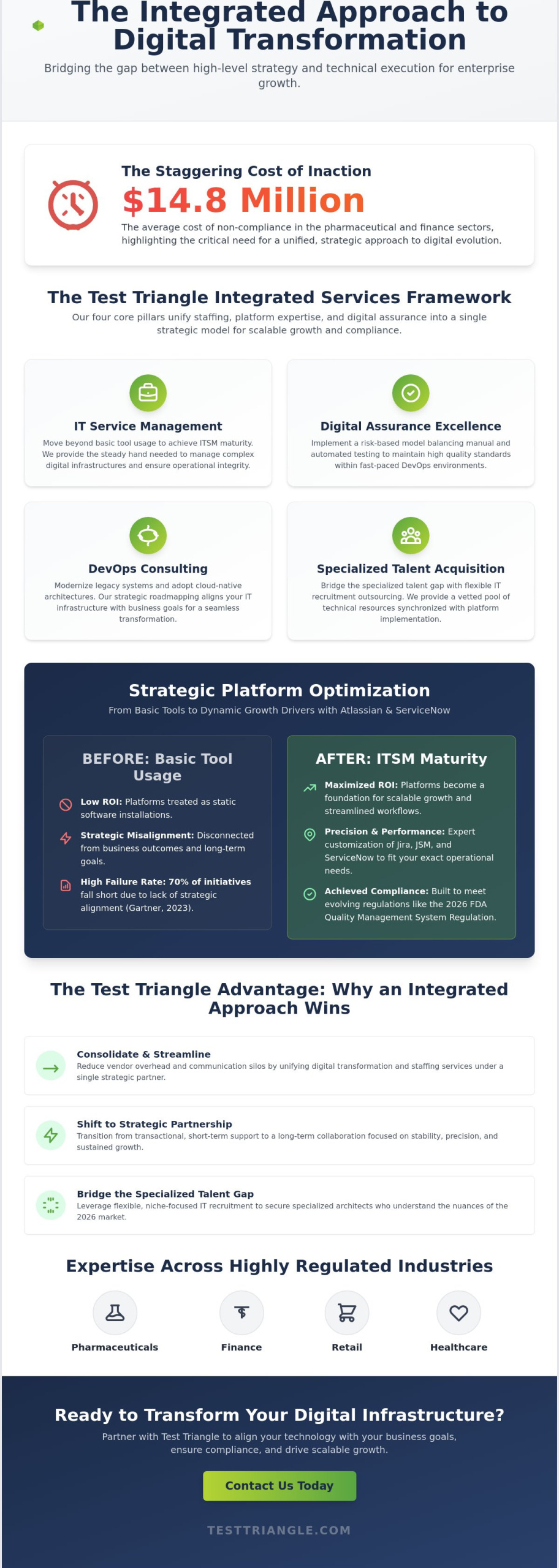

With the average cost of non-compliance in the pharmaceutical and finance sectors reaching 14.8 million dollars, the stakes for enterprise digital evolution have never been higher. You likely recognize the friction caused by managing disparate vendors for staffing and consulting while navigating the complexities of modern software migrations. It’s a common struggle to find specialized architects who understand the nuances of the 2026 market, which is why Test Triangle IT Services Consultancy focuses on bridging the gap between high-level strategy and technical execution.

Our approach unifies specialized IT staffing, platform expertise, and rigorous digital assurance into a single strategic framework designed for scalable growth. You’ll discover how integrating ServiceNow implementation and Atlassian consulting reduces time-to-market while providing access to a vetted pool of technical resources. This guide examines the methodology behind our digital transformation services and how they ensure your organization remains compliant with the latest FDA Quality Management System Regulation updates. We’ll explore how synchronizing talent acquisition with robust platform implementation creates the agility needed to thrive in a fast-changing technological landscape.

Key Takeaways

  • Transition from transactional support to a long-term strategic partnership with Test Triangle IT Services Consultancy to ensure stability and precision across complex digital infrastructures.
  • Maximize ROI and achieve IT Service Management maturity by moving beyond basic tool usage through expert Atlassian and ServiceNow platform optimization.
  • Implement a risk-based digital assurance model that balances manual and automated testing to maintain high quality standards within fast-paced DevOps environments.
  • Bridge the specialized talent gap in the Pharmaceutical and Life Sciences sectors by leveraging flexible, niche-focused IT recruitment outsourcing and managed services.
  • Streamline organizational progress by consolidating digital transformation and staffing services under a single consultant to reduce vendor overhead and communication silos.

Defining the Role of Test Triangle IT Services Consultancy in 2026

Enterprises can’t afford to treat technology as a series of isolated transactions. Test Triangle IT Services Consultancy operates as a global strategic partner, moving beyond basic support to foster long-term stability and precision. By 2026, the distinction between a simple vendor and a dedicated collaborator has become the primary indicator of digital success. We focus on four core pillars: IT Service Management (ITSM), comprehensive software testing, DevOps consulting, and specialized talent acquisition. This multi-faceted approach ensures that enterprises in highly regulated sectors like pharmaceuticals, finance, retail, and healthcare maintain operational integrity while pursuing rapid innovation. It’s a strategy rooted in stability, security, and scalability.

Enterprises don’t thrive by accident. The shift from transactional IT support to long-term strategic consultancy reflects a growing need for institutional maturity. Modern organizations face unprecedented pressure to integrate Generative AI into their core architectures while remaining compliant with evolving regulations like the 2026 FDA Quality Management System Regulation. We provide the steady hand needed to manage these complex digital infrastructures. By aligning technical execution with high-level business language, we ensure that both technical managers and executive leadership feel empowered to make informed decisions. Our presence in global markets allows us to operate across diverse industries, bringing a versatile perspective to every engagement.

The Integrated IT Services Framework

Technical expertise alone doesn’t sustain growth. Our integrated framework combines deep platform knowledge with flexible delivery models, ensuring that ServiceNow implementation or Atlassian tools are optimized for your specific workflows. We bridge the gap between implementation and managed service support by synchronizing IT staffing services with technical consulting. The Test Triangle Advantage is the intersection of people, process, and technology.

Driving Global Digital Transformation

Modernizing legacy systems requires more than a code refresh. In the 2026 technology landscape, it’s about a fundamental shift toward cloud-native architectures. Our strategic roadmapping aligns your IT infrastructure with business goals, providing a clear path for cloud adoption that doesn’t compromise stability. As a specialized field of IT consulting, we provide the technical discipline required to manage complex global infrastructures. Test Triangle IT Services Consultancy helps organizations transform digital debt into scalable assets.

Strategic Platform Optimization: Atlassian and ServiceNow Consulting

Enterprise platforms often fail to deliver expected value when treated as static software installations rather than dynamic drivers of digital transformation. According to a 2023 Gartner report, 70% of initiatives fall short because they lack strategic alignment. Test Triangle IT Services Consultancy addresses this gap by moving organizations away from basic tool usage toward advanced IT Service Management (ITSM) maturity. We focus on maximizing ROI through expert Atlassian Implementation and ServiceNow integration, ensuring these technologies serve as a foundation for scalable growth. It’s about achieving precision, performance, and progress through disciplined execution.

Transitioning to a mature ITSM model requires more than just technical configuration. It demands a partner who understands how to bridge the gap between technical execution and business outcomes. We work closely with global enterprises to customize Jira and JSM environments, ensuring that complex workflows are streamlined rather than complicated by new technology. This strategic focus reduces vendor management overhead and eliminates communication silos, positioning the company as a reliable collaborator deeply invested in your long-term operational stability. By anchoring our expertise in recognized global benchmarks, we provide the technical managers and executive leadership with the tools they need to succeed.

Atlassian Ecosystem Mastery

Managing complex enterprise workflows requires more than a default Jira setup. Our strategic guidance covers every facet of the Atlassian lifecycle, from initial license management and Atlassian Implementation to large-scale cloud migrations. We develop custom apps and integrations for the Atlassian Marketplace, tailoring Jira and JSM environments to the unique demands of global enterprises. By providing comprehensive training and support, we ensure platform adoption isn’t just a technical milestone but a cultural shift toward operational efficiency. This approach turns software into a strategic asset that empowers teams to deliver high-quality results with speed and security.

Enterprise Workflow Automation with ServiceNow

The 2026 release of ServiceNow introduces “Now Assist,” a GenAI-driven architecture that can reduce development cycles by up to 65%. Leveraging ServiceNow Consulting allows departments to automate routine tasks and achieve a 92% deflection rate through advanced natural language processing. We integrate these capabilities with existing AWS or Azure cloud infrastructures to build resilient ITSM frameworks that minimize service downtime. Our implementation strategy focuses on cross-departmental efficiency, ensuring technical execution directly supports business outcomes. This level of automation provides the peace of mind that comes from a robust, self-optimizing digital environment. If your organization is ready to modernize its service delivery, you can discuss a strategic roadmap with our consulting team.

Digital Assurance Excellence: Beyond Traditional Software Testing

The paradigm of software validation has shifted from simple defect detection to a strategic, risk-based assurance model. Within the high-velocity environments of modern development, achieving a balance between rapid delivery and uncompromising quality is a critical mandate for global enterprises. Test Triangle IT Services Consultancy provides the technical rigor required to bridge the “Quality Gap” that often emerges during accelerated application development cycles. By integrating security and performance testing directly into the CI/CD pipeline, organizations can identify vulnerabilities earlier, ensuring that Software and Digital Assurance Testing becomes an enabler of speed rather than a bottleneck. This proactive methodology transforms quality from a final checkpoint into a continuous thread that runs through the entire development lifecycle.

Rigorous digital assurance is fundamental to maintaining operational stability as organizations pursue large-scale technological evolution. The strategic focus in Digital Transformation in 2026 emphasizes the use of autonomous testing systems for routine validation, allowing human expertise to focus on complex edge cases. We implement integrated testing models that combine the precision of automation with the nuanced insight of manual validation. This dual approach ensures that every release meets high standards of quality and security, providing the peace of mind that comes from knowing your digital infrastructure is resilient. It’s a disciplined framework designed to support scalable growth while minimizing the risks associated with rapid innovation.

Strategic QA Outsourcing and Managed Testing

Global enterprises often struggle to maintain the specialized talent required for comprehensive quality assurance. Leveraging QA Outsourcing in 2026 provides a strategic advantage by offering flexible delivery models, including onshore, offshore, and hybrid options. These models allow organizations to scale their testing efforts based on project demands without the overhead of permanent staffing. While automation handles repetitive tasks, we utilize Manual Testing for human-centric UX validation, ensuring that software doesn’t just function correctly but also provides a seamless user experience. This balanced resourcing model empowers companies to maintain rigorous standards across diverse, highly regulated industries.

Advanced Automation and DevOps Integration

Accelerating release cycles requires a seamless transition from development to operations. Through expert DevOps Consulting, we help organizations implement robust automation frameworks that target system-critical areas like API and performance testing. A sustainable benchmark for 2026 is achieving 70-80% automation for regression and smoke tests, a goal that significantly reduces manual effort and human error. These frameworks are essential for ensuring data integrity during complex enterprise migrations and legacy system modernizations. By automating the routine, Test Triangle IT Services Consultancy allows your technical teams to focus on high-value strategic initiatives that drive long-term business success.

Test Triangle IT Services Consultancy: A Strategic Guide to Enterprise Digital Transformation

Agile Resourcing Models: Specialized IT and Pharma Staffing

54% of IT leaders globally report struggling to find specialized architects who understand the nuances of 2026 market demands. This talent gap often creates significant friction during large-scale technological evolution, stalling progress and increasing operational risk. Test Triangle IT Services Consultancy bridges this divide by providing a unified capability statement that synchronizes specialized recruitment with technical execution. Unlike traditional agencies, we ensure that every resource is vetted through a lens of platform-specific expertise and long-term operational stability. It’s a disciplined approach to human capital that ensures your technical teams are as robust as your software architecture.

Flexibility in resourcing is no longer a luxury but a strategic necessity for agile enterprises. Our delivery models adapt to your specific project lifecycle, whether you require contract expertise for a migration, permanent hires for long-term stability, or remote offshore teams to scale development capacity. By leveraging our Staffing Solutions, organizations bypass the traditional delays of talent acquisition and focus on delivering business value. We prioritize skills-based hiring over rigid academic credentials, aligning with the 2026 industry trend toward practical technical proficiency and immediate project impact.

Pharmaceutical and Life Sciences IT Staffing

Operating within highly regulated industries requires a deep understanding of complex compliance frameworks. The average cost of non-compliance for businesses in the pharma sector is $14.8 million, making the quality of technical talent a critical risk factor. We specialize in IT Staffing for the Pharma Industry, providing resources well-versed in the February 3, 2026, FDA guidance on Computer Software Assurance. Our GxP-compliant experts ensure that your digital infrastructure meets ISO 13485:2016 standards while maintaining the precision required for quality management systems.

Scalable Talent Acquisition for Tech Growth

Rapid digital shifts demand a recruitment strategy that scales as quickly as your technology stack. Our recruitment outsourcing managed services provide access to a global network of DevOps engineers and QA specialists, significantly reducing your time-to-hire without compromising candidate quality. We utilize AI-driven recruitment tools to achieve better candidate matching, ensuring that every hire contributes to your organizational progress. This scalable approach allows enterprises to maintain momentum during complex migrations and legacy system modernizations. If you’re ready to secure the specialized talent your organization needs, you can request a talent consultation today.

The Test Triangle Advantage: Why an Integrated Approach Wins

Fragmented IT strategies often lead to operational stagnation. When an enterprise manages multiple vendors for staffing, testing, and platform consulting, communication silos inevitably emerge and disrupt the flow of innovation. Test Triangle IT Services Consultancy solves this by offering a unified partnership model that bridges these gaps. Consolidating your digital initiatives under a single strategic consultant reduces vendor management overhead and ensures that your talent acquisition is perfectly synchronized with your technical execution. This integrated approach provides the clarity and comprehensive detail needed to drive large-scale technological evolution with confidence. It’s a model built on precision, performance, and progress.

Continuous improvement is a cornerstone of our philosophy. By utilizing Managed Outsourcing Services, organizations can focus on core business objectives while we handle the complexities of digital infrastructure. This model ensures that your systems remain optimized, secure, and ready for future growth. We don’t just provide a service; we act as a steady hand that guides your organization through the intricacies of the 2026 technology landscape. It’s about achieving long-term success through a combination of human expertise and technical precision. This synergy allows for a more adaptable approach to service delivery, ensuring your enterprise remains competitive in an increasingly complex market.

A Steady Hand in a Fast-Changing Landscape

Institutional maturity is what differentiates a simple service provider from a true collaborator. Our brand embodies the traits of a seasoned expert who values stability, precision, and scalable growth. We use high-level business language to bridge the gap between technical execution and executive vision, ensuring that all stakeholders are aligned. With official platform endorsements and a disciplined approach to service delivery, Test Triangle IT Services Consultancy provides the peace of mind derived from risk reduction. We focus on the process, the execution, and the ultimate benefit to your bottom line, positioning your company for long-term operational stability.

Getting Started with Test Triangle

Initiating a partnership begins with a comprehensive assessment of your current digital maturity. We develop a strategic technology roadmap that identifies immediate needs and long-term goals. Whether you require a full-scale ServiceNow implementation or specialized recruitment outsourcing, we tailor our engagement models to your specific organizational requirements. The next steps involve defining clear milestones and establishing a cadence for transparent communication. This methodical flow ensures that your journey toward digital transformation is intentional, well-organized, and highly efficient. You can begin your strategic evaluation by connecting with our consulting team to discuss your specific technical and staffing requirements.

Securing Your Digital Future with Strategic Precision

Navigating the complexities of large scale technological evolution requires more than just technical proficiency; it demands a disciplined approach to integration and stability. By consolidating platform implementation with specialized talent acquisition, enterprises can eliminate the communication silos that often stall organizational progress. Test Triangle IT Services Consultancy provides the institutional maturity necessary to bridge technical execution and business outcomes, ensuring your digital infrastructure remains resilient against shifting regulatory demands. Our status as an Atlassian Gold Solution Partner and a ServiceNow Specialist Partner, combined with our ISO 9001:2015 certification for quality management, reinforces our commitment to high standards of quality and security.

Success in the 2026 landscape depends on the synergy of people, process, and technology. As your organization pursues scalable growth, having a reliable long term collaborator ensures that every migration and automation initiative is managed with expertise. You can empower your technical teams and achieve operational excellence by choosing a partner that values precision and performance. If you’re ready to modernize your infrastructure and secure specialized talent, you should partner with Test Triangle for your next strategic IT initiative. We’re here to help you transform your digital challenges into sustainable competitive advantages.

Frequently Asked Questions

What core industries does Test Triangle IT Services Consultancy specialize in?

Test Triangle IT Services Consultancy specializes in highly regulated sectors including Pharmaceuticals, Finance, Healthcare, and Retail. Our expertise is specifically tailored to the complex digital infrastructures of global enterprises that require high standards of security and operational stability. By focusing on these core areas, we ensure that our strategic consulting and technical execution align with the specific regulatory benchmarks and market demands of the 2026 landscape.

How does Test Triangle integrate Atlassian and ServiceNow into existing workflows?

We integrate Atlassian and ServiceNow by aligning platform configurations with your overarching business goals and operational workflows. Our team customizes Jira and JSM environments to streamline complex enterprise processes while leveraging ServiceNow’s GenAI capabilities to reduce development cycles. This strategic optimization ensures that these tools move beyond basic usage to become dynamic drivers of digital transformation and IT Service Management maturity.

What are the benefits of using a specialized IT staffing agency for the pharmaceutical sector?

Specialized staffing provides access to a vetted pool of technical resources who understand complex regulatory requirements like GxP and ISO 13485:2016. In the pharmaceutical sector, where non-compliance costs average 14.8 million dollars, having experts who are familiar with the 2026 FDA guidance on Computer Software Assurance is a critical risk-reduction strategy. This niche expertise ensures that your digital infrastructure remains compliant while supporting rapid innovation.

Does Test Triangle offer both manual and automated software testing services?

Yes, we provide an integrated testing model that balances manual and automated software testing services to ensure comprehensive quality assurance. We utilize manual testing for human-centric UX validation and complex edge cases while implementing robust automation frameworks for regression and smoke tests. This dual approach helps organizations achieve sustainable benchmarks, such as 70-80% automation, while maintaining the precision required for high-quality software products.

What engagement models are available for managed outsourcing services?

Our managed outsourcing services offer flexible engagement models including onshore, offshore, and hybrid delivery to meet diverse organizational needs. You can choose from contract, permanent, or project-based staffing to scale your technical teams during rapid digital shifts. These adaptable models allow enterprises to reduce vendor management overhead while maintaining high standards of candidate quality and technical proficiency across global projects.

How does Test Triangle ensure quality and compliance in highly regulated industries?

Quality and compliance are managed through a risk-based assurance model and our ISO 9001:2015 certified quality management system. We stay current with the latest regulatory changes, such as the February 3, 2026, FDA update on Quality Management System Regulation, to ensure your software remains audit-ready. This disciplined framework prioritizes security and precision, providing the peace of mind that comes from institutional maturity and official endorsements.

Can Test Triangle support global cloud migrations to platforms like AWS?

We support global cloud migrations by providing strategic roadmapping for cloud adoption and legacy system modernization on platforms like AWS. Our consultants align your IT infrastructure with business objectives to ensure a seamless transition that doesn’t compromise operational stability. By integrating DevOps consulting into the migration process, we help organizations transform digital debt into scalable, high-performance assets within a secure cloud environment.

What makes Test Triangle different from a standard IT staffing firm?

Unlike standard firms, Test Triangle IT Services Consultancy combines specialized talent acquisition with deep platform implementation and rigorous digital assurance. We act as a strategic visionary and practical collaborator, offering a unified capability statement that connects human expertise with technical tools. Our focus on long-term partnership and official platform status ensures that we deliver systemic improvements rather than just transactional support for your digital infrastructure.

Paul Guy

Article by

Paul Guy

Paul serves as the Marketing Director at Test Triangle, where he leads a global team in driving growth through strategic B2B marketing and brand communications. With a strong emphasis on measurable outcomes and sustainable performance, he plays a pivotal role in aligning marketing functions to enhance customer engagement and accelerate business impact. Under his leadership, marketing initiatives have consistently delivered significant returns on investment, elevated brand visibility, and strengthened the company's presence across key markets.