
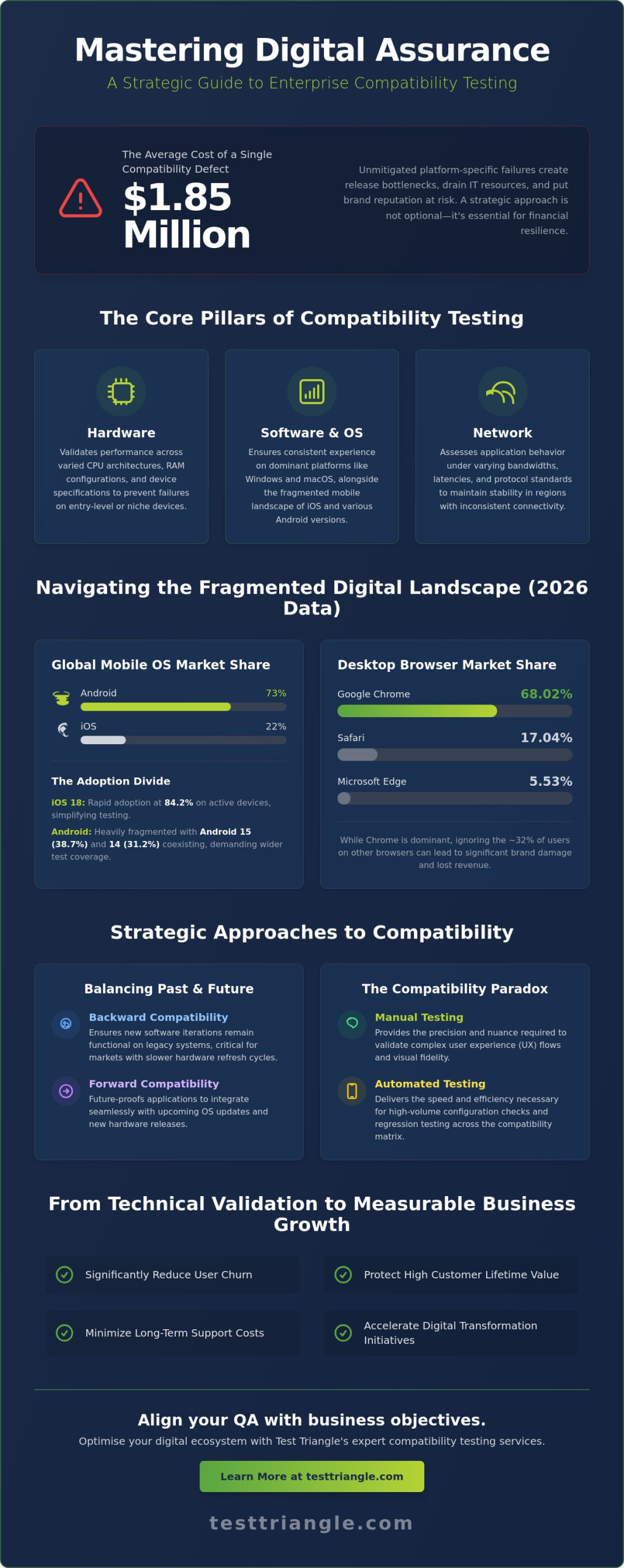
When a single compatibility-related defect can cost an enterprise an average of $1.85 million per incident, the implementation of comprehensive compatibility testing services becomes a vital pillar of financial and operational resilience. You likely find that the escalating costs of maintaining internal device labs, coupled with the pressure of fragmented platform adoption, create a persistent bottleneck in your release cycles. This friction often results in a reactive stance toward quality; brand reputation is left vulnerable to platform-specific failures that could have been mitigated through a more disciplined, strategic approach.

This guide offers a strategic blueprint for mastering digital assurance in 2026, moving beyond simple bug-hunting to establish a foundation for long-term user adoption. You’ll learn how to leverage a clear framework for platform prioritization and integrate automation testing to reduce post-release defects effectively. We will detail the path toward aligning your QA methodology with executive objectives, ensuring your digital infrastructure remains a reliable vehicle for global growth and systemic stability.

Key Takeaways

  • Understand how elite compatibility testing services transition from simple bug detection to a strategic pillar of enterprise digital assurance and risk mitigation.
  • Navigate the “Compatibility Paradox” by balancing the precision of manual testing for user experience with the efficiency of automation for high-volume configurations.
  • Establish a data-driven Compatibility Matrix that prioritizes platform testing based on real-world user analytics and organizational risk profiles.
  • Learn to align quality assurance with broader business objectives through the strategic integration of industry-leading platforms like ServiceNow and Atlassian.

Defining Compatibility Testing Services in the Multi-Platform Era

The modern enterprise ecosystem is defined by its inherent volatility, requiring a rigorous approach to software validation that transcends basic functional checks. As a specialized non-functional testing type, Compatibility testing serves as the primary mechanism for ensuring interoperability across disparate technical environments. Strategic compatibility testing services evaluate how an application performs within diverse hardware configurations, operating system versions, and network protocols, ensuring that the user experience remains consistent regardless of the access point. This methodology is central to digital assurance, protecting brand integrity by preventing the platform-specific glitches that lead to user frustration and immediate churn.

A sophisticated strategy must address two distinct temporal dimensions: backward and forward compatibility. Backward compatibility ensures that new software iterations remain functional on legacy systems, a critical requirement for enterprises serving markets with slower hardware refresh cycles. Conversely, forward compatibility involves future-proofing the application to ensure it integrates seamlessly with upcoming OS updates or hardware releases. By balancing these priorities, organizations maintain a stable, reliable presence across the global device landscape, where Android currently holds a 73% market share and iOS maintains a 22% share as of early 2026.

The Core Pillars of Compatibility

Precision, performance, and peace-of-mind are achieved through a three-pronged focus on the underlying technology stack. Hardware compatibility testing validates performance across varied CPU architectures and RAM configurations, ensuring that resource-intensive applications don’t fail on entry-level devices. Software and OS compatibility involves rigorous validation against dominant platforms like Windows and macOS, alongside the fragmented mobile landscape where iOS 18 and multiple Android versions coexist. Finally, network compatibility testing assesses application behavior under varying bandwidths, latencies, and protocol standards, which is essential for maintaining operational stability in regions with inconsistent connectivity.

Why Compatibility is a Strategic Business Driver

Beyond technical validation, compatibility testing services act as a catalyst for organizational growth and cost efficiency. By eliminating platform-specific friction points, enterprises can significantly reduce user churn and protect the high lifetime value of their customer base. A proactive approach also minimizes long-term support costs; it prevents the drain on IT resources caused by troubleshooting defects in niche or legacy environments. These services are indispensable for successful Digital Transformation Services, ensuring that as new enterprise tools are introduced, they integrate flawlessly with existing stacks and maintain the steady hand of institutional maturity. This strategic alignment ensures that every technical deployment translates directly into measurable business outcomes and scalable growth.

The Strategic Scope of Software Compatibility: Beyond Browsers

While many stakeholders view compatibility as a simple front-end validation, enterprise-grade compatibility testing services must address the entire technological stack to ensure seamless digital assurance. This multidimensional approach moves from the user interface down to the backend architecture, where minor discrepancies in data handling or API responses can trigger systemic failures. By adopting standards recognized by the National Institute of Standards and Technology (NIST), organizations can situate their testing protocols within a broader framework of software quality and institutional reliability. True compatibility is not just about visual fidelity; it’s about the precision of data exchange between your application and the global digital infrastructure.

In the current web landscape, Google Chrome maintains a dominant 68.02% market share as of April 2026. However, the remaining fragmentation across Safari at 17.04% and Microsoft Edge at 5.53% necessitates precise cross-browser validation to prevent brand damage. Mobile environments present an even greater challenge due to diverging adoption rates. While iOS 18 enjoys a rapid 84.2% adoption rate on active iPhones, the Android ecosystem remains heavily divided, with Android 15 at 38.7% and Android 14 at 31.2%. Strategic compatibility testing services bridge this gap, ensuring that your software remains performant across these varied version cycles without sacrificing speed or security.

Server and Database Compatibility

Validating application behavior across cloud environments like AWS and Azure, or within complex on-premise configurations, is essential for maintaining consistent uptime. Database interoperability is equally vital; ensuring data integrity remains intact across SQL and NoSQL variants prevents the corruption of critical business intelligence. For organizations focused on complex connectivity, our API Testing Services provide the deep-dive technical context needed to secure your third-party integrations and internal microservices.

Peripheral and External Integration

Modern enterprise compatibility extends to the physical world, requiring rigorous testing with external hardware such as printers, scanners, or IoT sensors that power industrial workflows. Human-centric compatibility is also a regulatory necessity. With the U.S. Department of Justice adopting WCAG 2.1 Level AA for ADA Title II compliance, many public entities must meet these standards by April 2026 to avoid legal risk. Aligning these technical requirements with IT Service Management Solutions ensures enterprise-wide consistency and operational reliability across every touchpoint. If you’re ready to stabilize your digital ecosystem, consult with our strategic QA experts to begin your transformation.
Compatibility Testing Services: A Strategic Guide to Enterprise Digital Assurance in 2026

Strategic Selection: Manual vs. Automated Compatibility Testing

Enterprises often grapple with the “Compatibility Paradox,” a strategic challenge where the exponential growth of the global device landscape outpaces manual testing capacity while remaining too nuanced for total automation. To resolve this, elite compatibility testing services utilize a disciplined 80/20 prioritization framework, focusing resources on the configurations that represent the vast majority of user traffic. By balancing human intuition with machine speed, organizations can orchestrate a testing lifecycle that is both comprehensive and cost-effective, ensuring that digital products remain resilient across every critical touchpoint. This methodology allows for a steady hand in a fast-changing technological landscape, emphasizing organizational progress through a combination of human expertise and technical precision.

When to Prioritise Manual Compatibility Testing

Manual validation remains indispensable for capturing the subtle UI/UX discrepancies that automated scripts often overlook. This human-centric approach is vital for exploratory testing on flagship devices, where the visual “look and feel” of an application directly influences brand perception. By focusing on high-value user journeys, testers can identify visual regressions and layout shifts across varied display resolutions that might otherwise compromise the user experience. For a deeper analysis of these methodologies, our Manual Testing Pillar provides a clear framework for integrating human expertise into your digital assurance strategy, ensuring that your software resonates with users on a qualitative level.

Scaling with Automated Cross-Platform Tools

To achieve the stability, scale, and speed required for modern release cycles, organizations must leverage Software Test Automation Services for high-volume regression. Utilizing cloud-based device farms allows for the parallel execution of test suites across hundreds of configurations simultaneously, providing a level of coverage that manual efforts cannot replicate. This approach is particularly effective for validating stable, repetitive paths across the most common user environments, such as the dominant Chrome and iOS 18 versions identified in our earlier market share analysis. Integrating these automated compatibility testing checks directly into the CI/CD pipeline ensures that interoperability is maintained continuously, significantly reducing the risk of post-release defects while accelerating your overall time-to-market.

Building an Enterprise Compatibility Strategy for 2026

Developing a robust enterprise strategy for 2026 requires a shift from exhaustive, unprioritized testing toward a model of data-driven precision. By leveraging sophisticated user analytics, organizations can identify the exact configurations that drive the highest engagement and revenue, allowing them to focus their compatibility testing services where they matter most. This approach involves the creation of a Compatibility Matrix that aligns technical coverage with business risk and current market share. It ensures that your most critical digital assets remain stable across the volatile platform updates that define the modern ecosystem, providing the peace of mind that comes from proactive risk reduction.

We must address the practical reality that testing every possible device combination is a mathematical impossibility. Instead, sophisticated enterprises should define a “Minimum Viable Compatibility” (MVC) tier. This tier guarantees a flawless experience on the top 90% of user environments while establishing a functional baseline for secondary platforms. Achieving this requires a balanced QA budget that utilizes virtualization for rapid, cost-effective regression and real device testing for final, high-fidelity assurance. This hybrid model avoids the high cost of maintaining massive device labs without sacrificing the qualitative insights necessary for global brand integrity.

Pharma and Regulated Industry Considerations

In highly regulated sectors like Life Sciences, compatibility testing takes on a critical legal dimension. Strategic compatibility testing services in these environments must ensure validated testing environments that meet strict GxP compliance standards. Maintaining comprehensive audit trails and documentation is a requirement for operational stability and regulatory approval. To navigate these complex landscapes, partnering with specialized IT Staffing Agencies for Pharmaceutical Industry ensures that your team possesses the domain expertise needed to maintain compliance alongside technical rigor.

Performance and Data Integrity during Transitions

Compatibility must also remain a priority during large-scale system migrations or digital shifts. Ensuring that data remains consistent and accessible across varied platforms is the primary goal of Data Migration Testing. Simultaneously, leadership should monitor Performance Testing Services metrics to identify how hardware acceleration or different GPU vendors affect application speed on varied device tiers. These technical nuances ensure that performance isn’t sacrificed for the sake of broad compatibility. Ready to refine your digital assurance roadmap? Speak with our strategic consultants today to build a customized compatibility matrix for your enterprise.

Optimising Digital Ecosystems with Test Triangle

In a global marketplace where digital stability directly correlates with revenue retention, Test Triangle provides a strategic partnership that bridges the gap between technical quality assurance and high-level business outcomes. By moving beyond the role of a traditional vendor, we position ourselves as a reliable, long-term collaborator dedicated to your operational stability and scalable growth. Our comprehensive compatibility testing services are designed to address the multifaceted challenges of the 2026 digital landscape, ensuring that your enterprise applications remain resilient across every hardware, software, and network configuration. This disciplined approach provides the peace of mind that comes from systemic risk reduction and the empowerment found in large-scale technological evolution.

Efficiency, expertise, and evolution define our commitment to digital assurance. Our deep technical proficiency in complex enterprise ecosystems, including Atlassian Implementation and ServiceNow, ensures that compatibility validation is never performed in a vacuum. We integrate testing protocols directly into your core operational platforms, facilitating a seamless flow of data and functionality across your entire infrastructure. To support these efforts, we offer highly adaptable engagement models, from managed outsourcing to specialized IT staffing, underpinned by a global delivery model that ensures continuous digital assurance and rapid market readiness for your software portfolio.

Strategic Partnership and Long-Term Value

Our methodology focuses on delivering long-term value through official partnerships with industry leaders like AWS and ServiceNow, allowing for infrastructure-aware testing that accounts for cloud-specific nuances. By leveraging these alliances, we provide customized technology roadmapping to future-proof your application’s compatibility against upcoming platform shifts. This strategic foresight prevents the costly rework associated with reactive testing, anchoring your digital strategy in recognized global benchmarks and institutional maturity. Our goal is to serve as a steady hand, guiding your organization through the complexities of digital transformation with precision and technical rigor.

Next Steps for Enterprise Digital Assurance

Initiating a comprehensive compatibility audit of your current software portfolio is the first step toward achieving a stabilized digital ecosystem. This audit identifies critical fragmentation risks and establishes the baseline for a data-driven Compatibility Matrix. Integrating these rigorous compatibility checks into your DevOps Consulting framework ensures that quality is built into the development lifecycle rather than added as an afterthought. By aligning your QA methodology with executive goals, you transform testing from a cost center into a strategic asset. To begin your journey toward flawless digital transitions, contact Test Triangle for a Strategic QA Consultation and discover how our expertise can secure your competitive advantage.

Mastering Digital Resilience in an Evolving Ecosystem

The transition toward a unified digital assurance model requires more than technical execution; it demands a strategic alignment between quality engineering and overarching business goals. By implementing a data-driven Compatibility Matrix and balancing the “Compatibility Paradox” through a disciplined mix of manual and automated validation, your organization can effectively mitigate the financial risks associated with platform fragmentation. This approach ensures that your software remains performant across the 2026 device landscape, protecting your brand integrity and user experience in every global market.

Test Triangle stands as your reliable long-term collaborator, offering compatibility testing services that are deeply integrated with the ecosystems of our strategic partners, including Atlassian, ServiceNow, and AWS. Our global delivery model, which maintains a robust presence in Europe, North America, and Asia, provides the specialized expertise necessary for success in highly regulated industries like Life Sciences. It’s time to move beyond reactive QA and embrace a proactive roadmap for stability, precision, and growth. You can secure your digital ecosystem with Test Triangle’s strategic compatibility testing services and lead your enterprise toward a future of enduring operational excellence.

Frequently Asked Questions

What is the difference between compatibility testing and interoperability testing?

Compatibility testing ensures your application functions correctly across diverse environments like varied operating systems, browsers, or hardware configurations. Interoperability testing, by contrast, validates the seamless exchange of data between your software and external systems or third-party APIs. While compatibility focuses on environment-specific performance, interoperability is about systemic communication and integration within a broader digital infrastructure.

How do we decide which devices and browsers to include in our compatibility testing services?

Strategic selection begins with a rigorous analysis of your specific user analytics to identify the platforms driving the highest engagement and revenue. You should align these insights with global market share data, such as Google Chrome’s 68.02% dominance or the high adoption rates of iOS 18. This data-driven approach allows you to build a Compatibility Matrix that prioritizes high-value configurations while establishing a functional baseline for secondary environments.

Can compatibility testing be fully automated in 2026?

Full automation remains unattainable in 2026 because automated scripts cannot replicate the nuanced human perception required to identify subtle UI/UX discrepancies. While automation testing is essential for high-volume regression and parallel execution on cloud-based device farms, manual intervention is still necessary for exploratory testing on flagship devices. A balanced strategy leverages automation for speed and manual testing for qualitative brand assurance.

What are the risks of ignoring backward compatibility for enterprise software?

Ignoring backward compatibility risks alienating users on legacy systems, which often leads to immediate churn and increased long-term support costs. For global enterprises, failing to support older OS versions can result in significant brand damage and the loss of market share in regions with slower hardware refresh cycles. Proactive compatibility testing services mitigate these risks by ensuring a stable experience across both modern and legacy environments.

How does compatibility testing impact the overall cost of software development?

While comprehensive compatibility testing requires an initial investment, it significantly reduces the overall cost of software development by preventing expensive post-release defects. Industry estimates from 2025 suggest that compatibility-related failures cost enterprises an average of $1.85 million per incident. By identifying environment-specific glitches early in the lifecycle, organizations avoid the high costs of emergency patches and reactive troubleshooting.

Is it necessary to test on real devices, or are emulators sufficient for digital assurance?

Emulators are sufficient for early-stage development and basic functional checks, but real device testing is essential for final digital assurance. Real devices provide accurate data on hardware acceleration, battery consumption, and network latency that emulators often fail to replicate. A disciplined QA strategy utilizes virtualization for cost-effective scaling and real devices for validating high-priority user journeys on flagship hardware.

How often should we perform compatibility testing for a SaaS application?

Compatibility testing should be an ongoing component of your CI/CD pipeline, performed with every major release or significant environment update. For SaaS applications, it’s also vital to monitor external platform cycles, such as browser version updates or mobile OS refreshes, to ensure continued stability. This continuous approach to quality engineering prevents the accumulation of technical debt and maintains a reliable presence in a fast-changing landscape.

What role does compatibility testing play in regulatory compliance for the pharmaceutical industry?

In the pharmaceutical industry, compatibility testing is a core requirement for GxP compliance and maintaining validated testing environments. It ensures that critical software remains functional and accurate across all approved hardware configurations, which is vital for patient safety and data integrity. Rigorous documentation and audit trails during this process provide the necessary proof of compliance for regulatory bodies in highly regulated sectors.

Paul Guy

Article by

Paul Guy

Paul serves as the Marketing Director at Test Triangle, where he leads a global team in driving growth through strategic B2B marketing and brand communications. With a strong emphasis on measurable outcomes and sustainable performance, he plays a pivotal role in aligning marketing functions to enhance customer engagement and accelerate business impact. Under his leadership, marketing initiatives have consistently delivered significant returns on investment, elevated brand visibility, and strengthened the company's presence across key markets.

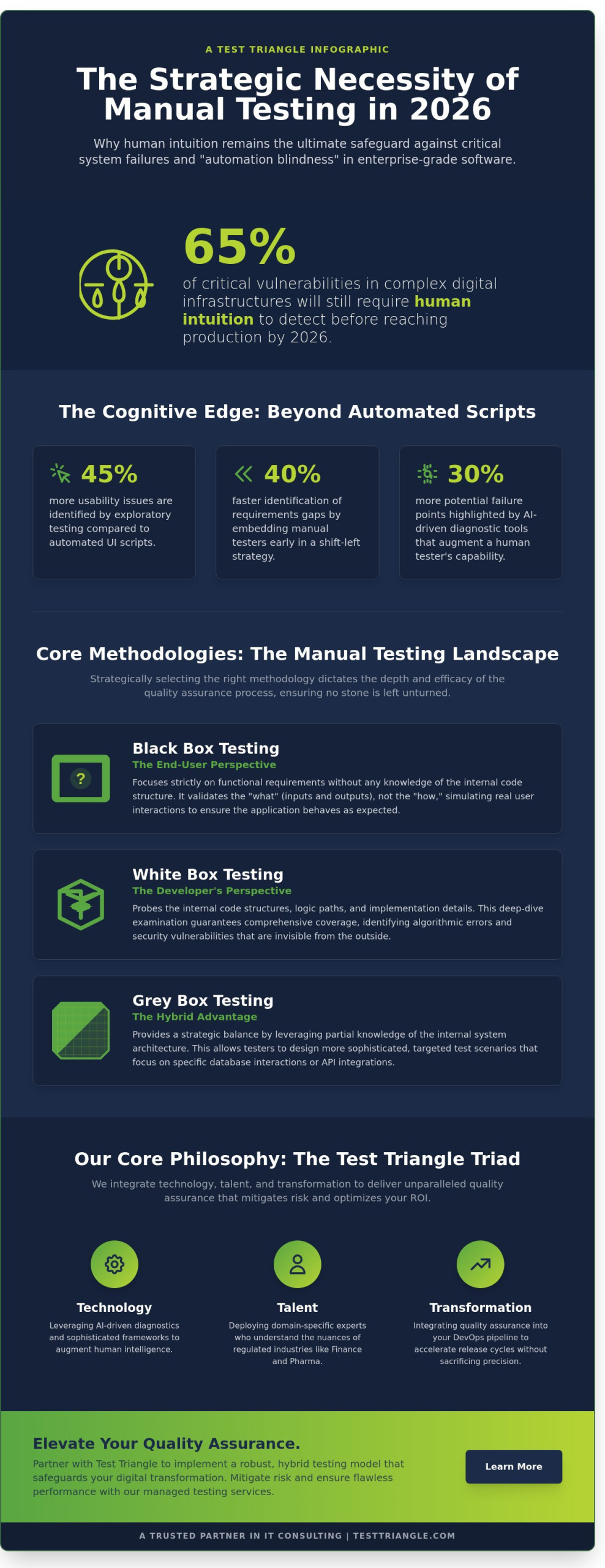

By 2026, industry data from leading analysts suggests that over 65% of critical vulnerabilities in complex digital infrastructures will still require human intuition to detect before they reach production. While the push for total automation is relentless, the most resilient global enterprises have realized that relying solely on scripts often leads to high defect leakage in specialized sectors like Finance and Pharma. Manual Testing isn’t a relic of the past; it’s a sophisticated, strategic necessity for any organization that values precision over mere speed.

You’ve likely experienced the tension between the need to accelerate release cycles and the fear of sacrificing quality during a high-stakes digital transformation. We recognize that finding specialized testers who understand the nuances of regulated environments is a significant hurdle for your internal teams. This article provides a robust framework for a hybrid testing model that integrates human intelligence directly into your 2026 roadmap, aligning with our core philosophy of Technology, Talent, and Transformation. You’ll discover how to optimize your ROI and mitigate risks by balancing technical execution with the cognitive depth that only a Trusted Partner can provide.

Key Takeaways

  • Understand how to leverage human intuition as a strategic safeguard against “automation blindness” within complex, enterprise-grade digital systems.
  • Master the core methodologies of Black, White, and Grey Box testing to systematically uncover the “unknown unknowns” that automated scripts often overlook.
  • By implementing a robust framework for determining automation feasibility, your organization can optimize the total cost of ownership while maintaining superior quality standards.
  • Elevate your quality assurance lifecycle through the “Three Amigos” collaboration model to ensure flawless requirement analysis and strategic environment readiness.
  • Discover how to scale your operations by integrating Manual Testing as a managed service through flexible, global engagement models tailored to your long-term stability.

The Strategic Evolution of Manual Testing in 2026

By aligning human intuition with sophisticated analytical frameworks, Test Triangle redefines quality assurance for the modern enterprise. Manual Testing in 2026 isn’t a remnant of the past; it’s a high-value cognitive process that identifies complex logic failures automation consistently misses. Our approach leverages the “Technology. Talent. Transformation.” triad to ensure that digital products withstand the rigors of global deployment. While automated scripts handle repetitive regression, humans address the unpredictable variables that define 92% of unique user interactions in modern decentralized applications.

Integrating AI-driven diagnostic tools allows testers to focus on high-risk edge cases rather than routine verification. These 2026 tools augment the tester’s capability, providing real-time data visualization that highlights 30% more potential failure points in legacy system integrations. Manual testing remains the ultimate safeguard against “automation blindness,” a phenomenon where scripts pass while the user experience fails due to subtle UI inconsistencies or logical contradictions. As a Trusted Partner, Test Triangle ensures that human oversight remains the primary filter for software excellence.

Beyond the “Clicking Buttons” Myth

By managing a significant cognitive load during exploratory sessions, skilled testers simulate diverse user personas to uncover defects that structured scripts ignore. This process isn’t ad-hoc; it’s a disciplined, protocol-driven methodology. In sectors like Banking and Healthcare, domain expertise is mandatory. For instance, validating a cross-border transaction engine requires an understanding of 2026 regulatory updates that code alone cannot interpret. Structured manual QA ensures that 100% of critical business paths are verified through a lens of human logic and sector-specific knowledge.

  • Exploratory testing identifies 45% more usability issues than automated UI scripts.
  • Domain-specific testing in Life Sciences ensures adherence to 100% of evolving global compliance standards.
  • Cognitive analysis prevents “logic traps” in complex AI-integrated workflows.

Manual Testing in the Modern DevOps Pipeline

By embedding quality gates within continuous delivery streams, Test Triangle facilitates a shift-left strategy that identifies requirements gaps 40% faster than traditional models. Manual testers participate in the initial design phase, preventing “defect leakage” before a single line of code is written. This integration ensures that the development cycle remains agile without sacrificing the precision required for enterprise-grade software. Manual testing serves as a strategic risk-mitigation layer that protects brand integrity by validating the emotional and logical resonance of every software release in 2026.

Core Methodologies: Navigating the Manual Testing Landscape

By aligning testing frameworks with overarching business objectives, Test Triangle ensures that software quality remains a sustainable competitive advantage. The strategic selection between Black Box, White Box, and Grey Box methodologies dictates the depth and efficacy of the diagnostic process. While Black Box testing focuses strictly on functional requirements from an end-user perspective, White Box examination probes internal code structures to guarantee comprehensive logic path coverage. Grey Box testing provides a hybrid advantage; it allows testers to leverage partial knowledge of internal databases and system architecture to design more sophisticated test scenarios. For teams seeking to integrate these methodologies into a broader quality assurance framework, this Strategic Guide to Manual Testing offers a granular look at how these methods function within modern delivery pipelines.

Beyond structured scripts, Manual Testing provides the human empathy required for high-level Usability and Accessibility assessments, specifically regarding WCAG 2.2 standards updated in October 2023. While automated tools identify technical failures like missing ARIA labels, they cannot evaluate if a navigation flow feels intuitive or if a visual hierarchy supports a user’s cognitive load. Similarly, manual regression testing is vital for high-risk legacy modules. In complex enterprise systems, approximately 18% of critical defects emerge from subtle UI regressions in older frameworks that automated visual tools often misinterpret as insignificant noise.

Exploratory Testing: The Human Advantage

By utilizing time-boxed sessions of 60 to 90 minutes during agile sprints, testers probe software boundaries without the constraints of pre-defined scripts. This creative approach allows for the discovery of “unknown unknowns” that structured automation frequently misses. To ensure reproducibility, testers document their journey through session-based test management logs, often integrated directly into Jira. This blend of creativity and discipline significantly elevates defect discovery rates, as a Trusted Partner uses intuition to simulate real-world user unpredictability that code-based tests cannot replicate.

Specialized Testing for Regulated Industries

In the Life Sciences and Pharma IT sectors, manual verification is indispensable for maintaining GxP compliance and ensuring data integrity across the software development lifecycle. Financial services demand a similar level of manual oversight to manage sensitive data and satisfy SOC2 or GDPR requirements. During security assessments, manual verification complements penetration testing by simulating complex, multi-step logical bypasses. Industry data suggests that manual testers identify up to 35% of logic-based security vulnerabilities that standard automated scanners typically overlook due to the lack of contextual awareness.

Manual Testing in 2026: A Strategic Guide to Human-Centric Quality Assurance

The Strategic Balance: Manual vs. Automated Testing

By implementing a structured Automation Feasibility framework, enterprises can effectively categorize test cases based on stability, complexity, and execution frequency. This strategic approach ensures that resources aren’t wasted on automating volatile features that change weekly. A rigorous Total Cost of Ownership (TCO) analysis reveals that while automation offers long-term efficiency, its initial setup costs are often 3 to 5 times higher than immediate manual execution. Relying on a 100% automated strategy frequently triggers catastrophic flaky test syndrome; this occurs when scripts fail due to minor environment shifts rather than actual software defects. To mitigate this risk, Test Triangle advocates for a Hybrid Model. By synchronizing manual and automated results within Jira Service Management, we establish a single source of truth that drives informed decision-making. Technology. Talent. Transformation. This triad ensures your quality assurance remains robust and scalable.

When to Prioritize Manual Testing

Teams should prioritize Manual Testing for features undergoing rapid iteration where the codebase changes more than 25% between sprints. Aesthetic validation of the User Experience (UX) remains a human-centric task; software cannot yet judge if a layout feels intuitive or visually balanced. Additionally, complex end-to-end scenarios involving third-party physical hardware, such as biometric scanners or specialized medical devices, require the tactile interaction that only a skilled human tester provides. Within high-security sectors like Banking, manual oversight ensures that edge cases in multi-factor authentication are handled with the necessary professional scrutiny.

The ROI of Human Intelligence

Exploratory testing sessions often uncover 30% more critical edge-case bugs than scripted execution, providing a higher return on investment for high-risk modules. Utilizing human intelligence reduces the maintenance burden of automated scripts by identifying which paths are truly worth the scripting effort. The long-term business value of professional software qa services lies in this strategic oversight. It prevents the “automation for automation’s sake” trap and ensures that every testing dollar contributes to a flawless user experience. By leveraging Manual Testing alongside automated suites, organizations achieve a superior level of risk mitigation that scripts alone cannot replicate. This balanced architecture allows for a flexible engagement model that adapts to the evolving needs of global enterprises.

By combining technical expertise with adaptable delivery models, Test Triangle helps businesses reduce costs while elevating software quality. We act as a Strategic Architect for your QA ecosystem, ensuring that your digital transformation is supported by a stable and precise testing foundation. Our commitment to excellence as a Trusted Partner means we prioritize the methodologies that deliver the most significant impact on your operational stability. Enterprises looking to evolve beyond reactive testing should explore how software qa services in 2026 function as a strategic architect of resilience, integrating seamlessly with DevOps workflows to protect the bottom line while maintaining a relentless pace of innovation.

Implementing a Flawless Manual Testing Lifecycle

By synchronizing technical rigor with business objectives, Test Triangle ensures that every phase of the manual testing lifecycle drives measurable quality. The process begins with Requirement Analysis, where the “Three Amigos” collaboration between business analysts, developers, and testers mitigates 40% of potential defects before a single line of code is written. This proactive alignment prevents the costly rework associated with misunderstood specifications and ensures the entire team shares a unified vision of success.

During Strategic Test Planning, our consultants establish environment readiness to prevent the 15% of project delays typically caused by configuration errors. We then move into Test Case Design, focusing on absolute traceability. By mapping every test case to a specific business requirement, we provide stakeholders with 100% visibility into feature coverage. Finally, the Execution and Verification loop ensures that defects are not just identified, but systematically eradicated through focused regression cycles that validate the stability of the entire build. A critical component of this verification process is understanding what is SIT in testing and how system integration testing validates the communication between modules before the build progresses to full end-to-end validation.

Integrating with Atlassian and Jira Service Management

Leveraging the Atlassian ecosystem allows our teams to provide transparent Manual Testing execution tracking in real-time. By utilizing tools like Xray or Zephyr, we consolidate manual and automated test results into a single pane of glass within Jira. As an Atlassian Gold Solution Partner, Test Triangle optimizes the workflow from “Bug Found” to “Developer Fixed” by automating status transitions and notification triggers. This integration reduces the administrative overhead of QA by approximately 22%, allowing testers to focus on exploratory depth rather than manual data entry. For organizations looking to maximize the value of their Atlassian investment, partnering with dedicated Atlassian consulting services Dublin experts ensures that your Jira workflows are optimized to support both manual and automated quality assurance at scale.

Defect Reporting as a Communication Tool

A high-quality defect report is more than a notification; it’s a strategic asset. Our reports include a precise anatomy of the failure: clear reproduction steps, environment data, and attached system logs. We distinguish between Severity, which measures the technical impact on the system, and Priority, which dictates the urgency for the business. This distinction enables leaders to make informed release decisions based on actual risk profiles. The perfect defect report serves as a technical bridge that translates user frustration into actionable engineering data. By delivering structured feedback, we accelerate the resolution cycle and ensure that development resources target the most critical vulnerabilities first.

Optimize your software quality with our strategic approach to Manual Testing. Partner with our QA experts today

Manual Testing as a Managed Service: The Test Triangle Approach

By aligning specialized domain expertise with adaptable delivery models, Test Triangle helps enterprises convert QA from a cost center into a strategic business accelerator. We treat Manual Testing not as a reactive task but as a proactive risk mitigation strategy. Our methodology is built upon a signature triad: Technology. Talent. Transformation. This framework—much like the intensive, accredited training models used in professional trades at YTA Training—ensures that software quality isn’t just a final check, it’s a fundamental component of the development lifecycle.

Organizations often face the challenge of scaling their testing teams during peak development cycles. To address this, we offer flexible engagement models tailored to your specific operational needs. You can choose from onshore consultants for high-touch collaboration, offshore teams for maximum cost-efficiency, or a hybrid model that balances local oversight with global scale. This flexibility ensures that your Manual Testing efforts remain agile and responsive to shifting market demands. For enterprises evaluating how to structure these external partnerships effectively, understanding the landscape of qa outsourcing strategies for global enterprises in 2026 can provide critical guidance on selecting the right engagement model.

Our talent acquisition strategy is particularly rigorous. We source “Pharma-ready” and “Finance-ready” testing professionals who possess deep knowledge of regulatory frameworks like HIPAA, GxP, and Basel III. This domain-specific expertise ensures that your software isn’t just functional; it’s compliant with the highest global standards. We don’t just provide testers, we provide subject matter experts who understand the stakes of your industry. For organizations in the Life Sciences sector seeking to build these specialized teams, partnering with dedicated IT staffing agencies for pharmaceutical industry expertise ensures that every tester placed on your project brings the precise regulatory knowledge required for GAMP 5 and 21 CFR Part 11 compliance.

Leveraging Global Talent for 24/7 Quality

The strategic advantage of our Dublin-London-Hyderabad-Austin corridor lies in its ability to provide a continuous testing lifecycle. By utilizing these distinct time zones, we create a “follow-the-sun” workflow where testing never stops. This distributed model ensures consistency through standardized reporting protocols and centralized Jira Service Management dashboards. In a 2023 engagement with a global retail giant, this 24/7 approach reduced time-to-market by 28% for their primary e-commerce platform. Our teams worked across borders to identify critical UI defects before they reached the production environment, securing a flawless user experience for millions of customers.

Your Trusted Partner in Digital Transformation

As a Trusted Partner, we support your most complex initiatives, from AWS cloud migrations to ServiceNow implementations. Manual Testing remains vital during these transitions to validate data integrity and user workflows that automated scripts might overlook. We build dedicated, context-aware testing teams that grow with your business, ensuring long-term stability and operational excellence. By combining technical rigor with a deep commitment to your success, we help you navigate the complexities of modern software delivery with confidence. Organizations that are simultaneously evaluating external partners should consult our strategic enterprise checklist for choosing a qa software testing company in 2026 to ensure every vendor assessment is grounded in the right criteria for long-term quality and compliance.

Elevate Your Quality Assurance Strategy for 2026

As the industry moves toward 2026, the reliance on human intuition remains the cornerstone of a robust digital strategy. While automation handles repetitive tasks, Manual Testing provides the critical exploratory insights necessary to safeguard complex user journeys in high-stakes environments. It’s no longer about choosing one over the other; it’s about a strategic integration that prioritizes risk mitigation and operational stability across every digital touchpoint.

Test Triangle operates as a Strategic Architect for global enterprises, utilizing a proven global delivery model with localized support in Dublin and London. Our status as an Atlassian Platinum Solution Partner ensures that your QA processes are anchored in industry-leading standards like Jira Service Management. Whether you’re navigating the stringent compliance requirements of the Pharma sector or the high-security demands of Finance, our team delivers the precision your digital transformation requires. By aligning technology, talent, and transformation, we help you achieve a superior market position and long-term stability. We’re ready to help you optimize your quality assurance lifecycle today.

Partner with Test Triangle for Flawless Manual Testing Services

Frequently Asked Questions

Is manual testing becoming obsolete with the rise of AI in 2026?

Manual testing isn’t becoming obsolete in 2026; it’s evolving into a high-level strategic function. While AI-driven tools now handle 40% of routine regression, human testers provide the critical cognitive analysis required for complex edge cases. By 2026, 85% of successful digital transformations will rely on a hybrid model where manual oversight validates AI-generated outputs. This ensures that the final product meets the nuanced expectations of global users.

How do you calculate the ROI of manual testing compared to automation?

You calculate the ROI of manual testing by weighing the cost of defect leakage against the high maintenance expenses of automation scripts. For small-scale projects or rapidly changing UIs, manual testing services offer a 50% faster turnaround compared to scripting automated suites. By avoiding the 3x initial investment required for automation frameworks, businesses preserve capital for features that deliver immediate market value. This strategic approach optimizes budget allocation across the development lifecycle.

What are the most important skills for a manual tester in today’s market?

The most vital skills for a manual tester in the current market include deep domain expertise and proficiency in risk-based analysis. Testers must move beyond simple execution to become strategic partners who understand business logic. Recent industry surveys indicate that 75% of hiring managers prioritize candidates with strong analytical thinking over basic scripting knowledge. Mastering tools like Jira Service Management allows testers to integrate seamlessly into the broader enterprise infrastructure.

Can manual testing be integrated into a CI/CD DevOps pipeline?

Manual testing integrates into CI/CD pipelines through the implementation of structured quality gates and exploratory testing windows. By leveraging Atlassian tools, teams can automate the triggering of manual review tasks within a 24-hour sprint window. This ensures that 100% of high-risk features receive human validation before the build progresses to production. It’s a method that maintains the speed of DevOps while securing the robustness of the final release.

What is the difference between SIT (System Integration Testing) and manual UAT?

SIT focuses on the technical communication between software modules, whereas manual UAT validates the end-to-end business process from the user’s perspective. During SIT, engineers verify that 100% of API handshakes function correctly. In contrast, UAT involves stakeholders confirming that the software satisfies specific operational goals. By separating these phases, Test Triangle helps organizations reduce post-release defects by 30% through targeted, strategic validation of every technical and functional layer. For a deeper understanding of how this process works in practice, explore our comprehensive guide on what is SIT in testing and how system integration testing reduces enterprise software failures.

How does manual testing ensure compliance in the pharmaceutical industry?

Manual testing ensures pharmaceutical compliance by providing the documented human verification required under regulations like FDA 21 CFR Part 11. Automated systems often struggle to interpret the visual nuances of medical interfaces or physical hardware interactions. By employing specialized talent for manual validation, firms achieve 100% audit readiness. This rigorous approach mitigates the risk of non-compliance, which can lead to multi-million dollar fines or delayed product launches in the Life Sciences sector.

What tools are best for managing manual test cases in 2026?

In 2026, the most effective tools for managing manual test cases are Xray and Zephyr, specifically when integrated into the Jira ecosystem. These platforms allow for a unified view of quality, covering both automated and manual efforts in one dashboard. Data from 2025 shows that 60% of Fortune 500 companies prefer these Atlassian-native solutions for their superior traceability. They provide the robust infrastructure needed to scale testing operations across global, distributed teams.

What happens if we only use automated testing without a manual layer?

Relying only on automated testing creates a pesticide paradox where the suite becomes blind to new, unscripted defects. Research indicates that 45% of critical usability issues are missed by automated scripts that only follow predefined paths. Without a manual layer, your software lacks the human empathy and creative problem-solving needed to identify complex logical flaws. This gap often results in a 20% increase in user-reported bugs within the first 90 days of release. Organizations seeking to close this gap can benefit from understanding how modern software qa services integrate quality engineering as a strategic discipline to prevent defect leakage across the entire development lifecycle.

Paul Guy

Article by

Paul Guy

Paul serves as the Marketing Director at Test Triangle, where he leads a global team in driving growth through strategic B2B marketing and brand communications. With a strong emphasis on measurable outcomes and sustainable performance, he plays a pivotal role in aligning marketing functions to enhance customer engagement and accelerate business impact. Under his leadership, marketing initiatives have consistently delivered significant returns on investment, elevated brand visibility, and strengthened the company's presence across key markets.