



What if the very platform designed to accelerate your team’s digital transformation has become the primary anchor slowing down your operational velocity? Most enterprise leaders recognize that Jira is indispensable for scale, yet they find themselves buried under a mounting pile of manual provisioning requests and a configuration sprawl that threatens system stability. To effectively reduce jira administration overhead, organizations must shift their perspective from reactive maintenance to a sophisticated, standardized governance framework that prioritizes long-term platform health over short-term fixes.
You likely understand the frustration of managing an environment where custom fields have spiraled toward the 700-field limit or where manual user de-provisioning consumes hours of your team’s week. We promise that by implementing the strategies outlined in this guide, you’ll reclaim administrative time for high-level strategic initiatives and build a self-sustaining ecosystem. We’ll examine the methodology behind field optimization, the automation of routine workflows, and the critical steps needed to align your environment with Atlassian’s evolving cloud-first roadmap and the 2029 Data Center end-of-life milestones.
Key Takeaways
- Identify architectural inefficiencies within your platform by moving beyond reactive ticket management toward a standardized global scheme that addresses the majority of team requirements.
- Discover how to reduce jira administration overhead by leveraging native automation tools and Identity Provider integrations to eliminate manual user provisioning.
- Empower internal teams through a disciplined delegated administration model that allows project leads to manage local versions and components without compromising system integrity.
- Evaluate the strategic advantages of offloading operational complexity to specialized Atlassian Consulting partners to ensure long-term stability and platform performance.
- Optimize system responsiveness and security by auditing redundant permission schemes and consolidating configuration sprawl into a scalable governance framework.
Diagnosing the Root Causes of Jira Administration Overhead
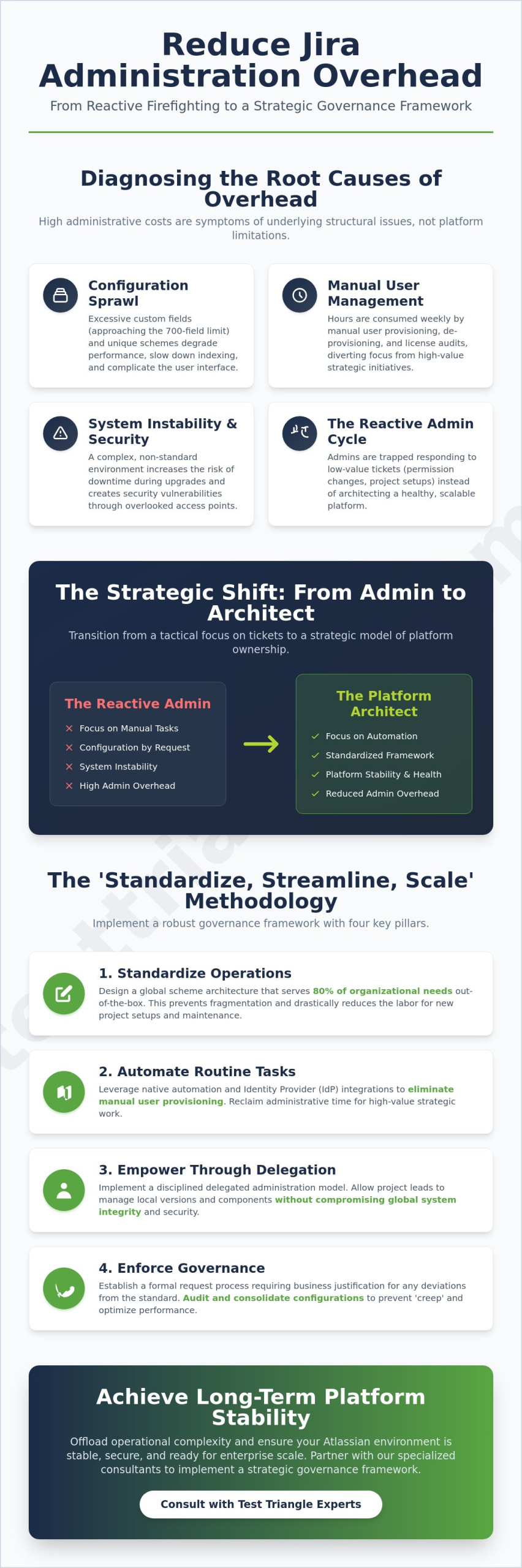
Organizations often view administrative burden as an inevitable byproduct of growth, yet this perspective ignores the underlying structural failures that compound over time. High administrative costs are rarely the result of platform limitations; rather, they’re symptoms of a fragmented Project governance framework that prioritizes individual team requests over global system health. To effectively reduce jira administration overhead, leadership must first acknowledge that most administrative labor is actually “rework” caused by a lack of standardization. When every project team is granted a unique set of custom fields and permission schemes, the resulting configuration sprawl creates a labyrinth that even seasoned admins struggle to navigate. This complexity doesn’t just frustrate users; it degrades system performance and increases the likelihood of security vulnerabilities through overlooked access points.
Beyond the technical debt of custom configurations, manual user management and license reconciliation represent a significant drain on internal resources. Research indicates that organizations automating user management can significantly lower licensing costs by identifying and deactivating inactive accounts. Without a strategic approach, IT teams remain trapped in a cycle of manual de-provisioning and license audits, diverting their expertise away from high-value Atlassian Consulting initiatives that could drive actual business transformation.
The Hidden Cost of Configuration Sprawl
The proliferation of custom fields acts as a silent tax on platform health. Atlassian recently noted that Jira Cloud can support up to 700 fields per space, but reaching these limits often leads to severe performance degradation. Excessive fields slow down issue indexing and complicate the user interface, making it harder for teams to find relevant information. A disciplined audit of field usage is essential to identify redundant or unused candidates for consolidation. Reducing this sprawl doesn’t just clean up the UI; it minimizes the risk of system downtime during upgrades or migrations, especially as organizations prepare for the 2029 Data Center end-of-life milestone.
Manual vs. Strategic Administration
Many IT departments operate in a “Reactive Admin” cycle, where the majority of their week is consumed by low-value support tickets for simple permission changes or project setups. This tactical focus creates a ceiling on team morale and prevents the transition toward a “Platform Architect” model. By quantifying the time lost to these routine tasks, leadership can justify the shift toward a self-service environment. True strategic administration involves designing a global scheme architecture that serves 80% of organizational needs without requiring manual intervention for every new request. This evolution empowers teams while ensuring the platform remains stable, secure, and ready for enterprise-scale growth.
Implementing a Robust Governance Framework to Standardize Operations
Transitioning from a reactive support model to a proactive governance framework requires more than just technical adjustments; it demands a cultural shift toward institutional discipline. To effectively reduce jira administration overhead, organizations must implement a ‘Standardize, Streamline, Scale’ methodology that treats project configuration as a shared corporate asset rather than a localized convenience. By designing a global scheme architecture that addresses 80% of team requirements through universal configurations, administrators can prevent the fragmentation that typically leads to performance bottlenecks. This strategic alignment ensures that every new project inherits a proven, secure foundation, significantly reducing the labor involved in manual setup and long-term maintenance.
A critical component of this evolution involves Implementing IT Governance to validate any requests for deviation from the standard. Establishing a formal request process that requires rigorous business justification for new custom fields or unique workflows prevents the ‘configuration creep’ identified in previous sections. For enterprises looking to accelerate this transition, our IT Service Management Services provide the structural expertise needed to align platform capabilities with business objectives. Documentation of these policies serves as the final pillar, ensuring that as the organization grows, the logic behind configuration decisions remains transparent and consistent.
Creating Shared Schemes for Scalability
Scalable governance relies on the deployment of universal permission and notification schemes that serve multiple projects simultaneously. By prioritizing Project Roles over individual user assignments, administrators can significantly reduce jira administration overhead by delegating day-to-day access management to project leads without granting global administrative rights. This approach simplifies the burden of security audits and ensures that standardized access patterns are applied consistently across the entire instance, protecting data integrity while fostering team autonomy.
The Role of a Jira Steering Committee
Maintaining a balance between team-level flexibility and enterprise-level stability requires the oversight of a Jira Steering Committee. This body, comprised of technical leads, business stakeholders, and compliance officers, approves major architectural changes and sets clear KPIs for administrative efficiency. By monitoring metrics such as field-to-project ratios and ticket resolution times, the committee ensures the platform remains agile. If your team is struggling to define these benchmarks, you might consider how a specialized assessment can help clarify your governance roadmap.
Automating Routine Tasks to Reclaim Administrative Time
While a robust governance framework establishes the necessary boundaries, automation serves as the engine that drives operational velocity. Relying on manual intervention for every status transition or field update is a recipe for administrative burnout and systemic delays. By leveraging native ‘Automation for Jira’ capabilities, organizations can reduce jira administration overhead through the creation of sophisticated rules that handle repetitive tasks without human oversight. This strategic shift allows your internal experts to focus on complex architectural challenges rather than the minutiae of daily maintenance, effectively transforming the IT department from a bottleneck into a facilitator of growth.
Beyond simple workflow triggers, the ability to execute bulk updates across hundreds of projects is essential for maintaining a standardized environment. Utilizing specialized scripts or third-party applications to synchronize permission schemes or update custom field configurations across the entire instance prevents the manual drift that often occurs in large-scale deployments. This automated synchronization ensures that your governance policies are enforced universally, protecting the system from the performance degradation typically associated with unmanaged configuration sprawl. By implementing these systemic controls, you establish a self-regulating ecosystem that maintains its own integrity.
Strategic User Provisioning and License Cleanup
Connecting your Jira environment to a central HRIS or Active Directory is a foundational step in scaling your infrastructure. This integration allows for the automated deactivation of users who haven’t logged in for 90 days, a practice that directly preserves your budget. Given that Jira Data Center costs have increased by approximately 111% between 2019 and 2026, maintaining strict license hygiene is no longer optional; it’s a financial imperative. For organizations navigating the complexities of these integrations, our Atlassian Implementation services provide the technical rigor required to ensure a seamless and secure transition.
Workflow Automation for Administrative Requests
Administrative requests themselves can be managed with the same precision as development tasks by building a dedicated ‘Jira for Jira’ project. This internal service desk uses template-based project creation to ensure every new workspace automatically adheres to your established governance rules from day one. This level of standardization significantly reduces the volume of ‘where is my ticket’ queries through automated status reporting and notifications. By providing teams with a clear, automated path for their requests, you eliminate the friction of manual follow-ups and ensure that all platform changes are documented and approved according to your global standards.
Empowering Teams Through Delegated Administration
Centralizing every minor configuration change within a single IT department creates an artificial ceiling on organizational agility and systemic velocity. While the governance framework established in previous sections provides the necessary structure, true scalability is achieved only when power is distributed effectively. To reduce jira administration overhead, enterprise leaders must transition toward a model of delegated administration, where project-level decisions are handled by the teams closest to the work. This shift doesn’t imply a loss of control; rather, it represents a sophisticated evolution of the administrative role from a tactical gatekeeper to a strategic enabler who provides the tools for self-sufficiency.
Implementing this decentralized approach requires a disciplined framework to ensure that localized flexibility doesn’t compromise global stability. By utilizing ‘Extended Project Administration’ features in a controlled manner, organizations can allow project leads to edit their own workflows and screens without affecting other projects or global schemes. This targeted delegation ensures that the central IT team is no longer burdened by low-value requests, allowing them to focus on high-level IT Service Management Solutions that drive long-term business value. Establishing an internal certification program further reinforces this model, ensuring that every delegated admin possesses a verified understanding of how their actions impact the broader ecosystem.
The Project Lead Empowerment Model
Shifting routine tasks such as version management, component updates, and basic workflow transitions to the project level is a primary driver of operational efficiency. Organizations that successfully implement a delegated model often report a reduction in the central administrative ticket queue by up to 40%, as teams no longer wait for external approval for minor adjustments. By setting clear guardrails and providing standardized templates, you ensure that team leads can innovate within their own workspace while the integrity of the global reduce jira administration overhead strategy remains intact. This approach fosters a culture of ownership and accountability, which is essential for maintaining a high-performance digital infrastructure.
Maintaining Oversight in a Decentralized Model
Effective delegation must be paired with robust oversight to prevent the gradual drift of configuration standards. Utilizing audit logs to monitor changes made by delegated administrators provides the transparency needed to maintain a secure and compliant environment. Regular ‘Health Check’ synchronizations between central IT and project leads serve as a proactive measure to identify potential issues before they escalate into systemic problems. This combination of trust and verification ensures that the platform remains agile, secure, and perfectly aligned with the organization’s evolving needs. If you’re ready to transform your administrative model from a bottleneck into a catalyst for growth, speak with our governance experts today to design your delegated roadmap.
Strategic Managed Services: Offloading Operational Complexity
Maintaining a high-performance Atlassian environment is a continuous endeavor that often exceeds the bandwidth of internal IT departments focused on broader digital transformation goals. While the governance and automation strategies discussed previously are vital, the sheer scale of global enterprise requirements can still overwhelm even the most disciplined teams. Deciding to reduce jira administration overhead through a strategic partnership allows your organization to offload the technical “heavy lifting” to experts who live and breathe the Atlassian ecosystem. This transition ensures that your platform remains optimized, secure, and ready to scale without exhausting your internal human capital.
The ROI of professional intervention becomes clear when you consider the cost of downtime and the complexity of modern compliance. Our Managed Outsourcing Services provide a structured approach to platform health, offering predictable operational costs and the peace of mind that comes from professional oversight. Enterprises often leverage managed outsourcing to maintain the continuous support and system health required for global operations, ensuring that technical debt never accumulates to the point of system failure.
The Value Proposition of Atlassian Consulting
Specialized consultants bring a level of technical rigor that’s difficult to replicate in-house, particularly when navigating high-stakes initiatives like Data Center to Cloud migrations. With the March 2029 end-of-life for Data Center products approaching, the need for precise, compliant transition planning is paramount. Professional consultants ensure that your environment meets rigorous standards, including GDPR and HIPAA requirements where necessary. For a comprehensive look at how a strategic partner can catalyze your growth, explore our Atlassian Consulting Services Dublin guide.
Tailored Support for Global Enterprises
A managed service model offers the flexibility to scale administrative support up or down based on your current project demand, ensuring you’re never paying for more than you need. This adaptability is crucial for global enterprises that require consistent system health across multiple time zones and business units. By establishing guaranteed service levels, you move away from the “best effort” internal support model toward a professionalized environment where performance is measured and optimized.
- Access to senior-level architects for complex integrations and API management.
- Continuous system health monitoring and proactive configuration cleanup.
- Strategic roadmap planning aligned with Atlassian’s seasonal release cadence.
- Rapid resolution of complex technical debt and configuration sprawl.
Ultimately, the goal is to transform your Atlassian suite from a source of administrative friction into a seamless engine for productivity. To reduce jira administration overhead permanently, you need a combination of internal governance and external expertise. Ready to secure your platform’s future? Optimize your Atlassian ecosystem with Test Triangle and reclaim your team’s time for the work that truly matters.
Securing Your Platform’s Future Through Strategic Governance
Achieving operational excellence within the Atlassian ecosystem is a continuous journey that requires a fundamental shift from manual fixes to systemic frameworks. By integrating the governance policies, automation triggers, and delegation models discussed in this guide, you move beyond the ‘reactive admin’ cycle. This transition doesn’t just save time; it builds a foundation for long-term scalability and system health.
To reduce jira administration overhead permanently, you need a partner who understands the complexities of enterprise-scale digital infrastructure. As an Atlassian Platinum Solution Partner with proven success in global enterprise migrations and specialized expertise in highly regulated industries like Pharma, we offer the technical rigor needed to optimize your environment. It’s time to transform your platform from a maintenance burden into a catalyst for progress.
Streamline your Atlassian environment with our expert consulting services and empower your team to focus on the strategic innovation that drives your business forward. We’re ready to help you navigate this evolution with confidence.
Frequently Asked Questions
How can I identify which Jira custom fields are safe to delete?
Identifying safe candidates for deletion requires a systematic audit of field population and usage frequency across your entire instance. You should utilize the Custom Field Optimizer available in Jira Data Center or leverage Marketplace applications to generate a report on fields with zero percent population or those that haven’t been updated in the last 12 months. Once identified, these fields should be moved to a “sandbox” environment for testing before permanent removal to ensure no critical reporting dependencies are broken.
What is the difference between a Jira Administrator and a Project Administrator?
Jira Administrators possess global system authority, allowing them to manage system settings, global schemes, and user directories that affect the entire instance. In contrast, Project Administrators are restricted to managing localized settings within a specific project, such as versions, components, and certain workflow transitions. This distinction is vital for maintaining a secure environment while allowing teams enough autonomy to manage their daily operational needs without central intervention.
Can I automate the removal of users to save on license costs?
You can effectively reduce jira administration overhead by integrating Jira with an Identity Provider (IdP) like Okta or Azure AD through SCIM provisioning. This setup allows for the automated deactivation of users based on their status in your central HR directory or Active Directory. Additionally, administrators can deploy scripts to identify and deactivate users who haven’t logged in for 90 days, ensuring your license count remains optimized without manual reconciliation.
How do I prevent my Jira instance from becoming slow due to overhead?
Preventing performance degradation requires a proactive commitment to configuration hygiene and systemic standardization. You should strictly limit the number of custom fields, as exceeding 700 fields per space can significantly slow down issue indexing and administrative navigation. Consolidating redundant permission schemes and performing regular system re-indexing are also critical actions that protect system responsiveness and ensure a stable experience for all global users.
Is it possible to delegate administration without giving away full system access?
Delegating authority is possible through the ‘Extended Project Administration’ permission, which empowers project leads to modify their own screens and workflows. This feature allows for localized flexibility while keeping global system configurations and security settings locked under the control of central administrators. It’s an effective way to reduce jira administration overhead by shifting minor tactical requests away from the central IT ticket queue.
How often should I perform a Jira health check and cleanup?
Enterprises should conduct a comprehensive system health check at least once per quarter to identify configuration drift and performance bottlenecks. Monthly reviews are recommended for license optimization and user cleanup to maintain financial discipline. Aligning these deep-dive audits with Atlassian’s seasonal release cadence ensures your environment remains compatible with the latest features and security patches, providing long-term operational stability.
What are the benefits of using shared schemes in Jira?
Shared schemes provide a unified architectural foundation that ensures consistency across multiple projects, significantly simplifying the administrative burden. When you update a shared permission or notification scheme, the changes propagate instantly across all associated projects, eliminating the need for manual, project-by-project updates. This approach reduces the risk of human error and ensures that your global governance policies are enforced universally across the entire enterprise.
When should an enterprise consider a Managed Service Provider for Jira?
An enterprise should consider a Managed Service Provider when internal IT teams are consistently overwhelmed by low-value support tickets or face complex technical challenges like a Cloud migration. Partnering with a specialized firm is particularly beneficial for organizations in highly regulated industries that require guaranteed SLAs and expert-level compliance oversight. This model allows your internal talent to focus on strategic innovation while external experts handle the complex operational maintenance.

Article by
Paul Guy
Paul serves as the Marketing Director at Test Triangle, where he leads a global team in driving growth through strategic B2B marketing and brand communications. With a strong emphasis on measurable outcomes and sustainable performance, he plays a pivotal role in aligning marketing functions to enhance customer engagement and accelerate business impact. Under his leadership, marketing initiatives have consistently delivered significant returns on investment, elevated brand visibility, and strengthened the company's presence across key markets.